Анисия, родом из Солуни, дочь знатных, богатейших и благочестивых родителей, получила в доме их тщательное воспитание и образование и, обладая таким редким сочетанием всех земных преимуществ, обладала притом и замечательной красотой. Но душевная красота её оказалась превыше всего этого и сделала её способной вменить в ничто всё её земное счастье в сравнении с блаженством загробным, в которое научили её верить её родители.
Anysia, a native of Thessalonica, the daughter of noble, wealthy, and pious parents, received in their home a careful upbringing and education, and, possessing such a rare combination of all earthly advantages, she also possessed remarkable beauty. But her spiritual beauty proved to be above all this and made her capable of counting all her earthly happiness as nothing in comparison with the blessedness of the afterlife, in which her parents had taught her to believe.
Потеряв их в ранней молодости, Анисия по-христиански перенесла временную разлуку с ними, зная, что её заменит вечное соединение с ними в ином мире, и употребила все свои старания и заботы на спасительную деятельность для достижения благой участи в загробном мире. Несметное богатство, доставшееся ей после родителей, употребила всё в пользу бедных, приложив к этой благотворительности и свой личный труд ухаживания за больными, посещения заключённых в темницы и доставления всякого утешения всем бедствующим от разнообразных расстройств.
Having lost them in early youth, Anysia bore the temporary separation from them in a Christian manner, knowing that it would be replaced by an eternal union with them in the other world, and she employed all her efforts and cares in salvific activity for the attainment of a good portion in the afterlife. The incalculable wealth that came to her after her parents she used entirely for the benefit of the poor, adding to this charity her own personal labor of caring for the sick, visiting those imprisoned in dungeons, and bringing every consolation to all who suffered from various afflictions.
Был знаком этой возлюбившей всецело Бога молодой душе и подвиг внутренней борьбы, но она уже владела искусством почерпать в молитве победоносное оружие в этой борьбе...
This young soul, who had wholly loved God, was also acquainted with the struggle of inner warfare, but she already possessed the art of drawing from prayer the victorious weapon in this struggle...
Нападала ли на неё леность или закрадывалось в душу уныние, она прибегала к молитве и освобождалась от искушения. Становилась ли в тягость суровая жизнь, которой добровольно подчинила себя Анисия, смущал ли её безотчётный страх, она молилась и преодолевала свою человеческую немощь и, укреплённая и вразумлённая свыше, воспринимала снова своё благодатное настроение...
Whether sloth attacked her or despondency crept into her soul, she had recourse to prayer and was freed from temptation. Whether the harsh life, to which Anysia had voluntarily subjected herself, became burdensome, or an unaccountable fear troubled her, she prayed and overcame her human weakness, and, strengthened and instructed from on high, she again received her grace-filled disposition...
Так, бодрствуя о своём спасении и благотворя всем, жила молодая подвижница. И среди этого пути Бог призвал к Себе её, готовую предстать перед Ним и облечённую, в довершение красоты, мученическим венцом...
Thus, keeping vigil over her salvation and doing good to all, the young ascetic lived. And in the midst of this path, God called to Himself her who was ready to stand before Him and clothed, to complete her beauty, with the martyr's crown...
Живя в царствование Максимиана, во время гонения на христиан, когда ничья, из исповедников Христа, безопасность жизни не была ограждена, так как и сам закон не вменял в вину убиение христианина, Анисия оказалась в числе подобных жертв... Идя однажды в церковь в тот день, когда, по случаю праздника, в честь солнца совершалось в капище языческое торжество, Анисия встретила воина-язычника, который, спросив её, кто она и куда идёт, и узнав, что она «раба Христова и идёт в свою церковь», стал принуждать её пойти с ним в языческое капище, чтобы принести жертву, но, раздражённый её мужественным сопротивлением, обнажил меч и нанёс ей такую тяжёлую рану, от которой она через несколько часов умерла. – Это было около 298-го года.
Living in the reign of Maximian, during the persecution of Christians, when no one among the confessors of Christ had their safety of life secured, since even the law did not consider the killing of a Christian a crime, Anysia found herself among such victims... Going one day to church on that day when, on the occasion of a festival in honor of the sun, a pagan celebration was being held in the temple, Anysia met a pagan soldier who, having asked her who she was and where she was going, and having learned that she was "a handmaid of Christ and was going to her church," began to force her to go with him to the pagan temple to offer sacrifice, but, enraged by her courageous resistance, he drew his sword and inflicted such a severe wound upon her that she died a few hours later. This occurred around the year 298.
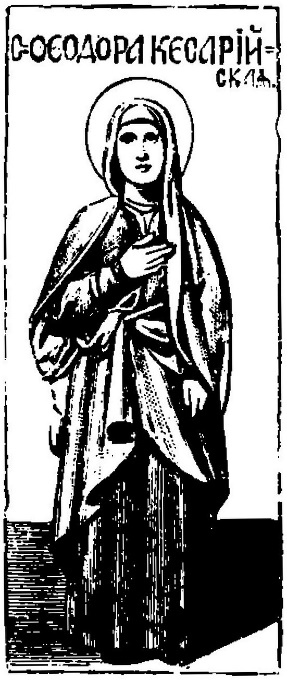
Дочь аристократической фамилии, плод молитв благочестивой матери, блаженная Феодора с детства воспитывалась в Кесарийской обители св. Анны375. Отец её был патриций Феофил, мать Феодора. Мать долго была бесплодной и часто молилась о разрешении неплодия её; когда родилась дочь, мать дала обет посвятить её Богу. В выполнение обета дочь воспитывалась в обители и полюбила уединение её. У св. Василия, архипастыря Кесарийского, разрешён был вопрос: «с какого возраста надобно дозволять произносить обет о посвящении себя Богу?» Как видно и в его время были строгие судьи делам благочестия и осуждали за принятие детей в обитель. Он пишет: «поелику Господь говорит: оставите детей приходить ко Мне (Мк.13:14), и Апостол похваляет измлада изучившего писание (2Тим.3:15), то всякое время и время первого возраста почитаем способным к принятию приходящих. Детей, у которых нет родителей, принимаем сами собой из соревнования Иову (Иов.29:12) быть отцами сирот; которые же зависят от воли родителей и которых сами родители приводят, принимаем при многих свидетелях, чтобы не подать случая желающим найти случай; но заградить всякие неправедные уста, говорящие против нас хулу». Сказав, что принятым детям надобно давать особое помещение, продолжает: «но молитвы, которые установлено совершать днём, должны быть общие и для детей и для старших, потому что у детей через соревнование старшим укореняется навык к сокрушённой молитве». Занятиями детей в келье должны быть обучение грамоте и обучение какому-нибудь ремеслу. «Когда раскроется разум и придёт в действие рассудок, тогда должно принимать обет девства, как уже твёрдый, произносимый по собственному расположению и рассуждению при совершенной зрелости разума376. Имп. Лев Исаврянин (717–740 г.), первый иконоборец из императоров, не любил монашества. Он нашёл себя в праве распорядиться юной Феодорой по-своему усмотрению, вопреки обету матери её и вопреки воле самой дочери. По его повелению юную Феодору насильно взяли из монастыря и доставили ко двору. Лев назначил для неё жениха – одного из молодых аристократов. Всё приготовлено было к браку – и наряды и приданое. Тяжело, очень тяжело было невольной невесте:
The daughter of an aristocratic family, the fruit of the prayers of her pious mother, blessed Theodora was raised from childhood in the Caesarea monastery of St. Anne375. Her father was the patrician Theophilus, her mother Theodora. Her mother was barren for a long time and often prayed for the resolution of her infertility; when a daughter was born, the mother made a vow to dedicate her to God. In fulfillment of the vow, the daughter was raised in the monastery and came to love its solitude. St. Basil, the archpastor of Caesarea, resolved the question: "from what age should one permit the pronouncement of a vow of dedication to God?" As is evident, even in his time there were strict judges of pious deeds who condemned the reception of children into a monastery. He writes: "since the Lord says: Suffer the children to come unto Me (Mk. 10:14), and the Apostle praises him who from childhood has known the Scriptures (2 Tim. 3:15), we consider every time and the time of early age capable of receiving those who come. Children who have no parents we receive of ourselves, emulating Job (Job 29:12) in being fathers to orphans; but those who are dependent on the will of their parents and whom the parents themselves bring, we receive in the presence of many witnesses, so as not to give occasion to those seeking to find occasion; but to stop every unjust mouth that speaks blasphemy against us." Having said that children who are received should be given a separate dwelling, he continues: "but the prayers which are appointed to be performed during the day should be common both for the children and for the elders, because in children, through emulation of the elders, a habit of contrite prayer is rooted." The occupations of the children in the cell should be learning to read and learning some craft. "When the mind unfolds and reason comes into action, then the vow of virginity should be accepted, as already firm, pronounced according to one's own disposition and judgment at the perfect maturity of reason376." The Emperor Leo the Isaurian (717–740 A.D.), the first iconoclast among the emperors, did not love monasticism. He considered himself entitled to dispose of the young Theodora according to his own discretion, contrary to the vow of her mother and contrary to the will of the daughter herself. By his command, the young Theodora was forcibly taken from the monastery and brought to court. Leo appointed a bridegroom for her—one of the young aristocrats. Everything was prepared for the marriage—both the attire and the dowry. It was hard, very hard for the unwilling bride:
Святую невесту Феодору, горячо молившуюся, сохранил Господь. Неожиданно ворвались в империю неприятели. Жених послан был с войском и на сражении был убит378. Когда получено было известие о том в столице, блаженная дева благодарила Господа за посланную ей свободу: дело произвола человеческого рушилось, Феодора поспешила сесть на корабль и возвратилась в свою любимую обитель. Отдав брачные наряды и подарки в дар обители, приняла она монашество, надела на себя вериги и стала вести жизнь примерно-строгую. Пищей её был кусок хлеба и то раз в два и три дня; одежда – суровая власяница, постель – камни, покрытые ветошками. Если бы сказали, что насилие, употреблённое Львом для удаления от иноческой жизни, возбудило жаркую ревность к иноческим подвигам в Феодоре, то сказали бы не полную правду. Энергия души раздражается препятствиями; но она же, когда душа не укрепляется благодатью, со временем, в покое слабеет и пропадает.
The Lord preserved the holy bride Theodora, who prayed fervently. Unexpectedly, enemies invaded the empire. The bridegroom was sent with the army and was killed in battle378. When news of this reached the capital, the blessed maiden thanked the Lord for the freedom sent to her: the work of human willfulness was destroyed. Theodora hastened to board a ship and returned to her beloved monastery. Having given the wedding attire and gifts as a donation to the monastery, she received monastic tonsure, put on chains, and began to lead an exemplary strict life. Her food was a piece of bread, and that once every two or three days; her clothing was a coarse hair-shirt, her bed was stones covered with rags. If one were to say that the violence used by Leo to remove her from the monastic life aroused in Theodora a fervent zeal for monastic struggles, one would not tell the whole truth. The energy of the soul is irritated by obstacles; but it also, when the soul is not strengthened by grace, weakens and disappears over time in repose.
Бдите и молитесь, да не внидете в напасть: дух бо бодр, плоть же немощна, говорит Господь. И с лучшими расположениями не спасёмся мы без благодати Божией, также как не спасёмся, если, надеясь на благодать, сами живём праздно, без труда и подвигов. Горячность души сама по себе до того ненадёжна, что если увлекаются ею без рассуждения, может обратиться в холодность ко всему доброму; она только тогда бывает надёжной, когда, освещаемая рассуждением, поддерживается понуждением себя к добру и усердной молитвой. Духа не угашайте, учил Апостол. Блаженная Феодора, при высокой любви к чистоте девственной, молилась и подвизалась до гроба; молитвы низводили в душу её благодать и с благодатью совершала она свои подвиги; она удаляла от души нечистое, оскорбляющее благодать. Блаженная кончина её последовала не позже 755 года.
Watch and pray, that ye enter not into temptation: the spirit indeed is willing, but the flesh is weak, says the Lord. And even with the best dispositions we shall not be saved without the grace of God, just as we shall not be saved if, trusting in grace, we ourselves live idly, without labor and struggles. The ardor of the soul in itself is so unreliable that if one is carried away by it without discernment, it can turn into coldness toward everything good; it is only reliable when, illumined by discernment, it is supported by self-compulsion to good and by fervent prayer. Quench not the Spirit, the Apostle taught. Blessed Theodora, with her high love for virginal purity, prayed and struggled until the grave; her prayers brought down grace into her soul, and with grace she accomplished her struggles; she removed from her soul everything unclean that offends grace. Her blessed repose occurred no later than the year 755.
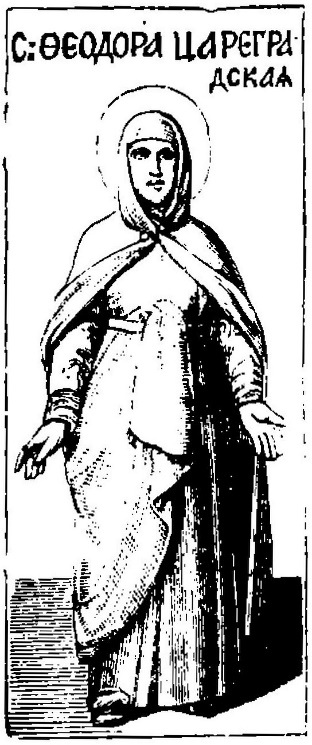
Феодора была зажиточная гражданка Цареграда379. По смерти мужа, она посвятила себя на служение ближним и молитве. Когда блаженный Василий стал жить в доме благочестивого Константина, в соседстве с домом Феодоры, Феодора, по приглашению Константина, с полным усердием прислуживала блаженному Василию, как рабу Божию. Если кто приходил видеться с затворником Василием, Феодора докладывала о том Василию, и Василий в келье Феодоры беседовал с приходившими к нему. Кто принимает во имя праведника, получит награду праведника, сказал Господь. «Каждый из нас должен угождать ближнему, во благо, к назаданию», учил Апостол (Рим.15:2). Феодора была притом усердная молитвенница. Это было в то время, когда в той же столице преп. Симеон Богослов ревностно одушевлял подвизающихся наставлениями о любви к Богу. Проповедуя о чистой любви к Богу, он вместе учил: «надобно поститься в три поста. В великий пост пощение усиленное, кроме великого праздника, субботы и недели, а в два другие – через день. В другие дни года следует принимать пищу один раз в день, кроме субботы, недели и праздника, при том не в сытость380. Это значит, что чистая любовь к Богу – не любовь мечтательная, довольная восторгами чувства и мыслями своеволия, а любовь трудолюбивая, строгая исполнительница заповедей Божиих и уставов Церкви. Так жила блаженная Феодора. Перед смертью приняла она иночество и скончалась 30 декабря 940 года. Ученик Василия, Григорий, усердно просил наставника открыть, где и как пребывает почившая Феодора? По молитвам Василия, Григорию во сне показаны были в образах состояния, которые прошла Феодора, пока достигла покоя; показано и то, что молитвы праведника служили великой помощью для Феодоры в загробной жизни её.
Theodora was a well-to-do citizen of Constantinople379. After the death of her husband, she dedicated herself to the service of her neighbors and to prayer. When blessed Basil began to live in the house of the pious Constantine, in the neighborhood of Theodora's house, Theodora, at Constantine's invitation, with full zeal served blessed Basil as a servant of God. If anyone came to see the recluse Basil, Theodora would inform Basil of it, and Basil would converse in Theodora's cell with those who came to him. He who receives a righteous man in the name of a righteous man shall receive a righteous man's reward, said the Lord. "Let each one of us please his neighbor for his good, to edification," the Apostle taught (Rom. 15:2). Theodora was moreover a fervent woman of prayer. This was at the time when, in the same capital, Venerable Symeon the Theologian was zealously inspiring those who struggled with instructions on the love of God. Preaching about pure love for God, he also taught: "One must fast during the three fasts. During Great Lent, fasting is intensified, except on great feasts, Saturdays, and Sundays; during the other two, every other day. On the other days of the year, one should take food once a day, except on Saturdays, Sundays, and feast days, and not to satiety380." This means that pure love for God is not a fanciful love, satisfied with raptures of feeling and thoughts of self-will, but a labor-loving love, a strict fulfiller of the commandments of God and the statutes of the Church. Thus lived blessed Theodora. Before her death, she received monastic tonsure and reposed on December 30, 940. Gregory, a disciple of Basil, earnestly asked his teacher to reveal where and how the departed Theodora dwelt. Through the prayers of Basil, the states through which Theodora passed until she attained rest were shown to Gregory in a dream in images; it was also shown that the prayers of the righteous man served as great help for Theodora in her afterlife.
Простр. прав. вопр. 15. В другом случае св. Василий писал: «исповедание обета допускаем в возрасте полного ума. Не прилично принимать в этих вещах детские слова за верные. Та дева, которая имеет 16 или 17 лет и зрелый ум, долго была испытана и постоянно просила о принятии, должна быть включаема в число девственниц; её исповедание должно быть принимаемо за правильное, а нарушение оного должно быть строго наказываемо. Многих (девочек) приводят родители, братья, родственники, прежде возраста, не по своей воле расположенных к девству, а имеют в виду свои выгоды. Таковых не надобно легко принимать, пока не дознаем собственное расположение их». Epist. 199. Ор. s. Basilii 4, 719 ed, Migne. Св. Феодор Студит осуждал за то, что иные настоятели принимали обет девства от невозрастных и полагал 16-летний возраст таким, в который можно давать обет. «Когда они уже владеют умом, т. е. на 16 году и позже; тогда уместны для них как почести, так и наказания». За то он строг был к тем, которые, дав обет, выходили в мир. «С того времени если захотят возвратиться к мирской жизни: то не отворять им ворот, если опять явятся, хотя бы это было в скором времени». Epist. 165, lib. 2.
Long. Right. Quest. 15. In another instance, St. Basil wrote: “We admit the confession of a vow at the age of full reason. It is not fitting to accept children’s words in these matters as reliable. That maiden who is sixteen or seventeen years old and of mature mind, who has been long tested and has constantly asked to be received, should be enrolled among the virgins; her confession should be accepted as valid, and its violation should be strictly punished. Many (girls) are brought by parents, brothers, relatives, before the proper age, not of their own will disposed toward virginity, but with a view to their own advantage. Such should not be easily received until we ascertain their own disposition.” Epist. 199. Op. s. Basilii 4, 719 ed. Migne. St. Theodore the Studite condemned the fact that some superiors received the vow of virginity from those under age and considered the age of sixteen as that at which a vow could be made. “When they already possess reason, that is, at the sixteenth year and later; then both honors and punishments are appropriate for them.” For this reason he was strict with those who, having made a vow, returned to the world. “From that time, if they wish to return to worldly life: do not open the gates to them, even if they appear again, though it be soon after.” Epist. 165, lib. 2.
В греческом синаксаре говорится, что женихом Феодоры был сын пмн. Льва Христофор. Но Дю-Канж (Familiae byzant. р. 125) справедливо заметил, что Христофор жив был и при Копрониме, ослепившем его.
The Greek Synaxarion says that Theodora’s bridegroom was Christopher, son of the aforementioned Leo. But Du Cange (Familiae byzant. p. 125) rightly observed that Christopher was still alive under Copronymus, who blinded him.
О ней пролог дек. 30 и Четь-Минея мар. 26. История блаж. Феодоры отдельно от жития Васильева – в Греч. рук. (Lambeicomm. bibl. Vindob. IV, 422) и в житии Василия по Греч. рук. Синод. Библ. (Mattaei descr. N. 236).
Concerning her, the Prologue for December 30 and the Cheti-Minei for March 26. The history of the Blessed Theodora separately from the Life of Basil—in a Greek manuscript (Lambeicomm. bibl. Vindob. IV, 422) and in the Life of Basil according to a Greek manuscript of the Synodal Library (Mattaei descr. N. 236).