Прав. Церковь, после торжества в честь великих священных событий с хвалебными и благодарственными песнями своими, обращаясь к избраннейшим орудиям Промысла, через которые празднуемые события совершились, на другой день после праздника Рождества Христова собирается восхвалять Богоматерь. «Приидите, взывает св. Церковь в этот день, воспоим Матерь Спасову, по рождестве паки явльшуюся Деву». Это собрание верующих в наутрие праздника Рождества Христова для прославления и благодарения Богородицы, родшей Спасителя, названо собором Пресвятой Богородицы.
The Orthodox Church, after the celebration in honor of the great sacred events with its hymns of praise and thanksgiving, turning to the chosen instruments of Providence through whom the celebrated events were accomplished, on the day after the feast of the Nativity of Christ gathers to praise the Mother of God. "Come," the holy Church calls out on this day, "let us sing to the Mother of the Savior, who after giving birth again appeared as a Virgin." This gathering of the faithful on the morrow of the feast of the Nativity of Christ for the glorification and thanksgiving of the Theotokos, who gave birth to the Savior, is called the Synaxis of the Most Holy Theotokos.
Установление сего собора относится к древним временам Христианской Церкви. В день этого Собора в IV веке отцы Церкви говорили уже поучения; к таковым принадлежит слово Епифания Кипрского, собеседника Иоанна Златоустого и умершего в 402 лето по Р. X. Об этом слове упоминается в церковной службе собора в честь Пресв. Богородицы, где говорится: «и чтём слово Епифания Кипрского, похвалу Пресв. Богородицы». Также св. Амвросий Медиоланский и блаж. Августин в своих поучениях на праздник Р. X. соединяли хвалу родшемуся Богочеловеку с хвалой родшей Деве. Указание на празднование Богородице по Рождестве Христове можно также находить в 79 правиле 6 Вселенского Собора, бывшего в 691 году. В этом правиле говорится: «Божественное от Девы рождение, яко бессеменно бывшее, исповедуя безболезненным и сие всему стаду проповедуя, подвергаем исправлению творящих, по неведению, что-либо недолжное. Понеже убо некие, по дне св. Рождества Христова Бога нашего, усматриваются приготовляющими хлебное печение и друг другу передающими, якобы в честь болезней рождения всенепорочные Девы Матери: то мы определяем, да не совершают верные ничего такого. Ибо не есть сие честь Деве, паче ума и слова, плотию родившей невместимое Слово, аще ее неизреченное рождение определяют и представляют, по примеру обыкновенного и нам свойственного рождения». Это обыкновение произошло из древнего лжеучения, которое впоследствии распространял Несторий, называя Богоматерь не Богородицей, а Христородицей.
The establishment of this Synaxis dates back to ancient times of the Christian Church. On the day of this Synaxis in the 4th century, the Fathers of the Church already delivered homilies; among these is the discourse of Epiphanius of Cyprus, a companion of John Chrysostom who died in the year 402 A.D. This discourse is mentioned in the church service of the Synaxis in honor of the Most Holy Theotokos, where it is said: "and we read the discourse of Epiphanius of Cyprus, a praise of the Most Holy Theotokos." Also, St. Ambrose of Milan and Blessed Augustine, in their homilies on the feast of the Nativity of Christ, joined praise of the born God-Man with praise of the Virgin who gave birth. An indication of the celebration of the Theotokos after the Nativity of Christ can also be found in the 79th Canon of the 6th Ecumenical Council, held in 691. This canon states: "Confessing the divine birth from the Virgin as having been without seed and proclaiming it to the whole flock as without pain, we subject to correction those who, through ignorance, do something improper. For since some, after the day of the holy Nativity of Christ our God, are observed preparing bread-baking and giving it to one another, as if in honor of the birth-pangs of the all-blameless Virgin Mother: we decree that the faithful shall do no such thing. For this is not an honor to the Virgin, who beyond mind and word gave birth in the flesh to the incomprehensible Word, if they define and represent her ineffable birth according to the example of ordinary birth which is natural to us." This custom arose from an ancient false teaching, which later Nestorius spread, calling the Mother of God not Theotokos, but Christotokos.
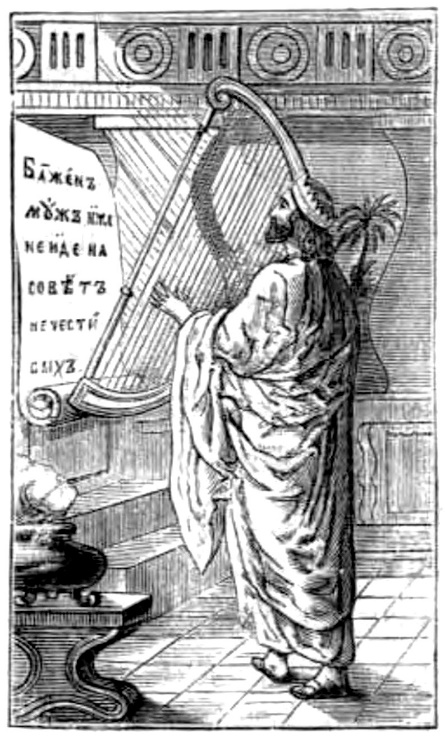
Давид был меньший из 8-ми сыновей Иессея, внук Овида, правнук Вооза и жены его, «благословенной Господом» Руфи; через Вооза же происходил из потомства Иуды, которому отец его Иаков, внук Авраама, обещал управление Еврейским народом до самого пришествия Спасителя на землю. «Не отойдёт скипетр от Иуды и законодатель от чресл его. доколе не приидет Примиритель, и Ему – покорность народов» (Быт.49:10), – сказал Иаков Иуде, когда, собрав своих сыновей, пророчески возвещал им о том, «что будет с ними в грядущие дни» ...
David was the youngest of the eight sons of Jesse, grandson of Obed, great-grandson of Boaz and his wife Ruth, "blessed of the Lord"; through Boaz he was descended from the tribe of Judah, to whom his father Jacob, grandson of Abraham, promised rule over the Hebrew people until the very coming of the Savior to earth. "The scepter shall not depart from Judah, nor a lawgiver from his loins, until the Reconciler come, and to Him shall be the obedience of the nations" (Gen. 49:10), Jacob said to Judah when, having gathered his sons, he prophetically declared to them "what shall befall them in the latter days" ...
Но в полнейшем неведении о своём будущем высоком назначении смиренно проводил своё детство Давид в маленьком городе Вифлееме, в бедном доме своего отца, пася его овец. Между тем час его избрания и Божественного призвания наступал...
But in complete ignorance of his future high calling, David humbly spent his childhood in the little town of Bethlehem, in the poor house of his father, tending his sheep. Meanwhile, the hour of his election and divine calling was approaching...
Над Израильтянами в это время царствовал Саул и уже предупреждён был пророком Самуилом, что за недостойное царствование Бог «отнимет у него царство Израильское и отдаст его ближнему его, лучшему его» (1Цар.15:28).
At that time Saul reigned over the Israelites and had already been warned by the prophet Samuel that for his unworthy reign God "will take the kingdom of Israel from him and give it to his neighbor, who is better than he" (1 Kgdms. 15:28).
Отошедшему же от отвергнутого Богом царя на жительство в г. Раму, престарелому Самуилу, сильно печалившемуся о царе Сауле, которого он любил, Бог сказал: «доколе будешь ты печалиться о Сауле, которого Я отверг, чтобы он не был царём над Израилем? Наполни рог твой елеем, и пойди; Я пошлю тебя к Иессею Вифлеемлянину, ибо между сыновьями его Я усмотрел Себе царя.
And to the aged Samuel, who had departed from the king rejected by God to live in the city of Ramah, and who grieved greatly over King Saul, whom he loved, God said: "How long wilt thou mourn for Saul, seeing I have rejected him from reigning over Israel? Fill thy horn with oil, and go; I will send thee to Jesse the Bethlehemite, for I have provided Me a king among his sons.
«И сказал Самуил: как я пойду? Саул услышит и убьёт меня. Господь сказал: возьми в руку свою телицу из стада и скажи: я пришёл для жертвоприношения Господу.
And Samuel said, How can I go? If Saul hear it, he will kill me. And the Lord said, Take a heifer with thee, and say, I am come to sacrifice to the Lord.
И сделал Самуил так, как сказал ему Господь. Когда пришёл он в Вифлеем, то старейшины города с трепетом вышли на встречу ему и сказали: мирен ли твой приход?
And Samuel did that which the Lord spake. When he came to Bethlehem, the elders of the city trembled at his coming, and said, Comest thou peaceably?
И отвечал он: мирен; для жертвоприношения Господу пришёл я; освятитесь и идите со мной к жертвоприношению; – и освятил, Иессея и сыновей его, и пригласил их к жертве.
And he said, Peaceably; I am come to sacrifice unto the Lord; sanctify yourselves, and come with me to the sacrifice; and he sanctified Jesse and his sons, and called them to the sacrifice.
И когда они пришли, он, увидев Елиава, сказал: верно этот перед Господом помазанник Его! – Но Господь сказал Самуилу: не смотри на вид его и на высоту роста его; Я смотрю не так, как смотрит человек; ибо человек смотрит на лицо, а Господь смотрит на сердце».
And when they were come, he looked on Eliab, and said, Surely the Lord's anointed is before Him. But the Lord said unto Samuel, Look not on his countenance, or on the height of his stature; I look not as man looketh; for man looketh on the outward appearance, but the Lord looketh on the heart.
И послал Иессей, и привели Давида. Он был белокур, с красивыми глазами и приятным лицом. И сказал Господь: встань, помажь его, ибо это – он».
And Jesse sent, and brought David in. Now he was ruddy, with beautiful eyes and a pleasant countenance. And the Lord said, Arise, anoint him, for this is he.
«Без сомнения, – говорит о нём преосвящ. Филарет, митроп. Моск.362, – от носившегося над юношей Давидом Духа Божия нисходили светлые лучи в ум его, чтобы просвещать его в познании того, что истинно, богоугодно и спасительно; упадали в сердце святые искры, чтобы воспламенять его к добрым намерениям и спасительным делам, – и всё существо его исполнялось вышней силой, с которой он и трудные дела с дерзновением начинал и совершал без утомления». – Развивались в избранном Богом юноше различные дарования; между прочим проявились они в музыке и пении: – «руки мои сделали орган, персты мои настраивали псалтирь», – говорит он сам о себе, воспоминая свои юношеские годы, и достиг впоследствии такого искусства в музыке, которое доставило ему известность. Вероятно уже тогда, в эти юношеские годы, когда он пас овец своего отца, то вдохновляемый красотой окружавшей его природы, Давид начинал слагать свои псалмы, в которых воспевал Творца природы и человека. – «Господи, Боже наш! – взывала пламенная душа молодого пастуха, – как величественно имя Твоё по всей земле! Слава Твоя простирается превыше небес!»
"Without doubt," says the Most Reverend Philaret, Metropolitan of Moscow, of him,362 "from the Spirit of God that hovered over the youth David, bright rays descended into his mind to enlighten him in the knowledge of what is true, God-pleasing, and saving; holy sparks fell into his heart to inflame it to good intentions and saving deeds – and his whole being was filled with heavenly power, with which he both boldly began difficult tasks and accomplished them without weariness." – Various gifts developed in the youth chosen by God; among other things they manifested themselves in music and singing: – "my hands made an organ, my fingers tuned a psaltery," – he says of himself, recalling his youthful years, and later attained such skill in music that it brought him renown. Probably already then, in those youthful years when he tended his father's sheep, inspired by the beauty of the nature surrounding him, David began to compose his psalms, in which he sang of the Creator of nature and man. – "O Lord, our Lord! – the ardent soul of the young shepherd cried out, – how excellent is Thy name in all the earth! Thy glory is exalted above the heavens!"
Не много Ты умалил его перед ангелами; славой и честью увенчал его; поставил его владыкой над делами рук Твоих; всё положил под ноги его, овец и волов всех, и также полевых зверей, птиц небесных и рыб морских, всё, преходящее морскими стезями.
For Thou hast made him a little lower than the angels, and hast crowned him with glory and honour. Thou madest him to have dominion over the works of Thy hands; Thou hast put all things under his feet: all sheep and oxen, yea, and the beasts of the field; the fowl of the air, and the fish of the sea, and whatsoever passeth through the paths of the seas.
И так прославился своим искусством в музыке пастух Давид, что когда царь Саул, страдавший в это время от припадков жестокой тоски, мучил всех окружающих его своей раздражительностью, то они однажды сказали ему: «вот злой дух от Бога возмущает тебя... Пусть господин наш прикажет слугам своим, которые перед тобой, поискать человека, искусного в игре на гуслях; и когда придёт на тебя злой дух от Бога, то он, играя рукой своей, будет успокаивать тебя.
And so the shepherd David became renowned for his skill in music, that when King Saul, suffering at that time from fits of cruel melancholy, tormented all those around him with his irritability, they once said to him: "Behold now, an evil spirit from God troubleth thee... Let our lord now command thy servants, which are before thee, to seek out a man, who is a cunning player on a harp; and it shall come to pass, when the evil spirit from God is upon thee, that he shall play with his hand, and thou shalt be well.
Тогда один из слуг его сказал: вот я видел у Иессея Вифлеемлянина сына умеющего играть, человека храброго и воинственного, и разумного в речах, и видного собой, и Господь с ним.
Then answered one of his servants, and said, Behold, I have seen a son of Jesse the Bethlehemite, that is cunning in playing, and a mighty valiant man, and a man of war, and prudent in matters, and a comely person, and the Lord is with him.
И когда дух от Бога бывал на Сауле, то Давид, взяв гусли, играл, – и отраднее и лучше становилось Саулу, и дух злой отступал от него».
And it came to pass, when the spirit from God was upon Saul, that David took a harp and played; so Saul was refreshed, and was better, and the evil spirit departed from him.
Между тем, Филистимляне, соседний народ, постоянно враждовавшие с Израильтянами, снова выступили на них. Отправляясь на войну, Саул отпустил к отцу Давида, вероятно, как слишком ещё молодого, и, возвратясь в Вифлеем, Давид стал снова пасти стада; три же старших его брата – Елиав, Аминадав и Самма отправились на войну.
Meanwhile, the Philistines, a neighboring people constantly at enmity with the Israelites, again marched against them. Setting out for war, Saul sent David back to his father, probably as being still too young, and returning to Bethlehem, David again began to tend the flocks; his three elder brothers – Eliab, Abinadab, and Shammah – went to war.
Небесплодным и ещё более дорогим должно было оказаться возвращение Давида к уединению после суетной и не лёгкой жизни при дворе больного душой царя. Чувства и мысли его, питаемые благотворными впечатлениями, деятельно работали, развивались, возвышались и изливались в то время и впоследствии в соответственных песнопениях, в которых отражалось и спокойствие, навеваемое тишиной природы, и умудрение сердца, поучаемого ею, и упование на Творца всяческой красоты в мире, что Он сохранит и среди бурь и волнений мирских человека, любимца Своего...
David's return to solitude after the vain and difficult life at the court of the king sick in soul was to prove not unfruitful and even more precious. His feelings and thoughts, nourished by beneficial impressions, actively worked, developed, were elevated, and poured forth at that time and afterwards in corresponding hymns, which reflected both the peace wafted by the stillness of nature, and the wisdom of the heart taught by it, and the hope in the Creator of all beauty in the world, that He would preserve His beloved man even amidst the storms and tumults of the world...
Если я пойду и долиной смертной тени, не убоюсь зла, потому что Ты со мной; Твой жезл и Твой посох – они успокаивают меня» (Пс.22).
Yea, though I walk through the valley of the shadow of death, I will fear no evil, for Thou art with me; Thy rod and Thy staff—they comfort me” (Ps. 22).
Между тем, война с Филистимлянами длилась; Иессей послал однажды Давида в стан Израильский, расположенный невдалеке от Вифлеема, чтобы наведаться о старших сыновьях своих. И вот, когда Давид пришёл в стан и разговаривал с братьями своими, то «выступил из стана Филистимского единоборец, по имени Голиаф», великан ростом и закованный с головы до ног в медное вооружение, издевался над Израильтянами, и кричал им: «зачем вы вышли воевать? Не Филистимлянин ли я, а вы – рабы Сауловы? Выберите у себя человека, и пусть сойдёт ко мне. Если может он сразиться со мной и убьёт меня, то мы будем вашими рабами; если же я одолею и убью его, то вы будете нашими рабами и будете служить нам».
Meanwhile, the war with the Philistines continued; Jesse once sent David to the camp of Israel, situated not far from Bethlehem, to inquire after his elder sons. And behold, when David came to the camp and was speaking with his brothers, “there went out a champion from the camp of the Philistines, named Goliath,” a giant in stature and armed from head to foot in bronze armor, who mocked the Israelites and cried out to them: “Why are ye come out to set your battle in array? Am not I a Philistine, and ye servants to Saul? Choose you a man for you, and let him come down to me. If he be able to fight with me and to kill me, then will we be your servants; but if I prevail against him and kill him, then shall ye be our servants and serve us.”
Не в первый раз уже этот Филистимлянин обращался с таким вызовом к Израильтянам, и угрожал посрамлением их, и все Израильтяне, «увидев этого человека, убегали от него и весьма боялись. И говорили Израильтяне: видите этого выступающего человека? Он выступает, чтобы поносить Израиля. Если бы кто убил его, одарил бы того царь великим богатством и дочь свою выдал бы за него, и дом отца его сделал бы свободным в Израиле». Между тем, никто не решался выступить против великана, обладающего необыкновенной силой. Давид же, видя и слыша Филистимлянина, возмутился, что он «поносит воинство Бога живого и высказал готовность сразиться с единоборцем. Об этом передали Саулу, и тот призвал его.
It was not the first time that this Philistine had made such a challenge to the Israelites and threatened them with disgrace, and all the Israelites, “when they saw the man, fled from him and were sore afraid. And the Israelites said: Have ye seen this man that is come up? Surely to defy Israel is he come up; and it shall be that the man who killeth him, the king will enrich him with great riches, and will give him his daughter, and make his father’s house free in Israel.” Yet no one dared to go out against the giant, who possessed extraordinary strength. But David, seeing and hearing the Philistine, was indignant that he “defied the armies of the living God,” and expressed his readiness to fight the champion. This was reported to Saul, and he summoned him.
И сказал Саул Давиду: не можешь ты идти против этого Филистимлянина, ибо ты ещё юноша, а он – воин от юности своей.
And Saul said to David: Thou art not able to go against this Philistine to fight with him, for thou art but a youth, and he a man of war from his youth.
И сказал Давид Саулу: раб твой пас овец у отца своего, и когда, бывало, приходил лев или медведь и уносил овцу из стада, то я гнался за ним и нападал на него, и отнимал из пасти его; а если он бросался на меня, то я брал его за космы, и поражал и умерщвлял его.
And David said to Saul: Thy servant kept his father’s sheep, and when a lion or a bear came and took a lamb out of the flock, I went out after him and smote him, and delivered it out of his mouth; and if he arose against me, I caught him by the beard, and smote him and slew him.
И льва, и медведя убивал раб твой, и с этим Филистимлянином необрезанным будет то же, что с ними, потому что он так поносит воинство Бога живого. Господь, Который избавлял меня от льва и медведя, избавит меня и от руки этого Филистимлянина. И сказал тогда Саул Давиду: иди, и да будет Господь с тобою».
Thy servant slew both the lion and the bear, and this uncircumcised Philistine shall be as one of them, seeing he hath defied the armies of the living God. The Lord, who delivered me out of the paw of the lion and out of the paw of the bear, He will deliver me out of the hand of this Philistine. And Saul said unto David: Go, and the Lord be with thee.”
Саул одел-было Давида в своё собственное вооружение, но, стесняясь им, «снял Давид всё это с себя, и взяв посох свой в руку свою, выбрал себе пять гладких камней из ручья и положил их в пастушескую сумку свою; и с сумкой, и с пращой в руке своей выступил против Филистимлянина.
Saul clothed David with his own armor, but being hindered by it, David put them off him, and took his staff in his hand, and chose him five smooth stones out of the brook, and put them in a shepherd’s bag; and with his bag and his sling in his hand, he went forth against the Philistine.
– Что ты идёшь на меня с палкой и с камнями? Разве я собака? – с презрением обратился тот к юноше Давиду, – подойди ко мне, и я отдам тело твоё птицам небесным и зверям полевым...
—Am I a dog, that thou comest to me with a staff and with stones?—said the Philistine contemptuously to the youth David.—Come to me, and I will give thy flesh unto the fowls of the air and to the beasts of the field...
– Ты идёшь против меня с мечом и щитом, – отвечал Давид Голиафу, – а я иду против тебя во имя Господа Саваофа, Бога воинств Израильских, которые ты поносил. Ныне предаёт тебя Господь в руку мою, и я убью тебя и сниму с тебя голову твою, и отдам труп твой и трупы войска Филистимского птицам небесным и зверям земным, и узнает вся земля, что есть Бог в Израиле. И узнает весь этот сонм, что не мечом и копьём спасает Господь, ибо это война Господа, – и Он предаст вас в руки наши».
—Thou comest to me with a sword and with a shield,—answered David to Goliath,—but I come to thee in the name of the Lord of hosts, the God of the armies of Israel, whom thou hast defied. This day will the Lord deliver thee into mine hand, and I will smite thee and take thine head from thee, and I will give the carcass of the Philistines’ host unto the fowls of the air and to the wild beasts of the earth, that all the earth may know that there is a God in Israel. And all this assembly shall know that the Lord saveth not with sword and spear, for the battle is the Lord’s, and He will give you into our hands.”
И сбылось по вере невооружённого ничем, кроме веры: Давид поразил великана камнем, пущенным из пращи, и собственным мечом его, не имея своего, отсёк ему голову. Увидев это, Филистимляне бежали, и полная победа осталась за Израильтянами.
And it came to pass according to the faith of him who was armed with nothing but faith: David smote the giant with a stone from his sling, and with his own sword, having none of his own, cut off his head. When the Philistines saw this, they fled, and a complete victory remained with the Israelites.
В новой песне излилась благодарность Богу смиренного победителя: – «Благословен Господь, твердыня моя, научающий руки мои битве и персты мои брани, – воспевает Давид в Пс.143, – милость моя, и ограждение моё, прибежище моё и избавитель мой, щит мой – и я на Него уповаю; Он подчиняет мне народ мой.
In a new song the humble victor poured forth his gratitude to God:—“Blessed be the Lord my strength, who teacheth my hands to war and my fingers to fight,—sings David in Ps. 143,—my mercy and my fortress, my high tower and my deliverer, my shield, and I trust in Him; who subdueth my people under me.
Человек подобен дуновению; дни его, как уклоняющаяся тень».., – приносится, быть может, в представлении Давида внезапно сражённый враг его, и, переходя мыслью к другим врагам, соплеменникам погибшего, он продолжает: – Господи! преклони небеса Твои, и сойди; коснись гор, и воздымятся.
Man is like to vanity; his days are as a shadow that passeth away”—perhaps the image of his suddenly slain enemy presented itself to David’s mind, and passing in thought to other enemies, the tribesmen of the fallen one, he continues:—Bow Thy heavens, O Lord, and come down; touch the mountains, and they shall smoke.
Простри с высоты руку Твою, избавь меня и спаси меня от вод многих, от руки сынов иноплеменных, которых уста говорят суетное и которых десница – десница лжи.
Stretch forth Thine hand from above; rid me and deliver me out of great waters, from the hand of strange children, whose mouth speaketh vanity, and their right hand is a right hand of falsehood.
Боже! новую песнь воспою Тебе, на десятиструнной псалтири воспою Тебе, дарующему спасение царям и избавляющему Давида, раба Своего, от лютого меча.
I will sing a new song unto Thee, O God; upon a psaltery and an instrument of ten strings will I sing praises unto Thee, who givest salvation unto kings, who deliverest David Thy servant from the hurtful sword.
«И самого Давида, молитвенника о других, Бог не оставлял хранением Своим, видимо пребывал с ним и ограждал его от опасностей, которые не замедлили представиться ему, как только он оставил свой мирный Вифлеемский приют и из смиренного пастуха овец превратился в начальствовавшего над людьми... Хотя и «благоразумно действовал он везде, куда ни посылал его Саул», приблизивший его окончательно к себе после чудной его победы над Голиафом и сделавший его даже начальником всех войск, тем не менее подвергся он ненависти самого Саула, который не мог перенести быстро возросшей славы Давида и, почувствовав в нём соперника, стал подозревать его и преследовать и несколько раз пытался даже убить его... В первый раз проявилось враждебное чувство царя к молодому победителю, когда, при возвращении их вместе с войны против Филистимлян, «женщины из всех городов Израильских, выходя им на встречу с пением и плясками, с торжественными тимпанами и с кимвалами, восклицали: Саул победил тысячи, а Давид – десятки тысяч!
And David himself, the intercessor for others, was not left by God without His protection; He visibly abode with him and guarded him from the dangers that were not slow to present themselves as soon as he left his peaceful Bethlehem shelter and from a humble shepherd of sheep became a ruler over men... Although ‘he behaved himself wisely in all his ways, whithersoever Saul sent him,’ Saul, who had finally brought him near to himself after his wondrous victory over Goliath and had even made him commander of all the army, nevertheless incurred hatred toward him, being unable to bear David’s quickly growing fame and, sensing a rival in him, began to suspect and persecute him, and several times even attempted to kill him... For the first time the king’s hostile feeling toward the young victor manifested itself when, upon their return together from the war against the Philistines, ‘the women came out of all the cities of Israel, singing and dancing, to meet them, with festive timbrels and with cymbals. And the women sang one to another in their play, and said: Saul hath slain his thousands, and David his ten thousands!’
И Саул сильно огорчился, и неприятно ему было это слово; он сказал: Давиду дали десятки тысяч, а мне – тысячи; ему недостаёт только царства... – И с того дня подозрительно смотрел на Давида. Вскоре, во время одного из своих припадков крайнего раздражения, порой до бешенства овладевавшего им, Саул, слушая музыку Давида, вместо успокоения, которое она обыкновенно производила на него, предался злобному чувству против Давида и, подумав: – «пригвожду Давида к стене, бросил в него копьё, бывшее при нём... но Давид два раза уклонялся от него» ...
And Saul was very wroth, and the saying displeased him; and he said: They have ascribed unto David ten thousands, and to me they have ascribed but thousands; and what can he have more but the kingdom?... And Saul eyed David from that day forward. Soon, during one of his fits of extreme irritation, which at times seized him even to madness, Saul, listening to David’s music, instead of the calm it usually produced in him, gave way to a malicious feeling against David and, thinking: ‘I will smite David even to the wall with it,’ cast a javelin that was by him... but David escaped out of his presence twice.
Зависть, между тем, разыгрывалась всё больше и больше в сердце Саула, так как он видел, что молодой Давид всё более и более овладевает любовью и уважением народа, и он искал его погубить, «но, – думал он, – пусть не моя рука будет на нём, но – рука Филистимлян», и в надежде, что Давид будет убит на войне с этими сильными врагами, он поручал ему вести войны с ними, обещая ему, в случае успеха на войне, выдать за него замуж старшую дочь свою Мерову.
Meanwhile, envy raged more and more in Saul’s heart, for he saw that the young David was ever more and more gaining the love and respect of the people, and he sought to destroy him, “but,—he thought,—let not my hand be upon him, but the hand of the Philistines,” and in the hope that David would be killed in war with these mighty enemies, he entrusted him with leading wars against them, promising him, in case of success in war, to give him his elder daughter Merab in marriage.
«Кто я, и что жизнь моя, и род отца моего в Израиле, чтобы мне быть зятем царя?» – смиренно недоумевал Давид в ответ на это предложение царя.
Who am I, and what is my life, or my father’s family in Israel, that I should be son-in-law to the king?”—humbly wondered David in answer to this proposal of the king.
Между тем Саул не исполнил обещания отдать старшую дочь свою за храброго победителя Филистимлян и выдал её в замужество за другого. Но узнав, что меньшая его дочь Мелхола полюбила Давида, он задумал и её «сделать сетью для него».
Meanwhile, Saul did not fulfill his promise to give his elder daughter to the brave conqueror of the Philistines and gave her in marriage to another. But learning that his younger daughter Michal loved David, he planned to make her also “a snare for him.”
«Через меньшую дочь ты породнишься со мной», – обещал он снова Давиду; между тем, желая уловить его в честолюбии, велел приближенным своим тайно передать ему: – «вот, царь благоволит к тебе, и все слуги его любят тебя; итак, будь зятем царя». – Но неуловимо смирение для коварства; с искренним простодушием Давид отвечал царским слугам: «разве легко, кажется вам, быть зятем царя? Я – человек бедный и незначительный». – Когда переданы были Саулу эти слова Давида, то он, продолжая «иметь в мыслях – погубить Давида руками Филистимлян», сказал: так скажите Давиду: царь не хочет вена (обычного выкупа) за невесту, но хочет, чтобы он убил сто Филистимлян – в отмщение врагам царя. – И пересказали слуги Саула эти слова Давиду, и понравилось Давиду сделаться зятем царя. «И прежде ещё, чем исполнился срок, назначенный для убиения ста Филистимлян, Давид, с помощью людей своих, убил уже двести. И выдал тогда Саул за него дочь свою Мелхолу в замужество.
“Through your younger daughter you will become kin to me,” he again promised David; meanwhile, wishing to ensnare him through ambition, he ordered his close servants to secretly convey to him: “Behold, the king is well-disposed toward you, and all his servants love you; therefore, be the king’s son-in-law.” But humility is impervious to cunning; with sincere simplicity David answered the king’s servants: “Does it seem easy to you to be the king’s son-in-law? I am a poor and insignificant man.” When these words of David were reported to Saul, he, continuing “to have in mind to destroy David by the hands of the Philistines,” said: “Tell David this: the king does not want a dowry (the usual bride-price) for the bride, but wants him to kill a hundred Philistines—in vengeance against the king’s enemies.” And Saul’s servants repeated these words to David, and David was pleased to become the king’s son-in-law. “And even before the term appointed for the slaying of a hundred Philistines had expired, David, with the help of his men, had already killed two hundred. And then Saul gave him his daughter Michal in marriage.
И увидел Саул и узнал, что Господь с Давидом (и весь Израиль любит его), и что дочь его Мелхола любила Давида. И стал Саул ещё больше бояться Давида, и сделался врагом его на всю жизнь». Не отступая от своей мысли погубить его, он, наконец, стал прямо говорить сыну своему Ионафану и всем слугам своим, чтобы они умертвили Давида. Но Ионафан, привязавшийся всей душой своей к Давиду, употребил все усилия, чтобы спасти его и успокоить безумное раздражение отца; он напомнил ему о всех достоинствах и заслугах Давида и достиг на этот раз того, что «Саул послушал голоса своего сына, и поклялся Саул: жив Господь, Давид не умрёт» ...
And Saul saw and knew that the Lord was with David (and all Israel loved him), and that his daughter Michal loved David. And Saul began to fear David even more, and became his enemy for life.” Not departing from his intention to destroy him, he finally began to speak directly to his son Jonathan and to all his servants, ordering them to put David to death. But Jonathan, who was attached to David with his whole soul, used every effort to save him and to calm his father’s mad irritation; he reminded him of all David’s merits and services, and on this occasion achieved that “Saul heeded the voice of his son, and Saul swore: ‘As the Lord lives, David shall not die’...”
Но не долго помнит клятвы свои человек, предающийся страстям своим, которые ослепляют его... Вскоре новое поражение, которое Давид нанёс Филистимлянам, снова возбудило зависть в сердце Саула и, в порыве злобы, он бросил копьё в Давида в то самое время, как тот старался успокоить музыкой возмущённое сердце царя... Но копье вонзилось в стену мимо ускользнувшего от удара Давида, который поспешил укрыться у себя в доме. Но и здесь не избавился от преследования, возненавидевшего его: «послал Саул слуг в дом к Давиду, чтобы стеречь и убить до утра. И сказала Давиду Мелхола, жена его: если ты не спасёшь души своей в эту ночь, то завтра будешь убит. – И спустила Мелхола Давида из окна, и он пошёл, и убежал, и спасся. И пришёл к Самуилу в Раму, и рассказал ему всё, что делал с ним Саул». Узнав об этом, Саул и здесь продолжал преследовать свою жертву – через слуг своих и лично, но Господь защитил Своего избранника, который, потеряв надежду обезоружить злобу царя, решился удалиться из пределов своей земли.
But a man who abandons himself to his passions, which blind him, does not long remember his oaths... Soon a new victory that David won over the Philistines again stirred up envy in Saul’s heart, and in a fit of rage he hurled a spear at David at the very moment when the latter was trying to soothe the king’s troubled heart with music... But the spear stuck into the wall past David, who had dodged the blow, and he hastened to take refuge in his own house. But even here he did not escape the persecution of the one who had come to hate him: “Saul sent servants to David’s house to watch him and kill him by morning. And Michal, his wife, said to David: ‘If you do not save your life this night, you will be killed tomorrow.’ And Michal let David down through a window, and he went, and fled, and escaped. And he came to Samuel in Ramah, and told him everything that Saul had done to him.” Learning of this, Saul continued to pursue his victim even there—through his servants and in person—but the Lord protected His chosen one, who, losing hope of disarming the king’s malice, resolved to depart from the borders of his own land.
Когда пришёл он к Анхусу, царю Гефскому, то подвергся большой опасности, потому что был узнан слугами его: – «Не Давид ли это, царь той страны? – сказали они Анхусу, – не ему ли пели в хороводах и говорили: Саул поразил тысячи, а Давид – десятки тысяч?»
When he came to Achish, king of Gath, he was in great danger, for he was recognized by his servants: “Is this not David, the king of that land?” they said to Achish. “Is it not of him that they sang in the dances and said: ‘Saul has slain thousands, but David tens of thousands’?”
Устрашился Давид слов этих, и не в это ли время воззвал к Богу, уповая на Него: – «услышь, Боже, вопль мой, внемли молитве моей! От конца земли взываю к Тебе в унынии сердца моего: возведи меня на скалу, для меня недосягаемую; ибо ты – прибежище моё, Ты – крепкая защита от врага. Да живу я вечно в жилище Твоём, и покоюсь под кровом крыл Твоих»... и, молясь о спасении своём от врагов, он в то же время молил Бога о своём злом враге: – «Приложи дни ко дням царя; лета его продли в род и род. Да пребудет он вечно перед Богом; заповедуй милости и истине охранять его» (Пс.60).
David was terrified by these words, and was it not at this time that he cried out to God, trusting in Him: “Hear, O God, my cry, hearken to my prayer! From the ends of the earth I call to Thee in the despondency of my heart: raise me up onto a rock inaccessible to me; for Thou art my refuge, Thou art the strong defense against the enemy. Let me dwell forever in Thy dwelling, and rest under the shelter of Thy wings...” and, praying for his own deliverance from enemies, he at the same time prayed to God for his evil enemy: “Add days to the king’s days; prolong his years from generation to generation. Let him abide forever before God; command mercy and truth to guard him” (Ps. 60).
Между тем, «изменил Давид лицо своё перед ними (враждебными чужеземцами) и притворился безумным в их глазах»... – «Видите, – сказал тогда царь рабам своим, видите, он – человек сумасшедший; для чего вы привели его ко мне?» – И тогда прогнали пришельца Филистимляне, и он укрылся в пещеру Адолламскую, невдалеке от Вифлеема, где мог рассчитывать на безопасность от преследований Саула и, преисполненный благодарности к Богу за своё избавление, радостно воспел своему Избавителю: – «Благословлю Господа во всякое время; хвала Ему непрестанно в устах моих. Господом будет хвалиться душа моя; услышат кроткие и возвеселятся. Величайте Господа со мною, и превознесём имя Его вместе!
Meanwhile, “David changed his face before them (the hostile foreigners) and feigned madness in their eyes”... “See,” said the king then to his servants, “see, he is a madman; why have you brought him to me?” And then the Philistines drove the stranger away, and he took refuge in the cave of Adullam, not far from Bethlehem, where he could count on safety from Saul’s persecutions and, filled with gratitude to God for his deliverance, joyfully sang to his Deliverer: “I will bless the Lord at all times; praise to Him is ceaseless on my lips. My soul will boast in the Lord; the meek will hear and rejoice. Magnify the Lord with me, and let us exalt His name together!
«В пещеру Адолламскую, где укрывался Давид, «пришли к нему братья его, и весь дом отца его, и собрались к нему все притеснённые и все должники и все огорчённые душой, и сделался он начальником над ними, и было с ним около 400 человек. С ними пошёл Давид за Иордан в Массиву Моавитскую и сказал Моавитскому царю: пусть отец мой и мать моя побудут у тебя, пока я не узнаю, что сделает со мной Бог». И, оставив их здесь, по совету пророка Гада, отошёл в землю Иудину и скрывался здесь в лесу Херст.
“To the cave of Adullam, where David was hiding, ‘came his brothers, and the whole house of his father, and all the oppressed and all the debtors and all the grieved in soul gathered to him, and he became their leader, and there were about 400 men with him. With them David went beyond the Jordan to Massebah of Moab and said to the king of Moab: ‘Let my father and my mother stay with you until I learn what God will do with me.’ And, leaving them there, on the advice of the prophet Gad, he withdrew to the land of Judah and hid there in the forest of Hareth.
В это время, не смотря на собственное опасное положение, Давид не мог удержаться, чтобы не подать помощь жителям города Кеиля против напавших на них Филистимлян и, прибегнув, по обыкновению своему, к Богу, отразил врагов.
At this time, despite his own dangerous situation, David could not refrain from giving aid to the inhabitants of the city of Keilah against the Philistines who had attacked them and, having recourse, as was his custom, to God, he repulsed the enemies.
Между тем, Саул, узнав, что Давид в Кеиле, созвал весь народ на войну, чтобы идти к Кеилю, осадить Давида и людей его. Но, предостережённый об угрожающей ему опасности, Давид, помолясь Богу и получив внушение не подвергаться встрече с Саулом, удалился из Кеиля и «пребывал в пустыне, в неприступных местах, а потом на горе в пустыне Зиф». Сюда пришёл к нему неизменный друг его – Ионафан «и укрепил его упованием на Бога, и сказал ему: не бойся, ибо не найдёт тебя рука отца моего Саула, и ты будешь царствовать над Израилем, а я буду вторым по тебе; и Саул, отец мой, знает это».
Meanwhile, Saul, learning that David was in Keilah, summoned all the people to war in order to go to Keilah, besiege David and his men. But, warned of the danger threatening him, David, having prayed to God and received the admonition not to confront Saul, withdrew from Keilah and “remained in the wilderness, in inaccessible places, and then on a hill in the wilderness of Ziph.” Here his steadfast friend Jonathan came to him “and strengthened him with hope in God, and said to him: ‘Fear not, for the hand of my father Saul will not find you, and you will reign over Israel, and I will be second to you; and Saul, my father, knows this.’”
Но не знали того любившие друг друга, как братья, и искренно заключившие между собой вышеупомянутый братский союз, что не состояться ему, потому что это свидание их было последнее в этом мире...
But those who loved each other like brothers and had sincerely concluded the aforementioned brotherly covenant did not know that it was not to be fulfilled, because this meeting of theirs was the last in this world...
Избавленный на время от преследования Саула, снова отправившегося отражать Филистимлян, Давид, удалившись из небезопасных мест, где уже искал Саул его погубить, «поселился в безопасных местах Эн-Гадди». Но и здесь Саул, возвратившись с войны, собирался преследовать его, и в это-то время имел случай убедиться в совершенном незлобии и святой преданности ему со стороны Давида. Зайдя однажды случайно в пещеру, в глубине которой укрывались Давид и люди его, Саул оказался в полной власти их. «Вот день, о котором говорил Тебе Господь, что предаст врага твоего в руки твои, и ты сделаешь с ним, что тебе угодно» ... говорили Давиду люди, бывшие с ним. Но Давид убедил их, что нельзя налагать руку на помазанника Божия, и ограничился тем, что отрезал только незаметно для Саула край от одежды его. Выждав же, когда Саул вышел из пещеры, он последовал вслед за ним и, поклонившись царю до земли, сказал ему: «зачем ты слушаешь речи людей, которые говорят тебе: вот, Давид умышляет на тебя зло? Вот, сегодня видят глаза твои, что Господь предавал тебя ныне в руки мои в пещере; и мне говорили, чтобы убить тебя; но я пощадил тебя и сказал: не подниму руки моей на господина моего, ибо он – помазанник Господа...
Delivered for a time from Saul’s persecution, as Saul had again set out to repel the Philistines, David, withdrawing from the unsafe places where Saul had already sought to destroy him, “settled in the safe places of En-gedi.” But here too Saul, returning from the war, prepared to pursue him, and it was at this time that he had occasion to be convinced of David’s perfect lack of malice and holy devotion to him. Having once accidentally entered a cave in the depths of which David and his men were hiding, Saul found himself completely in their power. “This is the day of which the Lord told you, that He would deliver your enemy into your hands, and you may do with him as you please,” David’s companions said to him. But David convinced them that one must not lay a hand on the Lord’s anointed, and contented himself with only cutting off the edge of Saul’s garment without his noticing. Then, waiting until Saul had left the cave, he followed after him and, bowing to the ground before the king, said to him: “Why do you listen to the words of people who tell you: ‘Behold, David is plotting evil against you’? Behold, today your own eyes see that the Lord delivered you into my hands in the cave; and they told me to kill you; but I spared you and said: ‘I will not raise my hand against my lord, for he is the Lord’s anointed’...
Отец мой! посмотри на край одежды твоей в руке моей; я отрезал край от одежды твоей, но тебя не убил. Узнай и убедись, что нет в руке моей зла и коварства, и я не согрешил против тебя; а ты ищешь души моей, чтобы отнять её...
My father! Look at the edge of your garment in my hand; I cut off the edge of your garment, but I did not kill you. Know and be convinced that there is no evil or deceit in my hand, and I have not sinned against you; but you seek my life to take it away...
До слёз был тронут Саул поступком Давида и вразумлён словами его, и сказал Давиду: «ты – правее меня, ибо ты воздал мне добром, а я воздавал тебе злом... Кто, нашедши врага, отпустил бы его в добрый путь? Господь воздаст тебе добром за то, что ты сделал сегодня мне.
Saul was moved to tears by David’s action and edified by his words, and said to David: “You are more righteous than I, for you have returned good for me, while I have returned evil for you... Who, having found his enemy, would let him go on his way in peace? The Lord will reward you with good for what you have done for me today.
И теперь я знаю, что ты непременно будешь царствовать, и царство Израилево будет твёрдо в руке твоей. Итак, поклянись мне перед Господом, что ты не искоренишь потомства моего после меня и не уничтожишь имени моего в доме отца моего.
And now I know that you will surely reign, and the kingdom of Israel will be firm in your hand. Therefore, swear to me before the Lord that you will not exterminate my descendants after me and will not destroy my name in the house of my father.
Но не искоренил Давид великодушием своим злобу в сердце Саула. Вскоре снова Саул, узнав, что Давид скрывается «на холме Гахила, что направо от Иесимона, «встал и спустился в пустыню Зиф, и с ним 3000 отборных мужей Израильских, чтобы искать там Давида» ...
But David’s magnanimity did not eradicate the malice in Saul’s heart. Soon Saul, learning that David was hiding “on the hill of Hachilah, to the right of Jeshimon, ‘arose and went down into the wilderness of Ziph, and with him 3000 chosen men of Israel, to seek David there’”...
«Узнав об этом, Давид, «встав ночью, пошёл (тайно) к месту, на котором Саул расположился станом, и, увидев, где спали Саул и военачальник его Авенир, бывший при нём, сказал сопровождавшему его Авессе (сыну Саруину, брату Иоава): «не убивай Саула, ибо кто, подняв руку на помазанника Божия, останется ненаказанным? Жив Господь! пусть поразит его Господь, или придёт день его, и он умрёт, или пойдёт на войну и погибнет; меня же да не попустит Господь поднять руку на помазанника Господня... А возьми его копьё, которое у изголовья его, и сосуд с водой, и пойдём к себе» ...
«Learning of this, David, “rising up by night, went (secretly) to the place where Saul had encamped, and, seeing where Saul and his commander Abner, who was with him, lay sleeping, said to Abishai who accompanied him (son of Zeruiah, brother of Joab): ‘Do not kill Saul, for who, having stretched out his hand against the Lord’s anointed, shall remain unpunished? As the Lord lives! Let the Lord strike him, or his day shall come and he shall die, or he shall go to war and perish; but may the Lord not permit me to stretch out my hand against the Lord’s anointed... But take his spear, which is at his head, and the vessel of water, and let us go to ourselves’”...
Так и сделали они и тихо отошли от шатра, не разбудив спящих. Отойдя же на большое расстояние, Давид, став на вершине горы, громко, так что разбудил его, позвал Авенира и стал упрекать его, что не бережёт господина своего, помазанника Господня. – «Посмотри, – кричал он, – где копье царя и сосуд с водой, что были у изголовья его? Зачем ты не бережёшь господина твоего, царя? Ибо приходил некто из народа, чтобы погубить царя, господина твоего... Не хорошо ты это делаешь. И достойны вы смерти за то, что не бережёте господина своего, помазанника Господня» ...
And so they did, and quietly withdrew from the tent, without waking the sleepers. Having withdrawn to a great distance, David, standing on the top of the mountain, called loudly to Abner, so loudly that he woke him, and began to reproach him for not guarding his lord, the Lord’s anointed. – “Look,” he cried, “where is the king’s spear and the vessel of water that were at his head? Why do you not guard your lord, the king? For one from among the people came to destroy the king, your lord... You have not done well in this. And you deserve to die, because you did not guard your lord, the Lord’s anointed”...
Разбуженный голосом Давида и шумом, поднявшимся в стане, проснулся и Саул и, узнав из слов Давида о том, что произошло ночью, снова был поражён великодушием ненавидимого им, снова выразил своё раскаяние, сказав:
Awakened by the voice of David and the commotion that arose in the camp, Saul also woke up and, learning from David’s words what had happened in the night, was again struck by the magnanimity of the one he hated, and again expressed his repentance, saying:
«Согрешил я, возвратись, сын мой Давид! ибо я не буду больше делать тебе зла, потому что душа моя ныне дорога в глазах твоих; безумно поступал я и очень много погрешал» ...
“I have sinned; return, my son David! For I will no longer do you harm, because my soul was precious in your eyes this day; I have acted foolishly and have erred exceedingly”...
Но, испытав уже, как несостоятелен царь в порывах своих, Давид не мог больше доверять ему и отвечал: «вот копье царя; пусть один из отроков придёт и возьмёт его», – и пошёл путём своим, а Саул возвратился в своё место.
But having already experienced how unreliable the king was in his impulses, David could no longer trust him and answered: “behold, the king’s spear; let one of the young men come and take it,” – and he went on his way, while Saul returned to his place.
И так, не доверяя изменчивым обещаниям царя, Давид продолжал скитаться, избегая преследований его. – «Боже мой! – воспевал он во время этого скитания по земле Иудейской364, – Ты – Бог мой, Тебя от ранней зари ищу я; Тебя жаждет душа моя, по Тебе томится плоть моя в земле пустой, иссохшей и безводной...
And so, not trusting the king’s changeable promises, David continued to wander, fleeing from his persecutions. – “O my God!” he sang during this wandering through the land of Judah364, “Thou art my God; from the early dawn I seek Thee; my soul thirsts for Thee, my flesh longs for Thee in a dry and weary land without water...
Как туком и елеем насыщается душа моя, и радостным гласом восхваляют Тебя уста мои, когда я воспоминаю о Тебе на постели моей, размышляю о Тебе в ночные стражи.
As with marrow and fatness my soul is satisfied, and with joyful lips my mouth praises Thee, when I remember Thee upon my bed, and meditate on Thee in the night watches.
Продолжая находиться под гнётом преследований возненавидевшего его царя, изнемогая порой душевно среди своих томительных скитаний, Давид «сказал однажды в сердце своём: когда-нибудь попаду я в руки Саула, и нет для меня лучшего, как убежать в землю Филистимскую... И отстанет от меня Саул и не будет искать меня более по всем пределам Израильским, и я спасусь от руки его...
Continuing to be oppressed by the persecutions of the king who hated him, sometimes growing faint of soul amid his wearisome wanderings, David “said once in his heart: now I shall perish one day by the hand of Saul; there is nothing better for me than to escape into the land of the Philistines... Then Saul will despair of seeking me any more within the borders of Israel, and I shall escape out of his hand”...
И встал Давид, и отправился сам и 600 мужей, бывших с ним, опять к Анхусу, царю Гефскому. И жил он в Гефе, сам и люди его, каждый с семейством своим, Давид и обе жены его – Авигея, бывшая жена Навала, Кармелитянка, и Ахиноама Изреелитянка. – И донесли Саулу, что Давид убежал в Геф, и не стал он более искать его».
“And David arose and went, he and the six hundred men who were with him, again to Achish, the king of Gath. And he dwelt in Gath, he and his men, each with his household, David and his two wives – Abigail, the former wife of Nabal the Carmelite, and Ahinoam of Jezreel. – And it was told Saul that David had fled to Gath, and he sought him no more.”
Из Гефа, города Секелага, который дал Давиду Анхус, он делал постоянные набеги на иноплеменников, для пропитания себя и бывших с ним, и не открывал Анхусу, что он наносит поражения не Иудеям, так что Анхус, предполагая, что он, перейдя к нему, действует против своих, «доверился Давиду, говоря: он опротивел народу своему, Израилю, и будет слугой моим вовек» ...
From Gath, from the city of Ziklag, which Achish had given to David, he made constant raids against the foreigners, for the sustenance of himself and those with him, and he did not reveal to Achish that he was striking not against the Judeans, so that Achish, supposing that David, having come over to him, was acting against his own people, “trusted David, saying: he has made himself utterly abhorred among his people Israel, and he shall be my servant forever”...
Но в трудное положение был поставлен Давид, когда открылась война между Израильтянами и Филистимлянами и царь Гефский Анхус сказал ему: «да будет тебе известно, что ты пойдёшь со мной в ополчение, ты и люди твои». И пошёл Давид с людьми своими, сопровождая Анхуса, вслед за князьями Филистимскими, которые шли с сотнями и тысячами. Но и тут Господь помог ему и не допустил его обнажить меч против своего родного народа. Филистимские князья обратили внимание на присутствие Евреев среди их ополчений и, узнав, что во главе их был Давид, постоянный и победоносный противник их, вознегодовали на Анхуса и сказали ему: «отпусти ты этого человека, чтобы он не сделался противником нашим на войне... Чем он может умилостивить господина своего, как не головами этих мужей? Не тот ли это Давид, которому пели в хороводах: Саул поразил тысячи, а Давид десятки тысяч?» – И, чтобы успокоить встревоженных князей Филистимских, Анхус отпустил Давида в место поселения его, г. Секелаг. Найдя городок этот опустошённым во время его отсутствия Амалекитянами, Давид едва не пострадал от своих спутников, пришедших в отчаяние оттого, что лишились своих семейств и имущества и хотевших побить камнями Давида... Но Давид, «укрепившись надеждой на Господа Бога своего», выступил в погоню за Амалекитянами, неожиданно напал на них и отнял у них всё, что взяли они.
But David was placed in a difficult position when war broke out between the Israelites and the Philistines, and Achish the king of Gath said to him: “know that you shall go out with me to battle, you and your men.” And David went with his men, accompanying Achish, behind the princes of the Philistines, who were marching with hundreds and thousands. But even here the Lord helped him and did not permit him to draw the sword against his own native people. The Philistine princes noticed the presence of Hebrews among their troops and, learning that at their head was David, their constant and victorious adversary, they were angry with Achish and said to him: “send this man back, that he may not become our adversary in the war... For with what could he reconcile himself to his lord, if not with the heads of these men? Is this not that David, of whom they sang in the dances: Saul has struck down his thousands, and David his tens of thousands?” – And, to calm the alarmed Philistine princes, Achish sent David back to the place of his settlement, the city of Ziklag. Finding this town laid waste during his absence by the Amalekites, David nearly suffered at the hands of his companions, who had fallen into despair at losing their families and property and wanted to stone David... But David, “strengthening himself in the Lord his God,” set out in pursuit of the Amalekites, fell upon them unexpectedly, and recovered from them all that they had taken.
Между тем, пришла весть, что Филистимляне обратили в бегство Израильтян и убили Саула и трёх сыновей его... Поражённый этою вестью Давид «схватил одежды свои и разорвал их, также и все люди, бывшие с ним, разодрали одежды свои, и рыдали и плакали, и постились до вечера о Сауле и о сыне его, Ионафане, и о народе Господнем, и о доме Израилевом, что пали они от меча» ...
Meanwhile, word came that the Philistines had put the Israelites to flight and had killed Saul and his three sons... Struck by this news, David “took hold of his clothes and tore them; and likewise all the men who were with him tore their clothes, and they mourned and wept and fasted until evening for Saul and for his son Jonathan, and for the people of the Lord, and for the house of Israel, because they had fallen by the sword”...
«И оплакал Давид Саула и сына его Ионафана плачевной песнью: – краса твоя, о Израиль, поражена на высотах твоих! как пали сильные!
“And David lamented with this lamentation over Saul and over his son Jonathan: – Your glory, O Israel, is slain upon your high places! How the mighty have fallen!
Не рассказывайте в Гефе, не возвещайте на улицах Аскалона, чтобы не радовались дочери Филистимлян, чтобы не торжествовали дочери необрезанных...
Tell it not in Gath, proclaim it not in the streets of Ashkelon, lest the daughters of the Philistines rejoice, lest the daughters of the uncircumcised triumph...
Горы Гелвуйские! Да не сойдёт ни роса, ни дождь на вас и да не будет на вас полей с плодами, ибо там повержен щит сильных, щит Саула, как-бы не был он помазан елеем...
O mountains of Gilboa! Let there be no dew nor rain upon you, nor fields bearing fruit, for there the shield of the mighty was cast down, the shield of Saul, as though he had not been anointed with oil...
Оплакав погибшего врага своего – царя и любимого друга своего – Ионафана, Давид, помолясь, по внушению Божию, отправился в г. Хеврон, главный из городов Иудиных, где и был помазан на царство, но только над одним домом Иудиным, так как прочие из Израильских колен провозгласили над собой царём Иевосфея, сына Саулова. В Хевроне прожил Давид 6½ лет, пока не погиб Иевосфей от измены двух своих воевод, которые, предвидя подчинение Давиду всех колен, задумали ускорить это дело и, рассчитывая угодить Давиду, убили Иевосфея, спящего в доме своём, и принесли голову его Давиду... Но ошиблись в своём расчёте не понимавшие возвышенного сердца Давида. Содрогнулся он от злодеяния изменников. – «Неужели вы думаете, – сказал он им, – что я не взыщу крови от руки негодных людей, которые убили невинного человека в его доме на постели его, и не истреблю вас с лица земли?»
Having mourned his fallen enemy – the king – and his beloved friend – Jonathan – David, after praying, by divine prompting went to the city of Hebron, the chief of the cities of Judah, where he was anointed king, but only over the house of Judah alone, since the rest of the tribes of Israel proclaimed Ishbosheth, the son of Saul, as their king. In Hebron David lived for 6½ years, until Ishbosheth perished through the treachery of his two commanders, who, foreseeing the submission of all the tribes to David, conceived the plan of hastening this matter and, hoping to please David, killed Ishbosheth while he slept in his house, and brought his head to David... But those who did not understand David’s exalted heart were mistaken in their calculation. He shuddered at the crime of the traitors. – “Do you think,” he said to them, “that I will not require blood at the hands of wicked men who have killed an innocent man in his own house upon his bed, and will not destroy you from the face of the earth?”
Между тем, собрались в Хевроне все старейшины Израиля, и «заключил с ними царь Давид завет перед Господом; и помазали Давида в царя над всем Израилем. Тридцать лет было ему, когда он воцарился, и царствовал после того 40 лет».
Meanwhile, all the elders of Israel gathered in Hebron, and “King David made a covenant with them before the Lord; and they anointed David king over all Israel. He was thirty years old when he began to reign, and he reigned afterward 40 years.”
«И пошёл царь и люди его на Иерусалим против Иевусеев (Ханаанского племени), жителей той страны», крепко утвердившихся там за неприступной почти их крепостью на горе Сионе. «Но Давид взял эту крепость и поселился в ней, и назвал её городом Давидовым, и обстроил кругом от Миллы и внутри. – И преуспевал Давид и возвышался, и Господь Бог Саваоф был с ним».
“And the king and his men went to Jerusalem against the Jebusites (a Canaanite tribe), the inhabitants of the land,” who were firmly established there behind their almost impregnable fortress on Mount Zion. “But David took that fortress and dwelt in it, and called it the city of David, and built around it from the Millo and inward. – And David grew greater and greater, and the Lord God of Hosts was with him.”
Основав своё пребывание в Иерусалиме, царь Давид перенёс в него и кивот Господень, бывший до тех пор в Еариафиариме, в доме Аминадава, с самого возвращения его из плена Филистимского. Это перенесение святыни в новую столицу, на гору Сион, совершено было с полным усердием и со всевозможной торжественностью.
Having established his dwelling in Jerusalem, King David brought into it also the Ark of the Lord, which until then had been in Kiriath-jearim, in the house of Abinadab, ever since its return from Philistine captivity. This translation of the holy thing to the new capital, to Mount Zion, was accomplished with full zeal and with the greatest possible solemnity.
«Господня земля и что наполняет её, вселенная и все живущее в ней, ибо Он основал её на морях и на реках утвердил её.
“The earth is the Lord’s and the fullness thereof, the world and all who dwell therein, for He has founded it upon the seas and established it upon the rivers.
Тот, у кого руки неповинны и сердце чисто, кто не клялся душей своей напрасно и не божился ложно (ближнему своему); тот получит благословение от Господа и милость от Бога, Спасителя своего.
He who has clean hands and a pure heart, who has not lifted up his soul to vanity and has not sworn deceitfully (to his neighbor); he shall receive blessing from the Lord and mercy from God, his Savior.
Тот, кто ходит непорочно и делает правду, и говорит истину в сердце своём; кто не клевещет языком своим, не делает искреннему своему зла и не принимает поношения на ближнего своего; тот, в глазах которого презрен отверженный, но который боящихся Господа славит; кто клянётся хотя бы злому, и не изменяет; кто серебра своего не отдаёт в рост и не принимает даров против невинного. Поступающий так не поколеблется вовек» (Пс.14) 366.
He that walketh uprightly, and worketh righteousness, and speaketh the truth in his heart; he that backbiteth not with his tongue, nor doeth evil to his neighbour, nor taketh up a reproach against his neighbour; in whose eyes a reprobate is despised, but he honoureth them that fear the Lord; he that sweareth to his own hurt, and changeth not; he that putteth not out his money to usury, nor taketh reward against the innocent. He that doeth these things shall never be moved (Ps. 14)366.
Сам воспел он и другим заповедал «воспевать святое имя Господа, с раннего утра возглашать во святилище и вечером славословить Его».
He himself sang and commanded others to “sing the holy name of the Lord, to proclaim it in the sanctuary from early morning, and to glorify Him in the evening.”
Пойдите вокруг Сиона и обойдите его; пересчитайте башни его; обратите сердце ваше к укреплениям его; рассмотрите дома его, чтобы пересказать грядущему роду.
Walk about Zion, and go round about her; count the towers thereof; mark ye well her bulwarks; consider her palaces, that ye may tell it to the generation following.
Совершив устройство новой скинии, учредив подобающее Богослужение, Давид горел усердием послужить святым и более того: построить храм Богу.
Having completed the arrangement of the new tabernacle and established the proper divine service, David burned with zeal to serve the saints and, more than that, to build a temple to God.
Но в ту же ночь было слово Господа к Нафану: пойди, скажи рабу Моему Давиду: так говорит Господь: ты ли построишь Мне дом для Моего обитания, когда Я не жил в доме с того времени, как вывел сынов Израилевых из Египта, и до сего дня, но переходил в шатре и скинии?
But that same night the word of the Lord came to Nathan: Go, and tell My servant David: Thus saith the Lord: Shalt thou build Me a house for My dwelling, whereas I have not dwelt in a house since the time that I brought up the children of Israel out of Egypt, even to this day, but have walked in a tent and in a tabernacle?
Где Я ни ходил со всеми сынами Израиля, говорил ли Я хотя слово какому-либо из колен, которому Я назначил пасти народ Мой, Израиля: почему не построите Мне кедрового дома?
In all the places wherein I have walked with all the children of Israel, spake I a word with any of the tribes of Israel, whom I commanded to feed My people Israel, saying: Why build ye not Me a house of cedar?
И теперь так скажи рабу Моему Давиду: так говорит Господь Саваоф: Я взял тебя от стада овец, чтобы ты был вождём народа Моего Израиля. Я был с тобой везде, куда не ходил ты, и истребил всех врагов твоих перед лицом твоим, и сделал имя твоё великим, как имя великих на земле. И Я устрою место для народа Моего, для Израиля, и укореню его, и будет он спокойно жить на месте своём и не будет тревожиться больше, и люди нечестивые не станут более теснить его, как прежде, с того времени, как Я поставил судей над народом Моим, Израилем; и Я успокою тебя от всех врагов твоих. И Господь возвещает тебе, что Он устроит тебе дом.
Now therefore so shalt thou say unto My servant David: Thus saith the Lord of hosts: I took thee from the sheepfold, from following the sheep, to be ruler over My people, over Israel. And I was with thee whithersoever thou wentest, and have cut off all thine enemies out of thy sight, and have made thee a great name, like unto the name of the great men that are in the earth. Moreover I will appoint a place for My people Israel, and will plant them, that they may dwell in a place of their own, and move no more; neither shall the children of wickedness afflict them any more, as beforetime, and as from the day that I commanded judges to be over My people Israel; and I will cause thee to rest from all thine enemies. Also the Lord telleth thee that He will make thee a house.
Когда же исполнятся дни твои, и ты почиешь с отцами твоими, то Я восставлю после тебя семя твоё, которое произойдёт из чресл твоих, и упрочу царство его. Он построит дом имени Моему, и Я утвержу престол царства его навеки.
And when thy days be fulfilled, and thou shalt sleep with thy fathers, I will set up thy seed after thee, which shall proceed out of thy bowels, and I will establish his kingdom. He shall build a house for My name, and I will establish the throne of his kingdom for ever.
Я буду ему отцом, и он будет Мне сыном; и если он согрешит, Я накажу его жезлом мужей и ударами сынов человеческих; но милости Моей не отниму от него, как Я отнял от Саула, которого Я отверг перед лицом твоим.
I will be his father, and he shall be My son; and if he commit iniquity, I will chasten him with the rod of men, and with the stripes of the children of men; but My mercy shall not depart away from him, as I took it from Saul, whom I put away before thee.
Все эти слова и всё это видение Нафан пересказал Давиду. «И пошёл царь Давид и предстал перед лицом Господа, и сказал: кто я, Господи, Господи, и что такое дом мой, что Ты меня так возвеличил!
All these words and all this vision Nathan recounted to David. “And King David went in and stood before the Lord, and said: Who am I, O Lord, Lord, and what is my house, that Thou hast so magnified me!
И этого ещё мало показалось в очах Твоих, Господи мой, Господи; но ты возвестил ещё о доме раба Твоего вдаль. Это уже по-человечески, Господи мой, Господи!
And this was yet a small thing in Thy sight, O Lord God; but Thou hast spoken also of Thy servant’s house for a great while to come. And this is the manner of man, O Lord God!
По всему велик Ты, Господи мой, Господи! ибо нет подобного Тебе и нет Бога, кроме Тебя, по всему, что слышали мы своими ушами.
Wherefore Thou art great, O Lord God; for there is none like Thee, neither is there any God beside Thee, according to all that we have heard with our ears.
И кто подобен народу Твоему Израилю, единственному народу на земле, для которого приходил Бог, чтобы приобрести его Себе в народ и прославить своё имя, и совершить великое и страшное перед народом Твоим, который Ты приобрёл Себе от Египтян, изгнав народы и богов их?
And who is like Thy people Israel, the one nation on earth for whom God came to acquire it for Himself as a people, and to glorify His name, and to do great and terrible things before Thy people, whom Thou hast acquired for Thyself from the Egyptians, driving out the nations and their gods?
И да возвеселится имя Твоё вовеки, чтобы говорили: Господь Саваоф – Бог над Израилем. И дом раба Твоего Давида да будет твёрд перед лицом Твоим.
And let Thy name rejoice for ever, that men may say: The Lord of hosts is the God over Israel. And let the house of Thy servant David be established before Thee.
Так как Ты, Господи Саваоф, Боже Израилев, открыл рабу Твоему, говоря: устрою тебе дом, то раб твой уготовал сердце своё, чтобы молиться Тебе такою молитвой:
For Thou, O Lord of hosts, God of Israel, hast revealed to Thy servant, saying: I will build thee a house; therefore hath Thy servant found in his heart to pray this prayer unto Thee.
Итак, Господи мой, Господи! Ты – Бог, и слова Твои непреложны, и Ты возвестил рабу Твоему такое благо! И ныне начни и благослови дом раба Твоего, чтобы он был вечно перед лицом Твоим; ибо Ты, Господи мой, Господи, возвестил это, и благословением Твоим соделается дом раба Твоего благословенным, (чтоб быть ему перед Тобою) во веки».
And now, O Lord God, Thou art that God, and Thy words be true, and Thou hast promised this goodness unto Thy servant. Therefore now let it please Thee to bless the house of Thy servant, that it may continue for ever before Thee; for Thou, O Lord God, hast spoken it; and with Thy blessing let the house of Thy servant be blessed for ever (that it may be before Thee).
И преуспевал царь Давид, благословляемый Богом, во всех делах своих. Счастливо вёл он войны с врагами и оградил от них страну свою со всех сторон: поразил и смирил он Филистимлян, и Моавитян и Адраазара, Сувского царя, так и союзников его – Сирийцев Дамасских, – и всё, добытое у побеждённых народов, посвящал Богу, заготовляя богатейший материал для построения в будущем величественнейшего храма Ему.
And King David, blessed by God, prospered in all his works. He waged war successfully against his enemies and secured his country from them on all sides: he smote and subdued the Philistines, and the Moabites, and Hadadezer, king of Zobah, and his allies, the Syrians of Damascus; and all the spoils taken from the conquered nations he dedicated to God, preparing the richest materials for the future building of a most magnificent temple to Him.
Среди благоденствия своего не превозносился Давид, «творил суд и правду над всем народом своим» и не охладевал в сочувствии к людям; в особенности заботился он об оказании милости кому-нибудь из дома Саула.
In the midst of his prosperity, David was not lifted up; “he executed judgment and justice unto all his people,” and did not grow cold in sympathy for men; he was especially concerned to show mercy to someone from the house of Saul.
«Не осталось ли ещё кого-нибудь из дома Саула? – спросил однажды Давид, – я оказал бы ему милость ради Ионафана». И, узнав, что ещё жив хромой ногами сын Ионафана – Мемфивосфей, он возвратил ему «всё, что принадлежало Саулу и всему дому его,» и предложил ему обедать всегда за его царским столом.
“Is there yet any that is left of the house of Saul?” David asked one day; “I would show him kindness for Jonathan’s sake.” And learning that Jonathan’s son, Mephibosheth, who was lame in his feet, was still alive, he restored to him “all that pertained to Saul and to all his house,” and commanded that he should always eat at the king’s table.
Не навсегда, однако же, сохранил своё спокойствие Давид, живя благочестиво и пользуясь всеми внешними благами. Грех вошёл в его душу; и спокойствие от неё отошло.
Not forever, however, did David preserve his peace, living piously and enjoying all external blessings. Sin entered his soul; and peace departed from it.
Однажды полюбив одну красивую женщину, именем Вирсавию, жену Урии Хеттеянина, бывшего тогда на войне, которую вели Израильтяне с Аммонитянами под начальством Иоава, Давид дошёл до такого преступного увлечения незаконным чувством к замужней женщине, что написал письмо военачальнику Иоаву, поручая ему поставить Урию там, где будет самое сильное сражение, и отступить от него, чтобы он был поражён и умер»... И, когда это приказание царя было исполнено, и Урия погиб, то Давид женился на вдове его Вирсавии. «И было это дело, которое сделал Давид, зло в очах Господа»...
Once, having taken a liking to a beautiful woman named Bathsheba, the wife of Uriah the Hittite, who was then at war which the Israelites were waging against the Ammonites under the command of Joab, David was carried away by such a criminal passion of unlawful feeling for a married woman that he wrote a letter to the commander Joab, charging him to place Uriah where the battle would be fiercest, and to withdraw from him, that he might be smitten and die... And when this command of the king was carried out and Uriah perished, David married his widow Bathsheba. “But the thing that David had done displeased the Lord”...
Тогда, для вразумления преступного царя, Бог послал к нему пророка Нафана. Тот пришёл к царю и приступил к возложенному на него делу следующим рассказом: – «Были в одном городе два человека, один богатый, а другой – бедный. У богатого было очень много крупного и мелкого скота; а у бедного ничего, кроме овечки, которую он купил маленькой и выкормил, и она выросла у него вместе с детьми его; от хлеба его она ела, и из его чаши пила, и на груди у него спала, и была для него, как дочь.
Then, to admonish the sinful king, God sent the prophet Nathan to him. He came to the king and approached the task laid upon him with the following story: “There were two men in one city; the one rich, and the other poor. The rich man had exceeding many flocks and herds; but the poor man had nothing, save one little ewe lamb, which he had bought and nourished up; and it grew up together with him, and with his children; it did eat of his own meat, and drank of his own cup, and lay in his bosom, and was unto him as a daughter.
«И пришёл к богатому человеку странник, и тот пожалел взять из своих овец или волов, чтобы приготовить обед для странника, который пришёл к нему, а взял овечку бедняка и приготовил её для человека, который пришёл к нему». – Сильно разгневался Давид на этого человека и сказал Нафану: «жив Господь! достоин смерти человек, сделавший это. И за овечку он должен заплатить вчетверо, за то, что он сделал это, и за то, что не имел сострадания» ...
“And there came a traveller unto the rich man, and he spared to take of his own flock and of his own herd, to dress for the wayfaring man that was come unto him; but took the poor man’s lamb, and dressed it for the man that was come to him.” David’s anger was greatly kindled against that man, and he said to Nathan: “As the Lord liveth, the man that hath done this thing shall surely die. And he shall restore the lamb fourfold, because he did this thing, and because he had no pity.”
«И сказал Нафан Давиду: ты – тот человек, который сделал это... Так говорит Господь Бог Израилев: Я помазал тебя в царя над Израилем, и Я избавил от руки Саула и дал тебе дом господина твоего и дом Израилев и Иудин, и, если этого для тебя мало, прибавил бы тебе ещё больше. Зачем же ты пренебрёг слово Господа, сделав злое перед очами Его? Урию Хеттеянина ты поразил мечом Аммонитян, а жену его взял себе в жену... Итак, не отступит меч от дома твоего во веки за то, что ты пренебрёг Меня и взял жену Урии Хеттеянина, чтобы она тебе была женою.
“And Nathan said to David: Thou art the man that hast done this... Thus saith the Lord God of Israel: I anointed thee king over Israel, and I delivered thee out of the hand of Saul; and I gave thee thy master’s house, and the house of Israel and of Judah; and if that had been too little, I would have added still more unto thee. Wherefore hast thou despised the word of the Lord, to do evil in His sight? Thou hast killed Uriah the Hittite with the sword of the children of Ammon, and hast taken his wife to be thy wife... Now therefore the sword shall never depart from thine house, because thou hast despised Me, and hast taken the wife of Uriah the Hittite to be thy wife.
Так говорит Господь: вот, Я воздвигну на тебя зло из дома твоего... Ты сделал тайно, а Я сделаю это перед всем Израилем и перед солнцем» ...
Thus saith the Lord: Behold, I will raise up evil against thee out of thine own house... Thou didst it secretly, but I will do this thing before all Israel, and before the sun.”
Прозирая всю глубину сокрушённого покаяния в своём грехе Давида, Нафан смягчил тягость, овладевшую сердцем преступного царя, следующими словами: «Господь снял с тебя грех твой; ты не умрёшь... Но, так как ты этим делом подал повод врагам Господа хулить Его, то умрёт родившийся у тебя сын (от Вирсавии).
Foreseeing the full depth of David’s contrite repentance for his sin, Nathan softened the burden that had seized the heart of the sinful king with these words: “The Lord also hath put away thy sin; thou shalt not die... Howbeit, because by this deed thou hast given great occasion to the enemies of the Lord to blaspheme, the child also that is born unto thee (by Bathsheba) shall surely die.”
И это предсказание пророка исполнилось, не смотря на то, что Давид «молился Богу о младенце, и постился, и, уединившись, провёл ночь, лёжа на земле» в сердечном сокрушении. Как велико было это сокрушение, в высшей степени красноречиво выражают известные псалмы L, VI, XXXI, XXXVII и CXLII, которые св. Церковь сама признаетпокаянными.
And this prophecy of the prophet was fulfilled, notwithstanding that David “besought God for the child; and David fasted, and went in, and lay all night upon the earth” in heartfelt contrition. How great this contrition was, the well-known Psalms 50, 6, 31, 37, and 142, which the holy Church herself acknowledges as penitential, express with the utmost eloquence.
После смерти дорогого младенца и другие бедствия посетили Давида и не отходили от дома его. Сын царя – Амнон, оскорбив свою сестру Фамарь (от другой жены своего отца), был убит за это единокровным братом её Авессаломом, который после того скрылся из дома отца своего и убежал к царю Гессурскому Фалмаю – в землю Ханаанскую и пробыл там три года. Сильно опечалился этим злом в доме своём и любящий детей своих царь Давид и во всю остальную жизнь не переставал оплакивать любимого сына своего, первенца Амноиа. Долго и по возвращении Авессалома в Иерусалим Давид, хотя и простил, но не хотел видеть его. Между тем, со стороны этого сына предстояло ему новое, тяжкое испытание. Честолюбивый, вкрадчивый и мстительный Авессалом задумал восстановить народ против своего отца и успел в этом: «народ (поверивший клеветам его на Давида и прельщённый различными обещаниями Авессалома), стекался и умножался вокруг него... И пришёл вестник к Давиду и сказал: сердце Израильтян уклонилось в сторону Авессалома... И сказал Давид всем слугам своим, которые были при нём в Иерусалиме: встаньте, убежим; ибо не будет нам спасения от Авессалома; спешите, чтобы нам уйти, чтобы он не застиг и не захватил нас, и не навёл на нас беды и не истребил города мечом...
After the death of the beloved infant, other calamities also visited David and did not depart from his house. The king's son Amnon, having dishonored his sister Tamar (by another wife of his father), was slain for this by her brother by blood, Absalom, who thereafter hid himself from his father's house and fled to Talmai, king of Geshur, in the land of Canaan, and remained there three years. King David, who loved his children, was deeply grieved by this evil in his house, and for the rest of his life did not cease to lament his beloved son, his firstborn Amnon. Even long after Absalom's return to Jerusalem, David, though he had forgiven him, would not see him. Meanwhile, from this son a new and heavy trial awaited him. The ambitious, insinuating, and vengeful Absalom conceived the plan of stirring up the people against his father, and succeeded in this: 'the people (believing his slanders against David and seduced by Absalom's various promises) gathered and multiplied around him... And a messenger came to David, saying: The heart of the men of Israel is turned after Absalom... And David said to all his servants who were with him at Jerusalem: Arise, let us flee; for we shall not escape from Absalom; make haste to depart, lest he overtake and seize us, and bring evil upon us, and smite the city with the edge of the sword...'
И вышел царь и весь дом его за ним пешком;» оказались преданными царю и сопровождали его и 600 человек из Филистимского города Гефа. «И плакала вся земля громким голосом... И перешёл царь поток Кедрон, и пошёл народ за ним по дороге к пустыне»...
And the king went forth, and all his household after him on foot; and there were faithful to the king and accompanied him also six hundred men from the Philistine city of Gath. 'And all the country wept with a loud voice... And the king crossed the brook Kidron, and all the people went on toward the way of the wilderness'...
«Священники Садок и Авиафар и все левиты собрались также в путь вместе с царём, – неся перед ним ковчег Божий, но Давид приказал возвратить его в город и поставить на своё место, говоря: «если я обрету милость перед очами Господа, то Он возвратит меня и даст мне видеть его и жилище его; а если Он скажет так: нет к тебе Моего благоволения, то вот я: пусть творит со мною, что Ему благоугодно».
'The priests Zadok and Abiathar and all the Levites also gathered together for the journey with the king, bearing the ark of God before him; but David commanded that it be returned to the city and set in its place, saying: If I find favor in the eyes of the Lord, He will bring me back and let me see it and its habitation; but if He thus say: I have no delight in thee; behold, here I am, let Him do to me as seemeth good unto Him.'
И возвратили Садок и Авиафар ковчег Божий в Иерусалим, и остались там. А Давид пошёл на гору Елеонскую, шёл и плакал; голова у него была покрыта; он шёл босой, и все люди, бывшие с ним, покрыли каждый голову свою, шли и плакали».
And Zadok and Abiathar brought the ark of God back to Jerusalem, and remained there. But David went up the Mount of Olives, weeping as he went; his head was covered, and he walked barefoot, and all the people who were with him covered each his head, and went up, weeping as they went.
Донесли в это время Давиду о том, что лучший советник его Ахитофел оказался также в числе заговорщиков с Авессаломом. Но с беспредельной кротостью относился он ко всем оскорблениям, одно вслед за другим поражавшим его. Так отнёсся он и к Семею, дальнему родственнику Саула, который, воспользовавшись прискорбным положением царя, поспешил присоединиться к врагам его. Встретив Давида, когда он приблизился к Бахуриму, Семей вышел оттуда и злословил царя: уходи, уходи, убийца и беззаконник! – кричал он ему и бросал камнями на Давида и на всех слуг его, – Господь обратил на тебя всю кровь дома Саулова, вместо которого ты воцарился, и предал Господь царство в руки Авессалома, сына твоего; и вот, ты в беде, ибо ты – кровопийца...
At this time it was reported to David that his best counselor Ahithophel was also among the conspirators with Absalom. But with boundless meekness he bore all the insults that struck him one after another. So also did he bear himself toward Shimei, a distant kinsman of Saul, who, taking advantage of the king's grievous plight, hastened to join his enemies. Meeting David when he drew near to Bahurim, Shimei came out from there and cursed the king: 'Begone, begone, thou man of blood, and thou man of Belial!' he cried at him, and threw stones at David and at all his servants. 'The Lord hath returned upon thee all the blood of the house of Saul, in whose stead thou hast reigned; and the Lord hath delivered the kingdom into the hand of Absalom thy son; and behold, thou art taken in thy mischief, because thou art a bloody man'...
Когда же Авесса, приближенный царя Давида хотел убить дерзкого оскорбителя своего государя, то Давид воспретил ему нанести даже малейшее зло восставшему против него. – «Что мне и вам, сыны Саруины? – сказал он, – оставьте его, пусть он злословит; ибо Господь повелел ему злословить Давида. Кто же может сказать: зачем ты так делаешь? Вот, если мой сын, который вышел из чресл моих, ищет души моей, – тем больше сын Вениамитянина. Оставьте его, пусть злословит; ибо Господь повелел ему. Может быть, Господь призрит на уничижение моё, и воздаст мне Господь благостью за теперешнее злословие его» ...
And when Abishai, one of David's attendants, would have killed the insolent reviler of his sovereign, David forbade him to do even the least harm to him who had risen against him. – 'What have I to do with you, ye sons of Zeruiah?' he said. 'Let him curse; for the Lord hath bidden him curse David. Who then shall say, Wherefore hast thou done so? Behold, if my son, who came forth from my bowels, seeketh my life, how much more now may this Benjamite do it? Let him alone, and let him curse; for the Lord hath bidden him. It may be that the Lord will look on mine affliction, and that the Lord will requite me good for his cursing of me this day' ...
Незлобие, смирение, безусловная преданность воле Божией, которые проявил Давид во время тяжёлых испытаний своих, принимаемых им как воздаяние за его согрешения, с неподражаемым красноречием излились во многих псалмах, которые относятся к этому времени его жизни. Таковы, например, 5, 10, 25, 40, 54, 57, 63, 139 и другие десять псалмов: 4, 22, 24, 26, 27, 36, 60, 61, 85 и 140367. В псалме 142 с особенной ясностью выражается состояние души царя Давида в то время, когда он страдал от преследования сына своего Авессалома. – «Господи! услышь молитву мою! – взывает он к своему Богу и единственному заступнику и утешителю, – внемлющему молению моему по истине Твоей; услышь меня по правде Твоей!
The meekness, humility, and absolute surrender to the will of God which David manifested during his heavy trials, received by him as retribution for his sins, poured forth with inimitable eloquence in many psalms which belong to this period of his life. Such, for example, are Psalms 5, 10, 25, 40, 54, 57, 63, 139, and ten other psalms: 4, 22, 24, 26, 27, 36, 60, 61, 85, and 140367. In Psalm 142 the state of King David's soul at the time when he suffered from the persecution of his son Absalom is expressed with particular clarity. – 'Lord, hear my prayer!' he cries to his God, his only intercessor and comforter, 'give ear to my supplication in Thy truth; hear me in Thy righteousness!'
Враг преследует душу мою, втоптал в землю жизнь мою, принудил меня жить во тьме, как давно умерших.
For the enemy hath persecuted my soul; he hath smitten down my life to the ground; he hath made me to dwell in darkness, as those that have been long dead.
Даруй мне рано услышать милость Твою, ибо я на Тебя уповаю. Укажи мне, Господи, путь, по которому мне идти, ибо к Тебе возношу я душу мою.
Cause me to hear Thy lovingkindness in the morning; for in Thee do I trust. Cause me to know the way wherein I should walk; for I lift up my soul unto Thee.
Между тем Авессалом продолжал вооружаться против отца своего. Хусий Архитянин, друг Давида, которому Давид поручил остаться в Иерусалиме, чтобы уведомлять его о всём происходившем там, предупредил царя, чтобы он перебрался за реку Иордан. «И встал Давид и все люди, бывшие с ним, и перешли Иордан; и пришёл Давид в Маханаим» (город Галаадский), где встретил много преданных ему людей, которые снабдили разными припасами его и людей, бывших при нём, – ибо, – говорили они, – народ голоден и утомлён, и терпел жажду в пустыне.
Meanwhile Absalom continued to arm himself against his father. Hushai the Archite, David's friend, whom David had charged to remain in Jerusalem to inform him of all that took place there, warned the king to cross over the river Jordan. 'And David arose, and all the people that were with him, and they passed over Jordan; and David came to Mahanaim' (a city of Gilead), where he met many devoted men who supplied him and the people with him with various provisions – 'for,' they said, 'the people are hungry, and weary, and thirsty, in the wilderness.'
И осмотрел Давид людей, бывших с ним, и поставил над ними тысяченачальников и сотников, и вверил начальство над ними Иоаву, Авессе и Еффею Гефянину, и сам хотел выступить с ними, но преданные ему люди удержали его, говоря: – если мы и побежим, если и умрёт половина из нас, то на это не обратят внимания, а ты один – то же, что нас десять тысяч; итак, для нас лучше, чтобы ты помогал нам из города. Поэтому Давид остался и, стоя у ворот города, когда выходили из него на сражение войска, просил только Иоава, Авессу и Ефеея – поберечь его отрока Авессалома» ...
And David reviewed the people that were with him, and set over them captains of thousands and captains of hundreds, and entrusted the command of them to Joab, Abishai, and Ittai the Gittite, and he himself would have gone forth with them, but the people who were devoted to him restrained him, saying: 'If we flee away, and if half of us die, they will not care for that; but thou art worth ten thousand of us; therefore it is better that thou succor us out of the city.' Therefore David remained, and standing at the gate of the city as the troops went forth to battle, he asked only of Joab, Abishai, and Ittai – to spare his young man Absalom' ...
«И вышли люди в поле на встречу Израильтянам, и было сражение в лесу Ефремовом, которое распространилось по всей той стране, и лес погубил народа больше, чем сколько истребил меч в тот день. И встретился Авессалом с рабами Давидовыми; он был на муле. Когда мул вбежал с ним под ветви большого дуба, то Авессалом запутался волосами в ветвях дуба и повис между небом и землёй, а бывший под ним мул убежал...
'And the people went out into the field against Israel, and the battle was in the wood of Ephraim, which spread over all that country, and the wood devoured more people that day than the sword devoured. And Absalom met the servants of David; he rode upon a mule. And when the mule went under the thick boughs of a great oak, Absalom's head caught hold of the oak, and he was taken up between the heaven and the earth; and the mule that was under him went away...'
Когда донесли об этом Иоаву, то, не смотря на просьбу о своём сыне царя, он «взял в руки три стрелы и вонзил их в сердце Авессалома, который ещё был жив на дубе, а в то же время окружили Авессалома десять отроков, оруженосцев Иоава, и поразили и умертвили его» ...
When this was reported to Joab, notwithstanding the king's plea for his son, he 'took three darts in his hand, and thrust them through the heart of Absalom, while he was yet alive in the midst of the oak; and ten young men that bare Joab's armor compassed about and smote Absalom, and slew him'...
И затрубил Иоав трубою, и возвратились люди из погони за Израилем, ибо Иоав щадил народ. И взяли Авессалома и бросили его в лесу в глубокую яму, и наметали над ним огромную кучу камней. И все Израильтяне разбежались, каждый в шатёр свой».
And Joab blew the trumpet, and the people returned from pursuing after Israel, for Joab spared the people. And they took Absalom, and cast him into a great pit in the wood, and raised over him a very great heap of stones. And all Israel fled every one to his tent.
Когда весть о таком исходе сражения дошла до царя Давида, то «смутился он, и пошёл в горницу над воротами плакал, и, когда шёл, говорил так: сын мой Авессалом! сын мой, сын мой Авессалом! О, кто дал бы мне умереть вместо тебя, Авессалом, сын мой!»
When the news of such an outcome of the battle reached King David, 'he was much moved, and went up to the chamber over the gate, and wept; and as he went, thus he said: O my son Absalom, my son, my son Absalom! would God I had died for thee, O Absalom, my son, my son!'
По причине этой скорби и плача о своём сыне царя, победа того дня обратилась в плач и для всего народа: «и входил тогда народ в город украдкой, как крадутся люди стыдящиеся, которые во время сражения обратились в бегство...
Because of this grief and weeping of the king for his son, the victory of that day was turned into mourning for all the people: 'and the people gat them by stealth that day into the city, as people being ashamed steal away when they flee in battle...'
И пришёл Иоав к царю в дом и сказал: ты в стыд привёл сегодня всех слуг твоих, спасших ныне жизнь твою и жизнь сыновей и дочерей твоих... Ты любишь ненавидящих тебя и ненавидишь любящих тебя, ибо ты показал сегодня, что ничто для тебя и вожди и слуги; сегодня я узнал, что, если бы Авессалом остался жив, а мы все умерли, то тебе было бы приятнее. Итак, встань, выйди и поговори к сердцу рабов твоих, ибо, клянусь Господом, что, если ты не выйдешь, то в эту ночь не останется у тебя ни одного человека, и то будет для тебя хуже всех бедствий, какие находили на тебя от юности твоей доныне» ...
And Joab came into the house to the king, and said: Thou hast shamed this day the faces of all thy servants, which this day have saved thy life, and the lives of thy sons and of thy daughters... For thou lovest thine enemies, and hatest thy friends; for thou hast declared this day, that thou regardest neither princes nor servants: for this day I perceive, that if Absalom had lived, and all we had died this day, then it had pleased thee well. Now therefore arise, go forth, and speak comfortably unto thy servants: for I swear by the Lord, if thou go not forth, there will not tarry one with thee this night: and that will be worse unto thee than all the evil that befell thee from thy youth until now" ...
Обратил внимание Давид на это предупреждение военачальника своего и «встал и сел у ворот, а всему народу возвестили, что царь сидит у ворот: и пришёл весь народ перед лицо царя».
David heeded this warning of his commander, and 'arose, and sat in the gate. And they told unto all the people, saying, Behold, the king doth sit in the gate. And all the people came before the king.'
Израильтяне же, разбежавшиеся сначала по шатрам своим, вскоре сами решили возвратить царя Давида на царство. Таким образом кончилось восстание, поднятое Авессаломом, и мятежники усмирились, но в это время явился другой возмутитель – Савей, из рода Саулова, увлёкший за собой все колена Израилевы, кроме Иудина. Впрочем, и это возмущение было скоро усмирено, и Савей был обезглавлен по решению самого народа.
The Israelites, however, who had at first fled every one to his tent, soon resolved of themselves to bring King David back to the kingdom. Thus ended the rebellion raised by Absalom, and the rebels were pacified; but at this time another agitator appeared – Sheba, of the house of Saul, who drew away after him all the tribes of Israel, save the tribe of Judah. This insurrection, however, was also soon quelled, and Sheba was beheaded by the decision of the people themselves.
Прекратились преследования Давида его врагами, но не был он избавлен от бедствий и в остальные годы его жизни: «был голод на земле (его) три года, год за годом;» потом снова открылась война между Филистимлянами и Израильтянами, и вышел Давид и слуги его с ним и воевали с Филистимлянами, и Давид утомился», почему и не участвовал уже лично в следующих войнах, так как народ не допустил его, говоря: – «не выйдешь ты с нами больше на войну, чтобы не угас светильник Израиля»... Но, когда кончились эти войны славными победами, и Господь избавил царя Давида от всех врагов его, то воспел он Богу хвалу, в которой излил благодарные чувства за всемогущее хранение и чудную помощь Божию, сопровождавшие его неизменно во всю жизнь его:
The persecutions of David by his enemies ceased, but he was not delivered from calamities in the remaining years of his life: “there was a famine in the land three years, year after year;” then war again broke out between the Philistines and the Israelites, and David went out, and his servants with him, and they fought against the Philistines, and David grew weary,” for which reason he no longer took part personally in the subsequent wars, as the people did not permit him, saying: “You shall go out no more with us to battle, lest you quench the lamp of Israel.”… But when these wars ended in glorious victories, and the Lord delivered King David from all his enemies, he sang praise to God, in which he poured forth grateful feelings for the almighty protection and wondrous help of God, which had unfailingly accompanied him throughout his life:
Объяли меня волны смерти, и потоки беззакония устрашили меня; цепи ада облегли меня, и сети смерти опутали меня; но в тесноте моей я призвал Господа и к Богу моему воззвал, и Он услышал из святого Своего чертога голос мой, и вопль мой дошёл до слуха Его.
The waves of death encompassed me, and the floods of ungodliness made me afraid; the cords of hell surrounded me, and the snares of death entangled me; but in my distress I called upon the Lord and cried to my God, and He heard my voice from His holy temple, and my cry came before His ears.
Наклонил он небеса и сошёл; и мрак под ногами Его. И воссел на Херувимов и полетел, и понёсся на крыльях ветра, и мраком покрыл Себя, как сенью, сгустив воды облаков небесных; от блистания перед Ним разгорались угли огненные.
He bowed the heavens and came down; and darkness was under His feet. And He rode upon the cherubim and flew, and was borne upon the wings of the wind, and made darkness His covering round about Him, gathering waters from the clouds of the heavens; at the brightness before Him coals of fire were kindled.
Простёр Он руку с высоты и взял меня, и извлёк меня из вод многих; избавил меня от врага моего сильного. от ненавидящих меня, которые были сильнее меня.
He reached from on high, He took me; He drew me out of many waters; He delivered me from my strong enemy, from those who hated me, for they were stronger than I.
Они восстали на меня в день бедствия моего; но Господь был опорой для меня и вывел меня на пространное место, избавил меня, ибо Он благоволит ко мне.
They confronted me in the day of my calamity; but the Lord was my support, and He brought me out into a broad place; He delivered me, because He delighted in me.
Воздал мне Господь по правде моей, по чистоте рук вознаградил меня, ибо я хранил пути Господа и не был нечестивым перед Богом моим; ибо все заповеди Его предо мною, и от уставов Его я не отступал, – и был непорочен перед Ним и остерегался, чтобы не согрешить мне.
The Lord rewarded me according to my righteousness; according to the cleanness of my hands He recompensed me, for I have kept the ways of the Lord and have not wickedly departed from my God; for all His ordinances were before me, and from His statutes I did not turn aside; and I was blameless before Him, and I kept myself from my iniquity.
С милостивым Ты поступаешь милостиво, с мужем искренним – искренно, с чистым – чисто, а с лукавым – по лукавству его.
With the merciful Thou dost show Thyself merciful; with the blameless man Thou dost show Thyself blameless; with the pure Thou dost show Thyself pure; and with the crooked Thou dost show Thyself perverse.
Бог препоясует меня силой, устрояет мне верный путь; делает ноги мои, как оленьи, и на высотах поставляет меня. Научает руки мои брани, и мышцы мои напрягает, как медный лук.
God girds me with strength, and makes my way perfect; He makes my feet like hinds’ feet, and sets me upon my high places. He trains my hands for war, and my arms bend a bow of bronze.
Ты избавил меня от мятежа народа моего; Ты сохранил меня, чтобы быть мне главой над иноплеменниками; народ, которого я не знал, служит мне. Иноплеменники ласкательствуют предо мною; по слуху обо мне повинуются мне. Иноплеменники бледнеют и трепещут в укреплениях своих.
Thou hast delivered me from the strife of my people; Thou hast kept me to be the head of the nations; a people I did not know serves me. Foreigners fawn upon me; as soon as they hear of me, they obey me. Foreigners lose heart and come trembling out of their strongholds.
Жив Господь и благословен защитник мой! Да будет превознесён Бог, убежище спасения моего, Бог, мстящий за меня и покоряющий мне народы, и избавляющий меня от врагов моих! Над восстающими против меня Ты возвысил меня; от человека жестокого Ты избавил меня.
The Lord lives, and blessed be my defender! Let God be exalted, the rock of my salvation, the God who avenges me and subdues peoples under me, and delivers me from my enemies! Thou hast exalted me above those who rise up against me; from the violent man Thou hast delivered me.
За то я буду славить Тебя, Господи, между иноплеменниками, и буду петь имени Твоему, величественно спасающий царя Своего и творящий милость помазаннику Своему Давиду и потомству его во веки!»
Therefore I will give thanks to Thee, O Lord, among the nations, and I will sing praises to Thy name, who magnificently saves His king and shows mercy to His anointed, to David and his descendants forever!”
Во время моровой язвы, посетившей страну и истребившей в короткое время до 70,000 народа, царь Давид снова высказал любовь свою к Израильтянам и глубокое смирение своё в молитве, в которой он просил Бога, чтобы «лучше рука Божия обратилась на него и на дом отца его, чем на неповинный народ. – Вот, я согрешил, я (пастырь) поступил беззаконно, – сознавался он перед Богом, – а эти овцы, что сделали оне?» «И умилостивился Господь над страной, и прекратилось поражение Израильтян» ... А Давид, по слову пророка Гада, «соорудил жертвенник Господу и принёс всесожжения и мирные жертвы Господу» на гумне Орны Иевусеянина – на том месте, где остановился истребляющий Иудеев Ангел Божий, купив землю, всю гору Мориаг у Орны, которую и назначил для постройки будущего храма.
During the plague that visited the land and destroyed in a short time up to 70,000 people, King David again showed his love for the Israelites and his deep humility in a prayer in which he asked God that “the hand of the Lord might rather turn against him and against his father’s house than against the innocent people. – Behold, I have sinned, I (the shepherd) have acted wickedly,” he confessed before God, “but these sheep, what have they done?” “And the Lord was merciful to the land, and the plague among the Israelites was stopped.”… And David, according to the word of the prophet Gad, “built an altar to the Lord and offered burnt offerings and peace offerings to the Lord” on the threshing floor of Ornan the Jebusite – on the very place where the Angel of God who was destroying Judah had stopped, having bought the land, the whole mountain Moriah, from Ornan, which he designated for the building of the future temple.
Дожив до старости, одряхлевший и немощный царь Давид имел огорчение в доме своём от оставшегося старшим между его сыновьями Адонии, который ещё при жизни его самовольно объявил себя преемником его царского достоинства. Впрочем, Давид, своевременно предупреждённый об этом женой своей Вирсавией, матерью Соломона, и пророком Нафаном, успел воспротивиться притязаниям Адонии, приказав провозгласить и помазать в преемники себе сына своего Соломона, о котором прежде ещё царь клялся Вирсавии «Господом Богом Израилевым, что он будет царствовать после него и сядет на престол вместо него».
Having lived to old age, the aged and feeble King David had grief in his house from Adonijah, who remained the eldest among his sons, and who, while David was still alive, arbitrarily declared himself the successor to his royal dignity. However, David, being duly warned of this by his wife Bathsheba, the mother of Solomon, and by the prophet Nathan, was able to oppose Adonijah’s claims by ordering that his son Solomon be proclaimed and anointed as his successor, concerning whom the king had earlier sworn to Bathsheba “by the Lord God of Israel, that he shall reign after him and sit upon his throne in his stead.”
Наконец, «приблизилось время умереть Давиду, (и тогда) завещал он сыну своему Соломону, говоря: вот, я отхожу в путь всей земли, ты же будь твёрд и будь мужествен. И храни завет Господа Бога твоего, ходя путями Его и соблюдая уставы Его и заповеди Его, и определения Его и постановления Его, как написано в законе Моисеевом, чтоб быть тебе благоразумным во всём, что ни будешь делать, и везде, куда ни обратишься; чтобы Господь исполнил слово Своё, которое Он сказал обо мне, говоря: если сыны твои будут наблюдать за путями своими, чтобы ходить предо Мною в истине от всего сердца своего и от всей души своей, то не прекратится муж от тебя на престоле Израилевом...
Finally, “the time drew near for David to die, (and then) he charged his son Solomon, saying: Behold, I am going the way of all the earth; be strong, therefore, and show yourself a man. And keep the charge of the Lord your God, walking in His ways and keeping His statutes and His commandments and His ordinances and His testimonies, as it is written in the law of Moses, that you may prosper in all that you do and wherever you turn; that the Lord may establish His word which He spoke concerning me, saying: If your sons take heed to their way, to walk before Me in truth with all their heart and with all their soul, you shall not lack a man on the throne of Israel…
И передав Соломону для построения все материалы, приготовленные им храма, а также и сам план храма, который «был у него на сердце построить во имя Господа своего», завещал и вельможам своим содействовать построению этого храма и, призвав Божие благословение на весь народ Иудейский, прославив Господа за все милости Его, мирно «почил Давид с отцами своими и погребён был в городе Давидовом». Это было около 1048 г. до Р. X.
And having handed over to Solomon all the materials he had prepared for the building of the temple, as well as the plan of the temple itself, which “was in his heart to build for the name of the Lord his God,” he also charged his nobles to assist in the building of this temple, and having invoked God’s blessing upon all the people of Judah, and having glorified the Lord for all His mercies, David “slept with his fathers and was buried in the city of David.” This was about 1048 B.C.
Как пророк, является царь Давид в третьей части псалмов своих, в которых содержатся подробные предсказания о пришествии на землю и всей земной жизни Спасителя, о страданиях Его, воскресении из мёртвых, вознесении и прославлении святейшей плоти Его, также и о Пресвятой Деве Богородице, Которой предстояло привести за Собою на небо множество дев, которые прославятся подражанием Ей в жизни Её.
As a prophet, King David appears in the third part of his psalms, which contain detailed predictions of the coming to earth and the entire earthly life of the Savior, of His sufferings, resurrection from the dead, ascension, and glorification of His most holy flesh, as well as of the Most Holy Virgin Theotokos, who was to bring after Her into heaven a multitude of virgins who would be glorified by imitating Her in Her life.
Премудрый Иисус, сын Сирахов, восхваляя в книге своей славных мужей и отцов, «через которых много славного являл Господь и величие своё от века», так повествует о царе Давиде:
The wise Jesus, son of Sirach, praising in his book the glorious men and fathers, “through whom the Lord manifested much glory and His greatness from of old,” speaks thus of King David:
В юности своей не убил ли он исполина, не снял ли поношение с народа, когда поднял руку с пращным камнем и низложил гордыню Голиафа?
In his youth did he not slay a giant, and remove reproach from the people, when he lifted his hand with a sling stone and brought down the pride of Goliath?
Он дал праздникам благолепие, и с точностью определил времена, чтобы они хвалили святое имя Его, и с раннего утра оглашали святилище.
He gave beauty to the feasts, and appointed the times with exactness, that they might praise His holy name, and from early morning fill the sanctuary with sound.
О применении этих Псалмов и Пс. С. к случаю перенесения ковчега Господня в Иерусалим см. в кн. «О происхождении Псалтири», священника Н. Вишнякова.
On the application of these Psalms and Ps. C. to the occasion of the translation of the Ark of the Lord to Jerusalem, see in the book “On the Origin of the Psalter,” by Priest N. Vishnyakov.