Сии мученики, уроженцы разных городов, собранные и представленные на суд правителя острова Крита, как ревнители христианской веры, были преданы им на истязания. Испытав над ними всевозможные роды мук, которые в продолжении тридцати дней они мужественно выносили, оставаясь непоколебимыми в своей вере, правитель велел их обезглавить. Это было в 251 г., во время гонения на христиан от императора Декия.
These martyrs, natives of various cities, were gathered together and brought before the judgment of the ruler of the island of Crete, and as zealots of the Christian faith were delivered by him to tortures. Having tried upon them every kind of torment, which they bore courageously for the space of thirty days, remaining unshaken in their faith, the ruler ordered them to be beheaded. This was in the year 251, during the persecution of Christians under the emperor Decius.
Отцы собора, бывшего в Крите в 458 году, говорят в письме к императору Льву, что «их остров до сих пор был охраняем от заблуждения ходатайством этих святых мучеников»346. – Впоследствии мощи их были перенесены в Рим. Память их совершалась и в Цареграде, в храме св. Стефана.
The fathers of the council held in Crete in the year 458 say in a letter to the emperor Leo that "their island had until then been preserved from error by the intercession of these holy martyrs"346. – Afterwards their relics were translated to Rome. Their memory was kept also in Constantinople, in the church of St. Stephen.
Сын богатых родителей, родом из Пафлагонии, Нифонт, получив хорошее домашнее воспитание, получил от родителей также и средства для дальнейшего своего научного образования в Константинополе.
The son of wealthy parents, a native of Paphlagonia, Niphon, having received a good upbringing at home, also received from his parents the means for his further scholarly education in Constantinople.
Велика сила хорошего образования, но, к сожалению, не всегда она может оградить человека от подчинения иной силе, также неотразимо действующей на него, если он недостаточно бодрствует, чтобы удаляться от неё: удаляться от влияния порочных людей. Так и Нифонт, сблизившись неосторожно с порочными товарищами, увлёкся дурными примерами до такой степени, что не только забыл все добрые внушения своих воспитателей, но и утратил, казалось, всякое помышление о Самом Боге...
Great is the power of a good education, but, unfortunately, it cannot always protect a man from subjection to another power, which also acts irresistibly upon him if he is not watchful enough to withdraw from it: to withdraw from the influence of depraved men. Thus Niphon also, having carelessly become close with depraved companions, was carried away by evil examples to such a degree that he not only forgot all the good admonitions of his teachers, but also lost, it seemed, every thought of God Himself...
Не красит человека безнравственная жизнь. Она безобразным клеймом отпечатлевается на всей его даже внешности. Так было и с погрязшим в омуте нечестивых развлечений молодым Нифонтом. – Но ещё не угасла в нём последняя искра добра, заронённая в сердце его хорошим воспитанием. Не утратил Нифонт вполне стыда, который внезапно пробудился в нём при встрече однажды с одним из своих прежних хороших товарищей, и при словах, которые невольно вырвались у того при взгляде на его обезображенное лицо, отражавшее безобразную жизнь, которую он вёл...
An immoral life does not adorn a man. It stamps itself like a hideous brand upon his whole appearance, even. So it was with the young Niphon, sunk in the mire of ungodly pleasures. – But the last spark of good, planted in his heart by a good upbringing, had not yet been extinguished in him. Niphon had not entirely lost his sense of shame, which suddenly awoke in him upon meeting one day one of his former good companions, and at the words that involuntarily escaped the latter at the sight of his disfigured face, which reflected the ugly life he was leading...
Впечатление ужаса, произведённое на товарища, отозвалось ещё большим ужасом в глубине сердца погрязшего в пороке Нифонта, и озарило перед ним гибельную бездну, на краю которой он внезапно почувствовал себя...
The impression of horror produced upon the companion echoed with even greater horror in the depths of the heart of Niphon, sunk in vice, and illuminated before him the deadly abyss at the edge of which he suddenly felt himself...
– Что, если человек так ужаснулся меня, – жгучим сознанием пронеслось в его представлении, – то каким страшным предстою я перед Богом, и как явлюсь в этом виде на суде Его?..
– What, if a man was so horrified at me, – flashed through his mind with burning awareness, – how terrible must I appear before God, and how shall I appear in this state at His judgment?..
И с этим представлением как-бы нахлынули на его душу воспоминания и о чистом детстве, проведённом им в доме благочестивых родителей, и о всех внушениях и понятиях, приобретённых во время дальнейшего образования в столице. Сознание, как отдалился он от всякого добра в кругу негодных товарищей, явилось ему во всей своей ужасающей ясности и произвело в нём спасительный переворот.
And with this thought, memories as if flooded his soul: both of the pure childhood he had spent in the house of his pious parents, and of all the admonitions and concepts acquired during his further education in the capital. The awareness of how far he had withdrawn from every good thing in the circle of worthless companions appeared to him in all its terrifying clarity and produced in him a saving change.
Но не вдруг благотворно-озарённые теперь его мысли и чувства, искажённые дурными навыками, могли осуществиться в сообразных делах. Ему предстояло вынести сначала сильную борьбу: то припадал он к надежде на милосердие Божие и прибегал к молитве, то поддавался унынию и смущению помыслов, отвлекавшему его от молитвы. В томлении борьбы между противоположными чувствами пришёл он однажды в храм и, припав к иконе Божией Матери, молился усердно: «помилуй меня, Заступница христиан, Обрадованная, Чистая! Помоги мне ради великого милосердия Твоего! В Тебе всё упование и надежда кающихся!»
But not at once could his thoughts and feelings, now beneficently illumined but distorted by evil habits, be realized in corresponding deeds. He had first to endure a fierce struggle: at times he would cling to hope in God's mercy and have recourse to prayer, at times he would give way to despondency and confusion of thoughts, which drew him away from prayer. In the anguish of struggle between opposing feelings, he came one day into a church and, falling down before an icon of the Mother of God, prayed fervently: "Have mercy on me, O Intercessor of Christians, O Joyful One, O Pure One! Help me for the sake of Your great mercy! In You is all the hope and trust of the penitent!"
Из глубины души воззвал к Божией Матери, неизъяснимым миром вдруг преисполнился Нифонт; любовью и прощением, казалось ему, озарены были черты её Божественного лика, и ободрённый и успокоенный вышел он из церкви. С тех пор, как только приближалось к нему уныние или искушение в борьбе с привычными помыслами и страстями, то в молитве к Божией Матери искал он и находил защиту от них и упокоение.
Having cried out from the depths of his soul to the Mother of God, Niphon was suddenly filled with inexpressible peace; love and forgiveness, it seemed to him, illumined the features of Her divine countenance, and encouraged and calmed, he went out of the church. From that time, whenever despondency or temptation in the struggle with habitual thoughts and passions drew near to him, he sought and found protection from them and repose in prayer to the Mother of God.
Нередко, однако же, ослабевал духом Нифонт, но так как не угасал в нём порыв к Богу и вопиющее стремление к спасению своей души, то Бог отзывался на них даже необычной поддержкой и помощью, открывался ему в чудных видениях и различных знамениях... Таким образом преодолел, наконец, с усердием борющийся – все искушения и пристрастия мирские и достиг такого совершенства в своей жизни, что был удостоен от Бога дара чудотворений и прозорливости.
Often, however, Niphon grew faint in spirit, but since the impulse toward God and the crying striving for the salvation of his soul did not die out in him, God responded to them even with extraordinary support and help, revealing Himself to him in wondrous visions and various signs... Thus at last the one who struggled with zeal overcame all worldly temptations and attachments and attained such perfection in his life that he was vouchsafed by God the gift of wonderworking and foresight.
Скрываясь от славы людской, в преклонных уже годах прибыл Нифонт в Александрию, но и здесь не остался в неизвестности, но, по особенному откровению, был избран в епископа г. Констанции на острове Кипре. Недолго, впрочем, продолжалось благодетельное управление его своей паствой. Предузнав заранее свою кончину, преп. Нифонт мирно преставился и был причислен Церковью к лику святых.
Hiding from human glory, in his advanced years Niphon arrived in Alexandria, but even here he did not remain unknown; rather, by a special revelation, he was chosen as bishop of the city of Constantia on the island of Cyprus. His beneficial governance of his flock, however, did not last long. Having foreseen his own end beforehand, the Venerable Niphon peacefully reposed and was numbered by the Church among the ranks of the saints.
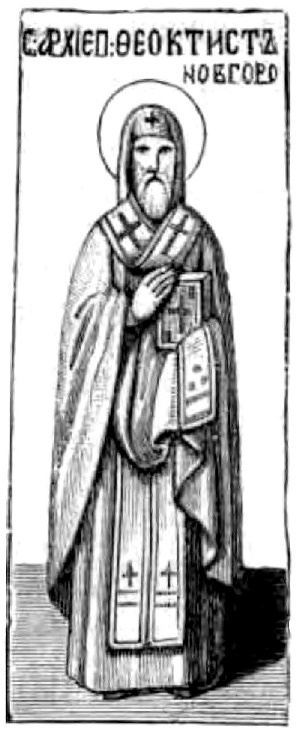
Не много сохранилось известий о земной жизни св. архиепископа Феоктиста; но и в немногих известиях можно видеть, какой был главный подвиг жизни его, прославленный небом.
Not many accounts have been preserved of the earthly life of St. Archbishop Theoctistus; but even in the few accounts one can see what was the chief feat of his life, glorified by heaven.
После того, как 22 мая 1299 г. преставился Климент, архиепископ Новгородский, «Новгородцы с посадником Андреем, долго рассуждая о преемнике, полюбили Богом назначенного, доброго и смиренного Феоктиста, игумена св. Благовещения. Собрав звоном вече у св. Софии, князь Борис Андреевич и все Новгородцы почтительно привели его и посадили на дворе владыки, пока узнают, где митрополит». В следующем году «митрополит Максим, Ростовский епископ Симеон и Тверской епископ Андрей прибыли в Новгород и поставили Феоктиста в архиепископа в Софийском соборе; Новгородцы очень рады были своему владыке»347. Торжество для Новгорода действительно было необыкновенное! Только в первый раз Новгородский владыка посвящается в Новгородском храме св. Софии. Что чувствовал сам посвящаемый, памятники не говорят. – В следующем году, по благословению св. Феоктиста, заложен был каменный храм св. арханг. Михаила и через два года освящён, – храм поныне целый348. – В 1305 г. видим блаж. архипастыря принимающим участие в договорах Новгорода с в. кн. Михаилом Тверским о сохранении древних взаимных отношений. «Княжение твое, говорят Новгородцы, честно держати (должны), по пошлине (по обычаю), без обиды; а тебе, господине, також Новгород держати (должно) без обиды, по пошлине». Печать на грамоте представляет лик Богоматери с предвечным Младенцем на персях, с надписью: Мр Ѳꙋ, а на обороте слова: «Фектист архиепис. Новгородский»349. В том же году видим святителя совершающим освящение храма в честь св. Бориса и Глеба и ещё другого, на княжем дворе, в честь отцов первого Вселенского Собора350. – Спустя два года Новгородцы за печатью своего архиепископа представили в. князю жалобу на его Новгородских наместников. В сентябре в. князь Михаил прибыл в Новгород и личными распоряжениями успокоил Новгородцев351. – Но время тогда было смутное. Кн. Юрий Данилович препирался с св. в. кн. Михаилом за Новгородское княжение, и происки Юрия наносили только неприятности Новгороду352. – Писец Апостола 1307 г. с скорбью говорил: «при сих князьях сеялись и росли усобицы и жизнь наша гибла от ссор княжеских и век людей укорачивался»353. – А блаж. святитель и без того был слаб здоровьем. При таком положении дел в декабре 1307 г. «благословив Новгородцев, по болезни удалился он в монастырь Благовещения Богородицы, с тем, чтобы пребывать в безмолвии»354. – Блаженный после того почти постоянно был болен, в продолжение целых трёх лет. «Он много страдал для Бога», говорит современник; «когда он умер, святая душа его взошла на небо, а лицо его как-бы озарилось светом, так что видевшие дивились и славили Бога». Так блаженный Феоктист и тогда, как был игуменом Благовещенской обители, украшен был добротой сердца и смирением. Но Богу угодно было посетить его тяжкой болезнью, и душа его страданием телесным ещё возвысилась в духовном совершенстве. – Чудны дела Божии! Премудрая благость знает, кто на каком пути может дойти до совершенства и ставит его на лучшем пути. – Не будем же роптать на Господа, когда посылает Он нам болезнь: она нужна нам, она – спасение наше. Будем переносить болезнь, как усмирение замыслов гордости нашей, как врачевство разным другим болезням нравственным, как лучшее состояние для приобретения твёрдости в добре, искусства в молитве и упования на Бога! Блаж. Феоктист, созревший духом в страданиях телесных, мирно почил 23 дек. 1310 г. «Честное тело его положено было с честью, в сопровождении всего духовенства, в монастырском храме Благовещения Богородицы355.
After Clement, Archbishop of Novgorod, reposed on 22 May 1299, "the Novgorodians with the posadnik Andrew, having long deliberated about a successor, came to love the God-appointed, good and humble Theoctistus, abbot of the monastery of the Annunciation. Having gathered the veche by the ringing of the bell at St. Sophia, Prince Boris Andreevich and all the Novgorodians respectfully led him and seated him in the court of the vladyka, until they should learn where the metropolitan was." In the following year "Metropolitan Maximus, Simeon Bishop of Rostov, and Andrew Bishop of Tver arrived in Novgorod and installed Theoctistus as archbishop in the cathedral of St. Sophia; the Novgorodians were very glad of their vladyka"347. The celebration for Novgorod was indeed extraordinary! For the first time a Novgorod vladyka was consecrated in the Novgorod church of St. Sophia. What the one being consecrated himself felt, the records do not say. – In the following year, with the blessing of St. Theoctistus, a stone church of the Holy Archangel Michael was founded and consecrated two years later – a church still standing to this day348. – In 1305 we see the blessed archpastor taking part in the treaties of Novgorod with Grand Prince Michael of Tver concerning the preservation of ancient mutual relations. "Your reign," say the Novgorodians, "we must hold honorably, according to custom, without offense; and you, lord, must likewise hold Novgorod without offense, according to custom." The seal on the document bears the image of the Mother of God with the Preëternal Child upon Her bosom, with the inscription: Мр Ѳꙋ, and on the reverse the words: "Theoctistus Archbishop of Novgorod"349. In the same year we see the Hierarch performing the consecration of a church in honor of Sts. Boris and Gleb, and also of another, in the prince's court, in honor of the fathers of the First Ecumenical Council350. – Two years later the Novgorodians, under the seal of their archbishop, presented to the Grand Prince a complaint against his Novgorod lieutenants. In September Grand Prince Michael arrived in Novgorod and by his personal orders calmed the Novgorodians351. – But the time was troubled. Prince George Danilovich contended with St. Grand Prince Michael for the Novgorod principality, and the intrigues of George brought only troubles upon Novgorod352. – The scribe of an Apostolos of 1307 said with sorrow: "under these princes strifes were sown and grew, and our life perished from princely quarrels, and the age of men was shortened"353. – And the blessed Hierarch was already weak in health. In such a state of affairs, in December 1307, "having blessed the Novgorodians, because of illness he withdrew to the monastery of the Annunciation of the Theotokos, in order to abide in silence"354. – The blessed one after that was almost constantly ill, for a full three years. "He suffered much for God," says a contemporary; "when he died, his holy soul ascended to heaven, and his face was as if illumined with light, so that those who saw it marveled and glorified God." Thus the blessed Theoctistus, even when he was abbot of the Annunciation monastery, was adorned with goodness of heart and humility. But God was pleased to visit him with grievous illness, and his soul was yet further exalted in spiritual perfection through bodily suffering. – Wondrous are the works of God! The all-wise goodness knows who by which path may attain perfection, and places him on the best path. – Let us not murmur, then, against the Lord when He sends us illness: it is needful for us, it is our salvation. Let us bear illness as a taming of the designs of our pride, as a medicine for various other moral ailments, as the best state for acquiring steadfastness in good, skill in prayer, and hope in God! The blessed Theoctistus, having matured in spirit through bodily sufferings, peacefully reposed on 23 December 1310. "His honorable body was laid with honor, accompanied by all the clergy, in the monastery church of the Annunciation of the Theotokos"355.
Первое прославление святителя Феоктиста совершилось спустя 300 лет после его кончины. Супруга царского дьяка Юлиания долго была больна, так что потеряли всякую надежду на её выздоровление. Раз ночью во сне явился ей муж в священном величии и сказал: «поищи гроб архиепископа сего города Феоктиста и получишь исцеление». Дьяк после справок с летописями о гробе блаженного Феоктиста привёз больную в Благовещенский монастырь; отпел здесь панихиду и роздал щедро милостыню. Больная тога даже почувствовала облегчение и скоро совсем выздоровела. По желанию благодарного дьяка тогда же написана была икона святителя, по явлению, бывшему жене его; а в то же время Софийский пономарь Феодор, занимавшийся иконописанием, написал икону его с того древнего подлинника, который сохранялся на стене Софийской паперти, и изобразил святителя в молитвенном положении перед иконой Благовещения. – Вслед затем в 1644 г. Новгородский наместник царя, князь Василий Ромодановский, по благоговейному усердию к святителю, поставил часовню на месте обрушившегося храма; потом устроил раку над мощами с ликом святителя, а наконец возобновил и каменный храм. В 1707 г. открыто положены были мощи святителя. Исцеления продолжались. Так, в 1710 г. поселянка Мария, 20 лет бывшая больной и 3 года слепой, когда облобызала лик святителя на гробе его, мгновенно получила здоровье. В 1714 г. пономарской вдове Евдокии, лежавшей в расслаблении, явился в ночном видении святой и сказал: «для чего напрасно лечишься у глупых волхвов?» Больная велела сыну вести её к гробу святителя Феоктиста и здесь получила исцеление.
The first glorification of St. Theoctistus took place 300 years after his repose. The wife of a tsar’s clerk, Juliana, was long ill, so that all hope of her recovery was lost. One night, in a dream, a man appeared to her in sacred majesty and said: “Seek the tomb of the archbishop of this city, Theoctistus, and you shall receive healing.” The clerk, after making inquiries from the chronicles about the tomb of the blessed Theoctistus, brought the sick woman to the Annunciation Monastery; he sang a panikhida there and gave alms generously. The sick woman even then felt relief and soon recovered completely. At the desire of the grateful clerk, an icon of the Hierarch was then painted, according to the appearance that had come to his wife; and at the same time, the sexton of St. Sophia’s, Theodore, who was occupied with iconography, painted an icon of him from that ancient original which was preserved on the wall of the St. Sophia porch, and depicted the Hierarch in a posture of prayer before the icon of the Annunciation. – Following this, in 1644, the Tsar’s viceroy of Novgorod, Prince Basil Romodanovsky, out of reverent zeal for the Hierarch, built a chapel on the site of the collapsed church; then he constructed a shrine over the relics with the likeness of the Hierarch, and finally he also restored the stone church. In 1707, the relics of the Hierarch were uncovered. Healings continued. Thus, in 1710, a peasant woman, Maria, who had been ill for 20 years and blind for 3 years, when she kissed the likeness of the Hierarch on his tomb, instantly received health. In 1714, the sexton’s widow, Eudocia, who lay in paralysis, had the saint appear to her in a night vision and say: “Why do you vainly seek healing from foolish sorcerers?” The sick woman ordered her son to lead her to the tomb of St. Theoctistus, and there she received healing.
В 1786 г. мощи святителя, по разрешению Свят. Синода, перенесены были из упразднённого Благовещенского монастыря в Юрьев монастырь и положены были в храме, подле стены, у иконостаса. Архимандр. Фотий устроил придел в честь святителя Феоктиста356.
In 1786, the relics of the Hierarch, by permission of the Most Holy Synod, were translated from the abolished Annunciation Monastery to the Yuriev Monastery and were placed in the church, by the wall, near the iconostasis. Archimandrite Photius built a side-chapel in honor of St. Theoctistus356.
Преп.Павла исповедника, епископа Неокесарийского. В гонение Ликиниево (320 г.) был местным правительством обвинён в противлении власти, заклеймён на руках горячим железом и сослан к реке Евфрату. После гибели Ликиния возвратился на престол и в 325 году был в числе других отцов на первом Вселенском Соборе, в Никее.
The Venerable Paul, Confessor, Bishop of Neocaesarea. During the persecution under Licinius (A.D. 320), he was accused by the local authorities of resistance to authority, was branded on his hands with hot iron, and was exiled to the Euphrates River. After the downfall of Licinius, he returned to his see, and in 325 he was among the other Fathers at the First Ecumenical Council in Nicaea.
Собр. грам. 1. № 9. 10. В договоре 1265 г. «держати ти Новгород по пошлине, как держал отец твой». См. № 8.11. «Пошлина» от «пошло» обычай.
Collected Charters, I, No. 9, 10. In the treaty of 1265: “Thou shalt hold Novgorod according to custom, as thy father held it.” See No. 8, 11. “Poshlina” from “poshlo”: custom.
1305 г. «священа бысть церковь св. м. Бориса и Глеба и великим священием, архиеп. Новгор. Феоктистом». Собр. л. III. 68. Великое освящение – освящение совершаемое самим архипастырем; а освящение совершаемое игуменом с преждеосвященным антиминсом – освящение малое, как совершаемое по краткому чину.
1305: “The church of the holy martyrs Boris and Gleb was consecrated with a great consecration by Archbishop Theoctistus of Novgorod.” Collection of Chronicles, III, 68. A great consecration is a consecration performed by the archpastor himself; while a consecration performed by an abbot with a previously consecrated antimension is a lesser consecration, as performed according to a brief rite.
Сами Новгородцы писали (собр. грам. 1. № 11), что Михаил, как в. князь, есть законный князь их. Но Юрий волновал их через купленных сторонников.
The Novgorodians themselves wrote (Collected Charters, I, No. 11) that Michael, as Grand Prince, was their lawful prince. But George stirred them up through bought partisans.
Ркп. святцы б. общ. ист. № 231, и Моск. акад. № 209. В Отенских святцах 1718 г. «положен бысть в Благовещенском монаст. от Нова-города 3 поприща; мощи под спудом; службы нет, тропарь и кондак и чудеса есть». Служба и житие св. Феоктиста в библ. Юрьева монастыря. Макария древ. 1, 421. 535. 536.
Manuscript Menologia of the Society of History, No. 231, and of the Moscow Academy, No. 209. In the Otensk Menologion of 1718: “He was laid to rest in the Annunciation Monastery, 3 poprishches from Novgorod; his relics are hidden; there is no service, but there is a troparion, kontakion, and miracles.” The service and life of St. Theoctistus are in the library of the Yuriev Monastery. Macarius, Antiquities, I, 421, 535, 536.