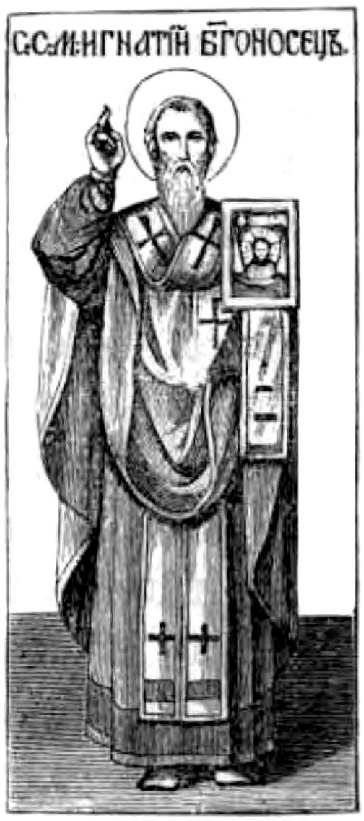
Св. Игнатий Богоносец259, живший в Апостольские времена, был учеником св. Апостола Иоанна Богослова, слушателем св. Апостола Петра, был, как говорит о нём св. Иоанн Златоуст: «общником Апостолов и в речах и в том, что неизреченно»260, – впоследствии был поставлен вторым после Эводия епископом Антиохийским, по назначению Апостолов.
St. Ignatius the God-bearer259, who lived in Apostolic times, was a disciple of St. John the Theologian, a hearer of St. Peter the Apostle, and was, as St. John Chrysostom says of him: "a partaker of the Apostles both in words and in that which is ineffable"260; he was later appointed, after Evodius, as bishop of Antioch by the appointment of the Apostles.
Св. Игнатий управлял Антиохийской Церковью в продолжении 40 лет, проявив в это время, как выражается св. Иоанн Златоуст в похвальном слове о нём, «все добродетели, какие только возможны для людей». Во время гонения на христиан, воздвигнутого Домицианом, он, по письменному свидетельству учеников его, «кормилом поста и молитв, неутомимостью в учении, ревностью духа противодействовал волнению, чтобы не потонул кто-либо из малодушных или неопытных»261.
St. Ignatius governed the Church of Antioch for forty years, manifesting during this time, as St. John Chrysostom expresses it in his eulogy of him, "all the virtues that are possible for men." During the persecution of Christians raised by Domitian, according to the written testimony of his disciples, "by the helm of fasting and prayers, by tirelessness in teaching, by zeal of spirit he withstood the disturbance, lest any of the faint-hearted or inexperienced should drown."261
Тщательно соблюдая все попечения, в которых нуждаюсь младенчествующая ещё тогда Церковь, святитель Игнатий способствовал ко всестороннему устройству её и благолепию; он первый, как передаёт церковный историк Сократ, по бывшему ему видению ангелов, воспевавших Пресвятой Тронце торжественную песнь на двух противоположных сторонах, ввёл в подражание им в Антиохийской Церкви пение на два лика (антифонное) Божественных песней, которое перешло впоследствии и в другие Церкви.
Carefully attending to all the concerns of which the Church, still in its infancy, stood in need, the Hierarch Ignatius contributed to its comprehensive order and beauty; he was the first, as the church historian Socrates relates, following a vision he had of angels singing a solemn hymn to the Most Holy Trinity on two opposite sides, to introduce in imitation of them into the Church of Antioch the singing of divine hymns by two choirs (antiphonal), which later passed over into other Churches as well.
Любовь свою к Богу и высокое служение Ему св. Игнатий запечатлел, наконец, и мученической кончиной. В царствование императора Римского Траяна, преследовавшего всякого рода общины или союзы, в которых он видел опасность нарушения государственного единства и к которым причислял он и общество христиан, епископ Игнатий подвергся ответственности и взысканию, как представитель многочисленных христиан в Антиохии (имевшей в то время до 200,000 жителей). Прибыв в Антиохию (в 106 г.), Траян пожелал сделать личный допрос христианскому епископу.
St. Ignatius finally sealed his love for God and his high service to Him with a martyr's end. In the reign of the Roman emperor Trajan, who persecuted all kinds of communities or unions in which he saw a danger to the unity of the state, and to which he also counted the society of Christians, Bishop Ignatius was subjected to responsibility and punishment as the representative of the numerous Christians in Antioch (which at that time had up to 200,000 inhabitants). Arriving in Antioch (in A.D. 106), Trajan wished to personally interrogate the Christian bishop.
– Кто ты такой, злой демон, что нарушаешь наши законы, да ещё и других побуждаешь к тому-же? – спросил император св. Игнатия, представленного к нему по его повелению.
"Who are you, evil demon, that you break our laws and even incite others to do the same?" the emperor asked St. Ignatius, who was brought before him by his command.
– Богоносец не может быть называем демоном, – отвечал святитель, – демоны или злые духи бежат от рабов Божиих; если же ты думаешь, что я неприязнен им, то я согласен с этим и ставлю это в честь себе.
"The God-bearer cannot be called a demon," answered the Hierarch; "demons or evil spirits flee from the servants of God; but if you think that I am hostile to them, I agree with this and count it an honor to myself."
– Что же значит это название – Богоносец? – спросил Траян.
"What then does this name—God-bearer—mean?" asked Trajan.
– Название «Богоносец» означает человека, который носит Бога в своём сердце...
"The name 'God-bearer' signifies a man who bears God in his heart..."
– Поистине ношу, – сказал св. Игнатий, так как в Свящ. Писании говорится: «вселюсь в них и буду ходить в них; и буду их Богом, и они – Моим народом» (2Кор..6:16).
"Truly I bear Him," said St. Ignatius, "for it is written in Holy Scripture: 'I will dwell in them and walk in them; and I will be their God, and they shall be My people' (2 Cor. 6:16)."
– Но неужели ты думаешь, что мы не имеем в душе богов, которые помогают нам одерживать победы над врагами?
"But do you really think that we do not have gods in our souls who help us gain victories over our enemies?"
– Ты, по заблуждению, величаешь языческих богов – богами, так как один только Бог – Иисус Христос, единородный Сын Божий, – возразил христианин.
"You, in your error, call pagan gods—gods, for there is only one God—Jesus Christ, the only-begotten Son of God," the Christian replied.
– Не о том ли ты говоришь, который был распят при Понтии Пилате?
"Are you not speaking of Him who was crucified under Pontius Pilate?"
– Да, я говорю о Том, Который распял на кресте мой грех вместе с виновником его...
"Yes, I speak of Him who crucified my sin together with its author upon the cross..."
Убедясь из дальнейших рассуждений епископа в твёрдости его христианских убеждений, опасной в особенности в главе и руководителе христианского общества, император осудил его на казнь и велел отправить его в Рим, чтобы там предать на съедение зверям, в потеху народу, который, не зная, что Игнатий осуждён за веру, мог принять его за обыкновенного преступника, и таким образом страдания мученика не способствовали бы на этот раз распространению последователей ему в подвиге за истинного Бога.
Convinced from the bishop's further arguments of the firmness of his Christian convictions, dangerous especially in the head and leader of Christian society, the emperor condemned him to death and ordered him to be sent to Rome, to be thrown there to the beasts for the amusement of the people, who, not knowing that Ignatius was condemned for his faith, might take him for an ordinary criminal, and thus the martyr's sufferings would not at this time contribute to the spread of followers in the struggle for the true God.
Радостно и с благодарностью к Богу, удостоившему его пострадать за веру в Него, отправился связанный тяжёлыми оковами св. Игнатий в свой последний путь. Проходя через г. Смирну, он имел утешение видеться с епископом Поликарпом и многими христианами, прибывшими сюда из разных мест, чтобы принять от него благословение и наставление. Видя скорбь их о нём и встревожась опасением, как- бы христиане из любви к нему не попытались спасти его от смерти, св. Игнатий, в предупреждение подобной попытки их, поспешил послать Римским христианам следующее письмо:
Joyfully and with gratitude to God, who had deemed him worthy to suffer for faith in Him, St. Ignatius set out, bound with heavy chains, on his final journey. Passing through the city of Smyrna, he had the consolation of meeting with Bishop Polycarp and many Christians who had come there from various places to receive his blessing and instruction. Seeing their grief for him and becoming anxious lest the Christians, out of love for him, might attempt to save him from death, St. Ignatius, to forestall any such attempt, hastened to send the following letter to the Roman Christians:
«Исполняя молитву мою, – писал он им, между прочим, – Господь дарует мне счастье увидеть вас. Я – узник за имя Христа и молю Бога, чтобы Он помог мне до конца восприять жребий мой; но боюсь любви вашей... не мешайте мне любовью вашей... Только просите мне у Бога внешней и внутренней силы, чтобы я не только говорил, но и желал; чтобы я не назывался только христианином, но и на самом деле был таким. Я пишу всем Церквам, что добровольно умираю за Бога, если только не воспрепятствуете мне. Умоляю и вас, не удерживайте меня безвременной любовью. Оставьте меня быть снедью зверей... Я – пшеница Божия, я должен быть измолот зубами зверей, чтобы быть чистым хлебом Христовым... Я ещё раб; во Христе воскресну свободным... Ныне только начинаю быть учеником, когда не желаю ничего, ни из видимого, ни невидимого, а чтобы только достигнуть мне Христа... Господа желаю, Сына истинного Бога и Отца; Того ищу, Кто за нас умер и воскрес!.. Простите мне, братья! Не мешайте мне получить жизнь, не желайте мне смерти!.. Дайте мне увидеть чистый свет, дайте мне быть подражателем страданий Бога моего! Кто сам имеет Его в себе, тот поймёт меня... Не слушайте меня, если бы я, при свидании с вами, стал просить об ином; а верьте тому, что я пишу к вам теперь. Теперь пишу я, полный жизни, объятый желанием умереть за Христа. Моя любовь распята, и нет во мне огня любви к миру; но вода живая течёт во мне и взывает ко мне: иди к Отцу. Сам Бог Отец и Господь Иисус Христос да явит вам, что я говорю правду. Молитесь о мне, чтобы я достиг».
"Fulfilling my prayer," he wrote to them, among other things, "the Lord grants me the happiness of seeing you. I am a prisoner for the name of Christ and pray God that He help me to the end to receive my lot; but I fear your love... do not hinder me by your love... Only ask for me from God outward and inward strength, that I may not only speak but also desire; that I may not only be called a Christian but actually be one. I write to all the Churches that I willingly die for God, if only you do not hinder me. I implore you also, do not hold me back with untimely love. Leave me to be food for the beasts... I am the wheat of God; I must be ground by the teeth of beasts, that I may become pure bread of Christ... I am still a slave; in Christ I shall rise free... Now only do I begin to be a disciple, when I desire nothing, neither of the visible nor the invisible, but only to attain to Christ... I desire the Lord, the Son of the true God and Father; Him I seek, who died and rose for us!... Forgive me, brethren! Do not hinder me from obtaining life; do not wish me death!... Let me see the pure light; let me be an imitator of the sufferings of my God! He who has Him within himself will understand me... Do not listen to me if, when I meet you, I should ask for anything else; but believe what I now write to you. Now I write to you, full of life, seized with the desire to die for Christ. My love is crucified, and there is in me no fire of love for the world; but living water flows within me and cries to me: Go to the Father. May God the Father Himself and the Lord Jesus Christ reveal to you that I speak the truth. Pray for me, that I may attain."
Вслед за письмом своим прибыл в Рим и сам епископ Игнатий; с теплейшим сочувствием встретили его здешние христиане; они действительно намеревались употребить все старания, чтобы избавить от смерти Игнатия, но он повторил им то, о чём просил их в своём письме, и убедил не воспрепятствовать его казни. Помолясь усердно вместе с ними, между прочим, о даровании мира Церкви, об укреплении между братиями взаимной любви, св. Игнатий был отведён воинами на казнь. Идя туда, он продолжал молиться, призывая имя Христа. – «Что ты все повторяешь это имя?» – спросили его воины. – «Оно у меня в сердце, потому и повторяют его уста», – отвечал Игнатий Богоносец.
Following his letter, Bishop Ignatius himself arrived in Rome; the Christians there received him with the warmest sympathy; they indeed intended to use every effort to save Ignatius from death, but he repeated to them what he had asked of them in his letter and persuaded them not to hinder his execution. Having prayed fervently with them, among other things for the granting of peace to the Church and for the strengthening of mutual love among the brethren, St. Ignatius was led away by the soldiers to execution. As he went, he continued to pray, calling upon the name of Christ. "Why do you keep repeating that name?" the soldiers asked him. "It is in my heart, and therefore my lips repeat it," answered Ignatius the God-bearer.
Прибыв в цирк, полный нетерпеливо ожидавших своей потехи – «зрелища казни старца – ожесточённых и развращённых преступников, Игнатий не смутился, услышав рыкание голодных львов. С величественным спокойствием обратясь к народу, он громко сказал:
Arriving at the circus, filled with hardened and depraved criminals impatiently awaiting their amusement—"the spectacle of the execution of the old man"—Ignatius was not dismayed upon hearing the roaring of the hungry lions. With majestic calm, turning to the people, he said loudly:
– «Знайте, Римские граждане, что не за злодеяние и преступление осуждён я на смерть, но только за веру в единого Бога моего, Которого люблю, и к Которому желаю идти. Я – пшеница Его и зубами звериными измалываюсь, чтобы соделаться для Него чистым хлебом» ... Едва успел мученик произнести эти слова, как на него накинулись два выпущенные льва и мгновенно растерзали его; – остались только немногие твёрдые части, которые были собраны потом христианами и перенесены впоследствии в Антиохию.
"Know, Roman citizens, that I am condemned to death not for any evil deed or crime, but only for faith in my one God, whom I love and to whom I desire to go. I am His wheat, and I am ground by the teeth of beasts, that I may become pure bread for Him." Scarcely had the martyr uttered these words when two released lions sprang upon him and instantly tore him to pieces; only a few hard parts remained, which were later gathered by Christians and subsequently transferred to Antioch.
Мученический подвиг св. Игнатия Богоносца совершился 20-го декабря 107 г. Подлинные акты о нём, написанные и очевидцами – Филоном и Агафоподом262 для Антиохийцев, заключаются следующими словами:
The martyr's struggle of St. Ignatius the God-bearer was accomplished on December 20, A.D. 107. The authentic acts concerning him, written by eyewitnesses—Philo and Agathopodus262 for the Antiochenes, conclude with the following words:
«Мы, видевшие это собственными глазами, всю ночь потом провели в слезах и, с коленопреклонением и молитвой, просили Бога утешить нас о случившемся. Когда потом мы немного заснули, то некоторые из нас увидели блаженного Игнатия, стоявшего близ нас и нас обнимающего; другие видели его с нами молящегося; иные – орошённого потом, как будто после большего труда пришедшего к предстоящего Господу. С радостью увидев это и сравнив сонные видения, мы воспели хвалу Богу, Подателю благ, ублажали святого мужа и записали день и год его кончины, чтобы, собираясь в день его мученичества, иметь нам общение с подвижником и доблестным мучеником Христовым».
"We, who saw this with our own eyes, spent the whole night afterward in tears and, with kneeling and prayer, asked God to comfort us concerning what had happened. When we later fell into a light sleep, some of us saw the blessed Ignatius standing near us and embracing us; others saw him praying with us; still others saw him bathed in sweat, as if after great labor he had come and stood before the Lord. Seeing this with joy and comparing our dream visions, we sang praise to God, the Giver of good things, blessed the holy man, and recorded the day and year of his death, so that, gathering on the day of his martyrdom, we might have communion with the athlete and valiant martyr of Christ."
После св. Игнатия Богоносца остались замечательные послания его, о которых св. Поликарп, епископ Смирнский, говорит, что «в них можно найти большую пользу, ибо они содержат в себе веру, терпение и всякое назидание в Господе нашем». Главная же цель этих посланий – способствовать к сохранению единения церковного в духе веры – в ограждение от еретических учений, которые начали уже сильно распространяться в то время. Об еретиках именно писал св. Игнатий: «предостерегаю вас от зверей, облечённых в человеческий вид: вам надобно не только не принимать их, но, если можно, и не встречаться с ними, а только молиться за них... Не обманывайтесь, братия, прелюбодейцы не внидут в Царствие Божие... Что-ж будет с тем, кто растлевает ложным учением веру Божию, за которую распялся Христос?» – «Не обманывайтесь. Кто следует учителю раскола, не внидет в Царствие Божие; кто ходит по учению еретическому, тот не сообразен страданию Христову».
After St. Ignatius the God-bearer, his remarkable epistles remain, of which St. Polycarp, Bishop of Smyrna, says that "in them one may find great benefit, for they contain faith, patience, and every edification in our Lord." The chief purpose of these epistles, however, is to contribute to the preservation of church unity in the spirit of faith—as a safeguard against heretical teachings, which had already begun to spread widely at that time. Concerning heretics, St. Ignatius wrote: "I warn you against beasts in human form: you must not only not receive them, but, if possible, not even meet with them, but only pray for them... Be not deceived, brethren: adulterers shall not inherit the Kingdom of God... What then shall become of him who corrupts the faith of God, for which Christ was crucified, by false teaching?"—"Be not deceived. He who follows a teacher of schism shall not enter the Kingdom of God; he who walks according to heretical teaching is not conformed to the suffering of Christ."
Называя еретиков то отравителями, а учение их – ядом; то – зверями в образе человеческом, или бешеными псами, которые кусают исподтишка и часто на смерть, св. Игнатий, карая заблуждение, но исполненный вместе с тем нежнейшей любви к заблуждающемуся человеку, беспрестанно напоминает об обязанности молиться за заблуждающихся. – «Непрестанно молитесь о них, – пишет он Ефесеям, – потому что им есть надежда покаяния, чтобы прийти к Богу. Дайте им научиться из дел ваших. Против гнева их будьте кротки; против их заносчивости – смиренномудры; их злословию противопоставляйте молитву; их заблуждению – твёрдость в вере; против их грубости будьте тихи». – «Всё совершенство, – пишет св. Игнатий в послании к Смирнянам, – в вере и любви, выше которых нет ничего на свете. Посмотрите же на тех, которые иначе учат о пришедшей к нам благодати Иисуса Христа; как они противны воле Божией! У них нет попечения о любви, о вдовице, ни о сироте, ни о притесняемом, ни об узнике, или освобождённом от уз, ни об алчущем, или жаждущем.
Calling heretics now poisoners, and their teaching—poison; now beasts in human form, or mad dogs that bite secretly and often unto death, St. Ignatius, while chastising error, yet filled at the same time with the tenderest love for the erring man, continually reminds of the duty to pray for those who err. —"Pray unceasingly for them," he writes to the Ephesians, "for there is for them hope of repentance, that they may come to God. Give them opportunity to learn from your works. Against their wrath be meek; against their arrogance—humble-minded; against their slander set prayer; against their error—firmness in faith; against their rudeness be gentle." —"All perfection," writes St. Ignatius in his epistle to the Smyrnaeans, "is in faith and love, above which there is nothing in the world. Look then at those who teach otherwise concerning the grace of Jesus Christ which has come to us; how contrary they are to the will of God! They have no care for love, neither for the widow, nor the orphan, nor the oppressed, nor the prisoner, or him released from bonds, nor the hungry or thirsty.
В животворном духе единой истинной веры, начальником которой есть Иисус Христос, св. Игнатий убеждает искать и решение сомнений и правила для всей жизни263. – Я прибегаю к Евангелию, как телу Иисусову, – говорит он, – и к Апостолам, как к пресвитерству Церкви. И пророков любить надобно, потому что и они предвозвестили Евангелие, уповали на Христа. Убеждаю вас, не делайте ничего по любопрению, но по учению Христову. Некоторые, как слышал я, говорят: если чего не нахожу в древнем (писании), то не верю в Евангелие... А для меня древнее – Иисус Христос, непреложное древнее – Крест Его, Его смерть и воскресение, вера Его, учение, принесённое Им264... Старайтесь утвердиться в догматах Господа и Апостолов, чтобы всё, что говорите, имело благой успех, внутренно и наружно, в вере и любви, в Сыне и Отце и Духе, в начале и конце»265. «Господь Иисус есть дверь Отца, которой входят патриархи, пророки, Апостолы и Церковь, чтобы достигнуть единения с Богом. То и другое, древнее и новое, превосходно, если вы веруете в любви. Вера есть начало жизни, любовь – конец; та и другая в совокупности от Бога... И так христианство состоит не в исповедании, но в силе веры, когда кто соблюдает верность до конца266.
In the life-giving spirit of the one true faith, of which Jesus Christ is the Head, St. Ignatius urges that the resolution of doubts and the rule for all of life be sought263. —"I have recourse to the Gospel as to the flesh of Jesus," he says, "and to the Apostles as to the presbytery of the Church. And the prophets also must we love, because they too foretold the Gospel and hoped in Christ. I exhort you, do nothing out of contentiousness, but according to the teaching of Christ. Some, as I have heard, say: if I find not a thing in the ancient (writings), I believe not the Gospel... But for me the ancient is Jesus Christ, the immutable ancient is His Cross, His death and resurrection, His faith, the teaching brought by Him264... Strive to be established in the dogmas of the Lord and the Apostles, that whatsoever you say may have good success, inwardly and outwardly, in faith and love, in the Son and the Father and the Spirit, in the beginning and the end"265. "The Lord Jesus is the door of the Father, through which enter the patriarchs, prophets, Apostles and the Church, to attain union with God. Both the one and the other, the ancient and the new, are excellent, if you believe in love. Faith is the beginning of life, love is the end; both together are from God... And so Christianity consists not in confession, but in the power of faith, when one keeps faithfulness unto the end"266.
В отражение различных еретических учений св. Игнатий Богоносец так объясняет личность Иисуса Христа: – «Христос Иисус прежде веков был у Отца и, наконец, явился». «Он – вечное слово Отца». «Он – Сын Божий и Бог». «В человеке Бог, в смерти истинная жизнь, и из Марии, и из Бога». «Через Него открылось нам Божество». «Он истинно родился от Девы, крестился от Иоанна, истинно пригвождён был за нас во плоти, при Понтии Пилате и Ироде Тетрархе». Истинно страдал, как истинно и воскресил Себя, не так, как говорят некоторые неверы, будто пострадал Он призрачно, сами будучи призрачными; как мудрствуют, так и поживут они, – тени бестелесные и духи злые».
In refutation of various heretical teachings, St. Ignatius the God-bearer thus explains the person of Jesus Christ: —"Christ Jesus was with the Father before the ages, and at last appeared." "He is the eternal Word of the Father." "He is the Son of God and God." "God in man, true life in death, and from Mary, and from God." "Through Him the Divinity was revealed to us." "He was truly born of the Virgin, was baptized by John, was truly nailed for us in the flesh, under Pontius Pilate and Herod the Tetrarch." He truly suffered, as He also truly raised Himself up, not as some unbelievers say, that He suffered in appearance only, they themselves being mere phantoms; as they think, so shall they live—bodiless shadows and evil spirits."
«Те, которые отвергают во Христе истинное человечество, – заключает св. Богоносец, – удаляются от Евхаристии, потому что не исповедуют с нами, что Евхаристия есть плоть Спасителя нашего Иисуса Христа, та плоть, которая страдала за нас и которую Отец воскресил по Своей благости». «Ясно, по учению Церкви, как Сын Божий в вочеловечении облечён был истинной плотью и кровью, так истинная плоть и кровь Его находится в Евхаристии. Учение противоположное тому – учение еретиков».
"Those who deny the true humanity in Christ," concludes the holy God-bearer, "withdraw from the Eucharist, because they do not confess with us that the Eucharist is the flesh of our Savior Jesus Christ, that flesh which suffered for us and which the Father raised up by His goodness." "It is clear, according to the teaching of the Church, that as the Son of God in His incarnation was clothed with true flesh and blood, so His true flesh and blood are in the Eucharist. The teaching contrary to this is the teaching of heretics."
Называя Евхаристию «врачевством бессмертия, противоядием против смерти», св. Игнатий призывает принимать как можно чаще участие в ней, указывая при этом и на славу общественной молитвы, совершаемой в духе единства, мира и любви. – «Собирайтесь чаще для Евхаристии и славословия Бога, – ибо если вы часто собираетесь вместе, то низлагаются силы сатаны, и единомыслием вашей веры разрушаются гибельные дела его. Никто не обманывайся! Кто не находится внутри алтаря (церкви), тот лишается хлеба Божия. Если молитва того или другого имеет великую силу, то тем более молитва епископа и всей Церкви. И так, кто не ходит в общее собрание, тот уже возгордился и сам себя отлучил (от Бога). Ибо написано: гордым Бог противится. Потому, прошу вас, старайтесь всё совершать в единодушии Божественном». Нет ничего лучше мира, ибо им обесславливается всякая против нас вражда поднебесных и земных. Всё это понятно вам, если вы имеете совершенную веру и любовь ко Христу».
Calling the Eucharist "the medicine of immortality, the antidote against death," St. Ignatius urges that one partake of it as often as possible, pointing also to the glory of common prayer, performed in the spirit of unity, peace and love. —"Gather together more frequently for the Eucharist and the praise of God—for if you often assemble together, the powers of Satan are cast down, and by the unanimity of your faith his destructive works are undone. Let no one deceive himself! He who is not within the altar (of the church) is deprived of the bread of God. If the prayer of this or that one has great power, how much more the prayer of the bishop and of the whole Church. And so, he who does not come to the common assembly is already proud and has excommunicated himself (from God). For it is written: God resisteth the proud. Therefore I beseech you, strive to do all things in divine unanimity." There is nothing better than peace, for by it every enmity against us, of things heavenly and earthly, is put to shame. All this is clear to you, if you have perfect faith and love toward Christ."
Наставления свои преподаёт святитель Игнатий в духе любви и крайнего смирения. – «Не повелеваю я вам, как будто имеющий на то власть или что-либо значащий, – пишет он, и между прочим, незадолго до своего мученического подвига; ибо хотя я и в узах за имя Христово, но ещё не совершен во Христе: теперь только начинаю учиться, а говорю вам, как учить, потому что любовь моя к вам не позволяет молчать, но побуждает меня писать вам и умолять вас следовать пути Господню».
His instructions the Hierarch Ignatius delivers in the spirit of love and extreme humility. —"I do not command you, as one having authority or being something," he writes, among other things, shortly before his martyric feat; "for though I am in bonds for the name of Christ, I am not yet perfect in Christ: now I am only beginning to learn, and I speak to you as one who teaches, because my love for you does not permit me to be silent, but impels me to write to you and to beseech you to follow the way of the Lord."
Эти 7 писем или посланий св. Игнатия из Смирны, а потом из Троады во время его путешествия в Рим на казнь – (к Римлянам, к Ефесеям, Магнезийцам, Траллианцам, Филадельфийцам, к Церкви Смирнской и к епископу Поликарпу) – содержат драгоценные указания на состояние Церкви и её учения в I и в начале II века. Ими руководствовались и свидетельствовались св. Афанасий, св. Ириней, Ориген и многие другие церковные писатели и учители. Вообще, пользовались эти послания великим уважением: их списывали, перечитывали, изучали, приводили в подтверждение или пояснение церковного учения и церковного предания, из них приводили наизусть достопамятные изречения, например: «как совершенный подвижник, переноси немощи каждого».
These 7 letters or epistles of St. Ignatius from Smyrna, and afterwards from Troas, during his journey to Rome for execution—(to the Romans, to the Ephesians, Magnesians, Trallians, Philadelphians, to the Church of Smyrna, and to Bishop Polycarp)—contain precious indications of the state of the Church and her teaching in the first and beginning of the second century. By them were guided and testified St. Athanasius, St. Irenaeus, Origen, and many other church writers and teachers. In general, these epistles enjoyed great respect: they were copied, reread, studied, cited in confirmation or explanation of church teaching and church tradition; from them memorable sayings were quoted from memory, for example: "As a perfect athlete, bear the infirmities of all."
«Христианин не властен над собой, принадлежа Богу».
"A Christian is not master of himself, belonging to God."
«Кто усвоил себе Иисусово слово, тот, и ничего не говоря, открывает о себе».
"He who has made his own the word of Jesus, even saying nothing, reveals himself."
«Хорошо учить тому, кто поступает, как учит».
"It is good to teach him who acts as he teaches."
«Нужно не говорить только, но и желать, не называться только, но и быть христианином».
"One must not only speak, but also desire; not only be called, but also be a Christian."
«Христианство не такое дело, чтобы молчать о нём» ...
"Christianity is not such a matter that one should be silent about it" ...