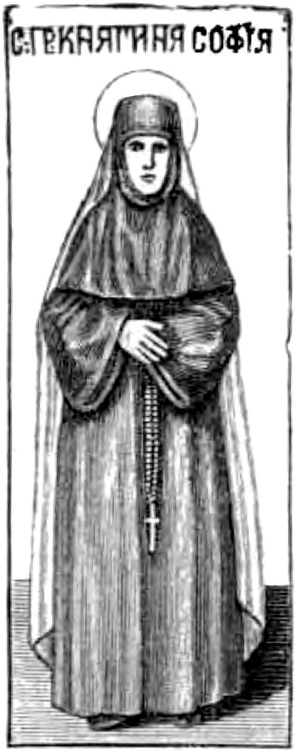
Юной дочери боярина Юрия Константиновича Сабурова неожиданно выпала блистательная доля. Для наследника Московского престола, по воле великого князя, собраны были девицы-невесты, лучшие по красоте и здоровью; из 500 выбрали 10, и из этих десяти молодой князь Василий выбрал себе невесту207. Это была Соломония Юрьевна Сабурова. Сент. 4-го 1505 года совершён был законный брак, а с 28 октября Василий был уже великим князем. – Но прошло пять, десять, 15 лет, а великая княгиня бездетна. Это – скорбь для супруга, а ещё более для супруги. – Великий князь сперва охладел в любви к супруге, потом стал обнаруживать и негодование. Один посланник при дворе вел. князя говорит: «не имея детей, Василий не уважал супруги, так что я, находясь в Москве, должен был ходатайствовать о свободе брата её, сидевшего в темнице за лёгкую вину»208. – Наконец, в 1525 г. великий князь решился развестись с неплодной Соломонией, чтобы вступить в брак с княжной Глинской. Государству, говорили, необходим наследник престола. Если бы у Василия не было и братьев, добрая цель не оправдывает собой незаконного средства, и не благословение, а гнев Божий, низводят на государство дела незаконные. Так говорили и лучшие современники Василия209, между прочими преп. Максим Грек. – Но перед силой закон бессилен; страсть князя к Глинской признали обидой для себя голоса чистой совести210. От невинной Соломонии потребовали, чтобы она по воле приняла монашество. Она отвечала, что не чувствует в себе такого желания. Её вывели из дворца. Ноября 25-го 1525 года «великий князь Василий велел постричь свою великую княгиню»211. При выполнении этой воли, слуги князя доходили до того, что ругали и даже били бывшую княгиню. Её постригли в Рождественском девичьем монастыре с именем Софии и отправили в Суздальский Покровский девичий монастырь212. «Вот я князь великий Василий Иванович всей России пожаловал старицу Софию в Суздале моим селом Вышеславским с деревнями и новосёлками, – после её смерти это село поступит в дом Пречистой Богородицы, к Покрову»: – так писал Василий в грамоте от 19 сент. 1526 г.213, т. е. спустя год после заключения княгини в монастырь. Тяжело было Софии в первое время переносить свою долю, когда сама она не думала расстаться с миром. – Но грамота вел. князя показывает, что в конце года она уже стала мириться со своей долей. 1530 г. авг. 28-го у вел. князя родился от Елены сын и «потом бысть грозный государь»214. – Рождение сына у Василия без сомнения ещё более смирило Софию. Она теперь уже вся обратилась к Господу и изгнала из души мирские мечты. Она стала очищать сердце, столько нечистое у всех нас, духовной бдительностью, самоукорением, покаянием, молитвой. Так восходя от совершенства к совершенству путём скорби и борьбы с собой, преподобная София прожила в обители 17 лет и пережила не только князя Василия († 1533 г.), но и развратную Елену, погибшую от яда (1537 г.); достигши высокого совершенства, она скончалась 16 дек. 1542 г.215. Князь Курбский называет блаж. княгиню преподобной мученицей216. По словам степенной книги, София, «пожив благодарно и богоугодно, к Богу отъиде» 217.
To the young daughter of the boyar Yuri Konstantinovich Saburov, a brilliant lot unexpectedly fell. For the heir to the Moscow throne, by the will of the Grand Prince, maidens-brides were gathered, the best in beauty and health; out of 500, ten were chosen, and from these ten the young Prince Basil chose his bride207. This was Solomonia Yurievna Saburova. On September 4, 1505, the lawful marriage was performed, and from October 28, Basil was already Grand Prince. – But five, ten, fifteen years passed, and the Grand Princess was childless. This was a sorrow for the husband, and even more so for the wife. – The Grand Prince first grew cold in love for his wife, then began to show indignation. One envoy at the court of the Grand Prince says: "Having no children, Basil did not respect his wife, so that I, being in Moscow, had to intercede for the freedom of her brother, who was sitting in prison for a light offense"208. – Finally, in 1525, the Grand Prince decided to divorce the barren Solomonia, in order to enter into marriage with Princess Glinskaya. The state, it was said, needed an heir to the throne. If Basil had not even had brothers, a good end does not justify an unlawful means, and it is not blessing, but the wrath of God, that unlawful deeds bring down upon the state. So spoke even the best contemporaries of Basil209, among them the Venerable Maximus the Greek. – But before force, the law is powerless; the prince's passion for Glinskaya was regarded as an insult by the voices of a pure conscience210. They demanded of the innocent Solomonia that she voluntarily accept monasticism. She replied that she felt no such desire within herself. She was led out of the palace. On November 25, 1525, "the Grand Prince Basil ordered his Grand Princess to be tonsured"211. In carrying out this will, the prince's servants went so far as to revile and even beat the former princess. She was tonsured in the Convent of the Nativity with the name Sophia and sent to the Convent of the Intercession in Suzdal212. "Behold, I, the Grand Prince Basil Ivanovich of All Russia, have granted the nun Sophia in Suzdal my village of Vysheslavsk with its hamlets and new settlements – after her death this village shall pass to the house of the Most Pure Theotokos, to the Intercession": thus wrote Basil in a charter of September 19, 1526213, that is, a year after the princess's confinement to the monastery. It was hard for Sophia at first to bear her lot, when she herself had not thought to part with the world. – But the Grand Prince's charter shows that by the end of the year she had already begun to be reconciled to her lot. On August 28, 1530, the Grand Prince had a son by Helen, and "afterwards he became a terrible sovereign"214. – The birth of a son to Basil undoubtedly humbled Sophia even more. She now turned wholly to the Lord and banished worldly dreams from her soul. She began to purify her heart, so unclean in all of us, by spiritual vigilance, self-reproach, repentance, and prayer. Thus ascending from perfection to perfection along the path of sorrow and struggle with herself, the Venerable Sophia lived in the monastery for 17 years and outlived not only Prince Basil († 1533), but also the dissolute Helen, who perished by poison (1537); having attained high perfection, she reposed on December 16, 1542215. Prince Kurbsky calls the blessed princess a Venerable Martyr216. According to the Book of Degrees, Sophia, "having lived gratefully and in a God-pleasing manner, departed to God"217.
Уже супруга в. кн. Феодора Иоанновича прислала «на великую княгиню Соломониду, а в иноцех Софию», бархатный покров с изображениями Спасителя и святых218. На другом древнем покрове изображена сама княгиня инокиня с подписью: «святая великая княгиня София, Суздальская чудотворица»219. – Этот покров принадлежит ко времени патр. Иосифа. П. Иосиф писал к Суздальскому архиепископу Серапиону: «писал ты, сын, к нам, патриарху, что в нынешнем 1650 г., по нашему указу и грамоте, в Суздальском Покровском девичьем монастыре свидетельствовал ты мощи вел. княгини Софии, и благоверная великая княгиня, погребённая под соборной Покровской церковью, лежит под спудом. Слушав твою грамоту, велели мы послать тебе в ответ нашу грамоту. Когда придёт к тебе наша грамота, то ты прикажи положить покров на гробницу и петь панихиды и молебны, как водится по чину, но не приказывай разбирать гробницу и разрывать землю»220. – Ключарь Анания пишет, что «от гроба преподобной Софии истекало много чудес и исцелений для притекающих с верой, в славу Христа Бога нашего». Он описывает сами чудеса. «Авг. 1-го 1598 г. преподобная благоверн. великая княгиня София простила у гроба своего девицу Анну, дочь княгини Александры Ногтевой»; та была слепа шесть лет, а у гроба Софии прозрела и стала здоровой. В 1609 г. Суздаль спасся от разорения защитой преп. княгини. От грозного явления её у известного Лисовского отнялась рука, и он поклялся не разорять города и монастырей. В 1610 г. при гробе преподобной исцелились три расслабленные, и прозрела слепая. В 1647 г. получили здравие один помешавшийся в уме, один глухой, три слепых и один расслабленный. Замечательно чудо 1654 г.: Юрьевский крестьянин Иеремия был болен головой и не спал ни днём, ни ночью; в тонкой дремоте явилась ему преп. София и исцелила от болезни221.
Already the wife of Grand Prince Theodore Ioannovich sent "for the Grand Princess Solomonia, and in monasticism Sophia," a velvet coverlet with images of the Savior and saints218. On another ancient coverlet, the princess-nun herself is depicted with the inscription: "the holy Grand Princess Sophia, Wonderworker of Suzdal"219. – This coverlet belongs to the time of Patriarch Joseph. Patriarch Joseph wrote to the Archbishop of Suzdal, Serapion: "You wrote, my son, to us, the Patriarch, that in the present year 1650, by our decree and charter, in the Suzdal Convent of the Intercession you examined the relics of the Grand Princess Sophia, and the faithful Grand Princess, buried under the cathedral Church of the Intercession, lies under a cover. Having heard your letter, we ordered that our charter be sent to you in reply. When our charter comes to you, then you order a coverlet to be placed on the tomb and have panikhidas and molebens sung, as is customary according to the rite, but do not order the tomb to be dismantled or the earth to be dug up"220. – The key-keeper Ananias writes that "from the tomb of the Venerable Sophia many miracles and healings flowed forth for those who approached with faith, to the glory of Christ our God." He describes the miracles themselves. "On August 1, 1598, the Venerable faithful Grand Princess Sophia granted forgiveness at her tomb to the maiden Anna, daughter of Princess Alexandra Nogteva"; she had been blind for six years, but at Sophia's tomb she regained her sight and became healthy. In 1609, Suzdal was saved from destruction by the protection of the Venerable Princess. From her terrible appearance, the hand of the notorious Lisovsky was paralyzed, and he swore not to destroy the city or the monasteries. In 1610, at the tomb of the Venerable One, three paralyzed persons were healed, and a blind woman regained her sight. In 1647, one who had lost his mind, one deaf man, three blind persons, and one paralyzed man received health. A remarkable miracle occurred in 1654: a peasant from Yuriev, Jeremiah, was ill in his head and slept neither by day nor by night; in a light slumber the Venerable Sophia appeared to him and healed him of his illness221.