Елевферий – Римлянин знатного происхождения, получил от матери своей Анфии, обращённой в христианство самим Апостолом Павлом, христианское воспитание и, присоединив к нему блистательное научное образование, с юности посвятил себя на служение Богу. Пятнадцати лет от роду был посвящён в диакона папой Анаклетом (79–91), на 18-м году получил сан пресвитера, а на 20-м возведён в сан епископа Иллирийского и вскоре заявил себя на высоте своего избрания святостью жизни своей и деятельным распространением и утверждением христианства среди паствы своей. Слух об его успешной деятельности в пользу гонимого христианского учения достиг до Рима, и император Андриан вызвал сюда Елевферия и, после многих истязаний, велел обезглавить этого исповедника Христа (около 120 г.).
Eleutherius was a Roman of noble birth. He received a Christian upbringing from his mother Anthia, who had been converted to Christianity by the Apostle Paul himself, and, joining to this a brilliant scientific education, from his youth he dedicated himself to the service of God. At fifteen years of age he was ordained deacon by Pope Anacletus (79–91); in his eighteenth year he received the rank of presbyter, and in his twentieth year he was elevated to the rank of Bishop of Illyricum. He soon showed himself worthy of his election by the holiness of his life and by his active spread and confirmation of Christianity among his flock. The report of his successful activity in favor of the persecuted Christian teaching reached Rome, and the Emperor Hadrian summoned Eleutherius there and, after many tortures, ordered that this confessor of Christ be beheaded (about A.D. 120).
Поражённый чудесами, бывшими при испытании Елевферия, которого не коснулись выпущенные на него дикие звери и который среди огня остался невредимым, сам префект Корривон обратился ко Христу и принял вместе с Елевферием мученическую кончину. Пострадали и мать Елевферия – Анфия, подошедшая к своему умершему сыну, чтобы дать ему последнее целование; она также была обезглавлена. Были ещё усечены мечом и двое простолюдинов, сначала мучивших Елевферия, но во время мучений его уверовавших во Христа.
Struck by the miracles that occurred during the testing of Eleutherius—for the wild beasts released upon him did not touch him, and he remained unharmed in the midst of fire—the prefect Corribon himself turned to Christ and received a martyr's end together with Eleutherius. Eleutherius' mother Anthia also suffered, having approached her dead son to give him a last kiss; she too was beheaded. Also put to the sword were two commoners who had first tormented Eleutherius but, during his torments, came to believe in Christ.
Мощи священномуч. Елевферия в настоящее время находятся в Риме, в церкви мученицы Сосанны. В конце IV столетия был сооружён при императоре Аркадии храм во имя его в Константинополе близ Ксиродофа (Сухого Холма) (Василием Патрикием). – Св. Иосифом песнописцем составлен в честь св. мученика канон, в восьмой песни которого говорится, что рака его изливает реки исцелений и чудес183.
The relics of the Hieromartyr Eleutherius are at present in Rome, in the church of the Martyr Susanna. At the end of the fourth century, during the reign of the Emperor Arcadius, a church was built in his name in Constantinople near Xerodophus (Dry Hill) by Basil the Patrician. St. Joseph the Hymnographer composed a canon in honor of the holy martyr, in the eighth ode of which it is said that his reliquary pours forth rivers of healings and wonders183.
Уроженец Елей близ Пергама, по смерти родителей вступил в монастырь горы Латра (близ Милета) и подвизался там во дни императора Константина Багрянородного. Слава его святой жизни и добродетелей собрала к нему множество ревнителей благочестия, и он был основателем знаменитой и в последующее время обители в ущелье той же Латрской горы. Скончался 15 декабря 950 года.
A native of Elaea near Pergamum, after the death of his parents he entered a monastery on Mount Latros (near Miletus) and struggled there in the days of the Emperor Constantine Porphyrogennetos. The fame of his holy life and virtues gathered around him a multitude of zealots for piety, and he became the founder of a monastery, famous also in later times, in a gorge of the same Latros mountain. He reposed on December 15, 950.
Св. Стефан, родом из Каппадокии, пятнадцати лет пришёл в Константинополь, в царствование Феодосия императора, третьего сего имени (715–716), для окончания образования в науках, и преуспел в мудрости внешней и священной. Патриарх Герман (714–730) полюбил его и сделал клириком при себе; но, ища жизни безмолвной, Стефан тайно ушёл в монастырь, оттуда же впоследствии удалился в пустынное место.
St. Stephen, a native of Cappadocia, came to Constantinople at the age of fifteen, during the reign of the Emperor Theodosius, the third of that name (715–716), to complete his education in the sciences, and he excelled in both external and sacred wisdom. Patriarch Germanus (714–730) loved him and made him his cleric; but, seeking a life of stillness, Stephen secretly withdrew to a monastery, and from there later departed to a desert place.
Когда умер в Суроже (Судак, Сугдая), что в Тавриде, епископ и граждане, несогласные в выборе преемника ему, предоставили этот выбор патриарху, то Герман посвятил для них Стефана (около 730 года). Стефан, заняв архиепископский престол, оказался достойным пастырем словесного стада Христова, усердно поучал народ и в пять лет обратил ко Христу всех Сурожских жителей, не ведавших истины. Ибо в Суроже, стоявшем на пограничьи, большом торговом городе, жило тогда много язычников, Евреев и магометан.
When the bishop in Surozh (Sudak, Sugdaia) in Taurica died, and the citizens, being unable to agree on the choice of a successor, left this choice to the patriarch, Germanus consecrated Stephen for them (about 730). Stephen, having taken the archiepiscopal throne, proved himself a worthy shepherd of Christ's verbal flock, diligently teaching the people, and within five years he converted to Christ all the inhabitants of Surozh who knew not the truth. For in Surozh, a large trading city situated on the border, there lived at that time many pagans, Jews, and Mohammedans.
Между тем император Лев Исаврянин, уже изгнавший (730 г.) патриарха Германа за противление его распоряжениям касательно св. икон, следил за поборниками православия и в отдалённых провинциях; посему вызвал Стефана из Сурожа и, не смогши склонить его на свою сторону, велел придворным своим трепать его за волосы и бороду и с бесчестием отослал в тюрьму. Скоро после сего и умер Лев (18-го июля 741 г.), оставив престол сыну Константину Копрониму. Копроним женат был на Ирине, дочери Хазарского хагана (царя) в Воспоре (Керчи), которая, ещё находясь в отечестве, научилась уважать святителя Сурожского. По её ходатайству Копроним освободил Стефана и отпустил на его кафедру. Довольное время пробыв на престоле и уведав свою скорую кончину, Стефан назначил преемником себе клирика Филарета и с миром предал дух свой Богу.
Meanwhile, the Emperor Leo the Isaurian, who had already deposed (730) Patriarch Germanus for opposing his decrees concerning the holy icons, kept watch over the champions of Orthodoxy even in distant provinces; therefore he summoned Stephen from Surozh and, being unable to win him over to his side, ordered his courtiers to pull him by the hair and beard and sent him in disgrace to prison. Soon after this Leo died (July 18, 741), leaving the throne to his son Constantine Copronymus. Copronymus was married to Irene, the daughter of the Khazar khagan (king) in Bosporus (Kerch), who, while still in her homeland, had learned to respect the hierarch of Surozh. Through her intercession, Copronymus freed Stephen and sent him back to his see. Having remained on his throne for a considerable time and foreseeing his imminent death, Stephen appointed the cleric Philaret as his successor and peacefully surrendered his spirit to God.
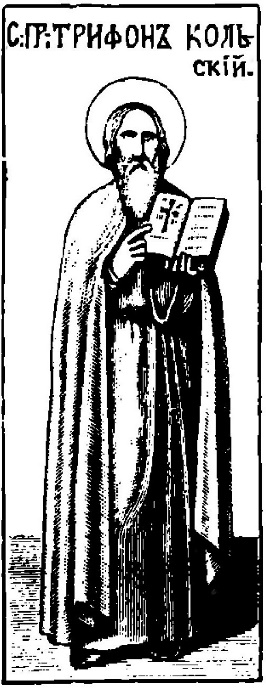
Уроженец Новгородских владений, сын священника, Трифон184, в крещении Митрофан185, призван был Господом на особенный подвиг, на подвиг проповедника веры диким Лопарям.
A native of the Novgorod domains, the son of a priest, Tryphon184, in baptism Mitrophan185, was called by the Lord to a special struggle, to the struggle of a preacher of the faith to the wild Lapps.
С юных лет благочестивый, он кроме того, что любил посещать храм Божий, читал и пел там, – по временам удалялся в уединение, чтобы беседовать с своей душой и Господом. Звание отца священника наводило его на мысль посвятить себя проповеди о св. вере язычникам; но он был призван к тому и особенною волей Божией. Раз, когда он молился в уединённом месте, услышал он голос: «не здесь твоё место, тебя ждёт земля необитаемая и жаждущая». Повинуясь небесному званию, отправился он в Кольский присуд, на р. Печенгу, к диким Лопарям. Страна дальнего севера входила прежде в состав Новгородских владений, а потом перешла под державу вел. князя России186. Русские и в начале XVI в. бывали здесь только временными гостями, являлись для рыбных и звериных промыслов; рыбный промысл манил к св. Носу многих. Недаром говорят поныне: «где рыба ни ходит, а св. Носа не минует»187. – Но между Лопарями для Русских только в Коле была часовня, а церквей нигде не было. Длинная и широкая полоса по р. Печенге была занята более кочующими, чем оседло живущими Лопарями. Это было поле обширное для деятельности проповедника, полного ревностью к истине Христовой и к спасению людей.
Pious from his youth, besides loving to attend the church of God, where he read and sang, he would at times withdraw into solitude to converse with his own soul and with the Lord. His father's calling as a priest led him to think of dedicating himself to preaching the holy faith to the pagans; but he was called to this also by a special will of God. Once, when he was praying in a solitary place, he heard a voice: "This is not your place; an uninhabited and thirsty land awaits you." Obedient to the heavenly call, he set out for the Kola district, on the Pechenga River, to the wild Lapps. The land of the far north had formerly been part of the Novgorod domains, and later passed under the sovereignty of the Grand Prince of Russia186. Even at the beginning of the 16th century, Russians came here only as temporary visitors, appearing for fishing and hunting; the fishing trade drew many to the Holy Nose. Not for nothing is it still said: "Wherever the fish may go, it will not pass the Holy Nose"187. But among the Lapps, for the Russians there was only a chapel in Kola, and churches nowhere. The long and wide strip along the Pechenga River was occupied by Lapps who were more nomadic than settled. This was a vast field for the activity of a preacher filled with zeal for the truth of Christ and for the salvation of men.
Первые сношения с Лопарями завязал Митрофан под видом дел торговли. Потом он говорил с ними о их верованиях и об одной небесной вере. Лопари обожали не только духов, но даже гадов и ночных нетопырей, поклонялись камням. Проповедник Евангелия говорил им, что один есть истинный Бог, один Творец земли и неба, один Отец всех племён и народов, один Спаситель всех потомков первозданного человека. Он показывал детям природы, как близок к ним Отец Небесный, посылая им пищу и одежду, и как грубо-ошибочно обожание идолов и духов, из которых первые не видят и не слышат, а другие – не более, как слуги Божии, мятежные или покорные, но творение одного Творца вселенной. – Тяжелы подвиги, какие надлежало совершать проповеднику Лопарей. Не легко ум отупелый от неподвижности привычек, загрубелый от копоти суеверий и страстей, навести на стези света и истины. Ещё труднее заставить сердце разорвать связь с привычными заблуждениями, с нажитыми привязанностями, с застарелыми пристрастиями. – А вот ещё против проповедника истины восстают жаркие друзья лжи, для которых служение заблуждению выгодное ремесло, – при нём они живут в довольстве и пользуются известностью, без него же они – ничтожество. Кебуны восстали на Митрофана сперва с гордой надеждой оспорить его, потом с ярою злобой, готовой убить и растерзать непобедимого проповедника новых мыслей и дел. Не раз они не только осыпали его бранью, но били жестоко и таскали за волосы. «Ступай прочь отселе, говорили ему кебуны, – иначе ждёт тебя злая смерть»; не раз собирались они и убить его; но Господь хранил раба Своего. Святой ревнитель небесной истины с кротостью переносил брань и побои, и когда свирепела злоба, удалялся в горы, а потом опять выходил на проповедь188. Как ни много в нас худого, – душа наша создана Господом для истины, и сердце ищет вечного покоя. И между Лопарями были такие, которые не оставались глухи для проповеди о вечной истине и вечном повое, – Когда Митрофан на время оставлял упорных произволу их дикой злобы, – оставаясь с своей совестью, они начали видеть свою виновность и нравственное превосходство христианского проповедника; его любовь к ним, его терпение и незлобие, его самоотречение для проповедуемой истины поражали сердца их, и они начали воздыхать о покое, ненаходимом в своей вере. Когда проповедник снова являлся к дикарям и одни из них, волнуемые слепой злобой, кричали – убьём его, другие говорили: он ни в чём не виноват перед нами, напротив он желает нам добра; за что же убивать его? Таким образом сперва немного было таких, которые принимали к сердцу слова проповедника истины, потом число их становилось значительнее.
Mitrophan first established contact with the Lapps under the guise of trade dealings. Then he spoke with them about their beliefs and about the one heavenly faith. The Lapps worshipped not only spirits, but even reptiles and bats, and bowed down to stones. The preacher of the Gospel told them that there is one true God, one Creator of heaven and earth, one Father of all tribes and nations, one Savior of all the descendants of the first-created man. He showed the children of nature how near the Heavenly Father is to them, sending them food and clothing, and how grossly mistaken is the worship of idols and spirits, of which the former neither see nor hear, while the latter are no more than servants of God, rebellious or obedient, but the creation of the one Creator of the universe. — Heavy were the struggles that the preacher to the Lapps had to undergo. It is not easy to lead a mind dulled by the immobility of habits, coarsened by the soot of superstitions and passions, onto the paths of light and truth. It is even harder to force the heart to break its bond with ingrained errors, with acquired attachments, with inveterate passions. — And then, against the preacher of truth arise the ardent friends of falsehood, for whom serving error is a profitable trade; with him they live in comfort and enjoy renown, without him they are nothing. The kebuns rose up against Mitrophan, first with the proud hope of arguing him down, then with furious malice, ready to kill and tear apart the invincible preacher of new thoughts and deeds. More than once they not only showered him with abuse, but beat him cruelly and dragged him by the hair. "Go away from here," the kebuns told him, "or else an evil death awaits you"; more than once they gathered to kill him; but the Lord preserved His servant. The holy zealot of the heavenly truth bore abuse and blows with meekness, and when malice raged, he withdrew into the mountains, and then again came forth to preach188. However much evil there is in us, our soul is created by the Lord for truth, and the heart seeks eternal peace. And among the Lapps there were those who did not remain deaf to the preaching of eternal truth and eternal peace. — When Mitrophan for a time left the stubborn to the will of their wild malice, remaining alone with their conscience, they began to see their own guilt and the moral superiority of the Christian preacher; his love for them, his patience and lack of malice, his self-denial for the truth he preached struck their hearts, and they began to sigh for the peace not found in their own faith. When the preacher again appeared to the savages, and some of them, agitated by blind malice, cried out, "Let us kill him," others said: "He is guilty of nothing before us; on the contrary, he wishes us well; why should we kill him?" Thus at first there were few who took the preacher's words to heart; later their number became more significant.
Блаж. Митрофан и для торговых сношений, которыми он начал свою связь с Лопарями, должен был сколько-нибудь знать Финский язык и, конечно, он узнал разговорный язык дикарей от других, вступавших в торговые связи с Лопарями. Но проповеднику веры надлежало знать гораздо более Финский язык, чем торговцу. На помощь ему Господь послал усердного и способного деятеля, иеродиакона Феодорита; это было в 1529 г., когда северный пустынник уже провёл более 5 лет «в прегорчайшей пустыне»189. Феодорит прежде того 15 лет прожил на Соловецком острове190; там, при частых сношениях с Лопарями, легко было даровитому Феодориту научиться языку Лопарей. Потому не трудно было ему перевести «некоторые молитвы с Славянского языка на язык Лопарей»191. А это было самой важной услугой для Печенжского проповедника.
Blessed Mitrophan, even for the trade dealings by which he began his connection with the Lapps, had to know the Finnish language to some extent, and of course he learned the spoken language of the savages from others who entered into trade relations with the Lapps. But the preacher of the faith needed to know much more of the Finnish language than a trader. To help him, the Lord sent a zealous and capable worker, the Hierodeacon Theodoret; this was in 1529, when the northern hermit had already spent more than five years "in the most bitter wilderness"189. Theodoret had previously lived for fifteen years on the Solovetsky Island190; there, through frequent dealings with the Lapps, it was easy for the gifted Theodoret to learn the language of the Lapps. Therefore it was not difficult for him to translate "certain prayers from the Slavonic language into the language of the Lapps"191. And this was the most important service for the preacher of Pechenga.
После долгих трудов и скорбей проповедника значительное число Лопарей, живущих у р. Печенги. уверовали в Господа Иисуса. Блаж. Митрофан не крестил их, потому что не был облечён в сан священства и даже не был ещё иноком. Он отправился в Новгород испросить у архиепископа Макария грамоту на построение храма. Из Новгорода привёл он с собой и плотников, которые более для Господа, чем за деньги, решились идти с ним в дальнюю и дикую страну. При построении храма блаженный за три версты носил на плечах своих брёвна и лес. – Построенный храм долго оставался не освящённым: из Новгорода не присылали священника. – Митрофан отправился в Колу, тогда ещё малолюдное местечко, и нашёл там иеромонаха Илию, который освятил храм, крестил обученных вере Лопарей и постриг в монашество самого проповедника, с именем Трифона. Это было не прежде 1532 г. Так надобно положить по соображении жития Трифона с летописью. Последняя говорит, что зимой в Филиппов пост 7040 – 1531 г. «прибыли в Великий Новгород Лапландцы с Мурманского (Норвежского моря) с р. Колы и Тутоломи (с р. Туломи, соединяющейся с р. Колой перед впадением в море) и просили государева архиепископа Макария дать им антиминсы и священников, чтобы освятить церкви Божии и их просветить св. крещением. Боголюбивый архиепископ Макарий послал священников и диакона, и они освятили церкви Благовещения Богородицы и святителя Николая в Филиппов пост и их самих крестили в великом числе, даже Лопарей за святым Носом»192.
After the preacher's long labors and sorrows, a considerable number of the Lapps dwelling by the River Pechenga believed in the Lord Jesus. Blessed Mitrophan did not baptize them, because he was not vested with the priestly rank and was not yet even a monk. He set out for Novgorod to ask Archbishop Macarius for a charter for the building of a church. From Novgorod he also brought with him carpenters who, more for the Lord's sake than for money, resolved to go with him into that distant and wild country. During the building of the church, the blessed one carried logs and timber on his shoulders for three versts. — The church when built long remained unconsecrated: no priest was sent from Novgorod. — Mitrophan set out for Kola, then still a sparsely populated place, and found there the Hieromonk Elias, who consecrated the church, baptized the Lapps instructed in the faith, and tonsured the preacher himself into monasticism with the name Tryphon. This was not before the year 1532. So it must be determined by comparing the life of Tryphon with the chronicle. The latter says that in the winter, during the Philip's Fast of the year 7040 — 1531, "there arrived in Great Novgorod Laplanders from the Murmansk (Norwegian) Sea, from the River Kola and Tutoloma (from the River Tuloma, which joins the River Kola before its entry into the sea), and asked the sovereign's archbishop Macarius to give them antiminses and priests, to consecrate the churches of God and to enlighten them with holy baptism. The God-loving Archbishop Macarius sent priests and a deacon, and they consecrated the churches of the Annunciation of the Theotokos and of St. Nicholas during the Philip's Fast, and baptized them in great number, even the Lapps beyond the Holy Nose"192.
Блаженный Трифон, воспользовавшись услугами Кольского иеромонаха для окрещения Печенжских Лопарей, стал устроять на устье р. Печенги обитель Св. Троицы. – Теперь у него были два труда – труд распространения Евангелия и труд устроения обители. Чтобы продолжать дело Евангельской проповеди, надлежало путешествовать. А что это значило в той стране? Жилища Лопарей разбросаны по местам болотистым, пересечённым горами и скалами; ни сёл, ни деревень нет, а только уединённые шалаши. – Каково же было, не встретив готовности сердец в одном жилье, идти по тундрам и горам, чтобы встретить подобный приём в другом шалаше? Подвижник Божий терпеливо трудился. Когда из тех, которые открыли вере христианской глубины души своей, нашлись готовые посвятить жизнь свою служению Господу, – это облегчило труды проповедника веры. Лопари, наученные Трифоном живому благочестию, с живым одушевлением передавали другим семена благочестия, и целый дикий край получил совсем новый вид. Вместе начала укрепляться и обитель Трифона. «Благодатью Божией, писал современник, блаж. Максим Грек, многие иноверные обратились в православную и благочестивую веру христианскую... Прежде того жили они как звери в пустынях непроходимых, в пещерах и расселинах, не имея ни храма, ни нужного для жизни; питались животными, зверями, птицами, морскими рыбами, и что кто ловил, тем торговал... Православие распространилось до Варяжского города Варгава, где живёт капитан или князь. И здесь ныне благоволением Отца, изволением Сына и действием Св. Духа устроен честный монастырь и собралось большое братство иноков. Это в 60 верстах от того Варяжского города, на р. Печенге, близ моря»193. По житию Трифона, крещённые Лопари до того полюбили св. веру, что одни приносили в пользу обители плоды торговли своей – деньги, другие отдавали земли, озёра и приморские угодья. Последнее видим и по царской грамоте, где записаны «земли, воды, угодья и промыслы, что дала в дом живоначальной Троицы новокрещённая Лопь»194.
Blessed Tryphon, having availed himself of the services of the Kola hieromonk for the baptism of the Pechenga Lapps, began to establish the monastery of the Holy Trinity at the mouth of the River Pechenga. — Now he had two labors — the labor of spreading the Gospel and the labor of establishing the monastery. To continue the work of evangelical preaching, it was necessary to travel. And what did that mean in that land? The dwellings of the Lapps were scattered over marshy places, intersected by mountains and cliffs; there were no villages or hamlets, but only solitary huts. — What was it like, when one did not find readiness of heart in one dwelling, to go across the tundras and mountains to meet a similar reception in another hut? The man of God labored patiently. When, among those who had opened the depths of their souls to the Christian faith, there were found some ready to devote their lives to the service of the Lord — this lightened the labors of the preacher of the faith. The Lapps, taught by Tryphon living piety, with lively fervor passed on to others the seeds of piety, and the whole wild region took on an entirely new appearance. At the same time, Tryphon's monastery began to be strengthened. "By the grace of God," wrote a contemporary, the blessed Maximus the Greek, "many of the heterodox were converted to the Orthodox and pious Christian faith... Before that they lived like wild beasts in impassable wildernesses, in caves and clefts, having neither a church nor the necessities of life; they fed on animals, beasts, birds, and sea fish, and whatever one caught, with that he traded... Orthodoxy spread as far as the Varangian city of Vargav, where a captain or prince dwells. And here now, by the good pleasure of the Father, the will of the Son, and the operation of the Holy Spirit, an honorable monastery has been established and a great brotherhood of monks has gathered. This is 60 versts from that Varangian city, on the River Pechenga, near the sea"193. According to the life of Tryphon, the baptized Lapps so loved the holy faith that some brought in support of the monastery the fruits of their trade — money, while others gave lands, lakes, and seacoast properties. The latter we also see in the royal charter, where are recorded "the lands, waters, properties, and fisheries that the newly-baptized Lapps gave to the house of the Life-giving Trinity"194.
В глубоком севере сеять хлеб почти нельзя, его надобно доставать из более тёплого края. «Печенжский монастырь стоит на украине, у студёного моря; пашни около монастыря нет, земля каменистая, стужа великая, во всё лето снег сходит на короткое время», так писали Печенжские иноки столетием позже Трифона195. Потому-то блаж. Трифону, отечески любившему собранную им обитель, не раз приходилось отправляться в Новгород, чтобы там собрать хлеба для своей обители. С таким намерением был он в Новгороде в 1551 г.196.
In the far north it is almost impossible to sow grain; it must be obtained from a warmer region. "The Pechenga monastery stands on the borderland, by the cold sea; there is no arable land around the monastery, the ground is stony, the cold is great, and during the whole summer the snow melts only for a short time," so wrote the Pechenga monks a century after Tryphon195. Therefore blessed Tryphon, who loved with fatherly love the monastery he had gathered, more than once had to set out for Novgorod to collect grain there for his monastery. With such an intention he was in Novgorod in the year 1551196.
Рассадник благочестия и новой веры, насаждённый в стране дикой, нужно было оградить защитой гражданской власти. Блаж. Трифон не принимал на себя звания игумена обители своей, звание игумена предоставил он другому; но он был отцом, насадителем и попечителем своей обители. Потому отправился он в Москву к царю с опытным иноком. В Москве полезен был Трифону прежний сожитель его в Лапландской пустыни, а теперь архимандрит Феодорит; последний в это время пользовался вниманием царя, так что отправлен был вскоре с особенными поручениями на Восток. Друг пустыни и сотрудник по проповеди Лапландской, конечно, говорил в Москве боярам и духовным об усердном проповеднике Трифоне197. Трифон и его спутник представили царю просьбу обители, когда с царевичем Феодором шёл он в храм. Добрый царевич вышел из храма в придел, как-бы по случаю, снял с себя верхнюю одежду и, послав её Трифону, велел сказать: «царевич, посылая одежду, желает, чтобы милостыня его предупредила царскую; пусть преподобный употребит её на церковную одежду». – По возвращении из храма, царь советовался с боярами о просьбе Трифона. Не трудно было видеть, после беглого взгляда на дела блаж. Трифона, что к проповеднику Лопарей не следует относить слов царя, которые незадолго перед тем предлагались собору: «старец поставит келью в лесу или срубит и церковь, но пойдёт по миру с иконой просить на сооружение, а у царя просить земли и руги, а что соберёт, то пропьёт»198. Царь наделил блаж. Трифона как церковной утварью, так и угодьями. Царская грамота от 1 ноября 1556 г. говорит: «по просьбе сыновей моих царевичей Иоанна и Феодора Иоанновичей, пожаловали мы Печенского монастыря, что у холодного моря, у Мурманской границы,обители Св. Троицы игумена Гурия с братией и кто бы там ни был игуменом с братией, в замен руги, молебных и панихидных денег, по их скудости, на пропитание в вотчину, морскими губами (заливами) Матоцкой, Лицкой иУрской, также губами Печенской, Пазренской иНавденской, в море всеми рыбными ловлями и выметом морским, когда из моря выкинет кита или моржа или иного зверя, со всем морским берегом и его островами, с реками и речками, с пашнями и лесами, с лесными озерками и звериными ловлями, с Лопарями, какие только приписаны теперь или будут приписаны к Матоцкой иПеченской губам, со всеми угодьями заливов и с царскими денежными сборами и волостными кормами, чтобы тем монастырь мог обустраиваться и питаться. Боярам нашим Новгородским и Двинским приказным людям Усть-Кольской волости, всем приморским жителям, Карельским детям и Лопарям и всякому другому не вступаться в ту отчину, в реки, тони, рыбные ловли и угодья»199. Блаж. Трифон, возвратясь в свою обитель с царскими и дарами, и грамотой, принёс ей радость и мир. Рыбными ловлями и другими угодьями она теперь обеспечена в существовании. – Первым делом его после благодарности Господу было объявить царскую грамоту местным начальникам и старшинам. Надобно было обрадовать и новокрещённых детей своих. Средствами, привезёнными из Москвы, блаж. Трифон построил для них на устье р. Паза (Паэса) храм св. Бориса и Глеба200.
The nursery of piety and of the new faith, planted in a wild land, needed to be protected by the defense of civil authority. Blessed Tryphon did not take upon himself the rank of abbot of his monastery; the rank of abbot he entrusted to another; but he was the father, planter, and caretaker of his monastery. Therefore he set out for Moscow to the Tsar with an experienced monk. In Moscow, Tryphon's former companion in the Lapland hermitage, and now Archimandrite Theodoret, was useful to him; the latter at that time enjoyed the attention of the Tsar, so that he was soon sent with special commissions to the East. The friend of the hermitage and fellow-worker in the Lapland preaching, of course, spoke in Moscow to the boyars and the clergy about the zealous preacher Tryphon197. Tryphon and his companion presented the monastery's petition to the Tsar when he was going to church with the Tsarevich Theodore. The good Tsarevich went out of the church into the side-chapel, as if by chance, took off his outer garment and, sending it to Tryphon, bade him be told: "the Tsarevich, sending this garment, desires that his alms may precede the Tsar's; let the Venerable One use it for church vestments." — Upon returning from church, the Tsar consulted with the boyars about Tryphon's petition. It was not difficult to see, after a cursory glance at the deeds of blessed Tryphon, that the words of the Tsar, which shortly before had been proposed to the Council, should not be applied to the preacher of the Lapps: "an elder will set up a cell in the forest or cut down timber and build a church, but then go about the world with an icon begging for its construction, and ask the Tsar for lands and support, and whatever he collects, he will drink away"198. The Tsar endowed blessed Tryphon both with church vessels and with properties. The royal charter of November 1, 1556 says: "at the request of my sons, the Tsareviches John and Theodore Ivanovich, we have granted the Pechenga Monastery, which is by the cold sea, at the Murmansk border, the monastery of the Holy Trinity, Abbot Gurias with the brethren, and whoever may be abbot there with the brethren, in place of support, moleben and panikhida money, by reason of their poverty, for their sustenance as a patrimony, with the sea inlets (bays) Matotskaya, Litskaya and Urska, also with the bays Pechenga, Pazrenskaya and Navdenskaya, with all the fishing grounds in the sea and the sea-castings, when the sea casts out a whale or a walrus or any other beast, with all the seacoast and its islands, with rivers and streams, with arable lands and forests, with forest lakes and animal hunting grounds, with the Lapps, whatever are now attached or shall be attached to the Matotskaya and Pechenga bays, with all the properties of the inlets and with the royal money collections and volost provisions, so that the monastery may thereby be established and fed. Let our boyars of Novgorod and Dvina, the officials of the Ust-Kola volost, all the seacoast inhabitants, the Karelian children and the Lapps, and anyone else, not encroach upon that patrimony, its rivers, fishing grounds, fisheries, and properties"199. Blessed Tryphon, returning to his monastery with the Tsar's gifts and charter, brought it joy and peace. With the fisheries and other properties it was now assured of its existence. — His first act after giving thanks to the Lord was to announce the royal charter to the local authorities and elders. It was also necessary to rejoice his newly-baptized children. With the means brought from Moscow, blessed Tryphon built for them at the mouth of the River Paz (Pazesa) a church of Sts. Boris and Gleb200.
С 1557 г. во всём северном краю был сильный продолжительный голод. Несколько лет сряду мороз убивал посевы201. Это вызвало блаж. Трифона на новые, тяжкие труды для обители. Взяв с собой несколько братий, он ходил по Новгородскому краю из одного поселения в другое, испрашивая у Боголюбивых подаяния. Всё, что получал, отсылал он на содержание братии. Так кормил он духовных детей своих целые 8 лет.
From the year 1557, throughout the whole northern region there was a severe and prolonged famine. For several years in succession frost killed the crops201. This called blessed Tryphon to new and heavy labors for the monastery. Taking with him several of the brethren, he went about the Novgorod region from one settlement to another, begging alms from the God-loving. Everything he received he sent for the maintenance of the brethren. Thus he fed his spiritual children for a full 8 years.
С юных лет возлюбив Господа, перенесши столько трудов и скорбей для Него в летах зрелости, преподобный боялся быть неверным Ему в старости и продолжал подвизаться для Него до гроба. – Раз купил он в Коле ручные жернова и положил их себе на плечи, чтобы нести в свою обитель. Ученики просили его не мучить себя такой ношей. «Братия! сказал старец, тяжёлое бремя лежит на потомках Адама, с рождения до самой смерти: к чему веселиться? Нет! Трифон! лучше повесить камень на шею твою, нежели соблазнять братию праздностью». И 158 вёрст от Колы до Печенской обители, дорогой то болотной, то гористой, нёс он жернова на себе; мало и того, он при таком труде мало вкушал пищи.
Having loved the Lord from his youth, having borne so many labors and sorrows for Him in the years of maturity, the Venerable One feared to be unfaithful to Him in old age and continued to strive for Him unto the grave. — Once he bought in Kola hand millstones and placed them upon his shoulders to carry to his monastery. His disciples asked him not to torment himself with such a burden. "Brethren!" said the elder, "a heavy burden lies upon the descendants of Adam, from birth to death itself: why should one make merry? No! Tryphon! better to hang a stone about your neck than to scandalize the brethren by idleness." And for 158 versts from Kola to the Pechenga monastery, along a road now marshy, now mountainous, he carried the millstones upon himself; and not only that, but amid such labor he partook of little food.
Такими подвигами преподобный достиг великой крепости духовной. Раз медведь вошёл в его келью, опрокинул квашню и начал есть тесто. Преподобный, придя к келье, сказал медведю: «Иисус Христос, Сын Божий, мой Бог, повелевает тебе выйти из кельи и стоять смирно». Медведь вышел и стал у ног преподобного. Взяв палку, преподобный наказал виновного медведя и, сказав, чтобы вперёд не смел беспокоить обители, отпустил его. С того времени, прибавлает инок обители, медведи никогда не делали вреда ни оленям, ни другим животным обители.
By such feats the Venerable One attained great spiritual strength. Once a bear entered his cell, overturned the kneading-trough, and began to eat the dough. The Venerable One, coming to the cell, said to the bear: "Jesus Christ, the Son of God, my God, commands you to go out of the cell and stand quietly." The bear went out and stood at the feet of the Venerable One. Taking a staff, the Venerable One punished the guilty bear and, telling it not to dare disturb the monastery henceforth, let it go. From that time, adds the monk of the monastery, bears never did harm either to the deer or to the other animals of the monastery.
В последние годы жизни своей преподобный часто удалялся в пустыньку, где, построив храм Успению Богоматери, проводил время в уединённой молитве202.
In the last years of his life the Venerable One often withdrew to a small hermitage, where, having built a church to the Dormition of the Mother of God, he spent his time in solitary prayer202.
Перед кончиной своей блаж. Трифон был тяжко болен. Наконец, близкий к смерти, сказал он братиям: «заповедую вам, погребите меня у церкви Успения Богородицы в пустыньке, куда отходил я на молчание». Глубокой старости достиг он, если почил в 1583 г.; тогда он прожил на Печенге почти 60 лет203. – Он был ростом не велик, но крепок, несколько сгорблен и плешив, с длинной, седой бородой. Так говорят о нём по уцелевшей древней иконе его и по видениям!
Before his end, the blessed Tryphon was grievously ill. At length, being near death, he said to the brethren: "I command you, bury me at the church of the Dormition of the Mother of God in the hermitage, whither I withdrew for silence." He attained a great age, if he reposed in 1583; by then he had lived on the Pechenga for almost 60 years203. – He was not tall in stature, but strong, somewhat stooped and bald, with a long, grey beard. Thus they speak of him according to a surviving ancient icon of his and from visions!
После кончины его царь Феодор Иванович осаждал крепкий город в Ливонской стране. Осаждённые Немцы, на рассвете, направили пушки свои на царский шатёр, когда царь ещё спал. Ему явился благолепный старец в иноческой одежде и сказал: «встань, государь, и выйди из шатра, иначе будешь убит». – Кто ты такой? спросил царь. Явившийся отвечал: «я тот Трифон, которому ты подал свою одежду, чтобы твоя милостыня предварила другие, – Господь Бог мой послал меня к тебе». Пробудившийся царь едва успел выйти из шатра, как ядро из города ударило в кровать царскую. Благочестивый Феодор возблагодарил Господа за чудное спасение своё. Он послал в обитель Печенгскую найти блажен. Трифона, но получил ответ о его кончине. Царь оказал потом милости обители. «Сказание» не определяет ни года, ни города, когда и где случилось дивное событие с царём. Но без сомнения это было под Нарвой, в феврале 1590 г. Царь Феодор был здесь с войском; Шведы упорно защищали Нарву, но она была взята204.
After his death, Tsar Theodore Ivanovich was besieging a strong city in the Livonian land. The besieged Germans, at dawn, directed their cannons at the Tsar's tent, while the Tsar still slept. A comely elder in monastic garb appeared to him and said: "Arise, Sovereign, and go out of the tent, else you will be killed." – "Who are you?" asked the Tsar. The apparition replied: "I am that Tryphon to whom you gave your garment, so that your alms might precede those of others – the Lord God my God has sent me to you." The awakened Tsar barely managed to go out of the tent when a cannonball from the city struck the Tsar's bed. The pious Theodore gave thanks to the Lord for his miraculous deliverance. He sent to the Pechenga monastery to find the blessed Tryphon, but received word of his death. The Tsar afterwards showed kindnesses to the monastery. The "Tale" does not specify either the year or the city where and when this wondrous event with the Tsar occurred. But without doubt this was at Narva, in February of 1590. Tsar Theodore was there with his army; the Swedes stubbornly defended Narva, but it was taken204.
В то же время (1590 г.) Шведы на севере опустошали поселения Русских. За неделю перед праздником Рождества Христова, говорит «сказание», они сожгли храм Успения Богородицы, где почивали мощи преподобного под спудом. Здесь замучили они праведного инока Иону. – Потом скрылись в засаде. В самый праздник, во время литургии, ворвались они в обитель Св. Троицы и, с зверской жестокостью, начали умерщвлять иноков и послушников; одних рассекли пополам, другим отрубили руки и ноги. Иных вдоль рассекли, – Игумена Гурия и иеродиаконов мучили различно, кололи оружием, жгли на огне, допытываясь от них, где монастырская казна. – Страдальцы не сказали им о казне, и разъярённые Шведы изрубили их в куски. Ограбив, что могли найти, предали они огню храмы и все здания обители. – Всех иноков погублено в обители 51 человек; послушников и рабочих – до 65 человек; остались целы только те, которых не было в обители. После того, по воле ц. Феодора монастырь, для безопасности, основался в г. Коле у Благовещенской церкви. После пожара 1619 г. он построен у города за р. Колой, но до 1675 г. два раза и здесь разоряли его Шведы205.
At the same time (1590) the Swedes in the north were ravaging the settlements of the Russians. A week before the feast of the Nativity of Christ, says the "tale," they burned the church of the Dormition of the Mother of God, where the relics of the Venerable One lay hidden beneath the earth. There they tortured to death the righteous monk Jonah. – Then they hid in ambush. On the very feast day, during the Divine Liturgy, they burst into the monastery of the Holy Trinity and, with bestial cruelty, began to slay the monks and novices; some they cleft in two, others they cut off hands and feet. Some they split lengthwise. – Abbot Gurias and the hierodeacons they tortured in various ways, stabbed them with weapons, burned them with fire, trying to wring from them where the monastery treasury was. – The sufferers did not tell them of the treasury, and the enraged Swedes hacked them to pieces. Having plundered what they could find, they consigned to the flames the churches and all the buildings of the monastery. – In all, 51 monks were slain in the monastery; novices and labourers, up to 65 men; only those who were not in the monastery remained unharmed. After that, by the will of Tsar Theodore, the monastery, for safety's sake, was established in the city of Kola at the church of the Annunciation. After the fire of 1619 it was built near the city beyond the Kola River, but until 1675 the Swedes ravaged it twice more205.
Мощи преподобного остаются под спудом, на месте погребения их, в Печенжском Лопарском погосте, в Сретенской церкви, приписанной к Кольскому собору.
The relics of the Venerable One remain hidden beneath the earth, at the place of their burial, in the Pechenga Lapp pogost, in the church of the Meeting of the Lord, which is attached to the Kola cathedral.
Иноки, перейдя в Колу, сохраняли такой устав: если кому из иеромонахов случалось быть вблизи прежнего места обители, непременно пел панихиду над гробом блаженного основателя обители. – Иеромонах Иона, быв здесь, не только не выполнил устава, но ещё сидел на могиле старца Ионы, замученного Шведами. Когда он отъехал на несколько вёрст от места покоя блаж. Трифона, внезапно вся половина тела его поражена была параличом. Глубоко почувствовав свои согрешения и исповедав их перед братией, он стал молить преподобного простить его. – На четвёртую ночь, явились ему двое святолепных мужей, один в иноческой одежде, другой в священнической. Последний говорил: «начальник и отец мой, святой Трифон! прикоснись к больному, чтобы был он здоров». – «Ты, отец Иона, почтен саном пресвитера, отвечал Трифон, на твоей гробнице сидел он: ты и должен исцелить». Нет, возразил Иона, ты – первоначальник в этой стране и мой учитель, а я только ученик. Преподобный сказал: «если называешь меня учителем, должен ты исполнить мою волю». – Тогда Иона осенил крестным знамением поражённые части больного и сказал: «во имя Святой Троицы, молитвами препод. Трифона, будь здоров и не нарушай пределов, положенных отцами». – Больной, проснувшись, почувствовал себя здоровым и увидел луч света, последовавший за отходящими святыми.
The monks, having moved to Kola, kept this rule: if any of the hieromonks happened to be near the former site of the monastery, he was obliged to sing a panikhida over the grave of the blessed founder of the monastery. – The hieromonk Jonah, having been there, not only did not fulfill the rule, but even sat upon the grave of the elder Jonah who had been tortured to death by the Swedes. When he had gone several versts from the resting-place of the blessed Tryphon, suddenly half of his body was stricken with paralysis. Deeply feeling his transgressions and having confessed them before the brethren, he began to pray to the Venerable One to forgive him. – On the fourth night, two men of holy aspect appeared to him, one in monastic garb, the other in priestly vestments. The latter said: "My superior and father, the holy Tryphon! Touch the sick man, that he may be well." – "You, Father Jonah, are honoured with the rank of presbyter," answered Tryphon, "upon your tomb he sat: it is you who must heal him." "No," replied Jonah, "you are the first-founder in this land and my teacher, while I am only a disciple." The Venerable One said: "If you call me teacher, you must do my will." – Then Jonah made the sign of the cross over the stricken parts of the sick man and said: "In the name of the Holy Trinity, by the prayers of the Venerable Tryphon, be well and transgress not the boundaries laid down by the fathers." – The sick man, upon waking, felt himself well and saw a ray of light following the departing saints.
О блаж. Ионе сохранилось предание, что он был священником церкви св. Николая в г. Коле и в мире назывался Иоанном. Потеря любимого дитяти так поразила его, что он ушёл в обитель блаж. Трифона и стал учеником его; он такую имел любовь к учителю своему, что после его смерти поселился при скитском храме Успения Богоматери, чтобы каждый день совершать литургию за покой усопшего. Здесь мученически убитый Шведами, положен он близ учителя своего.
Concerning the blessed Jonah, a tradition is preserved that he was a priest of the church of St. Nicholas in the city of Kola and in the world was called John. The loss of a beloved child so struck him that he withdrew to the monastery of the blessed Tryphon and became his disciple; he had such love for his teacher that after his death he settled at the skete church of the Dormition of the Mother of God, in order to celebrate the Divine Liturgy daily for the repose of the departed. Here, having been martyred by the Swedes, he was laid near his teacher.
Иноку Иоасафу, ослепшему от тяжкой головной боли, явился преп. Трифон и, коснувшись очам его, сказал: «во имя Св. Троицы будь здоров и прозри, но сохраняй монашество по обету». «Исцелился я и прозрел явлением преп. отца нашего Трифона!» кричал в восторге прозревший, и собравшиеся на голос его иноки прославили Господа.
To the monk Joasaph, who had gone blind from a severe headache, the Venerable Tryphon appeared and, touching his eyes, said: "In the name of the Holy Trinity be well and receive your sight, but keep monasticism according to your vow." – "I was healed and received my sight by the appearance of our Venerable Father Tryphon!" cried the restored man in ecstasy, and the monks who gathered at his voice glorified the Lord.
Житие преп. Трифона, известное ныне, писано после того, как «Св. Троицы и праведного обитель от Немец разорена и сожжена, – житие святаго, самовидцы писанное, погибе... У некоторых в малых книжицах и в писаниях кратких соблюдошеся». Сочинитель говорит: «попудихся службу и житие преподобнаго, во едину книгу совокупив, написати». След. это было не прежде 1655 г.; житие сшито из нескольких рассказов и рукой неискусной. Текст его в Правосл. собесед. 1859 г., но без многих чудес.
The Life of the Venerable Tryphon, as now known, was written after "the monastery of the Holy Trinity and the Righteous One was destroyed and burned by the Germans – the Life of the saint, written by eyewitnesses, perished... It was preserved in some small books and in brief writings." The author says: "I took pains to compile the service and the Life of the Venerable One into one book and write it." Consequently this was not before 1655; the Life is stitched together from several accounts and by an unskilled hand. Its text is in the Orthodox Interlocutor of 1859, but without many of the miracles.
В житии не показано мирское имя Трифона; но у Курбского пустынник, к которому прибыл Феодорит на р. Печенгѵ, называется Митрофаном. «Памятамися, Митрофан бе имя ему». Тогда, как Феодорит прибыл к Печенгскому проповеднику, последний ещё не был Трифоном.
The Life does not give the worldly name of Tryphon; but in Kurbsky the hermit to whom Theodoret came on the Pechenga River is called Metrophanes. "I remember, Metrophanes was his name." At that time, when Theodoret came to the Pechenga preacher, the latter was not yet Tryphon.
Договорная грамота Новгородцев 1265 г. «а се ти, княже, волости Новгородские: Торжек, Бежище, Вологда, Заволоцье (по берегам Двины). Тре (Лапландия), Перем (по Вычегде и верхней Каме), Печора (по берегам Печоры и Урала), Югра (за Уралом)». Летоп. под 1216 г. «Новгородьц убыша Семьюна Петриловпця, Търьскаго даныцика» – сборщика даней с Трейской, Лапландской области. Собр. лет. III, 35.
Treaty charter of the Novgorodians of 1265: "And these, Prince, are the Novgorod volosts: Torzhok, Bezhichi, Vologda, Zavolochye (along the banks of the Dvina). Tre (Lapland), Perm (along the Vychegda and upper Kama), Pechora (along the banks of the Pechora and the Urals), Yugra (beyond the Urals)." Chronicle under 1216: "The Novgorodians killed Semyun Petrilovits, the Tersky tribute-collector" – the collector of tribute from the Tersk, Lapland region. Collection of Chronicles III, 35.
«Народ омраченный, а паче кебуны пряхуся с праведником Божиим и пряхуся яко звери и неисповедимыя ему деяху пакости, за власы торгаху и о землю метаху и бияху и пхаху, называюще незнаема странника и юрода, – вопльствующе нань, аще от предел их не изыдет и пребывати с ними будет, горькою мукою и самою смертию претяху». Ркп. житие. Путешественник Вундерер, посещавший Псков, Пермь и Лапландию в 1590 г., пишет: «что касается до Лапонцев, – эти люди очень грубы и некрасивы, лицо у них толстое, желтоватое, но они очень поворотливы и хорошо стреляют из лука. Одежда их шита из звериных шкур. Они привозят в Ригу свои товары: сухую рыбу, звериные шкуры и т. п. Благодаря своемуволшебству, они безопасно плавают по морю» (Аделунга путешествия иностранцев по России, стр. 282. Μ. 1863). О славе волшебства, которой пользовались Финны и Лопари см. De fama magiae Fennis attributa a Porthan, Aboae 1780.
"The darkened people, and especially the kebuns, quarrelled with the righteous man of God and quarrelled like beasts and did unspeakable mischief to him, they dragged him by the hair and threw him to the ground and beat and shoved him, calling him an unknown stranger and a fool, – crying out against him, that if he did not depart from their borders and would remain with them, they threatened him with bitter torment and death itself." Manuscript Life. The traveller Wunderer, who visited Pskov, Perm and Lapland in 1590, writes: "As for the Lapps – these people are very coarse and ugly, their faces are thick and yellowish, but they are very nimble and shoot well with the bow. Their clothing is sewn from animal skins. They bring their goods to Riga: dried fish, animal skins, and the like. Thanks to their sorcery, they sail the sea safely" (Adelung's Travels of Foreigners in Russia, p. 282. M. 1863). On the fame of sorcery enjoyed by the Finns and Lapps see De fama magiae Fennis attributa by Porthan, Aboae 1780.
Курбского ист. Иоанна. В известиях Курбского о Феодорите должно иметь в виду два определённые предела времени и по ним располагать не совсем точные показания Курбского о Феодорите. Это 1554 г., когда Феодорит подвергся ответам за Артемия, и 1526 г., когда он пришёл в пустыню к Порфирию, бывшему игуменом Сергиевской Лавры до окт. 1525 г. По словам Курбского, с Порфирием пробыл Феодорит 4 года, на р. Коле около 20 лет, два года в Новгороде, 2 года в Новгородском монастыре, 4 года в Суздале (Ист. Иоанна, стр. 130. 131. 133). Таким образом: а) по этому счету прожито Феодоритом до заточения в Кириллов монастырь 30 лет; а с 1526 до 1554 г. выходит 28 лет. б) 20 лет жизни Кольской, очевидно, заключают в себе не только время пребывания Феодорита на Коле и основания там монастыря, но и жизнь Феодорита у Митрофана; по отделении же большего числа лет для жизни в Коле, останется для пребывания с Митрофаном не более 5 лет и при том для пребывания разновременного, в) По счёту Курбского надлежало бы положить, что Феодорит отправился в Новгород в 1551 г., а он в этом году был и в Москве. След. опять – неточность или неполнота.
Kurbsky's History of John. In Kurbsky's accounts of Theodoret one must keep in mind two definite limits of time and by them arrange Kurbsky's not entirely precise indications about Theodoret. These are 1554, when Theodoret was subjected to interrogation concerning Artemius, and 1526, when he came to the hermitage of Porphyry, who was abbot of the Sergius Lavra until October 1525. According to Kurbsky, Theodoret spent 4 years with Porphyry, about 20 years on the Kola River, two years in Novgorod, 2 years in a Novgorod monastery, 4 years in Suzdal (History of John, pp. 130, 131, 133). Thus: a) by this reckoning Theodoret lived 30 years before his imprisonment in the Cyril monastery; and from 1526 to 1554 comes to 28 years. b) The 20 years of life on the Kola obviously include not only the time of Theodoret's sojourn on the Kola and the founding of the monastery there, but also Theodoret's life with Metrophanes; after separating a greater number of years for life on the Kola, there remains for the stay with Metrophanes no more than 5 years and that for a stay at different times. c) According to Kurbsky's reckoning one would have to suppose that Theodoret set out for Novgorod in 1551, but in that year he was also in Moscow. Consequently, again – inaccuracy or incompleteness.
Предисловие к житию Соловецких чудотворцев, изд. Ундольским в библиогр. разысканиях, стр. 30. 31. Также в правосл. собесед. 1859 г. 2, 216. 217. Оно писано, по всей вероятности, после свидания с Артемием и Феодоритом в 1551 г. См. пр. 154.
Preface to the Life of the Solovki Wonderworkers, published by Undolsky in Bibliographical Researches, pp. 30, 31. Also in the Orthodox Interlocutor of 1859, 2, 216, 217. It was written, in all probability, after the meeting with Artemius and Theodoret in 1551. See note 154.
По известию Курбского, о Феодорите говорил царю игумен Сергиевой лавры Артемий, и по его отзывам вызван был Феодорит в Москву для поставления в архимандрита Суздальского (Курбский, стр. 133). поскольку же Артемий с июля 1551 г. пробыл игуменом лавры менее года, то ясно, что Феодорит был у царя в конце 1551 г. и след. за 5 лет раньше того, как Трифон явился в Москву и получил грамоту от 1 нояб. 1556 г. И Курбский, мало зная дела блаж. Трифона, как видно по его отзыву, не ясно отделил деятельность Феодорита, обнимавшую окрестности Колы, от деятельности Трифона, подвизавшегося на Печенге. А другие, включив без разбора в сказание о Трифоне повествования Курбского о Феодорите, навели полный мрак на жизнь Трифона. – Феодорит отправился на восток в 1557 г. летоп. у Карамз. VIII, пр. 587.
According to Kurbsky's account, the abbot of the Trinity–St. Sergius Lavra, Artemy, spoke to the Tsar about Theodoret, and on his recommendation Theodoret was summoned to Moscow to be appointed archimandrite of Suzdal (Kurbsky, p. 133). Since Artemy served as abbot of the Lavra from July 1551 for less than a year, it is clear that Theodoret was with the Tsar at the end of 1551, and consequently five years before Tryphon appeared in Moscow and received the charter of November 1, 1556. And Kurbsky, knowing little of the affairs of the blessed Tryphon, as is evident from his account, did not clearly distinguish the activity of Theodoret, which encompassed the environs of Kola, from that of Tryphon, who labored on the Pechenga. Others, having indiscriminately included Kurbsky's narratives about Theodoret in the account of Tryphon, have cast complete darkness upon the life of Tryphon. — Theodoret set out for the east in 1557, according to the chronicle in Karamzin VIII, note 587.
Ист. иер. 4, 582. 573. Щекатова геогр. словарь 111. 695. Без сомнения в этой грамоте включены и дары, данные обители новокрещёнными.
History of the Hierarchy 4, 582, 573. Shchekatov's Geographical Dictionary 111, 695. Without doubt, this charter also includes gifts given to the monastery by the newly baptized.
Акт. ист. IV, 549. «На Паз р. храм страстотерпцев Христовых Бориса и Глеба – поставление строителя их старца Трифона». То же в грамоте 1657 г. Дополн. к ис. акт. VI, 391. В книге большого чертежа – читаем: «на устье с левой страны р. Таза, от моря 20 вёрст, погост Бориса и Глеба». Таз – ошибка, чит. Паз. Ныне на картах: р. Паяс. – Далее в кн. чертежа: от Паза р. морским берегом 20 вёрст пала в море речка Деньга да речка Воема; а промеж тех речек Волотово городище» (стр. 160). Под именем Волотов известны были великаны. Карамз. V, пр. 210.
Acts of History IV, 549. "On the Paz River, the church of the Passion-bearers of Christ, Boris and Gleb — the foundation of their builder, the elder Tryphon." The same in the charter of 1657, Supplements to the Acts of History VI, 391. In the Book of the Great Map we read: "at the mouth, on the left side of the Taz River, 20 versts from the sea, the churchyard of Boris and Gleb." Taz is an error; read Paz. Now on maps: the Payas River. — Further in the Book of the Map: from the Paz River along the seashore 20 versts, the rivulet Denga and the rivulet Voyema fall into the sea; and between those rivulets is Volotovo Gorodishche (p. 160). Giants were known by the name Volots. Karamzin V, note 210.
По большому чертежу видно, что «пустынька» впоследствии обращалась в монастырь. Здесь читаем: «на усть реки Печенги два монастыря», стр. 160.
According to the Great Map, it is evident that the "little hermitage" was later turned into a monastery. Here we read: "at the mouth of the Pechenga River, two monasteries," p. 160.
По житию, он скончался декабря 15-го 1583 г. По одному списку святцев преподобный преставился июля 23, но другому – нояб. 14, по третьему – дек. 15 д. День кончины без сомнения 15 декабря, прочие дни – дни празднования перенесения мощей.
According to his life, he reposed on December 15, 1583. According to one list of the saints, the Venerable one reposed on July 23, but according to another — November 14, and according to a third — December 15. The day of his death is without doubt December 15; the other days are days of the celebration of the translation of his relics.
В ркп. житии, после известия об иноках, избиенных «от Свейских Немец», следуют статьи «о священноиноце Ионе Сорокоуме; о кровоточивой жене; о вдове Марии; о исцелении отрока Игнатия; о Иоасафе мнисе; о спасении монастырской лодии от потопления; о спасении другой лодии; об исцелении ока; о явлении преподобнаго иерею Алексею; о мнисе Иоасафе Майкове; о игумене Иоанне.
In the manuscript Life, after the account of the monks slain "by the Swedes and Germans," follow the articles: "about the hieromonk Jonah Sorokoum; about the woman with an issue of blood; about the widow Maria; about the healing of the youth Ignatius; about the monk Joasaph; about the saving of the monastery's boat from sinking; about the saving of another boat; about the healing of an eye; about the appearance of the Venerable one to the priest Alexis; about the monk Joasaph Maikov; about the abbot John."