Orthodox Translations

December 1212 декабря

Old Calendar: civil December 25 · New Calendar: civil December 12

History

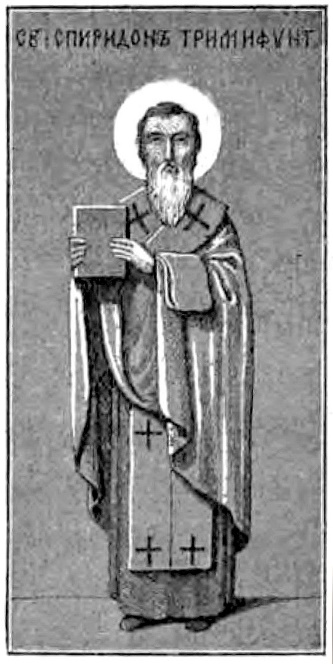
Св. Спиридона, епископа Тримифунтского

St. Spyridon, Bishop of Trimythous

E1.TAI draft
Engraving

Св. Спиридон родился на острове Кипре от родителей простого звания; был женат, имел детей и отличался необыкновенным смирением и христианской мудрой простотой сердца, чем и приобрёл такое уважение к себе, что по смерти жены своей, за святость жизни был единодушно избран и поставлен в епископа города Тримифунта. И в святительском сане св. Спиридон жил с прежней простотой, трудился в поле вместе с простыми работниками, продолжал заниматься овцеводством, что не препятствовало ему относиться с деятельным вниманием ко всем нуждам своей паствы, духовным и материальным. С величайшей любовью служил он всем словом и делом и был так угоден Богу, что получил дар спасительной для многих прозорливости и, вообще, чудотворений. В воспоминании сохранились бесчисленные примеры совершенной точности его предсказаний, вследствие чего он даже воздерживался произносить угрозы, чтобы его не считали причиной прозорливо предвидимых им бедствий... Так напр. предсказал святитель Спиридон посрамление замысла одного бесчеловечного корыстолюбца, желавшего обогатиться на счёт бедствующих, и это исполнилось. Когда, во время голода на острову, один из хлебных торговцев, закупив большой запас хлебного зерна, не хотел уступить его даже ни одному бедняку по уменьшенной цене, то на жалобу одного из этих несчастных, которым угрожала голодная смерть, святитель сказал: – «не плачь... завтра же дом твой наполнится житом, и богач, который отказал тебе сегодня в хлебе, завтра сам будет упрашивать тебя взять у него хлеб без платы» ... – И действительно в ту же ночь пролился такой сильный дождь, что все житницы хлебного торговца были размыты и хлебные зерна разнесены по всему городу, так что всякий мог собирать себе, сколько хотел, а растерявшийся богач, бросаясь во все стороны, сам упрашивал всех и в том числе вчерашнего бедняка взять, сколько хотят хлеба, чтобы только помочь ему спасти остальное зерно...

St. Spyridon was born on the island of Cyprus to parents of simple station; he was married, had children, and was distinguished by extraordinary humility and Christian wise simplicity of heart, by which he acquired such respect for himself that after the death of his wife, for the holiness of his life he was unanimously chosen and appointed bishop of the city of Trimythous. And in the hierarchal rank, St. Spyridon lived with his former simplicity, labored in the field together with simple workers, and continued to occupy himself with sheep-herding, which did not hinder him from attending with active care to all the needs of his flock, both spiritual and material. With the greatest love he served all by word and deed, and was so pleasing to God that he received the gift of clairvoyance, saving for many, and, in general, of wonderworking. In remembrance there have been preserved countless examples of the perfect accuracy of his predictions, as a result of which he even refrained from uttering threats, lest he be considered the cause of the calamities he clairvoyantly foresaw... Thus, for example, Hierarch Spyridon predicted the shaming of the scheme of a certain inhuman lover of gain, who wished to enrich himself at the expense of the suffering, and this came to pass. When, during a famine on the island, one of the grain merchants, having purchased a large supply of wheat, did not wish to sell it even to a single poor man at a reduced price, then to the complaint of one of these unfortunates, who were threatened with death by starvation, the hierarch said: "Do not weep... tomorrow your house will be filled with grain, and the rich man who refused you bread today will himself beg you tomorrow to take bread from him without payment"... And indeed, that very night such a heavy rain poured down that all the granaries of the grain merchant were washed away and the grains of wheat were scattered throughout the whole city, so that everyone could gather for themselves as much as they wished, while the bewildered rich man, rushing about in all directions, himself begged everyone, including the poor man of the day before, to take as much bread as they wished, only to help him save the remaining grain...

E1.0AI draft

Святитель Спиридон, как известный ревнитель веры, был тоже в числе епископов, принимавших участие в первом Вселенском Соборе, созванном в Никее для обличения лжеучения Ария, и, не смотря на свою простоту и на отсутствие всякой учёности, простым, но полным убеждения изложением веры убедил одного знаменитого философа в истине православного верования до такой степени, что он, не найдя слов для возражения, сказал святителю:

Hierarch Spyridon, as a known zealot of the faith, was also among the bishops who took part in the First Ecumenical Council, convened in Nicaea for the refutation of the false teaching of Arius, and, despite his simplicity and the absence of any learning, by a simple but conviction-filled exposition of the faith, he convinced a certain famous philosopher of the truth of the Orthodox belief to such a degree that he, finding no words for objection, said to the hierarch:

E1.1AI draft

– «Верю теперь я во всё то, что ты говорил», – и сознавался потом друзьям своим, что «чувствовал непреодолимую силу истины, исходившую из уст святого епископа» ...

"Now I believe in everything that you have said," and later confessed to his friends that he "felt the irresistible power of truth that proceeded from the mouth of the holy bishop"...

E1.2AI draft

Прославленный многими чудесами, святитель Спиридон, предузнав заранее время своего отшествия из мира, мирно скончался в глубокой старости – в 348 г. Был погребён в церкви святых Апостолов в г. Тримифунте.

Glorified by many miracles, Hierarch Spyridon, having foreknown the time of his departure from the world, peacefully reposed in deep old age—in the year 348. He was buried in the church of the Holy Apostles in the city of Trimythous.

E1.3AI draft

О нетленных мощах его известно171, что «около половины VII стол. по причине набегов варваров они были перенесены в Константинополь; в 1453 г., мая 29-го иерей Георгий, по прозванию Калохерет, взяв их и также мощи Феодоры Августы, отправился в Сербию, а оттуда на остров Корфу в 1460 г. Мощи св. Феодоры он передал жителям Корфу в общее достояние, а мощи св. Спиридона до сих пор, как многоценное сокровище, хранятся у его потомков неповреждёнными, так что кожа плоти его сохраняет мягкость. – Действительно Русские паломники XIV и XV веков, Стефан Новгородец в Зосима, видели мощи его в Константинополе в храме Апостолов. Барский в XVII стол. видел всё тело его на о. Корфу в церкви его имени, кроме правой руки, которая – в Риме, в церкви Богоматери новой».

Concerning his incorrupt relics it is known171 that "around the middle of the 7th century, on account of barbarian incursions, they were transferred to Constantinople; in 1453, on May 29, the priest George, surnamed Kalocheret, taking them and also the relics of the Augusta Theodora, set out for Serbia, and from there to the island of Corfu in 1460. The relics of St. Theodora he handed over to the inhabitants of Corfu as common property, while the relics of St. Spyridon are preserved to this day, as a most precious treasure, by his descendants, undamaged, so that the skin of his flesh retains softness. Indeed, Russian pilgrims of the 14th and 15th centuries, Stephen of Novgorod and Zosima, saw his relics in Constantinople in the Church of the Apostles. Barsky in the 17th century saw his entire body on the island of Corfu in the church of his name, except for the right hand, which is in Rome, in the Church of the New Mother of God."

E1.4AI draft

«Слава давшему тебе крепость, слава венчавшему тя, слава действующему тобою всем исцеления!» – воспевает Церковь святителю Спиридону, – любовию Христовою уязвився, священнейший, ум вперив зарею духа, детельным видением твоим деяние обрел еси, Богоприятне, жертвенник Божественный быв, и прося всем Божественнаго сияния» ...

"Glory to Him who gave thee strength, glory to Him who crowned thee, glory to Him who through thee worketh healings for all!"—the Church sings to Hierarch Spyridon—"Wounded with love for Christ, O most sacred one, having fixed thy mind upon the dawn of the Spirit, by thy active vision thou didst find action, O God-acceptable one, having become a divine altar, and asking for all divine radiance"...
E1.5AI draft

Св. Александра, епископа Иерусалимского

St. Alexander, Bishop of Jerusalem

E2.TAI draft

Около 209 года епископствовал в каком-то городе Каппадокии и за ревность к христианству претерпел темничное заключение. Бывши в узах, услышал о возведении (210 г.) на Антиохийский престол исповедника Асклипиада и приветствовал церковь Антиохийскую следующим посланием: «Александр, раб и узник Иисуса Христа, блаженной Церкви Антиохийской желаю здравствовать о Господе. Лёгкими и удобоносимыми соделал Господь узы мои во время заключения, сподобив меня услышать, что на епископский престол Антиохийской Церкви вашей промыслом Божиим поставлен Асклипиад, муж достойнейший по заслугам веры» и проч. Освободившись из заключения, прибыл на Богомолье в Иерусалим (212 г.) и тут избран в соправители сто-шестнадцати-летнему Иерусалимскому епископу Наркису (7 августа), по смерти коего, (213 года) епископствовал в Иерусалиме 38 лет. В истории христианского просвещения он известен тем, что на свой счёт собрал при Иерусалимской Церкви значительную библиотеку книг св. Писания и существовавших в то время творений христианских писателей. Этой библиотекой пользовался в своё время (в IV веке) и Евсевий, писатель Церковной Истории.

Around the year 209 he was bishop in some city of Cappadocia, and for zeal for Christianity he suffered imprisonment in chains. While in bonds, he heard of the elevation (in 210) of the Confessor Asclepiades to the Antiochene throne and greeted the Church of Antioch with the following epistle: "Alexander, a servant and prisoner of Jesus Christ, to the blessed Church of Antioch wishes health in the Lord. Light and easily borne has the Lord made my bonds during my imprisonment, having vouchsafed me to hear that upon the episcopal throne of your Church of Antioch, by the providence of God, Asclepiades has been placed, a man most worthy by the merits of faith," and so forth. Having been freed from imprisonment, he arrived on pilgrimage to Jerusalem (in 212) and there was chosen as co-ruler of the one-hundred-sixteen-year-old Bishop of Jerusalem, Narcissus (August 7), after whose death (in 213) he was bishop in Jerusalem for 38 years. In the history of Christian enlightenment he is known for having gathered, at his own expense, a significant library of the books of Holy Scripture and of the works of Christian writers existing at that time for the Church of Jerusalem. This library was used in his time (in the 4th century) also by Eusebius, the writer of Church History.

E2.0AI draft

В гонение Декия, в 250 году, святитель Александр вытребован был в Кесарию Палестинскую на суд и там вторично исповедал Христа. Брошенный в темницу, он долго пробыл там и умер в 251 году.

In the persecution of Decius, in the year 250, Hierarch Alexander was summoned to Caesarea in Palestine for trial and there for the second time confessed Christ. Thrown into prison, he remained there for a long time and died in the year 251.

E2.1AI draft

Св. мученика Разумника

St. Martyr Razumnik

E3.TAI draft

Римлянин по рождению, он папой Сикстом (257–258) произведён был в чтеца, а в царствование Аврелиана, около 275 года, за исповедание имени Христа подвергнут пыткам и обезглавлен. Имя Разумник есть перевод Греческого Синетос (Συνετός – Разумный); у Римлян же называется он Синезий.

A Roman by birth, he was appointed a reader by Pope Sixtus (257–258), and in the reign of Aurelian, around the year 275, for confessing the name of Christ he was subjected to tortures and beheaded. The name Razumnik is the translation of the Greek Synetos (Συνετός—Intelligent); among the Romans, however, he is called Synesius.

E3.0AI draft

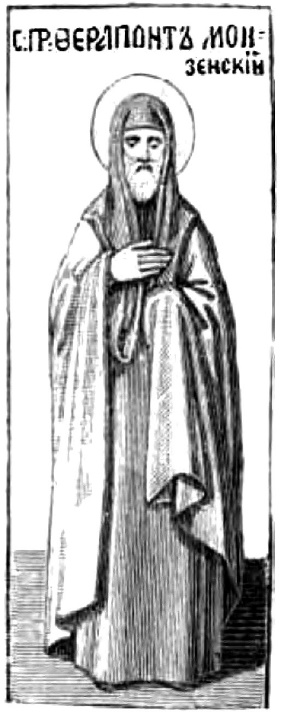
† Преподобного Ферапонта Монзенского

† Venerable Therapont of Monza

E4.TAI draft
Engraving

Преподобный Ферапонт172 почти во всю жизнь свою был сокровенным рабом Божиим. Он старался скрывать свои подвиги от глаз людских. По некоторым случаям и словам его видно, что он жил в Москве и проводил жизнь, по примеру блаженного Василия. Так, когда видел его Пафнутий ещё в Обнорском монастыре, на вопрос Пафнутиев: «кто он»? отвечал: «я сожитель Василиев, что на Москве». Точно также, когда в первый раз виделся с ним Адриан, он сказал ему: «ты будешь мне отцом и тогда узнаешь моё имя; теперь же скажу, что я сожитель Василия, который в Москве». Поселясь в Монзенской обители, на вопросы любопытных отвечал, что он «постриженик Воздвиженского монастыря, что и в Костроме, но бывал и в царствующем граде, где жил близ дома блаженного Василия, отделённый от него одним лишь тыном». За 16 лет до кончины своей, как сам он сказал духовнику, пострижен он в Костромском Воздвиженском монастыре, и след. в 1575 г. Таким образом ясно, что он не видал в живых блажен. Василия († 1554 г.), а только подражал сокровенному духовному житию его. О жизни его в Костромской обители дознано, что он служил здесь примером послушания, был великим постником, и братия уважала его за высокую жизнь. Жители Костромы, начиная с воеводы, питали к нему уважение, приходили слушать наставления его и принимать благословение; он принимал посещавших с любовью, но иных строго обличал за слабую жизнь и пристрастие к мирской суете. Тяготясь известностью, удалился он из Костромы и поселился на реке Монзе, при впадении её в Кострому, в 25 верстах от Галича; место, где поселился он, было лесное и окружено болотами, так что сюда можно было проникать только рекой Костромой. – Незримый никем, подвизался он здесь в молитве и посте. Только след незнаемого человека видели здесь на траве; но пустынник не показывался никому. Инок Адриан, поселившийся с несколькими в запустевшем Благовещенском монастыре и обижаемый здесь полой водой, хотел перенести монастырь на другое, понравившееся ему, место. Незнаемый отшельник пришёл к нему и сказал: «не трудись, старец! другое тебе назначено место, – на берегу реки Монзы; ты узнаешь его тогда, как двое юношей исцелятся от жестокой болезни», Адриан осматривал место на реке Монзе и, наконец, решился перевозить туда монастырь. В это время привезены в Благовещенскую обитель Адриана два больных отрока, один из Буйгорода, другой из Сольгалича; отец первого сказал, что неизвестный старец сказал ему, что сын его исцелится у старца Адриана, у которого ветхий монастырь Благовещенский, а на новом месте – храм Воскресения Христова и Николая чудотворца. По рассказу другого, старец сказал ему, что больной сын его исцелится у Адриана, который переносит монастырь на устье реки Монзы. Больные действительно исцелились у Адриана по совершении молебствия в храме. Когда монастырь уже устраивался на новом месте, преподобный Ферапонт сам пришёл в обитель Монзенскую и стал жить здесь. Он взял слово с Адриана, что не будет говорить о нём ничего, что известно ему, и просил быть его духовным отцом. «Скоро, прибавил преподобный, спустя два года с половиной, исполнится надо мною воля Божия; до смерти же моей не разглашай о мне». С того времени Ферапонт каждый день выходил из обители и, перейдя реку Монзу, скрывался в чаще леса; там молился он наедине, ночь же проводил в келье без сна и переписывал книги. Инок Кирилл возроптал на св. старца, что не участвует в строении обители, и увидел Эфиопов, внушавших ему негодование на святого; тяжело ему было от этих посетителей, пока не пришёл к нему Ферапонт, разогнавший духов, но запретивший говорить о том. Раз вышел преподобный в лес на обычное место для уединённой молитвы. Женщина Пелагия, собиравшая ягоды, увидев его издали, перешла овраг, чтобы посмотреть на него вблизи. Старец сидел на колоде, обнажённый до пояса; по телу его, искусанному комарами, лилась кровь, и над ним роились оводы. По пытливости женской, она подошла ещё ближе и ослепла. В страхе закричала она: «угодник Божий! прости меня грешную», и с этим словом невидимая сила отбросила её за овраг, и она стала видеть; но она боялась сказать о случившемся с ней кому-либо другому, кроме старца Адриана. Служивший в обители Пётр, видя однажды преподобного, идущего за реку Монзу, сказал ему с насмешкой: «древен ты годами, а ступаешь искусно, как-бы плывёшь ногами, и мантия на тебе не движется». Старец ничего не отвечал ему и прошёл мимо. Пётр, возвратясь в монастырь, почувствовал страшную боль в голове, и лицо его искривилось. Адриан, узнав о его болезни нечаянной, спросил: «не говорил ли ты при встрече чего-нибудь оскорбительного св. старцу?» Пётр исповедал грех свой. Адриан советовал ему молиться и просить прощения у блаженного Ферапонта. Когда св. старец выходил от вечерни, больной просил у него помилования. Ферапонт возложил на него руки и сказал: «не надобно осуждать никого», и болезнь миновалась. За день до кончины, блаженный Ферапонт сказал братии: «близок конец мой», и просил причастить его св. Таин во время литургии. Братия, видя его на ногах, не хотели верить, что скоро умрёт он. В самый день, кончины его все собрались к утрени; это был воскресный день неделя св. праотец; пришёл к утрени и блаженный Ферапонт: по окончании службы простился он со всей братией и пошёл в келью. Игумен Адриан пригласил братию идти в келию, чтобы видеть кончину праведника. Братия и теперь повторяли, что ещё крепок он; но когда пришли в келью, – преподобный лежал на одре в мантии и куколе, и свечи горели перед иконами; он уже отошёл ко Господу. Это было декабря 12-го 1591 г.173.

Venerable Therapont172 was a hidden servant of God for almost his entire life. He strove to conceal his ascetic labors from human eyes. From certain incidents and his words, it is evident that he lived in Moscow and led a life after the example of Blessed Basil. Thus, when Paphnutius saw him while still in the Obnora Monastery, and asked him, “Who are you?” he replied: “I am the cell-mate of Basil, who is in Moscow.” Likewise, when Adrian first met him, he said: “You will be a father to me, and then you will know my name; for now I will say that I am the cell-mate of Basil, who is in Moscow.” Having settled in the Monza monastery, in answer to the curious he replied that he was “a tonsured monk of the Vozdvizhensky Monastery, which is in Kostroma, but I was also in the reigning city, where I lived near the house of Blessed Basil, separated from him only by a fence.” Sixteen years before his repose, as he himself told his spiritual father, he was tonsured in the Kostroma Vozdvizhensky Monastery, and consequently in the year 1575. Thus it is clear that he did not see the blessed Basil alive († 1554), but only imitated his hidden spiritual life. Concerning his life in the Kostroma monastery, it is known that he served there as an example of obedience, was a great faster, and the brethren respected him for his lofty life. The inhabitants of Kostroma, beginning with the voivode, held him in esteem, coming to hear his instructions and receive his blessing; he received visitors with love, but also sternly reproved some for their weak life and attachment to worldly vanity. Burdened by his fame, he departed from Kostroma and settled on the Monza River, at its confluence with the Kostroma, 25 versts from Galich; the place where he settled was wooded and surrounded by marshes, so that it could only be reached by the Kostroma River. – Seen by no one, he struggled here in prayer and fasting. Only the trace of an unknown man was seen on the grass; but the hermit showed himself to no one. The monk Adrian, who had settled with several others in the abandoned Annunciation Monastery and was troubled there by floodwaters, wished to move the monastery to another place that pleased him. The unknown hermit came to him and said: “Do not trouble yourself, elder! Another place is appointed for you—on the bank of the Monza River; you will know it when two youths are healed of a grievous illness.” Adrian examined the place on the Monza River and finally decided to move the monastery there. At that time, two sick youths were brought to Adrian’s Annunciation monastery, one from Buigorod, the other from Solgalich; the father of the first said that an unknown elder had told him that his son would be healed by the elder Adrian, who had the old Annunciation Monastery, and at the new place—a church of the Resurrection of Christ and of Nicholas the Wonderworker. According to the account of the other, the elder told him that his sick son would be healed by Adrian, who was moving the monastery to the mouth of the Monza River. The sick youths were indeed healed by Adrian after a moleben was served in the church. When the monastery was already being established in the new place, the Venerable Therapont himself came to the Monza monastery and began to live there. He extracted a promise from Adrian that he would not speak of anything he knew about him, and asked him to be his spiritual father. “Soon,” added the venerable one, “in two and a half years, the will of God will be fulfilled upon me; until my death, do not reveal anything about me.” From that time, Therapont would leave the monastery every day and, crossing the Monza River, hide in the thicket of the forest; there he prayed alone, while the night he spent in his cell without sleep, copying books. The monk Cyril murmured against the holy elder for not taking part in the building of the monastery, and saw Ethiopians who inspired him with indignation against the saint; he was burdened by these visitors until Therapont came to him, driving away the spirits, but forbidding him to speak of it. Once the venerable one went into the forest to his usual place for solitary prayer. A woman named Pelagia, who was gathering berries, saw him from afar and crossed a ravine to look at him closely. The elder was sitting on a log, stripped to the waist; blood flowed from his body, bitten by mosquitoes, and gadflies swarmed over him. With womanly curiosity, she came even closer and became blind. In fear she cried out: “Man of God! Forgive me, a sinner,” and with these words an invisible force threw her back across the ravine, and she regained her sight; but she was afraid to tell anyone of what had happened to her except the elder Adrian. Peter, who served in the monastery, seeing the venerable one once going across the Monza River, said to him mockingly: “You are old in years, but you step skillfully, as if swimming with your feet, and your mantle does not move.” The elder answered him nothing and passed by. Peter, returning to the monastery, felt a terrible pain in his head, and his face became distorted. Adrian, learning of his sudden illness, asked: “Did you say anything offensive to the holy elder when you met him?” Peter confessed his sin. Adrian advised him to pray and ask forgiveness of the blessed Therapont. When the holy elder came out from Vespers, the sick man begged for his mercy. Therapont laid his hands on him and said: “One must not judge anyone,” and the illness passed. The day before his repose, the blessed Therapont said to the brethren: “My end is near,” and asked to be communed with the Holy Mysteries during the Divine Liturgy. The brethren, seeing him on his feet, did not want to believe that he would soon die. On the very day of his repose, all gathered for Matins; it was the Sunday of the Holy Forefathers; the blessed Therapont also came to Matins: after the service, he took leave of all the brethren and went to his cell. Hegumen Adrian invited the brethren to go to the cell to see the death of the righteous one. The brethren again repeated that he was still strong; but when they came to the cell, the venerable one was lying on his bed in his mantle and cowl, and candles were burning before the icons; he had already reposed in the Lord. This was on December 12, 1591173.

E4.0AI draft

В загробной жизни своей преподобный творил много чудес для земли. Раз после литургии игумен Адриан лёг отдохнуть на рогожке. Является Ферапонт и говорит: «спустя десять лет будет великий голод в России; береги рожь: многие будут тогда питаться из твоих житниц, и они не оскудеют; тогда заселятся и пустые земли твои». Феодосий, слепой старец, постриженик обители, в полночь молол жерновом рожь. И вот яркий свет наполнил храмину, и он увидал свет, исходящий из храма св. Николая; перед царскими дверьми стоял преподобный Ферапонт. «Чего ты просишь у Господа?» спросил его преподобный. «Отпущения грехов», отвечал слепой старец. «Подвизайся, и как начал, так и довершай; спустя немного времени увидишь ты свет вечности», сказал ему чудный Ферапонт. После того старец опять остался во мраке. В другое время Феодосий в полдень молол хлеб. Опять явился ему Ферапонт и сказал: «мир тебе и благословение». Феодосий, хорошо знавший его при жизни, пал к его ногам. Преподобный сказал: «спустя немного времени будет великий голод во всей России, но ты не доживёшь до того; скоро ты увидишь меня в другом мире; скажи тайно Адриану, чтобы крепко берёг рожь; многим придётся питаться от монастыря». Блаженный Феодосий скоро скончался174. В Успенский пост 1601 года мороз уничтожил хлеб по всей России: настал страшный голод и продолжался три года. В Москве похоронено в скудельницах до 127,000 человек, умерших от голода175. Обитель преподобного Ферапонта была питатальницей для всей окрестности, люди селились на пустошах монастырских, не находя на прежних местах пропитания. Игумен Адриан отпускал хлеб всем нуждающимся, в уповании на Господа, и, как предсказывал преподобный Ферапонт, житницы обители не оскудели176.

In his afterlife, the venerable one worked many miracles for the land. Once, after the Divine Liturgy, Hegumen Adrian lay down to rest on a mat. Therapont appeared and said: “In ten years there will be a great famine in Russia; keep the rye: many will then be fed from your granaries, and they will not be depleted; then your empty lands will also be settled.” Theodosius, a blind elder and a tonsured monk of the monastery, was grinding rye with a millstone at midnight. And behold, a bright light filled the room, and he saw light issuing from the church of St. Nicholas; before the royal doors stood the Venerable Therapont. “What do you ask of the Lord?” the venerable one asked him. “Forgiveness of sins,” answered the blind elder. “Strive, and as you have begun, so finish; in a little while you will see the light of eternity,” said the wondrous Therapont. After that, the elder was again left in darkness. Another time, Theodosius was grinding grain at noon. Again Therapont appeared to him and said: “Peace to you and a blessing.” Theodosius, who had known him well in life, fell at his feet. The venerable one said: “In a little while there will be a great famine throughout all Russia, but you will not live to see it; soon you will see me in the other world; secretly tell Adrian to guard the rye firmly; many will have to be fed from the monastery.” The blessed Theodosius soon reposed174. During the Dormition Fast of 1601, frost destroyed the grain throughout all Russia: a terrible famine began and lasted three years. In Moscow, up to 127,000 people who died of hunger were buried in common graves175. The monastery of the Venerable Therapont was a source of nourishment for the entire surrounding area; people settled on the monastery’s waste lands, finding no sustenance in their former places. Hegumen Adrian distributed bread to all the needy, trusting in the Lord, and, as the Venerable Therapont had foretold, the monastery’s granaries were not depleted176.

E4.1AI draft

Жизнь преподобного Ферапонта повторяет нам наставление Спасителя:

The life of the Venerable Therapont repeats for us the instruction of the Savior:

E4.2AI draft

«Когда молишься, не будь как лицемеры, которые любят в синагогах и на улицах становиться на молитву, чтобы видели их люди. Истинно говорю вам: они получили уже себе награду. Ты же, когда молишься, войди в комнату твою и, затворив за собою двери, помолись Отцу твоему, Который втайне, и Отец Твой, видящий тайное, воздаст тебе явно» (Мф.6:5–6).

“When thou prayest, be not as the hypocrites, who love to stand and pray in the synagogues and on the street corners, that they may be seen by men. Verily I say unto you, they have received their reward. But thou, when thou prayest, enter into thy closet, and when thou hast shut thy door, pray to thy Father in secret; and thy Father, who seeth in secret, shall reward thee openly” (Mt. 6:5–6).

E4.3AI draft

Примечания Notes

Из Греческого Часослова (1838 г.) – по указ. архим. Серг. в «Полном месяцесл. Вост.» т. II, ч. II, стр. 385.

From the Greek Horologion (1838) – according to the indication of Archim. Sergius in the “Complete Menology of the East,” vol. II, part II, p. 385.

N171AI draft

Ркп. повествование о начале Монзенского монастыря, писанное Монзенским иеромонахом, спустя 39 лет после кончины преп. Ферапонта. У Царского № 118.

Manuscript narrative of the founding of the Monza Monastery, written by a hieromonk of Monza, 39 years after the repose of the Venerable Therapont. In the collection of Tsarsky, No. 118.

N172AI draft

В повествовании о начале монастыря сказано, что преподобный преставился в 1591 г. В ркп. святцах: «пр. Ферапонт, чудный отец Благовещенского монастыря Монзенского, чудотворец, преставился в л. 7094 м. дек. 12 д.» след. 1585 года. То же в ист. иер. 6, 849. Правда на стороне повести: голод, бывший спустя 10 лет после кончины пр. Ферапонта, был в 1601 г.

In the narrative of the founding of the monastery, it is said that the venerable one reposed in 1591. In manuscript menologia: “Venerable Therapont, wondrous father of the Annunciation Monastery of Monza, wonderworker, reposed in the year 7094, month of December, day 12,” consequently 1585. The same in the History of the Hierarchies 6, 849. The truth is on the side of the narrative: the famine that occurred 10 years after the repose of the Venerable Therapont was in 1601.

N173AI draft

«Преподобн. Феодосий, трудник Монзенского монастыря», в ркп. святцах.

“Venerable Theodosius, toiler of the Monza Monastery,” in manuscript menologia.

N174AI draft

О трёхлетнем голоде, начавшемся успенским моровом 1601 г. Арцибашев в повеств. о России, кн. 5, стр. 62–64. У Трехлетова Апостол, писанный в Ростовском Борисоглебском монастыре, со след. современными паметками: «л. 7110 (1601) мороз побил... яр запала от него. С тех мест стал быть хлеб дорог. 110 г. В Ростове была четверть ржи по 20 алтын, а 111 г. в Ростове была в полтретья рубли четверть ржи, а на Москве была по три рубли и слишком, и того году людей множество с гладу мерло и со мразу и от разбоя и от пожара. Тот год был мятеж. А 112 г. была рожь по сороку алтын, а на Москве в полтора рубли, а овес по 20 алтын» (Яросл. губ. ведом. 1855 г. № 36).

Concerning the three-year famine that began with the Dormition pestilence of 1601: Artsibashev in his Narrative of Russia, book 5, pp. 62–64. In the Apostolos of Trekhletov, written in the Rostov Borisoglebsky Monastery, with the following contemporary notes: “In the year 7110 (1601) frost killed... the heat from it. From that time grain became dear. In the year 110 in Rostov a quarter of rye was 20 altyns, and in the year 111 in Rostov a quarter of rye was two and a half rubles, and in Moscow it was three rubles and more, and that year a multitude of people died of hunger and from frost and from robbery and from fire. That year was a time of rebellion. And in the year 112 rye was forty altyns, and in Moscow one and a half rubles, and oats 20 altyns” (Yaroslavl Provincial Gazette, 1855, No. 36).

N175AI draft

Служба у Царского № 118.

Service at the Tsar’s No. 118.

N176AI draft