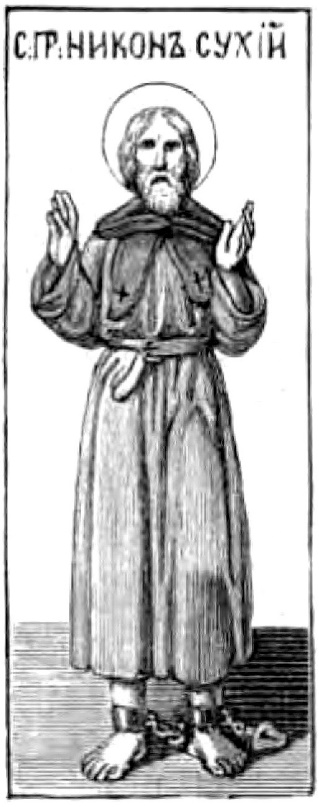
Преподобный Никон родился в Киеве от родителей знатных родом и богатством и пострижен в Киево-Печерской обители. В 1096 году, во время нападения хана Боняка с Половцами на Киев, в числе других попался в плен к Половцам и преподобный Никон167. Добрый Киевлянин, выкупив многих пленников, не выкупил Никона, но рассказал об нём богатым сродникам его. Те явились к Половцам с выкупом за него. «Не тратьтесь для меня, сказал Никон; если бы Господу угодно было, чтобы я был свободен, Он не отдал бы меня в руки беззаконных; приняв приятное от руки Господней, почему не стал бы я терпеть горькое?» – Не получив выкупа. Половцы стали мучить Никона. Три года они мучили его, то жгли на огне, то резали ножами. Скованный по рукам и ногам, он был опаляем солнцем и истаевал от голода и жажды; зимой выталкивали его на стужу. По два и по три дня, а иногда и более, оставляли его без пищи. И за всё это Никон благодарил Бога и молился. Половец употреблял все меры жестокости, чтобы вынудить выкуп за Никона. Никон сказал: «Христос избавит меня от рук ваших безденежно: я получил известие о том. Мне явился брат мой, которого вы продали жидам на распятие, и сказал мне: в третий день ты будешь в Печерском монастыре, по молитвам св. Антония и Феодосия и прочих черноризцев». Думая, что Никон хочет спасаться бегством, Половец подрезал ему жилы и стал зорко стеречь его. Почувствовав себя сильно больным, жестокий Половец отдал приказание: «распять пленника над моей могилой»; а Никон помолился за него, и Половец встал здоровым. На третий день, когда сидели около Никона, в самый полдень, он вдруг исчез, и в то время, когда братия пели причастен, он явился в Печерской церкви. Никон сам не рассказывал о случившемся с ним. Но тяжёлые железа, бывшие на нём, неизцельные раны, гноившееся от них, ещё облитое кровью тело заставили его рассказать правду. Он не хотел расстаться со своими оковами; но игумен убедил его снять их. «Если бы угодно было Господу, сказал игумен, чтобы ты носил оковы, то Он не освободил бы тебя из плена». С Никона сняли оковы и перековали их на вещи нужные для церкви. Довольно времени спустя пришёл в Киев Половец, у которого Никон был в плену. Увидав преподобного в живых, он рассказал всё, что было с Никоном, и не возвратился более на житие в Половецкую землю, но крестился со всем своим родом; он и со сродниками своими постригся в монашество и окончил жизнь свою в Печерской обители, служа своему прежнему пленнику. «Сей Никон называется сухим в памятнике (Печерском) оттого, что истёк он кровью и сгнил от ран».
The Venerable Nikon was born in Kiev of parents noble by birth and wealthy, and was tonsured in the Kiev Caves Monastery. In the year 1096, during the attack of Khan Boniak with the Polovtsy upon Kiev, the Venerable Nikon was taken captive among others by the Polovtsy167. A certain good citizen of Kiev, having ransomed many captives, did not ransom Nikon, but told of him to his wealthy kinsmen. They came to the Polovtsy with a ransom for him. "Spend nothing for me," said Nikon; "if it had pleased the Lord that I should be free, He would not have delivered me into the hands of the lawless; having received what is pleasant from the hand of the Lord, why should I not endure what is bitter?" Having received no ransom, the Polovtsy began to torment Nikon. For three years they tormented him, now burning him with fire, now cutting him with knives. Bound hand and foot, he was scorched by the sun and wasted away from hunger and thirst; in winter they thrust him out into the cold. For two or three days, and sometimes longer, they left him without food. And for all this Nikon gave thanks to God and prayed. The Polovtsian used every means of cruelty to extort a ransom for Nikon. Nikon said: "Christ will deliver me from your hands without payment: I have received tidings of this. My brother, whom you sold to the Jews for crucifixion, appeared to me and said: On the third day you shall be in the Pechersk Monastery, through the prayers of Sts. Anthony and Theodosius and the other monks." Thinking that Nikon wished to escape by flight, the Polovtsian cut his sinews and began to guard him closely. Feeling himself severely ill, the cruel Polovtsian gave the order: "Crucify the captive over my grave"; but Nikon prayed for him, and the Polovtsian rose up well. On the third day, as they sat around Nikon at high noon, he suddenly vanished, and at the very time when the brethren were singing the Communion hymn, he appeared in the Pechersk church. Nikon himself did not tell of what had happened to him. But the heavy fetters that were on him, the incurable wounds festering from them, and his body still covered with blood compelled him to tell the truth. He did not wish to part with his chains; but the abbot persuaded him to remove them. "If it had pleased the Lord," said the abbot, "that you should wear chains, He would not have freed you from captivity." The chains were taken from Nikon and reforged into articles needed for the church. After a considerable time, the Polovtsian in whose captivity Nikon had been came to Kiev. Seeing the Venerable One alive, he related all that had happened with Nikon, and returned no more to dwell in the Polovtsian land, but was baptized with all his household; he and his kinsmen were tonsured into monasticism and ended his life in the Pechersk Monastery, serving his former captive. "This Nikon is called the Dry in the (Pechersk) memorial because he was drained of blood and rotted from his wounds."
Так рассказывает блаж. Симон168. По этому известию, преп. Никон три года был пленником, тогда как взят в плен в 1096 г.; потом несколько времени жил в лавре. Потому надобно положить, что он скончался не прежде 1101 года. Ныне мощи его почивают в Антониевой пещере, и память его совершается 11 декабря169.
Thus relates the blessed Simon168. According to this account, the Venerable Nikon was a captive for three years, having been taken captive in 1096; afterwards he lived for some time in the Lavra. Therefore it must be supposed that he reposed no earlier than 1101. His relics now repose in the Anthony Cave, and his memory is celebrated on December 11169.
Блаженный Симон в заключение известия своего о страдальце Никоне говорит Поликарпу: «как же теперь мы изменили обещанию нашему! Какая разность в нашей жизни! С такой высоты ниспали в глубину житейскую. Начальники наши равны бесплотным; они – молитвенники и ходатаи к Творцу, подобные Ангелам и украшены мученическими венцами»170.
The blessed Simon, in concluding his account of the sufferer Nikon, says to Polycarp: "How have we now changed from our promise! What a difference in our life! From such a height we have fallen into the depth of worldly things. Our superiors are equal to the bodiless; they are intercessors and mediators with the Creator, like the Angels, and are adorned with martyrs' crowns."170
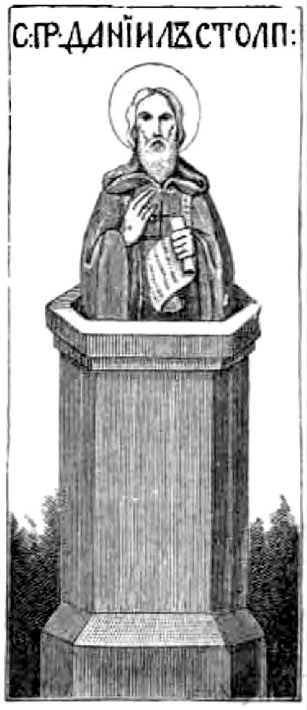
Первый ученик Симеона Столпника был преп. Даниил Столпник, Сирианин, из окрестностей Самосаты, сын родителей благочестивых. Матерь его, будучи неплодна, в горести сердца вышла однажды в полночь из дома своего и, воздевши руки к небу, со многими слезами помолилась Богу о разрешении её неплодства. По возвращении домой, она во сне увидела два светильника пресветлые и великие, прознаменовавшие будущую славу имевшего родиться сына, по молитвам матери. До пяти лет по рождении он не имел имени, ибо родители, получив его по особенной милости Божией, хотели, чтобы он и имя принял от Бога. Пять лет минуло младенцу; родители привели его в соседний монастырь и просили игумена нарещи сыну их имя. Игумен сказал, что тем именем подобает назвать младенца, которое откроет Сам Бог. Смотря на младенца, игумен велел дать книгу с престола и, разогнув её, обрёл некоторые слова пророка Даниила, и нарёк младенца Даниилом.
The first disciple of Simeon the Stylite was the Venerable Daniel the Stylite, a Syrian from the environs of Samosata, the son of pious parents. His mother, being barren, once went out from her house at midnight in grief of heart and, raising her hands to heaven, with many tears prayed to God for the resolution of her barrenness. Upon returning home, she saw in a dream two most bright and great lamps, which prefigured the future glory of the son who was to be born, through the prayers of his mother. For five years after his birth he had no name, for his parents, having received him through the special mercy of God, wished that he should receive his name also from God. Five years passed for the child; his parents brought him to a neighboring monastery and asked the abbot to give a name to their son. The abbot said that the child ought to be called by that name which God Himself would reveal. Looking at the child, the abbot ordered a book to be brought from the altar table and, opening it, found certain words of the Prophet Daniel, and named the child Daniel.
По влечению сердца своего Даниил 12 лет тайно от родителей оставил мир и принял иноческий сан в одной обители своей родины. С усердием и терпением Даниил переносил труды послушания. Игумен, имея нужду отбыть в Антиохию ради церковных потреб, взял с собой и Даниила. На пути они посетили преп. Симеона Столпника, который, увидев Даниила и прозревая будущие святые его подвиги, сказал ему: «мужайся, чадо, и да укрепится сердце твоё, многие неудобоносимые подъемлешь труды Христа ради, Который тебе будет во всём помощник». Приняв от св. Симеона Столпника благословение, Даниил восприял новую бодрость и крепость к духовному себя усовершенствованию. Переселившись в пределы Византии, в Анаплу, в царствование Льва 1 (457–473), Даниил сначала прославил себя подвигами благочестия в одной пещере. После девятилетнего пребывания в затворе преп. Даниил видел в видении перед собой столп, высотой превосходящий облака, и на верху столпа преп. Симеона и с ним двух святых юношей, и услышал голос с высоты столпа: «взыди сюда, Даниил». – Как взойти мне на такую высоту, отвечал Даниил. Преп. Симеон повелел юношам возвести Даниила. Юноши поставили его перед Симеоном, который обнял Даниила и сказал: «мужайся, Даниил, и стой прямо». Это видение предзнаменовало, что Даниил станет подражать своим подвигом Симеону. В то же время пришёл из Антиохии Сергий, – ученик преп. Симеона Столпника, и дал куколь его Даниилу, и тем подвиг его подражать Симеону. Бог в видении указал Даниилу и место для столпа, на котором он будет подвизаться.
Following the inclination of his heart, Daniel at the age of 12 secretly left his parents and received the monastic rank in a monastery of his homeland. With zeal and patience Daniel bore the labors of obedience. The abbot, having need to depart for Antioch for church needs, took Daniel with him. On the way they visited the Venerable Simeon the Stylite, who, seeing Daniel and foreseeing his future holy struggles, said to him: "Be of good courage, child, and let your heart be strengthened; you shall endure many unbearable labors for Christ's sake, Who will be your helper in all things." Having received the blessing of St. Simeon the Stylite, Daniel received new vigor and strength for his spiritual perfection. Having moved to the region of Byzantium, to Anaplous, during the reign of Leo I (457–473), Daniel first glorified himself by feats of piety in a cave. After a nine-year sojourn in seclusion, the Venerable Daniel saw in a vision before him a pillar, whose height surpassed the clouds, and on the top of the pillar the Venerable Simeon and with him two holy youths, and he heard a voice from the height of the pillar: "Come up here, Daniel." "How shall I ascend to such a height?" answered Daniel. The Venerable Simeon commanded the youths to bring Daniel up. The youths placed him before Simeon, who embraced Daniel and said: "Be of good courage, Daniel, and stand upright." This vision signified that Daniel would imitate Simeon by his struggle. At the same time, Sergius, a disciple of the Venerable Simeon the Stylite, came from Antioch and gave Daniel his cowl, thereby moving him to imitate Simeon. God also showed Daniel in a vision the place for the pillar on which he would struggle.
Итак преподобный создал себе столп, на котором пребыл 33 года и претерпел все воздушные перемены, с тем высоким самоотвержением, какое может вдохнуть человеку одна христианская вера. Слава подвигов и чудес Даниила привлекала к нему отовсюду людей, ближних и дальних, Греков и Римлян и варваров, простолюдинов и царей – Льва и Зенона (477–491); все приходили к нему, как к Ангелу Божию и, удаляясь от него, призывали его в молитвах на помощь. Император Лев столько любил и уважал великого угодника, украшавшего собой его царствование, что многократно прибегал к нему, прося его молитв, благословения и утешения. Патриарх Геннадий сам поднялся на столп его и рукоположил во пресвитера. Достигши в своих великих подвигах глубокой старости, преп. Даниил, заповедав ученикам своим смирение, послушание, странноприимство, пост, бдение, нищету и больше всего любовь, скончался 80 лет от рождения, в 489 году, смертью праведника. Чудотворные мощи его положены при столпе, на котором подвизался он и при котором после устроена была усердием царя церковь во имя Симеона Столпника.
Thus the Venerable One built himself a pillar, on which he remained for 33 years and endured all the changes of the weather, with that high self-denial which only the Christian faith can inspire in a man. The fame of Daniel's struggles and miracles drew to him people from everywhere, near and far, Greeks and Romans and barbarians, commoners and emperors—Leo and Zeno (477–491); all came to him as to an Angel of God, and departing from him, called upon him in prayer for help. The Emperor Leo so loved and respected the great saint who adorned his reign, that he repeatedly had recourse to him, asking for his prayers, blessing, and consolation. Patriarch Gennadius himself ascended his pillar and ordained him a presbyter. Having reached a great old age in his mighty struggles, the Venerable Daniel, having enjoined upon his disciples humility, obedience, hospitality, fasting, vigil, poverty, and above all love, reposed at the age of 80 from birth, in the year 489, the death of a righteous man. His wonderworking relics were laid at the pillar on which he had struggled, and near which a church was afterwards built by the zeal of the emperor in the name of Simeon the Stylite.
Ркп. святцы: «преподобномученик Никон сухий; память его м. дек. в 11 д.». Житие пр. Никона в ркп. прологе под 11 дек. у Румянцева № 325.
Manuscript menaion: "Venerable Martyr Nikon the Dry; his memory is December 11." The Life of the Venerable Nikon in a manuscript prologue under December 11, in the Rumyantsev collection, No. 325.