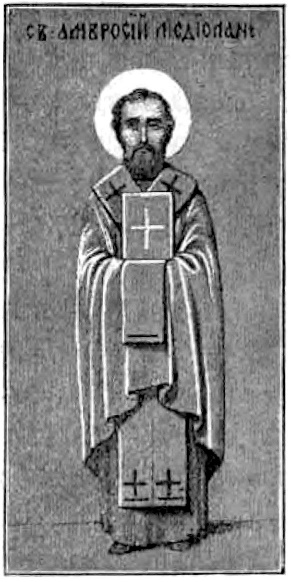
Св. Амвросий жил в IV веке по Р. X. Он происходил из знатной Римской фамилии: отец его, язычник, был префектом Галлии и Испании; он умер, успев воспитать своих сыновей, из которых Амвросий уже в детстве подавал большие надежды. Мать же Амвросия, христианка, по смерти мужа, переселилась из Трира в Рим, где Амвросий и брат его, сначала под руководством матери, а по кончине её, заботами и попечениями старшей сестры их Марцеллины успели получить высшее образование. На 25-м году Амвросий был известен уже, как один из лучших адвокатов в Риме. В 370 г. он был поставлен консуларием (губернатором) Эмилии и Лигурии, главным городом которых был Медиолан (Милан). Префект Проб, оценив достоинства Амвросия, знаменательно выразился при предоставлении молодому человеку этого важного назначения: – «ступай – и поступай не как судья, а как епископ». Так и сбылось – при том уважении и любви, которые скоро успел внушить всем к себе Амвросий. В 374 г. умер Медиоланский епископ Авксентий, один из последователей еретика Ария, поддерживаемых в то время государственной властью. По смерти его возникли споры между православными и арианами относительно избрания преемника ему. Амвросий, по обязанности своей, как префект, присутствовал в церкви в тот день, когда там было народное собрание по поводу избрания нового епископа. Вдруг среди собрания детский голос произнес: «Амвросий – епископ» ... Весь народ признал это за указание Божие и стал убеждать уважаемого префекта принять управление Церковью. Не смотря на своё сопротивление и на отзыв, что он не готовился к духовному званию и даже не крещён, Амвросий принуждён был уступить желанию народа и, приняв крещение, пройдя в семь дней степени клира, в 8-й день был возведён в сан епископа Медиоланского – на 35-году своей жизни.
St. Ambrose lived in the fourth century A.D. He came from a noble Roman family: his father, a pagan, was prefect of Gaul and Spain; he died, having succeeded in raising his sons, of whom Ambrose already in childhood gave great promise. Ambrose’s mother, a Christian, after the death of her husband moved from Trier to Rome, where Ambrose and his brother, first under the guidance of their mother, and after her death, through the cares and solicitude of their elder sister Marcellina, succeeded in obtaining a higher education. In his twenty-fifth year, Ambrose was already known as one of the best advocates in Rome. In 370, he was appointed consularis (governor) of Aemilia and Liguria, whose chief city was Mediolanum (Milan). The prefect Probus, appreciating Ambrose’s merits, significantly remarked upon granting this important appointment to the young man: “Go, and act not as a judge, but as a bishop.” And so it came to pass—such was the respect and love that Ambrose soon inspired in all. In 374, Auxentius, the bishop of Milan, one of the followers of the heretic Arius, who were at that time supported by the state authorities, died. After his death, disputes arose between the Orthodox and the Arians concerning the election of a successor. Ambrose, by virtue of his office as prefect, was present in the church on the day when a popular assembly was held there regarding the election of a new bishop. Suddenly, in the midst of the assembly, a child’s voice cried out: “Ambrose is bishop!” ... All the people recognized this as an indication from God and began to urge the respected prefect to accept the governance of the Church. Despite his resistance and his remark that he was not prepared for the spiritual calling and was not even baptized, Ambrose was compelled to yield to the people’s desire and, having received baptism and passed through the degrees of the clergy in seven days, on the eighth day he was elevated to the rank of Bishop of Milan—in the thirty-fifth year of his life.
Сделавшись так неожиданно епископом, Амвросий всецело предался исполнению высоких пастырских обязанностей. Обеспечив брата и сестру известною частью дохода с наследственного своего имения, он все остальное принёс в дар Церкви. Сознавая себя недостаточно подготовленным к неожиданно представившемуся ему поприщу, он всё свободное от священного служения время употреблял на пополнение своего Богословского образования, руководствуясь в особенности сочинениями своих знаменитых современников: Василия Кесарийского и друга его Григория. Но это не отвлекало его от практической неутомимой деятельности: дверь его всегда оставалась открытой для всех посетителей без исключения, которых он выслушивал с любовью и делал для каждого всё, что мог. При этом, жертвуя нередко и ночным отдыхом, успевал приготовить проповедь для каждого воскресного дня. Вообще, вёл жизнь постническую, принимая, кроме двух дней в неделе, пищу только вечером.
Having become bishop so unexpectedly, Ambrose devoted himself entirely to the fulfillment of his high pastoral duties. Having secured for his brother and sister a certain portion of the income from his hereditary estate, he donated all the rest to the Church. Conscious of being insufficiently prepared for the field that had so unexpectedly opened before him, he spent all his free time from sacred service in supplementing his theological education, being guided especially by the works of his famous contemporaries: Basil of Caesarea and his friend Gregory. But this did not distract him from practical, tireless activity: his door always remained open to all visitors without exception, whom he listened to with love and did for each whatever he could. At the same time, often sacrificing even his nightly rest, he managed to prepare a sermon for every Sunday. In general, he led an ascetic life, taking food only in the evening, except for two days a week.
Вскоре события вызвали епископа Амвросия и на иные подвиги. Когда, по умерщвлении в 383 году императора Грациана125 мятежниками в Галлии, один из военачальников – Максим вознамерился захватить власть над всей западной половиной Римской империи и с подчинившимся ему войском был уже на пути в Италию, то императрица Иустина, мать покойного Грациана и малолетнего наследника престола его – Валентиниана II, чувствуя себя не силах оказать сопротивление наступающему врагу и опасаясь даже за жизнь своего 12-ти летнего сына, обратилась к епископу Амвросию с просьбой отправиться к Максиму и предупредить его нашествие – предложением мира на условии удовольствоваться тем, что он успел уже захватить. Святитель не уклонился от возлагаемого на него не лёгкого дела, отправился в дальние путь и успел уговорить надменного своими успехами честолюбца согласиться на мир и предоставление Валентиниану II управления Италией, Африкой и областями до р. Дуная.
Soon events called Bishop Ambrose to other exploits as well. When, after the murder of Emperor Gratian125 by rebels in Gaul in 383, one of the military commanders—Maximus—intended to seize power over the entire western half of the Roman Empire and, with the army that had submitted to him, was already on his way to Italy, the Empress Justina, mother of the deceased Gratian and of his young heir to the throne, Valentinian II, feeling herself unable to offer resistance to the advancing enemy and even fearing for the life of her twelve-year-old son, turned to Bishop Ambrose with a request to go to Maximus and forestall his invasion by offering peace on the condition that he be satisfied with what he had already seized. The Hierarch did not shrink from the difficult task laid upon him; he set out on a long journey and succeeded in persuading the ambitious man, arrogant from his successes, to agree to peace and to grant Valentinian II the governance of Italy, Africa, and the regions as far as the Danube River.
Вместо благодарности, однако же, за эту великую услугу, оказанную Амвросием, Иустина, ревностная арианка, обеспеченная в своей власти, встала в неприязненные отношения к святителю, открыто покровительствуя еретикам. Она приказала Амвросию передать великую Медиоланскую церковь во владение арианам. Но хотя и безусловно действовавший всегда по заповеди Спасителя: «воздадите кесарева кесареви», святитель ещё с большей ревностью относился к исполнению дополнительного изречения, повелевающего воздавать «Божия Богови» и отказался исполнить волю императрицы, идущую вразрез с правами православной Церкви: – «всё своё я готов предоставить императору, за которого готов и жизнь свою положить, – отвечал он Иустине, – но того, что – Божие, не могу отдать и сам император того не может взять». Иустина именем императора выслала тогда отряд воинов, чтобы силой занять церковь; но св. Амвросий, заключившись в церкви с малым числом православных, объявил, что готов пострадать, но не выдаст ограду Христову волкам – хулителям веры Христовой, и сильным словом своим о суде Божием на притеснителей Церкви так подействовал на воинов-Готфов, что они устрашились производить насилия. Таким образом святитель отстоял храм от еретиков. Но эту борьбу с императрицей-арианкой пришлось выдерживать ему до тех пор, пока новое нашествие Максима на Италию (в 386 г.) не заставило её снова обратиться к нему с просьбой о посредничестве и о заступлении перед тираном. Незлобивый святитель и в этот раз не отказался отстаивать права малолетнего императора, но не имел успеха: Валентиниан и со-царствующая ему Иустина принуждены были оставить Медиолан и отправиться в Фессалонику, чтобы искать помощи у Восточного императора Феодосия Великого.
Instead of gratitude, however, for this great service rendered by Ambrose, Justina, a zealous Arian, now secure in her power, assumed hostile relations toward the Hierarch, openly patronizing the heretics. She ordered Ambrose to hand over the great church of Milan to the Arians. But although he always acted unconditionally according to the Savior’s commandment: “Render unto Caesar the things that are Caesar’s,” the Hierarch with even greater zeal attended to the fulfillment of the additional saying commanding to render “unto God the things that are God’s,” and refused to carry out the empress’s will, which ran counter to the rights of the Orthodox Church: “All that is mine I am ready to give to the emperor, for whom I am ready to lay down my life,” he answered Justina, “but that which is God’s I cannot give, and even the emperor himself cannot take it.” Justina then, in the emperor’s name, sent a detachment of soldiers to seize the church by force; but St. Ambrose, having shut himself up in the church with a small number of the Orthodox, declared that he was ready to suffer, but would not hand over Christ’s fold to wolves—the blasphemers of the faith of Christ—and by his powerful word concerning the judgment of God upon the oppressors of the Church, he so affected the Gothic soldiers that they feared to commit violence. Thus the Hierarch defended the temple from the heretics. But he had to endure this struggle with the Arian empress until a new invasion of Italy by Maximus (in 386) forced her again to turn to him with a request for mediation and intercession before the tyrant. The meek Hierarch did not refuse this time either to defend the rights of the young emperor, but he had no success: Valentinian and his co-ruler Justina were compelled to leave Milan and go to Thessalonica to seek help from the Eastern Emperor Theodosius the Great.
В 388 г. Максим погиб, но Иустина уже не возвращалась более в Медиолан. Феодосий же, низложивший Максима и уступивший Запад Валентиниану, посетил Италию для устройства разных государственных дел и, между прочим, довольно долго прожил в Медиолане, где и успел узнать и отличить своим вниманием великого Амвросия. С своей стороны и святитель уважал доблестного императора – христианина, который, под влиянием его, успел в это время сделать многое в пользу Церкви и веры, – однако же, по нелицеприятию своему не оставил Амвросий без обличения и вразумления и самого великого Феодосия, когда тот, в порыве свойственной ему, не смотря на все его достоинства, крайней раздражительности, допустил совершиться преступному делу... В 390 г., Феодосий, услышав, что в Фессалонике, жителям которой он не раз оказывал благодеяния, произошло возмущение, среди которого чернь умертвила нескольких императорских чиновников, в порыве неудержимого гнева решился страшно наказать неблагодарных мятежников и, по повелению его, в один из праздничных дней, когда народ собрался в цирк, до 7,000 человек безразлично были неожиданно преданы смерти.
In 388, Maximus perished, but Justina no longer returned to Milan. Theodosius, who had overthrown Maximus and ceded the West to Valentinian, visited Italy to settle various state affairs and, among other things, lived for a considerable time in Milan, where he came to know and honor the great Ambrose with his attention. For his part, the Hierarch respected the valiant Christian emperor, who, under his influence, had at this time accomplished much for the benefit of the Church and the faith—yet, by his impartiality, Ambrose did not leave even the great Theodosius himself without reproof and admonition, when the latter, in a fit of that extreme irritability which was characteristic of him despite all his virtues, allowed a criminal deed to be committed... In 390, Theodosius, hearing that in Thessalonica, whose inhabitants he had more than once shown favors, a rebellion had occurred in which the mob had killed several imperial officials, in a burst of uncontrollable anger decided to punish the ungrateful rebels terribly, and by his command, on one of the festive days, when the people had gathered in the circus, up to 7,000 persons were indiscriminately and unexpectedly put to death.
Узнав об этом безжалостном избиении, святитель Амвросий был поражён такой скорбью, что, удалившись в своё загородное уединение, написал оттуда Феодосию:
Learning of this merciless slaughter, Hierarch Ambrose was struck with such grief that, having withdrawn to his country solitude, he wrote from there to Theodosius:
«Оставаясь близ тебя, не посмел бы я сказать того, чего нельзя ни открыть без унижения друзей, ни скрыть без оскорбления совести. Позволь же мне сказать это тебе, Августейший император. Ты имеешь ревность по вере, – не отрицаю этого, – и страх Божий, – и того не оспариваю. Но у тебя есть прирождённая стремительность, которая склонна к милосердию, если кто говорит тебе кроткие слова; если же, напротив, раздражает её – то она возбуждается до того, что ты не можешь её сдержать. Дал бы Бог, чтобы никто не умерял, ни раздражал её! Я хотел тебя предоставить тебе самому: тебе должно сдерживать себя самого и порыв природы побеждать силой благочестия. Вот почему я удалился» ...
“Remaining near you, I would not have dared to say what can neither be revealed without humiliating friends, nor concealed without offending conscience. Permit me, then, to say this to you, August Emperor. You have zeal for the faith—I do not deny this—and the fear of God—neither do I dispute that. But you have a natural impetuosity, which inclines to mercy if one speaks gentle words to you; if, on the contrary, one provokes it, it is aroused to such a degree that you cannot restrain it. Would to God that no one either moderate or provoke it! I wished to leave you to yourself: you must restrain yourself and overcome the impulse of nature by the power of piety. This is why I have withdrawn” ...
Затем, обличив всю преступность поступка, совершенного в гневе Феодосием, Амвросий предложил императору загладить этот грех покаянием по примеру ветхозаветных царей:
Then, having denounced all the criminality of the deed committed in Theodosius’s anger, Ambrose proposed that the emperor atone for this sin by repentance, following the example of the Old Testament kings:
– «Тебе говорю это, – прибавляет он, – не унижая тебя, а примерами тех царей располагая тебя снять этот грех с твоего царства; но его не снимешь ты, если твоей душой не смиришься перед Господом. Ты – человек; тебя постигло искушение, – перенеси же его. Грех очищается только слезами и раскаянием. Ни ангел, ни архангел не может снять его. Один лишь Господь может сказать: – «Я – с тобой» ...
“I say this to you,” he adds, “not to humiliate you, but by the examples of those kings to dispose you to remove this sin from your kingdom; but you will not remove it unless you humble your soul before the Lord. You are a man; temptation has come upon you—bear it then. Sin is cleansed only by tears and repentance. Neither angel nor archangel can remove it. The Lord alone can say: ‘I am with you’” ...
«Советую, прошу, убеждаю, заклинаю. Для меня – великая печаль, что ты, подававший пример редкого благочестия, – ты, являвший на престоле величественный образец милости, часто не желавший казни одного преступника, ты не скорбишь о погублении стольких невинных. Я не имею к тебе никакой вражды, но испытываю страх; не осмелюсь я возносить Божественную жертву, если ты захочешь при этом присутствовать. Мне препятствовала бы это совершить невинно пролитая кровь одного человека. Дозволит ли кровь стольких невинных жертв. Не думаю. Пишу это для тебя собственноручно, чтобы один ты прочитал это» ...
“I advise, I beg, I exhort, I adjure. It is a great sorrow to me that you, who have given an example of rare piety—you, who have shown upon the throne a majestic model of mercy, often unwilling to punish even one criminal—you do not grieve over the destruction of so many innocent ones. I bear you no enmity, but I feel fear; I will not dare to offer the Divine Sacrifice if you wish to be present at it. The innocent blood of one man would hinder me from doing this. Will the blood of so many innocent victims permit it? I think not. I write this to you with my own hand, so that you alone may read it” ...
Несмотря на это письмо, Феодосий при первом случае хотел, по обыкновению, войти в храм Божий, но в дверях храма услышал голос Амвросия: – «ты подражал Давиду в преступлении, подражай ему и в раскаянии. Какими очами будешь ты созерцать храм общего Владыки? Как прострёшь руки, с которых ещё каплет кровь неповинного убийства... Отойди же и не пытайся прежнее беззаконие увеличивать новым» ...
Despite this letter, Theodosius, at the first opportunity, wished, as usual, to enter the church of God, but at the doors of the church he heard the voice of Ambrose: “You have imitated David in transgression; imitate him also in repentance. With what eyes will you behold the temple of the common Master? How will you stretch forth your hands, from which the blood of innocent murder still drips... Depart, then, and do not attempt to increase your former iniquity by a new one” ...
– «Того же, что должен сделать каждый убийца: у Бога нет лицеприятия» ... отвечал пастырь, – и Феодосий со слезами возвратился в свой дворец и провёл здесь в уединении несколько месяцев, предаваясь сокрушённому покаянию. По временам пробуждалась в нём, однако же, прежняя раздражительность при мысли, что он – император – отлучён от Церкви, и не раз порывался он об отмене святительского определения, но Амвросий отвечал, что император властен отнять у него жизнь, но не властен переменить определение Церкви. Наконец, перед праздником Рождества Христова, успев убедиться в раскаянии Феодосия, он разрешил его, расположив его прежде того издать закон, по которому смертные приговоры исполнялись бы не раньше, как через месяц от составления их.
“The same thing that every murderer must do: God shows no partiality,” answered the pastor—and Theodosius returned to his palace in tears and spent several months there in solitude, giving himself over to contrite repentance. At times, however, his former irritability would awaken in him at the thought that he—the emperor—was excommunicated from the Church, and more than once he was moved to have the hierarch’s decree annulled; but Ambrose replied that the emperor had the power to take his life, but not the power to change the decree of the Church. Finally, before the feast of the Nativity of Christ, having succeeded in convincing himself of Theodosius’ repentance, he absolved him, having first induced him to issue a law by which death sentences would not be carried out until a month after they were pronounced.
«Такою-то великой доблестью сияли и архиерей, и царь, – пишет церковный историк Феодорит в заключение своего повествования о покаянии великого Феодосия, – я удивляюсь обоим: и дерзновению одного и благопокорности другого; удивляюсь и теплоте ревности в первом, и чистоте веры в последнем».
“With such great valor did both the bishop and the emperor shine,” writes the church historian Theodoret in concluding his account of the repentance of the great Theodosius, “I marvel at both: at the boldness of the one and the ready obedience of the other; I marvel at the warmth of zeal in the former and the purity of faith in the latter.”
Эти замечательные, истинно-христианские отношения между пастырем и императором выразились в последний раз в прощальном слове, которое сказал Амвросий над гробом Феодосия Великого, скончавшегося в 395 году: – «я любил его, этого человека, милосердого и смиренного в проявлении власти, чистого сердцем и кроткого душой... Я любил этого человека, который, обличение предпочитая лести, однажды сумел, отложив свои царственные знаки, в церкви оплакать свой грех и со стенанием и слезами просить прощения. То, чего устыдился бы частный человек, – публичное покаяние, – не смутило этого императора, который с того дня не проводил ни одного дня без оплакивания своего греха. Я любил этого человека, который и при последнем вздохе ещё звал меня, и при конце жизни более занимался состоянием Церкви, чем своей собственной опасностью. Я любил его, – признаюсь в этом, – и вот почему оплакиваю я его из глубины моего сердца. Я любил его, и надеюсь я на моего Господа, что приимет Он голос молитвы, которой я постараюсь напутствовать эту благочестивую душу».
These remarkable, truly Christian relations between the pastor and the emperor were expressed for the last time in the farewell address which Ambrose delivered over the tomb of Theodosius the Great, who reposed in the year 395: “I loved him, this man, merciful and humble in the exercise of power, pure in heart and gentle in soul… I loved this man, who, preferring reproof to flattery, once knew how, laying aside his royal insignia, to weep over his sin in church and to ask forgiveness with groaning and tears. What a private person would have been ashamed of—public repentance—did not trouble this emperor, who from that day spent not a single day without bewailing his sin. I loved this man, who even with his last breath called for me, and at the end of his life was more concerned with the state of the Church than with his own danger. I loved him—I confess it—and that is why I mourn him from the depths of my heart. I loved him, and I trust in my Lord that He will receive the voice of the prayer with which I shall endeavor to speed this pious soul on its way.”
В 397 г., в Великую субботу, мирно и радостно почил и сам, как выражается о нём Кассиан, «великий священник Божий, сиявший как драгоценный камень».
In the year 397, on Holy Saturday, he himself, as Cassian says of him, “the great priest of God, who shone like a precious stone,” reposed peacefully and joyfully.
Св. Амвросий, обладая даром слова, оставил после себя много сочинений Богословского и нравственного содержания, писем и поучений; устроил чин литургии и других Божественных служб, имея в виду как можно большее сближение с обрядами Востока. Составил он также много церковных песней и гимнов, между которыми особенно известен торжественный благодарственный гимн: «Тебе Бога хвалим», который относится к тому времени, когда была одержана полная победа над арианством, т. е. около 386 г., а в 388 г., когда блаженный Августин принимал крещение от святого Амвросия, этот гимн воспевали и крестивший и крещаемый126. С V-го века этот гимн был во всеобщем употреблении на Западе, между прочим при коронации королей и на соборах, – и теперь поётся он за благодарственными молебнами.
St. Ambrose, possessing the gift of speech, left behind many writings of theological and moral content, letters and homilies; he established the order of the Divine Liturgy and other divine services, having in view the greatest possible rapprochement with the rites of the East. He also composed many church songs and hymns, among which the solemn hymn of thanksgiving, “We praise Thee, O God,” is especially well known; it dates from the time when a complete victory over Arianism was achieved, that is, around the year 386; and in the year 388, when blessed Augustine received baptism from St. Ambrose, this hymn was sung by both the baptizer and the baptized126. From the 5th century onward, this hymn was in universal use in the West, among other occasions at the coronation of kings and at councils—and it is still sung today at thanksgiving molebens.
Св. Амвросий учредил несколько монастырей, чем содействовал в числе других развитию на Западе подвижнической жизни, распространённой уже в это время на Востоке.
St. Ambrose founded several monasteries, thereby contributing, among others, to the development of ascetic life in the West, which was already widespread at that time in the East.
Сестре своей Марцеллине, инокине, он посвятил несколько книг об иночестве и, вообще, говорил о девстве и об иночестве так красноречиво, что некоторые матери не желали, чтобы дочери их слушали его проповеди, из опасения, чтобы они не увлеклись желанием подвижнической жизни под влиянием красноречивых доводов.
To his sister Marcellina, a nun, he dedicated several books on monasticism, and, in general, he spoke of virginity and monasticism so eloquently that some mothers did not wish their daughters to hear his sermons, for fear that they might be carried away by the desire for an ascetic life under the influence of his eloquent arguments.
Не оставлял однако же святитель без обличения порицавших жизнь девственную. – «Из Пиаченцы идут для посвящения девы, из Бонны идут, из Мавритании идут, чтобы принять здесь покров»127, – приводил он в пример многочисленных, привлечённых его проповедями, доказывая тем их целесообразность в те времена. – И вообще, из дальних стран приходил народ, чтобы видеть и слышать пользовавшегося большим влиянием святителя; многих неверующих обратил он к Богу своими убедительными поучениями и был орудием, между прочим, и спасения блаженного Августина128.
Yet the hierarch did not leave without reproof those who censured the virginal life. “From Piacenza they come for consecration as virgins, from Bonna they come, from Mauretania they come, to receive the veil here”127, he cited as an example the many who were drawn by his sermons, thereby proving their effectiveness in those times. And in general, people came from distant lands to see and hear the hierarch, who enjoyed great influence; he converted many unbelievers to God through his persuasive teachings and was an instrument, among other things, in the salvation of blessed Augustine128.
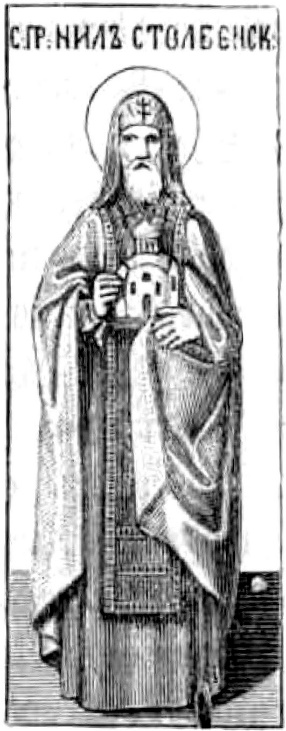
Рождение и воспитание преп. Нила было в погосте Жабенском Деревской пятины, что ныне в Валдайском уезде129. Нил с юных лет отличался кротостью и стремился в пустыню. – Повинуясь внутреннему влечению, он постригся (1505 г.) в иночество в Крыпецкой обители преп. Саввы. Почти десять лет провёл здесь в подвигах общежития. Потом, по благословению игумена, решился на отшельническую жизнь и удалился на р. Серемлю (тогда Ржевского, ныне Осташковского уезда). Здесь поставив хижину, довольствовал он тело своё только травами, а дух насыщал молитвой и Богомыслием. Мнимый чтитель Евангелия скажет; к чему такая суровость к себе? «Умный боится и убегает зла, а глупый смел и самонадеян» (Притч.14:16), говорит Боговдохновенный мудрец. Спаситель поучает: «широкия врата и пространный путь ведут в погибель, и многие идут ими» (Мф.7:13). Блаж. Нил не давал простора желаниям плоти и жил по духу, для Господа. Потому-то и Господь был с ним. Раз хотели напасть на него злые люди; он вышел к ним навстречу с иконой Богоматери, а они бежали. – К нему приходили многие за наставлениями и с просьбой о молитве; жизнь его была полезна для многих. Но он считал себя не утвердившимся в добре, а известность имени его – опасной для души. Потому сильно желал он безмолвия, – Раз после молитвы дремал он и услышал голос: «Нил!! иди на озеро Селигер, там на острове Столбенском можешь спастись». Узнав расспросами от приходивших к нему, где и каков Столбенский остров, Нил, в радости о готовом для него безмолвии, решился оставить не совсем покойное место своё. Поныне часовня и келья, окружённые группой вековых деревьев, остаются памятником пребывания преподобного на Серемле, составляя предмет благоговейного уважения для окрестных жителей130. Здесь преподобный Нил прожил 13 лет.
The birth and upbringing of the Venerable Nilus was in the village of Zhabensk, in Derevskaya Pyatina, which is now in Valdai District129. From his youth, Nilus was distinguished by meekness and yearned for the wilderness. Obeying an inner impulse, he was tonsured into monasticism (1505) in the Krypetsk monastery of the Venerable Sabbas. He spent almost ten years there in the labors of the cenobitic life. Then, with the blessing of the abbot, he resolved upon a hermit’s life and withdrew to the River Seremlya (then in Rzhev District, now in Ostashkov District). Having built a hut there, he satisfied his body only with herbs, while he nourished his spirit with prayer and the contemplation of God. A supposed admirer of the Gospel will say: why such severity toward oneself? “The wise man fears and flees from evil, but the fool is bold and self-confident” (Prov. 14:16), says the divinely inspired sage. The Savior teaches: “Wide is the gate and broad is the way that leads to destruction, and many go in by it” (Mt. 7:13). Blessed Nilus gave no scope to the desires of the flesh and lived according to the spirit, for the Lord’s sake. Therefore the Lord was with him. Once evil men tried to attack him; he went out to meet them with an icon of the Mother of God, and they fled. Many came to him for instruction and with requests for prayer; his life was beneficial to many. But he considered himself not established in goodness, and the fame of his name as dangerous for the soul. Therefore he greatly desired silence. Once, after prayer, he was dozing and heard a voice: “Nilus! Go to Lake Seliger; there on Stolbny Island you can be saved.” Having learned by questioning those who came to him where and what Stolbny Island was, Nilus, rejoicing in the silence prepared for him, resolved to leave his not entirely peaceful place. To this day, a chapel and a cell, surrounded by a group of ancient trees, remain as a monument of the venerable one’s sojourn on the Seremlya, being an object of reverent respect for the local inhabitants130. Here the Venerable Nilus lived for 13 years.
Столбенский остров на озере Селигере, заключая в себе около 8 десятин пространства, в XVI веке весь покрыт был дремучим лесом. От нынешнего г. Осташкова, если плыть водой, он в 9 верстах. Преподобный Нил рад был такому тихому месту. На первый раз он выкопал здесь в горе пещеру и прожил в ней зиму (1528 г.). – Потом поставил себе небольшую келью и часовню, для овощей возделал он землю; а без того питался ягодами и травой. Отшельник утешался тем, что славил Господа вместе с природой, не развлекаясь людьми. – Плоть не докучала ему, – он – подвижник не одного года. Духу была свобода славить Господа своего.
Stolbny Island on Lake Seliger, containing about 8 desyatinas of area, was entirely covered with dense forest in the 16th century. From the present-day town of Ostashkov, if one travels by water, it is 9 versts away. The Venerable Nilus was glad of such a quiet place. At first he dug a cave here in the hill and lived in it through the winter (1528). Then he built himself a small cell and a chapel; he cultivated the land for vegetables; otherwise he fed on berries and grass. The hermit consoled himself by glorifying the Lord together with nature, undistracted by people. The flesh did not trouble him—he was an ascetic of many years. The spirit had freedom to glorify its Lord.
Отшельник не просил у людей, ничем не тревожил их. Казалось бы, и им не за-что тревожить его. Но таковы страсти людские были и будут: они восстают со злостью на пустынника и за то одно: зачем он не живёт так, как живут другие? Зачем он в пустыне, а не в миру? А тут смотри, и житейская мудрость подаёт свой голос: к чему эти пустынники? Податей не платят. А услуги нравственной жизни обществу? Ну, – впереди их расчёты корысти подскажут свою умную претензию. Пусть для Селигерцев остров вовсе был бесполезен, при множестве лесов и пустошей; но зачем он будет полезным для других? Подумайте и согласитесь, что новый меркантильный социализм думает точно также. И вот Селигерцы начали опустошать лес на острове. Напрасно упрашивал их преподобный прекратить не нужное и потому преступное истребление леса. Злость разлютовалась. Зажжён был лес, чтобы сжечь и самого пустынника. Пламя с яростью пожирало деревья и готово было уничтожить отшельника. Отшельник стоял на молитве, взывая к Богу о помощи. И вот силой Божьей пламень погас, как только дошёл до горы отшельника.
The hermit asked nothing of people, nor did he trouble them in any way. It would seem that they too had no reason to trouble him. But such are human passions, they were and will be: they rise up with malice against the hermit for this one reason alone: why does he not live as others live? Why is he in the wilderness and not in the world? And then, behold, worldly wisdom adds its voice: what use are these hermits? They pay no taxes. And what of the services of moral life to society? Well—their calculations of self-interest will suggest their clever pretension. Let the island be entirely useless to the people of Seliger, given the multitude of forests and waste lands; but why should it become useful to others? Think and agree that the new mercantile socialism thinks exactly the same way. And so the people of Seliger began to lay waste the forest on the island. In vain did the venerable one entreat them to stop the unnecessary and therefore criminal destruction of the forest. Malice grew fierce. The forest was set on fire, to burn the hermit himself as well. The flame devoured the trees with fury and was ready to destroy the hermit. The hermit stood in prayer, calling upon God for help. And then, by the power of God, the flame went out as soon as it reached the hermit’s hill.
Раз пришли к отшельнику охотники до чужого добра и требовали денег. Когда же не думали о монахах, что у них и денег много и живут они роскошно? «Чада! сказал гостям своим преп. Нил, всё сокровище моё – в углу кельи». Там стояла у него икона Богоматери. Разбойники бросились искать деньги и – ослепли. – В слезах раскаяния просили они прощения себе. – Нил преподал им наставление жить честно, не волноваться завистью слепой, помнить волю Божию: в поте лица твоего снеси хлеб твой: потом, сжалившись над ними, молитвами возвратил им зрение. – По смерти преподобного, но не прежде, согласно с заповедью преподобного, они рассказывали сами, что было с ними и за что.
Once some hunters after others’ goods came to the hermit and demanded money. For do they not think of monks that they have much money and live luxuriously? “Children!” said the Venerable Nilus to his guests, “all my treasure is in the corner of the cell.” There stood his icon of the Mother of God. The robbers rushed to look for money and—were blinded. In tears of repentance they begged forgiveness for themselves. Nilus gave them instruction to live honestly, not to be agitated by blind envy, to remember the will of God: “In the sweat of your face you shall eat your bread”; then, taking pity on them, he restored their sight through prayers. After the venerable one’s death, but not before, in accordance with the venerable one’s command, they themselves told what had happened to them and why.
Иные были и добры к пустыннику. – Рыбаки по временам присылали ему рыбу. И он не оставлял их без наставлений. Раз послали они рыбу с одним товарищем своим; но преподобный, увидев его издали, затворил окошко, и тот принуждён был воротиться назад. «Конечно, брат, ты совершил какой-нибудь грех, почему святой не принял тебя», сказали ему товарищи. И тот сознался в нечестном, плотском грехе. – Они послали другого товарища, и преподобный принял от него рыбу и благословил его. – Не один десяток лет подвизался преподобный на острове. Выжженный злыми людьми лес поднялся. Урок, данный об острове молитвы, или забылся, или казался не важным. Подобный тем людям опять стал рубить лес, но вдруг упал, оглушённый громом. – Очнувшись, он дал себе слово никогда не касаться посвящённого на служение Богу.
There were also those who were kind to the hermit. Fishermen would send him fish from time to time. And he did not leave them without instruction. Once they sent fish with one of their companions; but the venerable one, seeing him from afar, shut the window, and the man was forced to turn back. “Surely, brother, you have committed some sin, which is why the saint did not receive you,” his companions said to him. And he confessed to a dishonest, carnal sin. They sent another companion, and the venerable one received the fish from him and blessed him. The venerable one labored on the island for no small number of decades. The forest burned by evil men grew up again. The lesson given about the island of prayer was either forgotten or seemed unimportant. A man like those others again began to cut wood, but suddenly fell, struck deaf by thunder. Coming to himself, he gave his word never to touch what was consecrated to the service of God.
Святой старец охотно преподавал наставления желавшим спасения, причём иным говорил голосом строгости. Один, осквернённый плотским грехом, бесстыдно пришёл к преподобному; но был обличён в грехе и с того времени стал жить в страхе Божием. Опытного в духовной жизни отшельника посещали многие с пользой для себя: – самоотверженное подвижничество его уже само по себе давало уроки каждому, кто всматривался в него.
The holy elder readily imparted instruction to those who desired salvation, speaking to some with a voice of severity. One man, defiled by carnal sin, shamelessly came to the Venerable One; but he was reproved for his sin and from that time began to live in the fear of God. Many visited the hermit experienced in spiritual life to their profit: — his self-denying asceticism in itself already gave lessons to everyone who gazed upon him.
Преподобный и для отдыха не ложился на одр или на землю; утомлённый трудами, он опирался на двух костылях и так предавался дремоте.
The Venerable One did not even lie down on a bed or on the ground for rest; when wearied by labors, he leaned upon two crutches and so gave himself over to slumber.
В последнее время своё св. Нил жил в пещере, приготовив в ней гроб, и молитвой готовился к переселению в вечность. – Извещённый о близкой кончине, он молил Господа удостоить его причастия св. Таин перед смертью. Великий подвижник, столько возвысившийся в духовной жизни, считал нужным для себя причаститься тела и крови Христовой; не так он думал, как думают мнимо-духовные христиане, или как бедняки – беспоповцы. По молитве святого, св. желание его исполнилось. На остров прибыл посетить отшельника духовный отец его Сергий, игумен Никольского монастыря, что на Рожку; блаженный отец исповедался и причастился Св. Таин; он просил игумена и ещё посетить его. – На другой день игумен пришёл с братией и уже застал преподобного почившим. Св. старец стоял, опершись на двух костылях: так нашли его. Он преставился 7 дек. 1554 г. после 26 лет пребывания на пустынном острове 131.
In his latter days, St. Nilus lived in a cave, having prepared a grave in it, and with prayer prepared himself for passage into eternity. — Being informed of his approaching end, he besought the Lord to vouchsafe him Communion of the Holy Mysteries before death. The great ascetic, who had risen so high in spiritual life, considered it needful for himself to partake of the Body and Blood of Christ; not so did he think, as those think who are falsely-spiritual Christians, or as the poor — the priestless schismatics. By the prayer of the saint, his holy desire was fulfilled. There arrived on the island to visit the hermit his spiritual father Sergius, abbot of the St. Nicholas Monastery on the Rozhok; the blessed father confessed and partook of the Holy Mysteries; he asked the abbot also to visit him again. — On the next day the abbot came with the brethren and already found the Venerable One reposed. The holy elder stood, leaning on two crutches: so they found him. He reposed on December 7, 1554, after 26 years of sojourn on the desolate island 131.
По кончине великого отшельника, остров остался по прежнему пустынным; но – над ним сияла слава великого подвижника. Спустя пять лет (1560 г.), Новгородский игумен Антоний и Герман, иеромонах Рожковского монастыря (ныне погоста, наход. в 4 вер. от Нилова острова), возобновили часовню преподобного и над могилой его устроили гробницу. Спустя три года оставили они остров. Но начали время от времени совершаться чудеса живым во Господе угодником Его.
After the end of the great hermit, the island remained desolate as before; but — over it shone the glory of the great ascetic. Five years later (1560), the Novgorod abbot Antony and German, hieromonk of the Rozhkov Monastery (now a churchyard, situated 4 versts from Nilus Island), restored the chapel of the Venerable One and over his grave built a tomb. Three years later they left the island. But miracles began to be performed from time to time by the one living in the Lord, His saint.
Осташковский житель Иоанн Куров похитил покров с гробницы блаженного, но впал в расслабление тела и исступление ума. Спустя полгода, несколько пришедши в себя, почувствовал он грех свой и, привезённый к гробнице блаженного, совсем исцелился.
A resident of Ostashkov, John Kurov, stole the covering from the tomb of the Blessed One, but fell into paralysis of body and derangement of mind. After half a year, having somewhat come to himself, he felt his sin and, being brought to the tomb of the Blessed One, was completely healed.
Осташковец Никита, посещавший Нила при его жизни, впал в исступление, ума. Во время мучений его не раз являлся ему преподобный и приводил его в покой; а сын Никиты Сильвестр, страдавший глазной болезнью, как только отёр больные глаза покровом святого, прозрел.
Nikita of Ostashkov, who had visited Nilus during his lifetime, fell into derangement of mind. During his torments the Venerable One appeared to him more than once and brought him to peace; and Nikita's son Sylvester, who suffered from an eye disease, as soon as he wiped his ailing eyes with the covering of the saint, received his sight.
Слуга боярина Бельского, плывя по озеру мимо Столбенского острова, говорил себе с наглой дерзостью: «хотя и святым считают тебя, Нил, но я проеду мимо тебя». Он прибыл в Осташков; но здесь стала страшно мучить его каменная болезнь, так что захватывало ему дыхание. Познав свою дерзость, привезён он был на остров Нила и здесь получил исцеление. В другое время явился ему в ночном видении преподобный и говорит: «по-твоему нет чудес, но слушай», и рассказал ему о разных чудесах, совершённых им. Это было в 1589 году.
A servant of the boyar Belsky, sailing across the lake past Stolben Island, said to himself with insolent boldness: "Though they consider you a saint, Nilus, I will sail past you." He arrived in Ostashkov; but here the stone disease began to torment him terribly, so that it seized his breath. Recognizing his insolence, he was brought to the island of Nilus and there received healing. At another time the Venerable One appeared to him in a night vision and says: "In your opinion there are no miracles, but listen," and told him of various miracles performed by him. This was in the year 1589.
Герман во второй раз (1590 г.) прибыл в пустыню, уже славившуюся чудесами отшельника. Спустя 4 года он и странник Божий Холмогорец построили здесь храм в честь Богоявления, и основалась обитель. В 1595 г. написан был лик преподобного иноками Оршина монастыря, по рассказам лично знавших преподобного. Лик написан был так удачно, что оказался весьма сходным с подлинником при открытии мощей его, как и по видениям. Вслед затем определено чтить память преп. Нила132.
German for the second time (1590) arrived at the hermitage, already famed for the miracles of the hermit. Four years later he and a wanderer of God, a man of Kholmogory, built here a church in honor of the Theophany, and a monastery was founded. In 1595 the image of the Venerable One was painted by the monks of the Orsha Monastery, according to the accounts of those who had personally known the Venerable One. The image was painted so successfully that it proved to be very similar to the original at the uncovering of his relics, as also according to visions. Thereupon it was determined to honor the memory of Venerable Nilus 132.
Постриженный в иночество в Ниловой пустыни с именем Нектария, дядя славного при Петре Магницкого, с 1620 г. игумен Ниловой пустыни, привёл пустынь в цветущее состояние. С 1634 г. митрополит Тобольский, с 1639 года возвратился он опять в любимую пустынь и на его пожертвование положено строить каменный храм133. При копании рвов, 1667 г. мая 27 д. открылись нетленные мощи преподобного Нила, и чудеса умножились134. Ныне они открыто почивают в серебряной раке. При мощах преподобного хранятся: келейная его Владимирская икона Богоматери, известная по чудесам схима его, лежавшая в земле 112 лет. В 27 д. мая, в день открытия мощей, каждый год бывает крестный ход из Осташкова в Нилову пустынь, при многочисленном стечении народа; все богомольцы и странники покоятся и питаются обителью, как в праздник, так и в другое время135.
One who was tonsured into monasticism in the Nilus Hermitage with the name Nectarius, the uncle of the famous Peter Magnitsky, from 1620 abbot of the Nilus Hermitage, brought the hermitage into a flourishing state. From 1634 metropolitan of Tobolsk, in 1639 he returned again to his beloved hermitage, and on his donation it was resolved to build a stone church 133. During the digging of trenches, on May 27, 1667, the incorrupt relics of Venerable Nilus were uncovered, and miracles multiplied 134. Now they repose openly in a silver reliquary. At the relics of the Venerable One are preserved: his cell Vladimir Icon of the Mother of God, known for miracles, and his schema, which had lain in the earth for 112 years. On May 27, the day of the uncovering of the relics, every year there is a procession of the cross from Ostashkov to the Nilus Hermitage, with a great gathering of people; all pilgrims and wanderers are given rest and fed by the monastery, both on the feast day and at other times 135.
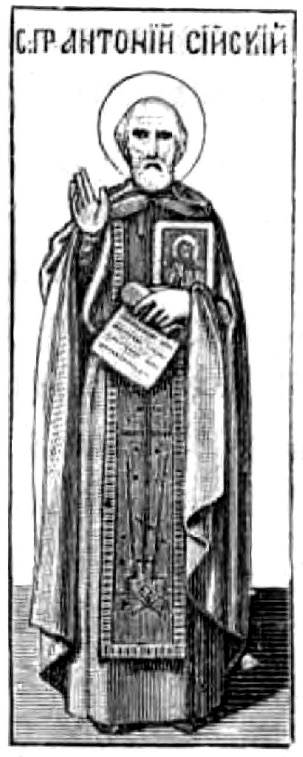
Родители блаженного Антония, в мире Андрея, были богатые и благочестивые земледельцы Двинской волости, деревни Кехты, вышедшие из Новгорода136. Андрей был старший сын их и был даровитый и красивый собой; отданный учиться грамоте, он скоро выучился ей; потом научился иконописанию; войдя в силы отрока, он почтителен был к родителям, но не имел охоты к их занятию, к земледелию; любимым занятием его было писать иконы, потом ходить в храм Божий. По смерти родителей, отправился он в Новгород и там пять лет служил у одного боярина; по совету его вступил в брак, но через год жена умерла, и он решился расстаться с суетой мира. Возвратясь в дом свой, он роздал свою часть нищим и в одной одежде отправился в Пахомиеву пустынь на р. Кену. На дороге, заснув, видел он во сне: муж благолепный, с крестом в руке, говорил ему: «возьми крест свой и не бойся вступить в подвиг», и осенил его крестом. Проснувшись, провёл он остальную ночь в молитве. Блаженный Пахомий, облёкши его в иноческую одежду с именем Антония, держал его в своей келье. Ему было 30 лет и это было в 1508 г.137, Антоний прежде всех являлся в храм на молитву; трудился на поварне, нося воду и готовя дрова; пищу принимал через день и то не до сытости; память о смерти и суде постоянно хранил в сердце. Посвящённый в иеромонашество, один совершал служение в храме, – другого иеромонаха не было, – и вместе с тем ходил на работы наравне с прочими; и здоровье его было так крепко, что мог он трудиться за двух.
The parents of the blessed Antony, in the world Andrew, were wealthy and pious farmers of the Dvina volost, of the village of Kekhta, who had come from Novgorod 136. Andrew was their eldest son and was gifted and handsome of appearance; being given to learn literacy, he soon learned it; then he learned icon-painting; having come into the strength of youth, he was respectful to his parents, but had no inclination for their occupation, farming; his favorite occupation was to paint icons, and then to go to the house of God. After the death of his parents, he set off for Novgorod and there served for five years under a certain boyar; by his advice he entered into marriage, but after a year his wife died, and he resolved to part with the vanity of the world. Returning to his home, he distributed his portion to the poor and in a single garment set off for the Pachomius Hermitage on the river Kena. On the road, having fallen asleep, he saw in a dream: a comely man, with a cross in his hand, said to him: "Take up your cross and do not fear to enter upon the struggle," and signed him with the cross. Awaking, he spent the rest of the night in prayer. The blessed Pachomius, having clothed him in the monastic habit with the name Antony, kept him in his cell. He was 30 years old, and this was in 1508 137. Antony was first of all to appear in the church for prayer; he labored in the kitchen, carrying water and preparing firewood; he took food every other day and then not to satiety; the remembrance of death and judgment he constantly kept in his heart. Being ordained to the hieromonastic rank, he alone performed the services in the church — there was no other hieromonk — and at the same time went to the labors on equal terms with the rest; and his health was so strong that he could labor for two.
По любви к пустынному уединению, по благословению игумена, оставил он Пахомиеву пустынь и с двумя братьями, Александром и Иоакимом, отправился на реку Шелексну; здесь избрано место для пустынной жизни, поставлен небольшой храм св. Николая и несколько келий, это было в 1513 г. К трём пустынникам присоединились ещё четыре инока, и преподобный прожил здесь семь лет. Соседние жители стали теснить пустынников, и они ушли ещё дальше на север138.
Out of love for desert solitude, with the blessing of the abbot, he left the Pachomius Hermitage and with two brethren, Alexander and Joachim, set off for the river Sheleksna; here a place was chosen for the desert life, a small church of St. Nicholas was erected and several cells, this was in 1513. To the three desert-dwellers four more monks were added, and the Venerable One lived here for seven years. The neighboring inhabitants began to oppress the desert-dwellers, and they withdrew still farther to the north 138.
В глухом севере зверолов показал пустынникам место удобное для пустынной жизни, Михайлов остров, окружённый глубокими озёрами и омываемый с одной стороны рекой Сией, вытекающею из озёр. Место было совершенно дикое, тундра и лес, озёра и чащи непролазные; оленей, лисиц, медведей, волков – множество, и только по временам звероловы заходили сюда, гоняясь за зверем, но ещё не обитал здесь человек. Антоний поставил тут часовню и для себя с братией хижину. Это было в 1520 г., на 42 году жизни Антониевой. Три года проведено здесь в крайней скудости и в тяжёлом труде: Антоний очищал лес и копал землю, чтобы сделать место сносным для житья; братия начинали роптать на скудость; но неожиданно неизвестный христолюбец доставил им хлеб, муку, масло и сверх того деньги на построение обители. Сборщик доходов Новгородского архиепископа Василий Бебрь, в уверенности, что у Антония много денег, вздумал добыть богатый доход для себя; он послал известных ему людей ограбить пустынников; но после сам с раскаянием говорил Антонию, что хищникам представилось, будто обитель окружена стражей139. – С того времени начали посещать пустынь Антония богомольцы и доставлять средства к жизни.
In the deep north, a hunter of wild beasts showed the desert-dwellers a place suitable for the desert life, Mikhailov Island, surrounded by deep lakes and washed on one side by the river Siya, which flows out of the lakes. The place was completely wild, tundra and forest, lakes and impenetrable thickets; of deer, foxes, bears, wolves — a multitude, and only occasionally did hunters come here, chasing after beasts, but no man had yet dwelt here. Antony set up a chapel here and for himself with the brethren a hut. This was in 1520, in the 42nd year of Antony's life. Three years were spent here in extreme want and in heavy labor: Antony cleared the forest and dug the earth, to make the place tolerable for habitation; the brethren began to murmur at the want; but unexpectedly an unknown lover of Christ delivered to them bread, flour, oil, and moreover money for the building of the monastery. A collector of revenues for the Novgorod archbishop, Basil Bebr, in the conviction that Antony had much money, conceived the idea of obtaining a rich income for himself; he sent men known to him to rob the desert-dwellers; but afterwards he himself with repentance said to Antony that the robbers fancied that the monastery was surrounded by a guard 139. — From that time pilgrims began to visit Antony's hermitage and to supply the means of life.
Когда число учеников умножилось, – два старшие Александр и Исаия отправлены в Москву испросить у В. КН. Василия дозволение занять дикое место пустынной обителью, и получена грамота; тогда построили обширный деревянный храм Св. Троицы. Местный храмовой образ написан был самим Антонием и с молебным пением поставлен в иконостас. Раз после утреннего пения оставили не загашенную свечу; храм объят был пламенем, когда вся братия была на работе с Антонием; весь храм и вся утварь сгорели, осталась только Антониева икона Св. Троицы. Построен новый храм и другой тёплый при трапезе. По общей просьбе братии, Антоний принял звание игумена, но продолжал быть примером любви к труду; он каждый день был в храме при каждом Богослужении, и потом в худой одежде то чистил он лес, то трудился на пашне, то занимался иконной работой. Праздности не любил ни в себе, ни в других; о больных заботился с отеческой любовью; пища и одежда были у него для всех одинаковые; нетрезвость считал нетерпимым грехом. – Преподобный внушал братии никогда не увлекаться гневом, жить в кротости, терпении и любви. Ещё при жизни Антония при иконе Св. Троицы получались исцеления.
When the number of disciples multiplied, — the two eldest, Alexander and Isaiah, were sent to Moscow to ask Grand Prince Basil for permission to occupy the wild place with a desert monastery, and a charter was obtained; then they built a spacious wooden church of the Holy Trinity. The local temple icon was painted by Antony himself and with moleben singing was placed in the iconostasis. Once after the morning singing they left an unextinguished candle; the church was enveloped in flames when all the brethren were at work with Antony; the whole church and all the vessels burned down, only Antony's icon of the Holy Trinity remained. A new church was built and another, a warm one, at the refectory. By the common request of the brethren, Antony accepted the rank of abbot, but continued to be an example of love for labor; every day he was in the church at every divine service, and then in poor clothing he would either clear the forest, or labor at the plowland, or occupy himself with icon work. Idleness he loved neither in himself nor in others; for the sick he cared with fatherly love; food and clothing were for him the same for all; drunkenness he considered an intolerable sin. — The Venerable One admonished the brethren never to be carried away by anger, to live in meekness, patience, and love. Even during Antony's lifetime, healings were received at the icon of the Holy Trinity.
Распространившаяся слава об Антонии не веселила Антония; посетители и хлопоты начальствования были докучливы, отнимая время у безмолвия. Потому, избрав на своё место ученика Феоктиста, Антоний с одним простым иноком поселился в месте мало доступном: место окружено было торами, как стенами, горы покрыты лесом, при подошве гор озеро Падунь; на скате горы между берёзами поставлена была часовня с кельей, и здесь-то Антоний начал подвизаться в безмолвии. Ночи проводимы были в молитве, а днём трудами рук своих добывал он себе пропитание; в знойные дни садился обнажённый до пояса, и комары терзали тело его. Так прошло два года.
The widespread fame of Antony did not gladden Antony; visitors and the cares of leadership were burdensome, taking away time from silence. Therefore, having chosen his disciple Theoctistus as his replacement, Antony settled with one simple monk in a place of difficult access: the place was surrounded by bogs like walls, the mountains were covered with forest, and at the foot of the mountains was Lake Padun; on the slope of the mountain, among the birches, a chapel with a cell was set up, and here Antony began to struggle in silence. He spent the nights in prayer, and by day he obtained his sustenance by the labor of his own hands; on hot days he would sit naked to the waist, and mosquitoes tormented his body. Thus passed two years.
Феоктист отказался от игуменства, и братия объявили Антонию, что если он не примет опять игуменства, они разойдутся в разные стороны. Антоний принуждён был опять игуменствовать.
Theoctistus refused the abbacy, and the brethren declared to Antony that if he did not again accept the abbacy, they would disperse in different directions. Antony was compelled to be abbot once more.
Перед кончиной своей, по просьбе учеников, оставил он духовную грамоту. «Братия и отцы!» писал он, «видите, постигла меня грешного старость, – часто подвергаюсь болезни, которой и теперь отягчён. Все болезни мои говорят мне об одном – о смерти и о страшном суде той жизни. Сердце моё смущено от грозного исхода, и страх смерти напал на меня. – Вы любовью своей понуждаете меня грешного написать, как вам жить после моей смерти. Господь Бог видит мои беззакония и в ваших глазах мои грехи. Вы просите превышающее силы мои, – Вы видели, – не был я примером ни одной добродетели. Вы называли меня грешного отцом своим, пастырем и учителем; но я не пастырь и не учитель. Один есть Пастырь Христос. Неразумием своим я грешный разорял ваше Богоугодное житие. Но не отчаиваюсь я в своём спасении, а надеюсь на милость Божию и на ваши молитвы. Бог говорит: «не приидох призвати праведники, но грешники на покаяние». Святыми молитвами вашими, по слову пророка, возлагаю на Господа печаль мою: пусть творит со мной, что Ему угодно; Он хочет, чтобы все спаслись и пришли в уразумение истины.
Before his end, at the request of his disciples, he left a spiritual testament. "Brethren and fathers!" he wrote, "you see that old age has overtaken me, a sinner—I am often subject to illness, with which I am now burdened. All my illnesses speak to me of one thing—of death and the dread judgment of that life. My heart is troubled by the terrible departure, and the fear of death has come upon me. — You, by your love, compel me, a sinner, to write how you should live after my death. The Lord God sees my transgressions and my sins in your eyes. You ask what exceeds my strength—You have seen—I was not an example of any virtue. You called me, a sinner, your father, pastor, and teacher; but I am neither pastor nor teacher. There is one Shepherd, Christ. By my folly, I, a sinner, have destroyed your God-pleasing way of life. But I do not despair of my salvation; I hope in the mercy of God and in your prayers. God says: 'I came not to call the righteous, but sinners to repentance.' By your holy prayers, according to the word of the prophet, I cast my care upon the Lord: let Him do with me as He wills; He desires that all should be saved and come to the knowledge of the truth.
«Много бы нужно писать вам из св. Писания. Но вы знаете, что я умею грамоте лишь отчасти; да и боюсь Владыки моего Христа, Который сказал, что прежде надобно самому делать и потом учить. Так, поручаю монастырь свой и вас Богу и Пречистой Матери Его и преп. Сергию. Назначаю вам в монастырь, по вашей просьбе, строителя старца Кирилла; пусть с ним священники соборно решают монастырские дела в трапезе, при всей братии. Если иные строптивые и раскольники не захотят жить по монастырскому чину, не станут повиноваться строителю и братии, – выгонять их из обители в страх прочим; если же такой возвратится с раскаянием, то принять его, как своего, простить и не считать врагом, а братом... Прежде всего имейте страх Божий в душе, да вселится в вас Дух Святой и научит вас всякой истине. Живите общей жизнью, по духу и телу, в пище и одежде, по заповеди св. отцов. Строитель пусть довольствуется братской трапезой, не прибавляя себе ничего; то же – в одежде и обуви, разве по особенному усмотрению. – Не держите хмельного в монастыре и не принимайте от христолюбивых. – Женский пол отнюдь не должен ночевать в монастыре, и миряне не должны ночевать в кельях вместе с братиями. – Поите и кормите бедных досыта; подавайте милостыню, чтобы не обеднело это святое место. Здоровые из братии, для своего спасения, не должны оставаться без работ. Не дозволяйте ставить дворов вокруг монастыря; скотный двор пусть стоит за озером. – Молю вас, храните это.
"Much would need to be written to you from Holy Scripture. But you know that I have only a partial knowledge of letters; and I also fear my Master Christ, Who said that one must first do and then teach. Therefore, I entrust my monastery and you to God and His Most Pure Mother and to the Venerable Sergius. I appoint for you in the monastery, at your request, the builder, Elder Cyril; let the priests with him decide the monastery's affairs in the refectory, in the presence of all the brethren. If any stubborn and schismatic persons do not wish to live according to the monastic rule, and will not obey the builder and the brethren—drive them out of the monastery as a warning to the rest; if such a one returns with repentance, receive him as one of your own, forgive him, and consider him not an enemy but a brother... Above all, have the fear of God in your soul, that the Holy Spirit may dwell in you and teach you all truth. Live a common life, in spirit and body, in food and clothing, according to the commandment of the holy fathers. Let the builder be content with the common table, adding nothing for himself; the same for clothing and footwear, unless by special discretion. — Do not keep strong drink in the monastery, nor accept it from Christ-lovers. — Women must by no means spend the night in the monastery, and laymen must not spend the night in the cells together with the brethren. — Give the poor to eat and drink their fill; give alms, so that this holy place may not become impoverished. The healthy among the brethren, for their own salvation, must not remain without work. Do not permit the building of farmsteads around the monastery; let the cattle yard stand beyond the lake. — I beseech you, keep this.
Да будет с вами милость Божия и Пречистой Богородицы и молитвы преп. Сергия, ныне и присно и во веки веков, аминь»140.
May the mercy of God and of the Most Pure Theotokos and the prayers of the Venerable Sergius be with you, now and ever and unto the ages of ages, Amen."140
Передав управление обителью ученику своему, преп. Антоний мирно почил на 79 году жизни своей, дек. 7, 1556 г.141.
Having handed over the governance of the monastery to his disciple, the Venerable Antony peacefully reposed in the 79th year of his life, on December 7, A.D. 1556.141
Память преп. Антония установлено праздновать в 1579 г. По писцовой книге 1627 г. видим в Сийской обители храм во имя преп. Антония Сийского142. Верный раб Божий прославился множеством чудес, которые совершались то при мощах его, то явлениями его в доме больных, или на море. Вот один из замечательных случаев. Священник соседнего села Харитон, по обыкновенной зависти, возбуждал ропот против обители между окрестными жителями и хулил и преподобного основателя её. Раз шёл он к вечерне и внезапно ослеп. Спустя несколько дней понял он грех свой и стал каяться в том; когда призвал он на помощь Антония, зрение возвратилось ему, и после того поступил он в Сийский монастырь.
The commemoration of the Venerable Antony was established to be celebrated in A.D. 1579. From the land-register book of 1627 we see in the Siya monastery a church in the name of the Venerable Antony of Siya.142 The faithful servant of God was glorified by many miracles, which were performed either at his relics, or by his appearances in the homes of the sick, or on the sea. Here is one remarkable case. A priest of the neighboring village, Chariton, out of ordinary envy, stirred up murmuring against the monastery among the local inhabitants and reviled its venerable founder. Once, as he was going to Vespers, he suddenly became blind. After a few days he understood his sin and began to repent of it; when he called upon Antony for help, his sight was restored to him, and after that he entered the Siya monastery.
Преподобный Сийский любил писать св. иконы. В обители и его остаётся руки его, кроме чудотворного образа Св. Троицы, икона Богоматери; во многих других местах Архангелского края ещё целы иконы искусного письма его. При нём многие из братии занимались писанием икон. Эта любовь к иконописанию долго оставалась в его обители и после его кончины. Ныне хранится там книга с рисунками ΧVII в.143. I Преподобный и по кончине одним из чудес показал, что украшать храмы иконами считает он за дело святое. Питирим, бывший игумен Комельской Николаевской обители, живя на покое в Сийском монастыре, много занимался писанием икон новых и поновлением старых; но он стал тяжко болен; болезнь усилилась наконец до того, что он близок был к смерти. В тонком сне видит он, что от гробницы преподобного идёт в келью его старец, согбенный летами, но благолепный, покрытый сединами. «Хочешь ли быть здоровым и окончить начатое?» спросил больного старец. «Хочу, но не могу», отвечал Питирим. «Св. Троица исцеляет тебя, сказал явившийся; не ослабевай в деле твоём; я настоятель Антоний пришёл посетить тебя в болезни». – Питирим почувствовал себя здоровым.
The Venerable One of Siya loved to paint holy icons. In the monastery there remain from his hand, besides the wonderworking icon of the Holy Trinity, an icon of the Mother of God; in many other places of the Arkhangelsk region, icons of his skillful painting are still intact. Under him, many of the brethren were occupied with icon-painting. This love for icon-painting long remained in his monastery after his repose. A book with drawings from the 17th century is preserved there.143 The Venerable One even after his repose showed by one of his miracles that he considered the adornment of churches with icons a holy work. Pitirim, a former abbot of the Komel Nicholas monastery, living in retirement at the Siya monastery, was much occupied with painting new icons and restoring old ones; but he fell gravely ill; the illness finally intensified to the point that he was near death. In a light sleep he saw an elder coming from the tomb of the Venerable One to his cell, bent with years but comely, covered with gray hair. "Do you wish to be well and to finish what you have begun?" the elder asked the sick man. "I wish to, but I cannot," answered Pitirim. "The Holy Trinity heals you," said the one who appeared; "do not grow weak in your work; I, Abbot Antony, have come to visit you in your illness." — Pitirim felt himself well.
Купец плыл с товаром к устью Двины, – в карбазе его была и монастырская рыба, – поднялась буря, волны катились горами; пловцы отчаялись в спасении. Неожиданно купец видит вблизи себя старца, который мантией прогоняет волны от карбаза. «Ты призываешь многих на помощь, сказал он изумлённому, а меня не зовёшь, хотя тут есть собственность нашей обители, но – Бог устроит тишину». – Кто ты, человек Божий? спросил пловец. Явившийся назвал себя Антонием и стал невидим. С той минуты море стало утихать, и подул попутный ветер. – Купец прибыл в монастырь и принял здесь пострижение в иночество.
A merchant was sailing with goods toward the mouth of the Dvina—in his karbas there was also monastery fish—when a storm arose, waves rolled like mountains; the sailors despaired of salvation. Unexpectedly, the merchant saw an elder near him, who with his mantle was driving the waves away from the karbas. "You call upon many for help," he said to the astonished man, "but you do not call upon me, although the property of our monastery is here; but—God will bring calm." — "Who are you, man of God?" asked the sailor. The one who appeared named himself Antony and became invisible. From that moment the sea began to calm, and a favorable wind blew. — The merchant arrived at the monastery and there received the tonsure into monasticism.
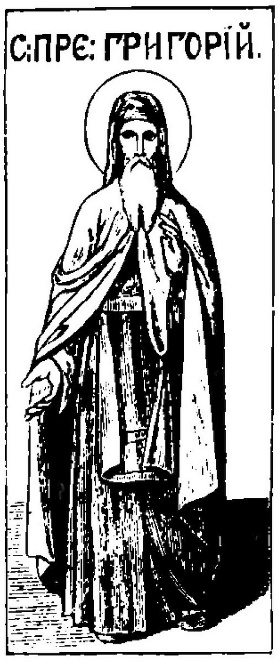
Отечеством св. Григория, ктитора Афонской обители Григориата, была Сербия. Так говорит предание и так говорится в службе ему. Путешественник Барский в первое своё посещение Афона видел в Григориевой обители много Славянских книг, памятник того, что здесь подвизались Славяне, хотя потом возобладали обителью Греки. На западе монастыря, на четверть часа пути от обители (в версте), поныне известна пещера, в которой подвизался препод. Григорий. Устроенная преподобным обитель посвящена была свят. Николаю, но она, как в давние времена, так и ныне в честь основателя своего называется Григорьевой. По актам Афонским находили подпись пр. Григория под актом 1405 г. К сожалению и акт, и описание жизни преподобного куда-то скрылись. По словам Греков, как бумаги и книги обители, так и мощи преп. Григория в пожар 1761 г. унесены были Сербскими иноками с Афона. Когда бы это была правда!144
The homeland of St. Gregory, the ktetor of the Athonite monastery of Grigoriat, was Serbia. So says tradition, and so it is said in the service to him. The traveler Barsky, during his first visit to Athos, saw in the monastery of Gregory many Slavic books, a memorial that Slavs struggled here, although later Greeks came to possess the monastery. To the west of the monastery, a quarter of an hour's walk from the monastery (about a verst), the cave in which the Venerable Gregory struggled is known to this day. The monastery built by the Venerable One was dedicated to St. Nicholas, but it, as in ancient times, so now, is called Gregory's in honor of its founder. From the Athonite acts, the signature of the Venerable Gregory was found under an act of 1405. Unfortunately, both the act and the description of the life of the Venerable One have disappeared somewhere. According to the Greeks, both the papers and books of the monastery and the relics of the Venerable Gregory were carried away from Athos by Serbian monks in the fire of 1761. If only this were true!144
Это было большой потерей для еп. Амвросия, так как, пользуясь расположением к себе этого благочестивого императора, он успевал склонять его на многое в пользу христиан, так напр. расположил его отменить его указ о свободе вероисповеданий и возвратить православным Медиоланцам отнятый у них арианами при содействии императрицы Иустины, храм в городе. Обратил также внимание Грациана, проводившего с 378 по 381 год зиму в Милане, на неприличную совместимость христианства и язычества в том, что церкви христиан и капища языческие, стоявшие рядом, были равно открыты для служения. Грациан в 382 году повелел вывести из Сената статую победы, а жрецов и весталок лишить общественного содержания, – и хотя сенаторы просили его о возвращении права древней религии Рима, император даже не принял посольства от них и отказался от предложенной ему «одежды верховного первосвященника» языческого, возразив, что «украшение языческое неприлично христианину».
This was a great loss for Bishop Ambrose, since, enjoying the favor of this pious emperor, he succeeded in inclining him to many things in favor of Christians; for example, he induced him to revoke his edict on freedom of worship and to return to the Orthodox Milanese the church in the city that had been taken from them by the Arians with the assistance of Empress Justina. He also drew the attention of Gratian, who spent the winter of 378–381 in Milan, to the unseemly coexistence of Christianity and paganism in that Christian churches and pagan temples, standing side by side, were equally open for worship. In 382, Gratian ordered the statue of Victory to be removed from the Senate, and the priests and Vestal Virgins to be deprived of public support—and although the senators petitioned him for the restoration of the rights of the ancient religion of Rome, the emperor did not even receive their embassy and refused the offered "garment of the supreme pontiff" of paganism, replying that "pagan adornment is unbecoming to a Christian."
Ркп. житие пр. Нила и чудеса его, из которых последнее 1599 г., у Царского, № 107, у Ундольского, № 345–147. Житие написано по запискам инока Германа, после соборного совещания, при ц. Борисе. Герман пишет: «пришёл я священноинок Герман в Нилову пустынь, на остров Столбенский, спустя много лет после преставления преподобного и что слышал от предков моих и иных христолюбцев, всё то поверил и записал; – и сам я родился и жил близ его пустыни. – Уже лет за 20 до сего писал я о жизни преподобного и чудесах, но держал у себя... Я собрал всё, что передавали мне христолюбивые о жизни и чудесах блажениого».
Manuscript life of the Venerable Nilus and his miracles, the last of which is from 1599, at Tsarsky, No. 107, at Undolsky, No. 345–147. The life was written from the notes of the monk German, after a council meeting, under Tsar Boris. German writes: "I, the hieromonk German, came to the Nilus Hermitage, on Stolben Island, many years after the repose of the Venerable One, and what I heard from my forefathers and other Christ-lovers, all that I verified and wrote down; — and I myself was born and lived near his hermitage. — Already about 20 years before this I wrote about the life of the Venerable One and his miracles, but kept it with me... I gathered everything that Christ-lovers told me about the life and miracles of the blessed one."
Пещера, где почил преподобный, поныне цела. Ист. иер. V, 207. Ркп. святцы: «пр. Нил Столбенский на Селигере озере преставися в л. 7063 м. дек. в 7 день».
The cave where the Venerable One reposed is still intact. History of the Hierarchy V, 207. Manuscript calendar: "The Venerable Nilus of Stolben, on Lake Seliger, reposed in the year 7063, month of December, on the 7th day."
Ркп. житие; ист. иер. V, 207. Журн. мин. внутр. дел 1843 г. 2, 400. У Царского служба № 107. 408. У Толстого 1. № 39. Служба, житие и повесть о чудесах.
Manuscript life; History of the Hierarchy V, 207. Journal of the Ministry of Internal Affairs 1843, 2, 400. At Tsarsky, service No. 107, 408. At Tolstoy, 1, No. 39. Service, life, and account of miracles.
Бл. Нектарий скончался в Москве в начале 1667 г. Тело его привезено в Нилову пустынь. Здесь над гробом его стоит образ его. Ист. иер. V, 207. 208.
Bl. Nektary reposed in Moscow at the beginning of 1667. His body was brought to the Nilova Hermitage. Here, above his grave, stands his icon. Hist. of the Hierarchy V, 207. 208.
Ркп. житие преп. Антония, описанное со слов очевидцев и сотрудников Антония царевичем Иоанном в 1589 году, у Царского № 85. 86, иером. Ионой в б. общ. ист. № 39. 40, у Ундольского первое под № 285, второе под № 284. Послесловие царевича у Карамз. IX, пр. 612
Manuscript life of the Venerable Anthony, written from the words of eyewitnesses and co-workers of Anthony by Tsarevich John in 1589, at Tsarsky No. 85. 86, by Hieromonk Jonah in the library of the Society of History No. 39. 40, at Undolsky the first under No. 285, the second under No. 284. Afterword of the Tsarevich in Karamzin IX, note 612.
Мощи блаженного Пахомия почивают в основанной им, поныне упразднённой, Канской или Кенской пустыни (свед. о монаст. 16); в ркп. святцах помещено имя его, но ни год, ни день кончины его не показаны. По житию преп. Антония можем полагать, что Пахомий скончался около 1520 г.
The relics of the Blessed Pachomius rest in the Kansk or Kensk Hermitage founded by him, now abolished (Information on Monasteries 16); in manuscript saints' calendars his name is included, but neither the year nor the day of his repose is shown. From the life of the Venerable Anthony we may suppose that Pachomius reposed around 1520.
Свед. о мон., стр. 17. В службе на 7 дек.: «содержа в уме вечные утехи Небесного Царствия, ты оставил всё земное, терпел много напастей и изгнания и от всего избавил тебя Даровавший тебе вечную жизнь». Минея, Μ. 1645 г.
Information on Monasteries, p. 17. In the service for December 7: "Holding in mind the eternal delights of the Heavenly Kingdom, you forsook all earthly things, endured many afflictions and exiles, and from all things He Who granted you eternal life delivered you." Menaion, Moscow 1645.
Об этом говорит и церк. служба: «не устрашила тебя, блаженный, ни долгота лет, ни скорби пустыни, ни нападение разбойников; у тебя одно было в виду – для Христа умереть в пустыни». Минея, Μ. 1645 г.
The church service also speaks of this: "Neither length of years, O blessed one, nor the sorrows of the wilderness, nor the attack of robbers terrified you; you had but one aim—to die for Christ in the wilderness." Menaion, Moscow 1645.
Словарь Максимовича, 1, 164–168. В Синод. б. в ркп. XVI в. № 814, есть устав Сийского монастыря, составленный по обиходу Сергиевой лавры и монастыря Кириллова; но едва ли писан он преп. Антонием.
Dictionary of Maksimovich, 1, 164–168. In the Synodal Library, in a 16th-century manuscript No. 814, there is a rule of the Siya Monastery, compiled according to the typicon of the Sergius Lavra and the Monastery of St. Cyril; but it was hardly written by the Venerable Anthony.
Пролог 7 дек. Церковная служба: «единаго лета ко осмидесяти в течении своем не докончал еси, блаженный». По ркп. святцам, «преставися в л. 7065 дек. 7 д.».
Prologue for December 7. Church service: "By a single year you did not complete eighty in your course, O blessed one." According to manuscript saints' calendars, "He reposed in the year 7065, December 7."
Послесловие царевича: «списано бысть сие: канон его 8720, – а житие его – л. 8088-го... Во время то прииде игумен Питирим обители блаженнаго и с ним ученик преподобнаго Фнлофей, его жития первый списатель... Приидоша ко отцу моему, да повелит его благородствие почитати его, якоже и всех святых; при цреосв. Антонии митрополите, иже первее бысть архиепископ граду Полоцку, – приидоша старцы. Он, по повелению царя и по соборном изложении, изложи праздновати преп. отцу Антонию» Карамз. IX. пр. 612. Акт. ист. 3, № 95.
Afterword of the Tsarevich: "This was copied: his canon—in the year 8720, and his life—in the year 8088... At that time there came Pitirim, abbot of the monastery of the blessed one, and with him the disciple of the Venerable Philotheus, the first scribe of his life... They came to my father, that his nobility might command him to be honored as all the saints; under Metropolitan Anthony, who formerly was Archbishop of the city of Polotsk, the elders came. He, by the command of the Tsar and by conciliar decree, decreed that the Venerable Father Anthony be glorified." Karamzin IX, note 612. Acts of History 3, No. 95.
Афонский Патерик 1, 400. Заметки поклонника, стр. 274. 275. Описание монастырей горы Афонской, стр. 127. СПб. 1859 по сказанию 1579 г. «монастырь Сербский Григориат». Аврамович Афонские древности, стр. 76, у Београду 1847 г.
Athonite Patericon 1, 400. Notes of a Pilgrim, pp. 274. 275. Description of the Monasteries of Mount Athos, p. 127. St. Petersburg 1859, according to a narrative of 1579, "the Serbian Monastery of Grigoriat." Avramovich, Athonite Antiquities, p. 76, at Belgrade 1847.