Orthodox Translations

November 2727 ноября

Old Calendar: civil December 10 · New Calendar: civil November 27

History

Преподобного Палладия, епископа Еленопольского

The Venerable Palladius, Bishop of Helenopolis

E1.TAI draft

Палладий, уроженец Галатии, имея от роду двадцать лет, прибыл в Александрию (в 388 году) и вел монашескую жизнь сперва (года три) в окрестностях этого города, потом в Нитрийской пустыне и Скитской (лет девять) и наконец, по причине болезни, для перемены воздуха перешел в Палестину, в Вифлеем, а чрез год в Вифинию, где не позднее начала 399 года граждане Еленополя избрали его на епископский престол.

Palladius, a native of Galatia, at the age of twenty years came to Alexandria (in the year 388) and led a monastic life, first (for about three years) in the vicinity of that city, then in the Nitrian desert and the Skete (for about nine years), and finally, on account of illness, for a change of air he moved to Palestine, to Bethlehem, and after a year to Bithynia, where, not later than the beginning of the year 399, the citizens of Helenopolis elected him to the episcopal throne.

E1.0AI draft

Палладий пользовался особым доверием св. Иоанна Златоуста и сам был привержен к нему; посему, когда (с апреля 404 года) Иоанн подпал гонению, и Палладий вынужден был скрываться, а в 405 году прибыл в Рим. Император Гонорий к посольству, имевшему ходатайствовать о Златоусте пред восточным императором Аркадием, присоединил и Палладия. Послы Римские воротились ни с чем, а Палладий задержан и сослан в город Сиену, в Верхнем Египте, откуда, по смерти Аркадия (в 408 году), переведен в Антиною. В 412 году он возвратился на свою кафедру, где, по просьбе Лавса, знатного придворного сановника, составил книгу, описывающую подвиги и чудеса мужей и жен Египта, Сирии, Месопотамии, Галатии, Каппадокии и города Рима, живших в IV и начале V века. Книга эта называется «Лавсаик» и составлена в 420 году.

Palladius enjoyed the special confidence of St. John Chrysostom and was himself devoted to him; therefore, when (from April 404) John fell under persecution, Palladius was compelled to hide, and in the year 405 he came to Rome. The Emperor Honorius added Palladius to the embassy that was to intercede for Chrysostom before the Eastern Emperor Arcadius. The Roman envoys returned with nothing, while Palladius was detained and exiled to the city of Syene in Upper Egypt, from whence, after the death of Arcadius (in the year 408), he was transferred to Antinoë. In the year 412 he returned to his see, where, at the request of Lausus, a noble court dignitary, he composed a book describing the ascetic labors and miracles of men and women of Egypt, Syria, Mesopotamia, Galatia, Cappadocia, and the city of Rome, who lived in the fourth and early fifth centuries. This book is called the Lausiac History and was composed in the year 420.

E1.1AI draft

К концу жизни Палладий переведен на епископскую же кафедру в город Аспуку, что́ в Галатии, и тут скончался. Церковным уставом полагается производить чтения из Лавсаика на утренях св. Четыредесятницы.

Toward the end of his life, Palladius was transferred to the episcopal see in the city of Aspuna in Galatia, and there he reposed. According to the Church Typicon, readings from the Lausiac History are appointed to be read at Matins during Holy Lent.

E1.2AI draft

Св. муч. Иакова Персянина (рассеченного)

The Holy Martyr James the Persian (the Dismembered)

E2.TAI draft

Из повествования очевидца о страданиях св. Иакова известно, что он жил в IV веке, происходил из христианской семьи и женат был также на христианке; но, занимая важную должность при дворе Персидского царя Издегерда и пользуясь расположением его и преемника его Варарана и, вообще, большим почетом, малодушно убоялся признать себя христианином, чтобы не лишиться своего блистательного положения, и; по-видимому, не отличался от огнепоклонников, к которым принадлежал царь и весь двор.

From the account of an eyewitness of the sufferings of St. James, it is known that he lived in the fourth century, came from a Christian family, and was also married to a Christian woman; but, holding an important office at the court of the Persian king Yazdegerd and enjoying the favor of him and of his successor Bahram, and generally being held in great honor, he cowardly feared to acknowledge himself a Christian, lest he lose his brilliant position, and outwardly he did not differ from the fire-worshippers, to whom the king and all the court belonged.

E2.0AI draft

Узнав, что Иаков участвует в обрядах богопротивного исповедания, мать и жена его пришли в ужас и поспешили написать ему, строго упрекая его за отступничество и вместе с тем умоляя раскаяться и мужественно заявить себя исповедником Бога Истинного: «если же ты не сознаешь и не искупишь покаянием греха своего, – писали они, – то мы не хотим видеть тебя у нас в доме, не хотим иметь ничего общего с богоотступником»...

Learning that James was participating in the rites of the godless confession, his mother and wife were horrified and hastened to write to him, sternly reproaching him for his apostasy and at the same time imploring him to repent and courageously declare himself a confessor of the True God: "But if you do not acknowledge and do not atone for your sin through repentance," they wrote, "then we do not wish to see you in our house, nor do we wish to have anything in common with an apostate from God"...

E2.1AI draft

Это письмо, хотя и строгое, но проникнутое истинною любовию, тронуло Иакова и пробудило в нем живое сознание своего малодушия. Чувствуя боль сердечную при мысли об отвращении от него любимых матери и жены, он с ужасом представил себе вечное отвержение его Самим Богом... Благодатное сокрушение овладело сердцем Иакова и излилось в молитве, которая внушила ему надежду на беспредельное милосердие Божие, на «всего мира грехами непреодолеваемую благость»... Молитве уединенной посвящал он с тех пор все время, которого не требовала от него служба, и больше уже не видали его в числе совершающих поклонение солнцу.

This letter, though severe, yet penetrated with true love, touched James and awakened in him a lively awareness of his cowardice. Feeling heartfelt pain at the thought of the aversion of his beloved mother and wife, he envisioned with horror the eternal rejection of himself by God Himself... Grace-filled contrition took hold of the heart of James and poured forth in prayer, which inspired in him hope in the boundless mercy of God, in "the goodness that is overcome by no sins of the whole world"... From that time on, he devoted all the time that his service did not require of him to solitary prayer, and he was no longer seen among those performing worship to the sun.

E2.2AI draft

– Уже не Назарянин ли ты? – спросил его однажды царь Вараран, предупрежденный придворными о перемене жизни Иакова.

"Are you not a Nazarene?" the king Bahram asked him one day, having been warned by the courtiers of the change in James's life.

E2.3AI draft

И когда Иаков с твердостию признал себя исповедующим веру в Единого Истинного Бога Христа, царь в негодовании стал угрожать ему смертию.

And when James with firmness acknowledged himself a confessor of faith in the One True God Christ, the king in indignation began to threaten him with death.

E2.4AI draft

– Смерть не страшит меня, – отвечал христианин, – это только временный сон, от которого все мы проснемся, чтобы не усыпать никогда в иной жизни...

"Death does not frighten me," answered the Christian, "it is only a temporary sleep, from which we shall all awake, never to slumber again in the other life"...

E2.5AI draft

Напрасно продолжал царь склонять своего любимца к новому отступничеству; наконец, убедившись в его непоколебимости, он решился примерно покарать неблагодарного в отношении и к нему и к богам... и – приняв совет одного из своих приближенных – подвергнуть отступника от веры магов «десятикратной смерти», Вараран повелел отсечь у Иакова все члены тела один за другим...

In vain did the king continue to incline his favorite to a new apostasy; at last, convinced of his steadfastness, he resolved to punish the ungrateful one exemplarily, both in regard to himself and to the gods... and—having accepted the advice of one of his close associates—to subject the apostate from the faith of the Magi to "a tenfold death," Bahram commanded that all the members of James's body be cut off one after another...

E2.6AI draft

Не смутился Иаков; раскаяние и желание искупить свой грех были в нем превыше всякого страха. Весь погруженный в молитву, он с необыкновенною твердостию переносил необыкновенную казнь... Растянув его за руки и за ноги, у него отсекали медленно по одному все пальцы на руках и на ногах; потом отсекли самые руки и ноги и отделили бедра от тела. Едва живой мученик не терял сознания и не ослабевал духом, и – на сожаления о нем друзей своих, говорил им:

James was not troubled; repentance and the desire to atone for his sin were in him above all fear. Wholly immersed in prayer, he endured the extraordinary execution with extraordinary fortitude... Having stretched him out by his hands and feet, they slowly cut off, one by one, all the fingers on his hands and feet; then they cut off the hands and feet themselves and separated the thighs from the body. The barely living martyr did not lose consciousness and did not weaken in spirit, and—to the expressions of pity from his friends, he said to them:

E2.7AI draft

– Не плачьте обо мне, но о себе и детях ваших, потому что я иду насладиться вечным покоем, а вы даже и не знаете, в чем он состоит...

"Weep not for me, but for yourselves and your children, for I am going to enjoy eternal rest, while you do not even know what it consists of"...

E2.8AI draft

Обливаясь кровию, в которой омыл все свои человеческие прегрешения, мученик, умирая, воскликнул: «свят, свят, свят еси, Бог Вседержитель, восхваляемый небесными силами! Призри на меня, умирающего, Бог живых и мертвых, и услыши моление мое! Уже отсечены все члены мои, и тело мое почти мертво; не имею ног, чтобы восстать перед Тобою; не имею рук, чтобы воздеть их молитвенно к Тебе, Владыке моему; не имею колен, чтобы припасть и преклониться перед Тобою, Создателем моим, но повержен я перед Всевидящим, как храмина распавшаяся, как дерево, обнаженное от ветвей, и молю Тебя, Человеколюбец, не остави меня до конца, но изведи из темницы душу мою»...

Pouring forth blood, in which he washed away all his human transgressions, the martyr, dying, cried out: "Holy, holy, holy art Thou, O God Almighty, praised by the heavenly powers! Look upon me as I die, O God of the living and the dead, and hear my prayer! Already all my members are cut off, and my body is almost dead; I have no feet to stand before Thee; I have no hands to lift up in prayer to Thee, my Master; I have no knees to fall down and bow before Thee, my Creator, but I am cast down before the All-Seeing One, like a house that has fallen apart, like a tree stripped of its branches, and I pray Thee, O Lover of mankind, forsake me not utterly, but bring my soul out of prison"...

E2.9AI draft

Так молился блаженный Иаков, когда один из воинов отсек и главу его...

Thus prayed the blessed James, when one of the soldiers cut off his head as well...

E2.10AI draft

В ту же ночь христиане тайно собрали рассеченные останки св. мученика и предали их земле. О перенесении мощей св. Иакова, когда впоследствии был издан в Персии указ сожигать мощи святых мучеников, существуют различные сказания424.

That same night, Christians secretly gathered the dismembered remains of the holy martyr and committed them to the earth. Concerning the translation of the relics of St. James, when later a decree was issued in Persia to burn the relics of the holy martyrs, various accounts exist424.

E2.11AI draft

† Преставление св. Иакова, епископа Ростовского

† The Repose of St. James, Bishop of Rostov

E3.TAI draft

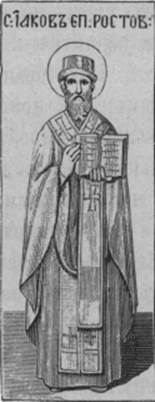
Блаженный Иаков425 еще в молодых летах посвятил себя на служение Господу в одной из обителей Ростовских. Строгий пост обучил тело его покоряться духу, молитва очистила и укрепила душу благодатию, а прилежное чтение книг обогатило разум его твердыми сведениями о св. вере426. В 1385 году, по смерти епископа Матфея, Грека, он посвящен был в архипастыря страны Ростовской427. В немногие годы правления своего он успел показать много дел святого пастыря. Какой-то Маркиан возмущал Ростовскую паству враждою своею против св. икон: человек начитанный и ловкий на слово, он успел образовать секту и даже некоторых бояр Ростовских успел убедить, что поклонение иконам – το же, что идолослужение, и потому преступно. Такой образ мыслей о св. иконах легко было занять тогда от магометанства, сильного между сильными Татарами и исступленно враждебного уважению священных изображений; его можно было усвоять тогда даже по видам на житейские выгоды. Ревностный святитель, коротко знавший учение отцов Церкви о св. иконах, обличил пред народом лживость и нечестие Маркианова учения, и Маркиана выгнали из Ростова. «Избавил ты людей, поет Церковь святителю, из уст волка своим учением, заградил говорливые уста еретические твоим богословием, великий отец!» «Гнусный Маркиан низложен священными словами твоими, Иаков преславный, и изрыгавший нечистоты выгнан, по нетерпимому неприличию его». В других песнях святитель восхваляется то как твердый наставник вельмож и охранитель от ереси, то как сострадательный покровитель вдов и бедных, утешитель печальных, или как смиренный и терпеливый пастырь428. Блаж. Иаков дышал Евангельскою любовию к страждущим, особенно душою. По надписи на древних иконах и по самым изображениям видим следующее: женщина, застигнутая в преступлении, приговором бояр осуждается на смерть; в раскаянии падает она к ногам святителя Иакова и умоляет его спасти ее от смерти. «Безгрешный пусть бросит камень на грешницу», говорит святой судьям и назначает грешнице место покаяния. Но этот, столько высокий поступок святителя раздражил и без того непокойную именитость. Высокий поступок его выдали за улику в нечистой жизни его и дерзко, без суда церковного, изгнали его из города. Кроткий святитель поставил себе хижину там же, где пребывал св. Леонтий, выгнанный из города, в 40 саженях от храма арх. Михаила, построенного св. Леонтием. Скоро стали собираться к блаж. Иакову многие из преданных ему граждан, а некоторые оставались жить с ним. Тогда блаж. Иаков построил деревянные келии для братии и деревянную церковь в честь зачатия св. Анны429. Так положено было основание Иаковлевскому монастырю! Основанием ему было терпение опозоренной святости. «Владея телесными страстями посредством пощения, ты не был побежден житейскими напастями», говорит похвальная песнь святителю430. Ростовцы почувствовали свой грех, раскаялись пред святителем, безрассудно оскорбленным, и просили его возвратиться на кафедру; но праведник, отягченный старостию, не захотел оставить тихой обители своей. Он мирно почил здесь ноября 27-го 1391 года.

The blessed James425 dedicated himself from his youth to the service of the Lord in one of the Rostov monasteries. Strict fasting trained his body to obey the spirit; prayer cleansed and strengthened his soul with grace; and diligent reading of books enriched his mind with solid knowledge of the holy faith426. In the year 1385, after the death of Bishop Matthew the Greek, he was consecrated as archpastor of the Rostov land427. In the few years of his rule, he succeeded in showing many deeds of a holy shepherd. A certain Markian disturbed the Rostov flock by his enmity against the holy icons: a man of learning and skillful in speech, he succeeded in forming a sect and even persuaded some of the Rostov boyars that the veneration of icons is the same as idolatry, and therefore sinful. Such a way of thinking about holy icons could easily be borrowed at that time from Mohammedanism, which was strong among the powerful Tatars and frantically hostile to respect for sacred images; it could even be adopted then with a view to worldly advantages. The zealous hierarch, who knew well the teaching of the Fathers of the Church concerning holy icons, exposed before the people the falsehood and impiety of Markian's teaching, and Markian was driven out of Rostov. "You have delivered the people, the Church sings to the hierarch, from the mouth of the wolf by your teaching; you have stopped the talkative heretical lips by your theology, O great father!" "The vile Markian was cast down by your sacred words, O most glorious James, and he who spewed forth filth was driven out, because of his intolerable indecency." In other hymns, the hierarch is praised now as a firm instructor of the nobles and a guardian from heresy, now as a compassionate protector of widows and the poor, a comforter of the sorrowful, or as a humble and patient shepherd428. The blessed James breathed with evangelical love for the suffering, especially in soul. According to the inscription on ancient icons and from the very depictions, we see the following: a woman caught in a crime is condemned to death by the verdict of the boyars; in repentance she falls at the feet of Hierarch James and implores him to save her from death. "Let him who is without sin cast a stone at the sinner," says the saint to the judges, and appoints for the sinner a place of repentance. But this, so lofty an act of the hierarch, angered the already restless nobility. His lofty act was presented as evidence of an impure life on his part, and they insolently, without a church trial, drove him out of the city. The meek hierarch set up a hut for himself in the same place where St. Leontius had dwelt when driven out of the city, forty sazhens from the church of the Archangel Michael built by St. Leontius. Soon many of the citizens devoted to him began to gather to the blessed James, and some remained to live with him. Then the blessed James built wooden cells for the brethren and a wooden church in honor of the Conception of St. Anne429. Thus was the foundation laid for the St. James Monastery! Its foundation was the patience of outraged holiness. "Having subdued the passions of the flesh through fasting, you were not overcome by the calamities of life," says the hymn of praise to the hierarch430. The people of Rostov felt their sin, repented before the hierarch who had been rashly insulted, and asked him to return to his cathedra; but the righteous man, burdened with old age, did not wish to leave his quiet monastery. He peacefully reposed there on November 27, 1391.

E3.0AI draft
Engraving

Святые мощи его почивают под спудом; над ними устроена богатая серебряная рака, усердием графини A.А. Орловой431.

His holy relics rest under the ground; over them a rich silver reliquary has been built, through the zeal of Countess A. A. Orlova431.

E3.2AI draft

«Земля покрывает тело твое, блаженный: но ты источаешь исцеления верным; дух твой в небе, с избранными, озаряемый сияниями Божества»432.

"The earth covers your body, O blessed one, but you pour forth healings upon the faithful; your spirit is in heaven with the elect, illumined by the radiances of the Godhead"432.

E3.3AI draft

Память о преп. Диодоре Юрьегорском

Commemoration of the Venerable Diodorus of Yuriegorsk

E4.TAI draft

25 верстах от Олонца, к северу, при озере Юрьеве и на горе того же имени, в самом начале XVII столетия, поселился отшельник Диодор и построил обитель с храмом Св. Троицы. В те времена не мало являлось желающих заводить новые обители; но Диодор был не из числа многих433. Уроженец Турчасовского прихода, Диомид, на 19 году возраста отправясь в Соловецкий монастырь для молитвы, остался здесь жить и, по испытании в послушании, пострижен в иночество игум. Антонием; настоятель поручил его в надзор духовному иноку, иеромонаху Иосифу Новгородцу. Похоронив отца своего, скончавшегося иноком на Соловках, Диодор пожелал видеть Соловецких отшельников, о которых говорил ему Иосиф. Он ушел на пустынный остров, не взяв с собою ни пищи, ни питья; ходя 40 суток по острову, он изнемог до крайности; некоторые из братий нашли его под деревом едва живым; они принесли его на монастырское подворье и призвали духовника. После исповеди, укрепившись пищею, ревнитель отшельнической жизни поселился на пустынном острову, при двух найденных им отшельниках. Отселе ходил он беседовать и с другими отшельниками, каковы были: старец Ефрем, Никифор белец, Алексей Калужанин, Иоасаф, Тихон Москвич, Феодор Рязанец, Трифон, Иоасаф, Севастиан и другие. Пустынник Тихон, по настоятельной просьбе его, рассказал о себе, что он ушел из Алексина во время Разстриги, оставив все свое и, переплыв на утлой лодке море, после трехлетней борьбы живет покойно. Никифор, встреченный без всякой одежды, поспешил скрыться и только сказал: «посещай, посещай, Диодор, чтоб и самому иметь от Бога утешение». Диодор усердно посещал пустынников, доставляя им необходимое для жизни. Впоследствии братия обители стали роптать на то я говорили: «хлеб обители тратится на тех, которые не трудятся для обители». Особенно же, когда ушел в отшельничество больничный келарь Кирик, лучше которого никто не ходил за больными, братия сильно возмутились, и игумен Иринарх вынужден был принять меры против страсти к отшельничеству. Он послал «братию, стрельцев и рабочих» на острова с тем, чтобы они возвратили отшельников в монастырь; тогда Диодор заключен был в оковы, в больнице, и к нему приставлена была стража. Спустя три месяца он снова ушел на остров и прожил здесь полгода. Брат его, живший также в Соловецком монастыре, отыскал его, но в самом жалком положении, расслабевшим от борьбы с нечистыми духами. Диодор решился теперь расстаться с Соловками и удалился на Оеегу. Невдали от Кеноозера, в пустынном лесу, избрал он себе место для пребывания и начал подвизаться. Но соседние жители вынудили его уйти отселе. Ему понравилась Юрьева гора, над озером Водлом; здесь водрузил он крест, поставил келью и начал подвизаться в молитве; сюда вскоре пришел к нему Прохор, и они 7 лет провели отшельниками. После того Диодор решился основать здесь обитель Св. Троицы и отправился в Москву; при посредстве келаря Сергиевой лавры, Александра Боголепа, получив доступ к царице, старице Марфе Ивановне, получил он от нее разную утварь и 200 р. денег; царь Михаил дал старцу грамоту; от других благотворителей получено им 300 р. Так были построены храм и обитель. Храм пришлось поставить на том месте, где было когда-то кладбище идолопоклонников, что не обошлось без привидений. Скоро собралось довольное число братий, и построен был еще храм Богоматери, с приделом в честь Соловецких чудотворцев. Хлебопашества своего еще не было у обители, а место было вдали от поселений. Оттого случилась нужда в хлебе. Поднялся ропот на старца: деньги, говорили, истратил на храм, а питаться нечем. « Потерпите», отвечал старец, и сам стал на молитву. Ему явился светлый старец. «Кто ты?» спросил Диодор. «Я – Александр Ошевенский, сказал явившийся, не скорби, а утверждай братию; пропитал же Господь народ Израильский в пустыне, а вас немного; будет время, что здесь соберется множество братии; теперь же скажи братии, чтобы ловили рыбу в озере». Старец не с первого раза поверил явившемуся, опасаясь обольщения: три раза являлся ему небожитель, и только тогда, как явившийся прочел молитвы, Диодор выслушал его доверчиво. Братия столько наловили рыбы, что, оставив себе нужное, продали на 60 р. и купили хлеба. В другой раз избавились от голода тем, что нечаянно нашли в лесу черную куницу и продали ее за восемь рублей. В монастырь прислан был патриархом инок Феодосий, человек беспокойный. Раз так озлобился он на старца, наставлявшего его добру, что хотел убить его. Он завел преподобного в лес под каким-то предлогом, жестоко избил его, до того, что бросил под деревом, считая его умершим. Когда старец, прийдя в себя, добрел кое-как до кельи, Феодосий испугался и бросился в ноги настоятелю, прося простить его. «Бог да простит тебя, чадо, это не твое дело, а дело врага», отвечал незлобивый старец и не сказал тогда никому о случившемся. Феодосий и тогда не переменился. Он начал возмущать братию против настоятеля и уговорил некоторых удалиться из обители: 17 человек убежали с Феодосием из обители, похитив, что только могли, из собственности обители. Диодор благодарил Бога, что избавил обитель от смут и тревог. Много и других скорбей пришлось видеть Диодору, но он переносил все терпеливо. Большая часть времени его проходила в уединенной молитве. Приблизился и конец жизни его. Собираясь ехать в Каргополь по нуждам обители, преподобный собрал братию и убеждал проводить жизнь иноческую и не слушаться людей, подобных Феодосию; а старцу Прохору сказал: «уже нам с тобой здесь не видаться; если Богу угодно, увидимся в будущем веке». И точно, прибыв в Каргополь, он заболел здесь, приобщился св. Таин и мирно скончался 27 ноября 1633 года. Он погребен был здесь под церковию; но ученик его Прохор, спустя два года, перевез нетленное тело его в обитель, где похоронено оно было на южной стороне храма Св. Троицы. После него найдено было духовное завещание его, где строго заповедал он братии отнюдь не держать в обители ничего хмельного. В рукописных святцах пр. Диодор называется чудотворцем. Мощи его почивают под спудом в храме обители его, обращенном в приходский Янгорский434.

Twenty-five versts from Olonets, to the north, at Lake Yurievo and on the mountain of the same name, at the very beginning of the 17th century, the hermit Diodorus settled and built a monastery with a church of the Holy Trinity. In those times, not a few desired to establish new monasteries; but Diodorus was not of the many433. A native of the Turchasovsky parish, Diomid, at the age of 19, setting out for the Solovetsky Monastery to pray, remained there to live and, after being tested in obedience, was tonsured as a monk by Abbot Anthony; the superior entrusted him to the supervision of a spiritual monk, Hieromonk Joseph of Novgorod. Having buried his father, who had reposed as a monk at Solovki, Diodorus wished to see the Solovetsky hermits of whom Joseph had spoken to him. He went to a desolate island, taking with him neither food nor drink; wandering for 40 days about the island, he grew weak to the utmost; some of the brethren found him under a tree barely alive; they brought him to the monastery metochion and summoned the spiritual father. After confession, having been strengthened with food, the zealot of the hermitic life settled on the desolate island, with two hermits he had found there. From there he went to converse also with other hermits, such as: the Elder Ephraim, Nikephor the layman, Alexis of Kaluga, Joasaph, Tikhon of Moscow, Theodore of Ryazan, Tryphon, Joasaph, Sebastian, and others. The hermit Tikhon, at his insistent request, told of himself, that he had fled from Aleksin during the time of the Pretender, leaving all that was his, and, having crossed the sea in a frail boat, after a three-year struggle, he lived in peace. Nikephor, encountered without any clothing, hastened to hide himself and only said: “Visit, visit, Diodorus, that you yourself may have consolation from God.” Diodorus diligently visited the hermits, supplying them with necessities for life. Afterwards, the brethren of the monastery began to murmur and said: “The bread of the monastery is spent on those who do not labor for the monastery.” Especially when the infirmarian cellarer, Kyrik, who tended the sick better than anyone, went off into hermitage, the brethren were greatly disturbed, and Abbot Irinarch was compelled to take measures against the passion for hermitage. He sent “brethren, streltsy, and workmen” to the islands, that they might return the hermits to the monastery; then Diodorus was put in chains, in the infirmary, and a guard was set over him. After three months, he again went to the island and lived there for half a year. His brother, who also lived in the Solovetsky Monastery, found him, but in a most pitiful condition, weakened from struggle with unclean spirits. Diodorus now resolved to leave Solovki and withdrew to the Onega. Not far from Lake Kenozero, in a desolate forest, he chose a place for his abode and began to struggle. But the neighboring inhabitants forced him to leave from there. Yurieva Mountain, above Lake Vodlo, pleased him; there he set up a cross, built a cell, and began to struggle in prayer; soon Prochor came to him, and they spent seven years as hermits. After that, Diodorus resolved to found a monastery of the Holy Trinity there and set out for Moscow; through the mediation of the cellarer of the Trinity-Sergius Lavra, Alexander Bogolep, having obtained access to the Tsaritsa, the nun Martha Ivanovna, he received from her various vessels and 200 rubles in money; Tsar Michael gave the elder a charter; from other benefactors he received 300 rubles. Thus the church and monastery were built. The church had to be placed on the site where there had once been a pagan burial ground, which did not occur without apparitions. Soon a sufficient number of brethren gathered, and another church was built to the Mother of God, with a side-chapel in honor of the Solovetsky Wonderworkers. The monastery still had no agriculture of its own, and the place was far from settlements. Therefore a need for bread arose. A murmur arose against the elder: “The money,” they said, “he spent on the church, but there is nothing to eat.” “Have patience,” the elder answered, and himself began to pray. A radiant elder appeared to him. “Who are you?” asked Diodorus. “I am Alexander of Oshevensk,” said the one who appeared, “do not grieve, but strengthen the brethren; the Lord fed the people of Israel in the wilderness, and you are few; the time will come when a multitude of brethren will gather here; now tell the brethren to catch fish in the lake.” The elder did not at first believe the one who appeared, fearing deception: three times the heavenly dweller appeared to him, and only when the one who appeared recited prayers did Diodorus listen to him trustingly. The brethren caught so many fish that, keeping what they needed, they sold them for 60 rubles and bought bread. Another time they were delivered from hunger by unexpectedly finding a black marten in the forest and selling it for eight rubles. A monk, Theodosius, a restless man, was sent to the monastery by the patriarch. Once he became so enraged at the elder, who was instructing him in goodness, that he wanted to kill him. He led the venerable one into the forest under some pretext, beat him severely, to the point that he left him under a tree, thinking him dead. When the elder, coming to himself, somehow made his way to the cell, Theodosius became frightened and threw himself at the feet of the superior, asking forgiveness. “May God forgive you, child; this is not your doing, but the enemy’s,” answered the meek elder, and told no one at that time of what had happened. Theodosius did not change even then. He began to stir up the brethren against the superior and persuaded some to leave the monastery: 17 men fled with Theodosius from the monastery, stealing whatever they could of the monastery’s property. Diodorus thanked God that He had delivered the monastery from disturbances and troubles. Many other sorrows also befell Diodorus, but he bore all patiently. The greater part of his time was spent in solitary prayer. The end of his life also drew near. Preparing to travel to Kargopol for the needs of the monastery, the venerable one gathered the brethren and exhorted them to lead the monastic life and not to listen to people like Theodosius; and to the elder Prochor he said: “We shall not see each other here again; if God wills, we shall meet in the age to come.” And indeed, having arrived in Kargopol, he fell ill there, partook of the Holy Mysteries, and peacefully reposed on 27 November 1633. He was buried there under the church; but his disciple Prochor, two years later, transferred his incorrupt body to the monastery, where it was buried on the south side of the church of the Holy Trinity. After him was found his spiritual testament, in which he strictly commanded the brethren on no account to keep anything intoxicating in the monastery. In manuscript saints’ calendars, the Venerable Diodorus is called a wonderworker. His relics rest under a bushel in the church of his monastery, which has been turned into the parish church of Yangory434.
E4.0AI draft

Воспоминание знамения и чуда от иконы Богоматери в Новгороде

Commemoration of the Sign and Miracle from the Icon of the Mother of God in Novgorod

E5.TAI draft

Знамение от иконы Пресв. Богородицы в Новгороде было в 1170 году. Суздальский князь Андрей Боголюбский, замыслив образовать на севере Руси северную державу, соединился с князьями Смоленским, Рязанским, Муромским, Полоцким, Переяславским и Ростовским и хотел одним ударом сразить силу Новгородцев. «В то время, говорит летопись, Двиняне не хотяху дати дани Новгороду, но предашася великому князю Андрею Юриевичу, в Суздале тогда державствующему. Новгородцы отправили на Двину отряд требовать законной дани. То слышав, Андрей посла на них полк свой, который Новгородцы разбили на Беле-озере». Тогда Андрей разгневался на Новгородцев и начал собирать новые и многие полки против них: «мало не вся земля Русская совокупися, единых бо князей тогда бяше 72», но сам разболелся и вместо себя послал сына своего Мстислава. «Приидоша в Новгородскую землю и много зла сотвориша». 25 февраля соединенные войска окружили город, и начались кровопролитные приступы. Новгородцы, видя сильную рать осаждающих и изнемогая от брани, были в великом страхе и уповали только на Господа, Пресвятую Его Матерь и на молитвы своего архипастыря Иоанна (в иночестве Илии). Днем и ночью отверсты были храмы, исполненные народа, слезно молившегося о спасении града. Неусыпно бодрствовал с ними в молитве и пастырь, ограждая их молитвами своими, паче крепких стен. В третью уже ночь, когда он, по обычаю своему, стоял на молитве пред иконою Всемилостивого Спаса и со слезами вопиял ко Владыке о избавлении града, внезапно услышал глас от иконы: «иди в церковь Господа нашего Иисуса Христа, что на Ильинской улице, и вознеси оттуда икону Владычицы на градские стены, и тотчас узришь спасение своему граду». Исполненный великой радости, он всю ночь провел без сна. По утру созвал весь собор священнослужителей, объявил им о бывшем ему гласе откровения: народ прославил Бога и Пречистую Его Матерь и ободрился, как бы получил сильную помощь. Архиеписков послал вместе с клиром своего протодиакона и велел принести в собор икону Богоматери, сам же начал соборне совершать молебное пение; но посланные возвратились с вестию, что при всех усилиях никак не могли двинуть с места икону. Тогда пошел сам святител со всем собором и, вошедши в церковь, пал пред иконою Владычицы и молился: «о, Премилостивая Владычице, Богородице Дево! Ты упование и заступница граду нашему, покров и прибежище всем христианам; молися Сыну Твоему и Богу нашему за град наш и не предаждь нас врагам нашим, грех ради наших; но услыши плач и воздыхание людей Твоих и пощади нас, как и Ниневитяне древле пощажены были, покаяния ради». Поднявшись от земли, начал он совершать молебное пение и, когда клир возгласил: « предстательство христиан непостыдное», внезапно, сама собою, подвиглась икона Богоматери; народ, видя чудо, единодушно возгласил: «Господи, помилуй!»

The Sign from the Icon of the Most Holy Theotokos in Novgorod was in the year 1170. Prince Andrew Bogolyubsky of Suzdal, having conceived the plan to form a northern dominion in the north of Rus’, united with the princes of Smolensk, Ryazan, Murom, Polotsk, Pereyaslavl, and Rostov, and wished to crush the power of the Novgorodians with a single blow. “At that time,” says the chronicle, “the Dvinians did not wish to give tribute to Novgorod, but surrendered to the great prince Andrew Yurievich, who was then ruling in Suzdal. The Novgorodians sent a detachment to the Dvina to demand the lawful tribute. Hearing this, Andrew sent his regiment against them, which the Novgorodians defeated on Lake Beloye.” Then Andrew grew angry with the Novgorodians and began to gather new and many regiments against them: “almost all the Russian land was assembled, for there were then 72 princes alone,” but he himself fell ill and sent his son Mstislav in his stead. “They came into the Novgorod land and did much evil.” On 25 February the allied forces surrounded the city, and bloody assaults began. The Novgorodians, seeing the strong army of the besiegers and growing faint from the battle, were in great fear and hoped only in the Lord, His Most Holy Mother, and the prayers of their archpastor John (in monasticism Elias). Day and night the churches were open, filled with people tearfully praying for the salvation of the city. The pastor also watched with them unceasingly in prayer, protecting them with his prayers more than with strong walls. On the third night, when, according to his custom, he stood in prayer before the icon of the All-Merciful Savior and cried with tears to the Lord for the deliverance of the city, he suddenly heard a voice from the icon: “Go to the church of our Lord Jesus Christ, which is on Ilyinskaya Street, and take from there the icon of the Lady to the city walls, and you shall immediately see salvation for your city.” Filled with great joy, he spent the whole night without sleep. In the morning he summoned the entire council of clergy, declared to them the voice of revelation that had come to him; the people glorified God and His Most Pure Mother and took courage, as if they had received mighty help. The archbishop sent his protodeacon together with the clergy and ordered them to bring the icon of the Mother of God to the cathedral, while he himself began to celebrate a moleben with the council; but the messengers returned with the news that, despite all efforts, they could by no means move the icon from its place. Then the hierarch himself went with the entire council and, entering the church, fell down before the icon of the Lady and prayed: “O most merciful Lady, Virgin Theotokos! Thou art the hope and intercessor of our city, the protection and refuge of all Christians; pray to Thy Son and our God for our city and deliver us not up to our enemies for our sins; but hear the weeping and sighing of Thy people and spare us, as the Ninevites of old were spared for the sake of repentance.” Rising from the ground, he began to celebrate the moleben, and when the clergy chanted: “The intercession of Christians is unashamed,” suddenly, of itself, the icon of the Mother of God moved; the people, seeing the miracle, cried out with one accord: “Lord, have mercy!”

E5.0AI draft

Архиепископ, приняв на руку святую икону, облобызал ее и с молебным пением соборно понес в сопровождении народа на стену градскую и там поставил напротив нападавших. Был уже час шестой дня; враги сильнее налегали на город и пустили тьму стрел на городские стены. Внезапно св. икона отвратила священный лик свой от нападавших и обратилась к городу, как бы в знамение великого милосердия Владычицы к бедствующим. Святитель же, воззрев на Божественный лик, увидел слезы, истекающие из милосердных очей Владычицы; он принял на свою фелонь сии драгоценные капли и воскликнул: «о, чудо славное! как из сухого дерева источает слезы Царица Небесная, являя нам знамение слезной Своей молитвы к Сыну Своему и Богу нашему о избавлении града!» Внезапный ужас напал на сопротивных и тьма их покрыла, гнев Божий смутил их; они взаимно поражали друг друга. Видя их смятение, граждане отворили врата, устремились на врагов и победили полки их, помощию Пресвятые Богородицы. В память этого события святитель Илия установил в 27 день ноября праздник Знамения Божией Матери в великом Новгороде и назвал его днем избавления Новгорода и днем наказания ратующих против единоверных. Вся Россия приняла этот праздник.

The archbishop, taking the holy icon into his hands, kissed it and, with prayerful chanting, carried it in procession with the people to the city wall and there placed it facing the attackers. It was already the sixth hour of the day; the enemies pressed harder upon the city and loosed a multitude of arrows at the city walls. Suddenly the holy icon turned its sacred countenance away from the attackers and faced the city, as if as a sign of the great mercy of the Lady toward the suffering. The Hierarch, gazing upon the Divine countenance, saw tears flowing from the merciful eyes of the Lady; he received these precious drops upon his phelonion and cried out: "O glorious wonder! How from dry wood does the Queen of Heaven pour forth tears, showing us a sign of Her tearful prayer to Her Son and our God for the deliverance of the city!" Sudden terror fell upon the adversaries and darkness covered them; the wrath of God confounded them; they struck one another. Seeing their confusion, the citizens opened the gates, rushed upon the enemies, and defeated their regiments with the help of the Most Holy Theotokos. In memory of this event, Hierarch Elijah established on the 27th day of November the feast of the Sign of the Mother of God in Great Novgorod and called it the day of the deliverance of Novgorod and the day of punishment of those who war against their fellow believers. All Russia accepted this feast.

E5.1AI draft

Чудотворная икона 186 лет после явления знамения находилась в Спасопреображенской церкви на Ильиной улице. В 1356 году для чудотворной иконы Знамения Богородицы начат постройкою в Новгороде особый храм, который доселе называется собором Знамения Богородицы.

For 186 years after the appearance of the sign, the wonderworking icon remained in the Church of the Transfiguration of the Savior on Ilyina Street. In 1356, a special church was begun in Novgorod for the wonderworking Icon of the Sign of the Mother of God, which to this day is called the Cathedral of the Sign of the Mother of God.

E5.2AI draft

Пахомий Логофет, иеромонах, родом Сербянин, пришедший в Россию из Афонской горы в Новгород, в 1460 г., по желанию Ионы, архиепископа Новгородского, написал два канона на праздник Знамения, из коих один напечатан в службе Богоматери.

Pachomius the Logothete, a hieromonk, a Serb by birth, who came to Russia from Mount Athos to Novgorod in 1460, at the desire of Jonah, Archbishop of Novgorod, wrote two canons for the feast of the Sign, of which one is printed in the service of the Mother of God.

E5.3AI draft

Празднование Абалацкой иконе Богоматери

The Celebration of the Abalatsk Icon of the Mother of God

E6.TAI draft

Абалацкая икона Божией Матери называется от Абалак, села, при котором с 1783 г. устроен монастырь. Абалацкий монастырь находится в Сибири в 25 верстах от Тобольска.

The Abalatsk Icon of the Mother of God is named after Abalak, a village near which a monastery was established in 1783. The Abalatsk Monastery is located in Siberia, 25 versts from Tobolsk.

E6.0AI draft

При царе Михаиле Феодоровиче и при Тобольском архиепископе Нектарие на Абалацком погосте уединенно жила некоторая благочестивая вдова Мария. Неизвестно, чья она была жена и родом.

During the reign of Tsar Michael Feodorovich and under Nektary, Archbishop of Tobolsk, a certain pious widow named Mary lived in solitude at the Abalatsk churchyard. It is unknown whose wife she was or of what lineage.

E6.1AI draft

Эта богобоязненная вдовица, спустя 50 лет по построении Тобольска, именно в 1636 году июля 10 дня, будучи в своей хижине, видела в тонком сне стоящий на воздухе образ Знамения Пресв. Богородицы с изображениями на сторонах – святителя и чудотворца Николая и преподобной Марии Египетской, и слышала от образа глас: «Мария! объяви это видение народу и скажи, чтобы построили на Абалацком погосте, по правую сторону ветхой Преображенской, новую деревянную церковь во имя Знамения Пресвятые Богородицы, что в древнем Новгороде, с приделами: по одну сторону – святителя Николая, а по другую – преподобной Марии Египетской». Видение кончилось, и Мария проснулась. Это было первое видение Марии; но она не посмела о нем сказать никому, по своей робости; и так оно повторилось до четырех раз и с угрозами за неблагоразумное молчание.

This God-fearing widow, fifty years after the founding of Tobolsk, specifically on 10 July 1636, while in her hut, saw in a light sleep an image of the Sign of the Most Holy Theotokos suspended in the air, with depictions on the sides of St. Nicholas the Hierarch and Wonderworker and the Venerable Mary of Egypt, and heard a voice from the image: "Mary! Announce this vision to the people and say that they should build at the Abalatsk churchyard, on the right side of the old Church of the Transfiguration, a new wooden church in the name of the Sign of the Most Holy Theotokos, which is in ancient Novgorod, with side-chapels: on one side, of St. Nicholas the Hierarch, and on the other, of the Venerable Mary of Egypt." The vision ended, and Mary awoke. This was Mary’s first vision; but she did not dare to tell anyone about it, out of timidity; and so it was repeated up to four times, with threats for her imprudent silence.

E6.2AI draft

Четвертое видевие, которого Мария не могла уже более скрывать, было 24-го июля и очень знаменательное. Мария шла из Абалака в Тобольск и, приближаясь к городу по подгорью, вдруг стала как бы в тумане или мраке: пред нею был как бы столп облачный, простирающийся до небес, и на столпе образ Знамения Божией Матери и образ преподобной Марии Египетской, а святитель Николай, как бы живой, на земле. Он гневно сказал ей: «для чего медлишь объявить о видениях и повелении народу? Если еще замедлишь, то всем телом будешь расслаблена; если же объявишь, а тебя не послушают, тогда не ты, а они потерпят». После сего вдовица всем рассказывала о своих видениях в Тобольске и объявила архиепископу Нектарию при всем соборе. В Абалацком погосте, по возвращении из Тобольска, для удостоверения в справедливости возвещаемых видений, показывали Марии образ Знамения Божией Матери, какого она прежде никогда не видала; она тотчас признала его и сказала, что это тот самый. Все поверили рассказам благочестивой Марии. Архиепископ, после строгого испытания, сделанного ей при собрании лиц духовных и гражданских, благословил прихожанам Абалацким в 1637 году строить храм, и многие из граждан Тобольских приняли участие в этом благочестивом деле.

The fourth vision, which Mary could no longer conceal, occurred on 24 July and was very significant. Mary was walking from Abalak to Tobolsk and, approaching the city along the hillside, suddenly became as if in a mist or darkness: before her was as it were a pillar of cloud, extending to the heavens, and on the pillar the image of the Sign of the Mother of God and the image of the Venerable Mary of Egypt, while St. Nicholas, as if alive, stood on the ground. He said to her angrily: "Why do you delay in announcing the visions and the command to the people? If you delay further, you will be paralyzed in your whole body; if you announce it and they do not listen to you, then not you, but they will suffer." After this, the widow told everyone in Tobolsk about her visions and announced them to Archbishop Nektary before the entire council. At the Abalatsk churchyard, upon her return from Tobolsk, to confirm the truth of the visions she reported, they showed Mary an image of the Sign of the Mother of God, such as she had never seen before; she immediately recognized it and said that it was the very same. All believed the accounts of the pious Mary. The archbishop, after a strict examination conducted before a gathering of clergy and civil authorities, blessed the parishioners of Abalak in 1637 to build the church, and many of the citizens of Tobolsk took part in this pious work.

E6.3AI draft

Между тем Промысл Божий дивно приготовил в эту церковь и храмовой образ. Некто крестьянин Евфимий лежал много лет в расслаблении. К нему приходит нищий, давно уже знакомый ему и вероятно пользовавшийся его милостями, по имени Павел, и говорит: «Ефим! на Абалаке строится церковь по повелению Божию, во имя Знамения Богородицы, святителя Николая и Марии Египетской. Дай обещание написать храмовой образ в эту церковь. Может быть, Господь, по вере твоей и усердию, простит тебя и освободит от болезни твоей». Евфимий выслушал Павла, как ангела Божия, и в тот же день дал твердое обещание написать икону Знамения Божией Матери с предстоящими по сторонам святителем Николаем и преподобною Марией Египетской. Господь призрел на веру его: того ж дня после полудня он начал владеть правою стороною своего тела.

Meanwhile, Divine Providence wondrously prepared a temple icon for this church as well. A certain peasant named Euthymius had lain paralyzed for many years. A beggar named Paul, long known to him and probably the recipient of his charity, came to him and said: "Euthymius! A church is being built at Abalak by God’s command, in the name of the Sign of the Mother of God, St. Nicholas, and Mary of Egypt. Make a promise to have a temple icon painted for this church. Perhaps the Lord, according to your faith and zeal, will forgive you and free you from your illness." Euthymius listened to Paul as to an angel of God, and that same day made a firm promise to have an icon of the Sign of the Mother of God painted, with St. Nicholas and the Venerable Mary of Egypt standing on either side. The Lord looked upon his faith: that same day after noon he began to have use of the right side of his body.

E6.4AI draft

На другой день Евфимий посылает к преосвященному Нектарию прошение о позволении написать храмовую икону для новой Абалацкой церкви и, получив благословение, заказывает ее Софийского Тобольского собора протодиакону Матфию, искуснейшему в то время по Сибири живописцу. И тем временем, как писали образ, Евфимий день от дня становился крепче. Наконец, он совершенно выздоровел, сам пришел к живописцу и своими руками принес написанный в 1637 году, по обещанию, образ в собор для освящения. Архиепископ, обрадованный и удивленный совершившимся чудом, сам окропил его святою водою и отслужил молебен в соборе, а потом с подобающею честию отпустил в село Абалацкое для поставления в новопостроенной церкви.

The next day, Euthymius sent a petition to His Grace Nektary for permission to have a temple icon painted for the new Abalatsk church, and having received the blessing, he commissioned it from Protodeacon Matthew of the Tobolsk Cathedral of St. Sophia, the most skilled iconographer in Siberia at that time. And while the icon was being painted, Euthymius grew stronger day by day. Finally, he was completely healed; he himself came to the iconographer and with his own hands brought the icon, painted in 1637 according to his vow, to the cathedral for consecration. The archbishop, rejoicing and amazed at the miracle that had taken place, himself sprinkled it with holy water and served a moleben in the cathedral, and then sent it with due honor to the village of Abalatsk to be placed in the newly built church.

E6.5AI draft

Абалацкая икона служит предметом особенного благоговения не только в Сибири, но и в губерниях России, преимущественно соседних с Сибирью; на поклонение ей прибывают издалека. Стечение народа в Абалак бывает особенно многочисленно в июне и в начале июля (до 6 числа), пред перенесением иконы в Тобольск.

The Abalatsk Icon of the Mother of God is an object of special veneration not only in Siberia but also in the provinces of Russia, especially those neighboring Siberia; pilgrims come from afar to venerate it. The gathering of people at Abalak is especially numerous in June and early July (until the 6th), before the translation of the icon to Tobolsk.

E6.6AI draft

Приносить сюда икону Абалацкую из Абалака каждогодно на две средние недели месяца июля установлено в 1665 г., когда в Тобольске и во всех окрестных местах беспрерывно шел проливной дождь; хлеба, овощи и травы гибли; все затопило водой, и народ приходил в отчаяние. Обратились к Божией Матери; тогдашний Тобольский архиепископ Корнилий послал освященный собор в село Абалацкое за чудотворною иконою Божией Матери. Икона с благоговением принесена была 8 июля и встречена духовными и гражданскими лицами и множеством народа. После молебствия среди града, икону внесли в собор, где тотчас началась литургия. Служба еще не окончилась, как, к радости и удивлению всех, мгла рассеялась, облака исчезли, дождь прекратился и сделалось ведро. В память этого благодатного знамения и для всегдашнего благодарения Господу Богу и Его Пречистой Матери установлен ежегодный крестный ход, при котором чудотворная икона Богоматери приносится из Абалака в Тобольск к 8 июля и пребывает в соборе до 23 того же месяца.

The bringing of the Abalatsk Icon of the Mother of God from Abalak to Tobolsk annually for the two middle weeks of the month of July was established in 1665, when in Tobolsk and all the surrounding places there was incessant torrential rain; grain, vegetables, and grasses were perishing; everything was flooded with water, and the people were in despair. They turned to the Mother of God; the then Archbishop of Tobolsk, Cornelius, sent a consecrated council to the village of Abalatsk for the wonderworking icon of the Mother of God. The icon was brought with reverence on 8 July and was met by clergy and civil authorities and a multitude of people. After a moleben in the midst of the city, the icon was brought into the cathedral, where the Divine Liturgy immediately began. The service had not yet ended when, to the joy and astonishment of all, the mist dispersed, the clouds vanished, the rain ceased, and fair weather came. In memory of this gracious sign and for perpetual thanksgiving to the Lord God and His Most Pure Mother, an annual procession of the cross was established, during which the wonderworking icon of the Mother of God is brought from Abalak to Tobolsk by 8 July and remains in the cathedral until the 23rd of the same month.

E6.7AI draft

Празднование Курской Иконе Богоматери

The Celebration of the Kursk Icon of the Mother of God

E7.TAI draft

Празднование Курской Иконе Богоматери, по случаю храмового праздника Знаменского монастыря. В 9-ю пятницу, в которую переносится Курская икона из Знаменского монастыря в Коренную пустынь, 13-го сентября, в день ее возвращения в Знаменский монастырь, и 27-го ноября, в день храмового праздника в Знаменском монастыре, Курские присутственные места свободны от своих обыкновенных занятий. Подробно 8 сентября.

The celebration of the Kursk Icon of the Mother of God, on the occasion of the temple feast of the Znamensky Monastery. On the ninth Friday, on which the Kursk icon is transferred from the Znamensky Monastery to the Korennaya Hermitage, on 13 September, on the day of its return to the Znamensky Monastery, and on 27 November, on the day of the temple feast in the Znamensky Monastery, the Kursk government offices are free from their ordinary occupations. Details on 8 September.

E7.0AI draft

Примечания Notes

См. «Месяцеслов. Вост.» архим. Серг. т. II, ч. 2, стр. 373.

See “Mesyatseslov. Vost.” by Archim. Sergius, vol. II, part 2, p. 373.

N424AI draft

Ркп. сказание о св. Иакове Ростовском. Описание Ростовского Яковлевского монастыря, Спб. 1849 г.

Manuscript account of St. James of Rostov. Description of the Rostov St. James Monastery, St. Petersburg, 1849.

N425AI draft

Ц. служба св. Иакову: «от юности взем крест свой, благочестно последовал еси и, увядив плотское мудрование воздержанием, тем же на святительском седалищи сед, Иакове, возвеличил еси Владыку». Минея за ноябрь, М. 1846 г.

Church service to St. James: “From youth you took up your cross and piously followed, and, having withered carnal wisdom by abstinence, therefore, sitting on the hierarchal throne, O James, you magnified the Master.” Menaion for November, Moscow, 1846.

N426AI draft

По лет., в 1382 г. на посвящении Саввы Сарайск. еписк. Был «Матвей Гречив, епископ Ростовский»; а «зимою 6893», в дек. 1384 г. «преставися Матфей еписк. Ростовск.». – Ник. л. IV, 140. 146. Посвящение бл. Иакова в еписк. м. Пименом было, конечно, в марте 1385 г., так как 9 мая 1385 г. Пимен отправился в Константинополь. Ник. л. IV, 147. Собр. л. VIII, 49.

According to the chronicles, in 1382, at the consecration of Sabbas, Bishop of Sarai, “Matthew Grechiv, Bishop of Rostov” was present; and “in the winter of 6893,” in December 1384, “Matthew, Bishop of Rostov, reposed.” – Nikon Chronicle IV, 140, 146. The consecration of blessed James as bishop by Metropolitan Pimen was, of course, in March 1385, since on 9 May 1385 Pimen set out for Constantinople. Nikon Chronicle IV, 147. Collection of Chronicles VIII, 49.

N427AI draft

Минея за ноябр, М. 1646 г. «От тмы зверей избавил еси стадо свое, растерзати имущих и отступити веры непорочныя, святителем доброта». – Стихира на хвалите показывает в св. Иакове «к нищим тихость, скорбящим утешение, безчисленное смирение». – Житие св. Иакова в опис. Иаковлева монастыря стр. 6. 7. Спб. 1849 г.

Menaion for November, Moscow, 1646. “From the darkness of beasts you delivered your flock, which was about to be torn apart and to depart from the immaculate faith, O adornment of hierarchs.” – The sticheron on the Praises shows in St. James “gentleness toward the poor, consolation for the sorrowful, countless humility.” – Life of St. James in the Description of the St. James Monastery, pp. 6, 7. St. Petersburg, 1849.

N428AI draft

Ист. иер. 2, 507–509. Сказ. о св. Иакове – в опис. Иаковлева мон. стр. 3, 4, 8.

History of the Hierarchy 2, 507–509. Account of St. James – in the Description of the St. James Monastery, pp. 3, 4, 8.

N429AI draft

Минея на ноябр. М. 1646 г.

Menaion for November, Moscow, 1646.

N430AI draft

Ркп. святцы: «св. Иаков преставися в л. 6900 вояб. 27 д.» Ист. иер. 2. 509. У Толстого, 2, № 190 ркп. служба ему на 6 д. февр. – на д. обретения мощей. В царск. грам. 1563 г. св. Иаков призывается на помощь вместе с другими Ростов. чудотворцами. Ист. ак. 1, 320. IV. 172. А. э. 1, 241. Пам. о нем н. 28 – в святцах устава и псалтыри XVI в., у Толстого 1. № 100. 113.

Manuscript calendar: “St. James reposed in the year 6900, November 27.” History of the Hierarchy 2, 509. In Tolstoy, 2, No. 190, a manuscript service to him on 6 February – on the day of the uncovering of his relics. In a tsar’s charter of 1563, St. James is invoked for help together with other Rostov wonderworkers. Historical Acts 1, 320; IV, 172. Acts of the Empire 1, 241. His memory is on the 28th in the calendars of the Typikon and Psalter of the 16th century, in Tolstoy 1, No. 100, 113.

N431AI draft

Минея на ноябрь, М. 1646 г.

Menaion for November, Moscow, 1646.

N432AI draft

В ркп. житие и подвиги пр. Диодора, «новоявлен. чудотворца, составльшаго пречестный монастырь живон. Троицы, нарицаемыя Юрьевы горы».

In the manuscript, the life and struggles of the Venerable Diodorus, "newly-revealed wonderworker, who founded the most honorable monastery of the Life-Giving Trinity, called Yuriev Mountains".

N433AI draft

Ист. иер. 6, 829. Ркп. св.: «пр. Диодор Юрьевск. мон. начальник преставися в л. 7142 м. ноября в 27 день». В ркп. есть тропарь пр. Диодору.

History of the Hierarchy 6, 829. Manuscript of the saints: "The Venerable Diodorus, abbot of Yuriev Monastery, reposed in the year 7142, on the 27th day of November." In the manuscript there is a troparion to the Venerable Diodorus.

N434AI draft