Алипий был сын благочестивых родителей, живших в Адрианополе Пафлагонском в VI стол. Еще до рождения его мать его имела таинственное возвещение о что просияет он в мире, – увидав во сне, что он держит на руках агнца, на рожках которого горели две зажженные свечи... Овдовев, когда Алипий был еще в детском возрасте, мать поручила воспитание его блаженному Феодору, епископу того города, который, научив отрока Свящ. Писанию, еще более позаботился о том, чтобы внушить ему усердие к исполнению того, чему учит Свящ. Писание, и, успев в этом и замечая необыкновенный разум и кротость Алипия, по мере того, как он входил в возраст, посвятил его в диакона. Недолго однако же он оставался на служении в этом сане, его больше привлекала безмолвная и уединенная жизнь, и вот, попросив согласие своей матери и раздав свое имение бедным, Алипий удалился за город и поселился в пустынном месте, в одной из бывших здесь Еллииских гробниц. Это место почиталось страшным в народе; его все обегали, и Алипий не избежал искушений от страха, нападавшего на него при непривычном уединении, но он был успокоен видением Ангела, сказавшего ему: «там место свято, где человек, любящий Бога, захочет жить богоугодно»...
Alypius was the son of pious parents who lived in Adrianople of Paphlagonia in the sixth century. Even before his birth, his mother had a mysterious intimation that he would shine forth in the world, having seen in a dream that she held in her arms a lamb, on whose horns two lighted candles burned... Having been widowed while Alypius was still a child, his mother entrusted his upbringing to the blessed Theodore, the bishop of that city, who, having taught the youth the Holy Scriptures, took even greater care to instill in him zeal for the fulfillment of that which the Holy Scriptures teach; and, succeeding in this and observing the extraordinary understanding and meekness of Alypius as he grew in age, he ordained him a deacon. He did not, however, remain long in the service of this rank; the silent and solitary life attracted him more, and so, having obtained the consent of his mother and distributed his possessions to the poor, Alypius withdrew beyond the city and settled in a desolate place, in one of the pagan tombs that were there. This place was considered dreadful by the people; everyone shunned it, and Alypius did not escape temptations from the fear that assailed him in his unaccustomed solitude, but he was comforted by a vision of an Angel, who said to him: "That place is holy where a man who loves God wishes to live in a godly manner"...
Над гробницею, в которой поселился Алипий, был каменный столб с идолом наверху; разбив этого идола, пустынник заменил его крестом. Приготовив свою душу не малым подвижничеством, Алипий, уединение которого нарушалось только знаменательными Божественными видениями, извлек из них указание устроить на этом месте храм во имя св. Евфимии, которая также являлась ему в сновидениях. Сам же пожелал усилить свой подвиг стоянием на столбе... и в продолжение 53-х лет переносил, не сходя с него, все перемены воздушные, всякое утомление и болезнь, – только за 14 лет до кончины, когда от стояния ноги его покрылись язвами, он уже не мог стоять, но лежал, страданиями своими, и терпением, и благодарением Бога за все напоминая Иова...
Above the tomb in which Alypius had settled, there was a stone pillar with an idol on top; having broken this idol, the hermit replaced it with a cross. Having prepared his soul by no small asceticism, Alypius, whose solitude was interrupted only by significant divine visions, drew from them an indication to build a church on that place in the name of St. Euphemia, who also appeared to him in dreams. He himself wished to intensify his ascetic feat by standing on a pillar... and for the space of 53 years he endured, without descending from it, all changes of weather, every weariness and illness—only 14 years before his end, when from standing his feet became covered with sores, he could no longer stand, but lay, by his sufferings, and patience, and thanksgiving to God for all things, reminding one of Job...
Множество народа стало стекаться в это место, прежде страшное, а теперь прославленное подвигами столпника и не малыми чудесами, даром которых Бог удостоил его. Иные желали селиться близ его жилища и со временем устроили тут мужеский и женский монастыри.
A multitude of people began to flock to this place, once dreadful, but now glorified by the feats of the Stylite and by no small miracles, with which gift God had deemed him worthy. Some desired to settle near his dwelling, and in time they established there a men's and a women's monastery.
Алипий скончался 118-ти лет от роду в 640 г., в царствование Ираклия. Житие его, описанное учеником его, свидетельствует в сочинителе современника и соотечественника святому; так, напр., описывая возвращение Алипия в отечество, он говорит: «Богу угодно было явить нам такую милость, что Он даровал спасительный плод тому самому городу, в котором он возрос»; в конце жизнеописания молится ему: призри на нас и сжалься над нами, которых ты собрал и оставил сиротами, – и проч.404.
Alypius reposed at the age of 118 in the year 640 A.D., during the reign of Heraclius. His Life, written by his disciple, bears witness in the author to a contemporary and fellow countryman of the saint; thus, for example, describing Alypius's return to his homeland, he says: "God was pleased to show us such mercy that He granted a saving fruit to that very city in which he grew up"; at the end of the biography he prays to him: "Look upon us and have compassion on us, whom you have gathered and left orphans," and so forth404.
«Терпения столп был еси, ревновавый праотцем преподобне. Иову во страстех, Иосифу во искушениих, и безплотных жительству, сый в телеси; Алипие, отче наш, моли Христа Бога спастися душам нашим!» (Троп.).
"Thou wast a pillar of patience, emulating the forefathers, O venerable one: Job in sufferings, Joseph in temptations, and the life of the bodiless ones while in the body. O Alypius, our father, pray to Christ God that our souls may be saved!" (Troparion).
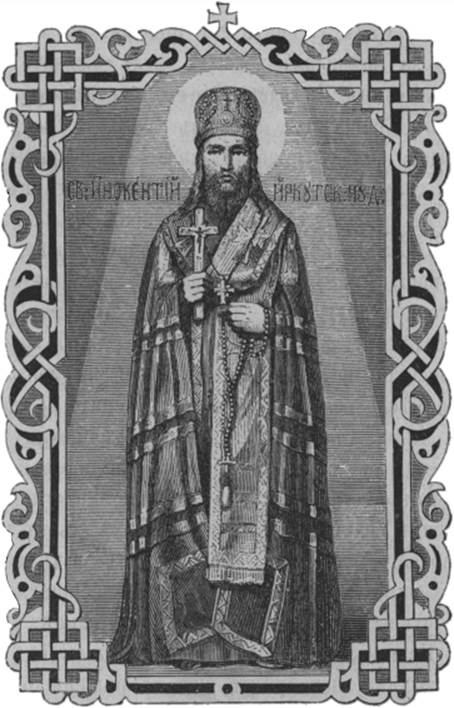
Отрасль древней дворянской Волынской фамилии Кульчицких, V блаж. Иннокентий получил умственное образование в Киевской академии405. В Киевской лавре пострижен был в иночество и здесь же приял священство. В 1710 г. отправлен он вместе с двумя другими к должности учителя в Московскую академию; в 1714 году получил здесь звание префекта и в том же году переведен в Невскую лавру, с званием соборного иеромонаха. Здесь он выполнял служение обер-иеромонаха по флоту, иначе был начальником флотских иеромонахов, надзирал за их поведением, разрешал сомнения их и о нуждах духовных сносился с Синодом. В 1720 г. архимандрит лавры Феодосий Яновский посвящен в епископа Новгородского, а Иннокентию поручено исправлять должность наместника лавры406. Когда государь Петр I, по представлению Сибирского губернатора, повелел, чтобы при Русской Пекинской миссии был, как и при Римской миссии, епископ, для такого великого служения назначен был блаж. Иннокентий. При этом Святейший Синод 14 февраля 1721 г. докладывал государю: «определенного в Хинское государство, иеромонаха Иинокентия Кульчицкого, архиереем Иркутским и Нерчинским, для близости к оному государству, посвятить ли и оного для удобнейшего обхождения от Сибирской епархии отделить ли?» Государь отвечал: в архиереи посвятить, но лучше бы без титула городов, понеже сии городы порубежные к Хине, чтобы иезуиты не перетолковали низко и бедства не нанесли407. Блажен. Иннокентий 5 марта 1721 г. хиротонисан был в епископа, и дабы согласно с соборным правилом, именовался он епископом определенной Церкви, он наименован епископом Переяславским. Китайское правительство тогда хорошо расположено было к Русскому двору и очень довольно первою Русскою миссиею для Пекина, которой начальником быль архимандрит Иларион. Это подавало надежды на то, что блаж. Иннокентий благосклонно будет принят Пекинским двором. Апреля 19 новый святитель выехал из Петербурга с двумя иеромонахами, пятью певчими и 3 служителями. Из патриаршей ризницы выданы были ему серебряные сосуды и омофор; прочую же утварь, по распоряжению Синода, взяли в Суздале из ризницы митр. Ефрема408.
A scion of the ancient noble Volhynian family of Kulchitsky, the blessed Innocent received his intellectual education at the Kiev Academy405. In the Kiev Lavra he was tonsured into monasticism, and there also he received the priesthood. In 1710 he was sent, together with two others, to the position of teacher at the Moscow Academy; in 1714 he received there the rank of prefect, and in the same year he was transferred to the Nevsky Lavra, with the rank of cathedral hieromonk. Here he fulfilled the service of chief hieromonk of the fleet, that is, he was the head of the fleet hieromonks, supervised their conduct, resolved their doubts, and communicated with the Synod concerning spiritual needs. In 1720, the archimandrite of the Lavra, Theodosius Yanovsky, was consecrated Bishop of Novgorod, and Innocent was entrusted with the office of vicar of the Lavra406. When Tsar Peter I, upon the recommendation of the Siberian governor, commanded that, as with the Roman mission, there should be a bishop attached to the Russian Peking Mission, the blessed Innocent was appointed for such a great service. On this occasion, the Most Holy Synod reported to the Tsar on February 14, 1721: "Shall the hieromonk Innocent Kulchitsky, appointed to the Chinese state, be consecrated as Bishop of Irkutsk and Nerchinsk, for proximity to that state, and shall he be separated from the Siberian diocese for more convenient dealings?" The Tsar replied: "Consecrate him as bishop, but better without the title of cities, since these cities are borderlands with China, lest the Jesuits misinterpret it as lowly and bring misfortune"407. The blessed Innocent was consecrated as bishop on March 5, 1721, and so that, in accordance with the canonical rule, he might be named bishop of a designated Church, he was named Bishop of Pereyaslavl. The Chinese government was at that time well disposed toward the Russian court and was quite satisfied with the first Russian mission for Peking, whose head was Archimandrite Hilarion. This gave hope that the blessed Innocent would be favorably received by the Peking court. On April 19, the new hierarch departed from St. Petersburg with two hieromonks, five choristers, and three servants. From the patriarchal sacristy, silver vessels and an omophorion were given to him; the remaining utensils, by order of the Synod, were taken in Suzdal from the sacristy of Metropolitan Ephraim408.
В марте 1722 г. святитель прибыл в Иркутск и в Селенгинске за Байкалом должен был ожидать распоряжений о пути в Пекин. На содержание его с свитою назначено было отпускать из Сибирских доходов 1500 р. Государь, хорошо знавший людей, видел и давал знать, что Иезуиты могут повредить св. делу и потому нужна осторожность в деле. К сожалению, в его отсутствие (он отправился в Персидский поход), из Сената написали в Китайский трибунал грамоту в таком виде: «на место умершего архимандрита, для отправления церковной службы и для всех прочих церковных дел, по воле государя, посылается духовная особа, господин Иннокентий Кульчицкий, с двумя иеромонахами, двумя диаконами и несколькими служителями. Сенат дружелюбно просит, дабы Хинское величество позволил помянутому господину Кульчицкому с находящимися при нем совершать в Пекине Божественную службу по обычаю христианскому, и посещать своих единоверцев в других местах. За то со стороны царского величества обещается в пределах Русских исполнять желание богдыхана». Посланник Измайлов, долженствовавший открыть путь для миссии в Пекине, ласково принят был Пекинским двором. Он не заключил договора с двором богдыхана, потому что еще не решены были дела пограничные; но ему обещали дать место в Пекине Русскому купечеству и построить двор для Русской миссии. После того надобно жалеть, что отношение Сената о миссии уже не застало Измайлова в Пекине. Ему, конечно, удалось бы личными объяснениями рассеять подозрения Китайцев, возбужденные неосторожною бумагою Сената. Без него же Мунгальский трибунал прислал ответ: «по указу богдыхана не велено пропускать в Пекин господина Иннокентия Кульчицкого, от того, что о нем нет письма от Сибирского губернатора и не приложено знака печати, какая дана Измайлову»409. Поспешили послать отношение губернатора и печати. Но трибунал тогда прямо написал: не может он пропустить Иннокентия, потому что он назван духовною особою и великим господином.
In March 1722, the hierarch arrived in Irkutsk, and in Selenginsk, beyond Lake Baikal, he had to await orders concerning the route to Peking. For his maintenance and that of his retinue, 1500 rubles were allocated from Siberian revenues. The Tsar, who knew men well, saw and gave warning that the Jesuits could harm the holy cause, and therefore caution was needed in the matter. Unfortunately, in his absence (he had set out on the Persian campaign), the Senate wrote a letter to the Chinese Tribunal in the following form: "In place of the deceased archimandrite, for the performance of church services and for all other church affairs, by the will of the Tsar, a spiritual person, Mr. Innocent Kulchitsky is sent, with two hieromonks, two deacons, and several servants. The Senate amicably requests that His Chinese Majesty permit the aforementioned Mr. Kulchitsky, together with those accompanying him, to perform Divine service in Peking according to the Christian custom, and to visit their co-religionists in other places. In return, on the part of His Tsarist Majesty, it is promised that within the Russian borders the wishes of the Bogdykhan will be fulfilled." The envoy Izmailov, who was to open the way for the mission in Peking, was kindly received by the Peking court. He did not conclude a treaty with the court of the Bogdykhan, because border affairs had not yet been settled; but he was promised that a place in Peking would be given for Russian merchants and a court built for the Russian mission. After that, one must regret that the Senate's communication concerning the mission no longer found Izmailov in Peking. He would, of course, have succeeded by personal explanations in dispelling the suspicions of the Chinese, aroused by the incautious paper of the Senate. Without him, the Mongolian Tribunal sent the reply: "By order of the Bogdykhan, Mr. Innocent Kulchitsky is not to be allowed into Peking, because there is no letter about him from the Siberian governor and the seal mark given to Izmailov has not been affixed"409. They hastened to send the governor's communication and the seals. But the Tribunal then wrote directly: it cannot allow Innocent to pass, because he is called a spiritual person and a great gentleman.
Так святителю Иннокентию пришлось оставаться в Селенгинске и ждать решения недоумений. И он пробыл здесь целые три года. Можно представить себе, как томительна была эта неопределенность положения! Как тяжело было ждать и ждать и не видеть конца ожиданиям! Это время было временем очищения сердечных глубин святителя. Теперь обучалась душа его терпению и полной покорности воле Божией. Но святитель нашел и в Селенгинске предметы для своей деятельности, согласные с его назначением. – Св. Синодом он назначен в проповедника св. веры, хотя и не в пределах России. – Святитель старался выполнить это назначение в круге доступном для него. Он проповедовал св. веру язычникам, кочевавшим около Селенгинска, Бурятам и Мунгалам. – И проповедь его не была бесплодна: он обратил значительное число язычников к свету Христову. В рукописном акафисте святителю читается: «горькия испытания терпеливо подъял еси, – препираяся с полчищами неверных и суеверных». Другой акафист поет: «услышав ухищренные Хиннов глаголы, яко не подобает ти прияту быти в их царство, обратился еси с Евангелием к языком своего царства Монгольским... Радуйся, яко проповедию Евангелия, тобою к языком Монгольским иринесенною, злоухищрение душ человеческих жестоко посрамися». Пребывание святителя в Селенгинске благодетельно было и тем, что подкрепляло в вере и благочестии туземных христиан, довольно ослабевших от влияния соблазнов язычества. Акафистная песнь поет ему: «ово просвещал еси светом Евангелия Христова неверующия языки Монгольския, ово утверждал еси верующия в послушании православные Церкве уставом».
Thus did Hierarch Innocent have to remain in Selenginsk and await the resolution of the misunderstandings. And he remained there for a full three years. One can imagine how tormenting this uncertainty of his situation was! How hard it was to wait and wait and see no end to the waiting! This time was a time of purification of the hierarch's heart's depths. Now his soul was being trained in patience and complete submission to the will of God. But the hierarch also found in Selenginsk objects for his activity, in accordance with his appointment. — He had been appointed by the Holy Synod as a preacher of the holy faith, albeit not within the borders of Russia. — The hierarch strove to fulfill this appointment within the circle accessible to him. He preached the holy faith to the pagans who roamed around Selenginsk, the Buryats and Mongols. — And his preaching was not fruitless: he converted a considerable number of pagans to the light of Christ. In a handwritten akathist to the hierarch it is read: "Bitter trials thou didst patiently endure, contending with the hordes of the unbelieving and superstitious." Another akathist sings: "Hearing the cunning words of the Chinese, that it was not fitting for thee to be received into their kingdom, thou didst turn with the Gospel to the pagan peoples of thy own kingdom, the Mongols... Rejoice, for by the preaching of the Gospel brought by thee to the Mongol peoples, the evil cunning of human souls was severely put to shame." The hierarch's sojourn in Selenginsk was also beneficial in that it strengthened in faith and piety the native Christians, who had grown rather weak from the influence of the temptations of paganism. An akathist hymn sings to him: "Now enlightening with the light of Christ's Gospel the unbelieving Mongol peoples, now confirming the believers in obedience to the statutes of the Orthodox Church."
В марте 1725 г. святитель по указу Синода переехал в Иркутский Вознесенский монастырь ожидать новых распоряжений о своей миссии. Здесь встретились ему свои искушения. Настоятель монастыря архимандрит Платковский искал и надеялся быть настоятелем Певинской миссии; а вместе был человек с страстями, самыми необузданными: на него жаловались все, до кого только он касался; он уже состоял под судом, по указу Синода: но не хотел отвечать никому о своих поступках. Когда святитель прибыл в монастырь, к нему обратились с жалобами обиженные; святитель утешал несчастных, сколько мог. Инквизитор Иовлев не раз просил святителя защитить его путем суда от нападений Платковского. Святитель объявлял, что он не в нраве рассматривать дела архимандрита, не состоящего в его ведении; самая прислуга архипастыря получала от него строгое приказание не вступать в сношение ни с кем из монастырских. Тобольский митрополит, услышав о вызове блаж. Иннокентия в Иркутск, писал к нему: « преосвященнейший архиерею Божий! благодетель мой! многим многих Иркутских духовных лиц нестроением и неизобретением к следствию о делах их достойных делателей принуждены есмы трудити ваше преосвященство, прося, дабы соблаговолили о тех их делах приказать исследовать, кому ваше преосвященство заблагоразсудите. – Предая себе в надежду вашея во всем неотъемлемые любви, явственно зде оные полагаем». Излагаются три дела, в том числе об Иркутском протопопе. Затем митроп. Антоний и губернатор князь Долгоруков, по совокупном совещании, просили блаж. Иннокентия исследовать по указу Синода дикие дела Платковского. Но святитель не взял на себя ничего, ни по тому, ни по другому отношенио, так как высшая власть указала ему другие занятия410.
In March 1725, the hierarch, by decree of the Synod, moved to the Irkutsk Ascension Monastery to await further orders concerning his mission. Here he encountered his own trials. The abbot of the monastery, Archimandrite Platkovsky, sought and hoped to become the head of the Peking mission; and he was also a man with the most unbridled passions: all whom he had dealings with complained of him; he was already under investigation, by decree of the Synod, but he did not wish to answer to anyone for his actions. When the hierarch arrived at the monastery, the wronged turned to him with complaints; the hierarch comforted the unfortunate as best he could. The inquisitor Iovlev repeatedly asked the hierarch to protect him through the courts from Platkovsky’s attacks. The hierarch declared that he was not entitled to examine the affairs of an archimandrite who was not under his jurisdiction; even the archpastor’s own servants received a strict order from him not to enter into any relations with anyone from the monastery. The Metropolitan of Tobolsk, hearing of the summons of blessed Innocent to Irkutsk, wrote to him: “Most Reverend Bishop of God! my benefactor! Compelled by the great disorder of many Irkutsk clergy and the lack of worthy workers for the investigation of their affairs, we are forced to trouble your Grace, begging that you deign to order an inquiry into those affairs, to whomever your Grace shall deem fit. – Committing ourselves to the hope of your unfailing love in all things, we here set them forth plainly.” Three matters are set forth, including one concerning the Irkutsk protopope. Then Metropolitan Anthony and the governor, Prince Dolgorukov, after joint consultation, asked blessed Innocent to investigate, by decree of the Synod, the wild affairs of Platkovsky. But the hierarch took nothing upon himself, neither in the one nor the other matter, since the higher authority had assigned him other occupations410.
В июне 1725 г. по воле импер. Екатерины повелено для окончательного решения дел с Китаем отправить полномочным посланником графа Владиславича-Рагузинского и с ним отправиться преосвященному Иннокентию, если не будет препятствия со стороны Китайцев. – Рагузинскому предписано было не объявлять Китайцам о епископском сане Иннокентия, а только называть его духовным лицом. Весною 1726 года преосвященный Иннокентий отправился в Селенгинск ожидать посланника. – Китайские пограничные чиновники с почетом встретили Рагузинского на границе; почетно принят он был и в Пекине; после некоторых затруднений согласились и на договор; Рагузинский поручил коммисару Лангу писать и заключить договор, но о миссии блаж. Иннокентия не было и помину411. Да и не хотел ничего делать Рагузинский для святителя. Когда был он в Селенгинске, он не удостоил св. Иннокентия даже того, чтобы видеться с ним. Он еще в Иркутске дал слово молодцу Платковскому, что он, Платковский, а никто другой будет в Пекине начальником миссии. Потому еще тогда, как Рагузинский еще не выехал из Китая, в Петербурге, в Верховном Тайном Совете решено было дело о предмете, касающемся более Церкви, чем государства. Святитель Иннокентий, пребывая в Селенгинске, 24 марта 1727 г. получил неожиданный указ. «Сего генваря 7 дня, говорит указ, в указе ее Величества из Верховного Тайного Совета Св. Синоду написано: доносил ее Величеству отправленный к Китайскому двору чрезвычайным посланником и полномочным министром ее Величества Иллирийский граф Савва Владиславич с границы Китайской от речьки Буры, от 31 августа (1726 г.), что Китайские министры (?), которые его на границе принимали, вашего преосвященства туды с ним графом в Китай без указа Хинского не пропустили, и не чает де он, чтобы ваше преосвященство Китайцы приняли; токмо де по его старанию в бытность при Китайском дворе, куда уже он из Сибири поехал, паки архимандрит и священники в Пекине приняты будут, а ваше преосвященство никогда не допуститеся, и представлял он граф Владиславич, чтоб послать Вознесенского архимандрита Антония, который при Иркутском живет и учит несколько детей языку Мунгальскому и бывал в Пекине». Совет определил сделать согласное с мнением посланника распоряжение. Св. Синод предписал пребывать преосвященному Иннокентию в Иркутском Вознесенском монастыре412.
In June 1725, by the will of Empress Catherine, it was ordered that for the final resolution of affairs with China, Count Vladislavich-Raguzinsky be sent as plenipotentiary envoy, and that His Grace Innocent accompany him, if there were no obstacle from the Chinese. – Raguzinsky was instructed not to reveal to the Chinese Innocent’s episcopal rank, but only to call him a clergyman. In the spring of 1726, His Grace Innocent set out for Selenginsk to await the envoy. – The Chinese border officials met Raguzinsky with honor at the frontier; he was received with honor also in Peking; after some difficulties, they agreed to a treaty; Raguzinsky commissioned Commissar Lang to write and conclude the treaty, but of the mission of blessed Innocent there was no mention411. Nor did Raguzinsky wish to do anything for the hierarch. When he was in Selenginsk, he did not even deign to meet with St. Innocent. He had already given his word in Irkutsk to the young man Platkovsky that he, Platkovsky, and no one else, would be the head of the mission in Peking. Therefore, even while Raguzinsky had not yet left China, in St. Petersburg, in the Supreme Privy Council, a matter concerning a subject more pertaining to the Church than to the state was decided. St. Innocent, while remaining in Selenginsk, received an unexpected decree on March 24, 1727. “On the 7th of January of this year,” says the decree, “in a decree of Her Majesty from the Supreme Privy Council to the Holy Synod it was written: Her Majesty was informed by the extraordinary envoy and plenipotentiary minister of Her Majesty sent to the Chinese court, the Illyrian Count Sabbas Vladislavich, from the Chinese border, from the Bura River, on August 31 (1726), that the Chinese ministers (?), who received him at the border, did not allow your Grace to pass with him, Count, into China without a Chinese decree, and he does not expect that the Chinese would accept your Grace; only, through his efforts during his stay at the Chinese court, whither he had already set out from Siberia, the archimandrite and priests would again be received in Peking, but your Grace would never be admitted, and Count Vladislavich proposed that the Ascension Archimandrite Anthony be sent, who lives near Irkutsk and teaches several children the Mongolian language and has been in Peking.” The Council decided to make a disposition in accordance with the envoy’s opinion. The Holy Synod ordered His Grace Innocent to remain in the Irkutsk Ascension Monastery412.
Нет сомнения, что тут действовали интриги Иезуитов, опасавшихся и того, что на них откроют глаза Китайцев. Много значило и то, что царствовавший тогда Ионг-Чисенг по случаю раздоров, происходивших между миссионерами двух Латинских орденов, объявил запрещение принимать христианский закон. Но обе эти причины еще не объясняют всего дела. Полномочный посланник успел же заставить Пекинский двор выполнить много такого, что далеко более важно для Пекинского двора, чем прием Русского епископа413. В рукописном акафисте святителю читаем: «всякия скорби и горькие испытания терпеливо подъял еси, отче, яко добр воин Христов, терпя наветы и клеветы от коварного начальника миссии и клевретов его». – По этим словам, архимандрит Платковский сильно противодействовал отправлению святителя в Пекин. Для него это и естественно: столько же неистовый в делах дурных, сколько и малодушный пред несчастием, он употреблял все меры к тому, чтобы избавиться от бед назначением его в Пекин. Несчастный не избежал суда Божия. Как ни укрывался он за Рагузинского, в 1731 г. провезли его из Пекина мимо Иркутска скованным414. Но, если Платковский мог действовать против святителя клеветою, значит был кто-то, кто принимал клеветы и портил все дело святое. Кто же это? Конечно, посланник Рагузинский. По одному ли увлечению клеветой тот действовал? Рагузинский – торгаш, под защитою Меншикова, был грабителем Малороссии415. Платковский предложил в распоряжение торгаша все монастырские житницы, как откроется впоследствии, и торгаш выставил Платковского самым способным миссионером для Пекина и ненужным – святителя.
There is no doubt that the intrigues of the Jesuits were at work here, who feared even that the eyes of the Chinese would be opened against them. Much also was due to the fact that the then-reigning Yongzheng, on account of the dissensions that had arisen between the missionaries of two Latin orders, declared a prohibition against receiving the Christian law. But both these reasons still do not explain the whole matter. The plenipotentiary envoy had succeeded in compelling the Peking court to fulfill many things far more important to the Peking court than the reception of a Russian bishop413. In the manuscript akathist to the hierarch we read: “Thou didst patiently endure every sorrow and bitter trial, O father, as a good soldier of Christ, suffering the slanders and calumnies of the crafty head of the mission and his confederates.” – According to these words, Archimandrite Platkovsky strongly opposed the sending of the hierarch to Peking. For him this was natural: as violent in evil deeds as he was faint-hearted before misfortune, he used every means to escape his troubles by being appointed to Peking. The unfortunate man did not escape the judgment of God. However much he hid behind Raguzinsky, in 1731 he was brought from Peking past Irkutsk in chains414. But if Platkovsky could act against the hierarch by slander, it means there was someone who received the slanders and spoiled the whole holy work. Who was this? Of course, the envoy Raguzinsky. Did he act merely out of being swayed by slander? Raguzinsky, a merchant, under the protection of Menshikov, was a plunderer of Little Russia415. Platkovsky placed all the monastery’s granaries at the merchant’s disposal, as would later be revealed, and the merchant set forth Platkovsky as the most capable missionary for Peking and the hierarch as unnecessary.
Для каждого православного приятно то, что Платковский назначен был в Пекин без всякого участия правления церковного. Совет распорядился ИИО своему усмотрению, не спросив у Синода даже сведений, кто такой Платковский? Тем то и жалки люди, что тогда, как мечтают о своей премудрости, способной знать все и управлять всем, делают такие дела, которые наносят им только стыд и бесчестие.
For every Orthodox person it is distressing that Platkovsky was appointed to Peking without any participation of the church government. The Council acted according to its own discretion, without even asking the Synod for information as to who Platkovsky was. How pitiable are people who, while dreaming of their own wisdom, capable of knowing everything and governing everything, commit such deeds as bring them only shame and dishonor.
Св. Синод с своей стороны не замедлил вывесть св. Иннокентия из его тяжкого положения. Он постановил то самое определение о блаж. Иннокентие, которое полагал он еще при Петре В. Указом 15 янв. 1727 г. церковь Иркутская, входившая дотоле в состав Тобольской епархии и с 1707 г. управлявшаяся викарным епископом поставлена в ряду самостоятельных епархий, а святитель Иннокентий наименован епископом Иркутским и Нерчинским. Так он начал собою ряд святителей Иркутской церкви! Не скоро дошло определение Синода до св. Иннокентия, но дошло. По получении указа святитель разослал окружную грамоту к своей пастве с пастырским наставлением. «Понеже благословением Божиим, писал он, ее Императорское Величество, имея сердце свое благодатное в руце Божией, но докладу Свят. Правительствующего Синода, благоволило мя милостивым своим указом определить в Иркутскую епархию настоящим епископом и титуловать себе по той епархии, того ради молю прежде всех творити моления за ее Императорское Величество и всю ее высокую фамилию, Святейший Правительствующий Синод, такожде и о нашем смирении, титулуя нас Иркутским и Нерчинским. Прочее молим вас и архипастырски увещеваем, да такожде мудрствуете единодушно, друг друга честию больша творяще, мир и любовь между собою имуще, якоже св. Апост. Павел поучает. Елика пречестна, елика прелюбезна, елика прехвальна, в сих поучайтеся, сим последуйте, сия держите, да тако и временная благая и вечная удостоитесь наследствовати. Всеусердно сего желаем и благословение посылаем. Аминь. Сент. 1-го 1727 года»416. Тобольским митрополитом в ведение нового Иркутского архипастыря переданы 3 монастыря, 9 городских церквей и до 34 поселянских; Иркутский Возненский монастырь отдан был Синодом в полное распоряжение св. Иннокентия417.
The Holy Synod, for its part, did not delay in delivering St. Innocent from his grievous situation. It enacted the very same determination concerning blessed Innocent that it had contemplated even under Peter the Great. By decree of January 15, 1727, the Church of Irkutsk, which had hitherto been part of the Tobolsk diocese and since 1707 had been governed by a vicar bishop, was established as an independent diocese, and St. Innocent was named Bishop of Irkutsk and Nerchinsk. Thus he began the line of hierarchs of the Irkutsk Church! The Synod’s determination did not reach St. Innocent quickly, but it did reach him. Upon receiving the decree, the hierarch sent out a circular letter to his flock with pastoral instruction. “Since by the blessing of God,” he wrote, “Her Imperial Majesty, having her gracious heart in the hand of God, upon the report of the Most Holy Governing Synod, has been pleased by her merciful decree to appoint me as the actual bishop of the Irkutsk diocese and to entitle myself according to that diocese, therefore I beseech you first of all to offer prayers for Her Imperial Majesty and all her high family, for the Most Holy Governing Synod, and also for our humility, entitling us as of Irkutsk and Nerchinsk. Moreover, we pray you and archpastorally exhort you, that you likewise be of one mind, esteeming one another in honor, having peace and love among yourselves, as the holy Apostle Paul teaches. Whatsoever things are honorable, whatsoever things are lovely, whatsoever things are praiseworthy, on these meditate, these follow, these hold fast, that so you may be vouchsafed to inherit both temporal blessings and eternal. This we most earnestly desire and send our blessing. Amen. September 1, 1727”416. By the Metropolitan of Tobolsk, three monasteries, nine city churches, and up to thirty-four rural churches were transferred to the jurisdiction of the new Irkutsk archpastor; the Irkutsk Ascension Monastery was given by the Synod into the full disposal of St. Innocent417.
Бывают люди по нравственному устройству своему такие, что они и себе строят один вред и тому, кто, каким бы то ни было образом, стал на их дороге, наносят муку. Таковы были по отношению к святителю Платковский и Рагузинский!
There are people who, by their moral constitution, are such that they bring only harm to themselves and inflict torment upon anyone who, in whatever way, stands in their path. Such, in relation to the hierarch, were Platkovsky and Raguzinsky!
Спустя недели две по вступлении на Иркутскую кафедру святитель Иннокентий получил от посла Рагузгнского письмо, где тот, известив, что дела с Пекином идут мирно и что в Пекин назначен архимандрит Платковский, писал: «прикажите архимандриту дать священника доброго и искусного да иеродиакона, всего два человека из церковных учителей, да архимандрит третий, да трех учеников по выбору его, архимандрита. И оным жалованье, всего 1250 р. на первый год. И то жалованье доведется им выдать немедленно из наличных монастырских денег да из конфискованных инквизиторских». Затем пишется, чтобы снабдить архимандрита утварью, которая дана для Пекинской миссии. Письмо доставлено с границы нарочным, адъютантом Рагузинского. Святитель немедленно сделал возможные распоряжения. Забайкальскому вдовому священнику Филимонову, изъявлявшему желание отправиться в Пекин, предписано явиться в распоряжение архимандрита Платковского; туда же предписано явиться посольскому иеродиакону Серапиону; архимандриту выдано из монастыря 300 р. Послу Рагузинскому отправлен 13 сент. следующий ответ: «сиятельнейший граф, Савва Владиславич, мой милостивейший благодетель! всякое благодарение Богу, в Троице славимому да будет, яко вашему сиятельству чрез неусыпные труды и поты, без кровопролития даде одержать победу и вместо брани вожделенный дарова мир, о чем не токмо я недостойный и не токмо все Российское государство, но и вси окрестные государства, хотящии мира, возрадуются и возвеселятся и рекут: блажен человек той, иже совокуии обоя во едино, иже сотвори такое дело, которое трудно было к совершению. Писали ваиие сиятельство в письме, которое получено сего 1727 г. сент. 5 д. чрез господина поручика к нашему смирению: 1) что отправляется к Китай архимандрит Антоний Платковский, а определенные ему 550 р. и при нем посылающимся единому священнику, единому иеродиакону и 3 человекам ученикам по 130 р. на первый раз жалованья дать из наличных в монастыре Вознесенском денег. А наличных в монастыре том денег токмо обрелось 400 рублей. Из того числа отдано архимандриту 300 рублей при нашем смирении и при помянутом поручике и при братии того монастыря. А одно сто осталось на разные монастырские нужды, которыми и со срочными нельзя расплатиться. А конфискованные инквизиторские деньги ко мне не надлежат: понеже я, как то чинилось, в Иркутску не был и того ничего не знал и ныне, сколько их есть числом, не известен; – я к сим деньгам касаться не смею. Иркутский воевода Измайлов, по указам ее Величества, как хощет, так с ними и да творит. А монастырь Иркутский едва не в конец разорен оным посылаемым архимандритом, чего для при сем моем покорном писании вашему сиятельству, ради свидетельства, выписанный из книг расходных монастыря того экстракт посылаю, что он деньгами и товаром, кроме животных и прочих от посуды медной, оловянной и поливяной и юфтей и иных мелочей и хлебных раздарунков и кроме школы, на которую сверх надлежащего иждивения употребилось, что, за краткостию времени по восприятии моем Иркутской епархии, еще не следовано, из того монастыря забрал. Ваше сиятельство можете выразуметь, коликое число им архимандритом забрано и сколько еще на нем денег того монастыря счисляется Может он из того числа себе и прочим при нем к показанным 300 выделить жалованье, а остальные деньги, аще превысокая вашего сиятельства к убогому монастырю обрящется милость, приказать ему назад в монастырь возвратить. 2) Еще же писали ваше сиятельство, чтобы отдать архимандриту ризы, книги и церковную утварь, которую я брал имянным блаженные и вечно достойные памяти Его Импер. В. указом и указом Св. Синода из разных мест, о чем и в Св. Синод репортовано, где что и от кого всего именно. Я ныне без послушного из Св. Синода указа тех всех вещей, которые приличествуют к моему архиерейскому служению, отдать не посмел, кроме того, что к архимандричью служению принадлежит, о чем и реестр посылается при сем письме, в которых вещех он и росписался своеручно».
About two weeks after his accession to the See of Irkutsk, Hierarch Innocent received a letter from the envoy Raguzinsky, in which the latter, having informed him that affairs with Peking were proceeding peacefully and that Archimandrite Platkovsky had been appointed to Peking, wrote: 'Order the archimandrite to provide a good and skilled priest and a hierodeacon, in all two men from the church teachers, and the archimandrite as a third, and three students of the archimandrite's own choosing. And to them a salary, in all 1250 rubles for the first year. And that salary is to be paid out immediately from the available monastery funds and from the confiscated inquisitorial monies.' Then it is written that the archimandrite should be supplied with the vessels which had been given for the Peking mission. The letter was delivered from the border by a special courier, Raguzinsky's adjutant. The Hierarch immediately made such arrangements as were possible. The widowed Transbaikal priest Philimonov, who had expressed a desire to set out for Peking, was ordered to place himself at the disposal of Archimandrite Platkovsky; the embassy hierodeacon Serapion was likewise ordered to appear there; the archimandrite was given 300 rubles from the monastery. On September 13 the following reply was sent to the envoy Raguzinsky: 'Most illustrious Count, Sabbas Vladislavich, my most gracious benefactor! All thanksgiving be to God, glorified in the Trinity, that your excellency, through unsleeping labors and toils, without bloodshed has been granted to obtain victory, and instead of war has bestowed the longed-for peace, whereof not only I, the unworthy one, and not only the entire Russian State, but also all neighboring states that desire peace shall rejoice and be glad and shall say: blessed is that man who has joined both into one, who has wrought such a deed as was difficult to accomplish. Your excellency wrote in the letter which was received this 1727th year, September 5th day, through Mr. Lieutenant, to our humility: 1) that Archimandrite Antony Platkovsky is being sent to China, and that the 550 rubles assigned to him, and for those sent with him, one priest, one hierodeacon, and 3 students, 130 rubles each, as first payment of salary, are to be given from the available monies in the Ascension Monastery. But of the available monies in that monastery there were found only 400 rubles. Of that number, 300 rubles were given to the archimandrite in the presence of our humility and of the aforementioned lieutenant and of the brethren of that monastery. And one hundred remained for various monastery needs, with which even the debts due at term cannot be paid. And the confiscated inquisitorial monies do not pertain to me: for since I was not in Irkutsk when that was done, and knew nothing of it, and now do not know how much of them there is in number, I dare not touch those monies. The Irkutsk voivode Izmailov, according to the decrees of Her Majesty, let him do with them as he wills. And the Irkutsk monastery has been almost utterly ruined by that same archimandrite who is being sent, wherefore with this my humble writing I send to your excellency, for the sake of evidence, an extract copied from the account books of that monastery, showing what he has taken from that monastery in money and goods, besides livestock and other things—copper, tin, and glazed vessels, and leather, and other small items, and distributions of grain, and besides the school, on which more than the proper expenditure was used, which, for lack of time since my reception of the Irkutsk diocese, has not yet been investigated. Your excellency can understand how great a quantity has been taken by him, the archimandrite, and how much more of that monastery's money is still reckoned against him. He may from that sum allot salary to himself and those with him out of the aforementioned 300, and the remaining money, if the most exalted mercy of your excellency toward the poor monastery be found, order him to return to the monastery. 2) Further, your excellency wrote that I should give to the archimandrite the vestments, books, and church vessels which I took by the personal decree of His Imperial Majesty, of blessed and eternally worthy memory, and by decree of the Most Holy Synod, from various places, whereof I have also reported to the Most Holy Synod, what was taken, where, and from whom, all in particular. I now, without an obedient decree from the Most Holy Synod, dared not give away all those things which pertain to my hierarchal service, except what belongs to the archimandrite's service, whereof a list is sent with this letter, and for which things he has signed with his own hand.'
Все, что предлагал теперь святитель, дышало умом, любовию, смирением – изумительными. Если потерянный Платковский не видел своих наглостей из кроткого вразумления гвятительского, это для него естественно. Более изумительно то, что Рагузинский не понимал неправд своих, на которые так умно указывал святитель, в предостережение ему418. Рагузинский, по гордости, сочел себя в праве снова оскорблять святителя. Окт. 15 Платковский явился в Иркутск с длинным письмом Рагузинского. Посол писал, что он остановил миссию по трем причинам. «Не мню, говорил он, чтоб Св. Синод принял за противность, ежели бы ваше преосвященство на такую нужную посылку отдали достальные из конфискованных инквизиторских денег. Второе – архимандрит привез с собою попа мирского, о котором доказывают здешние жители, что он – вседенная пьяница. Третья же превеликая известился из письма вашего преосвященства, будто он, архимандрит, монастырь разорил и много монастырских денег забрал неправдою, – по регистру показано, что архимандрит монастырю виноват 3794 руб.; а архимандрит объявил, что он монастырю и никому ни копейки не виноват». Потому посол просит расчесть архимандрита с монастырем или же отпустить его в Синод для принесения оправдания.
All that the Hierarch now proposed breathed of mind, love, and humility—qualities astonishing in their excellence. If the lost Platkovsky did not see his own insolence in the Hierarch's gentle admonition, that was natural for him. More astonishing is that Raguzinsky did not understand his own wrongs, to which the Hierarch so wisely pointed, as a warning to him418. Raguzinsky, out of pride, considered himself entitled to insult the Hierarch anew. On October 15 Platkovsky appeared in Irkutsk with a long letter from Raguzinsky. The envoy wrote that he had stopped the mission for three reasons. 'I do not think,' he said, 'that the Most Holy Synod would take it as an offense if your grace gave the remainder of the confiscated inquisitorial monies for such a necessary sending. Secondly—the archimandrite brought with him a secular priest, of whom the local inhabitants testify that he is an all-day drunkard. Thirdly, I have learned with great surprise from your grace's letter that he, the archimandrite, has ruined the monastery and taken much monastery money unjustly—according to the register it is shown that the archimandrite owes the monastery 3794 rubles; but the archimandrite has declared that he owes the monastery and no one a single kopeck.' Therefore the envoy asks that the archimandrite be settled with the monastery, or else that he be released to the Synod to offer his justification.
Все три претензии несправедливы и оскорбительны, не к чести посла. В первой звучит самонадеянность, привыкшая не уважать закона. Священник Филимонов прежде святителя был Забайкальским инквизитором и, если имел он слабость, то и лучших не было, по крайней мере из тех, которые пожелали бы отправиться в Пекин. Для расчетов монастыря с Платковским преосвященный назначил комиссию. Платковский поспешил послать просьбу к Тобольскому митрополиту – сообщить в Иркутск указ, который давал ему право получать из Вознесенского монастыря доходы, равные настоятелю Чудова монастыря, и с тем вместе дозволял взять оконфискованные деньги инквизитора. Коммисия, по рассмотрении всего дела, при всем желании сделать приятное страшному Рагузинскому, определила: истраченные Платковским во время пребывания его в Москве 632 р. взыскать с него, равно взыскать 400 р., взятые в виде жалованья, соразмерного с жалованьем Чудовского монастыря, также взыскать 54 р. излишне взятые, – во всех этих случаях деньги браты произволом; о прочих предметах войти в рассмотрение в последующее время. Платковский сперва не хотел исполнить определение комиссии и объявил, что отправляется с жалобою в Синод. Но это только выходка лукавства. Он хорошо понимал, что Синод поступить с ним не мягко. Потому заявил он письменно, что платит монастырю долги свои и прекращает всякий иск на него. Тобольский митрополит доставил сведение, что никакого указа из Синода не было об уравнении прав Платковского с правами Чудовского настоятеля, и что с Платковского следует взыскать 200 – 100 р., взятые им у архим. Гедеона Вишневского, и 100 р., должные Тюменскому монастырю.
All three claims were unjust and offensive, not to the envoy's honor. In the first sounds self-assurance, accustomed to disrespect the law. The priest Philimonov, before the Hierarch, had been the Transbaikal inquisitor, and if he had a weakness, there were no better men—at least among those who would have wished to set out for Peking. For the settlement of accounts between the monastery and Platkovsky, the Right Reverend appointed a commission. Platkovsky hastened to send a petition to the Metropolitan of Tobolsk—to communicate to Irkutsk a decree which gave him the right to receive from the Ascension Monastery revenues equal to those of the superior of the Chudov Monastery, and at the same time permitted him to take the confiscated inquisitorial monies. The commission, after examining the whole matter, despite every desire to please the terrible Raguzinsky, determined: the 632 rubles spent by Platkovsky during his stay in Moscow were to be recovered from him; likewise 400 rubles taken as salary, commensurate with the salary of the Chudov Monastery, were to be recovered; also 54 rubles taken in excess were to be recovered—in all these cases the money had been taken by arbitrary will; as for the other matters, they were to be examined at a later time. Platkovsky at first did not wish to comply with the commission's determination and declared that he was setting off with a complaint to the Synod. But this was only a trick of cunning. He well understood that the Synod would not deal gently with him. Therefore he declared in writing that he was paying his debts to the monastery and ceasing all claims against it. The Metropolitan of Tobolsk furnished information that no decree from the Synod had existed about equalizing Platkovsky's rights with those of the Chudov superior, and that from Platkovsky there should be recovered 200—100 rubles which he had taken from Archimandrite Gideon Vishnevsky, and 100 rubles owed to the Tyumen Monastery.
Между тем графа Рагузинского уведомили стороною, что по записям архимандрита Платковского в монастырских книгах значится не оплаченным долг за послом и его свитою. Это глубоко уязвило Рагузинского и заставило переменить тон обращения своего с святителем. В письме от 8 февр. 1728 г. он извещает святителя, что никогда не желал он обижать монастыря; писарь посольства брал из обители разные припасы, всего на 60 руб., и обменял 5 лошадей на монастырские лошади и за все расплатился, в чем имеется квитанция; секретарь Глазунов для себя брал припасы на 6 р. и также расплатился с Платковским. Потому просил для защиты чести его обратить внимание на сей предмет, оканчивая так письмо: «рекомендуя себя вашим архипастырским святым молитвам, желая вашего преосвященства благословения, целуя святые ваши руце, с глубочайшим респектом пребываю». Когда показали это письмо Платковскому, он поспешил доставить монастырю показанные в письме деньги. По требованию комиссии уплатил он еще 400 руб. Посольскому монастырю. И поспешил в Селенгинск419.
Meanwhile Count Raguzinsky was informed indirectly that according to the entries of Archimandrite Platkovsky in the monastery books, a debt owed by the envoy and his suite was recorded as unpaid. This deeply wounded Raguzinsky and forced him to change the tone of his dealings with the Hierarch. In a letter of February 8, 1728, he informs the Hierarch that he had never wished to wrong the monastery; the embassy clerk had taken various supplies from the cloister, in all to the value of 60 rubles, and had exchanged 5 horses for monastery horses, and had paid for everything, for which a receipt exists; Secretary Glazunov had taken supplies for himself to the value of 6 rubles and had likewise settled with Platkovsky. Therefore he asked, for the defense of his honor, that attention be given to this matter, ending the letter thus: 'Recommending myself to your archpastoral holy prayers, desiring your grace's blessing, kissing your holy hands, with deepest respect I remain.' When this letter was shown to Platkovsky, he hastened to deliver to the monastery the money indicated in the letter. At the commission's demand he also paid another 400 rubles to the Embassy Monastery. And he hastened to Selenginsk419.
Игумен Пахомий производил следствие о убиении крестьянина Лобанова священником Орловым и закрыл виновного. По принесении жалобы наряжена святителем комиссия. Орлов, уличаемый свидетелями, сознался, что он в кабаке играл в карты с двумя причетниками и с Ильею Лобановым; в ссоре, подравшись с Лобановым, пихнул его от себя, и тот, ударившись об лавку, умер; следователю Пахомию дал 6 руб. и два конца китайки. Пахомий также сознался в своей вине. Решение последовало такое: так как священник Орлов играл в карты, и еще в кабаке, и в драке убил человека, а по совершении убийства подкупал следователя и совершал служение, то, согласно с регламентом, подвергнуть его жестокому телесному наказанию, лишив права на священноолужение; Пахомия послать в хлебню сеять муку, взять в штраф 10 руб., деньги и китайку возвратить владельцу.
Abbot Pachomius conducted an investigation into the killing of the peasant Lobanov by the priest Orlov and concealed the guilty man. Upon the bringing of a complaint, the Hierarch appointed a commission. Orlov, convicted by witnesses, confessed that he had played cards in the tavern with two church clerks and with Ilya Lobanov; in a quarrel, having fought with Lobanov, he pushed him away from himself, and the latter, striking against a bench, died; to the investigator Pachomius he gave 6 rubles and two lengths of Chinese silk. Pachomius likewise confessed his guilt. The decision was as follows: since the priest Orlov played cards, and moreover in a tavern, and in a brawl killed a man, and after committing the murder bribed the investigator and continued to perform services, therefore, according to the Regulations, he was to be subjected to severe corporal punishment, being deprived of the right to serve as a priest; Pachomius was to be sent to the bakehouse to sift flour, to pay a fine of 10 rubles, and the money and silk were to be returned to their owner.
«Ведать тебе заказ Заморский (Забайкальский) во всем Селенгинском дистрикте, а в действии поступать по сим пунктам:
"You are to have charge of the Transmarine (Transbaikal) deanery throughout the entire Selenginsk district, and in your actions you are to proceed according to these points:
1. Объехать тебе церкви в твоем заказе и смотреть всего благочиния церковного и над священниками и над всем причтом, а именно: не бесчинствовали бы, не шумели бы по улицам или в церкви пьяни; не пиют ли вино по кабакам и прочая по прибавлению регламента о священниках.
1. You are to travel to the churches in your deanery and inspect all church order and the conduct of the priests and all the clergy, namely: that they not behave disorderly, that they not make noise in the streets or in church while drunk; that they not drink wine in taverns, and other matters according to the supplement to the Regulation concerning priests.
2. Указы Его Величества рассылать, – а для рассылки оных посылать поочередно в твоем заказе дьячков и пономарей, аще куда скорых и пенных попутчиков не прилучится; а подводы дьячкам и пономарям брать от церкви до церкви.
2. You are to dispatch His Majesty's decrees – and for their dispatch you are to send, in turn, in your deanery, the readers and sextons, unless swift and reliable fellow travelers happen to be going that way; and the readers and sextons are to take horses from church to church.
3. Тебе священнику давать венечные памяти ко всем церквам своего заказа, по правилам св. Апостол и св. отец и по указам Его Величества; а аще где далеко, то и иным приказывать; собирать пошлину по прежнему обыкновению без излишества; такожде давать дьячкам и пономарям указы по указу преосвященного со взятием пошлин; в прошениях о местах прописано бы было, руга ли ему, или из доходов питатъся будет, и что он добрый не подозрительный человек.
3. You, the priest, are to give marriage certificates to all the churches of your deanery, according to the canons of the holy Apostles and holy Fathers and according to His Majesty's decrees; and if it is far away, you may entrust this to others; you are to collect the fee according to the former custom, without excess; likewise, you are to give orders to readers and sextons according to the decree of the Right Reverend, with the collection of fees; in the petitions for positions it is to be stated whether he is to receive a fixed stipend or to be supported from income, and that he is a good and unsuspicious man.
4. Тебе ж повсягодно собирать со всех церквей твоего заказу данные по табели окладные деньги без излишества. Аще где возобновятся по указу часовни, данные окладные собирать же и отдавать...
4. You are also to collect annually from all the churches of your deanery the assessed taxes according to the schedule, without excess. If chapels are restored by decree, you are to collect the assessed taxes and deliver them...
5. аще кто на священника или на причетника подает тебе доношение, тебе смотреть, аще в каком важном деле есть, отсылать в Иркутский архиерейский приказ к решению, аще же о маловажных делех, таковые самому по правилам и регламенту решать, без всякой понаровки.
5. If anyone submits a report to you against a priest or a cleric, you are to examine it; if it concerns some important matter, you are to send it to the Irkutsk Bishop's Chancery for decision; but if it concerns minor matters, you are to decide such matters yourself according to the canons and the Regulation, without any partiality.
10. Не поступать сверх права, предоставленного инструкциею, и дела должности исполнять усердно и по совести.
10. You are not to act beyond the right granted by the instruction, and you are to fulfill the duties of your office diligently and according to conscience.
11. На бумагу, чернила брать со всех церквей по пропорции, сколько изойдет; такоже и писчику определить с каждой церкви по рублю, а больше не определять.
11. For paper and ink you are to take from all churches in proportion to what is used; likewise, you are to assign to the scribe one ruble from each church, and no more.
12. Подводы разложить на священников с причетники и собрать с них деньги в одну сумму, по рассмотрению прихода, с кого надлежит больше, с кого меньше, чтоб в том никому не было обиды; когда придут какие указы, то наймовать из той суммы собранной без излишества и рассылать, куда надлежит».
12. You are to apportion horses among the priests and clerics and collect money from them into one sum, according to the size of the parish, from whom more is due, from whom less, so that no one be wronged thereby; when any decrees arrive, you are to hire horses from that collected sum without excess and dispatch them where they are needed."
Иркутские священники, полагая, что преосвященный, живя в Вознесенском монастыре, в 5 вер. от города, не может знать, что у них творится в городе, продолжали, по укоренившемуся обычаю, очень рано служить литургию, к неудовольствию граждан. Святитель узнал о беспорядках и приказал послать следующий указ (13 нояб. 1727 г.) Иркутокому протопопу: «известно учинилось его преосвященству, что к литургии Божией весьма рано в Иркутске благовест бывает; а многие той ради вины, за неотправлением дел им врученных, слушания литургии лишаются. Того ради повелевается вам, чтоб в малые дни к литургии благовест был в полтора часа дни (с восхода солнца), а в великие – в 3 часа. Ради же лучшего порядка всякому, когда можно выслушать, петь во всякой день в соборах понедельно раннюю литургию, а именно в отдачу часов, не продолжая благовеста, но токмо трижды в колокол ударить».
The Irkutsk priests, supposing that the Right Reverend, living in the Ascension Monastery, five versts from the city, could not know what was happening among them in the city, continued, according to an ingrained custom, to celebrate the Divine Liturgy very early, to the displeasure of the citizens. The Hierarch learned of the disorders and ordered the following decree to be sent (November 13, 1727) to the Irkutsk protopope: "It has become known to His Grace that the bell for the Divine Liturgy is rung very early in Irkutsk; and many, for that reason, being unable to complete the tasks entrusted to them, are deprived of hearing the Divine Liturgy. Therefore it is commanded you, that on ordinary days the bell for the Liturgy be rung at one and a half hours of the day (after sunrise), and on great feasts at the third hour. For the sake of better order, so that everyone may hear when possible, an early Liturgy is to be sung every day in the cathedrals by weekly rotation, namely, at the dismissal of the Hours, without prolonging the bell-ringing, but only striking the bell three times."
Указом Синода от 22-го августа 1727 г. предписано было донесть о состоянии епархиальной школы. Святитель, согласно с регламентом, предписал (от 5-го января 1728 г.) духовенству немедленно доставить в Иркутскую духовную школу, открывающуюся в Вознесенском монастыре, всех детей от 7 до 15 лет возраста; Русская школа в том же году и открыта в монастыре, а вместе с тем продолжала существовать Мунгальская школа, оставленная Платковским крайне неустроенною.
By a decree of the Synod of August 22, 1727, it was ordered that a report be made on the state of the diocesan school. The Hierarch, in accordance with the Regulation, ordered (on January 5, 1728) the clergy to deliver immediately to the Irkutsk theological school, opening in the Ascension Monastery, all children from seven to fifteen years of age; the Russian school was opened in the same year in the monastery, and at the same time the Mongolian school, left by Platkovsky in extreme disorder, continued to exist.
По распоряжению Синода в 1727 г. отменены духовные инквизиторы, а бывших инквизиторов велено строго поверить и снова усилить поповских старост. Избранный для Иркутска и Иркутской десятины поповский староста получил от святителя две инструкции: в одной изображены постоянные обязанности его; другою дано поручение обревизовать церкви своего округа по всем отношениям и между прочим отобрать книжку: «правда воли монаршей».
By order of the Synod in 1727, the spiritual inquisitors were abolished, and the former inquisitors were ordered to be strictly audited and the priestly elders to be strengthened anew. The priestly elder elected for Irkutsk and the Irkutsk tithe received two instructions from the Hierarch: in one were set forth his permanent duties; by the other he was given the commission to audit the churches of his district in all respects and, among other things, to confiscate the booklet "The Truth of the Monarch's Will."
Так как в разное время поступили донесения о разных беспорядках, совершающихся в Забайкальских церквах и приходах, το в феврале 1728 г. святитель дал игумену Пахомию инструкцию, с которою тот должен осмотреть Забайкалье и, где будет нужно и возможно, произвесть следствие. Беспорядки, по донесениям, относились особенно к делам брачным.
Since reports had come in at various times about various disorders occurring in the Transbaikal churches and parishes, in February 1728 the Hierarch gave Abbot Pachomius an instruction with which he was to inspect the Transbaikal region and, where necessary and possible, to conduct an investigation. The disorders, according to the reports, related especially to marriage matters.
Один из Иркутских священников жаловался, что священник соседнего прихода, и после недавнего разделения приходов, исправляет требы в его приходе, к его обиде. Святитель двумя предписаниями (от 19-го марта 1728 г.) поставил в непременную обязанность, «чтоб священники от своего в другой приход за требами не ходили, без позволения приходского священника, кроме необходимой нужды, и ни в един дом не вступали молитвить, крестить, погребать и причащать; на исповедь принимать хотящих и из чужого прихода невозбранно, а к причастию отсылать в приход его, давая отпускное письмо, что был на исповеди и достоин причаститься, для лучшего усмотрения по указам, что прихожанин его – не раскольник ли. А кто из мирских, прибавлял святитель, по ссоре с священником, будет звать священника из чужаго прихода молитвить, крестить, причащать и браком сочетавать, таковым объявлять наше неблагословение».
One of the Irkutsk priests complained that a priest of a neighboring parish, even after the recent division of parishes, performed rites in his parish, to his detriment. The Hierarch, by two directives (of March 19, 1728), made it an absolute duty "that priests should not go from their own parish into another for rites, without the permission of the parish priest, except in case of extreme necessity, and should not enter any house to say prayers, baptize, bury, or give Communion; they may receive for confession those who wish even from another parish without hindrance, but for Communion they are to send them to their own parish, giving a letter of dismissal that they have been at confession and are worthy to receive Communion, for the better observation, according to the decrees, whether that parishioner is a schismatic or not. And if any layman, added the Hierarch, out of a quarrel with his priest, summons a priest from another parish to say prayers, baptize, give Communion, or perform marriage, such persons are to be declared under our non-blessing."
Священник монастырской Балдайской слободы, за которого но его неуменью подписался сын, жаловался, что поселенцы вопреки договору три года не доставляют ему по 4 нуда хлеба со двора. По расследовании дела святитель предписал уплатить за 1727 г. полное количество хлеба, а за другие года, по бедности крестьян, пострадавших от недорода хлеба, священник подождет уплату до лучшего времени.
The priest of the monastery's Baldai settlement, for whom his son had signed due to his inability, complained that the settlers, contrary to the agreement, had not delivered to him four poods of grain per household for three years. After investigation of the matter, the Hierarch ordered that the full amount of grain be paid for 1727, and that for the other years, due to the poverty of the peasants who had suffered from the crop failure, the priest should wait for payment until a better time.
Поселенцы Кудинской слободы жаловались, что священник их Феодор ведет жизнь нетрезвую, в Пасху от нетрезвости оставил ризы в крестьянской избе, где они оставались 9 недель, а между тем донес, будто ризы украдены пономарем. Этот священник и по ревизии благочинного оказался очень неисправным. Но заменить его было не кем, – так мало способных было к священническому служению! Преосвященный приказал священника за пьяную жизнь и за клевету на пономаря, а пономаря за доказанную нетрезвость наказать плетьми и возвратить на место служения.
The settlers of the Kudinsk settlement complained that their priest Theodore led an intemperate life, that at Pascha, from intemperance, he left the vestments in a peasant's hut, where they remained for nine weeks, and meanwhile reported that the vestments had been stolen by the sexton. This priest, even upon the audit of the dean, proved to be very negligent. But there was no one to replace him—so few were capable of priestly service! The Right Reverend ordered that the priest, for his drunken life and for slandering the sexton, and the sexton, for proven intemperance, be punished with the lash and returned to their place of service.
Сельский священник, по записке городского священника Васильева, похоронил у церкви повешенного преступника, вопреки 23 п. инструкции п. Адриана. Святитель обязал обоих священников подпискою выкопать похороненного и перенесть на своих плечах в убогий дом, а Васильеву еще уплатить 5 р. штрафу.
A rural priest, according to a note from the city priest Vasiliev, buried a hanged criminal at the church, contrary to point 23 of the instruction of Patriarch Adrian. The Hierarch obliged both priests, under written pledge, to dig up the buried man and carry him on their own shoulders to the poorhouse, and Vasiliev was also to pay five rubles in fine.
После недорода хлеба 1727 г. по Байкалу весною 1728 г. открылась грозная засуха. Святитель от 16-го мая предписал церквам Иркутска и Иркутской десятины в каждой литургии присоединять моление о прекращении засухи, по субботам петь акафист Богоматери, а в воскресенье собираться в собор для общего молебствия. Моления, говорил святитель, должны окончиться в Ильин день. Июля 30-го выезжал из Иркутска Рагузинский и бурею загнан был в Вознесенский монастырь, где и простился со святителем. Дождь шел такой сильный, что по улицам Иркутска вода стояла по колено.
After the crop failure of 1727, a terrible drought broke out around Lake Baikal in the spring of 1728. The Hierarch, on May 16, ordered the churches of Irkutsk and the Irkutsk tithe to add a supplication for the cessation of the drought at each Divine Liturgy, to sing an akathist to the Mother of God on Saturdays, and on Sundays to gather in the cathedral for a common moleben. The prayers, said the Hierarch, were to end on the day of the Prophet Elijah. On July 30, Raguzinsky departed from Irkutsk and was driven by a storm into the Ascension Monastery, where he took leave of the Hierarch. The rain was so heavy that the water stood knee-deep in the streets of Irkutsk.
Крестьянин Флоров жаловался: женатый сын его Матфей, по болезни, путешествовал по св. местам России. Жена его Авдотья без него незаконно родила сына и потом повенчана с крестьянином Аввакумом. Исследование, оправдав это донесение, открыло и то, что Флоров просил 25 руб. с Аввакума и получил 8 руб. за разрешение невестке вступить в новый брак. Святитель утвердил такое решение своего приказа: Флорова за то, что взял 8 руб. и обещал «отпорную (отпускную), бить плетьми нещадно, чтоб иным так невесток продавать было не повадно»; ее, наказав плетьми, отослать в монастырь на покаяние, а Аввакуму запретить жениться. В конце года Аввакум просил святителя: так как Матфей не хочет жить с Авдотьею, а ему, Аввакуму, при его молодости трудно уберечься от греха, то дозволить Авдотье жить с ним. Святитель написал: «да последняя не будет горшая, и первый муж отрекся от Авдотьи, того для выслать ее из монастыря ко второму мужу».
The peasant Florov complained: his married son Matthew, due to illness, traveled to the holy places of Russia. His wife Avdotya, in his absence, unlawfully gave birth to a son and was then married to the peasant Avvakum. The investigation, confirming this report, also revealed that Florov had asked 25 rubles from Avvakum and received eight rubles for permitting his daughter-in-law to enter into a new marriage. The Hierarch confirmed the following decision of his chancery: Florov, for taking eight rubles and promising a "release letter," was to be "beaten mercilessly with the lash, so that others would not be tempted to sell their daughters-in-law in this way"; she, after being punished with the lash, was to be sent to a monastery for repentance, and Avvakum was forbidden to marry. At the end of the year, Avvakum petitioned the Hierarch: since Matthew did not wish to live with Avdotya, and he, Avvakum, in his youth, found it difficult to guard himself from sin, he asked permission for Avdotya to live with him. The Hierarch wrote: "lest the last state be worse than the first, and the first husband has renounced Avdotya, therefore let her be sent out of the monastery to her second husband."
Иркутский протопоп Петр Григорьев предписал сельскому священнику повенчать родственника его Елезова, у которого жена была больная. Это было пред поступлением святителя на Иркутскую кафедру. Определено: протопопу год служить в звании рядового священника; венчавшего священника послать в монастырь, с лишением прихода; Елезову жить со второю женою; но за то, что не испросил он законного развода, взыскать с него 20 р. на построение собора и 10 р. на расходы по канцелярии420.
The Irkutsk protopope Peter Grigoriev ordered a rural priest to marry his relative Elezov, whose wife was ill. This was before the Hierarch's accession to the Irkutsk see. It was determined: the protopope was to serve for one year in the rank of an ordinary priest; the priest who performed the marriage was to be sent to a monastery, with loss of his parish; Elezov was to live with his second wife; but for not having sought a lawful divorce, 20 rubles were to be exacted from him for the construction of the cathedral and 10 rubles for chancery expenses420.
Так как указом Петра I предписано было содержать на свечную сумму богадельни при церквах, то святитель 8-го апреля 1728 г. потребовал донесть ему о состоянии церковных богаделен. Старосты отвечали, что все свечные деньги употребляются на расходы по церкви. Святитель обратился к другой стороне дела, приказал подтвердить, дабы церковные свечи продавались в форме, показанной в указе государя, и если сильный окажется нарушителем закона, то доносить ему. Какое было последствие? Один наглец, пойманный с неформенными свечами на рынке, едва не задушил причетника, поймавшего его.
Since a decree of Peter I prescribed that almshouses at churches be maintained from the candle fund, the Hierarch, on 8 April 1728, demanded a report on the state of the church almshouses. The churchwardens replied that all candle money was used for church expenses. The Hierarch turned to another aspect of the matter and ordered that it be confirmed that church candles be sold in the form shown in the sovereign’s decree, and that if a powerful person should prove to be a violator of the law, he be reported to him. What was the consequence? One insolent fellow, caught with non-standard candles at the market, nearly strangled the sexton who had caught him.
В том же году святитель обращал внимание на небывших у исповеди и св. причастия. В 1727 г. в одном Иркутске оказалось не бывших у исповеди 420 человек. Сообщено было о нарушителях долга в губернскую канцелярию для взыскания законного штрафа. Канцелярия отвечала, что по манифесту штраф прощен, но сделано внушение виновным выполнять постановление Церкви.
In the same year, the Hierarch turned his attention to those who had not been to confession and Holy Communion. In 1727, in Irkutsk alone, there turned out to be 420 persons who had not been to confession. The violators of this duty were reported to the provincial chancery for the exaction of the lawful fine. The chancery replied that, by manifesto, the fine had been remitted, but an admonition was given to the guilty to fulfill the ordinance of the Church.
Замечателен случай, как наказано свыше лукавство, уклонившееся от исполнения воли архипастыря. Святитель при пересмотре списка детей духовных предписал, дабы выслан был в училище сын священника Козмы. Священник отвечал, что сын уже исправляет должность причетника. Святитель написал: это не мешает ему поучиться в училище. Лукавый священник поспешил женить сына. Но что вышло? «Возвращаясь на лошади из лесу, доносил староста, сын Козмы упал с лошади и до того расшибся, что едва ли останется живым».
Remarkable is the case of how craftiness that evaded the fulfillment of the archpastor’s will was punished from on high. The Hierarch, upon reviewing the list of clergy children, ordered that the son of the priest Kozma be sent to the school. The priest replied that his son was already serving as a sexton. The Hierarch wrote: this does not prevent him from studying at the school. The crafty priest hastened to marry off his son. But what came of it? “Returning on horseback from the forest,” the churchwarden reported, “Kozma’s son fell from his horse and injured himself so badly that he will scarcely remain alive.”
Казачий сын Федор Евдокимов 4-го декабря 1728 г. умер внезапно. Жена просила у преосвященного разрешения удостоить его христианского погребения. По следствию оказалось, что Евдокимов 3-го декабря пьянствовал с ясачными. Преосвященный решил похоронить его в 2 верстах от села без священнического погребения.
The Cossack’s son Theodore Evdokimov died suddenly on 4 December 1728. His wife asked the Right Reverend for permission to grant him Christian burial. Upon investigation, it turned out that Evdokimov had been carousing with yasak-paying natives on 3 December. The Right Reverend decided to bury him two versts from the village without priestly burial.
В акафисте поют святителю: «радуйся, неусыпный страже, вверенные ти души, кровию Христовою искупленныя, бденным молением и путным человеческия силы превосходящим обхождением добре сохранивый». – В начале 1729 года святитель по зимнему пути обозревал епархию на левой стороне Ангары. В тех местах жили поселенцы Вознесенского монастыря. Милостивый святитель еще прежде простил им недоимки за два года. Теперь они собрали для архиерейского дома по пуду пшеницы со двора. Хотя святитель не получал ни копейки жалованья ни для себя, ни для дома, по странному недосмотру высших, но в облегчение поселенцев он приказал доставить пшеницу на монастырских подводах.
In the akathist they sing to the Hierarch: “Rejoice, O unsleeping watchman, who well preserved the souls entrusted to you, redeemed by the blood of Christ, through vigilant prayer and a circuit of journeys surpassing human strength.” – At the beginning of 1729, the Hierarch, traveling by the winter route, surveyed the diocese on the left bank of the Angara. In those places lived the settlers of the Ascension Monastery. The merciful Hierarch had already forgiven them their arrears for two years. Now they collected for the bishop’s house one pood of wheat per household. Although the Hierarch received not a single kopeck of salary either for himself or for his house, through a strange oversight of his superiors, yet for the relief of the settlers he ordered the wheat to be delivered on the monastery’s horse-drawn carts.
На сторожа Тихвинской церкви донесено, что он с церковным ключом был в питейном доме и там нетрезвый подрался с другим. Святитель убедил сторожа сознаться во всем и повелел: виновного держать сутки в монастырской хлебне на цепи, с тем, чтобы оеял он муку; затем отпустить с подпискою – вперед церковного ключа не носить в кабак и жить трезво.
A report was made against the watchman of the Tikhvin Church, that he had been in a tavern with the church key and there, intoxicated, had fought with another. The Hierarch persuaded the watchman to confess everything and decreed: the guilty man was to be kept for a day in the monastery bakehouse on a chain, sifting flour; then to be released upon his signed pledge—henceforth not to carry the church key into a tavern and to live soberly.
В Посольском монастыре один послушник назвал другого беглым солдатом. Следствие подтвердило жалобу, равно и то, что обиженный не был солдатом. Если бы название «беглый солдат», услышано было в гражданской канцелярии, то это грозило бедами и монастырю. Потому преосвященный приказал наказать виновного телесно, в виду братства, в предостережение другим.
In the Posolsky Monastery, one novice called another a deserter soldier. The investigation confirmed the complaint, and likewise that the offended man was not a soldier. If the term “deserter soldier” had been heard in the civil chancery, it would have threatened the monastery with troubles. Therefore the Right Reverend ordered the guilty man to be punished corporally, in the presence of the brotherhood, as a warning to others.
Дела по сбору казенных податей с монастырских крестьян были не легки. Особенно же много тревог и неприятностей наносил откуп винной продажи. Откупщики чрез гражданскую канцелярию настаивали на том, чтобы им не препятствовали продавать вино не только в селах монастырских, но даже вблизи монастырей. Святителю тяжело было видеть, что развращают народ пьянством и оскорбляют обители молитвы. Он приказал отвечать канцелярии, что епархиальным начальством не получено никакого указа по этому предмету из Свят. Синода. Канцелярия пропустила это мимо ушей и в новой бумаге грозила штрафами и судом за невыполнение требований. Святитель вынужден был уступить насилию, тем более, что за правдою отправляться из Иркутска в столицу далеко.
Matters concerning the collection of state taxes from monastery peasants were not easy. Especially many disturbances and unpleasantnesses were caused by the tax-farming of vodka sales. The tax-farmers, through the civil chancery, insisted that they not be hindered from selling vodka not only in the monastery villages, but even near the monasteries. It was painful for the Hierarch to see that the people were being corrupted by drunkenness and the houses of prayer insulted. He ordered that the chancery be told that the diocesan authorities had received no decree on this subject from the Most Holy Synod. The chancery let this pass unheeded and in a new paper threatened fines and a court action for non-fulfillment of demands. The Hierarch was forced to yield to violence, the more so because it was far to travel from Irkutsk to the capital for the sake of justice.
В марте 1729 г. монах Посольского монастыря донес святителю, что игумен того монастыря Иов наказал монаха Игнатия за плотской грех так жестоко, что тот скоро умер, и что производивший по сему делу следствие скрыл правду. Святитель вытребовал игумена и монахов в Иркутск и здесь поручил двум следователям отыскать правду. По рассмотрении нового следствия приказ положил и преосвященный утвердил: за то, что Иов упрашивал и научал братию скрыть правду, взять с него 10 р.; за то, что приказал бить Игнатия плетьми, по 154 арт. устава, наказать самого плетьми; а за то, что обнаружил грех духовного своего сына вслух братии, на соблазн, лишить управления монастырем и послать в Селенгинский монастырь с запрещением священнослужения на четыре года. Селенгинский архимандрит, почтенный старец, уже в июле того же года просил святителя разрешить Иову священнослужение. 30 июля 1730 г. было написано: «Божиею милостию преосвященный Иннокентий, епископ Иркутский и Нерчинский, в Святотроицком Селенгиноком монастыре обретающемуся бывшу игумену Иову. По благодати дара всесвятого и животворящего Духа, данной нам от Самого Великаго Архипастыря, Господа Бога нашего Иисуса Христа, подавшего власть вязати и решити, прошедшего 1729 г. мар. 22 д., по следственному в нашем приказе делу, отлучен ты Посольского монастыря игуменства и велено тебе 5ыть в Троицком монастыре в братстве четыре года. Но ныне Тогожде Господа Бога властию, для нужды в Троицком Селенгинском мовастыре, что не имеется ни единого иеромонаха для священнослужения, разрешаем вам, повелевая быть в Троицком монастыре, совершать по должности священнической всякия нужды, повеленные по правилам св. Апостол и отец, а у архимандрита быть в послушании без прекословия. Иеромонаху Иову о вышеписанном чинить по сему нашего архиерейства указу». – В игумена Посольского монастыря определен был иером. Паисий и оставлен судьею в духовном приказе.
In March 1729, a monk of the Posolsky Monastery reported to the Hierarch that the abbot of that monastery, Job, had punished the monk Ignatius for a carnal sin so cruelly that he soon died, and that the investigator of this matter had concealed the truth. The Hierarch summoned the abbot and the monks to Irkutsk and there entrusted two investigators to find out the truth. Upon examination of the new investigation, the consistory resolved, and the Right Reverend confirmed: for the fact that Job had entreated and instructed the brotherhood to conceal the truth, to exact from him 10 rubles; for the fact that he ordered Ignatius to be beaten with lashes, according to Article 154 of the statute, to have him himself beaten with lashes; and for the fact that he revealed the sin of his spiritual son in the hearing of the brotherhood, to the scandal, to deprive him of the governance of the monastery and send him to the Selenginsk Monastery with a prohibition from priestly service for four years. The archimandrite of Selenginsk, a venerable elder, already in July of the same year asked the Hierarch to permit Job to perform priestly service. On 30 July 1730, it was written: “By the mercy of God, the Right Reverend Innocent, Bishop of Irkutsk and Nerchinsk, to the former Abbot Job, who is present in the Holy Trinity Selenginsk Monastery. By the grace of the gift of the All-Holy and Life-Creating Spirit, given to us from the Great Archpastor Himself, the Lord our God Jesus Christ, Who has given authority to bind and to loose, on 22 March of the past year 1729, by the investigative matter in our consistory, you were removed from the abbacy of the Posolsky Monastery and ordered to be in the Trinity Monastery in the brotherhood for four years. But now, by the authority of the same Lord God, on account of the need in the Holy Trinity Selenginsk Monastery, that there is not a single hieromonk for priestly service, we grant you permission, commanding you to be in the Trinity Monastery, to perform according to priestly duty every need commanded by the rules of the holy Apostles and Fathers, and to be in obedience to the archimandrite without contradiction. Let the Hieromonk Job act concerning the above according to this decree of our bishopric.” – The hieromonk Paisius was appointed abbot of the Posolsky Monastery and left as judge in the spiritual consistory.
Царскою грамотою 1709 г. дозволено дворянскому сыну Никите Варламову построить в Нерчинске монастырь на свое иждивение и по устроении быть игуменом, при том – выбрать после Никиты способного из мирян для управления экономиею монастырскою, а «игуменам не ведать крестьян, ведать им токмо церковь Божию». Понятно, что при таком положении дел не могло быть порядка в обители. Игумен Панкратий (бывший Никита Варламов), по старости, отказался от игуменства, и святитель поставил в Нерчинского игумена иером. Нафанаила. Когда Нафаиаил прибыл в монастырь, то на первых же порах пришлось ему выслушать брань и грубости: ссоры и брань, своеволие и непослушание в обители – непрестанные. Ропот, по наущению старика Панкратия, особенно усилился, когда храмы Нерчинской обители, по тогдашнему порядку, обложены были пошлиною на содержание кафедры. Нафанаил с отчетами по благочинию вынужден был явиться сам в Иркутск для личных объяснений о положении дел. Святитель послал 17 июня 1729 г. следующую грамоту: «Указ нашего архиерейства Нерчинского Успенского монастыря монахам, вкладчикам и крестьянам. Известно нашему архиерейству от достоверных персон учинилось, а наипаче от того монастыря игумена Нафанаила, который в прошлом годе по просьбе нашей, а но благодати всесвятого Духа, чрез мерность нашу произведен к вам в игумена, что от монахов и бельцов носятся ему укорительные, бездельные слова, такожде во многих случаях и монастырских трудах, которые бывают для общей монастырской пользы, чинится непослушание. Того ради мы вас отечески увещеваем и повелеваем, дабы вы игумену Нафанаилу, яко отцу своему и начальнику, во всем повиновались и без его повеления ничесоже действовали и между собою яко зверие не ссорилися, под неблагословением Божиим и нашим. Аще противно будете чинить, и аще от него на вас впредь будет в чем прошение, то таковой к ответу по указам ее Имп. В-ва взят будет в Иркутск. Прочее же Бог мира и любовь да пребывает с вами и наше недостойное благословение».
By a royal charter of 1709, the nobleman’s son Nikita Varlamov was permitted to build a monastery in Nerchinsk at his own expense and, upon its construction, to be abbot, and moreover—to choose after Nikita a capable layman for the management of the monastery’s economy, while “the abbots are not to have charge of the peasants, but are to have charge only of the church of God.” It is understandable that under such a state of affairs there could be no order in the monastery. Abbot Pancratius (the former Nikita Varlamov), by reason of old age, resigned the abbacy, and the Hierarch appointed the hieromonk Nathanael as abbot of Nerchinsk. When Nathanael arrived at the monastery, from the very outset he had to hear abuse and rudeness: quarrels and swearing, self-will and disobedience in the monastery were incessant. Murmuring, at the instigation of the old man Pancratius, especially intensified when the churches of the Nerchinsk monastery, according to the order of the time, were taxed with a duty for the support of the cathedra. Nathanael, with his reports on deanery matters, was compelled to appear himself in Irkutsk for personal explanations about the state of affairs. The Hierarch sent, on 17 June 1729, the following charter: “Decree of our bishopric to the monks, donors, and peasants of the Dormition Monastery of Nerchinsk. It has become known to our bishopric from trustworthy persons, and especially from the abbot of that monastery, Nathanael, who in the past year, at our request, but by the grace of the All-Holy Spirit, through our unworthiness was appointed to you as abbot, that abusive and idle words are being uttered against him by the monks and lay brethren, and likewise in many cases and in the monastic labors which are undertaken for the common benefit of the monastery, disobedience is shown. Therefore we admonish you paternally and command that you obey Abbot Nathanael in all things as your father and superior, and do nothing without his command, and do not quarrel among yourselves like wild beasts, under the disfavor of God and of us. If you act contrary to this, and if any petition concerning you should henceforth come from him, then such a person shall be taken to Irkutsk for answer according to the decrees of Her Imperial Majesty. For the rest, may the God of peace and love abide with you, and our unworthy blessing.”
В ведение Иркутского архипастыря в 1729 г. поступила военная церковь Якутского полка, назначенного оберегать Китайскую границу. Полковник Бухгольц писал к святителю о полковом священнике иеромонахе Феофане Канарском: «пьянствует и напивается не в указные дни и дело свое не отправляет; в вел. пост на страстной неделе пил и непотребства чинил»; полковник просил прислать другого священника. Но в Иркутской епархии тогда мало было священников; притом по фамилии иеромонаха видно, что он был воспитанник Киевской коллегии, где образовался и св. Иннокентий. Потому святитель надеялся, что увещание его вразумит виновного. Он писал к нему: «честный отец Феофан! аще и недостоин ты такого честного названия, а достоин бесчестия, токмо за политику пишем. Как твоей образине не в укорство, что ты позван от Господа Бога о всем мире св. жертву приносить и пасти стадо словесных овец Его, о нихже истязан будеши и ответ даси в день страшного испытания, а ты того звания не содержишь, но безпрестани пьянствуешь и напиваешься пьян безвремеино, а дела своего не отправляегаь и чинишь многия бездельные непотребства, что видно от писания к нам превосходигельного господина полковника Ивана Дмитриевича и от слов честных персон. То ли дело священническое? Сие тебе ныне пишем, увещевая тя отечески, негли исправишися. Аще не будеши исправен, знай себе, что нечестно из полку переменен будеши, позван к нам на суд и приимеши достойное по делам твоим. Но прошу, исправься. Епископ Иннокентий. Апр. 1730 г.». Канарский умер марта 28-го 1731 г., и на его место определен Иоанн Осколков.
In 1729, the military church of the Yakutsk regiment, assigned to guard the Chinese border, came under the authority of the Irkutsk archpastor. Colonel Buchholz wrote to the Hierarch about the regimental priest, Hieromonk Theophanes Kanarsky: “He drinks and gets drunk on days not appointed, and does not perform his duty; during Great Lent, in Holy Week, he drank and committed indecent acts”; the colonel asked to send another priest. But in the Irkutsk diocese there were then few priests; moreover, from the surname of the hieromonk it is evident that he was a pupil of the Kiev Collegium, where St. Innocent also was educated. Therefore the Hierarch hoped that his admonition would bring the guilty one to reason. He wrote to him: “Honorable Father Theophanes! Although you are unworthy of such an honorable title, and are worthy of dishonor, yet for policy’s sake we write thus. Is it not a reproach to your countenance that you have been called by the Lord God to offer the holy sacrifice for the whole world and to shepherd the flock of His rational sheep, for which you will be examined and give answer on the day of dread judgment, yet you do not maintain that calling, but ceaselessly drink and get drunk untimely, and do not perform your duty, and commit many worthless indecencies, as is evident from the writing to us of His Excellency Colonel Ivan Dmitrievich and from the words of honorable persons. Is this the work of a priest? This we now write to you, admonishing you paternally, that you might perhaps correct yourself. If you do not become correct, know this, that you will be dishonorably removed from the regiment, summoned to us for judgment, and will receive what is worthy according to your deeds. But I beg you, correct yourself. Bishop Innocent. April, 1730.” Kanarsky died on March 28, 1731, and John Oskolkov was appointed in his place.
В мае 1729 г. по одобрению прихожан посвящен во священника Тресковского Иов Зырянов из дьячков. В следующем году местный пономарь жаловался, что Зырянов, напившись пьян, требовал «привесть пономаря к нему в духовный приказ», для объявления, что он не пономарь местный. Святитель написал: «священнику в пьянстве не храбрствовать и дому своего духовным приказом не называть; аще же впредь безстудие его Иовлево явится, то будет жестоко наказан; а пономарю быть по прежнему».
In May 1729, upon the approval of the parishioners, Job Zyryanov, from among the readers, was ordained priest of Treskovsk. The following year, the local sacristan complained that Zyryanov, having gotten drunk, demanded “to bring the sacristan to him in the spiritual chancery,” to declare that he was not the local sacristan. The Hierarch wrote: “Let the priest not play the braggart in drunkenness and not call his own house a spiritual chancery; if, however, the shamelessness of this Job appears again, he will be severely punished; and let the sacristan remain as before.”
Извещенный о том, что в некоторых Иркутских церквах священники не совершают службы в воскресные и праздничные дни, святитель предписал доносить ему каждую неделю о неисправных причтах.
Being informed that in some Irkutsk churches priests were not performing services on Sundays and feast days, the Hierarch ordered that reports be made to him every week concerning negligent clergy.
Донесено было, что проживающий у Ивана Шункова лама построил молельню. Шунков наивно сознался в оказании пособия построению кумирни, по той причине, что лама, говорил он, будет молиться своему богу и у него будут держаться дети. В Нерчинскую городскую канцелярию сообщено: наказать публично суевера Шункова в предостережение других.
It was reported that a lama living with Ivan Shunkov had built a prayer-house. Shunkov naively confessed to having assisted in the construction of the idol-temple, for the reason, he said, that the lama would pray to his god and his children would be kept there. The Nerchinsk city chancery was informed: to punish the superstitious Shunkov publicly as a warning to others.
Комиссар Засухин потребовал со священника Дмитриева пошлину за баню. Священник сказал, что у него баня церковная, за которую пошлину пусть платят прихожане. Комиссар посадил священника под арест на два дня, и когда священник заметил, что комиссар не в праве распоряжаться священником, а должен сообщить о нем начальству его, тот отвечал с наглою дерзостью, что не хочет знать духовного начальства. Святитель велел сообщить губернской канцелярии, дабы она подтвердила Засухину и другим самовольно не брать священников под арест и о виновных доносить духовному начальству, в полной уверенности, что виновные не будут оставлены без суда, а от дерзких слов насчет духовенства и его начальства удерживаться.
Commissar Zasukhin demanded from Priest Dmitriev a tax for a bathhouse. The priest said that his bathhouse was a church bathhouse, for which the parishioners should pay the tax. The commissar placed the priest under arrest for two days, and when the priest remarked that the commissar had no right to dispose of a priest, but should report him to his superiors, the latter answered with insolent audacity that he did not wish to know of spiritual authority. The Hierarch ordered that the provincial chancery be informed, so that it might confirm to Zasukhin and others not to take priests under arrest arbitrarily, and to report the guilty to the spiritual authorities, in full confidence that the guilty would not be left without judgment, and to refrain from insolent words concerning the clergy and its authorities.
По указу 1723 года часовни были закрыты; но потом дозволено возобновлять их по благословению архипастыря. Священник Григорий Смагин без воли святителя дозволил в 1729 году за р. Ангарою, в версте от храма, возобновить часовню и нанять к ней в дьячка каторжника, а другую часовню велел восстановить в дер. Евсеевой. Святитель велел самовольного священника «выстегать» и взыскать с него 5 р., а часовни упразднить.
By a decree of 1723, chapels were closed; but later it was permitted to restore them with the blessing of the archpastor. In 1729, Priest Gregory Smagin, without the Hierarch’s permission, allowed a chapel to be restored beyond the Angara River, a verst from the church, and hired a convict as its reader, and ordered another chapel to be restored in the village of Evseeva. The Hierarch ordered that the self-willed priest be “flogged” and that 5 rubles be exacted from him, and the chapels abolished.
Самые теплые заботы святителя обращены были на Монгольскую школу, открытую по указу при Вознесенском монастыре. Она была неустроена при Платковском во всех отношениях. Святитель привел в порядок помещение ее приказал, чтобы учились в ней и церковно-славянскому; вызвал способных учителей, прибавил им жалованье; подвергал штрафу 15 р. тех духовных, которые не выслали в школу детей 7–15 лет. В школу принимались и дети светских людей. 1728 г. сын поручика Изотова дал подписку в том, что «покамест не изучит Мунгальского языка совершенно, не оставит он школы». В училище было 32 ученика, тогда как и в 1809 году было их не более 70. Святитель сильно заботился и о доставлении школе нужных книг. В 1729 году писал он Лангу: «благородный господин Лаврений Лаврентьевич! Мой всегдашний друг! в нынешнем 1729 году февраля 28 дня подал нам Мунгальской школы учитель, некрещеный лама Лапсан, доношение и объявил, что он учит собранных по указу детей в школе Мунгальского языка, а книг у него Мунгальских малое число; а которые есть, и те иные ученики изучили и уже учить стает не по чему; а есть-де книги за Байкалом у разных лам, без которых во учении Мунгальской грамоты пробыть невозможно. А какие книги и у которых есть лам, приобщил при доношении реестр. Просил, чтобы оные книги указом Его Величества от лам для переписки были взяты в Иркутскую школу; а когда перепишутся, то паки тем ламам отдадутся. Прошлого 1728 года в июле месяце против словесного объявления учителя Лапсана о книгах посылал я в Иркутскую провинциальную канцелярию промеморию о посылке за море, к кому надлежит, Его Величества указа для взятия ради переписки тех книг у лам. Сего марта 18 дня ответствовано из канцелярии ко мне, что комиссару Чечеткину в прошлом июле об отобрании тех книг было писано, но от комиссара и поныне ответа не было; а ныне к комиссару Бейтону о том указ послан. Того ради прошу ваше благородие постараться об отобрании книг у лам и присылке к нам в Иркутск для переписки их; а как переписаны будут, то старые тем ламам для возврату к вашему благородию пришлю. А какие книги и у кого именно и которые нужнейшие, тому прилагается при сем моем письме реестр. Надеюся сему от вашего благородия статися скорее, нежели от Бейтона. Марта 29-го 1729 года».
The warmest cares of the Hierarch were directed toward the Mongolian School, opened by decree at the Ascension Monastery. It had been in disarray under Platkovsky in every respect. The Hierarch put its premises in order, ordered that Church Slavonic also be taught in it; summoned capable teachers, increased their salaries; imposed a fine of 15 rubles on those clergy who did not send their children aged 7–15 to the school. Children of laymen were also accepted into the school. In 1728, the son of Lieutenant Izotov gave a signed undertaking that “until he has completely learned the Mongolian language, he will not leave the school.” There were 32 pupils in the school, whereas even in 1809 there were no more than 70. The Hierarch also greatly concerned himself with supplying the school with necessary books. In 1729 he wrote to Lange: “Noble Sir Lavrenty Lavrentievich! My constant friend! On February 28 of this year 1729, the teacher of the Mongolian School, the unbaptized lama Lapsan, presented a report to us and declared that he teaches the children gathered by decree in the school the Mongolian language, but he has few Mongolian books; and those that there are, some pupils have already studied, and there is nothing left to teach from; and there are, he says, books beyond Lake Baikal with various lamas, without which it is impossible to proceed in the teaching of Mongolian literacy. And what books and with which lamas they are, he appended a list to the report. He requested that those books be taken by decree of His Majesty from the lamas for copying into the Irkutsk school; and when they are copied, they will be returned again to those lamas. In July of last year, 1728, following the verbal declaration of the teacher Lapsan concerning the books, I sent a memorandum to the Irkutsk Provincial Chancery about sending, beyond the sea, to whomever it concerns, a decree of His Majesty for the taking of those books from the lamas for copying. On March 18 of this year, an answer was given to me from the chancery, that Commissar Chechetkin was written to last July about the seizure of those books, but no answer has come from the commissar to this day; and now a decree has been sent to Commissar Beiton about this. Therefore I beg your honor to endeavor to have the books taken from the lamas and sent to us in Irkutsk for copying; and when they are copied, I will send the old ones to your honor for return to those lamas. And what books and with whom exactly, and which are most necessary, a list is appended to this my letter. I hope this will be accomplished by your honor more quickly than by Beiton. March 29, 1729.”
Спустя три месяца Ланг прислал следующие книги: 1. Сунду, в ней 237 л. 2. Також Сунду, 259 л. 3. Пайма Мингату, 447 л. 4. Чингис Ханкиту. 5. Гус Ламайн Туку. 6. Хотола Тедусексен Хан Кабудуна Туку. 7. Одесек Хане.
Three months later, Lange sent the following books: 1. Sundu, containing 237 leaves. 2. Likewise Sundu, 259 leaves. 3. Paima Mingatu, 447 leaves. 4. Chingis Khankitu. 5. Gus Lamain Tuku. 6. Khotola Tedusexen Khan Kabuduna Tuku. 7. Odesek Khane.
Все эти книги немедленно были списаны, списки отданы Лапсану для школы под расписку июля 27-го 1730 года, а подлинные отосланы с нарочным для возвращения их ламам.
All these books were immediately copied, the copies were given to Lapsan for the school under receipt on July 27, 1730, and the originals were sent by special courier for return to the lamas.
Содержание Мунгало-церковной школы стоило святителю немалых забот и огорчений. По указу Синода на школу должны были доставлять хлеб и одежду монастыри Киренский, Посольский и Селеиигинский. Но Тобольский митрополит Антоний, даже вопреки прежнему распоряжению, запретил Киренскому настоятелю доставлять хлеб на содержание Иркутской школы и велел Киренскому монастырю быть в ведении Тобольской митрополии. Св. Иннокентий предписывал Нерчинскому монастырю доставлять хлеб на содержание 7 учеников из числа 35, но обитель сгорела. Оставалось святителю содержать Мунгало-церковную школу из доходов Вознесенского монастыря, который питал и его самого.
The maintenance of the Mongolian-Church School cost the Hierarch no small cares and vexations. By decree of the Synod, the Kirensk, Posolsk, and Selenginsk monasteries were to supply bread and clothing for the school. But Metropolitan Anthony of Tobolsk, even contrary to a previous order, forbade the abbot of Kirensk to supply bread for the maintenance of the Irkutsk school and ordered the Kirensk Monastery to be under the authority of the Tobolsk Metropolia. St. Innocent ordered the Nerchinsk Monastery to supply bread for the maintenance of 7 pupils out of 35, but the monastery burned down. It remained for the Hierarch to maintain the Mongolian-Church School from the revenues of the Ascension Monastery, which also supported him.
По странному недосмотру при определении св. Иннокентия на Иркутскую епархию не сделано было распоряжения о жалованье. Границы Иркутской епархии также не определены были Синодом, а Тобольский митрополит, по видам экономии своего дома, хотел удерживать даже некоторые округи, бывшие в ведении викария епископа Иркутского. Это было сильным отягощением и для церквей, отдаленных от Тобольска на 1,000 и 2,000 верст. Св. Иннокентий представил Синоду о нужде в жалованье и о границах Иркутской епархии, требуемых самою местностию. Донесения о том и другом посланы были в 1728 году с доверенными лицами, по указу Синода. Святейший Синод постановил определение свое августа 29-го 1729 года как о назначении жалованья и о сумме на построение архиерейского дома, так о пределах епархии, в которую включены были, согласно с ходатайством св. Иннокентия, не только Селенгинский округ, но и округи Якутский и Илимский. Определение это сообщено было Сенату; но пришлось долго ждать сенатского распоряжения.
By a strange oversight, when St. Innocent was appointed to the Irkutsk diocese, no provision was made for a salary. The boundaries of the Irkutsk diocese were also not defined by the Synod, and the Metropolitan of Tobolsk, for reasons of economy for his own house, wished to retain even some districts that had been under the authority of the vicar bishop of Irkutsk. This was a great burden also for churches distant from Tobolsk by 1,000 and 2,000 versts. St. Innocent presented to the Synod the need for a salary and for the boundaries of the Irkutsk diocese, as required by the locality itself. Reports on both matters were sent in 1728 with trusted persons, by decree of the Synod. The Most Holy Synod issued its determination on August 29, 1729, both concerning the appointment of a salary and the sum for the building of a bishop’s house, and concerning the limits of the diocese, into which were included, in accordance with the petition of St. Innocent, not only the Selenginsk district but also the Yakutsk and Ilimsk districts. This determination was communicated to the Senate; but the Senate’s order was long in coming.
Св. Иннокентий боролся с крайними нуждами. В его руках были средства, данные ему для Китайского пути. Но только в 1730 году, когда начался размен товаров в Кяхте, открылась возможность сбыть с рук Китайское жалованье; да и тут встретились неприятности. В мае 1730 г. святитель писал в Иркутскую провинциальную канцелярию: «прошедшего 1726 июля 10 принял я, по указу блаженной и вечно достойной памяти Его Императорского Величества Петра Великого для пути Китайского из Иркутской провинциальной канцелярии из казны государственной, в жалованье, товаров мягкою рухлядью, в Китайскую руку, в чем в оной канцелярии и расписался; с товаром жалованным и тракт я имел до Селенгинска, где и жил близ года, ожидая себе приема в Китай. Но по указу императрицы Екатерины в Китай мне путь пресечен, а велено выехать в Иркутск. Товар оный с собою вывез для того, что в то время в Ургу с мягкою рухлядью для продажи ходить было не повелено. А ныне у Кяхтинской крепостцы мягкой рухляди торг чинится с Китайскими купцами свободно. Того-для желаю я оный товар, мне в жалованье данный, из Иркутска послать для продажи в Кяхту со вкладчиком Вознесенского монастыря Саввою Боковым да с певчим Андреем Поповым. Прошу, чтобы Иркутская провинциальная канцелярия благоволила для продажи в Кяхтинской крепостце на жалованный товар для ведома тамошних командиров Бокову и Попову и о пропуске на Никольской заставе и по пригородам и острогам пожаловать ее Императорского Величества указ». При этом приложен список жалованных товаров: «Якутских горностаев десять тысяч, Якутской белки три тысячи, четыре рыси, один корсок, двести лисиц белодушек, один мех горностаевый, четыреста песцов». Воевода Измайлов признал товар, как казенное жалованье, нс подлежащим таможенной пошлине и выдал билеты Бокову и Попову. В октябре получено было из Кяхтинской таможни уведомление, что Русский товар выменен на Китайский. Оставалось обменять последний на деньги. Между тем, Тобольская канцелярия потребовала, дабы, не взирая ни на что, взыскали пошлину за товар. Святитель вынужден был объяснить дело Тобольскому губернатору Плещееву в смиренном письме и формальном отношении. По этим помехам товар Русский остался не проданным до самой кончины святителя.
St. Innocent struggled with extreme needs. In his hands were the means given to him for the Chinese journey. But only in 1730, when the exchange of goods began in Kyakhta, did the opportunity arise to dispose of the Chinese salary; and even then unpleasantness arose. In May 1730, the Hierarch wrote to the Irkutsk Provincial Chancellery: “On July 10 of the past year 1726, I received, by decree of His Imperial Majesty Peter the Great, of blessed and eternally worthy memory, for the Chinese journey from the Irkutsk Provincial Chancellery, from the state treasury, as salary, goods in soft wares, for the Chinese trade, for which I signed in that chancellery; with the granted goods I made my way to Selenginsk, where I lived for nearly a year, awaiting my reception into China. But by decree of Empress Catherine, my way into China was cut off, and I was ordered to depart for Irkutsk. I brought that goods with me because at that time it was not permitted to go to Urga with soft wares for sale. And now, at the Kyakhta fort, trade in soft wares with Chinese merchants is carried on freely. Therefore, I desire to send that goods, given to me as salary, from Irkutsk to Kyakhta for sale with the depositor of the Ascension Monastery, Sabbas Bokov, and with the chorister Andrei Popov. I request that the Irkutsk Provincial Chancellery be pleased to grant a decree of Her Imperial Majesty for the sale at the Kyakhta fort of the salary goods, for the information of the local commanders, to Bokov and Popov, and for passage at the Nikolsky outpost and through the suburbs and stockaded towns.” With this was appended a list of the granted goods: “Ten thousand Yakut ermines, three thousand Yakut squirrels, four lynxes, one corsac fox, two hundred white-bellied foxes, one ermine fur, four hundred Arctic foxes.” Voivode Izmailov recognized the goods as state salary, not subject to customs duty, and issued passes to Bokov and Popov. In October, notification was received from the Kyakhta customs that the Russian goods had been exchanged for Chinese goods. It remained to exchange the latter for money. Meanwhile, the Tobolsk Chancellery demanded that, regardless of everything, duty be collected on the goods. The Hierarch was compelled to explain the matter to the Tobolsk Governor Pleshcheev in a humble letter and a formal report. Because of these hindrances, the Russian goods remained unsold until the very end of the Hierarch’s life.
Почти два года прошло, а Сенат не отвечал Синоду на сообщение его о Иркутской епископии. Марта 31-го 1731 года Синод снова сообщал о том Сенату, но и после того Сенат молчал полгода. Наконец, 27 октября 1731 года Синод взошел с докладом к самой императрице. Определение о границах епархии было утверждено. Затем и Сенат поспешил распорядиться о выдаче жалованья Иркутскому епископу и об отпуске суммы на построение архиерейского дома. Но этими плодами забот святителя пришлось пользоваться преемникам св. Иннокентия, а не ему самому. Тернистым путем недостатков и скорбей святитель приблизился к концу земной жизни421.
Nearly two years passed, and the Senate did not reply to the Synod concerning its communication about the Irkutsk bishopric. On March 31, 1731, the Synod again communicated about this to the Senate, but even after that the Senate remained silent for half a year. Finally, on October 27, 1731, the Synod submitted a report to the Empress herself. The determination concerning the boundaries of the diocese was confirmed. Then the Senate hastened to make arrangements for the issuance of a salary to the Irkutsk bishop and for the release of funds for the building of a bishop’s house. But these fruits of the Hierarch’s labors were to be enjoyed by the successors of St. Innocent, not by him himself. By the thorny path of privations and sorrows, the Hierarch drew near to the end of his earthly life421.
Св. Иннокентий никогда не пользовался крепким здоровьем во время служения в Иркутске422. Октябрь и ноябрь месяцы 1731 года он лежал больным и не был в состоянии совершать служение, даже для ожидавших посвящения в диаконы и священники. Во время болезни он благодарил служивших ему; обещал, если выздоровеет, наградить всех из своих рук; особенно заботился он о построении каменного храма в Вознесенской обители, на место прежнего деревянного, крайне обветшавшего. Он жалел, что правительство не назначает жалованья ему и дому, из чего первая тысяча рублей давно обещана им на построение каменного храма. Он заповедовал братии, в случае кончины его, позаботиться о храме, тем более, что о собрании средств для него он уже много заботился. Ноября 24-го, чувствуя усиление болезни, приказал он вынуть из кладовой 300 р. я удовлетворить всех жалованьем, а прочие суммы монастыря при всей братии привесть в точную известность, наложить на мешки печати и надписи о количестве суммы; тогда же велел принесть любимую песцовую шубу и подарил ее наместнику Паисию за его услуги. Ноября 25-го приказал молиться в храмах Иркутска о облегчении страданий его, что и было исполнено. Ноября 27-го, утром, святитель Божий почил мирно, не будучи в летах преклонной старости, но истощенный заботами и скорбями жизни.
St. Innocent never enjoyed robust health during his service in Irkutsk422. In the months of October and November 1731, he lay ill and was unable to perform services, even for those awaiting ordination as deacons and priests. During his illness, he thanked those who served him; he promised, if he recovered, to reward them all from his own hands; he was especially concerned about the building of a stone church in the Ascension Monastery, in place of the former wooden one, which had become extremely dilapidated. He regretted that the government did not assign a salary to him and his household, from which the first thousand rubles had long been promised by him for the building of a stone church. He charged the brethren, in the event of his death, to take care of the church, all the more since he had already taken much care in gathering funds for it. On November 24, feeling the intensification of his illness, he ordered 300 rubles to be taken from the storeroom and all to be satisfied with their salary, and the remaining sums of the monastery to be brought to exact knowledge in the presence of all the brethren, with seals and inscriptions placed on the bags indicating the amount; at the same time, he ordered his beloved Arctic fox fur coat to be brought and gave it as a gift to the vicar Paisius for his services. On November 25, he ordered prayers to be offered in the churches of Irkutsk for the alleviation of his sufferings, which was done. On November 27, in the morning, the Hierarch of God reposed peacefully, not at an advanced old age, but exhausted by the cares and sorrows of life.
По явлениям из загробной жизни, святитель был таков: волосы темнорусые, густые, продолговатые и отчасти кудрявые, лицом смугловат, роста среднего, борода русая.
According to appearances from the afterlife, the Hierarch was thus: hair dark brown, thick, long and partly curly, complexion somewhat swarthy, of medium height, beard light brown.
В 1764 году, по случаю производившихся работ под алтарем Тихвинской церкви, гроб святителя видели совершенно целым; даже бархат, которым он был обит, не был поврежден сыростию места; когда открыли гроб, св. тело оказалось совершенно нетленным и издавало весьма приятный запах.
In 1764, on the occasion of work being carried out under the altar of the Tikhvin Church, the coffin of the Hierarch was seen to be completely intact; even the velvet with which it was upholstered was not damaged by the dampness of the place; when the coffin was opened, the holy body was found to be completely incorrupt and emitted a very pleasant fragrance.
При императоре Павле сенаторы Ржевский и Левашов, ревизовавшие Иркутскую губернию, донесли государю о нетленных мощах и чудесах святителя. В 1800 году Синодом предписано было духовным лицам поверить на месте донесение сенаторов. Строгое следствие вполне оправдало все известия их. Затем, предписано праздновать во всей России память святителя Иннокентия ноября 26-го дня.
Under Emperor Paul, the senators Rzhevsky and Levashov, who were auditing the Irkutsk province, reported to the sovereign about the incorrupt relics and miracles of the Hierarch. In 1800, the Synod ordered the clergy to verify the senators’ report on site. A strict investigation fully confirmed all their reports. Then it was ordered to celebrate the memory of St. Innocent throughout all Russia on November 26.
В 1770 году жена Иркутского регистратора Пелагея Судейкина, две недели страдавшая горячкою, видела видение: ей представлялось, что она в Тихвинской церкви и святитель в алтаре совершает утреню. Она просила благословить ее, и он вышел из алтаря, благословил, потом выслал ей с ангеловидным юношею часть артоса; она вкусила артос и почувствовала себя здоровою. Затем желала она благодарить целителя, но, не зная, как призывать его, спросила: какую читать молитву ему? Святитель, остановив служение свое, вышел к ней и развернул пред нею свиток, где Пелагея прочитала: «милостивый мой наставниче, благоутробия сокровище, правоверия учителю, архиереев похвало, безпомощных заступниче, отче наш иерарше, моли Bora о нас». Пробудившаяся Пелагея нашла себя совершенно здоровою и тотчас встала.
In 1770, the wife of the Irkutsk registrar, Pelagia Sudeikina, who had suffered from fever for two weeks, saw a vision: it seemed to her that she was in the Tikhvin Church and the Hierarch was celebrating Matins in the altar. She asked him to bless her, and he came out of the altar, blessed her, then sent her a portion of artos by an angel-like youth; she tasted the artos and felt herself healed. Then she wished to thank the healer, but, not knowing how to invoke him, she asked: what prayer should she read to him? The Hierarch, stopping his service, came out to her and unrolled a scroll before her, on which Pelagia read: “My merciful teacher, treasury of compassion, teacher of right faith, glory of hierarchs, intercessor of the helpless, our father and hierarch, pray to God for us.” Awakening, Pelagia found herself completely healed and immediately arose.
Якутский купец Павел Серг. Лебедев переломил себе ногу и уже не чаял быть живым. В ночь (3-го января 1785 г.) вошел к нему в спальню святитель с жезлом и сказал: «проси помощи у Иннокентия, что в Иркутске». Купец проснулся, но, не дав значения видению, опять заснул. Опять является святитель и, упрекая в неверии, ударяет жезлом в пол. Больной, пробудившись, видит на полу знак удара и начинает верить. Пред утром в третий раз видит святителя и уже получает облегчение болей, – прежнюю ломоту в ноге заменяет зуд. Поутру он уже мог ходить без костыля и поспешил отправиться к гробу святителя.
The Yakut merchant Pavel Sergeevich Lebedev broke his leg and no longer expected to live. In the night (of January 3, 1785), the Hierarch entered his bedroom with a staff and said: “Ask help from Innocent, who is in Irkutsk.” The merchant awoke, but, not giving significance to the vision, fell asleep again. Again the Hierarch appears and, reproaching him for unbelief, strikes the floor with his staff. The sick man, awakening, sees the mark of the blow on the floor and begins to believe. Before morning, he sees the Hierarch a third time and already receives relief from his pains—the former ache in his leg is replaced by an itching. In the morning, he could already walk without a crutch and hastened to go to the tomb of the Hierarch.
В 1786 г. протоиерей Иаков Загоскин, долго страдавший глазной болезнию и, наконец, почти совсем лишившийся зрения, призывал святителя на помощь себе. Сидя в креслах, он забылся в легкой дремоте, и внезапно явился ему святитель Иннокентий в полном облачении, в каком почивает во гробе, положил на голову его руку и приказал призывать имя его чаще. Спустя немного прояснилась слепому комната, а потом и ясно стал видеть все.
In 1786, Archpriest James Zagoskin, who had long suffered from an eye disease and finally almost completely lost his sight, called upon the Hierarch for help. Sitting in an armchair, he fell into a light doze, and suddenly St. Innocent appeared to him in full vestments, as he reposes in the tomb, laid his hand on his head and commanded him to invoke his name more often. After a little while, the room became clear to the blind man, and then he began to see everything clearly.
У Иркутской мещанки все тело покрыто было ранами, и она не двигалась шесть лет. В легкой дремоте видит она старца в белом одеянии, с русыми волосами и проседью в бороде, среднего роста. Он сказал ей, что «пришел исцелить ее», и подал питье, которое показалось ей на вкус приятным; вслед затем она уже могла положить на себя крестное знамение, чего два года не могла делать, и даже встала с постели и перешла в другой покой. Явившийся был точно такой, каким представлялся святитель на виденной ею иконе его.
The body of a female burgess of Irkutsk was entirely covered with sores, and she had not moved for six years. In a light doze, she saw an elder in white raiment, with light brown hair and grey in his beard, of medium height. He said to her that “he had come to heal her,” and gave her a drink, which seemed to her pleasant to the taste; immediately after, she was able to make the sign of the cross over herself, which she had not been able to do for two years, and even rose from her bed and moved into another room. The one who appeared was exactly as the Hierarch was depicted on an icon of him that she had seen.
Одна слабоумная, завезенная в Иркутск из Екатеринбурга, находясь в тяжкой болезни, просила денег у своих благодетелей, в доме которых жила. «На что тебе оне?» спрашивали ее. «Надобно, говорила она, идти за реку, ставить свечи там, где живут одетые в черное платье и погребен старец». Слабоумная переплыла быстро Ангару и заставила нищую указать ей дорогу в обитель Вознесенскую. Здесь усердно молилась она, в продолжение всей литургии, пред иконою Богоматери и часто подходила к окну подалтарной палатки, где была гробница святителя. – Спустя два дня, она не только исцелилась от болезни, но и стала с полным здравым смыслом. Она рассказала теперь, кто она и откуда. Прежде же никто не знал того; сказала и о том, что ей во сне явился святитель, велел исповедаться и приобщиться святых Таин, прибавив, что скоро, в такой-то день, она умрет. Действительно, в назначенный святителем день она умерла. Это происшествие было в 1796 г.423.
A certain feeble-minded woman, brought to Irkutsk from Ekaterinburg, while in a severe illness, asked for money from her benefactors, in whose house she lived. “What do you need it for?” they asked her. “I must,” she said, “go across the river, to light candles where those dressed in black clothes live and an elder is buried.” The feeble-minded woman quickly swam across the Angara and made a beggar woman show her the way to the Ascension Monastery. Here she prayed fervently, throughout the entire Divine Liturgy, before the icon of the Mother of God and often approached the window of the chamber under the altar, where the tomb of the Hierarch was. Two days later, she was not only healed of her illness, but also became fully sound of mind. She now told who she was and whence she came. Previously, no one had known this; she also told that the Hierarch had appeared to her in a dream, commanded her to confess and commune of the Holy Mysteries, adding that soon, on such-and-such a day, she would die. Indeed, on the day appointed by the Hierarch, she died. This event occurred in 1796423.
Жизнь святит. в Ирк. стор. описана по акт. Ирк. в Ирк. епар. вед. 1863 и 1864 г. только здесь много и такого, что не относится к жизни святит., и многого нет такого, что входило в круг жизни св. Иннокентия.
The life of the Hierarch in the Irkutsk region is described according to the acts of Irkutsk in the Irkutsk Diocesan Gazette of 1863 and 1864; only here there is much that does not pertain to the life of the Hierarch, and much is missing that entered into the circle of life of St. Innocent.
Измайлову даны были в Пекине сто сургучн. печат., для приклад. их к паспорт. о свободном пропуске Русских в Пекин. – Ист. иер. 2,461.
Izmailov was given in Peking one hundred wax seals, to be affixed to passports for the free passage of Russians to Peking. – History of the Hierarchy, 2,461.
В 5 п. трактата, по воле богдыхана, сказано: «коен (дом), кот. ныне для Русск. в Пекине обретается, будет для них и вперед приезжающих, кот. будут жить в сем доме. А что Российский посол, Иллир. гр. Савва Владиславич представил о строении церкви, то она и сделана в сем доме усердием вельмож Китайских.. В сем доме будут жить один лама (священник), ныне в Пекине обретающийся, и прибавятся другие три ламы, которые прибудут, как решено». В словаре стр. 121 ошибки и неточности.
In paragraph 5 of the treaty, by the will of the Bogdykhan, it is said: "the koen (house) which is now for the Russians in Peking, will be for them and for those who come in the future, who will live in this house. And as the Russian envoy, the Illyrian Count Sava Vladislavich, presented concerning the building of a church, it has been made in this house by the zeal of the Chinese nobles... In this house will live one lama (priest), now residing in Peking, and three other lamas will be added, who will arrive, as decided." In the dictionary, p. 121, there are errors and inaccuracies.
Если еписк. со всею его свитою (2 иеромон., 5 певч., 3 служит.) назначено правит. 1500 р., с чего Рагузинский назначает архимандр. с 5 лиц. 1250 р.? Святитель искусно указывает на странность этой щедрости, когда говорит, что иеромонаху, как и 3 мальч., Платковский требует по 130 р. на кажд.
If 1500 rubles were assigned for the bishop with all his retinue (2 hieromonks, 5 chanters, 3 servants), why does Raguzinsky assign 1250 rubles for an archimandrite with 5 persons? The Hierarch skillfully points out the strangeness of this generosity when he says that Platkovsky demands 130 rubles each for a hieromonk, as well as for 3 boys.
Архиер. приказ, предписывая церквам молиться о облегчении страданий больного святит. (от 26 н. 1731 г.), писал: «его архиерейство Божиим посещением от нескольких лет присещен болезнию, от чего яко в приношении спасительныя за православныя христианы Божественной службы, тако в исправлениях духовных имеет остановку. Но оная болезнь иногда и умалилась. А ныне чрез трехнедельное время вящше преумножилась».
The hierarchal order, prescribing that the churches pray for the alleviation of the sufferings of the ailing Hierarch (of November 26, 1731), wrote: "His Hierarchate, by God's visitation, has for several years been visited with illness, from which he has hindrance both in the offering of the Divine service for the salvation of Orthodox Christians and in spiritual corrections. But that illness sometimes diminished. And now, for a period of three weeks, it has greatly increased."