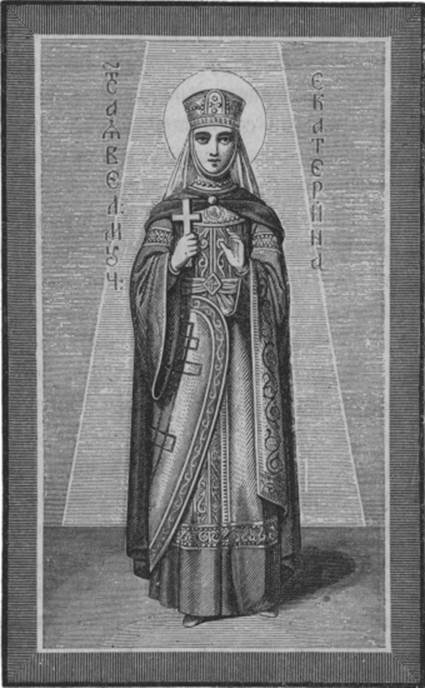
Екатерина, Александрианка, происходила из владетельного рода Консты и, достигнув 17-летнего возраста, отличалась красотою и редким образованием, но еще не была просвещена христианскою верою, так как в то время, в начале IV столетия, свирепствовало гонение на христиан и мать ее, хотя сама была христианка, но скрывала свою веру даже от дочери, опасаясь, вероятно, подвергнуть ее смертельной опасности. Но Божественной любви, превышающей земную, пристрастную, угодно было спасти прекрасную душу Екатерины и соделать ее орудием спасения для многих. Поводом к просвещению царственной язычницы послужило следующее обстоятельство. Когда пришло время вступить Екатерине в супружество и многие князья просили ее руки, то она отвергала все предложения; на просьбы же и советы матери и родных избрать себе жениха, высказалась однажды, что, если бы она согласилась выйти замуж, то не иначе, как за того, кто был бы равен ей по образованию, и по богатству, и по красоте... Но такого юноши не находилось, так как Екатерина обладала редкою в то время ученостию.
Catherine, an Alexandrian, came from the ruling house of Constus and, having reached the age of seventeen, was distinguished by beauty and rare education, but had not yet been enlightened by the Christian faith, since at that time, at the beginning of the fourth century, a persecution against Christians was raging, and her mother, although she herself was a Christian, concealed her faith even from her daughter, fearing, probably, to expose her to mortal danger. But Divine love, surpassing earthly, partial love, was pleased to save the beautiful soul of Catherine and to make her an instrument of salvation for many. The following circumstance served as the occasion for the enlightenment of the royal pagan. When the time came for Catherine to enter into marriage and many princes sought her hand, she rejected all proposals; to the entreaties and advice of her mother and relatives to choose a bridegroom, she once declared that, if she were to agree to marry, it would be only to one who would be equal to her in education, and in wealth, and in beauty... But no such youth was to be found, for Catherine possessed learning rare at that time.
Желая, однако же, склонить дочь свою к супружеству, мать Екатерины обратилась к одному мудрому и святому старцу, своему духовному отцу, прося его содействия. Пораженный умом молодой девушки, когда беседовал с нею, старец уразумел, что ей доступно высшее просвещение, и решился открыть ее душе познание Христа. – «Ты ищешь юношу равного тебе, – сказал он, – знаю я одного Отрока, превосходящего тебя во всем: красота Его светлее солнечного сияния... Мудрость Его управляет всем созданием... богатство Его разливается по всему миру, но это не уменьшает Его, а умножает... высота рода Его – неизреченна»...
Desiring, however, to incline her daughter to marriage, Catherine's mother turned to a certain wise and holy elder, her spiritual father, asking for his assistance. Struck by the young girl's intellect when he conversed with her, the elder understood that higher enlightenment was accessible to her, and resolved to open to her soul the knowledge of Christ. — "You seek a youth equal to yourself," he said, "I know a certain Youth who surpasses you in everything: His beauty is brighter than the radiance of the sun... His Wisdom governs all creation... His wealth is poured out over all the world, yet this does not diminish Him, but increases it... the height of His lineage is ineffable"...
– «Чей же Он сын?» – спросила в изумлении Екатерина.
— "Whose Son is He?" asked Catherine in amazement.
– «Он не имеет отца на земле, но родился вне законов человеческого естества от честнейшей родом Пресвятой и Пречистой Девы Марии, Которая, ради великой Своей святости, удостоилась быть Материю Такого Сына... Она пребывает бессмертною душою и телом и вознесена на небо, где ангелы поклоняются Ей, как Царице»...
— "He has no father on earth, but was born outside the laws of human nature from the most honorable by lineage, the Most Holy and Most Pure Virgin Mary, Who, for the sake of Her great holiness, was deemed worthy to be the Mother of such a Son... She abides immortal in soul and body and has been taken up into heaven, where angels worship Her as the Queen"...
– «Возможно ли мне увидеть того юношу, о котором я слышу такие дивные речи?» – робко спросила смущенная Екатерина.
— "Is it possible for me to see that youth of whom I hear such wondrous words?" timidly asked the troubled Catherine.
– «Если исполнишь, что я тебе скажу, то удостоишься увидеть пресветлое лицо Его», – отвечал старец и, подав Екатерине икону Божией Матери с Божественным Младенцем, прибавил: «вот изображение Матери Того Младенца, о Котором я тебе говорил; возьми его домой, принеси в свою комнату и, заперев за собою двери, помолись с благоговением и верою Той, Которая именуется Мариею; умоли Ее показать тебе ее Сына, и Она исполнит моление твое»...
— "If you do what I tell you, you will be deemed worthy to see His most radiant face," answered the elder, and, giving Catherine an icon of the Mother of God with the Divine Child, he added: "Here is the image of the Mother of that Child of Whom I spoke to you; take it home, bring it into your room, and, having locked the door behind you, pray with reverence and faith to Her Who is called Mary; beseech Her to show you Her Son, and She will fulfill your prayer"...
Екатерина поступила так, как сказал ей старец. Всю ночь молилась она и к утру заснула. Во сне увидела она Божию Матерь с Младенцем, окруженным необычайным сиянием, но, как она ни старалась увидеть Его лик, никак не могла, потому что Он отвращался от нее. Тогда Божия Матерь сказала Своему Сыну: «посмотри, Дитя Мое, на рабу Твою Екатерину, как она прекрасна и разумна!» – «Нет, – отвечал Младенец, – она и безумна, и безобразна, и Я не хочу видеть ее»... – «Не презирай Твоего создания, – просила Божия Матерь, – скажи рабе Твоей, что она должна делать, чтобы увидеть пресветлое лице Твое?» – «Пусть идет к старцу, – отвечал Младенец, – и научится от него, что ей делать, и если послушает его, то увидит Меня и приобретет Мою благодать».
Catherine did as the elder told her. She prayed all night and toward morning fell asleep. In her sleep she saw the Mother of God with the Child, surrounded by an extraordinary radiance, but, however much she tried to see His face, she could not, because He turned away from her. Then the Mother of God said to Her Son: "Look, My Child, upon Your handmaiden Catherine, how beautiful and intelligent she is!" — "No," answered the Child, "she is both foolish and ugly, and I do not wish to see her"... — "Do not despise Your creation," begged the Mother of God, "tell Your handmaiden what she must do to see Your most radiant face?" — "Let her go to the elder," answered the Child, "and learn from him what she must do, and if she heeds him, she will see Me and obtain My grace."
Едва проснулась Екатерина от чудного сна, то поспешила к старцу, давшему ей икону, и умоляла вразумить ее в смысле поразившего ее сновидения. Тогда старец открыл перед нею чудную тайну познания Богочеловека. Всем сердцем и умом воспринимала мудрая Екатерина Божественные истины, впервые открывавшиеся ей. Озаренная истинным светом, не замедлила она принять св. крещение и, научившись молиться, постоянно пребывала в этом общении уже не с Неведомым Богом... И вот, когда однажды, утомленная молитвою, она уснула, снова посетило ее чудное сновидение; снова явилась ей Божия Матерь с Младенцем, но теперь уже не отвращался Он от нее, но с любовию взирал на нее.
As soon as Catherine awoke from the wondrous dream, she hastened to the elder who had given her the icon, and begged him to instruct her in the meaning of the dream that had struck her. Then the elder opened before her the wondrous mystery of the knowledge of the God-Man. With all her heart and mind the wise Catherine received the Divine truths that were being revealed to her for the first time. Enlightened by the true light, she did not delay to receive holy Baptism, and, having learned to pray, she abode constantly in this communion, no longer with an Unknown God... And behold, when one day, wearied by prayer, she fell asleep, a wondrous dream visited her again; again the Mother of God appeared to her with the Child, but now He did not turn away from her, but looked upon her with love.
– Угодна ли Тебе, Сын Мой, эта девица? – спросила Матерь Божия. – Теперь она столько же премудра и богата, сколько была прежде безумна и убога, – отвечал Спаситель, – и Я так возлюбил ее, что обручаю ее Себе невестою... – и с этими словами вручил перстень Екатерине.
— "Is this maiden pleasing to Thee, My Son?" asked the Mother of God. — "Now she is as wise and rich as she was formerly foolish and poor," answered the Savior, "and I have so loved her that I betroth her to Myself as a bride"... and with these words He handed a ring to Catherine.
– Не достойна я, Господи, быть Твоею невестою, но удостой меня быть Твоею рабою! – со смирением и в чудном восторге воскликнула Екатерина и с этой минуты, проснувшись, навсегда пребыла под впечатлением чудного видения. Сердце ее преисполнилось любовию ко Христу; она отрешилась от всяких земных помышлений и вскоре мученическою кончиною засвидетельствовала веру свою в истинного Бога.
— "I am not worthy, O Lord, to be Thy bride, but deem me worthy to be Thy handmaiden!" with humility and in wondrous rapture exclaimed Catherine, and from that moment, having awakened, she abode forever under the impression of the wondrous vision. Her heart was filled with love for Christ; she detached herself from all earthly thoughts, and soon by a martyr's end she bore witness to her faith in the true God.
Явясь на языческое жертвоприношение, при котором присутствовал прибывший в то время в Александрию император, Екатерина стала обличать мерзость идолослужения, стала убеждать царя в существовании единого истинного Бога, безначального и бесконечного, Которым цари царствуют и стоит мир, Который сошел на землю и сделался человеком ради спасения людей, Который не требует жертвоприношений, но призывает к исполнению заповедей, которые Он возвестил миру.
Appearing at a pagan sacrifice, at which the emperor, who had arrived in Alexandria at that time, was present, Catherine began to denounce the abomination of idol-worship, and began to persuade the emperor of the existence of the one true God, without beginning and without end, by Whom kings reign and the world stands, Who came down to earth and became man for the salvation of men, Who does not require sacrifices, but calls to the fulfillment of the commandments which He proclaimed to the world.
Не убедили царя, но возбудили в нем гнев слова мужественной исповедницы. Он велел продолжать жертвоприношения и уже после празднества приказал привести к нему смелую защитницу преследуемого им учения Христова. На все его убеждения и угрозы она отвечала непоколебимым исповеданием веры во Христа. Пленясь ее разумом и красотой, император-язычник тем более не хотел видеть в ней христианку. Он призвал ученых, надеясь, что они ее победят в состязании о вере, но, с изумлением выслушав красноречивые и разумные доводы высокообразованной христианки, языческие ученые отказались возражать ей в защиту язычества. После новых напрасных убеждений, обещаний и угроз Екатерина была предана жесточайшим истязаниям; мучители, обнажив ее, беспощадно били воловьими жилами; кровь лилась из растерзанного тела ее. В таком положении она брошена была в темницу, где ее томили голодом в ожидании новых истязаний. После того истомленную мученицу – связанную положили между четырех колес – с острыми зубцами, чтобы, обращая колеса – два в правую и два в левую сторону, раздробить тело ее по частям. Но невидимою рукою были сокрушены орудия пытки и мученица встала невредимою. Тогда отсекли ей голову мечом.
The words of the courageous confessor did not persuade the emperor, but aroused his anger. He ordered the sacrifices to continue, and only after the festival commanded that the bold defender of the teaching of Christ which he persecuted be brought to him. To all his persuasions and threats she answered with an unshakable confession of faith in Christ. Captivated by her intellect and beauty, the pagan emperor was all the more unwilling to see her as a Christian. He summoned learned men, hoping that they would defeat her in a disputation about the faith, but, having listened with amazement to the eloquent and reasonable arguments of the highly educated Christian woman, the pagan scholars refused to argue with her in defense of paganism. After new vain persuasions, promises, and threats, Catherine was subjected to the most cruel tortures; her tormentors, having stripped her, mercilessly beat her with ox sinews; blood flowed from her lacerated body. In this condition she was thrown into prison, where they tormented her with hunger in expectation of new tortures. After that, the exhausted martyr was bound and placed between four wheels with sharp teeth, so that, by turning the wheels—two to the right and two to the left—her body might be crushed piece by piece. But by an invisible hand the instruments of torture were shattered, and the martyr arose unharmed. Then they cut off her head with a sword.
Многие, видя страдания св. Екатерины и проявление чудной Божественной силы в охранении ее, уверовали во Христа. Между ними была супруга царя Августа и военачальник Порфирий с 200 воинов, которые за день до кончины св. Екатерины приняли также мученическую смерть.
Many, seeing the sufferings of St. Catherine and the manifestation of wondrous Divine power in preserving her, believed in Christ. Among them were the wife of the Emperor Augustus and the commander Porphyrius with two hundred soldiers, who, the day before the end of St. Catherine, also suffered a martyr's death.
Существует историческое свидетельство, что мощи св. великомученицы Екатерины были открыты в XIII веке Египетскими христианами и перенесены в Аравию, в монастырь на Синайской горе. С того времени часто встречаются сведения о праздновании ей и о мощах ее393.
There exists a historical testimony that the relics of the holy Great Martyr Catherine were discovered in the thirteenth century by Egyptian Christians and transferred to Arabia, to a monastery on Mount Sinai. From that time, information about the celebration in her honor and about her relics is frequently encountered393.
«Богозванная невеста, блаженная Екатерина, – восхваляет Церковь св. великомученицу, – ты добродетелями, как солнечными лучами, и премудрым словом своим просветила неверных мудрецов и, как пресветлая луна, ты отгнала ходящим в нощи тьму неверия, множество мучеников привела ко Христу и царицу уверила, и мучителя обличила, и достигла к прекрасному Жениху. Владыка именующие верою имя великомученицы спасает от искушений и подает им благоздравие».
"O divinely called bride, blessed Catherine," the Church praises the holy Great Martyr, "by thy virtues, like rays of the sun, and by thy most wise word, thou didst enlighten the unbelieving wise men, and, like a most radiant moon, thou didst drive away the darkness of unbelief from those walking in the night; thou didst lead a multitude of martyrs to Christ, and didst convince the queen, and didst put the tormentor to shame, and didst attain to the beautiful Bridegroom. The Lord saves those who call with faith upon the name of the Great Martyr from temptations and grants them good health."