† Страдание св. князя Михаила Ярославича Тверского
† The Passion of the Holy Prince Michael Yaroslavich of Tver
Князь Михаил Ярославич родился уже после смерти отца своего кн. Ярослава Ярославича, в 1272 году310, и потому рос сиротою. Так и первые годы жизни его были уже запечатлены скорбию. Он воспитывался умною и благочестивою материю кн. Ксениею в страхе Божием; престол князя Тверского занимал старший брат Святослав, памятный Церкви и отечеству тем, что, княжив при жизни отца во Пскове, крестил он Литовцев, скрывшихся от бед отчизны во Пскове311. В первый раз встречаем Михаила князем Тверским в 1285 г. «Заложена была в Твери, говорит летописец, каменная церковь Козьмы и Дамиана благоверным князем Михаилом и материю его Ксениею и преподобным епископом Симеоном, и дали ей другое имя – св. Спас Преображение»312. Прекрасное начало княжению новому! В том же году «Литва напала на волость Тверского владыки – Олешню. Тверитяне, Москвичп, Волочане, Новоторжцы, Зубцовцы, Ржевичи совокупными силами пошли и накануне Спасова дня побили Литву в лесу. Бог помог христианам; князя Литовского Домонта убили, иных перехватали, других умертвили, всех взятых в плен отняли, иные же разбежались»313. Новому князю Тверскому надлежало отправиться в Орду, чтоб быть утвержденным на престоле. Но когда он был в Орде, по милости кн. Андрея, недостойного сына св. князя Невского, Татары (1287 г.) захватили Москву и готовы были опустошать владения Тверского князя. Кн. Михаил на возвратном пути из Орды, не зная ничего о делах Андрея, едва не попался в плен Татарам в Москве, но был во время предупрежден одним священником, который указал ему безопасную дорогу к Твери. Можно представить себе, с каким восторгом встретила Тверь своего князя, с часу на час ожидавшая свирепых Татар. «Бог защитил князя, говорит летопись, молитвами деда и отца, и не презрел слезной мольбы матери его». Князь Андрей и мурза Дюдень, узнав, что Михаил готов встретить их, не пошли на Тверь, а пошли грабить Волоколамск314. Кн. Димитрий, старший брать Андрея, услышав об удалении Татар, хотел пробраться в свой Переяславль, но дорогою едва не был схвачен недостойным братом своим; оставив казну свою в руках Андрея, он едва мог уйти в Тверь, где Михаил принял его с честию и вызвался быть миротворцем между братьями. Тверской епископ поехал к Андрею в Торжок, убеждал и молил Андрея о мире и наконец успел в благом деле. Димитрий отказался от прав старшинства своего, довольный одним Переяславлем, и вскоре умер схимником315. Добрый Михаил в конце 1295 года вступил в святой брак с доброю дочерью Ростовского князя Анною. Чрез год потом, безумный властолюбец и жадный хищник Андрей, не уважая ни совести, ни договоров, хотел отнять Переяславль у юного сына Димитриева Иоанна; но кн. Михаил и кн. Даниил Московский силою заставили Андрея отступиться от своего предприятия. После того Господь сохранил жизнь доброго князя от явной опасности; в ночной пожар, поднявшийся, когда все спали, князь и супруга его успели выскочить в окно пылавшего дворца, а многие сгорели вместе с дворцом; это так потрясло князя, что он был потом тяжко болен316.
Prince Michael Yaroslavich was born after the death of his father, Prince Yaroslav Yaroslavich, in the year 1272310, and therefore grew up an orphan. Thus even the first years of his life were already sealed with sorrow. He was raised by his wise and pious mother, Princess Xenia, in the fear of God. The throne of the Prince of Tver was occupied by his elder brother Svyatoslav, who is remembered by the Church and the fatherland for having, while reigning in Pskov during his father's lifetime, baptized the Lithuanians who had fled from the misfortunes of their homeland to Pskov311. We first encounter Michael as Prince of Tver in the year 1285. "A stone church of Cosmas and Damian was founded in Tver," says the chronicler, "by the right-believing Prince Michael and his mother Xenia and the Venerable Bishop Simeon, and they gave it another name—the Holy Transfiguration of the Savior"312. A beautiful beginning to a new reign! In the same year, "Lithuania attacked the volost of the Tver vladyka—Oleshnya. The men of Tver, Moscow, Volok, Novy Torg, Zubtsov, and Rzhev went together with united forces and on the eve of the Feast of the Savior defeated the Lithuanians in the forest. God helped the Christians; they killed the Lithuanian prince Domont, captured some, slew others, took back all those taken prisoner, and the rest fled"313. The new Prince of Tver was obliged to set out for the Horde to be confirmed on the throne. But while he was in the Horde, through the malice of Prince Andrew, the unworthy son of the holy Prince Alexander Nevsky, the Tatars (in 1287) seized Moscow and were ready to lay waste the domains of the Prince of Tver. Prince Michael, on his return journey from the Horde, knowing nothing of Andrew's deeds, nearly fell into Tatar captivity in Moscow, but was warned in time by a priest, who showed him a safe road to Tver. One can imagine with what delight Tver greeted its prince, who from hour to hour had been expecting the savage Tatars. "God protected the prince," says the chronicle, "through the prayers of his grandfather and father, and did not despise the tearful entreaty of his mother." Prince Andrew and the mirza Dyuden, learning that Michael was ready to meet them, did not march on Tver but went to plunder Volokolamsk314. Prince Demetrius, Andrew's elder brother, hearing of the Tatars' withdrawal, wished to make his way to his own Pereslavl, but on the road he was nearly seized by his unworthy brother; leaving his treasury in Andrew's hands, he barely managed to escape to Tver, where Michael received him with honor and offered to be a peacemaker between the brothers. The Bishop of Tver went to Andrew at Torzhok, urging and begging Andrew for peace, and at last succeeded in this good work. Demetrius renounced his rights of seniority, contenting himself with Pereslavl alone, and soon died a schemamonk315. The good Michael, at the end of 1295, entered into holy marriage with the good daughter of the Prince of Rostov, Anna. A year later, the insane lover of power and greedy plunderer Andrew, respecting neither conscience nor treaties, wished to take Pereslavl from Demetrius's young son John; but Prince Michael and Prince Daniel of Moscow by force compelled Andrew to abandon his undertaking. After that, the Lord preserved the good prince's life from manifest danger: during a night fire that broke out while all were asleep, the prince and his wife managed to leap from a window of the burning palace, while many perished together with the palace; this so shook the prince that he afterward fell gravely ill316.
По смерти беспокойного Андрея († 1304 г.), права вел. князя принадлежали кн. Михаилу Тверскому: он был теперь старший из всех князей. Но Юрий Московский присваивал себе эти права. Когда Михаил отправился в Орду за ярлыком, то и Юрий отправился туда же. М. Максим напрасно старался удержать Юрия не искать не принадлежащего ему; именем матери Михаиловой и своим собственным уверял его, что ему прибавят любой город к Москве, лишь бы не ходил спорить в Орду, к радости врагов имени христианского. Юрий не постыдился лгать пред святителем; он сказал, что идет не за именем вел. князя, а по своим делам. В 1305 году Михаил возвратился в Россию великим князем; князья охотно признали первенство его; Юрия силою принудили к тому; даже своевольный Новгород должен был смириться пред Михаилом317 тем более, что увидел, как своекорыстные и властолюбивые происки Юрия вредны были для Новгорода, тогда как Михаил заботился о покое и счастии всей России318.
After the death of the restless Andrew († 1304), the rights of the Grand Prince belonged to Prince Michael of Tver: he was now the eldest of all the princes. But George of Moscow claimed these rights for himself. When Michael set out for the Horde for the yarlyk, George also set out thither. Metropolitan Maximus tried in vain to restrain George from seeking what was not his due; in the name of Michael's mother and his own, he assured him that any city he wished would be added to Moscow, if only he would not go to contend in the Horde, to the joy of the enemies of the Christian name. George was not ashamed to lie before the hierarch; he said that he was going not for the title of Grand Prince, but on his own business. In 1305, Michael returned to Russia as Grand Prince; the princes willingly acknowledged his primacy; George was compelled to do so by force; even the self-willed Novgorod had to humble itself before Michael317, all the more so because it saw how the self-seeking and power-loving intrigues of George were harmful to Novgorod, whereas Michael cared for the peace and happiness of all Russia318.
В 1313 году занял престол ханский Узбек. И дела переменились: Узбек не только сам принял магометанство, но объявил его господствующею верою между Татарами. «Он обратил народ свой к исламизму», говорит восточный историк319. Исламизм везде отличался фанатизмом, особенно при первом появлении своем в народе; употреблял в свою пользу и меры жестокие и соблазны сильные, тогда как и сам по себе он – приманка для грешной чувственности. Древнее повествование говорит, что когда Узбек принял «бесерменство, наипаче не пощадети нача роду христианскаго». Никто из ханов не перегубил столько князей наших, как Узбек. Понятно, что искренний христианин, каковым был князь Михаил, менее мог быть приятен Узбеку, чем какой-нибудь Юрий, для которого христианство – вещь не очень нужная. К счастию России, исламизм принят Монголо-Татарскою ордою без отмены ясы – Монгольского государственного закона, освящавшего терпимость вер. Порядки правительства оставались прежние. К новому хану князь Михаил должен был явиться, чтобы быть утвержденным от него в правах великого князя. Юрий, еще не быв в Орде, дознал, как пойдут дела при новом хане, и начал наступательные действия против Михаила; пока тот был в Орде, он занял Новгород, где дотоле были наместники Михаила. Михаил жаловался на то в Орде и ему дали ярлык, а Юрия потребовали к ответу в Орду. Юрий оставил много хлопот Михаилу в Новгороде; два года возился великий князь с взволнованным упрямством Новгорода, заставляя уплатить долг оскорбленному великому князю320. Юрий, между тем, три года пресмыкался в Орде, дарил вельмож и, наконец, столько успел, что Узбек отдал за него свою сестру и с нею великое княжение. С толпами Татар и воеводою их, Кавгадыем, возвратился он в Россию и потребовал себе не только почестей великого князя, но и земель, принадлежащих Михаилу. «Будь великим князем, если это угодно царю, говорил Михаил Юрию, только оставь меня в моем наследии». Юрий стал жечь села и города Тверские. Михаил собрал на совет епископа и бояр. «Судите меня с племянником, сказал он. Хан утвердил меня на великом княжении; я заплатил дань царю. Теперь отказываюсь от достоинства и не могу смягчить злобы Юрия. Сколько зла наделал он в родовой моей собственности! Он ищет головы моей. Совесть не упрекает меня; но, может быть, я ошибаюсь. Скажите, виновен ли я пред Юрием?» Епископ и бояре единодушно отвечали: «ты прав, государь, во всем пред Юрием; смирение твое изумительно: в наших глазах столько обид вытерпел ты от Юрия. Чего ждать еще? Ужели того, чтобы Татары пришли и осквернили святыни наши? Иди против врагов: с тобою Бог и мы, готовые отдать жизнь за тебя». «Не за меня одного, сказал Михаил. Сколько людей лишены крова, свободы, чистоты, жизни! Господь сказал: кто положит жизнь за друзей своих, тот велик в Царствии Небесном». Князь, предводительствуя войском мужественным, встретил полки Юрия и Татар за 40 верст от Твери, где ныне село Бортенево. Началась битва. Шлем и латы князя Михаила были иссечены и исстрелены, а он остался цел. Юрий разбит на голову и едва не попался в плен; жена Юриева – Кончака-Агафия, брат Борис, многие бояре осталися в руках Михаила (это было 22 декабря 1317 года); Кавгадый сам явился в Тверь. «Мы с этих пор твои, сказал он, мы виноваты пред ханом, пролили столько крови без его воли». Михаил принял Кавгадыя с честию и, поверив мурзе, отпустил его и его Татар с подарками. Юрий не успокоился. Он привел Новгородцев против Михаила. Едва при посредстве архиепископа заключили мир. К несчастию, жена Юрия умерла в Твери. Злобный Юрий отправился в Орду с доносом, что Михаил отравил сестру хана; Кавгадый поспешил туда же и осыпал Михаила клеветами пред Узбеком. Михаил, чувствуя свою невинность, послал вслед за Юрием младшего сына Константина, а сам занялся устройством разоренной своей области321.
In 1313, Uzbek ascended the Khan's throne. And things changed: Uzbek not only himself embraced Mohammedanism, but declared it the dominant faith among the Tatars. "He converted his people to Islam," says an Eastern historian319. Islam everywhere was marked by fanaticism, especially at its first appearance among a people; it employed both cruel measures and powerful temptations for its own advantage, even as it is in itself a lure for sinful sensuality. An ancient narrative says that when Uzbek adopted "the Muslim faith, he began especially to spare not the Christian race." No other khan destroyed as many of our princes as Uzbek did. It is understandable that a sincere Christian, such as Prince Michael was, could be less pleasing to Uzbek than some George, for whom Christianity was not a very necessary thing. Fortunately for Russia, Islam was adopted by the Mongol-Tatar Horde without the abolition of the Yasa—the Mongol state law that sanctioned religious tolerance. The forms of government remained as before. Prince Michael had to appear before the new khan to be confirmed in his rights as Grand Prince. George, though not yet in the Horde, discerned how matters would proceed under the new khan and began offensive actions against Michael; while the latter was in the Horde, George occupied Novgorod, where Michael's lieutenants had previously been. Michael complained of this in the Horde, and a yarlyk was given to him, while George was summoned to answer in the Horde. George left many troubles for Michael in Novgorod; for two years the Grand Prince struggled with the agitated stubbornness of Novgorod, compelling it to pay its debt to the offended Grand Prince320. George, meanwhile, spent three years groveling in the Horde, giving gifts to the nobles, and at last succeeded so well that Uzbek gave him his own sister in marriage and with her the Grand Principality. With crowds of Tatars and their voivode, Kavgady, he returned to Russia and demanded for himself not only the honors of the Grand Prince, but also the lands belonging to Michael. "Be Grand Prince, if this is pleasing to the Tsar," said Michael to George, "only leave me in my inheritance." George began to burn the villages and towns of Tver. Michael summoned the bishop and the boyars to council. "Judge between me and my nephew," he said. "The Khan confirmed me in the Grand Principality; I have paid the tribute to the Tsar. Now I renounce the dignity, and I cannot soften George's malice. How much evil has he done in my ancestral property! He seeks my head. My conscience does not reproach me; but perhaps I am mistaken. Tell me, am I guilty before George?" The bishop and the boyars answered with one voice: "You are right, Sovereign, in everything before George; your humility is astonishing: in our eyes you have endured so many insults from George. What more is to be expected? Is it that the Tatars should come and defile our holy things? Go against the enemies: God is with you, and we are ready to give our lives for you." "Not for me alone," said Michael. "How many people have been deprived of home, freedom, purity, life! The Lord said: He who lays down his life for his friends, he is great in the Kingdom of Heaven." The prince, leading a courageous army, met the regiments of George and the Tatars forty versts from Tver, where the village of Bortenevo now stands. The battle began. The helmet and armor of Prince Michael were hacked and shot through, yet he remained unharmed. George was utterly defeated and barely escaped capture; George's wife—Konchaka-Agatha, his brother Boris, and many boyars remained in Michael's hands (this was on December 22, 1317); Kavgady himself appeared in Tver. "From now on we are yours," he said, "we are guilty before the Khan, having shed so much blood without his will." Michael received Kavgady with honor and, trusting the mirza, dismissed him and his Tatars with gifts. George did not calm down. He brought the Novgorodians against Michael. Peace was barely concluded through the mediation of the archbishop. Unfortunately, George's wife died in Tver. The malicious George set out for the Horde with a denunciation that Michael had poisoned the Khan's sister; Kavgady hastened thither as well and heaped slanders upon Michael before Uzbek. Michael, conscious of his innocence, sent his younger son Constantine after George, while he himself occupied himself with the restoration of his devastated domain321.
В августе 1318 года Михаил собрался сам идти в Орду. На берегу Нерли простился он с семьею и боярами и тут же исповедался у духовного отца своего игумена Иоанна. «Отче, сказал ему князь, много заботился я о покое христиан, но, по грехам моим, не мог прекратить междоусобий; теперь благослови меня, если придется пролить кровь мою за них, лишь бы они несколько отдохнули, а мне бы простил Господь грехи». Во Владимире встретил его ханский посол и сказал: «спеши в Орду; если не поспеешь в месяц, полки вступят в твою область; Кавгадый обнес тебя пред Узбеком и говорит, что ты совсем не думаешь явиться к хану». Устрашенные этими вестями, бояре говорили Михаилу: «один сын твой в Орде, пошли еще другого»; сыновья говорили: «дорогой родитель! не ходи в Орду; пошли из нас, кого хочешь; пусть пройдет гнев Узбека, пред которым оклеветали тебя». «Не вас, дети мои, требует царь, но меня, отвечал христианский князь; если уклонюсь я от готовой смерти, моя отчина будет опустошена, и тысячи христиан то истреблены будут, то попадутся в плен; умереть всем надобно, лучше же умереть за других». Преподав наставления детям, разделяв им отчину свою, написав грамоту, Михаил отправился в Орду и нашел Узбека при устье Дона, на море «Сурожском» или Азовском. По обычаю представил он подарки всем князьям Орды, женам ханским, самому хану и полтора месяца жил без тревог; казалось, все было покойно; от хана дан пристав, чтобы никто не оскорблял князя. Кавгадый, прежде того, раздражая гордого Узбека, говорил: «Михаил горд, никогда не явится сюда»; а в то же время, боясь появления его в Орде, хотел схватить и задержать его на дороге. Теперь он с Юрием употреблял другие меры, как успешнее погубить Михаила; клеветой и лестию завлекал сильных вельмож на свою сторону и против Михаила. Наконец, Узбек сказал вельможам: «вы мне говорили на князя Михаила; рассудите его с Московским князем и скажите, кто прав, кто виноват». Дело поставлено так, что если бы Узбек и хотел знать правду, он не узнал бы ее. Можно понять, каков был состав судей, когда Кавгадый был первым судьею, он, который был и обвинителем Михаила и сам же был виновным в истреблении людей, совершенном помимо воли хана. Начался суд: два раза приводили Михаила в собрание Ордынских вельмож, ему читали грамоты обвинительные: «ты был горд, непокорен хану; ты бесчестил ханского посла Кавгадыя, бился с ним и побил Татар; ты брал себе дани ханские; ты хотел бежать к папе; ты отравил княгиню Юрия». Михаил отвечал: «сколько сокровищ выдавал я хану и его князьям, на то есть у вас роспись; сражался я с князем Юрием, а посла царского спас от смерти и отпустил с честию; княгини Юрьевой, Бог свидетель, и на уме не было отравлять». Судьи хотели только обвинять, а не принимать оправдания князя. Для представления хану записали они только то, что хотели. Невинного князя связали, приставили к нему сторожей, разграбили платье его; прогнали от него слуг его, бояр, духовника игумена Александра, которым всем досталось вытерпеть много и побоев. На следующее утро, это было воскресение, на шею его возложили тяжелую деревянную колодку. «Слава Тебе, человеколюбивый Владыко, говорил святой, что Ты удостоил меня начать страдальческий подвиг; удостой же и кончить его». Хан отправился на охоту; за ним в колодке волокли Михаила; на ночь забивали руки его в ту же колодку, которая была на шее его. Благочестивый князь и прежде имел обыкновение каждую ночь заниматься чтением псалмов Давида; теперь он более, чем прежде, хотел исполнять святое правило свое; поскольку же руки его по ночам не пользовались свободою, то отрок сидел пред ним и перевертывал листы псалтыри. Днем он был постоянно весел. «Вам приятно было, друзья мои, говорил он своим, смотреть на меня в счастии; а теперь, смотря на колодку мою, вы печальны? Напрасно: испытав счастие, почему не перенесть несчастия? Что значит это несчастие в сравнении с грехами моими? Больше, гораздо больше следует мне страдать, чтобы получить прощение в грехах. Вас печалит колодка? Скоро не будет ее на шее моей». Когда же становилось тяжко на душе его, он повторял с Давидом: «вскую прискорбна еси, душе моя? Вскую смущаеши мя? Уповай на Бога, яко иповемся Ему: спасение лица моего и Бог мой». Орда остановилась, иаконец, за р. Тереком. на р. Совенце, под Тетяковым, недалеко от Дербента322. Во время охоты Узбековой, отроки говорили св. Михаилу: «князь! проводники и лошади готовы; беги в горы, спаси жизнь свою». «Не дай Бог сделать это, отвечал он; во всю жизнь не бегал я от врагов; и если я один спасусь, а люди мои останутся в беде, какая мне слава? Нет, воля Господня да будет!» Уже 24 дня находился он в таком позорном и томительном положении. Кавгадыю захотелось еще наругаться над несчастным и прибавить ему мук. Счастливый злодей велел вывесть его на торг, созвал заимодавцев его, приказал поставить князя на колени пред собою, говорил ему колкости и дерзости, величаясь своим счастием. Потом сказал ему: «знай, Михаил, таков обычай у хана, если хан рассердится на кого из своих родных (это был намек на Юрия), то также велит держать его в колодке, а потом минет гнев – и опальному возвращается честь; и тебя завтра или послезавтра освободят». Обратясь к сторожам, Кавгадый шутливо сказал: « отчего не снять с него теперь колоды?» Сторожа понимали, что каждое слово Кавгадыя – едкая насмешка над князем, и потому отвечали с улыбкою: «завтра или послезавтра снимем». «По крайней мере, поддержите колодку, чтобы не отдавила ему плеч», сказал Кавгадый, как будто по состраданию. Один простодушный сторож стал поддерживать колодку. Наругавшись над несчастным, злодей велел отвесть князя прочь. Но страдалец столько был истомлен сценою наглого злодея, что имел нужду в отдыхе и велел отрокам своим подать студ. Стояла толпа праздных: Греков, Неяцев, Литвы, Русских «Государь-князь! сказал один из близких его, видишь, как много народа стоит и смотрит на тебя; они слышали, что ты – князь владетельный; не лучше ли пойти тебе в свою палатку?» «Позор быхом ангелом и человеком», сказал Михаил и, встав, пошел с слезами на глазах. С тех пор часто стали видеть его в слезах: не оставалось сомнения, что смерть близка к нему. В самый день кончины, он велел отпеть заутреню, часы, прочел со слезами правило причащения, исповедался и причастился св. Таин; с ним были два священника и игумен; призвав сына своего Константина, объявил ему свои распоряжения о отчине, о боярах, о слугах и, не забыв самого последнего слуги, приказывал наградить каждого. Потом взял псалтырь и, разогнув, читал: «сердце мое смятеся во мне, и боязнь смерти нападе на мя». – О чем говорит псалом? спросил он. Не желая смущать его, отвечали ему: «псалмы известны тебе, государь! Там же написано: «возверзи на Господа печаль твою». Князь продолжал: «кто даст ми криле яко голубине? и полещу и почию»... В то самое время вбежал отрок с лицом, бледным от страха, и сказал: «Кавгадый, князь Юрий и множество народа идут к шатру». «Знаю – зачем», отвечал Михаил и немедленно послал сына своего к царице Боялыне под ее защиту323. Юрий и Кавгадый остановились невдали от шатра на площади и послали убийц в шатер. Как звери, убийцы вскочили в шатер, разогнали всех людей князя. Михаил стоял и молился. Они схватили его за колодку и ударили об стену так сильно, что шатер проломился. Не смотря на то, Михаил, крепкий здоровьем, вскочил на ноги; тогда бросились на него толпою, сшибли его и били ногами без пощады; один из них, Романец, вонзил нож в ребра и повернул его там. Это было в среду 22 ноября324. Чернь вломилась в ставку для грабежа, по обычаю Монгольскому. Юрий и Кавгадый, узнав, что все кончено, сели на коней и подъехали к шатру. Тело св. князя лежало нагое. Кавгадый с досадою сказал товарищу злодейства: «он – твой дядя; чего же ты смотришь, что тело брошено нагое?» Слуга Юрия прикрыл тело своею одеждою325.
In August 1318, Michael prepared to go himself to the Horde. On the banks of the Nerl, he took leave of his family and boyars, and there he made his confession to his spiritual father, Abbot John. "Father," said the prince to him, "I have labored much for the peace of Christians, but, because of my sins, I could not put an end to the internecine strife; now bless me, if it be my lot to shed my blood for them, if only they might have some respite, and the Lord would forgive me my sins." In Vladimir, the Khan's envoy met him and said: "Hasten to the Horde; if you do not arrive within a month, regiments will enter your domain; Kavgady has slandered you before Uzbek and says that you have no intention of appearing before the Khan." Terrified by these tidings, the boyars said to Michael: "One of your sons is already in the Horde; send another"; his sons said: "Dear father! Do not go to the Horde; send one of us, whomever you wish; let the wrath of Uzbek, before whom you have been slandered, pass." "It is not you, my children, that the Tsar demands, but me," answered the Christian prince; "if I shun the death that awaits me, my patrimony will be laid waste, and thousands of Christians will either be slain or taken captive; all must die, but it is better to die for others." Having given instructions to his children, apportioned his patrimony among them, and written a testament, Michael set out for the Horde and found Uzbek at the mouth of the Don, on the 'Surozh' or Sea of Azov. According to custom, he presented gifts to all the princes of the Horde, to the Khan's wives, and to the Khan himself, and lived without anxiety for a month and a half; all seemed peaceful; the Khan gave a guard so that no one should insult the prince. Kavgady, before this, had irritated the proud Uzbek, saying: "Michael is proud; he will never appear here"; at the same time, fearing his arrival in the Horde, he wanted to seize and detain him on the road. Now he and Yury employed other measures to destroy Michael more effectively; by slander and flattery he drew the powerful nobles to his side and against Michael. Finally, Uzbek said to the nobles: "You have spoken to me against Prince Michael; judge him with the Prince of Moscow and tell me who is right and who is guilty." The matter was so arranged that even if Uzbek had wished to know the truth, he would not have learned it. One can understand what kind of court it was when Kavgady was the chief judge—he who was both Michael's accuser and himself guilty of the destruction of people committed against the Khan's will. The trial began: twice they brought Michael before the assembly of Horde nobles; they read him the indictments: "You were proud and disobedient to the Khan; you dishonored the Khan's envoy Kavgady, fought with him, and killed Tatars; you took the Khan's tribute for yourself; you wanted to flee to the Pope; you poisoned Yury's wife." Michael answered: "How many treasures I gave to the Khan and his princes—you have a list of that; I fought with Prince Yury, but I saved the Tsar's envoy from death and sent him away with honor; as for Yury's wife, God is my witness, I never even thought of poisoning her." The judges wanted only to accuse, not to accept the prince's defense. They recorded for presentation to the Khan only what they wished. They bound the innocent prince, set guards over him, plundered his clothing; they drove away his servants, his boyars, and his confessor, Abbot Alexander, who all had to endure many beatings. The next morning, which was Sunday, they placed a heavy wooden block on his neck. "Glory to Thee, O Lover of mankind, O Master," said the saint, "that Thou hast deemed me worthy to begin the struggle of suffering; deem me worthy also to finish it." The Khan set out for the hunt; they dragged Michael behind him in the block; at night they fastened his hands into the same block that was on his neck. The pious prince had even before been accustomed to spend every night reading the Psalms of David; now he wished more than ever to fulfill his holy rule; but since his hands were not free at night, a youth sat before him and turned the pages of the Psalter. By day he was always cheerful. "It was pleasant for you, my friends," he said to his companions, "to look upon me in prosperity; but now, looking at my block, are you sad? It is in vain: having experienced happiness, why should we not bear misfortune? What is this misfortune compared to my sins? I ought to suffer much more, far more, to receive forgiveness of my sins. Does the block grieve you? Soon it will no longer be on my neck." When his soul became heavy, he repeated with David: "Why art thou cast down, O my soul? And why dost thou disquiet me? Hope in God, for I will confess Him: the salvation of my countenance and my God." The Horde finally halted beyond the Terek River, on the River Sovenets, near Tetyakov, not far from Derbent322. During Uzbek's hunt, the youths said to St. Michael: "Prince! guides and horses are ready; flee to the mountains, save your life." "God forbid I should do that," he answered; "in all my life I have never fled from enemies; and if I alone am saved while my people remain in trouble, what glory would that be to me? No, the will of the Lord be done!" He had already been in this shameful and grievous condition for twenty-four days. Kavgady desired yet further to mock the unfortunate man and add to his torments. The prosperous villain ordered him to be brought out to the market, summoned his creditors, commanded the prince to be placed on his knees before him, and spoke cutting and insolent words to him, exulting in his own good fortune. Then he said to him: "Know, Michael, such is the Khan's custom: if the Khan is angry with any of his relatives (this was a hint at Yury), he likewise orders him to be kept in the block, and then the wrath passes—and honor is restored to the disgraced one; and you will be freed tomorrow or the day after." Turning to the guards, Kavgady said jokingly: "Why not take the block off him now?" The guards understood that every word of Kavgady was a bitter mockery of the prince, and therefore answered with a smile: "Tomorrow or the day after we will take it off." "At least support the block, so that it does not press on his shoulders," said Kavgady, as if out of compassion. One simple-hearted guard began to support the block. Having mocked the unfortunate man, the villain ordered the prince to be led away. But the sufferer was so exhausted by the scene of insolent villainy that he needed rest and ordered his youths to bring him a stool. A crowd of idle people stood about: Greeks, Neitsy, Lithuanians, Russians. "Sovereign prince!" said one of his close companions, "do you see how many people are standing and looking at you? They have heard that you are a ruling prince; would it not be better for you to go to your tent?" "We are made a spectacle to angels and to men," said Michael, and rising, he went with tears in his eyes. From that time on, they often saw him in tears: there remained no doubt that death was near. On the very day of his end, he ordered Matins and the Hours to be sung, read the rule for Communion with tears, made his confession, and partook of the Holy Mysteries; two priests and the abbot were with him; calling his son Constantine, he declared to him his arrangements concerning his patrimony, the boyars, and the servants, and, not forgetting even the lowliest servant, he commanded that each be rewarded. Then he took the Psalter and, opening it, read: "My heart is troubled within me, and the fear of death has fallen upon me." — "What does the psalm speak of?" he asked. Not wishing to disturb him, they answered: "The psalms are known to you, sovereign! It is also written there: 'Cast thy care upon the Lord.'" The prince continued: "Who will give me wings like a dove? And I will fly and be at rest"... At that very moment a youth ran in, his face pale with fear, and said: "Kavgady, Prince Yury, and a multitude of people are coming to the tent." "I know why," answered Michael, and immediately sent his son to the Tsaritsa Bayalyn for her protection323. Yury and Kavgady stopped not far from the tent in the square and sent murderers into the tent. Like wild beasts, the murderers leaped into the tent and scattered all the prince's people. Michael stood and prayed. They seized him by the block and struck him against the wall so violently that the tent was torn. Nevertheless, Michael, strong in health, sprang to his feet; then they rushed upon him in a crowd, knocked him down, and kicked him without mercy; one of them, Romanets, thrust a knife into his ribs and twisted it there. This was on Wednesday, November 22324. The rabble broke into the camp for plunder, according to Mongol custom. Yury and Kavgady, learning that all was over, mounted their horses and rode up to the tent. The body of the holy prince lay naked. Kavgady said with vexation to his accomplice in villainy: "He is your uncle; why do you look on while his body is thrown out naked?" One of Yury's servants covered the body with his own garment325.
По распоряжению Юрия, тело св. князя положили на доске в телегу и, увязав веревкою, повезли за р. Адежь – Горькую326. Ночью два сторожа должны были стеречь тело. Но в первую ночь страх напал на сторожей, и они ушли в ставку. На утро не нашли они тела на доске, оно лежало у телеги, раною к земле, источавшею много крови; правая рука князя была под лицом его, а левая у раны, и был он одет в одежду. Во всю ночь никакой зверь не коснулся его, а их много скиталось в степи. Многие, не только верные, но и неверные видели, что два светлые облака осенили ночью тело святого. Утром говорили: князь – святой, невинно убитый. В Маджарах купцы, знавшие покойного, хотели покрыть тело его дорогими тканями и поставить в церковь с честию, с свечами327. Но бояры Юрия не дали и посмотреть на покойного и с бранью поставили его в хлев за стражею. Здесь также видели ночью светлый столб, склонившийся дугою к хлеву, где лежало св. тело страдальца. В Бездеже наглый сторож лег на сани, где лежало св. тело, но невидимая сила сбросила его с саней, и он едва мог подняться с земли; о том сам он с раскаянием говорил тамошнему священнику, «а от него, прибавляет жизнеописатель, слышали мы и записали». Привезши тело в Москву, похоронили его в Спасском кремлевском монастыре328.
By George's order, the body of the holy prince was laid on a board placed on a cart and, bound with ropes, was conveyed beyond the river Adezh—the Bitter326. At night two guards were to watch the body. But on the first night fear fell upon the guards, and they withdrew to the camp. In the morning they did not find the body on the board; it lay beside the cart, with the wound turned to the earth, the wound pouring forth much blood; the prince's right hand was beneath his face, and his left hand lay upon the wound, and he was clothed in a garment. Throughout the whole night no beast touched him, though many roamed the steppe. Many, not only of the faithful but also of the unbelievers, saw that two bright clouds overshadowed the body of the saint during the night. In the morning they said: "The prince is a saint, innocently slain." In Madzhary, merchants who had known the deceased wished to cover his body with costly fabrics and to place it in a church with honor, with candles327. But George's boyars would not even allow them to look upon the deceased, and with abuse placed him in a cattle-shed under guard. Here also was seen at night a luminous pillar, bending in an arc toward the shed where lay the holy body of the sufferer. In Bezdezh, an insolent guard lay down upon the sledge where the holy body lay, but an invisible force cast him from the sledge, and he could scarcely rise from the ground; of this he himself spoke with repentance to the priest of that place, "and from him," adds the biographer, "we heard it and wrote it down." Having brought the body to Moscow, they buried it in the Savior Monastery in the Kremlin328.
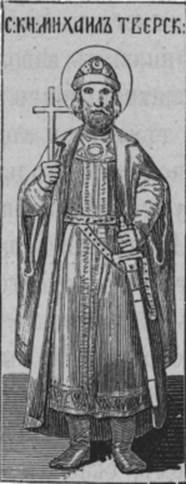
В Твери долго ничего не знали о князе Михаиле; не знали и о том, что тело его похоронено в Москве. Из свиты князя многих заковали в железо, как злодеев; спаслись от насилий только те, которые успели убежать к царице. Потом Узбек приказал отдать князя Константина и всех бояр убиенного Михаила на руки князю Юрию, который держал их в виде пленников. Юрий прибыл во Владимир с именем великого князя в июне 1319 года. Тогда только узнали о всем329. Супруга и сыновья убиенного прислали просить Юрия отпустить тело князя Михаила в Тверь. Только тогда, как князь Александр Михайлович заключил мир с Юрием во Владимире, Юрий согласился исполнить просьбу о князе Михаиле. В Москву посланы из Твери игумены и священники. Княгиня Анна, сыновья, епископ Варсонофий с духовенством, бояры и народ встретили почившего князя, и от вопля рыдавших не было слышно пения священного. В Спасском храме, который сооружен самим князем, положили тело его 6 сентября. К утешению сетовавших, тело св. князя, не смотря на то, что весну и лето лежало оно то в земле, то на открытом воздухе, оказалось совершенно нетленным. По летописи, св. князь был велик телом (широк в плечах, но не высок), крепок и мужествен330. В рукописных святцах читаем: «седина мала, плешив, на голове шапка, в правой руке крест, а в левой меч в ножнах; обретены быша мощи его в лето 7141 (1632) ноября 24 дня, а принесены в лето7163 (1654) сентября 1 дня»331. Ныне мощи его почивают в серебряной раке.
In Tver, for a long time they knew nothing of Prince Michael; nor did they know that his body had been buried in Moscow. Many of the prince's retinue were bound in iron, like malefactors; only those who had managed to flee to the empress escaped violence. Afterwards, Uzbek commanded that Prince Constantine and all the boyars of the slain Michael be given into the hands of Prince George, who kept them as captives. George arrived in Vladimir with the title of Grand Prince in June 1319. Only then did they learn of all that had happened329. The wife and sons of the slain prince sent to ask George to release the body of Prince Michael for burial in Tver. Only when Prince Alexander Mikhailovich concluded peace with George in Vladimir did George consent to fulfill the request concerning Prince Michael. From Tver were sent to Moscow abbots and priests. Princess Anna, the sons, Bishop Barsanuphius with the clergy, the boyars, and the people met the departed prince, and the sacred singing was drowned out by the wailing of those who wept. In the Savior Church, which had been built by the prince himself, they laid his body on September 6. To the consolation of the mourners, the body of the holy prince, despite having lain through spring and summer sometimes in the earth, sometimes in the open air, was found completely incorrupt. According to the chronicle, the holy prince was great of body (broad in the shoulders, though not tall), strong, and courageous330. In the manuscript calendars we read: "His grey hair was scant, he was balding, on his head a cap, in his right hand a cross, and in his left a sword in its sheath; his relics were found in the year 7141 (1632), November 24, and were brought in the year 7163 (1654), September 1"331. Now his relics repose in a silver reliquary.
«Приидите, похвалим чудотворца и мученика, законно и победоносно пострадавшего, ныне в славе и радости стоящего пред Христом. Прославим память его песнями любви и воспоем: радуйся, защитник и помощник против врагов; радуйся, врач больных и прогонитель бесов; радуйся, любимец Христов Михаил! Моли за нас Святую Троицу, да умирится мир и спасутся души наши».
"Come, let us praise the wonderworker and martyr, who lawfully and victoriously suffered, and now stands in glory and joy before Christ. Let us glorify his memory with songs of love and sing: Rejoice, defender and helper against enemies; rejoice, healer of the sick and driver-out of demons; rejoice, beloved of Christ, Michael! Pray for us to the Holy Trinity, that the world may be pacified and our souls saved."
«Поняв мимоходящую жизнь разумением чистым, за малость считал ты княжение земное и, стремясь к Небесному Царству, покорялся племяннику; но, как незлобивого агнца, закололи тебя ножом свирепые. Потому с ангелами веселишься ты, Михаил святой! Моли Христа Бога даровать прощение грехов почитающим память твою»332.
"Perceiving the passing life with pure understanding, thou didst count earthly princedom as little, and striving toward the Heavenly Kingdom, thou didst submit to thy nephew; but like a lamb without malice, thou wast slain with a knife by the fierce. Wherefore thou dost rejoice with the angels, O holy Michael! Pray to Christ God to grant remission of sins to those who honor thy memory"332.