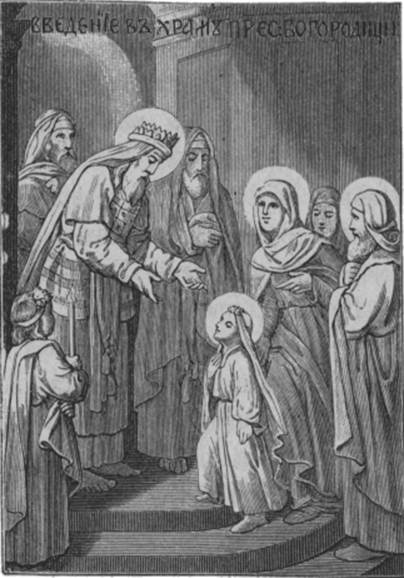
Введение во храм Пресвятой Богородицы
The Entry of the Most Holy Theotokos into the Temple
Праведные родители Пресв. Девы Марии, Иоаким и Анна, подобно Анне, матери Самуиловой, молясь о разрешении неплодства своего, дали св. обет принести в жертву Богу дитя свое, если Бог им дарует его. Через три года по рождении у них преблагословенной дщери, исполняя обет свой, они ввели Богоотроковицу во храм Иерусалимский в посвятили Богу. Благословенная Дева введена была во храм, хотя трех лет – в возрасте юном, но испрошенная молитвою благочестивых родителей, как дар небесный, и уготовляемая Промыслом в высочайшее орудие искупления рода и человеческого, она и «трилетствующая телом была многолетствующая духом и горних сил превысшая». О введении Пресв. Девы во храм Божий по трехлетнем ее возрасте упоминает в I-м веке епископ Антиохийский Еводий и в IV-м блаженный Иероним.
The righteous parents of the Most Holy Virgin Mary, Joachim and Anna, like Hannah, the mother of Samuel, praying for the resolution of their barrenness, made a holy vow to offer their child as a sacrifice to God, if God should grant them one. Three years after the birth of their most blessed daughter, fulfilling their vow, they brought the God-Child into the Temple of Jerusalem and dedicated her to God. The blessed Virgin was brought into the Temple, though three years old – of tender age, yet besought by the prayer of pious parents as a heavenly gift, and prepared by Providence to be the most exalted instrument of the redemption of the human race, she was "three years of age in body, but of many years in spirit, and higher than the heavenly hosts." The entry of the Most Holy Virgin into the Temple of God at the age of three is mentioned in the first century by Evodius, Bishop of Antioch, and in the fourth by Blessed Jerome.
К торжеству введения Пресв. Девы, как изображают это событие древние церковные предания, праведные Иоаким и Анна по обычаю созвали в Назарет своих родственников; собрали лик дев и приготовили многие свещи. Прибывшие из Назарета в Иерусалим благоговейно и торжественно шли к храму Божию, подобно ветхозаветному шествию с кивотом во храм Соломонов (1Пар.15). Ведомой во храм благочестивыми родителями девический лик предшествовал с горевшими свещами и пением; за нею с веселием следовали сродники, соседи и знакомые; первосвященник и священники с псалмами духовными сретили Пресв. Деву, будущую Матерь Архиерея великого. Иероним говорит «кругом храма, сообразно 15 псалмам степеней, было 15 ступеней, на каждой из сих ступеней пели один псалом священники и левиты, восходя к служению. На первую из этих ступеней родители поставили юную Марию. И когда сняли с нее дорожные одежды и по обычаю одели ее в лучшие и благолепнейшие, Дева Господня одна, ничьею рукою не поддерживаемая и не облегчаемая, взошла по всем ступеням так, как бы в совершенном возрасте. Если Господь в младенчестве Девы явил ее величие, это предвещало уже, какова будет она». Все удивились, видя трехлетнюю отроковицу, так скоро на все ступени восшедшую, как бы совершеннолетняя. Архиерей Захария совершил дело необычайное и для всех удивительное: ввел отроковицу в самое Святое Святых, где находился кивот завета, куда по закону дозволено было входить только одному архиерею, однажды в год, и притом с очистительною жертвенною кровию, которую приносил он за себя и за грехи народа, и куда не только женскому полу, но и священникам запрещен был вход (Евр.9:7. Исх.30:10). Но Матерь Божия, по выражению предания, введена была во Святое Святых, подобно ветхозаветному кивоту Божию, который древле с духовным веселием внесен был в Святая Святых (1Пар.15) в служил прообразованием Пресв. Девы Марии, одушевленного кивота, имевшего носить в себе Христа Бога. Первосвященник Захария, сын Варахиин, родитель Предтечев, пророк Божий, проразумевая будущее, ввел Пресв. Деву во Святая Святых, по таинственному Божию научению, быв тогда вне себя, Богом объят. И не только первосвященник, вводивший Деву, но и все, сопровождавшие ее при входе в храм Божий – ее родители, родственники и девы – объяты были Духом Божиим. Пресв. Дева вошла во Святое Святых не только однажды в день введения, но во все время пребывания своего во храме она невозбранно всегда входила туда, что запрещено было под страхом смерти даже первосвященнику (Лев.16:2). По словам Церкви: «Ангели, вхождение Пречистые зряще, удивишася: како со славою Дева вниде во Святая Святых».
For the celebration of the Entry of the Most Holy Virgin, as ancient Church traditions depict this event, the righteous Joachim and Anna, according to custom, summoned their relatives to Nazareth; they gathered a choir of virgins and prepared many candles. Arriving from Nazareth in Jerusalem, they proceeded reverently and solemnly to the Temple of God, like the Old Testament procession with the Ark to the Temple of Solomon (1 Chr. 15). The choir of virgins, led into the Temple by her pious parents, preceded her with burning candles and singing; behind her, with joy, followed relatives, neighbors, and acquaintances; the high priest and priests, with spiritual psalms, met the Most Holy Virgin, the future Mother of the Great High Priest. Jerome says: "Around the Temple, corresponding to the fifteen Psalms of Ascents, there were fifteen steps. On each of these steps, the priests and Levites sang one psalm as they ascended to the service. On the first of these steps, the parents placed the young Mary. And when they removed her traveling garments and, according to custom, clothed her in the finest and most splendid, the Virgin of the Lord, alone, supported by no hand and without assistance, ascended all the steps as if she were of full age. If the Lord manifested her greatness in the infancy of the Virgin, this already foretold what she would be." All marveled, seeing the three-year-old maiden ascend all the steps so quickly, as if she were of full age. The high priest Zacharias performed an extraordinary and astonishing deed for all: he brought the maiden into the Holy of Holies itself, where the Ark of the Covenant was located, into which, according to the Law, only the high priest was permitted to enter, once a year, and then only with the cleansing sacrificial blood which he offered for himself and for the sins of the people, and into which entry was forbidden not only to the female sex but also to the priests (Heb. 9:7; Ex. 30:10). But the Mother of God, according to the expression of Tradition, was brought into the Holy of Holies, like the Old Testament Ark of God, which of old was brought with spiritual joy into the Holy of Holies (1 Chr. 15) and served as a type of the Most Holy Virgin Mary, the animate Ark, who was to bear within herself Christ God. The high priest Zacharias, the son of Barachiah, the parent of the Forerunner, a prophet of God, foreseeing the future, brought the Most Holy Virgin into the Holy of Holies, by mysterious divine instruction, being then beside himself, seized by God. And not only the high priest who brought in the Virgin, but also all who accompanied her at her entrance into the Temple of God – her parents, relatives, and the virgins – were filled with the Spirit of God. The Most Holy Virgin entered the Holy of Holies not only once on the day of her Entry, but throughout all the time of her stay in the Temple she entered there freely, which was forbidden under pain of death even to the high priest (Lev. 16:2). According to the words of the Church: "The Angels, beholding the entry of the All-Pure, were amazed: how with glory the Virgin entered into the Holy of Holies."
По введении трехлетняя отроковица водворена была при храме для воспитания, с другими девственницами. Ибо кругом храма (Иерусалимского), по свидетельству Писания (Исх.38:8. 1Цар.1:28, 2:11. 4Цар.11:3. 1Пар28:11–13. Иез.40:45–46. Лк.2:37) и по словам Иосифа Флавия, построены храмины в три возвышения, – каждое в 30 храмин. В них особо жили девы, посвященные и служившие Богу, особо вдовицы, особо назореи, особо священники и левиты и пр. Иероним говорит: «принесши по обычаю закона жертву и совершив обет свой, родители Девы Марии оставили ее в оградах храма с прочими девами для воспитания, а сами возвратились домой. Дева Господня с возрастом лет возрастала в благочестии, по словам Давида: отец мой и мати моя остависта мя. Господь же восприят мя (Пс.26:10). Она удостоена была явлений ей Ангелов; это охраняло ее от всех зол и обогащало всякими благами». Во св. доме Божием она непрестанно упражнялась в молитве, в чтении Писания и в рукоделии. «Всю ее, говорит Церковь, пребывающую внутрь храма и питаемую пищею небесною, освятил Дух Всесвятый».
After her Entry, the three-year-old maiden was settled at the Temple for upbringing, together with other virgins. For around the Temple (of Jerusalem), according to the testimony of Scripture (Ex. 38:8; 1 Kgdms. 1:28, 2:11; 4 Kgdms. 11:3; 1 Chr. 28:11–13; Ezek. 40:45–46; Lk. 2:37) and according to the words of Josephus, chambers were built in three tiers – each of thirty chambers. In them dwelt separately the virgins, dedicated and serving God; separately the widows; separately the Nazirites; separately the priests and Levites, etc. Jerome says: "Having offered sacrifice according to the custom of the Law and fulfilled their vow, the parents of the Virgin Mary left her in the precincts of the Temple with the other virgins for upbringing, and themselves returned home. The Virgin of the Lord, as she grew in years, increased in piety, according to the words of David: For my father and my mother have forsaken me, but the Lord hath taken me up (Ps. 26:10). She was vouchsafed the appearances of Angels; this preserved her from all evils and enriched her with every good thing." In the holy house of God, she continually exercised herself in prayer, in reading the Scriptures, and in handiwork. "Her entire being," says the Church, "abiding within the Temple and nourished with heavenly food, was sanctified by the All-Holy Spirit."
Пресв. Дева Мария обитала во храме Иерусалимском около 12 лет. Достигши совершеннолетия, она сама себя уневестила Богу, давши св. обет всегдашнего девства. По сказанию древних писаний а последующих учителей Церкви, она первая обручила девство свое Богу. Ибо сия прекрасная добродетель, столько похваляемая Иисусом Христом и уважаемая в христианстве, у иудеев была не столь славна (Втор.7:14. Быт.19:31–38. Суд.11:37–39). Но Бог вдохнул чувствования о девстве, совершенно отличные от чувствований народа, той, которую избрал Он, да сбудется Писание: се Дева во чреве приимет и родит Сына. Когда наступило для Марии время, в которое она, по обычаю законному, должна была оставить святое жилище своего благочестивого воспитания и подобно прочим девицам вступить в супружество, она объявила первосвященнику и священникам, что она от зачатия своего посвящена родителями единому Богу и сама дала обещание блюсти во веки свое девство, и потому не может сочетаться браком. Итак, для нетленного хранения девства под чином и образом супружества, св. Дева около 15 лет своей жизни, по совету и согласию священного собора, была обручена родственнику своему, маститому старцу, праведному Иосифу, который решился, храня воздержание, таить девственную честь Марии, считано мнимым мужем ее и мнимым отцом Иисуса Христа (Лк.4:13), до совершенного открытия миру тайны воплощения. Таким образом она переселилась из храма в Назарет, в дом праведного Иосифа.
The Most Holy Virgin Mary dwelt in the Temple of Jerusalem for about twelve years. Having reached maturity, she betrothed herself to God, making a holy vow of perpetual virginity. According to the account of ancient writings and subsequent teachers of the Church, she was the first to betroth her virginity to God. For this beautiful virtue, so praised by Jesus Christ and honored in Christianity, was not so glorious among the Jews (Deut. 7:14; Gen. 19:31–38; Judg. 11:37–39). But God inspired feelings concerning virginity, completely different from the feelings of the people, in her whom He chose, that the Scripture might be fulfilled: Behold, a Virgin shall conceive and bear a Son. When the time came for Mary, according to the custom of the Law, to leave the holy dwelling of her pious upbringing and, like other maidens, to enter into marriage, she declared to the high priest and the priests that from her conception she had been dedicated by her parents to the one God, and that she herself had given a promise to keep her virginity forever, and therefore could not enter into marriage. Thus, for the incorrupt preservation of virginity under the form and image of marriage, the holy Virgin, at about fifteen years of age, by the counsel and consent of the sacred council, was betrothed to her kinsman, the venerable elder, the righteous Joseph, who resolved, preserving continence, to conceal the virginal honor of Mary, being considered her supposed husband and the supposed father of Jesus Christ (Lk. 4:13), until the full revelation to the world of the mystery of the Incarnation. Thus she moved from the Temple to Nazareth, to the house of the righteous Joseph.
В воспоминание введения Пресв. Богородицы во храм Иерусалимский древле учрежден Церковию праздник, 21 ноября. Указание на этот праздник можно находить в IV веке – в преданиях христиан палестинских, кои доселе указывают на бывшую древле церковь Введения Богородицы и построение этой церкви приписывают царице Елене. В IV веке указание на праздник Введения Богородицы находят также в словах Григория Нисского. В VIII в. – в день Введения произнесены были поучения Германом и Тарасием, Константинопольскими патриархами; в IX веке Георгий Никомидийский и Василий Македонянин, император Византийский, на день Введения сложили некоторые стихиры, ныне поемые Церковию в этот день.
In remembrance of the Entry of the Most Holy Theotokos into the Temple of Jerusalem, the Church anciently instituted a feast, on November 21. Indications of this feast can be found in the fourth century – in the traditions of Palestinian Christians, who to this day point to the formerly existing Church of the Entry of the Theotokos and attribute the building of this church to Empress Helen. In the fourth century, an indication of the feast of the Entry of the Theotokos is also found in the words of Gregory of Nyssa. In the eighth century – on the day of the Entry, homilies were delivered by Germanus and Tarasius, Patriarchs of Constantinople; in the ninth century, George of Nicomedia and Basil the Macedonian, the Byzantine Emperor, composed certain stichera for the day of the Entry, which are now sung by the Church on this day.
Праздник Введения Богородицы есть великий, дванадесятый и вселенский. Это есть день отделения от мира Богоизбранной Девы. По песнопениям Церкви, Введение Пресв. Девы есть предъизображение благоволения Божия, проповедание спасения человеком, предвозвестие Христа. «От Господа приимше обещания плод Иоаким и Анна, Божию Матерь, благоприятну жертву во храм введоша днесь».
The Feast of the Entry of the Theotokos is a great, twelfth, and universal feast. This is the day of the separation from the world of the God-chosen Virgin. According to the hymnody of the Church, the Entry of the Most Holy Virgin is the prefiguration of God's good pleasure, the proclamation of salvation to men, the fore-announcement of Christ. "Having received from the Lord the fruit of the promise, Joachim and Anna today bring the Mother of God, an acceptable sacrifice, into the Temple."
Пророчество Аггеево о втором храме Иерусалимском: велия будет слава храма завета сего последняя паче первыя (2:10) – со дня введения Богородицы начало сбываться. Во втором храме в сравнении с первым недоставало ковчега завета, пророческого – урим и туммим, небесного огня, облака, знаменующего присутствие Божие, и священного елея помазания (1Мак.2:6–9). Не смотря на это, второй храм делается славнее храма первого. В последнем является Богоносный ковчег – Пресв. Дева, престол Бога Слова; здесь сияет свет и совершенство (урим и туммим) в благодатной Деве; здесь огонь небесный – серафимская любовь в ее сердце; и облак славы Божией – в пречистом теле ее; и священное помазание – та обильная благодать Св. Духа, которая исполняла Благословенную и от нее чрез приближение к ней сообщалась другим (Лк.1:41).
The prophecy of Haggai concerning the second Temple of Jerusalem: The glory of this latter house shall be greater than that of the former (2:10) – began to be fulfilled from the day of the Entry of the Theotokos. In the second Temple, in comparison with the first, there was lacking the Ark of the Covenant, the prophetic Urim and Thummim, the heavenly fire, the cloud signifying the presence of God, and the holy oil of anointing (1 Macc. 2:6–9). Notwithstanding this, the second Temple becomes more glorious than the first Temple. In the latter appears the God-bearing Ark – the Most Holy Virgin, the throne of God the Word; here shines light and perfection (Urim and Thummim) in the grace-filled Virgin; here is the fire of heaven – seraphic love in her heart; and the cloud of the glory of God – in her most pure body; and the holy anointing – that abundant grace of the Holy Spirit which filled the Blessed One and from her, through nearness to her, was communicated to others (Lk. 1:41).
Воспоминание Введения во храм Пресв. Девы продолжается 6 дней – с 20-го по 25-е ноября. В событии Введения Богоизбранной Отроковицы Церковь созерцает исполнение пророчеств царя Давида: предста царица одесную тебе в ризах позлащенных одеяна. Слыши, дщи, и виждь, и приклони ухо твое, и забуди люди твоя и дом отца твоего. И возжелает царь доброты твоея: зане той есть Господь твой, и поклонишися Ему. Вся слава дщере царевы внутрь: рясны златыми одеяна и преиспещрена. Приведутся царю девы в след ея, искренния ее приведутся тебе: приведутся в веселии и радовании, введутся в храм царев (Пс.44:10–12, 14–16).
The commemoration of the Entry into the Temple of the Most Holy Virgin continues for six days – from the 20th to the 25th of November. In the event of the Entry of the God-chosen Maiden, the Church contemplates the fulfillment of the prophecies of King David: The queen stood at thy right hand, clothed in gold-woven raiment. Hearken, O daughter, and see, and incline thine ear, and forget thine own people and thy father's house. And the King shall desire thy beauty; for He is thy Lord, and thou shalt worship Him. All the glory of the King's daughter is within; she is clothed with golden fringes and adorned. The virgins shall be brought to the King after her; her companions shall be brought unto thee: with gladness and rejoicing shall they be brought; they shall be led into the King's temple (Ps. 44:10–12, 14–16).
Пример Богоотец Иоакима и Анны, посвятивших Богу дщерь свою с юных ее лет, внушает христианским родителям начинать воспитание детей учением благочестия с ранних лет. Раннее сближение детей с Божественными и священными глаголами Церкви и слова Божия делает сии глаголы особенно родными непорочному их сердцу на всю жизнь; а родной голос всегда для нас обязателен, приятен, утешителен и поучителен.
The example of the Forefathers of God, Joachim and Anna, who dedicated their daughter to God from her early years, instructs Christian parents to begin the upbringing of children with the teaching of piety from an early age. The early drawing near of children to the divine and sacred words of the Church and of the word of God makes these words especially native to their pure heart for all of life; and a native voice is always binding, pleasant, comforting, and instructive for us.