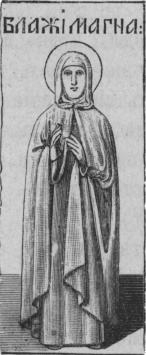
В городе Анкире Галатской, – пишет усердный посетитель подвижников Палладий276, – много дев, около двух тысяч или более; они подвизаются в святой, добродетельной жизни, хранят воздержание и совершают дело святое с ревностию. Между ними первое место по благочестивой жизни занимает Магна, жена почтеннейшая и опытнейшая. Не знаю, называть ли ее девою или вдовою. Мать вынудила ее выйти замуж, но она отклоняла от себя мужа под разными предлогами, давала вид, будто больна она, и, таким образом, осталась неприкосновенною и непорочною, как говорят родные ее. Муж ее скоро умер, и она осталась единственною наследницею после него. Тогда она всю себя посвятила Богу». «Великое приобретение быть благочестивым и довольным (умеренным в желаниях). Мы ничего не принесли в мир: явно, что ничего не можем и вынести из него (1Тим.6:6–8). Чистое и непорочное благочестие пред Богом и Отцом есть то, чтобы призирать сирот и вдов и хранить себя неоскверненным от мира (Иак.1:27). Достойно начальствующим пресвитерам должно оказывать двойную честь, особенно тем, которые трудятся в слове и учении» (1Тим.5:17). Таково учение Апостольское! Так и поступала блаж. Магна. «Богатство, какое было у нее, раздала она на монастыри, на дома бедных и странных, церквам, епископам, вдовам, сиротам и прочим нуждающимся. Охотною душою, но тайно, совершала она подвиги благотворительности». Не только не выставлялась пред людьми благотворительницею, но старалась скрывать добрые дела свои и от себя самой; она боялась обманчивой приятности славы людской так же, как своего самолюбия и берегла сердце свое в смирении. Вместе с тем, она «ревностно посещала Богослужение церковное, вела жизнь подвижническую, воздержную. Знаменитейшие епископы уважали ее. Стараясь исполнить всякую добродетель, она жила надеждою на жизнь лучшую – загробную».
In the city of Ancyra in Galatia, writes the diligent visitor of ascetics, Palladius276, there are many virgins, about two thousand or more; they strive in a holy, virtuous life, keep abstinence, and perform the sacred work with zeal. Among them, the first place in pious life is held by Magna, a most honorable and experienced woman. I know not whether to call her a virgin or a widow. Her mother forced her into marriage, but she turned away her husband under various pretexts, gave the appearance of being ill, and thus remained untouched and undefiled, as her relatives say. Her husband soon died, and she remained his sole heir. Then she devoted herself wholly to God. "Now godliness with contentment is great gain. For we brought nothing into this world, and it is certain we can carry nothing out" (1 Tim. 6:6–8). "Pure and undefiled religion before God and the Father is this: to visit orphans and widows in their trouble, and to keep oneself unspotted from the world" (Jas. 1:27). "Let the elders who rule well be counted worthy of double honor, especially those who labor in the word and doctrine" (1 Tim. 5:17). Such is the Apostolic teaching! So also did the blessed Magna act. "The wealth she had, she distributed to monasteries, to the houses of the poor and strangers, to churches, to bishops, to widows, to orphans, and to others in need. With a willing soul, but in secret, she performed her works of charity." Not only did she not display herself before people as a benefactress, but she strove to hide her good deeds even from herself; she feared the deceptive pleasantness of human glory as much as her own self-love, and kept her heart in humility. At the same time, "she zealously attended church services, led an ascetic, temperate life. The most renowned bishops respected her. Striving to fulfill every virtue, she lived in hope of a better life—the life beyond the grave."
В жизни блаж. Магны более всего изумительно то, что она, выданная в замужество, с такою твердостию воли отстояла свою девственную чистоту. Так в лучшие времена христианства любили девство! В одном провинциальном городе были целые две тысячи дев! Ликия была областию соседнею с Галатиею. Анкирские девы, конечно, читали разговор: «Праздник дев», святителя и мученика Мефодия, писанный им, когда был он епископом Олимпа Ликийского. Если ныне, к несчастию людей, мало ценят девство, не так думали в лучшие времена. Вот как учил о девстве великий учитель мученик:
In the life of the blessed Magna, what is most astonishing is that she, given in marriage, defended her virginal purity with such firmness of will. Thus was virginity loved in the best times of Christianity! In one provincial city there were as many as two thousand virgins! Lycia was a region neighboring Galatia. The virgins of Ancyra, of course, read the discourse "The Banquet of Virgins" by the Hierarch and Martyr Methodius, written when he was bishop of Olympus in Lycia. If today, to the misfortune of men, virginity is little valued, they did not think so in the best times. Thus did the great teacher and martyr teach concerning virginity:
«Велико, выше природы, чудно и славно девство. Это – питие, которое источается не землею, но небом. Господу предоставлено было преподать сие учение (о девстве) людям. Он один, пришедши на землю, научил человека возноситься к Богу. Архиерею и Главе пророков и ангелов прилично именоваться и Главою девственников. Ветхозаветные еще не могли вместить девства277.
"Great, above nature, wondrous and glorious is virginity. It is a draught which flows not from the earth, but from heaven. It was granted to the Lord to deliver this teaching (concerning virginity) to men. He alone, coming to earth, taught man to ascend to God. It is fitting for the High Priest and Head of prophets and angels to be named also the Head of virgins. Those of the Old Testament could not yet contain virginity277.
И закон свидетельствует, что очиститися чистотою Господу есть великий обет, выше всех обетов (Числ.1:6). Что же значит посвятить себя Господу? Если уста мои буду отверзать для изъяснения писания или для того, чтобы православно и достойно воспевать по силе Бога, и буду заключать уста, полагая хранение им, чтобы не говорить суетного: то чисты уста мои и посвящаются Богу. Если и взор приучу не прельщаться красотою телесною и не услаждаться зрелищами бесстыдными, но взирать на небо: то чисты и очи мои и посвящаются Господу. Если буду заграждать слух от злословия и поношений и отверзать для слова Божия, то и слух посвятила я Господу. Если чиста я сердцем, все помышления посвящаю Господу, не думаю ни о чем суетном, не живут во мне гордость и гнев, размышляю о законе Господнем день и ночь: то истинно совершаю обет великий: еже очиститися чистотою. Сонм дев, по преданию, именуется бескровным жертвенником Божиим»278.
And the Law testifies that to consecrate oneself in purity to the Lord is a great vow, above all vows (Num. 6:2). What does it mean to consecrate oneself to the Lord? If I open my mouth to explain the Scripture or to sing of God according to my strength, in an orthodox and worthy manner, and I close my lips, setting a guard over them, so as not to speak vanity: then my lips are pure and are consecrated to God. If I also train my gaze not to be seduced by bodily beauty nor to delight in shameless spectacles, but to look to heaven: then my eyes are pure and are consecrated to the Lord. If I stop my ears from slander and reproach and open them to the word of God, then I have consecrated my hearing also to the Lord. If I am pure in heart, dedicating all my thoughts to the Lord, thinking of nothing vain, and pride and anger do not dwell in me, and I meditate on the law of the Lord day and night: then I truly fulfill the great vow: to consecrate oneself in purity. The company of virgins, according to tradition, is called the bloodless altar of God."278
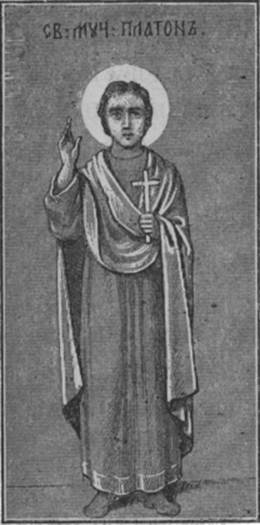
Молодой Платон, уроженец г. Анкиры Галатской, воспитанный в христианском благочестии, воодушевленный ревностию к вере, безбоязненно ходил по городу и обличал идолопоклонников, поучая вместе с тем вере в истинного Бога. За это был взят и представлен начальнику города.
The young Plato, a native of the city of Ancyra in Galatia, brought up in Christian piety and inspired with zeal for the faith, fearlessly walked about the city and rebuked the idolaters, while teaching faith in the true God. For this he was seized and brought before the city governor.
– Весь мир чествует богов, – стал убеждать христианина язычник, – а, ты проповедуешь какие-то басни... Отрекись от своего заблуждения... побереги свою молодую жизнь...
"The whole world honors the gods," the pagan began to persuade the Christian, "but you preach some fables... Renounce your delusion... spare your young life..."
– Я так и делаю, – отвечал Платон, – ищу жизни бесконечной, и потому пренебрегаю временной; спасаюсь от смерти вечной и потому не боюсь смерти временной мгновенной... Заблуждаетесь же вы, а не я, потому что я почитаю Бога, сотворившего небо и землю, а вы чествуете камень и дерево – произведения рук человеческих...
"I am doing just that," answered Plato, "I seek endless life, and therefore I despise the temporal one; I am saved from eternal death and therefore I do not fear a momentary temporal death... It is you who are deluded, not I, for I worship God, who made heaven and earth, while you honor stone and wood—the works of human hands..."
Видя, что юноша непоколебим в своем веровании, градоначальник велел пока заключить его в темницу. Сюда провожало его много народа, среди которого были и христиане. – «Знайте, братия, – обратился к ним Платон, – что меня карают не за какое-нибудь преступление, а единственно за исповедание Бога истинного, Который сотворил весь мир... Не смущайтесь, когда меня предадут истязаниям: «многие скорби праведнику, но от всех их избавит Господь». Будем все твердо стоять в вере нашей и не устрашимся потерпеть страдания за нее, потому что и сравнить нельзя временных земных страданий с вечною славою, предстоящею в ином мире верным до конца Богу Своему»... – И затем, войдя в темницу, Платон всецело предался молитве, чтобы Сам Господь помог ему перенести предстоящий подвиг. И была услышана молитва верующего, потому что без помощи свыше не мог бы человек перенести те испытания свыше обыкновенных сил человеческих, которым подвергли его через несколько дней томления в темнице... Двенадцать воинов попеременно истязали Платона жестокими ударами, потом три часа держали его на раскаленнном железе, затем строгали и резали тело его до обнажения костей. Терпя жестокую боль, мученик, взяв один ремень своей кожи, бросил его в лице мучителя со словами: «бесчеловечный и лютейший из всех свирепых зверей! Как ты не стыдишься истязать человека, созданного по образу Божию и одного естества с тобою... Но мучь меня еще сильнее; тогда увидят все терпение мое, а твою – жестокость... Я же ради Христа с радостию переношу все муки, после которых уповаю на вечное успокоение»...
Seeing that the youth was unshakable in his belief, the governor ordered him to be confined in prison for the time being. A great multitude of people accompanied him there, among whom were Christians. "Know, brethren," Plato addressed them, "that I am punished not for any crime, but solely for confessing the true God, who created the whole world... Be not troubled when I am given over to tortures: 'Many are the afflictions of the righteous, but the Lord delivers him out of them all.' Let us all stand firm in our faith and not be afraid to suffer for it, because the temporal sufferings of this earth cannot be compared with the eternal glory that awaits in the other world those who are faithful to their God unto the end." And then, entering the prison, Plato gave himself wholly to prayer, that the Lord Himself might help him to bear the impending struggle. And the prayer of the believer was heard, for without help from on high a man could not have endured those trials beyond ordinary human strength to which they subjected him after several days of languishing in prison... Twelve soldiers in turn tortured Plato with cruel blows, then held him on red-hot iron for three hours, then scraped and cut his body until the bones were laid bare. Enduring fierce pain, the martyr took one strip of his own skin and threw it in the face of the tormentor, saying: "Inhuman and most savage of all wild beasts! Are you not ashamed to torture a man created in the image of God and of one nature with you?... But torment me even more severely; then all will see my patience and your cruelty... For Christ's sake I gladly endure all torments, after which I hope for eternal rest."
Но не трогалось сердце, не прозирали глаза ослепленного язычника, – неутомимо продолжал он истязать мученика изощренными пытками; земля вокруг вся облита была его кровию, но Господь еще давал ему чудную силу переносить неизреченные муки... Наконец, решено было лишить его жизни мечом. Произнеся свою предсмертную молитву, Платон обратился к исполнителю казни и с кротостию сказав ему:
But the heart of the blinded pagan was not moved, nor did his eyes see; he tirelessly continued to torment the martyr with refined tortures; the ground all around was drenched with his blood, but the Lord still gave him wondrous strength to bear unspeakable pains... Finally, it was decided to put him to death by the sword. Having uttered his final prayer, Plato turned to the executioner and said to him with meekness:
«На 7-и Вселенском соборе читано было из письма св. Нила, ученика св. Иоанна Златоуста, к Илиодору чудо св. муч. Платона: как он освободил из плена сына инока, родом Галатянина. Сын его был взят в плен внезапно напавшими варварами. Старец со слезами молил соотечественного ему мученика Платона о помощи в этой беде. И вот является сыну его всадник на коне и велит юноше садиться. Юноша узнал в нем мученика, потому что часто видал его таким на иконе; юноша сел на коня; святой, доставив его отцу, сделался невидим»281.
"At the Seventh Ecumenical Council, a miracle of the holy martyr Plato was read from a letter of St. Nilus, a disciple of St. John Chrysostom, to Heliodorus: how he freed from captivity the son of a monk, a Galatian by birth. His son had been taken captive by barbarians who attacked suddenly. The elder tearfully begged his fellow-countryman, the martyr Plato, for help in this misfortune. And behold, a horseman on a horse appeared to his son and commanded the youth to mount. The youth recognized him as the martyr, because he had often seen him depicted thus on an icon; the youth mounted the horse; the saint, having delivered him to his father, became invisible."281
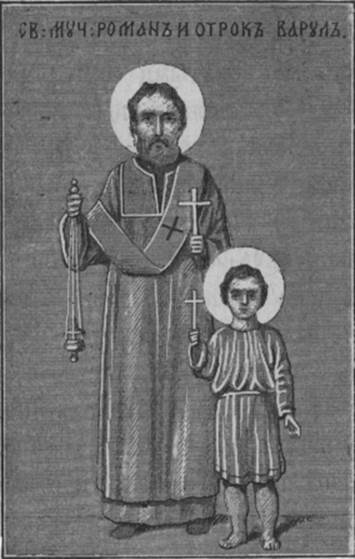
Роман, родом из одного села в Кесарии Палестинской, I исправлявший должность заклинателя и диакона, в бытность свою в Антиохии, не смотря на бывшее в то время (в 303 г.) гонение на христиан, открыто увещевал отпадших к раскаянию. За это был взят и предан истязаниям. Повешенный на дереве и раздираемый железными гвоздями, он мужественно переносил страдание. Множество народа присутствовало при этом зрелище казни, между прочими стоял и семилетний отрок Варул. Мученик Роман, указывая на него, с укоризною сказал судье: «это дитя разумнее тебя... хотя ему и немного лет, но рожденное от христиан оно знает истинного Бога, а ты дожил до старости и, как язычник, не знаешь Его»... Удивленный судья, подозвав к себе Варула, спросил его: «какого ты почитаешь Бога?» – «Бога – Христа почитаю», – отвечал отрок. – «Но что лучше, – спросил еще судия, – одного ли бога почитать, или многих?» – «Лучше почитать одного Бога, Иисуса Христа». – »Чем же лучше наших богов ваш Бог – Христос?» – продолжал спрашивать язычник. – «Тем лучше, что Он один – истинный Бог, Который создал нас всех, а ваши боги – демоны и не создали ничего»... И много еще дал подобных разумных ответов малолетный, в душу которого, очевидно, мать почти с молоком поспешила перелить свои христианские верования...
Roman, a native of a village in Caesarea of Palestine, who served as an exorcist and deacon, while residing in Antioch, despite the persecution against Christians then occurring (in the year 303), openly exhorted those who had fallen away to repentance. For this he was seized and delivered up to tortures. Suspended from a tree and torn with iron nails, he courageously endured the suffering. A great multitude of people was present at this spectacle of execution; among the bystanders stood also a seven-year-old youth, Varulus. The Martyr Roman, pointing to him, said reproachfully to the judge: “This child is wiser than you… though his years are few, being born of Christians he knows the true God, while you have lived to old age and, as a pagan, do not know Him…” The astonished judge, summoning Varulus, asked him: “What God do you worship?” “I worship God—Christ,” answered the youth. “But which is better,” the judge further inquired, “to worship one god or many?” “It is better to worship one God, Jesus Christ.” “In what way is your God—Christ—better than our gods?” continued the pagan to ask. “He is better in that He alone is the true God, Who created us all, while your gods are demons and have created nothing…” And many such wise answers did the young child give, into whose soul his mother had evidently hastened to instill her Christian beliefs almost with his milk…
Это дитя, подавшее голос за Христа, было осуждено на смертную казнь. Тогда выступила из толпы мать его (имя которой осталось неизвестным) и, взяв на руки своего сына, стала уговаривать его не бояться смерти... И лаская, и обнимая его, она сама понесла его на место казни. – «Не бойся смерти, мое милое дитя, – говорила она ему, – ты не умрешь, но будешь всегда жить с Христом в Его чудном раю вместе со святыми ангелами Его»... И из объятий своих передала сама мать под меч головку ребенка своего... а после казни собрала кровь его в чистый сосуд и предала погребению чистейшие останки его.
This child, who had raised his voice for Christ, was condemned to death. Then his mother (whose name has remained unknown) stepped forth from the crowd and, taking her son in her arms, began to urge him not to fear death… Caressing and embracing him, she herself carried him to the place of execution. “Fear not death, my dear child,” she said to him, “you will not die, but will live forever with Christ in His wondrous paradise together with His holy angels…” And from her own embrace the mother delivered her child’s head to the sword… and after the execution she gathered his blood into a clean vessel and committed his most pure remains to burial.
Между тем продолжались мучения Романа; «Галерий повелел отсечь ему язык, но мученик, не имея языка, говорил еще яснее прежнего, исповедуя веру свою; его заключили в оковы, растянули на деревянной колодке, подняли на высоту и сокрушали петлею челюсти его», – как свидетельствует церковный писатель Евсевий, современник этого события.
Meanwhile, the torments of Roman continued; “Galerius commanded that his tongue be cut out, but the martyr, having no tongue, spoke even more clearly than before, confessing his faith; they put him in fetters, stretched him on a wooden block, raised him on high, and crushed his jaws with a noose,” as the Church writer Eusebius, a contemporary of this event, testifies.
Мощи св. мученика Романа были впоследствии перенесены и положены в храме, построенном во имя его в Константинополе равноапостольною царицею Еленою.
The relics of the holy Martyr Romanus were later translated and placed in a church built in his name in Constantinople by the Equal-to-the-Apostles Empress Helena.
Св. Григорий Назианзеа: «девство прежде являлось в редких и покрытое полумраком. Когда же Христос родился от чистой Девы-Марии, оно явилось для людей в свете блистательном, отрешенное от мира и развязывающее мир немощный. Столько превосходит оно узы брака, сколько душа выше тела, небо земли, жизнь вечная выше жизни исчезающей. Брак – снисхождение к похоти, а девство – слава. Любовь, стремящаяся к одному, близится ко Христу, любящему любящего, встречающему идущего. Любя Его, дева оставила мир и не может смотреть на другое; связана она сладкими узами». Ор. s. Gregorii III, 528. 564. 634, ed. Migne.
St. Gregory Nazianzen: “Virginity formerly appeared in rare instances and covered with half-darkness. When Christ was born of the pure Virgin Mary, it appeared to men in a brilliant light, detached from the world and loosening the weak world. It surpasses the bonds of marriage as much as the soul is higher than the body, heaven than earth, eternal life than fleeting life. Marriage is indulgence to lust, but virginity is glory. Love that strives toward the One draws near to Christ, Who loves the lover, Who meets the one who comes. Loving Him, the virgin has left the world and cannot look upon another; she is bound by sweet bonds.” Or. s. Gregorii III, 528. 564. 634, ed. Migne.
Слово 5. В постановлениях Апостольских (кн. 3 гл. 5) жертвенником Божиим называются вдовицы, обрекшие себя Богу. Но св. Поликарп в послании пишет приветствие «девам, именуемым вдовицами». Следовательно ясно, что вдовицами назывались и обетные девы.
Homily 5. In the Apostolic Constitutions (Book 3, ch. 5) widows who have consecrated themselves to God are called the altar of God. But St. Polycarp in his epistle writes a greeting “to the virgins called widows.” Hence it is clear that consecrated virgins were also called widows.