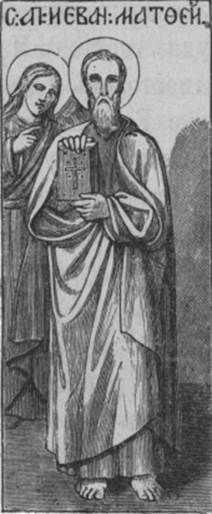
Св. апостол и Евангелист Матфей принадлежит к числу 12-ти Апостолов и в Писании называется также Левий (Лк.5:27). Он есть брат св. Апостола Иакова Алфеева и, до призвания своего в Апостольство, был Галилейский мытарь, т. е. сборщик податей (Лк.5:27. Mк.2:14). Господь узрел его седяща на лестнице, и призвал: по Мне гряди, и, востав, по Нем иде. Оставив все, он пошел за Господом и сделал для Господа в доме своем учреждение велие, т. е. угощение; великое множество мытарей и других, близких Матфею по родству в занятиям, возлежали с Иисусом Христом за трапезою. Господь окружен был тогда совозлежащими Ему учениками, и потом, ближе всех, мытарями и грешниками: это, может быть, оскорбило книжников и фарисеев, и они начали упрекать учеников за Учителя, говоря: почто с мытари и грешники Учитель ваш яст и пиет? Упрек сей услышал Сам Спаситель и кротко ответил фарисеям: не требуют здравии врача, но болящии. Шедше научитеся, что есть: милости хощу, а не жертвы. Не приидох бо призвати праведники, но грешники на покаяние. Фарисеи замолчали, но тогда же отозвались ученики Иоанна Крестителя, здесь бывшие, и предложили Самому Господу новый вопрос: почему ученики Его не постятся, тогда как они сами и фарисеи постятся много? Ответил и сим совопросникам Спаситель и открыл им в притче, что теперь не время поститься ученикам Его; они еще не приготовлены к истинному посту: еда могут сынове брачнии плакати, елико время с ними есть жених? приидут же дние, егда отнимется от них жених, и тогда постятся. Никто же бо приставляет приставления плата небелена ризе ветсе: возмет бо кончину свою от ризы, и горша дира будет и проч. (Мф.9:10–16). С тех пор св. Матфей, вместе с другими учениками Господа Иисуса, пребывал с Ним неотлучно; но в Евангелии ничего более не говорится о Матфее.
St. Apostle and Evangelist Matthew belongs to the number of the twelve Apostles and is also called Levi in Scripture (Lk. 5:27). He is the brother of St. Apostle James the son of Alphaeus and, before his calling to the Apostolate, was a Galilean publican, that is, a tax collector (Lk. 5:27; Mk. 2:14). The Lord saw him sitting on the stairs and called him: Follow Me. And he arose and followed Him. Leaving everything, he went after the Lord and made for the Lord in his house a great feast, that is, a banquet; a great multitude of publicans and others close to Matthew by kinship and occupation reclined with Jesus Christ at the table. The Lord was then surrounded by His disciples reclining with Him, and, nearest of all, by publicans and sinners: this perhaps offended the scribes and Pharisees, and they began to reproach the disciples concerning the Teacher, saying: Why does your Teacher eat and drink with publicans and sinners? The Savior Himself heard this reproach and gently answered the Pharisees: Those who are well have no need of a physician, but those who are sick. Go and learn what this means: I desire mercy, and not sacrifice. For I came not to call the righteous, but sinners to repentance. The Pharisees fell silent, but then the disciples of John the Baptist, who were present, responded and put a new question to the Lord Himself: why do His disciples not fast, whereas they themselves and the Pharisees fast much? The Savior also answered these questioners and revealed to them in a parable that now is not the time for His disciples to fast; they are not yet prepared for true fasting: Can the wedding guests mourn as long as the bridegroom is with them? The days will come when the bridegroom is taken away from them, and then they will fast. No one puts a piece of unshrunk cloth on an old garment, for the patch tears away from the garment, and a worse tear is made, and so forth (Mt. 9:10–16). From that time on, St. Matthew, together with the other disciples of the Lord Jesus, remained inseparably with Him; but the Gospel says nothing more about Matthew.
По сошествии Св. Духа, Апостол Матфей проповедал Евангелие, как и все 12 Апостолов (Деян.6:2), Евреям в Иудее. Здесь, по сказанию Евсевия, св. Афанасия Великого, Кирилла Иерусалимского, Иоанна Златоуста, чрез 8 лет по вознесении Господа и ранее прочих Евангелистов, Матфей написал Евангелие к уверовавшим Евреям Палестинским на их языке для того, чтобы, по удалении его, Евангелие могло заменить им его отсутствие, и передал свое Евангелие Иакову, брату Господню по плоти. Греческий перевод этого Евангелия, имеющий достоинство, равное подлиннику, сделан, по сказанию преданий, одним из Апостолов – св. Апостолом Иаковом или Иоанном Богословом. Bo II веке Пантен, с проповедию слова Божия ходивший к восточным народам, нашел Евангелие от Матфея, написанное по еврейски у христиан Индии; оно известно было в IV веке. По словам Оригена, писателя III века, Иеронима, Епифания – IV века, и по сказанию Софрония Иерусалимского, жившего в VII веке, приложенному в предисловии к Евангелию от Матфея, подлинник хранился еще в их время и именно в библиотеке Кессарийской, устроенной в III веке мучеником Памфилом. Евангелие от Матфея благовествует, главным образом, о том, что Иисус Христос есть обетованный Богом Мессия, предвозвещенный в Ветхом Завете пророками и посланный от Бога, из рода Давида и Авраама.
After the descent of the Holy Spirit, the Apostle Matthew preached the Gospel, as did all twelve Apostles (Acts 6:2), to the Jews in Judea. Here, according to the account of Eusebius, St. Athanasius the Great, Cyril of Jerusalem, and John Chrysostom, eight years after the Ascension of the Lord and before the other Evangelists, Matthew wrote a Gospel for the believing Jews of Palestine in their language, so that after his departure the Gospel might take his place among them, and he delivered his Gospel to James, the brother of the Lord according to the flesh. The Greek translation of this Gospel, which has a dignity equal to the original, was made, according to tradition, by one of the Apostles—St. Apostle James or John the Theologian. In the second century, Pantaenus, who traveled to the eastern peoples preaching the word of God, found the Gospel according to Matthew, written in Hebrew, among the Christians of India; it was known in the fourth century. According to the words of Origen, a writer of the third century, Jerome and Epiphanius of the fourth century, and according to the account of Sophronius of Jerusalem, who lived in the seventh century, appended to the preface of the Gospel according to Matthew, the original was still preserved in their time, namely in the library of Caesarea, established in the third century by the martyr Pamphilus. The Gospel according to Matthew proclaims, chiefly, that Jesus Christ is the Messiah promised by God, foretold in the Old Testament by the prophets and sent from God, of the lineage of David and Abraham.
Вне Палестины Ап. Матфей, по сказанию Евсевия, Дорофея, Сократа, Никифора и других, путешествовал для проповеди слова Божия в Сирию, Мидию, Персию, Ларфт, Азиатскую Ефиопию или Индию, и здесь великие Апостольские труды свои запечатлел мученическою смертию за слово Божие. В Ефиопии укрепляемый благодатию Господа Иисуса, Ап. Матфей предстал с Евангелием самому дикому и зверообразному племени антропофагов (людоедов). Повествуют, что Господь явился ему тогда в образе прекрасного юноши, с жезлом в деснице, и, подав мир Апостолу, вручил ему жезл и повелел посадить его в землю пред дверьми недавно устроенной церкви. Посаженный жезл укоренился, возрос в огромное дерево и принес несравненные, по красоте и сладости, плоды; а от корня его произошел источник самой чистой воды, которая измывала нечистоту и безобразие лиц человеческих. Это, без сомнения, символы всеочищающей воды благодатного крещения христианского, которые принес к дикому племени св. Апостол и Евангелист. Он имел там утешительные успехи во благовестии Христовом; скоро рукоположил в город Мирмены епископа Платона, а сам, пребывая в уединении, непрестанно молился об обращении всего племени ко Христу. Исцелив одержимых беснованием в семействе князя страны – Фульвиана, Евангелист сначала привлек к себе его удивление и почтение; потом обратил на себя всю силу гнева его, когда народ стал усердно слушать спасительную проповедь Апостола и обращаться к истинному Богу от скверн идолослужения. Благовестнику Христову уготовали страшную казнь: распростерти тело его и пригвоздивши руки и ноги к земле, обложили его всего горючими веществами и зажгли их. Пламень опалил вокруг стоящих, растопил идолов, поставленных пред мучеником, но не повредил тела св. Апостола. Князь, объятый изумлением и ужасом, хотел уже с честию извести Апостола из огня, но св. Матфей, совершив последнюю молитву, предал душу свою в руце Божии, около 60-ти лет после Р. Хр. В непродолжительное после того время сам Фульвиан отрекся от своей власти и принял крещение и имя Матфея в честь и славу св. Апостола. По смерти Платона, Фульвиан избран и посвящен был во епископа и сделался ревностным проповедником Евангелия, стараясь довершить то, что начал сам Апостол, и подражая ему в подвигах» молитвы, терпения и усердия к вере Христовой. Скончавшись, он сам присоединился к лику святых Божиих и вместе со св. Евангелистом Матфеем предстоит и ныне престолу Божию, моля о нас грешных, прибегающих к их заступлению и ходатайству.
Outside Palestine, the Apostle Matthew, according to the account of Eusebius, Dorotheus, Socrates, Nicephorus, and others, traveled to preach the word of God in Syria, Media, Persia, Parthia, Asiatic Ethiopia, or India, and there he sealed his great Apostolic labors with a martyr's death for the word of God. In Ethiopia, strengthened by the grace of the Lord Jesus, the Apostle Matthew appeared with the Gospel to the most savage and brutish tribe of anthropophagi (cannibals). They relate that the Lord appeared to him then in the form of a beautiful youth, with a staff in His right hand, and, giving peace to the Apostle, handed him the staff and commanded him to plant it in the ground before the doors of a newly built church. The planted staff took root, grew into a huge tree, and bore fruits incomparable in beauty and sweetness; and from its root sprang a spring of the purest water, which washed away the uncleanness and ugliness of human faces. This, without doubt, is a symbol of the all-purifying water of gracious Christian baptism, which the holy Apostle and Evangelist brought to the savage tribe. He had there comforting successes in the proclamation of Christ; he soon ordained Plato as bishop in the city of Myrmene, while he himself, remaining in solitude, prayed unceasingly for the conversion of the whole tribe to Christ. Having healed those possessed by demons in the family of the prince of the country—Fulvian—the Evangelist first drew forth his wonder and respect; then he drew upon himself the full force of his wrath when the people began eagerly to hear the saving preaching of the Apostle and to turn to the true God from the abominations of idolatry. A terrible execution was prepared for the herald of Christ: they stretched out his body and, having nailed his hands and feet to the ground, covered him all over with combustible materials and set them on fire. The flame scorched those standing around, melted the idols set before the martyr, but did not harm the body of the holy Apostle. The prince, seized with amazement and terror, wished already to bring the Apostle out of the fire with honor, but St. Matthew, having offered a final prayer, committed his soul into the hands of God, about sixty years after the birth of Christ. Shortly thereafter, Fulvian himself renounced his authority and received baptism and the name Matthew, in honor and glory of the holy Apostle. After the death of Plato, Fulvian was chosen and consecrated as bishop and became a zealous preacher of the Gospel, striving to complete what the Apostle himself had begun, and imitating him in the labors of prayer, patience, and zeal for the faith of Christ. Having reposed, he himself was joined to the choir of the saints of God and together with the holy Evangelist Matthew now stands before the throne of God, praying for us sinners who have recourse to their intercession and mediation.
В IX веке Феофан, митрополит Никейский, написал канон на день св. Ап. и Ев. Матфея, поемый ныне в этот день. Церковь, прославляя Ев. Матфея, как благовестника, между прочим восхваляет его за то, что он «унылых воздвиг души, написав час судный».
In the ninth century, Theophanes, Metropolitan of Nicaea, composed a canon for the day of the holy Apostle and Evangelist Matthew, which is chanted now on this day. The Church, glorifying the Evangelist Matthew as a herald of good tidings, praises him, among other things, for that he "raised up despondent souls, writing of the hour of judgment."