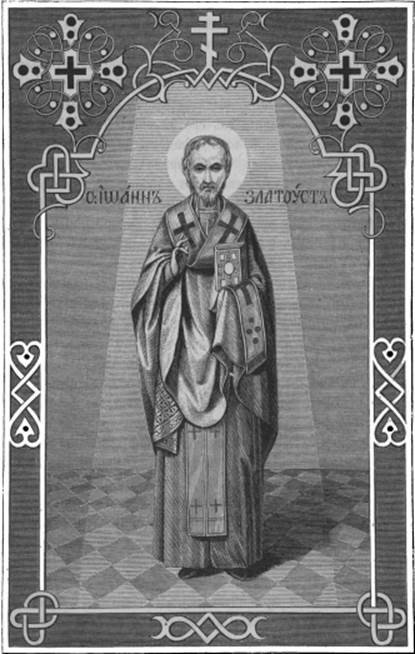
Святого отца нашего Иоанна Златоустого, архиепископа Цареградского
Our Holy Father John Chrysostom, Archbishop of Constantinople
Иоанн, наставник вселенский и победитель душ силою своего истинно-божественного дара слова, на которое отозвался мир наименованием его «Златоустым, устами Христа, устами Божиими», родился в Антиохии Сирийской в 347 году. – Сын одного из начальников войск, находившихся в Сирии, по имени Секунда, Иоанн еще в колыбели, по смерти отца своего, остался сиротою, но имел счастие найти в своей матери, по имени Анфусе, такую любящую, благочестивую и умную воспитательницу, которая сумела оградить его от всех бедствий и лишений раннего сиротства, сумела восполнить одним своим христианским, и потому всеобъемлющим, влиянием незаменимую для сына утрату отца.
John, the universal teacher and winner of souls by the power of his truly divine gift of speech, to which the world responded by naming him "Chrysostom—the mouth of Christ, the mouth of God," was born in Syrian Antioch in the year 347. — The son of one of the commanders of the troops stationed in Syria, named Secundus, John was left an orphan in the cradle after the death of his father, but had the happiness of finding in his mother, named Anthusa, a loving, pious, and wise guardian who was able to shield him from all the misfortunes and deprivations of early orphanhood, and who, by her Christian and therefore all-embracing influence, was able to compensate for the irreplaceable loss of a father to her son.
Под этим-то влиянием своей матери, отказавшейся, не смотря на свою молодость, от вступления в новый брак и сосредоточившей всю свою душу на своих детях, сыне и дочери, Иоанн получил первые уроки в христианских истинах и благочестии, которые сказались в нем впоследствии бессмертною славою образцового подвижника, отца Церкви, вселенского учителя.
It was under this influence of his mother, who, despite her youth, refused to enter into a new marriage and concentrated all her soul on her children—a son and a daughter—that John received his first lessons in Christian truths and piety, which later manifested in him as the immortal glory of an exemplary ascetic, a Father of the Church, and an ecumenical teacher.
Еще в нежном возрасте Иоанна мать его успела возбудить в нем ту силу и образовать постоянство, которые сделались основными свойствами его характера. Замечая его необыкновенные природные дарования, она, пользуясь пребыванием в Антиохии, столице Востока, многих лучших ученых наставников по всем отраслям наук и владея богатым состоянием, оставленным ей мужем, имела возможность доставить Иоанну лучших учителей. Подготовленный домашним воспитанием, он продолжал его в языческих школах, так как прежние, христианские школы были закрыты богоотступником Юлианом, а новых еще не успели устроить. Но это обстоятельство не повредило юноше, в сердце и уме которого уже твердо насаждены были христианские чувства и понятия. Притом же, так как он был приучен к полной откровенности с матерью, то она была в состоянии следить за всеми его впечатлениями и направлять их.
Even in John's tender age, his mother succeeded in awakening in him that strength and forming that constancy which became the fundamental properties of his character. Noticing his extraordinary natural gifts, and taking advantage of the presence in Antioch, the capital of the East, of many of the finest learned instructors in all branches of the sciences, and possessing the ample fortune left her by her husband, she had the means to provide John with the best teachers. Prepared by home education, he continued it in pagan schools, since the former Christian schools had been closed by the apostate Julian, and new ones had not yet been established. But this circumstance did not harm the youth, in whose heart and mind Christian feelings and concepts had already been firmly planted. Moreover, since he had been accustomed to complete openness with his mother, she was able to follow all his impressions and guide them.
В школах Иоанн занимался так успешно, особенно в красноречии, что, поражал не только товарищей, но и преподавателей. Ливаний, опытный софист, пожелал в присутствии большего собрания прочесть блистательную речь своего ученика, написанную им в похвалу императоров, и, кончив чтение, при общем рукоплескании воскликнул: «счастлив писатель, умеющий так прославлять императоров! Но также счастливы те императоры, которые царствуют в то время, когда мир владеет таким писателем!» – Этот же знаменитый ученый Ливаний через несколько лет после того, перед смертию своею, на вопрос: кого бы он желал иметь своим преемником? – отвечал, что он избрал бы Иоанна, если бы его не похитили христиане... и вообще предсказывал Иоанну блистательную будущность в свете.
In the schools, John was so successful, especially in eloquence, that he amazed not only his comrades but also his teachers. Libanius, an experienced sophist, wished to read before a large gathering a brilliant speech of his student, written in praise of the emperors, and, finishing the reading amid general applause, exclaimed: "Happy is the writer who knows how to glorify the emperors so! But also happy are those emperors who reign at a time when the world possesses such a writer!" — This same famous scholar Libanius, a few years later, before his death, when asked whom he would wish to have as his successor, replied that he would have chosen John, had he not been stolen by the Christians... and in general he predicted a brilliant worldly future for John.
Благополучно обошел Иоанн подводные камни общественного воспитания, не увлекся примером товарищей, которые отличались роскошною жизнью, и даже на убеждения некоторых родственников отца – приобресть экипаж, приличный его состоянию, возразил: «я не хочу подчиняться условиям света, которых не разделяю; могу обойтись без этих излишеств, не люблю ни блеска, ни роскоши, которой не может одобрить ни разум, ни учение Боговдохновенных писателей, ни слово Божие, которое говорит: «всяк возносяйся смирится, а смиряяйся вознесется»...
John safely navigated the hidden reefs of public education, was not carried away by the example of his comrades, who were distinguished by a luxurious life, and even to the persuasions of some of his father's relatives to acquire a carriage befitting his station, he replied: "I do not wish to submit to the conditions of the world which I do not share; I can do without these excesses; I love neither splendor nor luxury, which neither reason nor the teaching of the God-inspired writers nor the word of God can approve, which says: 'Everyone who exalts himself shall be humbled, and he who humbles himself shall be exalted'"...
Но избрав себе среди товарищей друзей по душе212, Иоанн вместе с ними, живя среди языческого мира, более всего обращал внимание на изучение Евангельских истин. Различие в понятиях не отчуждало впрочем христианского юношу и от прочих товарищей, и все они любили его за снисходительность и уважали за светлый разум.
But having chosen among his comrades friends after his own soul212, John, together with them, living amidst the pagan world, turned his attention most of all to the study of the Gospel truths. The difference in concepts, however, did not alienate the Christian youth from his other comrades, and they all loved him for his forbearance and respected him for his bright mind.
По окончании публичного образования, восемнадцатилетний Иоанн избрал для себя судебную деятельность и, превосходно подготовленный к ней и по природным дарованиям, и по разностороннему образованию, в скором времени приобрел лестную известность между адвокатами.
Upon completing his public education, the eighteen-year-old John chose for himself a judicial career, and being excellently prepared for it both by natural gifts and by his versatile education, he soon acquired a flattering reputation among the advocates.
Между тем этот успех в обществе, опасный для самолюбия, и непрерывные развлечения светской жизни сначала вредно подействовали на неопытного юношу: он уже не с прежним влечением предавался чтению св. Писания; следуя обычаям того общества, которым был окружен, посещал зрелища и другие места, вредное влияние которых на нравственность изобличал впоследствии с такою силою в своих поучениях. Воспоминая об обстоятельствах этого времени и об одном из лучших своих друзей, Иоанн, описав, какой «твердый и неразрывный союз» существовали» тогда между ними, продолжает с сокрушением сердечным: «но когда друг мой, поистине блаженный, решился посвятить себя иноческой жизни и истинной философии, тогда на весах жизни нашей (наполненной до тех пор одинаковыми стремлениями), потерялось равновесие. Его жребий, по причине легкости своей, возвысился, а я, все еще увлекаемый желаниями мирскими, унизил мою участь, клонил ее долу, отяготив юношескими мечтами. Хотя дружба наша оставалась и после того крепкою по прежнему, но союз общежития расторгнулся, – ибо невозможно было жить вместе тем, у которых различны были желания»213.
Meanwhile, this success in society, dangerous for self-love, and the constant distractions of worldly life at first had a harmful effect on the inexperienced youth: he no longer devoted himself to the reading of Holy Scripture with his former inclination; following the customs of the society by which he was surrounded, he attended spectacles and other places whose harmful influence on morality he later exposed with such force in his homilies. Recalling the circumstances of this time and one of his best friends, John, having described what a "firm and indissoluble union" existed between them at that time, continues with heartfelt contrition: "But when my friend, truly blessed, resolved to devote himself to the monastic life and true philosophy, then the balance of our life (filled until then with the same aspirations) was lost. His lot, by reason of its lightness, was raised, while I, still carried away by worldly desires, lowered my portion, weighing it down with youthful dreams. Although our friendship remained strong as before after that, the bond of common life was broken—for it was impossible for those whose desires were different to live together"213.
Но это увлечение миром было непродолжительно. Привычное благочестие нередко возбуждало в Иоанне недовольство тою жизнью, которая отвлекала его от удовлетворявшей его сосредоточенности на предметах внутреннего, духовного мира. Сверх того, друг его Василий, безрассеянно продолжавший подвизаться на пути самоусовершенствования, сильно влиял на него своим примером и старался обуздывать в нем пристрастие к миру, – зато и «принял Иоанна с распростертыми руками», когда, как говорил о себе Иоанн, «он освободился от житейской бури». «Впрочем, – продолжает воспоминать об этом Иоанн, – и тогда мы не могли соблюсти прежнего равенства. С великою ревностию проходя подвиг свой, к тому же опередив меня и самым временем, Василий достиг великой высоты и далеко оставил меня за собою. Но, будучи снисходителен и дорожа дружбою со мною, он, в то же время, как уклонялся от отношений с другими, со мною разделял свое время»214.
But this infatuation with the world was short-lived. His habitual piety often aroused in John a dissatisfaction with that life which distracted him from the concentration on the objects of the inner, spiritual world that satisfied him. Moreover, his friend Basil, who continued undistractedly to labor on the path of self-perfection, strongly influenced him by his example and tried to curb his attachment to the world—and therefore "received John with open arms" when, as John said of himself, "he was freed from the storm of life." "However," John continues to recall this, "even then we could not maintain our former equality. With great zeal pursuing his ascetic labor, and moreover having preceded me in time, Basil attained great height and left me far behind. But, being forbearing and cherishing his friendship with me, while he avoided relations with others, he shared his time with me"214.
Таким образом, сознав опасность для души в своем увлечении суетою мирскою, Иоанн решился прекратить все связи с миром и уединился в доме своей матери, посвящая все свое время молитве, чтению свящ. Писания и размышлению о предметах Божественных. Строго относясь к своим недавним заблуждениям, он в искупление их умерщвлял свою плоть постом и молитвою и ночным бодрствованием; засыпал на короткое время, и то – на голой земле.
Thus, having recognized the danger to his soul in his infatuation with worldly vanity, John resolved to break all ties with the world and secluded himself in his mother's house, devoting all his time to prayer, reading of Holy Scripture, and meditation on divine subjects. Strict with himself regarding his recent errors, he mortified his flesh in atonement for them by fasting, prayer, and night vigils; he slept for a short time, and that on the bare ground.
В это время Иоанн сблизился с высоким по своей жизни епископом Антиохийским – Мелетием, который, узнав его, полюбил, принял на себя труд руководствовать замечательного юношу, предвидя в нем задатки высокого духовного развития, и, подготовив его на этом пути, совершил над ним таинство крещения в 367 году, когда Иоанну было 25 лет. Спустя после этого три года, которые он провел безвыходно в доме своей матери, продолжая истинно-подвижническую жизнь, Иоанн был поставлен в 370 г. в должность чтеца (Зеноном епископом, пришедшим из Иерусалима, прибывшим в Антиохию, вероятно, по случаю бедствий Мелетия)215.
At this time John became close to the bishop of Antioch, Meletius, a man lofty in his life, who, having come to know him, loved him, took upon himself the labor of guiding the remarkable youth, foreseeing in him the makings of high spiritual development, and, having prepared him on this path, performed the mystery of Baptism over him in the year 367, when John was 25 years old. Three years after this, which he spent without leaving his mother's house, continuing a truly ascetic life, John was appointed in the year 370 to the office of reader (by Zeno, a bishop who had come from Jerusalem and arrived in Antioch, probably on account of the misfortunes of Meletius)215.
Продолжая жить в уединении, Иоанн сохранял однако же отношения с любимыми друзьями своими: Максимом, Феодором и Василием и даже возымел мысль о том, чтобы, поселившись вместе с Василием, проводить жизнь по правилам монашеского жития; но так как для матери его была тяжела разлука с ним, то он ради ее спокойствия отказался от заветного стремления своего сердца – вступить на иноческую стезю.
Continuing to live in seclusion, John nevertheless maintained relations with his beloved friends: Maxim, Theodore, and Basil, and even conceived the idea of settling together with Basil to live a life according to the rules of monastic life; but since separation from him was hard for his mother, he renounced, for the sake of her peace, the cherished desire of his heart—to enter upon the monastic path.
В 372 году, по изгнании Валентом из Антиохии православного епископа Мелетия, Иоанн и друзья его сблизились с Картерием и в особенности Диодором, бывшими настоятелями монастырей близ Антиохии, оставшимися поучать осиротевшую паству Мелетия. Под влиянием этого просвещенного и пламенного защитника православия, в Иоанне и друзьях его окончательно определилось намерение вступить в отшельническую жизнь, чего, однако же, не мог исполнить Иоанн, пока мать его не скончалась. Но напрасно старались они скрыться от мира; слава о жизни их и блистательных дарованиях просияла и из уединения, и положено было возвесть Иоанна и Василия на опустевшие, после арианского гонения, кафедры православных епископов. Как же отнеслись к этому возлюбившие подвиг пустынной жизни?
In the year 372, after the expulsion of the Orthodox bishop Meletius from Antioch by Valens, John and his friends became close to Carterius and especially to Diodore, who were the superiors of monasteries near Antioch and who remained to instruct the orphaned flock of Meletius. Under the influence of this enlightened and ardent defender of Orthodoxy, the intention to enter the hermitic life was finally determined in John and his friends; however, John could not fulfill this until his mother died. But in vain did they try to hide from the world; the fame of their life and brilliant gifts shone forth even from seclusion, and it was decided to elevate John and Basil to the sees of Orthodox bishops that had been left vacant after the Arian persecution. How did those who loved the labor of the desert life respond to this?
«Возникшая вдруг молва возбудила нас обоих... – рассказывает св. Иоанн Златоуст, – пронесся слух, будто намереваются возвести нас на степень епископства. Как только услышал я весть эту, то страх и недоумение овладели мною. Страх: я боялся, чтобы не взяли меня против воли моей. Недоумение: я ежеминутно думал и не мог придумать, откуда люди могли возыметь обо мне такое высокое мнение... потому что, обращаясь к себе, я не находил ничего такого, чем бы заслуживал это достоинство»216...
"A sudden rumor stirred us both..." relates St. John Chrysostom, "a report spread that they intended to raise us to the rank of bishop. As soon as I heard this news, fear and perplexity seized me. Fear: I was afraid that they might take me against my will. Perplexity: I thought every moment and could not imagine how people could have formed such a high opinion of me... because, turning to myself, I found nothing in me that would merit this dignity"216...
Василий так и был рукоположен в епископа Рафанейского в Сирии, но Иоанн успел уклониться от избрания, и через год после этого, когда скончалась мать его, спокойно расставшись с сыном, укрепившимся уже в любви Божией и стремлении служить Ему, решился немедленно отойти в горы, в келии пустынножителей, чтобы научиться у них жить для неба, презрев все земное...
Basil was indeed ordained bishop of Raphanea in Syria, but John managed to avoid the election, and a year after this, when his mother died—having peacefully parted with her son, who was already strengthened in the love of God and the desire to serve Him—he resolved to depart immediately to the mountains, to the cells of the hermits, to learn from them how to live for heaven, despising all earthly things...
Но когда же святой порыв достигал своего удовлетворения, не встретив на пути множество препятствий и искушений? Так было и с Иоанном. В то время, когда он достиг исполнения своего пламенного желания, в то время, когда открылась перед ним вожделенная пустынническая жизнь, она вдруг утратила в его глазах всю свою привлекательность... Невозмутимая тишина пустыни, ее ненарушимое уединение наполняли ужасом сердце человека, полного жизни. И какое же успокоение, – сомневался он, – найдет он в иноческой среде, где его могут принудить к непривычной для него грубой работе: рубить дрова, носить воду, – и где ему предстоит, может быть, испытывать лишение необходимой пищи, питаться одними овощами?...
But when has a holy impulse ever attained its satisfaction without encountering on the way a multitude of obstacles and temptations? So it was with John. At the very time when he attained the fulfillment of his ardent desire, at the very time when the longed-for life of desert-dwelling opened before him, it suddenly lost in his eyes all its attractiveness... The unruffled stillness of the desert, its unbroken solitude, filled with terror the heart of a man full of life. And what repose, he doubted, would he find in monastic life, where he might be compelled to unaccustomed coarse labor: to cut wood, to carry water—and where he might perhaps have to endure the deprivation of necessary food, to nourish himself on vegetables alone?...
Сознавая искушение, действующее во всех этих опасениях и жажде покоя, Иоанн боролся с мрачными мыслями и рассуждал так: «как те, которые принимают на себя должности начальников и управления общественными делами, заботятся не о покое, но о том, будет ли от их службы польза, польза временная, – и если они могут смело надеяться на это, так уже и не думают ни о трудах, ни об опасностях, ни о бесславии, ни об унизительных для них работах, ни о дальних путешествиях, ни о жизни на чужой стороне, ыи об огорчениях, ни о муках, ни о перемене обстоятельств, ни о безвременной смерти, ви о разлуке с родными, ни о другой какой неприятности, но, упоенные страстию к деньгам, терпят все, посредством чего только надеются получить их... А мы, которым уготованы не деньги и не земля, но небо и небесные блага, их же око не виде, и ухо не слыша, и на сердце человеку не взыдоша, – мы спрашиваем о покое; так-то мы, более, чем те, жалки и слабодушны! – Хотим идти на небо и получить тамошнее царство, и спрашиваем, нет ли какой трудности на этой дороге и в этом путешествии?... Объятому желанием небесного не должно, не говорю, искать покоя телесного, но и наслаждаться им, когда имеешь его. Не странно ли, что тогда как любящие нечистою любовию так всецело предаются своим возлюблемным, что кроме их и пребывания с ними не находят удовольствия во всех других наслаждениях жизни, как ни много их есть, а мы, объятые самою возвышенною любовию, не только не пренебрегаем покоем, когда его имеем, но еще ищем его, когда его нет»217.
Recognizing the temptation at work in all these fears and in this craving for repose, John struggled against his gloomy thoughts and reasoned thus: "As those who take upon themselves the offices of rulers and the administration of public affairs care not for repose, but for whether their service will bring benefit, temporal benefit—and if they can confidently hope for this, they no longer think of labors, nor of dangers, nor of dishonor, nor of humiliating tasks, nor of distant journeys, nor of life in a foreign land, nor of vexations, nor of torments, nor of changes of circumstances, nor of untimely death, nor of separation from kindred, nor of any other unpleasantness, but, intoxicated with the passion for money, they endure everything through which they hope to obtain it... But we, for whom are prepared not money and not land, but heaven and heavenly blessings, which eye hath not seen, nor ear heard, neither have entered into the heart of man—we ask about repose; so much more pitiable and faint-hearted are we than they! We wish to go to heaven and to receive the kingdom there, and we ask whether there is any difficulty on this road and in this journey?... One seized by the desire for heavenly things ought not, I say, even to seek bodily repose, but not even to enjoy it when one has it. Is it not strange that whereas those who love with an impure love give themselves so wholly to their beloved that apart from them and from being with them they find no pleasure in all the other enjoyments of life, however many there be—while we, seized by the most exalted love, not only do not disdain repose when we have it, but even seek it when it is absent" 217.
Внутренняя борьба Иоанна, при таком сознании и рассуждении, окрыляемых смирением и молитвою, не могла остаться безуспешною, так как для человека, истинно возлюбившего Бога, нет ничего невозможного. И потому смущавшие его помыслы отступили от него, и он обрел истинную сладость в тяжелом подвижничестве среди тех великих нагорных пустынножителей, под руководством которых он жил в продолжении четырех лет и о которых писал он впоследствии, что «если бы возможно было отворить двери сердца их и увидеть душу их и всю красоту внутреннюю, то (не совсем очищенному от мирских» страстей) невозможно было бы вынести сияния красоты их души, светлости внутренних одежд и блеска их совести»...218. Живя под влиянием таких светильников, и Иоанн достиг высокой степени нравственного совершенства, при которой и сам мог руководить других, и сокровища приобретенного им знания и святость своей души раскрывал в поучительных писаниях при представлявшихся к тому случаях. Так, по просьбе одного инока, по имени Димитрия, жившего с ним вместе, чтобы он помог ему «умягчить окаменевшее сердце и напитать его слезами сокрушения», и по неостступной просьбе одного пустынника Стелехия, Иоанн отозвался письменным словом о сокрушении; – положив в основание своему посланию, к которому приступил он с глубочайшим смирением, слова Спасителя: «блажени плачущие, яко тии утешатся», он объясняет спасительное значение слов о грехах своих: «как пыль, говорил он, – не может устоять против напора сильного ветра, так и множество нечистых пожеланий не может выдержать устремившейся против них силы сокрушения, но исчезает и рассеевается скорее всякой пыли и дыма. Если плотская любовь так порабощает душу, что отвлекает ее от всего и привязывает только к любимой особе, то чего не сделает любовь ко Христу и страх быть отлученным от Него...»
John's inner struggle, sustained by such awareness and reasoning, and uplifted by humility and prayer, could not remain fruitless, since for a man who has truly loved God nothing is impossible. And therefore the thoughts that troubled him withdrew from him, and he found true sweetness in the heavy ascetic labors among those great mountain-dwellers of the desert, under whose guidance he lived for the space of four years, and of whom he later wrote that 'if it were possible to open the doors of their heart and to see their soul and all its inner beauty, then (one not wholly purified of worldly passions) would find it impossible to bear the radiance of the beauty of their soul, the brightness of their inner garments, and the splendor of their conscience' 218. Living under the influence of such luminaries, John also attained a high degree of moral perfection, at which he himself could guide others, and the treasures of his acquired knowledge and the holiness of his soul he revealed in instructive writings on the occasions that presented themselves. Thus, at the request of a certain monk named Demetrius, who lived with him, that he help him 'to soften his stony heart and nourish it with tears of compunction,' and at the persistent request of a certain hermit Stelechius, John responded with a written word on compunction—having laid as the foundation of his epistle, to which he set himself with the deepest humility, the words of the Savior: 'Blessed are they that mourn, for they shall be comforted,' he explains the saving significance of weeping over one's sins: 'As dust,' he said, 'cannot stand against the onslaught of a strong wind, so the multitude of impure desires cannot withstand the power of compunction rushing against them, but vanishes and is scattered more quickly than any dust and smoke. If carnal love so enslaves the soul that it draws it away from everything and binds it only to the beloved person, then what will love for Christ and the fear of being separated from Him not do...'
Пламенный любитель Христа, Павел, так был уязвлен этою любовию, что даже стенал о замедлении и продолжительности здешнего странствования (2Kop.5:4)... Обратив раз очи на небо и увидев с изумлением тамошнюю красоту, он уже не хотел опять обратить взор свой на землю; увидев небесные блага, смотрел с небрежением на здешнюю бедность и, живя по необходимости телом си людьми, ни к чему здешнему не обращался душою... Любовь Христова так одушевляла его, что, если бы ему было предложено потерпеть для Христа и вечные наказания, он нс отказался бы и от этого. Он служил Христу не так, как мы, наемники, по страху геенны и по желанию царства; нет, объятый какою-то другою, несравненно лучшею и блаженнейшею любовию, он терпел и делал все ни для чего иного, как для того, чтобы только удовлетворять этой любви, которую он питал ко Христу.
The ardent lover of Christ, Paul, was so wounded by this love that he even groaned over the delay and length of this earthly sojourn (2 Cor. 5:4)... Having once turned his eyes to heaven and beheld with amazement the beauty there, he no longer wished to turn his gaze back to earth; having seen the heavenly blessings, he looked with disregard upon this earthly poverty and, living of necessity in the body among men, turned his soul to nothing here below... The love of Christ so animated him that, if he had been offered to suffer for Christ even eternal punishments, he would not have refused even this. He served Christ not as we hirelings do, out of fear of Gehenna and desire for the kingdom; no, seized by some other, incomparably better and more blessed love, he endured and did everything for no other reason than to satisfy this love which he bore toward Christ.
А у нас нет этого огня, напротив, все, что внутри, прах и пыль... И раскрыв состояние сердца, проникнутого сокрушением о грехах, нечувствительного вследствие того ни к чему земному, мертвого для всего мира, живущего для одного Бога и дел Божиих, не вменяющего ни во что удовольствия чувственные, богатство и славу, Иоанн Златоуст восклицает: «таков святой Павел! Он, среди великолепия и блеска великих городов, был так бесстрастен и нечувствителен ко всем преходящим благам, что его можно было почесть за мертвеца. Он сам говорил, что не только мир умер для него, но и сам он умер для мира. Великая мудрость – отрешиться от всех земных удовольствий, смотреть на мир, как на труп бездушный; но еще гораздо большая мудрость – умереть для мира, не иметь никакой привязанности ни к чему земному. Ибо иногда может нас привлекать и труп бездушный или какая-нибудь бездушная вещь; но когда мир для нас умер и мы для мира, то уже не может быть никакой связи с ним, как два бездушные трупа не могут делиться между собою ни чувствами, ни мыслями. Св. Апостол Павел был так мертв для мира, что, живя телом на земле, душой и сердцем всегда пребывал на небе; его любовь к Иисусу Христу возвышалась не только до третьего неба, но и проходила все небеса. Он не высок был ростом, но бесконечно превышал всех людей своею любовью и ревностию. Если я сравню любовь Павла к Иисусу Христу с обширным пожаром, обнимающим весь земной шар, которого огненный поток, обтекая все пространство между небом и землею, восходил до самого неба, то и тогда еще недостаточно скажу о нем».
But we have not this fire; on the contrary, all that is within us is dust and ashes... And having revealed the state of a heart penetrated with compunction for sins, insensible by reason of this to everything earthly, dead to the whole world, living for God alone and for the works of God, counting as nothing sensual pleasures, wealth, and glory, John Chrysostom exclaims: "Such was the holy Paul! He, amid the magnificence and splendor of great cities, was so passionless and insensible to all transitory goods that one might have taken him for a dead man. He himself said that not only was the world dead to him, but he himself was dead to the world. Great wisdom it is to detach oneself from all earthly pleasures, to look upon the world as upon a soulless corpse; but far greater wisdom is it to die to the world, to have no attachment to anything earthly. For sometimes even a soulless corpse or some lifeless thing may attract us; but when the world is dead to us and we to the world, then there can be no bond with it, just as two soulless corpses cannot share with each other either feelings or thoughts. The holy Apostle Paul was so dead to the world that, living in body on earth, he abode always in soul and heart in heaven; his love for Jesus Christ rose not only to the third heaven, but passed through all the heavens. He was not tall of stature, but infinitely surpassed all men in his love and zeal. If I compare Paul's love for Jesus Christ to a vast conflagration embracing the whole globe, whose fiery stream, encircling all the space between heaven and earth, ascended even to heaven itself, even then I should still not say enough of him."
Упомянув также о горячей любви к Богу святых пророков Илии и Давида, Иоанн Златоуст говорит, что «и мы имели бы чувства смирения и сокрушения, подобные тем, которые их воодушевляли, если бы, размышляя о гибельном действии греха, который делает нас врагами Богу, по неблагодарности человека, оскорбляющего своего Верховного Благодетеля, не смотря на постоянно изливающиеся от Него на нас благодеяния, мы всю жизнь, украшенную добродетелями, все сердце, полное чувств нежнейшей любви, принесли Ему в жертву», и что «и тогда мы еще ничего не сделали бы, чтобы возблагодарить Бога за неизреченные милости и великие благодеяния, ниспосланные на нас от начала дней нашего бытия».
Having also made mention of the fervent love for God of the holy prophets Elijah and David, John Chrysostom says that "we too would have feelings of humility and compunction like those which animated them, if, reflecting upon the destructive action of sin, which makes us enemies of God, through man's ingratitude in offending his Supreme Benefactor, despite the blessings continually poured out upon us by Him, we would bring to Him as a sacrifice our whole life adorned with virtues, our whole heart full of the feelings of tenderest love," and that "even then we should have done nothing to thank God for the ineffable mercies and great benefactions sent down upon us from the beginning of the days of our existence."
Одержав над собою победу в борьбе с трудностями жизни в пустыне, Иоанн был поражен глубокою скорбью, когда узнал, что один из его бывших друзей, по имени Феодор, оставивший мир под влиянием внушений Иоанна, которым он сочувствовал, не выдержал искушений, которые представляются на пути исполнения обетов иноческого жития, и, покинув пустыню, возвратился в город, где с увлечением предался пробудившимся в нем прежним мирским навыкам и страстям и даже, полюбив одну девицу, решился вступить с нею в брак.
Having gained the victory over himself in the struggle with the hardships of desert life, John was struck with deep sorrow when he learned that one of his former friends, named Theodore, who had left the world under the influence of John's exhortations, to which he had been sympathetic, had not endured the temptations that present themselves on the path of fulfilling the vows of monastic life, and, having abandoned the desert, had returned to the city, where he gave himself up with passion to the former worldly habits and passions that had awakened in him, and even, having fallen in love with a certain maiden, resolved to enter into marriage with her.
Не мог Иоанн перенести равнодушно отпадение своего друга от избранного им сознательно спасительного иноческого пути, и целым рядом красноречивейших письменных убеждений он старался возвратить его на этот путь. « Кто даст главе моей воду и очам моим источник слез? – начинает он свое письмо к Феодору, – так как я оплакиваю не разрушение городов, но опустошение священной души и разрушение и истребление христианского храма. Кто знал хорошо сожженную теперь духом зла красоту души твоей в то время, когда она сияла, тот не восстанет ли, слыша, что варварские руки осквернили святое святых?... потому что храм души твоей блистал не золотом и серебром, по благодатию Духа, и имел в себе обитающих Христа и Его Отца и Утешителя. А теперь уже не то... он теперь пуст и обнажен от той красоты... потерял Божественное и несказанное украшение, а с этим вместе лишился всякой безопасности и охранения, нет у него ни двери, ни запора, но для всяких открыт он душевредных и гнусных помыслов. Ничто не воспрепятствует им, а прежде, как небо, недоступна была для них чистота души твоей. Может быть, мои слова покажутся невероятными для тех, которые видят теперешнее запустение и разорение души твоей; поэтому-то я скорблю и сетую. и не перестану это делать, пока не увижу тебя опять в прежнем блеске»...
John could not bear with indifference the falling away of his friend from the salvific monastic path he had consciously chosen, and with a whole series of the most eloquent written exhortations he strove to bring him back to that path. 'Who will give to my head water and to my eyes a fountain of tears?'—he begins his letter to Theodore—'for I lament not the destruction of cities, but the desolation of a sacred soul and the ruin and destruction of a Christian temple. Who knew well the beauty of your soul, now burned by the spirit of evil, at the time when it shone, will he not rise up, hearing that barbarian hands have profaned the holy of holies?... For the temple of your soul shone not with gold and silver, but with the grace of the Spirit, and had dwelling in it Christ and His Father and the Comforter. But now it is no longer so... it is now empty and stripped of that beauty... it has lost the divine and ineffable adornment, and with this together it has lost all security and protection; it has neither door nor bolt, but is open to every soul-destroying and foul thought. Nothing hinders them, whereas before, like heaven, the purity of your soul was inaccessible to them. Perhaps my words will seem incredible to those who see the present desolation and ruin of your soul; therefore do I grieve and lament, and I will not cease to do so until I see you again in your former splendor'...
Раскрыв перед Феодором гибельное состояние его души, Иоанн старается спасти его от крайнего зла: уныния, которое окончательно погубило бы его. «Не отчаивайся в перемене на лучшее! – умоляет он его, – если дух зла имел столько силы, чтобы низвергнуть тебя в бездну с высоты добродетели, то тем более Богу возможно возвести тебя в прежнюю свободу и сделать не только таким, как ты был, но и гораздо блаженнейшим прежнего. Только не упадай духом, не потеряй доброй надежды! Не говори мне, что для тебя уже не может быть прощения; представим себе величайшего грешника, который только может найтись; положим, что он грешил с самого детства до самой старости, до самого даже смертного часа: но если он сохранил веру, если он проникнут сознанием своей виновности и сокрушением о грехах, то я убежден, что спасение не безнадежно».
Having laid open before Theodore the ruinous state of his soul, John strives to save him from the extreme evil: despondency, which would have utterly destroyed him. “Do not despair of a change for the better!” he implores him. “If the spirit of evil had so much power as to cast you down into the abyss from the height of virtue, then all the more is it possible for God to raise you to your former freedom and make you not only as you were, but even far more blessed than before. Only do not lose heart, do not lose good hope! Do not say to me that forgiveness can no longer be for you; let us imagine the greatest sinner that can be found; suppose that he sinned from childhood even unto old age, even unto the very hour of death: but if he preserved the faith, if he is penetrated with the consciousness of his guilt and contrition for his sins, then I am convinced that salvation is not hopeless.”
«Кто был более виновен, чем Навуходоносор и Манассия? и однако же Бог простил им, как только они смирились перед Ним. Нет ни одного греха, непростительного для Его благости. Он всегда принимает сердце сокрушенное и смиренное. Всякий грешник в одну минуту может примириться с Богом, если только он искренно раскается: раскаяние измеряется не временем, но силою чувства сокрушения».
“Who was more guilty than Nebuchadnezzar and Manasseh? and yet God forgave them as soon as they humbled themselves before Him. There is not a single sin that is unforgivable for His goodness. He always receives a contrite and humble heart. Every sinner can be reconciled with God in one minute, if only he repents sincerely: repentance is measured not by time, but by the strength of the feeling of contrition.”
И отвратив сердце друга своего от уныния, Иоанн ободряет его: «начни борьбу, и труд твой не останется без награды... Пока мы не испытаем, то самые легкие дела кажутся иногда трудными; но как только употребим малейшее усилие, то кажущаяся затруднительность уничтожается, уверенность заступает место отчаяния, и мы легко совершаем το, а чему боялись приступить».
And having turned his friend’s heart away from despondency, John encourages him: “Begin the struggle, and your labor shall not remain without reward... Until we have tried it, even the easiest tasks sometimes seem difficult; but as soon as we make the slightest effort, the seeming difficulty vanishes, confidence takes the place of despair, and we easily accomplish that which we feared to undertake.”
Чтобы облегчить Феодору отрешение от суеты мирской, которою увлекался он, Иоанн наглядно изображает превратность всего земного в его настоящем виде:
To make it easier for Theodore to renounce the vanity of the world, by which he was carried away, John vividly depicts the mutability of all earthly things in their present aspect:
«Не видал ли ты, как умирали жившие в роскоши, пьянстве, игре и прочих удовольствиях жизни? Где теперь те, которые одевались в шелковые одежды и издавали от себя благоухание мастей? Где теперь пышность их? Куда теперь все улетело? Во что обратилось то тело, которому они так много угождали? Приди на могилу, посмотри на пыль, на прах, на червей, посмотри на безобразие этого места и – горько восстенай! И о, если бы это наказание ограничилось только этою пылью! Но вот от могилы и от этих червей перенесись мыслью к тому неумирающему червю, к огню неугасимому, к скрежету зубов, к скорби и тесноте... Об этом подумай и, тот огонь противопоставив охватившему тебя теперь пожару вожделений, освободи себя наконец из этой печи... Положим, что проживешь много лет и не испытаешь перемены в счастии: что же это в сравнении с бесконечными веками и с нестерпимыми терзаниями?... Да и что значит наслаждение здешними благами в сравнении с состоянием будущего блаженства, как не сновидение одного дня в целой жизни? Итак, найдется ли человек, который бы из-за того, чтобы увидеть приятный сон, решился терпеть наказание во вею жизнь?»...
“Have you not seen how those who lived in luxury, drunkenness, gaming, and other pleasures of life died? Where now are those who clothed themselves in silken garments and gave forth the fragrance of ointments? Where now is their pomp? Whither has it all flown? Into what has that body turned, which they so much indulged? Come to the grave, look upon the dust, upon the ashes, upon the worms, look upon the ugliness of that place, and – groan bitterly! And oh, if this punishment were limited only to this dust! But behold, from the grave and from these worms transport yourself in thought to that undying worm, to the unquenchable fire, to the gnashing of teeth, to sorrow and distress... Think upon this, and, setting that fire against the conflagration of lusts that now envelops you, deliver yourself at last from this furnace... Suppose that you shall live many years and experience no change in fortune: what is this in comparison with infinite ages and with intolerable torments?... And what does the enjoyment of present blessings mean in comparison with the state of future bliss, if not a dream of one day in a whole lifetime? And so, will there be found a man who, for the sake of seeing a pleasant dream, would resolve to endure punishment all his life?”...
Не вдруг удалось Иоанну подействовать на заблуждавшегося друга, но он не терял надежды и старался со всем усердием содействовать его обращению. «Если бы можно было изложить на бумаге вздохи и слезы, то я наполнил бы ими письмо и послал бы его тебе... – продолжает он изливать перед ним свою нежную скорбь, – зло не в том, любезный Феодор, чтобы сражаясь пасть, но в том, чтобы упав – так и оставаться... Так теперь и ты, потому что враг несколько столкнул тебя с места, не толкай еще и сам себя в пропасть, но стой бодро, и скоро возвратись туда, откуда ушел, и не считай позором этого кратковременного поражения... Да не смущает тебя и то, что ты преткнулся так скоро и в самом начале. Ибо скоро увидел лукавый доблесть души твоей, и из многого догадался, что вырастет из тебя мужественный противник ему; поэтому-то он и поспешил, пробудился, поднялся с силою на тебя... Но так как он поразил тебя в то самое время, когда ты только еще изготовился к борьбе с ним, то и успел в том только, что сделал тебя более сильным в борьбе с ним; покусившись нанести тебе глубокую рану, этого не достиг, а заставил только вперед быть более бдительным и осторожным»...
It was not at once that John succeeded in influencing his erring friend, but he did not lose hope and strove with all diligence to further his conversion. “If it were possible to set down sighs and tears on paper, I would fill the letter with them and send it to you...” he continues to pour out his tender sorrow before him. “The evil, beloved Theodore, is not in falling while fighting, but in falling and remaining so... So now also you, because the enemy has somewhat thrust you from your place, do not thrust yourself also into the abyss, but stand courageously, and quickly return to that place whence you departed, and do not consider this brief defeat a disgrace... Let not this trouble you either, that you stumbled so soon and at the very beginning. For the evil one quickly saw the valor of your soul, and from many things guessed that a courageous opponent to him would grow out of you; therefore he hastened, he awoke, he rose up with force against you... But since he struck you at the very time when you were only preparing for the struggle with him, he succeeded only in this: that he made you stronger in the struggle with him; attempting to inflict a deep wound upon you, he did not achieve this, but only compelled you to be more vigilant and cautious in the future”...
«Власть, которую имеет христианин не над людьми, но над князьями, подвластными миродержателю тьмы, никто у него похитить не может, – снова одобрительно напоминает Феодору Иоанн, – так же истинно свободен, кто живет для Христа: он стоит выше всех бедствий. Если он не захочет сделать себе зла, то другой никогда не будет в состоянии сделать ему его. Нет, христианин – непобедим. Одно у него несчастие, это – оскорбить Бога, а прочее все, даже то, чего все ужасаются: переход отсюда туда, для него – приятнее жизни... Тень, даже тени ничтожнее – житейские дела, сопряжены со многими страхами, со многими опасностями, с крайним рабством... Не погуби же и того и этого века, когда тебе возможно, если захочешь, воспользоваться обоими»..
“The authority which a Christian has, not over men, but over the princes subject to the ruler of the darkness of this world, no one can take from him,” John again encouragingly reminds Theodore. “So truly free is he who lives for Christ: he stands above all misfortunes. If he does not wish to do himself harm, another will never be able to do it to him. No, a Christian is invincible. His one misfortune is to offend God; but everything else, even that which all dread – the passing from here to there – is for him more pleasant than life... A shadow, even less than a shadow, are the affairs of this life, fraught with many fears, many dangers, extreme bondage... Do not destroy both this age and that, when it is possible for you, if you wish, to enjoy both.”
«Знаю, – говорит Иоанн в заключение, – что я переступил пределы письма, но прости, потому что сделал это понуждаемый любовию и скорбию. Из-за нее-то я и сам насильно заставил себя написать письмо, между тем как многие удерживали меня: перестань трудиться напрасно и сеять на каменья, – говорили мне, но я никого не послушал. Есть надежда, чувствовалось мне, что письмо, если угодно Богу, произведет действие... если же не исполнится надежда моя, то по крайней мере получим ту пользу, что нам не придется обвинять себя в молчании, потому что мы сделали все, что от нас зависело»...
“I know,” says John in conclusion, “that I have overstepped the bounds of a letter, but forgive me, because I have done this compelled by love and sorrow. For this reason I myself forced myself to write the letter, while many restrained me: ‘Cease to labor in vain and to sow upon stones,’ they said to me, but I listened to no one. There is hope, I felt, that the letter, if God wills, will produce an effect... but if my hope is not fulfilled, at least we shall receive this benefit: that we shall not have to accuse ourselves of silence, because we have done all that depended on us”...
И действительно, Тот, Кто держит в руке Своей сердце человека, внял мольбе и слезам прибегавшего к Нему с упованием, коснулся благодатию Своею души, отпавшей от Него по своей человеческой немощи, и Феодор, проникнувшийся наконец искренним раскаянием, отказался от мира и всех его радостей и возвратился к исполнению своих иноческих обетов.
And indeed, He Who holds the heart of man in His hand hearkened to the prayer and tears of him who fled to Him with hope, touched with His grace the soul that had fallen away from Him through its human weakness, and Theodore, at last penetrated with sincere repentance, renounced the world and all its joys and returned to the fulfillment of his monastic vows.
Не довольствуясь подвигами монашеского жития, Иоанн, стремясь к полнейшему уединению, два года прожил одиноко в пещере, умерщвляя плоть свою всякими лишениями, не пользуясь даже надлежащим сном, так как не ложился отдыхать ни днем, ни ночью, и потому некоторые члены его тела дошли до омертвения. В это время, так же как и в монастыре, главным занятием его продолжало быть изучение свящ. Писания и собственные поучительные писания по разным представлявшимся поводам. Между прочим, написал он три книги против вооружающихся на ищущих монашества, так как в то время, независимо от враждебного отношения ариан к монашествующим, обличающим их лжеучение, многие и из слабых по жизни православных мирян восставали на пустынников, обвиняя их в том, что они «отнимали от мира его слуг» и воспитывали лучших людей не для служения миру.
Not content with the labors of the monastic life, John, striving for the fullest solitude, lived alone for two years in a cave, mortifying his flesh by every kind of privation, not even availing himself of proper sleep, since he did not lie down to rest either by day or by night, and therefore some members of his body became benumbed. At this time, as also in the monastery, his chief occupation continued to be the study of Holy Scripture and his own instructive writings on various occasions that arose. Among other things, he wrote three books against those who arm themselves against those seeking monasticism, since at that time, apart from the hostile attitude of the Arians toward monastics who denounced their false teaching, many even of the weak in life among the Orthodox laity rose up against the hermits, accusing them of “taking away from the world its servants” and of training the best men not for service to the world.
– «Хотел бы и я, – возражает таковым, между прочим, св. Златоуст, – и не меньше, а даже гораздо больше вашего, и даже часто молил, чтобы миновалась надобность в монастырях, и чтобы столько благочестия было и в городах, чтобы никому никогда не нужно было убегать в пустыню. Но так как все пришло в беспорядок, и города, где судилища и законы, полны стали беззакония и неправды, а напротив, пустыня произращает обильный плод любомудрия, то справедливость требует, чтобы вы винили не тех, которые желающих спастись исторгают из этой бури и волнения и ведут в тихую пристань, но тех, которые каждый город делают так неудобным и негодным для любомудрия, что ищущие спасения принуждены бывают убегать в пустыню»...
“I too would wish,” St. Chrysostom, among other things, replies to such persons, “and not less, but even much more than you, and have often even prayed, that the need for monasteries might pass away, and that there might be so much piety also in the cities that no one would ever need to flee into the desert. But since everything has fallen into disorder, and the cities, where there are courts of law and laws, have become full of lawlessness and unrighteousness, while on the contrary the desert produces abundant fruit of philosophy, justice demands that you blame not those who snatch those desiring to be saved from this storm and tumult and lead them into a quiet haven, but those who make every city so inconvenient and unfit for philosophy that those seeking salvation are compelled to flee into the desert”...
При всеобщей испорченности нравов, Иоанн Златоуст, видя, как затруднено воспитание детей окружающими их влияниями, советует родителям оберегать их воспитанием в монастыре, а на возражения некоторых из них: « пусть дети займутся прежде словесными науками, успешно изучат их, а потом уже перейдут к этому любомудрию», – отвечал: «если бы кто мог представить ручательство в том, что дети́, сохранят во время обучения словесности и добрую нравственность, то я не только не пожелал бы того, чтобы они, оставив города, бежали в пустыни, напротив того, не похвалял бы тех, которые бы стали склонять детей к бегству, но возненавидел бы, как врагов всего общества за то, что они, скрывая свещники и унося светильники из города в пустыню, похищают у живущих в городе самые лучшие блага. Но так как этого обещать никто не может, то какая польза посылать детей к учителям, у которых они научаются скорее порокам, нежели словесности и, желая приобрести менее важное, потеряют важнейшее – силу души и всякое доброе расположение! Когда душа целомудренна, то не будет никакой потери от незнания красноречия; а когда она развращена, то от нея – величайший вред, хотя бы и язык у такого человека был весьма изощрен, и даже тем более вреда, чем более силы в слове, – так как нечестие в соединении с искусством в слове производит гораздо более зла, чем необразованность».
Amid the universal corruption of morals, John Chrysostom, seeing how difficult the upbringing of children is made by the influences surrounding them, advises parents to safeguard them by upbringing in a monastery; and to the objections of some of them: “Let the children first occupy themselves with the verbal sciences, successfully study them, and then afterwards pass over to this philosophy,” he replied: “If anyone could give a guarantee that children would preserve good morals also during their study of letters, then I would not only not wish that they, leaving the cities, should flee into the deserts; on the contrary, I would not praise those who would incline children to flight, but would hate them as enemies of the whole society because they, hiding the lampstands and carrying the lamps out of the city into the desert, steal from those living in the city the very best goods. But since no one can promise this, what profit is there in sending children to teachers from whom they learn vices sooner than letters, and, desiring to acquire what is less important, lose what is most important – the strength of the soul and every good disposition! When the soul is chaste, there will be no loss from ignorance of eloquence; but when it is corrupt, there is the greatest harm from it, even if the tongue of such a man be very well trained, and even the more harm the more power there is in the word – since impiety combined with skill in speech produces far more evil than ignorance.”
Продолжая свой несоразмерный с человеческими силами подвиг в дикой, сырой и холодной пещере, Иоанн наконец совершенно ослабел, так что не мог уже удовлетворять собственными силами все нужды свои, и потому для поправления своего расстроенного здоровья возвратился в Антиохию. Св. Мелетий тогда же (в начале 381 г.), желая употребить на пользу Церкви дарования Иоаина, посвятил в сан диакона этого прославившегося уже и заслужившего общее уважение великого подвижника пустыни. Сделавшись служителем алтаря, Иоанн с усердием предался свойственной душе его деятельности, все свое время посвящал на пользу и утешение нуждающихся и вразумлял слабых в познании Божественных истин. Во время своего пятилетнего диаконства он научил таинствам веры множество крестившихся без подготовления – по случаю землетрясения, угрожавшего разрушением Антиохии, и в то же время, забывая свои болезни и немощи, продолжал назидать христиан своими изумительными и бессмертными сочинениями. В это время написал Иоанн три книги о провидении, в утешение смущаемого искушениями в борьбе с трудностями исполнения иноческих обетов бывшего друга его Стагирия.
Continuing his ascetic labor, disproportionate to human strength, in the wild, damp, and cold cave, John at last grew so utterly weak that he could no longer provide for all his needs by his own efforts, and therefore, to restore his shattered health, he returned to Antioch. St. Meletius, at that same time (at the beginning of 381 A.D.), wishing to employ John’s gifts for the benefit of the Church, ordained to the rank of deacon this great ascetic of the desert, who was already renowned and had won universal respect. Having become a minister of the altar, John devoted himself with zeal to the activity natural to his soul, giving all his time to the benefit and consolation of the needy and instructing the weak in the knowledge of divine truths. During his five years of diaconate, he taught the mysteries of the faith to a multitude who had been baptized without preparation—on the occasion of an earthquake that threatened to destroy Antioch—and at the same time, forgetting his own illnesses and infirmities, he continued to edify Christians with his astonishing and immortal writings. At this time John wrote three books On Providence, as a consolation to his former friend Stagirius, who was troubled by temptations in his struggle with the difficulties of fulfilling his monastic vows.
«Умоляю тебя, – обратился к Иоанну Стагирий, – сжалься надо мною. которого ты любил, и исторгни меня из пропасти отчаяния, которому я готов предаться, ибо ничто не может сравниться с теми страданиями, которые я испытываю... И за что послано мне такое нестерпимое мучение? Почему все эти бедствия окружили меня в пустыне, при жизни более сообразной с правилами христианской нравственности, тогда как, живя в мире, я наслаждался полным благоденствием? Непрестанное смущение и страх – вот чувства, которые постоянно испытываю! О, горе мне! Бог оставил меня, и я как бы осужден навсегда быть жертвою злого духа»...
“I implore you,” Stagirius addressed John, “have pity on me, whom you once loved, and snatch me from the abyss of despair into which I am ready to fall, for nothing can compare with the sufferings I endure… And why has such unbearable torment been sent upon me? Why have all these calamities surrounded me in the desert, in a life more conformable to the rules of Christian morality, whereas when I lived in the world I enjoyed complete prosperity? Unceasing confusion and fear—these are the feelings I constantly experience! O woe is me! God has forsaken me, and I am as though condemned forever to be the prey of an evil spirit”…
Отозвавшись немедленно и со всею полнотою просвещенной любви к своему страждущему другу, Иоанн напоминает ему, между прочим, что «скорби, искушения и все случающиеся с нами бедствия столько же, сколько и приятности в жизни, доказывают только Божие о нас промышление», – и что «если Бог и допускает злому духу наносить нам скорби и искушать нас, то это для того, чтобы приучить нас к борьбе, возбудить к бодрствованию, умножить наши венцы через победу, утвердить в духе смирения и заставить ближе прилепляться к Нему». – «Бог, – продолжал Иоанн, – каждодневно устраивает ради нашего спасения многое и великое, что известно только Ему Одному. И так как Он благодетельствует роду нашему единственно по благости Своей, не имея нужды ни в прославлении от нас, ни в каком-либо другом возмездии, то очень многого и не открывает нам. Если же иногда и открывает, то и это делает для нас же, чтобы мы, воздав Ему благодарность, этим привлекли к себе еще большую помощь Его. Будем же благодарить Его не только за то, что знаем, но и за то, чего не знаем, потому что Он благодетельствует нам не только – когда желаем того, но и когда не желаем... И Он благодеяния Свои изливает не только на добрых, но и на злых. Если же Он печется так о врагах Своих (т. е. согрешающих, поступающих против воли Его), то оставит ли без попечения верующих в Него и угождающих Ему по мере сил своих?
Responding immediately and with the full measure of enlightened love for his suffering friend, John reminds him, among other things, that “griefs, temptations, and all the calamities that befall us, no less than the pleasant things of life, prove only God’s providence over us,”—and that “if God does permit the evil spirit to bring sorrows upon us and to tempt us, it is in order to accustom us to struggle, to rouse us to vigilance, to multiply our crowns through victory, to confirm us in the spirit of humility, and to make us cleave more closely to Him.”—“God,” John continued, “daily arranges for our salvation many great things that are known only to Him alone. And since He bestows benefits upon our race solely out of His goodness, having no need either of glorification from us or of any other recompense, He does not reveal very much to us. If He sometimes does reveal it, He does this also for our sake, so that by offering Him thanks we may draw down upon ourselves even greater help from Him. Let us therefore thank Him not only for what we know, but also for what we do not know, because He benefits us not only when we desire it, but also when we do not… And He pours out His benefits not only upon the good, but also upon the evil. If He cares so much for His enemies (that is, for those who sin and act against His will), will He leave without care those who believe in Him and please Him according to their strength?
Итак, когда подумаешь, что ты ради Христа оставил отца, дом, друзей, родных, несчетное богатство и великую славу и между тем терпишь такую скорбь, то не упадай духом; ибо Бог не может солгать, а Он тому, кто оставил все это, обещал вечную жизнь. Ты презрел и отрешился от всего: что же тебе препятствует надеяться на Божие обещание? Гнетущее тебя теперь искушение? Но Бог обещал нам вечную жизнь не здесь. А если бы даже надлежало и здесь исполниться этому обещанию, то и тогда не следовало бы скорбеть, потому что человеку благочестивому и верующему надобно так твердо полагаться на обетование Божие, чтобы, видя и противоположные ему события, не возмущаться духом, не отчаиваться в исполнении обетований.
Therefore, when you think that for Christ’s sake you have left father, home, friends, relatives, countless wealth, and great glory, and yet suffer such sorrow, do not lose heart; for God cannot lie, and He has promised eternal life to him who has left all this. You have despised and renounced everything: what then hinders you from hoping in God’s promise? The temptation that now oppresses you? But God promised us eternal life not here. And even if this promise were to be fulfilled here, even then you ought not to grieve, because a pious and believing man must rely so firmly on God’s promise that, even seeing events contrary to it, he should not be disturbed in spirit nor despair of the fulfillment of the promises.
Но для чего Бог допускает такие события, которые противоречат обетованиям? Для того, во-первых, чтобы представить нам доказательство Своей силы, т. е. что Он может привесть в исполнение обетования, по видимому, самые невероятные; во-вторых, чтобы научить нас верить Ему во всем, хотя бы случающиеся с нами события казались противоречащими обетованиям.
But why does God permit events that contradict the promises? First, in order to give us a proof of His power, that is, that He can bring to pass promises that are, to all appearance, most improbable; second, to teach us to believe in Him in all things, even though the events that befall us may seem to contradict the promises.
Если достоинство веры состоит в том, чтобы верить тому, чего мы не понимаем, то и достоинство совершенной преданности и послушания состоит в точном исполнении воли Божией, хотя бы она противоречила нашим желаниям и хотя бы мы не понимали сокровенных причин ее.
If the worth of faith consists in believing what we do not understand, then the worth of perfect devotion and obedience consists in the exact fulfillment of God’s will, even though it may contradict our desires and even though we do not understand its hidden reasons.
Но тебя еще в недоумение приводит вопрос: почему чаще праведные страдают, а нечестивые блаженствуют? Вот что скажу на это: так как нам открыто Царство Небесное и показано воздаяние в будущей жизни, то уже и не стоит исследовать, почему праведные здесь терпят скорби, а порочные живут в удовольствиях, – потому что, если там каждого ожидает воздаяние по заслугам, то зачем возмущаться здешними событиями, счастливыми ли, несчастными ли? Но так как многие не хотят принимать учения о будущей жизни и воскресении, то Бог еще здесь представляет в малом виде образ суда, когда наказывает злых и награждает добрых... Если же бы здесь никто из злых совсем не наказывался, и никто из добрых не получал награды, то многие из неверующих учению о воскресении у клонились бы от добродетели, как от причины зла, а на грех смотрели бы, как на причину добра; с другой стороны, если бы здесь все получали по заслугам, то учение о суде могло бы показаться излишним и ложным».
But you are still perplexed by the question: why do the righteous suffer more often, while the ungodly prosper? Here is what I say to this: since the Kingdom of Heaven has been revealed to us and recompense has been shown in the future life, it is no longer worthwhile to inquire why the righteous endure sorrows here, while the wicked live in pleasures—because, if each awaits recompense according to his deeds there, why be disturbed by events here, whether happy or unhappy? But since many refuse to accept the teaching about the future life and the resurrection, God here presents a small image of judgment, when He punishes the wicked and rewards the good… If, however, no wicked person were punished here at all, and no good person received a reward, many of those who do not believe in the teaching of the resurrection would turn away from virtue as from a cause of evil, and would look upon sin as a cause of good; on the other hand, if all received according to their deserts here, the teaching about judgment might seem superfluous and false.”
«Не будем же роптать на Бога за то, что с нами случается, но будем Его благодарить».
“Let us not, then, murmur against God for what befalls us, but let us thank Him.”
«Итак продолжай бороться мужественно и в особенности бойся уныния, расслабляющего силы души. – Главное, что может служить к твоему подкреплению в подвиге, – это память о том, что время наград и венцев есть век будущий, а настоящий – время борьбы и трудов, если только мы хотим насладиться вечным покоем и бесчисленными благами. – Обрати внимание на блаженных и доблестных подвижников, живших в прежние времена, и ты увидишь, что все они скорбями приобрели дерзновение к Богу»...
“Therefore continue to struggle courageously, and especially beware of despondency, which enfeebles the powers of the soul. — The chief thing that can serve to strengthen you in your struggle is the remembrance that the time of rewards and crowns is the age to come, while the present is a time of struggle and labor, if only we wish to enjoy eternal rest and countless blessings. — Consider the blessed and valiant ascetics who lived in former times, and you will see that all of them acquired boldness toward God through sorrows”…
В 386 году Флавиан, преемник на Антиохийском престоле св. Мелетия, глубоко ценя высокие нравственные качества «святого диакона» Иоанна, посвятил его в сан священства и вскоре по рукоположении возложил на него обязанность говорить поучения Антиохийскому народу.
In the year 386, Flavian, the successor of St. Meletius on the throne of Antioch, deeply valuing the high moral qualities of the “holy deacon” John, ordained him to the rank of priesthood, and soon after his ordination laid upon him the duty of delivering homilies to the people of Antioch.
Замечательно по глубокому смирению первое слово, с которым обратился вновь освященный пресвитер к пастве своей: «неужели истинно случившееся с нами? Неужели настоящее – не ночь и сновидение, но действительно день, и все мы бодрствуем? И кто бы поверил этому, что днем, когда люди бодрствовали и не спали, убогий и отверженный юноша вознесен на такую высоту начальства... А ныне все случилось, сбылось и совершилось, как видите, и именно такое, что невероятнее сновидения: и город, столь обширный и многолюдный, народ чудный и великий, жадно внимает нашему убожеству, как будто услышит от нас что великое и превосходное»...
Remarkable for its deep humility is the first sermon with which the newly consecrated presbyter addressed his flock: “Has what has happened to us truly come to pass? Is the present not night and a dream, but truly day, and are we all awake? And who would have believed that in the daytime, when men were awake and not asleep, a poor and despised youth should be raised to such a height of authority… But now all has happened, come to pass, and been accomplished, as you see, and that which is more incredible than a dream: a city so vast and populous, a people wonderful and great, eagerly listens to our poverty, as though it were to hear from us something great and excellent”…
«Намереваясь в первый раз говорить в церкви, я хотел начатки вступительной беседы посвятить Богу, давшему нам язык, – потому что не только начатки гумна и точила, но и начатки слов надлежит посвящать Слову, так как этот плод и нам свойственнее и Самому чтимому Богу приятнее, ибо ягоду и колос произращают недра земли, обрабатывают руки земледельцев, а священную песнь рождает благочестие души, воспитывает добрая совесть, и в житницы небесные приемлет Бог... но один премудрый муж заграждает уста и устрашает, говоря: не красна похвала в устах грешника»... (Сир.15:9). – И слово это заключает Златоуст воззванием к народу: «помолитесь, да приидет ко мне свыше великое подкрепление! я и прежде нуждался в защите, тем более теперь мне потребны многие руки и бесчисленные молитвы, да возмогу в целости возвратить залог давшему его Господу в тот день, когда получившие таланты будут познаны и введены, и должны будут отдать отчет»...
“Intending to speak in church for the first time, I wished to dedicate the firstfruits of my introductory discourse to God, who gave us speech—because not only the firstfruits of the threshing-floor and the winepress, but also the firstfruits of words ought to be dedicated to the Word, since this fruit is both more proper to us and more pleasing to God Himself who is honored; for the berry and the ear are produced by the bosom of the earth and cultivated by the hands of farmers, but a sacred song is born of the piety of the soul, nurtured by a good conscience, and received into the heavenly storehouses by God… But one wise man stops my mouth and frightens me, saying: ‘Praise is not seemly in the mouth of a sinner’” (Sir. 15:9). — And Chrysostom concludes this sermon with an appeal to the people: “Pray that great help may come to me from on high! I needed protection even before, and now all the more I need many hands and countless prayers, that I may be able to return the deposit intact to the Lord who gave it, on that day when those who received talents shall be known and brought in, and shall have to give an account”…
И в продолжении 12-ти лет после того – до самого его епископского служения изливалась проповедь Златоуста в церкви Антиохийской и удовлетворяла всех, хотя Антиохия вмещала в себе в то время до двух сот тысяч жителей, из которых одна половина состояла из православных христиан, а другая – из язычников, иудеев и еретиков. И проповедовал Иоанн ежедневно во время постов, и два или три раза в неделю в обыкновенные дни, не считая праздников святых, мучеников и особенных случаев. Число его бесед чрезвычайно велико, и возбуждали они полное внимание народа, постоянно во множестве стекавшегося слушать его и в избытке чувств именовавшего его то – сладкоглаголивым, медоточивым, то – устами Божиими и Христовыми. Златоустом же назвала его одна простая женщина, которая, однажды слушая его и увлеченная впечатлением чего-то прекрасного, высшего, громко воскликнула: «учитель духовный Иоанн, золотые ста! учение твое глубоко, и слабый ум наш не все может постигнуть»... С того времени и весь народ стал называть Иоанна Злотоустым, и сама Церковь удержала это название.
And for twelve years thereafter—until his very episcopal service—the preaching of Chrysostom poured forth in the church of Antioch and satisfied all, although Antioch at that time contained up to two hundred thousand inhabitants, of whom one half consisted of Orthodox Christians, and the other of pagans, Jews, and heretics. And John preached daily during the fasts, and two or three times a week on ordinary days, not counting the feasts of saints, martyrs, and special occasions. The number of his homilies is exceedingly great, and they aroused the full attention of the people, who constantly flocked in multitudes to hear him and, in the abundance of their feelings, called him now sweet-voiced and honey-tongued, now the mouth of God and of Christ. But a simple woman gave him the name Chrysostom; once, listening to him and carried away by the impression of something beautiful and sublime, she cried out loudly: “Spiritual teacher John, golden-mouthed! Your teaching is deep, and our weak mind cannot grasp it all”… From that time the whole people began to call John Chrysostom, and the Church herself has retained this name.
Замечая впечатление, производимое его словами, Иоанн говорил: «вы хвалите слово; вы принимаете увещание с великим шумом и рукоплесканиями... но лучше выразите похвалу делами: такой ищу похвалы, такого рукоплескания самыми делами».
Noticing the impression produced by his words, John said: “You praise the word; you receive the admonition with great clamor and applause… but better express praise by deeds: such praise I seek, such applause by deeds themselves.”
Постоянно стараясь подражать св. Апостолу Павлу, жизнь которого Иоанн тщательно изучал и любовь к которому Иоанна есть идеал любви одного человека к другому, он имел целию жизни – попечение о всякой душе; все дарованные ему свыше силы он употреблял на то, чтобы просветить, научить, привести к Богу и спасти всех, делаясь подобно Павлу всем для всех, чтобы всех приобрести Иисусу Христу. Но как ни велико было усердие, как ни значительно содействие к возвышению нравственности в народе, все же недостаточно ее было для уврачевания всех зол, происходивших от закоренелой испорченности нравов того времени, о которой сам он говорит в следующем описании: «бедствия, угнетающие теперь святую Церковь, нисколько не меньше, что я говорю? – они еще гораздо более, чем были в предшествовавшие века. Не говорю здесь ни о предвещаниях, ни о гаданиях, ни о гороскопе (гадания по часу рождения), ни о значках, ни о колдовстве, ни о таинствах магии, ни о тысяче других суеверных обычаев, которым предавались весьма многие из христиан. Я ищу между овцами словесного стада истинных христиан, и не нахожу. Есть ли такие, которые не злословили бы своих братьев, не имели зависти, не предавались ненависти и мщению, которые не увлекались бы сладострастием или скупостию? Какое растление в юношах и небрежение в стариках! Никто не хочет заниматься воспитанием детей. Язычники смотрят на нас внимательно; святость нашей жизни должна бы руководить их к Богу и возбуждать к лучшей жизни; но увы! на деле выходит противное. Как могут они обратиться от заблуждений язычества, когда видят в нас те же желания, те же страсти, как и у них; когда мы нисколько не уступаем им в славолюбии; с такою же жадностию гоняемся за почестями и достоинствами земными. Что может их побудить к принятию христианской веры, когда они видят, что ты, при лучшем веровании, проводишь такую же земную и преступную жизнь, так же восхищаешься и любишь богатство, ищешь удобств жизни и содрогаешься при одной мысли о смерти? Не столько ли же мало мы выражаем терпения при постигающих нас бедствиях, болезнях и всех вообще невыгодах земного жития? Не с такою ли же стремительностию бежим в цирк и театр, как и они, чтобы потом погрязнуть в тине плотских наслаждений? Итак, могут ли они, смотря на наше преступное поведение, верить в те Божественные истины, которые мы им проповедуем? Что может их убедить? Чудеса? Но они в настоящее время немногочисленны. Святость нравов? Но почти ничья жизнь не служит образцом для нее. Величие и многообъемлемость вашей любви? Но наши души совершенно опустели; в них нет и следа этого теплого чувства219... Итак, мы служим причиною нечестия язычников и мы отдадим отчет Богу за то препятствие к их обращению, которое представляем им своими испорченными и расслабленными нравами. Ах! взойдем в самих себя, пробудимся от глубокого усыпления, будем проводить жизнь небесную и подвизаться, как борцы жизни вечной».
Constantly striving to imitate the holy Apostle Paul, whose life John carefully studied and John's love for whom is the ideal of one man's love for another, he had as the goal of his life—care for every soul; all the powers granted him from on high he employed to enlighten, teach, lead to God, and save all, becoming like Paul all things to all men, that he might gain all for Jesus Christ. But however great was his zeal, however significant his assistance in raising morality among the people, it was still insufficient for healing all the evils arising from the inveterate corruption of the morals of that time, of which he himself speaks in the following description: “The calamities now oppressing the holy Church are in no way less—what am I saying?—they are even much greater than they were in preceding ages. I speak here neither of divinations, nor of soothsayings, nor of horoscopes (divinations by the hour of birth), nor of omens, nor of sorcery, nor of the mysteries of magic, nor of a thousand other superstitious practices to which very many Christians gave themselves over. I seek among the sheep of the verbal flock true Christians, and I find none. Are there those who do not slander their brethren, who have no envy, who do not give themselves over to hatred and vengeance, who are not carried away by lust or avarice? What corruption in youths and what negligence in the aged! No one wishes to concern himself with the upbringing of children. The pagans look at us attentively; the holiness of our life ought to guide them to God and arouse them to a better life; but alas! in reality the opposite occurs. How can they turn from the errors of paganism, when they see in us the same desires, the same passions as in themselves; when we yield to them in nothing in love of glory; with the same greed we chase after earthly honors and dignities. What can impel them to accept the Christian faith, when they see that you, with a better belief, lead the same earthly and sinful life, likewise delight in and love wealth, seek the comforts of life and shudder at the mere thought of death? Do we show any more patience in the calamities, illnesses, and all the disadvantages of earthly life that befall us? Do we not run to the circus and theater with the same haste as they, only then to sink into the mire of fleshly pleasures? And so, can they, looking at our sinful conduct, believe in those Divine truths which we preach to them? What can convince them? Miracles? But they are few at the present time. Holiness of morals? But almost no one’s life serves as an example for it. The greatness and comprehensiveness of your love? But our souls have become completely empty; there is not even a trace of this warm feeling in them219… And so, we are the cause of the pagans’ impiety, and we shall give an account to God for the obstacle to their conversion which we present to them by our corrupt and enervated morals. Ah! Let us enter into ourselves, awaken from deep slumber, let us lead a heavenly life and strive as wrestlers of eternal life.”
Особенно часто и красноречиво проповедовал св. Златоуст о милосердии к бедным. Бедности он сочувствовал вполне. Истинную бедность он называл безопасным убежищем, спокойною пристанью, непрестанным упражнением в истинной мудрости, подражанием жизни ангельской и путем к небу. «Душа истинного бедняка христианина и покорного воле Промысла, – говорил он, – блестит, как золото; подобно перлу сияет; она свежа и благоуханна, подобно розе; ее не подтачивает червь зависти, не расхищает ненасытная страсть стяжательности и не возмущают заботы об этой жизни. Правда, она не повелевает людьми, но ей повинуются демоны, она удалена от великих земли повелителей, но зато приближается к Самому Богу; она не ведет войны с людьми, во зато имеет сотрудниками в духовной борьбе самих ангелов; она не владеет слитками золота и серебра, не имеет никаких сокровищ, но она так богата своею бедностию, что за ничто считает все богатства мира»220.
St. Chrysostom preached especially often and eloquently about mercy toward the poor. He fully sympathized with poverty. True poverty he called a safe refuge, a calm harbor, a continual exercise in true wisdom, an imitation of the angelic life, and a path to heaven. “The soul of a true poor Christian, submissive to the will of Providence,” he said, “shines like gold; it gleams like a pearl; it is fresh and fragrant like a rose; the worm of envy does not gnaw at it, the insatiable passion of covetousness does not plunder it, and cares for this life do not disturb it. True, it does not command men, but demons obey it; it is removed from the great rulers of the earth, but it draws near to God Himself; it does not wage war with men, but has the angels themselves as co-workers in spiritual struggle; it does not possess ingots of gold and silver, it has no treasures, but it is so rich in its poverty that it counts all the riches of the world as nothing.”220
Для большего убеждения жестокосердых богачей Иоанн сделал статистический обзор бедных, находившихся в Антиохии. «В этом городе, – говорил он, – находится 20 тысяч богатейших жителей, 60 тысяч также с изобильным достатком, 80 тысяч живущих своим трудом и только 20 тысяч так называемых – нищих. Если бы все эти лица с преизобилующим состоянием разделили между собою бедных, нуждающихся в ежедневном пропитании и необходимой одежде, то едва один или два достались бы на десятерых. Церковь Антиохийская питает до трех тысяч нуждающихся, не смотря на то, что доходы ее далеко не так велики, как доходы одного из богатейших граждан города. Какое извинение представим и мы на суде Божием, в чем найдем мы для себя спасение, проводя жизнь в пиршествах, неге и сладострастии, тогда как бедные умирают от голода, холода и других гибельных следствий нищеты»...
For greater conviction of the hard-hearted rich, John made a statistical survey of the poor who were in Antioch. “In this city,” he said, “there are 20 thousand of the wealthiest inhabitants, 60 thousand also with abundant means, 80 thousand living by their own labor, and only 20 thousand of the so-called beggars. If all these persons of superabundant means divided the poor among themselves, those in need of daily sustenance and necessary clothing, scarcely one or two would fall to each ten. The Church of Antioch feeds up to three thousand needy, despite the fact that its income is far from being as great as the income of one of the wealthiest citizens of the city. What excuse shall we present at the judgment of God, in what shall we find salvation for ourselves, spending our lives in feasting, luxury, and voluptuousness, while the poor die of hunger, cold, and other fatal consequences of poverty?”…
«Милосердый Господь Иисус Христос повелевает принимать даже самых презренных, – взывает св. Златоуст к терпимости и великодушию состоятельных людей, – потому что и хотя бы принимаемый тобою не был ни ученик, ни пророк, ни праведник, все же он – человек, который с тобою в одном живет мире, одно и то же видит солнце, имеет такую же душу, одного и Того же Владыку, приобщается одних и тех же с тобою таинств, к тому же призывается небу, и совершенно в праве требовать от тебя призрения, будучи беден и нуждаясь в необходимой пище».
“The merciful Lord Jesus Christ commands us to receive even the most despised,” cries St. Chrysostom to the tolerance and magnanimity of the well-to-do, “for even if the one received by you is neither a disciple, nor a prophet, nor a righteous man, still he is a man who lives with you in the same world, sees the same sun, has the same soul, the same Master, partakes of the same Mysteries with you, is called to the same heaven, and is fully entitled to demand from you care, being poor and in need of necessary food.”
Иоанн увещевает подавать милостыню – не укоряя, не браня, не тяготясь теми, которые кажутся недостойными. «Неужели не знаешь ты, – напоминает он, – сколько и одно слово может или ободрить, или привести в уныние, ибо сказано: лучше слово, нежели даяние (Сир.18:16). – Неужели не рассудишь, что сам на себя подъемлешь меч и наносишь себе жесточайшую рану, когда обруганный тобою нищий пойдет от тебя безмолвно, воздыхая и обливаясь слезами? Нищего посылает к тебе Бог. Итак, обижая его, подумай, кому делаешь обиду, когда Сам Бог посылает его к тебе и тебе велит подавать. Он Сам посылает к нам нищих, и когда даем, даем Божие».
John exhorts giving alms—without reproach, without abuse, without being burdened by those who seem unworthy. “Do you not know,” he reminds, “how much a single word can either encourage or cast down, for it is said: Better is a word than a gift (Sir. 18:16). Do you not consider that you yourself lift up a sword against yourself and inflict a most grievous wound upon yourself, when the beggar you have reviled goes from you in silence, sighing and shedding tears? God sends the beggar to you. And so, when you insult him, think to whom you do the injury, when God Himself sends him to you and commands you to give. He Himself sends the poor to us, and when we give, we give what is God’s.”
Сам же св. Златоуст отдавал все, что имел, когда же не имел у себя ничего, то своим душевным, красноречивейшим ходатайством возбуждал в других сострадание к несчастным и способствовал к тому, чтобы они не оставались беспомощными.
St. Chrysostom himself gave away all that he had; and when he had nothing of his own, then by his heartfelt, most eloquent intercession he aroused compassion in others for the unfortunate and helped ensure that they did not remain helpless.
Этому усердному, неутомимому покровителю бедняков привел Бог восстать на защиту и самых богатых и всех граждан своего города. Это было в то время, когда народ, раздраженный новым налогом, наложенным по военным обстоятельствам, произвел открытое возмущение: чернь, доведенная до ярости разными подстрекателями, свергла императорские статуи, волочила их по улицам и, наконец, разбила в куски с дерзкими при этом насмешками и ругательствами... К вечеру эта народная буря утихла и ее заменила зловещая тишина... Опомнившиеся бунтовщики пришли в ужас при сознании того, чего они могли ожидать... Дело было неисправимо, курьеры уже неслись из Антиохии с донесением императору Феодосию. В городе же начались разыскания виновных и темницы переполнялись заподозренными в возмущении людьми всякого возраста и состояния.
This zealous, tireless protector of the poor was brought by God to rise up in defense of even the richest and all the citizens of his city. This was at a time when the people, angered by a new tax imposed due to military circumstances, raised an open rebellion: the mob, driven to fury by various instigators, overthrew the imperial statues, dragged them through the streets, and finally smashed them to pieces with insolent mockeries and curses… By evening this popular storm subsided and was replaced by an ominous silence… The rebels, coming to their senses, were horrified at the realization of what they might expect… The deed was irreparable; couriers were already speeding from Antioch with a report to the Emperor Theodosius. In the city, investigations of the guilty began, and the prisons were filled with people of every age and station suspected of involvement in the rebellion.
Не имев сил воспрепятствовать народному восстанию, Иоанн молчал в первые дни страшных событий: «скорбь не позволяла слову его свободно излиться из сердца, а уныние, облегавшее души Антиохиан, подобно непроницаемому облаку, не давало доступа к ним слову учителя»221. Но по прошествии недели, когда сердца их смирились, смягчились и почувствовали расположение принять с доверием слова пастыря, он вошел на кафедру с убедительным словом о покаянии и утешении.
Not having the strength to prevent the popular uprising, John remained silent in the first days of the terrible events: “Grief did not allow his word to flow freely from his heart, and the despondency that enveloped the souls of the Antiochenes, like an impenetrable cloud, did not allow the teacher’s word access to them.”221 But after a week, when their hearts had humbled themselves, softened, and felt disposed to receive the pastor’s words with trust, he ascended the pulpit with a persuasive sermon on repentance and consolation.
– «Что мне сказать, и о чем говорить? – начал он, обращаясь к народу, – теперь время слез, а не слов; рыданий, а не речей; молитвы, а не проповеди. Так тяжко преступление, так неизлечима рана, так велика язва: она выше всякого врачевства и требует помощи свыше».
—“What shall I say, and of what shall I speak?” he began, addressing the people. “Now is the time for tears, not for words; for lamentations, not for speeches; for prayer, not for preaching. So grievous is the transgression, so incurable the wound, so great the plague: it is above every remedy and requires help from on high.”
«Ничего не было славнее нашего города; теперь ничего не стало жальче его. Жители его как пчелы, жужжащие около улья, каждый день толпились на площади, и все до сих пор почитали нас счастливыми за такое многолюдство. Но вот, этот улей опустел, потому что как пчел дым, так и нас разогнал страх... Недавно наш город подвергся землетрясению, а теперь содрогаются самые души жителей; тогда колебались основания домов, теперь содрогается у каждого самое основание сердца. Все мы каждый день видим смерть перед глазами, живем в непрестанном страхе и терпим наказание Каина, страдая более, нежели заключенные в темнице и выдерживая осаду необыкновенную и новую, ужаснее которой и вообразить нельзя»...
“Nothing was more glorious than our city; now nothing is more pitiable. Its inhabitants, like bees buzzing around a hive, thronged the square every day, and until now all considered us fortunate for such a multitude. But behold, this hive has become empty, for as smoke drives away bees, so fear has scattered us… Not long ago our city suffered an earthquake, and now the very souls of the inhabitants tremble; then the foundations of houses were shaken, now the very foundation of each man’s heart trembles. We all see death before our eyes every day, we live in unceasing fear and suffer the punishment of Cain, suffering more than those imprisoned in dungeons and enduring an extraordinary and new siege, more terrible than any can imagine.”…
«Но – предайте мне ваши души, преклоните ваш слух, отбросьте печаль! – поспешает пастырь ободрить унывающих, – возвратимся к прежнему обычаю, и как привыкли мы всегда быть здесь с благодушием, так и теперь сделаем, возложив все на Бога. Это послужит нам и к прекращению бедствия, потому что когда Он увидит, что мы со вниманием слушаем Его слово и в самое бедственное время не оставляем любомудрия, то скоро подаст нам помощь и совершит благую перемену и тишину в настоящей буре. Христианин и тем должен отличаться от неверных, чтобы все переносить благодушно и, окрыляясь надеждою будущего, воспарять на высоту, недоступную для человеческих бедствий. На скале стоит верный, и потому недоступен ударам волн. Пусть воздымаются волны искушений, они не достигнут его ног: он стоит выше всякого такого навета. Не упадем же духом, возлюбленные! Не столько мы сами заботимся о своем спасении, сколько сотворивший нас Бог; не столько мы печемся, чтобы не потерпеть какого-нибудь бедствия, сколько Тот, Кто даровал нам душу и затем дает еще такое же множество благ. Окрылим себя такою надеждою и будем благодушно ожидать, что благоугодно будет Господу сотворить с нами».
"But—entrust your souls to me, incline your ear, cast off sorrow!"—the shepherd hastens to encourage the despondent—"let us return to our former custom, and as we have always been accustomed to be here with good cheer, so now let us do, casting all upon God. This will serve us also for the cessation of the calamity, because when He sees that we listen to His word with attention and do not abandon philosophy even in the most disastrous time, He will soon grant us help and accomplish a good change and calm in the present storm. A Christian ought to be distinguished from the unbelieving precisely in this: to bear all things with good cheer and, taking wing with hope of the future, to soar to a height inaccessible to human calamities. On a rock stands the faithful one, and therefore is inaccessible to the blows of the waves. Let the waves of temptations rise; they will not reach his feet: he stands above every such assault. Let us not then lose heart, beloved! Not so much do we ourselves care for our salvation as God who created us; not so much do we take thought lest we suffer some calamity, as He who gave us a soul and then bestows upon us yet such a multitude of blessings. Let us wing ourselves with such hope and await with good cheer whatsoever the Lord shall be pleased to do with us."
Между тем, при увеличившемся смущении народа, когда разнесся слух, что Антиохия будет до основания разрушена, так как разгневанный Феодосий будто бы поклялся «провести по этому городу плуг на страх неблагодарным и беспокойным народам», – престарелый епископ Флавиан решился сам отправиться в Константинополь, чтобы умолять императора помиловать виновных, но раскаивающихся Антиохиан.
Meanwhile, amid the increasing agitation of the people, when a rumor spread that Antioch would be razed to its foundations, since the enraged Theodosius had supposedly sworn "to draw a plow through this city as a warning to ungrateful and restless peoples"—the aged Bishop Flavian resolved to go himself to Constantinople, to entreat the emperor to have mercy upon the guilty but repentant Antiochenes.
В отсутствие святителя Иоанн еще усерднее служил народу, утешая и ободряя его, возбуждая в нем раскаяние и внушая мужество для перенесения настоящих и предстоящих ему испытаний. – «Не следует бояться ничего, кроме греха, – поучал Иоанн, – из всех зол человеческих один грех есть настоящее зло, а не бедность, не болезнь, не обида, не бесчестие, и даже не смерть. Эти несчастия для любомудрствующих таковы только по имени, а не на самом деле; прогневать Бога и сделать что-либо Ему неугодное, вот – истинное несчастие! В самом деле, что страшного в смерти? – скажи мне. То ли, что она скорее приводит в тихую пристань и в ту безмятежную жизнь? Если и не умертвит тебя человек, то самый закон природы в известный срок разве не разлучит тела с душою? Пусть теперь и не случится того, чего мы боимся, но это будет спустя немного. Говорю так не потому, чтобы ожидал я чего-либо страшного или печального, но потому, что стыдно мне за тех, которые боятся смерти. Ожидаешь ты таких благ, их же око не виде, ухо не слыша и на сердце человека не взыдоша (1Кор.2:9), и не спешишь насладиться ими? нерадишь и медлишь, и не только медлишь, но еще боишься и трепещешь? И как тебе не стыдно скорбеть из-за смерти, когда Павел воздыхал из-за настоящей жизни?»...
In the absence of the Hierarch, John served the people with even greater zeal, comforting and encouraging them, arousing in them repentance and instilling courage for the endurance of present and impending trials. "One ought to fear nothing but sin," taught John, "of all human evils, sin alone is true evil—not poverty, not sickness, not insult, not dishonor, and not even death. These misfortunes are such for the wise only in name, not in reality; to anger God and to do something displeasing to Him—that is true misfortune! Indeed, what is terrible in death?—tell me. Is it that it leads more quickly to a calm haven and to that untroubled life? Even if a man does not kill you, will not the very law of nature in due time separate the body from the soul? Let not that which we fear happen now, but it will be after a little while. I say this not because I expect anything terrible or sorrowful, but because I am ashamed for those who fear death. You await such blessings as eye hath not seen, nor ear heard, neither have entered into the heart of man (1 Cor. 2:9), and you do not hasten to enjoy them? You are negligent and slow, and not only slow, but you even fear and tremble? And are you not ashamed to grieve over death, when Paul sighed over this present life?"...
Эти благодатные поучения свои (числом – 19) Иоанн говорил в продолжение великого поста, и народ под влиянием их со дня на день заметно очищался духовно; цирк и театр были забыты; не слышно было более соблазнительных песен и хохота, раздававшихся прежде на улицах и площадях; все были полны покаянного и молитвенного настроения; даже торговые лавки были закрыты, и весь город как бы превратился в церковь. – «Вы и ваша совесть – свидетели, – говорил им по этому поводу Иоанн, сколько пользы мы получили от настоящего искушения. Невоздержный теперь сделался целомудренным, дерзкий – более скромным, беспечный – заботливым, никогда не видавшие церкви, но проводившие все время на зрелищах, теперь по целым дням находятся в храме. Опустела площадь, но наполнилась церковь; та возбуждает печаль, эта подает духовную радость и веселие»...
These grace-filled teachings of his (nineteen in number) John delivered during Great Lent, and the people under their influence were visibly purified spiritually from day to day; the circus and theater were forgotten; no longer were heard the seductive songs and laughter that had formerly resounded in the streets and squares; all were filled with a penitent and prayerful disposition; even the shops were closed, and the whole city was as it were transformed into a church. "You and your conscience are witnesses," John said to them on this account, "how much benefit we have received from the present trial. The intemperate man has now become chaste, the insolent more modest, the careless more diligent; those who never saw the church but spent all their time at spectacles now remain in church whole days. The square has become empty, but the church has been filled; the one arouses sorrow, the other bestows spiritual joy and gladness"...
Между тем Флавиан явился к императору, и Бог помог ему смягчить гнев и тронуть сердце Феодосия сильным христианским словом. Не оправдывая преступления возмутившихся против царского постановления и оскорбивших его особу низвержением статуй отца его и умершей императрицы Флакиллы, память о которых для него была дорога, святитель обратился только к великодушию императора и умолял его, по примеру Христа, простить виновных, чтобы тем прославилась вера христианская, дающая силу прощать врагам... – И Феодосий простил, – и даже, жалея пребывающих в страхе и трепете своих оскорбителей, торопил Флавиана возвращением к ним: «знаю, – сказал он, – что теперь души их возмущены, и много еще следов несчастия: иди – утешь. Когда увидят кормчего, то и не вспомнят о минувшей буре, но совсем изгладят и самую память о бедствиях»...
Meanwhile Flavian appeared before the emperor, and God helped him to soften the wrath and to touch the heart of Theodosius with a powerful Christian word. Not justifying the crime of those who had risen against the imperial decree and insulted his person by casting down the statues of his father and of the deceased Empress Flacilla, whose memory was dear to him, the Hierarch appealed only to the emperor's magnanimity and besought him, following the example of Christ, to forgive the guilty, so that thereby the Christian faith might be glorified, which gives strength to forgive enemies...—And Theodosius forgave—and even, pitying his offenders who remained in fear and trembling, urged Flavian to return quickly to them: "I know," he said, "that their souls are now troubled, and many traces of the misfortune remain: go—comfort them. When they see the helmsman, they will not even remember the past storm, but will utterly blot out the very memory of the calamities"...
К самому празднику Пасхи возвратился Флавиан в Антиохию и обрадовал народ вестию о прощении. Весь город собрался в храм, и ликовал, и благодарил святителя. Иоанн же особым словом приветствовал народ и в заключение сказал:
Toward the very feast of Pascha Flavian returned to Antioch and gladdened the people with the news of forgiveness. The whole city gathered in the church, and rejoiced, and gave thanks to the Hierarch. John, for his part, greeted the people with a special discourse and in conclusion said:
– «Вы встретили нашего пастыря, украшая улицы факелами и венками, и праздновали, как бы при возрождении своего города; то же делайте и во всякое время, только иным образом: украшая себя не цветами, а добродетелью, возжигая в сердцах ваших светильники добрых дел, радуясь духовною радостию и непрестанно благодаря Бога не только за прекращение бедствий ваших, но и за то, что Он вам их послал».
"You met our shepherd, adorning the streets with torches and wreaths, and you celebrated as at the rebirth of your city; do the same at all times, only in another manner: adorning yourselves not with flowers but with virtue, kindling in your hearts the lamps of good deeds, rejoicing with spiritual joy and unceasingly thanking God not only for the cessation of your calamities, but also for having sent them to you."
С 389 г. св. Златоуст занимался толкованием св. Писания; он произнес Антиохийскому народу 75 бесед на книгу Бытия, 58 на псалмы, 90 бесед, составляющих и до сих пор лучшее из всех толкование на Евангелие Матфея, 88 на Евангелие от Иоанна, 32 беседы на послание к Римлянам, 74 на оба послания к Коринфянам, занимающих первое место между его творениями, – 1 толкование на послание к Галатам, 24 беседы на послание к Ефесеям, на оба послания к Тимофею 28 бесед. Он сказал также несколько бесед о Лазаре, о покаянии, 21 беседу Антиох. народу по случаю восстания, поучения против аномеев и иудеев и множество бесед на разные случаи.
From the year 389 St. Chrysostom was occupied with the interpretation of Holy Scripture; he delivered to the people of Antioch 75 homilies on the book of Genesis, 58 on the Psalms, 90 homilies comprising even to this day the best of all commentaries on the Gospel of Matthew, 88 on the Gospel of John, 32 homilies on the Epistle to the Romans, 74 on both Epistles to the Corinthians, occupying the first place among his works—1 commentary on the Epistle to the Galatians, 24 homilies on the Epistle to the Ephesians, 28 homilies on both Epistles to Timothy. He also delivered several homilies on Lazarus, on repentance, 21 homilies to the people of Antioch on the occasion of the uprising, teachings against the Anomoeans and the Jews, and a multitude of homilies on various occasions.
Слава этих писаний, имевших могущественное влияние при жизни Иоанна, после смерти его распространилась повсюду: «не знать таких прекрасных творений – значит то же, что не видеть солнца в самый полдень, – говорит о них живший в одном веке с Иоанном св. Исидор, выражая удивление и сожаление, что они оказались неизвестными одному из друзей его, – возможно ли читать сочинения Златоуста, не восхищаясь ими? Есть ли такой бесчувственный человек, который не возблагодарил бы Провидение, даровавшее миру такое блистательное светило?»
The fame of these writings, which had a powerful influence during John's lifetime, spread everywhere after his death: "not to know such beautiful works is the same as not to see the sun at high noon," says of them St. Isidore, who lived in the same century as John, expressing wonder and regret that they had remained unknown to one of his friends—"is it possible to read the works of Chrysostom without being enraptured by them? Is there such an insensible man who would not give thanks to Providence, which has granted to the world such a brilliant luminary?"
Чувствуя, что не бесплодно подвизается для общего блага, так как нравственность в народе значительно возвысилась, и даже иудеи, язычники и еретики, обличаемые им222, не дерзали уже возвышать голоса, Иоанн, привязанный к своей пастве отеческою любовию, рад был бы и до конца своей жизни продолжать свою священническую деятельность, но так как силы его часто изменяли ему, недуги увеличивались, то он подумывал иногда о возвращении в горы и успокоительной жизни среди чудных пустынников, среди которых и смерть казалась ему особенно отрадною, – но Богу угодно было призвать его к новой и бурной борьбе, которая должна была привести подвижника к вожделенному отечеству не иначе, как мученическим путем...
Feeling that he was not laboring fruitlessly for the common good, since morality among the people had been significantly elevated, and even the Jews, pagans, and heretics, reproved by him222, no longer dared to raise their voices, John, bound to his flock by fatherly love, would have been glad to continue his priestly activity to the end of his life; but since his strength often failed him and his infirmities increased, he sometimes thought of returning to the mountains and the tranquil life among the wondrous hermits, among whom even death seemed to him especially sweet—but God was pleased to call him to a new and stormy struggle, which was to lead the ascetic to the longed-for homeland by no other path than that of martyrdom...
Когда в 397 г. скончался в Константинополе архиепископ Нектарий, преемник Григория Богослова, то между тем, как двор был в нерешимости, кого избрать на его место, евнух Евтропий, первый министр императора Аркадия, имевший большое влияние на него, указал ему на Иоанна, которого он узнал во время своего путешествия на Восток и слава о котором уже была распространена по всей империи. И тогда, по единодушному желанию императора, клира и народа решено было избрать Златоуста на кафедру столицы. Но недоумевали, каким образом взять у Антиохии ее любимого святителя, не возбудив общего ропота и даже восстания? Поэтому положено было прибегнуть к хитрости: правитель Востока Астерий пригласил Иоанна посетить вместе с ним загородные места мучеников, и когда, ничего не подозревая, Иоанн согласился на это, то Астерий, выехав с ним из города до станции, здесь передал Иоанна посланным от императора, которые немедленно отвезли его в Константинополь, где был он 26-го февраля 398 г. торжественно посвящен в сан архиепископа Константинопольского, не смотря на сопротивление со стороны Александрийского патриарха Феофила, который, ради своих личных целей, желал доставить это место одному пресвитеру Исидору, и, так как это ему не удалось, то он сделался врагом Иоанна и вражда эта навлекла на Иоанна бесчисленные бедствия
When in the year 397 Archbishop Nectarius, the successor of Gregory the Theologian, died in Constantinople, while the court was undecided whom to choose in his place, the eunuch Eutropius, first minister of the Emperor Arcadius, who had great influence over him, pointed him to John, whom he had come to know during his journey to the East and whose fame was already spread throughout the whole empire. And then, by the unanimous desire of the emperor, the clergy, and the people, it was decided to elect Chrysostom to the see of the capital. But they were at a loss how to take from Antioch her beloved Hierarch without arousing general murmuring and even an uprising. Therefore it was decided to resort to a ruse: the governor of the East, Asterius, invited John to visit with him the suburban places of the martyrs, and when, suspecting nothing, John agreed to this, Asterius, having ridden out of the city with him to the station, here handed John over to the emperor's envoys, who immediately conveyed him to Constantinople, where on the 26th of February 398 he was solemnly consecrated to the rank of Archbishop of Constantinople, notwithstanding the opposition of Theophilus, Patriarch of Alexandria, who, for his own personal ends, wished to bestow this place upon a certain presbyter Isidore, and, since this did not succeed, he became an enemy of John, and this enmity brought upon John countless calamities.
Не в блистательном состоянии нашел Иоанн дела церковные, запущенные в продолжение 16-тилетнего управления Церковию Нектария, не отличавшегося ни знанием, ни ревностию, ни святостию своего великого предшественника Григория, и потому усиленная деятельность предстояла Иоанну, чтобы привести все в надлежащее благоустройство; но ему ли, облагодатствованному и укрепленному новыми дарами Святого Духа, было отступить или не преодолеть всех трудностей своего нового подвига, и, действительно, почти необозримы те дела, которые он совершил на вновь открывшемся для него поприще.
Not in a brilliant state did John find the affairs of the Church, neglected during the sixteen-year administration of the Church by Nectarius, who was distinguished neither by learning, nor zeal, nor the holiness of his great predecessor Gregory, and therefore intensified activity lay before John to bring everything into proper order; but was it for him, graced and strengthened by new gifts of the Holy Spirit, to draw back or fail to overcome all the difficulties of his new labor? And indeed, almost boundless are the deeds which he accomplished on the newly opened field before him.
В высшем сане, при усложнившейся деятельности, Иоанн не оставлял своих строгих иноческих подвигов. Пользуясь малейшею возможностию, он уединялся для молитвы, чтения и письменных трудов.
In the higher rank, amid his increasingly complex activity, John did not abandon his strict monastic labors. Availing himself of the slightest opportunity, he withdrew for prayer, reading, and literary work.
Очень малое время уделял для сна и не изменял посту, не вкушая ничего иного, кроме ячменного хлеба с водою.
He allotted very little time to sleep and did not alter his fasting, tasting nothing other than barley bread with water.
Подавая пример полнейшего воздержания, Иоанн обратил строгое внимание на исправление духовенства, многие члены которого заявляли себя корыстолюбием и наклонностию к роскоши; он убеждал священнослужителей удаляться от шумных обществ, заниматься предметами духовными, заботиться об исполнении своих священных обязанностей и не подавать повода мирским людям к осуждению тем, что некоторые из лиц духовного звания, не связанные браком, под разными предлогами, держали в своих домах женщин. Сделав, что мог, для исправления пороков, омрачавших честь дев и алтаря, Иоанн заботился и о преобразованиях в благоустроении состояния вдов. Некоторые из них были избираемы в диакониссы, обязанность которых состояла в научении догматам веры новопросвещаемых жен и в служении иногда при совершении крещения; также должны они были упражняться в делах благочестия, и находились под покровительством Церкви; но и между обществами этих вдов, звание которых было очень распространено в IV стол., особенно в Константинополе, закрались расслабления и злоупотребления. На это также обратил внимание ревностный и благочестивый святитель: однех утверждал в непоколебимом пребывании верными предпринятому подвигу, другим советовал лучше вступить в брак, чем несообразным с их званием или подозрительным поведением подавать повод к хуле или клевете на веру христианскую. И его слова, его писания и советы, а главное, пример его святой жизни возбуждали в них спасительное сознание и воодушевляли к усердию в делах благочестия. Между этими диакониссами была замечательна по своим добродетелям Олимпиада, находившаяся во главе многочисленного общества вдов, свято подвизавшаяся под руководством Иоанна, глубоко-преданная ему, много служившая и к его утешению, и которой суждено было потерпеть, вместе с своим пастырем, многие и тяжелые гонения223.
Giving an example of the most complete abstinence, John turned his strict attention to the correction of the clergy, many of whose members displayed covetousness and a propensity for luxury; he urged the sacred ministers to withdraw from noisy gatherings, to occupy themselves with spiritual matters, to be concerned with the fulfillment of their sacred duties, and not to give worldly people occasion for condemnation by the fact that some persons of the clerical rank, not bound by marriage, kept women in their houses under various pretexts. Having done what he could for the correction of the vices that darkened the honor of virgins and of the altar, John also concerned himself with reforms in the ordering of the estate of widows. Some of them were chosen as deaconesses, whose duty consisted in teaching the dogmas of the faith to newly-enlightened women and in serving sometimes at the celebration of Baptism; they were also to exercise themselves in works of piety and were under the protection of the Church. But even among these communities of widows, whose rank was very widespread in the fourth century, especially in Constantinople, laxity and abuses had crept in. The zealous and pious Hierarch also turned his attention to this: some he confirmed in unshakable fidelity to the undertaking they had embraced; others he advised rather to enter marriage than, by conduct inconsistent with their rank or suspicious, to give occasion for blasphemy or slander against the Christian faith. And his words, his writings and counsels, and above all the example of his holy life, awakened in them a saving awareness and inspired them to zeal in works of piety. Among these deaconesses, Olympias was remarkable for her virtues; she stood at the head of a numerous community of widows, holy striving under the guidance of John, deeply devoted to him, serving much also for his consolation, and destined to suffer, together with her pastor, many and grievous persecutions223.
Неутомимо заботясь об исправлении посвященных на служение Богу сословий, Иоанн заботился и о всех прочих верующих, вверенных его попечению, и прежде всего старался он внушать всем без различия необходимость молитвы общественной и частной. Чтобы утвердить в народе усердие к молитве, а также к посещению темниц, к благотворительности, Иоанн учредил (как и в Антиохии) чтение псалмов в церкви, пение священных песней в домах, в мастерских и среди работ полевых.
Tirelessly caring for the correction of the orders consecrated to the service of God, John also cared for all the other faithful entrusted to his oversight, and above all he strove to instill in all without distinction the necessity of public and private prayer. In order to confirm the people in zeal for prayer, as well as for visiting prisons and for charity, John established (as also in Antioch) the reading of psalms in church, the singing of sacred hymns in homes, in workshops, and amid the labors of the field.
«Ничто, – говорит он при разъяснении 41-го псалма, – так нс возбуждает и не окрыляет душу, ничто с такою силою не отторгает ее от земли и не разрешает от уз плоти, ничто не располагает столько к любомудрию и не возвышает над всем житейским, как гармоничный стих и священная песнь, сложенная по закону ритма. Природа наша так услаждается песнопением и стихами, такое имеет с ними сродство, что и грудные дети, если плачут и беспокоятся, то усыпляются ими. Кормилицы, нося их на руках, ходят туда и сюда и, напевая им детские песенки, тем и утешают их беспокойный плач. Часто также и путешественники, в жаркий полдень едущие на подъяремных животных, поют и пением облегчают тягость путешествия. Равно и земледельцы, выжимают ли сок из виноградных кистей или другое что делают, обыкновенно поют. И мореходцы, работая веслами, то же делают. Наконец, и женщины, когда ткут или спутавшиеся на стане нити разбирают челноком, иногда каждая порознь, иногда все в один голос, поют какую-нибудь песню...
"Nothing," he says in explaining the forty-first psalm, "so arouses and gives wings to the soul, nothing with such power tears it away from the earth and releases it from the bonds of the flesh, nothing so disposes it to philosophy and raises it above all that is worldly, as harmonious verse and sacred song composed according to the law of rhythm. Our nature is so delighted by singing and verses, and has such affinity with them, that even infants, if they cry and are restless, are lulled to sleep by them. Nurses, carrying them in their arms, walk to and fro and, humming childish songs to them, thereby soothe their restless crying. Often also travelers, riding on beasts of burden in the hot midday, sing and by singing lighten the burden of the journey. Likewise farmers, whether pressing the juice from grape clusters or doing something else, usually sing. And sailors, working at the oars, do the same. Finally, women too, when they weave or sort out with the shuttle the threads tangled on the loom, sometimes each separately, sometimes all with one voice, sing some song...
«Все же, и женщины и путешественники, и земледельцы и мореплаватели делают это для того, чтобы пением усладить труды свои, так как душа, при звуках стихов и песней, легче может выносить все – и скуку и труды. Итак, если этот род увеселения так сроден душе нашей, то Бог, в предотвращение того, чтобы люди не обольщались и не развращались песнями худыми, установил псалмы, которых свойство таково, что от них человек получает и удовольствие, и пользу. От мирских песней бывает много вреда, развращения и других зол, потому что все то, что есть в них худого и безнравственного, проникая в душу, ее расслабляет и развращает. Напротив, духовные песни доставляют великую пользу и назидание: это источники освящения, руководители к любомудрию, потому что и слова в них очищают душу, и Св. Дух нисходит в души поющих их, так как те, которые поют псалмы с сознанием, действительно призывают на себя благодать Его, которая освящает и уста и души поющих. Это я говорю не с тем, чтобы только вас самих расположить к псалмопению, но чтобы вы и детей и жен своих учили петь духовные песни, не только во время домашних занятий, но в особенности при трапезе»224.
"But all—both women and travelers, both farmers and sailors—do this in order to sweeten their labors by singing, since the soul, at the sound of verses and songs, can more easily endure everything—both tedium and toil. Therefore, if this kind of amusement is so akin to our soul, God, to prevent people from being seduced and corrupted by evil songs, established the psalms, whose property is such that from them a person receives both pleasure and profit. From worldly songs comes much harm, corruption, and other evils, because everything in them that is base and immoral, penetrating the soul, weakens and corrupts it. On the contrary, spiritual songs bring great benefit and edification: they are sources of sanctification, guides to philosophy, because both the words in them purify the soul, and the Holy Spirit descends upon the souls of those who sing them, since those who sing psalms with understanding truly invoke upon themselves His grace, which sanctifies both the mouths and the souls of the singers. I say this not only to dispose you yourselves to psalmody, but that you may teach your children and wives to sing spiritual songs, not only during household occupations, but especially at table"224.
Призывая народ к молитве, Иоанн поучениями своими вызывал в нем и другие духовные силы, и слово его поражало и также могущественно действовало и здесь, как в Антиохии. Он пользовался всеми случаями, чтобы развивать в народе христианское благочестие, и труды его не остались безуспешными. Вместо цирков и зрелищ народ стал усердно посещать храмы и так полюбил Иоанна, так жаждал его речей, что ежедневно стекался к нему во множестве и теснился вокруг него, чтобы нс проронить ни одного его слова. Христианская деятельность святителя простиралась и за пределами Константинополя: его стараниями многие из Скифов, Готфов, зараженных арианством, и даже язычников Финикийских обратились к православию. Св. Прокл, епископ Константинопольский, в похвальном слове св. Златоусту говорит: «он отовсюду отогнал заблуждение, в Ефесе обличил обман Мидянина, во Фригии обесчадил так называемую мать богов, в Кесарии обнажил бесчестность публичного распутства, в Сирии упразднил синагоги, враждовавшие на Господа, в Персии посеял слово благочестия; повсюду насадил корни православия».
Calling the people to prayer, John by his teachings also aroused in them other spiritual powers, and his word struck and acted as mightily here as in Antioch. He used every occasion to develop Christian piety in the people, and his labors did not remain fruitless. Instead of circuses and spectacles, the people began zealously to attend the churches, and so loved John, so thirsted for his discourses, that daily they flocked to him in multitudes and pressed around him, so as not to lose a single word of his. The Christian activity of the Hierarch extended also beyond the limits of Constantinople: through his efforts many of the Scythians, of the Goths infected with Arianism, and even of the Phoenician pagans, were converted to Orthodoxy. St. Proclus, Bishop of Constantinople, in his eulogy to St. Chrysostom says: "He drove away error from everywhere; in Ephesus he exposed the deceit of the Mede; in Phrygia he made barren the so-called mother of the gods; in Caesarea he laid bare the dishonor of public licentiousness; in Syria he abolished the synagogues that were hostile to the Lord; in Persia he sowed the word of piety; everywhere he planted the roots of Orthodoxy."
Иоанн ограждал свою церковь Богосдужебными уставами; изложил письменно чин литургии (известной с тех пор под именем Златоустого), сократив чин литургии, сокращенной прежде того св. Василием Великим из древнего чина Иерусалимской церкви. Причиною этого сокращения Прокл поставляет снисходительную любовь Златоуста к народу, который тяготился продолжительностию древней литургии и оттого иногда не посещал литургии, или, посещая, ослабевал во внимании к ней225.
John guarded his church with liturgical regulations; he set down in writing the order of the Divine Liturgy (known since then under the name of Chrysostom), abbreviating the order of the Divine Liturgy which had already been abbreviated before him by St. Basil the Great from the ancient order of the Church of Jerusalem. As the reason for this abbreviation, Proclus cites the condescending love of Chrysostom for the people, who were burdened by the length of the ancient Divine Liturgy and therefore sometimes did not attend the Divine Liturgy, or, attending, grew weak in attention to it225.
«Предохраняя православных от сетей ариан, которые приятным пением при крестных хождениях в праздники уловляли их к себе, Иоанн также установил в Константинополе крестные ходы с пением антифонов, восприявших начало в Церкви Христовой от Апостолов, и православные, – говорит Созомен, – сделались замечательнее приверженцев противной ереси, так что превзошли их и многочисленностию и благолепием, ибо им предшествовали и серебряные знаки крестов в сопровождении горящих светильников».
"Guarding the Orthodox from the snares of the Arians, who by pleasant singing at their processions with crosses on feast days enticed them to themselves, John also established in Constantinople processions with crosses and the singing of antiphons, which had taken their beginning in the Church of Christ from the Apostles; and the Orthodox," says Sozomen, "became more conspicuous than the adherents of the opposing heresy, so that they surpassed them both in number and in splendor, for they were preceded also by silver crosses accompanied by burning lamps."
Во многих селениях христианских Иоанн жертвами благотворителей, которых он умел расположить своими увещаниями, созидал святые храмы.
In many Christian villages John built holy churches with the offerings of benefactors whom he knew how to dispose by his exhortations.
Всегда и неусыпно заботясь о возлюбленных им бедных, святитель « отделил часть доходов епископских на содержание больницы и построил богадельни, смотрение за которыми поручил двум благочестивым пресвитерам; для больных избрал врачей и других прислужников. Убеждал и всех верующих в Константинополе – каждому иметь в доме своем приют для бедных и подражать первым христианам, у которых все было общее»226.
Always and unceasingly caring for the poor whom he loved, the Hierarch "set apart a portion of the episcopal revenues for the maintenance of a hospital and built almshouses, the oversight of which he entrusted to two pious presbyters; for the sick he chose physicians and other attendants. He urged also all the faithful in Constantinople—that each one should have in his own house a shelter for the poor and imitate the first Christians, among whom all things were common"226.
В продолжение немногих лет управления Константинопольскою церковию Иоанном она успела придти в цветущее состояние. «Духовенство было устроено, симония уничтожена, ереси стеснены, бедные и больные снабжены посильным вспомоществованием; монашествующие, девы и вдовицы представляли высокие образцы нравственного усовершенствования. Даже те, которые жили только для мира, которые, можно сказать, с бешенством устремлялись на игры цирка и театральные представления, уступили наконец неутомимой ревности и увлекательному красноречию своего пастыря, оставили свою рассеянность и перестали ходить в театры, а вместо того с радостию ходили в церковь Божию227. Одним словом, Константинополь совершенно переменился, и все это произвел один человек, человек, воодушевленный любовию, вооруженный всепобеждающим даром красноречивого слова. – Между тем, и у этого человека оказались враги.., и даже не мало врагов во всех слоях общества: это были те (в особенности из духовных лиц), для которых чистая жизнь святителя служила сама по себе безмолвным укором, не говоря уже об обличениях, которым подвергались их пороки со стороны ревностного проповедника правды и добра.
In the course of the few years of John's administration of the Church of Constantinople, it succeeded in attaining a flourishing condition. "The clergy was ordered, simony was abolished, heresies were constrained, the poor and the sick were supplied with such assistance as was possible; the monastics, virgins, and widows presented lofty examples of moral perfection. Even those who lived only for the world, who, one might say, rushed with frenzy to the games of the circus and theatrical performances, finally yielded to the tireless zeal and captivating eloquence of their pastor, abandoned their dissipation, and ceased going to the theaters, and instead went with joy to the church of God227. In a word, Constantinople was completely changed, and all this was wrought by one man—a man inspired by love, armed with the all-conquering gift of eloquent speech. — Meanwhile, even this man found enemies... and even no few enemies in all strata of society: these were those (especially among the clergy) for whom the pure life of the Hierarch was in itself a silent reproach, not to mention the reproofs to which their vices were subjected by the zealous preacher of truth and goodness.
Все они изыскивали случай к оклеветанию Иоанна и распускали о нем нелепые слухи, перетолковывая в дурную сторону каждое его слово, каждый поступок. Некоторые из них, в том числе несколько знатных и богатых женщин, имея доступ ко двору, старались склонить на свою сторону императрицу Евдоксию и успели внушить ей, что Иоанн позволяет себе в своих поучениях в храме оскорблять царицу бросающими на нее тень намеками. Этого было довольно, чтобы возбудить чувство мести в гордой и раздражительной женщине, собственная совесть которой свидетельствовала ей, что и она не чужда пороков, напр. сребролюбия, тщеславия и любви к роскоши, за которые Иоанн угрожал судом Божиим с кафедры своей... Евдоксия жаловалась императору, поручала делать выговоры Иоанну за его смелые речи; он же чрез посланных ее отвечал ей: «не могу не слышать голоса обиженных и плачущих; не могу не обличать согрешивших: я – епископ, и мне вручено попечение о душах. Поэтому я должен неусыпным оком на все смотреть, принимать от всех прошения, всех наставлять и некающихся укорять, ибо я знаю, как опасно не обличать беззаконий. Если умолчу о беззаконии и неправде, то заслужу обвинение пророка: священники утаили путь Господен (Ос.6:9). И Апостол учит нас: проповедуй слово, настой временно и безвременно, обличай, угрожай, увещевай (2Тим.4:2). Я обличаю беззакония, но не творящих беззаконния; не называю никого, но учу всех не делать зла, не обижать ближнего. Если же кого из слушателей моих совесть обличает в неправедном деле, то ему не на меня, а на себя самого следует негодовать; следует ему и стараться исправить жизнь свою. Если царица не знает зла за собою, то ей не за что сердиться; она скорее должна радоваться, что я усердно наставляю на добро подданных ее. Я не перестану говорить правду, потому что я должен более угождать Богу, нежели человеку».
All of them sought occasion to slander John and spread absurd rumors about him, interpreting every word, every action of his in a bad light. Some of them, including several noble and wealthy women, having access to the court, tried to win the Empress Eudoxia over to their side and succeeded in persuading her that John allowed himself in his homilies in the church to insult the empress with hints casting a shadow upon her. This was enough to arouse a feeling of vengeance in a proud and irritable woman, whose own conscience testified to her that she too was not a stranger to vices, such as love of money, vainglory, and love of luxury, for which John threatened with the judgment of God from his pulpit... Eudoxia complained to the emperor, charged him to rebuke John for his bold speeches; but he, through her messengers, answered her: "I cannot but hear the voice of the wronged and the weeping; I cannot but rebuke those who have sinned: I am a bishop, and the care of souls has been entrusted to me. Therefore I must watch with an unsleeping eye over all things, receive petitions from all, instruct all, and reprove the impenitent, for I know how dangerous it is not to rebuke lawlessness. If I keep silent about lawlessness and unrighteousness, I shall incur the prophet's accusation: The priests have hidden the way of the Lord (Hos. 6:9). And the Apostle teaches us: Preach the word, be instant in season and out of season, reprove, rebuke, exhort (2 Tim. 4:2). I rebuke lawlessness, but not those who commit lawlessness; I name no one, but I teach all not to do evil, not to wrong their neighbor. But if the conscience of any of my hearers convicts him of an unrighteous deed, then he ought to be angry not at me, but at himself; he ought also to strive to correct his life. If the empress knows no evil in herself, then she has no reason to be angry; she should rather rejoice that I zealously instruct her subjects in good. I will not cease to speak the truth, because I ought to please God more than man."
Раздраженная в высшей степени императрица окончательно решилась действовать против Иоанна. Она вошла в сношения с злейшим врагом его – Феофилом Александрийским, вызвала его в Константинополь, и тот, вооруженный разными, хотя и несправедливыми притязаниями на святителя, но рассчитывая и на слабость характера императора Аркадия, и на сочувствие Евдоксии, и на содействие епископов, клира и разных сильных лиц, негодовавших на Иоанна за его обличения, поспешил в столицу, с тем, чтобы составить собор против Иоанна. Он состоялся в 402 г. в предместье Халкидона, называемом Дубом, из 45 епископов под председательством Феофила. На собор съехались большею частию такие, которые по каким-либо причинам питали вражду против Иоанна, между прочим и такие, которых он лишил епископства. Не затруднились они выставить множество обвинительных пунктов (до 29-ти), о справедливости которых можно судить по тому, что Иоанна обвиняли то за то, что он милостив к грешным и язычникам, то за то, что он строг к духовенству; обвиняли в том, что он «всегда ел один и никого не приглашал к себе», что он надменен и скуп, осуждали за несоблюдение некоторых обрядов, придавали такое значение разным его словам и действиям, какое только может измыслить самая недобросовестная и злобная клевета, и призывали его на суд к ответу по всем этим обвинениям.
The empress, irritated to the highest degree, finally resolved to act against John. She entered into communication with his worst enemy—Theophilus of Alexandria, summoned him to Constantinople, and he, armed with various, though unjust, claims against the Hierarch, but counting both on the weakness of character of the Emperor Arcadius, and on the sympathy of Eudoxia, and on the assistance of bishops, clergy, and various powerful persons who were indignant at John for his reproofs, hastened to the capital, in order to convene a council against John. It took place in 402 A.D. in a suburb of Chalcedon called the Oak, consisting of 45 bishops under the presidency of Theophilus. To the council there came for the most part those who for some reason or other harbored enmity against John, among others those whom he had deprived of the episcopate. They did not hesitate to set forth a multitude of accusations (up to 29), the justice of which may be judged by the fact that John was accused now of being merciful to sinners and pagans, now of being strict with the clergy; they accused him of "always eating alone and inviting no one to his table," of being arrogant and stingy; they condemned him for the non-observance of certain rites; they attributed such a meaning to his various words and actions as only the most unscrupulous and malicious slander could devise, and they summoned him to trial to answer all these accusations.
Между тем составился и другой собор из 40 епископов в Константинополе в защиту св. Златоуста. Он представлял Дубскому собору, что ни Феофил не имеет права судить дел не своей области, ни Иоанн и никакой епископ не может быть судим вне своей епархии. Это привело в такое неистовство членов Дубского собора, что они отозвались разными насилиями представителям противного мнения. Узнав об этом, Иоанн отказался явиться на суд Дубского собора, требуя, чтобы его судил вселенский собор, и чтобы были удалены его враги. Не смотря на отказ Иоанна, его призывали еще четыре раза и, наконец, поставив ему в вину то, что он, будучи зван, не повиновался, низложили его. Слабохарактерный Аркадий, которому неповиновение Иоанна представили в виде оскорбления августейшего лица, повелел сослать архиепископа в заточение...
Meanwhile, another council of 40 bishops was formed in Constantinople in defense of St. Chrysostom. It represented to the Council of the Oak that neither did Theophilus have the right to judge matters outside his own province, nor could John or any bishop be judged outside his own diocese. This drove the members of the Council of the Oak into such a frenzy that they responded with various acts of violence against the representatives of the opposing opinion. Learning of this, John refused to appear before the Council of the Oak, demanding that he be judged by an Ecumenical Council, and that his enemies be removed. Despite John's refusal, they summoned him four more times and, finally, charging him with the guilt that, having been summoned, he had not obeyed, they deposed him. The weak-willed Arcadius, to whom John's disobedience was represented as an insult to the imperial person, ordered the archbishop to be sent into exile...
Как только весть об этом дошла до народа, то он бросился к храму, где находился в то время любимый его святитель, чтобы оберегать его от насилий: первая стража, пришедшая за Иоанном, была отбита; когда же через два дня снова было прислано определение императора, то Иоанн решился отдаться в руки присланного за ним, но перед этим простился с народом, обратившись к нему с следующею речью: «Сильные волны, жестокая буря! Но я не боюсь потопления, потому что стою на камне... Пусть свирепствует море: оно не может сокрушить камня! Пусть подымаются волны: они не могут поглотить корабля Иисусова! Скажите, чего бояться мне? Неужели смерти? – Для меня жизнь – Христос, а смерть – приобретение (Флп.1:21). Неужели ссылки? Господня земля и исполнение ее (Пс.23:1). Неужели описи имения? Мы ничего не принесли в мир; конечно, ничего не можем и изнести из него (1Тим.6:7). Презираю я устрашения мира сего и посмеваюсь над его благами. Не боюсь нищеты, не желаю богатства; не боюсь смерти и не желаю жизни, разве только для вашего успеха. Для того говорю я о настоящих моих обстоятельствах, для того обращаюсь к вам, чтобы вас успокоить. Никто не может разлучить нас. Что Бог соединил, того человек разделить не может. Если брак расторгнуть нельзя, то тем более невозможно расторгнуть Церковь Божию. Ничего нет сильнее Церкви. Как многие тираны покушались разрушить ее! Но ни мало не успели. Где теперь эти враги? Никто не говорит о них: все они забыты. Где Церковь? Она сияет светлее солнца. Если христиане остались непобедимы, когда их было немного, то можно ли победить их теперь, когда вся вселенная исполнена благочестием? Не тревожьтесь настоящим событием; покажите мне в одном любовь вашу – в непоколебимой вере. Я имею залог Господа, и не полагаюсь на силы мои. Я имею Его Писание. Оно мне опора, оно мне крепость, оно мне спокойная пристань. Пусть вся земля придет в смятение: у меня есть Писание, я читаю его; слова в нем для меня – стена и ограда. Какие слова? Аз с вами есмь до скончания века (Мф.28:30). Христос со мною; кого мне бояться? Пусть поднимаются на меня волны, пусть море, пусть неистовство сильных! Все это для меня слабее паутины. Вы одни удерживаете меня своею любовию. Я всегда молюсь: да будет воля Твоя, Господи! Не как хочет тот или другой, но как Ты хочешь.
As soon as the news of this reached the people, they rushed to the church where their beloved Hierarch was at that time, to protect him from violence: the first guard that came for John was repulsed; but when, two days later, the emperor's decree was sent again, John resolved to give himself into the hands of the one sent for him, but before that he took leave of the people, addressing them with the following speech: "Mighty waves, a fierce storm! But I fear not drowning, because I stand upon a rock... Let the sea rage: it cannot shatter the rock! Let the waves rise: they cannot swallow the ship of Jesus! Tell me, what should I fear? Is it death? — For me to live is Christ, and to die is gain (Phil. 1:21). Is it exile? The earth is the Lord's, and the fullness thereof (Ps. 23:1). Is it the confiscation of property? We brought nothing into the world; certainly we can carry nothing out of it (1 Tim. 6:7). I despise the terrors of this world and mock its blessings. I fear not poverty, I desire not riches; I fear not death, and I desire not life, except for your advancement. For this reason I speak of my present circumstances, for this reason I address you, that I may calm you. No one can separate us. What God has joined together, man cannot put asunder. If a marriage cannot be dissolved, then much less can the Church of God be dissolved. Nothing is stronger than the Church. How many tyrants have attempted to destroy her! But they have succeeded not at all. Where now are those enemies? No one speaks of them: they are all forgotten. Where is the Church? She shines brighter than the sun. If Christians remained unconquered when they were few, can they now be conquered, when the whole universe is filled with piety? Be not troubled by the present event; show me your love in one thing—in unwavering faith. I have the pledge of the Lord, and I do not rely on my own strength. I have His Scripture. It is my support, it is my strength, it is my peaceful haven. Let the whole earth be in turmoil: I have the Scripture, I read it; its words are for me a wall and a fortress. What words? Lo, I am with you always, even unto the end of the age (Mt. 28:20). Christ is with me; whom shall I fear? Let waves rise against me, let the sea, let the fury of the mighty! All this is weaker than a spider's web for me. You alone hold me back by your love. I always pray: Thy will be done, O Lord! Not as this one or that one wills, but as Thou willest.
Вот моя крепость, вот мой камень неподвижный; вот моя трость непоколебимая. Если Богу угодно, то да будет! Если Ему угодно оставить меня здесь, благодарю Его. Я буду благодарить Его, где ни захочет Он меня поставить. Ни от чего не приходите в смущение. Старайтесь быть в молитве... Где я, там и вы; а где вы, там и я. Мы одно тело. А тело от головы, как и голова от тела, не отделяется. Мы разделяемся местом, но любовию соединены; даже смерть не может разлучить вас. Хотя и умрет тело мое, но душа будет жива и станет вспоминать об этом пароде. Вы мне родные мои, вы моя жизнь, вы моя слава: как я могу забыть вас... Если вы преуспеваете, это слава мне; и жизнь моя, как богатство, лежит в сокровищнице вашей. Я готов тысячекратно положить душу свою за вас... все претерпеваю за любовь мою к вам, потому что все предпринимаю, чтобы вам доставить безопасность, – чтобы никто чужой не вошел в стадо мое, – и оно сохранилось непорочным»...228.
Behold my fortress, behold my immovable rock; behold my unshakable staff. If it is pleasing to God, so be it! If it pleases Him to leave me here, I thank Him. I will thank Him wherever He wills to place me. Be not troubled by anything. Strive to be in prayer... Where I am, there you are; and where you are, there am I. We are one body. And the body is not separated from the head, nor the head from the body. We are separated by place, but united by love; even death cannot separate you from me. Though my body die, my soul will live and will remember this people. You are my kindred, you are my life, you are my glory: how can I forget you... If you prosper, this is my glory; and my life, like a treasure, lies in your storehouse. I am ready a thousand times to lay down my soul for you... I endure all things for my love for you, because I undertake everything to secure your safety—that no stranger may enter my flock—and that it may be preserved blameless"228.
Сказав свое слово, Иоанн отпустил народ и предал себя в руки царского чиновника. В ту же ночь был перевезен в Пренету – в Вифинии.
Having spoken his word, John dismissed the people and gave himself up into the hands of the imperial official. That same night he was taken to Preneta—in Bithynia.
Но лишь только пронесся слух об удалении святителя, народ пришел в сильное негодование не только против епископов, но и против царя и, окружив дворец, требовал возвращения своего любимого пастыря, но – напрасно: никто не слушал его. Между тем наступила ночь и как бы заодно с волнением людей забушевали и стихии, и весь город был потрясен сильным землетрясением. «Это – казнь Неба! – раздались тогда крики со всех сторон, – это проявление гнева праведного Неба! Горе нам! погибли мы, если святой епископ не будет возвращен»...
But no sooner had the rumor of the Hierarch's removal spread, than the people became greatly indignant not only against the bishops, but also against the emperor, and, surrounding the palace, demanded the return of their beloved shepherd, but—in vain: no one listened to them. Meanwhile, night fell, and, as if in concert with the agitation of the people, the elements also raged, and the whole city was shaken by a strong earthquake. "This is a punishment from Heaven!"—cries rang out from all sides—"this is a manifestation of the wrath of righteous Heaven! Woe to us! we are lost, if the holy bishop is not returned"...
Императрица, испуганная и волнением народным, и землетрясением, удары которого особенно чувствуемы были во дворце, поспешила послать Иоанну письмо, в котором уверяла его, «что она невинна в устроенных против него замыслах и что уважает его, как Божиего служителя и тайноводителя ее детей»229, при чем умоляла его скорее возвратиться в столицу и спасти город от опасности; посол за послом спешили к Иоанну с повторением просьб императора и императрицы; он возвратился, но, остановясь в одном предместье, в загородном дворце близ Анаплы, отказался вступить в самый город, прежде чем новый собор не рассмотрит его дела; однако же, ради успокоения волнующегося народа и сопровождаемый жителями, которые шли с зажженными свечами и воспевали приготовленные на этот случай песнопения, торжественно вступил в город и вошел в храм, благословил народ и излился славословием Господа: «Благословен Бог, удалявший меня! Благословен Он, возвративший меня! Благословен Бог, попустивший на меня бурю, и благословен Он, удаливший ее! Я говорю это для того, – заключил Иоанн», – чтобы расположить вас к благодарению Бога, Пришло благополучие, благодари Бога, и благополучие твердо будет. Пришли несчастия, – благодари Бога, и несчастия прекратятся»... На другой день снова святитель беседовал с народом, и храм наполнился такими восторженными рукоплесканиями, что Златоуст должен был прекратить беседу, не кончив ее.
The Empress, frightened both by the popular agitation and by the earthquake, whose shocks were felt especially strongly in the palace, hastened to send a letter to John, in which she assured him "that she was innocent of the intrigues devised against him and that she respected him as a servant of God and the secret guide of her children"229, at the same time imploring him to return quickly to the capital and save the city from danger; messenger after messenger hurried to John with repeated entreaties from the emperor and empress; he returned, but, stopping in a suburb, in a country palace near Anaplus, he refused to enter the city itself until a new council should examine his case; however, for the sake of calming the agitated people, and accompanied by the inhabitants, who walked with lighted candles and sang hymns prepared for this occasion, he solemnly entered the city and went into the church, blessed the people, and poured forth in praise of the Lord: "Blessed is God, who removed me! Blessed is He, who returned me! Blessed is God, who permitted the storm upon me, and blessed is He, who removed it! I say this," John concluded, "in order to dispose you to thank God. Prosperity comes—thank God, and prosperity will be secure. Misfortunes come—thank God, and misfortunes will cease."... The next day the Hierarch again spoke with the people, and the church was filled with such enthusiastic applause that Chrysostom was obliged to stop his discourse without finishing it.
Вскоре собор, составившийся в Константинополе из 70 епископов, уничтожил определение собора Дуба, но св. Златоуст, не удовольствовавшись этим, просил императора, чтобы он созвал для суда над ним тех самых епископов, которые его обвинили. Вследствие этого разосланы были указы к Феофилу и его соучастникам, но все они уклонились. Феофил, не смотря на наступавшее зимнее время, тайно отплыл в Александрию. Иоанн же вступил вновь в управление своею паствою. Но ненадолго. Враги его, еще сильнее вознегодовавшие па него за его торжество, неусыпно искали случая низвергнуть его, и случай этот не замедлил представиться. Спустя два месяца, по возвращении Златоуста, перед Софийским храмом была поставлена статуя в честь Евдоксии; по этому случаю, для увеселения народа, в воскресный день были устроены публичные игры и зрелища. Префект города – из секты манихеев, но не вполне отставший от обычаев языческих, поусердствовал об увеселениях до того, что допустил всякое невоздержание, и некоторые из народа среди игр и пляски до того увлеклись, что это произвело замешательство при Богослужении, к которому не мог равнодушно отнестись благочестивый святитель и, выйдя к народу, сказал ему слово, в котором горько жаловался на оскорбление, причиненное храму, нападал на пристрастие к зрелищам и обвинял не только присутствовавших при этих зрелищах, но и допустивших их. Это послужило поводом раздражить снова императрицу, в глазах которой Иоанн был выставлен ее врагом, не хотевшим даже потерпеть почестей, учрежденных в честь ее статуи. Под ее влиянием Аркадий снова допустил собор (в марте 404 г.), который однако же, после долгого обсуждения обвинительных пунктов против Иоанна, принужден был объявить императору, что не находит твердого основания для низложения архиепископа и представляет решение дела его власти. Между тем враги Иоанна не бездействовали и успели склонить императора подписать указ об изгнании архиепископа.
Soon a council, assembled in Constantinople from 70 bishops, annulled the decree of the Council of the Oak, but St. Chrysostom, not satisfied with this, asked the emperor to summon for his trial those very bishops who had accused him. Consequently, decrees were sent to Theophilus and his accomplices, but they all evaded them. Theophilus, despite the approaching winter season, secretly sailed to Alexandria. John, meanwhile, again entered upon the governance of his flock. But not for long. His enemies, who were even more enraged against him because of his triumph, tirelessly sought an opportunity to overthrow him, and this opportunity was not long in presenting itself. Two months after Chrysostom's return, a statue was erected in honor of Eudoxia before the Church of Hagia Sophia; on this occasion, for the amusement of the people, public games and spectacles were arranged on a Sunday. The prefect of the city—a member of the Manichaean sect, but not entirely free from pagan customs—zealously attended to the entertainments to such an extent that he permitted every kind of intemperance, and some of the people, amidst the games and dancing, became so carried away that this caused a disturbance during the Divine service, to which the pious Hierarch could not remain indifferent; going out to the people, he addressed them, bitterly complaining of the insult done to the church, attacking the passion for spectacles, and accusing not only those present at these spectacles but also those who had permitted them. This served as a pretext to again irritate the empress, in whose eyes John was portrayed as her enemy, unwilling even to tolerate the honors instituted in honor of her statue. Under her influence, Arcadius again permitted a council (in March 404 A.D.), which, however, after a lengthy discussion of the charges against John, was forced to declare to the emperor that it found no solid ground for the deposition of the archbishop and referred the decision of the matter to his authority. Meanwhile, John's enemies were not idle and succeeded in persuading the emperor to sign a decree for the archbishop's banishment.
Вечером, накануне Пасхи, 400 вооруженных солдат ворвались в храм, где был Иоанн с епископами и паствою, и стали разгонять народ; тысячи готовившихся к крещению бежали из храма, многие были убиты: «что происходило при этом смятении, – говорит Созомен, – о том с намерением умалчиваю, чтобы описания моего не прочел кто-нибудь из язычников»... Иоанна отвели в дом, откуда он не выходил в продолжение двух месяцев, пока не получил царского указа отправиться в ссылку. Перед отъездом простился он в церкви с епископами и преданными ему служителями Церкви; уходя, сказал им: «пребывайте в единении мира, а я иду немного отдохнуть... Потом зашел в притвор крещальный и, прощаясь с Олимпиадою диакониссою и другими, сказал: «конец мой, кажется, приблизился; я кончил свое дело, и вы, может быть, уже не увидите более моего лица.. Продолжайте служит Церкви с таким же усердием, как и причине, и вспоминайте обо мне в ваших молитвах»... Затем, уклоняясь от прощания с народом, ожидавшим его выхода из церкви, вышел с противуположной стороны и, сев на корабль с присланным за ним чиновником, переправился в Вифинию 20-го июня 404 г. – В самую ночь отъезда его произошел сильный пожар, истребивший храм св. Софии, сенат и много общественных и частных зданий; враги Иоанна обвинили в поджоге приверженцев его и жестоко стали преследовать подозреваемых. Чтобы вынудить, между прочим, признание в мнимом поджоге у одного молодого чтеца Евтропия, его пытали бичами, палками ιι ногтями по ребрам и щекам, жгли тело его и, не достигнув признания в том, чего ни он и никто из христиан не мог совершить, бросили в темницу, где он и скончался. По этому же поводу была привлечена к ответу и диаконисса Олимпиада.
In the evening, on the eve of Pascha, 400 armed soldiers burst into the church where John was with the bishops and his flock, and began to disperse the people; thousands who were preparing for Baptism fled from the church, many were killed: "What took place during this tumult," says Sozomen, "I purposely pass over in silence, lest some pagan should read my description"... John was taken to a house, from which he did not emerge for two months, until he received the imperial decree to depart into exile. Before his departure, he took leave in the church of the bishops and the faithful servants of the Church; as he left, he said to them: "Abide in the unity of peace, and I am going to rest a little... Then he went into the baptistery and, taking leave of the deaconess Olympias and others, said: 'My end, it seems, is near; I have finished my work, and you, perhaps, will see my face no more... Continue to serve the Church with the same zeal as before, and remember me in your prayers'... Then, avoiding a farewell with the people who were awaiting his exit from the church, he went out from the opposite side and, boarding a ship with the official sent for him, crossed over to Bithynia on the 20th of June, 404 A.D. – On the very night of his departure, a great fire broke out, destroying the Church of Hagia Sophia, the Senate, and many public and private buildings; John's enemies accused his adherents of arson and began to persecute the suspects cruelly. To extort, among other things, a confession of the supposed arson from a young reader, Eutropius, they tortured him with whips, clubs, and nails on his ribs and cheeks, burned his body, and, failing to obtain a confession of what neither he nor any Christian could have done, threw him into prison, where he died. For this same reason, the deaconess Olympias was also called to account.
– Сожжение церкви не могло быть целию той, которая огромное свое состояние употребила на храмы Божии, – отвечала она; тем не менее, хотя и не могли обвинить ее при неимеющихся доказательствах, присудили ее к огромному денежному взысканию.
– The burning of a church could not have been the aim of one who had spent her vast fortune on churches of God, – she replied; nevertheless, although they could not accuse her for lack of evidence, they sentenced her to a huge monetary fine.
Кроме пожара, ряд и других событий, казалось, свидетельствовал о гневе Божием на осудивших неправедно того, кем созидалось и твердо поддерживалось благочестие в народе, – но не вразумились злобствующие на святителя и вскоре, по указанию Евдоксии, назначена была еще отдаленнейшая ссылка его в Армению, в городок Кукуз, отделенный от остальной части мира, лишенный всех удобств жизни и, кроме того, находящийся в стране, подверженной набегам диких и жестоких Исаврян. Это было последним проявлением злобы Евдоксии: через три месяца после того она умерла в родах..
Besides the fire, a series of other events seemed to testify to the wrath of God upon those who had unjustly condemned the one by whom piety in the people was built up and firmly maintained—but those who bore malice against the Hierarch were not brought to reason, and soon, at the instigation of Eudoxia, an even more distant exile was appointed for him, to Armenia, to the little town of Cucusus, cut off from the rest of the world, deprived of all the comforts of life, and, moreover, situated in a country subject to the raids of the wild and cruel Isaurians. This was the last manifestation of Eudoxia's malice: three months later she died in childbirth..
С неизменною покорностию принял весть о своем дальнейшем изгнании Иоанн и отправился в тяжелый путь, о котором известно из 14-го письма его к диакониссе Олимпиаде: «не огорчайся много тем, что я тебе расскажу, напротив, радуйся о Господе, утешает он своего преданного друга, – все скорби и гонения, которые я должен был вытерпеть от тех лиц, от которых менее всего мог ожидать этого, дают мне случай заслужить прощение грехов; скажу еще более: в этом мои победные пальмы, мои венцы, мои бесчисленные богатства, мое бессмертное сокровище. Избежав от рук Галатянина230, который угрожал мне почти смертию, я готовился вступить в пределы Каппадокии, но на дороге многие встретили меня и говорили, что епископ Фаретрий231 ожидает меня с нетерпением, ищет по всем путям, чтобы иметь удовольствие обнять меня и оказать всевозможное почтение и любовь, и с этим намерением послал мне на встречу множество монахов и монахинь. Зная хорошо, какие чувства питал ко мне Фаретрий, я чрезвычайно был удивлен этим... Наконец, достиг я Кесарии, но был чрезвычайно утомлен продолжительностию пути, нестерпимым жаром солнечных лучей; невыносимый жар лихорадки, достигший высшей степени развития, так сильно сожигал меня, что я испытывал муки предсмертных страданий. Я остановился на конце города; спешил найти какую-либо помощь, спрашивал лекаря, который мог бы погасить эту печь, которая палила меня, но не находил. Наконец Бог сжалился надо мною: вскоре меня обступили весь клир, народ, иноки, инокини, врачи; все спешили помочь мне, все старались оказать какую-либо услугу. При содействии врачей лихорадка стала ослабевать. Но Фаретрий не являлся, а нетерпеливо ожидал только моего выхода, и я никак не мог понять причины этого. Когда я почувствовал, что болезнь моя стала проходить, я стал помышлять о дальнейшем путешествии в Кукуз. Между тем разнесся слух, что вооруженные Исавряне опустошают окрестности Кесарии; все жители пришли в чрезвычайный страх. Впрочем я был покоен, предаваясь во всем в волю Божию; но, думая о нападении Исаврян, не ожидал я удара с другой стороны... Каково же было мое удивление, когда на рассвете дня окружило мой дом множество монахов, которые с криком угрожали, что сожгут его и причинят мне зло, если я не выйду из города... Напрасно говорили им о жалком состоянии моего здоровья, об опасности попасть в руки врагов; напрасно сам губернатор послал просить Фаретрия, чтобы он мне дал несколько дней срока, – на другой день монахи еще с большею настойчивостию требовали моего отбытия из города. Все открыто говорили, что это делается по мысли Фаретрия. И я решился отправиться, хотя был убежден, что иду на явную смерть. Народ плакал, проклинал виновника моих бедствий, но один клирик, преданный мне; подошел ко мне и сказал: иди, умоляю тебя; попадись ты Исаврянам, только избавься от нас, потому что куда бы ты ни попал, ты везде будешь безопаснее, если только уйдешь от наших рук»...
With unvarying submission John received the news of his further banishment and set out on the difficult journey, about which we know from his 14th letter to the deaconess Olympias: 'Do not grieve too much over what I am about to tell you; on the contrary, rejoice in the Lord,' he comforts his devoted friend, 'all the sorrows and persecutions which I have had to endure from those persons from whom I least expected them give me an opportunity to earn forgiveness for my sins; I will say even more: in this are my victorious palms, my crowns, my countless riches, my immortal treasure. Having escaped from the hands of the Galatian230, who threatened me almost with death, I was preparing to enter the borders of Cappadocia, but on the road many met me and said that Bishop Pharetrius231 was awaiting me impatiently, seeking me on all the roads, in order to have the pleasure of embracing me and showing me every possible honor and love, and with this intention he sent many monks and nuns to meet me. Knowing well what feelings Pharetrius had for me, I was extremely surprised by this... Finally, I reached Caesarea, but was extremely exhausted by the length of the journey and the unbearable heat of the sun's rays; the intolerable fever, having reached its highest degree of development, burned me so severely that I experienced the torments of death-agony. I stopped at the edge of the city; I hastened to find some help, asked for a physician who could quench this furnace that was consuming me, but found none. Finally, God took pity on me: soon I was surrounded by the whole clergy, the people, monks, nuns, physicians; all hastened to help me, all strove to render some service. With the help of the physicians, the fever began to abate. But Pharetrius did not appear, but only waited impatiently for my departure, and I could not at all understand the reason for this. When I felt that my illness was passing, I began to think about the further journey to Cucusus. Meanwhile, a rumor spread that armed Isaurians were ravaging the environs of Caesarea; all the inhabitants were seized with extreme fear. However, I was calm, surrendering myself entirely to the will of God; but, thinking about the attack of the Isaurians, I did not expect a blow from another side... What was my surprise when, at daybreak, a multitude of monks surrounded my house, threatening with shouts that they would burn it down and do me harm if I did not leave the city... In vain they were told of the pitiful state of my health, of the danger of falling into the hands of the enemy; in vain did the governor himself send to ask Pharetrius to grant me a few days' respite—the next day the monks demanded my departure from the city with even greater insistence. Everyone openly said that this was done according to Pharetrius's design. And I resolved to depart, although I was convinced that I was going to certain death. The people wept, cursed the author of my misfortunes, but one cleric, devoted to me, came up and said: "Go, I implore you; even if you fall into the hands of the Isaurians, only get away from us, because wherever you may end up, you will be safer everywhere, if only you escape from our hands."'...
В это время приютила Иоанна одна добрая женщина, Селевкия, жена министра, и предложила ему остановиться в ее селе – в пяти милях от Кесарии. «Лишь только Фаретрий узнал о месте моего пребывания, – продолжает Иоанн, – то стал делать страшные угрозы этой женщине, доставлявшей мне успокоение; но я ничего об этом не знал, Селевкия скрывала от меня и только распорядилась сбором поселян из других селений на тот случай, чтобы защитить меня, если придут нарушить мое спокойствие. На третий день однако же она предложила мне, ради удобнейшего успокоения, удалиться в укрепленный замок в другой из ее деревень, но, чувствуя себя хорошо и здесь, я отказался от предложения; между тем Фаретрий стал настоятельно требовать от Селевкии, чтобы она выгнала меня из своего дома; не имея сил дольше противиться ему, она решилась предоставить меня на произвол судьбы и, все еще скрывая от меня происходившее вне моего жилища, решилась выслать меня под предлогом набега варваров. В полночь, по ее наставлению, я был разбужен пресвитером Евсевием, который объявил мне, что варвары приступили, что они уже близко отсюда, и что он советует мне лучше скорее отправиться в путь, чем возвращаться в город»...
At this time, a certain good woman, Seleucia, the wife of a minister, gave shelter to John and offered him lodging in her estate—five miles from Caesarea. "As soon as Pharetrius learned of the place of my abode," continues John, "he began to make terrible threats against this woman, who was providing me with rest; but I knew nothing of this; Seleucia concealed it from me and only arranged for the gathering of peasants from other villages, in case they should come to disturb my peace, to defend me. On the third day, however, she proposed to me that, for the sake of more convenient repose, I should withdraw to a fortified castle in another of her villages; but, feeling well where I was, I refused the offer. Meanwhile, Pharetrius began insistently to demand of Seleucia that she drive me from her house; having no strength to resist him further, she resolved to abandon me to the mercy of fate and, still concealing from me what was happening outside my dwelling, decided to send me away under the pretext of a barbarian raid. At midnight, at her instruction, I was awakened by the presbyter Eusebius, who announced to me that the barbarians had approached, that they were already near, and that he advised me to set out quickly rather than return to the city"...
«Итак в полночь, в совершенной темноте, не имея путеводителя, обессиленный болезнию, едва живой, я отправился с ним по узкой, каменистой дороге. Едва мы отошли полмили, мул мой споткнулся и упал, носилки вместе со мною свалились и я получил такой сильный удар, что едва не умер. Однако же, поднявшись с трудом, продолжал идти, держась за Евсевия. Не могу тебе описать всех неудобств моего путешествия, страха, утомлений, бесчисленных лишений, которые я должен был вытерпеть, опасностей, которых избежал. Но – благодарение Богу за все случившееся; воспоминая о всем этом с особенным удовольствием и перебирая в уме все неприятности пути, радуюсь, как человек, обладающий огромным богатством. И тебя, почтенный друг, умоляю радоваться о моих приключениях и прославлять Бога, удостоившего меня столько потерпеть»...
"And so, at midnight, in complete darkness, without a guide, weakened by illness, barely alive, I set out with him along a narrow, rocky road. We had scarcely gone half a mile when my mule stumbled and fell; the litter together with me tumbled down, and I received such a violent blow that I nearly died. Yet, rising with difficulty, I continued on, holding onto Eusebius. I cannot describe to you all the discomforts of my journey—the fear, the exhaustion, the countless privations I had to endure, the dangers I escaped. But—thanks be to God for all that has happened! Recalling all this with particular pleasure and going over in my mind all the unpleasantnesses of the road, I rejoice like a man who possesses great wealth. And you, honored friend, I implore you to rejoice at my adventures and to glorify God, Who has deemed me worthy to suffer so much"...
Путешествие изгнанника совершилось благополучно. Бог избавил его от рук Исаврян; пройдя Вифинию, Фригию, Галатию, Каппадокию, он после 70-ти дней пути прибыл в Кукуз в сентябре того же 404 г. Как ни было тягостно это путешествие, оно однако же вышло для него более торжеством, чем уничижением, на всем пути народ и клир спешили выказать ему свое уважение и усердие; таким же образом он был принят и в Кукузе и поселился в доме благочестивого Диоскора, который окружил его таким вниманием ко всем его нуждам, что св. Златоуст часто вступал с ним в спор за то, что он желал содержать его слишком роскошно. Отдохнул он здесь среди людей, старавшихся всеми способами выражать ему свою преданность, и даже здоровье его несколько понравилось. Утешен он был также прибытием к нему в Еукуз тетки его, почтенной Савинианы, диакониссы Константинопольской. Произвольная изгнанница, не затруднявшаяся пи преклонностию лет, ни тяжестями пути ради своей преданности великому своему родственнику, была принята в Кукузе также с великим почетом и уважением, – и ей одной привелось быть зрительницею всех его скорбей, ссылки и кончины в изгнании.
The exile's journey was accomplished safely. God delivered him from the hands of the Isaurians; passing through Bithynia, Phrygia, Galatia, and Cappadocia, after seventy days of travel he arrived at Cucusus in September of that same year A.D. 404. However burdensome this journey was, it nevertheless turned out for him more as a triumph than a humiliation; along the entire way, the people and the clergy hastened to show him their respect and zeal. In like manner he was received in Cucusus and settled in the house of the pious Dioscorus, who surrounded him with such attention to all his needs that St. John Chrysostom often entered into dispute with him because he wished to maintain him too luxuriously. Here he rested among people who strove by every means to express their devotion to him, and even his health improved somewhat. He was also comforted by the arrival in Cucusus of his aunt, the venerable Saviniana, a deaconess of Constantinople. A voluntary exile, undeterred either by her advanced years or by the hardships of the journey because of her devotion to her great relative, she was received in Cucusus with great honor and respect—and she alone was granted to be a witness of all his sorrows, his exile, and his end in banishment.
Много отрады имел Иоанн от своих друзей, посещавших его даже из дальних мест и доставлявших ему деньги и все нужное, так что и здесь он мог доставлять себе радость делиться с возлюбленными своими бедняками; продолжая свою благотворительность, он вместе с тем пользовался и всяким случаем поучать народ, занимался также и писанием сочинений и писем.
John received much consolation from his friends, who visited him even from distant places and supplied him with money and all necessities, so that even here he could afford himself the joy of sharing with his beloved poor. Continuing his charity, he also made use of every opportunity to teach the people, and likewise occupied himself with writing works and letters.
Узнав от своего Константинопольского друга Пеания о всем, что происходило там после отъезда его, о гонении, которому и тот в числе многих подвергался за свою любовь к нему, Иоанн писал ему: «письмо твое наполнило мою душу святою радостию и невыразимым утешением не теми печальными известиями, которые ты мне сообщил, но тем, что, сказав о всем этом, ты прибавляешь, что во всяком случае должно предаваться в волю Божию и говорить: слава Богу о всем! Эти слова – смертоносная стрела для духа злого; они водворяют в душе мир и тишину, укрепляют ее и рассеевают мрачные облака печали, навеянные унынием. Да, слава Богу о всем! Будем непрестанно повторять эти слова, и все бури утихнут, облака печали рассеются, уныние отбежит, а заслуги наши увеличатся и награда будет нашим достоянием. Слава Богу о всем! Эти слова были щитом и мечом для Иова, которые дали ему победу над диаволом; были радугою, возвестившею ему мир, и, наконец, украсили патриарха венцем безсмертным».
Having learned from his Constantinopolitan friend Peanius of all that had happened there after his departure—of the persecution to which he, among many, was subjected for his love of him—John wrote to him: "Your letter filled my soul with holy joy and inexpressible consolation, not because of the sad tidings you communicated to me, but because, after telling me all this, you add that in any case one must surrender to the will of God and say: 'Glory to God for all things!' These words are a death-dealing arrow for the evil spirit; they establish peace and stillness in the soul, strengthen it, and disperse the gloomy clouds of sorrow brought on by despondency. Yes, glory to God for all things! Let us unceasingly repeat these words, and all storms will be calmed, the clouds of sorrow will disperse, despondency will flee, while our merits will increase and reward will be our portion. Glory to God for all things! These words were the shield and sword of Job, which gave him victory over the devil; they were the rainbow that announced peace to him, and finally they crowned the patriarch with an immortal crown."
«Блаженны узы, блаженны темницы, вас вмещающие! – пишет Иоанн епископам, пресвитерам и всем верным, заключенным в темницы за приверженность к нему, – но в тысячу раз счастливее вы сами, знаменитые пленники Господа! Вы привлекли к себе расположение со всех концов земли, куда только достиг слух о той удивительной борьбе, которую вы выдержали, о том непобедимом мужестве, какое вы показали! Не могли вас поколебать ни самые разнообразные казни, ни бешенство обвинителей, ни страх тысячи смертей... Радуйтесь тому, что ваши имена написаны на небесах в числе святых мучеников! – Прошу вас, молитесь обо мне; хотя и давно я расстался с вами и великое расстояние разделяет нас, однако же ежедневно ношусь мыслью среди вас. Мне кажется, что я вас вижу, слышу, что я целую вас лобзанием святым и радуюсь венцам, украшающим ваши главы... Пишите мне, ваши письма составляют для меня величайшее утешение в месте изгнания моего».
"Blessed are the bonds, blessed are the prisons that contain you!" writes John to the bishops, presbyters, and all the faithful imprisoned for their attachment to him. "But a thousand times more blessed are you yourselves, renowned captives of the Lord! You have drawn to yourselves the favor of all the ends of the earth, wherever the report has reached of that wondrous struggle you have endured, of that invincible courage you have shown! Neither the most varied torments, nor the fury of accusers, nor the fear of a thousand deaths could shake you... Rejoice that your names are written in heaven among the holy martyrs! I beg you, pray for me; although I parted from you long ago and a great distance separates us, yet daily I am carried in thought among you. It seems to me that I see you, that I hear you, that I kiss you with a holy kiss and rejoice in the crowns that adorn your heads... Write to me; your letters are the greatest consolation to me in this place of my exile."
Друзья св. Златоуста старались о перемене места его ссылки, но не успели в этом. Он же, благодаря их за участие, просил не утруждать себя заботою о нем и пребывал с покорностию в том месте, куда изгнали его люди, но не без воли Божией. Впрочем, недолго был он в Кукузе: в конце 406-го года, по случаю набега Исаврян, опустошавших Армению, переведен был в Арабисскую крепость на горе Тавре; по удалении Исаврян возвратился в Кукуз, где по причине необыкновенно жестокой зимы снова расстроилось его здоровье. Сильно страдал он, как видно из письма его к Олимпиаде: «я жил только для того, чтобы чувствовать одни несчастия; целые дни дневал я пригвожденный к постели; не мог удалить вреда, который нанесла мне стужа; чувствовал бессонницу: длинное море – эти бессонные ночи, которые проводил я»... и из письма к другу своему, епископу Елпидию: «не имею постоянного местопребывания, живу то в Кукузе, то в Арабисской крепости, то скрываюсь среди холмов и лесов, то убегаю во внутрь пещер и пустынь. Все здесь в развалинах и огне; многие города с их жителями погибли; мучимые страхом мы беспрестанно должны переменять свой ночлег, каждую минуту можем ожидать смерти. Крепость, служащая для меня темницею, не есть безопасное убежище, потому что не может защищаться от нападений Исаврян».
The friends of St. Chrysostom strove to have the place of his exile changed, but they did not succeed. He, thanking them for their concern, asked them not to trouble themselves with care for him, and remained in submission in that place to which men—yet not without the will of God—had exiled him. However, he was not long in Cucusus: at the end of the year 406, on account of a raid by the Isaurians, who were devastating Armenia, he was transferred to the fortress of Arabissus on Mount Taurus; after the Isaurians withdrew, he returned to Cucusus, where, because of an exceptionally severe winter, his health was again impaired. He suffered greatly, as is evident from his letter to Olympias: "I lived only to feel misfortunes; whole days I spent nailed to my bed; I could not remove the harm that the cold had done me; I suffered from sleeplessness: a long sea—those sleepless nights I spent"... and from his letter to his friend, Bishop Elpidius: "I have no fixed abode; I live now in Cucusus, now in the fortress of Arabissus, now I hide among the hills and forests, now I flee into the depths of caves and deserts. Everything here is in ruins and fire; many cities with their inhabitants have perished; tormented by fear, we must constantly change our lodging; every moment we may expect death. The fortress that serves as my prison is not a safe refuge, for it cannot defend itself against the attacks of the Isaurians."
Среди собственных страданий не истощалось в сердце Иоанна участие к горю других: «полное участие принимаю я в твоей скорби, – утешал он письменно одного отца, скорбевшего о потере дочери, но прошу тебя, не допускай себя до расслабления от сильной печали. Нет; смерти своей любимой дочери не приписывай своим грехам. Это был уже созревший для неба плод, и ты положил его в самое безопасное место, в руки нашего Отца. Утешься, дочь твоя вошла в покойную пристань жизни бесконечной. Убежав от ярости волн настоящей жизни, она теперь находится вдали от всякой опасности, стоит на недвижимом камне, на котором сокрыты все ее сокровища. Размышляя об этих утешительных словах, повторяй их матери этого любезного дитяти и составляй из них спасительное лекарство, могущее успокоить ее скорбь; и ты сам с совершенною покорностию воле Божией переноси скорбь отсутствия ее и благословляй десницу Того, Который посылает нам скорби для того, чтобы увеличить наши заслуги и награды, обещанные душам кротким и смиренным».
Amid his own sufferings, John's heart did not exhaust its compassion for the grief of others: "I take full part in your sorrow," he consoled in writing a certain father who grieved over the loss of his daughter, "but I beg you, do not allow yourself to be weakened by excessive grief. No; do not attribute the death of your beloved daughter to your own sins. She was a fruit already ripe for heaven, and you have placed her in the safest place—in the hands of our Father. Be comforted: your daughter has entered the peaceful harbor of endless life. Having fled the fury of the waves of this present life, she is now far from all danger, standing on the immovable rock on which all her treasures are hidden. Reflecting on these comforting words, repeat them to the mother of this dear child, and from them compose a saving medicine that can soothe her grief; and do you yourself, with complete submission to the will of God, bear the sorrow of her absence and bless the right hand of Him Who sends us sorrows in order to increase our merits and the rewards promised to meek and humble souls."
По поводу скорбей, вообще, Иоанн писал, что «скорби и лишения никому не могут вредить, они полезны и даже необходимы. Жизнь есть училище терпения, непрестанная борьба, печь пламенеющая», – но что «совесть есть твердыня против всех незаслуженных бедствий».
Concerning sorrows in general, John wrote that "sorrows and deprivations can harm no one; they are beneficial and even necessary. Life is a school of patience, an unceasing struggle, a fiery furnace"—but that "conscience is a fortress against all undeserved calamities."
Между тем, злоба врагов Иоанна не утихала, напротив, она еще более возбуждалась благоговейным вниманием и усердием к нему многочисленных приверженцев его, и они старались окончательно восстановить против него императора Аркадия. – «Спокойствие Церкви, – говорили они, – не может восстановиться до тех пор, пока изгнанника будут окружать друзья его, а Кукуз с Арабиссою будут для них сборным местом. Эти места слишком близки к Константинополю и Антиохии», – и потому просили они перевести Иоанна в отдаленнейшие, самые дикие и пустынные места. Император согласился на эти представления и назначил для ссылки св. Златоуста малоизвестный городок Питиунт в Колхиде, на северном берегу Черного моря – в соседстве с Сарматами, самым жестоким народом из всех Скифов. Спокойно принял весть о новом изгнании св. Златоуст: «мое сердце, – писал он в это время Олимпиаде, – находит величайшее утешение в страданиях; в них сокрыто мое сокровище». И вот, предпринял он свое последнее путешествие в сопровождении двух чиновников, которым было дано предписание обращаться с ним как можно строже... И они в точности исполнили это предписание, особенно один из них, утративший всякое чувство сострадания, заставлял больного изгнанника идти во время самого сильного зноя и не позволял останавливаться для отдыха даже во время бури и проливных дождей, избирая для остановок лишь такие дикие места и бедные селения, где нельзя было достаточно ни отдохнуть, ни напитаться. Таким образом шел Иоанн три месяца до Коман, небольшого городка в провинции Понта, и силы его истощились. Он изнемогал; однако же грубые воины принуждали его идти вперед; едва передвигаясь, прошел он еще шесть миль, но, дойдя до одного пустынного местечка, где была церковь с мощами св. Василиска, епископа Команского, замученного во время гонения на христиан при Максимине, Иоанн, едва живой, не мог дальше идти. Здесь в первый раз оказали ему снисхождение, позволили пробыть в молитвенной комнате священника, поставленного для священнодействия в том храме, в котором покоились мощи св. Василиска. В следующую же ночь, молясь среди своих невыносимых страданий, Иоанн был утешен предсмертною отрадою – видением во сне св. мученика, близ мощей которого он приютился: «не унывай, брат Иоанн, завтра мы будем вместе!» – обрадовал изнемогающего явившийся мученик...
Meanwhile, the malice of John’s enemies did not abate; on the contrary, it was still more aroused by the reverent attention and zeal shown him by his numerous followers, and they sought finally to turn the Emperor Arcadius against him. “The peace of the Church,” they said, “cannot be restored so long as the exile is surrounded by his friends, and Cucusus with Arabissus remains a gathering place for them. These places are too close to Constantinople and Antioch.” And therefore they asked that John be transferred to the most distant, wild, and desolate places. The emperor agreed to these representations and appointed for the exile of St. Chrysostom the little-known town of Pityus in Colchis, on the northern shore of the Black Sea, in the neighborhood of the Sarmatians, the most savage of all the Scythian peoples. St. Chrysostom received the news of his new exile calmly: “My heart,” he wrote at this time to Olympias, “finds the greatest consolation in sufferings; in them is hidden my treasure.” And so he undertook his final journey, accompanied by two officials who had been instructed to treat him with the utmost severity... And they carried out these instructions to the letter, especially one of them, who, having lost all sense of compassion, forced the sick exile to walk during the most intense heat and would not allow him to stop for rest even during storms and torrential rains, choosing for halts only such wild places and poor villages where it was impossible to rest or eat sufficiently. Thus John traveled for three months to Comana, a small town in the province of Pontus, and his strength was exhausted. He grew faint; yet the rough soldiers forced him to go on. Barely moving, he went another six miles, but upon reaching a desolate spot where there was a church with the relics of St. Basiliscus, Bishop of Comana, martyred during the persecution of Christians under Maximinus, John, barely alive, could go no further. Here, for the first time, they showed him leniency, allowing him to remain in the prayer room of the priest appointed to serve in that church where the relics of St. Basiliscus rested. That same night, as he prayed amidst his unbearable sufferings, John was comforted with a pre-death consolation—a vision in sleep of the holy martyr, near whose relics he had taken shelter: “Do not lose heart, brother John; tomorrow we shall be together!” the appearing martyr cheered the exhausted one.
Однако же и еще продлилось испытание его... Позволив ему провести здесь ночь, мучители его потребовали на другой день, чтобы он продолжал путь. Напрасно молил он остаться здесь еще несколько часов, его заставили пройти дальше несколько верст; затем он лишился последних сил; тогда принуждены были стражи возвратиться к месту, откуда повлекли умирающего в последний путь. Здесь, сознавая свой смертный час, св. Златоуст стал приготовляться к исходу; сняв с себя пропитанную грязью и потом одежду, надел он чистое белье; раздал все имевшееся при нем окружавшим его; приобщился Тайн святых и, произнеся свое обычное воззвание: слава Богу за все! – спокойно предал свою душу Богу – 14-го сентября, 407 г.
Yet his trial was prolonged still... Having allowed him to spend the night there, his tormentors demanded the next day that he continue his journey. In vain he begged to remain there a few hours longer; they forced him to go on several more versts; then he lost his last strength. At that point the guards were compelled to return to the place from which they had dragged the dying man on his final journey. Here, aware of his dying hour, St. Chrysostom began to prepare for his departure; taking off his clothes, soaked with mud and sweat, he put on clean linen; he distributed all that he had with him to those around him; he partook of the Holy Mysteries and, uttering his customary exclamation: Glory to God for all things!—he peacefully surrendered his soul to God, on the 14th of September, A.D. 407.
«При вести о кончине его, – говорит Палладий, – собралось со всех сторон такое множество благочестивых лиц всякого звания и возраста, что казалось, собраны были каким-то чудом все правоверные из Киликии, Понта, Армении и других областей ради того, чтобы присутствовать при погребении св. Златоуста... Между прочим, были пришедшие и из Антиохии и из Константинополя.
“At the news of his death,” says Palladius, “such a multitude of pious persons of every rank and age gathered from all sides that it seemed as if all the faithful from Cilicia, Pontus, Armenia, and other regions had been assembled by some miracle to be present at the burial of St. Chrysostom... Among them were those who had come from Antioch and from Constantinople.”
Останки св. Иоанна погребены были со всевозможною торжественностию и положены близ мощей св. мученика Василиска.
The remains of St. John were buried with all possible solemnity and placed near the relics of the holy martyr Basiliscus.
Вся Церковь оплакивала его, лишившись в нем одного из величайших святителей, одного из ревностнейших защитников и распространителей святой веры. Не переставали только злобствовать на святителя враги его и преследовали его клеветою и по смерти. Но над многими из них совершился грозный суд Божий еще при жизни их, и постепенно, особенно когда умерли Евдоксия, Аркадий и патриарх Феофил, водворился мир в Церкви.
The whole Church mourned him, having lost in him one of its greatest hierarchs, one of the most zealous defenders and spreaders of the holy faith. Only his enemies continued to rage against the hierarch and persecuted him with slander even after death. But the terrible judgment of God came upon many of them while they were still alive, and gradually, especially after the deaths of Eudoxia, Arcadius, and Patriarch Theophilus, peace was restored in the Church.
По прошествии же тридцати лет всенародно и торжественно восстановлена была память о святителе... и возвратился он в Константинополь с таким величием и торжественностию, которые превзошли унижение изгнания его.
After thirty years had passed, the memory of the hierarch was publicly and solemnly restored... and he returned to Constantinople with such majesty and solemnity as surpassed the humiliation of his exile.
В 438 г., когда св. Прокл, архиепископ Константинопольский, в день памяти св. Златоуста, в похвальном слове своем ему произнес: «о, Иоанн! жизнь твоя была многотрудна, но смерть – славна, гроб твой блажен и воздаяние обильно по благодати и милосердию Господа нашего Иисуса Христа. О, благодать, препобеждающая пределы, место и время! Место препобедила любовь, предел уничтожила незабвенная память, и местом не ограничились чудеса святителя. Он лежит в Понте, а похваляется во всем мире!» то народ прервал восклицаниями говорившего и просил перенести мощи драгоценного своего святителя Иоанна в Константинополь.
In A.D. 438, when St. Proclus, Archbishop of Constantinople, on the day of the commemoration of St. Chrysostom, said in his eulogy: “O John! your life was full of labor, but your death is glorious, your tomb is blessed, and your reward is abundant according to the grace and mercy of our Lord Jesus Christ. O grace that overcomes boundaries, place, and time! Love overcame place, unforgettable memory abolished the boundary, and the miracles of the hierarch are not limited by place. He lies in Pontus, but is praised throughout the whole world!”—the people interrupted the speaker with exclamations and begged that the relics of their precious hierarch John be transferred to Constantinople.
Когда же вскоре после того обретенные нетленные останки Иоанна Златоуста привезены были в столицу, то «православный народ, при перенесении их, множеством судов сделал море как бы сушею, устье Босфора покрыл светильниками. Царь с священным собором и синклитом при стечении многочисленного народа встретил св. мощи в Халкидоне и совершил благоговейное поклонение им. Преклонив свою голову на гроб святителя, Феодосий принес молитву за своих родителей, Аркадия и Евдоксию, и умолял простить им обиду, причиненную ему по неведению».
When, soon after, the uncovered incorrupt remains of John Chrysostom were brought to the capital, “the Orthodox people, at their translation, made the sea as if it were dry land with the multitude of ships, and covered the mouth of the Bosphorus with lamps. The emperor, with the sacred council and the senate, at the gathering of a vast multitude of people, met the holy relics in Chalcedon and made a reverent veneration of them. Bowing his head upon the coffin of the hierarch, Theodosius offered a prayer for his parents, Arcadius and Eudoxia, and begged forgiveness for the wrong done to him through ignorance.”
Мощи святого были положены в Константинополе в храме Апостолов232.
The relics of the saint were placed in Constantinople in the Church of the Apostles232.
«Яко украшение царское, царский град прием мощи Златоустого и ими украшается! – воспевает святая Церковь, празднуя это событие, – заточен быв от стада завистию, Божиим же мановением паки к нему по погребении возвратися Златоустый, источая струи чудес и реки проливая врачеваний. Радуется Церковь Христова, на свещник священный взирающи – на св. священномученика, егоже низложившее враги, под спудом молчания скрыша. На славу царскую днесь от Коман ко граду приходит царствующу».
“As a royal adornment, the royal city receives the relics of the Golden-mouthed and is adorned by them!” sings the holy Church, celebrating this event. “Exiled from the flock through envy, but by the will of God returning to it after burial, the Golden-mouthed pours forth streams of miracles and rivers of healings. The Church of Christ rejoices, beholding the sacred lampstand—the holy hieromartyr, whom the enemies cast down and hid under the bushel of silence. Today, for royal glory, he comes from Comana to the reigning city.”
«От небес приял еси Божественную благодать, – воохваляет св. Иоанна вообще святая Церковь, – и твоими устнами вся учиши поклонятися в Троице Единому Богу, Иоанне Златоусте, всеблаженне, преподобне, достойно хвалим тя; еси бо наставник, яко Божественная являя» (Кондак).
“From the heavens thou didst receive divine grace,” the holy Church praises St. John in general, “and by thy lips thou dost teach all to worship the one God in Trinity, O John Chrysostom, all-blessed, venerable, worthily we praise thee; for thou art a teacher, revealing divine things” (Kontakion).
«Уст твоих, якоже светлость огня, возсиявши благодать, вселенную просвети; не сребролюбия мирови сокровища списка, высоту нам смиренномудрия показа; но твоими словесы наказуя, отче Иоанне Златоусте, моли Слова Христа Бога спастися душам нашим!» (Тропарь).
“The grace that shone from thy lips like the brightness of fire enlightened the universe; it acquired for the world the treasure of non-avarice, and showed us the height of humility; but instructing us by thy words, O father John Chrysostom, pray to Christ God the Word that our souls may be saved!” (Troparion).
Преставление святителя Иоанна Златоустого, совершившееся 13-го сентября, в день Воздвижения Животворящего Креста Господня, Церковь, ради этого дня, празднует вместо него 13-го ноября, – а перенесение мощей святителя – в самый тот день: 27-го января.
The repose of St. John Chrysostom, which took place on the 13th of September, on the day of the Exaltation of the Life-giving Cross of the Lord, the Church, on account of that day, celebrates on the 13th of November instead; and the translation of the relics of the hierarch on that very day: the 27th of January.
О сочинениях св. Иоанна Златоуста см. в «Учении об отцах Церкви», § 172–177, и в «Истор. обзоре песнопевцев» – Филар., архиеп. Черниг.
On the writings of St. John Chrysostom, see in “The Teaching of the Fathers of the Church,” §§ 172–177, and in “Historical Survey of Hymnographers” by Philaret, Archbishop of Chernigov.