Остров Лесбос – один из островов Эгейского моря, соседний с мысом Мисии. Его Митилену посещал св. Павел (Деян.14); а на северном берегу его – город Мефимна. Это считалось частью Малой Азии. Парос, один из Цикладских островов, знаменитый своим мрамором, принадлежал к Элладе.
The island of Lesbos is one of the islands of the Aegean Sea, neighboring the cape of Mysia. Its city of Mytilene was visited by St. Paul (Acts 14); and on its northern shore lies the city of Methymna. This was considered part of Asia Minor. Paros, one of the Cyclades islands, famous for its marble, belonged to Hellas.
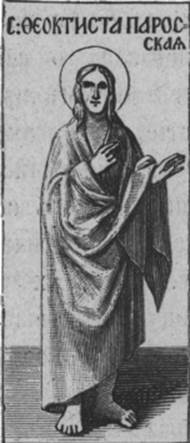
На острове Лесбосе, в городе Мефимне, родилась блаженная Феоктиста127. С юных лет, пожелав вести жизнь чистую, отдана она была родными в девичий монастырь. Семнадцати лет пострижена была в монашество. Случилось ей выйти из обители, для свидания с сестрою. В это время, неожиданно ни для кого, напали на остров пираты-арабы. Захватив множество пленных, захватили они и Феоктисту с ее сестрою. Грабители пристали потом к острову Паросу и расположились тут оценивать пленных. Феоктиста, трепеща не столько за жизнь, сколько за чистоту свою, бросилась бежать; долго гнались за нею; наконец она, спасаясь от них, скрылась в пустыне, на середине острова.
On the island of Lesbos, in the city of Methymna, the blessed Theoctista was born127. From her youth, desiring to lead a pure life, she was given by her relatives to a convent for maidens. At seventeen years of age she was tonsured into monasticism. It happened that she left the monastery to visit her sister. At that time, unexpectedly to all, Arab pirates attacked the island. Having taken many captives, they seized Theoctista together with her sister. The marauders then put in at the island of Paros and settled there to appraise the captives. Theoctista, trembling not so much for her life as for her purity, took flight; they pursued her for a long time; at last, escaping from them, she hid herself in the wilderness, in the middle of the island.
Феоктиста спасла жизнь и чистоту от насилия людей, – но остров оказался совершенно запустевшим. На нем стоял только каменный храм пустой. Феоктиста предала себя в волю Божию. Она питалась семенами местного растения, солнечника. Псалмы, которые изучила она в монастыре, составляли пищу и утешение ее. Одежда, в которой схватили ее пираты, впоследствии обветшала, обратилась в гниль и она осталась нагою. То зной летний жестоко палил ее, то холод зимы костенил тело ее. Она терпела и молилась. Местом молитв ее был притвор опустевшего храма. Так прожила она 35 лет. Случилось, что прибыли на остров охотники для ловли, зверей. Между ними был богобоязненный человек; он ходил один, следя за зверями; увидав запустевший храм, вошел в него молиться. Помолившись, видит небольшую ямку с водою и в ней намокшие семена солнечника. Верно, подумал он, подвизается здесь раб Божий, пустынник. Чтобы не потерять дружины, он поспешил выйти из храма. На следующий день мысль о пустыннике снова привела его в пустой храм. На этот раз увидал он на правой стороне притвора как бы растение, колеблемое ветром и закрытое густыми сетями паутины. Он хотел подойти и посмотреть, что это такое? Но услышал голос: «остановись; не подходи ко мне, добрый человек! стыжусь показаться тебе нагою». Он «затрепетал и хотел бежать, но собрался с духом и спросил: кто ты и откуда? «Брось мне какое-нибудь одеяние, чтобы я могла прикрыться, и тогда скажу». Он исполнил желание ее. Обвернувшись верхнею одеждою охотника и оградив себя крестным знамением, вышла она к охотнику. Волосы ее были белые, лице почернелое, одна кожа покрывала кости, и все целое походило более на призрак, чем на живого человека. Она рассказала о себе, как попала она на остров и как жила тут. Потом просила она охотника принесть ей святое причастие. Так как охотники, отправляясь в дальний и опасный путь, запасались тогда св. дарами Евхаристии, то тот поспешно принес сосуд с святыми дарами128. Она, помолившись, причастилась св. Евхаристии и воз несла благодарение Богу. Когда охотник еще раз пришел видеть дивную пустынницу, он нашел ее почившею. Выкопав могилу, какую мог, благоговейно положил он страдальческие останки подвижницы.
Theoctista saved her life and purity from the violence of men—but the island proved to be completely desolate. Upon it stood only an empty stone church. Theoctista surrendered herself to the will of God. She fed on the seeds of a local plant, the sunflower. The psalms which she had learned in the monastery were her food and consolation. The clothing in which the pirates had seized her later wore out, turned to rot, and she remained naked. At times the summer heat scorched her cruelly, at times the winter cold stiffened her body. She endured and prayed. The place of her prayers was the narthex of the deserted church. Thus she lived for thirty-five years. It happened that hunters came to the island to hunt beasts. Among them was a God-fearing man; he walked alone, tracking the animals; seeing the deserted church, he entered it to pray. Having prayed, he saw a small hollow with water and in it soaked sunflower seeds. "Surely," he thought, "a servant of God, a hermit, is struggling here." So as not to lose his company, he hastened to leave the church. The next day the thought of the hermit again brought him to the empty church. This time he saw on the right side of the narthex something like a plant, swayed by the wind and covered with thick webs of cobwebs. He wanted to approach and see what it was. But he heard a voice: "Stop; do not come near me, good man! I am ashamed to show myself to you naked." He "trembled and wanted to flee, but gathered his courage and asked: Who are you and from where? 'Throw me some garment, that I may cover myself, and then I will tell you.' He fulfilled her wish. Wrapping herself in the hunter's outer garment and signing herself with the sign of the cross, she came out to the hunter. Her hair was white, her face blackened, skin alone covered her bones, and the whole figure resembled a specter more than a living person. She told him about herself—how she had come to the island and how she had lived there. Then she asked the hunter to bring her Holy Communion. Since hunters setting out on a long and dangerous journey would then provide themselves with the holy gifts of the Eucharist, he quickly brought a vessel with the holy gifts128. She, having prayed, partook of the Holy Eucharist and offered thanksgiving to God. When the hunter came once more to see the wondrous female hermit, he found her reposed. Having dug a grave as best he could, he reverently laid the suffering remains of the ascetic to rest.
Нападение морских разбойников, Африканских Арабов, на остров Лесбос было в 846 г.; тогда они ограбили и Рим. Прибавляя к этому году разбоя 35 лет пребывания святой на безлюдном острове Паросе, находим, что дивная подвижница почила в 881 году.
The attack of sea pirates, African Arabs, on the island of Lesbos was in the year 846; at that time they also plundered Rome. Adding to this year of the raid the thirty-five years of the saint's sojourn on the uninhabited island of Paros, we find that the wondrous ascetic reposed in the year 881.
Дочь благочестивых родителей, живших в Персии, выдана была не по ее желанию замуж за дворянина129. Муж перешел на службу в столицу. Молодая жена, познакомясь с одною подвижницею, загорелась желанием как можно чаще посещать общественное Богослужение и помещения его. Муж не только препятствовал ей в том выговорами и подозрениями обидными, но часто бил ее. Десять лет прожила она с таким мужем. Измученная душевными страданиями, при неутоляемой, а усиливаемой жажде жить для Господа, она, в одежде евнуха, скрылась в мужском монастыре блаженного Вассиана, у которого было до 300 братий130.
The daughter of pious parents living in Persia, she was given in marriage against her will to a nobleman129. Her husband transferred to service in the capital. The young wife, having become acquainted with a certain female ascetic, was inflamed with the desire to attend public worship and its places as often as possible. Her husband not only hindered her in this with reproaches and offensive suspicions, but often beat her. She lived ten years with such a husband. Tormented by spiritual sufferings, with an unquenched—indeed, intensified—thirst to live for the Lord, she, in the garb of a eunuch, hid herself in the men's monastery of the blessed Bassian, who had up to three hundred brethren130.
В обители дознались, что евнух Вавила – жена. Препод. Вассиан строго обличил Матрону пред братиею. «Ты наводишь беды на нашу обитель», говорил ей настоятель и выгнал ее из обители131.
In the monastery it was discovered that the eunuch Babylas was a woman. The Venerable Bassian sternly rebuked Matrona before the brethren. "You are bringing calamities upon our monastery," the abbot said to her, and drove her out of the monastery131.
Положение Матроны было печальное. Преподобный видел пламенное рвение ее служить Господу, видел и препятствия тому. Чтобы успокоить ее, что было делать? Апостол писал: не уклоняйтесь друг от друга, разве по согласию, на время, для упражнения в посте и молитве (1Кор.7:5). По этому правилу Апостола, жена и муж, по взаимному согласию, могут на время оставлять общее ложе, могут оба дать обеты чистоты и подвизаться в монашеской жизни; но если муж не согласен вести чистую жизнь, жена, хотя бы и хотела, не должна давать обет чистоты. Св. Василий великий писал: «аще (жена отступила от мужа) потому, яко биена была и не стерпела ударов: то подобаше паче претерпевати, нежели разлучатися»132. Так рассуждал и св. Златоуст, но он же указал на возможный случай: «если, говорил он, муж вынуждает жену отступить от чистой веры, то, для сохранения важнейшего долга совести, жена пусть оставит такого мужа»133. По наставлению Спасителя (Лк.16:18), прелюбодеяние мужа дает жене право оставлять преступного мужа. Каков был муж Матроны? Нарушал ли он верность жене и св. вере? Не видно из жития Матроны. Но, по отношениям его к жене-монахине, видно, что это был человек пропитанный языческими мыслями о безграничных правах мужа над женою. После того, как жена его стала монахинею, он по гражданскому закону имел право взять за себя другую и жить покойно. Но он, как язычник, убежден, что он, муж, по сотне причин может прогнать от себя жену, а жена ни по какой причине не имеет права оставить мужа. Он гоняется за Матроною-монахинею и в столице, и в Эмесе, и в Палестине. Языческие убеждения о правах мужа над женою тогда еще были в силе; они обнаруживались и в жизни и в законах империи134. Пример жены-страдалицы, страдавшей от языческого права мужа над женою, видим во время св. Матроны на другом лице. На безлюдном острове найдена была иеромонахом жена с сыном. По ее рассказу, воспитанная сиротою в доме добродетельного вельможи, она, по желаниям его, стала супругою сына его. Отец скоро умер. Родные молодого аристократа не давали ему покоя; каждый день твердили ему: зачем он не берет за себя жены благородной и богатой? зачем держит при себе ту, которая бесчестит собою род его? Чтобы избавить доброго супруга от тяжелого положения его, молодая жена тайно оставила дом его и скрылась на острове для подвигов отшельницы; здесь, спустя 8 месяцев, родился сын, и она 30 лет прожила в подвигах сурового самоотречения, пока Господь не послал к ней иеромонаха для окрещения сына ее135. Особенность в состоянии Матроны была та, что она уже дала обет иночества. На совете старшей братии обители Вассиановой решили не возвращать Матроны в мир, а укрыть ее в женской обители.
Matrona's situation was grievous. The Venerable one saw her fervent zeal to serve the Lord, and also saw the obstacles to it. What was to be done to give her peace? The Apostle wrote: Defraud ye not one the other, except it be with consent for a time, that ye may give yourselves to fasting and prayer (1 Cor. 7:5). According to this rule of the Apostle, a wife and husband, by mutual consent, may for a time leave the common bed; both may make vows of chastity and struggle in the monastic life. But if the husband does not consent to lead a chaste life, the wife, even if she wishes, ought not to make a vow of chastity. St. Basil the Great wrote: "If (a wife has departed from her husband) because she was beaten and could not endure the blows: then she ought rather to endure than to separate"132. So also reasoned St. Chrysostom, but he likewise pointed to a possible case: "If," he said, "the husband compels his wife to depart from the pure faith, then, for the preservation of the more important duty of conscience, the wife may leave such a husband"133. According to the teaching of the Savior (Lk. 16:18), the adultery of the husband gives the wife the right to leave the transgressing husband. What was Matrona's husband like? Did he violate faithfulness to his wife and to the holy faith? This is not evident from the Life of Matrona. But from his relations toward his wife who had become a nun, it is evident that he was a man imbued with pagan notions of the unlimited rights of a husband over his wife. After his wife became a nun, by civil law he had the right to take another wife and live in peace. But he, as a pagan, was convinced that he, the husband, for a hundred reasons could drive his wife away from himself, while the wife had no right whatsoever to leave her husband. He pursues Matrona the nun both in the capital and in Emesa and in Palestine. Pagan convictions about the rights of a husband over his wife were still in force at that time; they manifested themselves both in life and in the laws of the empire134. An example of a suffering wife, suffering from the pagan right of a husband over his wife, we see in the time of St. Matrona in another person. On a deserted island a hieromonk found a woman with a son. According to her account, raised an orphan in the house of a virtuous nobleman, she, at his desire, became the wife of his son. The father soon died. The relatives of the young aristocrat gave him no peace; every day they insisted to him: why did he not take for himself a noble and wealthy wife? why did he keep with him one who dishonored his lineage by her presence? To deliver her good husband from his difficult position, the young wife secretly left his house and hid herself on the island for the struggles of a female hermit; there, after eight months, a son was born, and she lived for thirty years in the struggles of severe self-denial, until the Lord sent a hieromonk to her to baptize her son135. The particularity in Matrona's situation was that she had already made a vow of monasticism. In the council of the senior brethren of the monastery of Bassian, it was decided not to return Matrona to the world, but to conceal her in a women's monastery.
При содействии преп. Вассиана, Матрона принята была в Эмесский женский монастырь. Тут подвизалась она со всею твердостию136. Преследуемая мужем, посещала она Иерусалим и Синай, – места святых, дорогие для благочестивой души; но ни там, ни здесь Матрона не могла оставаться долго. Как тяжела эта жизнь бесприютная! Ведь блаж. Матрона – не то, что какая-нибудь личность, при шумных заявлениях о своей гениальности, осязаемо уменьшающая собою капитал сил общества. Матрона благочестивою жизнию своею успела привесть нескольких язычниц к св. вере.
With the assistance of the Venerable Bassian, Matrona was received into the women's monastery of Emesa. There she struggled with all steadfastness136. Pursued by her husband, she visited Jerusalem and Sinai—holy places dear to a pious soul; but neither there nor here could Matrona remain long. How heavy is this homeless life! For the blessed Matrona was not some personality who, with noisy declarations of her genius, tangibly diminishes the capital of society's strength. Matrona, by her pious life, succeeded in bringing several pagan women to the holy faith.
Муж умер, к покою блаженной, и Матрона возвратилась в Константинополь слушать наставления преп. Вассиана. Он вызвал к ней и Эмесских сестер ее. Супруга императора Льва Великого (457–473 г.), узнав о высокой ее жизни, посещала ее. Матрона, хотя жила очень бедно, ничего не просила у императрицы, а только говорила о душевном спасении. Удивленная тем, императрица еще более стала уважать подвижницу. Исцелив вдову эпарха, преподобная получила от нее средства для построения монастыря, тогда как дотоле жила она с сестрами в кельях очень тесных и притом наемных. К великой подвижнице многие и из мирян приходили за советами. «О, если бы люди, говорила она, столько заботились о добродетели, сколько они, во вред себе, заботливы о пустоте! Пусть бы эта страсть к зрелищам и вредным веселостям, пусть бы женская наша страсть к нарядам, страсть нравиться мужчине, заменены были ревностию к благочестию: какие были бы успехи в духовной жизни!» В столице тогда еще мало было женских общин молитвы, а много было разврата, тяжелого для душ, сколько-нибудь понимающих себя. Наставления свят. подвижницы, сильные искренностию и опытностию, влекли к ней многих. Измученные жизнию мирскою находили у нее отдых, больные – здоровье. Обитель ее стала весьма многолюдною. Под ее руководством воспиталось много чистых дев для неба. Св. Иосиф поет ей: «для пользы многих воздвигла ты священное жилище, будучи сама храмом Духа по чистоте душевной. Путеводила ты по подвигам поста спасительного и привела их целыми к Владыке, как брачное вено. С ними чтем тебя искренно, Матрона»137.
Her husband died, to the blessed one's peace, and Matrona returned to Constantinople to hear the instructions of the Venerable Bassian. He summoned her sisters from Emesa to her as well. The wife of the Emperor Leo the Great (457–473 A.D.), learning of her lofty life, visited her. Matrona, though she lived very poorly, asked nothing of the empress, but spoke only of spiritual salvation. Astonished by this, the empress began to respect the ascetic even more. Having healed the widow of the eparch, the Venerable One received from her the means to build a monastery, whereas until then she had lived with her sisters in very cramped and moreover rented cells. Many laypeople also came to the great ascetic for counsel. "Oh, if only people," she would say, "cared as much for virtue as they, to their own harm, care for vanity! If only this passion for spectacles and harmful amusements, if only our feminine passion for finery, the passion to please a man, were replaced by zeal for piety—what progress there would be in the spiritual life!" In the capital there were still few women's communities of prayer, but much debauchery, which was burdensome for souls that understood themselves at all. The instructions of the holy ascetic, powerful in their sincerity and experience, drew many to her. Those worn out by worldly life found rest with her, the sick found health. Her monastery became very populous. Under her guidance many pure maidens were raised for heaven. St. Joseph sings of her: "For the benefit of many you raised up a sacred dwelling, being yourself a temple of the Spirit by your purity of soul. You guided them through the labors of saving fasting and brought them whole to the Lord, as a bridal dowry. With them we honor you sincerely, Matrona."137
Но вот еще настало бурное время. Хищник престола Василиск выдает (в 476 г.) указ против Халкидонского собора. В 480 г. Царьград поражен был страшным землетрясением138. Император Зенон думал эдиктом своим (482 г.) примирить православных с еретиками – монофизитами; эдикт его диктован в духе индиферентизма (безразличия в вере), столько ненадежного ни для земли ни для неба. На западе произнесено было решительное осуждение мирной грамоты139. Император Анастасий с 491 г. поднял жестокое гонение против непринимавших этой грамоты. «В особенности понуждаемы были к мирному соглашению монастыри Вассиана, Неусыпающих и Матроны, которые наиболее отделились от принявшихи» примирительную грамоту Зенона, и со всею твердостию переносили гонение. Преподобная Матрона, прекратившая всякое общение с инокинями своими, принявшими мирную грамоту Зенона, совершила много чудес, когда принуждал ее к тому диакон великой церкви Хризафий. Встретив непреклонную твердость, оставили преподобную, как и других иноков, в покое140. Так соединилась она с своими духовными детьми пред своею кончиною. «Отроковицы, поет св. Иосиф, покоряющиеся твоему учению, возлюбили жениха – Господа. Побеждая силою духа телесную слабость, укротили ревностию страсти; вместе с тобою, Матрона, введены они в чертог небесный, священный, и всегда веселятся».
But now a stormy time came again. The usurper of the throne, Basiliscus, issued (in 476 A.D.) an edict against the Council of Chalcedon. In 480 A.D. Constantinople was struck by a terrible earthquake138. The Emperor Zeno thought by his edict (482 A.D.) to reconcile the Orthodox with the heretics—the Monophysites; his edict was dictated in the spirit of indifferentism (indifference in faith), so unreliable both for earth and for heaven. In the West a decisive condemnation of the charter of peace was pronounced139. The Emperor Anastasius, from 491 A.D., raised a fierce persecution against those who did not accept this charter. “Especially were the monasteries of Bassian, of the Akoimetoi, and of Matrona compelled to accept the peaceful agreement, which had most separated themselves from those who had accepted” the conciliatory charter of Zeno, and they endured the persecution with all steadfastness. The Venerable Matrona, having ceased all communion with her nuns who had accepted Zeno's charter of peace, performed many miracles when the deacon of the Great Church, Chrysaphius, compelled her to do so. Having encountered her unyielding firmness, they left the Venerable One, as they did the other monks, in peace140. Thus she was reunited with her spiritual children before her end. “The maidens,” sings St. Joseph, “submitting to your teaching, loved the Bridegroom—the Lord. Conquering bodily weakness by the power of the spirit, they tamed the passions with zeal; together with you, Matrona, they have been led into the heavenly, sacred bridal chamber, and ever rejoice.”
Блаженная Евстолия, дочь благочестивых родителей, с нежного возраста посвятила себя посту и молитве. Горя любовию к Господу, при императоре Маврикие (582–602 г.) оставила она Рим и пришла в Константинополь142.
The blessed Eustolia, daughter of pious parents, from a tender age devoted herself to fasting and prayer. Burning with love for the Lord, under the Emperor Maurice (582–602 A.D.) she left Rome and came to Constantinople142.
Лучшие люди Запада чувствовали и тогда нужду как можно ближе и как можно чаще знакомиться с Востоком, чувствовали, что уже и тогда христианская жизнь была слаба на Западе и выставляла собою много печального. Да и как было не чувствовать, когда еще св. Амвросий, Иероним и Августин должны были бороться с Иовинианом и ему подобными, которые осыпали бранью лучшую христианскую жизнь и жарко хвалили жизнь заботливую об одних интересах земных143?
The best people of the West felt even then the need to become acquainted with the East as closely and as often as possible; they felt that even then Christian life was weak in the West and presented much that was sorrowful. And how could they not feel it, when even Sts. Ambrose, Jerome, and Augustine had to contend with Jovinian and those like him, who heaped abuse upon the best Christian life and ardently praised a life concerned only with earthly interests143?
Св. Григорий беседователь, который так много боролся с гордостию современного Запада для того, чтобы ввести восточное Богослужение на Западе, вот что пишет о своих тетках, современницах св. Евстолии:
St. Gregory the Dialogist, who struggled so much against the pride of the contemporary West in order to introduce Eastern Divine Services in the West, writes the following about his aunts, contemporaries of St. Eustolia:
У отца моего были три сестры: Фарсилла, Гордиана и Емилиана; все три они дали обет девства в один и тот же день, с одинаковою горячностию души, и жили вместе. Фарсилла и Емилиана возрастали время от времени в любви к Господу, твердо борясь с немощами. Иначе жила Гордиана. Она хладела в благочестии и в душе ее явилась мирщина. Фарсилла часто, с глубокою скорбию, говорила: «вижу, что сестра наша Гордиана более уже не наша, предается рассеянию и не верна призванию Божию». Обе сестры дружески уговаривали сестру удерживаться от легкомыслия и ветренности в поступках. После таких напоминаний любви, Гордиана на время казалось степенною, – но потом опять возвращалась к прежней легкости, дружилась с девушками мирскими и отстранялась от тех, которые жили для Господа. Фарсилла постоянно пребывала в молитве и вела жизнь строгую. При такой жизни ее, в сонном видении, является ей дед ее – св. Феликс папа, показывает ей светлое место своего покоя и говорит: «иди, я принимаю тебя в это светлое жилище». Скоро после того она стала страдать от лихорадки и приблизилась к смерти. Благородные родственники собрались к умирающей, в том числе и мать моя, прибавляет св. Григорий. Больная поднимает глаза к небу, видит приближающегося Господа Иисуса и говорит громко: «отойдите, отойдите, идет Господь Иисус». И в те же минуты скончалась. Когда стали убирать ее к погребению, увидали, что на коленах и локтях ее кожа от молитвенных трудов стала груба и толста, как у верблюда. Она скончалась накануне дня Рождества Христова. После этого праздника Фарсилла, в сонном видении, явилась сестре Емилиане и сказала ей: «иди! без тебя праздновала я Рождество Христово, но с тобою хочу праздновать Богоявление». Емилиана, сильно озабоченная душевным спасением сестры Гордианы, оказала: «если я пойду, на кого оставлю сестру мою?» Та, как говорила Емилиана, с видом скорбным, сказала: « иди одна; сестра твоя принадлежит к чадам мира». После того Емилиана стала больною и скончалась накануне дня Богоявления, как предсказала Фарсилла. Гордиана, оставшись на полной свободе, быстро стала изменяться и, наконец, забыв страх Божий, потеряв всякий стыд, вышла замуж за одного арендатора земель. Св. Григорий рассказывает об этом и в своей истории людей благочестивых и в одной беседе на Евангелие. Так поразил его пример слабости, показанный девственницею теткою! Так и здесь повторяет он в заключении: мняйся стояти, да блюдется, да не падет (1Кор.10:12)144.
My father had three sisters: Tharsilla, Gordiana, and Aemiliana; all three made a vow of virginity on the same day, with equal fervor of soul, and lived together. Tharsilla and Aemiliana grew from time to time in love for the Lord, firmly struggling with infirmities. Gordiana lived otherwise. She grew cold in piety and worldliness appeared in her soul. Tharsilla often said, with deep sorrow: "I see that our sister Gordiana is no longer ours; she gives herself over to distraction and is unfaithful to God's calling." Both sisters kindly urged their sister to refrain from frivolity and flightiness in her conduct. After such reminders of love, Gordiana would seem sedate for a time—but then would return to her former levity, would befriend worldly girls and shun those who lived for the Lord. Tharsilla remained constantly in prayer and led a strict life. During such a life, in a dream vision, her grandfather—St. Felix the Pope—appeared to her, showed her the bright place of his repose, and said: "Come, I receive you into this bright dwelling." Soon after that she began to suffer from a fever and drew near to death. Noble relatives gathered around the dying woman, among them my mother, adds St. Gregory. The sick woman raises her eyes to heaven, sees the Lord Jesus approaching, and says loudly: "Stand back, stand back, the Lord Jesus is coming." And in the same moments she reposed. When they began to prepare her for burial, they saw that on her knees and elbows the skin had become rough and thick from her labors of prayer, like that of a camel. She reposed on the eve of the day of the Nativity of Christ. After this feast, Tharsilla appeared in a dream vision to her sister Aemiliana and said to her: "Come! Without you I celebrated the Nativity of Christ, but with you I wish to celebrate Theophany." Aemiliana, greatly concerned for the spiritual salvation of her sister Gordiana, said: "If I go, upon whom shall I leave my sister?" The other, as Aemiliana said, with a sorrowful look, said: "Come alone; your sister belongs to the children of the world." After that Aemiliana fell ill and reposed on the eve of the day of Theophany, as Tharsilla had foretold. Gordiana, left in complete freedom, quickly began to change and, finally, having forgotten the fear of God and lost all shame, married a certain tenant farmer. St. Gregory relates this both in his history of pious people and in one of his homilies on the Gospel. So greatly did the example of weakness shown by his virgin aunt strike him! And here too he repeats in conclusion: "Let him who thinks he stands take heed lest he fall" (1 Cor. 10:12)144.
Это событие Римское, современное для Евстолии, без сомнения, было одним из побуждений, заставивших Евстолию оставить слабый Рим и уйти в Константинополь, с надеждою видеть образцы лучшей жизни на Востоке.
This Roman event, contemporary with Eustolia, was without doubt one of the motives that caused Eustolia to leave weak Rome and go to Constantinople, hoping to see examples of a better life in the East.
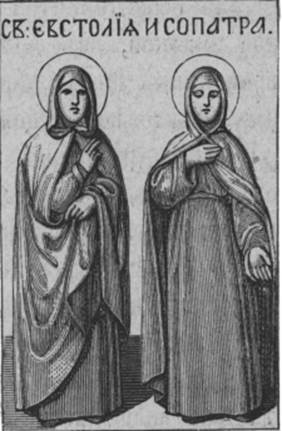
В Константинополе посещала она святыни и обители иноческие, с жаждою духовного совершенства. Во Влахернском храме встретилась с нею другая жаждущая душа и еще юная, дочь импер. Маврикия, Сопатра. Юная душа, встретив уже довольно созревшую в духовной жизни, неотступно просила Евстолию быть для нее духовною матерью-наставницею. Евстолия согласилась, тем более, что желала остаться на Востоке. Сопатра, оставив царский двор, приняла иночество. Дочь просила доброго отца устроить обитель молитвы, и просьба была исполнена145. Благочестивый император купил огромный дом патриция Кариана. Здесь прежде всего устроен был храм молитвы, потом явились и келии для девственниц; здесь же открыто было и помещение для престарелых146.
In Constantinople she visited the holy places and monastic communities, thirsting for spiritual perfection. In the Blachernae church she met another thirsting soul, still young—Sopatra, daughter of the Emperor Maurice. This young soul, having encountered one already quite mature in the spiritual life, earnestly begged Eustolia to be her spiritual mother and guide. Eustolia agreed, all the more because she wished to remain in the East. Sopatra, leaving the imperial court, received the monastic tonsure. The daughter asked her good father to establish a monastery of prayer, and the request was fulfilled145. The pious emperor bought the huge house of the patrician Carianus. Here first a church of prayer was built, then cells for the virgins appeared; here too a shelter for the elderly was opened146.
Блаженная Сопатра уже прежде того начала приучать себя к Евангельской жизни. Тетка ее Дамиана была игумениею Иерусалимской обители и потом жила затворницею. Сопатра путешествовала в Иерусалим для поклонения святым местам его и год прожила у тетки, выслушивая уроки ее о духовной жизни. «В одно время, говорит блаженная Дамиана у Иоанна Мосха, пришла в святой город племянница моя, дочь императора Маврикия, и провела целый год здесь. Однажды, взяв ее с собою, пошли мы к св. Козьме и Дамиану. Стоя в храме, говорю я племяннице: «смотри, госпожа, когда придет старица и будет давать тебе два нумула (две полушки), возьми их, не гордись». Она со вздохом сказала: как это приму я? Я сказала ей: «прими. Эта жена – велика пред Богом. Каждую неделю она раздает свои нумулы находящимся в храме, имея от роду 80 лет. Прими лепты; приняв, отдашь ты их другому; только не отвергай усердия старицы». Тогда как мы разговаривали об этом, вдруг подходит старица и подала мне тихо, ничего не сказав мне; но, подавая племяннице моей, сказала: «прими и съешь». Когда она удалилась, мы поняли, что Господь открыл ей, о чем говорили мы. Послав одного из слуг купить на две лепты бобов, племянница съела их и свидетельствовалась Богом, что бобы эти сладки, как мед; она дивилась и прославила Бога, подающего благодать рабыням Своим147. Другой урок, полезный для себя, Сопатра слышала тогда же в Кесарии. «Об одной знатной, из сенаторского дома, женщине, так пишет современник Мосх, ходившей для поклонения святым местам, некто из отцов рассказывал так: она, пришедши в Кесарию, решилась здесь остаться и обратилась к епископу с следующею просьбою: дайте мне девицу для обучения меня страху Божию. Епископ приставил к ней смиренную девицу. Спустя несколько времени, епископ, при встрече с нею, спрашивает у ней: «каково поживает девица, которую я приставил к вам»? – Хорошо, отвечала женщина, но для моей души она мало полезна, потому что позволяет мне исполнять мою волю, и это от того, что она смиренная, а я имею нужду, чтобы она бранила меня и не позволяла мне делать то, что хочу. Епископ вместо этой дал ей другую, с характером довольно грубым. Та начала бранить ее, называла ее глупою богачкою и тому подобными именами. По прошествии некоторого времени епископ опять спросил у нее: а эта девица какова? «Она истинно приносит мне пользу», отвечала жена. И она сделалась весьма кроткою148.
The blessed Sopatra had already before that begun to accustom herself to the Gospel life. Her aunt Damiana was the abbess of a Jerusalem monastery and later lived as a recluse. Sopatra traveled to Jerusalem to venerate its holy places and spent a year with her aunt, listening to her lessons on the spiritual life. “On one occasion,” says the blessed Damiana in John Moschus, “my niece, the daughter of the Emperor Maurice, came to the holy city and spent a whole year here. Once, taking her with me, we went to the church of Sts. Cosmas and Damian. Standing in the church, I said to my niece: ‘See, lady, when an old woman comes and gives you two nummi (two half-cents), take them, do not be proud.’ She said with a sigh: ‘How can I accept this?’ I said to her: ‘Accept it. This woman is great before God. Every week she distributes her nummi to those in the church, being eighty years old. Accept the mites; having accepted, you will give them to another; only do not reject the old woman’s zeal.’ While we were talking about this, suddenly the old woman approached and gave to me quietly, saying nothing to me; but, giving to my niece, she said: ‘Take and eat.’ When she had departed, we understood that the Lord had revealed to her what we were speaking about. Sending one of the servants to buy beans for two mites, my niece ate them and called God to witness that these beans were sweet as honey; she marveled and glorified God, Who bestows grace upon His handmaidens147. Another lesson, profitable for herself, Sopatra heard at that same time in Caesarea. “Concerning a certain noble woman, of the senatorial house, who went to venerate the holy places,” writes the contemporary Moschus, “a certain one of the fathers related thus: she, having come to Caesarea, resolved to remain there and turned to the bishop with the following request: ‘Give me a maiden to teach me the fear of God.’ The bishop assigned to her a humble maiden. After some time, the bishop, meeting her, asks her: ‘How is the maiden faring whom I assigned to you?’ ‘Well,’ answered the woman, ‘but for my soul she is of little profit, because she allows me to fulfill my own will, and this is because she is humble, whereas I have need that she should rebuke me and not allow me to do what I wish.’ The bishop gave her another in place of this one, with a rather harsh character. She began to rebuke her, called her a foolish rich woman and the like names. After some time had passed, the bishop again asked her: ‘And this maiden, how is she?’ ‘She truly brings me profit,’ answered the woman. And she became very meek148.
Блаженная Сопатра подчинила себя св. Евстолии для обучения себя самоотречению. К ним присоединились весьма многие другие девы и проводили время в трудах и молитвах. Подвижница Евстолия, прожив многие годы в иночестве, мирно переселилась ко Господу. Сопатра управляла после нее общиною и строго следовала правилам духовной своей матери. Достигши подвигами духовного совершенства, покойно скончалась ноября 9-го, около 610 года149.
The blessed Sopatra subjected herself to St. Eustolia for instruction in self-denial. Very many other virgins joined them and spent their time in labors and prayers. The ascetic Eustolia, having lived many years in monasticism, peacefully departed to the Lord. Sopatra governed the community after her and strictly followed the rules of her spiritual mother. Having attained spiritual perfection through her struggles, she peacefully reposed on November 9, about the year 610149.
Вспомнив судьбу других детей Маврикия, и мирские люди должны сознаться, что счастлива Сопатра, избравшая доброю волею жизнь иноческую. Кровожадный Фока, убив доброго императора Маврикия и трех сыновей его, жену и трех дочерей (Анастасию, Феоктисту и Клеопатру) запер в монастырь, где после трех лет предал смерти150. Не лучше ли было по воле избрать тишину уединения, чем по неволе? Не лучше ли добровольно отказаться от незавидной суеты мирской, чем против воли заключену быть во гробе? И в миру можно делать много доброго? Да, можно коптить сердца и небо! Делают добро души смиренные, а не гордые и самонадеянные. – «Со страхом и трепетом совершайте свое спасение» (Фил.2:12). Царство Небесное берется силою, и употребляющие насилие восхищают его (Мф.11:12).
Recalling the fate of Maurice’s other children, even worldly people must acknowledge that Sopatra is blessed, who of her own free will chose the monastic life. The bloodthirsty Phocas, having slain the good Emperor Maurice and his three sons, shut up his wife and three daughters (Anastasia, Theoctista, and Cleopatra) in a monastery, where after three years he put them to death150. Is it not better to choose the quiet of solitude willingly than unwillingly? Is it not better to renounce voluntarily the unenviable vanity of the world than to be shut up in a tomb against one’s will? Can one do much good even in the world? Yes, one can defile hearts and the heavens! Good is done by humble souls, not by proud and self-confident ones. — “Work out your own salvation with fear and trembling” (Phil. 2:12). The Kingdom of Heaven is taken by force, and those who use violence take it by force (Mt. 11:12).
Слышал я дело чудное, повествует св. Симон, слышал от благоговейных старцев; а они, по их словам, слышали от самовидцев дивного чуда, бывшего в игуменство Пимена (1132–1141 г.) в Печерском монастыре. Был муж совершенный, украшенный всеми добродетелями, именем Онисифор, саном иерей. – Он сподоблен был от Бога дара прозорливости, так что видел в другом согрешения его. – Но я об одном скажу. Был у сего блаженного Онисифора духовный сын, чернец и друг. Тот старался подражать ему и казался постником, но ложно; выставлял себя целомудренным, а тайно ел и пил и проводил время в нечистоте. Но это было сокрыто от духовного человека. – Никто и из братии не понял его. – В один день, будучи здоров, внезапно умер он. И – никто не мог приблизиться к его телу, от смрада, выходившего из трупа его. На всех напал ужас. Отрекаясь нуждою, не находя себя в состоянии от смрада совершить над ним обычные пения, положили его особо и, став издали, совершили пение, а некоторые, заткнув нос, отнесли его кое-как и положили в пещере. – Много раз был слышан крик, как бы кого мучили. Пресвитеру тому явился преп. Антоний и грозно говорил: «зачем ты положил здесь такого гнусного беззаконника? Такого еще не было здесь. Он осквернил святое место». Пресвитер встав после того видения, пал на лице и, молясь Господу Богу, говорил: «зачем, Господи, сокрыл Ты от меня дела этого человека?» «Затем, сказал ему явившийся ангел, чтобы показать его всем согрешающим и некающимся; пусть, увидев, покаются». Сказав это, стал невидим. Пресвитер рассказал об этом игумену Пимену. На другую ночь опять слышал он: «выбрось его скорее вои в пищу псам; он недостоин быть здесь». Пресвитер, услышав это, обратился к молитве и был к нему голос: «если хочешь, помоги ему». – Посоветовавшись с игуменом, положили, чтобы кто-нибудь заценил его веревкою, выволок вон и бросил в воду, так как от смрада никто не мог приблизиться туда, где была пещера. – Затем святой опять является и говорит: «жаль мне стало брата того. Находящиеся со мною здесь – не хуже тех, которые прежде закона угодили Богу. Я молил Господа Бога о спасении живущих в обители и – Господь сказал мне: Я слышал; Я сказал Аврааму, – для 20 праведников не погублю города, тем более для тебя и сущих с тобою помилую грешника». Онисифор пересказал все виденное и слышанное начальнику своему и всей братии. Тело брата перестало издавать смрад. Один из братии, по просьбе моей, рассказал мне это событие со слов тех первых черноризцев»151. Такова повесть Симона!
I have heard a wondrous thing, relates St. Simon, I have heard from devout elders; and they, according to their words, heard from eyewitnesses of a marvelous miracle that occurred during the abbacy of Pimen (1132–1141) in the Monastery of the Caves. There was a perfect man, adorned with all virtues, named Onesiphorus, by rank a priest. He was vouchsafed by God the gift of clairvoyance, so that he saw the sins of another. But I will speak of one thing. This blessed Onesiphorus had a spiritual son, a monk and friend. He strove to imitate him and appeared to be a faster, but falsely; he pretended to be chaste, but secretly ate and drank and spent his time in impurity. But this was hidden from the spiritual man. No one among the brethren understood him either. One day, being healthy, he died suddenly. And no one could approach his body, because of the stench that came from his corpse. Terror seized everyone. Being compelled by necessity, finding themselves unable because of the stench to perform the customary chanting over him, they laid him apart and, standing at a distance, performed the chanting, and some, stopping their noses, carried him somehow and laid him in the cave. Many times a cry was heard, as of someone being tormented. The Venerable Anthony appeared to that presbyter and said sternly: “Why have you laid such a vile lawless one here? Such a one has never been here. He has defiled the holy place.” The presbyter, rising after that vision, fell on his face and, praying to the Lord God, said: “Why, O Lord, have You hidden from me the deeds of this man?” “Because,” said the angel who appeared to him, “to show him to all who sin and do not repent; let them, seeing, repent.” Having said this, he became invisible. The presbyter told this to Abbot Pimen. The next night he again heard: “Cast him out quickly to the dogs for food; he is not worthy to be here.” The presbyter, hearing this, turned to prayer, and a voice came to him: “If you wish, help him.” Having taken counsel with the abbot, they decided that someone should tie a rope around him, drag him out, and throw him into the water, since because of the stench no one could approach the place where the cave was. Then the saint appears again and says: “I have taken pity on that brother. Those who are with me here are not worse than those who pleased God before the Law. I prayed to the Lord God for the salvation of those living in the monastery, and the Lord said to me: I have heard; I said to Abraham, for twenty righteous men I will not destroy the city, much more for you and those with you will I have mercy on the sinner.” Onesiphorus recounted all that he had seen and heard to his superior and to all the brethren. The body of the brother ceased to emit stench. One of the brethren, at my request, told me this event from the words of those first monks151. Such is the account of Simon!
Кальнофойский пишет о пещере преп. Антония: «здесь лежат нетленные два брата Спиридон и Онисифор. Из них когда один на перед отшел ко Господу, другой подвинул его с места, чтобы опочить подле него». Память преп. Спиридона октября 31, а Онисифора ноября 9. Итак, Онисифор почил после Сниридона и он-то подвинул почившего, чтобы почивать подле любимого и уважаемого духовного сына преп. Спиридона152; таким образом блаж. кончина преп. Онисифора, современника игумену Пимену (1132–1141 г.) и преп. Спиридону, последовала ноября 9-го 1148 г.
Kalnofoysky writes about the cave of the Venerable Anthony: “Here lie incorrupt two brothers, Spyridon and Onesiphorus. When one of them had departed to the Lord first, the other moved him from his place, that he might rest beside him.” The commemoration of the Venerable Spyridon is on October 31, and of Onesiphorus on November 9. Thus, Onesiphorus reposed after Spyridon, and it was he who moved the reposed one, that he might rest beside his beloved and respected spiritual son, the Venerable Spyridon152; thus the blessed end of the Venerable Onesiphorus, a contemporary of Abbot Pimen (1132–1141) and the Venerable Spyridon, occurred on November 9, 1148.
Блажен. митроп. Сильвестр, передав повествование Симона о преп. Онисифоре, говорит в заключении: «этою историею, братия иноки, св. Симон напоминает нам, чтобы тщательно оберегали мы благодатное звание оное, чтобы не были овечками кормленными или волками домовыми, чтобы не были на дворе убогими, а в келье богатыми, постниками пред людьми, как фарисеи, а в келье обжорливыми. Судия праведный за все, что сделано тайно, будет платить явно, на суде Своем»153.
The blessed Metropolitan Sylvester, having transmitted the account of Simon concerning the Venerable Onesiphorus, says in conclusion: “With this story, brethren monks, St. Simon reminds us that we should carefully guard that grace-filled calling, that we should not be fed sheep or domestic wolves, that we should not be poor in the courtyard and rich in the cell, fasters before men, like the Pharisees, but gluttons in the cell. The righteous Judge will repay openly for all that is done in secret, at His judgment”153.
Свящ. Писание учит нас: «кто скрывает проступки свои, тому не будет счастия; а кто признается и оставляет, тот будет помилован» (Прит.28:12). «Если бы мы судили самих себя, то не были бы судимы. Будучи же судимы, наказываемся Господом, чтобы не быть осужденными с миром» (1Кор.11:31, 32)154.
Holy Scripture teaches us: “He who conceals his transgressions will not prosper; but he who confesses and forsakes them will obtain mercy” (Prov. 28:13). “For if we would judge ourselves, we should not be judged. But when we are judged, we are chastened by the Lord, that we should not be condemned with the world” (1 Cor. 11:31, 32)154.
По Греческим известиям, неизвестно, – кто были родители преп. Евфимия, основателя Дохиарской Афонской обители155. Пусть так; но известно, что преп. Евфимий был родом Серб, из дома аристократического, бывшего в родстве с аристократиею Византийского двора156.
According to Greek accounts, it is unknown who were the parents of the Venerable Euthymius, the founder of the Docheiariou monastery on Mount Athos155. Let it be so; but it is known that the Venerable Euthymius was a Serb by birth, from an aristocratic house that was related to the aristocracy of the Byzantine court156.
Преп. Евфимий жил вместе с св. Афанасием еще до основания лавры, потом был очевидцем и устроения общежития лаврского. За любовь братскую, за кротость и ревность к иноческим трудам св. Афанасий поручил Евфимию должность дохиара, первую после настоятельской должности; на нем лежала забота о всех нуждах по содержанию братства и о всем продовольствии. Должность свою проходил он благоговейно, как бы пред лицом Божиим. Ревнуя о высшем совершенстве, он пожелал подвизаться в уединении. Мысль свою предложил он другу и авве своему Афанасию на духовный суд. Афанасий дозволил ему даже взять с собою желающих жить скитски. И Евфимий с несколькими братьями устроил на месте Дафна скит в честь св. Николая, а в память о должности, которую нес он в лавре, назвал Дохиаром. Евфимий зорко смотрел за состояниями души своей на новом пути своем и усилил свои подвиги в посте и молитве. Наша браньнесть к плоти и крови, говорил он и братиям своим, побуждая их к духовной бодрости. Раз Евфимий увидал приближающихся к берегу пиратов-арабов. Поняв намерения их, он поспешил в свой скит и с братиями своими скрылся в ближнем густом лесу. Пираты ворвались в скит, заграбили св. сосуды и весь скудный запас; потом, недовольные тем, разбросали стены церкви и скита... Возвратясь на место скита, преподобный благодушно перенес беду и убеждал братию не роптать на случившееся. Новую обитель положил он основать на месте более отдаленном от берега морского и потому менее доступном для нежелаемых гостей. По одобрению старцев горы, обитель основалась там, где она стоит поныне. Храм и здесь построен был в честь святителя Николая. Как дорого ценил святой безмолвие, видно по самой местности обители. Место обители низменная прибрежная скала, где нет воды. Но всему предпочтена тишина местности. Когда прибыл из Византии племянник его (по матери) Николай и, облеченный в иночество с именем Неофита, на деле показал ревность к иноческим подвигам: преп. Евфимий предложил братии – принять его в настоятеля себе, а сам обратился к подвигам отшельническим. Богатый племянник стал строить новый обширный храм; но смиренный храм преп. Евфимия поныне еще цел157. Преподобный почил в глубокой старости, вероятно не позже 990 г.158.
The Venerable Euthymius lived together with St. Athanasius even before the founding of the Lavra, and later was an eyewitness to the establishment of the Lavra’s cenobitic life. For his brotherly love, meekness, and zeal for monastic labors, St. Athanasius entrusted Euthymius with the office of docheiar, the first office after that of the abbot; upon him lay the care of all the needs for the maintenance of the brotherhood and of all provisions. He fulfilled his office reverently, as if before the face of God. Zealous for higher perfection, he desired to struggle in solitude. He submitted his thought to the spiritual judgment of his friend and abba Athanasius. Athanasius even permitted him to take with him those who wished to live in a skete. And Euthymius, with several brethren, established a skete at the place called Daphne in honor of St. Nicholas, and in memory of the office he had borne in the Lavra, he named it Docheiariou. Euthymius kept a watchful eye over the states of his soul on his new path and intensified his ascetic labors in fasting and prayer. For our wrestling is not against flesh and blood, he said also to his brethren, urging them to spiritual vigilance. Once Euthymius saw Arab pirates approaching the shore. Understanding their intentions, he hastened to his skete and, with his brethren, hid in a nearby dense forest. The pirates burst into the skete, plundered the holy vessels and all the meager supplies; then, dissatisfied with that, they tore down the walls of the church and the skete... Returning to the site of the skete, the Venerable One bore the misfortune with good cheer and urged the brethren not to murmur at what had happened. He resolved to found a new monastery in a place more distant from the seashore and therefore less accessible to unwelcome guests. With the approval of the elders of the Holy Mountain, the monastery was established where it stands to this day. The church there was also built in honor of St. Nicholas. How highly the saint valued silence is evident from the very location of the monastery. The site of the monastery is a low-lying coastal rock, where there is no water. But the quietness of the place was preferred to everything. When his nephew (on his mother’s side), Nicholas, arrived from Byzantium and, having been clothed in monasticism with the name Neophytos, showed in deed his zeal for monastic labors, the Venerable Euthymius proposed to the brethren that they accept him as their abbot, while he himself turned to the labors of a hermit. The wealthy nephew began to build a new, spacious church; but the humble church of the Venerable Euthymius remains intact to this day157. The Venerable One reposed in extreme old age, probably not later than A.D. 990158.
Святых мучеников Онисифора и Порфирия. В сказании стишного пролога, согласно с которым составлена святым Иосифом песнописцем и служба в честь этих, сегодня воспоминаемых мучеников, говорится о них, что они пострадали за веру Христову во время гонения Диоклитиана и «после жжения на сковороде умерли влачимые конями», «телеса же их, взятые христианами, источали чудеса в веси Панкеанон»159.
The Holy Martyrs Onesiphorus and Porphyrius. In the account of the verse Prologue, in accordance with which St. Joseph the Hymnographer also composed the service in honor of these martyrs commemorated today, it is said of them that they suffered for the faith of Christ during the persecution of Diocletian and “after being roasted on a gridiron, died dragged by horses,” “and their bodies, taken by Christians, poured forth miracles in the village of Pankeanon”159.
Иоанн, по прозванию Колов, что значит короткий, так как он был малого роста, – подвизался в Скитской Египетской пустыне в V веке и был наставником св. Арсения Великого (пам. 8 мая). Пылкий по природе, он успел достигнуть полной кротости и смирения. – «У тебя злое сердце», – укорил Иоанна однажды один из братий. – «Это правда, – с искренностию согласился осужденный, – и даже более злое, чем ты думаешь»...
John, surnamed Kolov, which means “short,” because he was of small stature, struggled in the Egyptian Skete desert in the fifth century and was a teacher of St. Arsenius the Great (commemorated May 8). Fiery by nature, he succeeded in attaining complete meekness and humility. — “You have an evil heart,” one of the brethren once reproached John. — “That is true,” the accused agreed with sincerity, “and even more evil than you think”...
Иоанн, ревнуя о своем спасении, с таким же усердием старался и о спасении других. Многих успел он обратить к покаянию, между прочими Таисию (пам. которой 16-го мая), и Паисия, совратившегося с доброго пути, успел так тронуть, что тот, внезапно и безвозвратно отступившись от всего своего достояния в мире, провел остальную свою жизнь в покаянии в дикой пустыне.
John, zealous for his own salvation, strove with equal diligence for the salvation of others. He succeeded in turning many to repentance, among them Thais (whose commemoration is May 16), and Paisius, who had strayed from the good path, he succeeded in moving so deeply that the latter, suddenly and irrevocably renouncing all his worldly possessions, spent the rest of his life in repentance in the wild desert.
Иоанн преставился около 430 г. в пустынной келии близ г. Кольцума (ныне Суэца). По смерти его остались записанными многие замечательные его изречения и описание жития преп. Паисия (пам. его 19-го июня), составленное им для пользы общей. В этом житии повествователь представляется неоднократно в близких сношениях с преп. Паисием, с которым сначала жил в одной пустыне, потом, разлучившись, посещал его и беседовал с ним.
John reposed about the year 430 in a desert cell near the city of Koltsum (now Suez). After his death, many of his remarkable sayings were recorded, as well as the description of the life of the Venerable Paisius (commemorated June 19), which he composed for the common benefit. In this life, the narrator repeatedly appears in close relations with the Venerable Paisius, with whom he first lived in the same desert, and later, having parted, visited him and conversed with him.
Симеон Метафраст, родом из Константинополя, благородного происхождения, получил блистательное образование, по окончании которого был принят ко двору и, успев обратить на себя внимание своими дарованиями и заслугами, занимал последовательно важные государственные должности. Между тем в душе его преобладало благочестие; все преимущества, которыми предоставляло ему пользоваться его блистательное мирское поприще, не препятствовали ему быть тайным аскетом. – Послужив своему отечеству как дипломат и воин, облеченный многими наградами за свои заслуги, Симеон сверх того известен и в Церкви по своей духовной деятельности, так как он много потрудился над составлением жизнеописаний святых. Наименование Метафраста (перелагателя) он получил за то, что давал древним жизнеописаниям святых лучший вид по содержанию и по слогу. Он составил их в числе 122-х и исправил многие другие.
Symeon Metaphrastes, a native of Constantinople of noble birth, received a brilliant education, upon the completion of which he was received at court and, having succeeded in attracting attention by his talents and merits, successively held important state offices. Meanwhile, piety predominated in his soul; all the advantages which his brilliant worldly career allowed him to enjoy did not hinder him from being a secret ascetic. — Having served his fatherland as a diplomat and a soldier, adorned with many rewards for his merits, Symeon is also known in the Church for his spiritual activity, for he labored much in compiling the lives of the saints. He received the name Metaphrastes (Reinterpreter) because he gave the ancient lives of the saints a better form in content and style. He compiled 122 of them and corrected many others.
«Писаниям священным посвящал ты труды», – восхваляется сладкий писатель метафразов в службе, составленной в честь его, – «исследывая и испытывая жизни святых; их мучения и подвиги возвеличил твоими метафразами», т. е. переложеняими, при которых он с рассмотрением удерживал из древних источников то, что ему не представлялось невероятным, и отстранял иное, « не изменяя предмета, но исправляя ошибки в словах». Этот труд Симеона, хотя и не строго исторический, так как у него не было ни средств, ни времени поверить со всею строгостию древние источники, тем не менее имел большое значение, так как, по свидетельству Михаила Пселла, недалекого по времени от Метафраста, «те, которые прежде него описывали деяния святых Божиих, частию писали несправедливое, частию изображали доблести святых без силы и красоты; о делах важных писали без должного внимания, – отчего происходило, что некоторые не хотели и читать писанного, а другие обращали даже в предмет насмешек или презрения чтение повествований о рабах Божиих».
“To the sacred writings you devoted your labors,” the sweet writer of metaphrases is praised in the service composed in his honor, “searching out and examining the lives of the saints; their sufferings and struggles you magnified by your metaphrases,” i.e., reworkings, in which he, with discernment, retained from the ancient sources what did not seem improbable to him, and set aside other things, “not changing the subject, but correcting errors in words.” This work of Symeon, although not strictly historical, since he had neither the means nor the time to verify the ancient sources with all strictness, nevertheless had great significance, for, according to the testimony of Michael Psellos, who lived not long after Metaphrastes, “those who before him described the deeds of the saints of God partly wrote what was unjust, partly depicted the virtues of the saints without power and beauty; about important matters they wrote without due attention — whence it happened that some did not even wish to read what was written, while others even turned the reading of narratives about the servants of God into an object of mockery or contempt.”
Кроме метафраз блаженный Симеон написал еще несколько слов160, молитв161, песней162, краткие мысли и составил извлечения из творений Василия Великого и Макария Великого.
Besides the metaphrases, the blessed Symeon also wrote several discourses160, prayers161, hymns162, brief thoughts, and compiled extracts from the works of Basil the Great and Macarius the Great.
В благодарность «мужу святому, который с большим трудом и потом изобразил мученические подвиги за истину, в хвалу Божию и вечное прославление мучеников», Греческие отцы причислили его к лику блаженных и установили день празднования торжества его – 27-го ноября.
In gratitude to “the holy man who, with great labor and sweat, depicted the martyric struggles for the truth, to the praise of God and the eternal glorification of the martyrs,” the Greek Fathers numbered him among the blessed and established the day of celebration of his feast — November 27.
Метафрастово описание разговора о св. Феоктисте в Латинском переводе – у Сурия ad 10 Novemb. Отрывки Греческого текста – у Аллятти de Symeonibus р. 49. 53. 55. В Четье-Минее ноября 9, из разговора составлено описание жизни. Метафраст разговаривал о святой на острове Лесбосе с пустынным старцем в 902 году. Старец просил его описать жизнь святой для общей пользы, и Симеон написал тогда же рассказ старца. Учение об отцах § 294.
Metaphrastes’ description of the conversation about St. Theoctiste in a Latin translation is in Surius ad 10 Novemb. Fragments of the Greek text are in Allatius de Symeonibus p. 49. 53. 55. In the Chet’i-Minei for November 9, a description of her life is compiled from the conversation. Metaphrastes conversed about the saint on the island of Lesbos with a desert elder in the year 902. The elder asked him to describe the life of the saint for the common benefit, and Symeon then wrote down the elder’s account. The Teaching of the Fathers § 294.
О том, как в древнее время причащались тела и крови Христовой, сказано довольно в прим. на 77 главу Луга духовного. Иоанна Мосха Луг духовный стр. 258 259. М. 1853 г. Причины, почему давно уже перестали поручать св. запасные дары на хранение мирянам, – понятны. Если св. Димитрий Ростовский и блаженный Иоасаф Белградский находили таких священников, которые оказывали самую грубую небрежность в хранении страшных таин, то чего ожидать от мирян позднего времени?
Concerning how in ancient times they partook of the Body and Blood of Christ, enough has been said in the notes on Chapter 77 of the Spiritual Meadow. John Moschos, The Spiritual Meadow, pp. 258–259. Moscow, 1853. The reasons why they long ago ceased to entrust the holy reserved Gifts to the keeping of laymen are understandable. If St. Demetrius of Rostov and the blessed Joasaph of Belgrade found such priests who showed the grossest negligence in the keeping of the awesome Mysteries, what is to be expected from laymen of later times?
Житие ее – в Четь-Минее, ноября 9. Метафрастово, очень неѵдачное сочинение ар. Syrium 8 Novemb. Славянский старинный перевод у Царского № 398. 614. Более полезны – канон Иосифа песнописца пр. Матроне и сказание Менолога.
Her life is in the Chet’i-Minei for November 9. Metaphrastes’ very unsuccessful composition is in Surius 8 Novemb. An old Slavonic translation is in Tsarsky’s collection, nos. 398, 614. More useful are the canon of Joseph the Hymnographer to the Venerable Matrona and the account in the Menologion.
Память преп. Вассиана октября 10. Краткое известие о нем в Менологе Basnagii р. 478. В Прологе ноября 9: «св. Василий» – ошибка.
The commemoration of the Venerable Bassian is October 10. A brief notice about him is in the Menologion of Basnagius p. 478. In the Prologue for November 9: “St. Basil” is an error.
Менолог Василия под 8 ноября: «св. Матрона была из Пергии Памфилийской и жила при императоре Льве. Когда от мужа родила дочь, пришла с ним в Константинополь, будучи 15 лет. Здесь, пользуясь дружеством с девою Евгениею, подражала житию ее, никогда не отходила от церквей Божиих. Разжженная еще более сильною любовию к Богу, чем та, когда услышала Евангельские слова: иже хощет по Мне ити, да отвержется себе и возмет крест свой и по Мне грядет, отдала дочку свою на воспитание благочестивой женщине. Оставив супруга и надев на себя одежду мужчины, вступила в монастырь св. Вассиана и приняла монашество. Когда же здесь была узнана, как женщина, святый послал ее в Иерусалим. После нескольких годов возвратясь в Константинополь, проводила жизнь уединенную и так скончалась».
The Menologion of Basil under November 8: “St. Matrona was from Perge in Pamphylia and lived under the Emperor Leo. When she bore a daughter to her husband, she came with him to Constantinople, being 15 years old. Here, enjoying friendship with the virgin Eugenia, she imitated her life, never departing from the churches of God. Inflamed with an even stronger love for God than she, when she heard the Gospel words: ‘If any man will come after Me, let him deny himself, and take up his cross, and follow Me,’ she gave her daughter to a pious woman to raise. Leaving her husband and putting on men’s clothing, she entered the monastery of St. Bassian and received the monastic habit. When she was recognized there as a woman, the saint sent her to Jerusalem. After several years, returning to Constantinople, she led a solitary life and thus reposed.”
Имп. Юстиниана новелла 117, § 8–13. Новел. 123, § 40. Новел. 127, § 4. Новел. 134, § 10, 11. П. Фотия Syntagma canonum in 71. Specilegii Bomani p. 419–421 ed. Romae 1842. Неволина ист. гражд. заков. I, 172. 173. Свб. 1853. Св. Назианзен писал: «закон дает развод по всякой вине; во Христос – не по всякой, а дозволяет мужу отделиться от жены только прелюбодейной» Orat. XXXI. Блаж. Иероним, после того, как привел слова Спаснтеля о разводе, говорит: «иные законы императора, другие – Христовы; иное говорит Пипиниан, другое предписывает нам Павел». Ер. 89 de morte Fabiolae.
Emperor Justinian’s Novella 117, § 8–13. Novella 123, § 40. Novella 127, § 4. Novella 134, § 10, 11. Photius’ Syntagma canonum in 71. Spicilegii Romani p. 419–421 ed. Romae 1842. Nevolin’s History of Civil Laws I, 172. 173. St. Petersburg, 1853. St. Gregory of Nazianzus wrote: “The law grants divorce for every fault; but Christ does not grant it for every fault, but permits a husband to separate from his wife only if she is an adulteress” Orat. XXXI. Blessed Jerome, after citing the Savior’s words on divorce, says: “Different are the laws of the emperor, different those of Christ; one thing says Papinian, another Paul commands us.” Ep. 89 de morte Fabiolae.
Патерик сборный под знам. М. гл. 25. Пролог мая 1. Пр. Марк, рассказывавший об этом событии, был основателем обители Марковой, находившейся в столице, близ храма м. Агафоника. Дионисий, игумен обители Марковой, подписался под определением собора, бывшего при п. Мине († 552 г.). Du-Cangii Const Chr. p. 158. Кажется, преп. Анна и сын ее Иоанн, поминаемые церковию июня 13, в Прологе без жития, – те самые лица, которые найдены были на острове.
The Patericon compiled under the sign of M., ch. 25. Prologue, May 1. The Venerable Mark, who related this event, was the founder of the Markova monastery, which was located in the capital, near the church of the Martyr Agathonicus. Dionysius, the abbot of the Markova monastery, signed the decree of the council held under Patriarch Mena († 552). Du-Cangii Const. Chr. p. 158. It seems that the Venerable Anna and her son John, commemorated by the Church on June 13, in the Prologue without a life, are the very persons who were found on the island.
Метафраст пишет, что Матрона, живя в Эмесе, поклонилась обретенной тогда главе Предтечи. Этого не могло быть. Правда, в хронике Маркеллина записано, что глава Предтечи обретена в Эмесе пресвитером Маркеллом в 453 г. (Marcellini Chronicon ad an. 453. Patrol. Lat. tom. 51). Но неудивительно, если заданный хронист ошибся в известии о том, что происходило на Востоке, и поставил событие не на своем месте. Странно, что Метафраст, живший в Константинополе, не сообразил того, что глава Предтечи еще при имп. Феодосие перенесена из Халкидона в Константинополь, и потому не должно быть никакой речи о ее обретении в Эмесе при преп. Матроне. Обретение гл. Предтечи пресвитером Маркеллом опис. в Четь-Минее февр. 24) должно быть отнесено ко времени импер. Констанция. При Валенте перенесена она в Халкидон и осталась в руках Македониян; а Феодосий Великий перевес ее в столицу и построил для нее великолепный храм (Созомена ист. 7, 21). Кажется, Метафраст принял Матрону, не уступавшую главы Предтечевой имп. Феодосию, за преп. Матрону. Но кроме анахронизма тут допускаются в преп. Матроне черты оскорбительные для святой: Матрона Феодосиева времени была последовательницею Македониевой ереси. Исправляем эту ошибку Метафраста и потому, что ее повторяли и Вершинский в месяцеслове стр. 178, Спб. 1856 г. и о. Мышкин в соч. о праздниках в честь Предтечи, стр. 130. Казань 1858 г.
Metaphrastes writes that Matrona, while living in Emesa, venerated the head of the Forerunner which was discovered at that time. This could not have been. It is true that in the chronicle of Marcellinus it is recorded that the head of the Forerunner was discovered in Emesa by the presbyter Marcellus in 453 (Marcellini Chronicon ad an. 453. Patrol. Lat. tom. 51). But it is not surprising if the given chronicler erred in his report of what happened in the East and placed the event out of its proper time. It is strange that Metaphrastes, who lived in Constantinople, did not realize that the head of the Forerunner had already been transferred from Chalcedon to Constantinople under Emperor Theodosius, and therefore there should be no talk of its discovery in Emesa at the time of the Venerable Matrona. The discovery of the head of the Forerunner by the presbyter Marcellus (described in the Chetii-Minei, February 24) must be referred to the time of Emperor Constantius. Under Valens it was transferred to Chalcedon and remained in the hands of the Macedonians; and Theodosius the Great transferred it to the capital and built a magnificent church for it (Sozomen, Hist. 7, 21). It seems that Metaphrastes took Matrona, who did not yield the head of the Forerunner to Emperor Theodosius, for the Venerable Matrona. But besides the anachronism, features offensive to a saint are here attributed to the Venerable Matrona: the Matrona of the time of Theodosius was a follower of the Macedonian heresy. We correct this error of Metaphrastes, and also because it was repeated by Vershinsky in his Menologion, p. 178, St. Petersburg, 1856, and by Fr. Myshkin in his work on the feasts in honor of the Forerunner, p. 130. Kazan, 1858.
Смысл Зеноновой грамоты верно выразил Факунд lib. XII с. 4: «То, что предписал Зенон, по своему произволу и власти, поправ благоговение пред Богом, кто примет? Кто возьмет во внимание? Безрассудная власть домогается не того, чему быть должно, а что ей угодно. Не понимает того, что не смешением образуется единство. О муж умный и осмотрительный! принял на себя дело священников. Православных называл безгласными, отделившимися от церкви. К чему убеждает он соединиться с духовною материю, если, отделившись от нее, остаются они православными?» Сл. Евагрия ист. 3, 14.
The meaning of Zeno’s edict was correctly expressed by Facundus, lib. XII c. 4: “What Zeno prescribed, according to his own will and authority, trampling upon reverence for God, who will accept? Who will take it into consideration? Foolish authority strives not for what ought to be, but for what pleases it. It does not understand that unity is not formed by mixture. O wise and prudent man! you have taken upon yourself the work of priests. You called the Orthodox voiceless, separated from the church. Why does he urge them to unite with the spiritual mother, if, having separated from her, they remain Orthodox?” Cf. Evagrius, Hist. 3, 14.
Летопись Феофана под 491 г. Du-Cangii Const. Clir. р. 159. Le Quien Or. chr. 1, 218. Пес. 3. «Ты явилась красою для единствующих, всечестня; ты же усвоила себе чистое и непорочное житие иноков». Пес. 6. «Ты возлюбила на земле жизнь Ангелов, непрестанно воспевала Того, Кто по великой милости воплотился за нас и укрепил женскую слабость для борьбы с хитрым врагом».
The Chronicle of Theophanes under the year 491. Du-Cangii Const. Chr. p. 159. Le Quien Or. chr. 1, 218. Ode 3. “You have appeared as an adornment for those who live in unity, O all-honored one; you have made your own the pure and blameless life of monastics.” Ode 6. “You loved on earth the life of Angels, you unceasingly sang to Him Who, out of great mercy, was incarnate for us and strengthened womanly weakness for the struggle with the crafty enemy.”
Память о ней в Греч. Церкви ноября 9, в Римской – 8 ноября, у Коптов – сент. 10. Краткий Менолог, под 9 ноября память «св. матери вашей Матроны: она, родясь в Перге Памфилийской, прославилась при имп. Льве великом подвигами монашеской жизни и, совершив чудеса, отошла ко Господу, будучи почтя ста лет».
Her memory in the Greek Church is on November 9, in the Roman Church on November 8, among the Copts on September 10. The Short Menologion, under November 9, has the memory “of your holy mother Matrona: she, born in Perge of Pamphylia, was glorified under Emperor Leo the Great by the labors of monastic life and, having performed miracles, departed to the Lord, being nearly one hundred years old.”
Сказание о св. Евстолии и Сонатре – в кратком менологе, изд. Банажем: Thesaurus monum. Т. 3. Amsterdami 1723. Перевод этого краткого известия в прологе ноября 9.
The account of Sts. Eustolia and Sopatras is in the short Menologion, published by Banase: Thesaurus monum. T. 3. Amsterdami 1723. A translation of this brief account is in the Prologue for November 9.
См. сочинения св. Амвросия: de virginibus; ер. 63 ad eccles. Vercellensem; de virginitate; de institutione virginis, exhortatio virginitatis. Бл.И adv. Iovinianum; ep. 91 ad Agesuchiam; ep. 5. ad Heliodorum: ep. 95 ad Rusticum. Августина de virginitate; opus imperf. cont. Iuli anum.
See the works of St. Ambrose: de virginibus; ep. 63 ad eccles. Vercellensem; de virginitate; de institutione virginis, exhortatio virginitatis. St. Jerome adv. Iovinianum; ep. 91 ad Agesuchiam; ep. 5 ad Heliodorum; ep. 95 ad Rusticum. Augustine de virginitate; opus imperf. cont. Iulianum.
Dialog, lib. 4 c. 16 In evangelium homil. 38. Мартиролог Барония под 23 декабря «в Риме кончина св. Фарсиллы девы, тетки св. папы Григория, о которой сам он свидетельствует, что в час смерти своей видела она идущего к ней Иисуса». Св. Григорий, родившийся в 540 году, скончался в 640. По такому времени жизни его надобно положить, что тетка его св. Фарсилла почила около 580 года. Барселонский собор 599 года определил в 4 правиле: «девы, давшие обет целомудрия и иночества, если выходят замуж, подвергаются такому отлучению, чтобы не смел никто говорить с ними». Фарисейская строгость – не надежная подпора нравственности.
Dialog, lib. 4 c. 16 In evangelium homil. 38. The Martyrology of Baronius under December 23: “in Rome, the repose of St. Tharsilla the virgin, aunt of St. Pope Gregory, of whom he himself testifies that at the hour of her death she saw Jesus coming to her.” St. Gregory, born in 540, reposed in 640. According to this time of his life, it must be supposed that his aunt, St. Tharsilla, reposed around 580. The Council of Barcelona in 599 decreed in its 4th canon: “virgins who have made a vow of chastity and monasticism, if they marry, are subject to such excommunication that no one may dare to speak with them.” Pharisaical strictness is not a reliable support for morality.
Напрасно Ф. Прокопович не обратил достаточного внимания на слова умного м. Сильвестра, так верно понявшего смысл Симоновой повести о пр. Онисифоре. Если бы было иначе, ему не только пришлось бы оправдываться в усвоявшихся ему хулах на преподобных Печерских, но уважение к толкам протестантов не увлекало бы его и до того, чтобы высказывать такую несправедливость: «о Печерском месте ложно расславили, что аще кто, и без покаяния преставився, на месте оном погребен будет, спасен будет» (Чтен. м. общ. ист. 1862 г. 2, 25. 46). Протестантский рационализм часто попадает в двойной грех, – и в грех пред историею и в грех пред точным смыслом св. писания.
In vain did F. Prokopovich not pay sufficient attention to the words of the wise Metropolitan Sylvester, who so correctly understood the meaning of Simon’s account of the Venerable Onesiphorus. Had it been otherwise, he would not only have had to justify himself for the blasphemies against the Venerable Fathers of the Kiev Caves attributed to him, but his respect for the opinions of the Protestants would not have carried him so far as to utter such an injustice: “about the Kiev Caves place they falsely spread the rumor that if anyone, even having reposed without repentance, is buried in that place, he will be saved” (Readings of the Moscow Society of History, 1862, 2, 25, 46). Protestant rationalism often falls into a double sin—both a sin against history and a sin against the precise meaning of Holy Scripture.
Аврамович, отыскивавший Сербские памятники в Афоне, говорит о Дохиаре: «св. Евфимие родом Сербин, – кой овай монастырь созда. Могао сам дозвати, да е овде было доста Србскы рукописны кныга и диплома, во да су Грици све спалили». Древн. Афонския стр. 80. О. Порфирий видел только один Сербский диплом Дохиару – царя Стефана 1349 г., да и тот в Греческом переводе. Самые древние Греческие: Михаила Дуки (1072–1078 г.), 1112 и 1117 г. (Афонские акты стр. 53. 20. 35. 36). Игумен Дохиара подписался под актом 1057 г. (Поклонник стр. 39). Григорович: «в Зографе не задолго до моего приезда сожгли кучу рукописей; от очевидцев слышал я, что в Ватопеде, Ксенофе, Симоатре и Филофее сожигали их беспощадно... Не желательно было, чтобы от этих книг Сербы и Болгаре, которые до сих пор повторяют о своих монастырях, захотели преобладать». Путеш. стр. 97. 98.
Avramovich, who sought out Serbian monuments on Athos, says of Docheiariou: “St. Euthymius, a Serb by birth, who built this monastery. I could have learned that there were enough Serbian manuscript books and documents here, but the Greeks burned everything.” Ancient Athonite Monuments, p. 80. Fr. Porfiry saw only one Serbian diploma to Docheiariou—of Tsar Stephen, 1349, and that in a Greek translation. The most ancient Greek ones are those of Michael Doukas (1072–1078), 1112 and 1117 (Athonite Acts, pp. 53, 20, 35, 36). The abbot of Docheiariou signed an act of 1057 (The Worshipper, p. 39). Grigorovich: “in Zografou, shortly before my arrival, they burned a pile of manuscripts; I heard from eyewitnesses that in Vatopedi, Xenophontos, Simonopetra, and Philotheou they burned them mercilessly... It was not desirable that from these books the Serbs and Bulgarians, who even now repeat claims about their monasteries, should want to predominate.” Travel, pp. 97, 98.