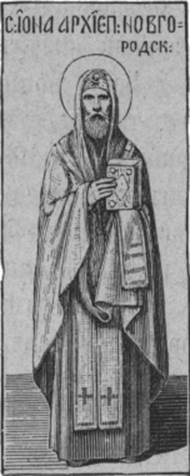
«Остался я сиротою», так рассказывал сам св. Иона, в мире Иоанн, «после отца семи лет, а после матери трех лет. Бог положил на сердце вдовице Наталии, матери Якова Дмитриевича Медоварцева: взяла она меня в свой дом, кормила и одевала, и отдала меня дьяку учиться грамоте. В училище было множество учащихся; я от бедности был тихий. В один день дети играли после вечерни; идет по улице блаженный муж; дети, кинувшись на него, бросали в него камешки и в глаза сор; а я стоял не трогаясь с места. Блаженный, оставив детей, прибежал ко мне, взял меня за волосы, поднял выше себя и, вовсе не зная меня, называл меня по имени: «Ванюша! говорил, учись грамоте, быть тебе в Новгороде архиепископом». Потом обнял Ваню и убежал. Это был блаженный Михаил Клопский38. В зрелых летах Иоанн удалился в Отню пустынь, за 50 верст от Новгорода; пустынь тогда была бедная и еще недавно основана удалившимся с юга от гонений архимандритом Харитоном39. Здесь Иоанн принял пострижение с именем Ионы. За жизнь чистую и подвижническую, братия, по смерти основателя Харитона, избрали Иону в игумена. Новгородцы, увидев бескорыстное усердие нового настоятеля к своей обители, полюбили игумена и обитель и стали щедро благотворить последней. В 1452 г. в бедной Отней пустыни построен великолепный каменный храм трех святителей. Искусные живописцы, лучшие того времени, написали иконы для иконостаса; стены храма также были с св. изображениями; св. сосуды – серебряные, украшены были каменьями; св. Евангелие обложено было дорогим окладом40.
"I was left an orphan," so the holy Jonah himself, in the world John, related, "after my father at seven years of age, and after my mother at three years. God put it into the heart of the widow Natalia, the mother of James Dmitrievich Medovartsev: she took me into her home, fed and clothed me, and gave me to a clerk to learn to read and write. In the school there were many pupils; I, from poverty, was quiet. One day the children were playing after Vespers; a blessed man was walking along the street; the children, rushing upon him, threw pebbles and dirt into his eyes; but I stood without moving from my place. The blessed one, leaving the children, ran up to me, took me by the hair, lifted me above himself, and, not knowing me at all, called me by name: 'Vanyusha! Learn to read and write; you are to be archbishop in Novgorod.' Then he embraced Vanya and ran away. This was the blessed Michael of Klopsk38. In his mature years John withdrew to the Otnya Hermitage, 50 versts from Novgorod; the hermitage was then poor and had only recently been founded by Archimandrite Chariton, who had withdrawn from the south fleeing persecution39. Here John received the tonsure with the name Jonah. For his pure and ascetic life, the brethren, after the death of the founder Chariton, chose Jonah as abbot. The Novgorodians, seeing the disinterested zeal of the new superior for his monastery, came to love the abbot and the monastery and began to give generous alms to the latter. In 1452, a magnificent stone church of the Three Hierarchs was built in the poor Otnya Hermitage. Skilled iconographers, the best of that time, painted the icons for the iconostasis; the walls of the church were also adorned with holy images; the sacred vessels were of silver, decorated with precious stones; the holy Gospel was bound in a costly cover40.
В 1458 г. Новгородцы избрали ревностного игумена Иону в архиепископа Новгороду и в февр. 1459 г. он посвящен был в Москве первосвятителем Ионою41. Едва возвратился он в Новгород, как насилия гордого Римского владыки произвели тревогу на юго-западе России и в Москве: из Рима прибыл в Литву любимец Исидора Григорий, посвященный униатом Григорием Маммою в митрополита России. Святитель Иона прислал Новгородскому архипастырю грамоту с убеждениями охранять себя и свою паству от сношений с посланцем хищного Рима42. Блаженный архипастырь в первое свое время вдвойне должен был трудиться. Он пересмотрел дела, оставшиеся некончеными после предшественника его, и следил за лицами сомнительными. К утешению паствы показал он в суде столько же правды, не взирающей на знатность и богатство, сколько снисхождения к немощам43. Особенно же, помня свое сиротство, употребил он меры для призрения сирот и для успокоения беспомощных вдов. «Вдовичьи уста благословили тебя, блаженный святитель, удостоившись твоей защиты; благоугождал ты Богу, по примеру Иова, и избавлял обижаемых от насилия», так пост ему Церковь44.
In 1458, the Novgorodians chose the zealous Abbot Jonah as archbishop for Novgorod, and in February 1459 he was consecrated in Moscow by the First Hierarch Jonah41. Scarcely had he returned to Novgorod when the violence of the proud Roman pontiff caused alarm in southwestern Russia and in Moscow: from Rome there arrived in Lithuania the favorite of Isidore, Gregory, consecrated by the Uniate Gregory Mammas as metropolitan of Russia. Hierarch Jonah sent a letter to the Novgorod archpastor with exhortations to guard himself and his flock from relations with the envoy of rapacious Rome42. The blessed archpastor in his early time had to labor doubly. He reviewed the cases left unfinished after his predecessor and kept watch over persons of doubtful character. For the consolation of his flock, he showed in judgment as much justice, which does not regard rank and wealth, as condescension to infirmities43. Especially, remembering his own orphanhood, he took measures for the care of orphans and for the comforting of helpless widows. "The lips of widows blessed you, O blessed hierarch, having been vouchsafed your protection; you pleased God, after the example of Job, and delivered the oppressed from violence," so the Church sings to him44.
В янв. 1460 г. прибыл в Новгород в. к. Василий с сыновьями своими, Юрием и Андреем. – На этот раз прибыл он сюда мирный, с ласками любви, чтобы поклониться святыне Новгородской и получить дань; а прежде того два раза приходил он сюда с грозным гневом на приязнь Новгорода к Шемяке. Новгородцы и теперь составили было заговор убить кн. Василия. «Безумцы! сказал бл. архипастырь, явясь в собрание их, если убьете вы великого князя, что выиграете? Больше горя и бед для Новгорода. Старший сын его Иоанн, услышав о злодействе вашем, явится против вас с сильным войском и опустошит вашу страну». Заговорщики поняли свое положение. – Новгородцы приняли великого князя с почестями и уважением45. Блаж. архипастырь с своей стороны оказывал всю любовь и уважение к в. князю. Молитвы угодника Божия Варлаама более всего расположили в. князя в пользу Новгорода. Во время пребывания в. князя в Новгороде совершилось чудо. Молодой человек. княжеский постельничий, сделался так болен, что лежал несколько часов мертвым; но при гробе пр. Варлаама ожил и стал здоровым. Москвичи, вел. князь, сыновья его и бояре видели это чудо и должны были сознаться, что Новгород – под покровом неба. Святитель Иона тогда же положил предать памяти потомства это дивное событие46.
In January 1460, Grand Prince Basil arrived in Novgorod with his sons, Yuri and Andrew. – This time he came here peacefully, with caresses of love, to venerate the holy things of Novgorod and to receive tribute; but before that he had come twice with terrible anger at Novgorod's friendship with Shemyaka. The Novgorodians even now formed a plot to kill Prince Basil. "Madmen!" said the blessed archpastor, appearing at their gathering, "if you kill the Grand Prince, what will you gain? More grief and woes for Novgorod. His elder son John, hearing of your villainy, will appear against you with a strong army and will lay waste your land." The conspirators understood their situation. – The Novgorodians received the Grand Prince with honors and respect45. The blessed archpastor for his part showed all love and respect to the Grand Prince. The prayers of the man of God, Venerable Barlaam, disposed the Grand Prince most of all in favor of Novgorod. During the Grand Prince's stay in Novgorod a miracle occurred. A young man, the prince's bedchamber attendant, became so ill that he lay dead for several hours; but at the tomb of Venerable Barlaam he revived and became well. The Muscovites, the Grand Prince, his sons, and the boyars saw this miracle and had to confess that Novgorod is under the protection of heaven. Hierarch Jonah then resolved to commit this wondrous event to the memory of posterity46.
Вел. князь, прощаясь с Новгородом, пригласил св. Иону в Москву. Нельзя было не выполнить этого желания в. князя и по уважению к нему, а еще более по любви к Новгороду. Святитель отправился в Москву с тяжеловесными дарами для вел. князя: это была и дань благодарности за посещение Новгорода и просьба о милости. Москва приняла добродетельного архипастыря с великими почестями: за несколько верст от Москвы встретили его бояре и почетные люди. Первосвятитель России Иона также принял его с любовию. Когда Новгородский архиепископ отправился к в. князю, был он встречен на дворе боярами, а по лестнице вели его под руки сыновья вел. князя; сам вел. князь взял его за руку и ввел в свои палаты и, «елики тяжести даров принесены быша архиепископом, радостно прият князь». В одно из последующих посещений вел. князь сильно жаловался архиепископу на граждан Новгорода и грозил наказать Новгород войною. Архиепископ-патриот упрашивал вел. князя не поднимать оружия, от которого могут пострадать невинные. «Если государь, не взирая на мольбу мою, говорил архипастырь, поднимет руку на невинных: то пусть не забывает, что между детьми его поднимутся раздоры зависти. Конец жизни твоей, князь, не далек. За счастие наследника твоего я и паства моя будут усердно молить Бога, – Он пошлет ему свободу от тяжестей власти ордынской, укрепит и распространит державу его». Обещание свободы от ордынских царей обрадовало великого князя, и он дал слово быть милостивым к Новгороду. Старец-архиепископ заплакал и плакал горько. Великий кн. и митрополит в удивлении спрашивали о причине скорби. «Кто в состоянии унизить и смирить такой сильный и многолюдный город мой, говорил архипастырь, если не низложат его раздоры граждан? По крайней мере при мне да даст Господь тишину и мир людям моим!» Архипастырь испросил у в. к. милость для любимой Отней пустыни – «свой суд»47.
The Grand Prince, taking leave of Novgorod, invited St. Jonah to Moscow. It was impossible not to fulfill this desire of the Grand Prince, both out of respect for him and even more out of love for Novgorod. The hierarch set out for Moscow with weighty gifts for the Grand Prince: this was both a tribute of gratitude for his visit to Novgorod and a petition for mercy. Moscow received the virtuous archpastor with great honors: several versts from Moscow the boyars and honorable people met him. The First Hierarch of Russia, Jonah, also received him with love. When the Novgorod archbishop went to the Grand Prince, he was met in the courtyard by the boyars, and up the stairs he was led by the arms by the sons of the Grand Prince; the Grand Prince himself took him by the hand and led him into his chambers, and "however great the weight of gifts brought by the archbishop, the prince received them joyfully." On one of the subsequent visits, the Grand Prince complained bitterly to the archbishop about the citizens of Novgorod and threatened to punish Novgorod with war. The archbishop-patriot begged the Grand Prince not to raise arms, from which the innocent might suffer. "If, O sovereign, despite my entreaty," said the archpastor, "you raise your hand against the innocent, then let him not forget that among your children quarrels of envy will arise. The end of your life, O prince, is not far. For the happiness of your heir, I and my flock will earnestly pray to God – He will send him freedom from the burdens of the Horde's power, and will strengthen and extend his dominion." The promise of freedom from the Horde tsars rejoiced the Grand Prince, and he gave his word to be merciful to Novgorod. The elder-archbishop wept, and wept bitterly. The Grand Prince and the Metropolitan asked in astonishment about the cause of his grief. "Who is able to humble and bring low such a strong and populous city of mine," said the archpastor, "if the discord of its citizens does not overthrow it? At least during my lifetime may the Lord grant peace and quiet to my people!" The archpastor obtained from the Grand Prince a favor for his beloved Otnya Hermitage – "its own court"47.
По определению Московского собора 1460 г. логофет Пахомий, образованный Афонский инок, написал житие св. Алексия48. Блаж. архиепископ, по согласию с первосвятителем, поручил тому же Пахомию составить жизнеописание и службы Новгородским святым, щедро одарив его средствами к жизни, подарками и пособиями для труда. Прежде всего пересмотрено было житие с чудесами преп. Варлаама; потом составлены жития Евфимия и Моисея архиепископов49, преп. Саввы Вишерского и благ. княгини Ольги50, далее службы преп. Онуфрию, Предтече, св. Евфимию, преп. Савве, князю Гавриилу, Чирской иконе Богоматери51. – До нас дошло и несколько Богослужебных книг, писанных по « благословению архиепископа Ионы»52.
By the decree of the Moscow Council of 1460, the logothete Pachomius, an educated Athonite monk, wrote the Life of St. Alexis48. The blessed archbishop, in agreement with the First Hierarch, commissioned the same Pachomius to compose the Lives and services of the Novgorod saints, generously providing him with means of livelihood, gifts, and assistance for his work. First of all, the Life with miracles of Venerable Barlaam was revised; then the Lives of Euthymius and Moses, the archbishops49, of Venerable Sabbas of Vishera and of the Right-believing Princess Olga50 were composed; further, services to Venerable Onuphrius, to the Forerunner, to St. Euthymius, to Venerable Sabbas, to Prince Gabriel, and to the Chira Icon of the Mother of God51. – Several liturgical books written by "the blessing of Archbishop Jonah" have also come down to us52.
Пред кончиною своею (март 1461 г.) великий Московский святитель Иона желал видеть в Москве блаж. архиепископа, для совета о своем преемнике и с мыслию о назначении его на эту кафедру. Смиренный архиепископ отвечал: «я уже стар, ноги у меня слабы, не могу исполнить желания твоего, святой отец; увидимся в той жизни». – Он послал только обыкновенное согласие свое на избрание того, кто признан будет за достойного собором53. – Новый митрополит Феодосий прислал Новгородскому архиепископу подтверждение охранять паству от сношений с униатом Григорием54. – Не оставляя забот о своей пастве, св. Иона обратил заботливую любовь свою на Отнюю пустынь. В 1462 г. построил он в ней каменный храм в честь св. Предтечи и в том же храме придел в честь св. Онуфрия. В следующем году построили там же теплый каменный храм св. Николая с братскою трапезою. Отняя пустынь усердием святителя из бедной становилась очень достаточною: он подарил ей несколько земель и рыбных озер, которые купил на свой счет55.
Before his death (March 1461), the great Moscow Hierarch Jonah desired to see the blessed archbishop in Moscow, for counsel concerning his successor and with the thought of appointing him to that see. The humble archbishop answered: "I am already old, my legs are weak, I cannot fulfill your desire, holy father; we shall see each other in that life." – He sent only his usual consent to the election of him who would be deemed worthy by the council53. – The new Metropolitan Theodosius sent to the Novgorod archbishop a confirmation to guard the flock from relations with the Uniate Gregory54. – Not abandoning his care for his flock, St. Jonah turned his solicitous love to the Otnya Hermitage. In 1462 he built in it a stone church in honor of the holy Forerunner, and in the same church a side-chapel in honor of St. Onuphrius. In the following year, a warm stone church of St. Nicholas was built there with a fraternal refectory. Through the zeal of the hierarch, the Otnya Hermitage from being poor became very well-provided: he gave it several lands and fishing lakes, which he purchased at his own expense55.
На великокняжеском престоле сидел уже (с апр. 1462 г.) И сын Василия Иоанн III. По некоторым делам видели в Новгороде, что новый великий князь недоволен Новгородом. Блаж. архиепископ решился (1463 г.) отправиться в Москву. – Иоанн принял добродетельного пастыря почтительно, просил молитв его за себя и напомнил ему обещание свободы от орды. Святитель отвечал: «не оставит Господь без внимания слезной молитвы стольких угнетенных, рассеет орду, какими судьбами знает, лишь бы государь пребыл в благочестии и тихими очами надзирал за своею областию». – Вместе с тем напомнил он великому князю, что отец его, твердо веря в скорую свободу отчизны от власти Татарской, и в духовном завещании писал не требовать с Новгородской области той дани, которая назначалась для орды56. М. Феодосий принял Новгородского архипастыря с особенною любовию. Он утвердил своею грамотою иерархические права архиепископа и внушал как духовенству, так мирянам, отдавать ему все должное57. – С своей стороны Новгородский архипастырь еще на пути в Москву дал обещание построить в Новгороде храм преп. Сергию, которому дотоле не было посвящено ни одного храма в Новгороде, и, возвратясь в Новгород, устроил и освятил в своем доме храм св. Сергию. На целой поныне иконе Сергия преподобный изображен в пояс, благословляющим именословно58. – Нельзя не остановиться вниманием на том, что храм преп. Сергию был единственный, построенный св. Ионою в Новгороде, а его предшественники так усердно строили новые храмы! Что это значит? То, что как предшественники св. Ионы видели нужду в храмах новых для Новгорода, так св. Иона в свое время уже не видел этой нужды. При св. Ионе было в Новгороде более 200 храмов, в том числе 100 каменных.
On the grand-princely throne there already sat (from April 1462) the son of Basil, John III. From certain affairs they saw in Novgorod that the new Grand Prince was displeased with Novgorod. The blessed archbishop resolved (in 1463) to set out for Moscow. – John received the virtuous pastor with respect, asked for his prayers for himself, and reminded him of the promise of freedom from the Horde. The Hierarch answered: “The Lord will not leave without heed the tearful prayer of so many oppressed; He will scatter the Horde, by what destinies He knows, only let the sovereign abide in piety and with quiet eyes oversee his domain.” – At the same time he reminded the Grand Prince that his father, firmly believing in the speedy freedom of the fatherland from the power of the Tatars, had written even in his spiritual testament not to demand from the Novgorod region that tribute which was appointed for the Horde56. Metropolitan Theodosius received the Novgorod archpastor with especial love. He confirmed by his charter the hierarchical rights of the archbishop and enjoined both the clergy and the laity to render him all that was due57. – For his part, the Novgorod archpastor, while still on the way to Moscow, gave a promise to build in Novgorod a church to the Venerable Sergius, to whom until then not a single church had been dedicated in Novgorod, and, having returned to Novgorod, he built and consecrated in his own house a church of St. Sergius. On an icon of Sergius preserved to this day, the Venerable One is depicted half-length, blessing with the name-forming blessing58. – One cannot but pause with attention on the fact that the church of the Venerable Sergius was the only one built by St. Jonah in Novgorod, while his predecessors had so zealously built new churches! What does this mean? It means that just as the predecessors of St. Jonah saw the need for new churches for Novgorod, so St. Jonah in his time no longer saw this need. Under St. Jonah there were in Novgorod more than 200 churches, including 100 of stone.
При св. Ионе Новгород наслаждался гражданским покоем. Иоанн III уважал святителя до гроба его и даже защищал древние права его на Псков. В 1464 г. Псков два раза присылал послов своих в Москву упрашивать великого князя о том, дабы посвящен был в Москве особый архипастырь для Пскова. Иоанн сперва отвечал, что это – дело великое и требует соборного рассмотрения59; потом, по сношении с митрополитом, объявил решительный отказ Пскову; а митрополит, с своей стороны, послал грамоту с строгим осуждением тщеславию Псковитян. Блаж. Иона старался смягчить своею любовию недовольство Псковитян на зависимость их от Новгородского владыки. Два года пользовались они землями и водами Новгородской кафедры; архипастырь не требовал от них никакого вознаграждения, когда в 1465 г. изъявили они ему свою покорность60. В следующем году отправился он к ним во Псков, и они встретили его с честию; он пробыл месяц у них, совершал служения, решал судебные дела, собрал обычные приношения о церквей и на четвертой неделе с почетом выехал в Новгород61.
Under St. Jonah, Novgorod enjoyed civil peace. John III respected the Hierarch until his grave and even defended his ancient rights over Pskov. In 1464, Pskov twice sent its envoys to Moscow to beseech the Grand Prince that a special archpastor might be consecrated in Moscow for Pskov. John at first answered that this was a great matter and required conciliar consideration59; then, after communication with the metropolitan, he declared a decisive refusal to Pskov; and the metropolitan, for his part, sent a charter with strict condemnation of the vanity of the Pskovites. Blessed Jonah strove to soften by his love the discontent of the Pskovites at their dependence on the Novgorod lord. For two years they enjoyed the lands and waters of the Novgorod cathedra; the archpastor demanded no recompense from them when in 1465 they expressed their submission to him60. In the following year he set out to them in Pskov, and they received him with honor; he stayed a month with them, performed services, decided judicial matters, gathered the customary offerings from the churches, and in the fourth week departed with honor for Novgorod61.
В конце 1466 г. Новгородская паства довольно страдала от моровой язвы; а в 1467 г. язва разразилась над нею в ужасающем виде. В одном Новгороде число умерших простиралось до 48,000 человек, в том числе монахов и монахинь умерло 7650 и 300 приходских священников; во всех Новгородских пятинах похищено заразою 250,652 человека. Можно представить себе, какою скорбию сокрушалось сердце доброго, патриотического архипастыря. Он плакал и молился день и ночь. В тяжкой скорби о пастве услышал он голос: «иди крестным ходом в Неревский конец, где явился образ Богоприимца Симеона, и мор перестанет». В Зверином девичьем монастыре, в Неревском конце, была тогда обширная скудельница, для погребения несчастных. Святитель крестным ходом отправился в Зверин монастырь, совершил коленопреклонное моление пред явленною иконою праведника об утолении гнева Божия, освятил обыденный храм в честь праведника и отслужил литургию. Затем мор прекратился62.
At the end of 1466, the Novgorod flock suffered considerably from a plague; and in 1467 the plague broke out upon it in a terrifying form. In Novgorod alone the number of the dead reached 48,000 persons, including 7,650 monks and nuns who died, and 300 parish priests; in all the Novgorod pyatinas, the contagion carried off 250,652 persons. One can imagine with what grief the heart of the good, patriotic archpastor was crushed. He wept and prayed day and night. In heavy sorrow for his flock, he heard a voice: “Go in a cross procession to the Nerevsky End, where the icon of the God-receiver Simeon has appeared, and the plague will cease.” In the Zverin Convent, in the Nerevsky End, there was then a large common grave for the burial of the unfortunate. The Hierarch set out in a cross procession to the Zverin Monastery, performed a kneeling prayer before the revealed icon of the righteous one for the appeasement of God’s wrath, consecrated a one-day church in honor of the righteous one, and served the Divine Liturgy. Then the plague ceased62.
В 1469 г. Псков еще раз потревожил своего архипастыря. По случаю бедствий моровой язвы и голода духовные Пскова предложили на вече поддержать благочестие, ослабевшее между прочим и от худой жизни вдовых священников и диаконов. На вече учреждено духовное управление, независимое от архиепископа, и постановлено удалять вдовых священнослужителей от священнодействия. Святитель, дряхлый от лет, поспешил во Псков. Его приняли с уважением; но когда сказал он, что незаконное управление должно быть заменено законным, ему отвечали, что беспорядки духовенства велики, требуют самого близкого надзора. Добродушный архипастырь отвечал: вижу, дети, что и на вашей стороне есть правда; пусть же решает дело св. митрополит63! Митрополит Филипп I прислал краткое увещание во Псков, и Псков снова подчинился управлению архиепископа. Святитель Иона вытребовал к себе всех вдовых священников и диаконов в Новгород и, по строгом испытании, выдал несомненным по поведению письменное дозволение священнодействовать, а прочих подверг запрещению64.
In 1469, Pskov once again troubled its archpastor. On the occasion of the calamities of the plague and famine, the clergy of Pskov proposed at the veche to support piety, which had weakened, among other things, from the bad life of widowed priests and deacons. At the veche, a spiritual administration independent of the archbishop was established, and it was decreed to remove widowed clergy from sacred ministry. The Hierarch, decrepit with years, hastened to Pskov. He was received with respect; but when he said that the unlawful administration must be replaced by a lawful one, they answered him that the disorders of the clergy were great and required the closest supervision. The good-natured archpastor answered: “I see, children, that on your side also there is truth; let St. Metropolitan decide the matter”63! Metropolitan Philip I sent a brief admonition to Pskov, and Pskov again submitted to the administration of the archbishop. Hierarch Jonah summoned to himself all the widowed priests and deacons to Novgorod and, after strict examination, issued to those unquestionable in conduct a written permission to perform sacred ministry, while the others he subjected to prohibition64.
Блаженный Иона, достигнув глубокой старости, почувствовал близость кончины и написал духовное завещание, в котором любимую свою пустынь поручал покровительству преемников своих, а свое бренное тело – пустыни. Причастившись св. Таин, он мирно почил 5 ноября 1470 г.65. Св. тело его положено было в могиле, им самнм приготовленной в Предтечевом храме Отней пустыни. Гроб остался навсегда незакрытым и чистое тело святителя не издавало запаха тления66.
Blessed Jonah, having reached deep old age, felt the nearness of his end and wrote a spiritual testament, in which he entrusted his beloved hermitage to the protection of his successors, and his mortal body to the hermitage. Having partaken of the Holy Mysteries, he peacefully reposed on November 5, 147065. His holy body was placed in a grave which he himself had prepared in the church of the Forerunner in the Otnya Hermitage. The grave remained forever uncovered, and the pure body of the Hierarch gave forth no odor of decay66.
Княжеские воины, проходя в г. Корелу, стали было грабить село Отней пустыни. Когда начальнику их объявили, что это село – собственность св. Ионы, он сказал: не трогать села, – великий святитель Иона спас меня от смертной казни, к которой присужден я был разгневанным царем. – Слуги стрелецкого головы Дмитрия Третьякова схватили богатого земледельца села монастырского Памфила и, вынуждая у него часть имения, засадили в оковы. Не ожидая ни откуда помощи на земле, молил он святителей Николая и Иону спасти его. И вот в тонком сне явились ему два мужа в светлых одеждах и сказали: «встань и иди отсюда». – «Я в оковах», ответил он. «Иди за нами>, говорили они. Пробудясь, не чувствовал он на себе оков, вслед за явившимися выскочил из комнаты и прибежал в дом. Множество больных исцелялось при гробе святителя, в том числе прозрели три слепца. Монастырский слуга Иаков был бесноватым и бегал в пустые места; скованного железами привели его в обитель; раз в келии заснул он; светлый муж в святительской одежде явился к нему и сказал: «Иаков! исцеляет тебя Господь Иисус мною, рабом Своим». И Иаков стал смысленным, покойным и здоровым. Это было в 1540 г.67. При митрополите Кирилле (1568–1572 г.) случился пожар в Отней пустыни. Двое из братий, вспомнив, что гроб святителя только закрыт досками, поспешили вынесть его из храма. Храм сгорел; пламя было вблизи гроба святителя, но мощи остались целы и невредимы. Тогда, по предложению Новгородского архиепископа, определено праздновать память св. чудотворца Ионы68.
Princely soldiers, passing through to the city of Korela, began to plunder the village of the Otnya Hermitage. When their commander was told that this village was the property of St. Jonah, he said: “Do not touch the village—the great Hierarch Jonah saved me from the death penalty to which I was condemned by the enraged Tsar.” – The servants of the streltsy commander Demetrius Tretyakov seized a wealthy farmer of the monastery village, Pamphilus, and, extorting from him a portion of his property, put him in chains. Expecting no help from anywhere on earth, he prayed to the Hierarchs Nicholas and Jonah to save him. And behold, in a light sleep two men in bright garments appeared to him and said: “Arise and go hence.” – “I am in chains,” he answered. “Come after us,” they said. Awaking, he felt no chains upon him, followed after those who had appeared, rushed out of the room, and ran home. A multitude of the sick were healed at the grave of the Hierarch, including three blind persons who received their sight. A monastery servant, James, was possessed by a demon and ran about in deserted places; they brought him bound with iron chains to the monastery; once in his cell he fell asleep; a bright man in hierarchal vesture appeared to him and said: “James! The Lord Jesus heals you through me, His servant.” And James became sensible, calm, and healthy. This was in the year 154067. Under Metropolitan Cyril (1568–1572), a fire occurred in the Otnya Hermitage. Two of the brethren, remembering that the grave of the Hierarch was only covered with boards, hastened to carry it out of the church. The church burned down; the flame was near the grave of the Hierarch, but the relics remained whole and unharmed. Then, at the proposal of the Novgorod archbishop, it was decreed to celebrate the memory of the holy wonderworker Jonah68.
Галактион был единственный сын богатых родителей, живших в городе Емесе в Сирии, в царствование Римского императора Декия. Это были язычники, но вероятно, по жизни своей, достойные особенного избрания и благословения Божия, которое выразилось в даровании им сына после того, как они, быв долго в супружестве, не имели детей и сильно скорбели об этом лишении. – В таком состоянии посетил их однажды христианский священник, именем Онуфрий, пришедший к ним в дом под видом нищего. Вступив в разговор с будущею матерью Галактиона, которая приветливо приняла его, он узнал от нее между прочим о том, что составляло предмет ее постоянного огорчения и желаний.
Galaction was the only son of wealthy parents who lived in the city of Emesa in Syria, during the reign of the Roman emperor Decius. They were pagans, but probably, by their life, worthy of especial election and blessing from God, which was expressed in the granting to them of a son after they, having been long in marriage, had no children and greatly grieved over this deprivation. – In such a state, a Christian priest, by name Onuphrius, once visited them, having come to their house under the guise of a beggar. Entering into conversation with the future mother of Galaction, who received him kindly, he learned from her, among other things, about that which was the subject of her constant sorrow and desires.
– Огорчение твое может исчезнуть и желание твое заветное может исполниться, – сказал старец, выслушав добрую женщину, которая простодушно сообщила ему свои задушевные впечатления, – если ты будешь молиться истинному Богу, Который один властен исполнить все по молитве прибегающих к Нему с верою... И, объяснив ей, как бессмысленны и напрасны упования язычников на их ложных богов, старец просветил ее познанием истинного Бога Иисуса Христа.
– “Your sorrow may disappear and your cherished desire may be fulfilled,” said the elder, having heard out the good woman, who had ingenuously shared with him her heartfelt impressions, “if you will pray to the true God, Who alone has power to fulfill all things according to the prayer of those who flee to Him with faith...” And, having explained to her how senseless and vain were the hopes of the pagans in their false gods, the elder enlightened her with the knowledge of the true God, Jesus Christ.
С горячностию восприняла темная язычница утешительное верование в благого и всемогущего Христа; немедленно, пока тайно от мужа, приняла св. крещение и с тех пор всю силу своей души изливала в пламенной молитве Богу – Творцу всех миров и человека. – И Богу угодны были молитвы новопросвещенной, и Он благословил ее дарованием ей сына. Иногда, после рождения его, отец пожелал принести благодарственную жертву богам, то жена решилась объяснить ему ложность богов, рассказала ему о том, как она пришла к познанию истинного Бога, и Бог помог ей просветить своего мужа христианскою истиною. Уверовав во Христа, он также принял крещение от пресвитера Онуфрия, и с тех пор в доме их установилось истинное христианское благочестие. Ревностно старались родители воспитать и сына их христианином, и святые старания их увенчались блаженным успехом. Галактион возрос в отчуждении от всяких земных пристрастий и, достигнув юношеского возраста, отличался смирением и чистотою душевною.
With fervor the dark pagan woman received the comforting faith in the good and almighty Christ; immediately, while still secretly from her husband, she received holy Baptism, and from that time poured out all the strength of her soul in fervent prayer to God—the Creator of all worlds and of man. – And the prayers of the newly-enlightened one were pleasing to God, and He blessed her by granting her a son. When, after his birth, the father wished to offer a thank-offering to the gods, the wife resolved to explain to him the falsity of the gods, told him how she had come to the knowledge of the true God, and God helped her to enlighten her husband with Christian truth. Having believed in Christ, he also received Baptism from the presbyter Onuphrius, and from that time true Christian piety was established in their house. Zealously did the parents strive to raise their son as a Christian, and their holy efforts were crowned with blessed success. Galaction grew up in estrangement from every earthly attachment and, having reached youthful age, was distinguished by humility and purity of soul.
Когда ему было 24 года, он, по желанию родителей своих, был обручен с девицею из семейства язычников, по имени Епистимою. Полюбив ее, Галактион поспешил доставить ей величайшее счастие – узнать Христа и полюбить Его выше всего. Посвящая постепенно свою прекрасную душою невесту в познание Божественного учения, Галактион успел представить ей во всем блеске красоту христианского понятия о девстве, успел довести ее до постижения той высоты, на которой стоят те, к кому, не принуждая и не обязывая, обращается слово Апостола: «могущий вместить да вместит»...
When he was 24 years old, he, according to the wish of his parents, was betrothed to a maiden from a pagan family, by the name of Epistima. Having come to love her, Galaction hastened to bestow upon her the greatest happiness—to know Christ and to love Him above all else. Gradually initiating his bride, beautiful of soul, into the knowledge of the divine teaching, Galaction succeeded in presenting to her, in all its splendor, the beauty of the Christian understanding of virginity; he succeeded in leading her to the comprehension of that height upon which stand those to whom, without compulsion and without obligation, the word of the Apostle is addressed: “He that is able to receive it, let him receive it”...
Епистима всею душою восприняла христианство. Галактион сам крестил ее и вместе с нею – одного из слуг своего тестя, по имени Евтолмия, которого он также успел привести к вере.
Epistima received Christianity with her whole soul. Galaction himself baptized her, and together with her, one of the servants of his father-in-law, by the name of Eutolmius, whom he had also succeeded in bringing to the faith.
После того, убежденная своим женихом, что для христиан не существует разлуки, но – вечное соединение в блаженном царстве Бога Отца, Епистима склонилась и на желание его – вместо брака посвятить себя им обоим иноческой жизни. Тогда скрылись они на пустынной горе Публион, близ Синая, и поселились: Галактион – в мужской общине, а Епистима – в женской, отстоящих одна от другой не на далеком расстоянии, где и предались они всецело служению Богу. Так и жили они, не видясь друг с другом, но не разрывая духовной связи, соединявшей их, которая, впрочем, не замедлила превратиться в общение вечное в ином мире...
After that, being persuaded by her betrothed that for Christians there is no separation, but rather an eternal union in the blessed kingdom of God the Father, Epistima also inclined to his desire—that instead of marriage they should both dedicate themselves to the monastic life. Then they hid themselves on the desolate Mount Publion, near Sinai, and settled: Galaction in a male community, and Epistima in a female one, situated at no great distance from each other, where they gave themselves wholly to the service of God. Thus they lived, not seeing one another, yet not breaking the spiritual bond that united them—a bond which, however, was not slow to be transformed into eternal communion in the other world...
Правитель той страны, узнав о монастырях на горе Публион и о скрывающихся в них христианах, которых гнали и преследовали по указу Декия, послал воинов захватить их всех. Поспешили скрыться в пустынях иноки и инокини... Остался в своей келии Галактион, и воины застали его погруженным в чтение св. Писания; они взяли его и привели к правителю. Узнав о том, Епистима умолила игумению отпустить ее, чтобы вместе с обрученным претерпеть мучения за Христа и предстать соединенными пред лице Того, ради Которого они расстались на земле...
The governor of that country, having learned of the monasteries on Mount Publion and of the Christians hiding in them, who were being persecuted and pursued by decree of Decius, sent soldiers to seize them all. The monks and nuns hastened to hide in the deserts... Galaction remained in his cell, and the soldiers found him immersed in the reading of Holy Scripture; they took him and brought him to the governor. Having learned of this, Epistima besought the abbess to release her, so that together with her betrothed she might endure sufferings for Christ and appear united before the face of Him for Whose sake they had parted on earth...
Сделав допрос Галактиону и убедившись в твердости его христианского исповедания, правитель велел истязать его побоями. Тогда неустрашимо стала укорять правителя Епистима за то, что он с такою жестокостию мучает невинного. Истязания были ответом доблестной христианке; она переносила их, славя Бога. Многие, пораженные ее величием в страдании, уверовали в ее Бога... Еще более раздраженный этим правитель изощрил испытания христиан: он велел вбить им под ногти рук и ног острые спицы и потом отрубить им руки и ноги. Мученики же с непоколебимым терпением переносили пытки, продолжая славословить своего Бога. Тогда вырваны у них были языки...
Having interrogated Galaction and being convinced of the firmness of his Christian confession, the governor ordered him to be tortured with beatings. Then Epistima fearlessly began to reproach the governor for tormenting an innocent man with such cruelty. Tortures were the answer to the valiant Christian woman; she endured them, glorifying God. Many, struck by her majesty in suffering, believed in her God... Even more enraged by this, the governor intensified the trials of the Christians: he ordered sharp spikes to be driven under the nails of their hands and feet, and then their hands and feet to be cut off. The martyrs, however, with unshakable patience endured the torments, continuing to praise their God. Then their tongues were torn out...
Евтолмий инок, бывший слуга родителей Епистимы, взял тайно останки мучеников и, положив их в драгоценный сосуд, сделал предметом общего чествования. Он же написал и житие мучеников Галактиона и Епистимы, в котором говорит о себе, как о свидетеле и сожителе святых69.
The monk Eutolmius, the former servant of Epistima’s parents, secretly took the remains of the martyrs and, placing them in a precious vessel, made them an object of general veneration. He also wrote the Life of the martyrs Galaction and Epistima, in which he speaks of himself as a witness and fellow-dweller of the saints69.
Пролог нояб. 5. Волокол. записка у Карамз. 5 пр. 386. «Воспоминание о блаж. Ионе» (изд. в 4 т. памятн. р. литер. 27–35) говорит о св. Ионе: «иже в сиявшу пред очима нашима, добродетелей его и благодеяния все мы припмателе и свидетеле суще». – По этим словам можно думать, что воспоминание писано вскоре после кончины св. Ионы, – одвим из свидетелей жизни его. – Но а) в воспоминании есть несколько хронологических неточностей, не совсем уместных в описании современника. – б) О делах св. Ионы времени в. к. Иоанна в воспоминании почти ничего не сказано, что опять странно в современном описании. – в) В конце жития сказано: «многа исцеления бываху от телесе святого отца да и до днесь». – А по описанию чудес первое чудо совершилось около 1540 г. при Иоанне Грозном. – г) Наконец, старший список воспоминания, синодальный, писан 1608 г. Впрочем, сочинитель имел в руках записки о св. Ионе. «Малая инии оставиша, большая памяти писавшей; елика тии оставиша, аки мала, и не вписаша, к прочим своим письменам приложихом.
Prologue, November 5. Volokolamsk note in Karamzin 5, note 386. “The Memorial of the Blessed Jonah” (published in vol. 4 of Pamyatniki russkoi literatury, pp. 27–35) says of St. Jonah: “who shone before our eyes, of whose virtues and benefactions we are all recipients and witnesses.” – From these words one may think that the Memorial was written soon after the repose of St. Jonah, by one of the witnesses of his life. – But a) in the Memorial there are several chronological inaccuracies, not entirely appropriate in the description of a contemporary. – b) Of the deeds of St. Jonah during the time of Grand Prince John, almost nothing is said in the Memorial, which again is strange in a contemporary account. – c) At the end of the Life it is said: “many healings were wrought from the body of the holy father even to this day.” – And according to the description of miracles, the first miracle occurred around 1540 under John the Terrible. – d) Finally, the oldest copy of the Memorial, the Synodal one, was written in 1608. However, the author had in his hands notes about St. Jonah. “Some left little, the greater memory being written; as many as those left, as if little, and did not inscribe, to the rest of their writings we have added.”
В 1408 г. «постави Харитон архимандрит Киевский церковь древяну трех святитель, на Красном острове» (Собр. л. IV, 111). В 1420 г. «поставлены две церкви древяных в Отни пустыуи Николая чуд. и Онуфрия вел. на Красном острове, а строил архимандрит Харитон» (Собр. л. III, 217. IV, 119). По всей вероятности, архим. Харитон прибыл из Киева вместе с Черниговскими боярами и князем Свидригайлом, пришедшими в Москву весною 1408 г. (Собр. л. V, 257. VI, 136). Этим не решаются недоумения о. Макария (Новгород. древн.1:634).
In 1408, “Archimandrite Chariton of Kiev built a wooden church of the Three Hierarchs on Krasny Island” (Collection of Chronicles IV, 111). In 1420, “two wooden churches were built in the Otnya Hermitage, of St. Nicholas the Wonderworker and of St. Onuphrius the Great, on Krasny Island, and Archimandrite Chariton built them” (Collection of Chronicles III, 217; IV, 119). In all probability, Archimandrite Chariton arrived from Kiev together with the Chernigov boyars and Prince Svidrigailo, who came to Moscow in the spring of 1408 (Collection of Chronicles V, 257; VI, 136). This does not resolve the perplexities of Fr. Macarius (Novgorod Antiquities 1:634).
Никон. л. V, 284. 285. В уставе синод. библ. XV в. «в л. 6966 (1458) преставись Евфимий мар. 11; того ж мес. марта в 19 д. возведен быст на владычество Иона, игумен Отенский».
Nikon Chronicle V, 284, 285. In the Typikon of the Synodal Library of the 15th century: “In the year 6966 (1458), Euthymius reposed on March 11; of the same month, on March 19, Jonah, Abbot of Otnya, was elevated to the bishopric.”
По благословению преосвященного господина и осподаря архиепископа в. Новгорода и Пскова, владыки Ионы, написана урядная грамота поселенцами Робичинской волости Юрьева монастыря и настоятелем Григорием. По содержанию ее видно, что пред тем был спор с монастырем. Грамота напеч. в чтен. общ. ист. 1861 г.
By the blessing of the Most Reverend Lord and Master, Archbishop of Great Novgorod and Pskov, Vladyka Jonah, a charter of regulation was written by the settlers of the Robichino district of the Yuriev Monastery and the superior Gregory. From its content it is evident that there had been a dispute with the monastery beforehand. The charter is printed in Readings of the Society of History, 1861.
Румянц. муз. стр. 204. 761. Буслаев (летоп. литер. III, 87) ошибается, думая, что Москва по примеру Новгорода стала описывать жития святых.
Rumyantsev Museum, pp. 204, 761. Buslaev (Chronicle of Literature III, 87) is mistaken in thinking that Moscow, following the example of Novgorod, began to write Lives of saints.
Муз. Румянц. 592–595. 597. 704. Службы Предтече и пр. Онуфрию писаны без сомнения ко времени освящения храмов Предтече и Онуфрию в Отней пустыне, совершавшемуся в 1462 г. Прим. 72.
Rumyantsev Museum 592–595, 597, 704. The services to the Forerunner and to St. Onuphrius were written without doubt for the time of the consecration of the churches of the Forerunner and of St. Onuphrius in the Otnya Hermitage, which took place in 1462. Note 72.
Собр. лет. III, 241. Воспоминание ст. 30 путает тут события, относя к тому же времени построение Тресвятительского храма.
Collection of Chronicles III, 241. The Memorial, p. 30, confuses the events here, attributing the building of the Church of the Three Hierarchs to the same time.
Собр. лет. III, 114. Минея нояб. М. 1645 г. Макария древности 1, 105. 2, 105. Воспоминание, а за ним вслед Костомаров ошибочно относят построение Сергиева храма к возвращению из первого путешествия в Москву.
Collection of Chronicles III, 114. Menaion for November, Moscow, 1645. Macarius, Antiquities 1, 105; 2, 105. The Memorial, and following it Kostomarov, erroneously attribute the building of the Church of St. Sergius to the return from the first journey to Moscow.
Собр. лет. III, 141. IV, 127. 132. 229. 230. V, 230. 374. Выписка из Никольского летописца в ж. м. просв. час. 80.
Collection of Chronicles III, 141; IV, 127, 132, 229, 230; V, 230, 374. Extract from the Nikolsky Chronicler in Journal of the Ministry of Public Education, part 80.
Повесть о чудесах, св. Иона называется св. чудотворцем в грам. 1563 г. (Ист. акт. 1, 320). Служба св. Ионе – у Царского, № 564, у Румянцева, № 397. В Минее на ноябрь мес. М. 1645 г. сл. Макария древности 1, 197.
Tale of the Miracles; St. Jonah is called a holy wonderworker in a charter of 1563 (Historical Acts 1, 320). The service to St. Jonah is in Tsarsky, No. 564, and in Rumyantsev, No. 397. In the Menaion for the month of November, Moscow, 1645; see Macarius, Antiquities 1, 197.