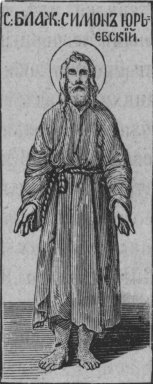
Блаж. Симон36, сын поселян, живших невдали от Юрьевца Поволгского, в молодых летах принял на себя иго юродства. Тайно ушел он из дома родительского в густой лес. Поселяне села Ялнатского увидели в лесу человека полунагого, в лохмотьях, но не могли допытаться от него, кто он и откуда. Из сострадания привели они его к священнику. В доме доброго пастыря послушливо занимался он работою и даже помогал другим в их работе, никогда не оставаясь праздным; он усердно посещал и храм Божий. Но, являясь малоумным, подвергался насмешкам и оскорблениям. Одна рубашка, зимою и летом, была одеждою его и земля служила постелью; обуви не носил он и в морозы. Так прожил он в Ялнатском 15 лет.
The Blessed Simon36, son of peasants who lived not far from Yuryevets on the Volga, took upon himself the yoke of foolishness-for-Christ in his youth. He secretly fled from his parents' house into a dense forest. Peasants of the village of Yalnatsk saw in the forest a man half-naked, in rags, but could not learn from him who he was or whence he came. Out of compassion they brought him to the priest. In the house of the good pastor he obediently occupied himself with work and even helped others in their labor, never remaining idle; he also diligently attended the church of God. But, appearing simple-minded, he endured mockery and insults. A single shirt, in winter and summer, was his clothing, and the earth served as his bed; he wore no footwear even in the frost. Thus he lived in Yalnatsk for fifteen years.
Перейдя в город Юрьевец, он здесь уже не имел никакого пристанища. По прежнему босой и полунагой, он скитался по улицам, собирая насмешки и оскорбления; только в жестокие морозы заходил он в корчемницу, но здесь встречал наглые толчки и шутки. Любимое место его была паперть того или другого храма, где проводил он время в молитве; особенно же любил он Богоявленскую обитель. Внимательные видали на глубоком снегу следы коленопреклонных молитв его. От суровой жизни кожа его совсем почернела и от поста прилипла к костям. Такими подвигами самоотречения дух его очистился и благодатно окреп, так что он видел, чего не видали другие.
Having moved to the town of Yuryevets, he no longer had any shelter there. As before, barefoot and half-naked, he wandered through the streets, gathering mockery and insults; only in severe frosts did he enter a tavern, but there he met with rude shoves and jokes. His favorite place was the porch of one church or another, where he spent his time in prayer; he especially loved the Monastery of the Theophany. Attentive people saw on the deep snow the traces of his kneeling prayers. From his harsh life his skin had become quite black, and from fasting it clung to his bones. By such feats of self-denial his spirit was purified and strengthened by grace, so that he saw what others did not see.
Раз юродствуя вошел он в дом воеводы Третьяка Трегуба; воевода разгневался на то, что вошел к нему такой нищий, и велел вытолкать его вон. Прогоняемый Симон намекнул на несчастие, ожидавшее воеводу: но за то подвергся новым побоям. На следующее утро жена Трегуба упала с крыльца дома и убилась до смерти. У гроба жены суровый воевода вспомнил о словах юродивого и, раскаявшись в своем поступке, стал уважать Симона. В другое время блаженный говорил: «молитесь, будет пожар». Но никто не обратил внимания на слова юродивого. Спустя несколько дней в полдень загорелся город. Третьяк вспомнил о словах Симона и послал отыскать его. Его нашли на паперти, со слезами молящимся пред иконою Богоматери. Воевода и другие просили его о помощи против страшной беды. Блаженный, юродствуя, ударил воеводу по щеке и указал на место самого сильного пламени, но этот пламень тотчас же погас. Юрьевецкий житель Зубарев, переплывая Волгу в ладье, на средине ее застигнут был сильною бурею и ладья его готова была потонуть. Увидав блаженного на берегу, он мысленно молил Симона помолиться о его спасении и обещал ему новую одежду и обувь. Буря утихла, но спасенный забыл о своем обещании. Спустя несколько времени Симон, встретясь с ним в уединенном месте, сказал ему: «ты забыл свое обещание, которое давал, как тонул в воде». Зубарев сознался в грехе своем и готов был немедленно исполнить обещание; но блаженный сказал: «мне не нужно, отдай нищим и не забывай их: милостыня избавляет от напастей».
Once, while acting the fool, he entered the house of the voivode Tretyak Tregub; the voivode grew angry that such a beggar had come to him and ordered him to be thrust out. As he was being driven out, Simon hinted at a misfortune awaiting the voivode; but for this he suffered new blows. The next morning Tregub's wife fell from the porch of the house and was killed. At his wife's grave the harsh voivode remembered the words of the fool and, repenting of his deed, began to respect Simon. At another time the blessed one said: "Pray, there will be a fire." But no one paid attention to the words of the fool. A few days later, at noon, the town caught fire. Tretyak remembered Simon's words and sent to find him. They found him on the porch, praying with tears before an icon of the Mother of God. The voivode and others asked him for help against the terrible calamity. The blessed one, playing the fool, struck the voivode on the cheek and pointed to the place of the strongest flame, and that flame immediately went out. A resident of Yuryevets, Zubarev, while crossing the Volga in a boat, was caught in the middle by a fierce storm, and his boat was about to sink. Seeing the blessed one on the shore, he mentally begged Simon to pray for his deliverance and promised him new clothing and footwear. The storm subsided, but the saved man forgot his promise. Some time later, Simon, meeting him in a solitary place, said to him: "You have forgotten your promise, which you made when you were drowning in the water." Zubarev confessed his sin and was ready to fulfill his promise immediately; but the blessed one said: "I do not need it; give it to the poor and do not forget them: almsgiving delivers from misfortunes."
Близкий к кончине своей, Симон зашел в дом нового воеводы Петелина. Тот, не зная его, избил его жестоко, до того, что блаженный заболел. Брошенный в подвале воеводы, упросил он слугу призвать духовника; как великой милости Божией обрадовался он, когда пришел священник с святыми Дарами; исповедался, приобщился святых Таин и предал дух свой Богу. Тело блаженного погребено было в Богоявленском монастыре, 4 ноября 1584 г.
Nearing his end, Simon entered the house of the new voivode, Petelin. The latter, not knowing him, beat him severely, so that the blessed one fell ill. Thrown into the voivode's cellar, he begged a servant to summon a confessor; he rejoiced as at a great mercy of God when the priest came with the Holy Gifts; he confessed, partook of the Holy Mysteries, and gave up his spirit to God. The body of the blessed one was buried in the Monastery of the Theophany, on November 4, 1584.
В 1619 г., при построении нового храма в обители, обрели гроб праведника. В то же время пришла женщина Соломония и просила отслужить панихиду о ее целителе Симоне. «Два года лежала я больною, говорила она, и уже желала смерти. Раз в тонкой дремоте явился мне некто в одной рубашке, босой, с волосами длинными и черными, с бородою круглою, и сказал: иди в Богоявленскую обитель, скажи священникам, чтоб отслужили панихиду над гробом Симона, – Господь исцеляет тебя по его молитве». Больная, мгновенно пробудясь, почувствовала себя здоровою. В 1635 г. Богоявленский игумен Дионисий донес патриарху о житии и чудесах Симона, равно и о многолюдном стечении народа к его гробу. Патриарх благословил написать икону Симона с сиянием. Игумен устроил и раку. – После того Юрьевцы много раз были свидетелями чудес блаж. Симона. Они чтят его, как молитвенника своего, и поныне, хотя обитель Богоявленская уже не существует37.
In 1619, during the construction of a new church in the monastery, the coffin of the righteous one was uncovered. At the same time a woman, Solomonia, came and asked that a panikhida be served for her healer Simon. "For two years I lay ill," she said, "and already desired death. Once, in a light slumber, there appeared to me someone in a single shirt, barefoot, with long black hair and a round beard, and said: 'Go to the Monastery of the Theophany, tell the priests to serve a panikhida over the grave of Simon—the Lord heals you through his prayer.'" The sick woman, instantly awakening, felt herself well. In 1635, the abbot of the Theophany Monastery, Dionysius, reported to the patriarch concerning the life and miracles of Simon, as well as the great multitude of people flocking to his grave. The patriarch blessed the painting of an icon of Simon with a halo. The abbot also had a shrine made. — After that, the people of Yuryevets were many times witnesses of the miracles of the blessed Simon. They honor him as their intercessor to this day, although the Monastery of the Theophany no longer exists.37
Действительно великим был тот, который, быв в заблуждении, умел раскаяться и исправиться; быв близок к почестям, которые могли бы выдвинуть его на блистательный путь и доставить человеческую славу, отвратился от нее и предпочел безъизвестность жизни в пустыне; не великим ли мог быть назван и тот, кто, чувствуя себя под влиянием сильной страсти – не поддался ей, а бросился почти в пасть вещественного змея, чтобы вырваться из пасти духовного змея – искусителя, и, проявив таким образом неоднократно величие своей светлой души, оказался на высоте величия, когда, не почувствовав ни малейшего озлобления против покушавшихся на жизнь его врагов, с любовию простил им, сам даже смиренно попросив у них прощения в том, что, быть может, невольно способствовал к их раздражению...
Truly great was he who, having been in error, knew how to repent and correct himself; having been close to honors that might have set him on a brilliant path and brought him human glory, turned away from it and preferred the obscurity of life in the desert. Could he not be called great who, feeling himself under the influence of a strong passion, did not yield to it, but threw himself almost into the jaws of a material serpent in order to tear himself from the jaws of the spiritual serpent—the tempter; and, having thus repeatedly manifested the greatness of his luminous soul, proved himself to be at the height of greatness when, feeling not the slightest malice toward enemies who had attempted his life, he forgave them with love, himself even humbly asking their forgiveness for having, perhaps unwittingly, contributed to their irritation...
Такова, в коротких словах, жизнь воспоминаемого сегодня церковию Иоанникия, или, вернее, таковы события, осветившие ее блистательными и неугасимыми лучами истинного величия.
Such, in brief words, is the life of Joannicius, commemorated today by the Church; or rather, such are the events that illumined it with the brilliant and inextinguishable rays of true greatness.
Утешительно заметить при знакомстве с этою жизнью то, что подготовилась и выработалась она самыми простыми и общедоступными средствами. Не в блистательной обстановке, изобилующей всякими воспитательными средствами, родился и провел свое детство блаженный Иоанникий; он даже не имел возможности познакомиться с грамотой, родившись в скромной доле сельского пастуха (в селении Марикатове, к северу от гор. Аполлониады).
It is comforting to note, when becoming acquainted with this life, that it was prepared and formed by the simplest and most accessible means. The blessed Joannicius was not born and did not spend his childhood in a brilliant setting abounding in every educational resource; he did not even have the opportunity to learn letters, having been born in the humble lot of a village shepherd (in the village of Marikatov, north of the city of Apollonias).
Здесь, среди прекрасной природы, природное его чувство подсказало ему познание ее Творца и внушило любовь к Нему; а любовь к Богу научила его истинной, лучшей сущности всякой науки и привела к достижению главных целей всякого человеческого знания: правды и добра.
There, amidst beautiful nature, his natural instinct suggested to him the knowledge of its Creator and inspired love for Him; and love for God taught him the true, best essence of all learning and led him to the attainment of the chief goals of all human knowledge: truth and goodness.
Часто, когда молодой пастух, пася свои стада, предавался созерцанию окружающих его дивных красот, то созерцание это возносило мысль его от бездушного создания к Душе всего мира – Богу Творцу, и, осенив знамением креста вверенных ему животных, непреодолимою силою он погружался в молитву и пребывал в ней ночи и дни, – а стадо его, как бы охраняемое молитвою беззаветно полюбившего Бога непорочного пастушка, мирно и безопасно паслось на лугах, и ни звери, ни люди худые не расхищали его.
Often, when the young shepherd, pasturing his flocks, gave himself up to the contemplation of the wondrous beauties surrounding him, this contemplation raised his mind from soulless creation to the Soul of all the world—God the Creator; and, having made the sign of the cross over the animals entrusted to him, with irresistible force he immersed himself in prayer and remained in it night and day—while his flock, as if guarded by the prayer of the blameless shepherd boy who loved God without reserve, peacefully and safely grazed in the meadows, and neither wild beasts nor evil men plundered them.
Достигнув совершенного возраста, Иоанникий был взят в военную службу. Кроткий и смиренный, вскоре приобрел он любовь своих молодых товарищей, и в то же время мужество Богу преданной души делало его отважным защитником своей родины, которую приходилось отстаивать от покушения или насилия врагов. Неустрашимостию и силою своею он обратил на себя внимание вождей и ему предстояли всякие награды и возвышения, но не к тому стремилась с детства проникнутая молитвенным возвышением к Богу его душа... К тому же в это время произошли такие случайности в жизни Иоанникия, которые окончательно определили дальнейшее направление ее. Среди своих товарищей почерпнул он сильно распространившееся тогда заблуждение против почитания святых икон, но Промыслом Божиим не остался без вразумления угодный Богу человек. Однажды, проходя с войском через Олимпийские горы, он встретил неизвестного инока, который, назвав его по имени, с укором спросил его: «как может он, будучи христианином, не почитать изображения Спасителя своего?» Сознав свое заблуждение, Иоанникий, постоянно стремившийся всего себя посвятить на служение Богу где-нибудь в пустынном уединении, окончательно решился оставить мир и обратился к одному святому подвижнику, прося его руководства на избранном пути; получив от старца совет пожить сначала в монастыре, Иоанникий два года провел в изучении обычаев разных обителей, выучился в это время грамоте и, подготовив себя подвигами послушания и смиренного отречения от своей воли, удалился в пустыню. Здесь поселился в землянке, где, питаясь скудною пищею, приносимою ему пастухом, целые дни и ночи проводил в молитве. Воспевая изученные им в монастыре псалмы Давидовы, он присоединял к ним олова: «упование мое – Отец, прибежище мое – Сын, покровитель мой – Дух Святой; Троица Святая, слава Тебе!» Эта молитва и теперь читается в Церкви. – Подвижническая жизнь Иоанникия не осталась в неизвестности, тем более, что Сам Бог прославил его даром прозорливости и чудотворений. Он исцелял больных; даже и душевные болезни побеждались его благотворным влиянием; многих еретиков обратил он от заблуждения. Между тем, благодетельствующий многим и не делающий зла никому, подвижник, не смотря на то, не избежал злобы завистников. Некто, иночествующий на той же горе Олимпийской, где подвизался Иоанникий, следя за возрастающею славою его, не мог ее переносить и, преисполнившись враждебного, завистливого чувства, задумал даже погубить прославляемого Богом и пользовавшегося великим почитанием людей... Однажды, во время бездождия, этот недостойный инок, по имени Епифаний, поджег сухую траву внизу той горы, на которой была землянка Иоанникия, окруженная также сухими деревьями, и вся гора быстро воспламенилась... Гибель подвижника, казалось, была неизбежна. Но Бог чудным образом сохранил его, и не только он сам не сгорел и не задохся от дыма, но даже его келия уцелела среди огня. Тогда, неспособный к обвинению ближнего и только самого себя обвиняя в том, что, может быть, как-нибудь неосторожно содействовал озлоблению его, Иоанникий пошел к своему недоброжелателю и просил его простить ему, если он в чем-нибудь виноват перед ним; но Даже и такое незлобие не тронуло и не возбудило раскаяния в злом завистнике, который бросился на святого и поразил его своим жезлом с острым наконечником. Но Бог и в этот раз чудным образом спас Иоанникия от смерти, и он долго еще прожил в чудных подвигах и в спасительной духовной деятельности. Часто являлся он провидцем будущего, исцелителем неизлечимых недугов, наставником на путь истинный многих заблуждавшихся, руководителем и помощником всех обращавшихся к нему. Между многочисленными посетителями подвижника были и епископы, и сам патриарх Мефодий исповедник, много пострадавший от иконоборцев.
Having reached full age, Joannicius was taken into military service. Meek and humble, he soon won the love of his young comrades, and at the same time the courage of a soul devoted to God made him a bold defender of his homeland, which had to be protected from the attacks or violence of enemies. By his fearlessness and strength he drew the attention of the leaders, and every reward and advancement lay before him; but his soul, from childhood penetrated with prayerful elevation to God, did not strive for these things. Moreover, at this time such events occurred in the life of Joannicius as finally determined its further course. Among his comrades he imbibed the then widespread error against the veneration of holy icons, but by the Providence of God this man, well-pleasing to God, did not remain without correction. Once, passing with the army through the mountains of Olympus, he met an unknown monk, who, calling him by name, asked him reproachfully: “How can you, being a Christian, not venerate the image of your Savior?” Having recognized his error, Joannicius, who had constantly striven to devote himself wholly to the service of God somewhere in desert solitude, finally resolved to leave the world and turned to a certain holy ascetic, asking for his guidance on the chosen path. Having received from the elder the advice to live first in a monastery, Joannicius spent two years in studying the customs of various monasteries; during this time he learned to read and write, and having prepared himself by the labors of obedience and humble renunciation of his own will, he withdrew into the desert. There he settled in a dugout, where, feeding on the scanty food brought to him by a shepherd, he spent whole days and nights in prayer. Singing the psalms of David which he had learned in the monastery, he added to them these words: “My hope is the Father, my refuge is the Son, my protector is the Holy Spirit; O Holy Trinity, glory to Thee!” This prayer is still read in the Church. The ascetic life of Joannicius did not remain unknown, especially since God Himself glorified him with the gift of foresight and wonderworking. He healed the sick; even spiritual ailments were overcome by his beneficial influence; he converted many heretics from error. Meanwhile, though he did good to many and did evil to no one, the ascetic, notwithstanding this, did not escape the malice of the envious. A certain monk living on the same Mount Olympus where Joannicius struggled, watching his growing fame, could not bear it, and, filled with hostile, envious feeling, even plotted to destroy him who was glorified by God and held in great honor by men. Once, during a drought, this unworthy monk, named Epiphanius, set fire to the dry grass at the foot of the mountain on which Joannicius’s dugout stood, surrounded also by dry trees, and the whole mountain quickly burst into flames. The destruction of the ascetic seemed inevitable. But God miraculously preserved him, and not only did he himself not burn or suffocate from the smoke, but even his cell remained unharmed in the midst of the fire. Then, incapable of accusing his neighbor and blaming only himself for having perhaps somehow carelessly contributed to his embitterment, Joannicius went to his ill-wisher and asked him to forgive him if he were in any way guilty before him. But even such meekness did not touch nor awaken repentance in the evil envier, who rushed at the saint and struck him with his staff, which had a sharp point. But God even this time miraculously saved Joannicius from death, and he lived long afterwards in wondrous labors and in saving spiritual activity. Often he appeared as a seer of the future, a healer of incurable maladies, a guide to the true path for many who had gone astray, a director and helper of all who turned to him. Among the numerous visitors to the ascetic were bishops and even Patriarch Methodius the Confessor himself, who had suffered much from the iconoclasts.
Достигнув 94-х летнего возраста, Иоанникий последнее время жизни своей подвизался в затворе и удостоился мирной кончины в 846 году. Почтенный нетлением, продолжал быть чудотворцем и по смерти своей.
Having reached the age of ninety-four, Joannicius spent the last period of his life in seclusion and was vouchsafed a peaceful end in the year 846. Honored with incorruption, he continued to be a wonderworker even after his death.
Величая преподобного, св. Церковь взывает к нему: «звезда явился еси всесветлая, в мире просвещаяй и сущия в мраце страстей облиставаяй; врач же крепчайший явился еси; но яко приял еси благодать исцелений, просящим тя подаждь исцеление, да зовем: радуйся, отче Иоанникие!»
Magnifying the Venerable One, the holy Church cries out to him: “Thou hast appeared as a most radiant star, enlightening the world and shining upon those who are in the darkness of the passions; thou hast appeared as a most mighty physician; but since thou hast received the grace of healings, grant healing to those who ask of thee, that we may cry: Rejoice, Father Joannicius!”
«Слез твоих теченми пустыни безплодное возделал еси и, иже из глубины воздыханми, во сто трудов уплодоносил еси; и был еси светильник вселенней, сияя чудесы, Иоанникие, отче наш, моли Христа Бога спастися душам нашим!»
“By the streams of thy tears thou didst cultivate the barren desert, and by sighs from the depths thou didst make fruitful thy labors a hundredfold; and thou wast a luminary to the universe, shining with wonders, O Joannicius, our Father, pray to Christ God that our souls may be saved!”
Рк. святцы: «святый и блаженный Симон, иже Христа ради юродивый, Юрьевский чудотворец, представися в л. 7102 (1593) мес. ноября в 4 д.». – Здесь в годе ошибка. – Свед. о монаст. 163.
Manuscript menologia: “The holy and blessed Simon, Fool-for-Christ of Yuriev, wonderworker, reposed in the year 7102 (1593) on the 4th day of November.” – There is an error in the year here. – Information on monasteries, p. 163.