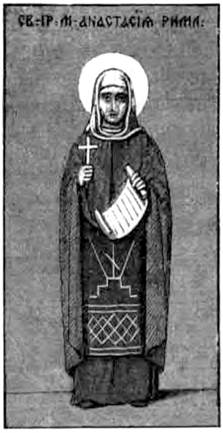
Анастасия, лишившись родителей своих, когда ей было только три года, была взята на воспитание в общину девственниц, находившуюся в уединённом месте близ Рима. С любовью материнской воспитывала сироту благочестивая начальница христианской общины София, и Бог благословил благодатным успехом её труды. Достигнув 20-ти-летнего возраста, Анастасия между всеми отличалась высокими качествами души, трудолюбием и благочестием; при этом, душевной красоте её соответствовала и замечательно красивая наружность, которая привлекла на неё внимание многих жителей Рима, и знатнейшие и богатейшие люди желали вступить с нею в супружество; но, с детства приученная полагать свою радость в служении единому Богу, Анастасия отвергла все предложения искателей её руки; не смотря на свою молодость, не находила она ничего привлекательного ни в каких блистательных благах мирских, представлявшихся ей, и не пожелала променять на них свою тихую, смиренную жизнь в общине девственниц-молитвенниц. Но если не привлекли её и не послужили для неё искушением блага мирские, то искушение не замедлило явиться в другом виде: под влиянием страха открывшегося в то время жестокого гонения на христиан от императора Валериана, когда и в общине повелено было захватить «верующих в Распятого», Анастасия могла бы пожелать спастись от мученической участи, согласившись выйти замуж за одного из влиятельных граждан Римских, но и перед мученичеством не отступила её любовь к Богу, и в то время, когда все другие подвижницы общины решились искать спасения в бегстве, она осталась в общине, послушав свою воспитательницу Софию, которая сказала ей, что «настало для неё время страдальческого подвига ради возлюбленного Христа»... – И упросив воинов, чтобы они дали ей время украсить нарядом Анастасию, за которой, как оказалось, и были они присланы по указанию язычников, получивших от неё отказ на их предложения ей супружества, София повела в церковь свою воспитанницу и, поставив её перед алтарём, стала со слезами убеждать молодую христианку приготовиться к ожидающему её подвигу. – «Молю тебя, возлюбленное дитя моё, – говорила она Анастасии, – не устрашись доказать теперь ту любовь ко Христу, в которой я воспитала тебя с самого детства... Пусть не будут напрасными труды мои и молитвы о соединении твоём с Богом всем сердцем и душою... Не дай прельстить себя коварными увещаниями и обещаниями благ земных. Когда же будут устрашать тебя всякими муками, то ответь, что ничего не боишься ты и ничем не смутишься, потому что твой Бог – с тобой. И когда будут терзать тебя, то не убойся убивающих тело, душу же убить не могущих... Радуйся, когда страдать будешь, помни, что во время страдания будет предстоять тебе Сам за тебя пострадавший Христос; когда изнеможешь, то Он Сам тебя подкрепит и пошлёт отраду душе твоей, и не отступит от тебя, пока не возьмёт из рук мучащих тебя и не восхитит в Свою небесную светлую обитель, где ты вместе со всеми небесными силами будешь предстоять вечной славе Его и узнаешь блаженство, неизреченное на языке человеческом... Иди же туда, иди с веселием к Божественному Агнцу, мученическою кровью ради Него обагрённая страданием, как роскошной брачной одеждой украшенная!»
Anastasia, having lost her parents when she was only three years old, was taken to be raised in a community of virgins located in a secluded place near Rome. With motherly love, the pious head of the Christian community, Sophia, raised the orphan, and God blessed her labors with gracious success. Having reached the age of twenty, Anastasia was distinguished among all by her high qualities of soul, diligence, and piety; at the same time, her spiritual beauty was matched by a remarkably beautiful appearance, which attracted the attention of many inhabitants of Rome, and the most noble and wealthy men desired to enter into marriage with her; but, from childhood accustomed to placing her joy in the service of the one God, Anastasia rejected all the proposals of her suitors; despite her youth, she found nothing attractive in any of the brilliant worldly goods that were presented to her, and did not wish to exchange for them her quiet, humble life in the community of virgin-prayerful women. But if worldly goods did not attract her and did not serve as a temptation for her, then temptation was not slow to appear in another form: under the influence of fear of the cruel persecution of Christians that had broken out at that time under the Emperor Valerian, when the community was ordered to seize "those who believe in the Crucified One," Anastasia might have wished to save herself from a martyr's fate by agreeing to marry one of the influential Roman citizens, but even before martyrdom her love for God did not waver, and at the time when all the other ascetics of the community decided to seek salvation in flight, she remained in the community, heeding her teacher Sophia, who said to her that "the time has come for you for the feat of suffering for the sake of the beloved Christ"... — And having begged the soldiers to give her time to adorn Anastasia with finery, for whom, as it turned out, they had been sent on the denunciation of pagans who had received a refusal from her to their proposals of marriage, Sophia led her pupil into the church and, placing her before the altar, began with tears to exhort the young Christian to prepare for the feat that awaited her. — "I beseech you, my beloved child," she said to Anastasia, "do not be afraid now to prove that love for Christ in which I have raised you from childhood... Let not my labors and prayers for your union with God with all your heart and soul be in vain... Do not let yourself be seduced by cunning exhortations and promises of earthly goods. And when they frighten you with all kinds of torments, then answer that you fear nothing and are troubled by nothing, because your God is with you. And when they torment you, fear not those who kill the body but cannot kill the soul... Rejoice when you suffer, remember that during your suffering Christ Himself, who suffered for you, will stand before you; when you grow faint, He Himself will strengthen you and send consolation to your soul, and will not depart from you until He takes you from the hands of those who torment you and snatches you away into His heavenly bright dwelling, where together with all the heavenly powers you will stand before His eternal glory and come to know blessedness inexpressible in human language... Go then, go with joy to the Divine Lamb, stained by suffering with martyr's blood for His sake, as if adorned with a luxurious bridal garment!"
– «Готово сердце моё пострадать за Христа! – радостно отозвалась Анастасия, – не бойся и не смущайся обо мне, мать моя, воспитавшая меня! Верую, что Иисус Христос подкрепит меня; и ты молись Ему, чтобы не отступил Он от меня во время подвига ради имени Его святого» ...
— "My heart is ready to suffer for Christ!" Anastasia joyfully responded. "Do not fear and do not be troubled for me, my mother who raised me! I believe that Jesus Christ will strengthen me; and do you pray to Him that He not depart from me during the feat for the sake of His holy name"...
Между тем, час испытания наступал. Воины, с нетерпением ожидавшие жертву свою, пошли разыскивать её и нашли в церкви подвижниц, не телесными украшениями занимающихся, но услаждающихся предсмертной душевной беседой. Они увели Анастасию от её престарелой воспитательницы и закованную цепями представили правителю в Рим.
Meanwhile, the hour of trial was approaching. The soldiers, who had been impatiently awaiting their victim, went to search for her and found her in the church, the ascetics not occupied with bodily adornments but delighting in a pre-death spiritual conversation. They led Anastasia away from her aged teacher and, bound in chains, presented her to the governor in Rome.
Поражённый красотой Анастасии, язычник стал убеждать её пощадить свою красоту, не лишать себя земного счастья, признать богов... С невозмутимою твёрдостью отвечала ему христианка исповеданием веры своей в истинного Бога – Иисуса Христа. Видя невозможность её убедить, правитель велел подвергнуть её истязаниям.
Struck by Anastasia's beauty, the pagan began to urge her to spare her beauty, not to deprive herself of earthly happiness, and to acknowledge the gods... With imperturbable firmness the Christian answered him with a confession of her faith in the true God — Jesus Christ. Seeing the impossibility of persuading her, the governor ordered her to be subjected to tortures.
Обнажённая была растянута Анастасия и привязана к четырём столбам; в этом положении били её палками, а снизу был разведён жестоко опалявший её огонь; потом строгали железом её избитое и опалённое тело; отрезали сосцы; вырвали ногти и зубы; мученица, вместо страдальческих воплей, воспевала псалмы... у неё был вырван язык. Видя изнеможение изливающейся кровью мученицы, один христианин, по имени Кирилл, напоил её водой. За это он был немедленно обезглавлен.
Naked, Anastasia was stretched out and tied to four posts; in this position they beat her with clubs, while below a fire was kindled that fiercely scorched her; then they scraped her beaten and scorched body with iron; they cut off her breasts; they tore out her nails and teeth; the martyr, instead of cries of suffering, sang psalms... her tongue was torn out. Seeing the exhaustion of the martyr, who was losing blood, a certain Christian by the name of Cyril gave her water to drink. For this he was immediately beheaded.
Однако же и народ, состоявший большей частью из язычников, хотя и привык к подобным жестоким зрелищам, стал возмущаться таким бесчеловечным мучительством и укорять правителя... Тогда изувеченное тело мученицы было обезглавлено и выброшено за городом на съедение зверям.
However, even the people, who consisted for the most part of pagans, although accustomed to such cruel spectacles, began to be indignant at such inhuman torture and to reproach the governor... Then the mutilated body of the martyr was beheaded and thrown outside the city to be devoured by wild beasts.
По извещению ангела, явившегося во сне престарелой Софии, она нашла останки своей любимой воспитанницы и, с помощью христиан, предала их погребению.
By the announcement of an angel who appeared in a dream to the aged Sophia, she found the remains of her beloved pupil and, with the help of Christians, committed them to burial.
«Девства водами очищена, преподобная, мученичества кровьми, Анастасия, венчавшися, подавши сущим в нуждах недугов исцеление и спасение приступающим от сердца; крепость бо тебе подает Христосе, источая благодать приснотекущую».
"Cleansed by the waters of virginity, O Venerable One, and crowned with the blood of martyrdom, Anastasia, you grant healing of ailments to those in need and salvation to those who draw near from the heart; for Christ gives you strength, pouring forth ever-flowing grace."
Сии три брата и сестра, отечеством которых была Ларанда в Ликаонии на границах Писидии и Исаврии, пострадали во время гонения на христиан при Диоклетиане в 285 году 23 августа, по донесению на них мачехи, желавшей таким способом выиграть тяжебное дело о наследстве, возникшее у неё с детьми её мужа. Из описания страданий их в проконсульских актах известно, что «Клавдий, старший брат, представленный правителю Киликии – Лисию в Егах, после исповедания св. веры и отречения принести жертвы богам, повешен на дереве; ноги его поджигали огнём, а пятки отрезали, затем он терзаем был когтями, строгаем по телу черепицами и обжигаем свечами и заключён в темницу. Второй брат его, Астерий, исповедав веру в единого Бога, переданную им родителями, также повешен на дереве, биен розгами и жилами по спине и по животу, между тем как под ногами были угли; затем заключён в темницу. Третий брат, Неон, по сокрушении шеи, растянут по земле, посыпан горячими углями и бит жилами; наконец все трое осуждены на распятие вне города. Феонилла, быв обнажена, бита по лицу, повешена за волосы и после исповедания, что она 23 года вдовствует в посте и молитве, резана бритвой, опоясана терновником, растянута между четырьмя колами, бита ремнём по всему телу, посыпана по животу углями, предала дух Богу и брошена в море в мешке» (см. «Месяцесл. Вост.» архим. Серг. т. II, ч. 2, стр. 345).
These three brothers and a sister, whose homeland was Laranda in Lycaonia on the borders of Pisidia and Isauria, suffered during the persecution of Christians under Diocletian in the year 285, on the 23rd of August, upon the denunciation of their stepmother, who wished in this way to win a lawsuit over an inheritance that had arisen between her and her husband's children. From the description of their sufferings in the proconsular acts it is known that "Claudius, the elder brother, presented to the governor of Cilicia, Lysias, in Aegae, after confessing the holy faith and refusing to offer sacrifices to the gods, was hung on a tree; his feet were set on fire, and his heels were cut off; then he was torn with claws, scraped on the body with potsherds, and burned with candles, and cast into prison. His second brother, Asterius, having confessed faith in the one God handed down to them by their parents, was likewise hung on a tree, beaten with rods and thongs on the back and belly, while coals were under his feet; then he was cast into prison. The third brother, Neon, after having his neck broken, was stretched on the ground, sprinkled with hot coals, and beaten with thongs; finally all three were condemned to be crucified outside the city. Theonilla, having been stripped naked, was beaten on the face, hung by the hair, and after confessing that she had lived as a widow for twenty-three years in fasting and prayer, was cut with a razor, girded with thorns, stretched between four stakes, beaten with a strap over her whole body, sprinkled with coals on her belly, gave up her spirit to God and was thrown into the sea in a sack" (see "Mesiatseslov Vostoka" by Archimandrite Sergius, vol. II, part 2, p. 345).
Преподобный Аврамий от юности любил молитву и пост, посещение церкви и чтение священного Писания; повинуясь воле родителей, вступил в брак, но на седьмой день оставил жену, вышел из города (Тении близ Лампсака) и поселился в кельи. Родители нашли его, но он сказал им: «оставьте меня пожить здесь, в безмолвии, ради любви к Богу!» По смерти родителей, роздал всё имение нищим и пробыл в монашестве 50 лет. Епископ той местности посвятил его во пресвитера (бесприходного) и поручил проповедь о Христе язычникам по приморью Геллеспонтскому.
The Venerable Abramius from his youth loved prayer and fasting, attendance at church and reading of the Holy Scriptures; obeying his parents' will, he entered into marriage, but on the seventh day he left his wife, went out of the city (Tenea near Lampsacus) and settled in a cell. His parents found him, but he said to them: "Leave me to live here in silence, for the love of God!" After the death of his parents, he distributed all his property to the poor and remained in monasticism for fifty years. The bishop of that region ordained him a presbyter (without a parish) and entrusted him with the preaching of Christ to the pagans along the Hellespontine coast.
У Аврамия был брат, имевший дочь. По смерти брата знакомые привели к нему семилетнюю сироту Марию. Он велел ей пребывать во внешней кельи, сам затворился во внутренней и учил племянницу книгам через небольшие двери. Мария прожила в посте и молитвах 20 лет, но некий лживый монах, часто приходивший к Аврамию, нашёл удобное время и обольстил девицу. В горе и отчаянии, она ушла в город Асс (в шестидесяти верстах от Лампсака) и стала жить в гостинице. Через два года Аврамий нашёл её и убедил возвратиться к честной жизни, сказав: «я отвечаю Богу за тебя и беру на себя грехи твои!» Он затворил её во внутренней кельи, где сам жил прежде. Скончался около 360 года, а Мария лет через пять после него.
Abramius had a brother who had a daughter. After the brother's death, acquaintances brought the seven-year-old orphan Mary to him. He bade her remain in the outer cell, while he himself shut himself up in the inner cell and taught his niece from books through a small door. Mary lived in fasting and prayers for twenty years, but a certain false monk, who often came to Abramius, found a convenient time and seduced the maiden. In grief and despair, she went to the city of Assos (sixty versts from Lampsacus) and began to live in an inn. After two years, Abramius found her and persuaded her to return to an honorable life, saying: "I answer to God for you and take your sins upon myself!" He shut her up in the inner cell where he himself had formerly lived. He reposed around the year 360, and Mary about five years after him.
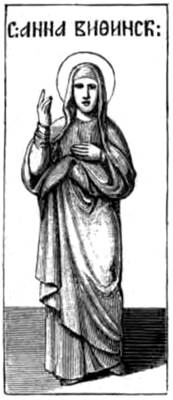
Отец блаженной Анны378 был диаконом Влахернской церкви и оставил дочь юной сиротой на руках бабки. Бабка нашла ей супруга, не спрашивая о её желаниях, тогда как Анна не желала быть в супружестве. Быв замужем, ходила она к дяде своему на Олимп. Строгий подвижник, за исповедание православия терпевший истязания, пожалел, что юная раба Божия отдана в услуги человеку. При императрице Ирине вызывали твёрдого исповедника в столицу, чтобы выслушать советы его. Это было, конечно, во время совещаний Вселенского собора 787 года об иконах. В это время он виделся с дорогой племянницей и сказал ей: «будь тверда и мужественна, – много скорбей для праведников; знай и то, что у тебя родится дитя, прежде чем умрёт муж твой». Предсказание исполнилось.
The father of the blessed Anna378 was a deacon of the Church of Blachernae and left his daughter a young orphan in the care of her grandmother. The grandmother found a husband for her without asking her wishes, whereas Anna did not desire to be married. Being married, she went to her uncle on Mount Olympus. A strict ascetic, who had suffered tortures for the confession of Orthodoxy, he regretted that the young handmaiden of God had been given into the service of a man. Under the Empress Irene, the steadfast Confessor was summoned to the capital to have his counsels heard. This was, of course, during the deliberations of the Ecumenical Council of 787 concerning icons. At this time he saw his dear niece and said to her: "Be firm and courageous — many are the sorrows of the righteous; know also that a child will be born to you before your husband dies." The prediction was fulfilled.
По смерти мужа, воспитав дитя, блаженная поручила его родственнику, а с другим сиротой усердно молилась то в том, то в другом храме. Олимпийский подвижник снова виделся с нею. Она жаловалась на тяжесть жизни своей. «Не сказал ли я тебе, что много скорбей праведникам» говорил прозорливый, – «надобно терпеть, но дети твои скоро умрут». Исполнилось и это предсказание. Под влиянием такого осязаемого промышления Божия, по указаниям такого опытного и чудного наставника, душа Анны загорелась полной любовью к Господу.
After the death of her husband, having raised the child, the blessed woman entrusted him to a relative, and with the other orphan she prayed fervently, now in one church, now in another. The ascetic of Olympus saw her again. She complained of the heaviness of her life. “Did I not tell you that many are the sorrows of the righteous?” said the clairvoyant one. “You must endure, but your children will soon die.” This prediction also came to pass. Under the influence of such a tangible providence of God, and by the guidance of such an experienced and wondrous teacher, the soul of Anna was inflamed with complete love for the Lord.
Советники мирские, пожалуй, предлагали совет: почему не выйти вдове в другой раз замуж? Другие готовы были ещё умнее советовать – жить, как случится жить. Но могут ли люди дать лучший совет, чем совет Апостола, вдохновенного Богом: «блаженнее, если останется так», без другого мужа, говорит он о вдове (1Кор.7:40). Тратить силы для пустоты дознанной – умно ли? «Не умно избирать мирщину для той, которой обещали столько радостей, и которая вместо радости испытала столько горечей»379. Не жить ли жизнью обезьянки? Сохрани Бог от того! Это не честь и для совести язычницы, тем более христианки. После земной жизни придётся жить вечно: с чем же будем жить там? Для людей и земли жили, надобно пожить для души своей, которая дорога каждому; надобно пожить для Господа Творца и Спасителя нашего. Так думала умная Анна.
Worldly counselors, perhaps, offered advice: why should the widow not marry a second time? Others were ready to advise even more cleverly — to live as it happens to live. But can men give better counsel than the counsel of the Apostle, inspired by God: “But she is happier if she so remain,” without another husband, he says of the widow (1 Cor. 7:40). Is it wise to waste strength on proven emptiness? “It is not wise to choose the worldly life for her to whom so many joys were promised, and who instead of joy has tasted so many bitternesses.”379 Should she live the life of a little monkey? God forbid! That is no honor even for the conscience of a pagan woman, much less a Christian woman. After earthly life, one must live eternally: with what then shall we live there? We have lived for men and for the earth; we must live for our own soul, which is precious to each one; we must live for the Lord, our Creator and Savior. Thus thought the wise Anna.
Раздав всё, что имела, она ходила в храмы и молилась. Потом, встретив доброго инока-старца, приняла иночество. Копроним навёл ужас лютостями против инокинь. Благочестивая Ирина старалась успокоить Церковь; но мало надеялись на покой будущий, и такое расположение умов оправдалось событиями. С именем инока евнуха Евфимиана Анна скрылась в Вифинском монастыре380. Здесь строгая жизнь нового инока была примером для других: евнух был самым усердным тружеником по послушаниям, суровым постником и пламенным молитвенником. П. Тарасий (784–815 г.), услыхав о высокой жизни инока Евфимиана, вызвал его в столицу для бесед. Наставления крепкой души привлекали к ней многих; от множества желавших слушать её оказалась тесной обитель, и патриарх устроил новый монастырь. Евфимиан стал известен и по дару чудес; но это не защитило его от скорбей. Инок-проповедник народный легко подпал клевете. Ложный инок, оказавшийся впоследствии разбойником, совершив насилие над девушкой, разгласил, что грех сотворён Евфимианом. Евфимиан молчал. Боголюбивая жена, слушая клевету бесстыдного, сказала: «смотри, брат, не оказался бы евнух, опорочиваемый тобой, святой девственницей и не пострадать бы тебе за грехи свои». бессовестный человек и после того делал пакости для святой души. Преподобная терпела, и уличённый злодей повешен был. Так как и известность имени не легка была для святой, да и стали догадываться о её поле, то, возвратясь в Вифинию, проводила она остальные годы жизни в глубоком уединении. Созревшая для неба, преставилась октября 29-го 826 года.
Having distributed all that she had, she went to the churches and prayed. Then, meeting a good monk-elder, she received the monastic tonsure. Copronymus spread terror by his cruelties against nuns. The pious Irene strove to give peace to the Church; but little was hoped for future peace, and this disposition of minds was justified by events. Under the name of the monk eunuch Euthymian, Anna hid herself in a Bithynian monastery380. Here the strict life of the new monk was an example for others: the eunuch was the most zealous laborer in obediences, a severe faster, and a fervent man of prayer. Patriarch Tarasius (784–815 A.D.), having heard of the lofty life of the monk Euthymian, summoned him to the capital for conversations. The instructions of this strong soul attracted many to him; from the multitude of those desiring to hear him, the monastery became too small, and the patriarch established a new monastery. Euthymian also became known for the gift of miracles; but this did not protect him from sorrows. The monk, a preacher to the people, easily fell victim to slander. A false monk, who later turned out to be a robber, having committed violence against a girl, spread the rumor that the sin had been committed by Euthymian. Euthymian remained silent. A God-loving woman, hearing the slander of the shameless one, said: “Take heed, brother, lest the eunuch whom you slander prove to be a holy virgin, and you suffer for your sins.” The shameless man even afterward did mischief to the holy soul. The Venerable one endured, and the exposed evildoer was hanged. Since even the fame of the name was not easy for the saint, and people began to guess her gender, she returned to Bithynia and spent the remaining years of her life in deep seclusion. Having ripened for heaven, she reposed on October 29, 826 A.D.
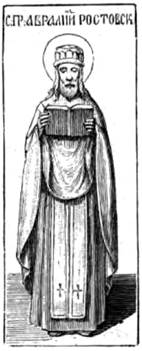
Преподобный Аврамий, в мире Аверкий, в молодых летах обучен был благочестивыми родителями книжной мудрости и благочестию381. Ревнуя о жизни духовной, оставил он дом родителей и принял иночество. По высшему внушению, пришёл он в Ростов, у озера Неро поставил себе хижину и стал подвизаться в посте и молитвах382. – В Ростове ещё были тогда и язычники: «Чудский конец поклонялся идолу камену» Велесу. Это исполняло глубокой скорбью Боголюбивую душу Аврамия: он скорбел о слепоте людей и о присвоении той чести бездушному истукану, которая принадлежит единому Богу. Скорбь побуждала усердно молить Господа об истреблении дел духа злобы. Он глубоко чувствовал немощь свою для успешного подвига против застарелого заблуждения людей и просил помощи свыше. В сильном раздумья сидел он раз вблизи Велеса и видит: идёт старец. «Откуда идёшь, человек Божий?» спросил Аврамий старца. «Я пришлец в вашей стороне», отвечал тот и прибавил: «ты о чём-то скорбишь!» – «Да, сказал Аврамий, молю Бога о сокрушении идола, и молитва моя не выполняется». – «Если хочешь», сказал старец, «чтобы выполнилось твоё желание, – иди на восток, отыщи дом Иоанна Богослова и помолись иконе его». Аврамий опечалился тем, что так далеко надобно идти. Старец сказал: Господь сократит путь твой. – Аврамий решился исполнить совет и лишь только перешёл речку Ишню, что в 4 верстах от Ростова, как ему встретился старец, которого вид невольно заставлял благоговеть перед ним. Лицо его было величественно и ясно, – седой, с бородой длинной и с головой почти безволосой. Аврамий невольно пал к его ногам. «Куда идёшь?» спросил дивный старец. «В дом Иоанна Богослова», отвечал Аврамий. «Возьми эту трость мою, сказал старец, иди к Велесу и ударь ею идола с словами: во имя Господа Иисуса Христа повелевает тебе Иоанн Богослов сокрушиться». – Сказал и стал невидим. Аврамий исполнил волю Апостола, и идол рассыпался. На месте, где явился Евангелист, Аврамий построил храм во имя Евангелиста: поныне в 4 верстах от Ростова, на берегу реки Ишни, стоит древний деревянный храм Иоанна Богослова, как напоминание потомству о благодеянии Апостола к стране383. – На месте разрушенного истукана преподобный построил храм в славу Богоявления Господня и основал при нём монастырь. – Язычники не раз собирались сжечь обитель Аврамиеву; но сила Божия и терпение Аврамия победили злость людей. По убеждениям Аврамия, многие язычники крестились. Преподобный старался действовать особенно на юность языческую: он учил детей грамоте, крестил их и потом постригал в монашество. – Когда умножилось число иноков, – Аврамий, при помощи благотворителей, построил на место малого храма просторный и приобрёл для него книги, иконы и утварь. Преподобный подавал собою пример инокам; сам участвовал во всех трудах братии, работал в хлебне, рубил дрова, мыл власяницы для братии. Епископ предложил князю Владимиру учинить обитель Аврамия архимандрией, и Аврамий почтён был саном архимандрита. Святой ревнитель святой веры не миновал и после того преследования злых людей: по ложному доносу, будто он отыскал богатый клад, взяли его под стражу и представили во Владимир Клязменский. – Кротость и искреннее благочестие его избавили его от истязаний: князь Владимир нашёл донос клеветой злобы и невежества. Оправданный Аврамий более прежнего стал быть предметом любви и уважения. Наконец, почил он в глубокой старости и погребён был учениками в созданной им обители. Таково древнее известие о преподобном Аврамии!
The Venerable Abraham, in the world Averkius, was taught in his youth by pious parents in bookish wisdom and piety381. Zealous for the spiritual life, he left his parents’ home and received the monastic tonsure. By a higher inspiration, he came to Rostov, set up a hut for himself by Lake Nero, and began to struggle in fasting and prayer382. — In Rostov there were still pagans at that time: “the Chudskii end worshipped a stone idol,” Veles. This filled the God-loving soul of Abraham with deep sorrow: he grieved over the blindness of the people and over the ascription to a soulless idol of that honor which belongs to the one God. Sorrow moved him to pray fervently to the Lord for the destruction of the works of the spirit of malice. He deeply felt his own weakness for a successful struggle against the inveterate delusion of men and asked for help from on high. Once, sitting in deep thought near Veles, he saw an elder approaching. “Where are you coming from, O man of God?” asked Abraham of the elder. “I am a stranger in your region,” the other replied, and added: “You are sorrowful about something!” — “Yes,” said Abraham, “I pray God for the crushing of the idol, and my prayer is not fulfilled.” — “If you wish,” said the elder, “that your desire be fulfilled, go to the east, find the house of John the Theologian, and pray before his icon.” Abraham was saddened that he had to go so far. The elder said: “The Lord will shorten your path.” — Abraham resolved to follow the counsel, and as soon as he crossed the river Ishnya, four versts from Rostov, he met an elder whose appearance involuntarily inspired reverence before him. His face was majestic and bright — gray-haired, with a long beard and a head almost bald. Abraham involuntarily fell at his feet. “Where are you going?” asked the wondrous elder. “To the house of John the Theologian,” answered Abraham. “Take this staff of mine,” said the elder, “go to Veles and strike the idol with it, saying: ‘In the name of the Lord Jesus Christ, John the Theologian commands you to be crushed.’” — He spoke and became invisible. Abraham fulfilled the will of the Apostle, and the idol crumbled to dust. On the spot where the Evangelist appeared, Abraham built a church in the name of the Evangelist: to this day, four versts from Rostov, on the bank of the river Ishnya, stands the ancient wooden church of John the Theologian, as a reminder to posterity of the Apostle’s benefaction to the region383. — On the site of the destroyed idol, the Venerable One built a church to the glory of the Theophany of the Lord and founded a monastery beside it. — The pagans more than once gathered to burn down Abraham’s monastery; but the power of God and the patience of Abraham overcame the malice of men. Through Abraham’s persuasions, many pagans were baptized. The Venerable One strove especially to work upon pagan youth: he taught children to read and write, baptized them, and later tonsured them as monks. — When the number of monks increased, Abraham, with the help of benefactors, built a spacious church in place of the small one and acquired books, icons, and vessels for it. The Venerable One set an example for the monks; he himself took part in all the labors of the brethren, worked in the bakery, chopped wood, and washed the hair shirts for the brethren. The bishop proposed to Prince Vladimir that Abraham’s monastery be made an archimandrite’s house, and Abraham was honored with the rank of archimandrite. The holy zealot of the holy faith did not escape persecution by evil men even after that: on a false denunciation that he had found a rich treasure, he was taken into custody and brought to Vladimir-on-the-Klyazma. — His meekness and sincere piety delivered him from torture: Prince Vladimir found the denunciation to be a slander of malice and ignorance. Acquitted, Abraham became even more an object of love and respect. Finally, he reposed in extreme old age and was buried by his disciples in the monastery he had founded. Such is the ancient account of the Venerable Abraham!
По этому повествованию, сличаемому с летописями, подвиги св. Аврамия против Велеса надобно отнести ко времени, следовавшему за кончиной св. Леонтия, а не к 990 году, как показывали иные. Владимир на Клязьме, где был преподобный Аврамий на суде князя Владимира, построен Владимиром Мономахом384. – Сан архимандрита, которым почтён был Аврамий, становится известным с XII века, да и из того что до преподобного Игнатия, архимандрита Богоявленского, с 1261 года епископа, насчитывается по синодику только 7 настоятелей, преемников преподобного Аврамия, видно, что преподобный Аврамий скончался в самом начале XII века385. С другой стороны, когда св. Исаия прибыл (в 1077 г.) в Ростов, он нашёл в Ростове неутверждённых в святой вере, но не язычников. Таким образом подвиги преподобного против Ростовского язычества начались с 1073 года, а подвижническая жизнь в обители продолжалась долее 30 лет. Что же касается до известий, относящих преподобного Аврамия ко времени равноапостольного Владимира, то и доверяющие им находят в них явные вымыслы и произволы поздних времён386.
According to this narrative, when compared with the chronicles, the struggles of St. Abraham against Veles must be assigned to the time following the repose of St. Leontius, and not to the year 990, as some have indicated. Vladimir-on-the-Klyazma, where the Venerable Abraham was brought before Prince Vladimir for judgment, was built by Vladimir Monomakh384. — The rank of archimandrite, with which Abraham was honored, became known from the 12th century; moreover, from the fact that before the Venerable Ignatius, archimandrite of the Theophany Monastery, who became bishop in 1261, only seven abbots, successors of the Venerable Abraham, are counted in the synodicon, it is evident that the Venerable Abraham reposed at the very beginning of the 12th century385. On the other hand, when St. Isaiah arrived (in 1077) in Rostov, he found in Rostov those unconfirmed in the holy faith, but not pagans. Thus the struggles of the Venerable One against Rostov paganism began in 1073, and his ascetic life in the monastery continued for more than 30 years. As for the accounts that refer the Venerable Abraham to the time of the Equal-to-the-Apostles Vladimir, even those who trust them find in them obvious inventions and arbitrary additions of later times386.
При внуке Мономаха вел. князе Всеволоде Георгиевиче (1176–1212) обретены нетленными мощи преп. Аврамия387. Ныне они открыто почивают в серебряной раке, в каменном храме, построенном в 1553 году по распоряжению Грозного царя. Здесь же при мощах архимандричья шапка преподобного Аврамия, невысокая, шитая золотом, с горностаевой опушкой. – Здесь же медный крест, часть того жезла, которым Аврамий сокрушил Велеса; остальная же, большая часть, взята царём Грозным в Москву388.
Under the grandson of Monomakh, Grand Prince Vsevolod Georgievich (1176–1212), the incorrupt relics of the Venerable Abraham were uncovered387. Now they rest openly in a silver reliquary, in a stone church built in 1553 by order of the Terrible Tsar. Here also, by the relics, is the archimandrite’s cap of the Venerable Abraham, low, embroidered with gold, with an ermine trim. — Here also is a copper cross, part of that staff with which Abraham crushed Veles; the remaining, larger part, was taken by the Terrible Tsar to Moscow388.
«Ревнитель Апостолов, преподобный! ты удостоился беседовать с Богословом и, получив от него жезл, сокрушил Велеса и, истребив козни, привёл неверных к Христовой вере. Ныне же моли Христа Бога за почитающих память твою».
“Zealous emulator of the Apostles, O Venerable One! You were accounted worthy to converse with the Theologian, and having received from him a staff, you crushed Veles, and having destroyed the wiles, you led the unbelievers to the faith of Christ. Now pray to Christ God for those who honor your memory.”
«Источником благодатной воды явился ты, блаженный Аврамий! подай мне источник слёз, да омою страсти души моей и убелю почерневшую душу мою светом покаяния»389.
“You have appeared as a source of grace-filled water, O blessed Abraham! Grant me a source of tears, that I may wash away the passions of my soul and make white my darkened soul with the light of repentance.”389
См. далее о св. Мавре и Анфусе. Сами обстоятельства времени показали, что к блаженной Анне не относилось правило Гангрского собора, строго осуждавшего за то, «аще какая жена ради мнимого подвижничества вместо обыкновенные женския одежды облечется в мужския». Прав. 13. К тому же собор осуждал собственно гордых Евстафиян. Он осуждал не одежду, а гордость раскола, выдумавшего свой устав. Евстафияне были такие же гордые фанатики своего устава, как Русские раскольники. Созомена, ист. 3, 14. Epistola Synodica gangrensis ар. Beveregium.
See further concerning Sts. Maura and Anthusa. The very circumstances of the time showed that the rule of the Council of Gangra, which strictly condemned “if any woman, for the sake of pretended asceticism, instead of the usual women’s clothing, should put on men’s clothing,” did not apply to the blessed Anna. Canon 13. Moreover, the Council condemned specifically the proud Eustathians. It condemned not the clothing, but the pride of the schism, which had invented its own rule. The Eustathians were as proud fanatics of their rule as the Russian schismatics. Sozomen, Hist. 3, 14. Epistola Synodica gangrensis ap. Beveregium.
Ркп. житие пр. Аврамия, старшее, писано не позже XIV в. (опис. муз., стр. 212, 598. 600. Синод. б. № 556). Оно с малыми переменами – в прологе и ч.-минее 29 окт. Второе ркп. житие нач. словами: «еже дивитися святых трудам добро» (опис. муз., стр. 208) писано во второй половине XVI в. Третье житие, с выписками из ч.-минеи св. Димитрия и следованной псалтыри – в Валаамском уставе и писано не раньше 1706 г. Как второй повествователь дополнял первого, так третий – второго. Первое житие и отличия второго напеч. в памяти, стар. Рус. литтер. 1, 221–225.
Manuscript Life of the Venerable Abraham, the older one, written no later than the 14th century (described in the Museum, pp. 212, 598, 600; Synodal Library, No. 556). It appears with minor changes in the Prologue and the Menaion for October 29. The second manuscript Life begins with the words: “It is good to marvel at the labors of the saints” (described in the Museum, p. 208) and was written in the second half of the 16th century. The third Life, with excerpts from the Menaion of St. Demetrius and the Psalter with commentary, is found in the Rule of Valaam and was written no earlier than 1706. Just as the second narrator supplemented the first, so the third supplemented the second. The first Life and the variations of the second are printed in Memories of Ancient Russian Literature 1, 221–225.
По второму житию Аврамий прежде Ростова жил на Валааме и здесь пострижен. Третье житие прибавляет, что Аврамий Чухломский язычник Иверк крещён с именем Аверкия на Валааме «в обители Св. Троицы». Но как не заметить, что на Валааме монастырский храм посвящён Преображению Спасителя? Не трудно видеть и то, что Иверк – простонародное название Аверкия, а смелый сказатель на имени, неправильно понятом, построил сказание о крещении язычника Иверка на Валааме. Рассказ о пострижении Аверкия на Валааме – поздний и не оправдывается никакими памятниками древности. – В обители Св. Троицы пострижен преп. Аврамий Чухломский, а не Ростовский.
According to the second Life, Abraham lived on Valaam before going to Rostov and was tonsured there. The third Life adds that the pagan Iverk was baptized with the name Averkius on Valaam “in the monastery of the Holy Trinity.” But how can one fail to notice that on Valaam the monastery church is dedicated to the Transfiguration of the Savior? It is also not difficult to see that Iverk is a popular corruption of the name Averkius, and the bold narrator, on the basis of a name incorrectly understood, constructed a tale about the baptism of the pagan Iverk on Valaam. The account of Averkius’s tonsure on Valaam is late and is not supported by any ancient sources. — It was the Venerable Abraham of Chukhloma, not of Rostov, who was tonsured in the monastery of the Holy Trinity.
Ц. Феодор Иоаннович грамотой своей, подтверждая грамоту отца, обеспечил за Богоявленским монастырём поселение Богословское на р. Ишне с перевозом и рыбными ловлями (Яросл. епарх. ведом. 1861 г. № 33). Царь грамотой своей, без сомнения, только подтверждал распоряжения князей Ростовских – о Богословском.
Tsar Theodore Ioannovich, by his charter confirming his father’s charter, secured for the Monastery of the Theophany the settlement of Bogoslovskoye on the River Ishna, with its ferry and fishing grounds (Yaroslavl Diocesan Gazette, 1861, No. 33). The Tsar, by his charter, no doubt merely confirmed the dispositions of the Princes of Rostov concerning Bogoslovskoye.
Лет. у Карамз. 2, пр. 238 относит построение Владимира Клязменского к 1116 г. В 1096 г. Олег пришёл из Мурома в Суздаль, из Суздаля в Ростов, взял в плен Суздальцев и Ростовцев, но в походах его ещё не видно ни Владимира, ни Владимирцев. По истории Олега вероятно, что население Владимира на Клязьме началось вслед за победой над Олегом, для противодействия замыслам беспокойного Олега. Так полагает и историк Погодин.
The chronicle in Karamzin 2, note 238, dates the founding of Vladimir-on-the-Klyazma to 1116. In 1096, Oleg came from Murom to Suzdal, from Suzdal to Rostov, and took captive the men of Suzdal and Rostov, but in his campaigns neither Vladimir nor its inhabitants are yet mentioned. From the history of Oleg, it is probable that the settlement of Vladimir-on-the-Klyazma began soon after the victory over Oleg, as a countermeasure against the designs of the restless Oleg. The historian Pogodin also holds this view.
Христ. чт. 1850 г. 1, 59–63. 1853 г. 1, 413–418. Сочинитель на стр. 415–417 сам указывает вымыслы во втором и третьем житии преподобного.
Christian Reading, 1850, 1, 59–63; 1853, 1, 413–418. The author, on pp. 415–417, himself points out the fabrications in the second and third Lives of the Venerable One.
Ист. иер. III, 64, 65. Службы преп. Аврамию – в ркп. Румянцева № 397. Царского № 563. И в печ. минее на окт. Μ. 1645 г. написана при царе Грозном. Преп. Аврамий чудотворец в грам. 1563 г. Ист. акт. 1, 320 и в грам. 1652 г. Ист. ак. IV. 172.
History of the Hierarchy III, 64, 65. Services to the Venerable Abraham are found in the manuscripts of Rumyantsev, No. 397, and of Tsarsky, No. 563, and in the printed Menaion for October, Moscow, 1645, composed under Tsar Ivan the Terrible. The Venerable Abraham is called a wonderworker in a charter of 1563 (Historical Acts 1, 320) and in a charter of 1652 (Historical Acts IV, 172).