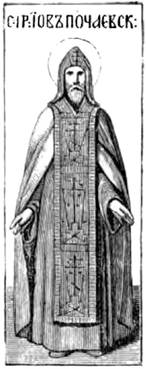
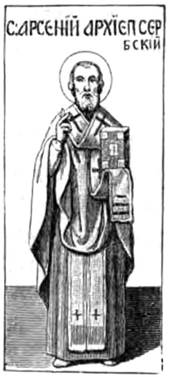
Преп. Иов, в крещении Иоанн, сын православных родителей из Покутья, прозываемых Железо343, полагал начало подвижнической жизни в Угорницком Спасском монастыре, одном из Карпатских. Сюда поступил он 10 лет и спустя два года пострижен был в монашество. – Возрастая послушанием, чистотой и кротостью в жизни духовной, он утешал друзей благочестия жизнью своею. Здесь же удостоился он, против воли своей и по воле настоятеля, сана священства, что было конечно не прежде, как на 30 году жизни его. В сане священства Иов удвоил ревность свою к подвижничеству. Известность добродетелей его разносилась по Украине. По любви к благочестию и чистой вере, кн. Константин Константинович Острожский, узнав о духовной твёрдости его, выпросил его у горняцкого игумена для должности настоятеля Дубенской обители своей344. Дубенский крестный монастырь расположен был на острове, омываемом с трёх сторон рекой, близ г. Дубно. Благочестивый князь с тем вызвал блаж. Иова в свою обитель, чтобы поддержать искреннее благочестие в иноках обители, среди разливавшейся порчи нравов, растлеваемых папизмом. Кн. Константин, при всём том, что владел огромным богатством, старался жить по уставу православной Церкви, в великий пост вкушал хлеб с водой и занимался только молитвой. Для поддержания православия содержал он училища, издавал книги, – как то: Библию, творения Василия В. и другие. Но папизм незримо портил людей. Вот явилась и уния – проводник растлевающего папизма. Пока жив был князь, он, сколько мог, охранял православие даже за пределами своих владений. Но в 1608 году он умер. Униат Поцей, сперва епископ Владимирский, потом митрополит, поступал с православными как палач. Иезуиты, наставники его, поступали ещё жесточе. По их наставлениям, недостойный, полупомешанный сын великого отца, кн. Януш Острожский стал фанатиком папизма: в 1615 г. через иезуитов лишил он наследства племянников своих, князей Константина и Ивана, за то, что не согласились они быть папистами. Так и г. Дубно попал в когти иезуитов345. – Можно представить себе, каково было блаж. игумену Дубенскому при таком положении дел православия! Он собрал в обитель свою многочисленное братство, которое, по его наставлению, усердно занималось изучением писаний св. отцов. – К нему приходили многие слушать наставления его в благочестии. Строгий подвижник твёрдо боролся со скорбями времени и утешал других в скорбях. Жестокие страдания, переносимые православными от иезуитов и прельщённой ими шляхты, не только не ослабляли благочестия, напротив возвышали его. Вот что пишет современник Копыстенский о Галицкой Руси: «в России нашей року 1621 преставися пустинножитель в Галицкой пущи, в ските над речкою, Бартемова прозиваемою, был муж преподобный, в великой схиме нареченный Иов, в малой Иезекииль, в крещении Иоанн, котории в святой горе Афонской многи лета в трудах и подвигах иноческих чесно прошедши, в отчизний край изволением Божиим завитавши, на предреченном местцу скит заложив и многи в нем любоподвижнии чада, наследники святых оных первих пустинножителей отшельников зоставил»346. Блаженный настоятель Дубенской обители более 20 л. управлял иноческой Дубенской обителью; но когда увидел, что нельзя уже ему оставаться более в том крае без вреда себе и другим, удалился в Почаевскую обитель347.
The Venerable Job, in baptism John, son of Orthodox parents from Pokuttya, surnamed Zhelezo343, laid the beginning of his ascetic life in the Uhornytsky Saviour Monastery, one of the Carpathian monasteries. He entered there at the age of 10 and two years later was tonsured into monasticism. — Growing in obedience, purity, and meekness in the spiritual life, he consoled his friends of piety by his life. Here also he was deemed worthy, against his own will and by the will of the abbot, of the rank of the priesthood, which was certainly not before the 30th year of his life. In the priestly rank, Job doubled his zeal for asceticism. The fame of his virtues spread throughout Ukraine. Out of love for piety and the pure faith, Prince Constantine Constantinevich Ostrozhsky, having learned of his spiritual firmness, requested him from the Uhornytsky abbot for the position of abbot of his Dubno monastery344. The Dubno Cross Monastery was situated on an island washed on three sides by a river, near the town of Dubno. The pious prince summoned the blessed Job to his monastery in order to support sincere piety among the monks of the monastery, amidst the spreading corruption of morals, corrupted by papism. Prince Constantine, despite possessing enormous wealth, strove to live according to the rule of the Orthodox Church; during Great Lent he ate bread with water and occupied himself only with prayer. For the support of Orthodoxy he maintained schools and published books — such as the Bible, the works of Basil the Great, and others. But papism invisibly corrupted people. And behold, the Union also appeared — a conduit of corrupting papism. While the prince was alive, he, as much as he could, protected Orthodoxy even beyond the borders of his domains. But in 1608 he died. The Uniate Pociej, first Bishop of Vladimir, then Metropolitan, dealt with the Orthodox as an executioner. The Jesuits, his instructors, acted even more cruelly. According to their instructions, the unworthy, half-mad son of the great father, Prince Yanush Ostrozhsky, became a fanatic of papism: in 1615, through the Jesuits, he disinherited his nephews, Princes Constantine and Ivan, because they did not agree to become papists. Thus the town of Dubno also fell into the clutches of the Jesuits345. — One can imagine what it was like for the blessed abbot of Dubno under such a state of affairs for Orthodoxy! He gathered into his monastery a numerous brotherhood, which, according to his instruction, diligently occupied itself with the study of the writings of the holy fathers. — Many came to him to hear his instruction in piety. The strict ascetic firmly struggled with the sorrows of the time and consoled others in their sorrows. The cruel sufferings borne by the Orthodox from the Jesuits and the seduced gentry not only did not weaken piety, but on the contrary elevated it. Here is what the contemporary Kopystensky writes about Galician Rus': "In our Russia, in the year 1621, there reposed a desert-dweller in the Galician wilderness, in a skete by a river called Bartemova; he was a venerable man, in the great schema named Job, in the small Ezekiel, in baptism John, who, having honorably passed many years in the holy Mount Athos in labors and monastic struggles, and having arrived in his native land by the will of God, founded a skete at the aforementioned place and left in it many lovers of asceticism, children, heirs of those holy first desert-dwellers and hermits."346 The blessed abbot of the Dubno monastery governed the monastic Dubno monastery for more than 20 years; but when he saw that he could no longer remain in that region without harm to himself and others, he withdrew to the Pochaev monastery347.
Карпатская Успенская обитель православия уже славилась тогда чудесами Богоматери348. А блаженному Иову пришлось видеть их вместе с делами папизма и протестантства. Последнее любит величать себя именем Евангельского учения. А это-то самоуслаждение и есть верный признак печального заблуждения. Практика протестантская слишком далека от духа Евангельского, с какой стороны ни посмотрите на неё. Наследник имений Анны Гойской, благочестивой благотворительницы Почаевского монастыря, был тем же в одежде протестанта, чем Попей – в рясе униатской. – Он отнял у обители имения, пожертвованные ей Гойской, и всячески теснил иноков, разгонял Богомольцев её и хотел совсем разорить её. В 1623 г. июня 19 д. послал он толпу слуг в монастырь разграбить его. – В исполнение воли пана ограблены были все драгоценные утвари обители и унесён был чудотворный образ Богоматери. Для Фирлея и этого было мало. Он нарядил свою жену в священные одежды, дал ей в руки св. потир, и она стала произносить хулы на св. евхаристию православия и на Богоматерь. Но в то же время злой дух овладел богохульной женой. Страшные её муки прекратились лишь тогда, как чудотворная икона благоговейно возвращена была в монастырь349. Это было тогда, как блаж. Иов был игуменом Почаевской обители350. – Он выполнял здесь должность настоятеля с ревностью подвижника. Днём трудился он для обители: то садил сам деревья в садах монастырских, то укреплял плотины около монастырской ограды; работал от души, как подёнщик, но для Господа. С братиями обходился кротко и ласково: никто не слыхал от него слова резкого. Из уст его всего чаще слышались слова: «Господи Иисусе Христе, Сыне Божий, помилуй меня грешного». Раз, проходя через гумно монастырское, застал он крадущего пшеницу. Вор в испуге пал к ногам игумена и умолял не объявлять о его поступке. Преподобный не только не укорил его ни одним словом, но ещё сам поднял на плечи его мешок и отпустил с миром, напомнив ему только о том ответе, который должны мы дать за дела свои перед судом Божиим. – Гонители православия Фирлеи окончили, наконец, актом примирения свои распри с иноками не в унии состоящими»; это было в 1642 г. при преп. Иове351.
The Carpathian Dormition monastery of Orthodoxy was already then famed for the miracles of the Mother of God348. And the blessed Job had to see them together with the deeds of papism and Protestantism. The latter loves to exalt itself with the name of Evangelical teaching. But this very self-complacency is a sure sign of a sad delusion. Protestant practice is too far from the spirit of the Gospel, from whatever side you look at it. The heir of the estates of Anna Hoiska, the pious benefactress of the Pochaev monastery, was the same in the garb of a Protestant as Pociej was in the Uniate cassock. — He took away from the monastery the estates donated to it by Hoiska, and in every way oppressed the monks, drove away its pilgrims, and wanted to completely destroy it. On June 19, 1623, he sent a crowd of servants to the monastery to plunder it. — In execution of the lord's will, all the precious vessels of the monastery were plundered, and the wonderworking icon of the Mother of God was carried away. For Firley even this was not enough. He dressed his wife in sacred vestments, placed the holy chalice in her hands, and she began to utter blasphemies against the holy Eucharist of Orthodoxy and against the Mother of God. But at the same time, an evil spirit took possession of the blasphemous woman. Her terrible torments ceased only when the wonderworking icon was reverently returned to the monastery349. This was at the time when the blessed Job was abbot of the Pochaev monastery350. — He fulfilled the office of abbot here with the zeal of an ascetic. By day he labored for the monastery: sometimes he himself planted trees in the monastery gardens, sometimes he strengthened the dams around the monastery wall; he worked from the heart, like a day-laborer, but for the Lord. He treated the brethren meekly and kindly: no one ever heard a harsh word from him. From his lips the words most often heard were: "Lord Jesus Christ, Son of God, have mercy on me, a sinner." Once, passing through the monastery threshing floor, he came upon a man stealing wheat. The thief, in fright, fell at the feet of the abbot and begged him not to report his deed. The Venerable One not only did not reproach him with a single word, but even himself lifted the sack onto his shoulders and let him go in peace, reminding him only of the answer which we must give for our deeds before the judgment of God. — The persecutors of Orthodoxy, the Firleys, finally ended their disputes with the monks not in the Union by an act of reconciliation; this was in 1642, under the Venerable Job351.
Блаж. Иов, окончив дело с Фирлеями, принял великую схиму, с именем Иоанна. Большую часть времени проводил он теперь в пещере, в строгих подвигах поста и молитвы. «Если бы каменная пещера, в которой тайно подвизался преподобный, имела уста, говорит ученик его Досифей, она о многом поведала бы». Впрочем, не оставлял он забот и об иноках обители, и в 1649 г. под его смотрением построен был великолепный храм Св. Троицы352! В пещеру затворялся он иногда на три дня, иногда на целую неделю, чтобы проливать слёзные молитвы за себя и за бедствующее православие края. Однажды во время пламенной молитвы его небесный свет осиял пещеру его и отразился из глубины пещеры на храме обители, – Свидетель сего чуда Досифей пал в ужасе. – От подвигов стояния молитвенного отекли ноги у преподобного и покрылись ранами. – Это можно видеть и поныне на нетленных мощах его. Гниение страдавших ног было так сильно, что тело кусками отпадало от костей; но преподобный переносил всё с терпением, по примеру древнего Иова. Тогда как проводил он такую подвижническую жизнь, дожил он до 100 л. и, назначив день смерти своей, тихо, без всякого страдания, почил 28 октября 1651 года.
The blessed Job, having finished the matter with the Firleys, received the great schema, with the name John. He now spent most of his time in a cave, in strict labors of fasting and prayer. "If the stone cave in which the Venerable One secretly struggled had a mouth," says his disciple Dositheus, "it would tell of many things." However, he did not abandon his care for the monks of the monastery, and in 1649, under his supervision, a magnificent church of the Holy Trinity was built352! He would shut himself up in the cave sometimes for three days, sometimes for a whole week, to pour forth tearful prayers for himself and for the suffering Orthodoxy of the region. Once, during his fervent prayer, a heavenly light illumined his cave and was reflected from the depths of the cave onto the monastery church — the witness of this miracle, Dositheus, fell in terror. — From the labors of standing in prayer, the Venerable One's legs became swollen and covered with wounds. — This can be seen even now on his incorrupt relics. The putrefaction of his suffering legs was so severe that the flesh fell away in pieces from the bones; but the Venerable One bore everything with patience, after the example of the ancient Job. While he led such an ascetic life, he lived to be 100 years old and, having foretold the day of his death, quietly, without any suffering, reposed on October 28, 1651.
Над мощами преподобного явился свет. Сам преподобный явился Дионисию Балабану, митрополиту Киевскому, и сказал, что Господу угодно открыть мощи его. Видение было в другой и в третий раз. В последний раз св. старец являлся с угрозой гнева Божия за невыполнение Божией воли о нём. Наконец, митроп. Дионисий с архимандритом Феофаном и с братией Почаевской обители (авг. 8 1659 г.) открыл гроб преподобного, и мощи его найдены нетленными. При этом последовали исцеления.
A light appeared over the relics of the Venerable One. The Venerable One himself appeared to Dionysius Balaban, Metropolitan of Kiev, and said that the Lord was pleased to uncover his relics. The vision was repeated a second and a third time. The last time, the holy elder appeared with a threat of God's wrath for not fulfilling God's will concerning him. Finally, Metropolitan Dionysius, together with Archimandrite Theophanes and the brethren of the Pochaev monastery (on August 8, 1659), opened the coffin of the Venerable One, and his relics were found incorrupt. Healings followed.
Самое замечательное исцеление совершилось над больным Почаевским игуменом Досифеем. Накануне праздника Воздвижения креста Господня прибывшая в обитель благородная панна Домашевская услышала с прислугой своей необыкновенное пение, исходившее из храма, тогда как в окнах светился огонь. – Сперва подумали, что иноки совершают всенощное служение. Посланная служанка Анна нашла церковные двери отворенными, в храме слышала пение и, когда вошла в храм, увидела преподобного Иова среди светлых мужей, совершающих молитву. – В страхе стояла она неподвижно; но преподобный, обратясь к ней, сказал: «не бойся, девушка, – иди и позови ко мне игумена обители Досифея». – «Он лежит на смертном одре», Анна отвечала. – Преподобный подал ей шёлковый плат, омоченный в миро, и велел отнести к больному. Анна пошла и у дверей кельи стала звать игумена в храм от имени преподобного Иова. Больной сперва принял этот зов за мечту; потом, оградив себя крестным знамением, взял плат, положил его на себя и, почувствовав себя окрепшим, встал с постели и пошёл в храм. Экклесиарх, пришедший к началу утрени, изумился, увидав того, кто вчера лежал на смертном одре. «Как это ты, отче, пришёл сюда?» спросил он игумена. – «Отец наш Иов молится за нас и прислал мне исцеление», отвечал игумен с восторгом и рассказывал, что было. – Храм, построенный панной Домашевской, поныне ещё цел и цело завещание её 1655 года, которым просит она похоронить её в церкви, построенной ею, «по чину восточного православного исповедания».
The most remarkable healing occurred over the sick Pochaev abbot Dositheus. On the eve of the feast of the Exaltation of the Cross of the Lord, the noble maiden Domashevska, who had arrived at the monastery, heard with her servants an extraordinary singing coming from the church, while a fire shone in the windows. — At first they thought that the monks were performing the All-night Vigil. The sent maidservant Anna found the church doors open, heard singing in the church, and when she entered the church, she saw the Venerable Job among radiant men performing prayer. — In fear she stood motionless; but the Venerable One, turning to her, said: "Fear not, maiden — go and call to me the abbot of the monastery, Dositheus." — "He lies on his deathbed," Anna answered. — The Venerable One gave her a silk cloth, moistened with myrrh, and told her to take it to the sick man. Anna went and at the door of the cell began to call the abbot to the church in the name of the Venerable Job. The sick man at first took this call for a dream; then, having signed himself with the sign of the cross, he took the cloth, placed it upon himself, and, feeling himself strengthened, rose from his bed and went to the church. The ecclesiarch, who had come for the beginning of Matins, was amazed to see him who yesterday lay on his deathbed. "How is it, father, that you have come here?" he asked the abbot. — "Our father Job prays for us and sent me healing," answered the abbot with rapture, and related what had happened. — The church built by the maiden Domashevska is still intact, and her testament of 1655 is also intact, in which she asks to be buried in the church built by her, "according to the rite of the Eastern Orthodox confession."
Оставляя давние чудеса преп. Иова, припоминаем чудо наших времён. – В 1832 году девица Матрона, Оренбургской губернии, три года страдавшая головной болью и отвращением ко всему святому, в Киеве видела во сне старца, украшенного сединой, и близ него некую жену в белом одеянии. По слухам о чудесах Почаевской иконы Богоматери, отправилась она в Почаевский монастырь и здесь над мощами преп. Иова получила облегчение, а перед чудотворной иконой полное исцеление353.
Leaving aside the ancient miracles of Venerable Job, we recall a miracle of our own times. – In 1832, a maiden named Matrona, of Orenburg province, who for three years had suffered from headache and an aversion to everything holy, saw in a dream in Kiev an elder adorned with grey hair, and near him a certain woman in white raiment. Hearing of the miracles of the Pochaev Icon of the Mother of God, she set out for the Pochaev monastery, and there, at the relics of Venerable Job, she received relief, and before the wonderworking icon, complete healing353.
В том же году, как скончался дивный подвижник юга преп. Иов Почаевский, в южном местечке Макарове у благочестивого сотника Саввы Григорьевича Тупталы родился сын Даниил354, который в своё время, ещё в земной жизни, явился великим светильником не для одного юга, но и для всей России. Чудное промышление Божие о Церкви Русской!
In the same year that the wondrous ascetic of the south, Venerable Job of Pochaev, ended his life, in the southern town of Makarov, a son, Daniel354, was born to the pious centurion Sabbas Grigorievich Tuptalo, who in his time, even during his earthly life, proved to be a great luminary not only for the south, but for all Russia. O wondrous providence of God for the Russian Church!
Юный Даниил Саввич, после домашнего воспитания, отдан был в Киевскую коллегию и здесь проходил по порядку классы учения, ревностно и с отличными успехами. Когда коллегия во время войны была расстроена, и два года (1666–1667 г.) совсем не преподавали в ней учения, – Даниил Саввич, расставшись с ней в классе риторики, 1668 года 9 июля принял пострижение и имя Димитрия в Киевском Кирилловском монастыре; это было на 18 году возраста его и там, где отец его был ктитором обители. Савва Григорьевич отличался живой любовью к благочестию. Посвящая милого сына на служение Господу, он построил в обители трапезный храм в честь вмч. Димитрия – ангелу сына-инока. Три дочери его, сёстры Даниила Саввича, были одна за другой игуменьями Иорданской женской обители, и сама эта обитель устроена заботливостью Боголюбивого Саввы Григорьевича. Прасковья Тупталовна, младшая из игумений, скончалась в 1710-г. Мать († 1693 г.) и отец († 1703 г.) похоронены в храме Кирилловского монастыря355. Юный инок Димитрий в 1669 г. посвящён в иеродиакона в Каневе митр. Иосифом Тукальским. Келейная молитва, строгий пост, неуклонное посещение храма Божия, чтение книг были его занятиями, которыми очищалась и просвещалась душа его. Игумен обители о. Мелетий Дзик, бывший ректор его по коллегии, любил его как сына и в обители докончил научное образование его. – В 1675 г. Лазарь Баранович, архиепископ Черниговский и блюститель митрополии, по ходатайству доброго игумена, посвятил Димитрия в иеромонаха и, узнав дарования его, оставил при кафедре своей в должности проповедника. В это время «иеромонах Димитрий Саввич» в книжке: «Руно орошенное», описал чудеса Черниговской Ильинской иконы Божией Матери356. – Два года проповеднического служения при Черниговской кафедре столько прославили о. Димитрия, что имя его стало известным в Украине и Литве и его желали иметь проповедником разные места. Сам же он искал только пищи благочестию. Понуждаемый благочестивым усердием, он отправился в Новодворский монастырь для поклонения чудотворной иконе Богоматери и был в Виленском монастыре Святого Духа. Белорусский епископ Феодосий Васильевич приглашал его в Слуцк; здесь в братском Преображенском монастыре, пользуясь любовью ктитора Иоанна Скочкевича, более года проповедовал он слово Божие. Из Слуцка отлучался он не один раз для поклонения разным святыням православия. – Почтив надгробным словом Скочкевича, св. Димитрий в 1679 г. возвратился в Украину, где гетман «принял его весьма милостиво и благодетельно», как говорит он сам. В Крупицком Николаевском монастыре проводил он время в молитве, а в праздничные дни проповедовал в Батурине, по желанию благочестивого Самойловича. В следующем году приглашали его на игуменство в Кирилловский монастырь; но он отказался, конечно потому, что и сам опасался обители, где могли беспокоить его родные, да и полюбивший его гетман не хотел с ним расстаться. В 1681 г. предложили ему игуменство Максаковской обители, и он с письмом гетмана явился к Лазарю Барановичу. – «Не читая письма, сказываю: да благословит вас Господь Бог не только игуменством, но по имени Димитрия желаю вам и митры; Димитрий да получит митру», так говорил умный архипастырь при встрече с Димитрием, радуясь и за паству свою, которая будет иметь такого редкого игумена. Он благословил его и своим посохом. Марта 1-го 1682 г. Димитрий переведён на игуменство Крупицкого монастыря; но спустя полтора года отказался от начальствования, чтобы вести жизнь отшельническую.
The young Daniel Savvich, after his home education, was sent to the Kiev Collegium, and there he passed through the classes of study in order, zealously and with excellent success. When the Collegium was disrupted during the war, and for two years (1666–1667) no teaching was given there at all, Daniel Savvich, having left it in the rhetoric class, on July 9, 1668, received the tonsure and the name Demetrius in the Kiev St. Cyril Monastery; this was in the eighteenth year of his age, and there, where his father was the ktitor of the monastery. Sabbas Grigorievich was distinguished by a lively love of piety. Dedicating his beloved son to the service of the Lord, he built in the monastery a refectory church in honor of the Great Martyr Demetrius—the angel of his son the monk. His three daughters, the sisters of Daniel Savvich, were one after another abbesses of the Jordan Convent, and this convent itself was established through the care of the God-loving Sabbas Grigorievich. Praskovia Tuptalovna, the youngest of the abbesses, reposed in 1710. The mother († 1693) and father († 1703) are buried in the church of the St. Cyril Monastery355. The young monk Demetrius was ordained a hierodeacon in 1669 at Kanev by Metropolitan Joseph Tukalsky. Cell prayer, strict fasting, unflagging attendance at the church of God, and reading of books were his occupations, by which his soul was purified and enlightened. The abbot of the monastery, Father Meletius Dzik, who had been his rector at the Collegium, loved him as a son and completed his scholarly education in the monastery. – In 1675, Lazarus Baranovich, Archbishop of Chernigov and guardian of the metropolitanate, at the petition of the good abbot, ordained Demetrius a hieromonk, and, learning of his gifts, kept him at his cathedral in the office of preacher. At this time, "Hieromonk Demetrius Savvich" in the booklet The Dew-Bearing Fleece described the miracles of the Chernigov Icon of the Mother of God of St. Elijah356. – Two years of preaching service at the Chernigov cathedral so glorified Father Demetrius that his name became known in Ukraine and Lithuania, and various places desired to have him as a preacher. He himself sought only food for piety. Compelled by pious zeal, he set out for the Novodvorsk Monastery to venerate the wonderworking icon of the Mother of God, and was at the Vilna Monastery of the Holy Spirit. Bishop Theodosius Vasilievich of Belarus invited him to Slutsk; there, in the Brotherhood Transfiguration Monastery, enjoying the love of the ktitor John Skochkevich, he preached the word of God for more than a year. From Slutsk he departed more than once to venerate various Orthodox shrines. – Having honored Skochkevich with a funeral oration, St. Demetrius returned in 1679 to Ukraine, where the hetman "received him most graciously and beneficently," as he himself says. In the Krupitsky St. Nicholas Monastery he spent his time in prayer, and on feast days he preached in Baturin, at the desire of the pious Samoilovich. In the following year, he was invited to the abbacy of the St. Cyril Monastery; but he refused, doubtless because he himself feared the monastery, where his relatives might disturb him, and also because the hetman, who had grown fond of him, did not wish to part with him. In 1681, the abbacy of the Maksakov Monastery was offered to him, and with a letter from the hetman he appeared before Lazarus Baranovich. – "Without reading the letter, I say: may the Lord God bless you not only with the abbacy, but, according to the name Demetrius, I wish you also a mitre; let Demetrius receive a mitre," so spoke the wise archpastor at his meeting with Demetrius, rejoicing both for his own flock, which would have such a rare abbot. He blessed him also with his own staff. On March 1, 1682, Demetrius was transferred to the abbacy of the Krupitsky Monastery; but a year and a half later he resigned from the leadership, in order to lead a hermit's life.
Ещё архимандрит Иннокентий Гизель, исполняя мысль митрополита Петра Могилы, выпросил у патриарха Иоакима четьи-минеи митрополита Макария, чтобы при их пособии составлять жития святых. Преемник его, архимандрит Варлаам, упросил Димитрия, как известного ему и по жизни, и по дару слова, принять на себя труд составления житий. От труда благочестивого, хотя и тяжёлого, Димитрий не отказался. В июне 1684 г. переселился он в лавру и начал писать четьи-минеи. В 1685 г. имел он два видения, которые показывали, что небожители благоволят к его новому занятию. В одном представлялось ему, что смотрению его поручена пещера с мощами святых, и он перекладывал мощи вмч. Варвары в лучшую раку; при этом св. Варвара, явясь как живая, на слова его: «благодетельница моя! умоли Бога о грехах моих», отвечала: «не знаю, умолю ли; ты молишься по-Римски», т. е., как понял смиренный Димитрий, коротко и редко. Когда же он смутился тем, она прибавила с весёлым лицом: «не бойся». Это было 10 августа 1685 г. Другое видение было в ноябре 1685 г. Св. митр. Орест, явясь с весёлым лицом, говорил ему: «я больше претерпел мук за Христа, нежели ты написал». Показав на левом боку великую рану, проходящую сквозь внутренность, сказал: «это мне железом прожжено». Указав на рану на локте правой руки, прибавил: «это мне перерезали». То же сказал, показав рану на локте левой руки. Открыв потом раны на сгибе обоих колен, сказал: «а это мне косою рассекли». «Видишь ли», прибавил мученик, «не больше ли претерпел я страданий за Христа, чем ты написал?» Димитрий, слушая это, думал: «который это Орест? Не тот ли, который празднуется 13-го декабря?» На эту мысль мученик отвечал: «я не из пято-численных, но тот Орест, которого жизнь ты ныне писал». Два года Димитрий занимался житиями святых, свободный от должностей. В январе 1686 г. гетман убедил его принять на себя игуменство в Батуринском монастыре. Хотя занятия по обители и особенно в шумном тогда Батурине отнимали у него немало времени от занятий житиями; но в письме от 15 марта 1688 г. он писал, что уже «написал житий святых месяцев шесть». В следующем году лавра приступила к изданию первой части сочинения. Между тем из Москвы поднялись тревоги на Малороссийскую Церковь, по поводу спора о святой евхаристии, поднятого Лихудами. – Патр. Иоаким сперва спрашивал митрополита Гедеона и архиепископа Лазаря: как думает Малороссия об унии? и как думает о времени пресуществления евхаристии? Св. Димитрий, от имени больного митрополита, писал тогда гетману: «мы не считаем себя обязанными следовать тем нескольким Русским, которые вовлечены лестью в унию с Римским костёлом и от самовластия папы заражены многими ересями и единомысленны с папой... О форме освящения евхаристии, слышали мы, рассуждают Греческие или Греко-Латинские учители в Москве; но этот спор не дошёл до нас; мы как научились от отцов наших, так исповедуем; Бог даст, под управлением вашей вельможности, будут поданы отзывы о том людей сведущих и благочестивых». Эти тревоги не прошли без неприятностей для занятий св. Димитрия житиями святых. Патр. Иоаким, не доверяя православию Малороссийских учёных, как состоящих под влиянием Запада, вытребовал в Москву четьи-минеи Макария и в грамоте выражал сильное неудовольствие за печатание первой части миней без его рассмотрения, указав при том на несколько ошибок в печатном издании её. В половине 1689 г. св. Димитрий был сам в Москве с новым гетманом. «Мы посещали его – патриарха – часто», замечает он в своём дневнике. Личными объяснениями легко разрешились недоразумения, и «святейший», говорит Димитрий, «благословил мне грешному продолжать писанием жития святых». По возвращении из Москвы Димитрий усердно продолжал заниматься благочестивым трудом своим, и замеченные в первой части недосмотры заставили его только удвоить осторожность. Чтобы иметь более свободы для труда своего, он начал жить в ските близ церкви св. Николая Крупицкого. Новый патриарх Адриан прислал от 3 октября 1690 г. похвальную грамоту Димитрию. «Сам Бог, писал патриарх, да воздаст ти, брате, всяцем благословением за твои Богоугодные труды в писании, исправлении и тихом издании книги душеполезныя житий святых за три месяцы первые. Той же да благословит, укрепит и поспешит потруждатися тебе даже на всецелый год». В ответ на это послание Димитрий излил живейшую благодарность доброму пастырю Церкви за его внимание к труду для святых и просил прислать взятые у него минеи Макария. Получив минеи на весь год, св. Димитрий заключился в новой келье скита и отказался от управления монастырём Батуринским, которым заведовал шесть лет. За год перед тем скончался под кровом любви Димитриевой, в Батуринской обители, чудный Адам Черниговец, оканчивавший здесь драгоценный труд свой об исхождении Духа Святого от Отца. – В мае 1693 г. Димитрий отправил в типографию вторую часть труда своего; но, получив в том же году «книги Болланда», ещё поправлял эту часть по новому источнику, и она напечатана была уже в 1695 г. В предисловии ко второй части он исправил и погрешности первой части. Патриарх прислал снова одобрительную грамоту. – После того занятия св. Димитрия житиями святых продолжались спокойно, и в 1700 году напечатана была третья часть, а в 1705 г. – последняя.
Earlier, Archimandrite Innocent Gizel, fulfilling the intention of Metropolitan Peter Mogila, had obtained from Patriarch Joachim the Cheti-Minei of Metropolitan Macarius, in order to compile the Lives of the Saints with their aid. His successor, Archimandrite Barlaam, entreated Demetrius, as one known to him both for his life and for his gift of speech, to take upon himself the labor of compiling the Lives. From a pious labor, though a heavy one, Demetrius did not refuse. In June 1684 he moved to the Lavra and began to write the Cheti-Minei. In 1685 he had two visions, which showed that the heavenly dwellers looked favorably upon his new occupation. In one, it seemed to him that a cave with the relics of saints was entrusted to his care, and he was transferring the relics of the Great Martyr Barbara into a better reliquary; at this, St. Barbara, appearing as if alive, replied to his words, "My benefactress! Pray to God for my sins," saying: "I know not whether I shall pray; you pray in the Roman manner," that is, as the humble Demetrius understood, briefly and rarely. When he was troubled by this, she added with a cheerful countenance: "Fear not." This was on August 10, 1685. The other vision occurred in November 1685. St. Metropolitan Orestes, appearing with a cheerful face, said to him: "I endured more torments for Christ than you have written." Showing a great wound on his left side, passing through his innards, he said: "This was burned into me with iron." Pointing to a wound on the elbow of his right arm, he added: "This was cut into me." He said the same, showing a wound on the elbow of his left arm. Then, uncovering wounds on the bend of both knees, he said: "And this was slashed into me with a scythe." "Do you see," added the Martyr, "did I not endure more sufferings for Christ than you have written?" Demetrius, hearing this, thought: "Which Orestes is this? Is it not he who is commemorated on December 13?" To this thought the Martyr replied: "I am not one of the five-numbered, but that Orestes whose life you have now written." For two years Demetrius occupied himself with the Lives of the Saints, free from offices. In January 1686 the hetman persuaded him to accept the abbacy of the Baturin Monastery. Although his duties at the monastery, and especially in the then-tumultuous Baturin, took away no little time from his work on the Lives, yet in a letter of March 15, 1688, he wrote that he had already "written the Lives of the Saints for six months." The following year, the Lavra proceeded to publish the first part of the work. Meanwhile, from Moscow, alarms were raised against the Little Russian Church, concerning the dispute about the Holy Eucharist raised by the Likhud brothers. – Patriarch Joachim first asked Metropolitan Gideon and Archbishop Lazarus: what does Little Russia think about the Union? and what does it think about the time of the transubstantiation of the Eucharist? St. Demetrius, on behalf of the ailing metropolitan, then wrote to the hetman: "We do not consider ourselves obliged to follow those few Russians who have been drawn by flattery into union with the Roman church and, from the pope's autocracy, have been infected with many heresies and are of one mind with the pope... Concerning the form of the consecration of the Eucharist, we have heard that the Greek or Greco-Latin teachers in Moscow are disputing; but this dispute has not reached us; as we have learned from our fathers, so we confess; God willing, under the governance of your lordship, responses on this matter will be given by knowledgeable and pious men." These alarms did not pass without unpleasantness for St. Demetrius's work on the Lives of the Saints. Patriarch Joachim, distrusting the Orthodoxy of Little Russian scholars, as being under Western influence, demanded that the Cheti-Minei of Macarius be sent to Moscow, and in a letter expressed strong displeasure at the printing of the first part of the Minei without his examination, pointing out at the same time several errors in its printed edition. In the middle of 1689, St. Demetrius himself was in Moscow with the new hetman. "We visited him—the patriarch—often," he notes in his diary. Through personal explanations, the misunderstandings were easily resolved, and "the Most Holy One," says Demetrius, "blessed me, a sinner, to continue the writing of the Lives of the Saints." Upon his return from Moscow, Demetrius diligently continued his pious labor, and the oversights noticed in the first part only made him redouble his caution. To have more freedom for his work, he began to live in a skete near the church of St. Nicholas of Krupitsk. The new Patriarch Adrian sent, on October 3, 1690, a commendatory letter to Demetrius. "May God Himself," wrote the patriarch, "reward you, brother, with every blessing for your God-pleasing labors in the writing, correction, and quiet publication of the soul-beneficial book of the Lives of the Saints for the first three months. May He also bless, strengthen, and hasten you to labor even for the entire year." In response to this epistle, Demetrius poured out the liveliest gratitude to the good shepherd of the Church for his attention to the labor for the saints and asked that the Minei of Macarius, which had been taken from him, be sent. Having received the Minei for the entire year, St. Demetrius shut himself up in a new cell of the skete and resigned from the administration of the Baturin Monastery, which he had directed for six years. A year before, under the shelter of Demetrius's love, the wondrous Adam of Chernigov had reposed in the Baturin monastery, finishing there his precious work on the procession of the Holy Spirit from the Father. – In May 1693, Demetrius sent the second part of his work to the printing house; but, having received in the same year "the books of Bolland," he further corrected this part according to the new source, and it was printed only in 1695. In the preface to the second part, he also corrected the errors of the first part. The patriarch again sent a letter of approval. – After that, St. Demetrius's work on the Lives of the Saints continued peacefully, and in 1700 the third part was printed, and in 1705, the last.
Между тем труженик Божий вызываем был к разным служениям Церкви. В 1694 г. поручен ему был Глуховский Петропавловский монастырь, а в июле 1697 г. посвящён он в архимандрита Черниговского Елецкого монастыря. Но чем выше становилось положение его в виду людей, тем смиреннее становилась душа его перед Господом. «Я не таков», писал он к другу Феологу, «каким считает меня любовь твоя. Я не благонравный, а злонравный, исполненный худых навыков, и по смыслу далёкий от умных людей; глуп я и невежда, а светение мое – тьма и пыль. Молю братскую любовь твою помолиться за меня Господу, дабы просветил тьму мою и извлёк честное из недостойного... Считаю делом любви вашей то, что благодарите вы Бога за возведение меня на архимандрию Елецкую. Но я несчастный недостоин ни любви вашей, ни архимандрии. Знаю, что Господь Бог попускает и недостойным, в числе которых я первый, получать почётные звания; это творит Он по недоведомым судьбам. Потому-то я в страхе, нося честь не по достоинству моему».
Meanwhile, the laborer of God was called to various services of the Church. In 1694, the Glukhov Peter and Paul Monastery was entrusted to him, and in July 1697 he was consecrated Archimandrite of the Chernigov Yelets Monastery. But the higher his position became in the sight of men, the more humble his soul became before the Lord. "I am not such," he wrote to his friend Theologus, "as your love considers me. I am not of good disposition, but of evil disposition, filled with bad habits, and in understanding far from intelligent men; I am foolish and ignorant, and my brightness is darkness and dust. I beseech your brotherly love to pray for me to the Lord, that He may enlighten my darkness and bring forth the honorable from the unworthy... I consider it a work of your love that you thank God for my elevation to the archimandrite of Yelets. But I, wretched one, am worthy neither of your love nor of the archimandrite. I know that the Lord God permits even the unworthy, among whom I am the first, to receive honorable titles; He does this according to His inscrutable judgments. Therefore I am in fear, bearing honor not according to my worth."
Во время управления Елецкой обителью, был сильный голод в Черниговском крае. Елецкий настоятель питал всех подданных обители из запасов обители, а для других бедняков покупал хлеб на свой счёт. – Так кормил он нуждающихся во всё голодное время357.
During his administration of the Yelets monastery, there was a severe famine in the Chernigov region. The Yelets abbot fed all the dependents of the monastery from the monastery's stores, and for other poor people he bought bread at his own expense. – Thus he fed the needy throughout the entire time of famine357.
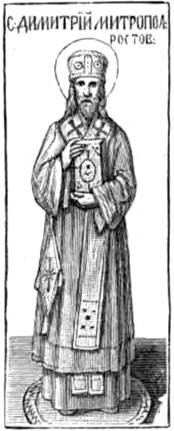
Когда в 1700 г. надлежало представить образованного и строгого по жизни архимандрита для занятия иераршеской кафедры Сибири, – представлен был св. Димитрий. В февр. 1701 г. приветствовал он в Москве царя речью и 21 марта посвящён в митрополита Тобольского. Но здоровье его было очень слабо, чтобы бороться с суровостью Сибирского климата, и он сделался болен. Пётр Великий посетил его и дозволил ему оставаться в Москве до нового назначения. Янв. 4-го 1702 г. определили его в митрополита Ростовского. В течение годового пребывания в Москве он ознакомился с новым порядком дел, который вводил Пётр Великий, заключил связь дружбы с митрополитом Стефаном Яворским, блюстителем патриаршества, и сказал несколько проповедей. Марта 1-го 1702 г. прибыл он в Ростов и, остановясь в Яковлевском монастыре, указал в правом углу монастырского собора место для своего погребения. Святитель обратил пастырское внимание прежде всего на служителей Церкви и к глубокой скорби увидал, что невежество его было до крайности и небрежение о звании изумительно. Он обратился к ним с двумя «окружными посланиями». – В первом обличал невежество и нерадение их относительно тайны исповеди. Во втором подверг рассмотрению небрежность и грубые мнения о таинстве евхаристии. Чтобы приготовить сколько-нибудь достойных служителей алтаря Божия, завёл он при архиерейском доме училище из трёх классов; часто посещал сам классы, следил за успехами учеников, предлагал вопросы и возбуждал любовь к св. истинам: иногда сам исправлял должность учителя, в другое время способным объяснял священное писание. Святитель Божий служил образцом ревности к высокому долгу пастыря. Во все воскресные и праздничные дни совершал он служение и редко без проповедания слова Божия. В июне 1706 г., быв в Ярославле, встревожен он был детскими помышлениями некоторых стариков своей паствы. Брить бороду и усы, чего требовал царь, казалось им то же, что искажать образ Божий. При выходе из собора после литургии, остановили его вопросом: «как поступить им? Они готовы положить на плаху голову, но не брить бороды». «А что отрастёт: голова или борода?» спросил святитель. «Борода», отвечали они. «Ну так лучше вам не беречь бороды, которая не раз может отрасти», сказал святитель. Попечительный архипастырь написал потом для своей паствы рассуждение: «об образе Божии», которое впоследствии много раз было издаваемо для всей России. Он рассылал и другие наставления по своей пастве, как-то вопросы и ответы о вере, где говорил и о перстосложении для креста, «зерцало православного исповедания», наставления для евхаристии. В конце 1705 г. и в 1706 г. был он в Москве для чередного занятия делами церковными; и там он нередко занимался проповеданием слова Божия. Зная, что для Церкви Русской не достаёт истории бытия людей, и уверенный в пользе сей истории особенно для пастырей народных, святитель решился заняться составлением летописи людей, а прежде того написал свод разных счислений времени. Он пересылал по частям труд свой на рассмотрение к блюстителю патриаршей кафедры, митрополиту Стефану. Тому было много скорбей по управлению, скорбей таких, которые по временам заставляли думать о покое. Ростовский святитель и в судьбе людей прошлых времён и в своей собственной видел, как неизбежны скорби на земле, и утешал первосвятителя и самого себя мыслями христианскими, самым верным врачевством против земных скорбей. Он писал блаж. «сколько могу, молю Господа, крепкого и сильного, да укрепит Он архиерейство ваше в ношении тяжкого креста. Не ослабевай, святитель Божий, под тяжестями. Ветвь под тяжестью приносит плоды. Не думай, что труды твои напрасны. «Придите ко Мне», говорит Господь, «вси труждающиися и обремененнии». – Велика награда перенесшим труды и зной дня. Не в суете те, которыми умно управляется корабль Христовой Церкви среди бурь. Ваше преосвященство считаете блаженным уединение. И я ублажаю его. Но худо ли рассуждение и св. Макария Египетского о пустынниках и о трудящихся для пользы других? Он пишет: «одни (пустынники) с помощью благодати заботятся только о себе; другие (учители) стараются принести пользу душам ближних. Последние много выше тех». Подвизайся же, Христов подвижник, о укрепляющем Иисусе. Бремя возложено на ваше святительство не случайно, а по смотрению Божию. Готов для вас и венец праведной награды. Благо носить иго Христово; да будет же лёгким бремя его!» Занятия летописью остановлены были сеятелями лжи. Учители раскола, проникая из Брынских лесов в паству Димитрия, требовали от пастыря обличений. В 1708 г. занялся он обширным «розыском» о Брынской вере. Тогда же, узнав в одном священнике наглого защитника суеверных толков, святитель отрешил его от места, с тем, чтобы шёл он в монастырь. Пронырливый священник нашёл себе защиту у доброй царицы Прасковьи Феодоровны, которая весьма уважала святителя Димитрия и была им уважаема. На просьбу царицы за пронырливого попа святитель отвечал: «много досады причинил он мне, перед множеством людей поносил моё смирение, называл меня еретиком, Римлянином, неверным. И я всё это прощаю ему, для Христа моего, Который, быв укоряем, не укорял и сносил страдания терпеливо. Смотря на незлобие Спасителя моего, простил я священника, не запретил ему священства, а предоставил ему избрать себе место в монастыре. – Но страшусь гнева Божия, если пущу в Христово стадо волка, одетого в овечью шкуру – губить души человеческие раскольничьим учением. Итак, молю ваше царское благородие не прогневаться на меня, что не могу выполнить невозможного». Святитель Димитрий изображал на печати своей герб благородной фамилии своей и знаки святительства358. Это значило, что людям смиренным давал он видеть, к их вразумлению, преимущества свои, данные ему свыше, – также он помнил в душе о своих немощах. Выше всего были для него дела звания. Свой «розыск» о Брынской вере посылал он по частям учёным друзьям своим – иноку Феологу и справщику Поликарпову для; предварительного пересмотра и, окончив к Троицыну дню 1709 г., разослал его по своей епархии. Оканчивая розыск, хотел он возвратиться к продолжению летописи. Но Господь судил иначе. Болезни тела, изнурённого учёными трудами и подвигами, становились чаще и тяжелее, и близился конец земной жизни его. Да и человек Божий созрел для вечности блаженной. Подвижник Божий во всю жизнь соблюдал строгое воздержание, мало вкушал пищи. В первую неделю великого поста он только раз принимал пищу; в страстную неделю вкушал только в четверток. Сам искренно благочестивый, он питал и поддерживал благочестие и в служивших при его доме. Он советовал им при каждом ударе колокола вспоминать о смерти и, ограждая себя крестным знамением, читать: «Отче наш» и «Богородице Дево, радуйся». Посетителей оделял иконами и советами любви. Любовь к распятому за нас Господу обращал он в главное начало жизни своей, и эта любовь расширяла сердце его для объятия всех любовью. За три дня предсказал он кончину свою, и смерть нашла его коленопреклонённым на молитве, на 58 году жизни его, 28 окт. 1709 г.
When in 1700 it was necessary to present an educated and strict-in-life archimandrite to occupy the hierarchal see of Siberia, St. Demetrius was presented. In February 1701 he greeted the Tsar in Moscow with a speech, and on 21 March he was consecrated Metropolitan of Tobolsk. But his health was too weak to contend with the severity of the Siberian climate, and he fell ill. Peter the Great visited him and permitted him to remain in Moscow until a new appointment. On 4 January 1702 he was appointed Metropolitan of Rostov. During his year-long stay in Moscow he acquainted himself with the new order of affairs which Peter the Great was introducing, formed a bond of friendship with Metropolitan Stephen Yavorsky, guardian of the patriarchal throne, and delivered several sermons. On 1 March 1702 he arrived in Rostov and, stopping at the Yakovlev Monastery, pointed out a place for his burial in the right corner of the monastery cathedral. The Hierarch turned his pastoral attention first of all to the ministers of the Church and, to his deep sorrow, saw that their ignorance was extreme and their negligence concerning their calling astonishing. He addressed them with two "circular epistles." – In the first he denounced their ignorance and negligence regarding the mystery of confession. In the second he subjected to examination their carelessness and crude opinions concerning the mystery of the Eucharist. In order to prepare at least somewhat worthy ministers of the altar of God, he established at the hierarchal house a school of three classes; he often visited the classes himself, followed the progress of the students, posed questions, and aroused love for the holy truths: sometimes he himself fulfilled the office of teacher, at other times he explained the Sacred Scripture to the capable. The Hierarch of God served as an example of zeal for the high duty of a pastor. On all Sundays and feast days he performed the services, and rarely without preaching the word of God. In June 1706, while in Yaroslavl, he was troubled by the childish thoughts of certain old men of his flock. Shaving the beard and moustache, which the Tsar demanded, seemed to them the same as distorting the image of God. Upon leaving the cathedral after the Divine Liturgy, they stopped him with the question: "What are we to do? We are ready to lay our heads on the block, but not to shave our beards." "And what will grow back: the head or the beard?" asked the Hierarch. "The beard," they answered. "Well then, it is better for you not to spare the beard, which can grow back more than once," said the Hierarch. The solicitous archpastor afterwards wrote for his flock a discourse "On the Image of God," which was subsequently published many times for all Russia. He also sent out other instructions throughout his flock, such as questions and answers about the faith, where he also spoke of the forming of the fingers for the sign of the cross, "The Mirror of the Orthodox Confession," instructions for the Eucharist. At the end of 1705 and in 1706 he was in Moscow for his turn of duty in church affairs; and there too he frequently occupied himself with preaching the word of God. Knowing that the Russian Church lacked a history of the lives of men, and confident of the usefulness of such a history especially for the pastors of the people, the Hierarch resolved to undertake the composition of a chronicle of men, and before that he wrote a compendium of various reckonings of time. He sent his work in parts for examination to the guardian of the patriarchal see, Metropolitan Stephen. The latter had many sorrows from his administration, sorrows such as at times made him think of repose. The Rostov Hierarch, both in the fate of men of past times and in his own, saw how inevitable sorrows are on earth, and consoled the chief hierarch and himself with Christian thoughts, the surest medicine against earthly sorrows. He wrote to the blessed one: "As much as I can, I pray the Lord, the strong and mighty One, that He strengthen your hierarchate in bearing the heavy cross. Grow not faint, O Hierarch of God, under the burdens. A branch under weight brings forth fruit. Think not that your labors are in vain. 'Come unto Me,' says the Lord, 'all ye that labour and are heavy laden.' – Great is the reward of those who have borne the labors and the heat of the day. Not in vain are they by whom the ship of Christ's Church is wisely steered amid the storms. Your Grace considers solitude blessed. I too bless it. But is not the judgment of St. Macarius of Egypt about hermits and about those who labor for the benefit of others good? He writes: 'Some (hermits), with the help of grace, care only for themselves; others (teachers) strive to bring benefit to the souls of their neighbors. The latter are far higher than the former.' Strive then, O athlete of Christ, in Jesus who strengthens you. The burden has been laid upon your hierarchate not by chance, but by the providence of God. Ready for you also is the crown of righteous reward. It is good to bear the yoke of Christ; may His burden be light!" The labors on the chronicle were interrupted by sowers of lies. The teachers of the schism, penetrating from the Bryn forests into Demetrius's flock, demanded refutations from the pastor. In 1708 he occupied himself with the extensive "Investigation" of the Bryn faith. At the same time, having learned that one priest was an insolent defender of superstitious teachings, the Hierarch removed him from his position, with the condition that he go to a monastery. The crafty priest found protection with the good Tsaritsa Praskovia Feodorovna, who greatly respected Hierarch Demetrius and was respected by him. To the Tsaritsa's request on behalf of the crafty priest, the Hierarch answered: "Much annoyance has he caused me; before a multitude of people he reviled my humility, calling me a heretic, a Roman, an unbeliever. And all this I forgive him, for the sake of my Christ, Who, being reviled, reviled not again and bore sufferings patiently. Looking upon the meekness of my Savior, I have forgiven the priest, have not forbidden him the priesthood, but have left it to him to choose a place for himself in a monastery. – But I fear the wrath of God if I let into Christ's flock a wolf clothed in sheep's skin, to destroy human souls with schismatic teaching. And so, I entreat your royal nobility not to be angry with me that I cannot accomplish the impossible." Hierarch Demetrius depicted on his seal the coat of arms of his noble family and the insignia of the hierarchate358. This meant that to humble people he gave to see, for their edification, his advantages given him from on high – and he also remembered in his soul his own infirmities. Above all else for him were the works of his calling. His "Investigation" of the Bryn faith he sent in parts to his learned friends – the monk Theologus and the corrector Polikarpov for preliminary review and, having finished it by Trinity Day 1709, sent it throughout his diocese. Finishing the investigation, he wished to return to the continuation of the chronicle. But the Lord judged otherwise. The illnesses of his body, worn out by scholarly labors and ascetic feats, became more frequent and more severe, and the end of his earthly life drew near. And indeed the man of God had ripened for blessed eternity. The ascetic of God throughout his life observed strict abstinence, eating little food. In the first week of Great Lent he partook of food only once; in Holy Week he ate only on Thursday. Himself sincerely pious, he nourished and sustained piety also in those who served at his house. He advised them at every stroke of the bell to remember death and, guarding themselves with the sign of the cross, to read: "Our Father" and "O Theotokos Virgin, rejoice." Visitors he bestowed with icons and counsels of love. Love for the Lord crucified for us he made the chief principle of his life, and this love expanded his heart to embrace all with love. Three days beforehand he foretold his death, and death found him kneeling in prayer, in the 58th year of his life, on 28 October 1709.
Спустя 42 года после кончины тело святителя обретено нетленным, хотя лежало в сыром месте и без каменного свода. Омофор и саккос, митра и шёлковые чётки были невредимы, а дубовый гроб сгнил. Со времени открытия мощей потекли исцеления от живого пред Богом святителя: больные горячкой, иные и с помешательством ума, получали здоровье; людям, не владевшим по нескольку лет ни ногами, ни руками, возвращалось употребление поражённых членов; бесноватые, как видели они, были осеняемы святителем и становились здоровыми. После того указом 1757 года установлено праздновать во всей Русской Церкви 28 октября день кончины святителя и 21 сентября день открытия мощей его359.
Forty-two years after his death, the body of the Hierarch was found incorrupt, although it had lain in a damp place and without a stone vault. The omophorion and sakkos, the mitre and silk prayer ropes were undamaged, while the oak coffin had rotted. From the time of the uncovering of the relics, healings began to flow from the Hierarch who is alive before God: those sick with fever, and some even with derangement of mind, received health; people who for several years had not controlled either their legs or their arms regained the use of their afflicted limbs; the demon-possessed, as they saw, were overshadowed by the Hierarch and became well. Thereafter, by decree of 1757, it was established to celebrate throughout the entire Russian Church on 28 October the day of the Hierarch's repose, and on 21 September the day of the uncovering of his relics359.
Из догматических сочинений св. Димитрия самый важный труд его – «розыск о Брынской вере», написанный с ясным и глубоким разумением христианства. – Сочинитель уличает раскол в полном несоответствии его духу Евангельскому. Частными мнениями раскольников он мало занимался и выставляет их только как странности или как улики в главном грехе раскола; не занимается ими и потому, что, как писал он: «довлеет моей худости писать о сём, чего в тех книгах («Увете» и «Жезле») не написано; написанная же повторити не настоит нужда»361. Вера раскольников – неправая, учение их вредно душе, дела их богопротивны; вот три мысли, которые раскрывает он в трёх частях «Розыска». Ныне явилась мода выхвалять раскол за его нравственность, и даже говорят, что доселе смотрели только на теоретические мысли раскола и не ценили жизни его. Пусть послушают святителя, какую цену даёт он жизни раскольничьей. Метко и сильно поражает «Розыск» врагов св. Церкви. За то и злятся же они на сочинителя «Розыска». В 1766 г. шайка раскольников решилась было украсть и сжечь мощи святителя, но не успела в покушении оттого, что святитель сам известил архимандрита о замысле злодеев362.
Among the dogmatic works of St. Demetrius, his most important labor is the "Investigation of the Bryn Faith," written with a clear and profound understanding of Christianity. – The author convicts the schism of its complete inconsistency with the spirit of the Gospel. With the particular opinions of the schismatics he concerned himself little, setting them forth only as oddities or as evidence of the chief sin of the schism; he did not occupy himself with them also because, as he wrote: "it suffices for my wretchedness to write about that which is not written in those books (the 'Admonition' and the 'Rod'); but to repeat what has been written there is no need"361. The faith of the schismatics is unrighteous, their teaching is harmful to the soul, their deeds are contrary to God; these are the three thoughts which he develops in the three parts of the "Investigation." Nowadays a fashion has appeared of praising the schism for its morality, and some even say that hitherto people have looked only at the theoretical ideas of the schism and have not valued its life. Let them hear the Hierarch, what value he gives to the schismatic life. Aptly and powerfully does the "Investigation" strike the enemies of the holy Church. And that is why they are so angry at the author of the "Investigation." In 1766 a band of schismatics resolved to steal and burn the relics of the Hierarch, but did not succeed in the attempt because the Hierarch himself informed the archimandrite of the evildoers' design362.
После «Розыска» достойны внимания «Зерцало православного исповедания» и «Ответы о вере» – то и другое род краткого катехизиса, применённого к нуждам времени; последнее отличается систематическою строгостью, а первое – подражанием известному «Исповеданию веры». Сочинение «О пресуществлении евхаристии» приближает св. тайну к общему разумению сравнениями с явлениями природы, занимая выражения и у школьной учёности.
After the "Investigation," worthy of note are the "Mirror of the Orthodox Confession" and the "Answers Concerning the Faith"—both are a kind of brief catechism, adapted to the needs of the time; the latter is distinguished by systematic rigor, while the former is an imitation of the well-known "Confession of Faith." The work "On the Transubstantiation of the Eucharist" brings the holy mystery closer to common understanding by comparisons with natural phenomena, borrowing expressions also from scholastic learning.
«Четьи-минеи» св. Димитрия – образцовое сочинение по искусству изложения, по критической осторожности в выборе известий и по духу благочестия. – «Да не будет ми лгати на святаго», сказал сочинитель, и выполнил своё слово, предложив чтение самое назидательное.
The "Lives of the Saints" (Chet'i-Minei) of St. Demetrius is an exemplary work in its art of exposition, in its critical caution in the selection of accounts, and in its spirit of piety. — "Let me not lie about a saint," said the author, and he fulfilled his word, offering the most edifying reading.
Всех проповедей святителя издано до 94 и ещё две речи. Искренность убеждения и глубокое благочестие составляли лучшую собственность их. Живостью речи и выражениями сильными проповедник поддерживает внимание слушателей к нему и не дозволяет скучать даже сухостью созерцательных истин. Тонкий вкус благочестивого проповедника виден особенно в том, что у него редко, не так, как у Яворского, встречаются странные приёмы речи, занятые у школы, например, остроты Польских учёных или намёки на богов. «Внутренний человек, в клети сердца своего поучающийся и молящийся» – прекрасное наставление для упражнения во внутренней молитве. «Молитва исповедания к Богу» – вопль грешника, кающегося с живой скорбью о грехе и тихой надеждой на Благого. «Исповедание грехов пред иереем» пересказывает грехи против Бога, ближних и самих себя, чего сам грешник не решился бы или не умел бы высказать. В размышлениях «о страданиях Спасителя» слышится голос души, дышащей той любовью к Распятому за нас, которая говорила в Апостоле: «мне же да не будет хвалитися, токмо о кресте Господа нашего Иисуса Христа». Одно из них писано стихами. Духовные песни (канты) св. Димитрия петы были, по его приказанию, в последние часы жизни его. – Это одно показывает значение их для душевного назидания. Песни: «Ты мой Бог – Иисусе; Иисусе мой прелюбезный, воплю к Богу в беде моей» – такие песни, которые всегда могут доставлять пищу и сердцу и уму. Наконец, «духовное завещание» святителя – урок для иночески-пастырской жизни. Повторим его здесь.
In all, up to 94 sermons of the Hierarch have been published, and two further addresses. Sincerity of conviction and deep piety constituted their best property. By the liveliness of his speech and powerful expressions, the preacher sustains the attention of his hearers and does not allow them to grow weary even of the dryness of contemplative truths. The refined taste of the pious preacher is especially evident in the fact that he rarely, unlike Yavorsky, employs strange turns of phrase borrowed from the schools, for example, the witticisms of Polish scholars or allusions to the gods. "The Inner Man, Instructing and Praying in the Cell of His Heart" is a beautiful instruction for the exercise of inner prayer. "The Prayer of Confession to God" is the cry of a sinner repenting with lively sorrow for sin and quiet hope in the Good One. "The Confession of Sins Before a Priest" recounts sins against God, one's neighbors, and oneself, which the sinner himself would not have dared or known how to express. In the meditations "On the Sufferings of the Savior," one hears the voice of a soul breathing that love for the Crucified One for us which spoke in the Apostle: "Let me not boast, save in the Cross of our Lord Jesus Christ." One of them is written in verse. The spiritual songs (kanty) of St. Demetrius were sung, by his order, in the last hours of his life. — This alone shows their significance for spiritual edification. The songs: "Thou art my God — Jesus; My most beloved Jesus, I cry to God in my distress" — such songs as can always provide nourishment both to the heart and to the mind. Finally, the "Spiritual Testament" of the Hierarch is a lesson for the monastic-pastoral life. Let us repeat it here.
«Я, смиренный архиерей Димитрий, митрополит Ростовский и Ярославский, внимаю гласу Господа моего, глаголющего в святом Евангелии: «будите готови, яко в оньже час не мните, Сын Человеческий приидет. Не весте бо, когда Господь дому приидет, вечер, или полунощи, или в петлоглашение, или утро, да не пришед внезапу, обрящет вы спяща». Внимая сему гласу и страшась его, особенно оттого, что часто подвергаюсь недугам, день-ото-дня изнемогаю телом, на всякий час жду того страшного часа, указанного Господом, и по силе готовлюсь к исходу из сей жизни. В таком расположении сочёл я за нужное известить духовной грамотой моей всякого, кто бы захотел после смерти моей отыскивать келейное имение у меня: пусть не трудится он понапрасну и не тревожит служивших мне для Бога. Пусть знает он, что сокровищ и богатства не собирал я от юности моей (не из тщеславия говорю о том, но извещаю ищущего моё имение). С того времени, как принял я святой иноческий образ, постригся в Киевском Кирилловом монастыре, на осмнадцатом году возраста моего, и дал обещание Богу любить произвольную нищету, – с того времени и до приближения моего ко гробу не приобретал я имущества, кроме святых книг, не желал иметь лишних одежд, ни вещей, кроме самых нужных. И душою и на деле старался я, сколько мог, соблюдать нищету и нестяжательность. Не заботился о себе, а полагался на промысл Божий, который никогда и не оставлял меня. Подаяния, какие доходили до рук моих от благодетелей или из доходов по должностям, употреблял я на мои и на монастырские нужды, там, где был игуменом или архимандритом. Точно также и в архиерейском сане не собирал я келейных доходов, которые при том и не были большими, но иное употреблял на мои нужды, другое на нужды нуждающихся, как приводил Бог. Итак, пусть никто не трудится по смерти моей отыскивать какое-либо келейное сокровище. – Ничего не оставляю я даже и на погребение моё. Пусть особенно при смерти явится перед Богом иноческая нищета. Убеждён я, что Ему приятнее будем, если ни одной копейки не останется после меня, чем то, когда бы раздавали множество собранного. Если меня, такого бедняка, никто не захочет предать обычному погребению; прошу тех, кто помнит о своей смерти, оттащить грешное тело моё в убогий дом и там бросить между трупами. Если же воля начальствующих повелит погребсти меня по обычаю, молю христолюбивых погребателей – похоронить меня в монастыре св. Иакова, епископа Ростовского, в углу церкви, где указал я место; смиренно молю о том. Кто захочет безмездно, для Бога, помянуть грешную мою душу, да помянут он будет в Царствии Небесном. Требующий же мзды за поминовение, прошу, пусть не трудится поминать меня нищего, который ничего не оставил на поминовение. Бог же да будет милостив ко всем и ко мне грешному во веки. Аминь».
"I, the humble Bishop Demetrius, Metropolitan of Rostov and Yaroslavl, hearken to the voice of my Lord, speaking in the holy Gospel: 'Be ready, for in the hour ye think not, the Son of Man shall come. For ye know not when the Master of the house shall come, at evening, or at midnight, or at cockcrow, or in the morning, lest coming suddenly, He find you sleeping.' Heeding this voice and fearing it, especially because I am often subject to infirmities, day by day growing weaker in body, I await every hour that terrible hour appointed by the Lord, and to the best of my strength I prepare for my departure from this life. In such a disposition, I have deemed it necessary to inform everyone, by this spiritual testament of mine, who might wish after my death to seek out my cell property: let him not labor in vain and disturb those who have served me for God's sake. Let him know that I have not gathered treasures and riches from my youth (I say this not out of vanity, but to inform him who seeks my property). From the time I received the holy monastic habit, having been tonsured in the Kiev Cyril Monastery, in the eighteenth year of my age, and made a vow to God to love voluntary poverty — from that time until my approach to the grave, I have acquired no property, save holy books, and have desired no superfluous garments nor things, except the most necessary. Both in soul and in deed, I have striven, as much as I could, to observe poverty and non-acquisitiveness. I did not concern myself about myself, but relied on the Providence of God, which never abandoned me. The alms that came into my hands from benefactors or from revenues from my offices, I used for my own and for the monastery's needs, wherever I was abbot or archimandrite. Likewise, in the episcopal rank, I did not gather cell revenues, which moreover were not large, but used some for my own needs, and others for the needs of the needy, as God brought about. Therefore, let no one labor after my death to seek any cell treasure. — I leave nothing even for my burial. Let monastic poverty appear before God especially at my death. I am convinced that we shall be more pleasing to Him if not a single kopeck remains after me, than if a multitude of gathered goods were distributed. If no one wishes to give me, such a poor man, an ordinary burial, I ask those who remember their own death to drag my sinful body to a pauper's house and cast it there among the corpses. But if the will of those in authority commands that I be buried according to custom, I implore the Christ-loving buriers to bury me in the monastery of St. James, Bishop of Rostov, in the corner of the church where I have indicated the place; I humbly entreat this. Whoever wishes to remember my sinful soul without payment, for God's sake, may he be remembered in the Heavenly Kingdom. But he who demands a fee for commemoration, I beg, let him not trouble himself to remember me, a pauper who left nothing for commemoration. May God be merciful to all and to me, a sinner, forever. Amen."
О сих мучениках сохранилось только краткое известие, что за исповедание Христа и нежелание принести жертву идолам мучимы были в гонение Декия (250–252) и умерщвлены в Сирии.
Of these martyrs only a brief account has been preserved, that for confessing Christ and refusing to offer sacrifice to idols, they were tortured during the persecution of Decius (250–252) and put to death in Syria.
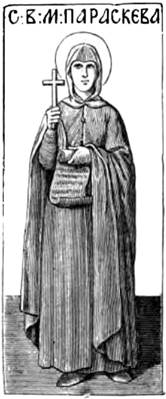
Святая великомученицаПараскева, наречённая Пятницей, достопримечательна как по этому имени, так по жизни и страданиям, сообразным с сим именем. Родители её, Иконийские христиане, особенно уважали день страданий Господних – пятницу, а потому, когда Бог, в этот же день, даровал им дочь, назвали её также Пятницей (Параскевой – по-Гречески). Впоследствии оказалось, что Параскева, сохраняя память о страданиях Христовых своим именем, сохраняла её и в своём сердце, а наконец сама приобщилась страстям Христовым – своими страданиями. Оставшись по смерти родителей при значительном имении, святая дева богатство своё раздавала меньшей братии Христовой, посвятила девство Господу и, непрестанно воспоминая Господа, прославляла Его и между язычниками в Иконии. За дерзновенное исповедание Распятого святую ввергли в темницу, а потом предали игемону на истязания, в царствование Диоклитиана (257–304). Ужасны были муки, какие наложил на неё мучитель; но велика открылась и благодать, сохранившая ту, для которой было еже жити Христос: и еже умрети, приобретение (Флп.1:21). Преподобную деву растерзали до костей; но в темнице посетил её Ангел, представил очам её любезные для неё предметы – орудия страстей Христовых, и вдруг все раны мученицы закрылись, вся она сделалась здравой. Новое чудо явилось, когда ввели святую в капище идольское; по её велению, все идолы в капище пали и обратились в прах. Затем следовали для исповедницы новые мучения: её опалили свечами; но огонь факелов вдруг столь сильно воспламенился, что пожёг многих нечестивых, близ мученицы стоявших. Наконец св. Параскева усечена мечом. Произнося – Параскева – это Греческое имя великомученицы, Церковь соединяет с ним и перевод его на нашем церковно-отечественном языке. Этот перевод усвоен имени великомученицы, согласно с толкованием, какое она сама дала на Греческом языке своему имени перед своими мучителями, которые спрашивали её о значении его.
The holy Great Martyr Paraskeva, called Pyatnitsa, is remarkable both for this name and for a life and sufferings corresponding to it. Her parents, Christians of Iconium, held in special reverence the day of the Lord's Passion — Friday; therefore, when God, on that same day, granted them a daughter, they named her also Pyatnitsa (Paraskeva — in Greek). Later it became evident that Paraskeva, preserving the memory of Christ's sufferings by her name, preserved it also in her heart, and finally she herself partook of the sufferings of Christ — through her own sufferings. Left after the death of her parents with considerable property, the holy maiden distributed her wealth to the poorer brethren of Christ, consecrated her virginity to the Lord, and, incessantly remembering the Lord, glorified Him also among the pagans in Iconium. For her bold confession of the Crucified One, the saint was cast into prison, and then delivered to the governor for torture, during the reign of Diocletian (257–304). Terrible were the torments inflicted upon her by the torturer; but great also was the grace that appeared, preserving her for whom to live is Christ: and to die is gain (Phil. 1:21). The venerable maiden was torn to the bone; but in prison an Angel visited her, presented before her eyes the objects dear to her — the instruments of the sufferings of Christ — and suddenly all the wounds of the martyr closed, and she became entirely whole. A new miracle occurred when the saint was brought into the pagan temple; at her command, all the idols in the temple fell and turned to dust. Then followed new torments for the confessor: she was burned with candles; but the fire of the torches suddenly blazed up so strongly that it burned many of the impious who stood near the martyr. Finally, St. Paraskeva was beheaded by the sword. Uttering — Paraskeva — this Greek name of the Great Martyr, the Church joins to it its translation in our Church-Slavonic language. This translation is attached to the name of the Great Martyr, in accordance with the interpretation which she herself gave in Greek of her name before her torturers, who asked her about its meaning.
В честь св. великомученицы Параскевы в 1865 году основана женская община в Инсарском уезде Пензенской губернии на месте явления иконы около 1780 года. Вот как говорит об этом предание. Явилась икона одному бывшему на службе солдату, родом из села Рузаевки, Инсарского уезда, Пензенской губернии. Этот солдат был так сильно болен ногами, что ему никак нельзя было пребывать на службе, а потому он лежал в лазарете. Средства врачей нисколько не пособили ему. В одно время во сне явилась ему прекрасной наружности женщина с крестом в руках и говорит: «хочешь ли быть здоров и желаешь ли идти на родину?» Солдат, проснувшись от сна, почёл это видение за обыкновенный сон и никому ничего не сказал; во вторую и третью ночь ему было то же самое видение и в третью ночь ещё добавлено было: «ты через три дня будешь совершенно здоров и через три дня тебя отпустят на родину; когда придёшь домой, не забудь, сходи в деревню Пайгарму, пройди в лес, держась от деревни в левую руку к оврагу, к кустарнику; там на полдороге найдёшь большую муравейную кучу, от которой сойди вниз под гору прямо, и увидишь небольшую яму воды и в ней мой образ; вычисти эту яму, опусти сруб, сделай часовню и поставь в неё мою икону, тогда ты никогда не будешь болеть ногами». После сего видения солдат действительно через три дня сделался здоров, и ноги его – как никогда не болели, чему обрадовался и удивился как сам, так и врачи. Солдат рассказал им своё троекратное сонное видение и заявил, что он верит явлению вполне. Врачи сочли его исцеление делом врачевания силы Божией и на третий же день выписали его из больницы и исхлопотали ему отпуск. Солдат, усердно помолившись Господу, чтобы Он даровал ему здоровье через Свою угодницу святую мученицу Параскеву, отправился на родину. По прибытии в деревню Пайгарму, солдат отправился в лес по тому направлению, как ему сказано было во сне, действительно находит муравейную кучу и, сойдя ниже под гору, увидел яму с водой и в ней образ своей целительницы – св. мученицы Параскевы. Долго он молился со слезами, взяв икону, поцеловал её и поставил на куст. Со-временем вырыл глубокую и широкую яму, опустил сруб, и вода быстрой струёй потекла из родника; затем построил часовню и перенёс в неё икону мученицы Параскевы. С этого-то времени, как рассказывают старожилы, стал ходить православный народ к сему месту на Богомолье, и всякий, по вере своей, получал различные исцеления. Сюда и поныне стекается народ главным образом в 9-ю пятницу после праздника Пасхи. Так как со дня постановки часовни простой народ с году на год всё большим числом приходил к роднику и явившейся иконе, то владельцы земли, потерпев большие убытки от того, что народ мял покосы и молодые побеги леса, приказали разобрать часовню, а икону отнести в приходскую Рузаевскую церковь. На другой же день икона опять явилась в том же роднике, чему православный народ обрадовался и ещё более стал иметь веру к явленному образу. Но владельцы земли, не веря явлению иконы, вначале приказали было уничтожить родник; затем, вздумали несколько ниже устроить водяную мельницу и спустить всю воду в пруд мельницы. Наняли мастера, приказали созвать народ, сколько потребовалось для прудов, плотины, канав, и завалить родник, в котором явился образ. Народ, по приказанию мастера, набивал мешки песком и глиной, заваливал родник; трудились над этим местом целое лето, но не могли завалить родника. Днём во время работы завалят родник совершенно, так что нигде нет воды; ночью вода опять начинает выбивать сильной струёй. Мастер мельницы, видя, что сила человеческая не может стоять против силы Божией, бросил работу и ушёл без всякого расчёта от землевладельца, который после сего совершенно оставил мысль о постройке мельницы.
In honor of the Holy Great Martyr Paraskeva, in 1865 a women's community was founded in the Insar district of Penza province, at the place where an icon had appeared around 1780. Thus speaks the tradition concerning this. The icon appeared to a soldier then in service, a native of the village of Ruzaevka, Insar district, Penza province. This soldier was so severely ill in his legs that he could by no means remain in service, and therefore he lay in the infirmary. The physicians' remedies availed him nothing at all. On one occasion there appeared to him in sleep a woman of beautiful appearance with a cross in her hands, who said: "Do you wish to be well, and do you desire to go to your homeland?" The soldier, awakening from sleep, took this vision for an ordinary dream and told no one anything; on the second and third nights he had the same vision, and on the third night it was further added: "In three days you shall be completely well, and in three days you shall be released to your homeland; when you come home, do not forget to go to the village of Paigarma, enter the forest, keeping from the village to the left hand toward the ravine, to the thicket; there halfway you will find a large anthill, from which go down below the hill straight ahead, and you will see a small pit of water and in it my image; clean out this pit, lower a timber frame, make a chapel, and place my icon in it, and then you shall never be ill in your legs." After this vision the soldier indeed became well in three days, and his legs were as if they had never ached, at which both he himself and the physicians rejoiced and marveled. The soldier told them of his thrice-repeated dream vision and declared that he fully believed in the appearance. The physicians accounted his healing as the work of the healing power of God, and on the very third day discharged him from the hospital and obtained a leave of absence for him. The soldier, having earnestly prayed to the Lord that He grant him health through His handmaiden, the Holy Martyr Paraskeva, set out for his homeland. Upon arriving at the village of Paigarma, the soldier went into the forest in the direction that had been told him in the dream; he indeed found the anthill and, going down below the hill, saw a pit with water and in it the image of his healer — the Holy Martyr Paraskeva. Long he prayed with tears, and taking the icon, kissed it and set it upon a bush. In time he dug a deep and wide pit, lowered a timber frame, and water flowed in a swift stream from the spring; then he built a chapel and carried the icon of the Martyr Paraskeva into it. From this very time, as the old inhabitants relate, the Orthodox people began to go to this place on pilgrimage, and everyone, according to his faith, received various healings. Hither even to this day the people flock, chiefly on the 9th Friday after the feast of Pascha. Since from the day of the chapel's erection the common people came year after year in ever greater numbers to the spring and the appeared icon, the landowners, having suffered great losses because the people trampled the hayfields and the young shoots of the forest, ordered the chapel to be taken apart and the icon to be carried to the parish church of Ruzaevka. On the very next day the icon again appeared in the same spring, at which the Orthodox people rejoiced and had even greater faith in the appeared image. But the landowners, not believing in the appearance of the icon, at first ordered the spring to be destroyed; then they conceived the idea of building a water mill somewhat lower down and letting all the water into the mill pond. They hired a master, ordered the people to be summoned, as many as were needed for the ponds, the dam, and the ditches, and to fill up the spring in which the image had appeared. The people, by the master's order, stuffed sacks with sand and clay and filled up the spring; they labored at this place a whole summer, but could not fill up the spring. By day, during the work, they would fill up the spring completely, so that there was no water anywhere; by night the water would again begin to burst forth in a strong stream. The mill master, seeing that human strength could not stand against the power of God, abandoned the work and left the landowner without any reckoning, and the latter after this entirely gave up the thought of building the mill.
Далее предание говорит, что один из живущих в ближайших селениях Татар вздумал было поругаться над источником, засорить его и взять железный обруч с части сруба, но Господь наказал его: Татарин потерял зрение, ослеп. Будучи человеком Богобоязливым, Татарин стал очищать и поправлять источник, и просил Бога единого простить ему вину и возвратить зрение. Искреннее раскаяние было принято Господом: Татарин вновь прозрел. Местное духовенство передаёт, что с того времени и были установлены ежегодные крестные ходы из ближайших селений на место источника и явленной иконы, – крестные ходы, продолжающиеся до настоящего времени.
Further, the tradition says that one of the Tatars living in the nearest settlements conceived the idea of mocking the spring, of fouling it, and of taking an iron hoop from part of the timber frame; but the Lord punished him: the Tatar lost his sight and became blind. Being a God-fearing man, the Tatar began to clean and repair the spring, and asked the one God to forgive him his guilt and restore his sight. His sincere repentance was accepted by the Lord: the Tatar regained his sight. The local clergy relate that from that time annual processions of the cross were established from the nearest settlements to the place of the spring and the appeared icon — processions of the cross that continue to the present day.
Освобождение крестьян (1861 года) поставило помещиков в необходимость продать землю; её купили крестьяне Мордва и, вырубивши лес, пожелали открыть женский монастырь. Будучи направлены в своём желании к соседней землевладелице, Марии Михайловне Киселевой, крестьяне, при помощи и содействии последней, исходатайствовали Высочайшее разрешение на открытие Параскево-Вознесенской общины, которая и была открыта 20-го июля 1865 года. Пожертвованной на общину земли было от Марии Михайловны Киселевой 20 десятин, крестьянина села Болдова Василия Губкова 16 десятин, крестьянина села Мордовской Пишли Николая Роланкина 5 десятин, Дмитрия и Петра Костиных, Семёна и Степана Захаровых тоже 5 десятин, а всего 46 десятин.
The emancipation of the peasants (1861) placed the landowners under the necessity of selling the land; it was bought by Mordvin peasants, and having cut down the forest, they desired to open a women's monastery. Being directed in their desire to the neighboring landowner, Maria Mikhailovna Kiseleva, the peasants, with her help and assistance, obtained the Imperial permission for the opening of the Paraskeva-Ascension community, which was opened on the 20th of July 1865. Of the land donated to the community, there was from Maria Mikhailovna Kiseleva 20 desyatins, from the peasant of the village of Boldovo, Basil Gubkov, 16 desyatins, from the peasant of the village of Mordovskaya Pishlya, Nicholas Rolankin, 5 desyatins, from Demetrius and Peter Kostin, Simeon and Stephen Zakharov likewise 5 desyatins, and in all 46 desyatins.
Дочь импер. Ираклия, блаженная Феврония, с юных лет пожелала служить единому Господу. Две сестры её, Августина и Мартина, украшались титлом августы, а Феврония подвизалась в уединении, заботясь только о том, как бы не лишиться славы вечной, приготовленной для всех страданиями Сына Божия363.
The daughter of the Emperor Heraclius, blessed Febronia, from her youthful years desired to serve the one Lord. Her two sisters, Augustina and Martina, were adorned with the title of Augusta, but Febronia struggled in seclusion, caring only lest she lose the eternal glory prepared for all by the sufferings of the Son of God363.
Св. Апостол учит: не замужняя заботится о Господнем, как угодить Господу, чтобы быть святою телом и духом (1Кор.7:34). Здесь две высокие мысли о деве: дева, посвящающая себя Богу, заботится о славе Божией, потом она же заботится об освящении души и тела.
The Holy Apostle teaches: the unmarried woman careth for the things of the Lord, that she may be holy both in body and in spirit (1 Cor. 7:34). Here are two lofty thoughts concerning a virgin: the virgin who devotes herself to God cares for the glory of God; and again, she cares for the sanctification of soul and body.
Кто так искренно и полно предан славе Господа, как та душа, которая не развлекается ничем земным? «Замужняя заботится о мирском, как угодить мужу» (1Кор.7:34). Умное угождение мужу – дело должное; это не то, что служение страстям и грешной воле. Но земля и небо – не одно и то же. Услуживать мужу и услуживать Господу – вещи разные по предмету, по достоинству, по последствиям. Прямое и полное служение Господу – занятие самое высокое и самое достойное желаний человеческих.
Who is so sincerely and fully devoted to the glory of the Lord as that soul which is distracted by nothing earthly? "The married woman careth for the things of the world, how she may please her husband" (1 Cor. 7:34). Wise pleasing of a husband is a duty; it is not the same as serving the passions and a sinful will. But earth and heaven are not the same thing. To serve a husband and to serve the Lord are things different in object, in dignity, and in consequences. Direct and full service to the Lord is the most exalted occupation and the most worthy of human desires.
Освящение души и тела – другой предмет забот девы. Чистота и невинность – свойства Богосозданной природы человеческой. С расстроенной грехом природой недоступна на земле невинность райская; но она возвращается постепенно, по частям, при пособиях благодати Божией. И вот о возвращении этой-то невинности воздыхает дева, её-то старается она усвоить себе подвигами.
The sanctification of soul and body is the other object of a virgin's care. Purity and innocence are properties of the God-created nature of man. With a nature disordered by sin, paradisal innocence is unattainable on earth; but it is restored gradually, in parts, with the aids of the grace of God. And behold, it is for the restoration of this innocence that the virgin sighs; it is this that she strives to make her own by her labors.
Властью над стремлением к другому полу человек ставит себя выше животного. Зверь неудержимо влечётся, следует влечению телесной природы. Человеку дана разумная свобода, чтобы господствовать над веществом. Честь ему, слава ему, если торжествует он победу над веществом. Само язычество уважало девственную чистоту: и оно для служения известным божествам назначало дев и юношей чистых, хотя с худым успехом. Тело христианина – собственность Божия, храм Св. Духа (1Кор.6:15,19,3:16,17); страшно злоупотреблять членами его (1Кор.6:18); только для обуздания грешной плоти указан брак (1Кор.7:2,3). Чистым же обещается высокое счастье (2Кор.7:1. 1Кор.7:35). «Ничто так не приближает к Богу, как добрая, целомудренная и Богоподобная чистота, которая доставляет честь и делает нас способными предстоять Господу без развлечения».
By his dominion over the inclination toward the other sex, man places himself above the animal. The beast is irresistibly drawn and follows the impulse of bodily nature. To man is given rational freedom, that he may rule over matter. Honor to him, glory to him, if he triumphs in victory over matter. Even paganism itself respected virginal purity: it too appointed pure virgins and youths for the service of certain deities, though with poor success. The body of a Christian is God's own possession, a temple of the Holy Spirit (1 Cor. 6:15, 19; 3:16, 17); it is terrible to abuse its members (1 Cor. 6:18); marriage is appointed only for the restraining of the sinful flesh (1 Cor. 7:2, 3). But to the pure is promised lofty blessedness (2 Cor. 7:1; 1 Cor. 7:35). "Nothing so draws near to God as good, chaste, and Godlike purity, which bestows honor and makes us capable of standing before the Lord without distraction."
Более чем вероятно, что св. Иоанн патриарх († 595 г.) писал для св. царевны своё «Послание деве, преданной Богу». Прочитаем некоторые места из этого обширного, прекрасного послания.
It is more than probable that St. John the Patriarch († 595) wrote for St. Febronia his "Epistle to a Virgin Devoted to God." Let us read some passages from this extensive and beautiful epistle.
«Хотя и успеешь в добродетели, не возносись добротой твоей, чтобы за тщеславие не отвратился от тебя Бог... Если уловлена будешь когда-нибудь глазами, как Давид, худо отворивший окна; если глаза твои возмутят душу твою, закрой с воздыханием око своё, худо смотревшее. Иначе навык греховный ведёт споткнувшегося к худшему. Если имеешь чистую одежду, не везде ходи в ней, чтобы как-нибудь не замаралась... Упражняйся непрестанно в св. Писании. Как вино, когда пьют его, прекращает печаль и производит в сердце весёлость, так и духовное вино, когда пьёшь его, производит в душе радость... Всё настоящее слабее паутины, обманчивее сновидений. Спаситель ублажает скорбящих, чтобы наслаждение приятным не удерживало в своей власти пристрастных к нему. Как Авраам, услышав слова: изыди от земли твоея (Быт.12:1), вышел, – оставим и мы обычные наклонности наши, чтобы, упражняясь в умерщвлении, переселиться в горний город; – будем всегда носить мертвенность Иисуса в теле своём и помнить слова: трезвитесь, бодрствуйте (1Пет.5:8) ... Много купцов, которые, обнищав, снова обогащались и, после кораблекрушения продолжая торговать, поправляли своё состояние. Неужели для нас приготовил Бог огонь? Нет, для диавола и ангелов его; только пусть сами мы не разводим того огня... Если не можешь быть солнцем, будь по крайней мере звездой, – восходи с земли к небу, начни ревновать светлым звёздам... Подвижник не намащается миром: ибо это есть забота только низложенных. Какую приносит пользу слоновой костью или серебром оправленный одр? Попечение об этом излишне и с неба низводит гнев... Ты возжелала девства? Храни заповеди, и Господь сохранит тебя. Если, молясь, скажешь: сохрани мя, Господи, яко зеницу ока (Пс.16:8), скажет тебе и Он: храни Моя заповеди и поживеши, словеса же Моя, яко зеницы очию (Притч.7:2). Если будешь расположена так, Господь, усвоив Себе попечение о тебе, скажет: касаяйсявас, яко касаяйся в зеницу ока Моего (Зах.2:8) ... Многие девы понесли мученичество. Если же другие перенесли смерть, ужели ты не можешь превозмочь похоти? Надобно властвовать не только над похотью, но и над гневом. Язык твой должен говорить немного... Берегись, чтобы язык не погубил тебя:язык, говорит Иаков, заражает всё тело (Иак.3:6); когда заразится всё тело, необходимо повредится и ум... Язык заключён двумя преградами: зубами и губами, чтобы, подобно целомудренной девице, не произносил ничего безрассудного... Сладок ночной сон; но будь уверена, что ничего нет слаще пения псалмов. Тебе тяжко спать на земле? Но вспомни, что мученики были повергаемы на горящие угли. У тебя очень горько во рту от поста? Но Христос для тебя вкусил желчи. Ты плачешь о себе? Но ты никогда не плакала, как Павел, о спасении других. Облегчай труд надеждой: за печалью следует радость»364.
“Though thou shouldst succeed in virtue, be not exalted by thy goodness, lest God turn away from thee because of vainglory… If thou art ever caught by the eyes, like David, who ill opened the windows; if thine eyes trouble thy soul, close with a sigh thine eye that looked amiss. Otherwise, the habit of sin leads him who stumbles to worse. If thou hast a clean garment, go not everywhere in it, lest it be somehow stained… Exercise thyself unceasingly in Holy Scripture. As wine, when drunk, puts away sorrow and produces gladness in the heart, so the spiritual wine, when thou drinkest it, produces joy in the soul… All that is present is weaker than a spider’s web, more deceptive than dreams. The Savior blesses those who mourn, lest the enjoyment of pleasant things hold in its power those who are attached to them. As Abraham, hearing the words: Go out from thy land (Gen. 12:1), went out, so let us also leave our customary inclinations, that, exercising ourselves in mortification, we may migrate to the heavenly city; – let us always bear the dying of Jesus in our body and remember the words: Be sober, watch (1 Pet. 5:8)… Many merchants, having become poor, again grew rich, and after shipwreck, continuing to trade, restored their condition. Has God prepared fire for us? No, for the devil and his angels; only let us not ourselves kindle that fire… If thou canst not be the sun, be at least a star, – ascend from earth to heaven, begin to emulate the bright stars… An ascetic is not anointed with ointment: for that is a care only of the vanquished. What profit is a bed adorned with ivory or silver? Care for this is superfluous and brings down wrath from heaven… Thou hast desired virginity? Keep the commandments, and the Lord will preserve thee. If, praying, thou sayest: Preserve me, O Lord, as the apple of the eye (Ps. 16:8), He also will say to thee: Keep My commandments and live, and My words as the apple of the eye (Prov. 7:2). If thou art so disposed, the Lord, taking upon Himself care for thee, will say: He that toucheth you toucheth the apple of Mine eye (Zech. 2:8)… Many virgins have suffered martyrdom. If others have endured death, canst thou not overcome lust? One must rule not only over lust, but also over anger. Thy tongue should speak little… Beware lest the tongue destroy thee: The tongue, says James, defileth the whole body (Jas. 3:6); when the whole body is defiled, the mind also is necessarily harmed… The tongue is enclosed by two barriers: teeth and lips, that, like a chaste maiden, it may utter nothing rash… Sweet is night’s sleep; but be assured that nothing is sweeter than the singing of psalms. Is it hard for thee to sleep on the ground? But remember that the martyrs were cast upon burning coals. Is thy mouth very bitter from fasting? But Christ for thee tasted gall. Dost thou weep for thyself? But thou hast never wept, like Paul, for the salvation of others. Lighten thy labor with hope: after sorrow comes joy”364.
По таким правилам, с такими мыслями, подвизалась святая царевна Феврония. Чистая душой и телом, почила она в 632 году, когда отец её император сражался с Персами365. Память её чтится Греческой Церковью октября 28 дня366.
By such rules, with such thoughts, did the holy princess Febronia struggle. Pure in soul and body, she reposed in the year 632, when her father the emperor was warring with the Persians365. Her memory is honored by the Greek Church on October 28366.
Как по Сербским памятникам показано чтить в 28 д. октября память св. Арсения, архиепископа Сербского367, так в Русском лицевом подлиннике изображён «Арсений святой, архиепископ Сербский, сед»368.
As the Serbian memorials indicate that the memory of St. Arsenius, Archbishop of Serbia367, is to be honored on October 28, so in the Russian Illuminated Menologion he is depicted: “Arsenius the holy, Archbishop of Serbia, gray-haired”368.
Сын православных родителей Славян, живших в Среме, блаженный Арсений, почувствовав в себе влечение к уединённой жизни, удалился в монастырь и принял монашество. Спустя некоторое время, услышав о подвигах Саввы Сербского, приходит он в Жичский монастырь. Духовный святитель на первый раз назначает ему простые послушания; потом, узнав его способности и ревность к подвигам, определил его в екклесиарха; это назначение одушевило Арсения на подвиги самого искреннего служения Господу. – Когда ожидали, что Венгры по внушению оскорблённого папы вторгнутся в Сербию с опустошениями, как вторгались они прежде, Савва поручил Арсению искать в Сербии покойное место для кафедры архиепископа, и Арсений нашёл Печь; место, говорил он Савве, ограждено с востока двумя высокими хребтами, – кажется весьма удобно для архиепископии. Святитель одобрил выбор. Арсений поставлен в игумена Жичского. Отправляясь в первый раз на восток, св. Савва поручил Жичскому игумену не только обитель, но и некоторые дела кафедры369. По возвращении с востока, к утешению своему, нашёл в Жичской обители такой порядок, какого только мог желать. – Решившись на вторичное путешествие в Иерусалим и вместе на отречение от кафедры, святитель назначил испытанного им Арсения в преемника по себе и посвятил его в архиепископа. Св. Савва уже не возвратился живым в Сербию; на возвратном пути скончался он в Тернове. «И горько и стыдно нам, говорил Арсений кралю Владиславу, что просветитель Сербии лежит в чужой стороне», и наконец через год мощи св. Саввы перенесены были в Милешов монастырь370. Самая усердная деятельность Сербского архиепископа обращена была теперь на устроение архиепископии в Пене и на построение там храма в честь Ап. Петра и Павла371. Нападение Монголов, вырвавшихся в Сербию из Венгрии в 1242 г., останавливало успехи забот святительских о кафедральной обители372, но продолжительное управление Сербской Церковью дозволило усердному архипастырю совершить свои намерения относительно архиепископии. В 1263 г. он был ещё жив373; последние три года своей жизни он был сильно болен, очищаясь скорбями для вечности, и почил октября 28-го 1266 года374. На алтарной стене Печского храма ещё читается прекрасная надпись: «Господи Боже наш, вонми, посети и благослови храм сей... помяните же и меня грешного Арсения». На левой стороне царских дверей у иконостаса стоит рака с главами святых «пятизарных» мучеников, которые получил блаженный Арсений из Болгарского Тернова. У столба на правой стороне храма гробница из белого мрамора, в которой покоятся мощи основателя Печской обители св. Арсения375.
The son of Orthodox Slavic parents living in Srem, the blessed Arsenius, feeling within himself a drawing to the solitary life, withdrew to a monastery and received the monastic tonsure. After some time, hearing of the struggles of Sava of Serbia, he came to the Žiča Monastery. The spiritual hierarch at first assigned him simple obediences; then, having learned of his abilities and zeal for ascetic labors, he appointed him ecclesiarch; this appointment inspired Arsenius to the struggles of the most sincere service to the Lord. – When it was expected that the Hungarians, at the instigation of the offended pope, would invade Serbia with devastation, as they had done before, Sava entrusted Arsenius with seeking in Serbia a peaceful place for the archbishop’s see, and Arsenius found Peć; the place, he said to Sava, is protected from the east by two high ridges – it seems very suitable for an archbishopric. The hierarch approved the choice. Arsenius was appointed abbot of Žiča. Setting out for the first time to the East, St. Sava entrusted to the abbot of Žiča not only the monastery, but also some affairs of the see369. Upon his return from the East, to his consolation, he found in the Žiča monastery such order as he could only have desired. – Having resolved on a second journey to Jerusalem and at the same time on resignation from the see, the hierarch appointed the proven Arsenius as his successor and consecrated him archbishop. St. Sava did not return alive to Serbia; on the return journey he reposed in Tarnovo. “It is both bitter and shameful for us,” said Arsenius to King Vladislav, “that the enlightener of Serbia lies in a foreign land,” and finally, after a year, the relics of St. Sava were translated to the Mileševa Monastery370. The most zealous activity of the Serbian archbishop was now directed to the establishment of the archbishopric in Peć and to the building there of a church in honor of the Holy Apostles Peter and Paul371. The incursion of the Mongols, who burst into Serbia from Hungary in 1242, hindered the success of the hierarch’s cares for the cathedral monastery372, but the long administration of the Serbian Church allowed the zealous archpastor to accomplish his intentions regarding the archbishopric. In 1263 he was still alive373; the last three years of his life he was grievously ill, being purified by sorrows for eternity, and he reposed on October 28, 1266374. On the altar wall of the Peć church there is still read a beautiful inscription: “O Lord our God, hearken, visit and bless this temple… Remember also me, the sinful Arsenius.” On the left side of the royal doors at the iconostasis stands a reliquary with the heads of the holy “five-radiant” martyrs, which the blessed Arsenius received from Bulgarian Tarnovo. At a pillar on the right side of the church is a tomb of white marble, in which repose the relics of the founder of the Peć monastery, St. Arsenius375.
Преосвященный Даниил передаёт чудный опыт загробной деятельности святителя Арсения. Болгарский князь Шишман, призвав в помощь хищных Татар, двинулся с войсками, чтобы ограбить богатую тогда Печскую обитель. – «В ту нощь спящим им близ места того Бог великое знамение страха яви им, молитвами угодников Своих и архиерея Христова Арсения, лежащего ту в доме св. Апостолов. Знамение глаголю таково, яко видети им столп огнен великий, сходящий с небесе, от негоже лучи пламенны исходяще паляху лица их, и мужие, огнени образы имуще, такожде и оружия имуще в руках своих, с нуждою великою гоняху секущи полки их». – Шишман в ужасе бежал и растерял большую часть войска. Это было при кор. Милютине376.
The Right Reverend Daniel relates a wondrous experience of the posthumous activity of Hierarch Arsenius. The Bulgarian prince Shishman, having summoned the predatory Tatars to his aid, moved with his troops to plunder the then wealthy Peć monastery. – “That night, as they slept near that place, God showed them a great sign of fear, through the prayers of His saints and of the hierarch of Christ Arsenius, lying there in the house of the Holy Apostles. A sign, I say, such that they saw a great pillar of fire descending from heaven, from which fiery rays went forth, burning their faces, and men having fiery forms, likewise having weapons in their hands, with great force pursued them, cutting down their ranks.” – Shishman fled in terror and lost the greater part of his army. This was under King Milutin376.
Пострадал в 643 году от магометан, сделавших в это время первое своё вторжение в Грузинские земли. Неофит был захвачен в плен, принуждаем к отречению от Христа и, как непреклонный в своей вере, обезглавлен.
He suffered in the year 643 at the hands of the Mohammedans, who at that time made their first incursion into the Georgian lands. Neophytus was taken captive, compelled to renounce Christ, and, as unyielding in his faith, was beheaded.
Редкое и утешительное явление представляет вековая жизнь св. Афанасия: вся она состояла из одних добрых дел, вся состояла из непрерывных подвигов любви к Богу и к людям. – Афанасий, в мире Алексий, родом из Адрианополя, с детства направленный к Богу благочестивыми родителями, уже в молодых годах поражал всех святым благоразумием, подобного которому можно было ожидать разве только от старческого возраста.
The long life of St. Athanasius presents a rare and comforting spectacle: it consisted entirely of good deeds, entirely of unceasing labors of love for God and for men. – Athanasius, in the world Alexis, a native of Adrianople, directed toward God from childhood by pious parents, already in his youthful years amazed all with holy prudence, such as one might expect only from old age.
Обогатив драгоценным содержанием свою душу под влиянием чтения священного Писания, воспламенённый усердием подражать жизни святых подвижников, Алексий, читая, между прочим, жизнеописание дивного Алипия Кионита (память его 26-го ноября), решился немедленно последовать его примеру и, оставив чуждый ему, суетный мир, тайно удалился из дома своего в Фессалонику, где находился дядя его в одном богатом монастыре. Здесь принял он пострижение с именем Акакия, но, не удовлетворившись жизнью в этой обители, куда проникало много светской суеты, недолго пробыв здесь, удалился на Афонскую гору.
Having enriched his soul with precious content under the influence of reading Holy Scripture, inflamed with zeal to imitate the life of the holy ascetics, Alexis, reading, among other things, the life of the wondrous Alypius the Stylite (his memory is on November 26), resolved immediately to follow his example and, leaving the vain world, which was alien to him, secretly departed from his home to Thessalonica, where his uncle was in a wealthy monastery. There he received the tonsure with the name Acacius, but, not being satisfied with life in this monastery, into which much worldly vanity penetrated, and having stayed there but a short time, he withdrew to Mount Athos.
В жизни Афонских отшельников нашёл он настоящий желанный образец и всеми силами души устремился к подражанию их подвигам. Прежде всего усвоил себе с полной лёгкостью отказавшийся от мира – совершенную нестяжательность: под иноческим одеянием – одна власяница заменяла ему всякую другую одежду; в пищу употреблял он только хлеб с водой; спал на голой земле; ходил всюду без обуви и пеший. Посетив монастыри Святой Горы, вступил в число братии в Есфигменской обители и предался самому строгому подвижничеству, но, тяготясь уважением, которое не замедлил возбудить к своей подобной ангельской жизни, ревностный инок оставил Афон. Отправился он для поклонения святым местам в Иерусалим, посетил пустыню Иорданскую, пожил в отшельничестве на горе Латрской, потом – на горе Авксентиевой назидался жизнью подвижников Илии, Нила Италийского и Афанасия Лепентрийского, наконец удалился на гору Галасийскую – в обитель блаженного Лазаря, где и провёл 8 лет в различных послушаниях и в это время принял великий ангельский образ и наречён Афанасием. Возведён был, хотя и против воли своей, на степень священства.
In the life of the Athonite hermits he found the true desired model and with all the strength of his soul he strove to imitate their struggles. First of all, he acquired with complete ease, having renounced the world, perfect non-acquisitiveness: under his monastic garb, a single hair-shirt replaced every other garment; for food he used only bread and water; he slept on the bare ground; he went everywhere barefoot and on foot. Having visited the monasteries of the Holy Mountain, he entered the brotherhood of the Esphigmenou Monastery and gave himself over to the strictest asceticism, but, burdened by the respect which he soon aroused for his angelic life, the zealous monk left Athos. He set out to venerate the holy places in Jerusalem, visited the Jordanian wilderness, lived as a hermit on Mount Latros, then on Mount Auxentius he was edified by the life of the ascetics Elias, Nilus of Italy, and Athanasius of Lependrium, and finally withdrew to Mount Galesion – to the monastery of the blessed Lazarus, where he spent eight years in various obediences and at that time received the great angelic schema and was named Athanasius. He was raised, though against his will, to the rank of the priesthood.
Среди неусыпного бодрствования над собой, достиг высокой степени духовности Афанасий и в смирении своём удостоился Божественного посещения. Однажды, когда он, по обыкновению своему, ночью молился на церковной паперти, услышал он призвание Того, к Кому возносился в горячей и слёзной молитве: – «так как ты любишь Меня, Афанасий, то тебе надобно будет пасти народ Мой» ... Глубоко поражён был этим явлением служитель Божий и с благоговением хранил в душе таинственные слова, возвестившие ему будущее назначение его...
Amidst his unceasing vigilance over himself, Athanasius attained a high degree of spirituality and, in his humility, was vouchsafed a Divine visitation. Once, when, according to his custom, he was praying at night on the church porch, he heard the call of Him to Whom he was raising himself in fervent and tearful prayer: “Since you love Me, Athanasius, you must shepherd My people.” … Deeply struck was the servant of God by this manifestation, and with reverence he kept in his soul the mysterious words that foretold his future calling…
Между тем, в нём возрастала потребность к безмолвию пустынному, и он возвратился на Афон, но, по причине случайно возникших там в это время смут, удалился оттуда и снова уединился на гору Ган. Но недолго продолжалось его уединение, так как слава о подвижничестве его не могла утаиться и привлекла к нему множество народа, жаждавшего поучаться у него. В том числе было много и женщин, для которых Афанасий основал монастырь.
Meanwhile, the need for desert silence grew within him, and he returned to Athos; but, because of disturbances that had by chance arisen there at that time, he departed from there and again secluded himself on Mount Ganus. His seclusion, however, did not last long, for the fame of his asceticism could not be hidden and drew to him a multitude of people thirsting to be taught by him. Among them were many women, for whom Athanasius founded a monastery.
На нём – испытанном и созревшем в подвигах духовных – остановил свой выбор царствовавший в то время благочестивый Иоанн Кантакузен, чтобы возвести его на оставшуюся праздною кафедру Константинопольской Церкви (в 1280 г.). Трудно было отшельнику расстаться со своей возлюбленной пустыней, но, вспоминая слова Христа, обещавшего вверить ему Свою Церковь, не нашёл он также и возражений явившимся передать ему волю царя, чтобы он оставил своё уединение, когда «Церковь особенно требует и зовёт его на помощь против своих врагов» ... – «Если ты не послушаешь этого зова, – прибавили посланные от императора, – то отдашь в этом ответ Богу в час суда» ...
Upon him—tested and matured in spiritual struggles—the pious John Cantacuzenus, who was then reigning, fixed his choice, to raise him to the vacant see of the Church of Constantinople (in A.D. 1280). It was hard for the hermit to part from his beloved desert, but, remembering the words of Christ, Who had promised to entrust His Church to him, he found no objections either to those who came to convey to him the will of the emperor, that he should leave his seclusion, when “the Church especially demands and calls you to her aid against her enemies” … “If you do not heed this call,” added the emperor’s envoys, “you will answer for it to God at the hour of judgment” …
И вот, беспрекословно вверился Промыслу Божиему Афанасий. Торжественно и среди общего ликования произошло его вступление на кафедру Вселенской Церкви, и скоро и блистательно оправдал он возлагаемые на него упования. Прежде всего Афанасий потрудился в борьбе с ересью, постарался успокоить Церковь, потрясённую смутами, нанесёнными ей патриархом Иоанном Векком. Подобно древним великим деятелям церковным, он энергично и беспощадно обличал несправедливых и хищников, не страшась ни вельмож, ни богачей, ни самого царя.
And so, without demur, Athanasius entrusted himself to the Providence of God. His accession to the see of the Universal Church took place solemnly and amidst general rejoicing, and he soon and brilliantly justified the hopes placed in him. First of all, Athanasius labored in the struggle against heresy; he strove to pacify the Church, shaken by the disturbances inflicted upon her by Patriarch John Beccus. Like the great church leaders of old, he energetically and mercilessly denounced the unjust and the rapacious, fearing neither nobles, nor the rich, nor even the emperor himself.
Когда не мог подействовать увещаниями, то налагал на непокорных строгие епитимии. Это возбудило против него многочисленных врагов, которые жаловались и клеветали на него императору и просили избрать более снисходительного патриарха, наконец, достигли того, что император, ради поддержания мира церковного и чтобы успокоить восставших против беспристрастного пастыря, между которыми были и архиереи, объявил Афанасию, что увольняет его от патриаршего служения...
When he could not effect anything by admonitions, he imposed strict penances upon the disobedient. This aroused against him numerous enemies, who complained and slandered him to the emperor and asked that a more lenient patriarch be chosen; finally, they achieved that the emperor, for the sake of maintaining church peace and to calm those who had risen against the impartial shepherd—among whom were also bishops—declared to Athanasius that he was dismissing him from the patriarchal service…
– «Государь! – отвечал на это Афанасий, – я не сам и не для того принял это высокое достоинство, чтобы раболепствовать перед людьми, молчать и оставлять без внимания недостатки их, но для того, чтобы обличать и исправлять их, потому что страшному осуждению подлежит всякий из нас, не обличая согрешающих. Если же за строгость моих обличений меня возненавидели и желают моего удаления с кафедры патриаршей – не прекословлю твоей власти и воле Божией, и удаляюсь, прося Бога, чтобы Он устроил нам всё во благо, как Сам ведает, предстательством Богородицы и святых Его».
“Sovereign!” Athanasius replied to this, “I did not accept this high dignity of myself, nor in order to be servile before men, to be silent and to disregard their faults, but in order to denounce and correct them, because a terrible condemnation awaits every one of us who does not denounce those who sin. If, for the severity of my denunciations, I have been hated and they desire my removal from the patriarchal see, I do not contradict your authority and the will of God, and I withdraw, beseeching God that He may arrange everything for our good, as He Himself knows, through the intercession of the Theotokos and His saints.”
После того Афанасий возвратился на гору Ган, где и продолжал своё строгое подвижничество, и в это время был удостоен необыкновенной Божественной благодати, проявившейся в различных чудных откровениях и даре прозорливости, удостоверенном тем, что все предсказания его осуществлялись. После десяти лет такой жизни снова и с торжеством больше прежнего возведён был Афанасий на патриаршескую кафедру вместо добродетельного, но, при безмерной кротости своей, не имевшего сил вести борьбу с врагами Церкви Божией – Иоанна. Снова явился он защитником Церкви и благодетелем народа, принимая участие во всех его тягостях, и особенно послужил ему во время страшного общественного бедствия – голода. Проповедями своими возбуждал милосердие в богатых, сам служил примером для них, деятельно принимая различные меры, которыми многие были спасены от голодной смерти.
After that, Athanasius returned to Mount Ganus, where he continued his strict asceticism, and at this time was vouchsafed an extraordinary Divine grace, manifested in various wondrous revelations and the gift of foresight, confirmed by the fact that all his predictions were fulfilled. After ten years of such life, he was again, and with greater triumph than before, raised to the patriarchal see in place of John—a virtuous man, but who, in his excessive meekness, had not the strength to wage war against the enemies of the Church of God. Again he appeared as a defender of the Church and a benefactor of the people, taking part in all their hardships, and especially served them during a terrible public calamity—a famine. By his sermons he stirred up mercy in the rich; he himself served as an example for them, actively taking various measures by which many were saved from death by starvation.
После семи лет вторичного управления Церковью, утомлённый и, не смотря на святость своей жизни, не избежавший врагов, великий святитель Церкви Афанасий снова удалился в свой монастырь. Усиленным подвижничеством старался он испросить Божие помилование за то, что по немощи своей и, как представлялось ему, неправильно уклонился он от указанного ему назначения – управлять паствой Христовой.
After seven years of his second administration of the Church, weary and, despite the holiness of his life, not having escaped enemies, the great Hierarch of the Church, Athanasius, again withdrew to his monastery. By intensified asceticism he strove to entreat God’s mercy for having, in his weakness and, as it seemed to him, wrongly deviated from the appointment indicated to him—to govern the flock of Christ.
Дожив до столетнего возраста и почувствовав, что приближается время отшествия его из мира земного, Афанасий, собрав своих учеников, отечески беседовал с ними, заповедовал им смиренномудрие, любовь и милосердие, которыми прославляется Бог, и без которых никто не спасётся: – «свято храните уставы Церкви и предания отцов, – также говорил он им, – очищайте сердце и мысль от нечистых помыслов и, спасая, спасёте свои души» ... Среди подобных бесед тихо предал Богу душу свою блаженный старец – 28-го октября, в XIV веке. – Многими чудотворениями прославил его Бог ещё и при жизни его377.
Having lived to the age of one hundred and feeling that the time of his departure from the earthly world was approaching, Athanasius, gathering his disciples, conversed with them in a fatherly manner, commanding them humility, love, and mercy, by which God is glorified, and without which no one will be saved: “Sacredly keep the statutes of the Church and the traditions of the fathers,” he also said to them, “purify your heart and mind from impure thoughts, and, saving yourselves, you will save your souls.” … Amidst such conversations, the blessed elder quietly surrendered his soul to God—on the 28th of October, in the XIV century. God glorified him with many miracles even during his life377.
Житие пр. Иова описано учеником его Досифеем. В Страннике 1846 г. помещено жизнеописание преп. Иова, составл. свящеп. Евг. Струменским, но очень бедное.
The Life of the Venerable Job was written by his disciple Dositheus. In the Strannik of 1846, a biography of the Venerable Job, compiled by the priest Evg. Strumensky, is included, but it is very poor.
Преп. Иов, скончавшийся в 1651 г., жил до 100 лет и след. поступил в Угорняцкую обитель в 1561 г., стал иеромонахом в 1581 г. Управление Дубенской обителью принял он около 1588 г.
The Venerable Job, who reposed in 1651, lived to be 100 years old and consequently entered the Uhornytsky monastery in 1561, became a hieromonk in 1581. He assumed the governance of the Dubno monastery around 1588.
Киевлянин на 1840 г. стр. 95–97. 115. 116. Маяк 7. 23. Стр. 43. 44. В 1636 г. иезуиты достигли того, что 40 священников выгнаны были из своих приходов, по приговору трибунала. – Ист. христ. цер. на Волыни–в христ. чт. 1855 г. 2, 14–20.
Kievlyanin for 1840, pp. 95–97, 115, 116. Mayak 7, 23, pp. 43, 44. In 1636, the Jesuits achieved that 40 priests were driven from their parishes by a tribunal verdict. — Ist. khrist. tser. na Volyni in Khrist. cht. 1855, 2, 14–20.
Опис. Синод. ркп. II, 3, стран. 341. Это тот самый Иоанн Вишневский, который в начале унии писал с Афона послания в Малороссию в подкрепление православию, Обзор дух. лит. 1, § 158.
Opis. Sinod. rkp. II, 3, p. 341. This is the same John Vishnevsky who, at the beginning of the Union, wrote epistles from Athos to Little Russia in support of Orthodoxy. Obzor dukh. lit. 1, § 158.
Житие пр. Иова Маяк 1845 г. Матер., стр. 44. По словам Досифея управление Дубенской обителью преподобный продолжал до 20 лет. Если управление начать с 1586 г. (пр. 344), то окончание приходилось бы на 1606 г. Но невероятно, чтобы последнее было прежде смерти кн. Константина (1608 года), и весьма вероятно, что фанатик Януш выгнал блаж. Иова из Дубенской обители после смерти отца своего, в 1610 или 1611 г.
Zhitie pr. Iova in Mayak 1845, Mater., p. 44. According to the words of Dositheus, the Venerable One continued the governance of the Dubno monastery for up to 20 years. If the governance began in 1586 (note 344), then its end would fall in 1606. But it is improbable that the latter occurred before the death of Prince Constantine (1608), and it is very probable that the fanatic Janusz drove the blessed Job from the Dubno monastery after the death of his father, in 1610 or 1611.
Чудо от иконы Богоматери над Татарами было в 1607 г. Анна Гойская в своей записи 1597 г. говорит: «в имении моём при селе Нечаеве с давних времён существует каменный храм Успения Пресв. Богородицы; дабы при той церкви постоянно совершалось славословие Божие, я вознамерилась устроить там монастырь и дать ему фундуш»; иноки сей обители «должны быть не иного исповедания, как только Греческого восточной церкви». – Сигизмунд II письмом 1554 г. подтвердил привилегию, данную Успенскому Почаевскому храму в 1527 г. (Акты – в Почаевском монаст.). При Успенском храме живали иноки и прежде Гойской, но по временам рассеваемы были Татарами.
The miracle from the Icon of the Mother of God over the Tatars occurred in 1607. Anna Goyka in her deed of 1597 says: “In my estate, at the village of Nechayev, there has existed from ancient times a stone church of the Dormition of the Most Holy Theotokos; so that at that church the praise of God might be constantly performed, I resolved to establish a monastery there and to endow it”; the monks of this monastery “must be of no other confession than only the Greek Eastern Church.” — Sigismund II, by a letter of 1554, confirmed the privilege granted to the Dormition Pochaev Church in 1527 (Acts—in the Pochaev Monastery). Monks had lived at the Dormition Church even before Goyka, but were at times scattered by the Tatars.
Гора Почаевская: «потом (после возвращения св. иконы) иноцы аще и велие имеяху попечение купно с игуменом своим, пречестным первее в мантии на имя Иовом, а послежде в схиме, си есть в святом великом ангельском образе, ИоанномЖелезом (егоже тело и доселе в пещере, в монастыре здешном сущей, нетленно опочивает) о том, дабы были возмогли похищенныя вещи церковныя, наипаче фелоны, бисеры, сребро и злато, отыскати, но не возмогоша». По ист. иер. 6, 560 игумен ПочаевскийИоанн в 1626 г.
Gora Pochaevskaya: “Afterwards (after the return of the holy icon), the monks, though they took great care, together with their most honorable abbot, first in the mantle under the name Job, and afterwards in the schema, that is, in the holy great angelic form, John Zhelezo (whose body even now reposes incorrupt in a cave existing in this monastery), to recover the stolen church vessels, especially phelonia, pearls, silver, and gold, were unable.” According to Ist. ier. 6, 560, the abbot of Pochaev John was in office in 1626.
Игуменья Параскевия Тупталовна в 1710 г. завещала Кирилловскому монастырю «двор свой отечний, близ притисского Николы». Кирилловский игумен Иннокентий Монастырский в 1694 г. купил для обители дом с садом на Подоле, «близ пляцу некгдысь салтановского, на котором теперь (в 1684 г.) мешкает пан Савва Туптало, сотник казацкий Киевский». – При бесприходном Иорданском храме, отданном в 1605 г. в заведывание Кирилловского игумена Василия Красовского, Девичий монастырь в первый раз упоминается в завещании м. Гедеона 1689 г. и первые игуменьи его – Тупталовны. – См. Киев. епарх. вед. 1863 г. № 22.
Abbess Paraskevia Tuptalovna in 1710 bequeathed to the Cyril Monastery “her paternal court, near St. Nicholas Prytysk.” The Cyril abbot Innocent Monastyrsky in 1694 bought for the monastery a house with a garden on the Podil, “near the plot formerly of Saltanov, on which now (in 1684) dwells Mr. Sabbas Tuptalo, a Cossack centurion of Kiev.” — At the non-parochial Jordan Church, given in 1605 into the charge of the Cyril abbot Basil Krasovsky, the Convent is mentioned for the first time in the will of Metropolitan Gideon of 1689, and its first abbesses were the Tuptalovnas. — See Kiev. eparkh. ved. 1863, No. 22.
Сочинитель книжки: Руно орошенное, Новгор. 1678 г. Черниг. 1680, которую приписывали и Лазарю Барановичу и Лаврентию Крещановичу (словарь писат. 1, 126. 2, 25) виден в четырёх стихах предисловия: «иеромонах Димитрий Савич».
The author of the booklet Runooroshennoe (The Fleece Bedewed), Novgorod 1678, Chernigov 1680, which was attributed both to Lazar Baranovich and to Lavrenty Kreshchanovich (Slovar’ pisat. 1, 126; 2, 25), is seen in the four verses of the preface: “Hieromonk Demetrius Savich.”
Послание св. Иоанна Постника изд. Мореллем в 1 томе творений Иоанна Златоуста; перевод его – в Христ. Чтении 1826 г. 24, 246–306.
The Epistle of St. John the Faster, published by Morel in the 1st volume of the works of John Chrysostom; its translation is in Christian Reading 1826, 24, 246–306.
Прохорова древности 1864 г. Тетр. 8 окт. 28 «ризы кресты» – т. е. священническая риза с крестами, полиставрион, так сказано в надписи, а на рисунке в мантии.
Prokhorov's Antiquities 1864, Notebook 8, Oct. 28: "rizy kresty" — i.e., a priestly vestment with crosses, a polystavrion, as it is said in the inscription, while in the drawing it is a mandyas.
Троношский поздний летописец (Гласник V, 40. 41) выставляет дела так, как будто нападение Венгерцев, по случаю которого Савва посылал искать новое место для архиепископии, было в отсутствии Саввы на Восток и однако при кр. первовенчанном. – Это – путаница. Св. Савва отправлялся на Восток по смерти первовенчанного. Между тем ни при Родославе, ни при Владиславе не видно нападений Венгрии на Сербию; напротив Владислав взял Срем у Венгрии. Раича 2, 374.
The late Tronoša chronicler (Glasnik V, 40, 41) presents matters as if the Hungarian attack, on account of which Sava sent to seek a new place for the archbishopric, occurred during Sava's absence in the East, and yet under the First-Crowned king. — This is confusion. St. Sava set out for the East after the death of the First-Crowned. Meanwhile, neither under Radoslav nor under Vladislav are Hungarian attacks on Serbia evident; on the contrary, Vladislav took Srem from Hungary. Raič 2, 374.
Ныне Печский храм в честь Вознесения Господня (зап. геогр. общ. XIII, 172); но начальный был в честь Апостолов.
The present church of Peć is dedicated to the Ascension of the Lord (Notes of the Geographical Society XIII, 172); but the original one was dedicated to the Apostles.
В послесловии к шестодневу I. экзарха Феодор пишет: «в л. 6771 (1263) – при внуке св. Симеона и при сыне первовенчанного короля Сербского, Стефане Уроше, при архиепископе Арсении – написана книга повелением «Дометиана иеромонаха, будуща тогда духовника своего братства Хиландарскые лавры». Калайдовича экзарх, стр. 164.
In the afterword to the Hexaemeron of John the Exarch, Theodore writes: "in the year 6771 (1263) — under the grandson of St. Simeon and under the son of the First-Crowned King of Serbia, Stephen Uroš, under Archbishop Arsenius — the book was written by the command of 'the hieromonk Domentian, then the spiritual father of his brotherhood of the Lavra of Chilandar.'" Kalajdovich's Exarch, p. 164.