Аверкий был третьим епископом города Иераполя, бывшего недалеко от нынешнего Турецкого Бамбук-Каласи, и которого теперь не осталось и следов. Многими трудностями сопровождалась его ревностная деятельность в городе, где христиан было очень мало; тем не менее он содействовал к распространению веры, в чём поддерживал его Бог многими чудесами. Однажды во время одного языческого празднества во время епископства его, когда он сильно скорбел об ослеплении народа и усердно молился, чтобы Бог помог ему в деле просвещения язычников, увидел он, заснув после молитвы, знаменательное сновидение. – «Иди и сокруши жезлом начальников заблуждения!» – сказал ему светлый юноша, подавая жезл.
Averkios was the third bishop of the city of Hierapolis, which was located not far from the present-day Turkish Bambuk-Kalasi, and of which now not even traces remain. His zealous activity in the city, where there were very few Christians, was accompanied by many difficulties; nevertheless, he furthered the spread of the faith, in which God supported him with many miracles. Once, during a pagan festival in the time of his episcopacy, when he was greatly grieved over the blindness of the people and prayed fervently that God would help him in the work of enlightening the pagans, he fell asleep after prayer and saw a significant dream. "Go and shatter the leaders of error with your staff!" a radiant youth said to him, handing him a staff.
Уразумев смысл видения, Аверкий, встав, поспешил в языческое капище и разбил в куски множество бывших в нём драгоценных идолов. Как только узнал об этом народ, то с яростью бросился к дому Аверкия, чтобы убить разрушителя его святыни. Епископ не уклонился от опасности, но, выйдя на площадь, наставлял народ, в Кого он должен веровать вместо идолов своих... В это же время, именем Того, Кого он проповедовал, совершил он в глазах всей толпы исцеление трёх больных юношей. И внезапно ярость народа против христианского епископа обратилась в почитание человека Божьего. – Истинно Тот – Бог, Которого проповедует Аверкий! – прозрела толпа и устремилась к нему, прося поведать ей о Том Боге, одним именем Которого больные получают исцеление. Весь тот день епископ поучал язычников и на другой день приняло от него святое крещение 500 человек.
Understanding the meaning of the vision, Averkios arose and hastened to the pagan temple, where he shattered into pieces the many precious idols that were in it. As soon as the people learned of this, they rushed with fury to the house of Averkios to kill the destroyer of their sanctuary. The bishop did not shrink from the danger, but, going out into the square, he instructed the people concerning Him in Whom they ought to believe instead of their idols... At that same time, in the name of Him Whom he preached, he performed the healing of three sick youths before the eyes of the whole crowd. And suddenly the fury of the people against the Christian bishop turned into reverence for the man of God. "Truly, He is God Whom Averkios preaches!" the crowd perceived, and they rushed to him, asking him to tell them about that God, by Whose mere name the sick receive healing. The entire day the bishop taught the pagans, and on the next day 500 people received holy baptism from him.
Но не в одном только своём городе Аверкий приводил народ к вере во Христа; он путешествовал с целью проповеди и в других странах, был в Сирии, Киликии, Месопотамии, Риме, почему и получил наименование равноапостольного.
But not only in his own city did Averkios lead the people to faith in Christ; he also traveled for the purpose of preaching in other lands, being in Syria, Cilicia, Mesopotamia, and Rome, for which reason he received the name Equal-to-the-Apostles.
Мощи св. Аверкия видели в Константинополе, в храме Спаса Милостивого, Стефан Новгородец и иеродиакон Зосима в XIV и XV столетиях.
The relics of St. Averkios were seen in Constantinople, in the church of the Merciful Savior, by Stephen of Novgorod and the hierodeacon Zosima in the 14th and 15th centuries.
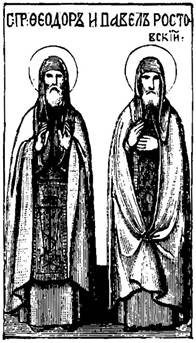
В ркп. святцах читаем: «преподобнии отцы Феодор и Павел, игумени Борисоглебского монастыря на Устье реке, быша в л. 7000, мес. октября в 22 д.». По ркп. повести о начале Борисоглебского монастыря289, Феодор пришёл в чёрный лес р. Устья из Новгородской стороны. Вблизи дороги, шедшей из Каргополя и Белоозера в Москву, построил он себе из хвороста хижину, а на дереве, при самой дороге, повесил кузовок, чтобы принимать от проходящих подаяние для пропитания своего. Он жил как небесная птица, без забот о земном, и проводил время в молитвах; так прожил он три года, один с Господом! Спустя три года пришёл к нему Павел и стал делить с ним пустынническую жизнь. При вел. кн. Димитрии Иоанновиче и м. Алексии, когда в Ростове княжил Константин III Васильевич, а святительскую кафедру занимал Игнатий III, преп. Сергий приходил на родину свою в Ростов. Это было в 1363 г., когда кн. Константина надлежало мирить с новым в. кн. Димитрием, и святое дело примирения было совершено с успехом290. Пустынножители Феодор и Павел сочли за святое дело обратиться за духовными советами к великому пустынножителю. Они просили его осмотреть место для новой пустынной обители и благословить его. Сергий обошёл с ними лесную пустыню и на р. Устье, где ныне стоит храм обители, указал строить церковь во имя св. мучеников Бориса и Глеба. «Призрит Господь на это место, великие страстотерпцы будут помогать вам; обстроится оно и получит известность», сказал преп. Сергий. Кн. Константин и епископ Игнатий с любовью дозволили строить новую обитель. Одушевлённые словами св. подвижника, которого все уважали, пустынники начали рубить лес, чтобы очистить место для храма и обители, и скоро увидели подтверждение словам Сергия. Раз, когда отдыхали они от трудов, явились им два воина в княжеских одеждах и сказали: «трудитесь здесь; Бог не оставит вас, и мы здесь будем неотступно, с помощью для вас и для ваших преемников». «Кто вы таковы?» спросили пустынники, пробудясь от сна; но только услышали ответ небесных воинов: «я Роман», сказал один; «а я Давид», сказал другой. После того пустынники удвоили ревность свою об устроении обители. Мало-помалу собрались к ним ревнители пустынной жизни. Пустынники построили два храма, – один в честь страстотерпцев, другой, тёплый, в славу благовещения Богоматери. Братия упросила Феодора принять на себя звание игумена. Место ревностных подвижников пришло в известность: к празднику страстотерпцев князей собирались многие Богомольцы и завёлся торг291. Многие из богатых людей Ростовской области стали желать быть погребёнными в пустынной обители мучеников и делали вклады. Так заведены были пашни и рабочий скот, – обитель обзавелась всем нужным для неё. Блаженный Феодор, достигнув старости, желал подвизаться в безмолвии. Поручив Борисоглебскую обитель спостнику своему Павлу, он с двумя учениками отправился на Кубенское озеро и здесь на святой Луке поставил келью. Но Чудь, ещё не расставшаяся с грубостью дикого язычества, разметала келью и заставила его удалиться с Луки. Перейдя на другой берег озера, он прошёл по глухим местам на р. Ковжу и при устье её полюбил место; здесь положил он основать обитель св. Николая. Он отправился в Москву к удельному кн. Андрею Дмитриевичу, в области которого находилась Белозеро-Вологодская сторона, и выпросил у него грамоту на рыбную ловлю и земли для обители292. Возвращаясь из Москвы, Феодор убедил Павла принять на себя сан игумена Борисоглебской обители и потом удалился на Ковжу. При впадении Ковжи в Белоозеро (в 40 верстах от нынешнего Белозерска) построил он храм во имя чудотворца Николая и сюда собралось к нему довольное число подвижников. Наконец, почувствовав близость кончины, избрал он настоятеля для новой обители, а сам возвратился на место начальных подвигов своих и здесь скончался 22 окт. 1409 (6918) г. Блаж. Павел, которому друг его, согласно с грамотой князя Андрея, поручил наблюдать и за Ковженской пустыней, прожил после того не долго293. Борисоглебская обитель чтит память его в один день с памятью первоначальника Феодора, окт. 22 дня.
In the manuscript Menologia we read: "the Venerable Fathers Theodore and Paul, abbots of the Boris and Gleb Monastery on the Ustye River, were in the year 7000, month of October on the 22nd day." According to the manuscript account of the founding of the Boris and Gleb Monastery289, Theodore came to the black forest of the Ustye River from the Novgorod side. Near the road that went from Kargopol and Beloozero to Moscow, he built himself a hut of brushwood, and on a tree by the very road he hung a basket to receive alms from passersby for his sustenance. He lived like a bird of the air, without care for earthly things, and spent his time in prayer; thus he lived for three years, alone with the Lord! After three years, Paul came to him and began to share the hermitic life with him. During the time of Grand Prince Demetrius Ioannovich and Metropolitan Alexis, when Constantine III Vasilievich was reigning in Rostov and Ignatius III occupied the hierarchal see, the Venerable Sergius came to his homeland in Rostov. This was in 1363, when Prince Constantine needed to be reconciled with the new Grand Prince Demetrius, and the holy work of reconciliation was accomplished successfully290. The hermits Theodore and Paul considered it a holy work to turn for spiritual counsel to the great hermit. They asked him to inspect the site for a new hermitage monastery and to bless it. Sergius walked with them through the forest wilderness and on the Ustye River, where the monastery church now stands, indicated that a church should be built in the name of the holy martyrs Boris and Gleb. "The Lord will look upon this place; the great passion-bearers will help you; it will be built up and become renowned," said the Venerable Sergius. Prince Constantine and Bishop Ignatius lovingly gave permission to build the new monastery. Inspired by the words of the holy ascetic, whom everyone respected, the hermits began to cut down the forest to clear the site for the church and monastery, and soon they saw confirmation of Sergius's words. Once, when they were resting from their labors, two warriors in princely garments appeared to them and said: "Labor here; God will not forsake you, and we will be here unceasingly, with help for you and for your successors." "Who are you?" the hermits asked, awakening from sleep; but they only heard the answer of the heavenly warriors: "I am Roman," said one; "and I am David," said the other. After that, the hermits doubled their zeal for the establishment of the monastery. Little by little, zealots of the hermitic life gathered to them. The hermits built two churches—one in honor of the passion-bearers, the other, a warm church, to the glory of the Annunciation of the Mother of God. The brethren begged Theodore to accept the office of abbot. The place of the zealous ascetics became known: for the feast of the passion-bearer princes, many pilgrims gathered and a market was established291. Many of the wealthy people of the Rostov region began to desire to be buried in the hermitage monastery of the martyrs and made donations. Thus fields and work animals were acquired—the monastery was furnished with everything necessary for it. Blessed Theodore, having reached old age, desired to struggle in silence. Entrusting the Boris and Gleb Monastery to his fellow ascetic Paul, he set out with two disciples to Lake Kubenskoye and there, at Holy Luka, set up a cell. But the Chud, who had not yet parted with the coarseness of wild paganism, scattered the cell and forced him to withdraw from Luka. Crossing to the other shore of the lake, he passed through desolate places to the Kovzha River and at its mouth took a liking to the place; here he resolved to found a monastery of St. Nicholas. He went to Moscow to the appanage Prince Andrew Dmitrievich, in whose domain the Beloozero-Vologda region lay, and obtained from him a charter for fishing and lands for the monastery292. Returning from Moscow, Theodore persuaded Paul to accept the rank of abbot of the Boris and Gleb Monastery and then withdrew to the Kovzha. At the confluence of the Kovzha with Lake Beloozero (40 versts from present-day Belozersk), he built a church in the name of the Wonderworker Nicholas, and a sufficient number of ascetics gathered to him there. Finally, sensing the nearness of his end, he chose a superior for the new monastery, and himself returned to the place of his initial struggles and there reposed on October 22, 1409 (6918). Blessed Paul, to whom his friend, in accordance with the charter of Prince Andrew, entrusted the oversight also of the Kovzha hermitage, lived not long after that293. The Boris and Gleb Monastery venerates his memory on the same day as the memory of its founder Theodore, October 22.
Второй праздник в честь Казанской иконы Божией Матери установлен в благодарность Богородице за избавление Москвы и России от нашествия Поляков в 1613 году. По низведении с престола царя Василия Иоанновича Шуйского, в 1610 году, Россия, междуцарствием, расстройством гражданского порядка, внутренней изменой и крамолой предана была в руки самозванцев и врагов внешних – Шведов и ненавистных Поляков, которые грабили, жгли города и сёла, овладели Москвой и привели отечество на край погибели и поругания. Народ Русский почувствовал своё унижение и несчастье. В разных местах начали составляться ополчения для избавления столицы и отечества от неистовых врагов. Тогда и Казань выказала своё усердие к отечеству, особенно после бывшей в ней измены, и выслала (в 1612 году) свои дружины к Москве с образом Казанской Богоматери. Ратники начали иметь великую веру к образу Пречистой. От него были многие чудеса. Прибывшие к Москве дружины со святой иконой, помощью Небесной Заступницы, 26-го мая отбили у Поляков Новодевичий монастырь и взяли в плен две роты Ляхов и 500 Немцев. Чудотворный образ пробыл с ополчением у Москвы до зимы; обратно отпущен был с Казанским протоиереем и принесён в Ярославль. В это время прибыли в Ярославль дружины Пожарского и Минина, шедшие к Москве из Нижнего Новгорода. Рать пожелала иметь икону с собой, а в Казань послали список с неё.
The second feast in honor of the Kazan Icon of the Mother of God was established in gratitude to the Theotokos for the deliverance of Moscow and Russia from the invasion of the Poles in 1613. After the deposition of Tsar Basil Ioannovich Shuisky in 1610, Russia, through the interregnum, the disorder of civil order, internal betrayal and sedition, was delivered into the hands of impostors and external enemies—the Swedes and the hated Poles, who plundered and burned cities and villages, seized Moscow, and brought the fatherland to the brink of ruin and disgrace. The Russian people felt their humiliation and misfortune. In various places, militias began to form for the deliverance of the capital and the fatherland from the frenzied enemies. Then Kazan also showed its zeal for the fatherland, especially after the betrayal that had occurred there, and sent out (in 1612) its detachments to Moscow with the image of the Kazan Mother of God. The warriors began to have great faith in the image of the Most Pure One. Many miracles were wrought from it. The detachments that arrived at Moscow with the holy icon, with the help of the Heavenly Intercessor, on May 26 recaptured the Novodevichy Monastery from the Poles and took captive two companies of Poles and 500 Germans. The wonderworking image remained with the militia at Moscow until winter; it was sent back with the Kazan protopriest and brought to Yaroslavl. At this time, the detachments of Pozharsky and Minin, marching to Moscow from Nizhny Novgorod, arrived in Yaroslavl. The army desired to have the icon with them, and a copy of it was sent to Kazan.
Движимые чувством благочестия, для испрошения помощи свыше в своём правом деле, предки наши наперёд обратились с постом и молитвой к Господу и Пречистой Его Матери. Всему православному воинству и народу заповедали тридневный пост и учредили торжественное молитвословие. Бог услышал молитвенный вопль болезнующих об отечестве и Церкви. Преп. Сергий явился Арсению, архиепископу Елассонскому, пришедшему в Россию с Греческим патриархом Иеремией, бывшему потом епископом Суздальским (1612–1613), находившемуся в плену у Поляков, и объявил, что Господь по молитвам Божией Матери и великих чудотворцев России – Петра, Алексия и Ионы, в следующий день низложит врагов и первопрестольный град Российский возвратит православным христианам. Божественное видение, исцелившее недуг святителя, удручённого врагами, скоро сделалось известным Российскому воинству. Ободрённые воины мужественно приступили к Москве в 1612 г. 20 августа; снова отняли у неприятеля Девичий монастырь, который после первого освобождения от врагов опять занят был ими; прогнали гетмана Ходкевича от Москвы; находившихся в Москве врагов совершенно стеснили и морили голодом; 22 октября 1612 г. освободили Китай-город. Поляки, потеряв надежду удержать остальную часть города, сами сдали Кремль и униженно испросили у Пожарского пощады.
Moved by a feeling of piety, to beseech help from on high in their righteous cause, our ancestors first turned with fasting and prayer to the Lord and His Most Pure Mother. A three-day fast was enjoined upon the entire Orthodox army and people, and a solemn prayer service was established. God heard the prayerful cry of those who were suffering for the fatherland and the Church. The Venerable Sergius appeared to Arsenius, Archbishop of Elasson, who had come to Russia with the Greek Patriarch Jeremiah, who later was Bishop of Suzdal (1612–1613), and who was held captive by the Poles, and declared that the Lord, through the prayers of the Mother of God and the great wonderworkers of Russia—Peter, Alexis, and Jonah—would overthrow the enemies on the following day and return the first-throne city of Russia to Orthodox Christians. The divine vision, which healed the infirmity of the hierarch, oppressed by the enemies, soon became known to the Russian army. Encouraged, the soldiers courageously advanced upon Moscow in 1612 on August 20; they again took from the enemy the Novodevichy Monastery, which after its first liberation from the enemies had been reoccupied by them; they drove Hetman Chodkiewicz from Moscow; they completely hemmed in the enemies who were in Moscow and starved them; on October 22, 1612, they liberated Kitai-gorod. The Poles, having lost hope of holding the remaining part of the city, themselves surrendered the Kremlin and humbly begged mercy from Pozharsky.
В следующий воскресный день, в сопровождении христолюбивого воинства, назначили совершить крестный ход с Казанской иконой Богоматери на Лобное место для принесения Господу и Пречистой Его Матери торжественного благодарения за избавление своё от врагов. Когда совершилось это священное, торжественное шествие, во сретение ему вышел из Кремля архиепископ Арсений с священным собором, неся Владимирскую икону Богоматери, честный крест и другие святые иконы, бывшие в плену. Узревши чудотворную икону Богоматери, воины и народ от умиления и радости пролили слёзы и лобызали св. изображения.
On the following Sunday, accompanied by the Christ-loving host, they appointed to make a procession with the Kazan Icon of the Mother of God to the Place of Skulls for the offering to the Lord and His Most Pure Mother of solemn thanksgiving for their deliverance from the enemies. When this sacred, solemn procession was accomplished, Archbishop Arsenius came out from the Kremlin to meet it with the sacred council, bearing the Vladimir Icon of the Mother of God, the precious Cross, and other holy icons that had been in captivity. Having beheld the wonderworking icon of the Mother of God, the soldiers and the people shed tears of tenderness and joy and kissed the holy images.
По изгнании врагов из Москвы, князь Пожарский освятил храм в своём приходе Введения Богородицы на Сретенской улице в Москве, и в этом храме поставил икону Богоматери Казанской. Священники храма донесли царю и великому князю Михаилу Феодоровичу о чудесах, бывших от иконы в бою с гетманом и при взятии Москвы. Михаил Феодорович и матерь его великая старица инокиня Марфа Ивановна возымели великую веру к образу и повелели праздновать в Москве дважды в год и установили крестный ход. Первое празднество и крестный ход в 8-й день июля, когда явилась Пречистая Богородица в Казани, а другое в 22-й день октября, когда очистилось Московское государство. Чудотворный образ украсил многою утварью князь Дмитрий Михайлович Пожарский, по обету своему, в 1625 г. Ныне оба праздника совершаются с крестным ходом в Казанский собор.
After the expulsion of the enemies from Moscow, Prince Pozharsky consecrated a church in his parish of the Entry of the Theotokos on Sretenka Street in Moscow, and in this church he placed the Kazan Icon of the Mother of God. The priests of the church reported to the Tsar and Grand Prince Michael Feodorovich about the miracles that had occurred from the icon in the battle with the Hetman and at the taking of Moscow. Michael Feodorovich and his mother, the great elder nun Martha Ivanovna, conceived a great faith in the image and commanded that it be celebrated twice a year in Moscow and established a procession. The first feast and procession on the 8th day of July, when the Most Pure Theotokos appeared in Kazan, and the other on the 22nd day of October, when the Muscovite State was cleansed. Prince Demetrius Mikhailovich Pozharsky adorned the wonderworking image with many vessels, according to his vow, in the year 1625. Now both feasts are celebrated with a procession to the Kazan Cathedral.
Со времени изгнания Поляков из Москвы и России и восшествия на Всероссийский престол Михаила Феодоровича икона Казанской Божией Матери сделалась семейной в царском роде.
From the time of the expulsion of the Poles from Moscow and Russia and the accession of Michael Feodorovich to the All-Russian throne, the icon of the Kazan Mother of God became a family treasure in the Tsar's line.
В 1649 году, 22 октября установлено совершать празднование Казанской Богоматери во всей России, по случаю рождения у Алексея Михайловича наследника престола – цесаревича Димитрия Алексеевича, – что для России, недавно испытавшей тяжкие бедствия от пресечения царского рода, служило радостным залогом будущего благоденствия. Так 29 сентября 1649 года в окружной царской грамоте царя и великого князя Алексея Михайловича писано было Маркеллу, архиепископу Вологодскому и Велико-Пермскому, о праздновании Казанской чудотворной иконе Пресвятой Богородицы в 22-й день октября: «в 1613 году, в 22-й день октября, милостью Божией, молитвами и заступлением Пречистые Владычицы нашей Богородицы Казанские чудотворные иконы, на память Аверкия, епископа Иерапольскаго чудотворца, Московское государство от Литовских людей очистилось, и ради сего Божия милосердия уставили праздновать Пречистой Богородицы чудотворной иконе Казанской, в царствующем граде Москве, при отце нашем блаженные памяти великом государе царе и великом князе Михаиле Феодоровиче всея России. А в 1649 году, в 22-й день октября, на праздник Пресвятые Богородицы чудотворные иконы Казанские, во время всенощного пения, Бог даровал, родился нам сын – государь цесаревич князь Димитрий Алексеевич; и мы указали ныне праздновать в 22-й день октября Пречистой Богородицы чудотворной иконе Казанской, во всех городах, по вся годы. Итак, по получении сей нашей грамоты, тыб, Богомолец наш, в соборной церкви, со всем освященным собором, и на посаде, и во всей архиепископии в городах и уездах, и в монастырях, и по всем церквам, велел праздновать Пречистой Богородицы чудотворной иконе Казанской, по вся годы октября в 22-й день, на память Аверкия, епископа Иерапольского». В своде отечественных законов 22-й день октября признаётся табельным.
In the year 1649, on October 22, the celebration of the Kazan Mother of God was established throughout all Russia, on the occasion of the birth to Alexis Mikhailovich of an heir to the throne—the Tsesarevich Demetrius Alexeevich—which for Russia, having recently endured grievous calamities from the extinction of the Tsar's line, served as a joyful pledge of future prosperity. Thus on September 29, 1649, in a circular Tsar's charter, the Tsar and Grand Prince Alexis Mikhailovich wrote to Marcellus, Archbishop of Vologda and Great Perm, concerning the celebration of the Kazan wonderworking icon of the Most Holy Theotokos on the 22nd day of October: "In the year 1613, on the 22nd day of October, by the mercy of God, by the prayers and intercession of the Most Pure Lady our Theotokos of the Kazan wonderworking icon, on the commemoration of Abercius, Bishop of Hierapolis, Wonderworker, the Muscovite State was cleansed of the Lithuanian people, and for the sake of this divine mercy, they established the celebration of the Most Holy Theotokos' wonderworking Kazan Icon in the reigning city of Moscow, under our father of blessed memory, the great sovereign Tsar and Grand Prince Michael Feodorovich of all Russia. And in the year 1649, on the 22nd day of October, on the feast of the Most Holy Theotokos' wonderworking Kazan Icon, during the All-night Vigil, God granted that a son be born to us—the sovereign Tsesarevich Prince Demetrius Alexeevich; and we have now decreed that on the 22nd day of October the Most Holy Theotokos' wonderworking Kazan Icon be celebrated in all cities, every year. And so, upon receiving this our charter, you, our supplicant, in the cathedral church with the entire sacred council, and in the posad, and throughout the entire archdiocese in cities and districts, and in monasteries, and in all churches, shall command that the Most Holy Theotokos' wonderworking Kazan Icon be celebrated every year on October 22, on the commemoration of Abercius, Bishop of Hierapolis." In the code of domestic laws, the 22nd day of October is recognized as a holiday.
Священный памятник и свидетель изгнания Поляков из Москвы и восшествия Дома Романовых на царский престол, в 1710 году, по повелению императора Петра I-го, перенесён из Москвы в С.-Петербург, в освящение этой новой столицы, и поставлен был первоначально в центре её на Петербургской стороне, в Посадской улице старого гостиного двора, в полотняной церкви, устроенной в часовне.
The sacred monument and witness of the expulsion of the Poles from Moscow and the accession of the House of Romanov to the Tsar's throne, in the year 1710, by command of Emperor Peter I, was transferred from Moscow to St. Petersburg, for the consecration of this new capital, and was placed initially in its center on the Petersburg Side, on Posad Street of the old Gostiny Dvor, in a canvas church arranged in a chapel.
«Оклад на образе Казанской Богоматери весьма полюбился бывшему тогда архимандриту Невского монастыря Феодосию. Приехав в церковь Казанскую для осмотра порядка церковного, он заметил, что образ Богородичин стоит низко в иконостасе, и всякие люди к нему прикасаются, и велел взять и отвезти его в Невский монастырь. Не по многом времени, ризу сняв, велел поставить образ в святых воротах монастыря. Узнав об этом, прихожане Казанской церкви очень оскорбились. Было доложено императору, и он с гневом повелел возвратить образ в прежнем окладе и поставить на прежнем месте в Казанской церкви».
"The riza on the Kazan Mother of God image was greatly liked by the then archimandrite of the Nevsky Monastery, Theodosius. Having come to the Kazan Church for an inspection of church order, he noticed that the image of the Mother of God stood low in the iconostasis, and that various people touched it, and he ordered it to be taken and brought to the Nevsky Monastery. After not much time, having removed the riza, he ordered the image to be placed in the holy gates of the monastery. Learning of this, the parishioners of the Kazan Church were greatly offended. The emperor was informed, and he angrily commanded that the image be returned in its former riza and placed in its former place in the Kazan Church."
В 1721 году образ Казанской Богоматери перенесён в Троицкий собор. В 1737 г., в день освящения новоустроенной церкви Рождества Богородицы на Невском проспекте, где ныне Казанский собор, икона перенесена сюда и украшена богатой золотой ризой и драгоценными камнями от приношения её Величества Императрицы Анны Иоанновны. Ко дню освящения настоящего собора Казанского в 1811 году 15 сентября на икону положена новая риза, сделанная из чистого золота превосходной работы, украшенная драгоценными каменьями и жемчугом, из коих большая часть принесена в дар императрицами Марией Феодоровной, Елисаветой Алексеевной и великой княгиней Екатериной Павловной. В день освящения собора святая икона, в присутствии императора, двора, военного парада, при бесчисленном стечении народа, перенесена в новоустроенный великолепный храм.
In the year 1721, the image of the Kazan Mother of God was transferred to the Trinity Cathedral. In 1737, on the day of the consecration of the newly-built Church of the Nativity of the Theotokos on Nevsky Prospect, where the Kazan Cathedral now stands, the icon was transferred there and adorned with a rich golden riza and precious stones from the offering of Her Majesty Empress Anna Ioannovna. By the day of the consecration of the present Kazan Cathedral in 1811, on September 15, a new riza was placed on the icon, made of pure gold of excellent workmanship, adorned with precious stones and pearls, of which the greater part was donated by Empresses Maria Feodorovna, Elizabeth Alexeevna, and Grand Duchess Catherine Pavlovna. On the day of the consecration of the cathedral, the holy icon, in the presence of the emperor, the court, a military parade, and with an innumerable gathering of people, was transferred to the newly-built magnificent temple.
Церковная служба во дни празднования Казанской иконе Богоматери 8 июля и 22 октября совершается одна и та же. Каноны составлены иеромонахом Игнатием. В эти дни Церковь между прочим взывает к верующим: «притецем, людие, к тихому сему и доброму пристанищу, – скорой помощнице, готовому и тёплому спасению, – к Покрову Девы. Ускорим на молитву и потщимся на покаяние: источает бо нам неоскудные милости Пречистая Богородица, предваряет на помощь и избавляет от всяких бед и зол благонравные и Богобоящиеся рабы Своя». О покровительстве Божией Матери благонравным и Богобоязненным христианам св. Димитрий Ростовский в слове своём на день явления иконы Пречистой Божией Матери в Казани говорит: «ужаснися, человече неблагонравный и небогобоящийся, ужаснися, слышав сие, яко благонравным токмо и Богобоящимся помоществует Божия Мати, и избавляет их от великих бед и зол, а развращённые нравы имущим и страх Божий от сердца отринувшим помоществовати не соизволяет. И что дивно? Ужели Мати начнет благодетельствовати тем, иже суть врази Сына её? Не паче ли прогневается на ня, видя их вторицею Сына ея распинающих грехами и ругающихся Ему беззаконии своими? Якоже бо древле Иудеи Христа распята и поругашася Ему: сице и ныне всяк человек христианский, нечистое житие проходяй и в сквернах своих яко в блате валяяйся, ни о покаянии помышляяй, распинает себе вторицею Божия Сына, ругается же Ему во удесех своих, кровью Христовою искупленных, егда взем уды Христовы, творит уды блудничи. Таковый может ли мил быти Пречистей Матери Христовой? Какая бо мати когда возлюби того, иже есть убийца сына ея? Чего же и ты, о человече грешный и ожесточенный, непокаянным твоим сердцем, чего надеешися от Матери Божией, еяже Сына по вся дни и нощи студными твоими делы печалити, и во удесех твоих бесчестити Его, и токмо имя христианское носити на себе, а делы худше неверных обретаешися! Милосердствует Мати Божия о грешницех, но о тех, иже аще и падают от немощи человеческие, обаче скорым покаянием восстают и притекают к Богу и к Божией Матери со слезами и теплыми молитвами. Помоществует Мати Божия грешником, но киим грешником? Тем, иже тщатся исправити житие свое и, уклоняющеся от зла, начинают творити добрыя дела. Избавляет Мати Божия от великих бед и зол не токмо праведныя, но и грешныя, но которыя грешныя? Тыя, иже возвращаются к Отцу Небесному, яко блудный сын, воздыхают биюще перси своя, яко мытарь, плачут у ног Христовых, яко грешница, омочившая нозе Его слезами, исповедание Ему приносят, яко на кресте разбойник. На таковыя грешныя Пречистая Божия Мати свыше призирает и ускоряет на помощь им, и от великих бед и зол избавляет я: а о некающихся грешницех небрежет».
The church service on the days of the celebration of the Kazan Icon of the Mother of God, July 8 and October 22, is the same. The canons were composed by Hieromonk Ignatius. On these days, the Church, among other things, calls out to the faithful: "Let us hasten, O people, to this quiet and good haven—the speedy helper, the ready and warm salvation—to the Protection of the Virgin. Let us make haste to prayer and strive for repentance: for the Most Pure Theotokos pours forth inexhaustible mercies, anticipates us with help and delivers from all troubles and evils her well-mannered and God-fearing servants." Concerning the protection of the Mother of God for well-mannered and God-fearing Christians, St. Demetrius of Rostov, in his homily on the day of the appearance of the icon of the Most Pure Mother of God in Kazan, says: "Be horrified, O ill-mannered and not God-fearing man, be horrified, hearing this, that the Mother of God helps only the well-mannered and God-fearing, and delivers them from great troubles and evils, but she does not deign to help those having depraved manners and having cast out the fear of God from their hearts. And what is surprising? Will the Mother begin to do good to those who are enemies of her Son? Will she not rather be angered at them, seeing them crucifying her Son a second time with sins and mocking Him with their lawlessness? For just as the Jews of old crucified Christ and mocked Him, so also now every Christian man who leads an impure life and wallows in his filth as in mire, not thinking of repentance, crucifies the Son of God a second time, and mocks Him in his own members, redeemed by the blood of Christ, when he takes the members of Christ and makes them members of a fornicator. Can such a one be dear to the Most Pure Mother of Christ? For what mother ever loved one who is the murderer of her son? And what do you, O sinful and hardened man, with your unrepentant heart, what do you hope for from the Mother of God, whose Son you grieve day and night with your shameful deeds, and dishonor Him in your members, and bear only the Christian name upon yourself, while by your deeds you are worse than the unbelievers! The Mother of God is merciful toward sinners, but toward those who, even if they fall from human weakness, yet rise again with quick repentance and hasten to God and to the Mother of God with tears and warm prayers. The Mother of God helps sinners, but which sinners? Those who strive to correct their life and, turning away from evil, begin to do good deeds. The Mother of God delivers from great troubles and evils not only the righteous, but also sinners, but which sinners? Those who return to the Heavenly Father like the prodigal son, sigh beating their breasts like the publican, weep at the feet of Christ like the sinful woman who wet His feet with tears, bring confession to Him like the thief on the cross. Upon such sinners the Most Pure Mother of God looks down from above and hastens to help them, and delivers them from great troubles and evils; but she neglects unrepentant sinners."
Икона Казанской Богоматери сделалась общей святыней С.-Петербурга и отечества. Императоры, все лица царской фамилии, жители столицы и все благочестивые соотечественники при своих приездах сюда и отъездах обращаются к иконе с молитвами. Она участвует во всех крестных ходах в столице и поднимается в дома жителей С.-Петербурга. – См. 8-го июля.
The Icon of the Kazan Mother of God became a common shrine of St. Petersburg and the fatherland. The emperors, all persons of the imperial family, the inhabitants of the capital, and all pious compatriots, upon their arrivals here and departures, turn to the icon with prayers. It participates in all processions in the capital and is taken into the homes of the inhabitants of St. Petersburg. — See July 8.
«Повесть о Борисоглебском монастыре, от коликих лет и како бысть начало» – в сборнике Сергиевой лавры № 20. Повесть писана вслед за тем, как в 1524 г. игумен Феофил начал строить новый каменный храм в Борисоглебской обители.
"The Tale of the Borisoglebsk Monastery, from How Many Years and How It Had Its Beginning" — in a collection of the Sergius Lavra, No. 20. The Tale was written immediately after, in 1524, Abbot Theophilus began to build a new stone church in the Borisoglebsk Monastery.
Так как Димитрий Иоаннович стал вел. князем с 1362 г. и в 1363 г. обязал кн. Константина грамотой признавать его вел. князем России (собр. грам. 1, 200. Ник. лет. 4–5), бывший при нём Игнатий был Ростовским епископом не далее 1363 г. (Святыни Ростова, стр. 58. 71) и в 1364 г. кн. Константин умер от чёрной смерти: то посещение Ростова Сергием, а след. и основание Борисоглебской обители, относились без сомнения к 1363 г. Затем несомненно и то, что пр. Сергий приходил мирить с вел. кн. Димитрием кн. Константина, безуспешно воевавшего за князей Суздальских (Никои, лет. 4, 5. Арцыбашев 2, прим. 795. 797).
Since Demetrius Ioannovich became Grand Prince in 1362 and in 1363 obliged Prince Constantine by charter to recognize him as Grand Prince of Russia (Collection of Charters 1, 200; Nikon Chronicle 4–5), Ignatius, who was with him, was Bishop of Rostov no later than 1363 (Shrines of Rostov, pp. 58, 71), and in 1364 Prince Constantine died of the Black Death: therefore, the visit of Sergius to Rostov, and consequently the foundation of the Borisoglebsk Monastery, undoubtedly belonged to the year 1363. Furthermore, it is also certain that Venerable Sergius came to reconcile Grand Prince Demetrius with Prince Constantine, who had unsuccessfully warred for the Suzdal princes (Nikon Chronicle 4, 5; Artsybashev 2, notes 795, 797).
В царской грамоте 1652 г. написано: «от начала преподобных отец Феодора и Павла мая во 2 д., на праздник страстотерпцев Бориса и Глеба съезжаются с городов и из уездов торговые люди всяких чинов со всякими торги и торговали беспошлинно, а им в Борисоглебский монастырь давали на свечи и на ладан, и на вино церковное».
In a royal charter of 1652 it is written: "From the beginning of the Venerable Fathers Theodore and Paul, on the 2nd day of May, on the feast of the Passion-bearers Boris and Gleb, traders from towns and districts of every rank gathered with all manner of wares, and they traded duty-free, and gave to the Borisoglebsk Monastery for candles, for incense, and for church wine."
«Окрест живущий неразумнии невегласи человецы, еще Чудское исчадие, сего преподобного изгониша и келейцу разметаша... Андрей же князь даде место и починкы и пожни и рыбные ловли».
"The foolish and ignorant men dwelling round about, even a Chud spawn, drove out this Venerable One and scattered his cell... And Prince Andrew gave the place, and hamlets, and hayfields, and fishing grounds."
По грамоте князя Андрея Дмитриевича велено Борисоглебскому игумену с братией «на Беле озере, за озером, на устье Ковжи поставити храм Николы чудотворца и монастырь устроити и дан к тому монастырю починок». Так сказано в царской грамоте 1615 г. Никольский монаст. на Ковже упразднился до учреждения штатов. Ист. Иер. 6, 548.
By a charter of Prince Andrew Dmitrievich, the abbot of Borisoglebsk with the brethren was commanded "on White Lake, beyond the lake, at the mouth of the Kovzha, to erect a church of Nicholas the Wonderworker and to establish a monastery, and a hamlet was given to that monastery." So it is stated in a royal charter of 1615. The St. Nicholas Monastery on the Kovzha was abolished before the establishment of the diocesan rolls. Hist. Hier. 6, 548.