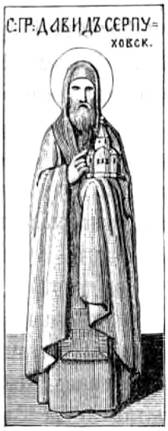
Блаженный Давид полагал начало монашескому житию под надзором преп. Пафнутия Боровского, в его обители256. Потом подвизался в безмолвном уединении. В 1515 году построил на реке Лопасне, в 23 верстах от Серпухова, храм Вознесения Господня и тем положил начало пустынной обители, известной под именем Давидовой Вознесенской пустыни. – Мощи преподобного старца, почившего 18 октября 1520 года, почивают в соборном каменном храме обители, где хранится и гроб преп. Моисея Угрина, подвижника Печерского257.
The blessed David began his monastic life under the guidance of the Venerable Paphnutius of Borovsk, in his monastery256. Afterwards he struggled in silent seclusion. In the year 1515, he built a church of the Ascension of the Lord on the Lopasna River, 23 versts from Serpukhov, and thereby laid the foundation for a wilderness monastery, known under the name of David's Ascension Hermitage. – The relics of the venerable elder, who reposed on 18 October 1520, rest in the stone cathedral church of the monastery, where the coffin of the Venerable Moses the Hungarian, a ascetic of the Kiev Caves, is also preserved257.
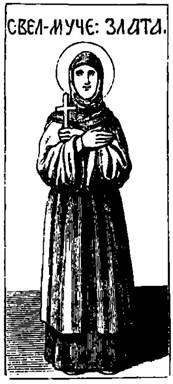
Святая девственница и невеста Христова Злата родилась и пострадала в Мглинской Болгарской епархии, в селении Златинах. Дочь бедного простого поселянина, она сияла как душевными, так и телесными высокими качествами: душевными – твёрдой верой в Господа Иисуса, смирением и чистотой сердца, телесными – красотой редкой, которая и была поводом к тому, что жизнь её украсилась страданиями великой мученицы. Местный Турок, прельщённый редкой красотой Златы, решился найти время и во что бы то ни стало удовлетворить своей гнусной страсти. Раз Злата вместе с другими отправилась в лес за дровами. Сладострастный Турок, подговорив подобных ему негодяев, при их помощи схватывает её и уводит в свой дом. Он старается сперва совратить её в исламизм разными обещаниями и даёт ей слово жениться на ней; за отказ же грозит ей пытками. Злата поражена была дерзостью, но отказалась с твёрдостью. Призвав в помощь имя Господа Иисуса, она отвечала: «я верую и покланяюсь только Господу Иисусу и от Него не отрекусь, хотя бы изрубили меня; да и я же дала обет девства, которому также не изменю ни для чего». – Турки поняли, что эту девушку нельзя склонить на свою сторону обыкновенными средствами, а нужно придумать что-нибудь особенное. Они поручают её женщинам, которые в подобных делах способнее завлечь девушку в обман. И чего не делали они с бедной? Каких хитростей не употребляли, чтобы совратить Злату в скотскую, чувственную жизнь магометанства! И прелести роскошной жизни, и выгоды богатства, и увлечения чувственности представляли ей в картинах самых заманчивых. Всё оказалось напрасным. Чистая душа Златы ощущала зловоние проповедниц и с трепетом отвращалась от них. – Пение их было для неё пением сатанинским. Турчанки были раздражены твёрдостью Христовой невесты; они призывают родителей и трёх сестёр страдалицы, чтобы те употребили своё влияние на девушку, – склонили её к магометанству; иначе, говорили, и их подвергнут жестоким пыткам.
The holy virgin and bride of Christ, Chryse, was born and suffered in the Mglinsk Bulgarian diocese, in the village of Zlatina. The daughter of a poor, simple peasant, she shone with both spiritual and bodily high qualities: with spiritual – firm faith in the Lord Jesus, humility and purity of heart; with bodily – rare beauty, which was the occasion that her life was adorned with the sufferings of a great martyr. A local Turk, captivated by the rare beauty of Chryse, resolved to find an opportunity and, come what may, to satisfy his vile passion. Once Chryse, together with others, went to the forest for firewood. The lustful Turk, having suborned scoundrels like himself, with their help seized her and led her away to his house. He first tried to seduce her into Islam with various promises and gave her his word that he would marry her; for refusal, he threatened her with tortures. Chryse was struck by the insolence, but refused with firmness. Calling upon the name of the Lord Jesus for help, she answered: "I believe in and worship only the Lord Jesus, and I will not renounce Him, even if I am cut to pieces; moreover, I have made a vow of virginity, which I will also not break for anything." – The Turks understood that this girl could not be won over to their side by ordinary means, and that something special had to be devised. They entrusted her to women, who in such matters are more capable of luring a girl into deception. And what did they not do to the poor girl? What cunning did they not employ to seduce Chryse into the brutish, sensual life of Mohammedanism! Both the allurements of a luxurious life, and the advantages of wealth, and the enticements of sensuality were presented to her in the most tempting pictures. All proved vain. The pure soul of Chryse sensed the stench of the preacheresses and turned away from them with trembling. – Their singing was for her satanic singing. The Turkish women were irritated by the firmness of the bride of Christ; they summoned the parents and three sisters of the sufferer, that they might use their influence on the girl – to incline her to Mohammedanism; otherwise, they said, they too would be subjected to cruel tortures.
Поражённые страхом, родители и сёстры уговаривали Злату принять магометанство, но и их слова не изменили намерений её. «Дочь наша, дорогая наша! рыдая говорили отец и мать, пожалей нас и сестёр: мы все погибнем, если не согласишься на желание Турок; Бог милостив, – простит грех твой, вынужденный необходимостью».
Struck with fear, the parents and sisters urged Chryse to accept Mohammedanism, but even their words did not change her intentions. "Our daughter, our dear one!" said the father and mother, sobbing, "have pity on us and your sisters: we will all perish if you do not agree to the desire of the Turks; God is merciful – He will forgive your sin, forced by necessity."
Можно представить себе борьбу, которую должна была вытерпеть Злата. Любовь к родителям, любовь к сёстрам влекла в одну сторону, а долг христианки требовал своего. Слёзы родителей и сестёр раздирали, мучили сердце её. – Наконец она сказала: «если уже и вы понуждаете меня отказаться от Христа Господа, – то вы не родители и не сёстры мне! Отцом моим остаётся один Господь Иисус и матерью – Пречистая Матерь Его, а братья и сёстры – мученики и мученицы».
One can imagine the struggle that Chryse had to endure. Love for her parents, love for her sisters drew her in one direction, but the duty of a Christian demanded its own. The tears of her parents and sisters tore at, tormented her heart. – Finally she said: "If even you urge me to renounce Christ the Lord – then you are not my parents nor my sisters! My only father remains the Lord Jesus, and my mother, His Most Pure Mother; and my brothers and sisters are the martyrs."
Когда неверные, особенно похититель девушки, увидели, что все хитрости их не привели их ни к чему, то обратились к пыткам. Сперва в продолжении трёх месяцев били каждый день страдалицу палками. Потом вырезали из спины её ремни и повесили перед глазами; кровь струилась из неё и покрыла весь пол. Мало им было и того. Звери, а не люди, накалив железный прут, прокололи голову её с одного уха до другого.
When the infidels, especially the girl's abductor, saw that all their cunning had led to nothing, they turned to tortures. First, for three months, they beat the sufferer with sticks every day. Then they cut straps from her back and hung them before her eyes; blood streamed from her and covered the whole floor. Even that was not enough for them. Beasts, not men, having heated an iron rod, pierced her head from one ear to the other.
Терпение страдалицы, очевидно, было «не по силам человеческим. Оно было делом сильной благодати Христовой, всегда близкой к сердцам смиренным. При высоком терпении своём страдалица не ожидала от себя особенного. Это она выразила в опыте. До неё дошёл слух, что в селении находится игумен Ставроникитского Афонского монастыря, духовник отца её, о. Тимофей. Она посылает к нему одного христианина с усердной просьбой своей помолиться за неё, дабы Господь сподобил её окончить свой подвиг Богоугодно. – и Смиренная молитва её исполнена: Господь дал ей силы окончить подвиг великой мученицы.
The endurance of the sufferer was evidently "not according to human strength. It was the work of the mighty grace of Christ, always near to humble hearts. In her great endurance, the sufferer did not expect anything special from herself. This she expressed in experience. A rumor reached her that in the village there was the abbot of the Stavronikita Monastery on Mount Athos, the spiritual father of her father, Father Timothy. She sent a certain Christian to him with an earnest request that he pray for her, that the Lord might grant her to finish her struggle in a God-pleasing manner. – And her humble prayer was fulfilled: the Lord gave her the strength to finish the struggle of a great martyr.
Кровожадные магометане повесили наконец страдалицу на пустыре и изрубили всё тело её в куски. Так св. Злата, очищенная огнём страданий в чистое золото, предала душу свою Господу, Которого возлюбила любовью крепкой, как смерть. Великая мученица переселилась на небо в окт. 1795 г.258.
The bloodthirsty Mohammedans finally hanged the sufferer in a deserted place and cut her whole body into pieces. Thus St. Chryse, purified by the fire of sufferings into pure gold, gave up her soul to the Lord, Whom she loved with a love strong as death. The great martyr departed to heaven in October 1795258.
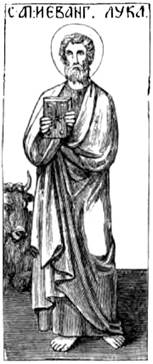
Св. Апостол и Евангелист Лука, из лика 70 Апостолов, родился в Антиохии от родителей язычников. Есть предание, что он ещё в юности хорошо образован был в науках Греческих. В писаниях его Греческий язык отличается и особенной чистотой, и правильностью. Но мудрость языческая не удовлетворила его желаниям, и он присоединился к Иудейской Церкви, о чём можно заключать и из писаний его, в которых видно точное знание писателем закона Моисеева и обычаев Иудейских. Находясь в Иерусалиме, Лука услышал проповедь Господа Иисуса Христа. Семя спасительного слова Божия пало на сердце его, как на добрую землю: он уверовал в Господа, сделался последователем Его и был причтён к лику семидесяти Апостолов, об избрании которых сам он повествует в своём Евангелии (Лк.10:1–16). Во время страданий Господа, когда, после поражения Пастыря, рассыпались овцы стада, и св. Лука оставил Господа, хотя в сердце не изгладились совершенно ни вера в Него, ни любовь к Нему; когда разнеслась весть о воскресении Господа, состояние духа св. Луки было такое же, как и прочих Апостолов: он не веровал от радости и чудился. Из такого смутного состояния вывел его Сам Господь, явившись ему в первый же день Своего воскресения, в вечеру, когда он шёл вместе с Клеопой из Иерусалима в Еммаус, сказавши има*от всех писаний, яже о Нем, начен от Моисея и от всех пророк. Господь благоволил потом открыться им в преломлении хлеба, и затем снова явился им в кругу всех Апостолов, когда они, возвратившись в Иерусалим, рассказывали другим ученикам о явлении им Господа (Лк.24:13–31). Удостоверившись сам в воскресении Иисуса Христа и в том, что точно естьхотяй избавити Израиля*, св. Лука по вознесении Господа сделался и для других проповедником Его.
The Holy Apostle and Evangelist Luke, from the choir of the 70 Apostles, was born in Antioch of pagan parents. There is a tradition that in his youth he was well educated in the Greek sciences. In his writings, the Greek language is distinguished by both particular purity and correctness. But pagan wisdom did not satisfy his desires, and he joined the Jewish Church, which can be concluded also from his writings, in which is seen an accurate knowledge by the writer of the Law of Moses and of Jewish customs. Being in Jerusalem, Luke heard the preaching of the Lord Jesus Christ. The seed of the saving Word of God fell upon his heart as upon good soil: he believed in the Lord, became His follower, and was numbered among the choir of the seventy Apostles, concerning whose election he himself relates in his Gospel (Lk. 10:1–16). During the sufferings of the Lord, when, after the striking of the Shepherd, the sheep of the flock were scattered, St. Luke also left the Lord, although faith in Him and love for Him were not completely erased from his heart; when the news of the Lord's resurrection spread, the state of St. Luke's spirit was the same as that of the other Apostles: he did not believe for joy and was amazed. The Lord Himself brought him out of such a confused state, appearing to him on the very first day of His resurrection, in the evening, when he was walking together with Cleopas from Jerusalem to Emmaus, saying to them from all the Scriptures concerning Him, beginning from Moses and from all the prophets. The Lord then deigned to reveal Himself to them in the breaking of bread, and afterwards appeared to them again in the circle of all the Apostles, when they, having returned to Jerusalem, were telling the other disciples about the Lord's appearance to them (Lk. 24:13–31). Having himself become assured of the resurrection of Jesus Christ and that He indeed is the one who would deliver Israel, St. Luke, after the Ascension of the Lord, became a preacher of Him also for others.
По обращении св. Апостола Павла, св. Лука был неотлучным его спутником и общником всех болезней и трудов его во благовестии Христове. С ним он проходил неоднократно области Малой Азии и Греции; с ним был в Иерусалиме; при нём находился в Риме во время первых и вторых его уз и не отходил от него до самой кончины его, как видно это из Деяний Апостольских и из многих мест посланий св. Апостола Павла (Деян.16:10 и дал. до конца книги; Кол.4:14; Флм.1:23). Лука един есть со мною (2Тим.4:10), писал Апостол Павел к Тимофею.
After the conversion of the Holy Apostle Paul, St. Luke was his inseparable companion and partaker of all his labors and sufferings in the evangelization of Christ. With him he traversed the regions of Asia Minor and Greece many times; with him he was in Jerusalem; he was with him in Rome during his first and second imprisonments and did not leave him until his very end, as is evident from the Acts of the Apostles and from many places in the epistles of the Holy Apostle Paul (Acts 16:10 and following to the end of the book; Col. 4:14; Phlm. 1:23). Luke alone is with me (2 Tim. 4:10), wrote the Apostle Paul to Timothy.
Через 15 лет по вознесении Господа и спустя около 48 лет по Рождестве Христове, после уже Матфея в Марка, св. Лука написал в странах Ахаи и Беотии, т. е. Греции, на Греческом языке Евангелие своё, якоже предаша ему,иже исперва самовидцы и слуги бывшии словесе (Лк.1:2), и изложил в своём Евангелии учение, проповеданное Апостолом Павлом (1Кор.15:1–3) об Иисусе Христе, Богочеловеке. Кроме внутренних признаков Божественного своего происхождения, какие имеют все священные книги, Евангелие от Луки, по сказанию древних писателей, имеет свидетельство и внешнего одобрения от св. Апостола Павла, который в своём послании к Коринфянам говорит о св. Луке: егоже*похвала во Евангелии по всем церквам* (2Кор.8:18). Также, когда повествует, что (Христос) явился Кифе, потом двенадцати, и говорит: по благовествованию,еже приясте (1Кор.15:1, 3), разумеет Евангелие Луки. Евангелие от Луки полнее других Евангелий. Порядок событий, описанных в нём, ближе к хронологическому порядку, нежели у первых двух Евангелистов. Будучи в Риме около 59 года по Рождестве Христове, святой Лука, по повелению Апостола Павла, изложил также книгу Деяний Апостольских, в которой, говорит св. Златоуст, «преимущественно описываются деяния Павла, более всех потрудившегося, потому что составителем этой книги был его ученик, блаженный Лука, которого добродетель можно видеть как из многого другого, так в особенности из того, что он неразлучно был с учителем и постоянно за ним следовал. Если же кто спросит: почему же Лука не всё описал, оставаясь с Павлом до конца, то я отвечу, что и этого довольно для тех, которые хотят быть внимательными, что (Апостолы) всегда заняты были делами нужнейшими, и что главная забота их состояла не в том, чтобы писать книги, так как они многое сообщили и посредством неписанного предания». Евангелие и книгу Деяний он написал одному благочестивому и знаменитому христианину Феофилу, по мнению некоторых – начальнику Ахаии, на Греческом языке.
Fifteen years after the Ascension of the Lord, and about 48 years after the Nativity of Christ, after Matthew and Mark, St. Luke wrote his Gospel in the regions of Achaia and Boeotia, i.e., Greece, in the Greek language, as they delivered to him,who from the beginning were eyewitnesses and ministers of the Word (Lk. 1:2), and set forth in his Gospel the teaching preached by the Apostle Paul (1 Cor. 15:1–3) concerning Jesus Christ, the God-man. Besides the internal signs of its Divine origin, which all the sacred books possess, the Gospel of Luke, according to the testimony of ancient writers, also has the testimony of external approval from the Holy Apostle Paul, who in his Epistle to the Corinthians speaks of St. Luke: whose**praise is in the Gospel throughout all the churches (2 Cor. 8:18). Also, when he relates that (Christ) appeared to Cephas, then to the twelve, and says: according to the gospel,which you have received (1 Cor. 15:1, 3), he means the Gospel of Luke. The Gospel of Luke is more complete than the other Gospels. The order of events described in it is closer to chronological order than in the first two Evangelists. Being in Rome around the year 59 after the Nativity of Christ, St. Luke, by the command of the Apostle Paul, also composed the book of the Acts of the Apostles, in which, says St. Chrysostom, "the acts of Paul are chiefly described, who labored more than all, because the compiler of this book was his disciple, the blessed Luke, whose virtue can be seen both from many other things, and especially from the fact that he was inseparably with the teacher and constantly followed him. If someone should ask: why then did Luke not describe everything, remaining with Paul until the end, I will answer that even this is enough for those who wish to be attentive, that (the Apostles) were always occupied with the most necessary matters, and that their chief concern was not to write books, since they communicated much also through unwritten tradition." He wrote the Gospel and the book of Acts to a certain pious and illustrious Christian, Theophilus, according to some, the governor of Achaia, in the Greek language.
По сказанию предания, св. Лука проповедал веру Христову и вГреции. В Солуни он поставлен был епископом сего города Македонии. Св. Златоуст пишет об Апостоле Луке, что «он удостоен был рукоположения. Ибо Апостол Павел свидетельствует об нём, что оносвящён (χειροτονηθεις) от церквей с нами ходити со благодатию сею, служимою нами (2Кор.8:19). Совершая служение Апостола, Евангелиста и епископа, врачуя души людей, св. Лука врачевал и телесные недуги: св. Апостол Павел называет его врачом (Кол.4:14). По свидетельству предания, св. Лука занимался и живописью: им написаны иконы Божией Матери, которым Она сообщила особенную благодать, и иконы св. Апостолов Петра и Павла.
According to the tradition, St. Luke preached the faith of Christ also in Greece. In Thessalonica he was appointed bishop of that city in Macedonia. St. Chrysostom writes of the Apostle Luke that "he was deemed worthy of ordination. For the Apostle Paul bears witness of him that he was consecrated (χειροτονηθεις) by the churches to go with us with this grace, which is ministered by us (2 Cor. 8:19). Fulfilling the service of an Apostle, Evangelist and bishop, healing the souls of men, St. Luke also healed bodily ailments: St. Apostle Paul calls him a physician (Col. 4:14). According to the testimony of tradition, St. Luke also occupied himself with painting: he painted icons of the Mother of God, to which She imparted a special grace, and icons of the holy Apostles Peter and Paul.
Истину своего благовестия Лука запечатлел мученической смертью за Иисуса Христа, по мнению иных в Ефесе, где и погребён. По иному же сказанию, св. Лука окончил свои Апостольские труды в городе Фивах, или Патрах, городе Ахаии, около 84 лет от рождения, быв повешен, по недостатку креста, на оливковом дереве. Тело его при императоре Константине в 360 году перенесено из Ахаии в Константинополь в церковь Петра и Павла вместе с мощами Апостолов Андрея и Тимофея. Филосторгий пишет о перенесении мощей св. Евангелиста Луки: «когда приплыли люди, вёзшие гроб, в котором лежал Лука, и когда этот гроб несли с моря во храм, Анатолий евнух с усердием подошёл и, сколько было в нём сил (он был болен), помогал несущим. В это время вдруг прекратилась его болезнь».
Luke sealed the truth of his Gospel with a martyr's death for Jesus Christ, according to some in Ephesus, where he was also buried. According to another account, St. Luke ended his Apostolic labors in the city of Thebes, or Patras, a city of Achaia, at about 84 years of age, having been hanged, for lack of a cross, on an olive tree. His body was transferred under the Emperor Constantine in the year 360 from Achaia to Constantinople, to the church of Peter and Paul, together with the relics of the Apostles Andrew and Timothy. Philostorgius writes of the translation of the relics of St. Evangelist Luke: "When the men who were carrying the coffin in which Luke lay sailed up, and when this coffin was being carried from the sea to the temple, Anatolius the eunuch approached with zeal and, as much as he had strength (he was ill), helped those who were carrying it. At that moment his illness suddenly ceased."
В IV веке о праздновании Апостолу и Евангелисту Луке свидетельствует св. Григорий Назианзен в слове своём против Юлиана. В V веке Анатолий Константинопольский, Лев Магистр – написали некоторые песнопения в честь Евангелиста Луки, возносимые ныне прав. Церковью в день его памяти. Церковь в своих песнопениях между прочим прославляет св. Луку, как Евангелиста и писателя Деяний Апостольских и как врача.
In the IV century, the celebration of the Apostle and Evangelist Luke is attested by St. Gregory of Nazianzus in his discourse against Julian. In the V century, Anatolius of Constantinople and Leo the Master wrote certain hymns in honor of the Evangelist Luke, which are now offered by the Orthodox Church on the day of his memory. The Church in its hymns glorifies St. Luke, among other things, as an Evangelist and writer of the Acts of the Apostles, and as a physician.
О преп. Иулиане св. Златоуст говорит в беседе своей к Антиохийцам: – «знаете, и слышали, и ещё некоторые видели мужа, о котором я буду говорить, Иулиана – удивительного. Человек этот – простой поселянин и в незнатном месте рождённый, не имеющий никакого внешнего образования, но исполненный философии не тщетной. Когда он входил в города, что случалось редко, то бывало такое стечение, какого не бывает во время прихода ритора, софиста или другого кого-либо. Что ещё скажу? Не воспевается ли имя его ныне славнее какого-либо из царей!»259
Concerning the Venerable Julian, St. Chrysostom says in his discourse to the people of Antioch: "You know, and have heard, and some have even seen the man of whom I shall speak, Julian—the wondrous one. This man is a simple peasant, born in an obscure place, having no external education, but filled with a philosophy that is not vain. When he entered the cities, which happened rarely, there was such a gathering as does not occur at the arrival of a rhetor, a sophist, or any other. What more shall I say? Is not his name now sung more gloriously than that of any of the emperors!"259
В своей «Истории Боголюбцев» блаженный Феодорит рассказывает о преп. Иулиане, что местом подвигов своих он избрал пещеру в глубине пустыни в Парфянской стране, простирающейся к западу до берегов Евфрата. Здесь проводил он жизнь, однажды в неделю только принимая пищу – хлеб с солью и водой, и то без пресыщения, но в мере, принятой один раз навсегда. Утешением же и духовным питанием для него служили псалмопения св. прор. и царя Давида и непрерывное размышление и молитвенная беседа с Богом. Неистощимо услаждаясь подобной пищей, в ней он не знал пресыщения и вместе с ней переливалась в его душу любовь к Богу того, кто воспевал: – «к Тебе прилепилась душа моя; жаждет душа моя Бога крепкого, живого: когда прииду и явлюсь перед лицо Божие! Да веселится сердце ищущих Господа! Вкусите и увидите, как благ Господь! – Блажен человек, который уповает на Него! Утешайся Господом, и Он исполнит желания сердца твоего; предай Господу путь твой, и уповай на Него, и Он совершит... Откровение Господа верно, умудряет простых; заповедь Господа светла, просвещает очи. Суды Господни – истина, все праведны. Они вожделеннее золота и даже множества золота чистого, слаще мёда и капель сота».
In his History of the Lovers of God, the blessed Theodoret relates of the Venerable Julian that he chose as the place of his struggles a cave in the depths of the desert in the Parthian country, which extends westward to the banks of the Euphrates. Here he passed his life, taking food only once a week—bread with salt and water—and that without satiety, but in a measure fixed once for all. His consolation and spiritual nourishment were the psalmody of the holy Prophet and King David, and unceasing meditation and prayerful converse with God. Inexhaustibly delighting in such food, he knew no surfeit in it, and together with it there poured into his soul the love for God of him who sang: "My soul cleaves to Thee; my soul thirsts for the strong, living God: when shall I come and appear before the face of God! Let the heart of those who seek the Lord rejoice! Taste and see how good the Lord is!—Blessed is the man who trusts in Him! Take delight in the Lord, and He will fulfill the desires of your heart; commit your way to the Lord, and trust in Him, and He will accomplish it... The revelation of the Lord is true, it makes the simple wise; the commandment of the Lord is bright, it enlightens the eyes. The judgments of the Lord are truth, all are righteous. They are more desirable than gold, and even than a multitude of pure gold, sweeter than honey and drops of the honeycomb."
Воспевая псалмы эти, Давид говорит: – «желал бы я приобрести многих сообщников и соучастников в любви к Богу», – и исполнилось желание его, привлёк он к любви Божественной и благочестивого Иулиана и сонм других, вечно словами его воспевающих славу Божию и любовь к Богу и неутолимое стремление к Нему...– «Иулиан, – говорит блаж. Феодорит, – воспламенён был такой любовью к Богу, что в упоении своём ею как бы не примечал ничего земного, а только о Любимом и ночью помышлял, и днём постоянно думал».
Singing these psalms, David says: "I would wish to acquire many companions and partakers in the love of God,"—and his desire was fulfilled, for he drew to Divine love both the pious Julian and a host of others, who eternally sing with his words the glory of God and love for God and an unquenchable striving toward Him... "Julian," says the blessed Theodoret, "was inflamed with such love for God that, in his intoxication with it, he seemed to take no notice of anything earthly, but thought only of the Beloved both by night and constantly by day."
Молва о пустынном подвижнике достигла до слуха людского, многие пожелали жить под руководством строгого образца и постепенно до ста человек населили пещерную келью Иулиана и стали подражать его строгой жизни. Разделяя однако же его пост, они сочли нужным иметь в запасе и заготовляемые своевременно дикие овощи на случай надобности для больных, и так как в пещере их были сырость и плесень, то они попросили старца Иулиана построить помещение отдельное для сохранения запасов. Иулиан, хотя и не считал необходимой эту заботу, но, научившийся от Ап. Павла «не искать своего», а снисходить к нуждам слабейших, разрешил им построить отдельное помещение, определив при этом и размеры его, а сам удалился вёрст за 50 в глубь пустыни, где он имел обыкновение уединяться по временам. Возвратясь же в пещеру и найдя, что шалаш для запасов – обширнее, чем он назначил, сказал братиям: «боюсь, братия, как бы, расширяя наши земные жилища, не уменьшить нам небесных, которые должны нам служить на вечные времена, между тем как те пригодны только на короткое время»... Сказал же это старец, руководя братий к высшему совершенству, но уклонение их от послушания ему простил, в силу своего послушания и подражания Апостолу, который сказал: «Угождаю всем во всём, ища не своей пользы, но пользы многих, чтобы они спаслись»... (1Кор.10:33).
The rumor of the desert ascetic reached the ears of men; many desired to live under the guidance of such a strict example, and gradually up to a hundred men populated the cave cell of Julian and began to imitate his strict life. Sharing, however, in his fast, they considered it necessary to have in reserve wild vegetables gathered in season for the needs of the sick, and since their cave was damp and moldy, they asked the elder Julian to build a separate room for storing supplies. Julian, although he did not consider this care necessary, yet, having learned from the Apostle Paul "not to seek his own," but to condescend to the needs of the weaker, allowed them to build a separate room, at the same time determining its dimensions, and himself withdrew about 50 versts into the depths of the desert, where he was accustomed to seclude himself from time to time. Returning to the cave and finding that the hut for supplies was more spacious than he had appointed, he said to the brethren: "I fear, brethren, lest by enlarging our earthly dwellings, we diminish the heavenly ones, which are to serve us for eternal times, while those are fit only for a short time"... The elder said this, guiding the brethren to higher perfection, but he forgave their deviation from obedience to him, by virtue of his own obedience and imitation of the Apostle, who said: "I please everyone in everything, seeking not my own benefit, but the benefit of many, that they may be saved"... (1 Cor. 10:33).
Когда, после совместной с братиями жизни в подвигах, Иулиан удалялся на время для уединённой молитвы, то имел обыкновение брать с собой кого-нибудь из лучших между братиями для соучастия в молитве. Однажды усердно просил у старца позволения сопровождать его в пустыню один юноша, благородного происхождения, воспитанный в неге, но имевший такое усердие к благочестию, которое превышало ещё его силы. Иулиан отговаривал этого юношу, по имени Астерия, от продолжительного путешествия в пустыню, где ещё при том не было воды, но наконец, убеждённый его желанием, склонился на его просьбу и взял его с собой. С радостью последовал за старцем Астерий; по прошествии же трёх дней стал изнемогать от нестерпимого зноя в пустыне; мучимый жаждой, он однако же стыдился сказать старцу о своих страданиях, о которых тот предупреждал. Наконец, обессилев совершенно, Астерий умолял старца сжалиться над ним. Так как предстояло ещё много пути, то Иулиан предложил юноше возвратиться назад. Но Астерий не знал пути к пещере, к тому же и не мог идти, потому что силы его истощились от жажды, томившей его. Тогда человек Божий, тронутый страданием своего спутника, снисходя к слабости его, преклонив колена, усердно воззвал к Богу, оросив землю горячими слезами, о спасении юноши. И молитву праведника услышал Бог: капли слез его, упавших на землю, превратил в водяной источник. «Этот источник, – повествует Феодорит, – сохранился и доныне, как памятник молитвы благочестивого старца, подобной молитве Моисея. Ибо как Моисей, ударив жезлом по сухому камню, извёл потоки вод, чтобы напоить многие тысячи людей, изнемогавших от жажды, так и этот Богоугодный старец, оросив слезами сухой песок, произвёл воду, чтобы утолить жажду одного юноши260.
When, after living together with the brethren in ascetic labors, Julian would withdraw for a time for solitary prayer, he was accustomed to take with him one of the best among the brethren to share in prayer. Once a certain youth, of noble birth, brought up in luxury, but having such zeal for piety as exceeded even his strength, earnestly begged the elder's permission to accompany him into the desert. Julian dissuaded this youth, named Asterius, from the long journey into the desert, where moreover there was no water, but finally, convinced by his desire, yielded to his request and took him along. Asterius followed the elder with joy; but after three days he began to grow weak from the unbearable heat of the desert; tormented by thirst, he was nevertheless ashamed to tell the elder of his sufferings, about which the elder had warned him. At last, completely exhausted, Asterius begged the elder to take pity on him. Since there was still much of the journey ahead, Julian suggested that the youth return. But Asterius did not know the way back to the cave, and besides, he could not walk, for his strength was spent from the thirst that tormented him. Then the man of God, moved by the suffering of his companion, condescending to his weakness, knelt down, earnestly called upon God, watering the earth with hot tears, for the deliverance of the youth. And God heard the prayer of the righteous man: the drops of his tears that fell upon the earth He turned into a spring of water. "This spring," relates Theodoret, "has been preserved to this day, as a memorial of the prayer of the pious elder, similar to the prayer of Moses. For as Moses, striking a dry rock with his staff, brought forth streams of water to water many thousands of people languishing from thirst, so this God-pleasing elder, watering the dry sand with his tears, produced water to quench the thirst of one youth."260
Говоря о высоком достоинстве молитвы Иулиана, жизнеописатель упоминает и о кротости его, свидетельством которой выставляет, между прочим, следующий случай. Однажды Астерий, выше упоминаемый ученик Иулиана, сделавшийся уже сам подвижником и руководителем других и посещавший нередко своего любимого учителя, в знак усердия к нему, принёс на своих плечах в дар ему большой мешок смокв; он нёс на себе эту тяжесть в продолжение семи дней пути. Смущённый и огорчённый тем, что ради него другой человек так утрудил себя, Иулиан не захотел воспользоваться его трудом и отказался принять приношение. Когда же Астерий стал уверять старца, что не сложит тяжести с своих плеч, пока он не согласится принять приношение, то, хотя и тяготился старец принять пищу, добытую трудом другого, но, увидев горячее усердие желавшего ему служить, предпочёл принять эту услугу вопреки своей собственной воле. «Исполню требование твоё, только прежде сложи поскорее с себя эту тяжесть», – уступил кроткий старец. По смирению своему не считал он себя достойным ни малейшего внимания, никакой почести и отвергал её, как незаслуженную им, но потом принял её, как только увидел, что своим согласием может облегчить и обрадовать другого...
Speaking of the high dignity of Julian's prayer, the biographer also mentions his meekness, for which he adduces, among other things, the following incident. Once Asterius, the aforementioned disciple of Julian, who had himself already become an ascetic and guide of others and often visited his beloved teacher, brought as a gift to him, as a sign of his zeal, a large sack of figs carried on his shoulders; he bore this burden for seven days' journey. Troubled and grieved that another man had so wearied himself for his sake, Julian did not wish to avail himself of his labor and refused to accept the offering. When Asterius began to assure the elder that he would not lay down the burden from his shoulders until he agreed to accept the gift, then, although the elder was burdened by the thought of accepting food obtained by another's labor, yet, seeing the ardent zeal of him who wished to serve him, he preferred to accept this service contrary to his own will. "I will fulfill your request, only first lay down this burden quickly," yielded the meek elder. In his humility, he did not consider himself worthy of the least attention or any honor, and rejected it as undeserved, but then accepted it as soon as he saw that by his consent he could lighten and gladden another...
Стяжавший жизнью своей дар прозорливости, Иулиан, между прочим, имел однажды откровение во время молитвы о скором избавлении Церкви от жестокого гонителя её, богоотступника Юлиана261. – «Нечистое и мерзкое животное погибло», – услышал молящийся таинственное извещение, и «молитву ходатайственную об избавлении Церкви от её врага заменил благодарственным псалмопением Господу – Спасителю Своих рабов и Всемогущему карателю Своих врагов» ... Окончив молитву, возвратился к братии успокоенный душой старец и обратил их внимание веселием, выражавшимся в его лице, так как обыкновенно оно бывало печальное. На вопрос их о причине этой перемены Иулиан отвечал: – «братия, настоящее время есть время благодушия и радования: нечестивца не стало... и дерзновенные получили достойное наказание; восстававший против Господа получил достойное поражение от преследовавшей его руки. Поэтому-то я и радуюсь, видя, что гонимые им Церкви торжествуют, и отступник не получил никакой помощи от демонов, которых чтил» ...
Julian, who had acquired the gift of foresight through his life, had, among other things, a revelation during prayer concerning the imminent deliverance of the Church from her cruel persecutor, the apostate Julian261. — “The unclean and abominable beast has perished,” the supplicant heard a mysterious announcement, and “replaced his intercessory prayer for the deliverance of the Church from her enemy with a psalm of thanksgiving to the Lord—the Savior of His servants and the Almighty Punisher of His enemies.” ... Having finished his prayer, the elder returned to the brethren with a soul at peace and drew their attention by the cheerfulness expressed on his face, for ordinarily it was sorrowful. In answer to their question about the reason for this change, Julian replied: “Brethren, the present time is a time of good cheer and rejoicing: the impious one is no more... and the insolent have received their just punishment; he who rose up against the Lord has received a worthy defeat from the hand that pursued him. Therefore I rejoice, seeing that the Churches persecuted by him triumph, and that the apostate received no help from the demons whom he honored.” ...
Не успокоилась однако же Церковь хотя и от иного рода потрясений во время царствования императора Валента, наследовавшего престол Римской империи после Юлиана: приверженцы заблуждений Ария восстали против предстоятелей Церквей, не заражённых ересью, и изгоняли их из церкви Божией с единомысленным им народом, чтившим единое и нераздельное существо Божественной Троицы.
The Church, however, did not find rest, though from a different kind of disturbance during the reign of the Emperor Valens, who succeeded to the throne of the Roman Empire after Julian: the adherents of the errors of Arius rose up against the rulers of the Churches not infected with the heresy, and drove them out of the Church of God together with the people of like mind with them, who honored the one and indivisible essence of the Divine Trinity.
Последователи лжи для подтверждения её распространили молву в Антиохии, что уважаемый народом знаменитый Иулиан также держится догматов, проповедуемых ими. Встревожились православные, чтобы эта молва, обманув простых и неопытных, не завлекла их в сети еретиков, и тогда Астерий с учеником своим Акакием, побуждаемые благочестивыми мужами Флавианом и Диодором, решились идти к Иулиану, этому светилу Церкви, защитнику самой жизнью своей Евангельского учения, – чтобы просить его «оставить пустынную жизнь и прийти на помощь к тысячам православных, погибающих от обольщения, и росою своего пришествия погасить арианское пламя».
The followers of falsehood, to confirm it, spread a rumor in Antioch that the renowned Julian, respected by the people, also held to the dogmas preached by them. The Orthodox were troubled, lest this rumor, deceiving the simple and inexperienced, should draw them into the nets of the heretics; and then Asterius, together with his disciple Acacius, urged on by the pious men Flavian and Diodorus, resolved to go to Julian, this luminary of the Church, defender by his very life of the Gospel teaching—to ask him “to leave his desert life and come to the aid of the thousands of Orthodox perishing from delusion, and with the dew of his coming to quench the Arian flame.”
– Велики, отче, твои труды перед Богом, – сказал подвижнику епископ Акакий, – но есть способ послужить Богу более, чем ты служишь теперь; я говорю это не по одному только своему соображению, но и по наставлению слова Божьего. Господь, спросивший некогда Петра, любит ли он Его больше, чем другие ученики, и узнав, о чём знал прежде ответа Петрова: «так, Господи, Ты знаешь, как я люблю Тебя», – показал ему, каким подвигом он может угодить Ему больше: – «Если любишь Меня, паси агнцев Моих»; так и тебе, отче, следует поступить, потому что стаду угрожает опасность и вред погибнуть от волков, а его крепко любит Тот, Кто горячо любим Тобой; любящим же свойственно делать приятное любимым; иначе и прежние твои подвиги утратят значение, если ты равнодушно или бездеятельно отнесёшься к тому, что истина угнетается так нагло, и что преданные ей вовлекаются в обольщение, приманкой к которому им служит самое твоё имя. Приверженцы Ариева богохульства разглашают, будто ты участвуешь в их лжеучении...
“Great, father, are your labors before God,” said Bishop Acacius to the ascetic, “but there is a way to serve God more than you now serve; I say this not only from my own reasoning, but also from the instruction of the word of God. The Lord, who once asked Peter whether he loved Him more than the other disciples, and knowing what He knew before Peter’s answer: ‘Yes, Lord, Thou knowest that I love Thee,’ showed him by what feat he could please Him more: ‘If thou lovest Me, feed My lambs’; so also you, father, should act, because the flock is in danger and harm of perishing from wolves, and He whom you love fervently loves it dearly; for it is characteristic of those who love to do what is pleasing to the beloved; otherwise even your former labors will lose their meaning if you remain indifferent or inactive to the fact that the truth is so insolently oppressed, and that those devoted to it are being led into delusion, for which your very name serves as a lure. The adherents of Arius’ blasphemy are spreading the word that you share in their false teaching...”
Услышав это, старец просил быть до времени спокойными, а сам отправился в Антиохию. Перейдя через пустыню, он дошёл ночью до одного селения, где остановился на отдых в доме одной благочестивой женщины. В то время, как она прислуживала знаменитому подвижнику и бывшим с ним, семилетний единственный сын её, среди домашней суеты, незаметно в сумерки вышел из дома и, бегая по двору, упал в колодезь. Когда по этому случаю поднялась в доме тревога, то, к общему удивлению, сама мать ребёнка, сохраняя спокойствие, успокаивала и других и, накрыв колодезь, продолжала благоговейно прислуживать своему высокому гостю... Так велика была её вера, что в присутствии молитвенника, известного уже даром чудотворений, не могло произойти несчастья в её доме... И Господь совершил по чудной вере её.
Hearing this, the elder asked them to be calm for a time, and he himself set out for Antioch. Crossing the desert, he reached a certain village by night, where he stopped for rest in the house of a pious woman. While she was serving the renowned ascetic and those with him, her seven-year-old only son, amid the household bustle, unnoticed in the twilight, went out of the house and, running about the yard, fell into a well. When an alarm was raised in the house over this, to everyone’s surprise, the child’s mother herself, maintaining calm, calmed the others and, covering the well, continued reverently to serve her distinguished guest... So great was her faith that in the presence of a man of prayer, already known for the gift of working miracles, no misfortune could occur in her house... And the Lord wrought according to her wondrous faith.
Когда, перед вкушением приготовленной трапезы, святой старец пожелал благословить сына приютившей его благочестивой хозяйки дома, то она ответила ему, что он болен; когда же Иулиан настоятельно потребовал привести к нему ребёнка, то мать объявила ему о случившемся несчастии. Старец немедленно оставил трапезу, пошёл к колодцу, открыл его и при свете огня увидал, что дитя сидит на поверхности воды и забавляется плесканием ею своими ручками... Сейчас же спущенный на верёвке в колодезь человек вытащил дитя из воды. Мальчик же, взглянув на старца, припал к нему, говоря, что он видел его, когда тот носил его по воде, не допуская его утонуть...
When, before partaking of the prepared meal, the holy elder wished to bless the son of the pious mistress of the house who had sheltered him, she answered him that he was ill; but when Julian insistently demanded that the child be brought to him, the mother told him of the misfortune that had occurred. The elder immediately left the meal, went to the well, opened it, and by the light of a fire saw that the child was sitting on the surface of the water and amusing himself by splashing it with his little hands... A man was immediately lowered on a rope into the well and pulled the child out of the water. The boy, looking at the elder, clung to him, saying that he had seen him when he carried him on the water, not letting him drown...
И многими ещё чудесными проявлениями сопровождалось путешествие Иулиана в Антиохию. Когда же он прибыл в этот город, то народ отовсюду приходил к нему, желая видеть человека Божьего и надеясь получить от него исцеление от болезни. Он поселился в той самой расселине горы, где, по преданию, обитал и укрывался св. Апостол Павел.
And Julian’s journey to Antioch was accompanied by many more miraculous manifestations. When he arrived in that city, the people came to him from everywhere, desiring to see the man of God and hoping to receive healing from him for their illnesses. He settled in that very cleft of the mountain where, according to tradition, St. Paul the Apostle had dwelt and hidden.
Отсюда производил подвижник не только телесные, но и духовные врачевания словом своим, и вскоре клеветники были обличены и посрамлены, а приверженцы истины – успокоены и обрадованы и «понесли отсюда в дома свои свет православия» …
From there the ascetic performed not only bodily but also spiritual healings through his word, and soon the slanderers were exposed and put to shame, while the adherents of the truth were comforted and rejoiced, and “carried from there into their homes the light of Orthodoxy.” ...
Облагодетельствовав город своим посещением, изобильно расточив многие чудеса и на всём пути, Иулиан возвратился в свою пустыню и, пребыв там до глубокой старости, мирно отошёл к своему возлюбленному Небесному Отцу.
Having blessed the city with his visit, abundantly bestowing many miracles and on the entire journey, Julian returned to his desert and, having remained there until extreme old age, peacefully departed to his beloved Heavenly Father.
Сведен. о монаст. 246. Ист. иер. 4,1. По одному списку святцев, преподобный преставился окт. 18, а по другому – 26 июня. Первый заслуживает более доверия, по другим примерам дознанной точности показаний.
Information on monasteries, 246. History of the Hierarchy, 4,1. According to one list of menologia, the Venerable reposed on October 18, and according to another, on June 26. The former deserves more trust, based on other examples of the proven accuracy of its indications.
Этот юноша, известный впоследствии подвижник Астерий, был основателем обители в окрестностях Гиндара (селение близ Антиохии) и воспитал многих знаменитых добродетелями учеников.
This youth, later known as the ascetic Asterius, was the founder of a monastery in the vicinity of Gindarus (a village near Antioch) and raised many disciples famous for their virtues.
В это время и другим святым мужам было открыто это событие. В Александрии знаменитый христианский учёный св. Дидим слепец, во время молитвы ночью, услышал слова: «сегодня не стало императора Иулиана, извести об этом Афанасия Великого».
At this time this event was also revealed to other holy men. In Alexandria, the famous Christian scholar, St. Didymus the Blind, during prayer at night, heard the words: “Today the Emperor Julian has died; announce this to Athanasius the Great.”