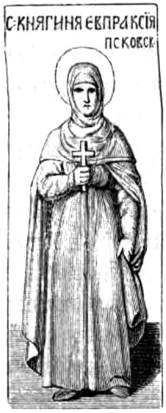
Блаженная Евпраксия, в мире Евфросиния, была дочь Полоцкого князя Рогвольда Борисовича230 и супруга князя Ярослава Владимировича. Отец Ярослава, князь Владимир Мстиславич, княживший в Пскове, несмотря на то, что женат был на дочери Рижского бискупа, много терпел оскорблений и бед от Немцев и вынужден был вместе с Псковичами не раз воевать против коварного ордена231. – Ярослав, не наученный опытом отца, думал жить счастливо между Немцами: недобрый муж бросил добрую жену свою, ушёл из Пскова к рыцарям и там женился на Немке; получив во владение городок Одемпе (Медвежью голову), за одно с Немцами не раз нападал на Русские поселения; в 1231 г. он захватил Изборск, но Псковичи схватили его здесь и заточили в Северный Переяславль232. – Благочестивая супруга его, брошенная легкомысленным мужем, обратилась к подвигам благочестия. Она основала в Пскове женский монастырь св. Иоанна Предтечи. Каменный храм Предтече, построенный ею, доселе цел и сам собой говорит, как о своей древности, так и о благочестии строительницы. Он сложен из крепкой, тёсаной плиты, с перемежкой четвероугольных кирпичей такой глины, обжиги и цвета, каких не видно во Пскове; кирпичи весьма сходны с Голландскими и Английскими. Так праведница не жалела издержек для дома Божия и дорогой ценой выписывала кирпич из заграничных мест. Не найдя утешения в мире, она искала их в Господе; приняв иночество, она была настоятельницей основанной ею женской обители. При гробнице её доселе стоит настоятельский чёрный посох её. Праведница приняла мученическую смерть от руки пасынка своего в г. Оденпе. Летописи не объясняют, почему пасынок поступил так с доброй матерью. Но принимая во внимание, что пасынок был сын Немки, папа Григорий домогался склонить Ярослава к принятию папизма, о чём писал послание к нему, и, по наставлению бескорыстных Немцев, Ярослав отказал Дерптской Церкви «половину своего законного наследства», которого не имел233, – присоединяя к тому то, что смерть праведницы последовала на другом году после знаменитой победы Невского над Немцами234, считаем и вполне вероятным, что мученическая смерть Евпраксии была делом жадного до корысти Немецкого папизма, излившего месть над ней за неудачи Ярослава и за своё собственное бесславие. Мощи праведницы принесены были во Псков и, здесь погребённые, скоро ознаменовались чудом; она умерщвлена 8 мая, а с 18 мая открылось знамение. Современник пишет: «в 18 день мая 1243 г. в Псковском монастыре св. Предтечи явилось знамение от иконы Спасителя, стоящей над гробом княгини, супруги князя Ярослава Владимировича, которую убил пасынок её в Медвежьей Голове; 12 дней истекало миро от иконы и наполнило 4 вощаницы, как скляницы. Две вощаницы привезены были на благословение в Новгород, а две оставлены во Пскове. Слава Тебе, Господи, давшему нам грешным и недостойным рабам такое благословение! Уповаем на Тебя, Вседержитель! Ты человеколюбивый призираешь на нас убогих великой милостью»235. – Мощи св. княгини-инокини почивают под спудом в Предтечевом храме; в ногах её погребена келейница её, монахиня Сандулия. Лик праведной княгини изображён древним письмом на двух иконах: на одной она молится перед Иоанном Предтечей и Ап. Андреем; другая икона при чудотворной иконе Спасителя. Память праведницы местно чтится 16 октября236.
Blessed Eupraxia, in the world Euphrosyne, was the daughter of Rogvolod Borisovich, Prince of Polotsk230, and the wife of Prince Yaroslav Vladimirovich. Yaroslav's father, Prince Vladimir Mstislavich, who reigned in Pskov, despite being married to the daughter of the Bishop of Riga, suffered many insults and calamities from the Germans and was compelled, together with the men of Pskov, to wage war repeatedly against the treacherous Order231. – Yaroslav, not taught by his father's experience, thought to live happily among the Germans: the evil husband abandoned his good wife, went from Pskov to the knights, and there married a German woman; having received the town of Odenpe (Bear's Head) as his domain, he together with the Germans repeatedly attacked Russian settlements; in 1231 he seized Izborsk, but the men of Pskov captured him there and imprisoned him in Pereyaslavl of the North232. – His pious wife, abandoned by her frivolous husband, turned to deeds of piety. She founded a convent of St. John the Forerunner in Pskov. The stone church of the Forerunner, built by her, remains intact to this day and itself speaks both of its antiquity and of the piety of its builder. It is constructed of strong, hewn flagstone, interspersed with square bricks of such clay, firing, and color as are not seen in Pskov; the bricks are very similar to Dutch and English ones. Thus the righteous woman spared no expense for the house of God and ordered bricks from foreign lands at a high price. Finding no consolation in the world, she sought it in the Lord; having received the monastic habit, she was the abbess of the convent she had founded. At her tomb her abbess's black staff still stands. The righteous woman suffered a martyr's death at the hand of her stepson in the town of Odenpe. The chronicles do not explain why the stepson acted thus toward his good mother. But taking into account that the stepson was the son of a German woman, that Pope Gregory sought to incline Yaroslav to accept papism, concerning which he wrote an epistle to him, and that, following the instruction of the disinterested Germans, Yaroslav bequeathed to the Church of Dorpat "half of his lawful inheritance," which he did not possess233 – adding to this that the death of the righteous woman occurred in the year following the famous victory of Nevsky over the Germans234, we consider it entirely probable that the martyrdom of Eupraxia was the work of the covetous German papism, which poured out its vengeance upon her for Yaroslav's failures and for its own disgrace. The relics of the righteous woman were brought to Pskov and, buried there, were soon marked by a miracle; she was slain on May 8, and from May 18 a sign was revealed. A contemporary writes: "On the 18th day of May, 1243, in the Pskov monastery of St. John the Forerunner, a sign appeared from the icon of the Savior standing over the tomb of the princess, the wife of Prince Yaroslav Vladimirovich, whom her stepson killed in Bear's Head; for 12 days myrrh flowed from the icon and filled four wax vessels, like small bottles. Two wax vessels were brought to Novgorod for a blessing, and two were left in Pskov. Glory to Thee, O Lord, Who hast given to us sinful and unworthy servants such a blessing! We put our hope in Thee, O Almighty! Thou, O Lover of mankind, lookest upon us wretched ones with great mercy."235 – The relics of the holy princess-nun rest hidden beneath the ground in the church of the Forerunner; at her feet is buried her cell-attendant, the nun Sandulia. The countenance of the righteous princess is depicted in ancient painting on two icons: on one she prays before John the Forerunner and the Apostle Andrew; the other icon is at the wonderworking icon of the Savior. The memory of the righteous woman is locally venerated on October 16236.
Лонгин, родом из Каппадокии, язычник, был по повелению Пилата приставлен, как сотник, с подчинёнными ему воинами к отправлению службы во время страданий Иисуса Христа и был до такой степени поражён необычайным событием, происходившим на его глазах, что, не имея до того времени никакого понятия ни о священном Писании, ни о пророчествах о Христе, уразумел истину, уверовал в Божество Спасителя, вместил в свою душу веру такую, к какой неспособными оказались старейшины и книжники Иудейские, изучившие закон и пророков...
Longinus, a native of Cappadocia, a pagan, was appointed by order of Pilate, as a centurion, with the soldiers under his command, to perform service during the sufferings of Jesus Christ, and was so struck by the extraordinary events taking place before his eyes that, having until that time no knowledge either of the Holy Scriptures or of the prophecies concerning Christ, he understood the truth, believed in the Divinity of the Savior, and received into his soul a faith of which the elders and scribes of the Jews, who had studied the law and the prophets, proved incapable...
«Сотник же и те, которые с ним сторожили Иисуса (во время страдания Его), видя землетрясение и все бывшее, устрашились весьма и говорили: воистинну Он был Сын Божий» ... «Сотник, стоявший напротив Его (Иисуса), увидев, что Он, так возгласив, испустил дух, сказал: истинно Человек Сей был Сын Божий»...
"Now the centurion and those who were with him guarding Jesus (during His suffering), seeing the earthquake and all that had happened, were greatly afraid and said: Truly He was the Son of God" ... "The centurion, who stood opposite Him (Jesus), seeing that He thus cried out and gave up the ghost, said: Truly this Man was the Son of God"...
Так свидетельствуют об уверовавшем во Христа сотнике Лонгине три Евангелиста (Мф.27:54; Мк.15:39, и Лк.23:47). – Предание же церковное к засвидетельствованному в Евангелии прибавляет, что Лонгин был и в числе стражей, приставленных ко гробу Спасителя, и, быв свидетелем чудесного воскресения Христова, окончательно вместе с двумя другими воинами уверовал во Христа, пришёл к Пилату и архиереям и рассказал им о всём. Когда же они предложили ему золото, чтобы он утаил о виденном им и воинами воскресении Христа и чтобы рассказывал всем, что ученики Христовы украли тело Его в то время, как уснули стерегущие Его, то Лонгин отвергнул их предложение и, напротив того, как самовидец, свидетельствовал народу о воскресении Христовом и называл Его истинным Богом. За это подвергся ненависти и гонению со стороны врагов Христа, которые стали изыскивать причину погубить его, но, не находя за ним вины, не решались на то, потому что Лонгин был старейший из воинов, человек честный и известный самому кесарю. Тогда Лонгин, уклоняясь от злобы преследователей, оставил свой воинский сан и, приняв крещение от святых Апостолов, удалился в своё отечество – Каппадокию, где повсюду открыто свидетельствовал об истине воскресения Христова. Слух об этом дошёл до Иудейских начальников, и архиереи со старцами умолили Пилата оклеветать Лонгина перед императором Тиверием в возмущении народа и достигли того, что проповеднику Христа был подписан смертный приговор. Посланные в Каппадокию воины обезглавили Лонгина и двух воинов, друзей его, – голову же его, в доказательство его смерти, принесли в Иерусалим, где Пилат и Иудеи велели выбросить её за городом, в место, где свалены были всякие нечистоты. – Через некоторое время она извлечена была однако же чудным образом: в Иерусалим для поклонения святыне приехала из Каппадокии одна христианка вдова, потерявшая зрение, вследствие болезни; при ней был её единственный сын, который внезапно занемог в Иерусалиме и умер. В глубочайшем горе несчастной женщины Бог утешил её видением: ей явился во сне мученик Лонгин, который обещал ей показать блаженное состояние её сына и возвратить ей зрение. Он возвестил ей о себе и указал ей то место, где она должна обрести его голову. Женщина отправилась с провожатыми на указанное место и, найдя голову святого, как только прикоснулась к ней, получила исцеление и с радостью принесла в дом священные останки. В следующую же ночь снова увидела во сне св. Лонгина, который с любовью обнимал её сына и говорил ей: «не плачь, утешься, видишь ли, как он радостен» ... И успокоилась чудно исцелённая и увидевшая сына своего в блаженном состоянии, и возвратилась в Каппадокию, привезя туда и обретённую голову святого, и предала её погребению вместе с останками своего сына.
Thus do the three Evangelists bear witness concerning the centurion Longinus who believed in Christ (Mt. 27:54; Mk. 15:39; and Lk. 23:47). – Church Tradition adds to what is witnessed in the Gospel that Longinus was also among the guards stationed at the tomb of the Savior, and having been a witness of the miraculous resurrection of Christ, he finally, together with two other soldiers, believed in Christ, went to Pilate and the high priests, and told them everything. When they offered him gold to conceal what he and the soldiers had seen of Christ's resurrection and to tell everyone that Christ's disciples had stolen His body while those guarding Him slept, Longinus rejected their offer and, on the contrary, as an eyewitness, testified to the people concerning the resurrection of Christ and called Him the true God. For this he incurred the hatred and persecution of the enemies of Christ, who began to seek a pretext to destroy him, but finding no guilt in him, they did not dare to do so, because Longinus was the chief of the soldiers, an honorable man known to Caesar himself. Then Longinus, fleeing the malice of his persecutors, left his military rank and, having received baptism from the holy Apostles, withdrew to his homeland, Cappadocia, where everywhere he openly testified to the truth of Christ's resurrection. Word of this reached the Jewish leaders, and the high priests with the elders persuaded Pilate to slander Longinus before the Emperor Tiberius as a stirrer of sedition among the people, and they succeeded in having a death sentence signed against the preacher of Christ. Soldiers sent to Cappadocia beheaded Longinus and two soldiers, his friends, and brought his head to Jerusalem as proof of his death, where Pilate and the Jews ordered it to be cast outside the city, into a place where all kinds of filth were dumped. – After some time, however, it was recovered in a miraculous manner: a Christian widow from Cappadocia, who had lost her sight due to illness, came to Jerusalem to venerate the holy places; with her was her only son, who suddenly fell ill in Jerusalem and died. In the deepest grief of the unfortunate woman, God comforted her with a vision: the martyr Longinus appeared to her in a dream, promising to show her the blessed state of her son and to restore her sight. He revealed himself to her and pointed out the place where she would find his head. The woman went with guides to the indicated place and, finding the head of the saint, as soon as she touched it, received healing and joyfully brought the sacred remains home. The following night she again saw St. Longinus in a dream, who lovingly embraced her son and said to her: "Weep not, be comforted; see how joyful he is"... And she, wondrously healed and having seen her son in a blessed state, was comforted, and returned to Cappadocia, bringing with her the recovered head of the saint, and buried it together with the remains of her son.
Святому мученику Лонгину, который, по преданию, сам был исцелён от болезни глаз при Кресте Спасителя каплей крови, попавшей ему в глаза, когда один из воинов «копьём пронзил рёбра» Распятому, – молятся об исцелении от глазных болезней.
To the holy martyr Longinus, who, according to tradition, was himself healed of an eye disease at the Cross of the Savior by a drop of blood that fell into his eyes when one of the soldiers "pierced the side" of the Crucified One with a spear, prayers are offered for healing from eye diseases.
В Деяниях св. доказывается, что писатель жития святого мученика Лонгина есть св. Исихий, пресвитер Иерусалимский († 434 г.), который нашёл акты мученика в библиотеке св. Воскресения и по ним составил своё описание, из которого видно, что мученик усекнут 16 октября237. – Честная рука св. Лонгина сотника находится в Риме в Ватиканском соборе святого Апостола Петра238.
In the Acts of the Saints it is demonstrated that the writer of the life of the holy martyr Longinus is St. Hesychius, presbyter of Jerusalem († 434 A.D.), who found the acts of the martyr in the library of the Holy Resurrection and from them composed his account, from which it is evident that the martyr was beheaded on October 16237. – The precious hand of St. Longinus the Centurion is in Rome, in the Vatican Basilica of the Holy Apostle Peter238.
Собр. лет. III, 54. V, 182. Степ. кн. 1, 353. «Вощаницы» – вощаные чаши над деревянными, расписными, свечами, куда ставились свечи. Образцы их в древн. гос. Рос. 1, 159.
Collection of Chronicles, III, 54; V, 182. Book of Degrees, 1, 353. "Voshchanitsy" – wax vessels over wooden, painted candles, into which candles were placed. Examples of them in Antiquities of the Russian State, 1, 159.
В житии сотника Лонгина, сочинитель пишет: «я, Исихий, пресвитер Иерусалимский, много и тщательно исследовал и не без великого труда мог найти нечто о св. Лонгине сотнике, который сказал при Кресте Христовом: воистинну Сей есть Сын Божий; я нашёл описание мученичества его в библиотеке Св. Воскресения» («Уч. об Отц. Церкви» Фил., архиеп. Черниг., § 203).
In the life of the centurion Longinus, the author writes: "I, Hesychius, presbyter of Jerusalem, having investigated much and diligently, and not without great labor, was able to find something concerning St. Longinus the centurion, who said at the Cross of Christ: Truly this is the Son of God; I found the account of his martyrdom in the library of the Holy Resurrection" (Philaret, Archbishop of Chernigov, "Teachings on the Fathers of the Church," § 203).