Родом из города Самосаты, в Сирии, сын благородных родителей, Лукиан получил хорошее образование, открывавшее ему путь к светским должностям. Однако же, с молодых лет полюбивший высшие духовные предметы, он, по смерти своих родителей, раздав всё своё имущество бедным, посвятил себя любимым занятиям и, придя к исповеднику Макарию в Одессу, пользовался наставлениями его в изучении священного Писания; при этом проводил строгую жизнь, за которую, равно как и за ревностное распространение слова Божия между Иудеями и язычниками, был посвящён в сан пресвитера Антиохийского. Здесь Лукиан устроил училище, сам же предавался изучению Писания и деятельному проповедованию веры во Христа. В 303 году, во время гонения при Диоклитиане, он, в числе других исповедников веры, потерпел в Никомидии от преследования гонителей, но в этот раз, сверх ожидания, был освобождён и возвратился в Антиохию, где и продолжал свою прежнюю христианскую деятельность. В это время он присоединил к своим занятиям исправление Греческого текста Библии, что признаётся великой заслугой, так как в то время текст Писания был во многом искажён – частью ошибками, вкравшимися в него от переписчиков, частью и умышленными изменениями со стороны злонамеренных людей. Ради этого полезного труда Лукиан предварительно изучил Еврейский язык.
Born in the city of Samosata in Syria, the son of noble parents, Lucian received a good education that opened for him the path to secular offices. Yet, having loved from his youth the higher spiritual subjects, upon the death of his parents he distributed all his possessions to the poor, devoted himself to his beloved pursuits, and, coming to the Confessor Macarius at Odessa, profited from his guidance in the study of the Sacred Scriptures. At the same time he led a strict life, for which, as well as for his zealous spread of the word of God among Jews and pagans, he was ordained to the rank of presbyter of Antioch. Here Lucian established a school, while he himself gave himself over to the study of the Scriptures and to the active preaching of faith in Christ. In the year 303, during the persecution under Diocletian, he, among other confessors of the faith, suffered in Nicomedia from the pursuit of the persecutors; but this time, beyond all expectation, he was released and returned to Antioch, where he continued his former Christian activity. At this time he added to his labors the correction of the Greek text of the Bible, which is acknowledged as a great service, since at that time the text of the Scriptures was in many ways corrupted—partly by errors that had crept into it from copyists, and partly by deliberate alterations on the part of malicious men. For the sake of this useful work, Lucian first studied the Hebrew language.
В 311 году, когда ярость гонителей христианства, как бы сознавая приближение его торжества, доходила до крайних пределов, Лукиан был схвачен и представлен в Никомидию, где находился тогда император Максимилиан; но, не страшась опасности, он смело представил префекту-мучителю апологию, составленную им в защиту христианских истин сильнейшими и красноречивейшими доводами. В ней, между прочим, упоминая о воскресении Христовом, Лукиан говорит: «воспользуюсь свидетельством самого места, где это случилось; само место соглашается со мною: Голгофская гора, рассевшаяся под славой Креста, та пещера, которая, по отверзтии входов преисподней, снова возвратила одушевлённое тело, чтобы более светлым вознеслось оно на небо... Привожу вам во свидетели само небо, которое, узрев, что делают нечестивые на земле, в полдень сокрыло свет свой. Поищите в ваших летописях и вы найдёте, что при Пилате, когда страдал Христос, день прерывался солнечным затмением».
In the year 311, when the fury of the persecutors of Christianity, as if conscious of the approach of its triumph, reached its utmost limits, Lucian was seized and brought to Nicomedia, where the emperor Maximian was then residing. But, not fearing danger, he boldly presented to the tormenting prefect an apology, composed by him in defense of Christian truths with the strongest and most eloquent arguments. In it, among other things, mentioning the Resurrection of Christ, Lucian says: "I shall avail myself of the testimony of the very place where this happened; the place itself agrees with me: Golgotha, the hill that split apart under the glory of the Cross, that cave which, after the opening of the gates of the underworld, again returned the animate body, that it might ascend to heaven all the more radiantly... I bring before you as witnesses the very heaven, which, beholding what the impious were doing on earth, hid its light at midday. Search your annals and you will find that under Pilate, when Christ suffered, the day was interrupted by a solar eclipse."
Но одной лишь безнадёжной бесчувственностью отозвалось сердце человека – закоренелого язычника на это призывание в свидетели истины самой бесчувственной природы... Лукиан за неустрашимое исповедание Христа был брошен в темницу в тяжких оковах и обречён на голодную смерть. Ему предлагали, впрочем, идоложертвенную пищу, его пытали даже, чтобы заставить вкусить её, но и терзаемый пытками, и изнемогая от голода, он отвечал только одно: «я – христианин».
But only with hopeless insensibility did the heart of a man—an inveterate pagan—respond to this summoning of insensate nature itself as witness to the truth... Lucian, for his fearless confession of Christ, was cast into prison in heavy chains and condemned to death by starvation. They offered him, to be sure, food sacrificed to idols; they even tortured him to force him to taste it, but though tormented by tortures and wasting away from hunger, he answered only one thing: "I am a Christian."
Наконец истощились от голода силы Лукиана, он почувствовал близость смерти и возрадовалась душа его. Отрешённый от всего земного, он только желал ещё раз на земле причаститься Тела и Крови Христовых. И вот, лёжа на спине, почти без движения по причине крайней слабости, пресвитер Божий на своей груди совершил бескровную жертву в праздник Богоявления, для приготовления к смерти себя и других христиан, заключённых с ним вместе в темнице. На другой же день после того скончался мучительной голодной смертью. Тело его, брошенное в море, было чудным образом обретено, и над ним впоследствии, в 326 году, был сооружён храм св. равноапостольной Еленой, в Дрепане, названном в честь её Еленополем.
At last Lucian's strength was exhausted by hunger; he felt the nearness of death, and his soul rejoiced. Detached from all that is earthly, he desired only once more on earth to partake of the Body and Blood of Christ. And so, lying on his back, almost motionless from extreme weakness, the priest of God performed the bloodless sacrifice upon his own breast on the feast of Theophany, preparing for death himself and the other Christians imprisoned with him in the dungeon. On the day following this, he died a painful death by starvation. His body, cast into the sea, was miraculously found, and over it was afterwards, in the year 326, a church built by St. Helen, Equal-to-the-Apostles, at Drepanum, which was named Helenopolis in her honor.
Труд св. Лукиана, т. е. исправленные им книги священного Писания, в предохранение от врагов веры, во время его исповеднического подвига – были сохранены в стене, где ящик с рукописью был залит известью и найден при благоверном Константине.
The labor of St. Lucian, that is, the books of the Sacred Scriptures corrected by him, was preserved from the enemies of the faith during the time of his confessional struggle—hidden in a wall, where the chest with the manuscript was sealed with lime and found under the Right-believing Constantine.
Евфимий, в мире – Никита, родился в 824 г. «Земным и временным отечеством своим имел страну Галатийскую, а по высоте деятельных и созерцательных совершенств справедливо был гражданином вышнего Сиона», – говорит составитель его жития. Родители его, благочестивые люди, «просияв некогда самими собой, сияют теперь и в отдалённом потомстве сиянием сына их», потому что успели возрастить в нём всецело преданного Богу христианина. Вся жизнь Евфимия с самого детства была Богоугодна и привела к той кончине, которая служит началом блаженной вечности для странников и пришельцев земных, возлюбивших её более временного мира. – Оставшись сиротой после отца, он, ещё совершенно юный, был уже настоящим помощником своей матери в её попечениях о доме и семействе; от этих домашних трудов не отвлекла Никиту и военная служба, на которую он должен был поступить по тогдашним постановлениям.
Euthymius, in the world Nicetas, was born in the year 824. "His earthly and temporal fatherland was the country of Galatia, but by the height of his active and contemplative perfections he was justly a citizen of the heavenly Zion," says the compiler of his Life. His parents, pious people, "having once shone by themselves, now shine in their distant posterity with the radiance of their son," because they succeeded in raising in him a Christian wholly devoted to God. The whole life of Euthymius from childhood itself was pleasing to God and led to that end which is the beginning of blessed eternity for the strangers and sojourners of earth who have loved it more than the temporal world. — Left an orphan after his father's death, he, while still quite young, was already a true helper to his mother in her cares for the house and family; and from these domestic labors Nicetas was not drawn away even by military service, into which he was obliged to enter according to the regulations of that time.
Женившись на достойной девушке, избранной для него его матерью, Никита подготовил в ней добрую помощницу в семейных делах. Вскоре Бог благословил этот союз рождением дочери Анастасии. Тогда решился молодой христианин удовлетворить свои личные, преобладающие и непреодолимые духовные стремления... Надеясь, что родившееся дитя будет достаточным утешением и матери его и жены, Никита решился оставить семью с тем, чтобы посвятить себя исключительно служению Богу на иноческом пути, тем более, что при семье оставалась ещё помощницей и замужняя его сестра – Мария, жившая в отеческом доме.
Having married a worthy maiden, chosen for him by his mother, Nicetas prepared in her a good helper in family affairs. Soon God blessed this union with the birth of a daughter, Anastasia. Then the young Christian resolved to satisfy his personal, prevailing, and irresistible spiritual aspirations... Hoping that the newborn child would be sufficient consolation both to his mother and to his wife, Nicetas resolved to leave his family in order to devote himself exclusively to the service of God on the monastic path, the more so since there remained in the family as a helper his married sister, Mary, who lived in the paternal home.
Таким образом и вышел однажды, никого не предупредив, из отеческого дома Никита, – обошёл многие места, посещая подвижников, прибыл на Олимп, где, пожив некоторое время под руководством двух великих старцев, Иоанникия и Иоанна, принял пострижение в иночество с именем Евфимия; проходил трудные послушания в киновии, посредством которых приобрёл такое смирение, что сделался выше страстей, изгнал из души своей уныние, обуздал язык, покорил себя воздержанию, стяжал молитву. Достигнув высокой степени духовного развития, обратил взор свой к жизни пустынной и удалился на Афонскую гору, куда привлекала его слава её подвижников.
And so it was that one day Nicetas went out, without warning anyone, from his father's house—he visited many places, seeking out ascetics, and arrived at Olympus, where, having lived for some time under the guidance of two great elders, Joannicius and John, he received the tonsure into monasticism with the name Euthymius. He performed difficult obediences in the cenobium, through which he acquired such humility that he became higher than the passions, drove despondency from his soul, bridled his tongue, subjected himself to abstinence, and acquired prayer. Having attained a high degree of spiritual development, he turned his gaze to the hermitic life and withdrew to Mount Athos, whither the fame of its ascetics drew him.
По пути на Афон, зашёл Евфимий в Никомидию, так как здесь он мог получить дорогую весть о своих родных; узнал он, что живы они, но скорбят о нём. Получив такое известие, Евфимий послал им крест и поручил посланному сказать им, что он уже инок и им советует последовать его примеру... Сначала странным показалось им такое предложение, и продолжали мать, жена и сёстры плакать о разлучившемся с ними, потом, размышляя, приучили себя к мысли об иночестве и, выдав в замужество дочь Евфимия Анастасию, которой предоставили всё имение, сами добровольно посвятили себя иноческой жизни.
On the way to Athos, Euthymius stopped at Nicomedia, since there he could receive precious news of his relatives; he learned that they were alive but grieving for him. Having received such tidings, Euthymius sent them a cross and charged the messenger to tell them that he was already a monk and advised them to follow his example... At first such a proposal seemed strange to them, and the mother, wife, and sisters continued to weep over him who had parted from them; then, reflecting, they accustomed themselves to the thought of monasticism and, having given Euthymius's daughter Anastasia in marriage, to whom they granted the entire estate, they themselves voluntarily devoted themselves to the monastic life.
Евфимий же, окончательно отрешившись от пристрастий земных, предался ещё более, чем до сих пор, суровому подвижничеству на Афоне. Три года безвыходно прожил он в безмолвии, в уединённой пещере, в трудах духовной борьбы между внутренним и внешним человеком, между душевным и духовным человеком – понятных только тому, кто сам испытал их... И обрёл небо в пещере своей... и когда вышел из неё к давно уже ожидавшим его другим подвижникам, то мог назидать их и словом, и жизнью.
Euthymius, however, having finally detached himself from earthly attachments, gave himself over even more than before to severe asceticism on Athos. For three years he lived without leaving his place, in silence, in a solitary cave, in the labors of spiritual struggle between the outer and inner man, between the soulful and the spiritual man—understandable only to those who have themselves experienced them... And he found heaven in his cave... and when he came out of it to the other ascetics who had long been awaiting him, he was able to edify them both by word and by life.
С Афона, по особенному откровению, Евфимий отошёл в Солунь и в горах, к востоку от города, на вершине Перистера, основал в 863 г. монастырь и восстановил храм святого Апостола Андрея Первозванного на запустевшем месте, прикрывавшем развалины прежнего храма, превращённого в овчарню. Сюда собралось к Евфимию множество ревностных иноков; пустыня приняла подобие города при большом стечении народа, ищущего духовного руководства чтимого подвижника. Таким образом, вокруг него, «если не совсем уничтожалось, то уменьшалось зло и заменялось процветанием всякого добра» ...
From Athos, by a special revelation, Euthymius departed to Thessalonica, and in the mountains to the east of the city, on the summit of Peristera, he founded in the year 863 a monastery and restored the church of the holy Apostle Andrew the First-called on a desolate spot that covered the ruins of a former church which had been turned into a sheepfold. Hither gathered to Euthymius a multitude of zealous monks; the wilderness took on the likeness of a city with a great concourse of people seeking spiritual guidance from the revered ascetic. Thus, around him, "if evil was not entirely destroyed, it was diminished and replaced by the flourishing of every good"...
Впоследствии основал здесь Евфимий и женскую обитель, в которой подвизались его мать и жена, а игуменьей была сестра его, принявшая схиму с именем Евфимии. После 14-ти лет управления обителями, Евфимий снова подвизался на Афоне до тех пор, пока почувствовал приближение кончины и, тяготясь частым нарушением безмолвия по причине множества людей, приходивших к нему, удалился на остров Священный, взяв с собой только одного инока Георгия. Здесь поселился он снова в пещере и после пяти месяцев уединённого подвижнического приготовления к отшествию из мира – после краткой и лёгкой болезни скончался в 15-й день октября, около 884 г.
Afterwards Euthymius founded here also a women's monastery, in which his mother and wife struggled, and the abbess was his sister, who had received the schema with the name Euthymia. After 14 years of governing the monasteries, Euthymius again struggled on Athos until he felt the approach of his end and, burdened by the frequent disturbance of his silence because of the multitude of people who came to him, withdrew to the island called Sacred, taking with him only one monk, George. Here he settled again in a cave, and after five months of solitary ascetic preparation for departure from the world—after a brief and light illness—he reposed on the 15th day of October, around the year 884.
Мощи преп. Евфимия, обретённые нетленными в пещере, покоятся теперь в городе Солуни, почему и преподобный называется Фессалоникийским, хотя отечеством его было другое место (селение Опсо, около города Анкира, в Галатии).
The relics of the Venerable Euthymius, found incorrupt in the cave, now rest in the city of Thessalonica, wherefore the Venerable One is called of Thessalonica, although his fatherland was another place (the village of Opson, near the city of Ancyra in Galatia).
Св. Лука Жидята, воспоминаемый Церковью также 10 февраля в числе девяти святителей Новгородских, сколько известно, первый из Русских был удостоен епископского сана в 1035 г. При нём и под его надзором строился в Новгороде Софийский собор, который и освящал он в 1049 г. В 1055 г., оклеветанный своим слугой Дудиком, епископ Лука был вызван в Киев, где после трехлетнего заключения был оправдан и освобождён, а клеветнику его в наказание были обрезаны нос и руки. Св. Лука скончался на возвратном пути из Киева в Новгород, в 1058 г., и похоронен в Софийском соборе.
St. Luke Zhidiata, commemorated by the Church also on February 10 among the nine Hierarchs of Novgorod, as far as is known, was the first of the Russians to be deemed worthy of the episcopal rank, in the year 1035. Under him and under his supervision the Cathedral of St. Sophia was built in Novgorod, which he consecrated in the year 1049. In the year 1055, slandered by his servant Dudik, Bishop Luke was summoned to Kiev, where after three years of imprisonment he was vindicated and released, while his slanderer, as punishment, had his nose and hands cut off. St. Luke reposed on the return journey from Kiev to Novgorod, in the year 1058, and was buried in the Cathedral of St. Sophia.
Святитель «учительный» Лука просвещал паству свою простыми, задушевными поучениями. О них можно судить по сохранившемуся до настоящего времени:
The “teacherly” Hierarch Luke enlightened his flock with simple, heartfelt instructions. One may judge of them from what has been preserved to the present day:
«Прежде всего должны мы, братия, хранить эту заповедь – веровать в единого Бога, Троице славимого, в Отца, Сына и Св. Духа, как научили Апостолы и утвердили святые отцы. «Верую во единого Бога» и проч. Веруйте воскресению, жизни вечной, вечной муке грешников. Не ленитесь ходить в церковь к заутрени, к обедне и к вечерне, и в своей клети, отходя ко сну, поклонись Богу, а потом уже ложись. В церкви стойте со страхом Божиим, не разговаривайте, не думайте ни о чём другом, но молите Бога всей душой, да простит вам грехи. Имейте любовь ко всякому человеку, а больше к братии; не будь у вас на сердце одно, а на устах – другое. Не рой брату яму, чтобы тебя Бог не ввергнул в худшую. Люби правду, и за правду, за Божий закон готов будь умереть, чтобы Бог причёл тебя к святым. Переносите друг от друга обиду, не платите злом за зло; друг друга хвалите, и Бог вас похвалит. Не ссорь других, чтобы не назвали тебя сыном диавола; помири, да будешь сыном Богу. – Не осуждай брата и мысленно; помни свои грехи, чтобы и тебя Бог не осудил. Милуйте странных, убогих, заключённых в темницы, и к своим сиротам (рабам) будьте милостивы; тот весьма милостив, кто оберегает от скорби своих домашних. Не следует говорить срамные слова и сердиться ежедневно; не унижай других, не смейся ни над кем; в напасти терпи, имея упование на Бога. Не будьте буйны и горды, а считайте других лучше себя, – помните, что может быть завтра будете смрад, гной, черви. Будьте смирны, кротки, немногоречивы, чтобы быть и слушателями, и исполнителями закона Божия; у гордого в сердце – диавол, и Божие слово не прильнёт к нему. Почитайте старого человека и родителей своих. Не клянитесь именем Божиим и другого не заклинайте и не проклинайте. Судите по правде, взяток не берите. Денег в рост не давайте. Бога бойтесь; князя чтите; рабы, повинуйтесь сначала Богу, потом – господам своим; чтите иерея Божия, чтите и слуг церковных. Не убивай, не лги, не кради, лживым свидетелем не будь, не враждуй, не завидуй, не клевещи; не будь гневлив, ни дерзок; с радующимися радуйся, с печальным будь печален; святые дни чтите. Бог же мира со всеми. Аминь»195.
“First of all, brethren, we must keep this commandment—to believe in the one God, glorified in Trinity, in the Father, the Son, and the Holy Spirit, as the Apostles taught and the holy fathers confirmed. ‘I believe in one God,’ and so forth. Believe in the resurrection, eternal life, and eternal torment for sinners. Be not slothful in going to church for Matins, for the Liturgy, and for Vespers; and in your own cell, when you go to sleep, bow down to God, and then lie down. In church stand with the fear of God; do not talk, do not think of anything else, but pray to God with all your soul, that He may forgive you your sins. Have love for every man, and especially for the brethren; let not one thing be in your heart and another on your lips. Dig not a pit for your brother, lest God cast you into a worse one. Love the truth, and for the truth, for God’s law, be ready to die, that God may number you among the saints. Bear with one another’s offenses; repay not evil for evil; praise one another, and God will praise you. Do not set others at odds, lest you be called a son of the devil; make peace, that you may be a son to God. — Judge not your brother even in thought; remember your own sins, lest God also judge you. Be merciful to strangers, to the poor, to those imprisoned in dungeons, and be merciful to your own orphans (servants); he is very merciful who guards his household from sorrow. You should not speak shameful words nor be angry every day; do not humiliate others, do not laugh at anyone; in misfortune be patient, having hope in God. Be not violent nor proud, but consider others better than yourselves—remember that tomorrow you may be stench, pus, worms. Be humble, meek, sparing of words, that you may be both hearers and doers of God’s law; in the heart of the proud is the devil, and God’s word does not cleave to him. Honor the aged man and your parents. Swear not by the name of God, and do not adjure or curse another. Judge righteously, take no bribes. Lend not money at interest. Fear God; honor the prince; servants, obey first God, then your masters; honor the priest of God, honor also the servants of the church. Do not kill, do not lie, do not steal, be not a false witness, do not be hostile, do not envy, do not slander; be not wrathful nor insolent; rejoice with those who rejoice, be sorrowful with the sorrowful; honor the holy days. The God of peace be with all. Amen.”195
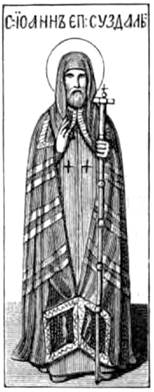
Блаж. Иоанн в молодых летах поступил в иноческую обитель и здесь Боголюбиво подвизался196. Князь Константин Васильевич, полюбив Нижний-Новгород, сделал его вместо Суздаля главным городом своего обширного княжества. Это было в 1350 г.197. Вместе с тем пожелал он иметь при себе особого епископа, отдельного от Ростовского и Владимирского, и обратился с просьбой о том к патриарху; согласно с его желанием благочестивый Иоанн посвящён был (1350 г.) патриархом в епископа Нижегородского и Суздальского198. Это посвящение не обошлось без неприятностей. Блаж. м. Феогност повиновался распоряжению патриарха; не так приняли его в Суздале. – В летописи читаем: «в 1351 г. преосвящ. Феогност митрополит благословил совершать служение епископу Даниилу Суздальскому; он отлучён был за некоторую вину и опять приял прежний сан свой»199. – В чём состояла вина Даниила? Весьма вероятно, что Суздальский епископ восстал с ропотом против распоряжений патриарха за посвящение Иоанна в епископа Нижегородского и Суздальского и за то подвергся запрещению. После того известие летописи о разрешении Даниила надобно отнести только к священнослужению, а не к самостоятельному управлению Суздальской епархией200, так как после того управлял монастырями Суздальскими епископ Иоанн. Когда благочестивый князь Борис Константинович пожелал устроить новую обитель в Суздале, то блаженный святитель Иоанн не только назначил преп. Евфимия в исполнителя доброй воли князя, но сам освящал место для обители и потом (1352 года) Евфимия в архимандрита201. – Блаженный архипастырь, радуясь успехам мужественного князя Константина, покорявшего своей власти дикую Мордву, усердно сеял семя слова Божия на новой ниве, между Мордвой202. Он покорял сердца св. вере особенно своей высокой благостью и живым благочестием. – Бескорыстный и сердобольный, он заботился более о покое других, чем о своём. Ему казалось, что на крестьянах, которые жили на землях церковных, лежат тяжёлые налоги, и он облегчил повинности их. Он устроил богадельни для больных и престарелых. Благочестие в народе возбуждал и поддерживал он повременным совершением крестных ходов. Раз, в праздник Преображения Господня, служил он литургию в Евфимиевой обители. Князь Борис видел, что с святителем служит кто-то, облечённый светом и славой. По настоятельной просьбе князя, святитель сказал, что это – ангел Божий, сослужавший ему и в другие времена. Благочестивый князь Андрей Константинович, рассказав святителю, что во время плавания по Волге был он в большой опасности от бури и тогда же дал обет построить женский монастырь в честь Покрова Богоматери, просил благословения и совета его на устроение обители. Святитель благословил добрые желания князя, назначил место для новой обители и поставил настоятельницей обители племянницу преп. Евфимия, жившую дотоле в Суздальском Александровом монастыре. Это было в 1364 г.203. Вскоре после того святитель похоронил благочестивого князя Андрея; а вслед затем открылись сильные споры между братьями князьями – Борисом и Димитрием. Первосвятитель Алексий на том основании, что при митр. Максиме к Владимирской кафедре его принадлежал не один Владимир, а и города Суздальского княжества, причислил к митрополичьей кафедре Суздаль, Нижгород и Городец204. – С того времени блаженный Иоанн, отказавшись от дел правления, стал проводить жизнь в уединении. В мирной обители совершал он подвиги молитвы и поста безмолвником205. Стенная надпись 1635 г. в Суздальском соборе говорит: «л. 6882 окт. 15 д. (1373 г.) святитель Иоанн почи зде». Мощи его почивают в Суздальском соборе под спудом. Надпись на шитом покрове говорит: «л. 7086 (1578) июля 28 д. – положила есми покров на гроб великого чудотворца Ивана епископа княже Владимирова княгиня Андреевича Евпраксия удельная». – На том же покрове вышит тропарь, в котором святитель Иоанн прославляется, как чудотворец. «Злоумышленным церковником молитвою скоро прозрети повеле и научи, якоже прежде св. Леонтий, – связа и паки благослови»206. – Итак в 1578 г. святитель Иоанн был уже почитаем в числе святых. В честь его воздвигались в Суздальской стороне храмы; а служба ему написана была в начале XVI столетия207. – Столетие назад тому, и именно в 1743 г., вот что случилось при раке святителя: Суздалец Иван Жилинин, с марта мес. разбитый параличом, лишён был употребления языка, рук и ног. Октября 27 он исповедал вслух всех в храме, что ему в сонном видении предстал муж, облечённый в светлые одежды, и, назвав себя Иоанном, епископом Суздальским, велел идти в собор, чтобы получить там полное исцеление. Больной проснулся и не чувствовал болезни; босой прибежал в храм и с восторгом лобызал честную раку святителя208. После того Синодом подтверждено чтить местно память святителей Феодора и Иоанна, как дотоле чтили209.
Blessed John entered a monastic community in his youth and there labored in a God-loving manner196. Prince Constantine Vasilievich, having come to love Nizhny Novgorod, made it, instead of Suzdal, the chief city of his extensive principality. This was in the year 1350197. At the same time, he desired to have a special bishop for himself, separate from those of Rostov and Vladimir, and turned with a request to the patriarch concerning this; in accordance with his wish, the pious John was consecrated (in 1350) by the patriarch as Bishop of Nizhny Novgorod and Suzdal198. This consecration did not take place without unpleasantness. Blessed Metropolitan Theognostus submitted to the patriarch’s decree; it was received differently in Suzdal. — In the chronicle we read: “in the year 1351, the Most Reverend Metropolitan Theognostus blessed Bishop Daniel of Suzdal to perform the services; he had been suspended for some offense and again received his former rank”199. — What was Daniel’s offense? It is very probable that the Bishop of Suzdal rose up with murmuring against the patriarch’s decrees concerning the consecration of John as Bishop of Nizhny Novgorod and Suzdal, and for this he was subjected to suspension. After this, the chronicle’s notice of Daniel’s absolution must be referred only to the performance of sacred services, and not to the independent administration of the Suzdal diocese200, since after that Bishop John administered the Suzdal monasteries. When the pious Prince Boris Constantinovich desired to establish a new monastery in Suzdal, the blessed Hierarch John not only appointed the Venerable Euthymius to carry out the prince’s good will, but himself consecrated the site for the monastery and later (in 1352) [appointed] Euthymius as archimandrite201. — The blessed archpastor, rejoicing at the successes of the courageous Prince Constantine, who was subduing the wild Mordvins to his authority, diligently sowed the seed of the word of God on the new field, among the Mordvins202. He won hearts to the holy faith especially by his lofty goodness and living piety. — Disinterested and compassionate, he cared more for the peace of others than for his own. It seemed to him that heavy taxes lay upon the peasants who lived on church lands, and he lightened their obligations. He established almshouses for the sick and the aged. He aroused and maintained piety among the people by periodically performing processions of the cross. Once, on the feast of the Transfiguration of the Lord, he served the Divine Liturgy in the Euthymius monastery. Prince Boris saw that someone was serving with the hierarch, clothed in light and glory. At the prince’s insistent request, the hierarch said that it was an angel of God, who had served with him also at other times. The pious Prince Andrew Constantinovich, having told the hierarch that during a voyage on the Volga he had been in great danger from a storm and had then made a vow to build a women’s monastery in honor of the Protection of the Mother of God, asked for his blessing and counsel on the establishment of the monastery. The hierarch blessed the prince’s good desires, appointed a site for the new monastery, and appointed as abbess of the monastery the niece of the Venerable Euthymius, who had until then lived in the Suzdal Alexander Monastery. This was in the year 1364203. Soon after this, the hierarch buried the pious Prince Andrew; and immediately afterward, strong disputes broke out between the brother princes—Boris and Demetrius. The First Hierarch Alexis, on the ground that under Metropolitan Maximus the Vladimir see had included not only Vladimir but also the cities of the Suzdal principality, annexed Suzdal, Nizhny Novgorod, and Gorodets to the metropolitan see204. — From that time, the blessed John, having withdrawn from the affairs of administration, began to spend his life in solitude. In a peaceful monastery he performed the labors of prayer and fasting as a hesychast205. A wall inscription of 1635 in the Suzdal cathedral says: “in the year 6882, October 15 (1373), Hierarch John reposed here.” His relics rest in the Suzdal cathedral under a bushel. An inscription on an embroidered cover says: “in the year 7086 (1578), July 28 — I, Princess Eupraxia, appanage princess of Prince Vladimir Andrew’s wife, placed this cover on the tomb of the great wonderworker John, bishop.” — On the same cover is embroidered a troparion, in which Hierarch John is glorified as a wonderworker. “A malicious churchman, by prayer he quickly commanded to see and taught, as formerly St. Leontius—he bound and again blessed”206. — Thus, in 1578, Hierarch John was already venerated among the saints. In his honor churches were erected in the Suzdal region; and a service to him was written at the beginning of the 16th century207. — A century ago, namely in 1743, the following occurred at the shrine of the hierarch: a Suzdalian, Ivan Zhilinin, who from the month of March had been stricken with paralysis and deprived of the use of tongue, hands, and feet. On October 27 he confessed aloud before all in the church that in a dream vision a man appeared to him, clothed in bright garments, and, calling himself John, Bishop of Suzdal, told him to go to the cathedral to receive complete healing there. The sick man awoke and felt no illness; he ran barefoot to the church and with rapture kissed the honorable shrine of the hierarch208. After this, the Synod confirmed that the memory of the Hierarchs Theodore and John should be venerated locally, as they had been venerated until then209.
С молодых лет посвятив себя на служение Богу, блаженный Дионисий, в мире Давид, по примеру Киевских Печерских подвижников, ископал себе пещеру на берегу Волги, в 5 верстах от Нижнего Новгорода. В Печерской обители его сохраняется Печерская икона Божией Матери с предстоящими Антонием и Феодосием, принесённая Дионисием из Киева210. – Это даёт видеть, что блаженный Давид пострижен был в иночество в Киевской пещерной обители и отсюда принёс на берег Волги любовь свою к пещерной жизни. В пещере своей блаженный Дионисий сперва жил один отшельником. Когда же явились желающие подвизаться вместе с ним иночески, он основал (около 1335 года) монастырь в честь Вознесения Господня211. Строгой подвижническою жизнью и обширным знанием правил веры и благочестия приобрёл он себе известность и уважение. В нём видели «мужа кроткого, рассудительного, знающего святое Писание, учительного, славного по постничеству и исполненного любви ко всем»212. Под его руководством получили начальное иноческое образование пр. Евфимий Суздальский и Макарий Унженский. Он преподавал наставления блаженной княгине Феодоре. – В Печерской обители, под его руководством, образовались учительные старцы, каков был Павел Высокий. По его благословению 12 учеников его, в том числе преп. Евфимий, насадили иноческие обители в разных местах страны Суздальской и Нижегородской213.
Having dedicated himself from his youth to the service of God, the blessed Dionysius, in the world David, following the example of the ascetics of the Kiev Caves, dug himself a cave on the bank of the Volga, 5 versts from Nizhny Novgorod. In the Pechersk monastery there is preserved the Pechersk Icon of the Mother of God with Anthony and Theodosius standing before Her, brought by Dionysius from Kiev210. — This shows that the blessed David was tonsured into monasticism in the Kiev Caves monastery and from there brought his love for the cave life to the bank of the Volga. In his cave, the blessed Dionysius at first lived alone as a hermit. When, however, there appeared those who wished to labor monastically together with him, he founded (around the year 1335) a monastery in honor of the Ascension of the Lord211. By his strict ascetic life and extensive knowledge of the rules of faith and piety, he acquired for himself renown and respect. In him they saw “a man meek, discerning, knowing the Holy Scriptures, teacherly, renowned for fasting, and filled with love for all”212. Under his guidance, the Venerable Euthymius of Suzdal and Macarius of Unzha received their initial monastic formation. He gave instruction to the blessed Princess Theodora. — In the Pechersk monastery, under his guidance, teacherly elders were formed, such as Paul the Tall. By his blessing, 12 of his disciples, including the Venerable Euthymius, planted monastic communities in various places of the Suzdal and Nizhny Novgorod regions213.
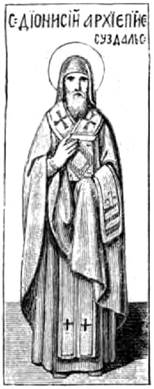
Святитель Алексий, лично зная добродетели и образованность Дионисия, в 1374 году посвятил его в епископа Суздальского214. В следующем году блаженному архипастырю пришлось подвергать собственную жизнь опасности, для спасения других. Народ, раздражённый своеволием Мамаевых послов, перебил нескольких из них; по распоряжению князя главный посол Мурза Сарайко заключён был с дружиной его в крепость, для его же безопасности. Но так как дознано было, что дикая дружина замышляет убийства, то хотели развести Татар в разные места. Узнав о том, Сарайко бросился с слугами в дом владыки, зажёг двор и начал стрелять в народ. Дионисий старался успокоить и чужих, и своих, но едва не лишился жизни: одна стрела Татарская вонзилась в мантию его. Раздражённый народ перебил озлившихся степняков215. В 1377 году святитель оплакал погибель войск Нижегородского и Московского на реке Пьяной и следовавшее затем опустошение Нижнего Татарами216. – По смерти святителя Алексия († 1378 г.) преподобный Сергий, в первый раз узнавший Дионисия ещё в Печерском монастыре (в 1365 г.), предлагал вел. князю Димитрию избрать Дионисия в митрополита. Но вел. князю и боярам непременно хотелось видеть митрополита Митяя, придворного священника. – К сожалению, светским людям нравятся Митяи – люди ловкие и лёгкие, для которых благочестие – дело неважное. – Митяй избран в митрополита. Любимец вел. князя не соблюдал даже приличий в новом своём счастье. Он вёл себя так гордо и заносчиво, что, не посвящённый в сан святителя, облекался в митрополичью мантию, носил белый клобук, обращался с духовенством властительски и брал себе доходы первосвятителя217. Он просил вел. князя, чтобы посвящение его совершилось в Москве. Великий князь пригласил епископов для посвящения Митяя. Блаженный Дионисий, явясь к вел. князю, смело сказал: «кто это учит тебя, государь, переменять закон по своему усмотрению? Не следует быть тому, чего желают от тебя и от нас». Великий князь отказался от своего желания. Митяй сильно оскорбился разрушением мечты своей и кипел досадой на Дионисия. «Почему ты, сказал он Дионисию, не был у меня до сего времени и не принял моего благословения?» Дионисий отвечал: «оттого, что я – епископ, а ты священник, – ты не имеешь права благословлять меня». Митяй задрожал от гнева, грозил с криком, что лишит Дионисия священства и своими руками сдерёт скрижали с мантии его. После того Митяй поспешил в Цареград. Дионисий отправился туда же, потому что его вызывал к себе патриарх, да и надобно было искать себе защиты. Это было в 1380 году218.
St. Alexis, knowing personally the virtues and learning of Dionysius, in 1374 consecrated him Bishop of Suzdal214. In the following year the blessed archpastor had to endanger his own life for the salvation of others. The people, irritated by the lawlessness of Mamai’s envoys, killed several of them; by order of the prince, the chief envoy, Murza Saraiko, was confined with his retinue in the fortress for his own safety. But when it was discovered that the savage retinue was plotting murder, they wished to disperse the Tatars to different places. Learning of this, Saraiko rushed with his servants into the bishop’s house, set fire to the courtyard, and began shooting at the people. Dionysius tried to calm both the foreigners and his own people, but nearly lost his life: one Tatar arrow lodged in his mantle. The enraged people killed the enraged steppe-dwellers215. In 1377 the Hierarch lamented the destruction of the Nizhny Novgorod and Moscow armies on the River Pyana and the subsequent devastation of Nizhny Novgorod by the Tatars216. – After the death of St. Alexis († 1378), the Venerable Sergius, who had first come to know Dionysius while still in the Pechersk monastery (in 1365), proposed to Grand Prince Demetrius that Dionysius be chosen as metropolitan. But the Grand Prince and the boyars absolutely wished to see Mityai, the court priest, as metropolitan. – Unfortunately, worldly people like Mityais – clever and frivolous men, for whom piety is a matter of no importance. – Mityai was chosen as metropolitan. The favorite of the Grand Prince did not even observe propriety in his new fortune. He behaved so proudly and arrogantly that, though not consecrated to the rank of hierarch, he clothed himself in the metropolitan’s mantle, wore the white klobuk, treated the clergy despotically, and took for himself the revenues of the chief hierarch217. He asked the Grand Prince that his consecration take place in Moscow. The Grand Prince invited the bishops for Mityai’s consecration. The blessed Dionysius, appearing before the Grand Prince, boldly said: “Who is it that teaches you, sovereign, to change the law according to your own discretion? That which they desire from you and from us should not be.” The Grand Prince abandoned his wish. Mityai was greatly offended by the destruction of his dream and seethed with vexation at Dionysius. “Why,” he said to Dionysius, “have you not come to me until now and received my blessing?” Dionysius answered: “Because I am a bishop, and you are a priest – you have no right to bless me.” Mityai trembled with anger, threatening with a shout that he would deprive Dionysius of the priesthood and with his own hands tear the tablets from his mantle. After that Mityai hastened to Constantinople. Dionysius set out for the same place, because the patriarch had summoned him, and it was also necessary to seek protection for himself. This was in 1380218.
В Цареграде Дионисий пробыл более года. Он употребил это время для пользы не только своей паствы, но и всей Русской Церкви. Для паствы своей послал он из Константинополя два точные списка с иконы Божией Матери Одигитрии, потом приобрёл часть Животворящего древа и мощи некоторых святых219. – Важнее же всего было то, что он объяснил патриарху опасность, в какой находится Русская Церковь от ереси стригольников, усилившейся во Пскове и Новгороде. Патриарх, лично узнав высокие достоинства Дионисия, почтил его саном архиепископа, дал ему фелонь с крестами и стихарь с источниками. Если бы Дионисий желал высшей чести, при расположении к нему патриарха, он, после несчастной смерти Митяя, мог бы испросить себе сан митрополита. Но он не искал земной чести, – а славы Божией желал. «Мы нашли его, писал патриарх в грамоте, достойным всякой похвалы: видели пощение и слёзы его, молитву и милостыню, всё, чем обозначается духовный Божий человек; он присутствовал и на святом соборе, духовно беседовал с епископами о священном Писании, причём показал ревность к вере и глубокое разумение священных правил. – Потому и удостоен он почётного сана, с возведением кафедры его на степень архиепископии, второй после Новогородской; даны ему стихарь с источниками и фелонь с четырьмя крестами и ликами Евангелистов»220. Патриарх поручил просвещённому и ревностному архипастырю лично быть в Новгородской пастве и употребить старание об истреблении там ереси. «Смирение наше и великий собор, писал патриарх Псковичам, послали к вам Боголюбивого архиепископа Суздальского Дионисия, мужа честного, благочестивого, добродетельного, известного хранителя священных канонов; он от лица нашего посетит и благословит вас, научит и наставит, устроит должное и соединит вас с соборной Апостольской Церковью Божией; вы должны узнать, что отлучающиеся от Церкви отлучаются от Самого Христа Бога; всё, что услышите из уст его, примите как наше собственное слово»221.
Dionysius remained in Constantinople for more than a year. He used this time for the benefit not only of his own flock, but of the entire Russian Church. For his flock he sent from Constantinople two exact copies of the Icon of the Mother of God “Hodegetria,” and later acquired a portion of the Life-giving Wood and the relics of certain saints219. – More important than all, however, was that he explained to the patriarch the danger in which the Russian Church stood from the heresy of the Strigolniki, which had grown strong in Pskov and Novgorod. The patriarch, having personally come to know the high merits of Dionysius, honored him with the rank of archbishop, gave him a phelonion with crosses and a sticharion with streams. If Dionysius had desired higher honor, given the patriarch’s favor toward him, he could, after the unfortunate death of Mityai, have requested for himself the rank of metropolitan. But he did not seek earthly honor – he desired the glory of God. “We have found him,” wrote the patriarch in his letter, “worthy of all praise: we have seen his fasting and tears, his prayer and almsgiving, everything by which a spiritual man of God is marked; he was present also at the holy council, and conversed spiritually with the bishops concerning the sacred Scriptures, showing zeal for the faith and a deep understanding of the sacred canons. – Therefore he has been deemed worthy of an honorable rank, with the elevation of his see to the degree of an archbishopric, second after that of Novgorod; there have been given to him a sticharion with streams and a phelonion with four crosses and the faces of the Evangelists”220. The patriarch entrusted the enlightened and zealous archpastor to go in person to the Novgorod flock and to make every effort for the eradication of the heresy there. “Our humility and the great council,” wrote the patriarch to the people of Pskov, “have sent to you the God-loving Archbishop Dionysius of Suzdal, an honorable, pious, virtuous man, a known guardian of the sacred canons; he will visit and bless you in our name, teach and instruct you, establish what is fitting, and unite you with the catholic Apostolic Church of God; you should know that those who separate themselves from the Church separate themselves from Christ God Himself; everything that you hear from his mouth, receive as our own word”221.
Снабжённый патриаршими грамотами, блаж. Дионисий в конце 1381 г. возвратился в Россию. Он был в Новгороде и Пскове и успел сильно потрясти там тлетворную ересь стригольников222. В это же время он установил общежитие в Псковском Светогорском монастыре. – «При Божией помощи, писал он в грамоте монастырю, как заповедал мне святейший вселенский патриарх, заботливый о спасении душ и обращении заблудших, возвращаю я на верный путь, к иноческому общежитию, уклонившихся от него». Разрешив виновных в своеволии, постановляет: «ни игумен, ни братья не должны иметь ничего своего; не должны ни есть, ни пить у себя по кельям; одежду необходимую должны брать у игумена, при том одежду простую, из обыкновенных, а не из Немецких сукон, шубы бараньи и без опушки; обувь, онучи брать у игумена; лишнего платья не иметь». Такое установление оправдывает он затем словами Василия В., Ефрема, Лествичника и других223. К празднику Богоявления (1382 г.) прибыл он в Суздаль и затем был в Нижнем. В любимой Печерской обители своей оплакал он кончину великого старца Павла, подвижника учительного224. Вел. князь увидал теперь достоинства блаж. Дионисия и в июне 1383 г. отправил его в Константинополь, для поставления в митрополита, на место Пимена, доставшего себе высокий сан помимо великого князя. Достоинства Дионисия известны были в Константинополе, и потому там согласились исполнить просьбу о нём великого князя, если полномочные собора найдут дело Пимена не правым. Блаженный Дионисий, возвращаясь в Россию через Киев, задержан был здесь Литовским князем Владимиром Ольгердовичем. Князь Литовский объявил, что, если Московский князь по своей воле изгнал из Москвы Киприана, митрополита всей России, то князь Киевский, следуя ему, задерживает Дионисия. По отношению к святой Церкви это означало, что произвол человеческий вводит с собой в св. Церковь только страдания и неустройства. По отношению к блаж. Дионисию это значило, что Господь ещё раз и уже в последний подвергает его очистительным скорбям. «Господь кого любит, учит св. Писание, того наказывает: биет всякого сына, о котором благоволит» (Евр.12:6). – «Благо мне, что я страдаю, дабы научиться уставам Твоим» (Пс.118:71), исповедует священный певец. Блаженный Дионисий в пещерной кельи проводил время в молитве и сокрушении сердечном225. Подвижник-пастырь скончался в Киевской пещере 15 октября 1384 г.226. «Тело же его, говорят летописи, и доныне цело и нетленно»227. По древним памятникам называется он чудотворцем228. В Печерском каноне молятся святителю Дионисию229.
Furnished with the patriarch’s letters, the blessed Dionysius returned to Russia at the end of 1381. He was in Novgorod and Pskov and succeeded in greatly shaking the pernicious heresy of the Strigolniki there222. At this same time he established the cenobitic rule in the Pskov Svetogorsk Monastery. – “With God’s help,” he wrote in his letter to the monastery, “as the most holy ecumenical patriarch, solicitous for the salvation of souls and the conversion of the erring, commanded me, I am returning to the true path, to the cenobitic life, those who have deviated from it.” Having absolved those guilty of self-will, he decrees: “Neither the abbot nor the brethren shall have anything of their own; they shall neither eat nor drink in their cells; they shall take necessary clothing from the abbot, and that clothing simple, of ordinary cloth, not of German cloth, sheepskin coats without trimming; footwear and footcloths they shall take from the abbot; they shall have no extra clothing.” He then justifies this ordinance with the words of Basil the Great, Ephraim, the Ladder, and others223. For the feast of Theophany (1382) he arrived in Suzdal and then was in Nizhny Novgorod. In his beloved Pechersk monastery he lamented the death of the great elder Paul, a teacherly ascetic224. The Grand Prince now saw the merits of the blessed Dionysius and in June 1383 sent him to Constantinople to be appointed metropolitan in place of Pimen, who had obtained the high rank apart from the Grand Prince. The merits of Dionysius were known in Constantinople, and therefore they agreed there to fulfill the request concerning him from the Grand Prince, if the plenipotentiaries of the council should find Pimen’s case unjust. The blessed Dionysius, returning to Russia through Kiev, was detained there by the Lithuanian Prince Vladimir Olgerdovich. The Lithuanian prince declared that if the Prince of Moscow, by his own will, had driven Cyprian, Metropolitan of All Russia, out of Moscow, then the Prince of Kiev, following him, was detaining Dionysius. In relation to the holy Church, this meant that human willfulness introduces only suffering and disorder into the holy Church. In relation to the blessed Dionysius, this meant that the Lord once more, and for the last time, subjected him to purifying sorrows. “For whom the Lord loves, holy Scripture teaches, He chastens: He scourges every son whom He receives” (Heb. 12:6). – “It is good for me that I have been afflicted, that I might learn Thy statutes” (Ps. 118:71), confesses the sacred singer. The blessed Dionysius spent his time in a cave cell in prayer and contrition of heart225. The ascetic-pastor reposed in the Kiev cave on October 15, 1384226. “His body,” say the chronicles, “remains whole and incorrupt to this day”227. In ancient records he is called a wonderworker228. In the Canon of the Kiev Caves, prayer is offered to St. Dionysius229.
Поуч. св. Луки сохранилось в Лаврент. списке Нестор. летоп. и напечатано в 1 части Достопамятностей, пзд. общ. истории и Росс. древностей.
The instruction of St. Luke is preserved in the Laurentian copy of the Nestor Chronicle and was printed in Part 1 of the Memorials, published by the Society of History and Russian Antiquities.
Относительно посвящения Иоанна в епископа допускали странную путаницу: то писали, что посвящён он после смерти св. Алексия († 1376 г.), то говорили, что он – предшественник архиеп. Дионисия (с 1374 г.) и поставлял преп. Евфимия в настоятеля, – Это зависело от того, что хотели, но не умели примирить посвящения Иоанна при Данииле, епископе Суздаля.
Regarding the consecration of John as bishop, a strange confusion has been allowed: some wrote that he was consecrated after the death of St. Alexis († 1376), others said that he was the predecessor of Archbishop Dionysius (from 1374) and appointed the Venerable Euthymius as abbot. – This arose from the fact that they wished, but were unable, to reconcile John’s consecration under Daniel, Bishop of Suzdal.
Анания о Суздале, стр. 127. 28. 140. Ркп. разговор 1785 г. о древностях Суздаля: «великий святитель и чудотворец Иоанн, епископ Суздальский, иже бысть епископ и Нижнему Новуграду и Городеску, преставися в л. 6882 окт. 15-го, и положены быша святыя мощи его в Суздальской соборной церкви, иже и доныне нетленны пребывают, чудес лучи с верою притекающим источая; память его святая Церковь торжественно празднует м. окт. 15 д.».
Ananias on Suzdal, pp. 127, 28, 140. Manuscript conversation of 1785 on the antiquities of Suzdal: “The great hierarch and wonderworker John, Bishop of Suzdal, who was also bishop of Nizhny Novgorod and Gorodets, reposed in the year 6882, October 15, and his holy relics were placed in the Suzdal cathedral church, where they remain incorrupt to this day, pouring forth rays of miracles for those who approach with faith; his memory is solemnly celebrated by the holy Church on October 15.”
Анания, стр. 117–150. Стихиры и каноны Иоанну и Феодору Суздальским чудотворцам – в описи Евфимиева монаст. Владимирский сборник, стр. 165. Анания, стр. 132.
Ananias, pp. 117–150. Stichera and canons to John and Theodore, Wonderworkers of Suzdal – in the inventory of the Euthymius Monastery. Vladimir Collection, p. 165. Ananias, p. 132.
Суздальский епископ Порфирий в 1751 г. писал в Святейший Синод: «не соблаговолено ли будет освидетельствовать мощи святителей Феодора и Иоанна?» Синод указом 27 авг. 1755 г. отвечал: «понеже святые Феодор и Иоанн были архиереи православные, в Суздальской стране пастырие благочестивии, и по скончании своея жизни пребыли и ныне пребывают нетленны и чрез такое многое время бывыми преемниками и народом были почитаемы и почитаются за святых: то не имея никакого о них сумнительства, вновь свидетельствовать несть потребы, а оставить в таком же, как доныне были, состоянии и почитании». Анания, стр. 145. 146.
Porfiry, Bishop of Suzdal, wrote to the Most Holy Synod in 1751: “Might it be deemed fitting to examine the relics of the Hierarchs Theodore and John?” The Synod, by decree of 27 August 1755, replied: “Inasmuch as the Saints Theodore and John were Orthodox hierarchs, pious pastors in the land of Suzdal, and after the end of their lives remained and to this day remain incorrupt, and through such a long time were venerated and are venerated as saints by their successors and by the people: therefore, having no doubt whatsoever concerning them, there is no need to examine them anew, but to leave them in the same state and veneration as they have been until now.” Ananias, pp. 145, 146.
Степ. кн. 1, 526. В 1343 г. из Печерской Дионисиевой обители отправился пр. Евфимий для основания монастыря в Суздале; а до того времени он жил у Дионисия, конечно, не менее 8 лет.
Book of Degrees 1, 526. In 1343, the Venerable Euthymius set out from the Dionysius Hermitage of the Caves to found a monastery in Suzdal; and before that time he had lived with Dionysius, certainly no less than eight years.
Никон. л. 4, 70. 71. 82. 83. Типогр. л. 140. 141. Продолж. Нестора, стр. 140–142. Собран. л. VIII, 30. Грамота патриарха в ист. акт. 1. № 251. «Князь великий – отпусти Дионисия на том слове, яко не ити ему к Царю-граду, но ждати до году Митяевой митрополии». Если Дионисий обещался только не препятствовать Митяю получить сан в Цареграде, то он не изменил и этому слову.
Nikon Chronicle 4, 70, 71, 82, 83. Typographical Chronicle, pp. 140, 141. Continuation of Nestor, pp. 140–142. Collected Chronicles VIII, 30. Letter of the Patriarch in Historical Acts 1, No. 251. “The Grand Prince – dismissed Dionysius on the condition that he not go to Constantinople, but wait until the year of Mityai’s metropolitanate.” If Dionysius promised only not to hinder Mityai from receiving the rank in Constantinople, then he did not break even this word.
Ст. кн. 1, 625. 626. Степ. 13. Один список иконы Одигитрии послан был Дионисием в Нижегородский Спасский собор, где он и ныне сохраняется. Макария памяти, церк. древн., стр. 43. 44. СПб. 1857 г.
Book of Degrees 1, 625, 626. Book of Degrees 13. One copy of the Hodegetria Icon was sent by Dionysius to the Nizhny Novgorod Transfiguration Cathedral, where it is preserved to this day. Macarius, Monuments of Church Antiquity, pp. 43, 44. St. Petersburg, 1857.
Собр. л. 3, 93. 4, 83. Никон. л. 4, 129–131. 299. 300. Степ. кн. 1, 527. 528. Иосифа просветитель, стр. 596. 597.
Collection of Chronicles 3, 93; 4, 83. Nikon Chronicle 4, 129–131, 299, 300. Book of Degrees 1, 527, 528. Joseph of Volokolamsk, The Enlightener, pp. 596, 597.
Никон. лет. 4, 142. 144. 147. 148. Типогр. лет., стр. 184. 185. Продолж. Нестора, стр. 137–142. 185. Собр. л. VIII, 48. 49. Соборное деяние 1389 г. у Калачева в архиве, стр. 15.
Nikon Chronicle 4, 142, 144, 147, 148. Typographical Chronicle, pp. 184, 185. Continuation of Nestor, pp. 137–142, 185. Collection of Chronicles VIII, 48, 49. Conciliar Act of 1389 in Kalachev’s Archive, p. 15.
По продолж. Нестора скончался 15 окт. 6894. По воскр. лет. (соб. летоп. VIII, 49) скончался 15 окт. 6893 (1384). По Львов. лет. 2, 186: «тогда же (6893) преставися в Киеве Дионисий митрополит октяб. 25 и положен в пещере». В синодике Нижегор. Печерск. монаст. сказано: «преосв. митрополит Дионисий, иже бысть архиепископ Суждальский, а прежде того был начальником Печерского монастыря, преставися 6983 окт. в 15 д., а память его в 26 день июня». Ниже о нём же: «на память преп. отца нашего Давида (26 июня) и на преставление в 15 день октяб. – в оба дни служити собором и кормы на братию ставити большия». Это записано конечно скоро после смерти Дионисия.
According to the Continuation of Nestor, he reposed on 15 October 6894. According to the Resurrection Chronicle (Collected Chronicles VIII, 49), he reposed on 15 October 6893 (1384). According to the Lvov Chronicle 2, 186: “At that same time (6893) Metropolitan Dionysius reposed in Kiev on October 25 and was buried in the cave.” In the synodicon of the Nizhny Novgorod Caves Monastery it is said: “The Most Reverend Metropolitan Dionysius, who was Archbishop of Suzdal, and before that was the head of the Caves Monastery, reposed in 6983 on October 15, and his memory is on June 26.” Further concerning him: “On the memory of our Venerable Father David (June 26) and on his repose on October 15 – on both days to serve with the cathedral and to set out meals for the brethren of a greater kind.” This was of course recorded soon after the death of Dionysius.
Типогр. лет. 184. 185. Львов. лет. 2, 166: «глаголют, яко и доныне лежит в теле». Степ. кн. 1, 528: «глаголют же, яко и доныне в теле лежит». Воскр. лет. (собр. лет. VIII, 49): «положен был в пещере Антониеве и тело же его и доныне цело есть и нетленно»; а ниже под 1389 г.: «лежит в пещере Феодосиевой», стр. 342, – В Софийск. (V. 239): «положен бысть в пещере Онтониеве». Ныне в Феодосиевой пещере пр. Дионисий.
Typographical Chronicle, 184, 185. Lvov Chronicle 2, 166: “They say that to this day he lies in the body.” Book of Degrees 1, 528: “They say that to this day he lies in the body.” Resurrection Chronicle (Collected Chronicles VIII, 49): “He was buried in the Antonian cave and his body is to this day whole and incorrupt”; and below under 1389: “He lies in the Theodosian cave,” p. 342. – In the Sophia Chronicle (V, 239): “He was buried in the Antonian cave.” Now the Venerable Dionysius is in the Theodosian cave.
Синодик 1552 г. Нижег. Печерского мон. «писан в Печерском монастыре Вознесения Господа нашего – и преподобного чудотворца Дионисия» (Макария памятники, стр. 364). В месяцеслове Любецкого, СПб. 1730 г., и в других, равно и в новом месяцеслове Вершинского (СПб. 1857 г.), память св. Дионисия, архиеп. Суздальск., под 26 июня.
Synodicon of 1552 of the Nizhny Novgorod Caves Monastery: “Written in the Caves Monastery of the Ascension of our Lord – and of the Venerable Wonderworker Dionysius” (Macarius, Monuments, p. 364). In the Menologion of Liubetsk, St. Petersburg, 1730, and in others, as well as in the new menologion of Vershinsky (St. Petersburg, 1857), the memory of St. Dionysius, Archbishop of Suzdal, is under June 26.