Orthodox Translations

October 1010 октября

Old Calendar: civil October 23 · New Calendar: civil October 10

History

Свв. мчч. Евлампия и Евлампии

Sts. Martyrs Eulampius and Eulampia

E1.TAI draft

Когда, в бывшее при Максимиане гонение на христиан, многие из них скрывались от преследования вдали от городов, то между ними находились и богатые, и знатные Пикомидийцы – брат и сестра, по имени Евлампий и Евлампия. Однажды, когда у них не стало чем питаться, Евлампий был послан в город для покупки хлеба. Придя в Никомидию, он прочёл прибитый на воротах царский указ, повелевающий избивать всех христиан, и с горькой насмешкой при бывшем тут народе выразил порицание безумию императора, который сам губит своё государство, лишая жизни лучших из своих подданных – христиан, добросовестнее, чем все прочие, служащих и трудящихся на пользу государства, да ещё вменяющих себе в обязанность молиться за благоденствие самого государя...

When, during the persecution of Christians under Maximian, many of them hid from pursuit far from the cities, among them were wealthy and noble Nicomedians—a brother and sister, by name Eulampius and Eulampia. Once, when they had nothing left to eat, Eulampius was sent into the city to buy bread. Coming to Nicomedia, he read the imperial decree posted on the gates, commanding that all Christians be put to death, and with bitter mockery, in the presence of the people gathered there, he expressed censure of the emperor's madness, who was himself destroying his own state by depriving of life the best of his subjects—the Christians, who more conscientiously than all others served and labored for the benefit of the state, and who even considered it their duty to pray for the well-being of the sovereign himself...

E1.0AI draft

За такие речи язычники схватили св. Евлампия и привлекли его к суду. Судия постарался образумить знатного юношу; то лестью, то угрозами принуждал его совершить жертвоприношение в честь языческих богов.

For such words the pagans seized St. Eulampius and brought him to trial. The judge tried to bring the noble youth to reason; by flattery and by threats he compelled him to offer sacrifice in honor of the pagan gods.

E1.1AI draft

– О, если бы вместо всех твоих увещаний, полных неправды, – возразил Евлампий судье своему, – ты сам выслушал бы от меня истину об едином истинном Боге Христе и поверил бы ей, то увидел бы, что все дары и богатства земные – ничто в сравнении с благами вечными, и уготованными Христом для верующих в Него. Как же, узнав Его, могу я приносить жертвы ложным богам? Не им, а только Богу своему христианин готов принести в жертву всё – и самого себя.

"O, if only instead of all your exhortations, full of falsehood," Eulampius replied to his judge, "you yourself would hear from me the truth about the one true God Christ and would believe it, then you would see that all gifts and earthly riches are nothing in comparison with the eternal blessings prepared by Christ for those who believe in Him. How then, having come to know Him, can I offer sacrifices to false gods? Not to them, but only to his God is a Christian ready to offer everything in sacrifice—even himself."

E1.2AI draft

Не успев отвлечь Евлампия от исповеданной им неустрашимо непоколебимой веры его во Христа, судья приказал его истязать. Мученик мужественно перенёс все пытки и привёл в изумление свидетелей его мучений, восстав невредимым с раскалённой решётки. Вдохновлённый необъятной верой, чувствуя Божественную помощь, пребывающую в нём, Евлампий изъявил желание идти в капище языческое. Судья, думая, что он склоняется принести жертву богам, повёл его туда в и сопровождении многочисленной толпы народа. Но народу предстояло совершенно-неожиданное зрелище: Евлампий, помолясь, чтобы Господь явил силу Свою и просветил ослеплённых людей, повелел, именем Иисуса Христа, идолам разрушиться, и внезапно пали кумиры и разбились на мелкие части... Многие тогда уверовали в Бога Евлампиева.

Failing to turn Eulampius from the fearlessly unwavering faith in Christ he had confessed, the judge ordered him to be tortured. The martyr courageously endured all torments and astonished the witnesses of his sufferings, rising unharmed from a red-hot grating. Inspired by boundless faith, feeling the Divine help abiding in him, Eulampius expressed a desire to go to the pagan temple. The judge, thinking that he was inclining to offer sacrifice to the gods, led him there accompanied by a great multitude of people. But a completely unexpected spectacle awaited the people: Eulampius, having prayed that the Lord would show His power and enlighten the blinded people, commanded, in the name of Jesus Christ, the idols to be destroyed, and suddenly the idols fell and shattered into small pieces... Many then believed in the God of Eulampius.

E1.3AI draft

Мученик же был предан новым истязаниям. Слух о них дошёл и до сестры Евлампия. Не утерпело сердце её, чтобы не разделить участь брата – мученическую и тем более желательную для христианки и для сестры. Она поспешила туда, где страдал Евлампий, и, протеснившись к нему, громко сказала: «не одной ли матери – дети мы? Не одной ли грудью её мы вскормлены? Не в одного ли Бога научила она нас веровать? Почему же тебе страдать за Него, а мне – быть лишённой этого счастья? Ведь и я хочу умереть за Христа, потому что и я – христианка» ...

The martyr was then subjected to new tortures. Word of them reached Eulampia, his sister. Her heart could not bear not to share the fate of her brother—the martyr's fate, all the more desirable for a Christian woman and for a sister. She hastened to where Eulampius was suffering, and pressing through the crowd to him, said loudly: "Are we not children of one mother? Were we not nursed at the same breast? Did she not teach us to believe in one God? Why then should you suffer for Him, while I am deprived of this happiness? For I too wish to die for Christ, because I too am a Christian..."

E1.4AI draft

Слыша это, мучители предали истязаниям и Евлампию вместе с её братом, и, не ослабевая в мужестве, поражая терпением своим присутствующий народ и многих приводя к уверованию в Бога доблестных мучеников, брат и сестра до конца претерпели все истязания, изобретённые злобой гонителей; Евлампию выкололи глаза, обоих их ввергли в кипящее масло и потом в разожжённую печь.

Hearing this, the tormentors subjected Eulampia together with her brother to tortures, and, not weakening in courage, striking the assembled people with their patience and leading many to believe in the God of the valiant martyrs, the brother and sister endured to the end all the torments devised by the malice of the persecutors; Eulampia's eyes were gouged out, both were cast into boiling oil and then into a heated furnace.

E1.5AI draft

Наконец умертвили Евлампия мечом, а сестра его скончалась прежде, чем меч палача успел коснуться её.

Finally they put Eulampius to death by the sword, and his sister died before the executioner's sword could touch her.

E1.6AI draft

Более 200 человек, уверовавших при зрелище страданий мучеников, были также обезглавлены – в 303 году.

More than 200 people, who believed at the sight of the martyrs' sufferings, were also beheaded—in the year 303.
E1.7AI draft

† Страдание Болгарских мучеников – иноков Зографской обители

† The Passion of the Bulgarian Martyrs—Monks of the Zograf Monastery

E2.TAI draft

Имп. Михаил Палеолог думал укрепить слабую империю свою союзом с папой – унией. Уния объявлена им в 1274 г., а в следующем году подвергал он казням осуждавших унию в столице. В 1278 г. издан им был указ вводить унию всеми мерами насилия141. Афонские иноки отправили послание к Михаилу. Здесь они основательно доказали, что ни главенство папы, ни поминание его в церквах, ни совершение евхаристии на опресноках, ни прибавление к Символу веры: и от Сына, не должны быть терпимы. «Мы ясно видим, продолжали они, что ты еретик, но умоляем тебя: оставь всё это и пребывай в том учении, которое ты принял... Отринь несвятые новые учения ложного знания, прибавляющего к вере догадки»142. Особенно сильные протесты заявлялись со стороны Славянских общин: Сербский краль Милютин заявил протест мечом, отобрав у империи несколько городов, где жили Славяне143. Гордый Михаил сильно раздражён был. Бродячие крестоносцы, выгнанные из Палестины и укрытые в Романии, заявили Михаилу ревность свою огнём и мечом раздвигать власть папы. Михаил нанял ещё Турок и Татар. Так, он в 1283 г. двинулся против Сербии. На пути был теперь ненавистный ему Афон. Чтобы не раздражать Греков, он положил и на Афоне излить злость свою за унию особенно на Славян. Ещё под актом 1162 г. подписался «Сѵмеон инъкъ и игумънъ Зографо»144. Столетием позже в Зографе конечно жили только одни Болгары, считавшие Зограф своим монастырём, как Сербы Хиландарь. По воле Михаила, слуги папы обрушились всей злобой своей на Зографцев. Когда предъявлено было Зографцам настойчивое требование принят унию, никто не хотел слушать о папизме. Большинство Зографцев рассеялось, кто куда мог. Самые твёрдые, в числе 26, заперлись в военной башне. Это были игумен Фома, иноки Варсонофий, Кирилл, Михей, Симон, Иларион, Иаков, Иов, Киприан, Савва, Иаков, Мартиниан, Косма, Сергий, Мина, Иоасаф, Иоанникий, Павел, Антоний, Евфимий, Дометиан, Парфений и 4 мирянина. Когда, не взирая ни на какие убеждения и ни на какие угрозы, Зографцы не хотели слышать об унии, считая её нечестием Евангельской веры: твёрдые исповедники, все 26, были сожжены в башне145. На наружной стене Зографа представлено «мучение 26 Зографских иноков, сожжённых папой в монастырской башне 10 октября 1284 г. за православие»146. По январскому счёту годов это было 10 октября 1283 г. Имп. Михаил, не дойдя до Сербии, скоропостижно умер в 1283 г. Ныне известно «исповедание» вдовы Михаила, где она обязалась перед Церковью не поминать души усопшего мужа своего Михаила. «Царственность моя, писала она, ненавидит и считает гнусным то дело (унию), которое недавно случилось в Церкви и смутило её всю... поскольку же Церковь Божия осудила Векка (патриарха) за хульные догматы его и с ним Мелитиниота и Метохита и отлучила от общения с собой: то и царственность моя, вследствие такого решения её, достойно считает их отобщёнными и отверженными. А так как та же святая Церковь Божия определила не удостаивать уставных поминовений и скончавшегося супруга моего, владыку и царя, за помянутое дело и смятение: то и царственность моя, предпочитающая всему страх Божий и покорность святой Церкви, одобряет и принимает это определение, и никто не понудит совершать поминовение о душе владыки и супруга моего»147.

Emperor Michael Palaeologus thought to strengthen his weak empire by union with the pope—the Union. The Union was proclaimed by him in 1274, and in the following year he subjected those who condemned the Union in the capital to executions. In 1278 he issued a decree to introduce the Union by all measures of violence141. The Athonite monks sent an epistle to Michael. In it they soundly demonstrated that neither the primacy of the pope, nor the commemoration of him in churches, nor the celebration of the Eucharist on unleavened bread, nor the addition to the Symbol of Faith: "and from the Son," ought to be tolerated. "We clearly see," they continued, "that you are a heretic, but we implore you: abandon all this and abide in that teaching which you received... Reject the unholy new teachings of false knowledge, which add conjectures to the faith"142. Especially strong protests were made by the Slavic communities: the Serbian King Milutin protested with the sword, taking from the empire several cities where Slavs lived143. The proud Michael was greatly angered. Wandering crusaders, driven out of Palestine and sheltered in Romania, declared to Michael their zeal to extend the pope's authority by fire and sword. Michael also hired Turks and Tatars. Thus, in 1283 he moved against Serbia. On the way was now the hated Athos. In order not to anger the Greeks, he resolved to pour out his wrath on Athos for the Union especially upon the Slavs. Even under the act of 1162 was signed "Symeon, monk and abbot of Zograf"144. A century later, in Zograf there lived of course only Bulgarians, who considered Zograf their monastery, as the Serbs considered Hilandar. By the will of Michael, the servants of the pope fell with all their malice upon the Zografites. When the persistent demand to accept the Union was presented to the Zografites, no one wanted to hear of papism. The majority of the Zografites scattered, each wherever he could. The most steadfast, numbering 26, shut themselves up in a military tower. These were Abbot Thomas, the monks Barsanuphius, Cyril, Micah, Simon, Hilarion, James, Job, Cyprian, Sabbas, James, Martinian, Cosmas, Sergius, Menas, Joasaph, Joannicius, Paul, Anthony, Euthymius, Dometian, Parthenius, and 4 laymen. When, despite all persuasions and all threats, the Zografites would not hear of the Union, considering it impiety against the Gospel faith: the steadfast confessors, all 26, were burned in the tower145. On the outer wall of Zograf is depicted "the martyrdom of the 26 Zograf monks, burned by the pope in the monastery tower on 10 October 1284 for Orthodoxy"146. By the January reckoning of years this was 10 October 1283. Emperor Michael, not having reached Serbia, died suddenly in 1283. There is now known a "confession" of Michael's widow, where she obligated herself before the Church not to commemorate the soul of her deceased husband Michael. "My majesty," she wrote, "hates and considers abominable that deed (the Union) which recently happened in the Church and troubled it entirely... since the Church of God condemned Beccus (the patriarch) for his blasphemous dogmas and with him Melitiniotes and Metochites and excommunicated them from communion with herself: therefore my majesty, in consequence of such her decision, rightly considers them excommunicated and rejected. And since the same holy Church of God determined not to vouchsafe the customary commemorations even to my deceased spouse, the lord and emperor, for the aforementioned deed and disturbance: therefore my majesty, who prefers above all the fear of God and obedience to the holy Church, approves and accepts this determination, and no one shall compel me to perform commemoration for the soul of my lord and spouse"147.

E2.0AI draft

† Преставление блаж. Андрея Тотемского

† The Repose of the Blessed Andrew of Totma

E3.TAI draft
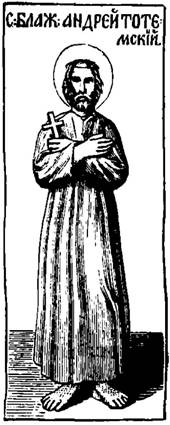
Engraving

Блаженный Андрей148, уроженец с. Усть-Толщемского, по смерти родителей жил в Галичском монастыре у одного инока. – Живший здесь подвижник Стефан подал ему совет принять на себя иго юродства для Христа и – Андрей стал юродом. В зимнее время ходил он без обуви и в разодранной одежде; пищей служили ему хлеб и вода. Каждый год обходил он для поклонения святыне окрестные обители и опять возвращался в Воскресенскую обитель. – По смерти наставника своего Стефана, перешёл он в Тотьму и поселился у церкви Воскресения Христова на берегу р. Сухоны. – Здесь он продолжал подвиги юродства: днём ходил он там и здесь, а ночь проводил в молитве; что давали ему добрые люди, тайно раздавал он нищим. Наконец он ещё при жизни обнаруживал в себе благодать Божию, исцеляющую недуги. – Раз зимой шёл он, по обыкновению босой, к храмовому празднику, за 50 вёрст от Тотьмы. С ним встретился на дороге старшина дикарей Ажбакай, страдавший глазами; зная по слухам Андрея, он упрашивал его исцелить глаза его и давал ему значительную сумму денег. – Андрей, не взяв ничего, убежал; Ажбакай умылся снегом, на котором стоял юродивый, и получил исцеление. – Почувствовав близость кончины, блаженный позвал к себе Воскресенского пономаря Иоанна, которого любил, и просил пригласить священника Афанасия для исповеди и причащения его св. Тайнами. – Причастившись св. Таин, попросил клирика оставить его одного; потом, позвав его, сказал: «брат; пришло время разлучения души с телом». – Иоанн в слезах зажёг свечу перед иконой и покурил фимиамом. Вслед затем блаженный тихо скончался с руками, сложенными на груди крестообразно; его похоронили, по его желанию, под колокольней. Десять лет юродствовал Андрей. Кончина его последовала 10 окт. 1673 г., когда было ему 35 лет от роду – По кончине своей блаженный Андрей прославился чудесами. – На раке преп. Феодосия Тотем. 1800 г. в клеймах изображены: преп. Вассиан Тиксенский, Андрей, юродивый Тотемский, Прокопий, юродивый Усьянский, и блаж. Максим Тотемский149.

The blessed Andrew148, a native of the village of Ust-Tolshchemsk, after the death of his parents lived in the Galich monastery with a certain monk. – The ascetic Stephen, who lived there, gave him counsel to take upon himself the yoke of foolishness for Christ's sake, and – Andrew became a fool. In wintertime he went without footwear and in torn clothing; his food was bread and water. Each year he would go around the neighboring monasteries to venerate the holy things and then return again to the Resurrection Monastery. – After the death of his teacher Stephen, he moved to Totma and settled at the Church of the Resurrection of Christ on the bank of the Sukhona River. – Here he continued the labors of foolishness: by day he walked here and there, and the night he spent in prayer; what good people gave him, he secretly distributed to the poor. Finally, even during his life he manifested in himself the grace of God, which heals infirmities. – Once in winter he was walking, as was his custom barefoot, to a patronal feast, 50 versts from Totma. On the road he met the chieftain of the pagans, Azhbaikay, who suffered with his eyes; knowing Andrew by report, he begged him to heal his eyes and offered him a considerable sum of money. – Andrew, taking nothing, fled; Azhbaikay washed himself with the snow on which the fool had stood, and received healing. – Sensing the nearness of his end, the blessed one called to him the sexton of the Resurrection church, John, whom he loved, and asked him to invite the priest Athanasius for his confession and communion of the Holy Mysteries. – Having communed of the Holy Mysteries, he asked the cleric to leave him alone; then, calling him, he said: "Brother, the time has come for the separation of the soul from the body." – John, in tears, lit a candle before the icon and censed with incense. Thereupon the blessed one quietly reposed with his hands folded crosswise on his chest; he was buried, according to his wish, under the bell tower. For ten years Andrew played the fool. His repose occurred on 10 Oct. 1673, when he was 35 years old. – After his repose, the blessed Andrew was glorified by miracles. – On the reliquary of Venerable Theodosius of Totma, 1800, in the medallions are depicted: Venerable Bassian of Tiksna, Andrew, Fool-for-Christ of Totma, Procopius, Fool-for-Christ of Ustyansk, and the blessed Maximus of Totma149.

E3.0AI draft

Примечания Notes

Пахимера история, стр. 517. 518. СПб. 1862 г.

Pachymeres' History, pp. 517, 518. St. Petersburg, 1862.

N141AI draft

Это послание отыскано о. Порфирием: беседы п. Фотия, стр. 99. СПб. 1864 г.

This epistle was discovered by Fr. Porphyry: Discourses of Patriarch Photius, p. 99. St. Petersburg, 1864.

N142AI draft

См. октября 30.

See October 30.

N143AI draft

У Григоровича 93. 89. У поклонника св. Горы, стр. 40. Григорович справедливо полагает, что грамота императора Льва, вписанная в зографский хрисовул ц. Душана, принадлежит скиту, который впоследствии присоединён к Болгарскому зографу (путеш., стр. 93); но всё-таки остаётся неизвестным, кем и когда устроен Зограф для Болгар. Славянские рукописи Зографа у Григоровича, стр. 62–73. У поклонника стр. 327–340. О древнейших монастырях Афона показания актов у Григоровича, стр. 87–90. У поклонника горы 38–40. У Аврамовича (древности, стр. 82) грамота Зографу Болгарского царя Иоанна Ясеня 1192 г.; другая грамота Болгарского царя Александра 1342 г.

In Grigorovich, pp. 93, 89. In the Devotee of the Holy Mountain, p. 40. Grigorovich rightly supposes that the charter of Emperor Leo, inscribed in the Zograph chrysobull of Tsar Dušan, belongs to a skete which was later joined to the Bulgarian Zograph (Travels, p. 93); nevertheless, it remains unknown by whom and when Zograph was established for the Bulgarians. The Slavonic manuscripts of Zograph are in Grigorovich, pp. 62–73. In the Devotee, pp. 327–340. On the most ancient monasteries of Athos, the evidence of the acts is in Grigorovich, pp. 87–90. In the Devotee of the Mountain, pp. 38–40. In Avramovich (Antiquities, p. 82) is a charter to Zograph from the Bulgarian Tsar John Asen, 1192 A.D.; another charter from the Bulgarian Tsar Alexander, 1342 A.D.

N144AI draft

Афонский патерик I, 233. Особое сказание напечат. в книге: рай мысленный, Иверский монаст. 1668 г. Григорович (стр. 97) указывает в Хиландарской рукописи повесть о разорении Афона; но неизвестно, то же ли это, что напечатано в Иверском монастыре. Гуманные дела Латинян на Афоне показаны и в послании Прота к велик. князю Василию Васильевичу, писанном 1445 г. (нап. в 9 т. летописи занятий археогр. комиссии, стр. 31). О зографцах здесь сказано, что они за твёрдость в вере задушены огнём в башне «и ныне мощи тех в освящение имамы». Ватопедский настоятель убеждал своих удалиться из обители; лучшие послушались его и удалились с настоятелем; упорные остались и предались Латинянам; так как они преданы были настоятелем анафеме, то по смерти тела их лежат чёрные как уголь. О времени события здесь говорится так, что это было по окончании власти Латинян над Цареградом.

The Patericon of Athos I, 233. A special account is printed in the book The Spiritual Paradise, Iveron Monastery, 1668. Grigorovich (p. 97) points to a narrative in a Hilandar manuscript about the devastation of Athos; but it is unknown whether this is the same as that printed at the Iveron Monastery. The humane deeds of the Latins on Athos are also shown in the epistle of the Protos to Grand Prince Basil Vasilievich, written in 1445 (printed in Vol. 9 of the Proceedings of the Archaeographical Commission, p. 31). Concerning the Zograph monks, it is said there that they were suffocated by fire in a tower for their steadfastness in the faith, "and now we have their relics for sanctification." The abbot of Vatopedi urged his monks to depart from the monastery; the better ones heeded him and departed with the abbot; the obstinate remained and gave themselves over to the Latins; and since they were anathematized by the abbot, after death their bodies lay black as coal. The time of the event is spoken of there as being after the end of Latin rule over Constantinople.

N145AI draft

Поклонник св. Горы, стр. 322.

Devotee of the Holy Mountain, p. 322.

N146AI draft

Исповедание отыскано и издано о. Порфирием: беседы Фотия, стр. 99. 100. После того конечно не будут более поднимать сомнений против разорения Афона папизмом 1283 г., как сомневались доселе Григорович в путеш. 91 и поклонник горы, стр. 322.

The Confession was discovered and published by Father Porfiry: The Homilies of Photius, pp. 99, 100. After this, of course, doubts against the devastation of Athos by papism in 1283 will no longer be raised, as were doubted until now by Grigorovich in his Travels, p. 91, and by the Devotee of the Mountain, p. 322.

N147AI draft

Ркп. житие блаж. Андрея Тотемского.

Manuscript Life of the Blessed Andrew of Totma.

N148AI draft

Нафанаила опис. Тотемского мон., стр. 45. Μ. 1850 г. О преп. Вассиане см. сент. 12; св. Максиме – янв. 16. В ркп. святцах: «св. праведный Прокопий Устьянский, чудотворец, иже на Ваге; обретены быша мощи его в л. 7200 (1692)». По записке о Вологодских святых мощи Прокопия открыто почивают в Устьянской церкви Вельского уезда и были свидетельствованы в 1696 и 1739 г. Холмогорскими преосвященными; местная память его июля 8. Волог. епарх. ведом. 1864 г., стр. 16–47.

Nathaniel's Description of the Totma Monastery, p. 45. Moscow, 1850. On the Venerable Bassian, see September 12; on St. Maximus, January 16. In the manuscript calendar of saints: "The holy Righteous Procopius of Ustyansk, Wonderworker, who is on the Vaga; his relics were uncovered in the year 7200 (1692)." According to a note on the Vologda saints, the relics of Procopius lie openly in the Ustyansk church of Velsk district and were examined in 1696 and 1739 by the Right Reverend prelates of Kholmogory; his local commemoration is July 8. Vologda Diocesan Gazette, 1864, pp. 16–47.

N149AI draft