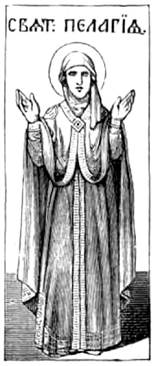
В орудие спасения для грешницы Пелагии Господь избрал св. епископа Нонна. Он известен был высокими добродетелями ещё в Тавенском монастыре. В 448 г. он был приглашён на Одесскую кафедру, на место низложенного Ивы; когда же в 451 г. Халкидонский собор возвратил Иве Одесскую кафедру и Антиохийскому патриарху предоставлено дать блаж. Нонну другую кафедру, то Нонн занял кафедру в Илиополе. Здесь деятельность его была чудная: им обращено было к св. вере до 30,000 Арабов. По смерти Ивы св. Нонн в 457 г. опять занял Одесскую кафедру100 и пробыл на ней до своей кончины, последовавшей в 471 г.101.
The Lord chose St. Bishop Nonnus as an instrument of salvation for the sinner Pelagia. He was known for his lofty virtues even while in the Tabennisi monastery. In 448 A.D. he was invited to the see of Edessa, in place of the deposed Ibas; when in 451 A.D. the Council of Chalcedon restored the see of Edessa to Ibas and granted the Patriarch of Antioch the right to give Blessed Nonnus another see, Nonnus took the see of Heliopolis. Here his activity was wondrous: through him up to 30,000 Arabs were converted to the holy faith. After the death of Ibas, St. Nonnus again occupied the see of Edessa in 457 A.D.100 and remained on it until his repose, which occurred in 471 A.D.101.
«Святейший епископ Антиохии», пишет очевидец св. Нонна и Пелагии102, «собрал к себе, по одному делу, восемь епископов: между ними был святой Божий человек, мой епископ Нонн, муж дивный и инок самый крепкий монастыря Тавенского. За несравненную жизнь свою он взят был из монастыря и поставлен в епископа. Епископ Антиохии повелел собравшимся епископам быть в храме св. муч. Юлиана. Мы вошли и все прочие епископы; сели перед входом храма мученического. Когда сидели епископы, владыку моего Нонна просили сказать поучение. Святый епископ тотчас изустно стал говорить в наставление всех. Все дивились святому поучению его. И вот проходит директрисса плясуньев и пантомимистов Антиохии; сидя на осле, ехала она с великой пышностью, разряженная так, что на ней видны были только золото, жемчуг и дорогие каменья. Ноги её покрыты были золотом и жемчугом, с ней был пышный кортеж молодых людей и девиц, одетых в дорогие одежды. На её шее была цепь. Одни ехали впереди её, другие сзади. Светская молодёжь не могла наглядеться на красоту её. Когда она проезжала мимо нас, воздух наполнился мускусом и другими ароматами. Когда епископы увидели её, проезжавшую без покрывала и так бесстыдно, то вздыхали от души и отворачивались от лица её, как от греха. Блаженнейший же Нонн пристально и долго смотрел на неё, так что оглядывался на неё, когда и проехала она. Затем, обратясь к епископам, говорил: «вас не заняла красота её?» Те молчали. Он склонил лицо на колени и вымочил слезами своими не только платок, бывший в руках его, но и все колени свои. Тяжко вздыхая, говорил он к епископам: «вас не заняла красота её? А я истинно увлечён красотой её. На эту красоту Бог укажет нам епископам на суде Своём, когда будет судить нас и наше управление. Как думаете, возлюбленные, сколько времени провела эта жена в своей одевальной комнате моясь, прибираясь, со всем напряжением мыслей осматриваясь в зеркале, чтобы не было какого-нибудь недостатка в уборе, чтобы не быть униженной перед любовниками, которые ныне живы, а завтра пропали. У нас есть Отец Небесный, Жених бессмертный, дарующий верным Своим награды вечные, которых оценить нельзя. Глаз не видел, ухо не слышало, на ум не всходило то, что Бог приготовил любящим Его. Что говорить много! Мы, которым обещана честь видеть великое, светлое, несравненное лицо Жениха, на которое не смеют взирать херувимы, а мы не украшаем себя, не очищаем нечистот с сердец наших бедных, а оставляем их по нерадению».
"The most holy bishop of Antioch," writes an eyewitness of St. Nonnus and Pelagia102, "summoned to himself, on a certain matter, eight bishops: among them was that holy man of God, my bishop Nonnus, a wondrous man and a monk of the strictest observance of the Tabennisi monastery. For his incomparable life he was taken from the monastery and appointed bishop. The bishop of Antioch commanded the assembled bishops to be in the church of the holy martyr Julian. We entered, and all the other bishops as well; we sat down before the entrance of the martyrium. While the bishops were seated, they asked my lord Nonnus to give a homily. The holy bishop immediately began to speak orally for the instruction of all. All marveled at his holy teaching. And behold, the directress of the dancers and pantomimists of Antioch passed by; seated on a donkey, she rode with great pomp, adorned so that only gold, pearls, and precious stones were visible on her. Her feet were covered with gold and pearls; with her was a magnificent retinue of young men and maidens, dressed in costly garments. On her neck was a chain. Some rode before her, others behind. The worldly youth could not gaze enough at her beauty. When she passed by us, the air was filled with musk and other fragrances. When the bishops saw her passing by without a veil and so shamelessly, they sighed from their souls and turned away from her face as from sin. But the most blessed Nonnus gazed intently and long at her, so that he even turned to look after her when she had passed. Then, turning to the bishops, he said: 'Were you not captivated by her beauty?' They were silent. He bowed his face to his knees and wet with his tears not only the handkerchief that was in his hands, but also his entire lap. Sighing heavily, he said to the bishops: 'Were you not captivated by her beauty? But I am truly captivated by her beauty. God will point out this beauty to us bishops at His judgment, when He judges us and our stewardship. What do you think, beloved, how much time did this woman spend in her dressing room, washing, adorning herself, with all the effort of her mind examining herself in the mirror, lest there be some defect in her attire, lest she be humiliated before her lovers, who live today and are gone tomorrow? We have a Heavenly Father, an immortal Bridegroom, Who grants to His faithful eternal rewards that cannot be valued. Eye has not seen, ear has not heard, nor has it entered into the heart of man what God has prepared for those who love Him. Why say much? We, to whom the honor is promised of seeing the great, bright, incomparable face of the Bridegroom, upon Whom the cherubim dare not gaze, yet we do not adorn ourselves, do not cleanse the filth from our poor hearts, but leave it through negligence.'"
«После того епископ взял меня грешного диакона, и мы вошли в гостиницу, где дана нам келья. Войдя в спальню, упал он на землю лицом своим и, ударяя в грудь свою, плакал и стенал. «Господи Иисусе Христе!» говорил он, «прости меня грешника и недостойного. Уборы одного дня на блуднице далеко превышают убор души моей. Каким лицом буду смотреть я на Тебя? Как оправдаюсь перед Тобой? Скрыть души моей перед Тобой не могу: Ты видишь все тайны: Горе мне грешнику! Стою перед престолом Твоим и не выставляю души моей в той красоте, какой желаешь Ты. Она обещала нравиться людям – и нравится. Я обещал угождать Тебе и солгал от нерадения моего. Нагой я перед небом и землёй, не выполняю заповедей Твоих. Итак, нет мне надежды на дела мои; надежда моя только на Твоё милосердие, от которого ожидаю спасения». Так говорил он и долго горевал. В тот же день праздновали мы праздник.
"After that, the bishop took me, a sinful deacon, and we entered the inn, where a cell was given us. Entering the bedchamber, he fell on his face to the ground and, striking his breast, wept and groaned. 'Lord Jesus Christ!' he said, 'forgive me, a sinner and unworthy one. The adornments of a single day on a harlot far surpass the adornment of my soul. With what face shall I look upon Thee? How shall I justify myself before Thee? I cannot hide my soul from Thee: Thou seest all secrets. Woe to me, a sinner! I stand before Thy throne and do not present my soul in that beauty which Thou desirest. She promised to please men—and she pleases. I promised to please Thee and have lied through my negligence. Naked am I before heaven and earth, not fulfilling Thy commandments. Therefore, I have no hope in my works; my hope is only in Thy mercy, from which I await salvation.' Thus he spoke and grieved for a long time. On that same day we celebrated the feast."
В следующий день, который был воскресным, после того как совершили мы ночные молитвы, св. епископ Нонн говорит мне: «брат диакон! я видел сон и сильно смущаюсь. Я видел во сне: стоит у алтаря чёрная голубка, покрытая всякой грязью; она летала около меня и зловония её не мог я выносить. Она стояла около меня, пока не совершилась молитва оглашаемых. Когда диакон возгласил: «оглашенные, изыдите», она уже более не являлась. Когда, после молитвы верных и совершения приношения, отпущен был народ, голубка, покрытая нечистотами, опять пришла и летала около меня. Протянув руку, я взял её и опустил в купель преддверия церковного. Голубка вышла из воды совсем чистая и белая, как снег. Летая, понеслась она вверх и исчезла из глаз». Когда святой Божий епископ Нонн рассказал свой сон, то взял меня, и мы с прочими епископами пришли в великую церковь, где поздравляли епископа города.
The following day, which was Sunday, after we had completed the night prayers, St. Bishop Nonnus says to me: 'Brother deacon! I have seen a dream and am greatly troubled. I saw in a dream: a black dove stood by the altar, covered with all manner of filth; she flew about me, and I could not bear her stench. She stood near me until the prayer of the catechumens was completed. When the deacon proclaimed: "Catechumens, depart," she appeared no more. When, after the prayer of the faithful and the completion of the offering, the people were dismissed, the dove, covered with impurities, came again and flew about me. Stretching out my hand, I took her and immersed her in the font of the church narthex. The dove came out of the water completely clean and white as snow. Flying, she soared upward and vanished from sight.' When the holy bishop of God, Nonnus, told his dream, he took me, and we came with the other bishops to the great church, where we greeted the bishop of the city.
Войдя в церковь, поучал он народ; епископы сидели на кафедрах. После уставного служения, или после чтения Евангелия, епископ города, подавая святое Евангелие блаженнейшему Нонну, предложил ему сказать поучение народу. Он изрекал премудрость Божию, обитавшую в нём, – ничего не говорил он изысканного или философского, или беспорядочного, но, исполненный Духа Святого, обличал и увещевал народ, со всей искренностью говоря о будущем суде и о будущем воздаянии. Весь народ сильно сокрушился от его слова, так что пол обливался слезами. По устроению милосердия Божия, пришла в ту же церковь и та блудница, о которой говорено было. И дивное дело, та, которая никогда не думала о грехах своих и никогда не ходила в церковь, внезапно была поражена страхом Божиим, проливала потоки слёз и никак немогла удержаться от рыданий. Потом она сказала двум слугам своим: «стойте здесь; когда выйдет епископ Нонн, идите за ним и узнайте, где живёт он; потом придите и скажите мне». Слуги поступили так, как приказала госпожа; следуя за нами, пришли в церковь св. мученика Юлиана, где для нас была гостиница или келья. Потом ушли и сказали госпоже: «он живёт в церкви св. мученика Юлиана». Услышав это, она тотчас прислала с теми же слугами такое письмо: «святому ученику Христову, грешница и ученица диавола. Слышала я о Боге твоём, что Он преклонил небеса и нисшёл на землю не для праведных, а для того, чтобы спасти грешников. Он столько смирился, что приближался к мытарю, и Тот, на Кого не смеют смотреть херувимы, шёл между грешниками. И ты, господин мой, в котором так много святости, хотя не видал телесными очами Христа Иисуса, говорившего с Самарянкой у колодца, но искренний поклонник Его, как слышала я от христиан. Если же ты ученик Его, то не отвержешь меня, желающую через тебя видеть Спасителя». Святый епископ Нонн отвечал ей письмом так: «всё открыто Богу, и дела твои и желание твоё. Но говорю тебе: не искушай смирения моего, я грешный раб Божий. Если ты искренно желаешь благочестия, принять веру и видеть меня: со мной тут другие епископы и в их присутствии можешь видеть меня, но одного не увидишь». Когда прочитала это грешница, то весьма обрадовалась, бегом пришла в церковь св. муч. Юлиана и дала знать о своём приходе. Святый епископ Нонн, услыхав о том, пригласил к себе епископов и затем приказал ей войти. Войдя туда, где собраны были епископы, она упала на пол и ухватилась за ноги блаженного Нонна епископа. «Умоляю тебя, владыко мой, говорила она, будь подражателем учителя твоего Господа Иисуса, излей на меня доброту твою, сотвори меня христианкой. Я, владыко мой, – море грехов и бездна нечестия. Прошу, чтобы крестили меня». Едва св. епископ мог убедить её, чтобы встала она. Потом сказал ей: «правила церковные велят не иначе крестить блудницу, как если представит она поручителей в том, что не будет более валяться в грехах». Выслушав это решение, она опять упала на пол, ухватилась за ноги св. епископа и, омывая их слезами, говорила: «отдашь ответ Богу за душу мою и на тебя возложу нечестие дел моих, если станешь откладывать крещение гнусной женщины; не найдёшь ты доли у Бога со святыми, если меня не удалишь от злых дел моих». Тогда все епископы и собравшиеся клирики, видя такую грешницу, так горячо желающую благочестия, сказали: «мы ещё не видали такой веры, какова вера этой грешницы». Тотчас послали меня, диакона, к епископу города возвестить ему о всём и просить, чтобы блаженство его приказало прислать одну из диаконисс. Услышав это, он сказал: «хорошо, почтенный отец». И тотчас прислал со мною первую из диаконисс, госпожу Роману. Она застала её ещё у ног епископа Нонна. Он едва мог поднять её. «Встань, дочь, для совершения заклинания; исповедуй все грехи твои». Она отвечала: «если посмотрю на сердце моё, то не нахожу в себе ни одного доброго дела. Знаю грехи мои, их более, чем песку на море. Уповаю на Бога твоего, что Он Сам взвесит тяжесть грехов моих и призрит на меня». Тогда епископ Нонн спросил: «как твоё имя?» «Родители мои», сказала она, «назвали меня Пелагией, а граждане Антиохии зовут меня Маргаритой, по тяжести украшений, которыми украсили меня грехи мои, я краса и сосуд диавола». Св. епископ сказал: «природное твоё имя Пелагия»? «Точно так», отвечала она. Тогда епископ совершил над ней заклинание и крестил её; возложил на неё печать Господа103 и преподал ей Тело Христово. Духовной материю её была госпожа Романа, первая диаконисса. Взяв её, привела она её в покой оглашенных, – потому что и мы там были. Св. епископ Нонн сказал мне: «брат диакон, возрадуемся ныне с ангелами Божиими, сверх обычая будем вкушать пищу с елеем и примем вино с веселием духовным, ради спасения этой девицы».
Entering the church, he taught the people; the bishops sat on their cathedras. After the appointed service, or after the reading of the Gospel, the bishop of the city, handing the holy Gospel to the most blessed Nonnus, proposed that he deliver a sermon to the people. He uttered the wisdom of God that dwelt in him—he said nothing refined or philosophical or disorderly, but, filled with the Holy Spirit, he reproved and exhorted the people, speaking with all sincerity of the future judgment and of the future recompense. All the people were greatly contrite at his word, so that the floor was drenched with tears. By the dispensation of God's mercy, that harlot of whom we have spoken also came into the same church. And a wondrous thing: she who had never thought of her sins and had never gone to church was suddenly struck with the fear of God, shed torrents of tears, and could in no way restrain her sobbing. Then she said to her two servants: "Stand here; when Bishop Nonnus goes out, follow him and find out where he lives; then come and tell me." The servants did as their mistress commanded; following us, they came to the church of the holy martyr Julian, where we had a guesthouse or cell. Then they went away and said to their mistress: "He lives in the church of the holy martyr Julian." Hearing this, she immediately sent with the same servants a letter as follows: "To the holy disciple of Christ, from a sinner and disciple of the devil. I have heard of your God, that He bowed the heavens and came down to earth not for the righteous, but to save sinners. He humbled Himself so much that He drew near to the publican, and He, whom the cherubim dare not look upon, walked among sinners. And you, my lord, in whom there is so much holiness, though you have not seen with bodily eyes Christ Jesus, who spoke with the Samaritan woman at the well, are yet a sincere worshiper of Him, as I have heard from Christians. If then you are His disciple, do not reject me, who desires through you to see the Savior." The holy bishop Nonnus answered her in writing thus: "All things are open to God, both your deeds and your desire. But I say to you: do not tempt my humility; I am a sinful servant of God. If you sincerely desire piety, to receive the faith and to see me: there are other bishops with me here, and in their presence you may see me, but me alone you shall not see." When the sinner read this, she rejoiced greatly, ran to the church of the holy martyr Julian, and gave notice of her arrival. The holy bishop Nonnus, hearing of it, summoned the bishops to him and then ordered her to enter. Entering where the bishops were assembled, she fell to the floor and grasped the feet of the blessed bishop Nonnus. "I beseech you, my master," she said, "be an imitator of your teacher, the Lord Jesus; pour out your kindness upon me, make me a Christian. I, my master, am a sea of sins and an abyss of impiety. I beg that I may be baptized." The holy bishop could scarcely persuade her to stand up. Then he said to her: "The church canons command that a harlot be baptized only if she presents guarantors that she will no longer wallow in sins." Hearing this decision, she again fell to the floor, grasped the feet of the holy bishop, and, washing them with her tears, said: "You will give answer to God for my soul, and I will lay the impiety of my deeds upon you if you delay the baptism of a vile woman; you will find no portion with God among the saints if you do not remove me from my evil deeds." Then all the bishops and the assembled clergy, seeing such a sinner so fervently desiring piety, said: "We have not yet seen such faith as the faith of this sinner." Immediately they sent me, the deacon, to the bishop of the city to announce everything to him and to ask that his blessedness order one of the deaconesses to be sent. Hearing this, he said: "It is well, venerable father." And immediately he sent with me the first of the deaconesses, the lady Romana. She found her still at the feet of Bishop Nonnus. He could scarcely raise her. "Arise, daughter, for the performance of the exorcism; confess all your sins." She answered: "If I look upon my heart, I find in myself not a single good deed. I know my sins; they are more than the sand of the sea. I trust in your God, that He Himself will weigh the burden of my sins and look upon me." Then Bishop Nonnus asked: "What is your name?" "My parents," she said, "named me Pelagia, but the citizens of Antioch call me Margaret, because of the weight of the adornments with which my sins have adorned me; I am the beauty and vessel of the devil." The holy bishop said: "Your given name is Pelagia?" "Exactly so," she answered. Then the bishop performed the exorcism over her and baptized her; he set upon her the seal of the Lord103 and imparted to her the Body of Christ. Her spiritual mother was the lady Romana, the first deaconess. Taking her, she led her into the chamber of the catechumens—for we were also there. The holy bishop Nonnus said to me: "Brother deacon, let us now rejoice with the angels of God; contrary to custom, let us partake of food with oil and receive wine with spiritual gladness, for the salvation of this maiden."
Когда мы кушали, вдруг слышится крик как бы человека, которого давят; диавол кричал: «увы, увы, что терплю я от этого старика? Не довольно тебе 30,000 Арабов, которых ты отнял и крестил, и принёс Богу твоему! Не довольно тебе Илиополя, который также был моим, – все жители его чтили меня, а ты отнял и принёс Богу твоему! Теперь ты отнял у меня самую лучшую надежду мою. И я не выношу уловок твоих. Проклят день, в который родился ты». Потом, обратясь к новокрещённой девушке, говорил: «что это ты делаешь, госпожа моя Пелагия? Ты подражаешь Иуде. Он, увенчанный почестью, предал Господа своего: и ты то же со мной сделала». Святый епископ Нонн говорит ей: «огради себя крестом Христовым и прокляни его». Она ознаменовалась во имя Христово, дунула на демона, и он тотчас исчез104.
While we were eating, suddenly a cry was heard, as of a man being choked; the devil cried out: "Woe, woe, what I suffer from this old man! Is it not enough for you the 30,000 Arabs whom you took away and baptized and brought to your God! Is it not enough for you Heliopolis, which was also mine—all its inhabitants honored me, but you took it away and brought it to your God! Now you have taken away from me my best hope. And I cannot bear your wiles. Cursed be the day on which you were born." Then, turning to the newly-baptized maiden, he said: "What is this you do, my lady Pelagia? You imitate Judas. He, crowned with honor, betrayed his Lord: and you have done the same to me." The holy bishop Nonnus says to her: "Sign yourself with the cross of Christ and curse him." She marked herself in the name of Christ, blew upon the demon, and he immediately vanished104.
Спустя два дня, когда спала она со святой Романой, явился ей ночью диавол, разбудил рабу Божию Пелагию и говорил: «госпожа моя Маргарита, не обогащена ли ты золотом и серебром? не украсил ли я тебя жемчугом и камнями? чем же оскорблена ты? отвечай мне, и я всё сделаю для тебя, только ты не делай меня посмешищем христиан». Тогда раба Божия Пелагия ознаменовалась и, дунув на демона, сказала: «Бог мой, Который похитил меня из зубов твоих и ввёл в небесный чертог Свой, Он да восстанет за меня против тебя». И диавол более не являлся.
Two days later, while she was sleeping with the holy Romana, the devil appeared to her by night, awakened the handmaid of God Pelagia, and said: "My lady Margaret, have you not been enriched with gold and silver? Have I not adorned you with pearls and gems? In what have you been offended? Answer me, and I will do everything for you, only do not make me a laughingstock to the Christians." Then the handmaid of God Pelagia marked herself and, blowing upon the demon, said: "My God, who snatched me from your teeth and brought me into His heavenly bridal chamber, let Him arise for me against you." And the devil appeared no more.
В третий день после крещения своего, святая Пелагия позвала слугу своего, который всем у неё заведовал, и сказала ему: «ступай в гардеробную мою и перепиши всё, что есть в серебре и золоте, в нарядах, в дорогих одеждах – и принеси мне». Слуга исполнил волю госпожи и всё имущество её принёс. Она тотчас через мать свою святую Роману пригласила святого епископа Нонна и всё имущество своё передала в его руки. «Вот, владыко, говорила она, богатства, которыми наделил меня сатана; передаю их в волю святыни твоей; делай с ними, что хочешь; мне надобно желать даров Господа моего Иисуса Христа». Он позвал старшего хранителя церковного и в её присутствии всё имение отдал в его руки. «Заклинаю тебя, говорил он, неразделимой Троицей, – ничто из этого не должно поступить в дом епископа или в церковь, а всё должно быть роздано нищим, вдовам и сиротам; пусть худо собранное расточено будет умно» ... Она пригласила всех слуг и служанок своих и всем дала свободу; она дала им золотые цепи и сказала: «спешите освободиться из мира нечестивого, – дабы, как были мы вместе в этом веке, так пребывать бы нам вместе в той блаженной жизни».
On the third day after her baptism, the holy Pelagia called her servant, who managed everything for her, and said to him: "Go to my wardrobe and make a list of everything that is in silver and gold, in attire, in costly garments—and bring it to me." The servant fulfilled his mistress's will and brought all her property. She immediately, through her mother the holy Romana, invited the holy bishop Nonnus and placed all her property in his hands. "Behold, master," she said, "the riches with which Satan endowed me; I entrust them to your holiness's will; do with them as you wish; I must desire the gifts of my Lord Jesus Christ." He called the chief steward of the church and, in her presence, gave all the property into his hands. "I adjure you," he said, "by the indivisible Trinity—nothing of this shall go into the house of the bishop or into the church, but all shall be distributed to the poor, to widows, and to orphans; let that which was wickedly gathered be wisely dispersed." ... She summoned all her male and female servants and gave freedom to all; she gave them golden chains and said: "Hasten to free yourselves from the ungodly world—that as we were together in this age, so we might abide together in that blessed life."
В восьмой день, когда надлежало снять белые одежды, встав ночью, чего не знали мы, сняла она одежду крещения своего и оделась во власяницу и подрясник епископа Нонна и с того времени исчезла из города Антиохии. Святая Романа плакала о ней; но святой Нонн утешал её и говорил; «не плачь, дочь, а радуйся: Пелагия избрала добрую долю, подобно Марии, которую предпочёл Господь Марфе».
On the eighth day, when the white garments were to be laid aside, she rose by night, unknown to us, took off her baptismal garment, clothed herself in the hairshirt and cassock of Bishop Nonnus, and from that time disappeared from the city of Antioch. The holy Romana wept for her; but the holy Nonnus comforted her and said: "Weep not, daughter, but rejoice: Pelagia has chosen the good portion, like Mary, whom the Lord preferred to Martha."
Спустя три или четыре года захотелось мне, диакону Иакову, сходить в Иерусалим для поклонения воскресению Господа нашего Иисуса Христа, и я выпросил у епископа моего дозволение на путь. Отпуская меня, сказал он: «брат диакон! Когда придёшь в Иерусалим, отыщи там некоторого брата Пелагия, монаха и евнуха, живущего несколько годов в затворе, – истинно ты получишь пользу от него». Это говорил он прикровенно о рабе Божией Пелагии.
After three or four years, I, the deacon James, desired to go to Jerusalem to venerate the resurrection of our Lord Jesus Christ, and I asked permission from my bishop for the journey. As he dismissed me, he said: "Brother deacon! When you come to Jerusalem, seek out there a certain brother Pelagius, a monk and eunuch, who has lived several years in seclusion—truly you will receive benefit from him." This he said covertly concerning the handmaid of God Pelagia.
Я пришёл в Иерусалим, поклонился св. воскресению Господа нашего, а на другой день отыскал раба Божия. Я нашёл его на Елеонской горе, где молился Господь, в маленькой запертой келийке, с малым окошечком в стене. Я постучал в окошко. Она отворила и узнала меня, но я не узнал её. Как мне было узнать ту, которую когда-то видал красавицей, и которая была сухой от поста? Глаза её как бы ввалились в углубления. Она сказала мне: «откуда пришёл ты брат?» – Я послан к тебе епископом Нонном, отвечал я. – «Да помолится он о мне! Он истинно – святой Божий», сказала она. И тотчас затворила окошко и начала петь третий час. Я молился у стены кельи её и потом удалился с великой пользой от того, что видел ангела. Возвратясь в Иерусалим, начал я обходить монастыри. По обителям носилась великая слава о господине Пелагии. Потому положил я ещё раз побывать у него, дабы воспользоваться спасительными наставлениями его. Когда пришёл я к келийке и стал толкать и звать даже по имени, ответа не было. Я ждал другой и третий день, называл по имени Пелагия и ничего не слыхал. Потому сказал я себе: или тут нет никого, или ушёл монах. Потом говорил себе: посмотрю, не умер ли? Я отворил окошко, посмотрел и – вижу умершего. Затворив окошко и замазав глиной, поспешил я в Иерусалим с известием: св. монах Пелагий, творивший чудеса, почил.
I came to Jerusalem, venerated the holy Resurrection of our Lord, and on the next day sought out the servant of God. I found her on the Mount of Olives, where the Lord prayed, in a small, locked cell with a tiny window in the wall. I knocked at the window. She opened it and recognized me, but I did not recognize her. How could I have recognized the one I had once seen as a beauty, and who was now withered from fasting? Her eyes seemed sunken into their hollows. She said to me: "Whence have you come, brother?" — "I was sent to you by Bishop Nonnus," I replied. — "May he pray for me! He is truly a saint of God," she said. And at once she closed the window and began to chant the Third Hour. I prayed at the wall of her cell and then departed, greatly edified by having seen an angel. Returning to Jerusalem, I began to visit the monasteries. Throughout the monasteries there was great renown concerning Master Pelagius. Therefore I resolved to visit him once more, so as to benefit from his salutary instructions. When I came to the cell and began to knock and even call him by name, there was no answer. I waited the second and third day, calling Pelagius by name, and heard nothing. So I said to myself: either there is no one here, or the monk has gone. Then I said to myself: let me see if he has not died? I opened the window, looked in, and—I saw a dead person. Closing the window and sealing it with clay, I hastened to Jerusalem with the news: the holy monk Pelagius, who had worked miracles, had reposed.
Тогда святые отцы пришли с иноками разных монастырей и отворен был вход в келью. Святое тело вынесено было наружу и положено, как драгоценность. Когда святые отцы намащали его миррой, то узнали, что это женщина105. Они хотели скрыть это, но народ узнал, и все восклицали: «слава Тебе, Господи Иисусе, что у Тебя есть сокровенные на земле, не только мужи, но и жёны». Молва распространилась всюду, и все монастыри девственниц пришли, как из Иерихона, так и с Иордана, со свечами, лампадами, и гимнами. Святые останки с честью похоронены были св. отцами»106.
Then the holy fathers came with monks from various monasteries, and the entrance to the cell was opened. The holy body was brought out and laid as a precious treasure. When the holy fathers anointed it with myrrh, they recognized that it was a woman105. They wished to conceal this, but the people learned of it, and all exclaimed: "Glory to Thee, O Lord Jesus, that Thou hast hidden ones on earth, not only men, but also women." The rumor spread everywhere, and all the convents of virgins came, both from Jericho and from the Jordan, with candles, lamps, and hymns. The holy remains were honorably buried by the holy fathers106.
Так, очищенная водами крещения, Пелагия в четыре года самоотверженной жизни столько возвысилась, что ещё при жизни творила чудеса.
Thus, cleansed by the waters of baptism, Pelagia, in four years of self-denying life, was so elevated that she worked miracles even during her lifetime.
Русский игумен Даниил в XII веке писал: «на горе Елеонстей есть печера глубока вельми, близь Взнесения Господня, на полдень лицем, и в той печере гроб святыя Пелагии блудницы»109. Инок Зосима в 1420 г. говорил: «вторая церковь (на горе Елеонской) мала, в нейже Пелагия блудница, и гроб её от стены яко локоть, и оле чудо! кто хощет поидти мимо гроба её, она не пускает, аще не достоин»110.
The Russian Abbot Daniel wrote in the 12th century: "On the Mount of Olives there is a very deep cave, near the Ascension of the Lord, facing south, and in that cave is the tomb of St. Pelagia the harlot"109. The monk Zosima said in 1420: "The second church (on the Mount of Olives) is small; in it is Pelagia the harlot, and her tomb is about a cubit from the wall, and O miracle! whoever wishes to pass by her tomb, she does not let him, if he is unworthy"110.
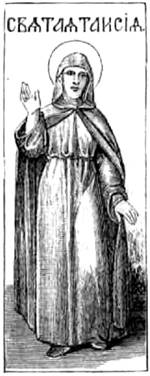
Отечество Таисии и город, который был свидетелем печальных побед её, неизвестны111. Известно только то, что она жила в Египте, и весь Египет знал о непомерном распутстве её. Мать её была женщина дурной жизни и не только не заботилась о внушении ей добрых правил, но сама учила её торговать развратом. При таких уроках красавица дочь стала страшной. Богатые люди всякого возраста спешили уловить внимание её, разоряли состояние своё на подарки; любовники в доме прелестницы не только дрались, но и убивали один другого; покой и счастье многих семейств были расстроиваемы по милости этой слуги сатанинской.
Thaisia's homeland and the city that witnessed her sad victories are unknown111. Only this is known: that she lived in Egypt, and all Egypt knew of her immeasurable debauchery. Her mother was a woman of evil life and not only took no care to instill good principles in her, but herself taught her to trade in depravity. With such lessons, the beautiful daughter became a terror. Rich men of every age hastened to capture her attention, squandering their fortunes on gifts; lovers in the harlot's house not only fought but killed one another; the peace and happiness of many families were destroyed through the mercy of this servant of Satan.
Слух о прелестнице Таисии дошёл до монастыря Гераклейского аввы Пафнутия112. Пафнутий был такой высокий подвижник, что на него смотрели, как на ангела Божия. Ревнуя о спасении душ, он многих забывчивых мирян обратил на путь спасения113. Услышав о Таисии, Пафнутий снял с себя отшельническую одежду и в наряде светского богатого человека, с запасом денег, явился в толпе обожателей прелестницы.
The rumor about the harlot Thaisia reached the monastery of the Heraclean Abba Paphnutius112. Paphnutius was such a lofty ascetic that he was regarded as an angel of God. Zealous for the salvation of souls, he turned many heedless laymen to the path of salvation113. Hearing of Thaisia, Paphnutius removed his hermit's garb and, dressed as a wealthy secular man with a supply of money, appeared among the crowd of the harlot's admirers.
Таисия ещё не совсем заглушила в сердце своём требования религии; она ещё верила в Бога всеведущего, верила, что по смерти будет суд правды. Но эти мысли только мелькали в душе её, как у всех светских женщин; они были затемняемы и не доходили до глубины сердечной, под влиянием пристрастий её к наслаждениям светским – к роскоши, неге, плотоугодию, весёлой жизни.
Thaisia had not yet completely stifled the demands of religion in her heart; she still believed in an all-knowing God, believed that after death there would be a judgment of truth. But these thoughts only flickered in her soul, as in all worldly women; they were obscured and did not reach the depths of her heart, under the influence of her attachments to worldly pleasures—luxury, softness, fleshly indulgence, a merry life.
Пафнутий воспользовался для спасения Таисии истинами, доступными для души её. Пустив в ход средства, открывающие доступ к жалким женщинам, Пафнутий просил Таисию назначить свидание в тайном месте, в таком тайном, где бы не только люди, но Сам Бог не мог видеть их. Она отвечала с улыбкой, что это невозможно, – Бог везде и всё видит. Тогда Пафнутий живо представил ей ужас дерзости грешить так нагло, так гнусно, как она грешит; открыл ей, какой устрашающий ответ должна она дать перед Богом и за свои гнусности и за беззакония прельщённых и погубленных ею душ, за множество душ, истерзанных распутством её или потерявших саму жизнь в гоньбе за нею.
Paphnutius used truths accessible to her soul for Thaisia's salvation. Employing the means that open access to wretched women, Paphnutius asked Thaisia to appoint a meeting in a secret place, so secret that not only people but even God Himself could not see them. She replied with a smile that this was impossible—God is everywhere and sees everything. Then Paphnutius vividly presented to her the horror of the audacity of sinning so brazenly, so foully, as she sinned; he revealed to her what a terrifying answer she must give before God both for her own foul deeds and for the lawlessness of the souls she had seduced and ruined, for the multitude of souls tormented by her debauchery or who had lost even their lives in pursuit of her.
Таисия скоро почувствовала, что тот, кто говорит с ней таким языком, – не светский грешный человек и даже не светский умник, а человек, посланный к ней Богом, и – сердце её озарилось небесным светом.
Thaisia soon felt that the one speaking to her in such a language was not a worldly sinful man, nor even a worldly wise man, but a man sent to her by God—and her heart was illumined with heavenly light.
Трепеща, обливаясь слезами, кинулась она к ногам отшельника и сказала: «подвергни меня какому угодно покаянию, – чувствую мерзость мою, трепещу мук, готовых для меня, – но и надеюсь, что твоими молитвами Бог помилует меня; дай мне не более трёх часов времени, нужного мне, и я явлюсь, куда прикажешь, и выполню всё, чего бы ни потребовал ты от меня». Пафнутий согласился и назначил место свидания.
Trembling, bathed in tears, she threw herself at the hermit's feet and said: "Impose upon me whatever penance you wish—I feel my vileness, I tremble at the torments prepared for me—but I also hope that through your prayers God will have mercy on me; give me no more than three hours of time, which I need, and I will appear wherever you command and will do everything you require of me." Paphnutius agreed and appointed a meeting place.
Таисия собрала все собранные ей сокровища, плоды страшного распутства её, наряды, драгоценности, стоившие огромной суммы; приказала сносить всё на площадь; тут, в присутствии народа, сама зажгла всё и громко призывала участников развратной жизни её каяться в грехах; предавая плоды греха огню, она давала видеть, что признаёт она гнусной свою прежнюю жизнь, не находит имущества, нажитого грехом, стоящим даже и того, чтобы раздать его бедным, а жжёт всё, как зачумлённое.
Thaisia gathered all the treasures she had amassed, the fruits of her terrible debauchery—her finery, her jewels, worth an enormous sum; she ordered everything brought to the square; there, in the presence of the people, she herself set it all on fire and loudly called upon the participants in her dissolute life to repent of their sins; consigning the fruits of sin to the fire, she showed that she acknowledged her former life as vile, that she considered property acquired by sin unworthy even of being distributed to the poor, and burned everything as if plague-stricken.
Выполнив это, явилась она в назначенное Пафнутием место. Он отвёл её в женский монастырь и запер в тесной кельи; к дверям приложена была свинцовая печать, а в малое окошечко приказано было подавать кающейся ломоть хлеба и несколько воды.
Having done this, she appeared at the place appointed by Paphnutius. He led her to a women's monastery and shut her in a narrow cell; a lead seal was affixed to the door, and through a small window it was ordered that the penitent be given a crust of bread and a little water.
Заключённая как бы во гробе, Таисия просила уходившего Пафнутия об одном: как должна она молиться Богу? «Ты недостойна призывать Бога и именовать Его твоими устами, – недостойна и поднимать руки к небу; уста твои полны нечестия и руки осквернены преступлениями. Обратясь к востоку, повторяй одно: Создавший меня! помилуй меня!»114
Confined as if in a tomb, Thaisia asked the departing Paphnutius for one thing: how should she pray to God? "You are unworthy to invoke God and to name Him with your lips—unworthy even to raise your hands to heaven; your lips are full of impiety and your hands defiled by crimes. Turning to the east, repeat only this: 'He who created me, have mercy on me!'"114
Спустя три года, Пафнутий почувствовал в сердце сожаление о заключённой. Он отправился к великому Антонию узнать, отпущены ли Богом грехи Таисии? Явясь к нему, он сказал ему о жизни Таисии. Св. Антоний собрал к себе главных учеников своих и предложил им провести ночь в молитве, не откроет ли Господь воли Своей о нужде Пафнутия? Воля Божия открыта была Павлу, которого звали Препростым. Ему явилось на небе ложе, покрытое одеяниями неподражаемой красоты и которое охраняют три девы с лицами светлыми и прекрасными. Павел с восторгом сказал: «верно это готово для отца моего Антония». Тогда голос возвестил ему: «нет, это не для Антония, а для блудницы Таисии». Так Пафнутий узнал волю Божию о Таисии.
After three years, Paphnutius felt pity in his heart for the imprisoned woman. He set out to the great Anthony to learn whether Thaisia's sins had been forgiven by God. Appearing before him, he told him of Thaisia's life. St. Anthony gathered his chief disciples and proposed that they spend the night in prayer, that the Lord might reveal His will concerning Paphnutius's need. The will of God was revealed to Paul, who was called the Simple. He saw in the heavens a bed, covered with coverings of incomparable beauty, guarded by three maidens with bright and beautiful faces. Paul said with rapture: "Surely this is prepared for my father Anthony." Then a voice announced to him: "No, it is not for Anthony, but for the harlot Thaisia." Thus Paphnutius learned the will of God concerning Thaisia.
Явясь в монастырь, где заперта была Таисия, он открыл двери кельи её. Таисия кротко сказала ему, что желала бы остаться в затворе. Пафнутий объявил: «выходи, Бог простил тебе грехи твои». Она повиновалась и при том сказала: «Бог – свидетель, с той минуты, как вошла я в келью, все грехи мои были перед моими глазами, и я обливалась слезами, смотря на них». «3а это именно, сказал Пафнутий, Господь милосердый и помиловал тебя, а не за строгость заключения твоего».
Appearing at the monastery where Thaisia was confined, he opened the doors of her cell. Thaisia meekly said to him that she wished to remain in seclusion. Paphnutius declared: "Come out, God has forgiven you your sins." She obeyed and said: "God is my witness—from the moment I entered the cell, all my sins were before my eyes, and I was bathed in tears, looking upon them." "It is for this very reason," said Paphnutius, "that the merciful Lord has had mercy on you, and not for the severity of your confinement."
Таисия прожила только 15 дней по выходе из очистительного заключения. Душа её, омытая покаянием и разрешённая Взявшим на Себя грехи всего мира, возлетела на небо за нетленной наградой.
Thaisia lived only fifteen days after emerging from her purifying confinement. Her soul, washed by repentance and absolved by the One Who took upon Himself the sins of the whole world, flew up to heaven for an imperishable reward.
Пафнутий, за день до своей смерти, рассказал о Таисии бывшим у него отшельникам, показывая в опыте, что нет состояния в жизни, которое позволено бы было презирать, и что величайшие преступники могут искренним покаянием достигнуть и прощения, и великих наград.
Paphnutius, a day before his own death, told the hermits who were with him about Thaisia, showing by this example that there is no condition in life that may be despised, and that the greatest criminals can, through sincere repentance, attain both forgiveness and great rewards.
Так как блаженная Таисия подвизалась и почила при вел. Антонии († 356 г.) и Павле Препростом († 340), то кончина её последовала не позже 340 г.115.
Since the blessed Thaisia labored in asceticism and reposed during the time of St. Anthony the Great († 356) and Paul the Simple († 340), her end followed no later than A.D. 340115.
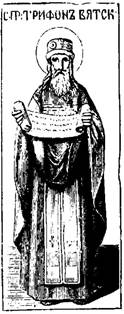
Это восклицание пророка, повторенное Апостолом, можем мы повторить и при мысли о блаж. Трифоне Вятском, проповеднике веры и добра, с молодых лет и до гроба116.
This exclamation of the prophet, repeated by the Apostle, we may repeat also at the thought of the blessed Tryphon of Vyatka, a preacher of faith and goodness, from his youth to the grave116.
Сын благочестивых земледельцев Мезенских (Архангельского края), деревни Малой Немигожки117, Трифон с юных лет чувствовал влечение жить для одного Господа. – Его хотели сочетать браком, и раз братья положили девушку в той клети, где спал он; но, как от навождения бесовского, бежал от неё целомудренный юноша. – Тайно удалясь из дома родительского, он, в одежде нищего, пришёл в Устюг и здесь несколько времени прожил под руководством благочестивого приходского священника Иоанна. Потом, по его благословению, жил в соседней волости Шемоксе, снискивая хлеб трудом и тайно подвизаясь в молитве. – Хозяева, полюбив его за любовь к труду и кротость, хотели связать его узами брака и уже обручили его с невестой; но, вспомнив обещание совести жить в целомудрии, он тайно убежал в Орлец, городок Строгановых. Тут поселился он близ приходской церкви и целый год терпел то зной, то холод, в разодранной одежде. Раз в жестокий мороз люди Строганова встретили его на улице и в злостной шутке столкнули его с крутой горы к реке; снег засыпал его своими глыбами, и едва спасся он от близкой смерти. Не жалуясь никому, смиренный юноша скрылся из Орлеца в с. Никольское, принадлежавшее кафедре епископа. Проведя здесь несколько времени в подвигах молитвы, при приходской церкви, отправился на р. Каму. В Пыскорской обители изучал он монашеское житие и принял пострижение от игумена Варлаама. Ему тогда было 22 года. И это было не прежде 1565 года118. Не опуская ни одной службы церковной и неся труды от души в пекарне, он ночью выходил на болото и полунагой давал насекомым терзать своё тело. От изнурения подвигами он сделался тяжко болен и 40 дней лежал больным. Явившийся святитель Николай исцелил его и сказал, что явился на помощь к нему с тем, чтобы ещё более утвердился он на добром пути.
The son of pious peasants of Mezen (in the Arkhangelsk region), from the village of Malaya Nemigozhka117, Tryphon from his youth felt a drawing to live for the Lord alone. They wished to marry him off, and once his brothers placed a maiden in the same cell where he slept; but, as from a demonic temptation, the chaste youth fled from her. Secretly departing from his parental home, in the garb of a beggar he came to Ustyug and there lived for some time under the guidance of a pious parish priest, John. Then, with his blessing, he lived in the neighboring volost of Shemoksa, earning his bread by labor and secretly striving in prayer. His hosts, having come to love him for his love of work and meekness, wished to bind him with the bonds of marriage and had already betrothed him to a bride; but, remembering the promise of his conscience to live in chastity, he secretly fled to Orlets, a town of the Stroganovs. There he settled near the parish church and for a whole year endured now heat, now cold, in tattered clothing. Once, in a severe frost, men of Stroganov met him on the street and, in a malicious jest, pushed him from a steep hill down toward the river; snow buried him under its clods, and he barely escaped from near death. Complaining to no one, the humble youth withdrew from Orlets to the village of Nikolskoye, which belonged to the bishop’s see. Having spent some time there in feats of prayer at the parish church, he set out for the Kama River. In the Pyskor monastery he studied the monastic life and received the tonsure from Abbot Barlaam. He was then twenty-two years old. And this was not before the year 1565118. Not missing a single church service and bearing labors from the soul in the bakery, he would go out at night to the swamp and, half-naked, allow insects to torment his body. From exhaustion through his ascetic feats he fell gravely ill and lay sick for forty days. St. Nicholas the Hierarch appeared and healed him, and said that he had come to his aid in order that he might be yet more firmly established on the good path.
Блаж. Трифон решился искать более глубокого безмолвия. Он спустился по Каме до устья р. Мулянки, к месту нынешнего гор. Перми. По тайному влечению, пройдя вёрст 5 по Мулянке, вышел он на берег, поднялся на гору и увидал местность чудную: окружённая густым лесом, она благоухала цветами. Нельзя было не полюбить такой местности любителю безмолвия. Скоро узнал он, что тут мольбищное место Остяков, куда собираются они приносить жертвы. Для пламенного подвижника веры это было новой причиной избрать это место для своего пребывания. Когда Остяки услышали, что на их заветном месте поселился какой-то странный человек, старшина Зевендук с 70 Остяками пришёл посмотреть, кто этот смелый человек? Они нашли его копающим землю, и орудия земледелия показались им страшными. Зевендук начал расспрашивать, кто он таков? и зачем пришёл? «Я раб Господа моего Иисуса Христа», отвечал Трифон. – Кто же Бог твой и почему ты раб Его? спросил язычник. Трифон в ответе своём объяснил суету идолов, показал Промыслителя и Творца мира, рассказал историю сотворения и падения человека, пришествие Спасителя рода человеческого, указал на будущий суд всемирный и на горькую вечность грешников. Простые дети природы с изумлением слушали поучение отшельника и сказали о нём князю Амбалу. – «Ни мы, ни отцы наши не слышали ничего подобного», говорили они о слышанном от Трифона. Амбал сказал, что в своё время посмотрит он на странного пришельца. – Феодор Сухоятин, давно знакомый с этой стороной по торговым делам своим, подарил Трифону топор Такиянского железа, лучшего в сравнении с Русским; он же рассказал, в каком уважении у Остяков и Вогулов требище, вблизи которого живёт он, и как боятся все коснуться чтимого, но грозного дерева топором. – Трифон до шести недель постился и молился и потом, взяв икону Деисус (изображение Спасителя с молящимися Богоматерью и Предтечей), пошёл к боготворимой ели. Она отличалась от других и вышиной и толстотой; две сажени было её в объёме, и ветви её шли от ствола на четыре сажени. – Став на колена перед иконой, усердно молился он Господу о разрушении лести бесовской, держащей бедных людей в пагубном мраке. Затем, громко повторяя имя Господа Иисуса, стал рубить дерево и наконец свалил его. – Приношения, висевшие на сучьях ели и состоявшие из шёлковых ширинок, мехов, золота и серебра, предал огню, как и дерево. – Князь Амбал, услышав о том, пришёл со многими Остяками и дивился тому, как грозное дерево мог испепелить пустынник! «За одно намерение оскорбить ель, говорил он Трифону, наказывались другие смертью; ужели ты сильнее богов наших?» Преподобный отвечал: «вы уже слышали, Какого Бога проповедую я вам; Его силой я, меньший раб Его, совершил это дело, которому вы дивитесь, – совершил с тем, чтобы это дерево не губило вас и ваших детей». – «Велик Бог христианский, Он сильнее богов наших», воскликнули Остяки. Тем не менее они отправились в местечко Сылву к начальнику городка. – «Инок христианин, говорили они, в худой одежде поселился в лесу, срубил и сжёг мольбищное дерево наше и, проповедуя Христа, велит нам креститься; что делать нам с этим человеком?» Приказчик Строгановых Третьяк Моисеевич, уже слышавший о преп. Трифоне, сказал князю Амбалу: «я знаю человека, о котором вы говорите; он человек добрый: если он учил вас веровать во Христа Господа, делайте то, что приказывает он вам; слушаясь святого человека, получите жизнь вечную». Остяки изъявили негодование на истребление их бога, но после увещаний несколько успокоились. Между тем новое обстоятельство вызвало неудовольствие у Остяков против Трифона. Стало известно, что Черемисы грабят по Каме суда и идут воевать с Остяками. Это узнали от русских, бежавших к Остякам от Черемисов. Остякам пришло на мысль, что Трифон откроет Черемисам жилья Остяков, по неудовольствию за их нерасположение к нему. – Зевендѵк и другие положили убить Трифона. Они пришли на место пребывания его; но по милости Божией не отыскали Трифона, хотя он стоял в своей келье на молитве. После того мало-помалу появилось в Остяках сперва уважение к человеку Божию, потом к проповедуемому им учению. Прежде и других приняли христианство дочери Остяцкого князя Амбала и Вогульского Безяка. Вслед за ними крестились и многие другие. Крестившиеся стали приносить Трифону мёд, воск и кое-что другое. Радуясь обращению к св. вере, Трифон с любовью принимал приношения и обращал их то для прославления имени Божия, то на помощь бедным. Памятниками обращения Мульских Остяков к св. вере служат Никольский храм в Верхних Мулах и две часовни Нижних Мулов, известные по писцовой книге 1624 г.119.
The blessed Tryphon resolved to seek a deeper silence. He went down the Kama to the mouth of the Mulyanka River, to the site of the present city of Perm. By a secret impulse, having gone about five versts up the Mulyanka, he came ashore, climbed a hill, and saw a wondrous place: surrounded by dense forest, it was fragrant with flowers. A lover of silence could not but love such a place. Soon he learned that this was a place of pagan worship for the Ostyaks, where they gathered to offer sacrifices. For a fervent ascetic of the faith, this was a new reason to choose this place for his abode. When the Ostyaks heard that some strange man had settled on their sacred spot, the elder Zevenduk, with seventy Ostyaks, came to see who this bold man was. They found him digging the earth, and the tools of agriculture seemed terrible to them. Zevenduk began to question him: who he was, and why he had come. “I am a servant of my Lord Jesus Christ,” answered Tryphon. “And who is your God, and why are you His servant?” asked the pagan. Tryphon in his reply explained the vanity of idols, showed forth the Provider and Creator of the world, recounted the history of the creation and fall of man, the coming of the Savior of the human race, and pointed to the future universal judgment and the bitter eternity of sinners. The simple children of nature listened with amazement to the teaching of the hermit and told of him to Prince Ambal. “Neither we nor our fathers have heard anything like this,” they said of what they had heard from Tryphon. Ambal said that in due time he would look into this strange newcomer. Theodore Sukhoyatin, long acquainted with this region through his trading affairs, gave Tryphon an axe of Takiyan steel, the best in comparison with Russian steel; he also told him in what reverence the Ostyaks and Voguls held the place of sacrifice near which he lived, and how all feared to touch the revered but fearsome tree with an axe. Tryphon fasted and prayed for up to six weeks, and then, taking the Deesis icon (an image of the Savior with the praying Mother of God and the Forerunner), he went to the deified fir tree. It was distinguished from others both in height and thickness; it measured two sazhens in girth, and its branches extended from the trunk for four sazhens. Kneeling before the icon, he fervently prayed to the Lord for the destruction of the demonic deception that held the poor people in pernicious darkness. Then, loudly repeating the name of the Lord Jesus, he began to chop the tree and finally felled it. The offerings hanging on the branches of the fir, consisting of silk kerchiefs, furs, gold, and silver, he consigned to the fire, along with the tree. Prince Ambal, hearing of this, came with many Ostyaks and marveled how the fearsome tree could have been burned to ashes by a hermit! “For the mere intention of insulting the fir,” he said to Tryphon, “others were punished with death; are you stronger than our gods?” The Venerable One answered: “You have already heard what God I preach to you; by His power I, the least of His servants, have done this deed at which you marvel—I have done it so that this tree might not destroy you and your children.” “Great is the Christian God; He is stronger than our gods,” cried the Ostyaks. Nevertheless, they went to the town of Sylva to the head of the settlement. “A Christian monk,” they said, “in poor clothing has settled in the forest, cut down and burned our sacred tree, and, preaching Christ, commands us to be baptized; what shall we do with this man?” The Stroganov steward Tretyak Moiseyevich, who had already heard of the Venerable Tryphon, said to Prince Ambal: “I know the man of whom you speak; he is a good man: if he has taught you to believe in Christ the Lord, do what he commands you; by obeying the holy man, you will obtain eternal life.” The Ostyaks expressed indignation at the destruction of their god, but after exhortations they grew somewhat calmer. Meanwhile, a new circumstance aroused displeasure among the Ostyaks against Tryphon. It became known that the Cheremis were plundering ships on the Kama and were coming to make war on the Ostyaks. This was learned from Russians who had fled to the Ostyaks from the Cheremis. It occurred to the Ostyaks that Tryphon would reveal the dwellings of the Ostyaks to the Cheremis, out of displeasure at their disaffection toward him. Zevenduk and others resolved to kill Tryphon. They came to the place of his abode; but by the mercy of God they did not find Tryphon, although he was standing in his cell at prayer. After that, little by little, there arose in the Ostyaks first respect for the man of God, then for the teaching he preached. Before others, the daughters of the Ostyak prince Ambal and the Vogul prince Bezyak received Christianity. After them, many others were also baptized. Those who were baptized began to bring Tryphon honey, wax, and various other things. Rejoicing at the conversion to the holy faith, Tryphon lovingly accepted the offerings and used them partly for the glorification of the name of God, partly for aid to the poor. Monuments to the conversion of the Mulya Ostyaks to the holy faith are the Church of St. Nicholas in Verkhniye Muly and two chapels in Nizhniye Muly, known from the cadastral book of 1624119.
Братия Пыскорской обители, услышав о славных подвигах Трифона, очень желали видеть его в своей обители; они просили приказчика Строгановых доставить к ним о. Трифона. Преподобный, против воли прибыв к ним в обитель, провёл здесь немного времени; но и в короткое время успел обратить ко Христу Остяков, живших около Соликамска, в том числе богатого землевладельца Иртега, которого потомки Иртеговы живут ещё поныне120. По его желанию жить уединённо, Строгановы, Иаков и Григорий, предложили ему, что может он жить в их отчине на р. Чусовой. – Трифон перешёл на Чусовую. Здесь, разогнав страх суеверов перед местом, где решился он жить, поставил часовню с святыми иконами, а потом устроил монастырь в честь Успения Богоматери121. – Но здесь встретилось искушение, удалившее Трифона из Перми. Чтобы приготовить землю для посева хлеба, зажёг он около кельи своей пни и корни срубленных дерев. Огонь, усиленный ветром, распространился по лесу и истребил огромные запасы дров, приготовленные для соленых промыслов Строгановских. Местные поселенцы, озлобленные потерей дров, гонялись за Трифоном, чтобы убить его. Строганов Григорий посадил его в оковы; потом советовал ему удалиться из его владений. О. Трифон поручил обитель ученику своему Иоанну, а сам решился перейти в Хлынов.
The brethren of the Pyskor monastery, having heard of the glorious feats of Tryphon, greatly desired to see him in their monastery; they asked the Stroganov steward to bring Father Tryphon to them. The Venerable One, against his will, came to them in the monastery and spent but a short time there; yet even in that short time he succeeded in converting to Christ the Ostyaks living near Solikamsk, including the wealthy landowner Irteg, whose descendants, the Irtegovs, still live to this day120. According to his desire to live in solitude, the Stroganovs, James and Gregory, proposed that he might live on their patrimony on the Chusovaya River. Tryphon moved to the Chusovaya. There, having dispelled the superstitious fear of the place where he resolved to live, he set up a chapel with holy icons, and afterwards established a monastery in honor of the Dormition of the Mother of God121. But here a trial arose that removed Tryphon from Perm. To prepare the land for sowing grain, he set fire near his cell to the stumps and roots of felled trees. The fire, fanned by the wind, spread through the forest and destroyed the huge reserves of firewood prepared for the Stroganov saltworks. The local settlers, enraged by the loss of the firewood, pursued Tryphon to kill him. Gregory Stroganov put him in chains; then he advised him to withdraw from his domains. Father Tryphon entrusted the monastery to his disciple John, and himself resolved to go to Khlynov.
Янв. 18-го 1580 г. пришёл он в первый Вятский город и отправился к Хлынову. – Странник обходил в Хлынове храмы Божии и всего чаще посещал церковь св. Николая, где стояла чудотворная Великорецкая икона святителя. Диакон этой церкви Максим Мальцов полюбил раба Божия и принимал его у себя. Потом и другие Хлыновцы стали приглашать его в свои дома. Ознакомясь с окрестной местностью Хлынова, он избрал место для обители и, явясь в собрание Вятских людей, просил дозволения устроить обитель за городом у двух церквей, из коих одна, ветхая, была в честь Успения Богоматери. Все обрадовались такому предложению. С просьбой Вятчан о обители преподобный отправился в Москву. Святитель посвятил Трифона в иеромонаха – строителя новой обители, а царь Иоанн Васильевич дал грамоту на землю для обители122. По возвращении в Хлынов, на месте ветхой церкви преподобный начал строить каменный храм. Скоро собралась братия в новую обитель. Новый Вятский воевода, Василий Овцын, верный слуга царский и Богобоязненный правитель, особенно помогал преподобному в ограждении обители от крайних нужд; он часто беседовал с преподобным о спасении души. По его предложению Вятчане охотно доставили пожертвования для нового обширного храма Успения Богоматери, и храм был построен. Число братии увеличилось до 40, а средства к жизни были недостаточные. Преподобный снова отправился в Москву; он просил ц. Феодора дать угодья монастырю. Добрый царь милостиво принял просьбу, «велел дать угодья, сёла и озёра с рыбной ловлей братии на пропитание». Так пишет сам преподобный в своём завещании. – Вероятно в это время патриарх почтил его самого саном архимандрита и дал для обители много икон, книг и утвари. В Москве принимал его князь Иван Михайлович Воротынский, скорбевший с княгиней о бездетстве своём. Преподобный сказал боярину: «князь, ты призрел меня, бедного старца, Бога ради; но не меня ты почтил, а Господа, исполняя заповедь Его; знай же, что у тебя родится сын Алексий». Князь и княгиня приведены были в смущение приятной для них вестью; они просили молитв преподобного, дали ему много милостыни для обители, и через год слово старца исполнилось. После того Воротынский был самым усердным благотворителем Трифоновой обители. – Преподобный, став архимандритом людной обители, не изменил своей подвижнической жизни: не дозволял он себе ни вкусной пищи, ни мягкой одежды; на теле носил он тяжёлые вериги и жёсткую власяницу. Всё, что присылали ему, отдавал он в монастырскую казну, а в кельи его были только книги и иконы.
On January 18, 1580, he arrived in the first Vyatka town and set out for Khlynov. The wanderer visited the churches of God in Khlynov and most often frequented the church of St. Nicholas, where the wonderworking Velikoretsk Icon of the Hierarch stood. The deacon of this church, Maxim Maltsov, came to love the servant of God and received him into his home. Later, other inhabitants of Khlynov also began to invite him into their houses. Having become acquainted with the surrounding countryside of Khlynov, he chose a place for a monastery and, appearing before the assembly of the Vyatka people, asked permission to establish a monastery beyond the city near two churches, one of which, an old one, was in honor of the Dormition of the Mother of God. All rejoiced at such a proposal. With the request of the Vyatka people concerning the monastery, the Venerable One set out for Moscow. The Hierarch tonsured Tryphon as a hieromonk—builder of the new monastery, and Tsar Ivan Vasilievich granted a charter for the land for the monastery122. Upon his return to Khlynov, on the site of the old church, the Venerable One began to build a stone church. Soon brethren gathered in the new monastery. The new voivode of Vyatka, Vasily Ovtsyn, a faithful servant of the Tsar and a God-fearing ruler, especially helped the Venerable One in shielding the monastery from extreme needs; he often conversed with the Venerable One about the salvation of the soul. At his suggestion, the people of Vyatka willingly made donations for the new, spacious church of the Dormition of the Mother of God, and the church was built. The number of brethren increased to forty, but the means of subsistence were insufficient. The Venerable One again set out for Moscow; he asked Tsar Theodore to grant lands to the monastery. The good Tsar graciously received the petition, “ordered that lands, villages, and lakes with fishing be given to the brethren for their sustenance.” Thus writes the Venerable One himself in his testament. — Probably at this time the Patriarch honored him himself with the rank of archimandrite and gave many icons, books, and vessels for the monastery. In Moscow, Prince Ivan Mikhailovich Vorotynsky received him, grieving with his princess over their childlessness. The Venerable One said to the boyar: “Prince, you have received me, a poor elder, for God’s sake; but you have honored not me, but the Lord, fulfilling His commandment; know then that a son, Alexis, will be born to you.” The prince and princess were thrown into confusion by the news, pleasant to them; they asked for the prayers of the Venerable One, gave him much alms for the monastery, and a year later the elder’s word was fulfilled. After that, Vorotynsky was the most zealous benefactor of Tryphon’s monastery. — The Venerable One, having become archimandrite of a populous monastery, did not change his ascetic life: he allowed himself neither tasty food nor soft clothing; on his body he wore heavy chains and a coarse hair-shirt. Everything that was sent to him, he gave to the monastery treasury, and in his cell there were only books and icons.
Строгая жизнь преподобного не нравилась некоторым. Мало-помалу усилилось неудовольствие против него. Старец решился уклониться от зла, тем более, что может он, думалось ему, послужить краю на другом пути. – Он передал управление обителью ученику своему Ионе Мамину. Последний, будучи из дворян Московских, легко достиг того в Москве, что определён был в настоятеля обители Вятской. Старец отправился странствовать.
The strict life of the Venerable One displeased some. Little by little, discontent against him increased. The elder resolved to withdraw from evil, the more so because, he thought, he might serve the region in another way. — He handed over the governance of the monastery to his disciple Jonah Mamin. The latter, being from the Moscow nobility, easily obtained in Moscow that he was appointed rector of the Vyatka monastery. The elder set out to wander.
Никита Строганов построил для изгнанного старца келью в Сольвычегодской Введенской обители и содержал его на свой счёт. Старец пожелал помолиться в Соловецкой обители. Строганов дал ему судно с запасами и людьми, для доставления на остров; но старец, так жаловался впоследствии Строганов, отпустил людей, продал запасы и судно и, побывав в Соловках, употребил дары Строганова для Вятской обители. – Строганов не совсем понимал старца. Душа старца горела желанием содействовать христианскому просвещению глухого края, тогда как Вятская сторона имела нужду и в монастырях, и в храмах, и даже часовнях. В это время устроился в Слободском монастырь в честь Богоявления Господня123. И на устроение этой обители старец отдал часть даров Строганова. Блаженный понимал, что достанется ему от Строганова за неточное выполнение воли его. Но любовь терпелива. Поныне ещё целы часовни по берегам Камы и Вятки, которые строил Трифон на пути от Строгановых варниц к Хлынову. – По дороге из Слободского в Кай в селе Верхосвятском стоит «обыденная» церковь, ныне весьма ветхая, построенная блаж. старцем во время болезни124. Вот на что употреблял блаженный старец дары Строганова!
Nikita Stroganov built a cell for the exiled elder in the Solvychegodsk Vvedensky Monastery and supported him at his own expense. The elder wished to pray at the Solovetsky Monastery. Stroganov gave him a vessel with supplies and men to convey him to the island; but the elder, as Stroganov later complained, dismissed the men, sold the supplies and the vessel, and, having visited Solovki, used Stroganov’s gifts for the Vyatka monastery. — Stroganov did not fully understand the elder. The elder’s soul burned with a desire to further the Christian enlightenment of the remote region, while the Vyatka region had need of both monasteries and churches, and even chapels. At this time, a monastery in honor of the Theophany of the Lord was established in Slobodskoy123. And for the establishment of this monastery, the elder also gave part of Stroganov’s gifts. The blessed elder understood that he would suffer from Stroganov for the inexact fulfillment of his will. But love is patient. Even now, chapels along the banks of the Kama and Vyatka are still intact, which Tryphon built on the way from Stroganov’s saltworks to Khlynov. — On the road from Slobodskoy to Kai, in the village of Verkhosvyatskoye, stands a “one-day” church, now very dilapidated, built by the blessed elder during an illness124. This is what the blessed elder used Stroganov’s gifts for!
В новой Слободской обители с радостью покоили старца, заботливого о ней. Он не хотел быть никому в тягость; напротив, горел желанием облегчать других. С учеником своим Досифеем отправился он в Сольвычегодск за милостыней для новой обители. С простотой любящей души явился он к благодетелю своему Никите Строганову; но тот с гневом прогнал его от себя. Преподобный покойно отправился в другие дома, а вечером сказал ученику своему: «необходимо терпение для добра; завтра ты один явишься к Строганову в храме, после утрени». Строганов, узнав, что Досифей – ученик Трифона, сверх ожидания принял его с смиренной любовью. «За оскорбление раба Божия я много страдал в эту ночь», говорил он. Потом рассказал, что давно знает Трифона и много помогал ему, и что поступок Трифона с судном, назначенным в Соловки, вызвал из души его гнев, с каким вчера принял его; «чувствую и исповедую мой грех, прибавил добрый христианин; проси отца Трифона посетить дом мой благословением». – Принятый с любовью Строгановым, старец Божий получил щедрую милостыню для обители.
In the new Slobodskoy monastery, they gladly gave rest to the elder, who was solicitous for it. He did not wish to be a burden to anyone; on the contrary, he burned with a desire to lighten the burden of others. With his disciple Dositheus, he set out for Solvychegodsk for alms for the new monastery. With the simplicity of a loving soul, he appeared before his benefactor Nikita Stroganov; but the latter drove him away in anger. The Venerable One calmly went to other houses, and in the evening said to his disciple: “Patience is necessary for good; tomorrow you alone will appear before Stroganov in the church, after Matins.” Stroganov, learning that Dositheus was Tryphon’s disciple, beyond expectation received him with humble love. “For insulting a servant of God, I have suffered much this night,” he said. Then he related that he had long known Tryphon and had helped him much, and that Tryphon’s action with the vessel destined for Solovki had aroused anger in his soul, with which he had received him yesterday; “I feel and confess my sin,” added the good Christian; “ask Father Tryphon to visit my house with a blessing.” — Received with love by Stroganov, the elder of God received generous alms for the monastery.
В последние годы жизни своей Трифон ещё раз странствовал в Соловецкую обитель на поклонение чудотворцам. Соловецкие старцы советовали ему остаться в их обители, указывая ему на его дряхлость. Душа его стремилась в любимую Успенскую обитель свою. Больной довезён он до Хлынова. Но когда послал послушника просить настоятеля Иону принять его в обитель, жестокий ученик отказал. Больного принял в свой дом диакон Максим. Здесь пробыл он два месяца, и так как чувствовал, что уже недолго жить ему, просил протоиерея и священников упросить настоятеля принять его в обитель. Сердце Ионы смягчилось и при встрече просил он у наставника прощения. «Бог да простит тебя, сын мой, – отвечал старец; случившееся – дело старого врага нашего, он давно борется с боящимися Господа». Иона, ожидавший упрёков, поражён был кротостью учителя; преподобный рад был, что опять в своей обители125.
In the last years of his life, Tryphon once again journeyed to the Solovetsky Monastery to venerate the Wonderworkers. The Solovetsky elders advised him to remain in their monastery, pointing to his decrepitude. His soul yearned for his beloved Dormition monastery. Ill, he was conveyed as far as Khlynov. But when he sent a novice to ask the rector Jonah to receive him into the monastery, the cruel disciple refused. The deacon Maxim received the sick man into his house. Here he remained for two months, and since he felt that he had not long to live, he asked the protopriest and priests to prevail upon the rector to receive him into the monastery. Jonah’s heart softened, and at the meeting he asked forgiveness of his teacher. “May God forgive you, my son,” answered the elder; “what has happened is the work of our old enemy; he has long struggled with those who fear the Lord.” Jonah, who had expected reproaches, was struck by the teacher’s meekness; the Venerable One was glad to be again in his own monastery125.
Для любимой, основанной им, обители написал он духовное завещание. Сказав о том, каких трудов стоило ему основать и оградить обитель Богоматери, он так говорит к братии: «собранное о Христе стадо, отцы и братия! послушайте меня грешного. Хотя я груб и хуже всех, но Бог и Пречистая Матерь Его дозволили мне худому заведовать домом Своим. Молю вас, для Бога и Пречистой Матери Его, имейте духовную любовь между собой. Без неё никакая добродетель не полна перед Богом. Уста Христовы изрекли ученикам: да любите друг друга. О сём разумеют вси, яко Мои ученицы есте, аще любовь имате между собою. По словам Апостола Павла, друг друга тяготы носите. Не осуждайте пред Богом один другого, в храме ли, или в келье, наедине ли, или в общении с братией. Келейные молитвы совершайте со страхом. А церковного пения отнюдь не пропускайте; хотя бы и дело было, бежи в церковь Божию на духовное пение. Прежде всего отдавайте Божие Богу, а потом выполняйте другие дела. Друг друга честью больша себе творите. Благословляю я грешный архимандрит Трифон быть вместо меня в доме Пречистой Богородицы ученику моему, келейному старцу Ионе Мамину. И вы, отцы и братия! повинуйтесь ему во всём, слушайте его. Когда из вас позовёт он на службу: Бога ради, выполняйте службу без ропота. Берегите монастырское; за монастырь, без благословения настоятеля, не давайте, и монастырским добром не дружитесь ни с кем, и родным не давайте ничего монастырского без благословения настоятеля. И себе в собственность также не берите ни из денег, ни из построек и ни из чего другого.
For his beloved monastery, which he had founded, he wrote a spiritual testament. Having spoken of what labors it had cost him to found and shield the monastery of the Mother of God, he thus speaks to the brethren: “The flock gathered in Christ, fathers and brethren! Hearken to me, a sinner. Although I am rude and worse than all, yet God and His Most Pure Mother have allowed me, a worthless one, to be in charge of His house. I beseech you, for the sake of God and His Most Pure Mother, have spiritual love among yourselves. Without it, no virtue is complete before God. The lips of Christ spoke to the disciples: Love one another. By this all will know that you are My disciples, if you have love among yourselves. According to the words of the Apostle Paul, bear one another’s burdens. Do not judge one another before God, whether in church or in the cell, in private or in communion with the brethren. Perform your cell prayers with fear. And do not by any means omit church singing; even if there is work, run to the church of God for spiritual singing. Above all, give God His due, and then fulfill other tasks. Honor one another above yourselves. I, the sinful archimandrite Tryphon, bless my disciple, the cell elder Jonah Mamin, to be in my stead in the house of the Most Pure Theotokos. And you, fathers and brethren! Obey him in everything, hearken to him. When he calls you to a service: for God’s sake, perform the service without murmuring. Guard the monastery’s property; do not give anything from the monastery without the blessing of the rector, and do not make friends with anyone using the monastery’s goods, nor give anything of the monastery’s to relatives without the rector’s blessing. And do not take for yourselves as property either money, or buildings, or anything else.
Ты, брат и господин, старец Иона! Бога ради и для Пречистой Богородицы и для своего родителя будь усерден в послушании по молению нашему. Заботься о доме Пречистой и о стаде – братстве, собранном во Христе, о вотчинах и угодьях... Бога ради, ревнуй св. отцам, как ими узаконено жить в монастырях и лаврах, т. е. св. Евфимием Великим, Саввой Освященным, Феодосием Киновиархом, также святыми отцами, просиявшими в России, Сергием, Варлаамом, Кириллом, Зосимой и Савватием. Молю тебя, Бога ради, имей любовь к братии и понеси тяготу. Писано: вы сильнии немощи немощных носите. Бесчиния пусть не будет. По Апостолу, настой, обличи, запрети благовременно и безвременно. Прошу тебя, Бога ради, не вводи хмельного питья в дом Пречистой. Как при моей жизни не было хмельного питья и столов по кельям, так и после меня пусть не будет того. Прежде всего пусть у тебя не будет ни для себя, ни для гостей хлебного питья и столов. Для братии на трапезе пусть будет пищи довольно и квас хороший. Утешай братию, чтобы не было скудости в трапезе. Дом Пречистой не оскудеет от того... Если будете иметь любовь между собой, то дом Пречистой никогда не оскудеет.
You, brother and lord, elder Jonah! For God’s sake and for the sake of the Most Pure Theotokos and for your parent, be diligent in obedience according to our entreaty. Care for the house of the Most Pure One and for the flock—the brotherhood gathered in Christ, for the estates and lands... For God’s sake, emulate the holy fathers, as they have established the rule for living in monasteries and lavras, i.e., St. Euthymius the Great, Sabbas the Sanctified, Theodosius the Cenobiarch, and also the holy fathers who shone forth in Russia: Sergius, Barlaam, Cyril, Zosimas, and Sabbatius. I beseech you, for God’s sake, have love for the brethren and bear the burden. It is written: You who are strong, bear the infirmities of the weak. Let there be no disorder. According to the Apostle, admonish, reprove, forbid in season and out of season. I ask you, for God’s sake, do not introduce intoxicating drink into the house of the Most Pure One. As there was no intoxicating drink or tables in the cells during my life, so let there be none after me. Above all, let there be for you neither grain-based drink nor tables for yourself or for guests. For the brethren at the refectory, let there be sufficient food and good kvass. Comfort the brethren, so that there be no scarcity at the refectory. The house of the Most Pure One will not be impoverished by that... If you have love among yourselves, then the house of the Most Pure One will never be impoverished.
Бога ради, не забудьте меня грешного; поминайте меня на литиях и на панихидах, больших и малых. Поминайте всегда, и вас помянет Бог. Да будет с вами мир и милость Господа нашего Иисуса Христа и Пречистой Матери Его и моё благословение, во веки веков, аминь»126.
For God’s sake, do not forget me, a sinner; remember me at the lityas and at the panikhidas, great and small. Remember always, and God will remember you. May the peace and mercy of our Lord Jesus Christ and His Most Pure Mother and my blessing be with you, forever and ever, Amen”126.
Родители его, Георгий и Мария, переселясь в Филиппополь, отдали здесь сына учиться грамоте. Имея хорошие способности, он скоро выучился тому, чему учили. С молодых лет он почувствовал стремление к пустынной жизни и удалился в обитель преп. Иоанна Рыльского. – Старец попался ему человек жестокий; шесть лет жил он у этого старца, выполняя должность чтеца в храме и с веселием незлобия перенося от старца брань и побои. Наконец, когда гневный старец бурей гнева подверг опасности жизнь послушливого Иоанна, – тот вынужден был убежать от него.
His parents, George and Mary, having moved to Philippopolis, sent their son there to learn to read and write. Possessing good abilities, he soon learned all that was taught. From his youth he felt a longing for the solitary life and withdrew to the monastery of the Venerable John of Rila. – The elder he encountered was a harsh man; six years he lived with this elder, fulfilling the office of reader in the church and bearing with the cheerfulness of meekness the elder's abuse and blows. At length, when the wrathful elder, in a storm of anger, endangered the life of the obedient John, he was compelled to flee from him.
В то время шла война между Сербами и Турками. Магометане принуждали отца Иоаннова идти на войну в звании и тысященачальника, как человека сильного и храброго; но он отвечал, что не может воевать против единоверцев и единоплеменников. Дикари прокололи ему бок и потом лишили его головы. Недовольные тем, в бешенстве фанатизма захватили жену и двух дочерей страдальца и страхом принудили потурчиться. Иоанн, переодевшись, скрылся в доме доброй старушки; его искали здесь, но не угадали переодетого. Добрая старушка выпроводила его в Валахию. Переходя из одного места в другое, попал он в Бухарест и здесь подружился с блаж. Евфимием129.
At that time a war was being waged between the Serbs and the Turks. The Mohammedans compelled John's father to go to war in the rank of a commander of thousands, as a man strong and brave; but he answered that he could not fight against those of the same faith and the same people. The savages pierced his side and then cut off his head. Not content with that, in the frenzy of fanaticism they seized the wife and two daughters of the sufferer and by terror forced them to turn Turk. John, having disguised himself, hid in the house of a good old woman; they searched for him there, but did not recognize him in his disguise. The good old woman sent him into Wallachia. Passing from one place to another, he came to Bucharest and there became friends with the blessed Euthymius129.
В Бухаресте и тогда жил разврат. – Иоанн, опасаясь соблазнов, решился пробраться в Афон. Дорогой был он в Шумле и здесь в скорби узнал о падении друга своего Евфимия. Между тем разбойничья шайка Турок, производя грабёж, захватила Иоанна и принуждала его потурчиться. – Иоанн дал обещание принять исламизм и, оставленный на свободе, убежал из Шумлы в Эски-Загору. Отсюда с одним Афонцем обители Григориевой пришёл на Афон и поселился в Григориате. Пробыв здесь и в других местах несколько времени, пришёл в скит Анны к блаженному Василию. С ним вместе по надобности отправился он в Солунь; здесь при них пострадал за Христа препод. Давид; – твёрдость страдальца одушевила Иоанна желанием пролить кровь свою за веру Христову. По возвращении в скит старец скоро заболел и умер. Иоанн перешёл в такой же строгий скит Кавсокаливский. Скит св. Анны на восточном скате горы Афона; «тут же неподалёку скит Кавсокаливский и третье отшельническое место – Каруля. Все эти высшие школы подвига устроены в местах диких, трудных и едва доступных путнику. – Восточная оконечность Афона до сих пор верна первому образцу Афонского подвижничества, оставленному на горе св. Петром». Так говорит недавний посетитель Афона130. В Кавсокаливском скиту Иоанн узнал, что друг его Евфимий совершил мученический подвиг. Радуясь блаженной доле друга, Иоанн ещё более стал желать мученичества. Явясь к преподобному духовнику Никифору, усердно просил он принять его в духовное руководство. Старец поручил его старцу Акакию. Пища его была хлеб и вода и то в малой мере; день и ночь молился он коленопреклонно и читал священное Писание. Не взирая на такие подвиги, он был весел. Древняя злоба подняла против него сильную брань плоти; он пал на землю и долго лежал, борясь с адским огнём; потом прибежал к попечителю своему Акакию и просил помощи. Старец утешал скорбевшего. Подвижник пришёл в церковь, взял в руки икону Богоматери и, лобызая, со слезами молил Пречистую избавить его от брани. Пречистая не оставила без помощи. Блаженный почувствовал внезапно чудное благоухание, и брань не возвращалась более. Когда духовник Никифор увидел в Иоанне твёрдую решимость быть и верным исповедником имени Христова, он постриг его в иночество с именем Игнатия и потом отпустил его в Константинополь с опытным старцем Григорием. Прибыв 29 сентября в Константинополь, нашли путники нужное платье и решено было начать в пятницу подвиг, В назначенный день блаженный Игнатий являлся в суд, но узнал, что заседания не будет до вторника. Исповедник готовился слёзной молитвой перед иконой Богоматери в доме одного Христолюбца Григория. Во вторник, явясь в суд, он говорил судье: «дурные люди выдают поддельную монету за настоящую, да и ещё насилием принуждают брать её». «Да, это – дело не доброе», сказал кадий; «кто же эти такие нечестивцы?» «Вы магометане», отвечал исповедник. «В молодых годах ваши Турки насилием принудили меня дать обещание отречься от Христа и принять магометанство. Вижу нечестие обещания моего – и свободно говорю, что магометанство ложь и пагуба души». С этими словами сбросил он с головы зелёную повязку. «Кто тебя привёл сюда?» с гневом закричал судья. «Моё собственное желание – очистить совесть свою». И, вынув икону Спасителя, прибавил: «видишь Судию вселенной?» – «Оставь глупости», сказал наглый кадий. «Лучше будет, если выполнишь обещание, – будешь и в почёте, и с деньгами. Иначе готова страшная казнь. Подумай хорошенько». Исповедник отвечал с улыбкой: «охотно уступаю тебе всё счастье земное; бедняку магометанину не может достаться иная доля, кроме земной и скотской жизни. А там и ему, и его обманщику куда как плохо будет!» Судья изменился от гнева в лице, и слуги заперли Игнатия в сторожке, надев на него железные цепи. Недовольные тем, они то нагло насмехались над ним, то били его, заставляя принять магометанство. Кадий, окончив другие дела, вновь потребовал к себе исповедника. «Кто привёл тебя сюда?» снова спросил кадий. «Господь Иисус Христос», отвечал исповедник. «Послушай, друг мой», ласково говорил кадий, «ты горяч и заносчив, – одумайся: придётся тебе испытать такие муки, о каких ты и не думаешь». «Вечная участь, судья, стоит того, чтобы хлопотать о ней не холодно. Равнодушие в таком деле не умно и преступно. Если же не дорожим мы небесной истиной и покойно любим ложь человеческих произволов (а как это безнравственно и низко!), то уже слишком не умно быть беззаботным на счёт своей вечной участи. – Не так ли? Между тем не трудно понять, что сколько рай Магометов – грязен и вонюч, столько же рай, открытый Христом Господом, – истинный рай. Итак, прикажешь ли отрубить мне голову, или повесить, готов на всё с радостью», говорил исповедник. Судья велел отвести его в темницу. Спутник Григорий с радостью выслушал, что было со страдальцем. – И другие христиане также хвалили Господа и молились за исповедника. Что делали в темнице с Игнатием, подлинно не известно, но Константинопольские христиане говорили, что страдальца жестоко терзали там. Когда кадий вновь призвал к себе Игнатия и увидел, что ни ласки, ни пытки не изменяют твёрдого исповедника, он определил удавить его. Так святой, повешенный на парма-кани, был задушен 8 октября 1814 года в четверток в 6 часов.
In Bucharest even then debauchery reigned. – John, fearing temptations, resolved to make his way to Athos. On the road he was in Shumla, and there in sorrow he learned of the fall of his friend Euthymius. Meanwhile a band of Turkish robbers, engaged in plunder, seized John and forced him to turn Turk. – John gave a promise to embrace Islam and, being left at liberty, fled from Shumla to Eski-Zagra. From there, with a certain Athonite of the monastery of Gregoriou, he came to Athos and settled at Gregoriou. Having remained there and in other places for some time, he came to the Skete of Anna to the blessed Basil. With him, as need required, he went to Thessalonica; there, before their eyes, the Venerable David suffered for Christ; – the steadfastness of the sufferer inspired John with the desire to shed his own blood for the faith of Christ. Upon returning to the skete, the elder soon fell ill and died. John moved to the equally strict Skete of Kavsokalyvion. The Skete of St. Anna is on the eastern slope of Mount Athos; "nearby also is the Skete of Kavsokalyvion and the third hermitic place – Karoulia. All these higher schools of ascetic struggle are established in places wild, difficult, and scarcely accessible to the traveler. – The eastern extremity of Athos to this day remains faithful to the first model of Athonite asceticism, left on the mountain by St. Peter." So says a recent visitor to Athos130. In the Kavsokalyvion Skete John learned that his friend Euthymius had accomplished the martyr's feat. Rejoicing in the blessed lot of his friend, John desired martyrdom all the more. Appearing before the Venerable confessor Nicephorus, he earnestly asked him to receive him under his spiritual guidance. The elder entrusted him to the elder Acacius. His food was bread and water, and that in small measure; day and night he prayed on bended knee and read the Holy Scriptures. Notwithstanding such labors, he was cheerful. The ancient malice raised against him a strong warfare of the flesh; he fell to the ground and lay long, struggling with the fire of hell; then he ran to his guardian Acacius and asked for help. The elder comforted the sorrowing one. The ascetic came to the church, took in his hands the icon of the Mother of God and, kissing it, with tears besought the Most Pure One to deliver him from the warfare. The Most Pure One did not leave him without help. The blessed one suddenly sensed a wondrous fragrance, and the warfare returned no more. When the confessor Nicephorus saw in John a firm resolve to be a faithful confessor of the name of Christ, he tonsured him into monasticism with the name Ignatius, and then sent him to Constantinople with the experienced elder Gregory. Arriving in Constantinople on September 29, the travelers found the necessary clothing, and it was decided to begin the feat on Friday. On the appointed day the blessed Ignatius appeared at the court, but learned that there would be no session until Tuesday. The confessor prepared himself by tearful prayer before the icon of the Mother of God in the house of a certain Christ-loving Gregory. On Tuesday, appearing at court, he said to the judge: "Evil men pass off counterfeit coin as genuine, and moreover by violence force people to take it." "Yes, that is not a good deed," said the qadi; "who then are these wicked ones?" "You Mohammedans," answered the confessor. "In my youth your Turks by violence forced me to give a promise to renounce Christ and embrace Mohammedanism. I see the wickedness of my promise – and I freely declare that Mohammedanism is a lie and the ruin of the soul." With these words he cast off the green turban from his head. "Who brought you here?" cried the judge in anger. "My own desire – to cleanse my conscience." And, drawing out an icon of the Savior, he added: "Do you see the Judge of the universe?" – "Leave off your foolishness," said the insolent qadi. "It will be better if you fulfill your promise – you will be both honored and wealthy. Otherwise a terrible execution awaits you. Think it over well." The confessor answered with a smile: "Gladly do I yield to you all earthly happiness; a poor Mohammedan can obtain no other portion than an earthly and brutish life. And there, how ill it will fare for him and for his deceiver!" The judge changed countenance from anger, and the servants shut Ignatius in a guardhouse, placing iron chains upon him. Not content with that, they either insolently mocked him or beat him, forcing him to accept Mohammedanism. The qadi, having finished his other affairs, again summoned the confessor before him. "Who brought you here?" asked the qadi again. "The Lord Jesus Christ," answered the confessor. "Listen, my friend," said the qadi kindly, "you are hot-headed and presumptuous – come to your senses: you will have to experience such torments as you do not even imagine." "Eternal destiny, judge, is worth laboring over not half-heartedly. Indifference in such a matter is neither wise nor prudent. And if we do not value the heavenly truth and calmly love the lie of human fancies (and how immoral and base that is!), then it is all the more unwise to be careless about one's eternal lot. – Is it not so? Meanwhile it is not hard to understand that as much as the paradise of Mohammed is filthy and stinking, so much is the paradise revealed by Christ the Lord the true paradise. And so, whether you order my head to be cut off, or me to be hanged, I am ready for everything with joy," said the confessor. The judge ordered him to be taken to prison. His companion Gregory joyfully heard what had befallen the sufferer. – And other Christians likewise praised the Lord and prayed for the confessor. What was done to Ignatius in prison is not truly known, but the Christians of Constantinople said that the sufferer was cruelly tormented there. When the qadi again summoned Ignatius and saw that neither caresses nor tortures changed the steadfast confessor, he decreed that he be strangled. Thus the saint, hanged on a parma-kani, was strangled on October 8, 1814, on Thursday, at the sixth hour.
Св. Нонн воспоминается восточной Церковью между подвижниками в субботу сырной недели. Римский мартиролог под 2 дек.: «в Эдессе кончина св. Нонва епископа; его молитвами кающаяся Пелагия обратилась ко Христу».
St. Nonnus is commemorated by the Eastern Church among the ascetics on the Saturday of Cheese-fare week. The Roman Martyrology under Dec. 2: "at Edessa, the repose of St. Nonnus the bishop; by his prayers the penitent Pelagia turned to Christ."
Повествование диакона Иакова in. Vit. Patr. I, 663–672. Act. Sanet. Oct. IV, 248 S. в Четь-Минее окт. 8. Древний Слав. перевод у Царского 375. 389.
The narrative of the deacon James in Vit. Patr. I, 663–672. Act. Sanet. Oct. IV, 248 S. in the Chet-Minei for Oct. 8. The ancient Slavonic translation in Tsarsky 375. 389.
«Возложил на неё печать Господа» – совершил над ней таинственное миропомазание. Так видно по содержанию описаний, где возложение печати отличается как от крещения, так и от причащения евхаристии. Миропомазание обыкновенно называется у отцов печатью Господней. Св. Киприан писал: «чего недоставало, то совершили Пётр и Иоанн... Так бывает и у нас... Совершенствуются Господней печатью». Ер. 70 ad. Jan. См. Догмат. Богословие, 2, 232–233. 238–240. Черниг. 1866 г.
"He set upon her the seal of the Lord" – he performed over her the mystical anointing with myrrh. This is evident from the content of the accounts, where the setting of the seal is distinguished both from Baptism and from Communion of the Eucharist. The anointing with myrrh is commonly called by the Fathers the seal of the Lord. St. Cyprian wrote: "what was lacking, Peter and John accomplished... So it is also with us... They are perfected by the Lord's seal." Ep. 70 ad Jan. See Dogmatic Theology, 2, 232–233. 238–240. Chernigov, 1866.
Жизнь, св. Пахомия § 17: «он, оградив чело своё знамением креста, дунул на него (на демона), и он убежал». § 48: «ограждая себя крестом и дуя на него, сказал: отойди от меня, диавол, проклят ты и видение твоё и хитрости твои, – нет тебе места у рабов Божиих. И стал он прахом и наполнил келью отвратительным смрадом». Палладий в разговоре о жизни Златоуста: «демоны связываются одним дуновением верующих». Дунуть на демона то же, что проклясть его. Тертуллиан о идолопоклонстве § XI. «Христианин, торгующий ладоном, идя мимо языческого храма, плюнет ли на дымящиеся жертвенники и дунет ли на них, о которых так заботится».
Life of St. Pachomius § 17: "he, having guarded his brow with the sign of the cross, breathed upon him (the demon), and he fled." § 48: "guarding himself with the cross and breathing upon him, he said: depart from me, devil, cursed are you and your vision and your wiles – there is no place for you among the servants of God. And he became dust and filled the cell with a foul stench." Palladius in the dialogue on the life of Chrysostom: "demons are bound by the mere breath of the faithful." To breathe upon a demon is the same as to curse him. Tertullian on idolatry § XI. "A Christian, selling frankincense, passing by a pagan temple, will he spit at the smoking altars and breathe upon them, about which he is so concerned."
Блаж. Августин, объясняя слова Иосифа: «и приказал отрокам ενταφιασταις ενταφιασαι отца его» (Быт.50:2), говорит: «В Латинском языке (как и в Русском) нет слова, соответствующего ενταφιασταις. Ибо не они погребают или предают земле тела умерших, что у Греков выражается не словом ενταφιασαν, а словом έθαψαν. Ἐνταφιασται приготовляют к погребению умерших, – намащают, высушивают, обёртывают и увязывают. Этим отличается у Египтян попечение об умерших». Деяние муч. Авина у Метафраста под 15 нояб. «Обвернули (тело мученика) дорогим полотном, намастили дорогими мастями».
Blessed Augustine, explaining the words of Joseph: "and he commanded the servants ενταφιασταις ενταφιασαι his father" (Gen. 50:2), says: "In the Latin language (as in the Russian) there is no word corresponding to ενταφιασταις. For they do not bury or commit to the earth the bodies of the dead, which in Greek is expressed not by the word ενταφιασαν but by the word έθαψαν. Ἐνταφιασται prepare the dead for burial – they anoint, dry, wrap, and bind them. In this the Egyptians' care for the dead consists." The Acts of the Martyr Abinus in Metaphrastes under Nov. 15: "They wrapped (the body of the martyr) in costly linen and anointed it with precious ointments."
Напрасно Вейсс (Leben d. Heiligen 74, 295) сомневается в том, что Пелагия совершила подвиги в одежде инока. Известие очевидца не дозволяет сомневаться. Не оправдывают Вейсса выражения Менолога: «придя в Иерусалим и став монахиней, такое получила дерзновение у Бога, что совершила много чудес». Слова эти только не точно выражают дело. Точнее говорит Пролог по Синаксарю: «и власяная наложивши и в мужа претворившися, достиже гору Елеонскую и затворившися в келии и весь живот свой Богоугодно поживши, с миром почи о Господе».
In vain does Weisse (Leben d. Heiligen 74, 295) doubt that Pelagia accomplished her feats in the garb of a monk. The account of an eyewitness does not permit doubt. The expressions of the Menologion do not justify Weisse: "Having come to Jerusalem and become a nun, she received such boldness before God that she wrought many miracles." These words only inexactly express the matter. The Prologue according to the Synaxarion speaks more precisely: "And having put on a hairshirt and having transformed herself into a man, she reached the Mount of Olives, and having shut herself up in a cell and lived all her life in a God-pleasing manner, she reposed in peace in the Lord."
Путешествия по изд. Сахарова, СПб. 1849 г., стр. 64. Паломник 1582 г.: «в полуденную страну горы Елеонския стоит церковь, а в ней гроб св. Пелагии; а владеют местом Турки, и стоит та церковь за печатию Турецких людей; а прежь того странники приходя грехи свои исповедали у того гроба». Ibid., стр. 147. Западный паломник Анзельм in descript. S. terrae в 1509 г. писал: «ниже места вознесения, сходя ступеней 20 или около того, место или келийка, где святая Пелагия совершила покаяние». – Thesaur. nionum. ed. Basnagii IV. 786.
Journeys according to the edition of Sakharov, St. Petersburg, 1849, p. 64. The Pilgrim of 1582: "On the southern side of the Mount of Olives stands a church, and in it the tomb of St. Pelagia; and the Turks possess the place, and that church stands sealed by Turkish people; and formerly pilgrims, coming, confessed their sins at that tomb." Ibid., p. 147. The Western pilgrim Anselm in descript. S. terrae in 1509 wrote: "Below the place of the Ascension, descending twenty steps or thereabouts, is a place or little cell where St. Pelagia accomplished her repentance." – Thesaur. nionum. ed. Basnagii IV. 786.
Древнее сказание о св. Таисии in Vit. patr. 1,661–663 ed. Migne, Act. Sanet. Octob. IV, 223 S. в Четь-Минее на 8 окт. Краткие известия в Менологе и Синаксаре Минеи.
The ancient account of St. Thais in Vit. patr. 1,661–663 ed. Migne, Act. Sanet. Octob. IV, 223 S. in the Cheti-Minei for October 8. Brief notices in the Menologion and the Synaxarion of the Menaion.
У Греков Гераклея, у ЕвреевГанес, у АрабовАнас, один из городов Гептаномской провинции, расположенной между Нижним и Верхним Египтом, причислявшийся и к Верхнему Египту (Allidi Allberht. 2, 95. Landsh. 1844). Потамон, епископ Гераклейский, исповедник при Максиме, защитник Афанасия, мучен и замучен был арианами (Le-Quien. Or. ehr. 2, 582). Он должен бы быть поминаем в каноне сырной субботы.
Among the Greeks, Heraclea; among the Hebrews Ganes; among the Arabs Anas—a city of the Heptanomis, situated between Lower and Upper Egypt, also reckoned as part of Upper Egypt (Allidi Allberht. 2, 95. Landsh. 1844). Potamon, Bishop of Heraclea, a confessor under Maximin, a defender of Athanasius, was tortured and put to death by the Arians (Le-Quien. Or. ehr. 2, 582). He ought to be commemorated in the canon of Cheese-Fare Saturday.
О нём Руфин in hist. monach. с. 16. Палладий в Лавзаике гл. 57. В Синаксаре наставник Таисии называется, по родине, Сидонянином. Пафнутий Гераклейский, ученик Антония, не был епископом. Пафнутий, епископ Тайса, был защитником св. Афанасия и терпел изгнание; это тот, о котором Мартиролог под 11 сент. (Le-Quien Or. ehr. 2,519). У Вершинского (стр. 217) смешан Пафнутий преподобный Гераклейский с Пафнутием, епископом Тайса.
Concerning him, Rufinus in hist. monach. c. 16. Palladius in the Lausiac History, ch. 57. In the Synaxarion, the instructor of Thais is called, by his homeland, a Sidonian. Paphnutius of Heraclea, a disciple of Anthony, was not a bishop. Paphnutius, Bishop of Thais, was a defender of St. Athanasius and suffered exile; this is the one of whom the Martyrology speaks under September 11 (Le-Quien Or. ehr. 2,519). Vershinsky (p. 217) confuses the Venerable Paphnutius of Heraclea with Paphnutius, Bishop of Thais.
Обычай молиться с лицом, обращённым к востоку, Василий Вел. (гл. 27, кн. о Св. Духе), Григорий Нисский (Бес. 5 о молитве Господней), Златоуст (Толк. на Дан. VI, 10) объясняют тем, что на востоке был рай, которого лишились люди за преступление прародителей и который надеемся возвратить себе верой в Господа Иисуса. Тертуллиан (против Валент. гл. 3) говорит, что восток – образ Христа просвещающего, почему христиане и молятся на восток и строят храмы с алтарём на восток.
The custom of praying with the face turned toward the east, Basil the Great (ch. 27, On the Holy Spirit), Gregory of Nyssa (Homily 5 on the Lord's Prayer), and Chrysostom (Commentary on Dan. VI, 10) explain by the fact that in the east was paradise, which men lost through the transgression of the forefathers and which we hope to regain through faith in the Lord Jesus. Tertullian (Against the Valentinians, ch. 3) says that the east is an image of Christ the Enlightener, wherefore Christians pray toward the east and build churches with the altar toward the east.
Ркп. житие пр. Трифона, писанное Вятчанином, в б. Моск. дух. акад. и у Царского № 136. Первая половина его, где Вятчанин писал по слухам и рассказам, иногда легковерным, требует особенной осмотрительности и поверки. Повествователь не заметил странности, что у него Трифон в молодых летах, 20 лет и около того, то и дело творит чудеса, а Трифон старец подвижник не совершил почти ничего чудесного. Жизнь духовная – не так идёт.
The manuscript Life of the Venerable Tryphon, written by a man of Vyatka, in the former Moscow Theological Academy and in that of Tsarsky, No. 136. The first half of it, where the man of Vyatka wrote from hearsay and stories, sometimes credulous, requires particular caution and verification. The narrator did not notice the strangeness that in his account Tryphon, in his youth, twenty years old and about that, continually works miracles, while Tryphon the elder ascetic accomplished almost nothing miraculous. Spiritual life does not proceed in such a manner.
Пыскорский монастырь основался в 1558–1560 г. Ист. иер. 2, 604. 605. Дополн. к ист. акт. 2, 110. Пермской губерн. ведом. 1857 г. № 23. 24. Городок Орлец или Орлов на Каме построен в 1524 г. Царская грамота о его построении – в доп. к ист. ак. 1. № 117.
The Pyskor Monastery was founded in 1558–1560. Ist. ier. 2, 604. 605. Dopolneniya k ist. akt. 2, 110. Permskoi Gubernskoi Vedomosti, 1857, Nos. 23, 24. The little town of Orlets or Orlov on the Kama was built in 1524. The Tsar's charter concerning its construction – in Dopolneniya k ist. ak. 1. No. 117.
Грамота п. Иова от 4 января 1599 г. о построении Богоявленского монастыря в Слободском, изд. а. э. 1. № 11. Здесь Трифон называется архимандритом и настоятелем Вятского монастыря. – Поэтому видно, что Иона оставлен был блажен. Трифоном в виде казначея монастыря, и что он после 1599 г. выхлопотал себе и звание настоятеля.
The charter of Patriarch Job of January 4, 1599, concerning the building of the Theophany Monastery in Slobodskoy, published in a. e. 1. No. 11. Here Tryphon is called archimandrite and superior of the Vyatka Monastery. – Hence it is evident that Jonah was left by the blessed Tryphon as treasurer of the monastery, and that after 1599 he obtained for himself also the title of superior.
На Афоне чтят память мученика 20 октября, в день перенесения мощей на Афон, и ещё мая 1. Патерик Афонский 2, 306. 318.
On Mount Athos the memory of the martyr is venerated on October 20, the day of the translation of his relics to Mount Athos, and also on May 1. Athonite Patericon 2, 306, 318.