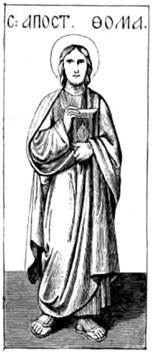
Святый Апостол Фома – по-Еврейски, Дидим – по-Гречески (то и другое значит близнец), родом из Галилеи, слыша проповедь Иисуса Христа, когда Он проходил по городам и селениям, уча и исцеляя людей, – видя Его чудеса, пошёл за Ним, неотступно пребывал при Нём во всё время Его служения спасению рода человеческого и удостоился быть в числе 12-ти Апостолов Его.
The Holy Apostle Thomas — in Hebrew, Didymus in Greek (both meaning twin), was a native of Galilee. Hearing the preaching of Jesus Christ as He passed through cities and villages, teaching and healing people, and seeing His miracles, he followed Him, remaining unceasingly with Him throughout the entire time of His ministry for the salvation of the human race, and was deemed worthy to be numbered among His twelve Apostles.
Фома был глубоко предан Христу. Когда Иисус перед тем, чтобы совершить воскрешение умершего Лазаря, намеревался пойти опять в Иудею, и ученики возразили Ему: «Равви! давно ли Иудеи искали побить Тебя камнями, и Ты опять идёшь туда?» то «Фома сказал ученикам: пойдём и мы, и умрём с Ним» (Ин.11:8, 16). – Когда Иисус в последней беседе со Своими учениками говорил им, что идёт приготовить место им в обителях Отца Своего, а потом придёт опять и возьмёт их к Себе, чтобы они были там, где Он, то «Фома сказал Ему: Господи! не знаем, куда идёшь, и как можем знать путь?»
Thomas was deeply devoted to Christ. When Jesus, before raising the dead Lazarus, intended to go again into Judea, and the disciples objected to Him: "Rabbi, the Jews were but now seeking to stone You, and are You going there again?" then "Thomas said to the disciples: Let us also go, that we may die with Him" (Jn. 11:8, 16). — When Jesus, in His final discourse with His disciples, told them that He was going to prepare a place for them in the mansions of His Father, and would then come again and take them to Himself, that they might be where He is, "Thomas said to Him: Lord, we know not where You are going, and how can we know the way?"
На это скорбное недоумение любящей души Иисус отозвался: – «Я есмь путь, и истина, и жизнь; никто не приходит к Отцу, как только через Меня. Если бы вы знали Меня, то знали бы и Отца Моего. И отныне знаете Его и видели Его» ... (Ин.14:5–7).
To this sorrowful perplexity of a loving soul, Jesus responded: "I am the way, the truth, and the life; no one comes to the Father except through Me. If you had known Me, you would have known My Father also. From now on you know Him and have seen Him" ... (Jn. 14:5–7).
После этих двух упоминаний о Фоме записано ещё в Евангелии знаменательное явление Иисуса Христа Ему по воскресении: когда в первый день недели, в тот самый, что воскрес Христос, «вечером, когда двери дома, где собрались ученики Его, были заперты из опасения от Иудеев, пришёл Иисус и стал посреди, и говорит им: мир вам! Сказав это, Он показал им руки, и ноги, и ребра Свои. Ученики обрадовались, увидев Господа». Таким образом исполнилось предсмертное обещание Христа: «Я увижу вас опять, и возрадуется сердце ваше» (Ин.16:22).
After these two mentions of Thomas, there is also recorded in the Gospel a significant appearance of Jesus Christ to him after the Resurrection: when on the first day of the week, the very day on which Christ rose, "in the evening, when the doors of the house where the disciples were assembled were locked for fear of the Jews, Jesus came and stood in their midst, and said to them: Peace be with you! Having said this, He showed them His hands, and His feet, and His side. The disciples rejoiced when they saw the Lord." Thus was fulfilled Christ's pre-death promise: "I will see you again, and your heart will rejoice" (Jn. 16:22).
«Фома же, один из двенадцати, называемый Дидим, не был тут с ними, когда приходил Иисус. Другие ученики сказали ему: мы видели Господа. Но он сказал им: если не увижу на руках Его ран от гвоздей и не вложу перста моего в раны от гвоздей, и не вложу руки моей в рёбра Его – не поверю» (Ин.20:24–25). Такое недоверие не может ли быть объяснено только пламенным сожалением, что не привелось Апостолусобственными чувствами убедиться в явлении воскресшего Христа... потребностью не только видеть, но и осязать то, что только видели другие Апостолы и истины чего не могло отвергать его давно уверовавшее во всемогущество Сына Божия сердце...
"But Thomas, one of the twelve, called Didymus, was not with them when Jesus came. The other disciples said to him: We have seen the Lord. But he said to them: Unless I see in His hands the print of the nails, and put my finger into the print of the nails, and put my hand into His side, I will not believe" (Jn. 20:24–25). May not such disbelief be explained only by a burning regret that the Apostle was not granted to be convinced by his own senses of the appearance of the risen Christ... by a need not only to see, but also to touch what the other Apostles had only seen, and the truth of which his heart, long believing in the omnipotence of the Son of God, could not deny...
Между тем, допущенное не без промысла Божьего это проявление неверия одного из ближайших учеников Христа послужило окончательно – через осязание Апостолом Фомой язв Христовых – к яснейшему обнаружению истины воскресения Христова...
Meanwhile, this manifestation of unbelief in one of Christ's closest disciples, permitted not without the providence of God, served finally — through the Apostle Thomas's touching of Christ's wounds — for the clearest revelation of the truth of Christ's Resurrection...
«После осми дней, когда опять были в доме ученики Христовы, и Фома с ними, пришёл Иисус, когда двери были заперты, стал посреди их и сказал: мир вам!
"After eight days, when the disciples of Christ were again in the house, and Thomas with them, Jesus came, the doors being locked, stood in their midst and said: Peace be with you!
Потом говорит Фоме: подай перст твой сюда и посмотри руки Мои, подай руку твою и вложи в рёбра Мои; и не будь неверующим, но верующим» (Ин.20:26–27).
Then He said to Thomas: Reach your finger here, and see My hands; reach your hand and put it into My side; and be not unbelieving, but believing" (Jn. 20:26–27).
Но, увидев Христа и услышав Его обращение к нему, Фома только из глубины своего верующего сердца воскликнул: «Господь мой и Бог мой!» – «Иисус же говорит ему: ты поверил, потому что увидел Меня; блаженны не видевшие и уверовавшие» (Ин.20:29).
But having seen Christ and heard His address to him, Thomas only cried out from the depths of his believing heart: "My Lord and my God!" — "Jesus said to him: Because you have seen Me, you have believed; blessed are those who have not seen and yet have believed" (Jn. 20:29).
Таким образом неверие Апостола Фомы послужило и к тому, что Господь отозвался на него ясным указанием, каково должно быть свойство истинной веры в Него.
Thus the unbelief of the Apostle Thomas also served this purpose: that the Lord responded to it with a clear indication of what the nature of true faith in Him should be.
После вознесения Иисуса Христа и сошествия Духа Святого на Апостолов Фома проповедовал в Палестине, Месопотамии91 и других странах. О проповеди его у Парфян говорят церковные писатели Ориген, Евсевий, Руфин, Сократ; о проповеди в Ефиопии упоминает Иоанн Златоуст, о проповеди в Индии говорят Григорий Назианзен, Григорий Великий, – и другие о других местах92.
After the Ascension of Jesus Christ and the descent of the Holy Spirit upon the Apostles, Thomas preached in Palestine, Mesopotamia91, and other countries. Church writers Origen, Eusebius, Rufinus, and Socrates speak of his preaching among the Parthians; John Chrysostom mentions his preaching in Ethiopia; Gregory of Nazianzus, Gregory the Great, and others speak of his preaching in India, and still others of other places92.
В беседе LXI на Евангелие от Иоанна св. Иоанн Златоуст говорит о св. Апостоле Фоме: – «Фома, бывший некогда слабее других Апостолов в вере, сделался по благодати Божией мужественнее, ревностнее и неутомимее всех их, так что обошёл с своей проповедью почти всю землю, не убоявшись возвещать слово Божие народам свирепым, диким и кровожадным».
In his 61st homily on the Gospel of John, St. John Chrysostom says of the Holy Apostle Thomas: "Thomas, who was once weaker than the other Apostles in faith, became by the grace of God more courageous, more zealous, and more indefatigable than all of them, so that he went around almost the whole earth with his preaching, not fearing to proclaim the word of God to fierce, wild, and bloodthirsty peoples."
В различных древних сказаниях об Апостоле Фоме нет совершенной точности и к ним присоединяются иногда позднейшие прибавления, но одно из них, в котором приводится обстоятельство, выражающее смысл и значение благотворительности, передаётся одинаково многими повествователями об его жизни. Оно относится ко времени до предпринятия святым Апостолом путешествия в Индию – с целью проповеди в этой стране. Когда во время пребывания Апостола Фомы в Иерусалиме пришёл туда один Индейский купец и по поручению царя своего искал здесь художника, который взялся бы построить для царя роскошный дворец, то Фома, воспользовавшись этим случаем проникнуть в назначенные ему в удел для проповеди Евангельской восточные страны, выдал себя за искусного строителя и отправился в Индию с купцом. Прибыв туда и получив от царя деньги для сооружения дворца, Фома вместо того, чтобы исполнять то дело, которое он принял на себя, начал раздавать царское золото бедным и больным и вместе с тем, войдя таким образом в отношения с народом, начал усердно проповедовать ему слово Божие. Через несколько времени, когда царь пожелал узнать о ходе работ, ему было дано знать, что дворец будет скоро готов, что осталось только поставить крышу. Между тем, деньги, снова посланные царём, Фома по прежнему роздал нищим, говоря при этом: «благодарю Тебя, Господи, что Ты различными путями устраиваешь спасение людей!»
In various ancient accounts of the Apostle Thomas there is no perfect accuracy, and later additions are sometimes attached to them; but one of them, which recounts a circumstance expressing the meaning and significance of charity, is related identically by many narrators of his life. It pertains to the time before the holy Apostle undertook his journey to India for the purpose of preaching in that country. When, during the Apostle Thomas's stay in Jerusalem, an Indian merchant came there and, on behalf of his king, sought an artisan who would undertake to build a luxurious palace for the king, Thomas, taking advantage of this opportunity to penetrate the eastern countries appointed to him as his lot for Gospel preaching, gave himself out as a skilled builder and set off for India with the merchant. Arriving there and receiving money from the king for the construction of the palace, Thomas, instead of carrying out the task he had undertaken, began to distribute the king's gold to the poor and sick, and at the same time, having thus entered into relations with the people, began zealously to preach the word of God to them. After some time, when the king wished to know the progress of the work, he was informed that the palace would soon be ready, that only the roof remained to be put on. Meanwhile, the money sent again by the king, Thomas again distributed to the beggars, saying: "I thank You, Lord, that You arrange the salvation of people in various ways!"
Наконец, когда царь узнал, что Фома обманывает его и даже как будто смеётся над ним, потому что на расспросы его о постройке дворца Фома отвечал, что «царь в этой жизни не увидит выстроенных для него великолепных палат, но поселится в них и будет радоваться в них вечно только по смерти своей», то, разгневанный, велел заключить Фому в темницу и предать его смертной казни.
Finally, when the king learned that Thomas was deceiving him and even, as it were, mocking him, because in answer to his inquiries about the building of the palace Thomas replied that "the king will not see the magnificent chambers built for him in this life, but will settle in them and rejoice in them eternally only after his death," the enraged king ordered Thomas to be cast into prison and put to death.
Между тем внезапно опасно заболел любимый царский брат. Во время его болезни – в видении показаны ему были жилища, приготовленные для святых, и предложено было выбрать одно из них, которое ему больше всех понравится. Когда же он выбрал лучшее, то ангел сказал ему: это жилище ты не можешь занять, потому что Фома соорудил его на золото твоего брата, и оно принадлежит твоему брату – царю...
Meanwhile, the king's beloved brother suddenly fell dangerously ill. During his illness, dwellings prepared for the saints were shown to him in a vision, and he was offered to choose one of them which pleased him most. When he chose the best, the angel said to him: "You cannot occupy this dwelling, because Thomas built it with your brother's gold, and it belongs to your brother the king..."
Придя в себя, больной рассказал о видении своему брату и, уразумев смысл этого видения, царь вызвал из темницы строителя, обещавшего и действительно создавшего для него в неземном царстве царскую палату, и просветился от св. Апостола вместе с братом своим светом учения христианского, после чего уже беспрепятственно продолжал св. Апостол Фома распространять в Индии веру Христову – до тех пор, пока в Индии же, в городе Малипуре93, на восточной стороне полуострова, принял мученическую смерть за обращение в христианскую веру жены тамошнего властителя Тертианы и сестры её Мигдонии.
Coming to himself, the sick man told his brother of the vision, and having understood the meaning of this vision, the king summoned from prison the builder who had promised and indeed created for him a royal chamber in the heavenly kingdom, and was enlightened by the holy Apostle together with his brother with the light of Christian teaching. After this, the holy Apostle Thomas continued unhindered to spread the faith of Christ in India — until, in India itself, in the city of Malipur93, on the eastern side of the peninsula, he suffered a martyr's death for converting to the Christian faith the wife of the local ruler, Tertiana, and her sister, Mygdonia.
Мощи Апостола Фомы были перенесены в 385 г. в город Едессу, где построена была во имя его великолепная церковь, куда на поклонение мощам предпринимались путешествия из отдалённых стран94.
The relics of the Apostle Thomas were translated in the year 385 to the city of Edessa, where a magnificent church was built in his name, to which pilgrimages were undertaken from distant countries for the veneration of the relics94.
Из церковного предания известно, что в то время, когда наступило успение Божией Матери, Апостол Фома, проповедовавший Евангелие в отдалённой Индии, замедлил прибыть к погребению Богородицы, на котором присутствовали все собравшиеся ко дню пречестного её успения остальные Апостолы. И это послужило к тому, чтобы соделать известным, что Матерь Божия взята на небеса неразлучно с телом Своим.
From Church tradition it is known that at the time of the Dormition of the Mother of God, the Apostle Thomas, who was preaching the Gospel in distant India, was delayed in arriving for the burial of the Theotokos, at which all the other Apostles, gathered for the day of her most honorable Dormition, were present. And this served to make known that the Mother of God was taken up to heaven inseparably with her body.
Прибыв после погребения на 3-й уже день, Фома сильно скорбел, что не мог вместе с Апостолами проститься и проводить тело Богородицы. Чтобы утешить его, решено было общим советом Апостолов открыть гроб Божией Матери для Фомы, и тогда увидели, что в гробу лежат только её погребальные пелены, и узнали, что Она с плотью вознесена на небо95. И открылась полная слава Той, в Которой мир чтит несомненную и ближайшую перед Богом Заступницу рода христианского...
Arriving on the third day after the burial, Thomas grieved greatly that he could not, together with the Apostles, bid farewell and accompany the body of the Theotokos. To comfort him, it was decided by the common counsel of the Apostles to open the tomb of the Mother of God for Thomas, and then they saw that only her burial shrouds lay in the tomb, and they learned that She had been taken up to heaven in the flesh95. And the full glory of Her was revealed, in Whom the world honors the undoubted and closest Intercessor before God for the Christian race...
Святая Церковь воспевает святому Апостолу Фоме: – «Ученик Христов быв, Божественного собора Апостольского сопричастник, неверствием бо Христово воскресение известив, и Того пречистую страсть осязанием уверив, Фомо всехвальне, и ныне нам проси мира и велия милости!»
The Holy Church sings to the holy Apostle Thomas: "Having been a disciple of Christ and a partaker of the divine assembly of the Apostles, for by your unbelief you confirmed Christ's Resurrection, and by touching you assured His most pure Passion, O all-praised Thomas, now ask for us peace and great mercy!"
«Премудрости благодати исполнен, Христов Апостол и служитель истинный, в покаянии вопияше Тебе: Ты мой еси Бог же и Господь!»
"Filled with the grace of wisdom, O Apostle of Christ and true servant, in repentance you cried out to Thee: Thou art my God and Lord!"