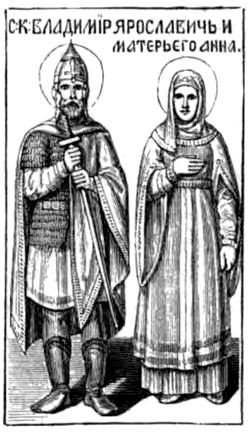
Владимир Ярославич, старший сын князя Ярослава великого, родился в 1020 г. В 1034 году великий князь Ярослав посадил его в Новгороде и дал Новгородцам грамоту, с повелением: «по этой грамоте давайте дань»51. В это время Владимир был ещё только 14 лет и без сомнения состоял под руководством опытного воеводы, каким был Вышата, и благочестивого епископа Луки. Возмужавший князь отличался в воинских делах отвагой и мужеством, свойственными роду его. В 1042 году ходил он с Новгородскими дружинами на Ямь, нынешних Финнов, и разбил их52. В следующем году Ярослав послал Владимира с сильным войском наказать коварных Греков за оскорбления Русских купцов и за умерщвление одного из них. Послы императора Мономаха вышли к Владимиру на встречу, с обещанием наказать виновных. Но тем, которые много раз обманывали, не верят, и князь шёл вперёд. Император велел взять под стражу всех Русских, бывших в Константинополе, и выслал корабли против судов Владимира. Три галеры с Греческим огнём врезались в средину Русских судов и зажгли их; поднявшаяся буря разметала и потопила малые суда Русские, в том числе и судно Владимира. Творимич. из дружины княжеской, спас своего князя и воевод Ярослава, взяв их к себе на лодку. Спасшиеся на берегу, в числе 6000, решились с Вышатой возвратиться на родину сухим путём, а князь с остальными судами пустился в обратный путь морем. Император послал за Русскими сухим путём и морем; 24 галеры обогнали Владимира и стали в заливе; князь разбил их на голову и пришёл в Киев с множеством пленных. Вышата отважно дрался с Дунайским Греческим войском; но оставшиеся в живых 800 человек взяты были в плен и только через три года отпущены были в Россию53. Сын благочестивого строителя Киевского Софийского храма оставил по себе прочный памятник благочестия в Новгороде – Софийский собор, доселе целый. Великолепный для того времени храм заложен был в 1045 г. и освящён сентября 14-го 1049 г.54, а перед тем построена была каменная крепость в Новгороде55. Благочестивый князь усердно поучался в законе Господнем: по его желанию списаны были (1047 г.) книги пророческие с толкованиями отцов; священник писал её 7 месяцев; много значило, что списана была полезная книга; а ещё более важно то, что списаны были книги слова Божия, а не слова человеческого56. Господь взял к Себе доброго князя ещё в молодых его летах: князь скончался 32 лет, 4 октября 1051 года, и положен был в созданном благочестивою ревностью его Софийском храме57. По летописи, уже в 1180 г. в мраморной гробнице благов. князя Владимира положен был искренно-христианский князь Мстислав58, и след. уже известны были нетленные мощи благоверного князя Владимира, и для них устроена была особая рака. «1439 г. архиепископ Евфимий позлати гроб князя Владимира, внука великого Владимира, и подписа; такожде и матери его гроб подписа и покров положи, и память им устави творити на всяко лето октября 4 дня»59.
Vladimir Yaroslavich, the eldest son of the great Prince Yaroslav, was born in the year 1020. In 1034, the great Prince Yaroslav placed him in Novgorod and gave the Novgorodians a charter, with the command: "according to this charter, give tribute"51. At this time Vladimir was only 14 years old and, without doubt, was under the guidance of an experienced voivode, such as Vyshata was, and of the pious Bishop Luke. When he came of age, the prince was distinguished in military affairs by the daring and courage characteristic of his line. In 1042, he went with the Novgorod druzhinas against the Yam, the present-day Finns, and defeated them52. In the following year, Yaroslav sent Vladimir with a strong army to punish the treacherous Greeks for the insults to Russian merchants and for the murder of one of them. The envoys of the Emperor Monomachus came out to meet Vladimir, with a promise to punish the guilty. But those who have deceived many times are not believed, and the prince pressed forward. The emperor ordered all Russians who were in Constantinople to be taken into custody, and sent out ships against Vladimir's vessels. Three galleys with Greek fire cut into the midst of the Russian ships and set them ablaze; a storm that arose scattered and sank the small Russian vessels, including Vladimir's own ship. Tvorimich, one of the prince's druzhina, saved his prince and Yaroslav's voivodes, taking them into his boat. Those who escaped to shore, numbering 6000, resolved with Vyshata to return to their homeland by land, while the prince with the remaining ships set out on the return journey by sea. The emperor sent forces after the Russians both by land and by sea; 24 galleys overtook Vladimir and took up position in the bay; the prince utterly defeated them and arrived in Kiev with a multitude of captives. Vyshata fought bravely against the Greek army on the Danube; but the 800 men who remained alive were taken captive and were released to Rus' only after three years53. The son of the pious builder of the Kiev Sophia cathedral left behind a lasting monument of piety in Novgorod—the cathedral of St. Sophia, still intact to this day. This temple, magnificent for its time, was founded in 1045 and consecrated on September 14, 104954, and before that a stone fortress was built in Novgorod55. The pious prince diligently learned in the law of the Lord: at his desire, the prophetic books with commentaries of the fathers were copied (in 1047); the priest wrote them for seven months; it was significant that a useful book was copied; but even more important was that the books of the word of God were copied, and not the word of man56. The Lord took the good prince to Himself while he was still in his youthful years: the prince reposed at the age of 32, on October 4, 1051, and was laid to rest in the Sophia cathedral built by his pious zeal57. According to the chronicle, already in 1180, the sincerely Christian Prince Mstislav was laid in the marble tomb of the right-believing Prince Vladimir58, and therefore the incorrupt relics of the right-believing Prince Vladimir were already known, and a special reliquary was prepared for them. "In 1439, Archbishop Euthymius gilded the tomb of Prince Vladimir, the grandson of the great Vladimir, and inscribed it; likewise he inscribed the tomb of his mother and placed a cover upon it, and established that their memory be celebrated every year on October 4"59.
Св. мать святого князя Владимира, супруга великого князя Ярослава, преставилась февраля 10-го 1051 г.60. Блаженный Иларион митр. в одушевлённой речи своей говорит равноапостольному Владимиру: «посмотри и на благоверную сноху твою Ирину; посмотри на внуков и правнуков твоих, как содержат они благоверие, тобою преданное; как часто посещают святые храмы, как славят Христа, как поклоняются имени Его»61. По этой хвале видим, что благоверная княгиня была благочестива не только для себя, но воспитывала благочестие в детях и внуках своих. По житию преп. Феодосия видим, что, когда мать Феодосия объявила желание поступить в монастырь (а это было в 1036 г.), св. Антоний «возвестил о ней княгине, и та приняла её в женский монастырь святого Николая»62. Это показывает, как великая княгиня рада была делать дела добрые и как она уважала таких людей, каков Антоний. Женский монастырь св. Ирины, построенный Ярославом в Киеве, конечно построен был и по усердию благочестивой супруги его Ирины. Нежная мать с первенцем своим переселилась из Киева в Новгород и здесь провела последнее время жизни своей. – Дочь Олава, короля Шведского, называвшаяся в земле своей Ингигердой, по-Гречески Ириной, перед кончиной своей приняла иночество с именем Анны и первая показала пример князьям и княгиням Русским, как приятно душе менять пышную княжескую одежду на рубище иноческое. На древних Новгородских иконах она именуется святой Анной. Мощи её почивают поныне открыто в Софийском соборе, где память её совершается окт. 4 и февр. 10 д.63.
The holy mother of the holy Prince Vladimir, the spouse of the Grand Prince Yaroslav, reposed on February 10, 105160. Blessed Metropolitan Hilarion, in his inspired discourse, says to Equal-to-the-Apostles Vladimir: "Behold also your right-believing daughter-in-law Irene; behold your grandsons and great-grandsons, how they preserve the right-believing faith handed down by you; how often they visit the holy churches, how they glorify Christ, how they worship His name"61. From this praise we see that the right-believing princess was pious not only for herself, but nurtured piety in her children and grandchildren. From the life of the Venerable Theodosius we see that, when the mother of Theodosius declared her desire to enter a monastery (and this was in 1036), St. Anthony "announced it to the princess, and she received her into the women's monastery of St. Nicholas"62. This shows how glad the Grand Princess was to do good deeds and how she respected such men as Anthony. The women's monastery of St. Irene, built by Yaroslav in Kiev, was of course built also through the zeal of his pious spouse Irene. The tender mother, together with her firstborn, moved from Kiev to Novgorod and spent the last time of her life there. — The daughter of Olaf, King of Sweden, called in her own land Ingigerd, in Greek Irene, before her end received monasticism with the name Anna, and was the first to show an example to Russian princes and princesses of how pleasant it is for the soul to exchange splendid princely raiment for the beggar's garb of a monk. On ancient Novgorod icons she is called St. Anna. Her relics repose to this day uncovered in the Sophia cathedral, where her memory is celebrated on October 4 and February 1063.
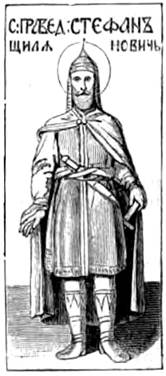
Праведный Стефан Щилянович родился от родителей благочестивых в Жупе, ныне называемой Паштровитье, в южной стороне Захолмья. Ещё в юности оказался он Боголюбивым; когда же достиг зрелого возраста, то старался исполнять волю Божию со всем усердием. Он был умён, храбр, хорошо знаком с военным делом. Вступив в службу при Сербском деспоте, выполнял все поручения верно и успешно. Вместе с тем пребывал он верным слугой перед Господом: страхом Божиим отгонял он от себя самые помыслы греховные, тем более не допускал душу до того, чтобы овладел ею какой-либо грех. Храм арх. Михаила в Призрене, построенный благочестивым воеводой Щиляновичем, поныне ещё цел64. – За верную службу деспот дал ему земли близ Срема. Стефан жил здесь праведником: делился избытками и с бедными и в сношениях с соседями соблюдал честность и правду. Случился жестокий голод в крае, не от неурожая хлеба, а от того, что нечестивые Турки, воюя не один год с Сербами, угнали весь скот у христиан и лишили средств к обрабатыванию земли. Праведный Стефан открыл житницы свои для несчастных и кормил бедность в голодное время.
The Righteous Stephen Shchilyanovich was born of pious parents in Zhupa, now called Pashtrovitje, in the southern part of Zaholmye. Even in his youth he showed himself to be a lover of God; and when he reached mature age, he strove to fulfill the will of God with all diligence. He was intelligent, brave, and well-versed in military affairs. Having entered the service of the Serbian Despot, he carried out all commissions faithfully and successfully. At the same time, he remained a faithful servant before the Lord: with the fear of God he drove away from himself even sinful thoughts, and still less did he allow his soul to be possessed by any sin. The church of the Archangel Michael in Prizren, built by the pious voivode Shchilyanovich, remains intact to this day64. — For his faithful service, the Despot gave him lands near Srem. Stephen lived here as a righteous man: he shared his abundance with the poor, and in dealings with his neighbors he observed honesty and truth. A severe famine occurred in the region, not from a failure of the grain harvest, but because the impious Turks, warring for many years with the Serbs, drove away all the cattle of the Christians and deprived them of the means to till the land. The Righteous Stephen opened his granaries to the unfortunate and fed the poor during the time of famine.
Поелику же насилия и грабежи Турок не прекращались и после голодного года, а защищаться от них не было сил, то Стефан вынужден был отдаться под защиту Венгерского короля. Король с удовольствием принял в службу честного и храброго воина; он подарил ему прекрасные земли по берегам Дравы65. Праведник продолжал жить для ближних и в страхе Божием. В 1515 году блаженно скончался он. Супруга его Елена, с честью похоронив тело его, удалилась к родным в Германию. Спустя неделю после того Турки завладели краем. В одно время увидали они над могилой свет. Думая найти зарытое серебро, откопали могилу и увидали нетленное тело. – По докладе паше, стали расспрашивать: кто похоронен был? Знавшие объявили, что это – праведный Стефан, благотворитель бедных. Оказалось, что паша, бывший христианин, был родственником блаж. Стефана Щиляновича. Благоговейные иноки выпросили у паши за щедрый подарок мощи праведника и перенесли их в монастырь Фруштской горы. Шишатовец. Супруга Елена, услыхав о нетленном теле праведного мужа, хотя и была удерживаема родными, поспешила прибыть в Шишатовец и облобызала мощи праведника. Приняв монашество, она стала жить уединённо невдали от монастыря, в молитве и посте. Спустя три года она скончалась и похоронена была в обители. Мощи праведного Стефана почивают в храме обители66.
Since the violence and plundering of the Turks did not cease even after the year of famine, and there was no strength to defend against them, Stephen was compelled to place himself under the protection of the King of Hungary. The king gladly received the honest and brave warrior into his service; he granted him beautiful lands along the banks of the Drava65. The righteous man continued to live for his neighbors and in the fear of God. In the year 1515, he blessededly reposed. His wife Helena, having honorably buried his body, withdrew to her relatives in Germany. A week later, the Turks took possession of the region. At one time they saw a light over the grave. Thinking to find buried silver, they dug up the grave and saw the incorrupt body. — Upon reporting to the pasha, they began to inquire: who had been buried? Those who knew declared that it was the Righteous Stephen, a benefactor of the poor. It turned out that the pasha, a former Christian, was a relative of the blessed Stephen Shchilyanovich. The reverent monks, with a generous gift, obtained the relics of the righteous man from the pasha and transferred them to the monastery of Frushka Gora, Shishatovac. His wife Helena, hearing of the incorrupt body of her righteous husband, although detained by her relatives, hastened to come to Shishatovac and venerated the relics of the righteous man. Having received monasticism, she began to live in seclusion not far from the monastery, in prayer and fasting. After three years she reposed and was buried in the monastery. The relics of the Righteous Stephen repose in the monastery church66.
Св. священномуч. Иерофея, епископа Афинского. Друг Дионисия Ареопагита, подобно ему, хотя несколько позже, обращён к вере Апостолом Павлом; после Дионисия епископствовал в Афинах и скончался мученически.
The holy Hieromartyr Hierotheus, Bishop of Athens. A friend of Dionysius the Areopagite, like him, though somewhat later, he was converted to the faith by the Apostle Paul; after Dionysius he was bishop in Athens and died a martyr.
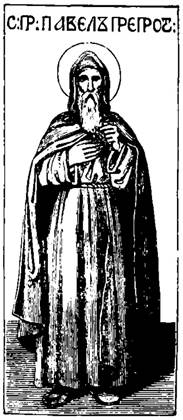
Павел был земледелец; до старости жил он в мире и постоянно, но с терпением и незлобием переносил оскорбления и огорчения от своей злой и неверной жены. Потеряв наконец надежду на её исправление, Павел, не сделав даже жене своей никакого упрёка, оставил свой дом и отошёл в пустыню.
Paul was a farmer; he lived in the world until old age, and constantly, but with patience and meekness, he bore the insults and vexations from his wicked and unfaithful wife. Having at last lost hope of her correction, Paul, without even making any reproach to his wife, left his house and went into the desert.
Побывав в нескольких монастырях, он прибыл во внутреннюю пустыню, где подвизался преп. Антоний Египетский, и, войдя в его уединённую келью, на вопрос Антония, чего он желает? – отвечал, что желает быть иноком.
Having visited several monasteries, he arrived in the inner desert, where the Venerable Anthony of Egypt was struggling, and entering his solitary cell, in answer to Anthony's question, what he desired? — he replied that he desired to be a monk.
– Ты не можешь быть иноком, – возразил пришельцу подвижник, – ты уже стар, тебе трудно будет перенести скорби жизни в пустыне; возвратись лучше в твоё селение к твоему привычному труду и продолжай работать, благодаря Бога.
— You cannot be a monk, — the ascetic objected to the newcomer, — you are already old; it will be difficult for you to bear the sorrows of life in the desert; return rather to your village, to your accustomed labor, and continue to work, giving thanks to God.
– Если ты так желаешь быть иноком, то пойди в общежительный монастырь, где много братий, которые могут снисходить к твоим немощам. А я здесь живу один, ем через пять дней и то не досыта, – снова отказал Антоний и запер дверь своей кельи и три дня из неё не выходил.
— If you so much desire to be a monk, then go to a cenobitic monastery, where there are many brethren who can be indulgent toward your infirmities. But I live here alone, I eat every five days and even then not to satiety, — Anthony refused again and shut the door of his cell, and did not come out of it for three days.
Видя, что при нём нет никакого съестного запаса, и опасаясь, что он может умереть с голода, Антоний ввёл его к себе и сказал: – можешь спастись, если будешь послушен, – и чтобы испытать Павла, налагал на него труды, какие не по силам человеку и в молодые годы. Антоний заставлял старца подолгу стоять на зное и дожидаться, совершая во всё это время молитву, пока он не принесёт ему работу; потом, намочив финиковые ветви, давал ему плести из них верёвку, и когда Павел, с трудом окончив своё плетение к вечеру, подавал его своему наставнику, тот заставлял его расплетать и переплетать вновь. Точно также приходилось Павлу шить, распарывать и перешивать снова одежду, и при этом по нескольку дней оставаться без пищи и, едва уснув, вставать с полночи и петь псалмы до самого дня.
Seeing that he had no food supplies with him, and fearing that he might die of hunger, Anthony brought him into his cell and said: "You can be saved if you are obedient"—and to test Paul, he imposed upon him labors beyond the strength of a man even in his youth. Anthony made the elder stand for a long time in the heat and wait, praying all the while, until he brought him work; then, having soaked date branches, he gave them to him to plait into rope, and when Paul, having with difficulty finished his plaiting by evening, handed it to his teacher, he made him unplait and plait it anew. Likewise, Paul had to sew, rip apart, and sew his clothing again, and at the same time remain without food for several days, and, having barely fallen asleep, rise at midnight and sing psalms until daybreak.
Ни разу не возроптал Павел, но все свои послушания исполнял в простоте сердца с усердием. Тогда Антоний сказал ему: – во имя Господа Иисуса ты подлинно уже стал монахом; живи теперь один, чтобы испытать искушения и от духов злобы... – И на некотором расстоянии от своей пещеры в горе выстроил для него келью.
Never once did Paul murmur, but performed all his obediences in simplicity of heart with zeal. Then Anthony said to him: "In the name of the Lord Jesus, you have truly become a monk; now live alone, so that you may experience temptations from the spirits of evil..." And at some distance from his own cave in the mountain, he built a cell for him.
И скоро обнаружилось, что недавний монах, стяжавший ещё своей жизнью в мире такие сокровища, как незлобие, простота сердца, терпение и смирение, возвысился до такого совершенства, какого иные могли достигнуть только путём долгих, тяжёлых подвигов пустынного жития. И Бог даровал в простоте сердца и с безусловным послушанием предавшемуся Ему чудную прозорливость и благодатную силу исцеления недугов и изгнания злых духов.
And soon it became evident that the recent monk, who had already acquired in his life in the world such treasures as guilelessness, simplicity of heart, patience, and humility, had risen to a perfection that others could attain only through long and severe ascetic labors of the desert life. And God granted to him, who had surrendered himself in simplicity of heart and unconditional obedience, a wondrous clairvoyance and a grace-filled power to heal ailments and cast out evil spirits.
«Бог даровал Павлу такую благодать, – говорит древний историк, – что он в каждом видел, какова его душа, так, как мы друг у друга лица. Однажды он пришёл в монастырь Писпер для посещения братии. Братия пошли в церковь для совершения обычной службы. Смотря на всех входящих в церковь, Павел видел души их светлыми и радостными, но один из братий вошёл весь омрачённый, как бы окружённый духами злобы. Горько заплакал Павел, сел на пороге церкви и проплакал всё время, пока продолжалась служба. Когда же служба кончилась и братия стали выходить, то Павел увидел, что тот же бывший расстроенным брат шёл между другими спокойный и просветлённый. Павел вскрикнул от радости и, остановив его при всех, обратился к нему: «ради общей пользы скажи нам, – просил он, – как случилось, что ты, такой расстроенный прежде, теперь совсем иной?»
“God granted Paul such grace,” says an ancient historian, “that he saw in each man what his soul was like, just as we see each other’s faces. Once he came to the monastery of Pisper to visit the brethren. The brethren went to church to perform the usual service. Looking at all those entering the church, Paul saw their souls bright and joyful, but one of the brethren entered entirely darkened, as if surrounded by spirits of evil. Paul wept bitterly, sat down on the threshold of the church, and wept throughout the entire service. When the service ended and the brethren began to come out, Paul saw that the same brother who had been distressed was now walking among the others calm and illumined. Paul cried out with joy and, stopping him before all, addressed him: ‘For the common benefit, tell us,’ he said, ‘how did it happen that you, so distressed before, are now completely different?’
– Да, я был другим человеком; в моей душе жил грех, – чистосердечно отвечал инок, – я жил порочно и беззаботно, но когда я услышал сегодня в храме слова пророка: «омойтесь, очиститесь; перестаньте делать зло... Тогда приидите, – говорит Господь, – и если будут грехи ваши, как багряное, Я их как снег убелю; если будут красны, как пурпур, как волну убелю»... (Ис.1:16–18), то внезапно почувствовал решимость изменить, исправить жизнь мою... и теперь обещаю перед всеми, что буду служить Богу от искреннего сердца...
“Yes, I was a different man; sin dwelt in my soul,” the monk replied candidly. “I lived viciously and carelessly, but when I heard today in church the words of the prophet: ‘Wash yourselves, cleanse yourselves; cease to do evil... Then come,’ says the Lord, ‘and if your sins are as scarlet, I will whiten them like snow; if they are red as purple, I will whiten them like wool’... (Is. 1:16–18), then suddenly I felt the resolve to change, to correct my life... and now I promise before all that I will serve God from a sincere heart...”
– Видите, братия, – выслушав это признание, радостно сказал Павел, – как Господь готов принять каждого грешника, только бы приходили к Нему!68
“You see, brethren,” Paul said joyfully, having heard this confession, “how ready the Lord is to receive every sinner, if only they would come to Him!”68
И много было других случаев, когда молитва Павла верующего в Бога в простоте души, производила чудотворное действие. – Указывая на пример Павла, безропотным послушанием в короткое время достигшего высокого совершенства, преп. Антоний говорил: «если кто хочет скоро достигнуть совершенства, не должен быть сам себе учителем, ни повиноваться своей воле, хотя бы своё желание казалось правым, но, по заповеди Спасителя, каждый прежде всего должен отречься себя самого, отказаться от своей воли. Сам Спаситель говорит о Себе: «не пришел Я творить волю Мою, но волю Пославшего Меня» ... Как же мы избежим суда, если будем исполнять волю свою?»
And there were many other instances when the prayer of Paul, who believed in God in simplicity of soul, produced a miraculous effect. Pointing to the example of Paul, who through uncomplaining obedience attained high perfection in a short time, the Venerable Anthony said: “If anyone wishes to attain perfection quickly, he must not be his own teacher, nor obey his own will, even if his own desire seems right, but, according to the commandment of the Savior, each must first of all deny himself and renounce his own will. The Savior Himself says of Himself: ‘I did not come to do My will, but the will of Him who sent Me’... How then shall we avoid judgment if we fulfill our own will?”
Писатель жития препод. Павла такими словами заключает свой рассказ о нём: – «пожил же праведный в святой простоте своей лет довольно и, много чудес сотворив, отошёл ко Господу. Иже прост на земле бе, ныне премудрейший есть на небеси, паче всех любомудрцев мира сего, и с мудрыми херувимами зрит Христа, Божию силу и Божию премудрость; то бо есть мудрость правая, еже боятися Бога и Ему в простоте духа и незлобии сердца работающи благоугождати. Молитвами, Господи, угодника Твоего, Препростаго Павла, умудри нас в делании заповедей Твоих; даждь нам начало премудрости – страх Твой имети, да страхом Твоим уклонившись от зла, сотворим благое пред Тобою и обрящем милость Твою во веки».
The writer of the life of the Venerable Paul concludes his account of him with these words: “The righteous one lived in his holy simplicity for many years and, having worked many miracles, departed to the Lord. He who was simple on earth is now the wisest in heaven, more than all the philosophers of this world, and with the wise cherubim beholds Christ, the power of God and the wisdom of God; for that is true wisdom—to fear God and to please Him, working in simplicity of spirit and guilelessness of heart. By the prayers, O Lord, of Thy saint, the Simple Paul, make us wise in the fulfillment of Thy commandments; grant us the beginning of wisdom—to have Thy fear, so that through Thy fear, turning away from evil, we may do good before Thee and find Thy mercy forever.”
Аммон, родившийся в III стол. в Египте от богатых и благородных родителей, по желанию их, несмотря на то, что сам предпочитал безбрачную жизнь, вступил в супружество. Встретив же в жене своей согласную во всём с его понятиями подругу, он после 18-ти лет девственной жизни под одним кровом с нею, предоставив ей отдельную жизнь, с согласия её удалился в пустыню и, найдя уединённое место на южной стороне Мареотского озера за так-называемой Нитрийской горой (в нижнем Египте, в 70-ти милях от Александрии), поселился здесь и 22 года провёл в строжайшем подвижничестве.
Ammon, born in the 3rd century in Egypt to wealthy and noble parents, at their desire, despite his own preference for a celibate life, entered into marriage. Having found in his wife a companion who agreed with him in all his views, after eighteen years of a virginal life under the same roof with her, he granted her a separate life and, with her consent, withdrew into the desert. Finding a solitary place on the southern side of Lake Mareotis beyond the so-called Nitrian Mountain (in Lower Egypt, seventy miles from Alexandria), he settled there and spent twenty-two years in the strictest asceticism.
Когда, в начале избранной им жизни, Аммон посетил Антония, подвизавшегося в это же время, то великий подвижник сказал ему: «ты успеешь в страхе Божием», – потом вывел его из кельи и, указав ему камень, сказал: «брани этот камень и бей его».
When, at the beginning of his chosen life, Ammon visited Anthony, who was also laboring in asceticism at that time, the great ascetic said to him: "You will succeed in the fear of God." Then he led him out of his cell and, pointing to a stone, said: "Curse this stone and strike it."
– В эту меру придёшь и ты, – прозорливо сказал Антоний. – И действительно, Аммон отличался всегда особенной снисходительностью к немощам ближнего69.
"To that measure you will come," said Anthony prophetically. And indeed, Ammon was always distinguished by a special indulgence toward the infirmities of his neighbor.69
Аммон не только сам посещал Антония, но удостоился посещения и этого великого образца пустынножителей и по его благословению основал в Нитрийской пустыне кельи для иноков, которые прежде того жили скитски, каждый отдельно и по своему правилу. Слава монастыря Аммонова привлекала к нему учеников из далёких стран, между ними – Милета, епископа Сузского (прославленного впоследствии мученическою смертью, память его 10 ноября), – и к концу IV века было уже до 50 обителей на Нитрийской горе, на которой Аммон был первым отшельником.
Ammon not only visited Anthony himself, but was also deemed worthy of a visit from this great model of the desert-dwellers, and with his blessing founded cells in the Nitrian desert for monks who had previously lived scattered in a skete manner, each separately and according to his own rule. The fame of Ammon’s monastery attracted disciples from distant lands, among them Miletus, Bishop of Susa (later glorified by a martyr’s death, his memory on November 10), and by the end of the 4th century there were already up to fifty monasteries on the Nitrian Mountain, where Ammon was the first hermit.
Известный своей строгой жизнью, Аммон ещё при жизни прославлен был даром чудотворений. Однажды привели к нему отрока, укушенного бешеной собакой, чтобы он исцелил его своей молитвой.
Known for his strict life, Ammon was glorified even during his lifetime with the gift of wonderworking. Once, a youth who had been bitten by a rabid dog was brought to him to be healed by his prayer.
– Чего вы просите у меня? – сказал Аммон родителям больного, – от вас самих зависит, чтобы сын ваш был здоров: возвратите бедной вдове вола, которого вы у неё украли, и сын ваш выздоровеет...
"What do you ask of me?" said Ammon to the parents of the sick boy. "It depends on you yourselves for your son to be healthy: return to the poor widow the ox which you stole from her, and your son will recover..."
Преп. Аммон скончался около 350 г., «не позже 350 г., т. е. кончины преп. Антония, который, в самую минуту преставления преп. Аммона, видел душу его, возносимую ангелами»70.
The Venerable Ammon reposed around the year 350, "not later than 350, i.e., the repose of the Venerable Anthony, who, at the very moment of the repose of the Venerable Ammon, saw his soul being borne up by angels."70
О жене Аммона Нитрийского, неизвестной по имени, передаётся, что она, «после удаления своего мужа в пустыню, в своём доме собрала до 70-ти девственниц, и в посте и молитве подвизалась с ними. Два раза в год она посещала своего мужа, чтобы пользоваться его советами и наставлениями»71.
Of Ammon of Nitria's wife, unknown by name, it is related that she, "after her husband's withdrawal into the desert, gathered up to seventy virgins in her own home and labored in asceticism with them in fasting and prayer. Twice a year she visited her husband to benefit from his advice and instructions."71
Собр. лет. I, 67. III, 2. 121. V, 134, Супрасльск. лет. 13. В нов. лет. освящение отнесено к 6560 г. Но по другим оно было сент. 14 6558 г. Собр. лет. V, 138. VII, 332.
Collection of Chronicles I, 67. III, 2. 121. V, 134, Suprasl Chronicle 13. In the new chronicle, the consecration is ascribed to the year 6560. But according to others, it was September 14, 6558. Collection of Chronicles V, 138. VII, 332.
Исследование о переводе пророчеств, вошедших в список священника Упира – в описании Синод. рукоп. I, 112–120. Обзор толкований – в опис. Синод. рукоп. 2, 113–117.
Study on the translation of the prophecies included in the list of Priest Upir—in the Description of Synodal Manuscripts I, 112–120. Survey of interpretations—in the Description of Synodal Manuscripts 2, 113–117.
Собр. лет. I, 69. III, 2. 121. 212. V, 138. В Новгородском синодике супруга кн. Владимира кн. Александра, а мать – христолюбивая княгиня Анна. Опис. Рум. муз. 571. Описание Новг. Соф. соб., стр. 103. 104.
Collection of Chronicles I, 69. III, 2. 121. 212. V, 138. In the Novgorod Synodicon, the wife of Prince Vladimir is Princess Alexandra, and the mother is the Christ-loving Princess Anna. Description of the Rumyantsev Museum 571. Description of the Novgorod St. Sophia Cathedral, pp. 103, 104.
Собр. лет. I, 63. V, 138. Февраль мартовского 1050 г. принадлежит к 1051 январскому году. Потому и в надгробной надписи справедливо показан 1051 г. годом кончины св. Анны.
Collection of Chronicles I, 63. V, 138. February of the March year 1050 belongs to the January year 1051. Therefore, the epitaph correctly gives the year 1051 as the year of the repose of St. Anna.
Μ. Илариона похвала кагану Владимиру – в прибавл. к твор. отц. 2, 279. Иларион говорил похвалу свою ранее 10 февраля сентябрьского 6559 г.
Metropolitan Hilarion's Eulogy to the Kagan Vladimir—in the Supplements to the Works of the Fathers 2, 279. Hilarion delivered his eulogy before February 10 of the September year 6559.
Собр. лет. I, 65. II, 24. Синопсис 62. Карамз. 2, пр. 34. Недавно ошибочно писали: «мать Владимира во св. крещении названа св. Анной». Стыдно ныне говорить такую неправду.
Collection of Chronicles I, 65. II, 24. Synopsis 62. Karamzin 2, note 34. Recently it has been mistakenly written: "the mother of Vladimir was named St. Anna in holy baptism." It is shameful to utter such a falsehood now.
В нынешней Славонии. О переселениях Сербов 1481–1526 г. с правого на левый берег Дуная см. у Попова: Сербы в Австрии (Русский Вестник 1865 г. май), стр. 264, 265.
In present-day Slavonia. On the migrations of the Serbs from 1481–1526 from the right to the left bank of the Danube, see Popov: Serbs in Austria (Russian Messenger, May 1865), pp. 264, 265.
Синаксарь и служба в сербляке 1861 г. На картинке св. Стефан назван деспотом и изображён в деспотском одеянии. Но синаксарь не говорит, что он был деспотом. Раича 3. 338. Попов в вестнике 1865 г. стр. 365.
Synaxarion and service in the Serbian Menaion of 1861. In the picture, St. Stephen is called a despot and depicted in despotic vestments. But the synaxarion does not say that he was a despot. Raić 3. 338. Popov in the Messenger of 1865, p. 365.