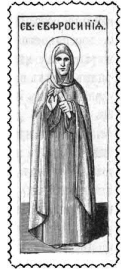
При Феодосии Младшем в Александрии жил добрый христианин Пафнутий, человек очень богатый и уважаемый. Жена его была также добрая христианка и долго не рождала детей. Пафнутий много делал благодений для обителей и бедных. Наконец родилась ему дочь Евфросинья. Ей дано было образование по состоянию. На 12 году, лишась матери, дочь стала предметом самых нежных забот отца. Умная и красавица собой, она пленяла молодых людей. Нежный отец, сделав выбора между женихами, обещал руку дочери молодому человеку, отличному по уму, по сердцу и по благородному происхождению. Но блаженная Евфросинья, воспитанная с юности в благочестии, желала пламенно жить для одного Господа. Она теперь скорбела о том, выполнится ли желание ее.
In the reign of Theodosius the Younger, there lived in Alexandria a good Christian named Paphnutius, a very wealthy and respected man. His wife was also a good Christian and for a long time bore no children. Paphnutius performed many good deeds for monasteries and the poor. At last a daughter, Euphrosyne, was born to him. She was given an education befitting her station. At the age of 12, having lost her mother, the daughter became the object of her father’s most tender care. Intelligent and beautiful, she captivated young men. Her tender father, having made a choice among the suitors, promised his daughter’s hand to a young man distinguished for his mind, his heart, and his noble birth. But the blessed Euphrosyne, raised from youth in piety, ardently desired to live for the Lord alone. She now grieved over whether her wish would be fulfilled.
Один из братий обители, которой особенно благотворил Пафнутий, послан был игуменом пригласить благотворителя на храмовой праздник обители. Не застав в доме отца, он увиделся с дочерью. Евфросинья, расспросив его подробно о жизни монастырской, открылась перед ним, что очень желает она посвятить себя на служение Богу, но что отец, который страстно любит ее, уже отдал руку ее жениху и никак не согласится отпустить ее в монастырь. Инок объяснил ей преимущества девства371 и дал совет пригласить к себе старца, иеромонаха их, когда отец будет на празднике обители. Евфросинья так и поступила и провела ночь в молитве – о исполнении над ней воли Божьей. Пришедший старец, после беседы о значении самоотречения христианского, остриг волосы ее и одел ее в иноческую одежду. Осталось скрыться в обитель, но какую? В девичьей обители страстный отец мог отыскать ее. Евфросинья оделась в одежду инока и явилась с именем евнуха Смарагда в обитель Феодосиеву, где было по 350 братий.
One of the brethren of the monastery to which Paphnutius was especially beneficent was sent by the abbot to invite the benefactor to the monastery’s patronal feast. Not finding the father at home, he met with the daughter. Euphrosyne, having questioned him in detail about the monastic life, revealed to him that she greatly desired to dedicate herself to the service of God, but that her father, who loved her passionately, had already given her hand to a suitor and would by no means consent to let her go to a monastery. The monk explained to her the advantages of virginity371 and advised her to invite an elder, their hieromonk, to her when her father would be at the monastery feast. Euphrosyne did so and spent the night in prayer for the fulfillment of God’s will concerning her. The elder who came, after a conversation on the meaning of Christian self-denial, cut her hair and clothed her in the monastic habit. It remained to hide herself in a monastery, but which one? In a convent, her passionate father could find her. Euphrosyne dressed herself in the garb of a monk and appeared under the name of the eunuch Smaragdus at the monastery of Theodosius, where there were up to 350 brethren.
Феодосий, которому Евфросинья назвала себя евнухом, служившим при царском дворе, по наскучившим мирской суетой, поручил Смарагда опытному иноку Агапиту. Евфросиньи было тогда 18 лет.
Theodosius, to whom Euphrosyne introduced herself as a eunuch who had served at the imperial court, weary of worldly vanity, entrusted Smaragdus to the experienced monk Agapitus. Euphrosyne was then 18 years old.
Красота Смарагда, похожая на красоту женскую, стала предметом смущения для некоторых, которые еще не победили своих немощей, и они жаловались на то настоятелю. Игумен призвал Смарагда и предложил ему жить в уединенной келье. Евфросинья с радостью приняла совет. В строгом затворе прожила она 18 лет.372 В продолжении этого времени отец много раз бывал в монастыре со скорбью о пропавшей дочери и просил братию молиться об отыскании следов ее. Раз, когда он особенно сильно скорбел перед настоятелем о дочери, настоятель говорит ему: «не хочет ли он побеседовать с благочестивым братом, служившим при дворе императора Феодосия?» Пафнутий изъявил желание. Настоятель приказал Агапиту отвесть Пахомия к затворнику Смарагду. Евфросинья, увидев любящего отца, заплакала. Но Пафнутий не узнал дочери: красота ее от бдений и слез поблекла, да и она же закрыла лице свое головным покрывалом. Она говорила отцу о вечности, о смирении, о чистоте, о любви и милосердии, приближающих к Богу – благости бесконечной; говорила о том, что любовь к детям не должна превышать любви к Господу и что скорби времени, если переносятся терпеливо, усовершают душу для неба; уверяла его благостию Божьей, что дочь его при стольких молитвах непременно была бы найдена, если бы была на пути недобром, и что, во всяком случае, Господь утешит его в свое время.
The beauty of Smaragdus, resembling feminine beauty, became a cause of disturbance for some who had not yet overcome their infirmities, and they complained about it to the superior. The abbot summoned Smaragdus and proposed that he live in a solitary cell. Euphrosyne gladly accepted the advice. In strict seclusion she lived for 18 years.372 During this time, her father often came to the monastery grieving over his lost daughter and asked the brethren to pray for the discovery of her traces. Once, when he was grieving particularly intensely before the superior about his daughter, the superior said to him: “Would he not like to converse with a pious brother who had served at the court of Emperor Theodosius?” Paphnutius expressed his desire. The superior ordered Agapitus to lead Paphnutius to the recluse Smaragdus. Euphrosyne, seeing her loving father, wept. But Paphnutius did not recognize his daughter: her beauty had faded from vigils and tears, and she also covered her face with a head veil. She spoke to her father about eternity, about humility, about purity, about love and mercy which draw one near to God—infinite goodness; she spoke about how love for children should not exceed love for the Lord, and that the sorrows of the present time, if borne patiently, perfect the soul for heaven; she assured him, by the goodness of God, that his daughter, with so many prayers, would certainly have been found if she had been on an evil path, and that, in any case, the Lord would comfort him in His own time.
Беседа дочери оживила душу отца. «Я так много получил пользы от брата, как бы нашел дочь мою», говорил он настоятелю.
The daughter’s conversation revived the father’s soul. “I have received so much benefit from this brother, as if I had found my daughter,” he said to the superior.
Не будем думать что деве чистой жить в обществе мужчин было легко, или при свидании с нежным отцом не тяжко было смотреть на душевные страдания его. Она боролась с природой, от поста и борьбы харкала кровью, но при помощи благодати, побеждала природу. Святой певец поет: «Странное зрелище, не легко понятное для естества человеческого… Как ты прошла сквозь огонь не обжегшись! Ты испепелила сласти похоти огнем воздержания, молитвой и слезами доискивалась Бога. Разжегшись огнем святой любви, ты сожгла хворост слабостей и, разгоревшись огнем любви ко Господу, ты, чудная, засияла лучами чудес».373
Let us not think that it was easy for a pure virgin to live in the company of men, or that at the meeting with her tender father it was not grievous for her to look upon his spiritual suffering. She struggled with nature; from fasting and struggle she coughed up blood, but with the help of grace, she conquered nature. The holy hymnographer sings: “A strange sight, not easily understood by human nature… How did you pass through the fire without being burned? You consumed the sweets of lust with the fire of abstinence; with prayer and tears you sought after God. Inflamed with the fire of holy love, you burned up the brushwood of weaknesses, and, kindled with the fire of love for the Lord, you, O wondrous one, shone forth with rays of miracles.”373
После блестящих побед над природой, святая Евфросинья приблизилась к кончине своей, лежала тяжко-больной. На то время отец ее прибыл в монастырь. Узнав о смертной болезни Смарагда, он говорил с глубокой скорбью: смерть Смарагда будет для него тяжелой потерей; ему одному обязан он той покорностью Промыслу, с какой переносить потерю дочери. Он выпросил у настоятеля дозволение видеться с затворником в последний раз. Больной затворник, при свидании с Пафнутием, просил его остаться на три дня в монастыре и обещал открыть ему нечто неожиданное. Пафнутий полагал, что затворник имел видение о дочери, и остался ждать. Спустя три дня пришел он к Смарагду. Тогда святая открыла ему, что он в келье дочери своей, оставившей жениха и отца для Господа; она просила отца не дозволять никому прикасаться к телу ее, но пусть он, отец, обмоет тело грешной дочери своей; наконец просила и о том, чтобы отец отдал монастырю имущество, которое могло принадлежать ей. И вслед затем испустила дух свой на руках отца своего (около 445 года).
After brilliant victories over nature, St. Euphrosyne drew near to her end, lying grievously ill. At that time her father arrived at the monastery. Learning of Smaragdus’s mortal illness, he spoke with deep sorrow: the death of Smaragdus would be a heavy loss for him; to him alone he owed that submission to Providence with which he bore the loss of his daughter. He begged the superior’s permission to see the recluse for the last time. The sick recluse, at the meeting with Paphnutius, asked him to remain for three days in the monastery and promised to reveal something unexpected to him. Paphnutius supposed that the recluse had had a vision concerning his daughter, and he remained to wait. After three days he came to Smaragdus. Then the saint revealed to him that he was in the cell of his daughter, who had left her suitor and father for the Lord; she asked her father not to allow anyone to touch her body, but that he, the father, should wash the body of his sinful daughter; finally she asked also that her father give to the monastery the property that might belong to her. And thereupon she gave up her spirit in her father’s arms (about the year 445).
Открывшаяся тайна, смерть так долго отыскиваемой дочери, произвели на отца потрясающее, но понятное действие. С громким воплем упал он без чувств на пол. Агапит, услышав крик его, поспешил дать ему пособие и дал знать настоятелю; скоро собрались все братия. Тайна стала известной всем, и все воздали хвалу Богу, подавшему крепость для победы в борьбе столько трудной. Пафнутий отдал значительную часть имения своего монастырю, остальное раздал бедным и решился раздал бедным и решился провесть остаток жизни в келье дочери. Спустя 10 лет умер он на той самой рогожке, на которой умерла дочь его.
The revealed secret, the death of the daughter so long sought, produced a shattering but understandable effect on the father. With a loud cry he fell senseless to the floor. Agapitus, hearing his cry, hastened to give him aid and informed the superior; soon all the brethren gathered. The secret became known to all, and all gave praise to God, Who had granted strength for victory in so difficult a struggle. Paphnutius gave a significant portion of his estate to the monastery, distributed the rest to the poor, and resolved to spend the remainder of his life in his daughter’s cell. After 10 years he died on the very mat on which his daughter had died.
Благодать Божия открылась в тебе Евфросиньи чудом, спустя несколько часов после ее смерти. Один из братий, слепой на один глаз, припав к умершей, со слезами молился и вдруг поднялся с лицом веселым: он внезапно прозрел.
The grace of God was revealed in Euphrosyne by a miracle a few hours after her death. One of the brethren, blind in one eye, falling down before the deceased, prayed with tears and suddenly arose with a joyful face: he had suddenly received his sight.
Тем же путем, по которому шла преподобная Евфросинья, лет за 50 до нее шла и достигла Небесного Царствия подвижница Ликопольской пустныни. Преступно, оскорбительно для совести чистой, ели жена является в одежде мужчины по легкомыслию, по движениям греха, особенно женщина, предъявляющая права на деятельность мужчины в кругу общественном, – великое, уродливое явление. Это не женщина и не мужчина, а погибший член людской. В отношении к обществу, природа указала место женщине – семью; тут она полезный деятель. Другое дело, когда хотят жить только для себя и Господа, ищут спасения своего. Одежда мужчины может оказаться необходимой жене, даже для спасения жизни телесной. По отношению к душевному спасению, если одежда мужчины оберегает женщину и от одного праздного любопытства жен, самого докучливого и самого бесплодного: и это уже великая выгода для души; но она же может спасать жену и от похотливых очей мужчин. Если же с одеждой мужчины жена соединяет глубокое молчание, то она совершает самый тяжелый подвиг, так как говорливость – досадная слабость женской организации.
By the same path along which the Venerable Euphrosyne walked, about 50 years before her, an ascetic of the Lycopolis desert walked and attained the Heavenly Kingdom. It is sinful and offensive to a pure conscience when a woman appears in men’s clothing out of frivolity, from movements of sin, especially a woman claiming rights to male activity in the public sphere—a great, monstrous phenomenon. This is neither woman nor man, but a lost member of humanity. In relation to society, nature has assigned woman her place—the family; there she is a useful worker. It is a different matter when one wishes to live only for oneself and the Lord, seeking one’s salvation. Men’s clothing may prove necessary for a woman, even for the preservation of physical life. With regard to spiritual salvation, if men’s clothing protects a woman even from the idle curiosity of women—the most importunate and most fruitless—this is already a great advantage for the soul; but it may also save a woman from the lustful eyes of men. If, moreover, a woman combines deep silence with men’s clothing, she accomplishes the most difficult feat, since talkativeness is a vexing weakness of the female constitution.
Скитский авва Виссарион, который скончался не позже 390 года, странствуя с учеником своим Дулой по пустыне около Ликополя, зашел в пещеру. Наставник и ученик нашли здесь пустынника старца, который вил веревки из пальмовых листьев; по входе их, пустынник не обратил на них никакого внимания, ни приветствовал их, ни обратился к ним с вопросом или просьбой, а продолжал в молчании свое дело – работу и молитву. «Пойдем отсюда», сказал авва ученику, «старец не получил извещения, чтобы говорить с нами». Спустя несколько времени, возвращаясь назад, шли они опять мимо пещеры. Авва Виссарион сказал ученику своему: «зайдем опять сюда, может быть, Бог даст, что сей старец поговорит с нами». Входят в пещеру и видят, что пустынник умер. Наставник сказал ученику: «похороним почившего, на это и послал нас Бог сюда». Когда стали совершать обряд погребения, увидали, что это – жена. И учитель и ученик поражены были изумлением. «Смотри, чадо, сказал авва, вот и жены в пустыне успешно ведут брань с духом злобы и одолевают его, а мы не бодрствуем». Учитель и ученик прославили Господа.375
The Scetic abba Bessarion, who reposed no later than 390, while journeying with his disciple Doulas through the desert near Lycopolis, entered a cave. The teacher and disciple found there a hermit, an elder, who was twisting ropes from palm leaves; upon their entrance, the hermit paid them no attention, neither greeted them, nor addressed them with a question or request, but continued in silence his work—labor and prayer. “Let us go from here,” said the abba to his disciple, “the elder has not received notice to speak with us.” Some time later, returning, they passed again by the cave. Abba Bessarion said to his disciple: “Let us enter here again; perhaps God will grant that this elder speak with us.” They enter the cave and see that the hermit had died. The teacher said to the disciple: “Let us bury the departed one; for this God has sent us here.” When they began to perform the burial rite, they saw that it was a woman. Both teacher and disciple were struck with amazement. “See, child,” said the abba, “behold, even women in the desert successfully wage war against the spirit of evil and overcome him, while we do not keep watch.” The teacher and disciple glorified the Lord.375
Преподобная Евфросинья в мире Феодулия,376 была старшая дочь черниговского князя Михаила, впоследствии мученика.377 – Благоухание, внезапно наполнившее дом ее родителей, просивших у Бога детей, и видение во сне прекрасной голубки, добровольно летевшей в их руки, предсказали Михаилу и его супруге рождение необыкновенной дочери, Феодулии. Мать ее Феофания воспитывала ее в благочестии; образованный боярин Феодор был наставником ее. Красота и ум ее привлекали к ней многих женихов; но сердце ее уязвлено было любовью к небесному жениху Христу. Между искавшими руки ее был князь Мина Иванович. Это был потомок благочестивого варяжского князя Шимона, любимого преподобный Феодосием; сын Шимона Юрий в 1130 г. бы тысяцким в Суздале378 и приобрел здесь недвижимое имение, которым владел Мина.379 Родители Феодулии предпочли князя Мину другим женихам и желали, чтобы Феодулия вышла за него. Покорная дочь не противилась воле родителей; но тайно молила сохранить ее в девстве. – Молитва чистой души была услышана. В то время, как черниговская княжна была уже на пути в Суздаль, жених скончался, и она, не возвращаясь более к отцу и матери, решилась вступить в иноческую Ризоположенскую обитель, что была за земляным городским валом.380 Это было в 1227 г.
The Venerable Euphrosyne, in the world Theodulia,376 was the eldest daughter of Prince Michael of Chernigov, later a martyr.377 – A fragrance that suddenly filled the house of her parents, who were beseeching God for children, and a vision in a dream of a beautiful dove that willingly flew into their hands, foretold to Michael and his spouse the birth of an extraordinary daughter, Theodulia. Her mother, Theophania, raised her in piety; the learned boyar Theodore was her tutor. Her beauty and intellect attracted many suitors; but her heart was pierced with love for the heavenly Bridegroom, Christ. Among those who sought her hand was Prince Mina Ivanovich. He was a descendant of the pious Varangian prince Simon, beloved of the Venerable Theodosius; Simon’s son Yuri, in 1130, was a tysiatsky in Suzdal378 and acquired there immovable property, which Mina possessed.379 Theodulia’s parents preferred Prince Mina to other suitors and desired that Theodulia marry him. The obedient daughter did not oppose her parents’ will; but secretly she prayed to be preserved in virginity. – The prayer of a pure soul was heard. At the very time when the princess of Chernigov was already on the road to Suzdal, the bridegroom died, and she, no longer returning to her father and mother, resolved to enter the Convent of the Deposition of the Robe, which was beyond the earthen city rampart.380 This was in the year 1227.
Блаженная Феодулия, в иночестве Евфросинья, с пламенной ревностью начала выполнять обеты иночества. Сперва принимала она пищу раз в день, потом стала употреблять через день, а иногда и один раз в неделю; с безответной покорностью исполняла все послушания; ночи нередко проводила без сна в чтении книг и молитве; неопустительно посещала храм Божий, где пела и читала. Много искушений терпела она; иногда эти искушения сильно смущали ее. Она спрашивала игумению: «для чего Господь попускает такие искушения?» – «Без нападений врага, отвечала опытная старица, не было бы твердых рабов царских; и – Господь допускает любящим Его терпеть искушения, чтобы явились добродетели их». – Блаженная Евфросинья подавляла нечистые движения плоти усиленным постом и телесными трудами, и наконец, в составе телесном остались у нее почти одни кости.
The blessed Theodulia, in monasticism Euphrosyne, began with fervent zeal to fulfill the vows of monasticism. At first she took food once a day, then she began to partake every other day, and sometimes only once a week; with uncomplaining obedience she performed all obediences; she often spent nights without sleep in reading books and in prayer; she unfailingly attended the church of God, where she sang and read. She endured many temptations; at times these temptations greatly troubled her. She asked the abbess: “Why does the Lord permit such temptations?” – “Without the attacks of the enemy,” answered the experienced elder, “there would be no steadfast servants of the King; and – the Lord permits those who love Him to endure temptations, so that their virtues might be revealed.” – The blessed Euphrosyne suppressed the impure movements of the flesh by intensified fasting and bodily labors, and finally, in her bodily frame, almost only bones remained.
Слух о святой жизни княжны привлекал в обитель многих богомольцев из города. Образованность ее, озаренная духовной опытностью, стала видна и для обыкновенных людей. Игумения во временам заставляла ее преподавать наставления сестрам в трапезе и храме. Эти наставления и высокая духовность жизни производили необыкновенное действие: многие вдовы и девицы поступали в монастырь, чтобы учиться у нее благочестию, а жившие в обители смотрели на нее, как на образец для себя. Обитель Ризоположенская достигла тогда самого цветущего состояния: не было в Суздальской стороне монастыря, где были бы такой порядок («устро») и благочиние, где воспитывались бы такие богобоязненные рабыни, как было это в обители, где подвизалась Евфросинья; Ризоположенская обитель одолжена была тем особенно духовной мудрости Евфросиньи. Монастырь разделялся тогда на две половины: в одной жили девы, в другой – вдовицы; для молитвы собирались все в один храм. Преподобная Евфросинья убедила игуменью построить для вдовиц особенный храм Святой Троицы и тем докончить отделение их от дев, в тем, чтобы беседы вдовиц не оставляли ненужных и даже вредных мыслей в невинных сердцах девственниц.381 – Игуменья скончалась, приготовленная к исходу беседами мудрой Евфросиньи, предвидевшей близкую ее кончину.
The report of the holy life of the princess attracted many pilgrims from the city to the convent. Her learning, illumined by spiritual experience, became evident even to ordinary people. The abbess, from time to time, made her give instructions to the sisters in the refectory and the church. These instructions and the high spirituality of her life produced an extraordinary effect: many widows and maidens entered the monastery to learn piety from her, and those living in the convent looked upon her as a model for themselves. The Convent of the Deposition of the Robe then attained its most flourishing state: there was no monastery in the Suzdal region where there was such order (“ustro”) and good discipline, where such God-fearing handmaidens were raised, as was the case in the convent where Euphrosyne struggled; the Convent of the Deposition of the Robe owed this especially to the spiritual wisdom of Euphrosyne. The monastery was then divided into two halves: in one lived the virgins, in the other the widows; for prayer they all gathered in one church. The Venerable Euphrosyne persuaded the abbess to build a separate church of the Holy Trinity for the widows, and thus to complete their separation from the virgins, so that the conversations of the widows might not leave unnecessary and even harmful thoughts in the innocent hearts of the virgins.381 – The abbess reposed, prepared for her end by the conversations of the wise Euphrosyne, who had foreseen her approaching death.
Преподобная осталась начальницей обители. Ей открыто было, что Господь хочет испытать Русскую землю страшным посещением, мечем и игом неверных, для очищения от грехов. – Сообщив о том сестрам, она готовила их к тому молитвами. – В 1238 г. Батый явился с полчищами в Суздале: «он стоял на Яруновой горе у реки Каменки»; свирепые дикари его предавали все огню и мечу. «Татары, говорит летопись, сожгли церкви и монастыри в Суздале; Господь сохранил только девичий монастырь Положения ризы Богоматери, где страдальчески совершала иноческую борьбу блаженная Феодулия, дочь великого князя Михаила Черниговского и мученика, нареченная в иночестве Евфросинья: по ее молитве, Господь покрыл тот монастырь чудесным образом».382 Преподобная, прославив Господа за чудное сохранение обители ее, продолжала подвиги свои. – Она имела скорбь и вместе утешение слышать о мученической кончине отца своего, святого князя Михаила, и своего наставника Феодора († 1244 г.); в видении они утешали ее своим явлением.383 Бывшая княжна и теперь игуменья не отличалась в обители от других ничем, кроме своей святой жизни; одежда ее была худая и ветхая. Один из зажиточных суздальцев, увидя княжну в разодранном рубище, принес ей новую и дорогую одежду. Она сказала: «к чему это мне? Рыба на стуже, засыпанная снегом не портится, не воняет и даже бывает вкусна, так и мы черноризцы, мужского и женского пола, если терпим холод, крепнем душой и бываем приятны Богу». Зная же, что принесший скуп и жесток для своих домашних, просила его принесть в обитель только масла для лампады и ладана, о домашних же заботиться с любовью и без скупости.
The Venerable one remained as the superior of the convent. It was revealed to her that the Lord wished to test the Russian land with a terrible visitation, by the sword and yoke of the infidels, for the cleansing of sins. – Having communicated this to the sisters, she prepared them for it with prayers. – In 1238, Batu appeared with his hordes in Suzdal: “he stood on Yarunova Hill by the river Kamenka”; his savage barbarians consigned everything to fire and sword. “The Tatars,” says the chronicle, “burned the churches and monasteries in Suzdal; the Lord preserved only the maiden monastery of the Deposition of the Robe of the Mother of God, where the blessed Theodulia, daughter of the great prince Michael of Chernigov and martyr, named in monasticism Euphrosyne, was ascetically waging the monastic struggle: by her prayer, the Lord covered that monastery in a miraculous manner.”382 The Venerable one, having glorified the Lord for the wondrous preservation of her convent, continued her ascetic labors. – She had the sorrow and at the same time the consolation of hearing of the martyric end of her father, the holy Prince Michael, and of her tutor Theodore († 1244); in a vision they comforted her by their appearance.383 The former princess and now abbess was distinguished in the convent from others by nothing except her holy life; her clothing was poor and worn. One of the wealthy citizens of Suzdal, seeing the princess in a tattered garment, brought her new and costly clothing. She said: “What need have I of this? A fish in the cold, covered with snow, does not spoil, does not stink, and is even tasty; so we black-veiled ones, of both male and female sex, if we endure cold, grow strong in soul and are pleasing to God.” Knowing, however, that the one who brought it was stingy and harsh toward his household, she asked him to bring to the convent only oil for the lamp and incense, and to care for his household with love and without stinginess.
После недолгой болезни, приобщившись святых Тайн, преподобная скончалась 25 сентября 1250 г.384 При гробе ее совершались чудеса, и в XVI веке совершалась служба ей;385 но мощи ее обретены нетленными 18 сентября 1698 г. и тогда же, по благословению патриарха Адриана, положены в соборном храме обители ее.386
After a brief illness, having partaken of the Holy Mysteries, the Venerable one reposed on September 25, 1250.384 Miracles were wrought at her tomb, and in the 16th century a service was celebrated to her;385 but her relics were found incorrupt on September 18, 1698, and at that time, with the blessing of Patriarch Adrian, they were placed in the cathedral church of her convent.386
«Терпя болезни поста, прияла ты, чистая, благодать врачевать болезни душевные, духом прогонять духи и за всех ходатайствовать. В молитвах твоих проси для всех исцеления, преподобная Евфросинья».
“Having endured the afflictions of fasting, thou, O pure one, received the grace to heal spiritual ailments, to drive out spirits by the spirit, and to intercede for all. In thy prayers, ask for healing for all, O Venerable Euphrosyne.”
«Рака мощей твоих, преблаженная Евфросинья, источает прозрение слепым и исцеление всяким больным, приходящим с верой. Испроси нам в молитвах твоих велию милость».387
“The reliquary of thy relics, O most blessed Euphrosyne, pours forth the restoration of sight to the blind and healing to all the sick who come with faith. Obtain for us in thy prayers great mercy.”387
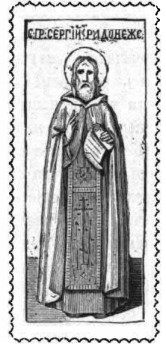
Чем были Антоний и Феодосий на юге России в XI веке, тем же в Московском княжестве был преподобный Сергий в XIV веке. Это – великий светильник иноческой жизни, благотворный и для жизни городской. «Благодарение Богу, скажем с блаженным Епифанием, что даровал нам в земле Русской такого старца, святого и преподобного Сергия». Благодарение Богу, прибавим еще, и за то, что жизнь богоносного Сергия описал искренний ученик его, собиравший сведения о нем со всем усердием.388
What Anthony and Theodosius were in the south of Russia in the 11th century, the Venerable Sergius was in the Principality of Moscow in the 14th century. He is a great luminary of monastic life, beneficial also for city life. “Thanks be to God,” let us say with the blessed Epiphanius, “that He granted us in the Russian land such an elder, holy and venerable Sergius.” Thanks be to God, let us add further, also for the fact that the life of the God-bearing Sergius was described by a sincere disciple of his, who gathered information about him with all diligence.388
Родиной преподобного был Ростов, и родители его были благочестивые бояре Кирилл и Мария. Еще прежде рождения его (в 1313 г.),389 промысл Божий дал о нем знать, что это будет святая отрасль благочестивого корня. Раз Мария стояла вместе с женами во время литургии в храме. Перед чтением Евангелия вдруг вскрикнул младенец во чреве ее, так громко, что слышен был голос другим. В начале херувимской песни вновь раздался младенческий голос по церкви, и мать ужаснулась. Когда священник возгласил: святая святым, младенец закричал в третий раз, и мать, испуганная, начала плакать. Женщины захотели видеть младенца, и мать принуждена была сказать, что младенец кричал не на руках, но во чреве ее. Благочестивый Епифаний в объяснение сего случая основательно указывает на примере Иоанна и других святых, которых рождение предзнаменовано было необыкновенными событиями. После необыкновенного приключения мать Сергия стала особенно внимательной к своему состоянию. Во все остальное время беременности своей она не употребляла ни мяса, ни молока, ни рыбы, ни вина, а питалась только хлебом и водой и молилась Богу. Родившегося сына назвали Варфоломеем. Скоро мать, а потом и другие, приметили в младенце дивную особенность: когда мать насыщалась тучной пищей, младенец не брал сосцов ее; то же бывало в среды и пятки. Думали было объяснить это болезнью, но дитя не страдало, а явление возобновлялось.
The birthplace of the Venerable one was Rostov, and his parents were the pious boyars Cyril and Mary. Even before his birth (in 1313),389 divine Providence gave a sign that this would be a holy offshoot of a pious root. Once Mary was standing together with the women during the Divine Liturgy in the church. Before the reading of the Gospel, the infant suddenly cried out in her womb, so loudly that the voice was heard by others. At the beginning of the Cherubic Hymn, the infant’s voice resounded again through the church, and the mother was terrified. When the priest exclaimed: “The Holy Things for the Holy,” the infant cried out a third time, and the mother, frightened, began to weep. The women wished to see the infant, and the mother was compelled to say that the infant had not cried out in her arms, but in her womb. The pious Epiphanius, in explanation of this event, points fittingly to the example of John and other saints whose birth was foretold by extraordinary events. After this extraordinary occurrence, Sergius’s mother became especially attentive to her condition. During the entire remaining time of her pregnancy, she partook neither of meat, nor milk, nor fish, nor wine, but nourished herself only on bread and water and prayed to God. The son born was named Bartholomew. Soon the mother, and later others, noticed a wondrous peculiarity in the infant: when the mother partook of rich food, the infant would not take her breast; the same happened on Wednesdays and Fridays. They thought to explain this by illness, but the child did not suffer, and the phenomenon recurred.
На седьмом году отдали Варфоломея учиться грамоте. Братья его Стефан и Петр учились хорошо, а Варфоломею не давалась грамота. Учитель наказывал его, товарищи смеялись над ним, родители увещевали, – но Варфоломей и хотел учиться, но учился тупо. Сильно огорчилось тем доброе дитя. Раз отец послал его искать коней и с ним случилось то же, что с Саулом. Варфоломей увидел в поле под дубом черноризца старца, который стоял на молитве и проливал слезы. Варфоломей кротко подошел и ожидал окончания молитвы. «Что тебе надобно, чадо?» спросил старец. «Я учусь, но не умею грамоте, отвечал он, помолись за меня Богу, отче святой, чтобы я мог научиться грамоте». Старец с молитвой дал Варфоломею часть просфоры. «Не скорби, сказал он, с этого дня Господь даст тебе разумение грамоты». Когда старец хотел уйти, Варфоломей пал к его ногам и просил посетить дом родителей: «родители мои, прибавил он, весьма любят таких, как ты, отче». Старец с улыбкой любви пошел с отроком в дом родителей его и был ими встречен с уважением. Они просили разделить с ними трапезу. Старец, пошел в молитвенную храмину и, взяв с собой Варфоломея, приказал ему читать псалмы часов. Смущенный отрок говорил, что не умеет читать. Старец повторил приказание, и отрок, взяв от него благословение, начала читать псалтирь правильно и внятно; и он сам, и родители, и братья дивились, как хорошо читает он, который дотоле так тупо учился и мало знал. За трапезой родители рассказали старцу, что было с матерью в храме, и старец, прощаясь сказал загадочные слова: «отроку надлежит соделаться обителью Святой Троицы и привести многих к разумению Ее воли».390
At the age of seven, Bartholomew was sent to learn to read and write. His brothers Stephen and Peter studied well, but literacy was not given to Bartholomew. The teacher punished him, his comrades mocked him, his parents admonished him—yet Bartholomew desired to learn, but learned with difficulty. The good child was greatly grieved by this. Once his father sent him to look for horses, and the same thing happened to him as to Saul. Bartholomew saw in a field under an oak tree a black-robed elder, a monk, who stood in prayer and shed tears. Bartholomew meekly approached and waited for the end of the prayer. “What do you need, child?” asked the elder. “I am learning, but I cannot master letters,” he replied; “pray to God for me, holy father, that I may be able to learn to read.” The elder, with prayer, gave Bartholomew a portion of a prosphora. “Do not grieve,” he said; “from this day the Lord will grant you understanding of letters.” When the elder wished to depart, Bartholomew fell at his feet and asked him to visit his parents’ home: “my parents,” he added, “greatly love such as you, father.” The elder, with a smile of love, went with the youth to his parents’ house and was received by them with respect. They asked him to share a meal with them. The elder went into the prayer room and, taking Bartholomew with him, commanded him to read the psalms of the hours. The embarrassed youth said that he did not know how to read. The elder repeated the command, and the youth, having received his blessing, began to read the Psalter correctly and clearly; and he himself, his parents, and his brothers marveled at how well he read, he who until then had learned so poorly and knew so little. During the meal, the parents told the elder what had happened with the mother in the church, and the elder, taking his leave, spoke enigmatic words: “This youth is destined to become a dwelling-place of the Holy Trinity and to lead many to the understanding of His will.”390
Получив так нечаянно успех в учении, Варфоломей усердно стал ходить в храм Божий и читал священное писание. Спустя некоторое время он стал наблюдать строгое воздержание: в среды и пятки не вкушал ничего, а в прочие дни довольствовался сухим хлебом и водой. Мать, предостерегая его, говорила, что тело его еще растет и имеет нужду в пище. «Не ты ли, отвечал сын, сказывала мне, что я еще в колыбели постился? Не должен ли я беречься от грехов?» «Тебе только 12 лет, говорила мать, тебе ли говорить о грехах своих?» «Мать моя, отвечал сын, ты увлекаешься любовью ко мне; ты слышала, что никто не чист перед Богом, хотя бы он жил только один день». Варфоломей продолжал укрощать тело свое воздержанием и трудами, для охранения чистоты в душе и теле.
Having thus unexpectedly attained success in learning, Bartholomew began diligently to attend the church of God and to read the Holy Scriptures. After some time, he began to observe strict abstinence: on Wednesdays and Fridays he ate nothing, and on other days he contented himself with dry bread and water. His mother, cautioning him, said that his body was still growing and had need of food. “Was it not you,” replied the son, “who told me that I fasted even in the cradle? Should I not guard myself from sins?” “You are only twelve years old,” said the mother; “is it for you to speak of your sins?” “My mother,” replied the son, “you are carried away by love for me; you have heard that no one is pure before God, even if he lives but a single day.” Bartholomew continued to subdue his body by abstinence and labors, for the preservation of purity in soul and body.
Все это было в Ростове; но не в Ростове надлежало сиять светильнику Божию. Он перенесен в Радонеж обыкновенными путями дел человеческих. Отец его Кирилл был один из известных богатых бояр при дворе Ростовского князя. Но он обнищал от разных бед. То путешествие в орду вместе с князем, то голод страны, то нападения татар обессилили его. Затем московский князь Иван Данилович, купив уделы белозерского и угличского князей, составлявшие некогда одно целое с Ростовским княжеством, наложил руку свою и на сократившийся удел ростовского князя.391 Присланный им в Ростов воевода Василий Кочев поступал здесь с необузданным своеволием, налагал разные тяжести на богатых и обирал их без внимания к правде и любви; наглость его простерлась до того, что он повесил вниз головой старшего ростовского боярина Аверкия. Эти насилия вынудили Кирилла вместе со многими другими выехать из Ростова. Они переселились в Радонеж, который отдан был князем Калитой в удел меньшему сыну, князю Андрею, и где обещались разные льготы желавшим селиться.392 Это было не раньше 1330 г.393
All this took place in Rostov; but it was not in Rostov that this lamp of God was to shine. He was transferred to Radonezh by the ordinary ways of human affairs. His father Cyril was one of the well-known wealthy boyars at the court of the Prince of Rostov. But he was impoverished by various misfortunes. At one time, a journey to the Horde with the prince, at another, a famine in the land, and then the attacks of the Tatars weakened him. Afterwards, the Moscow prince Ivan Danilovich, having purchased the appanages of the princes of Beloozero and Uglich, which had once formed a single whole with the Rostov principality, laid his hand also upon the diminished appanage of the prince of Rostov.391 The voivode Basil Kochev, sent by him to Rostov, acted there with unbridled willfulness, imposing various burdens upon the wealthy and plundering them without regard for truth or love; his insolence went so far that he hanged the senior Rostov boyar Averkii head downward. These acts of violence compelled Cyril, together with many others, to leave Rostov. They moved to Radonezh, which had been given by Prince Kalita as an appanage to his younger son, Prince Andrew, and where various privileges were promised to those wishing to settle there.392 This was not earlier than the year 1330.393
В Радонеже Варфоломей продолжал свои подвиги. Два брата его вступили в брак; Варфоломей, возбужденный скорбями родителей, просил позволения вступить в иноческую жизнь. «Помедли, говорили они ему, мы стары, немощны и бедны; некому послужить нам; твои братья, Стефан и Петр, женились и заботятся о женах; позаботься ты о нас; ты хорошо делаешь, что стараешься угодить Господу; – но твоя благая часть не отнимается у тебя; проводи нас во гроб, и тогда исполнишь твое доброе желание». Благодатный сын повиновался родителям. Прекрасный пример рассудительной любви родительской и послушания сыновнего! Кирилл и Мария не гасят в сыне святого желания его, не принуждают его связать себя с суетой мира брачной жизнью, – а только указывают ему на свои нужды, имея при том в виду и его молодость, требующую еще испытания. Сын не следует примеру детей своевольных, ни во что ставящих желания и нужды родителей; он чувствует достоинство своих намерений; но решается томить себя до времени неисполненными желаниями, чтобы покоить по возможности старость родителей. Спустя некоторое время Кирилл и Мария сами вступили в монастырь и, недолго пожив там, отошли к Богу. Варфоломей 40 дней молился при гробе из, питал нищих, служил панихиды; потом передал имение младшему брату Петру и решился исполнить давнее желание сердца своего.
In Radonezh, Bartholomew continued his ascetic labors. His two brothers entered into marriage; Bartholomew, moved by the sorrows of his parents, asked permission to enter the monastic life. “Wait,” they said to him; “we are old, infirm, and poor; there is no one to serve us; your brothers, Stephen and Peter, are married and care for their wives; do you care for us; you do well to strive to please the Lord—but your good portion is not taken from you; accompany us to the grave, and then you shall fulfill your good desire.” The gracious son obeyed his parents. A beautiful example of discerning parental love and filial obedience! Cyril and Mary do not extinguish the holy desire in their son, nor do they compel him to bind himself to the vanity of the world by marriage—they only point out their own needs, having in view also his youth, which still required testing. The son does not follow the example of willful children who set at naught the desires and needs of their parents; he feels the worth of his own intentions; but he resolves to afflict himself for a time with unfulfilled desires, in order to comfort the old age of his parents as much as possible. After some time, Cyril and Mary themselves entered a monastery and, having lived there but a short while, departed to God. Bartholomew prayed for forty days at their grave, fed the poor, and served panikhidas; then he gave his inheritance to his younger brother Peter and resolved to fulfill the long-standing desire of his heart.
Старший брат его Стефан, лишась супруги, принял иночество в Хатькове монастыре, где погребены и родители их. Варфоломей, желая глубокого уединения, убедил Стефана поискать удобнейшего места для жизни подвижнической. Они долго ходили по лесам, пока не нашли в густом лесу место не безводное и удаленное не только от жилищ, но и от путей людских; в 10 верстах от Радонежа и от Хатькова, небольшая площадь возвышается над окрестностью в виде маковки, почему названа «Маковицей». – Здесь-то пустынники поставили себе келью, а потом небольшую церковь. Младший брат, покорный старшему, спросил во чье имя будет храм сей? Старший, напомнив Варфоломею о словах дивного старца, сказал, что храму следует быть посвященным в честь Святой Троицы. Тогда младший сказал, что такова же была и его мысль. Малый храм освящен был по благословению м. Феогноста. Призвав к себе игумена Митрофана, Варфоломей принял 7 октября пострижение в иночество с именем Сергий. Это было на 24 году возраста его, в 1337 г. Стефан вскоре затем перешел в Московский Богоявленский монастырь.394
His elder brother Stephen, having lost his wife, received the monastic tonsure at the Khotkov Monastery, where their parents were also buried. Bartholomew, desiring deep solitude, persuaded Stephen to seek a more suitable place for the ascetic life. They walked long through the forests, until they found in a dense forest a place not without water and remote not only from dwellings but also from human paths; ten versts from Radonezh and from Khotkov, a small area rises above the surrounding area like a little hill, which is why it was called “Makovitsa.” Here the hermits built themselves a cell, and afterwards a small church. The younger brother, obedient to the elder, asked in whose name this church should be. The elder, reminding Bartholomew of the words of the wondrous elder, said that the church should be dedicated in honor of the Holy Trinity. Then the younger said that such had also been his thought. The small church was consecrated with the blessing of Metropolitan Theognostus. Summoning to himself Abbot Mitrophan, Bartholomew received on October 7 the tonsure into monasticism with the name Sergius. This was in the twenty-fourth year of his age, in the year 1337. Stephen soon afterwards transferred to the Moscow Epiphany Monastery.394
Вот Сергий, в глухом лесу, на иноческом подвиге, без наставника, с одним Господом! Силен Бог и готов на помощь тем, которые призывают Его. Но много и опасностей для уединенного подвижника, против которых надобно призывать помощь Божью. Сколько браней надобно испытать ему, прежде чем окрепнет он силой Божьей! Голод, жажда, холод, страх зверей, опасение погибнуть от скудости, тягость плоти, уныние души, смущение и разъяснение мыслей требуют борьбы и подвигов, чтобы иначе душа не пала. А невидимые враги, когда примечают, что человек, расставшись с миром, усиливается проникнуть в область духовную, вступить в общение с силами святыми, вторгаются в область воображения его и начинают преследовать подвижника разными страхами. Так было и с ревностным подвижником Сергием. Не раз во время ночной молитвы представлялись ему устрашающие видения, грозившие ему погибелью, и слышался грозный голос: беги отсюда, не надейся жить здесь. Мужественный подвижник ограждался крестным знамением и бил ратников именем Иисуса. Смиренной, но слезной молитвой укреплял он душу, и молитва низводила на него силу Божию. Что касается до брани с плотью, он приучил плоть свою к умеренности еще с юных лет; в пустыне же крепкие стояния на молитве, частые коленопреклонения, долгие пощения его кто изочтет? По временам стада голодных волков рыскали около жилища его и выли по целым ночам; грозно горели в лесу глаза их; в другое время приходили к келии его медведи. Это – действительность, осязаемая и чувствами. В беспомощном одиночестве Сергий вооружался молитвой и против таких опасностей. Раз увидал он перед хижиной своей медведя, и примечая, что он не столько свиреп, сколько голоден, сжалился над ним, вынес кусок хлеба и предложил ему пустынный обед на пне. Зверь полюбил доброго к нему пустынника, часто приходил к келии и ждал обыкновенного угощения. Преподобный каждый раз миловал зверя, делил с ним и последний кусок хлеба, оставаясь сам без пищи.395
Behold Sergius, in a deep forest, at the monastic struggle, without a guide, with the Lord alone! God is strong and ready to help those who call upon Him. But many are the dangers for the solitary ascetic, against which one must invoke God’s help. How many battles must he endure before he is strengthened by the power of God! Hunger, thirst, cold, fear of wild beasts, dread of perishing from want, the burden of the flesh, despondency of soul, confusion and distraction of thoughts—all require struggle and labors, lest the soul fall. And the invisible enemies, when they notice that a man, having parted with the world, strives to penetrate into the spiritual realm, to enter into communion with the holy powers, they invade the realm of his imagination and begin to pursue the ascetic with various terrors. So it was also with the zealous ascetic Sergius. More than once during night prayer, terrifying visions appeared to him, threatening him with destruction, and a fearsome voice was heard: flee from here, do not hope to live here. The courageous ascetic fortified himself with the sign of the cross and struck the warriors with the name of Jesus. With humble but tearful prayer he strengthened his soul, and prayer brought down upon him the power of God. As for the struggle with the flesh, he had accustomed his flesh to moderation from his youth; in the wilderness, who can number his steadfast standing in prayer, frequent prostrations, and long fasts? At times, packs of hungry wolves prowled about his dwelling and howled the whole night through; their eyes gleamed menacingly in the forest; at other times, bears came to his cell. This was reality, tangible and perceptible. In his helpless solitude, Sergius armed himself with prayer also against such dangers. Once he saw before his hut a bear, and noticing that it was not so much fierce as hungry, he took pity on it, brought out a piece of bread, and offered it a wilderness meal on a stump. The beast grew fond of the kindly hermit, often came to the cell, and waited for the usual treat. The Venerable One each time showed mercy to the beast, sharing with it even the last piece of bread, remaining himself without food.395
Как благоуханный цветок, хотя и кроется в дикой траве, не может укрыться, – прекрасный запах его ощущается издали, так блаженный Сергий, хотя скрывался от людей в глубине дикого леса, – благоухание святой жизни его услышалось издали.
As a fragrant flower, though it hides among wild grass, cannot remain hidden—its sweet fragrance is perceived from afar—so the blessed Sergius, though he hid himself from men in the depths of the wild forest, the fragrance of his holy life was perceived from afar.
Около трех лет оставался он в одиночестве, как стали приходить к нему и просить позволения жить подле него. Он выставлял трудности пустынной жизни, но те обещались терпеть все с помощью Божьей; Сергий поступал по слову Спасителя: грядущего ко Мне не изжену вон. Мало-по-малу собралось к нему до 12 братий, и каждый сам построил себе келью. В церкви ежедневно совершались полунощница, утреня, часы, вечерня и повечерие, а часто и молебные пения. Для совершения же литургии призывали со стороны пресвитера или игумена, – своего еще не было. Наконец, пришел к ним на житие игумен Митрофан, тот самый, который постригал Сергия. Преподобный рад был ему, по нужде в иерее Божием; но ветхий старец прожил недолго и скончался. – Сергий по смирению не думал принимать на себя сана игуменства; он хотел вести жизнь скитскую. – Пример жизни его управлял братией. Он был первый тем, что был всем слуга. Он рубил дрова и носил к кельям, молол жерновом рожь, пек хлебы, носил воду на своих плечах двумя ведрами и поставлял у келии каждого. – Братия видели в примере его много учительного; но чувствовали нужду и в игумене – наставнике. Сообща это чувство один другому, они собрались вместе, пришли к преподобному и сказали: «отче! Не можем жить без игумена и желаем, чтобы ты был нам игумен, дабы приходили мы к тебе с покаянием и, открывая грехи, получали наставление и разрешение; надобно и то, чтобы совершалась литургия, и мы от чистых рук твоих приобщались Святых Таин». Сергий отказывался, – братия говорили, что для него и пришли в пустыню. Сергей сказал: «разойдемся теперь каждый в свою келью и помолимся Богу». Спустя несколько дней братия опять собрались к преподобному и умоляли его принять на себя игуменство. «Не мое дело совершать ангельское служение, – мое дело плакать о грехах», говорил Сергий. Братия плакали и наконец сказали: «если ты не хочешь пещись о душах наших, и мы вынуждены будем оставить это месть, пойдем блуждать как овцы, ты будешь отвечать за нас перед Богом». – Какая прекрасная распря! Смирение старшего сражается с любовью младших! В мирских обществах сражаются друг с другом за власть и производят расстройство в делах, расстройство в сердцах, губя себя и других жаждой власти. Как благотворен закон Твой, Господи! «Желаю лучше повиноваться, чем начальствовать», сказал наконец Сергий, – «но страшась суда Божия, поручаю дело воле Господа». – Взяв с собой двух старших, отправился он в Переяславль к Афанасию, епископу Волынскому, которому святой Алексий, во время отсутствия своего в Царьград, поручил дела митрополии. – Представ пред него, Сергий просил назначить игумена для его общества. «Я слышал о тебе, – сказал блаженный Афанасий, – рука Моя поможет ему, сказал Господь об избранном; тебя избрал Господь, и ты будешь игуменом обители Святой Троицы». Еще пытался Сергий отклонить от себя дело тяжелое для смирения. Но блаженный пастырь сказал: «ты не имеешь послушания» – и тем обезоружил его. Сергий посвящен был в пресвитера и игумена. Это было в 1354 г.396
For about three years he remained in solitude, when men began to come to him and ask permission to live near him. He set forth the hardships of the desert life, but they promised to endure all things with God’s help; Sergius acted according to the word of the Savior: him that cometh to Me I will in no wise cast out. Little by little, as many as twelve brethren gathered to him, and each built himself a cell. In the church, Midnight Office, Matins, the Hours, Vespers, and Compline were performed daily, and often also prayers of supplication. For the celebration of the Divine Liturgy, however, they summoned a presbyter or abbot from outside—they had none of their own as yet. At last, the abbot Mitrophan, the very one who had tonsured Sergius, came to live with them. The Venerable One was glad of him, for the need of a priest of God; but the aged elder lived not long and reposed. —Sergius, out of humility, did not think to take upon himself the rank of abbot; he wished to lead a skete life. —The example of his life governed the brethren. He was first by being the servant of all. He cut wood and carried it to the cells, ground rye with a hand-mill, baked bread, and bore water on his shoulders with two buckets, setting it at the cell of each. —The brethren saw much instruction in his example; but they also felt the need of an abbot—a guide. Communicating this feeling one to another, they gathered together, came to the Venerable One, and said: “Father! We cannot live without an abbot, and we desire that you be our abbot, so that we may come to you with repentance and, opening our sins, receive instruction and absolution; it is also necessary that the Liturgy be celebrated, and that we partake of the Holy Mysteries from your pure hands.” Sergius refused—the brethren said that it was for his sake that they had come into the wilderness. Sergius said: “Let us now depart each to his own cell and pray to God.” After several days, the brethren again gathered to the Venerable One and besought him to take upon himself the abbacy. “It is not my work to perform the angelic service—my work is to weep for my sins,” said Sergius. The brethren wept and at last said: “If you will not care for our souls, we shall be forced to leave this place; we shall go wandering like sheep, and you will answer for us before God.” —What a beautiful dispute! The humility of the elder contends with the love of the younger! In worldly societies, men contend with one another for power and produce disorder in affairs, disorder in hearts, destroying themselves and others with the thirst for power. How beneficent is Thy law, O Lord! “I desire rather to obey than to rule,” said Sergius at last, “but fearing the judgment of God, I commit the matter to the will of the Lord.” —Taking with him two of the eldest, he set out for Pereslavl to Athanasius, Bishop of Volhynia, to whom St. Alexis, during his absence in Constantinople, had entrusted the affairs of the metropolis. —Standing before him, Sergius asked him to appoint an abbot for his community. “I have heard of you,” said the blessed Athanasius, “My hand shall help him, said the Lord concerning the chosen one; the Lord has chosen you, and you shall be abbot of the monastery of the Holy Trinity.” Sergius again attempted to avert from himself a matter heavy for his humility. But the blessed pastor said: “You have no obedience”—and thereby disarmed him. Sergius was ordained presbyter and abbot. This was in the year 1354.396
Сергий, приняв начальство, не переменил иноческой своей жизни. Не многими словами учил братию, но когда учил, слово его исполнено было силы и жизни; более же наставлял примером. – Каждый день благоговейно совершал литургию, на каждое молитвословие являлся в храм первый и во время служения не наклонялся к стене, весь предстоя пред Господом, делал свечи и приготовлял просфоры, не дозволяя в последнем труде никому участвовать. В начале игуменства, около трех лет, число братии не превышало 12, так что новый брат поступал по смерти одного из бывших. Первый поступивший сверх того числа был смоленский архимандрит Симон; он явился с усердием быть в послушании у Сергия, и Сергий принял усердного; на значительное пожертвование его построен был более просторный храм Святой Троицы. С того времени число братии возрастало. Преподобный прежде, чем постригал нового брата, приказывал ему в длинной черной свите познакомиться с братией и привыкать к монастырскому уставу. Одного одевал он затем в рясу, другого же облекал мантией иноческой. Положено было за правило для всех, чтобы после повечерия братия не ходили из келии в келию, за исключением крайней нужды, и не проводили времени в разговорах, – а каждый в келии своей занимался бы молитвой и рукоделием. Для наблюдения преподобный по совершении келейной молитвы, в глубокий вечер, особенно в долгие ночи, обходил тайно все келии братий. Если слышал в какой-либо келии празднословящих, ударял в дверь или окно, чтобы прекратили беседу; а на утро призывал к себе в келию и приводил в сознание своих обетов, – если же кто упорствовал, строго обличал.397 Другим правилом положено было не посылать никого из братии для сбора подаяний на обитель, какой бы ни встретился недостаток в обители. Правило тяжелое для выполнения, особенно пустынникам Сергия. Более 15 лет к его отшельнической пустыни вела только тропинка по лесам. Только в управление великого князя Иоанна II (1353–1355 г.) стали в окрестностях кое-где селиться земледельцы, и потому уже, как говорит блаженный Епифаний, «исказиша пустыню и не пощадеша и составиша села и дворы многи». Тогда проложена была и дорога мимо монастыря от Москвы на северные города. Однако и при преподобном Никоне еще леса были так глухи, что по рекам ловили бобров.398 В такой глуши кто мог посетить пустыню Сергия и принесть что-нибудь? Но Сергий веровал Богу верой твердой, испытанной скорбями, и по вере его было с ним; той же вере обучал он учеников своих. Случалось, что не доставало вина для литургии, ладана для каждения и воска для свеч. Тогда зажигали березовую и сосновую лучину и при таком освещении совершали утреню. По свидетельству преподобного Иосифа, в обители Сергия такая была нищета, такое нестяжание, что и «самые книги писались не на хартиях, а не берестах».399
Sergius, having taken up the leadership, did not change his monastic life. He taught the brethren with few words, but when he taught, his word was filled with power and life; he instructed more by example. —Each day he reverently celebrated the Liturgy; he was first to appear in the church for every prayer service, and during the service he did not lean against the wall, but stood wholly before the Lord; he made candles and prepared prosphora, allowing no one to share in this latter labor. At the beginning of his abbacy, for about three years, the number of brethren did not exceed twelve, so that a new brother entered only upon the death of one of the existing ones. The first to enter beyond that number was the Smolensk archimandrite Simon; he came with zeal to be in obedience to Sergius, and Sergius received the zealous one; with his considerable donation, a more spacious church of the Holy Trinity was built. From that time, the number of brethren increased. Before tonsuring a new brother, the Venerable One would bid him, in a long black cassock, to become acquainted with the brethren and to grow accustomed to the monastic rule. One he would then clothe in the ryassa, another he would invest with the monastic mantle. It was established as a rule for all that after Compline the brethren should not go from cell to cell, except in extreme necessity, and should not spend time in conversations—but each in his cell should occupy himself with prayer and handiwork. For supervision, after completing his cell prayer, in the deep evening, especially during the long nights, the Venerable One would secretly go around all the cells of the brethren. If he heard anyone in a cell speaking idly, he would knock on the door or window to stop the conversation; and in the morning he would summon him to his cell and bring him to awareness of his vows—if anyone was stubborn, he would strictly rebuke him.397 Another rule established was not to send any of the brethren to collect alms for the monastery, whatever need might arise in the monastery. A rule difficult to fulfill, especially for the hermits of Sergius. For more than fifteen years, only a footpath through the forests led to his hermitage. Only during the rule of Grand Prince John II (1353–1355) did farmers begin to settle here and there in the vicinity, and therefore, as the blessed Epiphanius says, “they transformed the wilderness and did not spare it, and established villages and many homesteads.” Then a road was also laid past the monastery from Moscow to the northern cities. Yet even under the Venerable Nikon, the forests were still so dense that beavers were caught along the rivers.398 In such a wilderness, who could visit the hermitage of Sergius and bring anything? But Sergius believed in God with a firm faith, tried by sorrows, and according to his faith it was with him; he taught the same faith to his disciples. It happened that there was a lack of wine for the Liturgy, incense for censing, and wax for candles. Then they would light birch or pine splinters and perform Matins by such illumination. According to the testimony of the Venerable Joseph, in the monastery of Sergius there was such poverty, such non-acquisitiveness, that “even the books themselves were written not on parchment, but on birch bark.”399
Случилось, что у самого игумена на было ни хлеба, ни соли, и во всех обители крайняя скудость. Три дня провел игумен без пищи, и на рассвете четвертого пошел к брату Даниилу и сказал: «я слышал, что ты хочешь пристроить сени к келье; прострою я тебе их, чтобы руки мои не были без дела; это недорого будет стоить тебе: мне хочется гнилого хлеба, а у тебя он есть. Даниил вынес куски гнилого хлеба, лежавшие у него за гнилью. «Побереги, сказал Сергий, до девятого часа; я не беру платы не работавши». Он принялся долбить столбы, тесать доски и к вечеру построил сени. Даниил вынес ему гнилые куски; Сергий помолился, благословив предложенное и с одной водой, даже без соли, кончил обед свой. Братия крепилась в терпении, смотря на пример наставника. Наконец, ослабели и стали роптать. «Мы умираем с голоду, говорили немощные; ты не дозволяешь ходить за милостыней; но завтра пойдем отсюда, каждый в свою сторону, и более не возвратимся». Преподобный собрал всех и убеждал не ослабевать в искушении; указывал на заповедь Спасителя прежде всего искать Царствия Божия, обещающую усердным искателям его ниспослание всего нужного для жизни. «Верую, сказал он наконец, что Бог не оставит живущих в этом месте». И действительно в это самое время услышали, что кто-то стучится во врата обители. Вратарь в отверстие увидел, что привезено множество хлебов. В радости он прибежал к преподобному. «Отче, говорил он, привезли множество хлебов, – благослови принять». Святый велел впустить привезших хлебы. Он пригласил всех в трапезу, а прежде того отслужил благодарный молебен Господу благодеющему. Во время трапезы указал немощным на опыт промышления Божия. «Где же привезшие дар?» спросил он. «По приказанию твоему, мы приглашали их в трапезу и спрашивали: кем посланы они? Они отвечали, что прислал любящий Христа, а им еще надобно спешить исполнением другого поручения». Так говорили иноки. «Видите ли, братия, сказал Сергий, Господь не оставляет сего места? Будем подвизаться, не ослабевая».
It happened that the abbot himself had neither bread nor salt, and throughout the monastery there was extreme scarcity. For three days the abbot went without food, and at dawn of the fourth he went to the brother Daniel and said: “I have heard that you wish to add a porch to your cell; I will build it for you, so that my hands may not be idle; this will cost you little: I desire some moldy bread, and you have it.” Daniel brought out pieces of moldy bread that he had lying about because of the mold. “Keep it,” said Sergius, “until the ninth hour; I do not take payment without having worked.” He set to work hollowing posts, planing boards, and by evening he had built the porch. Daniel brought out the moldy pieces; Sergius prayed, blessed what was offered, and with only water, even without salt, finished his meal. The brethren strengthened themselves in patience, looking upon the example of their teacher. At last, they grew weak and began to murmur. “We are dying of hunger,” said the weak ones; “you do not allow us to go for alms; but tomorrow we will go from here, each in his own direction, and will not return.” The Venerable One gathered them all and urged them not to grow weak in temptation; he pointed to the Savior’s commandment to seek first the Kingdom of God, which promises to those who earnestly seek it the sending down of all that is needful for life. “I believe,” he said at last, “that God will not forsake those who dwell in this place.” And indeed, at that very moment they heard someone knocking at the gates of the monastery. The gatekeeper saw through the opening that a great quantity of loaves had been brought. In joy, he ran to the Venerable One. “Father,” he said, “a great many loaves have been brought—bless that they be received.” The Saint ordered that those who had brought the loaves be let in. He invited all to the refectory, but first he served a moleben of thanksgiving to the Lord the Benefactor. During the meal, he pointed out to the weak ones the experience of God’s providence. “Where then are those who brought the gift?” he asked. “By your command, we invited them to the refectory and asked: by whom were they sent? They answered that they were sent by one who loves Christ, and that they still had to hasten to fulfill another commission.” So said the monks. “Do you see, brethren,” said Sergius, “that the Lord does not forsake this place? Let us strive, not growing weak.”
И другое было испытание терпения для учеников Сергия. Не было не только в обители, но и вблизи обители воды; надобно было ходить за ней далеко, под гору. Братия не раз жаловалась на недостаток воды. Наконец стали сильно роптать. «Для чего на таком месте создал обитель?» говорили Сергию. Сергий отвечал: «я хотел один безмолвствовать здесь. Богу угодно было устроить здесь обитель. Но, прибавил он, если угодно Ему поставить здесь обитель, то подаст Он и нужную для нее воду». Затем обратился он с молитвой к Богу, и по его молитве потекла вода там, где ее не было. Этот источник братия долго называли Сергиевым. Но смиренный «Сергий запретил так называть его». Это – на северной стороне обители.400
And there was another trial of patience for the disciples of Sergius. There was no water not only in the monastery, but even near the monastery; they had to go far for it, down the hill. The brethren more than once complained of the lack of water. At last they began to murmur greatly. “Why did you build the monastery in such a place?” they said to Sergius. Sergius answered: “I wished to dwell here alone in silence. It pleased God to establish a monastery here. But,” he added, “if it pleases Him to establish a monastery here, He will also provide the water needed for it.” Then he turned with prayer to God, and by his prayer water flowed where there had been none. For a long time the brethren called this spring “Sergius’s.” But the humble Sergius forbade them to call it so. This is on the northern side of the monastery.400
Раз в глубокий вечер молился преподобный о братии своей обители. Внезапно услышал он голос: Сергий! Сотворив молитву отворил он окно и увидел необыкновенный свет с неба. «Сергий! Господь услышал молитву твою о чадах твоих; посмотри, какое множество иноков собрано тобой во имя Святой Троицы!» Преподобный увидел множество прекрасных птиц, летавших не только в обители, но и вокруг ее. «Так, продолжал голос, умножится число учеников твоих, и после тебя не оскудеют последующие стопам твоим». Преподобный в удивлении и радости позвал к себе Симона, и тот еще успел видеть некоторые остатки явления.
Once, late in the evening, the Venerable One was praying for the brethren of his monastery. Suddenly he heard a voice: “Sergius!” Having finished his prayer, he opened the window and saw an extraordinary light from heaven. “Sergius! The Lord has heard your prayer for your children; look, what a multitude of monks you have gathered in the name of the Holy Trinity!” The Venerable One saw a multitude of beautiful birds, flying not only over the monastery but also around it. “Thus,” the voice continued, “shall the number of your disciples be multiplied, and after you, those who follow in your footsteps shall not be lacking.” The Venerable One, in astonishment and joy, called Simon to him, and he was still able to see some remnants of the vision.
Спустя некоторое время пришли к преподобному посланные п. Филофеем и принесли ему благословение на крест, параманд и схиму, и послание патриарха. «Не к иному ли вы посланы?» сказал смиренный Сергий. – Дав им покой, сам отправился к м. Алексию с донесением. Патриарх писал: «Божьей милостью архиепископ Константинограда, Вселенский патриарх, кир Филофей о Святом Духе сыну и сослужебнику нашего смирения – Сергию. Благодать и мир и наше благословение да будет с вами. Мы слышали о добродетельной жизни твоей и очень одобрили ее и славим Бога. Но одного недостает тебе – общежития. Ты знаешь, преподобный и богоотец пророк Давид, обнявший все разумением, хвалит общежитие. Се что добро или что красно, но еже жити братии вкупе. Потому и я даю вам совет полезный, – составьте общежитие. Милость Божия и наше благословение да будет с вами».401 «Что же повелишь, святой владыка?» спросил Сергий Алексия, по выслушании послания. Митрополит и со своей стороны посоветовал устроить полное общежитие. Преподобный так и поступил. Он построил здания, нужные для общежития, распределил общежительные должности, – положил всему быть общему и запретил иметь собственность или называть что-нибудь своим. Когда, таким образом, довершилось устроение обители, то число учеников возросло, и в обители водворилось обилие. Преподобный ввел тогда в обители принятие странных, питание нищих и подаяние просящим. Об этом учреждении сказал он ученикам своим: «если без ропота будете сохранять это установление мое, то по смерти моей обитель распространится и многие годы будет стоять, благодатью Христовой».402
After some time, envoys sent by Patriarch Philotheus came to the Venerable One and brought him a blessing for a cross, a paraman, and a schema, together with a letter from the patriarch. “Are you not sent to someone else?” said the humble Sergius. Having given them rest, he himself went to Metropolitan Alexis with a report. The patriarch wrote: “By the mercy of God, Archbishop of Constantinople, Ecumenical Patriarch, Kyr Philotheus, in the Holy Spirit to the son and fellow-servant of our humility—Sergius. Grace and peace and our blessing be with you. We have heard of your virtuous life and have greatly approved of it, and we glorify God. But one thing you lack—the cenobitic rule. You know that the venerable prophet David, the forefather of God, who embraced all things with understanding, praises the common life: Behold, how good and how pleasant it is for brethren to dwell together in unity. Therefore I also give you a profitable counsel—establish a cenobitic community. May the mercy of God and our blessing be with you.”401 “What do you command, holy master?” asked Sergius of Alexis, after hearing the epistle. The metropolitan, for his part, also advised establishing a full cenobitic rule. The Venerable One did so. He built the buildings necessary for the common life, assigned the cenobitic offices—ordained that all things should be common, and forbade anyone to possess property or call anything his own. When, in this manner, the ordering of the monastery was completed, the number of disciples increased, and abundance was established in the monastery. The Venerable One then introduced into the monastery the reception of strangers, the feeding of the poor, and the giving of alms to those who asked. Concerning this institution, he said to his disciples: “If you keep this ordinance of mine without murmuring, then after my death the monastery will spread and will stand for many years, by the grace of Christ.”402
Казалось, что после того обитель Сергиева со всех сторон безопасна от превратностей. Но внезапно поднялась буря – по милости людских слабостей, и буря едва не лишила обитель хранителя обители. В один субботний день святой Сергий стоял в алтаре, совершая сам вечернюю службу. Брат его Стефан, который опять пришел в обитель, стоял на левом клиросе. «Кто тебе дал эту книгу?» спросил Стефан канонарха. «Игумен», – отвечал тот. «Кто здесь игумен? С гневом сказал Стефан; не я ли первый основал это место»? И прибавил к тому другие жестокие слова. Преподобный слышал все это в алтаре. – Ему понятно было, что здесь излилось тайное негодование многих на новый порядок обители. – По недовольству общежитием иные тайно удалились из обители Сергиевой;403 другие не желали более иметь Сергия и игуменом.404 Иноки того времени, по недостаточному рассуждению духовному, не любили общежития. Много стоило трудов пастырям Церкви и после того устроять жизнь апостольской общины в обителях. Преподобный, предоставляя своевольных их совести, по окончании вечерни не пошел и в келию, а удалился из обители. Лучшие иноки встревожились тем, но думали еще, что Сергий возвратится. Но ожидание не исполнилось; Сергий поселился на Киржаче. Некоторые отправились к святителю Алексию и умоляли его возвратить им игумена. Святитель хорошо знал, как нужен Сергий для обители Святой Троицы; видел и то, как тяжело огорчили блаженную душу своевольные, возмутившиеся и против отца своего и против патриарха. Святитель отправил почетное посольство к Сергию, двух архимандритов; посланные от имени святителя сказали Сергию: «поставь, кого знаешь, строителем в новой пустыни; сам же возвратись в прежний монастырь, дабы не скорбели любящие тебя о разлуке с тобой; а непокорных и злостных выгоню я из монастыря». «Скажите господину моему митрополиту, отвечал Сергий, что все исшедшее из уст его принимаю, как исшедшее из уст Христовых». И, сделав некоторые распоряжения в новой пустыни, возвратился в обитель Святой Троицы. Встреча возвращающемуся была торжеством добра над злом. Ученики, поспешив навстречу учителю своему, целовали руки его, ноги, самую одежду. Он также радовался за детей своих, которых видел теперь детьми.405 Вскоре после того, и именно в 1375 г., блаженный Сергий был болен до того, что опасались за жизнь его; он пролежал больным с великого поста до 1 октября. «Пусть не удивляются тому, говорит при этом летописец, что праведникам посылаются скорби и болезни: многими скорбями подобает внити в Царствие Небесное».406 – Впоследствии, в утешение Сергию, при борьбе с недовольными общежитием, п. Нил прислал свое послание: он называл привычный образ жизни русских иноков жизнью мирских людей и делом дикой страны; напротив, введенное Сергием общежитие называл делом высокой духовной мудрости и предложил наставление о нужде и достоинстве послушания.407
It seemed that after this, the monastery of Sergius was safe from all sides against misfortunes. But suddenly a storm arose—by the mercy of human weaknesses—and the storm nearly deprived the monastery of its guardian. On a certain Saturday, St. Sergius was standing in the sanctuary, himself celebrating the evening service. His brother Stephen, who had again come to the monastery, was standing on the left cliros. “Who gave you that book?” Stephen asked the canonarch. “The abbot,” he replied. “Who is abbot here?” Stephen said with anger; “Was it not I who first founded this place?” And he added other harsh words to this. The Venerable One heard all this from the sanctuary. It was clear to him that here the secret displeasure of many at the new order of the monastery had poured forth. Some, dissatisfied with the cenobitic rule, had secretly departed from the monastery of Sergius;403 others no longer wished to have Sergius as abbot.404 The monks of that time, through insufficient spiritual discernment, did not love the cenobitic life. Much labor it cost the pastors of the Church even afterward to establish the life of the apostolic community in monasteries. The Venerable One, leaving the self-willed to their conscience, after the end of Vespers did not even go to his cell, but withdrew from the monastery. The better monks were troubled by this, but still thought that Sergius would return. But their expectation was not fulfilled; Sergius settled on the Kirzhach. Some went to Hierarch Alexis and implored him to return their abbot to them. The hierarch knew well how necessary Sergius was for the monastery of the Holy Trinity; he also saw how grievously the self-willed had grieved the blessed soul, rising up both against their father and against the patriarch. The hierarch sent a honorable embassy to Sergius, two archimandrites; the envoys said to Sergius in the hierarch’s name: “Appoint whomever you know as superior in the new hermitage; but return yourself to your former monastery, so that those who love you may not grieve over separation from you; and the disobedient and malicious I will drive out of the monastery.” “Tell my lord the metropolitan,” answered Sergius, “that I receive all that has come from his lips as coming from the lips of Christ.” And, having made some arrangements in the new hermitage, he returned to the monastery of the Holy Trinity. The welcome given to him on his return was a triumph of good over evil. The disciples, hastening to meet their teacher, kissed his hands, his feet, even his garment. He too rejoiced for his children, whom he now saw as children.405 Soon after this, namely in 1375, the blessed Sergius was so ill that they feared for his life; he lay ill from Great Lent until October 1. “Let no one be surprised at this,” says the chronicler on this occasion, “that sorrows and illnesses are sent to the righteous: through many tribulations we must enter the Kingdom of Heaven.”406—Later, for the consolation of Sergius in his struggle with those dissatisfied with the cenobitic rule, Patriarch Nilus sent his epistle: he called the customary way of life of Russian monks the life of worldly people and the work of a wild country; on the contrary, he called the cenobitic rule introduced by Sergius a work of high spiritual wisdom and offered instruction on the necessity and dignity of obedience.407
Блаженный митрополит Алексий, видя близость свою к смерти, призывает блаженного Сергия и приказывает принесть золотой крест для него. «Прости меня, святой владыка, сказал, поклонясь, Сергий, – в молодых летах не носил я золота, тем более в старости надобно мне оставаться в нищете». «Знаю, сказал святитель, что такова была всегда жизнь твоя; но окажи послушание и прими дар сей в благословение». Сказав это, он возложил своими руками крест на Сергия. Затем святитель объявил преподобному, что чувствуя свою немощь старческую, желает он назначить достойного преемника себе и избирает его, сообразно с желанием великого князя, почему намерен посвятить его в епископа. «Прости мне, владыка святой, отвечал Сергий, ты хочешь возложить на меня бремя не по силам моим; ты не найдешь во мне, чего ищешь; я – самый грешный и хуже всех». Долго святитель склонял Сергия принять великий сан. Смиренный и прозорливый труженик сказал решительно: «владыка святой! Если не хочешь прогнать мою нищету от твоей святыни, не говори о том моей худости». Святитель желал видеть Сергия преемником своим особенно потому, что великий князь, увлеченный пристрастием к своему казначею Митяю, желал недостойного Митяя видеть митрополитом в Москве. Иначе патриархом уже посвящен был митрополитом всей России Киприан, а перед волей патриарха благоговели и Алексий и Сергий. В таком положении дел, как видел богомудрый Сергий принять предлагаемый сан значило увеличить церковные смуты или принять на себя очень тяжелое дело умиротворения сильных смут; глубокое смирение не приняло на себя и последнего. Потому-то Сергий так решительно отказался от высокого сана. – Все, что мог он принять на себя для блага Церкви, состояло в том, чтобы убеждать великого князя принять Киприана. Он и убеждал князя, выставляя на вид и то, что разделение митрополии Русской, желаемое князем, вредно для святой Церкви. Но князь не послушался богомудрого Сергия. По смерти Алексия Митяй не задумался облечься в одежды святительские, даже не посвященный в митрополита, и грозил разорить обитель Сергия. Смиренный Сергий, услышав угрозы гордого, сказал: «Михаил не только не получит сана, но и не увидит Царя-града». И это исполнилось.408
The blessed Metropolitan Alexis, seeing his death approaching, summoned the blessed Sergius and ordered a golden cross to be brought for him. “Forgive me, holy master,” said Sergius, bowing, “in my youth I did not wear gold, and all the more in old age must I remain in poverty.” “I know,” said the hierarch, “that such has always been your life; but show obedience and accept this gift as a blessing.” Having said this, he placed the cross on Sergius with his own hands. Then the hierarch declared to the Venerable One that, feeling his own aged weakness, he wished to appoint a worthy successor for himself and was choosing him, in accordance with the desire of the Grand Prince, and therefore intended to consecrate him as bishop. “Forgive me, holy master,” answered Sergius, “you wish to lay upon me a burden beyond my strength; you will not find in me what you seek; I am the most sinful and worse than all.” For a long time the hierarch tried to persuade Sergius to accept the great rank. The humble and discerning toiler said decisively: “Holy master! If you do not wish to drive away my poverty from your holiness, do not speak of this to my lowliness.” The hierarch desired to see Sergius as his successor especially because the Grand Prince, carried away by partiality for his treasurer Mityai, wished to see the unworthy Mityai as metropolitan in Moscow. Otherwise, Cyprian had already been consecrated by the patriarch as metropolitan of all Russia, and both Alexis and Sergius revered the patriarch’s will. In such a state of affairs, as the God-wise Sergius saw, to accept the proposed rank would mean to increase church disturbances or to take upon himself the very difficult task of pacifying great disturbances; deep humility did not take even the latter upon itself. Therefore Sergius so decisively refused the high rank. All that he could take upon himself for the good of the Church consisted in persuading the Grand Prince to accept Cyprian. And he did persuade the prince, pointing out also that the division of the Russian metropolitanate, desired by the prince, was harmful to the holy Church. But the prince did not listen to the God-wise Sergius. After the death of Alexis, Mityai did not hesitate to clothe himself in hierarchal vestments, though not even consecrated as metropolitan, and threatened to destroy the monastery of Sergius. The humble Sergius, hearing the threats of the proud man, said: “Michael will not only not receive the rank, but will not even see Constantinople.” And this was fulfilled.408
Мир видит в пустынниках людей бесполезных для гражданских обществ, думая, что он-то со своей волей, он-то со своим умом, он-то со своими шумными уставами и есть единственный благотворитель обществ. Но мир не понимает значения нравственных сил для обществ; не знает ни силы молитвы, ни обширности зрения духовного. Мамай, гордый и грозный повелитель орды, подвинул не только свои, но и наемные полчища против России, решась поставить ее в то же отношение к себе, в каком была она к Батыю. Великий князь Дмитрий Иоаннович, в опасении перед грозным бедствием, пришел к преподобному Сергию и спрашивал: идти ли ему против сильного и грозного врага? Преподобный, совершив молитву, сказал великому князю: «так как гордый Мамай отвергает предложение любви, то иди, государь, против нечестивых, – они унижены будут, а за тебя – Бог правды». – Великий князь, тревожась вестями о приближении Мамая, хотел поспешить в Москву. – «Не тревожься, князь, спокойно говорил преподобный, покушай монашеской трапезы с молитвой: Господь сохранит тебя для вечной славы, а сподвижникам – готовы венцы страдальцев». Сергий отпустил с ним двух иноков своих, Александра Пересвета и Андрея Ослабю, облеченных в схиму; первый был когда-то боярином Брянским, и оба были храбрыми и опытными воинами, а теперь горели желанием положить жизнь свою за веру христианскую. Великий князь, выступив в поле против татар, отважно перешел Дон; но иные еще колебались сомнениями. Неожиданно явился к князю посланный от преподобного с просфорой Богородичной и посланием; преподобный писал: «иди, иди смело, князь, надеясь на помощь Божию». Это одушевило мужеством князя и его сподвижников. На берегах Непрядвы произошло кровопролитное сражение. Послушник преподобного – Пересвет мужественно вступил в бой с татарским великаном Темир Мурзой, гордым своей силой и ростом, и оба пали мертвыми.409 Над Мамаем одержана полная победа (сентября 8-го 1380 г.). Преподобный во время битвы, стоя с братией на молитве, к утешению их, говорил об успешном ходе битвы и о мужестве великого князя, сказал и о решительной победе и даже наименовал павших в битве, за которых принес молитву. Великий князь, возвратясь с победой, благодарил преподобного за советы и молитву и с восторгом исповедал милость Божью над Россией. И это не был единственный опыт любви к святой отчизне в пустынном Сергии. В 1385 г. святой игумен отправлялся пешком в Рязань убеждать беспокойного князя Олега прекратить кровавую вражду против великого князя. Уже не один посол отправлялся с тем же поручением к Олегу, и Олег не хотел слышать о мире. Преподобный смягчил сердце Олега, и он заключил мир с великим князем, скрепленный потом и семейным союзом.410
The world sees in hermits people useless to civil societies, thinking that it—with its will, with its mind, with its noisy statutes—is the sole benefactor of societies. But the world does not understand the significance of moral forces for societies; it knows neither the power of prayer, nor the breadth of spiritual vision. Mamai, the proud and terrible lord of the Horde, moved not only his own but also hired hordes against Russia, resolving to place her in the same relation to himself as she had been to Batu. Grand Prince Demetrius Ioannovich, in fear before the terrible calamity, came to the Venerable Sergius and asked: should he go against the strong and terrible enemy? The Venerable one, having completed prayer, said to the Grand Prince: "Since the proud Mamai rejects the offer of love, go then, sovereign, against the ungodly—they shall be humbled, and for you—the God of righteousness." — The Grand Prince, troubled by tidings of Mamai's approach, wished to hasten to Moscow. — "Do not be troubled, prince," the Venerable one calmly said, "partake of the monastic meal with prayer: the Lord will preserve you for eternal glory, and for your companions—crowns of martyrs are prepared." Sergius sent with him two of his monks, Alexander Peresvet and Andrew Osliabia, clothed in the schema; the first had once been a boyar of Bryansk, and both were brave and experienced warriors, and now burned with desire to lay down their lives for the Christian faith. The Grand Prince, having marched into the field against the Tatars, boldly crossed the Don; but some still wavered in doubt. Unexpectedly there appeared to the prince a messenger sent from the Venerable one with a prosphora of the Theotokos and an epistle; the Venerable one wrote: "Go, go boldly, prince, trusting in the help of God." This inspired courage in the prince and his companions. On the banks of the Nepriadva a bloody battle took place. The novice of the Venerable one—Peresvet—courageously entered combat with the Tatar giant Temir-Murza, proud of his strength and stature, and both fell dead.409 Over Mamai a complete victory was won (September 8, 1380). The Venerable one, during the battle, standing with the brethren in prayer, to their consolation spoke of the successful course of the battle and of the courage of the Grand Prince, and also declared the decisive victory, and even named those fallen in battle, for whom he offered prayer. The Grand Prince, returning with victory, thanked the Venerable one for his counsels and prayer, and with rapture confessed God's mercy over Russia. And this was not the only experience of love for the holy fatherland in the hermit Sergius. In 1385 the holy abbot set out on foot to Ryazan to persuade the restless Prince Oleg to cease his bloody enmity against the Grand Prince. Already more than one envoy had been sent with the same commission to Oleg, and Oleg would not hear of peace. The Venerable one softened the heart of Oleg, and he concluded peace with the Grand Prince, afterwards sealed also by a family union.410
При умножении братии, случилась скудость в обители Сергия. Сергий не оскудевал в надеждах на Господа; нет; он возрастал более и более духом и был уже великим перед Господом, хотя и не перед собой.
With the increase of the brethren, scarcity befell the monastery of Sergius. Sergius did not grow poor in hopes in the Lord; no; he grew more and more in spirit and was already great before the Lord, though not before himself.
В глубокую ночь Сергий пел перед иконой Богоматери акафист и молил Небесную Царицу, да призрит Она на обитель его. По совершении правил сел он отдохнуть, но вдруг сказал ученику своему Михею: «бодрствуй, чадо, мы будем иметь чудное посещение». Едва произнес он эти слова, как услышан был голос: «Пречистая грядет». Святой Сергий поспешил из келии в сени, и его осиял великий свет, ярче солнечного. Он узрел Богоматерь, сопровождаемую апостолами Иоанном и Петром. Сергий пал на землю. Благая Матерь коснулась его и сказала: «не бойся, избранник Мой; молитва твоя об учениках твоих и о сем месте услышана; при тебе и после тебя неотступна буду от обители твоей и буду покрывать ее». Сказав сие, стала невидимой. Святой, придя в себя, нашел ученика своего от страха полумертвым. Он поднял его. «Скажи, отче, спрашивал несколько пришедший в себя Михей, что это за чудное видение? Душа моя едва не разрешилась от тела». Но Сергий не мог еще говорить от движений души; только лицо его сияло радостью. Спустя минуту, велел он призвать двух благоговейных из братий Исаака и Симеона и рассказал им, что было. Все вместе совершили молебное пение Богоматери; святой же всю ночь пробыл без сна, размышляя о милости небесной. Это было в пост Рождества Христова, в пятницу.411
In the deep night Sergius sang before the icon of the Mother of God an akathist and prayed to the Heavenly Queen, that She would look upon his monastery. After completing the rule, he sat down to rest, but suddenly said to his disciple Micah: "Watch, child, we shall have a wondrous visitation." Scarcely had he uttered these words, when a voice was heard: "The Most Pure One cometh." St. Sergius hastened from his cell into the vestibule, and a great light shone upon him, brighter than the sun. He beheld the Mother of God, accompanied by the Apostles John and Peter. Sergius fell to the ground. The gracious Mother touched him and said: "Fear not, My chosen one; thy prayer for thy disciples and for this place is heard; in thy time and after thee I shall not depart from thy monastery and shall cover it." Having said this, She became invisible. The saint, coming to himself, found his disciple half-dead from fear. He raised him up. "Tell me, father," asked Micah, somewhat recovered, "what is this wondrous vision? My soul almost departed from my body." But Sergius could not yet speak from the movements of his soul; only his face shone with joy. After a moment, he bade two of the devout brethren, Isaac and Simeon, be called, and told them what had happened. All together performed a moleben of supplication to the Mother of God; the saint, however, remained awake all night, meditating on the heavenly mercy. This was in the fast of the Nativity of Christ, on a Friday.411
После того серпуховской князь Владимир послал боярина своего предложить трапезу братии Сергия; боярин дорогой прохлаждался на счет того, что велено доставить братии. Прозорливый Сергий кротко сказал боярину, что без благословения не надобно касаться пищи.
After that, the prince of Serpukhov, Vladimir, sent his boyar to offer a meal to the brethren of Sergius; the boyar on the way refreshed himself at the expense of what was ordered to be delivered to the brethren. The clairvoyant Sergius gently said to the boyar that without a blessing one ought not to touch food.
Благодать Божья видимо действовала через Сергия, на вразумление людей. Некто насильно завладел кормленной свинкой соседа. – «Верим ли мы, сказал ему Сергий, что есть Бог – мститель направд наших? Без страха грабим мы и обижаем брата нашего». Тот обещал заплатить соседу за его свинку, но не заплатил. И – свинка в зимнее время закипела червями; поневоле выбросили гнилое мясо псам, но и те не стали есть.
The grace of God visibly worked through Sergius for the admonition of men. A certain man forcibly seized a neighbor's fattened pig. — "Do we believe," said Sergius to him, "that there is a God—an avenger of our wrongs? Without fear we plunder and wrong our brother." That man promised to pay the neighbor for his pig, but did not pay. And—the pig in wintertime swarmed with worms; perforce they threw the rotten meat to the dogs, but even they would not eat it.
Один из живших вблизи обители Сергиевой лежал в жестокой болезни, так что целых 20 дней не ел, не спал. Братьям его пришла добрая мысль: столько чудес совершает Господь рукой святого старца; не умилостивится ли и над нами? Они принесли больного к старцу. – Сергий окропил его святой водой, и тот почувствовал облегчение, а потом, заснув крепким сном, встал здоровым.412
One of those living near the monastery of Sergius lay in a severe illness, so that for a full 20 days he neither ate nor slept. His brethren had a good thought: so many miracles does the Lord work through the hand of the holy elder; will He not be merciful also to us? They brought the sick man to the elder. — Sergius sprinkled him with holy water, and he felt relief, and then, falling into a deep sleep, arose healthy.412
По видению небесному прекрасные птицы порхали в обители Сергия и вокруг ее. Под руководством великого наставника действительно образовались дивные ученики. Одни из них оставались до гроба в обители Сергия; другие основали обители в разных местах. Первыми сподвижниками Сергия в тяжелой отшельнической жизни были Василийсухой, пришедший с берегов Северной Двины, Иаков, служивший безответно при выполнении ограниченных потребностей пустынников; Онисим, престарелый диакон, служивший привратником еще худо огражденной обители,413Симон архимандрит, променявший власть на звание послушника Сергиева и удостоенный славного видения об учениках. Исаак, был любимым учеником Сергия. Преподобный желал оставить его начальником Киржачской обители; но тот просил у Сергия благословения быть молчальником. «Завтра, сказал ему на просьбу Сергий, когда совершим божественную литургию, благословлю тебя». И на другой день, осенив его крестным знамением, сказал: «Господь да исполнит твое желание». Исааку показалось, что какой-то пламень, но не палящий, исшел из руки преподобного и объял его всего. – Раз преподобный Сергий совершал литургию. Молчальник Исаак стоял в церкви и видел в алтаре кого-то сослужащего Сергию и в одеждах светлых. На входе с Евангелием чудный шел вслед за Сергием и лицо его сияло таким сильным светом, что Исаак не мог смотреть на него. Чудо разрешило ему уста, и он спросил благоговейного Макария: кто это? «Не знаю, отвечал Макарий, и меня проникает ужас, – я думал сперва, что это пресвитер, пришедший с князем Владимиром, – но бояре сказали, что нет; без сомнения это ангел, сослужащий Сергию». По окончании литургии оба ученика умоляли учителя сказать им: кто служил с ним? И Сергий открыл, что это – точно – ангел, который служит с ним всегда. Исаак молчальник, украшенный смирением, чистотой, нестяжанием, незлобием и слезным умилением преставился прежде наставника своего в 1388 г.414Симеон екклесиарх, подобно как Исаак и Макарий, был соучастником в видении тайн духовных; он видел небесный огонь на святом престоле, когда Сергий совершал литургию.415 Затем после преподобного Михея и Никона Варфоломей и Наум известны по явлению преподобного Сергия во время осады лавры.416 Все эти ученики Сергия и еще Иоанникий, Елисей и Епифаний изображены вместе с учителем на иконе Троицкого собора лавры.417 Они же поставлены в числе святых в описании обителей в разных местах России. Известны святые Божии Феодор Симоновский, Андроник Московский, Мефодий Пешношский, Савва Звенигородский, Авраамий Чухломский, Сергий и Павел Муромские. Афанасий ученик основал в Серпухове Высоцкий монастырь, а Никита – в Боровске Высокий монастырь.418Леонтий и Савва ученики были назначены начальниками Успенской пустыни на Стромыне.419Григорий ученик – первый настоятель Голутвина монастыря в Коломне; Ксенофонт ученик основал Тутанский монастырь в Тверском уезде; Сильвестр был основателем и игуменом Воскресенского монастыря на Обноре.420Афанасий «железный посох» отшельнически жил на том месте, где основали Воскресенский Череповецкий монастырь.421 Какая чудесная сила духа в наставнике Сергии!
According to the heavenly vision, beautiful birds fluttered in the monastery of Sergius and around it. Under the guidance of the great teacher, wondrous disciples were indeed formed. Some of them remained to the grave in the monastery of Sergius; others founded monasteries in various places. The first companions of Sergius in the heavy hermitic life were Basil the Dry, who came from the banks of the Northern Dvina; James, who served without complaint in fulfilling the limited needs of the hermits; Onesimus, an aged deacon, who served as gatekeeper of the still poorly enclosed monastery;413Simon the archimandrite, who exchanged authority for the rank of novice of Sergius and was deemed worthy of the glorious vision concerning the disciples. Isaac was the beloved disciple of Sergius. The Venerable one wished to leave him as superior of the Kirzhach monastery; but he asked Sergius for a blessing to be a silent one. "Tomorrow," said Sergius to him in response to his request, "when we have celebrated the Divine Liturgy, I shall bless you." And on the next day, signing him with the sign of the cross, he said: "The Lord fulfill your desire." It seemed to Isaac that some flame, but not burning, issued from the hand of the Venerable one and enveloped him entirely. — Once the Venerable Sergius was celebrating the Liturgy. The silent one Isaac stood in the church and saw in the altar someone concelebrating with Sergius and in bright vestments. At the entrance with the Gospel, the wondrous one walked after Sergius, and his face shone with such strong light that Isaac could not look upon him. The miracle loosed his lips, and he asked the devout Macarius: who is this? "I know not," answered Macarius, "and terror penetrates me—I thought at first that it was a presbyter who had come with Prince Vladimir—but the boyars said no; without doubt it is an angel concelebrating with Sergius." After the end of the Liturgy, both disciples besought the teacher to tell them: who served with him? And Sergius revealed that it was—indeed—an angel, who always serves with him. Isaac the silent one, adorned with humility, purity, non-acquisitiveness, guilelessness, and tearful compunction, reposed before his teacher in 1388.414Simeon the ecclesiarch, like Isaac and Macarius, was a participant in the vision of spiritual mysteries; he saw heavenly fire on the holy altar when Sergius celebrated the Liturgy.415 Then after the Venerable Micah and Nikon, Bartholomew and Naum are known from the appearance of the Venerable Sergius during the siege of the Lavra.416 All these disciples of Sergius, and also Joannicius, Elisha, and Epiphanius, are depicted together with the teacher on the icon of the Trinity Cathedral of the Lavra.417 They are also numbered among the saints in the descriptions of monasteries in various places of Russia. Known are the holy ones of God Theodore of Simonov, Andronicus of Moscow, Methodius of Peshnosha, Sabbas of Zvenigorod, Abraham of Chukhloma, Sergius and Paul of Murom. Athanasius, a disciple, founded the Vysotsky monastery in Serpukhov, and Nicetas—the Vysoky monastery in Borovsk.418Leontius and Sabbas, disciples, were appointed superiors of the Dormition hermitage on Stromyn.419Gregory, a disciple, was the first abbot of the Golutvin monastery in Kolomna; Xenophon, a disciple, founded the Tutan monastery in the Tver district; Sylvester was the founder and abbot of the Resurrection monastery on the Obnora.420Athanasius "the iron staff" lived as a hermit on the place where the Resurrection Cherepovets monastery was founded.421 What wondrous power of spirit in the teacher Sergius!
За шесть месяцев до кончины преподобный, призвав братию, поручил ее управлению Никона, а сам вступил в совершенное безмолвие. – В сентябре месяце почувствовал он болезнь, призвал снова братию и дал им последние наставления. Перед самым исходом души приобщился святых Тайн и предал чистую душу свою в руки Божии. Это было 1391 г. сентября 25, на 78 году жизни преподобного.422 – В минуту разрешения души от тела небесное благоухание разлилось в келье и лицо преподобного, образ чистой души, было чисто и светло.
Six months before his end, the Venerable one, having called the brethren, entrusted them to the governance of Nikon, and himself entered into perfect silence. — In the month of September he felt illness, called the brethren again, and gave them his final instructions. Just before the departure of his soul he partook of the Holy Mysteries and committed his pure soul into the hands of God. This was in 1391, September 25, in the 78th year of the Venerable one's life.422 — At the moment of the soul's release from the body, a heavenly fragrance spread through the cell, and the face of the Venerable one, the image of a pure soul, was pure and bright.
Спустя 30 лет после погребения, по особенному видению, открыто было с торжеством святое тело преподобного, 5 июля. – При открытии гроба опять разлилось благоухание необыкновенное. И не только тело его оказалось нетленным, самые одежды его были невредимы, хотя с обеих сторон гроба стояла вода. С тех пор честный гроб его остается неистощимым источником благодатных исцелений.
Thirty years after his burial, by a special vision, the holy body of the Venerable one was solemnly uncovered, on July 5. — At the opening of the grave, an extraordinary fragrance again spread forth. And not only did his body prove incorrupt, but even his very garments were undamaged, although water stood on both sides of the coffin. From that time, his venerable tomb remains an inexhaustible source of grace-filled healings.
Отрок Леонтий в продолжении 8 лет был с сухой рукой, прикорченной к ребрам, и странствовал по многим местам. Ему явился преподобный и велел идти в его обитель. Он пришел и начал молиться у раки Сергия. «Всем братиям предстоящим и мне недостойному Пахомию, писавшему чудеса, ужасно видеша чудо вси. Яко бо сотвори третий поклон, припаде ко гробу отрок и возопи велиим гласом: се здрава сухая моя рука! И сие рек, воздвиже ю горе, глаголя: се зрю святого Сергия стояща у гроба своего и повелевающа манием простирати руку сухую. Благодарение же тебе воздаю, великому в чудесех!»
A youth named Leontius had for eight years a withered arm, drawn up against his ribs, and he wandered through many places. The Venerable one appeared to him and commanded him to go to his monastery. He came and began to pray at the shrine of Sergius. "All the brethren standing about, and I, the unworthy Pachomius, who wrote down the miracles, beheld a terrible wonder, all of us. For when he made the third prostration, the youth fell down before the grave and cried out with a loud voice: 'Behold, my withered hand is whole!' And saying this, he raised it on high, exclaiming: 'Behold, I see the holy Sergius standing at his grave and commanding with a sign that the withered hand be stretched out. And I render thanks to thee, who art great in miracles!'"
На Флорентийском соборе с Исидором был пресвитер Симеон; не соглашаясь на унию, он много терпел от Исидора и наконец вместе с Тверским послом Фомой решился бежать в Россию. Они пристали к путешествующим купцам; но перед одним городом купцы прогнали их от себя, опасаясь потерпеть за людей неизвестных. На одной горе, не зная что делать с собой, Симеон и Фома легли и задремали. Пресвитер в дремоте видит старца, который взяв его за правую руку, сказал: «благословился ли ты у последовавшего стопам апостольским Марка, епископа Ефесского?» Симеон отвечал: «благословился». Явившийся говорит: «благословен Богом человек сей: никто из суетных латинян не преклонил его ни имением, ни ласкательством, ни страхом мук. – Проповедуй же заповеданное тебе святым Марком учение всем православным, куда ни придешь. О пути вашем не скорбите: я с вами и проведу вас через город; немного пройдя, увидите две палаты и подле них жену Евгению, она примет вас в свой дом и успокоит; потом и через город пройдете свободно». Пресвитер спросил старца, кто он? «Я Сергий Московский, отвечал он. Ты обещался придти в мою обитель, но не пришел и теперь не исполнишь обещания, но по неволе там будешь». Пробудясь, пресвитер рассказал свое видение Фоме, и они пошли с радостью. Все случилось по предсказанию. Евгения пригласила их в дом для успокоения; через город прошли они среди вооруженных людей и не были задержаны. Достигнув России, пресвитер, почему-то, не поспешил в обитель Сергия. Прибывший Исидор запер беглеца в оковы; потом освобожденный Симеон отдан игумену Сергиева монастыря.
At the Council of Florence, the priest Simeon was with Isidore; not agreeing to the union, he suffered much from Isidore, and at last, together with the Tver envoy Thomas, resolved to flee to Russia. They joined themselves to traveling merchants; but before one city, the merchants drove them away, fearing to suffer on account of unknown men. On a certain mountain, not knowing what to do with themselves, Simeon and Thomas lay down and dozed off. The priest, in his slumber, sees an elder who, taking him by the right hand, said: "Have you received a blessing from him who followed in the footsteps of the apostles, Mark, Bishop of Ephesus?" Simeon answered: "I have received a blessing." The one who appeared says: "Blessed by God is this man: none of the vain Latins has bent him, neither by wealth, nor by flattery, nor by fear of torments. — Preach then the teaching commanded you by the holy Mark to all the Orthodox, wherever you go. Do not grieve about your journey: I am with you, and I will lead you through the city; having gone a little way, you will see two chambers and beside them a woman, Eugenia; she will receive you into her house and give you rest; then you will pass freely through the city." The priest asked the elder who he was. "I am Sergius of Moscow," he answered. "You promised to come to my monastery, but you did not come, and even now you will not fulfill the promise, but against your will you will be there." Awakening, the priest told his vision to Thomas, and they went on with joy. Everything happened according to the prediction. Eugenia invited them into her house for rest; through the city they passed among armed men and were not detained. Having reached Russia, the priest, for some reason, did not hasten to the monastery of Sergius. The arriving Isidore put the fugitive in chains; afterwards, the freed Simeon was given to the abbot of the Sergius monastery.
В 1551 г. основан был в татарской стороне Свияжск и в нем монастырь святой Троицы. Тогда от образа чудотворца Сергия совершались в этом монастыре многие чудеса. В Свияжске явились с покорностью царю старшины горных Черемис и говорили: «лет за пять до основания сего города, когда тут было пусто и Казань была покойна, мы часто слыхали здесь русский церковный звон, посылали сюда легких молодых людей посмотреть, что такое происходит; они слышали голоса прекрасно поющих, как бы в церкви, а никого не видали, только один старый инок ходил с крестом, благословлял на все стороны и как бы размерял место, где теперь город, и все то место наполнялось благоуханием. Когда пускали в него стрелы, стрелы не ранили его, а летали вверх и ломались, падая на землю. Мы сказали о том нашим князьям, а они царице и вельможам».
In 1551, Sviyazhsk was founded in the Tatar lands, and in it a monastery of the Holy Trinity. Then from the image of the Wonderworker Sergius many miracles were performed in this monastery. In Sviyazhsk, the chieftains of the mountain Cheremis appeared in submission to the Tsar and said: "About five years before the founding of this city, when this place was empty and Kazan was at peace, we often heard here Russian church bells ringing; we sent light young men to see what was happening; they heard voices beautifully singing, as if in church, but saw no one, only one old monk walked with a cross, blessing on all sides and as if measuring the place where the city now stands, and all that place was filled with fragrance. When arrows were shot at him, the arrows did not wound him, but flew upward and broke, falling to the ground. We told our princes of this, and they told the Tsaritsa and the nobles."
В бедственное время нашествия ляхов, когда Сергиева лавра была в осаде, в один воскресный день после утрени преподобный явился пономарю Иринарху во время его дремоты и предсказал нападение врагов. Потом тот же старец видел его ходящим по ограде и окропляющим здания святой водой. В следующую ночь последовало нападение; но враги встретили неожиданный отпор и потерпели поражение. В другое время осажденные были сильно стеснены и скорбели, что нельзя послать в Москву с просьбой о помощи. Преподобный, явясь тому же Иринарху, говорил: «скажи братии и всем ратным людям: пусть не скорбят. Я послал от себя в Москву, в дом Пречистой и к Московским чудотворцам, с молением, трех учеников моих: Михея, Варфломея и Наума, в третьем часу ночи. Враги ваши видели их. Спросите врагов: вы видели старцев, почему же не поймали? Будет вам беда от них». Из переговоров с осаждающими из допроса пленника открылось, что осаждающие в ту ночь видели и преследовали трех старцев, едущих на клячах, но не могли поймать их. Один больной старец, услышав о том, вошел в детское сомнение: на каких конях святой Сергий послал их? Преподобный Сергий, явясь ему, сказал: «посланы на слепых конях, не тех, которые за недостатком корма выгнаны за ограду», и – в то же время исцелил его от болезни и неверия. Повелев объявить о том всем, преподобный сказал еще: «не так гнусен мне смрад мирян, согрешающих блудом, как иноков невнимательных к своему обету; и врагов под стенами обители истреблю, и тех, которые в обители живут двусмысленно, погублю, и расправлюсь с осквернившимися».
In the calamitous time of the invasion of the Poles, when the Lavra of Sergius was under siege, on one Sunday after Matins the Venerable one appeared to the sexton Irinarch during his slumber and predicted an attack of the enemies. Afterwards, the same elder saw him walking along the walls and sprinkling the buildings with holy water. The following night the attack came; but the enemies met an unexpected repulse and suffered defeat. At another time, the besieged were greatly distressed and grieved that they could not send to Moscow with a request for help. The Venerable one, appearing to the same Irinarch, said: "Tell the brethren and all the soldiers: let them not grieve. I have sent from myself to Moscow, to the house of the Most Pure One and to the Moscow Wonderworkers, with prayer, three of my disciples: Micah, Bartholomew and Nahum, at the third hour of the night. Your enemies saw them. Ask the enemies: you saw the elders, why did you not catch them? Trouble will come upon you from them." From negotiations with the besiegers and from the interrogation of a prisoner, it was revealed that the besiegers had that night seen and pursued three elders riding on nags, but could not catch them. One sick elder, hearing of this, fell into childish doubt: on what horses did the holy Sergius send them? The Venerable Sergius, appearing to him, said: "They were sent on blind horses, not those which for lack of fodder were driven out beyond the walls," and — at the same time healed him of his illness and unbelief. Having commanded that this be announced to all, the Venerable one said further: "Not so abominable to me is the stench of laymen sinning by fornication, as of monks inattentive to their vow; and I will destroy the enemies under the walls of the monastery, and those who live in the monastery with double minds I will destroy, and I will deal with those who have defiled themselves."
В тот же самый день, в который было видение об отправлении иноков в Москву, в Москве, которая тоже была в осаде, многие видели: за седовласым старцем тянется обоз двенадцати возов с печеным хлебом. На вопрос о себе старец отвечал, что он из дома Святой Троицы. Когда спросили: как стоит дом Пресвятой Троицы? Старец сказал: «не предаст Господь имени Своего в поношение нечестивым; только сами вы, братия, не волнуйтесь земными мыслями».
On the very same day on which there was the vision of the sending of the monks to Moscow, in Moscow, which was also under siege, many saw: behind a gray-haired elder stretched a train of twelve carts with baked bread. When asked about himself, the elder answered that he was from the house of the Holy Trinity. When they asked: how does the house of the Most Holy Trinity stand? The elder said: "The Lord will not deliver His name to reproach by the impious; only you yourselves, brethren, do not be agitated by earthly thoughts."
При арх. Дионисии ключарь Иоанн Наседка, в сильной скорби о бедствиях отчизны и силе врагов, доходил до отчаяния, помышлял: не быть православию на Руси. В это самое время слышит он в окно голос: «кто ты, который так думаешь, что не быть православию на Руси? Ты не знаешь, что за вас молит Бога Василий Великий, Димитрий Солунский и преподобный Сергий чудодействующий». Иоанн затрепетал и пошел сказать о слышанном архимандриту. Но тут оказалось, что действительно в это самое время чудодействовал Сергий. Человек, бывший дотоле немым, которого знали все, рассказывает следующее: «сейчас сидел я в келии, в которой лежал расслабленный монах лицом к стене. Вошли два инока, светлые и с седыми бородами, подошли к расслабленному и, сотворив молитву имени Иисусову, говорили, чтобы тот обратился к ним лицом. Он сказал, что не может. Те повторили требование. Больной с гневом отвечал: «отойдите от меня, разве не знаете, как я болен? Как мне поворотиться?» Боголепные старцы, обратив его к себе лицом, поставили его на ноги и сказали: «напрасно ты называешься больным, – ты здоров». Затем, выходя из келии, сказали мне: «пойди, расскажи архимандриту, как этот непослушный говорил с нами».
Under Archimandrite Dionysius, the treasurer John Nasedka, in great grief over the calamities of the fatherland and the power of the enemies, reached the point of despair, thinking: Orthodoxy will not endure in Rus'. At that very moment he hears through the window a voice: "Who are you, who thinks thus, that Orthodoxy will not endure in Rus'? You do not know that for you Basil the Great, Demetrius of Thessalonica, and the Venerable Sergius the Wonderworker pray to God." John trembled and went to tell the archimandrite what he had heard. But here it turned out that indeed at that very time Sergius was working wonders. A man who had until then been mute, whom everyone knew, relates the following: "Just now I was sitting in the cell in which lay a paralyzed monk, facing the wall. Two monks entered, radiant and with gray beards; they approached the paralyzed man and, having made the prayer in the name of Jesus, told him to turn his face to them. He said he could not. They repeated the demand. The sick man answered with anger: 'Depart from me; do you not know how ill I am? How am I to turn?' The godly elders, turning him to face them, set him on his feet and said: 'In vain you call yourself sick — you are well.' Then, going out of the cell, they said to me: 'Go, tell the archimandrite how this disobedient one spoke with us.'"
Известный подвижник за отчизну Козма Минин по временам маливался в особой комнате. Здесь явился ему преподобный Сергий и повелевает собирать казну для военных людей и идти для очищения отчизны от врагов. Видение повторилось в другой и в третий раз. В последний раз преподобный сказал ему: «такова воля Божия, милующая Россию; старейшие не столько будут согласны с ним, сколько младшие, но дело окончится успехом». Козма решился, не доверяя дотоле себе. Вскоре выбрали его по городу в земские старосты. Он начал говорить со слезами о бедствиях отчизны и о нужде действовать для ее спасения. Некоторые с насмешками отходили прочь, другие и особенно младшие были тронуты и стали говорить отцам, что враги, пожалуй, возьмут все у них, – пусть же собственность идет для спасения родины. И дело закипело. Так говорил сам Козма арх. Имандриту Дионисию.
The renowned zealot for the fatherland, Kozma Minin, at times prayed in a separate room. Here the Venerable Sergius appeared to him and commanded him to gather funds for the military men and to go for the cleansing of the fatherland from enemies. The vision was repeated a second and a third time. The last time the Venerable one said to him: "Such is the will of God, having mercy on Russia; the elders will not be so much in agreement with him as the younger ones, but the matter will end in success." Kozma resolved, having until then not trusted himself. Soon he was chosen by the city as an elder of the zemstvo. He began to speak with tears about the calamities of the fatherland and about the need to act for its salvation. Some turned away with mockery, others, and especially the younger ones, were moved and began to say to their fathers that the enemies might well take everything from them — let their property then go for the salvation of the homeland. And the matter began to boil. So Kozma himself told Archimandrite Dionysius.
Блаженный митрополит Платон на одной книжке жития преподобного написал: «да и в прошедшем 1782 г., как всем довольно известно есть единая жена, имея более десяти лет связанные ноги и не возмогши никак и никогда ходить, что совершенно исследовано, ползала по земле: она, приползши к сей раке, яко к некоему источнику врачебной силы, внезапу встала на ноги, и ходя, и скача, и хваля Бога, и избранного Им».
The blessed Metropolitan Plato wrote on one copy of the Life of the Venerable one: "And even in the past year 1782, as is well known to all, there was a certain woman who, having had her legs bound for more than ten years and being utterly unable ever to walk, as was fully investigated, crawled on the ground: she, having crawled to this shrine, as to some source of healing power, suddenly stood on her feet, walking and leaping and praising God and His chosen one."
Одно из чудес новейшего времени, исцеление больной дворянской девушки, замечательно по продолжительности целения. «Ты будешь здорова, только не скоро; а иначе скоро забудешь», сказал ей преподобный при первом явлении своем; а в последний раз сказал: «теперь поверят», когда скорченная нога при наложении руки его выпрямилась.424
One of the miracles of recent times, the healing of a sick noble maiden, is remarkable for the length of the cure. "You will be well, only not soon; otherwise you will soon forget," the Venerable one said to her at his first appearance; and the last time he said: "Now they will believe," when her contracted leg was straightened at the touch of his hand.424
Менолог Василия на 25 сент. в кратком известии. Древнее описание жития in Vitis Patrum 1, 643–650 ed. Migne; Act. Sanct. febr. 11, 535. Биограф говорит: «день отшествия (дочери и отца) ко Господу празднуется в монастыре даже доныне». Итак жизнь писана не очень скоро по смерти Евфросинии и не очень долго прежде опустошения Египта Арабами-магометанами. Метафрастово описание у Сурия Т. 1, Act. Sanct. febr. 11, 537 II в Четь-Минее сент. 25. Третье сказание в рукописи Fabricii bibi. Gr. X, 225. В Греческой Минее синаксарь стихами. Здесь два канона, второй Иосифа песнописца, тот, который напечатан и в Славянской Минее, на 25 сентября.
The Menologion of Basil for September 25 in a brief account. The ancient description of the life in Vitis Patrum 1, 643–650 ed. Migne; Act. Sanct. febr. 11, 535. The biographer says: "the day of the departure (of the daughter and the father) to the Lord is celebrated in the monastery even to this day." Thus the life was written not very soon after the death of Euphrosyne, and not very long before the devastation of Egypt by the Arab Mohammedans. The Metaphrastian account in Surius Vol. 1, Act. Sanct. febr. 11, 537 II, and in the Chet-Minei for September 25. A third account in the manuscript of Fabricii bibl. Gr. X, 225. In the Greek Menaion, the synaxarion is in verse. Here there are two canons, the second by Joseph the Hymnographer, the one printed in the Slavonic Menaion for September 25.
Великий учитель Александрийский Ориген (| 254 г.) писал: «если молитва праведная возносится пред лицеи Господа, как всесожжение, и воздеяние рук его – жертва вечерняя; а Апостол говорит брачным: не уклоняйтесь друг от друга, разве по согласию на время, для упражнения в посте и молитве; а потом будьте опять вместе (1Кор.7:5), то ясно, что находящимся в супружестве нельзя возносить непрестанной жертвы. Потому кажется мне, что только тот в состоянии возносить непрестанную жертву, кто дал обет всегда пребывать в чистоте». Hom. XXIII in Num, 1.
The great Alexandrian teacher Origen († A.D. 254) wrote: “If a righteous prayer is offered up before the face of the Lord as a whole burnt offering, and the lifting up of his hands as an evening sacrifice; and the Apostle says to those who are married: Do not deprive one another, except by agreement for a time, that you may give yourselves to fasting and prayer; and then be together again (1 Cor. 7:5), then it is clear that those who are in marriage cannot offer up an unceasing sacrifice. Therefore it seems to me that only he is able to offer up an unceasing sacrifice who has vowed to abide always in purity.” Hom. XXIII in Num., 1.
Менолог: «прожила в монастыре 18 лет», во прологу – 28, во житию – 38 лет. Последнее очевидная ошибка; тогда сколько лет было бы отцу, скончавшемуся после дочери спустя 10 лет.
The Menologion: “She lived in the monastery for 18 years”; in the Prologue – 28; in the Life – 38 years. The latter is an obvious error; for then how many years would the father have lived, who reposed after his daughter ten years later?
По менологу Василия память о ней еще, вместе с отцом, февр. 15 д., а по краткому менологу оба вспоминаются сент. 25 д. Римская церковь чтит Евфросинию февр. 11 и янв. 1. Мощи святой перенесены были в Компьен, во Францию.
According to the Menologion of Basil, her commemoration, together with her father, is also on February 15; and according to the brief Menologion, both are remembered on September 25. The Roman Church honors Euphrosyne on February 11 and January 1. The relics of the saint were translated to Compiègne, in France.
Патерик Скитский, слово 29. Патерик сборный под знам. В. Воскресн. Чтен. VI, 18. Достоп. сказ. о подв. отцев, стр. 63. 64.
The Skete Patericon, word 29. The Composite Patericon under the sign of V. Sunday Readings VI, 18. Memorable Tales of the Asceticism of the Fathers, pp. 63, 64.
Житие пр. Ефросинии опис. иноком Григорием в конце XV в. (обзор литер. § 118). Писатель говорит: «я удостоился слушать достоверное в г. Суздале от поведавших мне черноризиц обители преподобной». Синод. б. № 869.
The Life of the Venerable Euphrosyne was written by the monk Gregory at the end of the 15th century (Survey of Literature § 118). The writer says: “I was deemed worthy to hear a trustworthy account in the city of Suzdal from the nuns of the monastery of the Venerable One who told me.” Synodal Library No. 869.
Старший из 5 братьев Феодулии Ростислав посажен на коня в 1231 г., а это бывало на 12 году, женился в 1238 г., т. е. на 19 году и умер в 1249 г., след. родился в 1219 г., а Феодулия, по житию, родилась в 1212 г. См. сент. 20.
The eldest of the five brothers of Theodulia, Rostislav, was mounted on a horse in 1231, and this happened at the age of 12; he married in 1238, i.e., at the age of 19, and died in 1249; consequently, he was born in 1219, while Theodulia, according to the Life, was born in 1212. See September 20.
Собр. лет. II, 12. В 1130 г. «Георгий, Ростовский тысячский, окова гроб Феодосиев». Надпись на раке пр. Феодосия: «лета 1130 украшена рака пр. Феодосия – коштом Георгия Симоновича, тысященачальника, единаго от князей Варяжских, жившаго в городе Суздале». Опис. лавры, стр. 300.
Collection of Chronicles II, 12. In 1130, “George, the Tysyatsky of Rostov, adorned the coffin of Theodosius.” Inscription on the reliquary of the Venerable Theodosius: “In the year 1130 the reliquary of the Venerable Theodosius was adorned at the expense of George Simonovich, the Tysyatsky, one of the Varangian princes, who lived in the city of Suzdal.” Description of the Lavra, p. 300.
По описанным книгам Суздаля на юг от Суздаля в 3 верст. показывали «Минино селище» с городовым торжищем. Здесь быль дом князя Мины Ивановича. Анания о Суздале, стр. 96. М. 1855 г. Мина Иванович назывался князем по происхождению, а Суздальским во мнению, находившемуся в Суздале, тогда как владетельным князем Суздаля и Владимира был в. кв. Георгий Всеволодович. Прочее, что говорит инок Григорий о роде Шимона – неправда.
According to the described books of Suzdal, three versts south of Suzdal, “Mina’s Settlement” was pointed out, with a city marketplace. Here was the house of Prince Mina Ivanovich. Anania on Suzdal, p. 96. Moscow, 1855. Mina Ivanovich was called prince by origin, and Suzdalian by opinion, residing in Suzdal, while the sovereign prince of Suzdal and Vladimir was Grand Prince George Vsevolodovich. The rest of what the monk Gregory says about the lineage of Simon is false.
Русский времен. у Карамз. III, пр. 364, у Полевого ист. IV, прилож., стр. 25. 26. Карамзин (III, пр. 364. 366) напрасно смешивал Феодулию с сестрою ее Мариею, бывшею в замужестве за Ростовским князем Васильком, и тем наводил сомнение на историю Феодулии. Мария также была инокинею, только это было уже после сражения на Сити, где князь пострадал мученически. – На Яуновой горе ныне Козмодемьянская церковь.
Russian Chronograph in Karamzin III, note 364; in Polevoy, History IV, appendix, pp. 25, 26. Karamzin (III, notes 364, 366) mistakenly confused Theodulia with her sister Maria, who was married to Prince Vasilko of Rostov, and thereby cast doubt on the history of Theodulia. Maria also became a nun, but this was only after the battle on the Sit River, where the prince suffered martyrdom. – On Yaunova Hill there is now the Church of Cosmas and Damian.
Мощи ее обретены во сказанию, спустя 450 л. после ее кончины, в 1700 г.; этим определяется и год кончины. Румянц. № 167.
Her relics were uncovered, according to the account, 450 years after her repose, in 1700; this also determines the year of her repose. Rumyantsev No. 167.
Анания о Суздале 57. Надпись на серебр. ковше: «смиренный Арсений архиеп. Суздальский дал в монаст. преподобной княжне Ефросинии в л. 7132 (1624)». Служба у Царского в ркп. 1592 г. № 563.
Ananias on Suzdal, p. 57. Inscription on a silver ladle: “The humble Arsenius, Archbishop of Suzdal, gave this to the monastery of the Venerable Princess Euphrosyne in the year 7132 (1624).” Service in Tsarsky’s manuscript of 1592, No. 563.
«Скорбел я о том, пишет Епифаний, что в течение 27 лет никто не писал о нем (о Сергии). – Два года спустя после кончины старца осмелился я бедный на это дело; воздохнув пред Богом и призвав старца на молитву, начал я понемногу записывать кое-что о жизни его. Так составились главы о жизни старца, иные в свертках, другие же в тетрадях. – Я нашел рассудительных старцев и спрашивал их: одобрят ли они мое желание, надобно ли мне писать? «Как не следует, отвечали они, описывать жизнь нечестивых людей, так не следует предавать забвению жизнь праведников. Если будет описана жизнь праведного, то это послужит в пользу и писателю, и читающим. Прочитав ее, поревнуют идти в след праведного». С тех пор еще охотнее начал я расспрашивать древних старцев о том, что знали они о жизни преподобного. И все, что рассказывали они мне, что видел я своими глазами, что слышал от старца пли от учеников его, а особенно от того, который возливал воду на его руки, что слышал о рождении, воспитании, юном возрасте до пострижения от старшего брата его Стефана, – все то собрал как достойное веры. Другие очевидцы говорили о начальном пустынничестве его и поставлении в игуменство и о трудах старческих». Епифаниево житие пр. Сергия, по пересмотренное Пахомием и дополненное чудесами, издано было М. 1647 г. Самый старший список «списася в л. 6939 в святой горе Аоонсце, – последи же повелением господина Зиновия, игумена Сергиева монастыря, списася грешным Ионою, игуменом Угрешским» (ркп. Сергиевой лавры). В Синод. б. житие в ркп. XV в. № 491.
“I grieved,” writes Epiphanius, “that for 27 years no one had written about him (about Sergius). – Two years after the repose of the elder, I, a poor man, dared to undertake this task; sighing before God and calling upon the elder for prayer, I began little by little to write down something of his life. Thus were composed the chapters on the life of the elder, some in scrolls, others in notebooks. – I found discerning elders and asked them: would they approve my desire, ought I to write? ‘Just as it is not fitting,’ they answered, ‘to describe the life of ungodly men, so it is not fitting to consign the life of the righteous to oblivion. If the life of a righteous man is written, it will be of benefit both to the writer and to the readers. Having read it, they will be zealous to follow in the footsteps of the righteous.’ From that time I began even more eagerly to question the ancient elders about what they knew of the life of the Venerable One. And all that they told me, what I saw with my own eyes, what I heard from the elder or from his disciples, and especially from him who poured water on his hands, what I heard about his birth, upbringing, youthful age before tonsure from his elder brother Stephen – all this I gathered as worthy of belief. Other eyewitnesses spoke of his early hermit life and his installation as abbot, and of the labors of his old age.” Epiphanius’s Life of the Venerable Sergius, revised by Pachomius and supplemented with miracles, was published in Moscow in 1647. The oldest copy “was written in the year 6939 on Holy Mount Athos; afterwards, by command of the lord Zinovy, abbot of the Sergius Monastery, it was written by the sinful Jonah, abbot of Ugresh” (manuscript of the Holy Trinity–St. Sergius Lavra). In the Synodal Library, the Life is in a manuscript of the 15th century, No. 491.
По словам Епифания, Сергий родился «в княжение великое Тверское при вел. кн. Димитрии Михаиловиче; при архиепископе преосвященнем Петре, митрополите всея Русии, егда рать Ахмутова бысть». Дмитрий Михайлович стал великим князем, и Ахмыл, посол Узбека, являлся с ратию в 1322 г. (собр. л. 1, 229. V, 216). По этому показанию годом рождения св. Сергия надлежало бы признать 1322 г. Но хронологическ. показания бл. Епифания вообще неудачны, см. пр. 394. Так как преп. Сергий скончался в 1391 г. 78 лет (пр. (422), то родился он в 1319 г.
According to the words of Epiphanius, Sergius was born “in the great reign of Tver, under Grand Prince Demetrius Mikhailovich; under the archbishop, the Most Reverend Peter, Metropolitan of All Russia, when the Akhmyl raid occurred.” Demetrius Mikhailovich became Grand Prince, and Akhmyl, the envoy of Uzbek, appeared with a raid in 1322 (Collection of Chronicles 1, 229; V, 216). According to this indication, the year of St. Sergius’s birth would have to be recognized as 1322. But the chronological indications of the blessed Epiphanius are generally unsuccessful; see note 394. Since the Venerable Sergius reposed in 1391 at the age of 78 (note 422), he was born in 1319.
Димитрий Донской говорит в своем завещании: <а сыаа своего Андрея благословляю куплею деда своего – Белым озером, а сына Петра куплею же своего деда Углечем». Русск. вивл. 1, 105. Никон. л. 4, 188. Татарская рать с темниками Туралыком и Чиком опустошала Тверское и частию Ростовское княжества в 1327 г. (Новгор. и воскр. лет. под 1327 г.). Поелику же в 1337 г. Варфоломей уже был Сергием, то Туралыково нападение на Ростов, упоминаемое биографом св. Сергия, не могло быть между причинами удаления родителей Сергия из Ростова; – если оно могло иметь влияние на судьбу родителей, то разве тем, что касалось недвижимого имения Сергиевых родителей, которое бить может оставалось в Ростовской области по водворении их в Радонеже.
Demetrius Donskoy says in his will: “And I bless my son Andrew with the purchase of my grandfather – White Lake, and my son Peter with the purchase of my grandfather, Uglich.” Russian Vivliofika 1, 105. Nikon Chronicle 4, 188. A Tatar army with the commanders Turalyk and Chik ravaged the Tver and partly the Rostov principalities in 1327 (Novgorod and Resurrection Chronicles under 1327). Since in 1337 Bartholomew was already Sergius, Turalyk’s attack on Rostov, mentioned by the biographer of St. Sergius, could not have been among the reasons for the removal of Sergius’s parents from Rostov; – if it could have had any influence on the fate of the parents, it would only be insofar as it concerned the immovable property of Sergius’s parents, which perhaps remained in the Rostov region after their settlement in Radonezh.
Никон. лет. 4, 203–205. Русск. времен. 1, 269. 270, у Епифания переселенцы из Ростова: «Юрий Протопопов с родом своим, Иван Феодорович Тормасов с родом своим, зять его Дюден с родом своим, дядя его Онисим, бывший потом диаконом, тот Онисим, о котором говорят, что пришел он с тысяцким Протасием».
Nikon Chronicle 4, 203–205. Russian Chronograph 1, 269, 270. In Epiphanius, the settlers from Rostov: “Yuri Protopopov with his family, Ivan Feodorovich Tormasov with his family, his son-in-law Dyuden with his family, his uncle Onisim, who later became a deacon, that Onisim of whom it is said that he came with the Tysyatsky Protasius.”
Андрей Иоаннович родился в 1327 г. и в духовном завещании кн. Иоанна Даниловича, составленном в 1328 г. по случаю отправления в орду, «село Радонежское» назначено в удел в. княгини «с малыми детьми». Собр. грам. 1, 30. 31.
Andrew Ioannovich was born in 1327, and in the spiritual will of Prince John Danilovich, drawn up in 1328 on the occasion of his departure for the Horde, “the village of Radonezhskoye” was assigned as an appanage to the Grand Princess “with her young children.” Collection of Charters 1, 30, 31.
Собр. л. 6, 120. Ник. л. 4, 206–211. «Тако бо тогда нарицаху имена, – вь онь же день аще котораго святаго память прилучится, в то время прорицаху постригающемуся имя». Сергий пострижен 7 окт. на память св. м. Сергия и Вакха. Русск. времен. 2, 271–274. Епифаний: «священа бысть церковь во имя Св. Троицы благословением преосв. Феогноста – при в. кн. Симеоне Ивановиче, мню убо еже рещи, в начало княжения его». Ясно, что Епифаний, говоря об освящении храма при кн. Симеоне, говорит гадательно. Если Сергий пострижен на 24 году жизни его и вскоре по освящении храма, то и другое было при вел. кн. Иоанне Даниловиче, в 1337 г. Сличи прим. 395.
Collection of Chronicles 6, 120. Nikon Chronicle 4, 206–211. “For thus they named names in those days: on whatever day the commemoration of some saint occurred, at that time they would pronounce the name for the one being tonsured.” Sergius was tonsured on October 7, on the commemoration of the holy martyrs Sergius and Bacchus. Russian Chronograph 2, 271–274. Epiphanius: “The church was consecrated in the name of the Holy Trinity by the blessing of the Most Reverend Theognostus – under Grand Prince Simeon Ioannovich, I think, to say, at the beginning of his reign.” It is clear that Epiphanius, speaking of the consecration of the church under Prince Simeon, speaks conjecturally. If Sergius was tonsured in the 24th year of his life and soon after the consecration of the church, then both events occurred under Grand Prince John Danilovich, in 1337. Compare note 395.
Епифаний: «пребывшу ему в пустыни единому единьствовавшу или две лете или боле или меньши, Бог весть». По Русск. времен. 1, 274 Сергий прожил «един в пустыни той лета два пли три».
Epiphanius: “And he remained alone in the wilderness, living alone for two years or more or less; God knows.” According to the Russian Chronograph 1, 274, Sergius lived “alone in that wilderness for two or three years.”
Так по древнейшему списку жития Сергиева. В позднее время колодезь у Пятницкого монастыря стали считать чудесным источником Сергия. Но это мнение без основания.
Thus according to the most ancient copy of the Life of Sergius. In later times, the well near the Piatnitsky Monastery came to be considered a miraculous spring of Sergius. But this opinion is without foundation.
П. Филофей вторично возведен на патриаршую кафедру в 1362 г. и оставил престол в 1376 г. Грамота к пр. Сергию прислана вероятно в одно время с грамотою к м. Алексию о новом митрополите западном, в 1372 г. см. февр. 12. В степ. кн. 1, 519 патриарх, приславший грамоту, называется Афанасием; по никакого Афанасия патриарха не было при жизни пр. Сергия.
Patriarch Philotheus was elevated to the patriarchal throne a second time in 1362 and left the throne in 1376. The letter to the Venerable Sergius was probably sent at the same time as the letter to Metropolitan Alexis concerning the new western metropolitan, in 1372; see February 12. In the Book of Degrees 1, 519, the patriarch who sent the letter is called Athanasius; but there was no Patriarch Athanasius during the life of the Venerable Sergius.
Послание нап. в правосл. собесед. 1860 г. 1, 459–461. Нил был патриархом 1380–1388, а не с 1377 г., как говорит издатель послания. П. Нилу предшествовал после Филофея Макарий; на соборе, низложившем Макария, присутствовал м. Киприан, как пишет он в житии св. Петра. Послание п. Нила к пр. Сергию прислано было без сомнения в одно время с тем, как п. Нил писал к в. князю, чтобы принял он Пимена, т. е. в сент. 1382 г. см. сент. 14.
The epistle was published in the Orthodox Interlocutor, 1860, 1, 459–461. Nilus was patriarch from 1380 to 1388, and not from 1377, as the publisher of the epistle says. Patriarch Nilus was preceded, after Philotheus, by Macarius; at the council that deposed Macarius, Metropolitan Cyprian was present, as he writes in the Life of St. Peter. The epistle of Patriarch Nilus to the Venerable Sergius was undoubtedly sent at the same time as Patriarch Nilus wrote to the Grand Prince that he should receive Pimen, i.e., in September 1382; see September 14.
Продол. Нестора, стр. 163–165. Никон. лет. 4, 111–114. 121. Древн. летоп. 11, 23. 43. 44. 56. Спб. 1777. В ркп. святцах: «преподобно-мучеников зде на Симонове положены у церкви древн. рожд. Богородицы, ученики Сергия во иноцех Адриан (Андрей Ослабя), во иноцех Александр (Пересвет), что были посланы от св. Сергия на безбожнаго Мамая».
Continuation of Nestor, pp. 163–165. Nikon Chronicle 4, 111–114, 121. Ancient Chronicle 11, 23, 43, 44, 56. St. Petersburg, 1777. In the manuscript calendar of saints: "The Venerable Martyrs are buried here at Simonovo, by the church of the ancient Nativity of the Theotokos, disciples of Sergius: in monasticism Adrian (Andrei Osliabia), in monasticism Alexander (Peresvet), who were sent by St. Sergius against the godless Mamai."
Никон. лет. 4, 125. 147. 150. 151. Собр. лет. 7, 243. Еще прежде того (1365 г.) Сергий ходил в Нижний мирить князей (собр. лет. V, 230. VIII, 13) и на этом пути основал в Гороховском уезде пустынь Св. Троицы и св. Георгия (Грамота 1592 г. у Иванова в опис. госуд. архива, М. 1849 г.). Пр. Сергий присутствовал при кончине в. кв. Димитрия и в завещании князя, прекрасном по духу христианскому и по политическому значению, нельзя не ощущать веяния духа Сергиева. Никон. лет. 4, 191. Степ. кн. 1, 505. Сл. июля 7.
Nikon Chronicle 4, 125, 147, 150, 151. Collection of Chronicles 7, 243. Even before that (1365), Sergius went to Nizhny Novgorod to reconcile the princes (Collection of Chronicles V, 230; VIII, 13), and on that journey he founded in the Gorokhovsky district the hermitage of the Holy Trinity and St. George (Charter of 1592 in Ivanov's Description of the State Archive, Moscow, 1849). Venerable Sergius was present at the death of Grand Prince Demetrius, and in the prince's testament, beautiful in its Christian spirit and political significance, one cannot but sense the breath of Sergius's spirit. Nikon Chronicle 4, 191. Book of Degrees 1, 505. See July 7.
Собр. лет. VI, 112. Никон. лет. 4, 236–238. Вероятно, это было в последний год жизни пр. Михея, скончавшегося мая 5 1385 г.
Collection of Chronicles VI, 112. Nikon Chronicle 4, 236–238. This was probably in the last year of the life of Venerable Micah, who reposed on May 5, 1385.
О Епифании Пахоний. Об Афанасии сент. 12. О Никите в житии Пафнутия мая 1, у Буслаева (словесн. и искусство 2, 355) Никифор по ошибке вы. Никиты.
On Epiphanius, Pachomius. On Athanasius, September 12. On Nikita, in the Life of Paphnutius, May 1, in Buslaev (Literature and Art 2, 355) Nikephoros is written by mistake instead of Nikita.
По Троицкой лет. (Карамз. 5, пр. 124), Львов. 2,164, и Никон. IV, 84. Стромынский монастырь основан в 1378 г. В ркц. сватцах: «июля 20 память пр. отца нашего Саввы игумена Стромывского мон. Преч. Богородицы на р. Дубенке». В сборнике м. акад. XVII в. № 201: «преп. Сергия ученицы пр. Савва и Леонтий, начальницы быша Стромынского монастыря благословением пр. Сергия».
According to the Trinity Chronicle (Karamzin 5, note 124), Lvov Chronicle 2, 164, and Nikon Chronicle IV, 84. The Stromynsky Monastery was founded in 1378. In the manuscript calendar of saints: "July 20, the memory of our Venerable Father Sabbas, abbot of the Stromynsky Monastery of the Most Holy Theotokos on the river Dubenka." In a collection of the Moscow Academy, 17th century, No. 201: "The disciples of Venerable Sergius, Venerable Sabbas and Leontius, were founders of the Stromynsky Monastery by the blessing of Venerable Sergius."
Ркп. святцы: «преп. Афанасий пустынник, зовомый – железный посох, ученик бысть св. Сергия чудотворца; преставися в л. 6900 (1382)». Сведен. о монаст. 404. У Буслаева (словесн. и искус. 2, 355. 356) всего 21 ученик, но иные пропущены.
Manuscript calendar of saints: "Venerable Athanasius the hermit, called the Iron Staff, was a disciple of St. Sergius the Wonderworker; he reposed in the year 6900 (1382)." Information on Monasteries, 404. In Buslaev (Literature and Art 2, 355–356) there are altogether 21 disciples, but some are omitted.
Никон. лет. IV. 205: «в л. 6900 мес. сент. 25 преставись пр. игумен Сергий Радонежский». То же в др. летоп. соб. лет. 1, 233. V, 245. VI, 519. Степ. кн. 1, 519. По счету с января Сергий преставился сент. 25 1391 г., а не 1392 г. По одному списку жития (Шевырева ист. Рус. слов. III, 153): «чистую свою и священную душу с молитвою Господеви предасть в л. 6905 м. сент. 27, жив же преподобный лет 70 и 8». Но здесь – букву е напрасно приняли за цифру, тогда как она – знак окончания. Следует читать: «шесть тысячь девятьсотое». 1397 г. – года кончины Сергиевой нельзя согласить с 1398 годом основания Саввина Сторожевского монастыря.
Nikon Chronicle IV, 205: "In the year 6900, on the 25th of September, the Venerable Abbot Sergius of Radonezh reposed." The same in other chronicles: Collected Chronicles 1, 233; V, 245; VI, 519. Book of Degrees 1, 519. Counting from January, Sergius reposed on September 25, 1391, and not 1392. According to one copy of the Life (Shevyrev, History of Russian Literature III, 153): "His pure and sacred soul he gave up to the Lord with prayer in the year 6905, on the 27th of September, having lived 78 years." But here the letter "e" was mistakenly taken for a numeral, whereas it is a sign of ending. One should read: "six thousand nine hundredth." The year 1397 as the year of Sergius's death cannot be reconciled with the year 1398 as the founding of the Savvino-Storozhevsky Monastery.
Чудеса пр. Сергия описывали: а) Пахомий, который в сказаниии о пресвитере Симеоне говорит: «сия же аз смиренный таха ермонах Пахомий, пришедшу ми в обитель святаго, – дерзнух написати, елика слышах или видех». б) По воле ц. Алексея Мих. написал повесть о новых чудесах Сергия келарь Симон Азарьин. То и другое вместе с житием Сергия напечатано было в Москве 1647 г. с исключением впрочем из повести Симона некоторых статей, на что тот жаловался. в) М. Филарет: некоторые черты жития преп. Сергия после смерти, нап. с житием Сергия. М. 1852 г. г) Письма монастырские. М. 1863 г.
The miracles of Venerable Sergius were described by: a) Pachomius, who in his account of the priest Simeon says: "I, the humble hieromonk Pachomius, having come to the monastery of the saint, — dared to write as much as I heard or saw." b) By the will of Tsar Alexis Mikhailovich, the cellarer Simon Azaryin wrote a narrative of the new miracles of Sergius. Both, together with the Life of Sergius, were printed in Moscow in 1647, though with the exclusion from Simon's narrative of certain articles, of which he complained. c) Metropolitan Philaret: Some features of the Life of Venerable Sergius after his death, printed with the Life of Sergius. Moscow, 1852. d) Monastic Letters. Moscow, 1863.