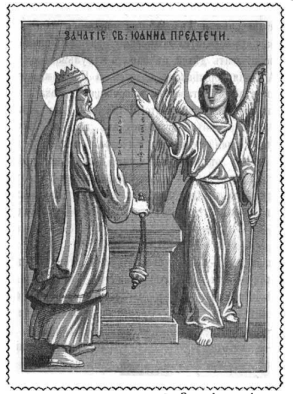
Люди, предназначаемые Промыслом для великих дел в царстве благодати, зачинаются и рождаются под особенным смотрением Божиим. Часто природу немощную Бог избирал орудием рождения Своих избранных, внушая тем, что для выполнения великих и святых Его предначертаний потребны не силе естества, но сила Божия, и немощи совершенная. Это сбылось в зачатии Предтечи Елисаветой, которая по гласу Церкви, «первее не раждающая, неплоды, зачала светильника, просвещать имущего всю вселенную, слепотой недугующую».
People destined by Providence for great works in the kingdom of grace are conceived and born under the special providence of God. Often God chose weak nature as an instrument for the birth of His chosen ones, thereby teaching that for the fulfillment of His great and holy designs, not the powers of nature are needed, but the power of God, which is made perfect in weakness. This came to pass in the conception of the Forerunner by Elizabeth, who, according to the voice of the Church, "she who before was barren, not giving birth, conceived the lamp that was to enlighten the whole universe, suffering from blindness."
Во дни Ирода, царя Иудейского, был некто Захария, священник Авиевой череды, и жена его из рода Ааронова – Елисавета. Оба они были праведны перед Богом, поступая во всем по заповедям и уставам Господним. У них не было детей, ибо Елисавета была неплодна, и оба были уже в летах преклонных. Однажды Захария служил перед Богом в свою череду; в храме было множество народа для молитвы. Во время каждения явился Захарии Ангел Господень, стоя по правую сторону алтаря кадильного. Увидев Ангела, Захария смутился, и напал на него страх. Не бойся, Захарие, сказал ему Ангел:зане услышана бысть молитва твоя ижена твоя Елисавета родит сына тебе, и нарешечи имя ему Иоанн. И будет тебе радость и веселие, и мнози о рождестве его возрадуются. Будет бо велий пред Господом: и вина и сикера не имать пити: и Духа Святого исполнится еще из чрева матери своея. И многих от сынов Израилевых обритит ко Господу Богу их. И той предъидет пред Ним духом и силой Илиной, обратити сердца отцем на чада, и противные в мудрости праведных, уготовати Господеви люди совершенны. По чесому разумению сие, спросил Захария,аз есмь стар, и жена моя заматоревши в днех своих. Аз есмь Гавриил, предстояй пред Богом, отвечал Ангел,и послан есмь глаголати к тебе и благовестити тебе сия: зане не веровал еси словесем моим, яже сбудутся во время сие. Между тем народ ожидал Захарию и дивился, что он медлит во святилище. Вышед, Захария не мог уже говорить; предстоявшие поняли, что он видел видение во храме. По прошествии дней службы своей, Захария возвратился в дом свой. Елисавета, жена его, зачала и благодарила Господа, что Он призрел на нее, чтобы избавить ее от нарекания между людьми (Лук. I, 5–25). Так зачатие Предтечи было чудесно и славно по особенному смотрению и обетованию Божию! В шестой месяц по зачатии своем Предтеча радостным взыгранием во чреве матери, при свидании ее я Богоматерью, исповедал Господа.
In the days of Herod, king of Judea, there was a certain Zacharias, a priest of the course of Abijah, and his wife was of the daughters of Aaron—Elizabeth. They were both righteous before God, walking in all the commandments and ordinances of the Lord. They had no child, because Elizabeth was barren, and they were both well advanced in years. Once, while Zacharias was serving as priest before God in the order of his course, there was a great multitude of people in the temple praying. During the time of incense, an angel of the Lord appeared to Zacharias, standing on the right side of the altar of incense. When Zacharias saw the angel, he was troubled, and fear fell upon him. Fear not, Zacharias, said the angel to him: for thy prayer is heard; and thy wife Elizabeth shall bear thee a son, and thou shalt call his name John. And thou shalt have joy and gladness; and many shall rejoice at his birth. For he shall be great in the sight of the Lord, and shall drink neither wine nor strong drink; and he shall be filled with the Holy Ghost, even from his mother's womb. And many of the children of Israel shall he turn to the Lord their God. And he shall go before Him in the spirit and power of Elias, to turn the hearts of the fathers to the children, and the disobedient to the wisdom of the just; to make ready a people prepared for the Lord. Whereby shall I know this? asked Zacharias; for I am an old man, and my wife well stricken in years. I am Gabriel, that stand in the presence of God, answered the angel, and am sent to speak unto thee, and to shew thee these glad tidings: because thou believest not my words, which shall be fulfilled in their season. Meanwhile the people waited for Zacharias, and marvelled that he tarried so long in the temple. When he came out, he could not speak unto them; and they perceived that he had seen a vision in the temple. As soon as the days of his ministration were accomplished, he departed to his own house. Elizabeth his wife conceived, and thanked the Lord, Who had looked upon her, to take away her reproach among men (Lk. 1:5–25). Thus the conception of the Forerunner was miraculous and glorious, according to the special providence and promise of God! In the sixth month after her conception, the Forerunner, by a joyful leaping in his mother's womb at her meeting with the Mother of God, confessed the Lord.
В воспоминание зачатия Предтечи, по особенному Божию намерению, Православная Церковь совершает праздник, который, без сомнения, установлен в первые времена христианства. Ибо Православная Церковь непреложно поступает по словам Евангелия, а Евангелие изображает зачатие Предтечи событием высоким и радостным и побуждает нас благодарить Бога за это событие и праздновать оное. Действительно самые указания на день зачатия Крестителя, до нас дошедшие, относятся к древним временам Христианства. От IV века сохранились до нас беседы св. Иоанна Златоуста, произнесенные им в день зачатия Предтечи при Богослужении. В VIII веке св. Иоанн Дамаскин и в IX Византий написали многие песни церковные на день зачатия Предтечи, ныне поемые в этот день при богослужении.
In remembrance of the conception of the Forerunner, according to the special purpose of God, the Orthodox Church celebrates a feast, which, without doubt, was established in the earliest times of Christianity. For the Orthodox Church unfailingly follows the words of the Gospel, and the Gospel depicts the conception of the Forerunner as a sublime and joyful event, and urges us to give thanks to God for this event and to celebrate it. Indeed, the very indications of the day of the Baptist's conception that have come down to us belong to the ancient times of Christianity. From the fourth century, homilies of St. John Chrysostom, delivered by him on the day of the Forerunner's conception during divine service, have been preserved. In the eighth century, St. John of Damascus, and in the ninth, Byzantius, wrote many church hymns for the day of the Forerunner's conception, which are sung today during divine service on this day.
Прославляя зачатие Предтечи, по особенному смотрению Божию, Церковь прославляет в своих песнопениях и праведных родителей Предтечи. «Первее не раждающая неплоды возвеселися: ибо зачала сего солнца светильника яве, просвещати имуща всю вселенную: ликуй, Захарие, вопия со дерзновением: пророк Вышняго есть хотяй родитися.
Glorifying the conception of the Forerunner, according to the special providence of God, the Church glorifies in her hymns also the righteous parents of the Forerunner. "Rejoice, thou that before wast barren and didst not bear: for thou hast conceived the lamp of the sun manifestly, which shall enlighten the whole universe: be glad, Zacharias, crying with boldness: the Prophet of the Most High is about to be born."
Веселится светло Захария великий со всеславной Елисаветой супружницей, достойно зачинающе Иоанна Предтечу, егоже Архангел благовести радуяся, и человецы достодолжно почтим, яко таиника благодати».
"Great Zacharias rejoiceth brightly with his all-glorious spouse Elizabeth, worthily conceiving John the Forerunner, whom the Archangel announced with joy, and let us men worthily honour him as a steward of grace."
При взятии Сиракуз в мае 868 года попали мусульманам в плен четыре христианина, Иоанн с несовершеннолетними сыновьями и Андрей. Они достались на часть самому эмиру Ибрагиму, повелителю северной Африки и Сицилии, который велел воспитывать детей в законе мусульманском и потом сделал Антония сборщиком податей, а Петра казначеем.
At the capture of Syracuse in May 868, four Christians—John with his underage sons and Andrew—fell into the hands of the Muslims as captives. They fell to the lot of the emir Ibrahim himself, the ruler of North Africa and Sicily, who ordered the children to be brought up in the Muslim law and later made Anthony a tax collector and Peter a treasurer.
Но они втайне оставались христианами, пока случай или какой враг не обнаружили этого. Ибрагим, не успевши склонить их к перемене веры, осудил их на мучительную смерть: после немилосердного бичевания палачи деревянными орудиями сперва отняли им руки, потом ноги. После сего при бездыханных трупах был умерщвлен и отец. Андрей же и за сим содержался долго в тюрьме, и когда остался непреклонен к вере, то был также убит (891 года).
But they secretly remained Christians, until chance or some enemy revealed this. Ibrahim, having failed to persuade them to change their faith, condemned them to a painful death: after merciless scourging, the executioners first cut off their arms with wooden instruments, then their legs. After this, the father was also put to death beside their lifeless bodies. Andrew, however, was kept for a long time in prison after this, and when he remained unyielding in the faith, he too was killed (in the year 891).
Неудобно усердно молиться к тому, для Кого все возможно и Кто по благости Своей готов помогать и любить дарить чистоту (Флп.4:13. Иак.1:5).
It is not difficult to pray fervently to Him for Whom all things are possible and Who, in His goodness, is ready to help and loves to grant purity (Phil. 4:13; Jas. 1:5).
Охраняйте чувства, взор, слух, осязание: очи – двери смерти (Иерем. IX, 21). Смотрите на святое и святое будет в уме и сердце. Берегитесь обхождения с другим полом, чтения соблазнительных книг и сладострастных картин. Кто любит опасность, попадет в нее (Еккл.3:27).
Guard the senses: sight, hearing, touch. The eyes are the gates of death (Jer. 9:21). Look upon what is holy, and what is holy will be in the mind and heart. Beware of association with the opposite sex, of reading seductive books and lascivious pictures. He who loves danger shall fall into it (Eccl. 3:27).
Неожиданно иногда снисходит посещение Божие в душу человека и становится внезапно немощное создание лицом к лицу с высшим подвигом, и является тогда готовым его совершить.
Sometimes the visitation of God descends unexpectedly upon the soul of a man, and suddenly a weak creature stands face to face with a higher feat, and proves ready to accomplish it.
И во всякое время и во всяком делании присуще бывает человеку восприятие благодати Божией: не обусловливается оно ни возрастом, ни умственным и научным развитием; обусловливается только одним духовным состоянием человека – постижением божественной истины и стремлением к источнику ее – Богу – Христу.
At all times and in every activity, the reception of the grace of God is present to man: it is conditioned neither by age nor by intellectual and scholarly development; it is conditioned only by the spiritual state of man—the comprehension of divine truth and the striving toward its source—God—Christ.
Так и молодая по годам, но уже инокиня – Ираида (Александриянка), воспринявшая и вместившая в почти детской своей душе спасительную истину – веру в Иисуса Христа, восприняла посещение Господне и внезапно вместила в душе своей необъятный порыв – жизнь свою положить вместе с защитниками единой правды и единого блага – веры Христовой.
Thus also Iraida (the Alexandrian), young in years but already a nun, who had received and contained in her almost childlike soul the saving truth—faith in Jesus Christ—received the Lord's visitation and suddenly contained in her soul an immeasurable impulse—to lay down her life together with the defenders of the one truth and the one good—the faith of Christ.
Вероятно никакими широкими замыслами, никакими глубокими задачами не задавалась неопытная и невинная мысль Ираиды, когда, однажды, шла она совершить свое простое посильное дело монастырского служения – принести воды для своей обители… Спокойно и беспечно подошла она к берегу за водой и вдруг предстало перед ней иное дело, иная задача: не воды почерпнуть для утоления жажды телесной, но всю свою жизнь передать для утоления жажды духовной – засвидетельствовать себя защитницей правды Христовой вместе с обреченным на мученичество ради нее…
Probably Iraida's inexperienced and innocent mind entertained no broad designs, no profound tasks, when one day she went to perform her simple, feasible work of monastic service—to fetch water for her monastery… Calmly and carelessly she approached the shore for water, and suddenly another work, another task presented itself before her: not to draw water to quench bodily thirst, but to give her whole life to quench spiritual thirst—to bear witness as a defender of the truth of Christ together with those condemned to martyrdom for its sake…
Когда, подойдя к берегу, Ираида увидела приставший к нему корабль с префектом города, который вез с собой в цепях многих пресвитеров, диаконов, святых жен и дев за исповедание Христова имени (числом всех около 150-ти человек), то внезапно почувствовала, что и ее душа всецело любит Того же Бога, за веру в Которого заключены в цепях все эти люди… что и ее место – посреди тех, которые готовы смертью своей запечатлеть эту божественную веру… И оставив свое смиренное житейское занятие, Ираида вдруг приобщилась к великому всемирному делу исповедания Христа. Она присоединилась к узникам, дала заковать себя, молодую, теми же тяжелыми цепями, какими были удручены святые мученики, и, последовав за ними, была отведена в Антиноэ, где вместе со всеми была осуждена на жестокие истязания и усечение мечем.
When, approaching the shore, Iraida saw a ship moored there with the prefect of the city, who was carrying with him in chains many presbyters, deacons, holy women and virgins for confessing the name of Christ (numbering in all about 150 persons), she suddenly felt that her soul also loved wholly the same God, for faith in Whom all these people were bound in chains… that her place also was in the midst of those who were ready to seal this divine faith with their death… And leaving her humble daily occupation, Iraida suddenly joined the great universal work of confessing Christ. She joined the prisoners, allowed herself, though young, to be bound with the same heavy chains with which the holy martyrs were burdened, and, following them, was taken to Antinoë, where together with all she was condemned to cruel tortures and beheading by the sword.
Не отступила перед муками и самой смертью едва начавшая свою жизнь молодая инокиня. Мужественная и сильная силой свыше, внезапно осенившей готовый сосуд благодати – ее чистую душу, Ираида первая из всех узников314 приняла смертную казнь, соединившую ее навеки со Христом.
The young nun, who had scarcely begun her life, did not shrink from torments and death itself. Courageous and strong with power from on high, which suddenly overshadowed the ready vessel of grace—her pure soul—Iraida was the first of all the prisoners314 to receive the death sentence, which united her forever with Christ.
О ней Греческое сказание писано при патр. Евфимии (906–909 года) современником, но не издано. Fabricii bibi. Gr. X, 286. В месяцеслове Вершинского не упомянута эта святая.
Concerning her, a Greek account was written under Patriarch Euthymius (906–909) by a contemporary, but it has not been published. Fabricii bibl. Gr. X, 286. This saint is not mentioned in the menologion of Vershinsky.