† Страдание святого князя Михаила Черниговского и боярина его Феодора и память о внуке князя Михаила, князе Олеге Брянском
† The Passion of the Holy Prince Michael of Chernigov and of his Boyar Theodore, and the Memory of the Grandson of Prince Michael, Prince Oleg of Bryansk
Михаил Князь Черниговский, сын Всеволода Чермного, с молодых лет отличался благочестивым настроением души; в молодости не пользовался он добрым здоровьем, напротив, был весь расслаблен; по слуху о Переяславском столпнике Никите отправился оно просить молитв праведника и по вере своей получил (1186 г.) полное здоровье.261 В 1224 г. видим его в совете князей, решавшем, идти ли навстречу татарам, по призыву половцев, а в конце того же года он уже был с дружиной своей в Торжке, готовый помогать великому князю Юрию, за которым была в замужестве сестра его. Новгородцы, не приняв к себе сына Юрьева, охотно приняли к себе Михаила. – Юрий при всем том, что помирился с новгородцами, взял из Торжка казну новгородскую; князь Михаил явился с просьбой возвратить Новгороду его собственность и Георгий уважил ходатайство его. Новгородцы с восторгом благодарили князя своего за его услугу, возвратившую сотням состояние их. Умными и благодушными поступками своими Михали снискал любовь новгородцев. «Вся область наша, говорит новгородский летописец, благословляла свой жребий, не чувствуя никакой тягости». Но в страшной Калкской битве убит был вместе с сыном брат Михаила Мстислав, княживший в Чернигове. Князь Михаил объявил, что должен возвратиться в родной город. Напрасно новгородцы просили его остаться с ними, напрасно говорили, что князь любимый Новгородом не может оставить Новгорода без оскорбления доброму сердцу своему. Михаил отвечал, что Чернигов и Новгород должны быть одно между собой, и он идет скрепить узы дружества и торговых сношенией между ними.262 Михаил занялся устройством родного ему княжества. В 1227 г. он готов был воевать с соседом своим, с Курским князем Олегом. К счастью, митрополит Кирилл помирил князей. В то время смут и междоусобий миролюбивый князь не мог не вовлекаться в междоусобия, и Михаил по вызову князя Киевского должен был отправиться в Волынь для войны с Галицким князем, но этот поход кончился без бед, миром. В конце 1228 г. новгородцы, теснимые князем Ярославом и своими неурядицами, отправили послов просить Михаила в Новгород. Михаил тем более поспешил в Новгород, что несчастные послы новгородские задержаны были в Смоленске по воле Ярослава. Народ принял его с восторгом. Князь, дав клятву охранять древнюю правду Ярославову, прежде всего занялся прекращением неурядицы в Новгороде. Согласно с древним новгородским законом он решил прекратить все споры и тяжбы по взысканию оброков с поселян, переведенных или перешедших от одного владельца к другому: «как повелели древние князья, так и платить, сказал он; кто где живет, там плати; кто пришел на новою землю, свободен от дани, хотя бы и за пять лет». Поселяне, дотоле угнетенные и разорявшиеся богатыми землевладельцами, благословили доброго князя Михаила. Устроив и другие внутренние дела Новгорода, миролюбием склонив Ярослава к уступкам в пользу Новгорода, Михаил оставил новгородцам юного князя Ростислава, а сам возвратился на юг. Он примирил с Черниговом и Киевом князя Ярослава, грозившего войной. В 1235 г. Владимир, князь Киевский, и Даниил, князь Галицкий, привели войска к Чернигову; обложив город, они сожгли предместье и разорили окрестности. Михаил искусно вывел войска из Чернигова и наголову разбил князя Галицкого. Изяслав, союзник и родственник Михаила, подоспел на помощь и Киев взят был для Изяслава, а Михаил взял себе Галич.263
Michael, Prince of Chernigov, son of Vsevolod the Red, was distinguished from his youth by a pious disposition of soul; in his youth he did not enjoy good health, but on the contrary was wholly enfeebled; having heard of the Stylite Nikita of Pereyaslavl, he went to ask the prayers of the righteous man, and by his faith he received (in 1186) complete health.261 In 1224 we see him in the council of princes which was deciding whether to go out to meet the Tatars at the summons of the Polovtsy, and at the end of that same year he was already with his retinue in Torzhok, ready to aid Grand Prince Yuri, whose wife was his sister. The Novgorodians, having refused to receive Yuri's son, willingly received Michael. — Yuri, notwithstanding that he had made peace with the Novgorodians, took the Novgorodian treasury from Torzhok; Prince Michael appeared with a request to return to Novgorod its own property, and George respected his intercession. The Novgorodians with delight thanked their prince for his service, which restored to hundreds their means. By his wise and kindly acts Michael won the love of the Novgorodians. "Our whole region," says the Novgorodian chronicler, "blessed its lot, feeling no burden whatsoever." But in the terrible battle of the Kalka, Michael's brother Mstislav, who had reigned in Chernigov, was slain together with his son. Prince Michael declared that he must return to his native city. In vain the Novgorodians begged him to remain with them; in vain they said that a prince beloved by Novgorod could not leave Novgorod without offending his good heart. Michael answered that Chernigov and Novgorod should be one with each other, and he was going to strengthen the bonds of friendship and commercial intercourse between them.262 Michael occupied himself with the ordering of his native principality. In 1227 he was ready to make war with his neighbor, Prince Oleg of Kursk. Fortunately, Metropolitan Cyril reconciled the princes. In that time of disturbances and internecine strife, a peace-loving prince could not avoid being drawn into internecine wars, and Michael, at the summons of the Prince of Kiev, had to set out for Volhynia for war with the Prince of Galich, but this campaign ended without calamity, in peace. At the end of 1228, the Novgorodians, oppressed by Prince Yaroslav and by their own disorders, sent envoys to ask Michael to come to Novgorod. Michael hastened to Novgorod all the more because the unfortunate Novgorodian envoys had been detained in Smolensk by the will of Yaroslav. The people received him with delight. The prince, having sworn to preserve the ancient justice of Yaroslav, first of all occupied himself with putting an end to the disorder in Novgorod. In accordance with the ancient Novgorodian law, he resolved to end all disputes and lawsuits concerning the collection of dues from the peasants who had been transferred or had passed from one landowner to another: "As the ancient princes commanded, so let it be paid," he said; "let each pay where he lives; let him who has come to new land be free of tribute, even if for five years." The peasants, who had until then been oppressed and ruined by rich landowners, blessed the good Prince Michael. Having also settled other internal affairs of Novgorod, and having by his peaceableness inclined Yaroslav to concessions in favor of Novgorod, Michael left the young Prince Rostislav to the Novgorodians, and himself returned to the south. He reconciled Prince Yaroslav, who was threatening war, with Chernigov and Kiev. In 1235, Vladimir, Prince of Kiev, and Daniel, Prince of Galich, brought troops to Chernigov; having besieged the city, they burned the suburb and laid waste the environs. Michael skillfully led his troops out of Chernigov and utterly defeated the Prince of Galich. Izyaslav, Michael's ally and kinsman, arrived in time with aid, and Kiev was taken for Izyaslav, while Michael took Galich for himself.263
Наступило страшное время. В 1238 г. татары опустошили Рязань, Суздаль и Владимир. В 1239 г. обратились они на южную Россию. В это время Михаил владел Киевом. Послы Мангу потребовали от Киева и князя, чтобы покорились добровольно хану. Михаил и его дружина видели, что нет сил победить страшного врага; но признали за низость просить себе цепей у гордого врага. Послы хана за дерзкие отзывы были убиты. Михаил поспешил искать помощи отчизне за ее пределами, – он обратился к Беле, королю венгерскому. Киев был взят, и еще прежде того опустошен Чернигов, дорогой Михаилу. Князь Мстислав, двоюродный брат Михаила, истощал и мужество и военные средства спасти Чернигов. Город был сильно укреплен; защитники бились с татарами, не щадя жизни. Татары выставили стенобитные машины, – на город саженей за 100 летали каменья огромные, такие, что четыре человека едва могли поднять один камень. Мстислав уступил упорному напору многочисленного врага; множество из его войска пало в битвах; город был взят и предан огню; епископа Порфирия взяли в плен, но, истомленного летами и скорбями, отпустили из Глухова, и он умер. Князь Михаил не нашел помощи у сильного Белы, – тот остался ждать своей очереди, которая и дошла до Венгрии после Киева. Михаил ездил из страны в страну. Ограбленный немцами близ Сирада, он возвратился в Киев и жил на острове, против развалин древней столицы; потом переселился в опустошенный Чернигов. Между тем сын его Ростислав умел снискать любовь Белы, и венгерский король выдал за него дочь свою. Михаил, думая найти в родственнике верного союзника, в другой раз прибыл в Венгрию; но и опять встретил там прием слепого своекорыстия. Огорченный князь вернулся на родину.264
The terrible time arrived. In 1238 the Tatars laid waste Ryazan, Suzdal, and Vladimir. In 1239 they turned upon southern Russia. At this time Michael held Kiev. The envoys of Mangu demanded of Kiev and of the prince that they submit voluntarily to the Khan. Michael and his retinue saw that there was no strength to conquer the terrible enemy; but they considered it baseness to ask chains for themselves from the proud enemy. The Khan's envoys were slain for their insolent words. Michael hastened to seek help for his fatherland beyond its borders — he turned to Bela, King of Hungary. Kiev was taken, and even before that Chernigov, dear to Michael, had been laid waste. Prince Mstislav, Michael's cousin, exhausted both his courage and his military resources to save Chernigov. The city was strongly fortified; the defenders fought the Tatars without sparing their lives. The Tatars brought up battering-rams — stones of enormous size flew into the city from about 100 sazhens, such that four men could scarcely lift a single stone. Mstislav yielded to the stubborn onslaught of the numerous enemy; many of his troops fell in battle; the city was taken and given over to fire; Bishop Porfiry was taken captive, but, worn out by years and sorrows, was released from Glukhov, and he died. Prince Michael found no help from the mighty Bela — he remained to await his own turn, which reached Hungary after Kiev. Michael traveled from land to land. Robbed by the Germans near Sirad, he returned to Kiev and lived on the island opposite the ruins of the ancient capital; afterwards he moved to the devastated Chernigov. Meanwhile his son Rostislav managed to win the love of Bela, and the Hungarian king gave him his daughter in marriage. Michael, thinking to find in his kinsman a faithful ally, arrived in Hungary a second time; but again he met there a reception of blind self-interest. The grieved prince returned to his homeland.264
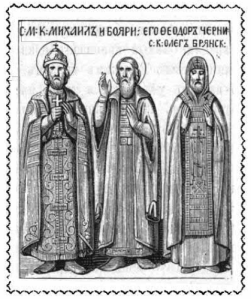
Чиновники хана переписывали в Черниговской области всех оставшихся жителей для сбора дани; от князей требовали они, чтобы не иначе вступали они в управление областями, как явясь наперед с покорностью к Батыю. Князь Михаил, не нашедший нигде помощи отчизне, видел, что надобно покориться хану, – такова воля Божия; но что делать, если придется встретиться с язычеством двора Батыева? Святой верой надобно дорожить более всего, думал он. Благочестивый Михаил обратился за советом к отцу духовному, епископу Иоанну. Тот говорил ему: «многие князья отправлялись в орду и поступали по воле язычника; прельстясь славой света сего, ходили сквозь огонь и кланялись идолам. Но ты, князь, не принимай в уста твои ни пищи, ни питья их; а исповедуй веру христианскую, говори, что христианам не следует поклоняться твари, а только Господу Иисусу Христу». Князь отвечал: «пусть молитвой твоей совершится воля Божия! Я желаю пролить кровь мою за Христа и за веру чистую». Боярин Михаила Феодор сказал то же. «Если так поступите», сказал епископ, «вы будете новыми мучениками, на утверждение другим». Князь и воевода обещались поступить так. Духовный отец дал им святое причастие на путь и отпустил с молитвой: «да укрепит вас Бог, за Которого желаете страдать!»
The Khan's officials were registering in the Chernigov region all the remaining inhabitants for the collection of tribute; they demanded of the princes that they should not enter into the administration of the regions otherwise than by first appearing with submission before Baty. Prince Michael, who had found no help anywhere for his fatherland, saw that it was necessary to submit to the Khan — such was the will of God; but what was to be done if he should have to encounter the paganism of Baty's court? The holy faith must be prized above all things, he thought. The pious Michael turned for counsel to his spiritual father, Bishop John. He said to him: "Many princes have gone to the Horde and have acted according to the will of the pagan; seduced by the glory of this world, they passed through the fire and bowed down to idols. But you, prince, take neither their food nor their drink into your mouth; but confess the Christian faith, and say that it is not fitting for Christians to worship the creature, but only the Lord Jesus Christ." The prince answered: "Let the will of God be accomplished by your prayer! I desire to shed my blood for Christ and for the pure faith." Michael's boyar Theodore said the same. "If you act thus," said the bishop, "you will be new martyrs, for the confirmation of others." The prince and the voivode promised to act thus. The spiritual father gave them the Holy Communion for the journey and dismissed them with the prayer: "May God strengthen you, for Whom you desire to suffer!"
Прибыв в стан Батыя с внуком Борисом Васильковичем, Ростовским князем, и с боярином Феодором, князь Михаил объявил, что желает представиться Батыю. О нем доложили. Батый приказал позвать жрецов и сказал: «выполните над русским князем Михаилом все, что следует по вашим уставам, и тогда представьте его ко мне». Жрецы потребовали, чтобы князь и боярин его прошли среди огня. – Князь отвечал: «христианин поклоняется Творцу, а не твари». – Объявили Батыю о непокорности русского князя. Батый рассвирепел и послал вельможу своего Эльдегу объявить князю: «как смеет он не исполнять волю царя? Пусть избирает одно из двух: или поклонится богам и будет спокойно владеть княжеством, или умереть он злой смертью». – Князь отвечал: «я готов поклониться царю, – ему вручил Бог судьбу земных царств; но я христианин и не могу поклониться тому, чему поклоняются жрецы!» Так пишет современник.265
Having arrived at Baty's camp with his grandson Boris Vasilkovich, Prince of Rostov, and with the boyar Theodore, Prince Michael declared that he wished to present himself before Baty. He was announced. Baty ordered the priests to be summoned and said: "Perform over the Russian prince Michael all that is prescribed by your statutes, and then present him to me." The priests demanded that the prince and his boyar pass through the fire. — The prince answered: "A Christian worships the Creator, not the creature." — They announced to Baty the disobedience of the Russian prince. Baty flew into a rage and sent his nobleman Eldega to declare to the prince: "How dare he not fulfill the will of the Tsar? Let him choose one of two things: either bow down to the gods and peacefully possess his principality, or die an evil death." — The prince answered: "I am ready to bow down to the Tsar — to him has God entrusted the fate of earthly kingdoms; but I am a Christian and cannot bow down to that which the priests worship!" Thus writes a contemporary.265
Что за действие, которого требовали от князя Михаила и от которого отказался он? По известию духовника – епископа Иоанна, это было дело языческое. так и это было?266 О хане Мангу западный путешественник говорит: «он приносил жертвы небу, солнцу, луне и горам».267 Согласимся, что Батый «не принадлежал ник какой секте и поклонялся только единому Богу».268 – Но Яса Чингисова была господствующим законом монголов; а в Ясе предписывалось вместе с поклонением верховному поклонение духам добрым и злым, поклонение солнцу, луне, стихиям, предкам. – Как ни думал для себя Батый, в стане его господствовал монгольский закон с его жрецами. Даниил, князь Галичский, спустя три года после Михаила, «видел здесь гнусные волховательные богослужения и установленные Чингисханом бредни, – царей, князей, вельмож закон водил около куста кланяться солнцу, луне, земле, диаволу, умершим в аду отцам, дедам и матерям».269 – Известно, что даже буддийские ламы вынуждены были сохранить между бурятами поклонение огню – их древнее заблуждение.270 Гордости монголов естественно было тешиться тем, что русские отдают уважение и их религии. Если же для кого, то особенно для князя Михаила Батый не мог отменить ничего из требований жрецов монгольских. Он видел в Михаиле того, кто старался отклонить от себя монгольскую власть. «Татары выискивали случай убить его», говорит западный очевидец событий. – Этот римский миссионер не совсем верно и слишком коротко описал прием князя Михаила в Орде; но и он писал: «южной стороне поклоняются как Богу и заставляют то же делать других знатный людей, которые покоряются им. Недавно Михаил, одни из великих герцогов русских, приехал к Батыю; ему сказали, чтобы он поклонился Цингис-Хану на юг. Михаил отказался... У них есть идолы, сделанные из войлока: они почитают солнце, светила, огонь, воду, землю, поклоняются и приносят в жертву начатки пищи и питья».271 – Так благоверный князь Михаил и боярин Феодор поставлены были лицом к лицу перед язычеством; им оставалось одно из двух – или поступить по совести язычника, или умереть с христианской совестью. И летописи наши не иначе называют подвиг князя Михаила, как подвигом «за святую веру»,272 страданием за неуважение язычества.273
What was this act that was demanded of Prince Michael and which he refused? According to the account of his confessor, Bishop John, it was a pagan practice. Was it indeed so?266 Of Khan Mangu, a Western traveler says: "He offered sacrifices to heaven, the sun, the moon, and the mountains."267 Let us agree that Batu "belonged to no sect and worshipped only the one God."268 — But the Yasa of Genghis was the prevailing law of the Mongols; and the Yasa prescribed, together with worship of the Supreme Being, worship of good and evil spirits, worship of the sun, the moon, the elements, and ancestors. — However Batu may have thought for himself, in his camp the Mongol law with its priests held sway. Daniel, Prince of Galicia, three years after Michael, "saw there abominable sorcerous rites and the follies established by Genghis Khan — the law led tsars, princes, and nobles around a bush to bow down to the sun, the moon, the earth, the devil, and to fathers, grandfathers, and mothers who had died in hell."269 — It is known that even Buddhist lamas were compelled to preserve among the Buryats the worship of fire — their ancient error.270 It was natural for Mongol pride to take pleasure in the fact that the Russians showed respect to their religion as well. And if for anyone, then especially for Prince Michael, Batu could not abrogate any of the demands of the Mongol priests. He saw in Michael one who had tried to avert Mongol authority from himself. "The Tatars sought an opportunity to kill him," says a Western eyewitness of events. — This Roman missionary described the reception of Prince Michael in the Horde not entirely accurately and too briefly; but he also wrote: "They worship the southern side as God and compel other noble persons who submit to them to do the same. Not long ago Michael, one of the great dukes of the Russians, came to Batu; they told him to bow down to Genghis Khan toward the south. Michael refused... They have idols made of felt; they honor the sun, the stars, fire, water, the earth; they worship and offer the firstfruits of food and drink as sacrifice."271 — Thus the Right-believing Prince Michael and the boyar Theodore were placed face to face with paganism; they had but one of two choices — either to act according to a pagan conscience, or to die with a Christian conscience. And our chronicles call the feat of Prince Michael nothing other than a feat "for the holy faith,"272 a suffering for refusing to honor paganism.273
Обратимся же к истории высокого христианского подвига.
Let us turn, then, to the account of this lofty Christian feat.
Когда Эльдега услышал отказ князя исполнить то, что от него требовали, он сказал: «понимаешь ли, князь, что ты произносишь себе смертный приговор?» «Да, отвечал покойно князь; я желаю страдать за Христа моего, готов пролить кровь за чистую веру». – Юный князь Борис Ростовский, которому Батый также объявил свою волю о Михаиле,274 со слезами говорил деду: «государь-батюшка! поклонись». Бояре Борисовы говорили: «готовы мы со всей страной своей принять на себя епитимью за тебя, князь». Михаил отвечал: «не хочу я быть христианином только по имени, а дела творить язычника». – Это значило, что святой князь не хотел быть лицемерным христианином и бесчестить христианство перед язычниками; он хотел быть лучшим христианином, на которого могли бы с торжеством смотреть христиане, не земле и на небе. Боярин Феодор думал между тем: не склонили бы князя мольбы своих к измене совести, – вызываемая ими в душе князя борьба с любовью к жизни, к милой семье, ко всему дорогому не кончилась бы победой худшего. И он сказал любимому князю: «помнишь ли, государь, слова духовного отца нашего? Господь сказал: иже хощет душу свою спасти, погубит ю; а иже погубит душу свою Мене ради и Евангелия Моего, спасет ю. Кая польза человеку, аще мир весь приобрящет, а душу свою погубит? Иже исповесть Мя пред человеки, исповем его и Аз пред Отцем Моим; а иже отвержется Мене пред человеки, отвергуся и Аз пред Отцем Моим». – Князь Борис и его бояре со своей стороны не переставали убеждать Михаила пощадить себя. «Не слушаю вас, не погублю души моей», сказал решительно святой князь. И сняв с себя княжескую епанчу, бросил ее со словами: «прочь слава мира сего, не хочу ее».275 Увидев, что никакие убеждения не переменяют решимости князя, ханский вельможа отправился к Батыю передать ответы князя Михаила. «Множество христиан и язычников собралось тут слушать, что отвечает князь Михаил царю», говорит описатель подвига. Так и христианский и языческий мир смотрели на подвиг святого князя Михаила. Мир христианский с радостью и торжеством видел, что христианский князь не унизил в себе имени христианина, к соблазну братий; нет, он подал пример другим, каков должен быть искренний христианин. – Мир языческий должен был сознаться, что христианство воспитывает людей высоких по духу, которые любят веру свою не до первой опасности для чести или жизни, а все отдают за нее. Говорят, и это вполне вероятно, что Батый, выслушав ответ Михаила, сказал: «это – влеикий человек».276 – Без сомненья, твердость святого князя Михаила, восторжествовавшая над гордостью монгольской, доставила святой Церкви ту услугу, что после Михаила князей русских уже не ставили лицом к лицу с язычеством при приемах в Орде.
When Eldega heard the prince's refusal to do what was demanded of him, he said: "Do you understand, prince, that you are pronouncing a death sentence upon yourself?" "Yes," the prince answered calmly; "I desire to suffer for my Christ; I am ready to shed my blood for the pure faith." — The young Prince Boris of Rostov, to whom Batu had also declared his will concerning Michael,274 said with tears to his grandfather: "Sovereign father! Bow down." Boris's boyars said: "We are ready, together with all our land, to take upon ourselves the penance for you, prince." Michael answered: "I do not wish to be a Christian only in name, while doing the deeds of a pagan." — This meant that the holy prince did not wish to be a hypocritical Christian and to dishonor Christianity before the pagans; he wished to be a better Christian, one upon whom Christians on earth and in heaven could look with triumph. The boyar Theodore, meanwhile, thought: would not the entreaties of his own people sway the prince to betray his conscience — would not the struggle they aroused in the prince's soul, between love of life, of his dear family, of all that was precious, end in the victory of the worse? And he said to his beloved prince: "Do you remember, sovereign, the words of our spiritual father? The Lord said: For whosoever will save his life shall lose it; but whosoever shall lose his life for My sake and the Gospel's, the same shall save it. For what shall it profit a man, if he shall gain the whole world, and lose his own soul? Whosoever therefore shall confess Me before men, him will I confess also before My Father; but whosoever shall deny Me before men, him will I also deny before My Father." — Prince Boris and his boyars, for their part, did not cease to urge Michael to spare himself. "I do not listen to you; I will not destroy my soul," said the holy prince decisively. And taking off his princely cloak, he threw it away, saying: "Away with the glory of this world; I want it not."275 Seeing that no persuasions could change the prince's resolve, the khan's nobleman went to Batu to report Prince Michael's answers. "A multitude of Christians and pagans gathered there to hear what Prince Michael answered the tsar," says the describer of the feat. Thus both the Christian and the pagan world looked upon the feat of the holy Prince Michael. The Christian world saw with joy and triumph that the Christian prince had not debased the name of Christian within himself, to the scandal of his brethren; no, he gave an example to others of what a sincere Christian ought to be. — The pagan world was forced to acknowledge that Christianity nurtures men lofty in spirit, who love their faith not only until the first danger to honor or life, but give up everything for it. It is said, and this is entirely probable, that Batu, having heard Michael's answer, said: "This is a great man."276 — Without doubt, the steadfastness of the holy Prince Michael, which triumphed over Mongol pride, rendered the holy Church this service: that after Michael, Russian princes were no longer placed face to face with paganism at their receptions in the Horde.
Когда Эльдега удалился, блаженный Михаил и его достойный боярин начали петь псалмы и, окончив пение, приобщились святых Таин, которые дал им духовный отец, благословивший их на страдания за Христа.277 «Князь Михаил!» сказали еще раз татарские чиновники, «идут от хана убить вас; покоритесь и останетесь живы». Великий князь и Феодор отвечали за-одно: «не слушаем вам, не хочем славы мира сего». И начали петь себе: «мученицы Твои, Господи, не отвергошася Тебе, не отступиша от заповедей Твоих». Потом пели другие мученические стихи. Так укреплялись они на довершение высокого подвига.
When Eldega had departed, the blessed Michael and his worthy boyar began to sing psalms, and having finished the singing, they partook of the Holy Mysteries, which their spiritual father, who had blessed them for suffering for Christ, had given them.277 "Prince Michael!" the Tatar officials said once more, "they are coming from the khan to kill you; submit, and you will remain alive." The Grand Prince and Theodore answered together: "We do not listen to you; we do not want the glory of this world." And they began to sing to themselves: "Thy martyrs, O Lord, did not deny Thee, did not depart from Thy commandments." Then they sang other martyr verses. Thus they strengthened themselves for the completion of their lofty feat.
Явились убийцы. Соскочив с коней, татарские палачи схватили князя Михаила, растянули за руки и ноги и начали быть то кулаками, то палками по груди, потом повернули его лицом к земле и били ногами. – Это зверство длилось долго. Даже отступники от христианства, путивлянин Дементий, оскорбился тем и ноже отрезал голову святому мученику.
The murderers appeared. Leaping from their horses, the Tatar executioners seized Prince Michael, stretched him out by his hands and feet, and began to beat him, now with their fists, now with sticks, on the chest; then they turned him face down and kicked him. — This brutality lasted a long time. Even an apostate from Christianity, Dementius of Putivl, was offended by it and cut off the head of the holy martyr with a knife.
Боярина Феодора стали уговаривать не следовать примеру князя и обещали ему почести. Он отвечал: «не могу кланяться твари, хочу страдать за Христа моего, как и государь мой князь». – Его стали мучить, как мучили князя, и наконец отрезали ему голову. Это было 20 сентября 1244 г.278
The boyar Theodore was urged not to follow the prince's example, and honors were promised him. He answered: "I cannot bow down to the creature; I wish to suffer for my Christ, as did my sovereign the prince." — They began to torture him as they had tortured the prince, and finally cut off his head. This occurred on September 20, 1244.278
Святые тела мучеников были брошены в пищу псам. Не один день лежали они, но остались целы и невредимы. Господь, за которого пострадали мученики, явил Свое знамение в подкрепление веры слабых и унижение язычеству. Над святыми телами стоял столп светлый, горели свечи и слышны были небесные голоса. – Богобоязненные христиане, видевшие это, с радостью и слезами, тайно взяли святые тела и принесли в Чернигов.279 Так как сказание о мученическом подвиге святого князя и его воеводы написано было еще духовником их, епископом Иоанном, то нет сомнения, что память их стали чтить в Чернигове вслед за принесением мощей их в Чернигов.280 В 1572 г. святые мощи из по воле царя Иоанна перенесены в Москву, из опасения, – не подвергались бы они поруганию со стороны папистов, по переходе Чернигова под власть Польскую. Ныне они почивают в Архангельском соборе.281
The holy bodies of the martyrs were thrown out as food for dogs. They lay there for more than one day, but remained whole and unharmed. The Lord, for whom the martyrs had suffered, manifested His sign to strengthen the faith of the weak and to humble paganism. Over the holy bodies stood a luminous pillar, candles burned, and heavenly voices were heard. — God-fearing Christians who saw this, with joy and tears, secretly took the holy bodies and brought them to Chernigov.279 Since the account of the martyric feat of the holy prince and his voivode was written by their confessor, Bishop John, there is no doubt that their memory began to be honored in Chernigov immediately after the bringing of their relics to Chernigov.280 In 1572, the holy relics were transferred by the will of Tsar John to Moscow, for fear that they might be subjected to desecration by the Papists after Chernigov passed under Polish rule. They now repose in the Cathedral of the Archangel.281
Святой князь Михаил за великий подвиг свой награжден и не земле благословением небесным. Тогда как ветви других потомков равноапостольного давно угасли, ветви святого князя Михаила поныне еще зеленеют: князья Барятинские, Горчаковы, Долгорукие, Елецкие, Звенигородские, Кольцовы-Мосальские, Оболенские, Одоевские, Щербатовы. В потомках его постоянно живо было благочестие. Не говорим здесь о знаменитой дочери его – о святой Евфросиньи.282 – Великому родителю подражал в благочестии сын его князь Роман Брянский, а еще более внук его князь Олег Романович. В рукописных святцах читаем: «святый благоверный князь Олег Романович Брянский, во иноцех Леонтий, преставился в лето 6740 и положен бысть в Петропавловском монастыре». Здесь в означении времени – ошибка. Князь Олег Романович, внук святого князя Михаила, в 1274 г. был вместе с отцом своим на войне против Литвы. «По окончании войны, говорит современник, из Новгородка Литовского Олег приехал во Владимир (Волынский) к сестре своей (Ольге – Елене Романовне, супруге князя Волынского Владимира). – Владимир усердно звал тестя своего к себе. «Государь-батюшка! Говорил он, приезжай побывать в своем доме и посмотреть на здоровье дочери твоей». Но Роман отказался. – «Сын мой Владимир! Отвечал он: не могу я отлучиться от дружины моей ратной; я живу в стороне, угрожаемой войной; кто без меня управит моей дружиной? Вот пусть едет вместо меня сын мой Олег». Они поцеловались и каждый отправился в свое место». По этому известию видим, как в князе Владимире почтительного сына, хотя по другому известию он и стриг бороду, так и в князе Романе – является князь попечительный о своих подданных, жертвующий для долга самым невинным удовольствием.283 – По известию о начале Свенского монастыря, князь Роман Михайлович – князь благочестивый, и душевные расположения его привлекают на него особенную милость Божию. По этому известию, князь был сильно боле и чудесно исцелился на Свенской горе перед иконой Богоматери. – Он тогда же поставил на месте исцеления крест, доселе целый; потом построены им на горе храм и монастырь, а чудотворная икона украшена дорогим окладом.284 – Храброго князя Романа Михайловича видим еще воюющим в 1285 г.285 Но князя Олега после 1274 г. не видим более ни в какой мирской тревоге. В древних синодиках поминали: великий князь Романа старого Черниговского и княгиню Анну и сына его князя Олега Романович, великого князя Черниговского. Леонтия, оставившего двенадцать тем людей и приемшего ангельский образ, во иноцех Василия.286 Синодики дают видеть в блаженном князе Олеге нравственное мужество, расставшееся с заманчивой властью наследственного великого князя Черниговского, могшего еще располагать стами тысяч народа. По летописям видим, что после князя Романа наследовал отцу старший сын его князь Михаил, а затем в 1309 г. Брянским князем был Василий Михайлович.287 Ясно, что князь Олег, видя непрочность земного счастья, не успокаивающего собой любимцев своих, предоставил брату и его сыну княжество Черниговское и Брянское, а сам решился в одежде инока служить Господу и начал строить Петропавловский монастырь. По благочестивым расположениям детей и внуков святого князя Михаила, не можем сомневаться, что и сестра блаженного князя Ольга, получив в 1289 г. богатые имения на Волыни, по завещанию супруга,288 щедро помогала брату в устроении Брянской обители. – Князь инок Василий скончался строгим подвижником. Мощи его почивают под спудом в каменном храме обители его, которую патриарх Никон, по благоговению к святому князю-подвижнику, возводил на степень ставропигии.289
St. Prince Michael was rewarded for his great feat even on earth with a heavenly blessing. While the branches of other descendants of the Equal-to-the-Apostles have long since withered, the branches of St. Prince Michael still flourish to this day: the princes Baryatinsky, Gorchakov, Dolgoruky, Yeletsky, Zvenigorodsky, Koltsov-Mosalsky, Obolensky, Odoyevsky, Shcherbatov. Piety was constantly alive in his descendants. We do not speak here of his famous daughter—of St. Euphrosyne.282 – The great parent was imitated in piety by his son, Prince Roman of Bryansk, and even more so by his grandson, Prince Oleg Romanovich. In the handwritten saints’ calendars we read: “the holy right-believing Prince Oleg Romanovich of Bryansk, in monasticism Leontius, reposed in the year 6740 and was laid to rest in the Peter and Paul Monastery.” Here there is an error in the indication of the time. Prince Oleg Romanovich, grandson of St. Prince Michael, was with his father in the war against Lithuania in 1274. “After the end of the war,” says a contemporary, “from Novgorodok of Lithuania Oleg came to Vladimir (Volynsk) to his sister (Olga—Elena Romanovna, wife of Prince Vladimir of Volyn). – Vladimir earnestly invited his father-in-law to him. ‘Sovereign-father!’ he said, ‘come visit your own home and see the health of your daughter.’ But Roman refused. – ‘My son Vladimir!’ he answered: ‘I cannot be separated from my military retinue; I live in a region threatened by war; who will govern my retinue without me? Let my son Oleg go instead of me.’ They kissed and each departed to his own place.” From this account we see in Prince Vladimir a respectful son, although according to another account he did cut his beard, and in Prince Roman—a prince solicitous for his subjects, sacrificing even the most innocent pleasure for duty.283 – According to the account of the founding of the Svensky Monastery, Prince Roman Mikhailovich was a pious prince, and his spiritual dispositions drew upon him special mercy from God. According to this account, the prince was severely ill and was miraculously healed on Svenskaya Hill before the icon of the Mother of God. – He then set up a cross on the place of his healing, which remains intact to this day; afterwards, a church and monastery were built by him on the hill, and the wonderworking icon was adorned with a precious cover.284 – We see the brave Prince Roman Mikhailovich still waging war in 1285.285 But after 1274 we no longer see Prince Oleg in any worldly turmoil. In the ancient synodikons they commemorated: the great Prince Roman the Elder of Chernigov and Princess Anna and his son Prince Oleg Romanovich, great Prince of Chernigov. Leontius, who left behind twelve tmy of people and received the angelic habit, in monasticism Basil.286 The synodikons reveal in the blessed Prince Oleg a moral courage that parted with the alluring power of the hereditary great prince of Chernigov, who could still command hundreds of thousands of people. From the chronicles we see that after Prince Roman, his eldest son Prince Michael succeeded his father, and then in 1309 the prince of Bryansk was Basil Mikhailovich.287 It is clear that Prince Oleg, seeing the instability of earthly happiness, which does not give rest even to its favorites, left the principality of Chernigov and Bryansk to his brother and his son, while he himself resolved to serve the Lord in the garb of a monk and began to build the Peter and Paul Monastery. From the pious dispositions of the children and grandchildren of St. Prince Michael, we cannot doubt that the sister of the blessed Prince Oleg, Olga, having received rich estates in Volhynia in 1289 by her husband’s will,288 generously helped her brother in the establishment of the Bryansk monastery. – The prince-monk Basil reposed as a strict ascetic. His relics rest hidden in the stone church of his monastery, which Patriarch Nikon, out of reverence for the holy prince-ascetic, raised to the rank of a stauropegion.289