Однажды в Антиохии совершался языческий праздник, приносились жертвы, происходило пьянство и бесчиние. Пришедшие в это время в город благочестивые мужи Трофим и Савватий воздохнули об ослеплении язычников и со слезами сказали: «Боже, призри с небес и исторгни этих людей от власти лукавого!» Язычники, увидавши в них христиан, отвели их к градоначальнику Аттику, и этот после допроса Трофиму велел мучить его и заключить в темницу. Затем спросил Савватия: «Какого ты сана?» Савватий отвечал: «Сан, отечество, слава и богатство мое – Христос, Сын Божий». Судья ударил его, велел принести жертву богам, и когда праведник укоризненно отозвался о них, велел повесить и строгать острым железом. В этих муках и скончался Савватий.
Once in Antioch a pagan festival was being celebrated; sacrifices were offered, and there was drunkenness and disorder. The pious men Trophimus and Sabbatius, who had come to the city at that time, sighed over the blindness of the pagans and said with tears: "O God, look down from heaven and tear these people from the power of the Evil One!" The pagans, seeing them to be Christians, led them away to the city prefect Atticus, and he, after interrogating Trophimus, ordered him to be tortured and cast into prison. Then he asked Sabbatius: "What is your rank?" Sabbatius answered: "My rank, fatherland, glory, and wealth is Christ, the Son of God." The judge struck him, ordered him to offer sacrifice to the gods, and when the righteous man spoke reproachfully of them, he ordered him to be suspended and scraped with sharp iron. In these torments Sabbatius died.
Трофим же отослан на муки в город Синнад, во Фригию, где правитель Дионисий велел бить его суровыми жилами, вливать в ноздри уксус с горчицей и резать бока. Св. мученик утешал себя словами Писания: много скорбей у праведного, и от всех их избавит его Господь (Пс.23:20). «Советую тебе принесть жертву богам», говорил судья. «Не отвергнусь моего истинного Бога», отвечал мученик. На его раны поливали уксус с солью, палили ребра огнем; наконец, бросили его в тюрьму.
Trophimus, however, was sent for torture to the city of Synnada in Phrygia, where the governor Dionysius ordered him to be beaten with raw sinews, to have vinegar mixed with mustard poured into his nostrils, and his sides to be cut. The holy martyr consoled himself with the words of Scripture: Many are the sorrows of the righteous, and from all of them the Lord will deliver him (Ps. 23:20). "I advise you to offer sacrifice to the gods," said the judge. "I will not deny my true God," answered the martyr. Vinegar and salt were poured on his wounds, his ribs were scorched with fire; finally, they cast him into prison.
Тут посещал его сенатор, то есть член местного сената городского, Доримедонт, благочестивый христианин, омывал и перевязывал раны его. Случилось правителю быть на празднике в капище; не видя Доримедонта, он послал за ним. Доримедонт сказал посланным: «Я – христианин, и мне не должно ходить на эти праздники». Тогда привели его насильно и подвергли пыткам. Наконец, его обезглавили вместе с Трофимом (282 года).
Here he was visited by Dorymedon, a senator—that is, a member of the local city senate—a pious Christian, who washed and bandaged his wounds. It happened that the governor was at a festival in the pagan temple; not seeing Dorymedon, he sent for him. Dorymedon said to those sent: "I am a Christian, and I must not go to these festivals." Then they brought him by force and subjected him to tortures. Finally, he was beheaded together with Trophimus (in the year 282).
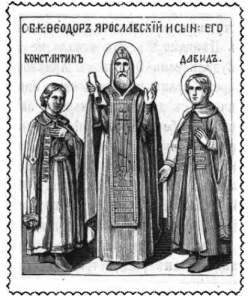
Феодор Ростиславич Черный, благоверный князь Смоленский и Ярославский, был сын Смоленского князя Ростислава Мстиславича и правнуков Мономаха. По словам древнего биографа его,238 воспитанный в страхе божием, он и в молодых летах был боголюбив, а вместе отличался воинской отвагой и мужеством. – У него был два брата, князья Глеб и Михаил. По смерти отца братья поступили с ним несправедливо: дали ему из княжества один только Можайск; но он не спорил с ними. Умный, добрый князь можайский умел так устроить небольшой городок свой, что тот скоро стал и людным и небедным. – Он вступил в брак с дочерью князя ярославского, кн. Василия Всеволодовича, Марией, единственной наследницей Ярославского княжества. Это было около 1267 г.239 – Казалось, что этот союз брачный был счастливый; но теща его любила быть первой и была женщина с характером твердым. Только неудовольствия со стороны братьев заставили кн. Феодора жить в Ярославле, где Мария родила ему сына Михаила. В 1277 году он и некоторые другие князья, по воле хана Менгу-Темира, отправились с войсками в Орду, чтобы вместе с войсками хана воевать против яссов, не хотевших платить дань татарам. Князья русские доходили до Дербента и смирили яссов, взяв богатую добычу и пленников. Хан был доволен князьями; но особенно обратил его внимание на себя мужественный князь Феодор.240 Выдав затем дочь свою за сына князя Белозерского, князь Феодор по воле хана отправился (1278 г.) с зятем своим на войну в Болгарию, где какой-то бродяга принял на себя лице человека, предназначенного небом освободить Болгарию от татар; самозванец был разбит. Подвиги Феодора доставили ему благосклонность в Орде, где приняли его с отличным вниманием.241 Князь Феодор служил при дворе хана в виде любимца, весьма уважаемого. Мужественная красота, высокий рост, такой же ум его так пленили царицу, что она предложила ему руку дочери своей.242 Феодор отвечал, что у него есть супруга, дочь князя, и он, как христианин, не может иметь другой. Но когда он с опасностью для жизни отклонял от себя лестное предложение могущественной ханши, по возвращении его в Россию теща его, княгиня Ксения, не пустила его в Ярославль, осыпала его бранью и объявила, что есть законный князь Ярославский, осыпала его бранью и объявила, что есть законный князь Ярославский, князь Михаил. Даже посредничество Ордынского посла не могло преодолеть упрямства властолюбивой тещи. Добрый князь не хотел призывать грозного гнева ханского на отчизну, и Господь послал ему другую помощь: смерть братьев доставила ему в 1280 г. Смоленское княжество: здесь он назначил наместником своим племянника, Александра Глебовича, чтобы иметь свободу заниматься делами Ярославля.243
Theodore Rostislavich the Black, the Right-believing Prince of Smolensk and Yaroslavl, was the son of Rostislav Mstislavich, Prince of Smolensk, and a great-grandson of Monomakh. According to the words of his ancient biographer,238 brought up in the fear of God, he was even in his youthful years God-loving, and at the same time distinguished by military valor and courage. He had two brothers, the princes Gleb and Michael. After their father's death, the brothers dealt unjustly with him: they gave him only Mozhaisk from the principality; but he did not dispute with them. The wise, good prince of Mozhaisk knew how to arrange his small town so well that it soon became both populous and not poor. He entered into marriage with Maria, the daughter of Prince Vasily Vsevolodovich of Yaroslavl, the sole heiress of the Yaroslavl principality. This was around the year 1267.239 It seemed that this marital union was a happy one; but his mother-in-law loved to be first and was a woman of firm character. Only displeasure on the part of his brothers forced Prince Theodore to live in Yaroslavl, where Maria bore him a son, Michael. In 1277, he and several other princes, by the will of Khan Mengu-Timur, set out with troops for the Horde, in order to wage war together with the khan's forces against the Yasses, who did not wish to pay tribute to the Tatars. The Russian princes reached as far as Derbent and subdued the Yasses, taking rich booty and captives. The khan was pleased with the princes; but the courageous Prince Theodore especially drew his attention.240 Then, having given his daughter in marriage to the son of the Prince of Beloozero, Prince Theodore, by the khan's will, set out (in 1278) with his son-in-law to war in Bulgaria, where some vagabond had taken upon himself the guise of a man destined by heaven to free Bulgaria from the Tatars; the impostor was defeated. Theodore's exploits won him favor in the Horde, where he was received with exceptional attention.241 Prince Theodore served at the khan's court as a favorite, highly respected. His manly beauty, tall stature, and equal intelligence so captivated the khan's wife that she offered him the hand of her daughter.242 Theodore replied that he had a wife, a prince's daughter, and that as a Christian he could not have another. But when, at the risk of his life, he declined the flattering offer of the powerful khan's wife, upon his return to Russia his mother-in-law, Princess Xenia, would not let him into Yaroslavl, heaped abuse upon him, and declared that there was a lawful Prince of Yaroslavl, Prince Michael. Even the mediation of the Horde's envoy could not overcome the stubbornness of the ambitious mother-in-law. The good prince did not wish to call down the fearsome wrath of the khan upon his fatherland, and the Lord sent him other help: the death of his brothers brought him the Smolensk principality in 1280: here he appointed his nephew, Alexander Glebovich, as his viceroy, in order to have freedom to attend to the affairs of Yaroslavl.243
Супруга св. князя, Мария, умерла. – Он отправился в орду, где принят был с прежней благосклонностью. Для брака его с дочерью хана оставалось одно препятствие – вера ее. Ханша не прочь была от того, чтобы дочь ее была христианкой. Хан принял на себя предложить дело на разрешение патриарха. Сарайский епископ Феогност отправился послом от Менгу-Темира в Константинополь. Патриарх разрешил брак князя Феодора с дочерью хана, с тем, чтобы она приняла христианство;244 в то время дочь императора, Ефросинья, уже была в супружестве за Ногаем, ханом Ногайской орды.245 Дочь Менгу-Темира наречена в крещении Анной и вступила в христианский брак с кн. Феодором.
The wife of the holy prince, Maria, died. He set out for the Horde, where he was received with his former favor. For his marriage to the khan's daughter, only one obstacle remained—her faith. The khan's wife was not averse to her daughter becoming a Christian. The khan took it upon himself to refer the matter to the patriarch for resolution. Theognostus, Bishop of Sarai, set out as an envoy from Mengu-Timur to Constantinople. The patriarch permitted the marriage of Prince Theodore to the khan's daughter, on condition that she accept Christianity;244 at that time, the daughter of the emperor, Euphrosyne, was already married to Nogai, the khan of the Nogai Horde.245 The daughter of Mengu-Timur was named Anna at baptism and entered into a Christian marriage with Prince Theodore.
Хан назначил зятю и дочери на содержание несколько городов; по дозволению хана благочестивый хан построил не один храм в улусах орды. Это было великим благодеянием для тысячей христиан, то состоявших в свите князей русских при хане, то обращенных в невольных слуг мурзами. – Блаж. князь не изменялся в счастье: по-прежнему любил он Господа своего более всего и старался о славе имени Его.246
The khan assigned several cities to his son-in-law and daughter for their support; with the khan's permission, the pious prince built more than one church in the uluses of the Horde. This was a great blessing for thousands of Christians, some of whom were in the retinue of the Russian princes at the khan's court, others having been turned into involuntary servants by the mirzas. The blessed prince did not change in good fortune: as before, he loved his Lord above all and strove for the glory of His name.246
Между тем мечты властолюбивой Ксении рассеялись: кн. Михаил умер. Благов. князь Феодор отправился в Ярославль с супругой и с двумя сыновьями Давидом и Константином, родившимися в орде. Жители Ярославля и теперь не хотели принять его; но кн. Феодор со смоленским войском принудил их к покорности, а виновники возмущения. Согласно с волей хана, были наказаны.
Meanwhile, the dreams of the ambitious Xenia were dispelled: Prince Michael died. The Right-believing Prince Theodore set out for Yaroslavl with his wife and his two sons, David and Constantine, who had been born in the Horde. The inhabitants of Yaroslavl still did not wish to receive him; but Prince Theodore, with the Smolensk army, forced them to submission, and the instigators of the rebellion were punished in accordance with the khan's will.
Грамота 1284 г. к Рижскому епископу о торговых сношениях Смоленска с Ригой, писанная от имени кн. Феодора Ростиславича Смоленского, показывает, что кн. Феодор в то же время усердно заботился и о счастье своих подданных в Смоленском княжестве, оставаясь там главным властителем.247 Письмо к нему рижского архиепископа, писанное около того же времени, говорит, что благоверный князь строго вступался за обиды подданных его, ведших торговые дела с немцами.248 Это, однако, не мешало ему решить тогда же: «судил есть Бореля с Армановичем про колокол немецкий. Борель прав, а Арманович виноват. – Выдал есмь Армановича и со двором немьцом за колокол».249 Решение образцовое по беспристрастию! Но едва ли не оно подало повод к тому, что в 1285 г. брянский князь Роман восстал против Феодора и Смоленска: Роману жаловались на обиду витебцев рижанами, которая по суду кн. Феодора оказалась недоказанной. И Роман мечтал быть лучшим судьей – князем во Смоленске. Но Смоленск не дался ему: город был хорошо укреплен.250
A charter of 1284 to the Bishop of Riga concerning trade relations between Smolensk and Riga, written in the name of Prince Theodore Rostislavich of Smolensk, shows that Prince Theodore at the same time diligently cared for the welfare of his subjects in the Smolensk principality, remaining there as the chief ruler.247 A letter to him from the Archbishop of Riga, written about the same time, says that the Right-believing prince strictly defended the interests of his subjects who conducted trade with the Germans.248 This, however, did not prevent him from deciding at that same time: "I have judged Borelya against Armanovich concerning the German bell. Borelya is right, and Armanovich is guilty. I have handed over Armanovich and his household to the German for the bell."249 A decision exemplary in its impartiality! But it was probably this that gave occasion for Prince Roman of Bryansk to rise up against Theodore and Smolensk in 1285: Roman complained of an offense done to the Vitebskians by the Rigans, which, according to Prince Theodore's judgment, had proved unsubstantiated. And Roman dreamed of being a better judge—as prince in Smolensk. But Smolensk did not yield to him: the city was well fortified.250
Благоверный князь много заботился и о благосостоянии Ярославля, – он распространил его и обвел земляным валом. Построил в нем несколько храмов, наделил их книгами и утварью, св. иконы украсил каменьями и жемчугом. Особенно же любил он монастырь Спасский: он часто посещал его, молился в нем, раздавал милостыню бедным, кормил братию. Об этой любви к монастырю Спасителя свидетельствует и благочестивый внук его кн. Василий Давидович: в грамоте своей он пишет, что согласно с грамотой деда своего определяет он инокам Спасской обители жалованье по 2 рубля.251 Супруга кн. Феодора Анна подражала ему в добродетелях; она построила храм архангела Михаила, снабдила его и притч всем нужным.252
The Right-believing prince also greatly concerned himself with the prosperity of Yaroslavl—he expanded it and surrounded it with an earthen rampart. He built several churches there, furnished them with books and vessels, and adorned the holy icons with precious stones and pearls. He especially loved the Monastery of the Savior: he often visited it, prayed there, distributed alms to the poor, and fed the brethren. This love for the Monastery of the Savior is also attested to by his pious grandson, Prince Vasily Davidovich: in his charter he writes that, in accordance with his grandfather's charter, he assigns to the monks of the Savior's monastery a salary of 2 rubles each.251 Prince Theodore's wife Anna imitated him in virtues; she built a church of the Archangel Michael and supplied it and its clergy with all necessities.252
При частых смутах и междоусобиях того времени неудивительно, что и благочестивый князь Феодор вовлекался в печальные события того времени. По летописям с 1293 г. он брал сторону князя Андрея против брата его вел. кн. Димитрия. Не сможем сомневаться, что князь Феодор оскорблялся преимущественно тем, что князь Димитрий искал и находил себе помощь у Ногая, который коварно и неприязненно действовал против сына Менгу-Темирова и подвергал Россию произволам двух жестоких владык. – Князь Андрей, чтобы более склонить Феодора на свою сторону, предложил ему Переяславль; но потом, помирясь с братом, заставил Феодора со стыдом оставить сей город, и татары сожгли Переяславль.253 Эта изменчивость князя Андрея тем более была тяжела для князя Феодора, что когда (1297 г.) племянник его князь Александр Глебович объявил себя владетельным князем Смоленска, князь Андрей, теперь уже великий князь, и не думал защищать князя Феодора против племянника. – Благоверный князь уже был стар; но ему не хотелось, чтобы дети его лишились законной части в наследственном Смоленском княжестве. В 1298 г. он отправился с войском под Смоленск, которым племянник совсем завладел, с нарушением прав и его и детей его.254 Царь Иоанн Грозный, в раздражительности своей не щадивший никого и ничего, в оправдание своих дел, писал князю Курбскому, потомку благ. князя Феодора: «князь Феодор Ростиставич, прародитель ваш, в Смоленске на Пасху колики крови пролиял есть, и во святых причитается».255 Летопись вот что говорит: «князь Феодор Ярославский собрал много войска и пошел войной к Смоленску против племянника своего Александра Глебовича и бившись отступил и возвратился в Ярославль»,256 или, как другая летопись говорит: «бился много дней у города и не взял его, ибо тот был весьма крепок, и возвратился в Ярославль».257 Если князь Феодор не мог войти в город, а бился только под городом, то и не мог он пролить много крови. Следовательно, Грозный царь в желаниях оправдать свою дикую жестокость говорит более, чем надлежало сказать о святом князе. По внушению самолюбия извиняем мы свои слабости примерами святыми, вовсе к нам не применимыми.
Amid the frequent disturbances and internecine strife of that time, it is not surprising that even the pious Prince Theodore was drawn into the sorrowful events of that era. According to the chronicles, from 1293 he took the side of Prince Andrew against his brother, Grand Prince Demetrius. We cannot doubt that Prince Theodore was offended chiefly by the fact that Prince Demetrius sought and found help from Nogai, who acted treacherously and hostilely against the son of Mengu-Temir and subjected Russia to the arbitrary rule of two cruel lords. – Prince Andrew, in order to incline Theodore more to his side, offered him Pereslavl; but later, having made peace with his brother, he forced Theodore to leave that city in shame, and the Tatars burned Pereslavl.253 This fickleness of Prince Andrew was all the more grievous for Prince Theodore because when (in 1297) his nephew, Prince Alexander Glebovich, declared himself the sovereign prince of Smolensk, Prince Andrew, now already Grand Prince, did not even think of defending Prince Theodore against his nephew. – The Right-believing Prince was already old; but he did not wish his children to lose their lawful share in the hereditary Principality of Smolensk. In 1298 he set out with an army against Smolensk, which his nephew had completely seized, in violation of the rights of both him and his children.254 Tsar John the Terrible, who in his irritability spared no one and nothing, wrote in justification of his own deeds to Prince Kurbsky, a descendant of the Right-believing Prince Theodore: "Prince Theodore Rostislavich, your forefather, in Smolensk at Pascha, how much blood did he shed, and yet he is numbered among the saints."255 The chronicle says the following: "Prince Theodore of Yaroslavl gathered a large army and went to war against Smolensk against his nephew Alexander Glebovich, and after fighting, he withdrew and returned to Yaroslavl,"256 or, as another chronicle says: "he fought for many days at the city and did not take it, for it was very strong, and returned to Yaroslavl."257 If Prince Theodore could not enter the city, but fought only beneath the city, then he could not have shed much blood. Consequently, the Terrible Tsar, in his desire to justify his wild cruelty, says more than should have been said about the holy prince. Prompted by self-love, we excuse our own weaknesses by holy examples that are completely inapplicable to us.
По возвращении из Смоленска, благоверный князь, отягченный старостью, стал чувствовать близость смерти. В сентябре 1298 г. лежал он больным. Сентября 17 ударили в колокола на дворе у Святой Богородицы. На княжий двор собрался народ и поднялся плач. Князя понесли, по его желанию, через весь город в монастырь Спасский. – Когда поставили его здесь в притворе церковном, – на вопрос игумена: «что пришел, брате? Желаешь ли сподобиться ангельского образа?» Князь, подняв руки к небу, сказал: «всей душей готов, Владыка и Творец мой, работать Тебе», и, обратясь к игумену, прибавил: «да, честный отче». По совершении пострижения понесли его к игумену на двор, где весь день прощался он со всеми, исповедал пред всеми грехи и ошибки жизни своей и давал прощение другим. Позвав к себе княгиню и детей, простился с ними, наказывая детям исполнять наставления его. Поздно вечером попросил игумена облечь его в схиму и затем сказал, чтобы кроме игумена и немногих братий все вышли. Во время утреннего пения, когда начинали петь третью славу псалтири, он оградил себя крестным знамением и предал дух свой Богу; это было сентября 19-го 1298 г.258
Upon his return from Smolensk, the Right-believing Prince, weighed down by old age, began to feel the nearness of death. In September 1298 he lay ill. On September 17, the bells were rung in the court of the Most Holy Theotokos. The people gathered at the prince's court, and lamentation arose. The prince was carried, according to his wish, through the entire city to the Monastery of the Savior. – When they set him down in the church porch, the abbot asked: "Why have you come, brother? Do you desire to be vouchsafed the angelic habit?" The prince, raising his hands to heaven, said: "With my whole soul I am ready, O Lord and my Creator, to serve Thee," and, turning to the abbot, added: "Yes, venerable father." After the tonsure was performed, they carried him to the abbot's court, where he took leave of everyone the whole day, confessed before all the sins and errors of his life, and granted forgiveness to others. Having summoned the princess and his children, he took leave of them, charging his children to fulfill his instructions. Late in the evening he asked the abbot to clothe him in the schema, and then said that all should leave except the abbot and a few brethren. During the singing of Matins, when they began to sing the third Glory of the Psalter, he made the sign of the cross over himself and gave up his spirit to God; this was on September 19, 1298.258
Сыновья его, Давид и Константин, наследовали благочестие отца своего; младший скончался безбрачным и положен подле отца своего в Спасской обители; Давид 23 года управлял Ярославским княжеством и, оставив, двух сыновей, Василия и Михаила, мирно скончался.
His sons, David and Constantine, inherited the piety of their father; the younger died unmarried and was laid beside his father in the Monastery of the Savior; David governed the Principality of Yaroslavl for 23 years and, having left two sons, Basil and Michael, reposed in peace.
Летопись под 1463 г. говорит: «в Ярославле в монастыре святого Спаса лежали поверх земли три князя, князь Феодор Ростиславич Смоленский и Ярославский, сыновья его Константин и Давид; князь Феодор – человек роста большого, и те лежали у него под мышками. Игумен и соборные священники на совещании положили собравшись положить мощи тут же в землю, в самой церкви. Они возвестили о том и начальнику города, князю Александру Ярославскому. Он согласился на то и хотел устроить каменную гробницу, покрыть ее дорогим покровом и поставить свечи. Когда же собрались священники, иноки, мирские и князь Александр, правнук их, и когда взяли мощи: Бог исцелил прежде всего Богородицкого священника и его сына; омывали мощи его водой и от той воды прозрели две слепые женщины. После того известили всех и начали звонить; стали приходить прикладываться к мощам. И уже не опустили их в землю. Донесли о том епископу Ростовскому Трифону, так как город в его епископии; но тот не доверял. Апреля 3 Бог исцелил у их гроба бесноватого и слепого; 20 апреля исцелились слепая отроковица да муж с женой бесноватые; мая 10 исцелились у чудотворцев слепая да больной отрок; июня 25 – исцелились четыре женщины, – три слепые, а четвертая такая, которая грызла тело свое». В 1467 г. архиепископ Трифон послал протоиерея Константина освидетельствовать как мощи, так и известия о чудесах их. Протоиерей по прибытии в Ярославль сочел себя сильно оскорбленным от того, что его не встретил игумен, и с гневом потребовал, чтобы немедленно открыли ему храм и показал мощи. Мало и того – он с дерзостью сорвал со святого князя часть иноческой одежды. Но это недешево обошлось ему: внезапно он пал, пораженный незримой силой, онемел, и тело его как бы помертвело. Прибывший игумен отслужил молебен чудотворцам, окропил бедняка водой, и он ожил, но еще остался расслабленным. Архиепископ Трифон, услышав о том, пришел в ужас, сделался немощен, отказался от кафедры, чтобы в раскаянии провести остальную жизнь.259
The chronicle under the year 1463 says: "In Yaroslavl, in the monastery of the Holy Savior, there lay above the ground three princes: Prince Theodore Rostislavich of Smolensk and Yaroslavl, and his sons Constantine and David; Prince Theodore was a man of great stature, and they lay under his arms. The abbot and the cathedral priests, having taken counsel, decided to gather and lay the relics in the ground, in the church itself. They announced this also to the city governor, Prince Alexander of Yaroslavl. He agreed to it and wished to build a stone tomb, cover it with a precious pall, and place candles. When the priests, monks, laymen, and Prince Alexander, their great-grandson, gathered, and when they took the relics: God first healed a priest of the Theotokos church and his son; they washed his relics with water, and from that water two blind women received their sight. After that, they informed everyone and began to ring the bells; people began to come and venerate the relics. And they did not lower them into the ground. They reported this to Bishop Tryphon of Rostov, since the city was in his diocese; but he did not believe it. On April 3, God healed a demoniac and a blind man at their tomb; on April 20, a blind maiden and a man and his wife, who were demoniacs, were healed; on May 10, a blind woman and a sick youth were healed at the wonderworkers' tomb; on June 25, four women were healed—three blind, and a fourth who gnawed her own body." In 1467, Archbishop Tryphon sent Protopriest Constantine to examine both the relics and the reports of their miracles. Upon arriving in Yaroslavl, the protopriest considered himself greatly offended because the abbot had not met him, and in anger demanded that the church be immediately opened to him and the relics shown. Not content with that, he insolently tore off a part of the monastic garment from the holy prince. But this cost him dearly: he suddenly fell, struck by an invisible force, became mute, and his body grew as if dead. The abbot, having arrived, served a moleben to the wonderworkers, sprinkled the wretch with water, and he revived, but remained paralyzed. Archbishop Tryphon, hearing of this, was horrified, became infirm, resigned his see, in order to spend the rest of his life in repentance.259
Курбский писал, что тело святого князя Феодора столько лет пребывает нетленным, благоухает лучше ароматов и благодатью Святого Духа источает исцеления, как и сам царь знает. Грозный царь в ответе своем Курбскому не мог не сознаться, что «святой благоверный князь Феодор Ростиславич, своими молитвами, по действию Святого Духа, воздвиг от врат смерти царицу Анастасию».260
Kurbsky wrote that the body of the holy Prince Theodore remains incorrupt for so many years, is fragrant better than spices, and by the grace of the Holy Spirit pours forth healings, as the tsar himself knows. The Terrible Tsar, in his reply to Kurbsky, could not but confess that "the holy Right-believing Prince Theodore Rostislavich, by his prayers, through the action of the Holy Spirit, raised the Tsarina Anastasia from the gates of death."260
Житие благ. кн. Феодора описал иером. Антоний при м. Филиппе 1, вскоре после открытия мощей св. князя, след. около 1470 г. Это описание помещено, но с переменами, в ст. кн. 1,392–397 и в Никон. л. 3, 62–68. Самый древний список его – в муз. Румянцева № 305. Описание отличается цветным и изысканным слогом, и сочинитель, как видно, не знал многого о св. Феодоре.
The Life of the Right-believing Prince Theodore was written by Hieromonk Anthony under Metropolitan Philip I, soon after the uncovering of the relics of the holy prince, therefore around 1470. This account is included, but with changes, in the Book of Degrees 1, 392–397 and in the Nikon Chronicle 3, 62–68. The most ancient copy of it is in the Rumyantsev Museum, No. 305. The account is distinguished by a florid and elaborate style, and the author, as is evident, did not know much about St. Theodore.
Собр. лет. VII, 170. Дочь кн. Феодора выдана была за кн. Михаила Глебовича Белозерского в 1278 г. (Карамз. 4, пр. 158). В родословной о кн. Феодоре (времен. общ. истор. X, 54) сказано: «понял за себя дщерь кн. Васильеву Всеволодовича Ярославского, княжну Марью, Ярославль в приданое взял и седе в Ярославле на княжении в лет. 6788 (1280)». Последнее – неверно, если только не разумеется правление, следовавшее за смертию кн. Михаила Феодоровича.
Collection of Chronicles VII, 170. The daughter of Prince Theodore was given in marriage to Prince Michael Glebovich of Beloozero in 1278 (Karamzin 4, note 158). In the genealogy concerning Prince Theodore (Transactions of the Society of Russian History X, 54) it is said: "he took for himself the daughter of Prince Basil Vsevolodovich of Yaroslavl, Princess Mary, received Yaroslavl as a dowry, and sat in Yaroslavl on the throne in the year 6788 (1280)." The latter is incorrect, unless it refers to the rule following the death of Prince Michael Theodorovich.
По ркп. «подлиннику» св. Феодор <по летам старый, по виду седой, с седою, нераздвоенною бородою, телом высокий и красивый, со взором умным; на главе схима». Сахаров об иконописании, стр. 45. Спб. 1849. По ркп. и печатному прологу «царь всегда повелеваше ему (кн. Феодору) пред собою стоять у себя и чашу от руку его приимаше и три лета держаше его у себе». Около года (в 1278 г.) провел он в Болгарском походе; затем до 1280 г. пробыл в орде.
According to the manuscript "iconographic original," St. Theodore is "old in years, gray in appearance, with a gray, undivided beard, tall and handsome of body, with an intelligent gaze; on his head is the schema." Sakharov on Iconography, p. 45. St. Petersburg, 1849. According to the manuscript and printed Prologue, "the tsar always commanded him (Prince Theodore) to stand before him, and received the cup from his hand, and kept him with him for three years." About a year (in 1278) he spent in the Bulgarian campaign; then until 1280 he remained in the Horde.
Степен. кн. 1, 395, говорит, что хав дал зятю для содержания его 36 городов – Чернигов, Болгары, Куманы, Корсунь, Арск, Казань. Карамзин хочет считать Анну дочерью Ногая; но если бы он знал сочинение иером. Антония, которое повторяет степен. кн., то он не стал бы не доверять последней и придумывать предположения произвольные; он считает Менгу-Темира фанатиком магометанства, а тот был язычник, строгий исполнитель Чингисова закона. Григорьев о достоверности ярлыков, стр. 48. М. 1843 г.
The Book of Degrees 1, 395, says that the khan gave his son-in-law 36 cities for his maintenance – Chernigov, Bolgars, Cumans, Korsun, Arsk, Kazan. Karamzin wishes to consider Anna the daughter of Nogai; but if he had known the work of Hieromonk Anthony, which the Book of Degrees repeats, he would not have distrusted the latter and devised arbitrary conjectures; he considers Mengu-Temir a fanatic of Mohammedanism, but he was a pagan, a strict executor of the law of Genghis. Grigoriev on the Authenticity of the Yarlyks, p. 48. Moscow, 1843.
Так по ркп. житию кн. Феодора и в степ. кн. 1, 383. В 1692 г. производилось дело о мощах княгинь Анастасии, Ксении и князя Михаила, обретенных по случаю построения нового Петропавловского храма, бывшего монастырского (Румянц. муз., стр. 224). Одни называли тогда Анастасию супругою св. кн. Феодора, а кн. Ксению тещею его; другие говориши, что у св. кн. Феодора не было супруги Анастасии (Синодал. ркп. № 781). Но всего вероятнее, что имя Анастасии было иноческим именем кн. Анны. По этому делу видим в Ярославле храмы Петропавловский на берегу р. Волги, Димитриев, Николая чудотворца Бельского, Леонтьевский, Ильинский, Богословский, Св. Духа, Власия, Воздввженской, Симеонов, Никольский в Кремле, Архангельский и Златоустовский.
Thus according to the manuscript Life of Prince Theodore and in the Book of Degrees 1, 383. In 1692, an inquiry was conducted concerning the relics of the princesses Anastasia and Xenia and Prince Michael, uncovered on the occasion of the construction of the new Peter and Paul Church, formerly a monastery church (Rumyantsev Museum, p. 224). Some then called Anastasia the spouse of St. Prince Theodore, and Princess Xenia his mother-in-law; others said that St. Prince Theodore had no spouse Anastasia (Synodal manuscript No. 781). But it is most probable that the name Anastasia was the monastic name of Princess Anna. From this inquiry we see in Yaroslavl the churches: Peter and Paul on the bank of the Volga River, Demetrius, Nicholas the Wonderworker of Belsk, Leontius, Elijah, John the Theologian, the Holy Spirit, Blaise, the Exaltation of the Cross, Simeon, Nicholas in the Kremlin, the Archangel, and Chrysostom.
Сочин. Курб. 2, 16. 96. Память св. кв. Феодора – в святцах устава XVI в. у Толстого 1. № 100 и псалтири XVI в. Толстого 1. № 113.
Works of Kurbsky 2, 16. 96. The memory of St. Right-believing Prince Theodore — in the menaion of a 16th-century ustav of Tolstoy 1, No. 100, and a 16th-century psalter of Tolstoy 1, No. 113.