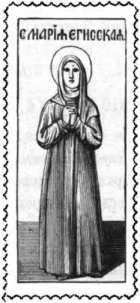
Два старца шли из Егов в Тарс, город Киликийский, пишет Иоанн Мосх. Пришедши, по усмотрению Божию, в гостиницу, расположившись отдохнуть в ней. Было знойно. Здесь нашли они трех молодых людей, отправлявшихся из Егов вместе с блудницей. Старцы сели поодаль. Один из них, взяв из сумки св. Евангелие, начал читать. Блудница, бывшая с молодыми людьми, увидав, что старец читает, оставив их, подошла и села подле старца. Старец, обратясь к ней, сказал: «несчастная! Как ты бесстыдна! Ты не устыдилась подойти к нам и сесть.» Она отвечала: «нет, отец, не отвергай меня. Я полна грехами, но Владыка Бог всех не отвергнул приблизившейся к Нему блудницы.» Старец сказал ей: «та блудница после уже не была блудницей.» Она отвечала ему: «надеюсь на Сына Бога живого, что этого часа и я не возвращусь к грехам моим.» Оставив молодых людей и все, что имела, последовала она за старцами. Они отослали ее в монастырь, что близ Егов, называемый Нахиба. Я и видел ее уже в старости, весьма благоразумно рассуждающей, и от нее самой это слышал.129 По другим известиям она называлась Марией и столько наконец возвысилась в духовной жизни, что творили чудеса.130
Two elders were walking from Egis to Tarsus, a city of Cilicia, writes John Moschus. Having come, by God's providence, to an inn, they settled down to rest in it. It was sultry. There they found three young men who were setting out from Egis together with a harlot. The elders sat down at a distance. One of them, taking the holy Gospel from his bag, began to read. The harlot, who was with the young men, seeing that the elder was reading, left them, drew near and sat down beside the elder. The elder, turning to her, said: "Wretched woman! How shameless you are! You were not ashamed to come up to us and sit down." She answered: "No, father, do not reject me. I am full of sins, but the Sovereign God of all did not reject the harlot who drew near to Him." The elder said to her: "That harlot afterwards was no longer a harlot." She answered him: "I hope in the Son of the living God that from this hour I too shall not return to my sins." Leaving the young men and all that she had, she followed the elders. They sent her to a monastery near Egis, called Nachiba. I saw her already in old age, discoursing very wisely, and heard this from her very self.129 According to other accounts, she was called Mary and at length attained such a height in the spiritual life that she worked miracles.130
Прибавим к этому рассказ тоже Мосха о событии Ликийском, современном деяниям Марии, тем более, что оно, выражая необходимость твердой верности добрым намерениям, служить дополнением к истории Марии.
Let us add to this the account, also from Moschus, of an event in Lycia contemporary with the deeds of Mary, all the more because it, expressing the necessity of firm fidelity to good intentions, serves as a supplement to the history of Mary.
«Авва Николай, пишет Мосх, пресвитер Иорданского монастыря евнухов, рассказывал нам (Иоанну и Софронию), что в стране его (он был из Ликии) есть монастырь, в котором находится около сорока дев; в этом монастыре пять дев согласились ночью убежать из монастыря и избрать себе мужей. В одну ночь, когда все монастырки спали, они хотели взять свои одежды и убежать, но вдруг все пять объяты были беснованием. Когда это случилось, они уже не ушли из монастыря и после благодарили Бога и, исповедуя грехи свои, говорили: благодарим милостивого Бога, наказавшего нас, чтобы не погибли души наши.»131
"Abba Nicholas," writes Moschus, "a presbyter of the Jordan monastery of the eunuchs, told us (John and Sophronius) that in his country (he was from Lycia) there is a monastery in which there are about forty nuns; in this monastery five nuns agreed to flee from the monastery by night and choose husbands for themselves. One night, when all the nuns were asleep, they wanted to take their clothes and flee, but suddenly all five were seized with demonic possession. When this happened, they no longer left the monastery, and afterwards they thanked God and, confessing their sins, said: 'We thank the merciful God, Who punished us so that our souls might not perish.'"131
Плакилла, жена императора Феодосия Великого, известна, как глубоко-благочестивая христианка. Усердие, с которым предавалась она делам благотворительности, было так велико, что она не только деньгами помогала бедным, но и лично посещала их и ухаживала за больными.
Placilla, the wife of the Emperor Theodosius the Great, is known as a deeply pious Christian. The zeal with which she devoted herself to works of charity was so great that she not only helped the poor with money, but also personally visited them and cared for the sick.
Находя это несообразным с достоинством царственного лица, некоторые лица внушили императрице, что достаточно с ее стороны оказывать денежные пособия и неуместно посвящать беднякам свой личный труд.
Finding this inconsistent with the dignity of a royal person, certain individuals suggested to the empress that it was sufficient on her part to give monetary assistance and that it was improper to devote her personal labor to the poor.
– «Знаю, что императорскому званию прилично оказывать щедрые пособия нуждающимся, – отвечала императрица, – но думаю, что мой долг – посвящать мой личный труд ради Того, Кому угодно было возвести меня в это звание.»
"I know that it befits the imperial rank to give generous assistance to the needy," replied the empress, "but I think that it is my duty to devote my personal labor for the sake of Him Who was pleased to raise me to this rank."
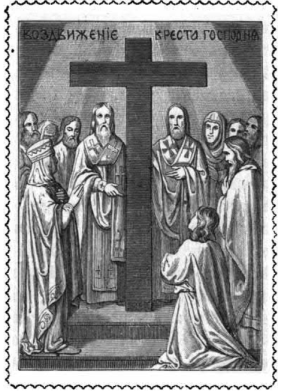
Праздник Воздвижения есть славное торжество честного и животворящего Креста Господня, по двум священным событиям в истории Церкви Христовой. Первое есть чудесное явление и обретение Креста в царствование Константина Великого. Константин, рожденный в язычестве, питал справедливую любовь к христианству, по примеру отца своего, который между соцарственниками своими один умел в своей власти явить подданным источник безопасности и спокойствия.
The feast of the Exaltation is the glorious solemnity of the precious and life-giving Cross of the Lord, on account of two sacred events in the history of the Church of Christ. The first is the miraculous appearance and finding of the Cross in the reign of Constantine the Great. Constantine, born in paganism, nurtured a just love for Christianity, following the example of his father, who alone among his co-rulers knew how, in his authority, to show his subjects a source of security and tranquility.
Максентий объявил войну Константину под предлогом отомстить ему за смерть отца своего Максимиана Геркулия и в лице Константина поразить сильного защитника христиан. Евсевий повествует, что силы Константина были слабее, нежели вражеские. Он чувствовал, что ему нужна помощь свыше, и искал ее. Он стал думать: какого Бога призвать бы себе на помощь. При этом пришло ему на мысль, что не малое число прежних державных лиц, возложив надежду свою на многих богов, обманулись и окончили свое дело несчастливо; и что отец его Константий, во всю свою жизнь почитавший единого Всевышнего Бога, имел знамения Его покровительства. Константин начал призывать Его, просить и умолять, чтобы Он явил вразумить его о Себе и в настоящем деле простереть ему Свою денницу. Усердно вознося свои молитвы и прошения об этом, «царь (т.е. Константин Великий) получил удивительнейшее, посланное от Бога знамение, так что и поверить было бы нелегко, если бы говорил кто другой. Но нас с клятвой уверял сам победоносный царь, когда, долго спустя после того, мы писали настоящее сочинение и удостоились его знакомства и беседы. Посему, кто станет сомневаться в истине сего сказания, – тем более, что и последующее время было свидетельством его истины?»
Maxentius declared war on Constantine under the pretext of avenging the death of his father Maximian Herculius and, in the person of Constantine, striking the powerful defender of Christians. Eusebius relates that Constantine's forces were weaker than the enemy's. He felt that he needed help from above, and he sought it. He began to think: which God should he call upon for help. At this it came to his mind that not a few former sovereigns, having placed their hope in many gods, were deceived and ended their undertaking unhappily; and that his father Constantius, who throughout his whole life honored the one Most High God, had signs of His protection. Constantine began to call upon Him, to ask and beseech Him that He would reveal and make Himself known to him and in the present matter stretch out His right hand to him. Earnestly offering up his prayers and petitions for this, "the emperor (i.e. Constantine the Great) received a most marvelous sign sent from God, so that it would not be easy to believe it if someone else had spoken. But the victorious emperor himself assured us with an oath, when, long after that, we were writing the present work and were deemed worthy of his acquaintance and conversation. Therefore, who would doubt the truth of this account—all the more since subsequent time was a witness of its truth?"
В 312 году в 28 день октября, идя против Максентия, который заключился в Риме, «в полуденные часы дна, когда солнце начало уже склоняться к западу, говорил царь, я собственными очами видел составившееся из света и лежавшее на солнце знамение Креста, с надписью: сим побеждай (εν τουτω νιχα). Это зрелище объяло ужасом как его самого, так и все войско, которое, само не зная куда, следовало за ним и продолжало созерцать явившееся чудо.» Таким образом чудесное явление Креста Константину Великому было среди дня и засвидетельствовано современными писателями, со слов очевидцев подробно изложившими обстоятельства явления: таков в особенности Евсевий и другие. «Константин недоумевал, что бы значило такое явление? В следующую ночь во сне явился ему Христос Божий с виденным на небе знамением и повелел по подобию его устроить воинское знамя и употреблять его для защиты от нападения врагов. Едва только озарил дневной свет, Константин рассказал приближенным свою тайну и потом, призвав рассказал приближенным свою тайну и потом, призвав знатоков, умевших обратиться с золотом и драгоценными камнями, и описав им образ знамения, приказал по подобию его сделать такое же из золота и драгоценных камней. Это знамя некогда случилось видеть и нам своими глазами. Оно имело следующий вид: на длинном, покрытом золотом копье, был вверху поперечник, образовавший с копьем образ Креста. На самой вершине копья неподвижно лежал венок из драгоценных камней и золота, а на венке знак спасительного наименования: две первые буквы показывали имя Христа, из середины коих выходила буква ρ. Эти буквы впоследствии царь имел обычай носить и на шлеме своем. На поперечнике копья висел тонкий, белый плат – царская ткань, покрытая различными драгоценными камнями, блиставшими лучами света. Вышитый золотом, этот плат казался зрителям невыразимо красивым и, вися на поперечнике, имел одинаковую широту и долготу. На прямом копье, которого нижний конец был весьма длинен, под знаком Креста, при самой верхней части ткани висело сделанное из золота грудное изображение боголюбезного царя и его детей. Этим-то спасительным знамением, как оборонительным оружием, всегда пользовался царь для одоления противной и враждебной силы и повелел во всех войсках носить подобные знамена. Пораженный дивным видением и решившись не чтить никакого другого Бога, кроме виденного, Константин призвал к себе таинников Его слова и спросил их: кто Тот Бог, и какой смысл знамения, которое он видел? Они отвечали, что Бог, явившийся ему, есть единородный Сын единого и единственного Бога, а явившееся знамение есть знамение бессмертия и торжественный знак той победы над смертью, которую одержал он во дни Своей земной жизни. Потом, подробно раскрыв учение о вочеловечении, объяснили Константину и причины пришествия Сына Божия на землю. Константин, хотя и вразумлялся их словами, однакоже тем не менее имел перед очами чудо дарованного ему богоявления и, сравнивая небесное видение со словесным объяснением, утверждался в своих мыслях. Он убежден был, что знание сих предметов сообщается ему свыше, и даже сам начал заниматься чтением божественных писаний. Сверх сего повелел находиться при себе Божиим иереям, – в той мысли, что виденного Бога должно чтить всеми способами служения. Оградившись, таким образом, благими на Него надеждами, он поспешил, наконец, угасить пламень тиранского огня. Призвав Бога всяческих и призвав как спасителя и помощника Христа Его, также поставив перед своими латниками и телохранителями победную хоругвь со спасительным знаменем, Константин выступил с войском своим против Максентия, укрепившегося в Риме. Силой Божией Константин низложил неприятеля, который, спасаясь бегством, был низринут с Милвианского моста в Тибр, в 15 верстах от Рима, и утонул. Победитель с торжеством вступил в царствующий город, где все встречали Константина с веселыми лицами и сердцами, с благословениями и невыразимой радостью. Но, обладая врожденным благочестием, он нисколько не тщеславился народными восклицаниями и не возгордился похвалами, но, сознавая помощь Божию, тотчас же вознес благодарственную молитву к Виновнику победы. Всенародными памятниками и подписями он поведал всем силу спасительного Христова знамения. Среди царственного города он воздвиг эту священную хоругвь и начертал определенно и неизгладимо, что сие спасительное знамя есть хранитель Римской империи и всего царства. Когда же на самом людном месте Рима поставили его статую, он немедленно приказал то высокое копье в виде Креста утвердить в руке своего изображения и начертать на латинском языке следующую надпись: «сим спасительным знамением, истинным свидетельством мужества, я спас и освободил город наш от ига мучителя и возвратил римскому сенату и народу свободу, прежний блеск и знаменитость.»
In the year 312, on the 28th day of October, going against Maxentius, who had shut himself up in Rome, "in the afternoon hours of the day, when the sun had already begun to decline toward the west," said the emperor, "I saw with my own eyes the sign of the Cross, formed of light and lying upon the sun, with the inscription: 'By this conquer' (εν τουτω νιχα). This spectacle filled with terror both him and the whole army, which, itself not knowing whither, followed him and continued to gaze upon the miracle that had appeared." Thus the miraculous appearance of the Cross to Constantine the Great was in the midst of the day and was attested by contemporary writers, who, from the words of eyewitnesses, set forth in detail the circumstances of the appearance: such, in particular, is Eusebius and others. "Constantine was perplexed as to what such an appearance might mean. In the following night, Christ God appeared to him in a dream with the sign seen in the sky and commanded him to make a military standard after its likeness and to use it for defense against the attack of enemies. Scarcely had daylight dawned when Constantine told his intimates his secret, and then, summoning craftsmen skilled in working with gold and precious stones, and describing to them the form of the sign, he ordered them to make one like it of gold and precious stones. This standard it once fell to our lot to see with our own eyes. It had the following appearance: on a long spear, covered with gold, there was a crosspiece at the top, forming with the spear the image of the Cross. At the very top of the spear lay a wreath of precious stones and gold, and on the wreath the sign of the saving name: the first two letters showed the name of Christ, from the middle of which came the letter ρ. These letters the emperor afterward had the custom of wearing also on his helmet. On the crosspiece of the spear hung a fine, white cloth—imperial fabric—covered with various precious stones, gleaming with rays of light. Embroidered with gold, this cloth appeared to beholders inexpressibly beautiful and, hanging on the crosspiece, had equal breadth and length. On the straight spear, whose lower end was very long, beneath the sign of the Cross, at the very top part of the cloth, hung a golden breast-image of the God-beloved emperor and his children. With this saving sign, as a defensive weapon, the emperor always availed himself for overcoming the opposing and hostile force, and commanded that similar standards be borne in all the armies. Struck by the wondrous vision and resolved to honor no other God but the One seen, Constantine summoned to himself the initiates of His word and asked them: Who is that God, and what is the meaning of the sign which he had seen? They answered that the God who had appeared to him is the only-begotten Son of the one and only God, and the sign that appeared is the sign of immortality and the triumphant token of that victory over death which He had won in the days of His earthly life. Then, having set forth in detail the teaching concerning the incarnation, they explained to Constantine also the reasons for the coming of the Son of God to earth. Constantine, though instructed by their words, nevertheless no less had before his eyes the miracle of the divine manifestation granted him, and, comparing the heavenly vision with the verbal explanation, was confirmed in his thoughts. He was convinced that the knowledge of these matters was communicated to him from on high, and even himself began to occupy himself with the reading of the divine Scriptures. Moreover, he commanded that God's priests be with him, in the thought that the God he had seen must be honored by every means of service. Having thus fortified himself with good hopes in Him, he hastened at last to quench the flame of tyrannical fire. Calling upon the God of all and invoking as Savior and Helper His Christ, and also placing before his cuirassiers and bodyguards the victorious standard with the saving sign, Constantine set out with his army against Maxentius, who had fortified himself in Rome. By the power of God, Constantine overthrew the enemy, who, fleeing, was cast down from the Milvian Bridge into the Tiber, 15 versts from Rome, and drowned. The victor entered the imperial city in triumph, where all met Constantine with joyful faces and hearts, with blessings and inexpressible gladness. But, possessing innate piety, he was in no wise puffed up by the people's acclamations nor exalted by praises, but, recognizing God's help, immediately offered up a prayer of thanksgiving to the Author of the victory. By public monuments and inscriptions he made known to all the power of the saving sign of Christ. In the midst of the imperial city he erected this sacred standard and inscribed clearly and indelibly that this saving banner is the guardian of the Roman Empire and of the whole kingdom. And when his statue was set up in the most populous place of Rome, he immediately commanded that the high spear in the form of the Cross be fixed in the hand of his image and that the following inscription be inscribed in Latin: 'By this saving sign, the true witness of courage, I have saved and delivered our city from the yoke of the tyrant and have restored to the Roman senate and people freedom, their former splendor and renown.'"
Впоследствии Константин и воины его неоднократно испытывали силу и помощь Креста. По сказанию Евсевия, «где знамя Креста показывалось, там враги обращались в бегство, а победители преследовали их. Когда царь узнал об этом, то спасительное знамя, как действительнейшее средство победы, повелел переносить туда, где видел такой-либо свой полк ослабевшим. При этом знамении победа тотчас восстановлялась, потому что сражавшихся при нем укрепляла бодрость и сила, посылаемая свыше. Посему тем из своих щитоносцев, кои отличались крепостью тела, силой души и благочестивым нравом, Константин повелел состоять единственно при служении этому знамени. Таких мужей числом было не более пятидесяти; они не имели другой обязанности, как стоять вокруг знамени, либо следовать за ним в виде стражи, когда каждый из них попеременно нес его на своих плечах.» Писателю настоящей истории, спустя много времени после тех событий, рассказывал об этом на досуге сам царь, и к своему рассказу присоединил следующее достопамятное событие. «Однажды в самом жару сражения произошел в войске шум и распространилось великое смятение. В это время несший знамя сильно страдал от робости, и потому передал свою ношу другому, чтобы убежать с поля битвы. Когда же один принял знамя, а другой удалился и находился уже вне стражи знамени, – пущенная стрела в сего последнего пронзила ему чрево и лишила его жизни. Принимая наказание за боязливость и неверие, он упал и умер. Напротив, для того, кто взял спасительную хоругвь, она сделалась охранителем его жизни, так что сколько ни пускали в него стрел, он остался невредим.» Силой Креста Константин победил не одного Максентия, но и Августа Ликиния, Скифов и Савроматов.
Subsequently, Constantine and his soldiers repeatedly experienced the power and help of the Cross. According to the account of Eusebius, "wherever the standard of the Cross was shown, there the enemies turned to flight, and the victors pursued them. When the emperor learned of this, he commanded that the saving standard, as the most effective means of victory, be carried to that place where he saw any of his regiments weakening. With this sign, victory was immediately restored, because those fighting near it were strengthened by the courage and power sent from on high. Therefore, Constantine commanded that those of his shield-bearers who were distinguished by bodily strength, strength of soul, and a pious disposition, be assigned solely to the service of this standard. Such men were in number no more than fifty; they had no other duty than to stand around the standard, or to follow it as a guard, when each of them in turn bore it on his shoulders." The writer of the present history, long after those events, was told of this at leisure by the emperor himself, and to his account he added the following memorable event. "Once, in the very heat of battle, a noise arose in the army and great confusion spread. At that time, he who bore the standard suffered greatly from cowardice, and therefore handed his burden to another, in order to flee from the battlefield. When one had taken the standard, and the other had withdrawn and was already outside the guard of the standard, an arrow shot at this latter pierced his belly and deprived him of life. Receiving punishment for his timidity and unbelief, he fell and died. On the contrary, for him who took the saving standard, it became a protector of his life, so that however many arrows were shot at him, he remained unharmed." By the power of the Cross, Constantine conquered not only Maxentius, but also the Augustus Licinius, the Scythians, and the Sauromatians.
Крест, униженное у язычников орудие казни, со времени явления и вспомоществования Константину в победах над врагами, сделался знамением торжества христианства над язычеством в Римской империи.
The Cross, a despised instrument of execution among the pagans, from the time of its appearance and assistance to Constantine in victories over his enemies, became the sign of the triumph of Christianity over paganism in the Roman Empire.
Чудесное и благодетельное явление Креста усилило в Константине Великом любовь к христианству и поселило в нем высокое благоговение к древу страдания и смерти Господа, ка по причине данного царю божественного знамения о Кресте, так и по причине содействия, оказанного ему Крестом в сражениях с врагами. Царь явно начал оказывать покровительство христианской вере; запретил наказывать крестной казнью; знамена и оружия украсил изображением на них Креста, и при себе имел постоянно животворящий Крест, для которого он «поставил палатку вне лагеря и в весьма далеком от него расстоянии, и, держась там непорочного и чистого образа жизни, возносил молитвы к Богу.»
The miraculous and beneficent appearance of the Cross strengthened in Constantine the Great his love for Christianity and implanted in him a high reverence for the tree of the suffering and death of the Lord, both on account of the divine sign concerning the Cross given to the emperor, and on account of the assistance rendered him by the Cross in battles with his enemies. The emperor openly began to show protection to the Christian faith; he forbade punishment by crucifixion; he adorned standards and weapons with the image of the Cross upon them, and kept constantly with him the life-giving Cross, for which "he set up a tent outside the camp and at a very great distance from it, and, maintaining there a blameless and pure manner of life, offered up prayers to God."
По окончании Никейского собора и по возвращении всех пастырей Церкви ко своим местам, царь чрезмерно радовался тому, что вся Церковь согласна в учении веры.
After the conclusion of the Council of Nicaea and the return of all the pastors of the Church to their places, the emperor rejoiced exceedingly that the whole Church was in agreement in the teaching of the faith.
Для изъявления благодарности Богу за единодушие епископов, за себя и за детей, и за империю, он признал своей обязанностью немедленно построить молитвенный дом в Иерусалиме, подле называемого Краниева места, чтобы священнейшее место страданий и воскресения сделать предметом всеобщего благоговения, и о своем намерении писал к Макарию, епископу Иерусалимскому. Исполнению благого желания царя содействовала благочестивая мать его Елена. В 326 году она прибыла в Иерусалим с письмом царя, имея усердие поклониться св. местам и желание найти Крест, на котором Спаситель принес Себя в жертву за грехи мира. Предполагали найти Крест на Голгофе, ибо у Иудеев было обыкновение закапывать орудие казни близ места ее. О крестных орудиях св. Андрей Критский в слове на день Воздвижения Креста говорит: «когда Господь жизни и смерти, спустя три дня после смерти крестной, воскрес, – тогда иудеи, уязвляясь стрелами зависти и страха (чтобы какие-либо из досточтимых и священных орудий страданий Христовых не сделались орудиями отмщения иудеям и защиты для христиан), зарыли в землю и, таким образом, скрыли сокровище, т.е. Крест и все прочие орудия крестные, как-то: гвозди и надпись.» Иудеи глубоко засыпали утес гроба Господня, в котором видели сокрушительный упрек себе и памятник отвержения своего от Иеговы.
To express thanksgiving to God for the unanimity of the bishops, for himself and for his children, and for the empire, he recognized it as his duty immediately to build a house of prayer in Jerusalem, near the place called Cranium, that the most sacred place of the suffering and resurrection might be made an object of universal reverence, and concerning his intention he wrote to Macarius, Bishop of Jerusalem. The fulfillment of the emperor's good desire was furthered by his pious mother Helen. In the year 326, she arrived in Jerusalem with the emperor's letter, having zeal to venerate the holy places and a desire to find the Cross on which the Savior offered Himself as a sacrifice for the sins of the world. It was supposed that the Cross was to be found on Golgotha, for among the Jews it was the custom to bury the instrument of execution near the place of execution. Concerning the instruments of the Cross, St. Andrew of Crete, in his homily on the day of the Exaltation of the Cross, says: "When the Lord of life and death, three days after His death on the Cross, rose again, then the Jews, stung by the arrows of envy and fear (lest any of the venerable and sacred instruments of Christ's sufferings should become instruments of vengeance upon the Jews and of protection for Christians), buried them in the earth and thus hid the treasure, that is, the Cross and all the other instruments of the Cross, such as: the nails and the inscription." The Jews deeply covered over the rock of the Lord's tomb, in which they saw a crushing reproach to themselves and a monument of their rejection by Jehovah.
Впрочем, не только иудеи, но и язычники, сменившие иудеев по ненависти ко Христу и христианам, старались изгладить божественный памятник страдания, смерти и воскресения Христа Спасителя, предать забвению и истребить едва возникавшее богопочтение. В 119 году язычники, по повелению Адриана, изгнавшего иудеев из Иерусалима, завалили спасительную пещеру землей, замостили камнем и закрыли идольским капищем. По повелению царскому место страдания и смерти Христа на Голгофе было отыскано и расчищено. В глубине его в одной стороне открыли в виде пещеры гроб – место воскресения Христова, а в другой стороне того же места найдены были три креста, и еще отдельно от них дощечка, на которой начертаны были буквы не только еврейские, но и греческие и римские, каковые буквы и слова не иное что выражали, как следующее: Иисус Назарянин Царь Иудейский. Сии самые слова, как читаем в Евангелии, по повелению Пилата – правителя Иудеи, написаны были над головой Иисуса распятого (Ин.19:19). Однакож весьма еще трудно было отличить Крест Господень от других крестов, особенно же, когда не только надпись отнята была и находилась вдали от него, но и самые три креста лежали все вместе. По этой причине божественное древо Креста Господня оставалось еще неизвестным и требовалось свидетельство высшее, нежели какое было во власти человеческой. В самом деле Бог не попустил, чтобы христиане вместо Креста Господня воздали честь кресту разбойника. Высшее свидетельство явлено было в чудодейственной силе животворящего Креста. Чудесным исцелением женщины от тяжкой болезни и воскрешением умершего от возложения одного из крестов найденных открыт животворящий Крест Христов. Спасительный Крест, обретенный в то время, и доселе еще хранится в Иерусалиме в серебряном ковчеге, а часть сего Креста царица препроводила к сыну своему Константину. «Известие об этом событии передали мы, говорит Созомен, как сами приняли от мужей, которым упомянутое событие совершенно известно и которые сведения о нем, получив по преемству от отцов к детям, по возможности описали их и оставили потомству.»
However, not only the Jews, but also the pagans who succeeded the Jews in their hatred of Christ and Christians, strove to obliterate the divine monument of the suffering, death and resurrection of Christ the Savior, and to consign to oblivion and destroy the worship of God that was barely emerging. In the year 119, the pagans, by order of Hadrian, who had driven the Jews out of Jerusalem, filled the salvific cave with earth, paved it with stone, and covered it with a pagan temple. By imperial command, the place of the suffering and death of Christ on Golgotha was found and cleared. In its depths, on one side, a tomb in the form of a cave was uncovered—the place of Christ's resurrection—and on the other side of the same place, three crosses were found, and separately from them a tablet, on which letters were inscribed, not only Hebrew, but also Greek and Roman; and these letters and words expressed nothing other than the following: Jesus of Nazareth, King of the Jews. These very words, as we read in the Gospel, were written by order of Pilate, the governor of Judea, above the head of the crucified Jesus (Jn. 19:19). However, it was still very difficult to distinguish the Cross of the Lord from the other crosses, especially since not only had the inscription been removed and was lying at a distance from it, but the three crosses themselves lay all together. For this reason, the divine wood of the Cross of the Lord remained unknown, and a testimony higher than any within human power was required. Indeed, God did not permit that Christians should honor the cross of the thief instead of the Cross of the Lord. A higher testimony was manifested in the miraculous power of the life-giving Cross. Through the miraculous healing of a woman from a grievous illness and the raising of a dead man by the laying on of one of the crosses that had been found, the life-giving Cross of Christ was revealed. The salvific Cross, discovered at that time, is still preserved in Jerusalem in a silver reliquary, and a portion of this Cross the empress sent to her son Constantine. "The account of this event we have handed down," says Sozomen, "as we ourselves received it from men to whom the aforementioned event is perfectly known, and who, having received knowledge of it by succession from fathers to children, described it as best they could and left it to posterity."
Обретением Креста положено начало празднику Воздвижения. Событие обретения при живом участии и при личном присутствии царицы Елены, Иерусалимского патриарха и многочисленного собрания христиан, сопровождавшееся дивными знамениями Промысла, послужившими к указанию и прославлению Креста Господня и обратившими ко Христу многих неверных, было началом праздника. Царица, патриарх и прочее, увидев животворящий Крест, с радостью и благоговением поклонялись ему и целовали. Но многочисленное по случаю обретения Креста стечение народа на Голгофе не позволяло тотчас каждому лобызать это драгоценное сокровище, извлеченное из недр земли, и многие горели желанием по крайней мере видеть его. Чтобы удовлетворить благочестивой жажде верующих, патриарх Макарий с возвышенного места показывал народу честное древо, воздвигая или поднимая его. Христиане, видя Крест Господень, с благоговением взывали: «Господи, помилуй!» Таким образом день обретения Креста сделался началом ежегодного праздника Воздвижения Креста и тех молений, поклонений ему и лобзаний, кои доселе сохраняются в Православной Церкви в день Воздвижения Креста.
The uncovering of the Cross laid the foundation of the feast of the Exaltation. The event of the uncovering, with the active participation and personal presence of Empress Helena, the Patriarch of Jerusalem, and a numerous assembly of Christians, accompanied by wondrous signs of Providence which served to indicate and glorify the Cross of the Lord and converted many unbelievers to Christ, was the beginning of the feast. The empress, the patriarch, and the rest, seeing the life-giving Cross, with joy and reverence worshipped and kissed it. But the great multitude of people gathered on Golgotha on the occasion of the uncovering of the Cross did not permit everyone to kiss this precious treasure, drawn forth from the bowels of the earth, immediately, and many burned with desire at least to see it. To satisfy the pious thirst of the faithful, Patriarch Macarius, from an elevated place, showed the people the precious wood, exalting or raising it up. The Christians, seeing the Cross of the Lord, cried out with reverence: "Lord, have mercy!" Thus the day of the uncovering of the Cross became the beginning of the annual feast of the Exaltation of the Cross and of those prayers, acts of worship and veneration, and kisses which are preserved to this day in the Orthodox Church on the day of the Exaltation of the Cross.
Со времени обретения Креста стали устроять храмы в честь его. Такие храмы основаны были царицей Еленой в Иерусалиме на месте обретения Креста и Константином Великим в Риме. По устроении первого в память страданий, смерти, воскресения и обретения Креста, и по освящении этого храма 13 сентября 335 года, праздник Воздвижения отнесен к 14 дню сентября. Со времени обретения Креста у отцов Церкви, например: у св. Кирилла Иерусалимского, Амвросия Медиоланского, Иоанна Златоустого и других мы встречаем многие указания на праздник Воздвижения. Св. Кирилл с огласительном слове своем говорит: «Иисус Христос истинно распят был за грехи наши. Если вознамеришься отвергать это, обличить тебя видимое нами место, – это блаженная Голгофа, на которой собрались мы теперь ради Распятого на ней; да и вся вселенная имеет уже части древа Крестного.» Должно заметить, что до обретения Креста, когда на Голгофе стоял языческий храм, христиане при всем своем усердии не могли собираться на ней для богослужения; и следовательно со времени обретения Креста начались богослужебные собрания на Голгофе и празднование Кресту. В V веке Анатолий, епископ Константинопольский, изложил некоторые песнопения на праздник Воздвижения, ныне слышимые нами в 14 день сентября. Древле на этот праздник стекались в Иерусалим многочисленные поклонники. В V веке в числе их была преподобная Мария Египетская, которая, поклонясь Кресту Господню, скрылась от соблазнов мира в пустыню и начала спасительные подвиги собственного креста. В этом же веке Евагрий упоминает о воздвижении Креста, поклонении ему и целовании его, как это издревле сохраняется доселе. В VI веке св. Григорий Великий упоминает о празднике Воздвижения в 14 день сентября. В VII св. Андрей Критский в слове на Воздвижение Креста говорил: «Крест воздвигается и все верные стекаются. Крест воздвигается и град торжествует, и народы совершают празднество. Воздвигается Крест не потому только, что Христос вознесен был на нем, но и потому, что Крест, быв обретен, обличил безумие иудеев. Посему-то мы ныне и торжествуем, что в настоящий день обретена давно сокрытая святыня, – что это утаенное сокровище, быв извлечено из земли, воссияло, как злато.»
From the time of the uncovering of the Cross, churches began to be built in its honor. Such churches were founded by Empress Helena in Jerusalem at the site of the uncovering of the Cross and by Constantine the Great in Rome. After the construction of the first church in memory of the suffering, death, resurrection, and uncovering of the Cross, and after the consecration of this church on September 13, 335, the feast of the Exaltation was assigned to September 14. From the time of the uncovering of the Cross, we find many references to the feast of the Exaltation in the Church Fathers, for example, in St. Cyril of Jerusalem, Ambrose of Milan, John Chrysostom, and others. St. Cyril, in his catechetical discourse, says: "Jesus Christ was truly crucified for our sins. If you intend to deny this, the place we see will convict you—this blessed Golgotha, on which we have now gathered for the sake of Him who was crucified upon it; and indeed the whole universe already possesses portions of the wood of the Cross." It should be noted that before the uncovering of the Cross, when a pagan temple stood on Golgotha, Christians, despite all their zeal, could not gather there for divine services; consequently, from the time of the uncovering of the Cross, liturgical gatherings on Golgotha and the celebration of the Cross began. In the 5th century, Anatolius, Bishop of Constantinople, composed certain hymns for the feast of the Exaltation, which we now hear on September 14. In ancient times, numerous pilgrims flocked to Jerusalem for this feast. In the 5th century, among them was the Venerable Mary of Egypt, who, having worshipped the Cross of the Lord, withdrew from the temptations of the world into the wilderness and began the salvific labors of her own cross. In the same century, Evagrius mentions the exaltation of the Cross, the worship of it, and the kissing of it, as this has been preserved from ancient times to the present. In the 6th century, St. Gregory the Great mentions the feast of the Exaltation on September 14. In the 7th, St. Andrew of Crete, in a homily on the Exaltation of the Cross, said: "The Cross is exalted, and all the faithful flock together. The Cross is exalted, and the city rejoices, and the peoples keep festival. The Cross is exalted not only because Christ was lifted up upon it, but also because the Cross, having been found, exposed the folly of the Jews. Therefore we now celebrate, because on this day a long-hidden sanctuary has been found—because this concealed treasure, drawn forth from the earth, has shone forth like gold."
В VII веке с древним праздником Воздвижения Церковь соединила воспоминание другого священного события, вновь прославившего животворящий Крест Господень. Это событие было славное возвращение животворящего Креста из Персии. По воцарении греческого императора Фоки (602–610), Хозрой II, царь персидский, объявил ему войну под предлогом отмщения за смерть Маврикия и его детей. Ираклий I (610–629) низложил Фоку и должен был сражаться с персами, которые в 614 году в июне перешли Иордан и опустошили Палестину и Иерусалим; умертвили многих священнослужителей, монашествующих и благочестивых мирян; сожгли Иерусалимский храм Вознесения; похитили все, что было в храме драгоценного – множество священных сосудов, и между прочим, древо Креста Христова. Патриарх Захария с многочисленным народом взят был в плен. Святыня 14 лет была в руках язычников, впрочем к славе своей: молва, распространившаяся в Персии с принесением Креста Господня, что сюда пришел Бог христианский, таким страхом объяла сердца язычников, что они оставили неприкосновенным не только самое древо и кивот, в котором оно хранилось, но и сокровища, украшавшие кивот. Многие из язычников, слыша о силе Креста, обращались ко Христу. Сирой или Сироэс, сын и преемник Хозроя на персидском престоле, силой римского оружия принужденный заключить мир с греческим царем Ираклием, в конце 628 года возвратил плененных и св. Крест. Радуясь и благодаря Бога за великую милость, ниспосланную христианам возвращением святыни, царь сам с патриархом, клиром и народом благоговейно встретил в Константинополе и отсюда в 629 году сопровождал возвращавшийся Крест до Иерусалима, чтобы там принести благодарение Богу за дарованные Им победы. Дойдя до горы Елионской, царь Ираклий приял Крест на рамена свои, чтобы нести его до храма Воскресения. Но у врат на Голгофу невидимая сила останавливает Крест. Патриарх Захария, сопровождавший Крест, внушил царю, что Сын Божий нес древо Креста на Голгофу не в царском величии, но в смиренном образе раба. Тронутый внушением святителя, царь смирился, отложил царские одежды и босой на другой день внес животворящий Крест во храм, на то место, откуда он похищен был персами. Христиане с радостью взирали на торжество Креста Господня. Во храме, по древнему обыкновению, Крест снова воздвигаем был руками патриарха, и народ в умилении восклицал: «Господи, помилуй.»
In the 7th century, the Church united with the ancient feast of the Exaltation the commemoration of another sacred event, which again glorified the life-giving Cross of the Lord. This event was the glorious return of the life-giving Cross from Persia. Upon the accession of the Greek emperor Phocas (602–610), Chosroes II, king of Persia, declared war on him under the pretext of avenging the death of Maurice and his children. Heraclius I (610–629) deposed Phocas and had to fight the Persians, who in June of the year 614 crossed the Jordan and devastated Palestine and Jerusalem; they killed many clergy, monastics, and pious laymen; burned the Jerusalem church of the Ascension; carried off everything precious that was in the church—a multitude of sacred vessels, and among them, the wood of the Cross of Christ. Patriarch Zacharias, together with a great multitude of people, was taken captive. The holy object was in the hands of the pagans for 14 years, yet to its own glory: the rumor that spread in Persia with the bringing of the Cross of the Lord, that the God of the Christians had come there, so filled the hearts of the pagans with fear that they left untouched not only the wood itself and the ark in which it was kept, but also the treasures that adorned the ark. Many of the pagans, hearing of the power of the Cross, turned to Christ. Siroi or Siroes, the son and successor of Chosroes on the Persian throne, compelled by the force of Roman arms to make peace with the Greek emperor Heraclius, returned the captives and the holy Cross at the end of the year 628. Rejoicing and thanking God for the great mercy granted to Christians by the return of the holy object, the emperor himself, together with the patriarch, the clergy, and the people, reverently met it in Constantinople and from there, in the year 629, accompanied the returning Cross as far as Jerusalem, in order to offer thanksgiving to God there for the victories He had granted. Having reached the Mount of Olives, Emperor Heraclius took the Cross upon his shoulders to carry it to the Church of the Resurrection. But at the gates leading to Golgotha, an invisible force stopped the Cross. Patriarch Zacharias, who accompanied the Cross, suggested to the emperor that the Son of God carried the wood of the Cross to Golgotha not in royal majesty, but in the humble form of a servant. Moved by the hierarch's admonition, the emperor humbled himself, laid aside his royal robes, and the next day, barefoot, brought the life-giving Cross into the church, to the very place from which it had been carried off by the Persians. The Christians looked with joy upon the triumph of the Cross of the Lord. In the church, according to ancient custom, the Cross was again exalted by the hands of the patriarch, and the people cried out in compunction: "Lord, have mercy."
Обретение и возвращение Креста Господня от персов соединены в один праздник Воздвижения; и это соединение усугубило торжественность праздника. Он причислен к дванадесятым и соединен с постом, как в день воспоминания крайнего уничижения и смерти Господа, и прославлен новыми богослужебными песнопениями. В VII в. Андрей Иерусалимский, епископ Критский, в VIII Козьма Маиумский, Феофан Константинопольский-исповедник, св. Иоанн Дамаскин, в IX Иосиф Студит, император Лев Мудрый и другие предали Церкви многие песнопения, которыми она ныне прославляет честный Крест.
The uncovering and the return of the Cross of the Lord from the Persians are united in one feast of the Exaltation; and this union has intensified the solemnity of the feast. It is numbered among the twelve great feasts and is combined with fasting, as on a day commemorating the extreme humiliation and death of the Lord, and is glorified with new liturgical hymns. In the 7th century, Andrew of Jerusalem, Bishop of Crete; in the 8th, Cosmas of Maiuma, Theophanes the Confessor of Constantinople, St. John of Damascus; in the 9th, Joseph the Studite, Emperor Leo the Wise, and others bequeathed to the Church many hymns with which she now glorifies the precious Cross.
Впрочем, праздник Воздвижения Креста первоначально не везде совершался в 14 день сентября, может быть потому, что обретение Креста было во дни Пасхи и праздновалось в эти дни до построения на месте обретения храма Божия. О древнем праздновании Воздвижения Креста в Пасху в Иерусалиме упоминает Павлин, епископ Ноланский, в XI письме своем к Северу, около 393 года. Он пишет: «епископ города ежегодно, когда бывает Пасха Господня, выносит Крест к народу для поклонения, сам начиная поклонение. Кроме этого дня, в который празднуется таинство самого Креста, и как некоторое знамение священного торжества предносится, его никогда не показывают, разве только по просьбе людей благочестивых, которые приходят из отдаленных мест единственно для поклонения Кресту, как бы в награду им за из продолжительное странствование.» На основании сих слов думают, что Воздвижение Креста древле праздновали в Иерусалиме в Великую пятницу. Ученый Ассеманий, ориенталист (1687–1768), утверждает, что празднование Воздвижению отправлялось древле в Иерусалиме во второй день Пасхи, и свое мнение утверждает на словах Софрония, Иерусалимского патриарха (629 г.), который в слове на день Воздвижения Креста говорит: «сегодня воспоминается воскресенье: завтра является Крест. Сегодня прославляется воскресенье: завтра на возвышенном месте возносится Крест. Древле Крест предшествовал воскресенью, а ныне ведет за собой и предваряет Крест. Удивительное изменение.» Но эти слова свидетельствуют только о том, что святитель говорил слово на Воздвижение Креста после воскресного дня, а не о том, что древле Воздвижение совершалось на второй день Пасхи. В восьмом веке на Западе праздник обретения Креста Еленой перенесен на 3 день мая, а в 14 день сентября воспоминается там явление Креста Константину Великому и возвращение Креста из Персии.
However, the feast of the Exaltation of the Cross was not originally celebrated everywhere on the 14th of September, perhaps because the uncovering of the Cross occurred during the days of Pascha and was celebrated on those days until the construction of a church of God on the site of the uncovering. The ancient celebration of the Exaltation of the Cross at Pascha in Jerusalem is mentioned by Paulinus, Bishop of Nola, in his eleventh letter to Severus, around the year 393. He writes: “The bishop of the city each year, when the Pascha of the Lord occurs, brings forth the Cross to the people for veneration, himself beginning the veneration. Except for this day, on which the mystery of the Cross itself is celebrated, and it is borne before as a kind of sign of the sacred triumph, it is never shown, except at the request of pious people who come from distant places solely for the veneration of the Cross, as if as a reward to them for their long journey.” On the basis of these words, some think that the Exaltation of the Cross was anciently celebrated in Jerusalem on Great Friday. The learned Assemani, an orientalist (1687–1768), asserts that the celebration of the Exaltation was anciently performed in Jerusalem on the second day of Pascha, and he bases his opinion on the words of Sophronius, Patriarch of Jerusalem (629 A.D.), who in a homily for the day of the Exaltation of the Cross says: “Today the Resurrection is commemorated; tomorrow the Cross appears. Today the Resurrection is glorified; tomorrow the Cross is raised on high. Of old the Cross preceded the Resurrection, but now it follows after and the Cross goes before. A marvelous change.” But these words testify only that the Hierarch delivered a homily on the Exaltation of the Cross after the Sunday, and not that the Exaltation was anciently performed on the second day of Pascha. In the eighth century in the West, the feast of the uncovering of the Cross by Helen was transferred to the 3rd of May, and on the 14th of September the appearance of the Cross to Constantine the Great and the return of the Cross from Persia are commemorated there.
Не ограничиваясь пределами предпразднества и попразднества, заключающими 9 дней – от 13 до 21 сентября, Церковь начинает прославлять животворящий Крест с 1 августа, – со дня происхождения честного Креста, поя на утренних богослужениях: «Крест начертав Моисей». Встречая и провожая великий праздник Воздвижения, Церковь предшествующий ему воскресный день называет неделей перед Воздвижением, а последующий – неделей по Воздвижении.
Not limiting itself to the boundaries of the forefeast and afterfeast, which encompass nine days—from the 13th to the 21st of September—the Church begins to glorify the life-giving Cross from the 1st of August, from the day of the Procession of the Precious Cross, chanting at Matins: “Moses prefigured the Cross.” Meeting and seeing off the great feast of the Exaltation, the Church calls the preceding Sunday the Sunday before the Exaltation, and the following one the Sunday after the Exaltation.
Всемирное воздвижение животворящего Креста издревле есть великий памятник воздвижения Церкви Христовой из-под ига трех-вековых с лишком гонений для всемирного торжества над иудейством и язычеством, – день победы и воздвижения над врагами веры Христовой. Дни животворящего Креста Господня внушают одерживать подобную победу нам над своими страстями, кои также суть враги Христа, для беспрепятственного последования Христу и достижения вечного блаженства. Иже хочет по Мне идти, говорит Спаситель, да отвержется себе и возьмет крест свой, и по Мне грядет. Иже погубить душу свою Мене ради и Евангелия, той спасет ю (Мк.8:34–35). По примеру ап. Павла, нам должно хвалиться токмо о кресте Господа нашего Иисуса Христа (Гал.6:14). Распятый Христос есть для нас Божия сила и Божия премудрость (1Кор.1:24). Путь креста, сопряженный с внешними лишениями, есть путь очищения, духовного совершенства и высокой радости. Несение креста причиняет подвижнику благочестия страдания и смерть, но оно же приносит и жизнь и радость. Под крестом наш внешний, земной и суетный человек страдает и тлеет, а внутренний и духовный обновляется (2Кор.4:16). Св. Церковь, выражая крестное состояние внешнего лишения со внутренним восполнением, украшает древо крестное во дни поклонения ему зеленеющими и благоухающими цветами, – знамениями жизни, надежды и радости.
The universal Exaltation of the life-giving Cross is from ancient times a great memorial of the raising up of the Church of Christ from under the yoke of more than three centuries of persecutions for the universal triumph over Judaism and paganism—a day of victory and exaltation over the enemies of the faith of Christ. The days of the life-giving Cross of the Lord inspire us to achieve a similar victory over our own passions, which are also enemies of Christ, for the unhindered following of Christ and the attainment of eternal blessedness. Whosoever will come after Me, says the Savior, let him deny himself, and take up his cross, and follow Me. For whosoever will save his life shall lose it; but whosoever shall lose his life for My sake and the Gospel’s, the same shall save it (Mk. 8:34–35). Following the example of the Apostle Paul, we ought to glory only in the cross of our Lord Jesus Christ (Gal. 6:14). Christ crucified is for us the power of God, and the wisdom of God (1 Cor. 1:24). The way of the cross, joined with outward privations, is the way of purification, spiritual perfection, and sublime joy. The bearing of the cross causes the ascetic of piety suffering and death, but it also brings life and joy. Under the cross our outward, earthly, and vain man suffers and decays, while the inward and spiritual man is renewed (2 Cor. 4:16). The Holy Church, expressing the cross-like state of outward privation with inward fulfillment, adorns the tree of the cross on the days of its veneration with verdant and fragrant flowers—signs of life, hope, and joy.
О последующей судьбе Креста Христова заметим, что он находился в Иерусалиме во время крестовых подходов, от 1099 до 1245 г. При осаде Иерусалима крестоносцами в 1099 г. христиане, бывшие в городе, скрывали Крест от глаз мусульман. При взятии Иерусалима христианами 11 июля 1099 года вид Креста возбудил живейший восторг в крестоносцах; Крест восхитил их так, как будто бы они увидели Самого Распятого на Кресте. С торжеством носили Крест по улицам города и опять поставили во храме Воскресения Христова. При нашествии эмира Авдала с многочисленной силой в 1099 году, чтобы исторгнуть Иерусалим из рук христиан, патриарх вышел к воинству с животворящим Крестом. Накануне битвы 14 августа древо Креста носимо было по рядам воинов, как залог благословения и победы. Битва произошла на поле Аскалонском, и мусульмане были совершенно разбиты. Балдуин I, царь Иерусалимский (1100–1118 г.), поручил десяти рыцарям хранение честного Креста. Неудачи во войне Балдуин приписывал отсутствию Креста. При Балдуине, который жил и умер посреди лагерей, в продолжение 18 лет его царствования, жители Иерусалима почти никогда не видели во храме животворящего Креста, почти никогда не видели во храме животворящего Креста, потому что он постоянно находился среди воинов и один вид его часто доставлял победу. При Балдуине II, царе Иерусалимском (1118–1131 г.), перед битвой на Аскалонских равнинах с войсками египетскими патриарх св. града нес впереди войска древо животворящего Креста, и мусульмане были разбиты. При Балдуине III, царе Иерусалимском (1131–1142 г.), в стране Трахонитской в виду Бостры рыцари, воины и народ, обступя епископа Назаретского, несшего животворящий Крест, со слезами заклинали его прекратить своими молитвами невыносимые бедствия от тучи стрел неприятельских, от огня и дыма среди горящего терния на поле, через которое проходили крестоносцы. Епископ воздвиг Крест, моля о помиловании, и в то же время ветер переменил направление.
Concerning the subsequent fate of the Cross of Christ, let us note that it was in Jerusalem during the Crusades, from 1099 to 1245 A.D. During the siege of Jerusalem by the Crusaders in 1099, the Christians who were in the city hid the Cross from the eyes of the Muslims. Upon the capture of Jerusalem by the Christians on July 11, 1099, the sight of the Cross aroused the most lively rapture among the Crusaders; the Cross enraptured them as if they had seen the Crucified One Himself on the Cross. With triumph they carried the Cross through the streets of the city and again placed it in the Church of the Resurrection of Christ. During the invasion of Emir Avdala with a numerous force in 1099, to wrest Jerusalem from the hands of the Christians, the patriarch went out to the army with the life-giving Cross. On the eve of the battle, August 14, the wood of the Cross was carried through the ranks of the soldiers, as a pledge of blessing and victory. The battle took place on the field of Ascalon, and the Muslims were completely defeated. Baldwin I, King of Jerusalem (1100–1118 A.D.), entrusted ten knights with the guarding of the precious Cross. Baldwin attributed the misfortunes in war to the absence of the Cross. Under Baldwin, who lived and died amidst camps, during the 18 years of his reign, the inhabitants of Jerusalem almost never saw the life-giving Cross in the church, because it was constantly among the soldiers, and the mere sight of it often brought victory. Under Baldwin II, King of Jerusalem (1118–1131 A.D.), before the battle on the plains of Ascalon with the Egyptian troops, the patriarch of the holy city carried the wood of the life-giving Cross before the army, and the Muslims were defeated. Under Baldwin III, King of Jerusalem (1131–1142 A.D.), in the land of Trachonitis, in sight of Bostra, the knights, soldiers, and people, surrounding the Bishop of Nazareth, who was carrying the life-giving Cross, with tears implored him to stop by his prayers the unbearable calamities from the cloud of enemy arrows, from fire and smoke amidst the burning thorns on the field through which the Crusaders were passing. The bishop raised the Cross, praying for mercy, and at the same time the wind changed direction.
Во время третьего крестового похода (1171–1188 года) перед борьбой против Саладина животворящий Крест показан был христианам, как единственное средство спасения, и поставлен среди собрания защитников Иерусалимского царства. 1188 года 2 июля при битве Тивериадской животворящий Крест, поставленный на возвышении, одушевлял благочестивых воинов. Сам неприятель (Саладин) говорил, что христианские воины около Креста сражались с отличным мужеством, потому что видели в Кресте твердейший для себя оплот и несокрушимый щит. Рыцари храма или св. Иоанна сражались до вечера вокруг Креста, который носим был Птолемаидским епископом. Когда он был убит, епископ Лидский принял Крест и хотел было бежать; но был задержан и взят в плен Сарацинами. Крик отчаяния раздался между христианами, когда они увидели знамение своего спасения в руках зловерных. Воины кидали оружие и не думали уже о побеге, бросались на мечи врагов; поле сражения представляло зрелище отчаяния. Христине, не могши сохранить Крест Иисуса Христа, уже не боялись потерять свободу и жизнь. Крест отнесен был в Багдад.
During the Third Crusade (1171–1188 A.D.), before the struggle against Saladin, the life-giving Cross was shown to the Christians as the only means of salvation, and was placed in the midst of the assembly of the defenders of the Kingdom of Jerusalem. On July 2, 1188, at the Battle of Tiberias, the life-giving Cross, placed on a height, inspired the pious soldiers. The enemy himself (Saladin) said that the Christian soldiers around the Cross fought with exceptional courage, because they saw in the Cross a most firm bulwark and an indestructible shield for themselves. The knights of the Temple or of St. John fought until evening around the Cross, which was carried by the Bishop of Ptolemais. When he was killed, the Bishop of Lydda took the Cross and attempted to flee; but he was detained and taken captive by the Saracens. A cry of despair rang out among the Christians when they saw the sign of their salvation in the hands of the unbelievers. The soldiers threw down their weapons and no longer thought of flight; they threw themselves upon the swords of the enemies; the field of battle presented a spectacle of despair. The Christians, unable to preserve the Cross of Jesus Christ, no longer feared to lose their freedom and life. The Cross was taken to Baghdad.
При осаде Птолемаиды (1188–1192 года) эмиры, доведенные крестоносцами до невозможности защищаться, обещали французскому королю Филиппу, если он даст им свободу и жизнь, возвратить христианам животворящий Крест. Но Саладин под разными предлогами не исполнял условия; Саладин взирал на Крест, как не предмет соблазна, как на поругание Божества. Он никак не соглашался уступить Крест ни грузинскому царю, ни константинопольскому императору, которые предлагали за святыню значительные суммы денег. Все выгоды мира, говорил Саладин, не могли бы его принудить возвратить христианам этот постыдный памятник их идолослужения. Древо Креста более 30 лет находилось в плену у Саладина и его преемников. В 1221 году 8 сентября при сдаче Дамиэтты христиане возвратили животворящий Крест Иисуса Христа, по договору. Во время седьмого крестового похода (1242 – 1245 г.) перед битвой с хивинцами при Газе древо честного Креста по обычаю предшествовало христианскому воинству.
During the siege of Ptolemais (1188–1192 A.D.), the emirs, driven by the Crusaders to the impossibility of defending themselves, promised the French King Philip, if he would grant them freedom and life, to return the life-giving Cross to the Christians. But Saladin, under various pretexts, did not fulfill the condition; Saladin looked upon the Cross as an object of scandal, as a blasphemy against the Godhead. He would by no means agree to yield the Cross either to the King of Georgia or to the Emperor of Constantinople, who offered significant sums of money for the sacred object. All the advantages of the world, said Saladin, could not compel him to return to the Christians this shameful monument of their idolatry. The wood of the Cross remained in captivity with Saladin and his successors for more than 30 years. On September 8, 1221, upon the surrender of Damietta, the Christians recovered the life-giving Cross of Jesus Christ, according to the treaty. During the Seventh Crusade (1242–1245 A.D.), before the battle with the Khwarezmians at Gaza, the wood of the precious Cross, according to custom, preceded the Christian army.
Кроме этих немногих сведений о древе животворящего Креста Христова мы не имеем и, упоминая о нем, нельзя представлять его во всей его полноте, в какой он был при распятии на нем Спасителя. Предание сообщает нам о многих частях Креста Христова, издревле отделенных от него и разнесенных по всем странам мира, для освящения его.
Apart from these few pieces of information about the wood of the life-giving Cross of Christ, we have none; and when mentioning it, one cannot represent it in all its fullness, as it was at the crucifixion of the Savior upon it. Tradition communicates to us about many parts of the Cross of Christ, from ancient times separated from it and dispersed throughout all the countries of the world, for its sanctification.
Древнейшая из частей Креста Христова была без сомнения в Константинополе, присланная сюда, по словам Созомена, в 326 году царицей Еленой, которая обретши Крест, препроводила часть его сыну своему Константину в благословение царства его. В том же веке Павлин Ноланский послал часть Креста Северу. Св. Златоуст, говоря о благоговении древних христиан ко Кресту, писал в IV веке: «многие, обложив золотом частицу Креста, носят при себе на шее». В IV веке сохранялись части Креста в Сирии – Анамее и Сергиополе на Евфрате, присланные сюда Юстинианом и Феодорой, его супругой. В том же веке принесена была часть Креста с востока во Францию в Пуатье. В VI веке св. Григорий Великий, епископ Римский, послал часть Креста на благословение Ричарду, царю Визигофскому. В VII веке, по хронике Сигиберта в 688, а – Еккегарда в 969 году, папа Сергий установил ежегодно выносит в день Воздвижения при богослужении часть Креста, которая хранилась в Риме, в церкви, называемой Константиновской, для поклонения и целования от народа. В 1109 году 28 июля принесена из Иерусалима часть Креста в Париж и положена в церкви св. Клавдия (Saint-Cloud). По сему случаю во Франции установлен праздник в первый воскресный день августа (Susception de la sainte croix). В начале XIII века дож Венеции Генрих Дандоло содействовал перенесению в этот город части Креста Господня, оправленной в золото, которую по преданию носил на себе император Константин Великий. Особенно часто о частях Креста упоминается в сказаниях о крестоносцах, из коих иные в награду себе за труды желали получить и получали только частицы животворящего Креста; а иные считали себе позволительным похищать части Креста и иную святыню.
The most ancient of the parts of the Cross of Christ was without doubt in Constantinople, sent there, according to Sozomen, in the year 326 by the Empress Helen, who, having found the Cross, sent a part of it to her son Constantine as a blessing for his kingdom. In the same century, Paulinus of Nola sent a part of the Cross to Severus. St. Chrysostom, speaking of the reverence of the ancient Christians for the Cross, wrote in the fourth century: “Many, having encased a particle of the Cross in gold, wear it on their neck.” In the fourth century, parts of the Cross were preserved in Syria—Anamia and Sergiopolis on the Euphrates, sent there by Justinian and Theodora, his spouse. In the same century, a part of the Cross was brought from the East to France, to Poitiers. In the sixth century, St. Gregory the Great, Bishop of Rome, sent a part of the Cross as a blessing to Richard, king of the Visigoths. In the seventh century, according to the chronicle of Sigebert in 688, and of Ekkehard in 969, Pope Sergius established that on the day of the Exaltation a part of the Cross, which was preserved in Rome in the church called the Constantinian, should be brought out annually during divine service for the veneration and kissing by the people. In the year 1109, on July 28, a part of the Cross was brought from Jerusalem to Paris and placed in the church of St. Claudius (Saint-Cloud). On this occasion, a feast was established in France on the first Sunday of August (Susception de la sainte croix). At the beginning of the thirteenth century, the Doge of Venice, Henry Dandolo, facilitated the translation to that city of a part of the Cross of the Lord, set in gold, which, according to tradition, the Emperor Constantine the Great wore upon himself. Particularly often are parts of the Cross mentioned in the accounts of the Crusaders, some of whom, as a reward for their labors, desired and received only particles of the life-giving Cross; while others considered it permissible to steal parts of the Cross and other holy things.
Часть животворящего Креста издревле хранилась также в Москве в Успенском соборе. О хранении этой части соборным определением 1681 года постановлено было: «устроити в уготованном ковчеге и держати в соборной церкви в особом твердом к тому устроенном месте, со всяким опаством.» Часть Креста Христова хранится в Киево-Софийском соборе и С.-Петербурге с 1799 года. С недавнего времени хранится часть и в Гефсиманском ските, близ Сергиевской Московской лавры, и в иных местах.
A part of the life-giving Cross was also preserved from ancient times in Moscow in the Dormition Cathedral. Concerning the preservation of this part, it was decreed by the council resolution of 1681: “to place it in a prepared ark and to keep it in the cathedral church in a special, securely constructed place, with all caution.” A part of the Cross of Christ is preserved in the Kiev-Sophia Cathedral and in St. Petersburg since 1799. In recent times, a part is also preserved in the Gethsemane Skete, near the Holy Trinity–St. Sergius Lavra of Moscow, and in other places.
Таким образом, Крест Христов по частям своим, как сказал еще в IV веке св. Кирилл Иерусалимский, достался все концам вселенной, для спасения которой Христос распят был на Кресте. Но главная часть древа Крестного, которое древле хранилось в Иерусалиме во храме Воскресения, говорят, и до селе находится там в алтаре соборной церкви греков в особенном ковчеге.
Thus, the Cross of Christ, in its parts, as St. Cyril of Jerusalem said already in the fourth century, has come to all the ends of the universe, for the salvation of which Christ was crucified on the Cross. But the main part of the wood of the Cross, which was anciently preserved in Jerusalem in the Church of the Resurrection, is said to remain there to this day in the altar of the cathedral church of the Greeks, in a special ark.
Мосха Луг духов., гл. 134, стр. 135. 136. Так как Софроний стал жить с блаж. Иоанном с 594 г., то и событие Ликийское случилось около 588 г.
Moschus, The Spiritual Meadow, ch. 134, pp. 135–136. Since Sophronius began to live with the blessed John in 594, the Lycian event occurred around 588.