Автоном был епископом где-то в Италии; в гонение же Диоклитианово, вспомнив слова Христовы: «когда будут гнать вас в одном городе, бегите в другой» (Мф.10:23), оставил Италию и, достигнув Вифинии, принят был страннолюбно в доме некоего Корнилия в местечке Сореосе (близ залива Никомидийского). Тут он прожил несколько времени, проповедуя Христа язычникам, устроил Церковь и поставил Корнилия пресвитером, а затем и епископом. Языческая власть пыталась схватить его, но он удалился в Ликаонию и Исаврию, где также распространял свет веры. Снова возвратясь с Сореос, он проповедал Христа жителям соседнего села Лимны и большинство крестил. В один день язычники села Лимны совершали торжество в честь богов своих; новопросвещенные же, находясь в большем числе напали на них, опрокинули жертвы, сокрушили идолов и разрушили капище (это было после объявления свободы христианам, в начале 313 года). Язычники выжидали удобного случая отомстить и однажды во время богослужения в Сореосе напали на церковь, разогнали христиан, а епископа Автонома умертвили. Некая диаконисса похоронила тело его, а в царствование Константина один вельможа устроил церковь над гробом его. Около 430 года обветшавшую церковь разобрал некий священник и, не зная, что на том месте похоронено тело мученика, устроил ее на другом; уже через шестьдесят после сего лет обретены мощи нетленными и создана церковь св. священномученика Автонома.
Autonomus was a bishop somewhere in Italy; during the persecution of Diocletian, remembering the words of Christ: "When they persecute you in one city, flee to another" (Mt. 10:23), he left Italy and, having reached Bithynia, was received with hospitality in the house of a certain Cornelius in the town of Soreos (near the Gulf of Nicomedia). Here he lived for some time, preaching Christ to the pagans, established a Church, and ordained Cornelius as presbyter, and later as bishop. The pagan authorities attempted to seize him, but he withdrew to Lycaonia and Isauria, where he also spread the light of the faith. Returning again to Soreos, he preached Christ to the inhabitants of the neighboring village of Limnae and baptized the majority. One day, the pagans of the village of Limnae were celebrating a festival in honor of their gods; the newly-enlightened, being greater in number, attacked them, overturned the sacrifices, shattered the idols, and destroyed the pagan temple (this was after the declaration of freedom for Christians, at the beginning of the year 313). The pagans awaited a convenient opportunity to take revenge, and once, during divine service in Soreos, they attacked the church, scattered the Christians, and put Bishop Autonomus to death. A certain deaconess buried his body, and during the reign of Constantine, a certain nobleman built a church over his grave. Around the year 430, a certain priest dismantled the dilapidated church and, not knowing that the martyr's body was buried in that place, built it elsewhere; only sixty years after this were the relics found incorrupt, and a church of the holy Hieromartyr Autonomus was built.
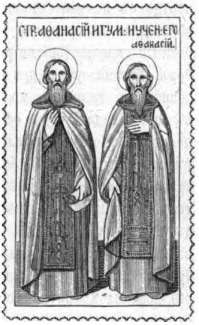
Преподобный Афанасий, в крещении Андрей, сын священника Авксентия Обонежской пятины,105 в юности обучен был отцем чтению книг; отец и мать были благочестивые и воспитали сына в страхе Божием. Люди боголюбивые заботятся о том, ка бы не быть в стыде за жизнь и веру свою перед Богом, и тому же учат детей своих. Таковы были родители Андрея; отце его был особенно усерден к делам звания своего; понимал сам и внушал другим, что, не занимаясь словом Божиим, люди ходят во тьме и губят себя и своих детей. Добрый отрок Андрей, по наставлению отца своего, усердно ходил в храм Божий и в этом училище всего святого научался благочестию. При таком воспитании родилось в нем желание удалиться от мира, но он боялся решиться на то. Когда услышал он о пустынных преп. Сергия Радонежского, он положил отдать себя в руководство великому наставнику. Оставив родину, явился он в пустыню Сергия, и преподобный принял юношу, испытал его и облек в иноческие одежды.
The Venerable Athanasius, named Andrew at baptism, was the son of the priest Auxentius of the Obonezh Pyatina.105 In his youth he was taught the reading of books by his father; his father and mother were pious and raised their son in the fear of God. God-loving people are concerned not to be put to shame for their life and faith before God, and they teach the same to their children. Such were Andrew's parents; his father was especially diligent in the duties of his calling; he understood himself and taught others that, without occupying themselves with the word of God, people walk in darkness and ruin themselves and their children. The good youth Andrew, according to the instruction of his father, diligently attended the church of God, and in that school of all that is holy he learned piety. With such an upbringing, a desire arose in him to withdraw from the world, but he feared to decide upon it. When he heard of the wilderness of the Venerable Sergius of Radonezh, he resolved to place himself under the guidance of the great teacher. Leaving his homeland, he appeared in the wilderness of Sergius, and the Venerable One received the youth, tested him, and clothed him in monastic garb.
Новый инок с ревностью подвизался на пути спасения. Он открывал св. старцу каждый смущавший его помысл, как того и требовал св. старец. Это облегчало его в самоусовершении. «Во мнозе совете спасение людем», а совет опытного в жизни духовной очень много значит и для молодого, и для старого инока. Как легко неопытность может принять благовидные, но в сущности вредные мысли за святые и попасть на путь опасный. Опытный наставник, снимая с совести кающегося тяжести ее, указывает ученику то на опасности незримыя им, то на лучшее приемы жизни. Под руководством св. Сергия Афанасий зрел в жизни духовной. Святой старец любил его и особенно отличал в нем хорошее знание св. книг. «Афанасий, говорит жизнеописатель Сергия, был весьма сведущ в священных писаниях, и многие книги руки его поныне свидетельствуют о том, потому и очень любим он был Сергием.»
The new monk zealously struggled on the path of salvation. He revealed to the holy elder every thought that troubled him, as the holy elder required. This eased his progress in self-perfection. "In the multitude of counsel there is salvation for the people," and the counsel of one experienced in the spiritual life means very much for both the young and the old monk. How easily inexperience may take plausible but essentially harmful thoughts for holy ones and fall onto a dangerous path. An experienced guide, relieving the conscience of the penitent of its burdens, points out to the disciple both the dangers unseen by him and the better methods of life. Under the guidance of St. Sergius, Athanasius matured in the spiritual life. The holy elder loved him and especially valued in him his good knowledge of the holy books. "Athanasius," says the biographer of Sergius, "was very learned in the sacred writings, and many books written by his hand bear witness to this even now, and for this reason he was greatly loved by Sergius."
Дело доброго князя, как и всякого доброго начальника, заботится и со своей душе, и о спасении поручаемых смотрению его. Так думал добрый Серпуховской князь Владимир Андреевич. Основав Серпухов, он счел нужным устроить в новом городе монастырь, как училище благочестия христианского и всего доброго.
The concern of a good prince, like that of any good leader, is for both his own soul and the salvation of those entrusted to his care. So thought the good Prince of Serpukhov, Vladimir Andreevich. Having founded Serpukhov, he considered it necessary to establish a monastery in the new city, as a school of Christian piety and of all that is good.
Он пригласил к себе преп. Сергия с тем, чтобы взял с собой ученика своего Афанасия, открыл св. старцу свои мысли о монастыре и просил совета его. Св. старец благословил желание доброго князя и вместе с князем осмотрел место будущей обители. Месть назвалось Высоким и отвечало своему имени. Оно было на возвышенном берегу р. Нары и вблизи р. Оки, в лесу, в версте от города. Св. старец благословил место, и лес был очищен. Дек 2-го 1373 г. пр. Сергий заложил храм обители в честь Зачатия Богоматери св. Анной и основал общежительную обитель. Князь просил, чтобы Афанасий оставлен был в строителя и игумена новой обители. Не хотелось св. старцу расставаться с любимым учеником, а еще более не хотелось блаж. Афанасию расстаться с дивным наставником; но так угодно Господу, сказал Сергий и, пробыв несколько дней в беседах с князем и новым игуменом, оставил Афанасия в Серпухове.106 Афанасий с помощью благочестивого князя построил келии и храм. Скоро собрались к нему братья. Преп. Сергий прислал к нему Никона, будущего игумена лавры. Это был первый инок Серпуховский; он скоро удостоен здесь иеромонашества, но недолго пробыл в новой обители. По благословению Афанасия пошел он посетить преп. Сергия, и Сергий оставил его в своей обители. Затем поступил будущий преемник основателя обители. Сын знатных родителей Ярославских, Амос, явился с горячим усердием к иноческим подвигам; преп. игумен постриг его в иночество с именем Афанасия. На седьмом году пребывания в обители и на третьем году иночества младшего Афанасия набожный князь Владимир построил в обители каменный собор Богоматери и при братской трапезе теплый храм. При освящении главного храма младший Афанасий посвящен был в иеродиакона. Храм освящен был блаж. Киприаном митрополитом. Конечно после этого личного свидания митрополит писал игумену Афанасию обширное послание с разными наставлениями, по просьбе самого Афанасия.107 Игумен строго наблюдал за благочинием в храме и за жизнью келейной братий. Он часто предлагал поучения. По его правилам иноки его должны хранить чистоту души и тела, иметь кроткую поступь, взор потупленный, голос не громкий, умеренность в пище и питье, власяную одежду, как можно меньше быть в праздности и как можно чаще заниматься чтением книг. «Доныне, говорит известие 1698 г. доброписания руки его в монастыре Высоцком обретаются.» Ныне известна книга Никона Черногорца, писанная в 1381 г., «при игумене грешном Афанасии», по его благословению.108 Преподобный игумен управлял Высоцкой обителью до 11 лет.
He invited the Venerable Sergius to come to him, asking him to bring along his disciple Athanasius, revealed to the holy elder his thoughts concerning the monastery, and sought his advice. The holy elder blessed the desire of the good prince and, together with the prince, inspected the site of the future monastery. The place was called Vysokoe and was true to its name. It was on the elevated bank of the Nara River, near the Oka River, in a forest, a verst from the city. The holy elder blessed the place, and the forest was cleared. On December 2, 1373, the Venerable Sergius laid the foundation of the monastery church in honor of the Conception of the Theotokos by St. Anne and founded a cenobitic monastery. The prince asked that Athanasius be left as builder and abbot of the new monastery. The holy elder was loath to part with his beloved disciple, and still more was the blessed Athanasius unwilling to part with his wondrous teacher; but 'so it is pleasing to the Lord,' said Sergius, and having spent several days in conversation with the prince and the new abbot, he left Athanasius in Serpukhov.106 Athanasius, with the help of the pious prince, built cells and a church. Soon brethren gathered to him. The Venerable Sergius sent Nikon, the future abbot of the Lavra, to him. This was the first monk of Serpukhov; he was soon deemed worthy of the rank of hieromonk there, but he did not remain long in the new monastery. With the blessing of Athanasius, he went to visit the Venerable Sergius, and Sergius kept him in his own monastery. Then came the future successor of the founder of the monastery. A son of noble Yaroslavl parents, Amos, came with fervent zeal for monastic struggles; the venerable abbot tonsured him into monasticism with the name Athanasius. In the seventh year of his stay in the monastery and in the third year of the younger Athanasius’s monastic life, the devout Prince Vladimir built a stone cathedral of the Mother of God in the monastery and, near the refectory, a warm church. At the consecration of the main church, the younger Athanasius was ordained a hierodeacon. The church was consecrated by the blessed Cyprian, Metropolitan. Doubtless after this personal meeting, the Metropolitan wrote an extensive epistle to Abbot Athanasius with various instructions, at the request of Athanasius himself.107 The abbot strictly observed good order in the church and in the cell life of the brethren. He frequently offered teachings. According to his rules, his monks were to preserve purity of soul and body, to have a meek gait, a downcast gaze, a voice not loud, moderation in food and drink, a hair-shirt garment, to be as little idle as possible, and to occupy themselves as often as possible with the reading of books. 'To this day,' says a report from 1698, 'fair writings of his hand are found in the Vysotsk monastery.' At present, the book of Nikon of the Black Mountain is known, written in 1381, 'under the sinful Abbot Athanasius,' by his blessing.108 The venerable abbot governed the Vysotsk monastery for eleven years.
Когда митрополит Киприан в начале 1383 г. вынужден был удалиться из Москвы в Киев, то он написал к духовному другу своему Афанасию о намерении искать защиты у патриарха. «Ты же, говорил святитель, прилежи своей пастве, ведай, яко о низ воздаси слово; аще ли кто не послушает, о том больше прилежи и учи, веси бо слово Господне, – маловерна жизнь наша. Отпиши же ко мне, чтобы имел я сведения о положении дел.»109 Летопись говорит: «с ним (с м. Киприаном) отправился в Киев Высоцкий Серпуховской игумен Афанасий».110 Это значит, что неудовольствия, поднятые против Киприана, коснулись и искренно преданного ему игумена, и блаж. Афанасий удалился к уважаемому им святителю. – Когда в 1387 г. блаж. Киприан отправился в Царьград, то и Афанасий «отыде в Царьград, оставив игуменство Бога ради».111 Здесь в Предтечевой обители купил себе келию и жил с несколькими учениками, занимаясь то молитвой, то книгами, то делами благотворения. Спутник м. Пимена иерод. Игнатий, описывая свое пребывание в Царьграде 1388 г., пишет: «июля 1 пошли мы в монастырь св. Иоанна, по-гречески Подрома, по-русски Предтечи, и здесь сотворили поклонение; здесь очень хорошо успокоили нас живущие тут русские.»112 Это – пр. Афанасий и его ученики. Один из учеников его, списывавший в 1392 г. по его воле сборник, вот что писал впоследствии: «сию книгу писал я по благословению и совету моего старца, священносчестнейшего между иноками, кир Афанасия, бывшего прежде начальником общежития и братии в монастыре на Высоком. Рассмотрев жизнь рассудительным умом своим, оставил он монастырь и все, что было дорого ему, родных, знатных знакомых и удалился в Константинополь; здесь пребывает он, как один из убогих; забывая все земное, печется только о будущем. Митрополит Киприан сильно упрашивал его (1389 г.) чтобы согласился идти в Россию и принять там почетную должность. Но он отказался. «Келья моя дороже мне тех почестей», сказал он. О. ум рассудительный! О, взор светлый! Возлюбил ты горькое и скорбное. Как же мне больно, что не умею я наслаждаться тем же. Тем, которые вкушают эту горечь, она по пророку слаще меда. Дивлюсь я твоему подвижническому житию; много ты учил, но я не внимаю; ты прикладывал полезный пластырь к ранам моим, а я бросаю его прочь.»113 Прекрасная скорбь в ученике! Каков же наставник! Одним из самых любимых занятий пр. Афанасия в Константинопольской келье было списывать лучшие книги, и не для себя одного. Сборник, списанный по его воле, заключает в себе 400 глав Максима, главы Марка, слово Симеона, нового Богослова. В 1401 г. в царской обители Иперивлето «грешный Афанасий, малейший в единообразных», списал, а может быт и перевел церковный уста, который назвал оком церковным, причем прибавлял: «братия, проходяще книгу сию, не порецете (не произносите), Бога ради, тягости на душу мою, аще и неудобрение (несовершество) зрите, или погрешение обрящете.»114 С его устава списывали потом списки в России.115 Летопись называет преп. Афанасий добродетельным, учительным, знающим св. Писание и прибавляет: «о том поныне свидетельствуют писания его.»116 По этим словам несомненно, что преп. Афанасий писал назидательные сочинения.
When Metropolitan Cyprian was compelled to withdraw from Moscow to Kiev at the beginning of 1383, he wrote to his spiritual friend Athanasius about his intention to seek protection from the patriarch. "You, however," said the Hierarch, "attend to your flock; know that you shall give account for them; if any hearken not, be the more diligent with him and teach him, for you know the word of the Lord—our life is of little faith. Write to me, that I may have knowledge of the state of affairs."109 The chronicle says: "With him (with Metropolitan Cyprian) there went to Kiev the Vysotsk Serpukhov abbot Athanasius."110 This means that the displeasure raised against Cyprian touched also the abbot who was sincerely devoted to him, and the Venerable Athanasius withdrew to the Hierarch whom he revered. – When in 1387 the Blessed Cyprian set out for Constantinople, Athanasius also "departed for Constantinople, having left the abbacy for God's sake."111 There, in the monastery of the Forerunner, he bought himself a cell and lived with several disciples, occupying himself now with prayer, now with books, now with works of charity. The companion of Metropolitan Pimen, Hierodeacon Ignatius, describing his stay in Constantinople in 1388, writes: "On July 1 we went to the monastery of St. John, in Greek Podroma, in Russian of the Forerunner, and there we made our reverence; the Russians living there gave us very good rest."112 These were the Venerable Athanasius and his disciples. One of his disciples, who copied a collection in 1392 at his bidding, later wrote the following: "This book I wrote by the blessing and counsel of my elder, the most honorable among monks, kyr Athanasius, who was formerly the head of the community and of the brethren in the monastery on the High Place. Having examined life with his discerning mind, he left the monastery and all that was dear to him—relatives, noble acquaintances—and withdrew to Constantinople; here he abides as one of the poor; forgetting all earthly things, he cares only for the future. Metropolitan Cyprian earnestly entreated him (in 1389) to consent to go to Russia and accept an honorable office there. But he refused. 'My cell is dearer to me than those honors,' he said. O discerning mind! O bright gaze! You have loved that which is bitter and sorrowful. How it pains me that I know not how to delight in the same. To those who taste this bitterness, it is, according to the prophet, sweeter than honey. I marvel at your ascetic life; you have taught much, but I give no heed; you applied a useful plaster to my wounds, but I cast it away."113 A beautiful sorrow in the disciple! What then must the teacher have been! One of the most beloved occupations of the Venerable Athanasius in his Constantinople cell was to copy the best books, and not for himself alone. The collection copied at his bidding contains 400 chapters of Maximus, the chapters of Mark, a discourse of Symeon the New Theologian. In 1401, in the imperial monastery of Iperivleto, "the sinful Athanasius, the least among those of like form," copied, and perhaps also translated, a church typicon, which he called the Eye of the Church, adding: "Brethren, when you go through this book, do not, for God's sake, lay a burden upon my soul if you see any awkwardness or find any error."114 Copies of his typicon were later made in Russia.115 The chronicle calls the Venerable Athanasius virtuous, instructive, knowing the Holy Scriptures, and adds: "of this even to this day his writings bear witness."116 From these words it is certain that the Venerable Athanasius wrote edifying works.
Таким образом преп. Афанасий и в Константинополе трудился для св. Русской Церкви так, как немногие трудились в России. – Известие 1698 г. говорит, что преп. Афанасий прислал из Константинополя в Высоцкую обитель «7 икон поясных окладных» и еще 3 иконы. «И ныне, прибавляет то же известие, те иконы в той обители в храме Пресвятой Богородицы над царскими дверьми, 7 икон, стоят, от всех зримы и чествуемы поклонением.»117 Вероятно в том же 1401 г., в котором писан был преп. Афанасием церковный устав, опочил он от трудов своих в Константинопольской обители.118
Thus the Venerable Athanasius, even in Constantinople, labored for the holy Russian Church as few labored in Russia. – A report from 1698 says that the Venerable Athanasius sent from Constantinople to the Vysotsk monastery "seven half-length icons in rizas" and also three icons. "And now," adds the same report, "those icons stand in that monastery in the church of the Most Holy Theotokos above the royal doors, seven icons, visible to all and honored with veneration."117 Probably in the same year 1401, in which the church typicon was written by the Venerable Athanasius, he reposed from his labors in the Constantinople monastery.118
Перед удалением из обители Высоцкой преп. Афанасий сам назначил в преемника себе по обители ученика своего Афанасия. Младший Афанасий оправдал все благие надежды на него. Он умножил число братий в обители, вел жизнь подвижническую и побуждал братию к жизни достойной звания иноческого; перед кончиной своей он долго был болен и преставился 12 сентября 6904 (1395 г.) «Погребоша прямо против церковных западных дверей, идеже ныне особое каменоустройство над гробом его учинися», говорит известие 1698 года.
Before his departure from the Vysotsk monastery, the Venerable Athanasius himself appointed his disciple Athanasius as his successor in the monastery. The younger Athanasius justified all the good hopes placed in him. He increased the number of the brethren in the monastery, led an ascetic life, and urged the brethren to a life worthy of the monastic calling; before his death he was ill for a long time and reposed on September 12, 6904 (1395). "He was buried directly opposite the western doors of the church, where now a special stone structure has been made over his grave," says the report of 1698.
В рукописных святцах сказано: «преп. Афанасий, игумен Высоцкого Зачатского монастыря, иже в Серпухове, новый чудотворец, преставился в лето 6904 сентября в 12 день, ученик преп. Афанасия, дивного ученика преп. Сергия, что после был в Царграде и тамо преставился.»
In the manuscript menologia it is said: "The Venerable Athanasius, abbot of the Vysotsk Conception Monastery, which is in Serpukhov, a new wonderworker, reposed in the year 6904, on the 12th day of September, a disciple of the Venerable Athanasius, the wondrous disciple of the Venerable Sergius, who later was in Constantinople and there reposed."
По повествованию 1698 года, во время самого погребения младшего Афанасия, брат, не пошедший на погребение по презорливому нерадению, поражен был болезнью и, придя в себя перед гробом, исцелился. Затем не раз видали преподобного ходящим с кадильницей по гробам или с горящими свечами в руках. Во время нападения крымских татар на Серпухов и неприятели и свои из города видели старца на белом коне с жезлом в реке, смуглого лицом и с густой, черной бородой; выехав из обители, из которой однако иноки еще прежде все удалились, старец объехал стан врагов и потом с угрожающим видом устремился на врагов. Это навело такой страх на орду, что она мгновенно бросилась бежать прочь от города.
According to the narrative of 1698, at the very time of the burial of the younger Athanasius, a brother who had not gone to the burial out of contemptuous negligence was struck with illness and, coming to himself before the grave, was healed. Then more than once they saw the venerable one walking with a censer among the graves or with burning candles in his hands. During the attack of the Crimean Tatars on Serpukhov, both the enemies and their own people from the city saw an elder on a white horse with a staff in the river, dark of face and with a thick, black beard; having come out of the monastery, from which however the monks had all withdrawn beforehand, the elder rode around the enemy camp and then rushed at the enemies with a threatening appearance. This brought such fear upon the horde that it instantly fled away from the city.
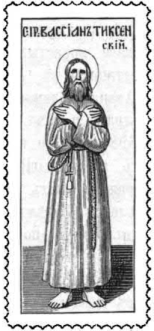
Преподобный Вассиан, в мире Василий, из с. Стрелицы, что близ Тотьмы, в мирском быту был швецом, вступал в брак и имел двух сыновей. Потом, в Тотемской обители приняв монашество, года два провел в подвигах послушания под смотрением настоятеля Ферапонта. Ревнуя же о высшем совершенстве, по благословению настоятеля, поселился в 50 верстах от Тотьмы на реке Тисне при храме св. Николая. Сперва жил он здесь на паперти храма, потом упросил причт и окрестных жителей уступить ему место в 20 саженях от храма для хижины. Ему поставили келью, и он начал уединенно подвизаться в посте и молитве. Это было в 1594 г. Он приходил в храм на каждую службу его, а в келье совершал иноческое правило. По благословению наставника своего Ферапонта, возложил он на тело свое вериги, на плечи – цепь, на чресла – железный обруч, а на голову под куколем надел железную шапку.
The Venerable Vassian, in the world Basil, from the village of Strelitsa, near Totma, in his worldly life was a tailor, entered into marriage and had two sons. Later, having received monasticism in the Totma monastery, he spent about two years in the labors of obedience under the supervision of the abbot Therapont. Zealous for higher perfection, with the blessing of the abbot, he settled 50 versts from Totma on the river Tiksna at the church of St. Nicholas. At first he lived here on the church porch; then he begged the clergy and the local inhabitants to grant him a place 20 sazhens from the church for a hut. They set up a cell for him, and he began to struggle in solitude in fasting and prayer. This was in 1594. He came to the church for every service, and in his cell he performed the monastic rule. With the blessing of his instructor Therapont, he placed upon his body chains, on his shoulders a chain, on his loins an iron hoop, and on his head under the koukoulion he put an iron cap.
В таком одеянии подвизался он 13 лет. Он не принимал никого к себе в келью, кроме духовного отца, и питался подаянием, которое принимал в оконце кельи. Так подвизался раб Божий в строгом затворе, очищая дух страданиями грешной плоти, для жизни небесной. Уразумев близкую кончину свою, пригласил он духовника, исповедался и приобщился св. таин и тихо предал дух свой Богу, 12 сентября 1624 г. Только при погребении узнали, какими тяжестями смирял он тело свое. По кончине его, на месте его подвигов основалась обитель в честь Нерукотворенной иконы Спасителя. Почитание преп. Вассиана началось с моровой язвы 1647 года, когда у гроба его многие получали исцеление. Ныне мощи преп. Вассиана покоятся в приходской, прежней монастырской, церкви Спаса.119
In such attire he struggled for 13 years. He received no one into his cell except his spiritual father, and he lived on alms, which he received through the window of his cell. Thus the servant of God struggled in strict seclusion, purifying his spirit through the sufferings of his sinful flesh for the heavenly life. Perceiving his approaching end, he summoned his confessor, confessed and partook of the Holy Mysteries, and quietly gave up his spirit to God, on September 12, 1624. Only at his burial did they learn with what weights he had humbled his body. After his death, a monastery in honor of the Icon of the Savior Not-Made-by-Hands was founded on the site of his struggles. The veneration of the Venerable Vassian began with the plague of 1647, when many received healing at his grave. Now the relics of the Venerable Vassian rest in the parish church of the Savior, formerly the monastery church.119
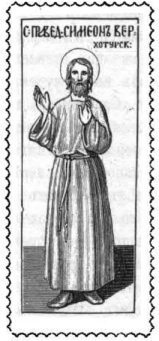
В рукописных святцах читаем: «св. праведный Симеон Меркушинский, новый чудотворец, преставися в лето 7150 (1642).» Праведный Симеон был родом из дворян,120 но, скрыв знатность свою в смирении христианском, вел жизнь бедняка. Переходя из деревни в деревню, шил он платье, преимущественно для бедных; кончив работу, уходил из дома рано поутру, кода все спали, чтобы избежать не только денежной платы, но и слова благодарного за работу.
In the manuscript menologia we read: "The holy righteous Symeon of Merkushino, a new wonderworker, reposed in the year 7150 (1642)." The righteous Symeon was of noble birth,120 but, having concealed his nobility in Christian humility, he led the life of a poor man. Going from village to village, he sewed clothing, chiefly for the poor; having finished his work, he would leave the house early in the morning, while everyone was asleep, in order to avoid not only monetary payment but even a word of thanks for his work.
Он доволен был и тем, что давали пищу и кров. Чаще всего проживал он в погосте Меркушах, в 50 верстах от Верхотурья, где была пристань судов, плававших по реке Туре. Он любил в тиши уединения наслаждаться природой и хвалить Творца ее. Когда не было работы, брал он уду, садился на берегу реки и доставал оттуда лишь нужное для дня. Еще поныне цела ель, на утесистом берегу реки Туры, где любил сидеть блаженный, занимаясь ловлей рыбы. Вогуличи и другие инородцы края тогда были новыми христианами. Блаженный Симеон вступал с ними в разговоры и учил христианскому благочестию.121 Располагая к себе бедных своей услужливостью, он находил сердца их открытыми для принятия наставлений его и усердно сеял в сердцах правила страха Божия. – Никогда не оставлял он посещать богослужение храма и особенно храма Меркушевского. Чистая жизнь его служила примером для всех; а этот пример особенно нужен был и благотворен для края еще дикого, недавно увидавшего свет христианский. Блаженный Симеон, страдавший болью живота, скончался не старым, около 35 лет, в 1642 г. и погребен был при церкви архистратига Михаила.122
He was content even with what was given him for food and shelter. Most often he lived in the churchyard of Merkushino, 50 versts from Verkhoturye, where there was a wharf for ships sailing on the Tura River. He loved in the stillness of solitude to enjoy nature and to praise its Creator. When there was no work, he would take a fishing rod, sit on the riverbank, and take from it only what was necessary for the day. Even now the fir tree on the rocky bank of the Tura River, where the blessed one loved to sit, occupied with fishing, is still intact. The Voguls and other natives of the region were then new Christians. The blessed Symeon entered into conversation with them and taught them Christian piety.121 Making himself agreeable to the poor by his helpfulness, he found their hearts open to receive his instructions, and he diligently sowed the rules of the fear of God in their hearts. – He never failed to attend the divine services of the church, especially the church of Merkushino. His pure life served as an example for all; and this example was especially necessary and beneficial for a region still wild, which had only recently seen the light of Christianity. The blessed Symeon, who suffered from pain in the abdomen, died not old, about 35 years of age, in 1642, and was buried at the church of the Archangel Michael.122
Чудеса, происходившие от мощей праведника, и нетление мощей его заставляли тобольских архипастырей не раз свидетельствовать мощи его, и митрополит Игнатий не себе испытал силу молитв праведника.123 В 1704 году, по распоряжению митрополита Филофея и по желанию края, мощи угодника Божия перенесены в Верхотурский Николаевский монастырь и установлено праздновать 12 сентября. К этому времени сходятся и съезжаются в Верхотурье не только из ближних селений, но даже из отдаленных мест.
The miracles that occurred from the relics of the righteous one and the incorruption of his relics compelled the Tobolsk archpastors to examine his relics more than once, and Metropolitan Ignatius himself experienced the power of the righteous one's prayers.123 In 1704, by the order of Metropolitan Philotheus and by the desire of the region, the relics of the man of God were translated to the Verkhoturye St. Nicholas Monastery, and it was established to celebrate on September 12. At this time people gather and come together in Verkhoturye not only from the nearby settlements but even from distant places.
Праведник совершал много чудес в Меркушах, много совершал и в обители. Особенность в явлениях его та, что он исцелением телесных болезней преподавал наставления для души. При митрополите Игнатии житель Верхотурского уезда Иаков лежал больной при смерти. Ему явился человек в белой одежде и велел объявить Верхотурскому дьячку, чтобы удерживался от пьянства, содержал пост и исповедовал грехи свои духовнику, – а самому больному приказал идти молиться над гробом праведного Симеона. Пробудясь от сна, больной почувствовал облегчение, а в Меркушах у гроба праведника совсем выздоровел. Священнику соборной Верхотурской церкви Павлу Праведникову говорил строгие укоризны за нетрезвость. Испуганный иерей просил помилования и облегчения своей болезни, обещаясь не пить вина. Кто будет за тебя порукой? – спросил праведный. Священник указал на крест. Праведник обличил потом иерея и в других грехах. Исцеленный иерей выполнял обещание до гроба. В 1711 г. Симеон явился старцу Иакову и грозными словами привел его в ужас, так что тот пал в бесчувствии. Придя в себя, он объявил архимандриту и прочим, что праведник велел архимандриту и воеводе внушать народу удерживаться от бранных слов и нечистых дел, иначе готова казнь Божия – мор и голод. В 1749 г. житель Невьянского завода, где упорно держался раскол, Василий Масленников, три года лежавший в параличе, без языка, с рукой сведенной к шее и с искривленным ртом, во сне увидел человека в белой одежде, с русыми волосами, такого, каким написан был праведный Симеон на гробовой доске. «Ты хочешь быть здоровым?» спросил явившийся. Когда Василий отвечал, что хочет, и спросил об имени своего попечителя, «я Симеон Меркушинский, отвечал явившийся; иди в Верхотурье, в обитель св. Николая, помолись там с усердием, отслужи молебен над моими мощами и будешь здоров; да крестное знамение изображай на себе во образ Св. Троицы, тремя первыми перстами. Слушай же, иначе будет хуже.» Василий с детства был раскольником. После явления он почувствовал облегчение и на другой день рассказал в Невьянской конторе все бывшее с ним. Затем был на поклонении целителю своему в Верхотурье.124 В Верхотурской обители хранятся: а) серебряная дщица с надписью: «за чудесное избавление от тяжкой болезни молитвами св. праведного Симеона посвящается коллеж. советн. Иваном Лихаревым, 1793 г.»; б) серебряный крест с надписью: «праведного Симеона чудотворца Верхотурского молитвами исцелевшей, болевшей изломом ног, 1822.»125
The righteous one performed many miracles in Merkushi, and many also in the monastery. A particular feature of his appearances is that through the healing of bodily ailments he gave instruction for the soul. During the time of Metropolitan Ignatius, a resident of Verkhoturye district, James, lay sick unto death. A man in white raiment appeared to him and commanded him to declare to the Verkhoturye sexton that he should refrain from drunkenness, keep the fast, and confess his sins to his spiritual father—and to the sick man himself he ordered that he go and pray at the grave of the righteous Symeon. Awakening from sleep, the sick man felt relief, and at Merkushi, by the grave of the righteous one, he was completely healed. To Paul Pravednikov, a priest of the Verkhoturye cathedral church, he spoke stern reproaches for intemperance. The frightened priest begged for mercy and for relief from his illness, promising not to drink wine. “Who will be surety for you?” asked the righteous one. The priest pointed to the cross. The righteous one then also reproved the priest for other sins. The healed priest kept his promise until the grave. In 1711, Symeon appeared to the elder James and with terrible words brought him to such terror that he fell down senseless. Coming to himself, he declared to the archimandrite and the others that the righteous one had commanded the archimandrite and the voivode to admonish the people to refrain from foul language and unclean deeds, otherwise the punishment of God—pestilence and famine—was ready. In 1749, a resident of the Nevyansk factory, where schism stubbornly persisted, Basil Maslennikov, who had lain for three years paralyzed, without speech, with his hand drawn to his neck and his mouth twisted, saw in a dream a man in white raiment, with light brown hair, such as the righteous Symeon was depicted on his coffin board. “Do you wish to be whole?” asked the one who appeared. When Basil answered that he did, and asked the name of his benefactor, “I am Symeon of Merkushi,” replied the one who appeared; “go to Verkhoturye, to the monastery of St. Nicholas, pray there with zeal, have a moleben served over my relics, and you will be whole; and make the sign of the cross upon yourself in the image of the Holy Trinity, with the first three fingers. Listen, or else it will be worse.” Basil had been a schismatic from childhood. After the vision he felt relief, and on the next day told in the Nevyansk office all that had happened to him. Then he went to venerate his healer in Verkhoturye.124 In the Verkhoturye monastery are preserved: a) a silver plaque with the inscription: “For miraculous deliverance from a grievous illness through the prayers of St. righteous Symeon, dedicated by Collegiate Councillor Ivan Likharev, 1793”; b) a silver cross with the inscription: “Of the righteous Symeon, Wonderworker of Verkhoturye, through whose prayers she was healed who had suffered from a fracture of the legs, 1822.”125
Ркп. «слово о житии преп. отца нашего Афанасия Высоцкого и ученике его игум. Афанасии», написанное в 1698 г., у Ундольского № 288. В Синод. ркп. XVIII в. X 85. Вместе с житиями св. Серапиона Новгор. и Дионисия Радонежского. Слово, как слово, написано красноречиво и назидательно, но скудно историческими известиями и с ошибками против истории. По слогу и по времени оно принадлежит Кариону Истомину.
Manuscript: “A discourse on the life of our Venerable Father Athanasius of Vysotsk and of his disciple, Abbot Athanasius,” written in 1698, in Undolsky’s collection, No. 288. In a Synodal manuscript of the 18th century, X 85. Together with the lives of St. Serapion of Novgorod and Dionysius of Radonezh. The discourse, as a discourse, is written eloquently and edifyingly, but is poor in historical information and contains errors against history. By its style and by its time it belongs to Karion Istomin.
Никон. лет. 4, 38. 39. 232. 233. Собр. лет. VIII, 21. Львов. лет. 2, 149. Русск. времен. 1, 277. Здесь говорится: «благослови ученика своего Афанасия, родом Ростовца». Но по слову о пр. Афанасии урожденцем Ростова был ученик Афанасия и его преемник – Афанасий младший. В этом отношении надобно доверить слову, по подробностям, с какими оно говорит о родителях ученика Сергиева и ученика Афанасиева.
Nikon Chronicle 4, 38. 39. 232. 233. Collection of Chronicles VIII, 21. Lvov Chronicle 2, 149. Russian Timepiece 1, 277. Here it is said: “He blessed his disciple Athanasius, by birth a Rostovite.” But according to the discourse on the Venerable Athanasius, the native of Rostov was the disciple of Athanasius and his successor—Athanasius the Younger. In this respect, one must trust the discourse, because of the details with which it speaks of the parents of the disciple of Sergius and the disciple of Athanasius.
Опис. муз. № 445. «Коснулся трудолюбне книги сея, яже есть око церковное... Нас же рачительство желанием распали к таковей купли труда; аще и нехудожне сию снискахом, обаче трудне края достигохом, лету сущу 6909 мая 30».
Description of the Museum, No. 445. “I have labored diligently at this book, which is the Eye of the Church... But zeal inflamed us with desire for such a purchase of labor; and though we acquired it not skillfully, yet laboriously we reached the end, in the year 6909, May 30.”
У Толстого устав 1409 года с тем же послесловием, какое написал Афавасий. 1. X 11. В библ. Казав. университета список 1429 года, списанный Ионою в Сергиевой обители. Ж. М. просв., ч. 75, отд. III, 71. 72.
In Tolstoy’s collection, a Typikon of 1409 with the same colophon that Athanasius wrote. 1. X 11. In the library of Kazan University, a copy of 1429, copied by Jonah in the monastery of Sergius. Journal of the Ministry of Public Education, part 75, section III, 71. 72.
После того, что сказано по современным памятникам о пребывание пр. Афанасия в Константинополе, нет нужды доказывать несправедливость известия 1698 г. о том, будто Афанасий был патриархом в Константинополе. Впрочем и сочинитель известия 1698 г. так начинает свой рассказ о том: «обретается не во многих писаниях, аще и мало, свидетельство» и потом не раз выражает свое сомнение о верности такого свидетельства. Ист. иер. 3. 632.633. Никон. лет. 4,39. «Бога ради остави (Афанасий) игуменство и отыде в Царьград и купи себе тамо келью, дал андрофат; и поживе в молчании со святыми старцы и тако в старости глубоце преставися ко Господу».
After what has been said from contemporary monuments concerning the sojourn of the Venerable Athanasius in Constantinople, there is no need to prove the falsity of the account of 1698, according to which Athanasius was supposedly patriarch in Constantinople. However, even the author of the account of 1698 begins his narrative thus: “There is found in not a few writings, albeit little, testimony,” and afterwards more than once expresses his doubt as to the veracity of such testimony. History of the Hierarchy 3. 632. 633. Nikon Chronicle 4, 39. “For God’s sake, Athanasius left the abbacy and departed to Constantinople and bought himself a cell there, gave an androphat; and he lived in silence with the holy elders, and thus in deep old age he reposed in the Lord.”
Ркп. сказание о житии и чудесах прав. Симеона, соч. м. Игнатия (Обзор литер. § 243); ркп. Сибирский летописец Тобольской семинарии под 1692 г. Макария сказание о жн8ни и чудесах св. праведного Симеона. Спб. 1857.
Manuscript account of the life and miracles of the righteous Simeon, composed by Metropolitan Ignatius (Survey of Literature § 243); manuscript Siberian Chronicler of Tobolsk Seminary under the year 1692. Macarius’s account of the life and miracles of St. righteous Simeon. St. Petersburg, 1857.
Погост Меркуши основался в 1620 г., а Верхотурье – в 1598 г. Акты Верхотурья в времен. общ. ист., кв. 25, смесь, стр. 3–13. Местность, где основались Верхотурье, называется в актах Чудским городищем – Нарымкурою.
The churchyard of Merkushi was founded in 1620, and Verkhoturye in 1598. Acts of Verkhoturye in the Proceedings of the Society of History, book 25, miscellany, pp. 3–13. The locality where Verkhoturye was founded is called in the acts the Chud settlement—Narymkura.
Кроме ркп. жития праведника, Сибирский летописец: «до Тюмени ехал (с губернатором кн. Гагариным) преосвященный Иоанн, митрополит Тобольский, для свидетельства св. мощей». Север. арх. 7. 19, стр. 249.
Besides the manuscript life of the righteous one, the Siberian Chronicle: “The Most Reverend John, Metropolitan of Tobolsk, traveled (with Governor Prince Gagarin) as far as Tyumen for the examination of the holy relics.” Northern Archive 7. 19, p. 249.