Дочь богатых родителей, прекрасная собой, выдана была в замужество за доброго молодого человека. Молодой муж любил молодую жену, и жизнь их была примером счастливой супружеской жизни. На несчастье, молодой богатый человек страстно влюбился в Феодору. Он сыпал подарки и деньги, уверения и ласки, чтобы совратить с пути долга. Та не поддавалась греху. Он обратился за помощью к ловкой женщине, занимавшейся обманами разного рода; продажная душа взялась за молодую, неопытную женщину; после многих сатанинских обольщений, она успела внушить Феодоре ту мысль, что Бог не видит грехов нощных, и преступление совершилось ночью. Но едва совершен был гнусный грех, Феодора почувствовала жгучее раскаяние. Терзаемая совестью, она не могла переносить присутствия своего мужа, своих родных и знакомых. Напрасно говорила она себе, что грех ее неизвестен добрым людям и Богу. Совесть ее обличала в неверности мужу и не давала ей покоя. Наконец приняла она твердое намерение бежал из дома и в пустынном месте загладить преступление строгим покаянием.
The daughter of wealthy parents, beautiful of form, she was given in marriage to a good young man. The young husband loved his young wife, and their life was an example of a happy married life. Unfortunately, a certain rich young man fell passionately in love with Theodora. He showered her with gifts and money, assurances and caresses, in order to lead her from the path of duty. She did not yield to sin. He turned for help to a cunning woman who engaged in various kinds of deceit; this venal soul took on the young, inexperienced woman; after many satanic seductions, she succeeded in instilling in Theodora the thought that God does not see sins committed in the night, and the transgression was committed at night. But scarcely was the foul sin committed when Theodora felt a burning remorse. Tormented by her conscience, she could not bear the presence of her husband, her relatives, or her acquaintances. In vain she told herself that her sin was unknown to good people and to God. Her conscience accused her of unfaithfulness to her husband and gave her no peace. At last she formed a firm resolve to flee from her home and, in a desolate place, to atone for her transgression by strict repentance.
Сперва явилась она в женский монастырь, где приняли ее с любовью. Игуменья, заметив тоску ее, дала ей читать Евангелие. Когда прочла она здесь: ничтоже покровено, еже не открыется, она обомлела от ужаса. Терзая на себе волосы, призналась она теперь настоятельнице в своем преступлении. «Если есть для покаяние», говорила она, «то разрываю связи с миром и стану молить Бога о помиловании». Боясь того, что муж найдет ее в женском монастыре и не допустит ее выполнить подвигов раскаяния, она положила скрыться в мужском монастыре. В мужской одежде пришла она в Октодекадский монастырь. Настоятель на первый раз не велел давать ответа до утра. Она осталась ночью за монастырем. Потом сказано: «ты евнух молодой и изнеженный, а устав монастыря строг, – суров: нельзя принять тебя.» «Умру с голода, но не уйду от монастыря», отвечал евнух. Настоятель уступил. Феодора теперь – в том самом монастыре, где лежали мощи св. Фомаиды, отдавшей жизнь свою за сохранение верности супружеской. Понятно, как решимость ее на подвиги должна была усилиться. Понятно, почему хотела она умереть, но не отойти от стен Октодекада. Прием в Октодекаде считала она знаком, что желания ее каяться не отвергнуты небом. На нее возложена была работа в монастырском саду – разноска воды, где она требовалась, наконец – очистка всего двора; вместе с тем не освобождала она себя от поста, бдений, молитв келейных и общих.
First she appeared at a women's monastery, where she was received with love. The abbess, noticing her distress, gave her the Gospel to read. When she read there: For nothing is covered, that shall not be revealed, she was struck dumb with terror. Tearing her hair, she now confessed her transgression to the abbess. "If there is repentance," she said, "then I break all ties with the world and will pray to God for mercy." Fearing that her husband would find her in the women's monastery and would not allow her to fulfill the labors of repentance, she resolved to hide in a men's monastery. In men's clothing she came to the Octodecadus Monastery. The abbot at first ordered that no answer be given her until morning. She remained outside the monastery for the night. Afterwards it was said: "You are a young and effeminate eunuch, but the rule of the monastery is strict and severe—you cannot be received." "I will die of hunger, but I will not leave the monastery," replied the eunuch. The abbot yielded. Theodora was now in that very monastery where lay the relics of St. Thomasis, who gave her life for preserving marital fidelity. It is understandable how her resolve for ascetic labors must have been strengthened. It is understandable why she wished to die, but not to depart from the walls of Octodecadus. She considered her reception at Octodecadus a sign that her desire to repent had not been rejected by heaven. She was assigned work in the monastery garden—carrying water where it was needed, and finally, cleaning the entire courtyard; at the same time, she did not exempt herself from fasting, vigils, and prayers both in her cell and in common.
Феодора со смирением говорила себе, что судя по важности ее преступления, послушания, возложенные на нее, слишком легки и снисходительны.
Theodora said to herself with humility that, judging by the gravity of her transgression, the obediences laid upon her were too light and indulgent.
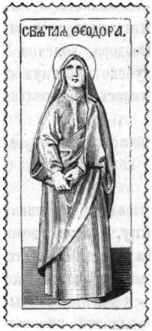
Она сама хотела усилить свои труды и довела ревность свою до того, что принимала пищу только один раз в неделю. Успехи ее в духовных подвигах привлекали на нее милосердие Спасителя, и она приводила в изумление игумена и братию своими подвигами; до того распялась она на кресте умерщвления, беспрестанно припадая, как новая блудница, к ногам Христа, день и ночь омывая их слезами покаяния, что не только грех ее прощен был, но она стала на высокой степени духовного совершенства.
She herself wished to increase her labors and carried her zeal to such a degree that she partook of food only once a week. Her progress in spiritual labors drew upon her the mercy of the Savior, and she filled the abbot and the brethren with amazement by her ascetic feats; so thoroughly did she crucify herself on the cross of mortification, ceaselessly falling, like a new harlot, at the feet of Christ, washing them day and night with tears of repentance, that not only was her sin forgiven, but she attained a high degree of spiritual perfection.
Божественная благодать: стала обнаруживаться в ней видимо. Так, раз крокодил, пожиравший людей, издох по ее слову. И однако Господь допустил подвижнице быть под страшным испытанием. Настоятель послал ее в город с верблюдами, на которых она должна была нагрузить елей и хлеб и возвратиться в монастырь; ей было приказано, если в пути застанет ночь, остановиться в девятом монастыре (он находился в девяти милях от Александрии). Здесь девушка, принимая Феодору за мужчину, хотела склонить ее ко греху, но быв со смиренным негодованием отвергнута, бросилась, в постыдном своем исступлении, в объятия какого-то прохожего. Сделавшись беременной, она на настояния родителей, хотевших узнать, кто обольститель ее, отвечала, что виной ее преступления монах девятого монастыря, и определила день, часть и место, где с ним встретилась. По принесении жалоб и произведении розыска в этом монастыре, решили, что виновный – Феодор.
Divine grace began to manifest itself visibly in her. Thus, once a crocodile that was devouring people died at her word. Yet the Lord permitted the ascetic to undergo a terrible trial. The abbot sent her to the city with camels, onto which she was to load oil and bread and return to the monastery; she was commanded, if night overtook her on the way, to stop at the ninth monastery (it was nine miles from Alexandria). There a girl, taking Theodora for a man, tried to seduce her to sin, but being rejected with humble indignation, threw herself, in her shameful frenzy, into the arms of some passerby. Having become pregnant, she answered the insistence of her parents, who wished to know who her seducer was, that the monk of the ninth monastery was the cause of her transgression, and she specified the day, hour, and place where she had met him. Upon the lodging of complaints and the conducting of an inquiry in that monastery, it was decided that the guilty one was Theodore.
Монахи девятого монастыря обратились с громкими жалобами к настоятелю того монастыря, в котором жила подвижница, требуя строгого наказания за оскорбление всего монашества. Смиренная Феодора, конечно, могла бы оправдаться немедленно; но она, глубоко чувствуя свои недостатки перед святостью Божьей, решилась добровольными скорбями усовершать душу свою.
The monks of the ninth monastery turned with loud complaints to the abbot of the monastery in which the ascetic lived, demanding strict punishment for the insult to the whole monastic order. The humble Theodora, of course, could have justified herself immediately; but she, deeply feeling her own shortcomings before the holiness of God, resolved to perfect her soul through voluntary sorrows.
Ее выгнали из монастыря; она должна была скрыться в нищенский шалаш, который сама поставила вблизи обители.
She was driven out of the monastery; she had to take refuge in a beggar's hut, which she herself set up near the monastery.
Когда обвинившая Феодору девушка родила, Феодоре принесли ребенка, как отцу, долженствовавшему питать его; она кормила этого приемыша молоком, которое соседние пастухи давали ей из сострадания. Сама же довольствовалась дикими травами пустыни, а в утоление жажды пила морскую воду. Сколько скорбей вытерпела эта нежная женская душа под градом насмешек дерзкой праведности! Чего стоило переносить и зной жаркого климата, и холод зимнего сырого воздуха! Лишенная права жить с людьми, жила она со зверями пустынными. И все это переносила с любовью молчаливой целые семь лет.
When the girl who had accused Theodora gave birth, the child was brought to Theodora as to the father, who was obliged to nourish it; she fed this foster-child with milk which the neighboring shepherds gave her out of compassion. She herself was content with the wild herbs of the desert, and to quench her thirst she drank sea water. How many sorrows did this tender feminine soul endure under the hail of mockeries from insolent self-righteousness! What it cost to bear both the heat of the torrid climate and the cold of the damp winter air! Deprived of the right to live with people, she lived with the beasts of the desert. And all this she bore with silent love for seven whole years.
Спустя семь лет после изгнания, монахи девятого монастыря, требовавшие наказания Феодоры, явились к изгнавшему ее настоятелю и просили принять покаявшегося евнуха. Ее приняли, но с условием, что она запрется со своим ребенком в уединенной келье и не будет выходить из нее.
Seven years after her expulsion, the monks of the ninth monastery, who had demanded Theodora's punishment, appeared to the abbot who had expelled her and asked him to receive the repentant eunuch. She was received, but on condition that she shut herself up with her child in a solitary cell and not come out of it.
Затворничество это продолжалось два года. Незадолго до смерти ее, монастырь терпел великое бедствие: от засухи не было воды в колодцах и даже в самом озере. Игумен, созвав братию, сказал: – только отец Феодор, почивающей на нем благодатью Божьей, может спасти нас. Вызвав Феодору из уединенной кельи, он велел ей взять сосуд и принести воды из колодца, который был совершенно сух. Она, со словом: «благослови, отче», пошла и почерпнула воду из колодца, который мгновенно наполнился водой и не был без воды во все остальное время засухи.
This seclusion lasted two years. Shortly before her death, the monastery suffered a great calamity: from drought there was no water in the wells, nor even in the lake itself. The abbot, having gathered the brethren, said: "Only Father Theodore, by the grace of God resting upon him, can save us." Summoning Theodora from her solitary cell, he ordered her to take a vessel and bring water from the well, which was completely dry. She, with the words: "Bless, father," went and drew water from the well, which was instantly filled with water and did not remain without water for the entire remaining time of the drought.
Пере смертью своей, Феодора предложила ребенку, считавшему ее своим отцом, самые назидательные советы. Она увещевала его остаться во монастыре, быть послушным, терпеливым, услужливым. Она умоляла его, никогда и ни в каком случае, не осуждать никого, о согрешающих молиться единому Безгрешному, отвечать скромно на вопросы, не осквернять уст ни праздным, ни хульным словом, служить инокам с любовью, особенно же ухаживать усердно за больными, прибегать к Богу во всех печалях и искушениях, и творить о ней поминание перед Господом, Который имеет судить не только грехи, но и правоту людей.
Before her death, Theodora gave the child, who considered her his father, the most edifying counsels. She exhorted him to remain in the monastery, to be obedient, patient, and helpful. She implored him never, under any circumstances, to judge anyone, to pray for those who sin to the only Sinless One, to answer questions modestly, not to defile his lips with either idle or blasphemous words, to serve the monks with love, especially to care diligently for the sick, to have recourse to God in all sorrows and temptations, and to make remembrance of her before the Lord, Who is to judge not only the sins but also the righteousness of men.
В заключение она сказала мнимому своему сыну, что вручает его Богу Всемогущему, Который не оставит его, ибо Он отец и матерь всех сирот, наставник и руководитель ко спасению; эти последние советы ее ребенку слышали некоторые из иноков. После горячей молитвы она почила от трудов своих.
In conclusion she said to her supposed son that she entrusted him to Almighty God, Who would not forsake him, for He is the father and mother of all orphans, the instructor and guide to salvation; these last counsels of hers to the child were heard by some of the monks. After fervent prayer she reposed from her labors.
Увидев, что она умерла, ребенок начал громко рыдать; монахи, слышавшие поучения и дивную последнюю молитву ее, пересказали о том настоятелю, но Бог уже открыл ему и о поле и о духовных заслугах умершей; настоятель не хотел обнаружить этого иначе, как в присутствии отшельников девятого монастыря, за которыми и послал. Они прибыла все и игуменом. Тайна пола, ангельская чистота, долгое терпение чудное, подвиги самоотречения, невинность Феодоры были торжественно признаны. Провидению было угодно привесть и мужа ее в обитель; он узнал только в это время как о причине удаления жены из дому, так и о подвижничестве ее; глубоко пораженный примером , он оставил свет, продав свое имущество, принял монашество, поселился в келье Феодоры и был погребен в одной с ней могиле. Ребенок же возрастал в добродетели и впоследствии был настоятелем этого самого монастыря.
Seeing that she was dead, the child began to wail loudly; the monks who had heard her teachings and her wondrous final prayer reported this to the abbot, but God had already revealed to him both the gender and the spiritual merits of the deceased; the abbot did not wish to disclose this otherwise than in the presence of the hermits of the ninth monastery, for whom he sent. They all arrived, together with their abbot. The secret of her gender, her angelic purity, her long and wondrous patience, her feats of self-denial, and Theodora's innocence were solemnly acknowledged. Providence was pleased to bring her husband also to the monastery; he learned only at this time both the reason for his wife's departure from home and of her asceticism; deeply struck by her example, he forsook the world, sold his property, received monastic tonsure, settled in Theodora's cell, and was buried in the same grave with her. The child grew in virtue and afterwards became the abbot of this same monastery.