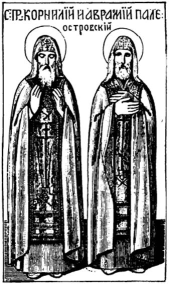
Блаженный Аврамий, как повествует о нем ученик его Ефрем180, родился в Смоленске от богатых и благочестивых родителей; родитель его пользовался уважением за услуги, оказанные в суде; и отец и бать были набожны. Они имели 12 дочерей, но ни одного сына; долго молились о даровании сына, раздавая милостыню по церквам, и наконец молитва их была услышана. Сын молитв воспитан был в страхе Божием и учении книжном, и сам с юности любил ходить в храм Божий. Родители очень желали, чтобы единственный сын их вступил в брак: но юноша отказался, чувствуя в себе влечение к иноческой жизни; к тому же родители скоро умерли; по смерти их, сын, раздав имущество монастырям, церквам и бедным, ходил в рубище, моля и Бога указать ему путь спасения, и скоро, по влечению внутреннему, поступил «в монастырь пресвятой Богородицы, что в пяти верстах от Смоленска, на месте называемом Селище»181. Здесь, облеченный в иночество, проходил он разные послушания и трудился от всей души. В 1177 г. в Смоленске совершилось чудо. Ослепленные владимирцами князья Мстислав и Ярополк Ростиславичи, братья владетельного князя смоленского, на пути в южную Россию усердно молились св. мученикам Борису и Глебу в их Смядынском монастыре и в день убиения св. Глеба (5 сент.) прозрели182. Это не могло не утешить такого раба Божия, каким был Аврамий. – Он любил переноситься мыслию к святым местам, где Господь Иисус проводил земную жизнь и запечатлел любовь свою в людям крестною смертию; в жизни же Спасителя поучался, чего можно ожидать праведным людям от мира грешного и где их защита? Тогдашний смоленский князь Роман, сын св. князя Ростислава, любил просвещение: завел в Смоленске училище, где учились не только по славянски, но даже по греческим и латинским книгам183. Бл. Аврамий ревностно читал отеческие сочинения, особенно Златоустого и Ефрема Сирина, также – жития святых: Антония, Евфимия, Саввы, Феодосия восточных, Феодосия печерского и других, стараясь по возможности усвоять душе своей мысли и чувства святых184. Как трудолюбивая пчела, собирая отвсюду душеспасительные писания, иные списывал сам, другие поручал списывать писцам. – Жизнь земная, думал и говорил он, – война; а для войны нужны оружия, нужны познания опытные: так для брани духовной нужно учиться многому у опытных св. мужей, нужно от них узнать, какое духовное оружие полезно в каком случае: – от них же можем хорошо узнать и врагов наших. Блаженный усердно трудился и по монастырю, исполняя с точностию поручаемые ему дела. – Видя добродетельную жизнь Аврамия, игумен убедил его (1198 г.) принять сан священства. В сане священства преподобный каждый день совершал служение и всегда с глубоким благоговением. Игумен, зная его обширные познания и дар слова, поручил ему должность духовника и дозволил принимать в себе желающих слушать наставления его. Это было при Мстиславе Романовиче, когда уже более 30 лет преп. Аврамий подвизался в обители185. Но вот настали для блаженного Аврамия искушения, преимущественно от своей братии. – Смотря с завистию на то, что познания и красноречие его привлекали к нему многих, как иноков, так мирян, некоторые стали выдумывать разные клеветы на преподобного и наносили ему разные огорчения; 5 лет терпел он все неприятности, не преставая назидать приходящих к нему. Наконец восстал против него и игумен. Блаженный уступил место вражде и оставил обитель.
The blessed Abraham, as his disciple Ephraim relates180, was born in Smolensk of rich and pious parents; his father was held in esteem for services rendered in the courts; both father and mother were devout. They had twelve daughters, but no son; for a long time they prayed for the gift of a son, distributing alms to the churches, and at last their prayer was heard. The son of prayer was brought up in the fear of God and in the study of books, and from his youth he himself loved to go to the church of God. His parents greatly desired that their only son should enter into marriage, but the youth refused, feeling within himself an inclination toward the monastic life; moreover, his parents soon died. After their death, the son distributed his property to monasteries, churches, and the poor, went about in rags, praying God to show him the way of salvation, and soon, following an inner impulse, he entered "the monastery of the Most Holy Theotokos, which is five versts from Smolensk, at a place called Selishche"181. There, having been clothed in the monastic habit, he fulfilled various obediences and labored with all his soul. In the year 1177, a miracle took place in Smolensk. The princes Mstislav and Yaropolk Rostislavich, blinded by the men of Vladimir, brothers of the ruling prince of Smolensk, on their way to southern Russia fervently prayed to the holy martyrs Boris and Gleb in their Smyadyn monastery, and on the day of the murder of St. Gleb (September 5) they received their sight182. This could not but console such a servant of God as Abraham was. He loved to transport himself in thought to the holy places where the Lord Jesus spent His earthly life and sealed His love for men by His death on the Cross; and in the life of the Savior he learned what righteous people may expect from the sinful world and where their protection lies. The then prince of Smolensk, Roman, son of the holy prince Rostislav, loved enlightenment: he established a school in Smolensk where they studied not only from Slavonic, but even from Greek and Latin books183. Blessed Abraham zealously read the patristic writings, especially those of Chrysostom and Ephraim the Syrian, and also the lives of the saints: Anthony, Euthymius, Sabbas, Theodosius of the East, Theodosius of the Kiev Caves, and others, striving as much as possible to assimilate into his soul the thoughts and feelings of the saints184. Like a laborious bee, gathering soul-profiting writings from everywhere, he copied some himself and had others copied by scribes. Earthly life, he thought and said, is a war; and for war one needs weapons, one needs experienced knowledge: so for spiritual warfare one must learn much from experienced holy men, one must learn from them what spiritual weapon is useful in what circumstance; from them we may also come to know our enemies well. The blessed one also labored diligently for the monastery, fulfilling with exactness the tasks entrusted to him. Seeing Abraham's virtuous life, the abbot persuaded him (in 1198) to receive the rank of priesthood. In the priestly rank, the Venerable One performed the service every day and always with deep reverence. The abbot, knowing his extensive knowledge and gift of speech, entrusted him with the office of spiritual father and permitted him to receive those who wished to hear his instructions. This was under Mstislav Romanovich, when the Venerable Abraham had already been struggling in the monastery for more than thirty years185. But then temptations began for the blessed Abraham, chiefly from his own brethren. Looking with envy upon the fact that his knowledge and eloquence attracted many, both monks and laymen, some began to invent various slanders against the Venerable One and caused him various vexations; for five years he endured all these unpleasantnesses, never ceasing to edify those who came to him. Finally, the abbot also rose up against him. The blessed one yielded place to enmity and left the monastery.
Изгнанный праведник перешел в город и стал жить в бедном «монастыре св. Креста». Здесь еще более стали стекаться к Аврамию; монастырский храм полон бывал богомольцев. Многие приносили ему жертвования, которые употреблял он в пользу монастыря и храма или же раздавал нищим; он украсил храм Божий иконами, завесами, свечами186. Сам он написал две иконы: на одной изобразил страшный суд, – на другой мытарства. На этих иконах он часто останавливал внимание свое и других, возбуждая к покаянию. – Он проводил такую строгую жизнь, что от поста и трудов был крайне сух и бледен. Вина он совсем не вкушал и воду пил в меру, – не любил дорогих одежд, а одевался в худые. Совершая сам с благоговением литургию, он не терпел того, чтобы разговаривали во время литургии, и строго внушал стоять в храме со страхом Божиим. Он усердно предлагал наставления, в храме и в кельи. «Уста его не умолкали для великих и малых людей, для рабов и свободных, для ремесленников и других, приходивших то на церковное пение, то для бесед... Когда облекался он в священнические одежды: то походил на великого Василия, украшенный такою же черною брадою, но с главою безвласою». Дух злобы много творил пакостей подвижнику Божию, домогался смутить его мечтами и привидениями и потом возбудил против него людей. На Аврамия поднялось городское духовенство, огорчавшееся тем, что он привлекал к себе множество духовных чад. Начали распускать слухи, что Аврамий то еретик, – читает «гълубинные книги»187, то живет нечисто, прикрывая темные дела наружною святостию, – наконец подняли такое волнение в городе, что знать городская явилась к епископу Игнатию и просила подвергнуть Аврамия суду. Злость против Аврамия до того была велика, что иные требовали сжечь его на костре, другие настаивали, чтобы Аврамия водить по улицам с побоями и потом бросить в воду188. – Посланы были слуги – доставить Аврамия на суд. Аврамий стоял на молитве, когда явились в обитель слуги: они схватили его и двух учеников его и повлекли с бесчестием и бранью к епископу. В это самое время один благочестивый инок, Лука Прусин, совершавший девятый час молитвы в монастыре св. архангела Михаила189, слышал с неба глас: «вот ведут угодника моего. Аврамия с учениками его на сонм, но ты не соблазняйся тем». Блаж. Лука старался образумить притеснителей праведника. «Невинен тот, говорил он, кого хулите вы. О! когда бы грехи его были на мне»! Но его не слушали. На суде епископа, совершившемся в присутствии князя и вельмож, все обвинения, какие выставляли против Аврамия, оказались клеветою. Но «безчинные попы» как волы, рыкали на Аврамия, игумены – также». Князь и вельможи говорили, что не видят они вины в Аврамие; и однако не приняли мер к обузданию людей безпокойных, так нагло оскорблявших невинность. – Епископ, для общего покоя, повелел Аврамию удалиться в Богородичный монастырь, запретив ему беседовать с людьми и совершать священнослужение.
The exiled righteous man moved into the city and began to live in the poor "monastery of the Holy Cross." Here even more people began to flock to Abraham; the monastery church was filled with worshippers. Many brought him offerings, which he used for the benefit of the monastery and the church or distributed to the poor; he adorned the church of God with icons, curtains, and candles186. He himself painted two icons: on one he depicted the Last Judgment, and on the other the toll-houses. On these icons he often fixed his own attention and that of others, arousing them to repentance. He led so strict a life that from fasting and labors he was extremely gaunt and pale. He tasted no wine at all and drank water in moderation; he did not love costly garments, but clothed himself in poor ones. Performing the Divine Liturgy himself with reverence, he could not bear that people should talk during the Divine Liturgy, and he strictly taught that one should stand in church with the fear of God. He zealously offered instruction, in church and in his cell. "His mouth was never silent for great and small people, for slaves and free men, for craftsmen and others who came either for church singing or for conversation... When he vested himself in priestly garments, he resembled the great Basil, adorned with the same black beard, but with a head without hair." The spirit of malice caused many annoyances to the ascetic of God, striving to disturb him with fantasies and apparitions, and then stirred up people against him. The city clergy rose up against Abraham, vexed that he attracted to himself a multitude of spiritual children. They began to spread rumors that Abraham was either a heretic—reading "the deep books"187—or that he lived impurely, covering dark deeds with outward holiness; finally they stirred up such turmoil in the city that the city nobles came to Bishop Ignatius and asked that Abraham be brought to trial. The malice against Abraham was so great that some demanded he be burned at the stake, others insisted that Abraham be led through the streets with beatings and then thrown into the water188. Servants were sent to bring Abraham to trial. Abraham was standing at prayer when the servants appeared at the monastery; they seized him and two of his disciples and dragged them with dishonor and abuse to the bishop. At that very time, a pious monk, Luke Prusin, who was performing the ninth hour of prayer in the monastery of the holy Archangel Michael189, heard a voice from heaven: "Behold, they are leading My servant Abraham with his disciples to the council, but do not be offended by this." Blessed Luke tried to reason with the oppressors of the righteous man. "He is innocent," he said, "whom you revile. Oh, would that his sins were upon me!" But they did not listen to him. At the bishop's trial, which took place in the presence of the prince and the nobles, all the accusations brought against Abraham proved to be slander. But "the disorderly priests bellowed like oxen at Abraham, and the abbots likewise." The prince and the nobles said that they saw no guilt in Abraham; yet they took no measures to restrain the restless people who so insolently insulted innocence. The bishop, for the sake of general peace, commanded Abraham to withdraw to the monastery of the Theotokos, forbidding him to converse with people and to perform the sacred service.
Врагам пр. Аврамия не удалось сделать более того, что праведник удален был в загородную обитель с запрещением. – Но и из запрещения, возложенного на Авраамия, вышло много последствий вредных. Люди слабые, которых удерживал он от пороков своими наставлениями, стали теперь жить по-прежнему, порочно. – Благочестивый смоленский священник Лазарь, тот самый, который после Игнатия был епископом, пришел к епископу Игнатию и сказал: город строго будет наказан, если не раскается в своей несправедливости против Аврамия. И точно скоро наступила страшная засуха в стране Смоленской. – Напрасно совершались молебствия о дожде с крестным ходом вокруг города; дождя не было. Блаженный Игнатий чувствовал, что он допустил слабость, сделав уступку проискам злобы. Он послал сказать врагам Аврамия, чтобы пришли в себя и перестали поносить Аврамия. Но те мало думали о себе. По их милости Аврамий стоял под такою строгою опалою, что мечники стерегли на дорогах и не пущали никого к Аврамию, а иных и грабили. Но один благоговейный священник, явясь к епископу, сказал: мы молились Богу и не были услышаны; не оттого ли это, что невинному Аврамию запрещено священнодействовать? Тогда епископ, призвав к себе Аврамия, разрешил ему священнослужение, просил у него прощения себе и городу и молитв его о дожде. Угодник Божий с глубоким смирением называл себя грешником, недостойным милости Божией, но обязанным исполнить волю святителя. Возвращаясь в обитель, дорогою молился он в душе о дожде и еще не дошел до обители, как сильный дождь напоил жаждущую землю. Все увидели в этом силу молитв праведника, все признали невинность Аврамия и стали высоко уважать его.
The enemies of the Venerable Abraham succeeded in nothing more than that the righteous man was removed to a suburban monastery under a prohibition. But even from the prohibition laid upon Abraham many harmful consequences ensued. Weak people, whom he had restrained from vices by his instructions, now began to live as before, in a depraved manner. The pious Smolensk priest Lazarus, the very one who after Ignatius became bishop, came to Bishop Ignatius and said: "The city will be severely punished if it does not repent of its injustice against Abraham." And indeed, a terrible drought soon came upon the land of Smolensk. In vain were molebens for rain performed with a procession around the city; there was no rain. Blessed Ignatius felt that he had shown weakness by yielding to the intrigues of malice. He sent word to the enemies of Abraham to come to their senses and cease reviling Abraham. But they thought little of themselves. Through their doing, Abraham was under such a strict ban that the guards watched the roads and allowed no one to go to Abraham, and even robbed some. But one reverent priest, appearing before the bishop, said: "We prayed to God and were not heard; is this not because the innocent Abraham has been forbidden to serve?" Then the bishop, summoning Abraham to him, lifted the prohibition from his sacred service, asked his forgiveness for himself and for the city, and asked for his prayers for rain. The man of God, with deep humility, called himself a sinner, unworthy of God's mercy, but obliged to fulfill the hierarch's will. Returning to the monastery, on the way he prayed in his soul for rain, and before he had reached the monastery, a heavy rain watered the thirsty earth. All saw in this the power of the righteous man's prayers; all acknowledged Abraham's innocence and began to hold him in high esteem.
Блаженный святитель Игнатий, построив близь города новый «монастырь в честь положения ризы Богоматери», почтительно, чрез протопопа Георгия, пригласил к себе блаж. Аврамия и поручил ему настоятельство в новой обители. Преподобный скоро украсил новый храм иконами и утварию. По-прежнему стали стекаться к преподобному бояре и простолюдины, богатые и бедные, чтобы пользоваться наставлениями его. Много было желавших поступить в Аврамиеву обитель; но преподобный принимал их весьма разборчиво и после испытаний, так что у него было только 17 братий. Преп. Аврамий пережил духовного друга своего, епископа Игнатия190. После его смерти он еще более прежнего стал готовиться к исходу из сей жизни, молился день и ночь о том, дабы не быть осужденным на суде Божием, и внушал братии помнить о смерти.
The blessed Hierarch Ignatius, having built near the city a new "monastery in honor of the Placing of the Robe of the Mother of God," respectfully, through the protopope George, invited the blessed Abraham to him and entrusted him with the abbacy of the new monastery. The Venerable One soon adorned the new church with icons and vessels. As before, boyars and commoners, rich and poor, began to flock to the Venerable One to benefit from his instructions. Many desired to enter Abraham's monastery, but the Venerable One received them very selectively and after trials, so that he had only seventeen brethren. The Venerable Abraham outlived his spiritual friend, Bishop Ignatius190. After his death, he began even more than before to prepare for his departure from this life, praying day and night that he might not be condemned at the judgment of God, and he taught the brethren to remember death.
Из учеников преп. Аврамия прославился святостию жизни блаж. Ефрем, описавший жизнь учителя своего. Какое смирение воспитал в себе ученик под руководством святого наставника, лучше всего показывают собственные слова Ефрема. В заключении жития Аврамиева бл. Ефрем пишет: «я, грешный и недостойный Ефрем, пребываю в великом нерадении и не совершил ничего доброго. Называюсь черноризцем, а по делам вовсе не таков... И при жизни преп. Аврамия я был последним из его учеников, потому что вовсе не следовал его житию: терпению, смирению, любви, молитве и другим добродетелям. Он в умилении плакал, а я веселился; он ревностно спешил на молитву, на чтение священных книг и славословие в церкви Божией; а я предавался дремоте и глубокому сну... Он не празднословил и не осуждал: а я осуждал и говорил не нужное. Он любил памятовать о страшном суде, – а я помышлял о трапезах и пирах... Он старался подражать житию святых, а я подражал суетным обычаям худых людей. Он смирял и унижал себя; а я увлекался веселием и гордостию. Он любил нищих и раздавал все нуждающимся – а я только собирал и никому не давал, побеждаемый скупостию и немилосердием... Господи Иисусе Христе! приими худую молитву грешного и недостойного раба Твоего Ефрема; помилуй меня и не удали меня от преподобных. Много согрешил я пред Тобою, прогневал Тебя более, чем кто-нибудь: но не знаю иного Бога, кроме Тебя, создавшего все... Наставь и научи меня, Господи, творить волю Твою; посли благодатную помощь рабу Твоему, да сохраняемый Тобою избавлюсь от нападений врага. Подай и всему граду и рабу Твоему руку помощи. Не допусти, Владыко, чтобы взята была душа моя из тела без покаяния; примии сие малое мое покаяние; воскреси и оживи меня грешного, молитвами Пречистой Богородицы и всех небесных сил».
Among the disciples of the Venerable Abraham, the blessed Ephraim, who described the life of his teacher, was glorified for the holiness of his life. What humility the disciple cultivated under the guidance of his holy instructor is best shown by the very words of Ephraim. At the conclusion of the Life of Abraham, the blessed Ephraim writes: “I, the sinful and unworthy Ephraim, remain in great negligence and have done nothing good. I am called a monk, but by my deeds I am not such at all... Even during the life of the Venerable Abraham, I was the last of his disciples, because I did not at all follow his way of life: his patience, humility, love, prayer, and other virtues. He wept with compunction, but I rejoiced; he zealously hastened to prayer, to the reading of the sacred books and to the glorification of God in the church of God; but I gave myself over to drowsiness and deep sleep... He did not speak idly and did not judge; but I judged and spoke what was unnecessary. He loved to remember the terrible judgment—but I thought about feasts and banquets... He strove to imitate the life of the saints, but I imitated the vain customs of evil men. He humbled and abased himself; but I was carried away by merriment and pride. He loved the poor and distributed everything to the needy—but I only gathered and gave to no one, being overcome by stinginess and unmercifulness... O Lord Jesus Christ! Accept the poor prayer of Thy sinful and unworthy servant Ephraim; have mercy on me and remove me not from the venerable ones. I have sinned much before Thee, I have angered Thee more than anyone else: but I know no other God besides Thee, Who hast created all things... Instruct and teach me, O Lord, to do Thy will; send forth gracious help to Thy servant, that, preserved by Thee, I may be delivered from the attacks of the enemy. Grant also a helping hand to the whole city and to Thy servant. Permit not, O Master, that my soul be taken from my body without repentance; accept this my small repentance; raise up and revive me, a sinner, through the prayers of the Most Pure Theotokos and all the heavenly powers.”
Так как смоленский епископ Игнатий, в последние годы свои духовный друг преп. Аврамия, по летописи в 1206 г. был послом князя своего Мстислава Романовича к в. к. Всеволоду191, а преемник его блаж. епископ Лазарь в 1224 г. уже оставил кафедру192, то блаж. кончина преп. Аврамия, подвизавшегося в иночестве до 50 лет193, последовала не позже 1220 года, тогда как блаженный ученик его Ефрем умер не прежде 1238 г.
Since Ignatius, the Bishop of Smolensk, who in his later years was the spiritual friend of the Venerable Abraham, was, according to the chronicle, in the year 1206 an envoy of his prince Mstislav Romanovich to Grand Prince Vsevolod191, and his successor, the blessed Bishop Lazarus, had already left the see in 1224192, the blessed repose of the Venerable Abraham, who labored in monasticism for up to fifty years193, followed no later than the year 1220, whereas his blessed disciple Ephraim died no earlier than 1238.
Ркп. служба «на память преп. отца нашего Аврамия смоленского чудотворца и ученика его Ефрема» молит преподобных: «молитеся Христови даровати православным людем избавление от поганских пленений... молите милостиво, да вас избавит от агарянских обстоятй194. Очевидно, эта служба составлена была под гнетом языческого татарского ига. Потому нет сомнения, что если не прежде, то в конце 13 века в Смоленске уже чтили память преп. Аврамия и ученика его195. В 1608 году смоленцы писали, что обещались они Господу и угодникам Меркурию, Аврамию и Ефрему стоять за дом Богоматери до смерти196. В каменном храме обители один придел посвящен пр. Аврамию. Но мощи его вовремя польского разгрома 1609 г., неизвестно где сокрыты197.
The manuscript service “in memory of our Venerable Father Abraham, Wonderworker of Smolensk, and his disciple Ephraim” prays to the venerable ones: “pray ye to Christ to grant deliverance from pagan captivities to the Orthodox people... pray mercifully, that He may deliver you from the assaults of the Hagarenes194.” Evidently, this service was composed under the oppression of the pagan Tatar yoke. Therefore there is no doubt that, if not earlier, then at the end of the 13th century in Smolensk the memory of the Venerable Abraham and his disciple was already venerated195. In 1608, the people of Smolensk wrote that they had promised the Lord and His saints Mercurius, Abraham, and Ephraim to stand for the house of the Mother of God unto death196. In the stone church of the monastery, one side-chapel is dedicated to the Venerable Abraham. But his relics, at the time of the Polish devastation of 1609, were hidden in an unknown place197.
Осматривая жизнь преп. Аврамия, видим в ней то труды и подвиги жестокие, то гонения и скорби от людей. Печальная картина! Ужели иному быть нельзя для праведника? «Нечестивые, говорил с скорбию страждущий Иов, возносят голос при звуке тимпанов и цитры и веселятся при гласе псалтыри. Протекают в удовольствии дни их и в минуту нисходят во гроб» (Иов.21:12,13). Но нам христианам стыдно измерять земным счастием достоинство и жизнь человека. Нам сказал Спаситель, что просторная дорога – в ад, а до неба доходят тесным путем. Нам стыдно скучать долею бедности – и алчно жаждать удовольствий земных. Мы уже слышали, где слышит богач голос Авраама: «чадо! вспомни, что ты благоденствовал в жизни своей, а Лазарь бедствовал; ныне он здесь утешается, а ты страдаешь» (Лк.16:25). Мы уже по стольким опытам знаем, как «блажен человек, который переносит искушения: прошедши испытания, он получит венец жизни, который обещал Господь любящим Его» (Иак.1:12).
Surveying the life of the Venerable Abraham, we see in it both severe labors and struggles, and also persecutions and sorrows from men. A sorrowful picture! Could it be otherwise for a righteous man? “The ungodly,” said the suffering Job with grief, “lift up their voice with the timbrel and harp, and rejoice at the sound of the psaltery. They spend their days in pleasure, and in a moment they go down to the grave” (Job 21:12,13). But it is shameful for us Christians to measure the worth and life of a man by earthly happiness. The Savior has told us that the broad road leads to hell, but that men reach heaven by the narrow path. It is shameful for us to be weary of the lot of poverty—and greedily to thirst for earthly pleasures. We have already heard where the rich man hears the voice of Abraham: “Child! remember that thou in thy lifetime receivedst thy good things, and likewise Lazarus evil things; but now he is comforted, and thou art tormented” (Lk. 16:25). We already know from so many experiences how “blessed is the man that endureth temptation: for when he is tried, he shall receive the crown of life, which the Lord hath promised to them that love Him” (Jas. 1:12).
На старинной иконе печерских чудотворцев Антониевой пещеры пр. Аврамий назван игуменом; точно с тем же саном известен он в ркп. святцах. Если так: то он в 1396 г. похоронил подле гроба Феодосиева кн. Скиригайла – Иоанна, убиенного слугами в Вышгороде198. У Кальнофойского пр. Аврамий трудолюбивый почивает в пещерной трапезе199. Это дает право положить, что пр. Аврамий последнее время жизни своей подвизался в пещере и здесь после молитвы трудился над приготовлением всего нужного для пещерной братии, чем и заслужил название трудолюбивого.
On an ancient icon of the wonderworkers of the Kiev Caves in the Anthony Cave, the Venerable Abraham is named abbot; he is known with the same rank in manuscript saints’ calendars. If this is so, then in 1396 he buried Prince Skirgaila–John, who was slain by servants in Vyshgorod198, near the tomb of Theodosius. According to Kalnofoysky, the Venerable Abraham the Industrious reposes in the refectory of the cave199. This gives the right to suppose that the Venerable Abraham spent the last period of his life laboring in the cave, and here, after prayer, he worked at preparing everything necessary for the cave brethren, for which he earned the name “Industrious.”
Дикое изуверство раскольников два раза предавало истреблению Палеостровский монастырь200; почему затруднялись определить даже время, когда подвизался основатель северной пустынной обители201. При ближайшем знакомстве с памятниками отдаленного прошлого оказывается, что хотя нет средств «определить, в каком году прибыл пр. Корнилий на Палий остров, но можно определить время подвигов его. В писцовой книге 1482 г. видим «пустынку Пречистой на Палье острове»202. В межевой записи Юрьева монастыря 1391 г. читаем: «пойдет межа водою Муромского и Палеостровского монастыря»203. – К концу XIV в. относится и первая разводная грамота самой Палеостровской пустыни204. Принимая еще во внимание то, что до преп. Лазаря, как говорит завещание его, не было на Онежском озере ни монастырей, ни церквей, приходим к убеждению, что подвиги основателя Палеостровской пустыни относились к концу XIV и к началу XV в.205. Так как Палеостровская пустынь только в конце XV в. освободилась от подчинения новгор. Вяжицкому монастырю, быв дотоле в его ведении206, то это дает право положить, что преп. Корнилий, родом псковитянин, полагал начало иноческому житию в Вяжицкой обители и отселе любовию к уединению увлечен был на Палий остров. – Любовь его к этому острову была не напрасна. Трудно найти уединение более полное и более красивое, как Палий остров. Остров – невелик; доступ к нему возможен только в одном месте. С вершины отвесной скалы его открывается панорама всего Онежского озера, во всей дикой красоте. Изредка только виднеется рыбачья лодка, еще реже барка с лесом из Повенца. Только в начале весны караван соловецких богомольцев заходит к мощам преп. Корнилия; затем круглый год не бывает в пустыни ни богомольцев, ни посетителей, – так ныне. Что же было тут в конце XIV в.? И на этом-то острове жил преп. Корнилий, как Божия птица, для подвигов поста и молитвы. Благочестивая жизнь его, не взирая на глухое и дикое уединение острова, привлекла к нему ревнителей отшельнической жизни. Преподобный построил храм Рождества Пречистой и другой, теплый, с трапезою, в честь пр. Илии207. Любитель пустынной жизни устроил общежитие, по духу любви апостольской, и храмом пр. Илии указывал пустынникам на великого пустынника и постника, питавшегося надеждою на Господа. Онежская сторона поныне бедна хлебом, – такова почва ее. Зато Палий остров мог питать пустынников своих рыбою: близкие заливы берегов твердой земли известны особым родом рыбы, сообщившим острову свое имя: палий – рыба, род форели. Сам преподобный и тогда, как занимался строением обители, часто удалялся для уединенной молитвы в пещеру, за полверсты от обители. В последнее же время своей жизни он пребывал в ней постоянно, посвящая время молитве и подвигам поста. Тяжелые вериги, бывшие на теле его, служат памятником сурового подвижничества его. Он почил в пещере – около 1420 г. и мощи его перенесены в храм обители учеником его Аврамием. Аврамий также проводил подвижническую жизнь; о нем в ркп. святцах сказано: «преп. Аврамий, игумен Рождества Богородицы палеостровский, на Онеге, новгородский чудотворец», – ныне мощи преп. Корнилия и Аврамия покоятся под спудом в храме обители их208.
The wild fanaticism of the schismatics twice subjected the Paleostrov Monastery to destruction200; for this reason, even the time when the founder of the northern hermitage201 labored was difficult to determine. Upon a closer acquaintance with the monuments of the distant past, it appears that, although there are no means “to determine in what year the Venerable Cornelius arrived on Paley Island, it is possible to determine the time of his struggles. In the cadastral book of 1482 we see ‘the hermitage of the Most Pure One on Palye Island’202. In the boundary record of the Yuriev Monastery from 1391 we read: ‘the boundary shall go by water of the Murom and Paleostrov Monasteries’203. The first deed of partition of the Paleostrov Hermitage itself also dates to the end of the 14th century204. Taking also into account that, as the testament of the Venerable Lazarus says, there were neither monasteries nor churches on Lake Onega before him, we come to the conviction that the struggles of the founder of the Paleostrov Hermitage belonged to the end of the 14th and the beginning of the 15th century205. Since the Paleostrov Hermitage only at the end of the 15th century freed itself from subordination to the Novgorod Vyazhitsky Monastery, having been under its authority until then206, this gives the right to suppose that the Venerable Cornelius, a native of Pskov, laid the beginning of his monastic life in the Vyazhitsky Monastery and from there was drawn by love for solitude to Paley Island. His love for this island was not in vain. It is difficult to find a more complete and more beautiful solitude than Paley Island. The island is small; access to it is possible only in one place. From the summit of its sheer cliff, a panorama of the entire Lake Onega opens up, in all its wild beauty. Only occasionally is a fisherman’s boat visible, even more rarely a barge with timber from Povenets. Only at the beginning of spring does a caravan of Solovki pilgrims call at the relics of the Venerable Cornelius; then for the whole year there are neither pilgrims nor visitors in the hermitage—so it is today. What was it like here at the end of the 14th century? And on this island the Venerable Cornelius lived, like a bird of God, for the struggles of fasting and prayer. His pious life, despite the remote and wild solitude of the island, attracted zealots of the hermitic life to him. The Venerable One built a church of the Nativity of the Most Pure One and another, a warm one with a refectory, in honor of the Venerable Elijah207. The lover of the desert life established a cenobitic community, according to the spirit of apostolic love, and by the church of the Venerable Elijah he pointed the hermits to the great hermit and faster, who was nourished by hope in the Lord. The Onega region is still poor in bread—such is its soil. But Paley Island could nourish its hermits with fish: the nearby bays of the mainland shores are known for a particular kind of fish, which gave the island its name: paliy—a fish, a kind of trout. The Venerable One himself, even when he was occupied with the building of the monastery, often withdrew for solitary prayer into a cave, half a verst from the monastery. But in the last period of his life he remained in it constantly, devoting his time to prayer and the struggles of fasting. The heavy chains that were on his body serve as a memorial of his severe asceticism. He reposed in the cave—around the year 1420—and his relics were translated to the church of the monastery by his disciple Abraham. Abraham also led an ascetic life; about him it is said in the manuscript saints’ calendars: “the Venerable Abraham, abbot of the Nativity of the Theotokos of Paleostrov, on the Onega, wonderworker of Novgorod.”—Now the relics of the Venerable Cornelius and Abraham lie hidden beneath a bushel in the church of their monastery208.
Отчизна и род праведницы209 были в провинции оптиматов, где были города: Никомидия, Еленополь, Пренет, Парфенополь. Родители ее были Константин и Анастасия, христиане искренние; с нежного возраста дочь воспитана была ими в благочестии. Сочетавшись с супругом Захариею, она уговорила его жить с нею, как с сестрою. Так она никогда не знала удовольствий брачного ложа и осталась девственницею. Люди Периклова века были образованы, очень образованы в искусствах и в философии, а гнусная гетера отнимала супруга у супруги и заражала болезнями дорогую юность. Только вера Христова не только защищает супружескую верность, но и обращает супругов в девственников чистых210. Феоклета усердно занималась чтением душеполезных сочинений и особенно священных наставлений о жизни приличной женам211. Она твердо заучила желание апостола, предъявленное женам. Желаю, писал св. чтобы жены в приличном одеянии, со стыдливостию и целомудрием, украшали себя не плетением волос, не золотом, не жемчугом, не многоценною одеждою, но добрыми делами, как прилично женам, посвящающим себя благочестию (1Тим.2:9, 10). Деньги, истрачиваемые другими на наряды, она назначала для лучшего употребления. Средства свои, труды, силы посвящала она преимущественно на пользу ближних: всякий день, так или иначе, помогала она бедным. Родина ее доставляла ей много случаев к тому. Провинция оптиматов (вельможей) называлась так в насмешку. Это была страна самая бедная; жители ее, говорит император Константин, – деньщики офицеров и высших придворных чиновников; они же погонщики при походах войска; при бедности они грубы212. В такой-то стране совершала подвиги милосердия св. Феоклета. «Стыдись, говорил Квинтилиан, склоняться пред бедным, а скорее отвращайся от него с презрением». Плавт писал: «для чего ты даешь подаяние бедному? Твоя помощь только удлиняет страдания его. Он беден? Ну, пусть и пропадает с голоду». Вот как рассуждала философия языческая! Она то от гордости не уделяла бедняку и ласкового взгляда; то при недостатке самоотверженной любви отчаивалась в возможности успешно лечить раны бедного. Как неизмеримо высока пред тем любовь христианская! Оптиыаты с их разнородными нуждами находят в ней неисчерпаемый родник утешений! Что нужно для того, чтобы подвиг сострадательной любви был вполне христианским, вполне угодным Господу и потому сильным благодатию? Нужно, чтобы совершался он в духе смирения, без поисков за славою человеческою и без самоуслаждения самолюбивого (Мф.6:2); нужно, чтобы совершался он веселою душою, с радостию (2Kop.10:7; Рим.12:8, Мк.12:42); нужно, чтобы не ослабляли его ни неблагодарность человеческая, подчас и грубая, ни собственное желание покоя (Гал.6:9; 2Сол.3:13). Так подвизалась Феоклета. Она не утомлялась трудами служения другим, не оскорблялась непризнательностию людскою; каждому помогала с любовию и радостию; не дозволяла себе и тешиться своими делами, славя за все Господа и твердо помня о своей греховности. И вот она была неистощимым родником живительных утешений для несчастных оптиматов. Подвигами самоотверженной любви она столько возвысилась в жизни духовной, что, когда приблизилось время кончины ее, пригласив знакомых, объявила о дне смерти своей и частных обстоятельствах ее будущих. По смерти ее, мощи прославились множеством чудес, к утешению страждущих. Подвиги догробного милосердия ее совершались при императоре Феофиле, и потому кончину ее надобно отнесть к 840 г.213
The fatherland and lineage of the Righteous one209 were in the province of the Optimates, where there were cities: Nicomedia, Helenopolis, Prenet, Parthenopolis. Her parents were Constantine and Anastasia, sincere Christians; from a tender age their daughter was raised by them in piety. Having been joined in marriage to her husband Zacharias, she persuaded him to live with her as with a sister. Thus she never knew the pleasures of the marriage bed and remained a virgin. The people of the age of Pericles were educated, highly educated in the arts and in philosophy, yet a vile hetaera would take a husband from his wife and infect precious youth with diseases. Only the faith of Christ not only protects marital fidelity, but also turns spouses into pure virgins210. Theoctista diligently occupied herself with reading soul-beneficial writings and especially the sacred instructions concerning a life becoming to wives211. She firmly committed to memory the desire of the Apostle set forth for wives. "I desire," wrote the saint, "that women adorn themselves in modest apparel, with shamefacedness and sobriety; not with braided hair, or gold, or pearls, or costly array; but (which becometh women professing godliness) with good works" (1 Tim. 2:9, 10). The money that others spent on finery she designated for a better use. Her means, her labors, her strength she devoted chiefly to the benefit of her neighbors: every day, in one way or another, she helped the poor. Her homeland provided her with many opportunities for this. The province of the Optimates (the nobles) was so called in mockery. It was a very poor country; its inhabitants, says the Emperor Constantine, were orderlies to officers and higher court officials; they were also drivers during military campaigns; in their poverty they were coarse212. In such a country did St. Theoctista perform her deeds of mercy. "Be ashamed," said Quintilian, "to bow before a poor man, rather turn away from him with contempt." Plautus wrote: "Why do you give alms to the poor? Your help only prolongs his suffering. He is poor? Well, let him then perish of hunger." Such was the reasoning of pagan philosophy! At one time, out of pride, it would not grant even a kindly glance to the poor man; at another, lacking self-sacrificing love, it despaired of the possibility of successfully healing the wounds of the poor. How immeasurably exalted before this is Christian love! The Optimates, with their manifold needs, find in it an inexhaustible spring of consolation! What is needed for a deed of compassionate love to be fully Christian, fully pleasing to the Lord, and therefore powerful through grace? It is necessary that it be performed in a spirit of humility, without seeking human glory and without self-complacent self-love (Mt. 6:2); it is necessary that it be performed with a cheerful soul, with joy (2 Cor. 9:7; Rom. 12:8; Mk. 12:42); it is necessary that it be weakened neither by human ingratitude, at times coarse, nor by one's own desire for ease (Gal. 6:9; 2 Thess. 3:13). Thus did Theoctista labor. She did not grow weary in the labors of serving others, nor was she offended by human ingratitude; she helped everyone with love and joy; she did not allow herself to take delight in her own deeds, glorifying the Lord for all things and firmly remembering her own sinfulness. And thus she was an inexhaustible fountain of life-giving consolation for the unfortunate Optimates. Through the deeds of self-sacrificing love she so ascended in the spiritual life that, when the time of her end drew near, having summoned her acquaintances, she announced the day of her death and the particular circumstances of her future end. After her death, her relics were glorified by a multitude of miracles, for the consolation of the suffering. The deeds of her pre-mortem mercy were performed during the reign of the Emperor Theophilus, and therefore her end must be assigned to the year 840 A.D.213
В тот же день св. ап. Фаддея, из 70. О нем см. 4 января и 16 августа (в соборе 70 и в сказании о Нерукотв. образе).
On the same day, St. Apostle Thaddeus, of the Seventy. Concerning him, see January 4 and August 16 (in the Synaxis of the Seventy and in the account of the Image Not-Made-by-Hands).
В жизнеописателе виден современник. «Острижеся, говорит он об Аврамие, яко мнози ведят, св. Богородицы монастырь к востоку, Селище нарицают е». О том что Аврамий пресвитер каждый день совершал службу, говорит он так: «якоже и мнози ведят его бывша и до самое смерти». О сладости устных бесед его говорит: «сему мнози суть послуси». – Впрочем житие написано не прежде 1237 г. уже при монголах; потому что говорит: «поганых нашествия испроверзи... измаильтеские языки разсыпли». – Сокращение древнего жизнеописания в четьи мин. и в прологе 2 авг. Евфремово описание изд. в Собеседнике 1858 г. со списка 1558 г. с множеством явных пропусков и ошибок писца, да и не все издано, без послесловия Евфремова. – В синод. б. ркп. XV в. № 555. К сожалению в писании блаж. Евфрема видно излишнее усилие говорить искусственно и многоречиво, а не сказано даже того, когда скончался пр. Аврамий.
In the hagiographer one sees a contemporary. "He was tonsured," he says of Abrahamius, "as many know, in the monastery of the Most Holy Theotokos to the east, which they call Selishche." Concerning the fact that Abrahamius the presbyter performed the service every day, he speaks thus: "as many also know that he was so until his very death." Concerning the sweetness of his oral discourses he says: "of this many are witnesses." – However, the Life was written no earlier than 1237, already under the Mongols; because it says: "the invasions of the pagans have overthrown... scatter the Ishmaelite peoples." – An abridgement of the ancient Life is in the Cheti-Minei and in the Prologue for August 2. Ephraem's description was published in Sobesednik in 1858 from a copy of 1558, with many obvious omissions and errors of the scribe, and moreover not all was published, lacking Ephraem's afterword. – In the Synodal Library, a manuscript of the 15th century, No. 555. Unfortunately, in the writing of the blessed Ephraem one sees an excessive effort to speak artificially and verbosely, and it does not even state when the Venerable Abrahamius reposed.
Богородичный Успенский монастырь на Селище был на рославской дороге, там, где ныне село Богородичное; он существовал в 1522 г. (Карам. 7. пр. 238. Опис. мон. 497).
The Dormition Monastery of the Theotokos at Selishche was on the Roslavl road, where the village of Bogorodichnoye now stands; it existed in 1522 (Karamzin, vol. 7, note 238; Description of Monasteries, p. 497).
Жизнеописатель не только здесь указывает на «жития и словеса святых», но он делает потом выписки из жития пр. Саввы, из книги златая цепь, из повести духовного отца сыну. «Достойно же есть зде помянути слово, еже от жития пр. Саввы, о патр. иерусалимстем Илии... Пишет бо в златых чепех вся вселенныя святый отед... И есть подобно помянутой повесть отца духовнаго к сыну».
The hagiographer not only here points to "the Lives and discourses of the saints," but he later makes extracts from the Life of the Venerable Sabbas, from the book The Golden Chain, from the Discourse of a Spiritual Father to His Son. "It is fitting here to recall the word from the Life of the Venerable Sabbas concerning the Patriarch of Jerusalem, Elias... For the holy fathers of the whole world write in the Golden Chains... And there is a similar discourse of a spiritual father to his son."
В Смоленске после Ростислава († 1167 г.) были князьями Роман († 1170 г.) и Давид Ростиславичи, Давид, постригшийся в Смядынском монастыре († 1197 г.) Мстислав Романович до 1214 г., с 1214 Владимир Рюрикович (Новг. IV, 20), с 1223 г. Мстислав Давидович † 1230 г. (Переслав. летоп. 76. 104). Преп. Аврамий иночествовал 50 лет; звание духовника и наставника поручено ему «при княжении великаго и христолзобив. князя Мстислава смоленскаго», а скончался не позже 1220 г. (См. пр. 129–132). След. духовником он был при еп. Мстиславе Романовиче.
In Smolensk, after Rostislav († 1167), the princes were Roman († 1170) and David Rostislavich; David, who was tonsured in the Smyadyn Monastery († 1197); Mstislav Romanovich until 1214; from 1214, Vladimir Rurikovich (Novgorod IV, p. 20); from 1223, Mstislav Davidovich, † 1230 (Pereyaslavl Chronicle, pp. 76, 104). The Venerable Abrahamius lived as a monk for 50 years; the office of spiritual father and teacher was entrusted to him "during the reign of the great and Christ-loving Prince Mstislav of Smolensk," and he reposed no later than 1220 (see notes 129–132). Consequently, he was a spiritual father under Bishop Mstislav Romanovich.
По лучшим спискам: «гълубинныя», или „г’лубинные“. – поскольку же звук ъ в древнем говоре заменял о напр. в слове, въсток: то здесь разумеется таинственная, голубинная книга, о которой сложен известный стих о голубинной книге, иначе разумеется своеобразное учение о творении мира.
According to the best copies: "g'lubinnyya" or "g'lubinnye." Since the sound ъ in the ancient dialect replaced o, for example in the word "vъstok," here is meant the mysterious, dove book, concerning which the well-known verse about the Dove Book was composed; otherwise, a peculiar teaching about the creation of the world is understood.
«Никтоже, аще бы не глаголя на блаженнаго Аврамия в граде, събравшися вси от мала до велика весь град на нь: инии глаголют заточити, а инии к стене ту пригвоздити и зажщи, а другии потопити и проведше сквозь град».
"No one, if not speaking against the blessed Abrahamius in the city, having gathered together all from small to great, the whole city was against him: some said to exile him, and others to nail him to the wall and set him on fire, and others to drown him, having led him through the city."
Каменный храм архангела Михаила построен быль Романом Ростиславичем, скончавшемся в 1180 г. о без сомнения с того же времени основалась при храме обитель, которая известна была в 1486 г. и после того (ак. зап. Росс. 1. № 87. Ак. ист. 2, 318. Опис. мон. 496 497.).. „Монастырь св. креста» находился на покровской горе, на правой стороне Днепра, где ныне кладбищный храм «в Садрах». Свед. о мон. 495. 496).
The stone church of the Archangel Michael was built by Roman Rostislavich, who reposed in 1180, and without doubt a monastery was founded at the church from that same time, which was known in 1486 and afterwards (Acts of Western Russia, vol. 1, No. 87; Acts of History, vol. 2, p. 318; Description of Monasteries, pp. 496, 497). The "Monastery of the Holy Cross" was located on Pokrovskaya Hill, on the right bank of the Dnieper, where the cemetery church "in Sadry" now stands. Information on Monasteries, pp. 495, 496.
Мало же по той любви пожив епископ, преставися к Богу, по правде рещися – от юности потрудився и до самые седины великаго священства, тако преставися к Богу святитель великий Игнатий града Смоленска, яко же в преставленьи его мнози поведают о нем, глаголющет яко велик свет сниде на ня с небесе, яко страх нападе на вся, и тако взыде радуяся на небеса, свершив течение добре о Бозеи. По ркп. святцам: «святый Игнатий епископ смоленский», по другому списку: «чудотворец преставися ген. 29».
Having lived but a little while after that love, the bishop reposed unto God; truly it may be said – having labored from youth even to the very grey hairs of the great priesthood, thus reposed unto God the great Hierarch Ignatius of the city of Smolensk; as at his repose many relate concerning him, saying that a great light descended upon them from heaven, so that fear fell upon all, and thus he ascended rejoicing to the heavens, having finished his course well in God. According to manuscript menologia: "St. Ignatius, Bishop of Smolensk"; according to another copy: "the Wonderworker reposed on January 29."
Троицк. лет. у Карам. 3, пр. 118. В собр. л. 1, 178. 7, 114. До одному списку епископ назван Михаилом, а по другим – Михаил был игуменом Отроча монастыря; последнее верно, но не первое.
Trinity Chronicle in Karamzin, vol. 3, note 118; in Collection of Chronicles, vol. 1, p. 178; vol. 7, p. 114. According to one copy, the bishop is named Michael, but according to others, Michael was the abbot of the Otroch Monastery; the latter is correct, but not the former.
Послание Симова – в памятн. XII в. и у Карам. 3. пр. 171. В послании Симеон говорит о созданной им в Суздале соборной церкви; а она освящена сент. 8-го 6733 (1224 г.). Собр. л. 7, 133. О епископе Лазаре блаж. Евфрем говорит «истиною рещи, яко поборник и пастух Христовы церкви и словесных овец, сей бо Бога ради оставил епископью свою и за много обидение святых церквей, иже обидят властители, отнимающе имения и злая без правды творяще и обидяще вдовицы и сироты». – Эти слова, сличаемые с словами Симона, дают видеть, что блажен. Лазарь оставил кафедру в 1224 г., вследствие неудовольствий за обиду церквей.
The Epistle of Simon – in Monuments of the 12th Century and in Karamzin, vol. 3, note 171. In his epistle, Simeon speaks of the cathedral church he built in Suzdal; and it was consecrated on September 8, 6733 (1224). Collection of Chronicles, vol. 7, p. 133. Concerning Bishop Lazarus, the blessed Ephraem says: "truly to speak, he was a champion and shepherd of Christ's Church and of His rational sheep; for he, for God's sake, left his bishopric because of the great oppression of the holy churches, which the rulers oppress, taking away possessions and doing evil without justice, and oppressing widows and orphans." – These words, compared with the words of Simon, show that the blessed Lazarus left his see in 1224, as a result of displeasure over the injustice done to the churches.
В печ. прологе: «пожив 50 лет от рождения». Это – ошибка, вследствие не правильно понятой рукописи. В ркп. житии: „и пребысть блаженный Аврамий подвизаяси лет 50, от юности до конца живота своего“. – Св. Димитрий: Ему же (Господу) до 50 лет неленостно во иночестве поработа“.
In the printed Prologue: "having lived 50 years from birth." This is an error, resulting from a misunderstanding of the manuscript. In the manuscript Life: "and the blessed Abrahamius remained, laboring for 50 years, from youth to the end of his life." St. Demetrius: "To Him (the Lord) he labored without sloth in monasticism for 50 years."
Ркп. святцы: «преп. отец Аврамий архим. преставился в л. 6800 мес. авг. в 21 д. Преп. Евфрем архимандрит ученик св. Аврамия».
Manuscript menologia: "The Venerable Father Abrahamius, Archimandrite, reposed in the year 6800, on the 21st day of the month of August. The Venerable Ephraem, Archimandrite, disciple of St. Abrahamius."
У Лохвицкого грамота вяжицкого игумена 1478 г.: «а кто почнет с ними (иноками Далеостр. п.) супоровати: ино его звати нашею пизовницею, а суд его предо мною».
In Lokhvitsky, a charter of the Vyazhitsky abbot from 1478: "and if anyone begins to dispute with them (the monks of the Dalneostrovsky Monastery): then let him be summoned to our pizovnitsa, and his judgment is before me."
У Неволина опись 1582 г. «монастырь общий, церкви рож. Богородицы и пр. Илии», последняя с трапезою, «построены прежним игуменом Корнилием», кроме игум. Ионы два иеромонаха и 49 братьев. Пятины, прилож. стр. 166. Спб. 1953 г. сл. ист. акт. V, 258.
In Nevolin, an inventory of 1582: "a coenobitic monastery, the churches of the Nativity of the Theotokos and of the Prophet Elijah," the latter with a refectory, "built by the former abbot Cornelius"; besides Abbot Jonah, two hieromonks and 49 brethren. Pyatiny, appendix, p. 166. St. Petersburg, 1953. Cf. Historical Acts V, 258.
О ней Синаксарь греческой Минеи августа 21, и краткий менолог Банажа. В месяцеслове Вершинского нет и помину об этой святой.
Concerning her, the Synaxarion of the Greek Menaion for August 21, and the brief Menologion of Banaž. In the monthly calendar of Vershinsky there is no mention at all of this saint.
Наприм. еще св. Дионисий александрийский († 266 г.) писал: «о женах, находящихся в очищении, позволительно ли им в таком состоянии входить в дом Божий, излишним почитаю исследовать, ибо не думаю, чтобы они, аще суть верные и благочестивые, находясь в таком состоянии, дерзнули или приступити к святой трапезе или коснуться тела и крови Христовых. Ибо и жена имевшая дванадесятное кровотечение, ради исцеления прикоснулась не Ему, но токмо воскрилия. Молитися, в каком бы состоянии кто ни был и как бы ни был расположен, поминати Господа и просити помощи не возбраняю есть. Но приступати к тому, еже есть святая святых, да запретится не совсем чистому душою и телом». Книга правил стр. 303. Спб. 1839 г.
For example, St. Dionysius of Alexandria († 266 A.D.) also wrote: "Concerning women in a state of purification, whether it is permissible for them in such a condition to enter the house of God, I consider it superfluous to inquire; for I do not think that they, if they are faithful and pious, being in such a state, would dare either to approach the holy table or to touch the Body and Blood of Christ. For even the woman with the issue of blood for twelve years, for the sake of healing, touched not Him, but only the hem of His garment. To pray, in whatever state one may be and however disposed, to remember the Lord and to ask for help, is not forbidden. But to approach that which is the Holy of Holies, let it be forbidden to one not entirely pure in soul and body." Book of Canons, p. 303. St. Petersburg, 1839.
Краткий Менологе под 21 августа «воспоминание о св. Феоклете чудотворице. Она жила при ненавистнике Феофиле; с детства воспитанная в благочестии, занималась размышлением о слове Божием, подаянием милостыней и трудом служа нуждам бедных. Она предсказала и день смерти своей. Сколько и какие чудеса совершены ею, трудно обнять в кратком слове».
The Brief Menologion under August 21: "The commemoration of St. Theocleta the Wonderworker. She lived under the hater Theophilus; from childhood raised in piety, she occupied herself with meditation on the word of God, the giving of alms, and labor in service to the needs of the poor. She also foretold the day of her death. How many and what kind of miracles were performed by her, it is difficult to encompass in a brief account."