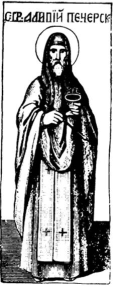
Блаженный Алипий учился иконописанию у греческих иконописцев, в 1083 г. украшавших великую печерскую церковь св. иконами141. Когда окончено было стенное писание в печерской церкви: Алипий, усердный труженик в св. деле, пострижен был в иночество пр. Никоном. Превосходный иконописец писал иконы игумену и братии даром. Если слышал, что где либо в церкви обветшали иконы: он брал их к себе и поправлял, но не требовал платы. Никогда не видади его без дела. Только божественная служба, которой не оставлял он ни для какого дела, отвлекала его от иконописания; а большую часть ночи проводил он в молитве и пении псалмов. Если случалось ему получать плату за свой труд: то часть употреблял на покупку материалов для иконописания, другую – на милостыню нищим, а третью – на свои нужды. За свои великие добродетели и чистую жизнь, по одобрению игумена, он возведен был в сан священства. Присутствие в нем Божией благодати обнаруживалось чудесными делами.
Blessed Alypius learned iconography from the Greek iconographers who adorned the great Kiev Caves church with holy icons in 1083141. When the wall painting in the Kiev Caves church was finished, Alypius, a zealous laborer in the holy work, was tonsured into monasticism by the Venerable Nikon. An excellent iconographer, he painted icons for the abbot and the brethren without payment. If he heard that icons in any church had become dilapidated, he would take them to himself and restore them, but he demanded no payment. He was never seen idle. Only the divine service, which he never abandoned for any work, drew him away from iconography; and he spent the greater part of the night in prayer and the singing of psalms. If it happened that he received payment for his labor, he would use one part for the purchase of materials for iconography, another for alms to the poor, and a third for his own needs. For his great virtues and pure life, with the approval of the abbot, he was raised to the rank of the priesthood. The presence of God's grace in him was manifested through miraculous deeds.
Один киевлянин страдал проказою и ему не помогали никакие лекарства. – По совету других, но без собственного убеждения, пришел он в Печерский монастырь за помощию. Игумен приказал напоить его водою из колодезя святого Феодосия, а главу намочить тою же водою. За неверие свое больной закипел смрадными струпами, так что стали бегать его. С горестию воротился он домой и смрадом струпов приведен был в сознание грехов своих. Снова пошел он в монастырь и искренно исповедал пред Алипием грехи свои, как и свою скорбь. Алипий красками, приготовленными для св. икон, покрыл все струпы его. Затем привел в церковь, приобщил тела и крови Спасителя, обмыл струпы его водою, которая принесена была для литургии. И все струпы его спали, – он весь стал здоровым.
A certain man of Kiev was suffering from leprosy, and no medicines helped him. On the advice of others, but without his own conviction, he came to the Kiev Caves Monastery for help. The abbot ordered him to be given water from the well of St. Theodosius to drink, and to have his head moistened with the same water. Because of his unbelief, the sick man broke out in foul-smelling sores, so that people began to flee from him. With grief he returned home, and the stench of the sores brought him to awareness of his sins. He went again to the monastery and sincerely confessed his sins before Alypius, as well as his sorrow. Alypius covered all his sores with paints prepared for holy icons. Then he brought him into the church, gave him communion of the Body and Blood of the Savior, and washed his sores with water that had been brought for the Divine Liturgy. And all his sores fell off, and he became completely healthy.
«Набожный киевлянин, построив храм, захотел для его украшения приобресть икону деисус142 и еще несколько других. Он поручил двум печерским инокам заказать Алипию иконы, какой бы цены тот ни потребовал и дал им доски и часть денег. Иноки два раза брали у него деньги и после того, но Алипию не говорили ни слова. Долго ждав икон, киевлянин настойчиво потребовал их у иноков и те отвечали, что Алипий, взяв деньги, не хочет писать икон. Тот явился с жалобой к игумену. Призванный Алипий отвечал, что ни слова не слыхал о поручении и не видал денег. Послали за иноками и дсками. Дски оказались с превосходными ликами святых». Игумен Никон выгнал корыстолюбивых и лживых иноков из монастыря. Те оказались такими дурными людьми, что, прикрывая бесчестный свой поступок, разгласили по Киеву, что будто иконы написаны ими и заказавший не заплатил им ничего за труд их, а за их обиду их же выгнали из обители. Господь оправдал и прославил правду. В пожар, церковь, в которую поставлены были иконы, сгорела, а те иконы найдены целыми. Кн. Владимир Мономах, слышавший о прежнем происшествии, услышав о новом, прибыл на место и видел чудо Божие. Он благоговейно взял себе одну икону – икону Богоматери и отослал ее в Ростов, для храма, построенного им. «Она и поныне тут стоит, говорит при том благоговейный Поликарп. Я видел ее. При мне случилось в Ростове, что церковь та упала, а икона осталась невредимою. Потом она внесена была в деревянную церковь; церковь сгорела, а икона осталась без вреда, так что нет на ней и следа пожара»143.
«A devout man of Kiev, having built a church, wished to acquire for its adornment a Deisis icon142 and several others besides. He entrusted two Kiev Caves monks with commissioning icons from Alypius, whatever price he might demand, and gave them the panels and part of the money. The monks took money from him twice, and afterwards as well, but said not a word to Alypius. Having waited long for the icons, the man of Kiev insistently demanded them from the monks, and they answered that Alypius, having taken the money, did not wish to paint the icons. The man came with a complaint to the abbot. Alypius, being summoned, answered that he had heard not a word about the commission and had not seen the money. They sent for the monks and the panels. The panels turned out to have excellent faces of the saints.» Abbot Nikon expelled the covetous and lying monks from the monastery. They proved to be such wicked men that, to cover up their dishonorable deed, they spread a rumor throughout Kiev that the icons had supposedly been painted by them and that the one who commissioned them had paid them nothing for their labor, and that for their offense they themselves had been driven out of the monastery. The Lord justified and glorified the truth. In a fire, the church in which the icons had been placed burned down, but those icons were found intact. Prince Vladimir Monomakh, who had heard of the earlier incident, upon hearing of this new one, arrived at the place and saw the miracle of God. He reverently took one icon for himself—an icon of the Mother of God—and sent it to Rostov, for the church he had built. «It stands there to this day,» says the devout Polycarp in this regard. «I have seen it. In my time it happened in Rostov that that church collapsed, but the icon remained unharmed. Afterwards it was brought into a wooden church; the church burned down, but the icon remained unharmed, so that there is not even a trace of fire upon it.»143
Другой благочестивый человек заказал Алипию написать икону Богоматери к празднику Успения. Алипий захворал и не мог взяться за кисть. Тот не раз приходил за иконою. Алипий отвечал: «положись на Бога, он все выполнит». Заказавший пришел накануне праздника, а икона не была готова. «Зачем ты не сказал мне о твоей болезни?» говорил с досадою заказавший икону. «Я поручил бы написать икону другому иконописцу. А теперь ее не будет к празднику Успения». Преподобный отвечал: «не гневайся, брат! От небрежности ли моей случилось так? Но для Бога достаточно одного слова, и икона пресв. Девы будет написана. Вот я отхожу из сего света, – так открыл мне Господь, – но Господь утешит тебя». Когда тот вышел с скорбию: к Алипию входит прекрасный юноша и начинает писать икону. Алипий и сам подумал, что верно разгневанный господин прислал другого иконописца. Но спустя три часа икона была готова и писавший спросил: «не допущено ли ошибки в иконе»? Алипий отвечал: «хорошо написано, Бог помог тебе». К вечеру писавший скрылся и с иконою. Заказавший всю ночь не спал от слез, горюя о том, что к празднику не готова праздничная икона. Встав к утрени, он первый пришел в храм и поражен был изумлением: дорогая для него икона – готова, стоит на месте. Боголюбивый муж пришел потом к игумену и рассказал все случившееся. Вместе пошли они к Алипию и застали его уже умирающим. Однако игумен спросил его: кто бы это написал образ? «Был у меня, сказал Алипий, юноша, но думаю, что это ангел: так скоро написал и исчез; впрочем вот он теперь предстоит предо мною». И с этими словами предал Богу дух свой. Так рассказывает блаж. Поликарп. По ркп. святцам преп. Алипий почил 17 августа и это согласно с повествованием Поликарпа. Сильверст Коссов в 1635 г. писал, что память преп. Алипия празднуется 17 Августа144. Полагают, что преподобный дожил до 1114 г.; мощи его открыто почивают в Антониевых пещерах145. У правой руки его три первые перста сложены совершенно ровно, а два последние пригнуты в ладони: обличение новым суеверам! Одна икона преп. Алипия, известная под именем: «предста царица одесную тебе», ныне стоит в иконостасе московского Успенского собора одеяние небесной царицы отделано роскошно; раскраска похожа на мозаику146. Икона Божией Матери, перенесенная Мономахом в Ростов, ныне стоит в иконостасе каменного ростовского собора. Она потемнела не столько от свечного дыма, сколько от дыхания прикладывающихся к ней: ее носят в дальние места в крестном ходе147.
Another pious man commissioned Alypius to paint an icon of the Mother of God for the feast of the Dormition. Alypius fell ill and could not take up the brush. The man came repeatedly for the icon. Alypius answered: "Trust in God; He will accomplish everything." The one who had commissioned it came on the eve of the feast, but the icon was not ready. "Why did you not tell me of your illness?" said the one who had commissioned the icon with vexation. "I would have entrusted the painting of the icon to another iconographer. But now it will not be ready for the feast of the Dormition." The Venerable One answered: "Do not be angry, brother! Did this happen through my negligence? But for God, one word is enough, and the icon of the Most Holy Virgin will be painted. Behold, I am departing from this world—so the Lord has revealed to me—but the Lord will comfort you." When the man went out in sorrow, a beautiful youth entered to Alypius and began to paint the icon. Alypius himself thought that the angry master had surely sent another iconographer. But after three hours the icon was finished, and the painter asked: "Is there any mistake in the icon?" Alypius answered: "It is well painted; God has helped you." Toward evening the painter disappeared, together with the icon. The one who had commissioned it did not sleep all night from weeping, grieving that the festal icon was not ready for the feast. Rising for Matins, he was the first to enter the church and was struck with amazement: his precious icon was ready, standing in its place. The God-loving man then went to the abbot and told him all that had happened. Together they went to Alypius and found him already dying. Nevertheless, the abbot asked him: "Who could have painted this image?" "A youth was with me," said Alypius, "but I think it was an angel: he painted so quickly and disappeared; however, behold, he now stands before me." And with these words he surrendered his spirit to God. So relates Blessed Polycarp. According to the manuscript menologia, the Venerable Alypius reposed on August 17, and this agrees with the account of Polycarp. Sylvester Kossov wrote in 1635 that the memory of the Venerable Alypius is celebrated on August 17144. It is believed that the Venerable One lived until 1114; his relics lie openly in the Anthony Caves145. At his right hand, the first three fingers are folded perfectly evenly, while the last two are bent into the palm: a refutation to the new superstitious! One icon of the Venerable Alypius, known under the name "The Queen stood at Thy right hand," now stands in the iconostasis of the Moscow Dormition Cathedral; the vesture of the Queen of Heaven is richly adorned; the coloring resembles mosaic146. The Icon of the Mother of God, brought by Monomakh to Rostov, now stands in the iconostasis of the stone Rostov Cathedral. It has darkened not so much from candle smoke as from the breath of those who venerate it; it is carried to distant places in procession147.