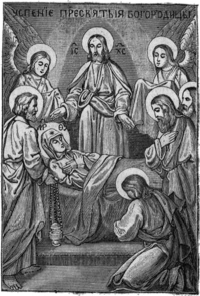
Высокий жребий преблагословенной Девы в деле благодатного смотрения Божия о спасении мира соделал всю ее жизнь дивною и поучительною. «Чудно рождение твое, восклицает Церковь, чуден образ воспитания, чудно, дивно и неизъяснимо для смертных все в тебе, Богоневеста»!
The exalted lot of the most blessed Virgin in the work of the gracious dispensation of God for the salvation of the world made her whole life wondrous and instructive. "Wondrous is thy birth," exclaims the Church, "wondrous is the manner of thy upbringing; wondrous, marvelous, and ineffable for mortals is everything in thee, O Bride of God!"
После того, как Спаситель, со креста утешая и ублажая пречистую Матерь Свою, вместо Себя усыновил ей возлюбленного ученика своего Иоанна Богослова, разделявшего с нею страдания ее, ученик взял ее к себе (Ин.19:28–27) и не оставлял до ее успения, служа ей как матери своей. Пребывание ее было в дому св. Иоанна Богослова, в Иерусалиме на Сионе.
After the Savior, from the cross comforting and blessing His most pure Mother, adopted for her, in His stead, His beloved disciple John the Theologian, who shared her sufferings with her, the disciple took her to himself (Jn. 19:26–27) and did not leave her until her dormition, serving her as his own mother. Her abode was in the house of St. John the Theologian, in Jerusalem on Zion.
Уже при жизни ее начали сбываться над нею пророческие ее слова о себе: се бо отныне ублажат мя вси роди. С распространением славы Иисуса Христа, яко Сына Божия, блажима была и пречистая Его Богоматерь, жившая на земле. По вознесении Иисуса Христа на небо она пребывала с учениками в молитве (Деян.1:14), и прияла дары Святого Духа в день Пятидесятницы.
Already during her life, her prophetic words about herself began to be fulfilled: For behold, from henceforth all generations shall call me blessed. With the spread of the glory of Jesus Christ as the Son of God, His most pure Mother, who lived on earth, was also blessed. After the ascension of Jesus Christ into heaven, she remained with the disciples in prayer (Acts 1:14), and received the gifts of the Holy Spirit on the day of Pentecost.
Для апостолов и всех верующих она была утешением и назиданием. Беседуя с ними, она передала им все слова, которые слагала в сердце своем; поведала о чудесных событиях благовещения, бессеменного зачатия и нетленного от нее рождества Христова, Его младенчества» и всей земной жизни. Подобно апостолам, насаждала и утверждала христианскую Церковь своим присутствием, словом и молитвами. Благоговение апостолов к Богоматери было чрезвычайно. По приятии Св. Духа они пребывали в Иерусалиме около 10 лет, служа спасению иудеев и желая чаще видеть и слышать от нее божественные слова. Имея ее, яко наместницу Христа Господа Своего, взирая на ее святое лице и слушая ее слова, ученики Христовы исполнялись высокой радости. Многие из новопросвещенных верою даже приходили из дальних стран в Иерусалим, чтобы видеть и слышать Матерь Христа Бога.
For the apostles and all the faithful, she was a comfort and edification. Conversing with them, she imparted to them all the words which she had laid up in her heart; she told of the wondrous events of the Annunciation, the seedless conception and the incorrupt birth of Christ from her, His infancy, and all His earthly life. Like the apostles, she planted and established the Christian Church by her presence, word, and prayers. The reverence of the apostles for the Mother of God was extraordinary. After receiving the Holy Spirit, they remained in Jerusalem for about ten years, serving the salvation of the Jews and desiring to see and hear divine words from her more often. Having her as the representative of Christ the Lord, gazing upon her holy face and hearing her words, the disciples of Christ were filled with great joy. Many of the newly enlightened by faith even came from distant lands to Jerusalem to see and hear the Mother of Christ God.
Во время гонения, воздвигнутого Иродом на юную Церковь Христову (Деян.12:1–3), пресв. Дева Мария с св. Иоанном Богословом, около 43 года по Р. X. удалилась в Ефес, в котором проповедать Евангелие выпал жребий Богослову. Впрочем, по сказанию предания, она была не только в Ефесе, но и в Кипре у св. Лазаря, там епископствовавшего, и также на горе Афонской, о которой, как говорит Стефан Святогорец, Богоматерь пророчески сказала: «сие место буде мне в жребий, данный мне от Сына и Бога моего. Аз буду заступница месту сему, и Богу о нем ходатайница».
During the persecution raised by Herod against the young Church of Christ (Acts 12:1–3), the Most Holy Virgin Mary, with St. John the Theologian, withdrew to Ephesus about the year 43 A.D., to which the lot had fallen for the Theologian to preach the Gospel. However, according to the account of tradition, she was not only in Ephesus, but also in Cyprus with St. Lazarus, who was bishop there, and also on Mount Athos, about which, as Stephen the Hagiorite says, the Mother of God prophetically said: "This place shall be for me a lot, given to me by my Son and my God. I will be the intercessor for this place, and a mediator to God for it."
Равно и благоговение древних христиан к Божией Матери было так велико, что они предали все о жизни ее, что только могли заметить из ее св. слов и деяний, и даже передали нам о ее внешнем виде. По сказанию св. Амвросия Медиоланского, основанному на словах Дионисия Ареопагита и Игнатия Богоносца, пресвятая Богородица, живя на земле, «была Дева не только плотию, но и духом, в сердце смиренна, в словах богомудренна, в глаголании не скора, в чтении писаний неутомима, в трудах бодра, в беседах целомудренна, никого не обидела, всем желала добра, не гнушалась убогого, никому не посмеялась, и вид ее был образцом внутреннего ее совершенства. Все дни свои она обратила в пост: сну предавалась только по требованию нужды, но и тогда, как тело ее покоилось, духом она бодрствовала, повторяя во сне читанное, или размышляя о приведении в исполнение предположенных намерений, или предначертывая новые. Из дому выходила только в церковь, и то в сопутствии родных. Впрочем, она хотя и являлась вне дома своего в сопровождении других, но лучшим стражем для себя была она сама; другие охраняли только тело ее, а нравы свои она блюла сама». А св. Епифаний Кипрский, и за ним Никифор Ксанфопул, жившие – первый в IV, а второй в XIV веке, упоминают на основании преданий, до них дошедших, даже о внешнем виде Девы Марии. «Вид лица ея был аки вид зерна пшенична, власа желтаго, очес острых, в них же зеницы подобны бяху масличнаго плода виду; брови ея наклонены и изрядно черны; нос не краток; уста, аки цвет розы; лице не кругло, ни остро, но мало продолжено; руце и персты продолговать; одежды ея бяху просты, якоже и ныне святый покров пресвятые главы ея являет».
Likewise, the reverence of the ancient Christians for the Mother of God was so great that they handed down everything about her life that they could observe from her holy words and deeds, and even transmitted to us her external appearance. According to the account of St. Ambrose of Milan, based on the words of Dionysius the Areopagite and Ignatius the God-bearer, the Most Holy Theotokos, living on earth, "was a Virgin not only in flesh, but also in spirit; humble in heart, God-wise in words, not swift in speech, unwearied in reading the Scriptures, alert in labors, chaste in conversation; she offended no one, wished well to all, did not disdain the poor, mocked no one, and her appearance was an image of her inner perfection. All her days she turned to fasting; she gave herself to sleep only as necessity demanded, but even then, while her body rested, she was vigilant in spirit, repeating in sleep what she had read, or reflecting on the fulfillment of intended purposes, or devising new ones. She left the house only for church, and then in the company of relatives. However, although she appeared outside her home accompanied by others, she herself was her own best guard; others guarded only her body, but she herself kept her morals." And St. Epiphanius of Cyprus, and after him Nicephorus Callistus Xanthopoulos, the former living in the fourth, the latter in the fourteenth century, mention, on the basis of traditions that have come down to them, even the external appearance of the Virgin Mary. "The appearance of her face was like the appearance of a grain of wheat, her hair yellow, her eyes sharp, with pupils like the appearance of the fruit of the olive; her eyebrows were arched and fairly black; her nose not short; her lips like the flower of a rose; her face neither round nor sharp, but somewhat elongated; her hands and fingers were long; her garments were simple, as even now the holy veil of her most holy head shows."
Ко времени своего блаженного Успения пресв. Дева Мария опять прибыла в Иерусалим. Слава Ея, как Богоматери, распространилась уже по земле и вооружила против нее многих завистливых и гордых иудеев, которые покушались на ее жизнь: но Бог хранил ее от врагов.
By the time of her blessed Dormition, the Most Holy Virgin Mary had again arrived in Jerusalem. Her glory as the Mother of God had already spread throughout the earth and armed against her many envious and proud Jews, who attempted her life; but God preserved her from her enemies.
Живя у св. Иоанна Богослова, в Иерусалиме, пресв. Дева пребывала в непрестанной молитве, постоянно имела божественное желание созерцать Сына своего, седящего одесную Бога. Часто посещала места, которые Сын ее и Бог освятил стопами пречистых ног Своих. Горя непрестанно любовию к Богу, св. Дева часто молилась и воздыхала о своем переселении в блаженные обители Сына Своего и Бога нашего. И как предвозвещено ей было о воплощении от Нея Сына Божия: так, когда приблизилась она к своему отшествию от земной юдоли, Господь открыл ей о ее блаженном успении.
Living with St. John the Theologian in Jerusalem, the Most Holy Virgin remained in unceasing prayer, constantly having the divine desire to behold her Son sitting at the right hand of God. She often visited the places which her Son and God had sanctified by the steps of His most pure feet. Burning unceasingly with love for God, the holy Virgin often prayed and sighed for her translation to the blessed abodes of her Son and our God. And as it was foretold to her concerning the incarnation of the Son of God from her, so, when she drew near to her departure from the earthly vale, the Lord revealed to her her blessed dormition.
Обстоятельства, предшествовавшие успению Богоматери и сопровождавшие оное, известны в православ. Церкви от времен апостольских. В I веке о успении Богоматери писал Дионисий Ареопагит. Bo II веке сказание о телесном переселении пресв. Девы Марии на небо находится между сочинениями Мелитона, епископа Сардийского. В IV веке на предание об успении Богоматери указывает св. Епифаний Кипрский. В У веке Ювеналий, патриарх Иерусалимский, о успении Богородицы говорил греческой царице Пульхерии: «хотя в священном писании нет повествования об обстоятельствах кончины ее, впрочем мы знаем об них из древнейшего и вернейшего предания». Это предание с подробностию собрано и изложено в церковной истории Никифора Каллиста в ΧΙV веке.
The circumstances preceding and accompanying the Dormition of the Mother of God have been known in the Orthodox Church from apostolic times. In the first century, Dionysius the Areopagite wrote about the Dormition of the Mother of God. In the second century, a narrative of the bodily translation of the Most Holy Virgin Mary to heaven is found among the works of Melito, Bishop of Sardis. In the fourth century, St. Epiphanius of Cyprus refers to the tradition of the Dormition of the Mother of God. In the fifth century, Juvenal, Patriarch of Jerusalem, spoke of the Dormition of the Mother of God to the Greek empress Pulcheria: "Although there is no narrative in Holy Scripture of the circumstances of her death, nevertheless we know of them from the most ancient and most reliable tradition." This tradition was collected in detail and set forth in the Church History of Nicephorus Callistus in the fourteenth century.
Пресв. Дева Мария окончила свою земную жизнь в летах преклонных. Из древнейших сказаний о успении Богоматери, собранных Никифором, известно следующее. Успение Божией Матери сопровождалось многими чудесными знамениями, которые все величественно изображает Церковь в своих священных песнях. Ко времени преставления Богоматери Апостолы восхищены были на облаках из разных стран и поставлены в Иерусалиме. В самый день успения ее явился в сретение душе ее в необычайном свете, осиявшем храмину отходившей, Господь с Ангелами и Святыми. Подобно облачному столпу, осенявшему и охранявшему древле народ богоизбранный (Исх.14:19–20), облачный круг в день погребения также осенял и охранял святейшее тело богоизбранной отроковицы и матери, несомое апостолами для погребения.
The Most Holy Virgin Mary ended her earthly life at an advanced age. From the most ancient accounts of the Dormition of the Mother of God, collected by Nicephorus, the following is known. The Dormition of the Mother of God was accompanied by many miraculous signs, all of which the Church majestically depicts in her sacred hymns. At the time of the repose of the Mother of God, the Apostles were caught up on clouds from various lands and set down in Jerusalem. On the very day of her dormition, the Lord appeared with Angels and Saints to meet her soul in an extraordinary light that illumined the chamber of the departing one. Like the pillar of cloud that of old overshadowed and protected the God-chosen people (Ex. 14:19–20), a circle of cloud on the day of burial also overshadowed and protected the most holy body of the God-chosen Maiden and Mother, borne by the apostles for burial.
По завещанию пресв. Девы, святое тело ее положено было в Гефсиманской веси, находившейся на горе Елеонской, близ Иерусалима, между гробами праведных ее родителей и ее обручника. На третий день по смерти, когда ап. Фома, небывший при погребении св. Девы, пришел в Гефсиманию и открыл гроб ее, пречистого тела ее уже не было в гробнице. Господь переселил пренепорочную Матерь Свою в небесные обители. Как Сам Он воскрес в третий день и в сороковый вознесся на небо с пречистою Своею плотию: так и Матерь Его, в третий день по смерти ее, дивным смотрением Божиим с телом взята на небеса, согласно с предсказанием пророка Давида: воскресни Господи в покой Твой, Ты и кивот святыни Твоея (Пс.131:8). После успения Богоматери, когда апостолы во время трапезы своей беседовали о необретении тела Богоматери во гробе, они увидели пресв. Деву на небесах, «живу, со множеством ангелов стоящую и неизреченною славою осияваемую, яже и рече к ним: радуйтеся». Место погребения пресв. Девы доселе служит предметом благоговения и поклонения не только для христиан и даже для неверных.
According to the testament of the Most Holy Virgin, her holy body was laid in the village of Gethsemane, situated on the Mount of Olives, near Jerusalem, between the tombs of her righteous parents and her betrothed. On the third day after her death, when the Apostle Thomas, who had not been present at the burial of the holy Virgin, came to Gethsemane and opened her tomb, her most pure body was no longer in the sepulchre. The Lord translated His all-blameless Mother to the heavenly abodes. As He Himself rose on the third day and on the fortieth ascended into heaven with His most pure flesh, so His Mother, on the third day after her death, by the wondrous dispensation of God, was taken up to heaven with her body, according to the prophecy of the Prophet David: Arise, O Lord, into Thy rest, Thou and the ark of Thy holiness (Ps. 131:8). After the Dormition of the Mother of God, when the apostles during their meal were conversing about the non-finding of the body of the Mother of God in the tomb, they saw the Most Holy Virgin in heaven, "alive, standing with a multitude of angels and illumined with ineffable glory, who said to them: Rejoice." The place of the burial of the Most Holy Virgin has to this day been an object of reverence and veneration not only for Christians, but even for unbelievers.
Преставление Божией Матери называется Успением. Ибо она, «как бы сном на малое время смертию уснула, вскоре от нее, яко от сна воспрянула, и мертвость гробную, как сонное от очес дремание оттрясши, узрела бессмертную во свете лица Господня жизнь и славу».
The Repose of the Mother of God is called the Dormition. For she, "as if by sleep, for a short time slept in death, soon from it, as from sleep, she arose, and having shaken off the deadness of the tomb like the slumber of sleep from the eyes, she beheld the immortal life and glory in the light of the Lord's face."
В честь и память Успения Божией Матери установлен Церковию праздник с древних времен христианства. Об нем упоминается в IV веке в сочинениях Иеронима и Августина. Иероним свидетельствует, что на гробе Богоматери построен был храм, и хотя не упоминает, кем этот храм построен, но по настоящим преданиям христиан палестинских он сооружен был равноапостольною царицею Еленою. В V веке Анатолий Константинопольский, в VIII св. Иоанн Дамаскин и Косма Маиумский, в IX Феофан Никейский – написали каноны на день Успения, поемые ныне Церковью в этот день.
In honor and memory of the Dormition of the Mother of God, a feast was established by the Church from ancient times of Christianity. Mention is made of it in the fourth century in the works of Jerome and Augustine. Jerome testifies that a church was built over the tomb of the Mother of God, and although he does not mention by whom this church was built, according to the present traditions of Palestinian Christians, it was built by the Equal-to-the-Apostles Empress Helen. In the fifth century, Anatolius of Constantinople, in the eighth, St. John of Damascus and Cosmas of Maiuma, in the ninth, Theophanes of Nicaea wrote canons for the day of the Dormition, which are now sung by the Church on this day.
Праздник Успения есть великий дванадесятый, вселенский. Иероним называет праздник Успения торжеством, несравненным с празднествами Святых, «ибо в оный, говорит он, Спаситель всех Сам во всей Своей славе с радостию сретил и вселил Матерь Свою с Собою». После пятого вселенского Собора, исповедавшего человеческое естество Иисуса Христа, по желанию императора Маврикия (582–603), одержавшего знаменитую победу над персами в 15 день августа, день Успения Богоматери сделался торжественнейшим в прав. Церкви.
The Feast of the Dormition is a great twelfth, universal feast. Jerome calls the feast of the Dormition a triumph incomparable with the feasts of the Saints, "for on it," he says, "the Savior of all Himself, in all His glory, met with joy and placed His Mother with Himself." After the Fifth Ecumenical Council, which confessed the human nature of Jesus Christ, at the desire of the Emperor Maurice (582–603), who won a famous victory over the Persians on the 15th day of August, the day of the Dormition of the Mother of God became the most solemn in the Orthodox Church.
В песнях канона на день Успения называется он знаменитым, торжественным и божественным праздником. Кроме сего Успение Богоматери в прав. Церкви восхваляется особенным акафистом в честь этого события.
In the hymns of the canon for the day of the Dormition, it is called a renowned, solemn, and divine feast. Besides this, the Dormition of the Mother of God is praised in the Orthodox Church by a special akathist in honor of this event.
Праздник Успения Божией Матери, в пределах предпразднества и попразднества, продолжается 10 дней с 14 по 25 августа.
The Feast of the Dormition of the Mother of God, within the limits of the forefeast and afterfeast, continues for 10 days, from the 14th to the 25th of August.
Значение изображения Софии – премудрости Божией объясняют словами притчей Соломоновых: Премудрость созда себе дом, и утверди столпов седмь (IX, 1). Здесь под словом премудрость или по-гречески София, разумеют Сына Божия, как говорит и ап. Павел: ми проповедуем Христа, Божию Силу и Божию Премудрость (1Kop.1:24). Согласно с изъяснением апостола, понимают премудрость св. Игнатий Богоносец, св. Амвросий Медиоланский, Августин. Итак, Божия Премудрость есть Господь, создавший Себе дом. Этот дом в смысле обширнейшем знаменует Церковь Божию, как изъясняет и Афанасий Великий, или частнее – Матерь Божию, яко одушевленный храм Спасов. Под словом: дом разумеют Божию Матерь св. Игнатий Богоносец и прав. Церковь, которая в паремиях и песнопениях своих, в богородичные праздники, называет Матерь Божию домом, свитком, горою, вратами, и прочими прообразовательнопророческими именами. Посему слова: Премудрость созда Себе дом, означают пресв. Деву Марию, чрез которую Бог для спасения ыира облевся естеством человеческим и стал видим; – Слово плоть бысть, и вселися в ны, и видехом славу Его, славу, яко единороднаго от Отца (Ин.1:14).
The meaning of the icon of Sophia – the Wisdom of God – is explained by the words of the Proverbs of Solomon: Wisdom hath built herself a house, and hath established seven pillars (Prov. 9:1). Here by the word Wisdom, or in Greek Sophia, is understood the Son of God, as the Apostle Paul also says: we preach Christ, the Power of God and the Wisdom of God (1 Cor. 1:24). In accordance with the Apostle's explanation, St. Ignatius the God-bearer, St. Ambrose of Milan, and Augustine understand Wisdom. Thus, the Wisdom of God is the Lord, who built Himself a house. This house, in the broadest sense, signifies the Church of God, as Athanasius the Great also explains, or more particularly – the Mother of God, as the animate temple of the Savior. By the word house St. Ignatius the God-bearer and the Orthodox Church understand the Mother of God, which in its paroemias and hymns, on the feasts of the Theotokos, calls the Mother of God a house, a scroll, a mountain, a gate, and other typological-prophetic names. Therefore, the words: Wisdom hath built herself a house signify the Most Holy Virgin Mary, through whom God, for the salvation of the world, clothed Himself with human nature and became visible; – the Word became flesh, and dwelt among us, and we beheld His glory, the glory as of the Only-begotten from the Father (Jn. 1:14).
Пророчественное изображение воплотившейся Софии – Премудрости – Божией послужило образцом для иконописных ее изображений, какие были в древле построенных храмах в Византии – в храме Юстиниановом, в Киеве, Новгороде и в других местах. Иконы св. Софии – Премудрости Божией, византийская и киевская, изображают соединение Церкви небесной и видимой, чрез воплощение Сына Божия, – Премудрости Божией, представляют дом или храм, и в нем стоящую Богоматерь в хитоне, с покрывалом на голове, под сению, поддерживаемой семью столпами. К этому числу приспособлены многие предметы иконы. Руки и длани Богоматери начертаны распростертыми, ее стопы утвержденными на серповидной луне (Ап.12:1). При персях Божией Матери на ее деснице изображается Предвечный Младенец, десницею своею благословляющий, а в шуйце имеющий державу. Над сению начертаны слова: Премудрость созда Себе дом, и утверди столпов седмь. Над домом вверху изображены в сиянии лучей Бог Отец, имеющий в левой руке державу, а правою благословляющий, из уст Его исходят слова: Аз утвердих столпы ея; и окруженный лучами – Дух Святой. По обеим сторонам изображения Бога Отца и Св. Духа представлены Церковь небесная: – предстоят в облаках седмь архангелов: с правой – Михаил с пламенным мечем в руке; Уриил держит молнию, вниз опущенную; Рафаил – алавастр мира; с левой Гавриил с лилиею; Селафиил с четками; Иегудиил с царским венцем; Варахиил с пуком цветов на белом плате. На ступенях дома по обеим сторонам пред Божиею Матерью представлена Церковь Божия на земле; изображены ветхозаветные тайнозрители Воплотившегося – праотцы и пророки: Моисей со скрижалями; Аарон в митре, яко великий архиерей, с прозябшим жезлом; Давид в царской мантии, с ковчегом завета; Исаия с хартией, на которой написано: се Дева во чреве зачнет и родит Сына; Иеремия со свитком; Иезекииль, держащий врата затворенные; Даниил с камнем.
The prophetic image of the incarnate Sophia – Wisdom – of God served as a model for its iconographic depictions, which were in ancient churches built in Byzantium – in the Church of Justinian, in Kiev, Novgorod, and in other places. The icons of St. Sophia – the Wisdom of God, the Byzantine and the Kievan, depict the union of the heavenly and visible Church through the incarnation of the Son of God – the Wisdom of God; they represent a house or temple, and in it the standing Mother of God in a chiton, with a veil on her head, under a canopy supported by seven pillars. Many objects of the icon are adapted to this number. The hands and palms of the Mother of God are depicted as outstretched, her feet set upon a crescent moon (Rev. 12:1). At the breast of the Mother of God, on her right hand, is depicted the Pre-Eternal Child, blessing with His right hand, and holding an orb in His left. Above the canopy are inscribed the words: Wisdom hath built herself a house, and hath established seven pillars. Above the house, at the top, are depicted in a radiance of rays God the Father, holding an orb in His left hand and blessing with His right; from His mouth issue the words: I have established her pillars; and surrounded by rays – the Holy Spirit. On both sides of the depiction of God the Father and the Holy Spirit, the heavenly Church is represented: seven archangels stand in the clouds: on the right – Michael with a flaming sword in his hand; Uriel holding a lightning bolt, pointed downward; Raphael – an alabaster vessel of myrrh; on the left – Gabriel with a lily; Selaphiel with prayer beads; Jehudiel with a royal crown; Barachiel with a bunch of flowers on a white cloth. On the steps of the house, on both sides before the Mother of God, the Church of God on earth is represented; depicted are the Old Testament visionaries of the Incarnate One – the forefathers and prophets: Moses with the tablets; Aaron in a mitre, as the great high priest, with a blossoming rod; David in a royal mantle, with the Ark of the Covenant; Isaiah with a scroll on which is written: Behold, a virgin shall conceive in the womb and bear a Son; Jeremiah with a scroll; Ezekiel, holding closed gates; Daniel with a stone.
Впрочем не все изображения Софии – Премудрости Божией одинаковы; например – новгородская икона есть род Деисуса; на ней изображен Вседержитель в царской одежде или далматике, с огненными крылами, яко велика совета Ангел (Ис.9:6), на огненном престоле о семи столпах. Окрест Вседержителя голубое небо со звездами, по сторонам Богоматерь с иконою Иисуса Христа и св. Иоанн Креститель, как ближайшие свидетели воплощенного Слова Божия. Сверху изображения Спаситель в огненном круге и надпись: Премудрость Божия; еще выше опять звездное голубое небо, и на золотом престоле евангелие, пред которым по три ангела с каждой стороны преклоняют колена.
However, not all depictions of Sophia – the Wisdom of God – are identical; for example, the Novgorod icon is a kind of Deesis; on it is depicted the Pantocrator in royal vestments or a dalmatic, with fiery wings, as the Angel of the Great Council (Is. 9:6), on a fiery throne with seven pillars. Around the Pantocrator is a blue sky with stars; on the sides are the Mother of God with an icon of Jesus Christ and St. John the Baptist, as the closest witnesses of the incarnate Word of God. Above is a depiction of the Savior in a fiery circle and the inscription: Wisdom of God; still higher, again a starry blue sky, and on a golden throne the Gospel, before which three angels on each side bend their knees.
Однакож все изображения Софии выражают одну главную мысль: Матерь Божию, послужившую воплощению Сына Божия, или воплотившуюся от нее Премудрость Божию. Поэтому празднование Софии – Премудрости Божией совершается прав. Церковию в богородичные дни, напр., в Киеве в день Рождества Богородицы; в Новгороде, Вологде, Тобольске, в Москве и в других местах в праздник Успения Богоматери.
Nevertheless, all depictions of Sophia express one main idea: the Mother of God, who served the incarnation of the Son of God, or the Wisdom of God incarnate from her. Therefore, the feast of Sophia – the Wisdom of God – is celebrated by the Orthodox Church on Theotokian days, for example, in Kiev on the day of the Nativity of the Theotokos; in Novgorod, Vologda, Tobolsk, Moscow, and in other places on the Feast of the Dormition of the Mother of God.
Икона Успения Богоматери, именуемая Семигородная, писана преподобным Дионисием Глушицким в ХУ веке и, вероятно, отшельниками из его обители принесена в непроходимые леса, на расстояние 20 верст от его обители, за реку Двиницу. Там построена была приходская церковь для Семигородной волости. В страшную чуму, опустошавшую вологодские волости в ХV веке, все жители этой волости вымерли. Около полутораста лет церковь стояла в запустении. В 1593 г. одной старице Юлиании из рода Белоозерских дворян, долго болевшей и уже три года лежавшей в расслаблении в московском Новодевичьем монастыре, было видение. Ей явилась Богоматерь и обещала исцеление, если она пойдет в Семигородную пустынь и возобновит ее. Дав обет исполнить повеленное, старица получила исцеление. Пришедши на место обители, она нашла здесь одну только церковь, и в ней Дионисиеву икону Успения Богоматери. Она построила келию, а около 1602 г. обитель я до самой кончины жила тут с несколькими сестрами в общежитии. В конце XVII века сия обитель обращена в мужскую. В 1810 г. прочищена на 13½ верст лесом широкая дорога для проезжающих к чудотворной Семигородной иконе Богоматери, от коей многие совершившиеся чудеса и исцеления записаны в особенной монастырской книге.
The Icon of the Dormition of the Mother of God, called Semigrod, was painted by the Venerable Dionysius of Glushitsa in the 15th century and, in all likelihood, was brought by hermits from his monastery into the impenetrable forests, to a distance of 20 versts from his monastery, beyond the River Dvinitsa. There a parish church was built for the Semigrod volost. During the terrible plague that devastated the Vologda volosts in the 15th century, all the inhabitants of this volost died out. For about a century and a half the church stood in desolation. In 1593, a certain nun Juliana, of the family of the Beloozero nobles, who had been long ill and had lain in paralysis for three years in the Moscow Novodevichy Convent, had a vision. The Mother of God appeared to her and promised healing if she would go to the Semigrod hermitage and restore it. Having made a vow to fulfill what was commanded, the nun received healing. Having come to the place of the monastery, she found here only one church, and in it the Dionysian icon of the Dormition of the Mother of God. She built a cell, and around 1602 the monastery, and lived there until her death with several sisters in community. At the end of the 17th century this monastery was turned into a men's monastery. In 1810, a wide road was cleared through the forest for 13½ versts for travelers to the wonderworking Semigrod Icon of the Mother of God, from which many miracles and healings that took place are recorded in a special monastery book.
Алимпий, постриженец Никона, игумена Сергиева монастыря, будучи весьма искусен в иконописании, писал иконы для игумена и для братии. Если слышал, что где либо в церквах есть обветшавшие иконы: он брал их к себе и поправлял, не требуя платы. Никогда не видали его без дела. Только божественная служба, которой он не опускал ни для какого дела, отвлекала его от иконописания, а большую часть ночи проводил он в молитве и пении. Если случалось ему получить плату за свой труд: то часть употреблял на расходы для иконописного дела, другую – на милостыню нищим, а третью – на свои нужды. За свои великие добродетели и чистую жизнь, по одобрению игумена, он рукоположен был во священника, Присутствие в нем божественной благодати обнаружилось даром чудотворений. Как лекарством он помазывал своими вапами струпы больных и исцелял.
Alypius, a tonsured monk of Nikon, the abbot of the Sergius Monastery, being very skilled in iconography, painted icons for the abbot and for the brethren. If he heard that anywhere in churches there were dilapidated icons, he would take them to himself and repair them, asking no payment. He was never seen without work. Only the divine service, which he never missed for any work, distracted him from iconography, and he spent the greater part of the night in prayer and singing. If it happened that he received payment for his labor, he would use one part for expenses for iconographic work, another for alms to the poor, and a third for his own needs. For his great virtues and pure life, with the approval of the abbot, he was ordained a priest. The presence of divine grace in him was manifested by the gift of wonderworking. As with a medicine, he would anoint the sores of the sick with his paints and heal them.
Один христолюбивый мирянин хотел сделать для церкви Деисус и две местных иконы. Он поручил двум инокам печерским договориться о сем деле с Алимпием. Иноки несколько раз брали деньги с него, но удерживали их у себя, не говоря Алимпию, и наконец объявили, что Алимпий не хочет писать икон. Заказывавший пошел жаловаться к игумену. Алимпий говорил, что он и не слыхал о сем поручении. Послали за досками, на которых должны быть написаны иконы. Они явились написанными чудным образом. Благодать божественная вскоре прославила сии иконы. Случился пожар, сгорела и церковь, где были сии иконы, но они обретены совершенно невредимыми. Князь Владимир Мономах был свидетелем сего чуда. Одну икону, изображающую пресв. Богородицу, он взял и перенес в Ростов, где она прославилась чудесами и доселе пребывает в ростовском Успенском соборе, известная под именем Владимирской.
One Christ-loving layman wished to have a Deesis and two local icons made for a church. He commissioned two monks of the Kiev Caves to negotiate this matter with Alypius. The monks several times took money from him, but kept it for themselves, not telling Alypius, and finally declared that Alypius did not want to paint the icons. The one who had commissioned them went to complain to the abbot. Alypius said that he had not even heard of this commission. They sent for the boards on which the icons were to be painted. They appeared painted in a miraculous manner. Divine grace soon glorified these icons. A fire occurred, and the church where these icons were burned down, but they were found completely unharmed. Prince Vladimir Monomakh was a witness to this miracle. One icon, depicting the Most Holy Theotokos, he took and transferred to Rostov, where it became famous for miracles and to this day remains in the Rostov Dormition Cathedral, known under the name of the Vladimir of Rostov.
Псковопечерская икона Успения Богородицы явлена в 1473 году, исцелением слепой жены, и пребывает в Псковопечерском монастыре, основанном при заштатном городе Печерах, в 56 верстах от Пскова. От явления иконы над древнею пещерою и город и монастырь и икона получили свое имя. Явленная икона прославилась многими чудесами, в память коих установлен праздник 15-го августа. В 1521 году, псковскими купцами Василием и Феодором пожертвована в Печерский монастырь новая икона Успения Богородицы-умиление, прославившаяся с 1524 года чудотворениями. Но обе иконы прославились особливо во время нашествия на Псков и на Печерский монастырь Стефана Батория, короля польского, в 1581 году. В 27 день августа этого года, по сказанию псковской летописи, некоему благочестивому мужу Дорофею было явление и откровение от Матери Божией о будущем нападении на город со стороны угла крепости при Покровском монастыре. Почему Печерского монастыря игумен Тихон, еще до осады вызванный в город с чудотворными печерскою и умиления Богородицы иконами Печерского монастыря, начал, по повелению царя и епископа, совершать крестные хождения с сими иконами на помянутое место. В соборном храме Пскова совершали ежедневно моления о прав. царе, его детях и всех прав. христианах, чтобы Господь отвратил праведный свой гнев. 6-го сентября игумен Тихон и протоиерей Лука, по совещанию с прочими духовными, но утру благовестом созвали граждан в собор и совершили оттуда опять крестный ход к покровскому углу с чудотворною Печерскою иконою Богородицы, с мощами св. благоверного князя псковского Гавриила и с древнею печерскою хоругвию. Весь народ сопровождал их с плачем и рыданием, не чая ни откуда более помощи и защиты, кроме Бога. 7-го и 8-го чисел сентября были усиленные и непрестанные приступы Батория к стенам Пскова для покорения его. Наконец и горестная весть о проломе в стенах и о занятии врагами стен Пскова достигла до множества народа, собравшегося в соборе на беспрерывное моление. Страх овладел сердцами всех; поднимали руки к небу с рыданиями; старые, жены и дети наполнили церковь воплем и, как говорит летопись, весь пол облили слезами, моля о защищении города и о внушении защитникам его – доброго совета и мужества. В это самое время, как все устремились на защиту проломанного места и крепко отражали врагов, пришло на мысль защитникам поставить большое псковское орудие у церкви Покрова Богородицы и употребить на поражение неприятелей. Это распоряжение поколебало ряды осаждавших и заставило их отступить. Король, увидев бегущих воинов своих, немедленно выслал на помощь им свежие, лучшие свои войска, с решительным повелением не отступать от стен до совершенного взятия города. Битва возобновилась и защитники опять начали ослабевать от сильного напора неприятелей. Тогда воеводы послали в собор к духовным сказать, чтобы они принесли из собора мощи св. благоверного князя псковского Гавриила с чудотворными иконами Богородицы и другими. Немедленно подняты были святыни; а наперед их прибыли в пролому три инока Печерского монастыря и громко воскликнули к воеводам и воинам: «не бойтесь, братия! станем крепко, устремимся дружно на литовскую силу! Богородица к нам грядет с милостию и заступлением и с помощию всех Святых»! Этот нечаянный, утешительный и ободрительный голос оживил ослабевших. Все с радостию повторяли: «Богородица к нам грядет, умрем вкупе за Христову веру и за прав. царя и не предадим града». Вслед за сим появились духовные, неся мощи св. благоверного князя Гавриила и чудотворные иконы. Началось молебствие пред самым проломом в виду защитников и врагов и продолжалось шествием к Покровской церкви. Это благоговейное зрелище вдохнуло защитникам такое мужество, что все они единодушно устремились в пролом на неприятелей; самые женщины вмешивались в сражение. Сражение с обеих сторон было жаркое, долговременное и упорное. При наступающей уже ночи 8 сентября неприятели все вытеснены были из пролома, сбиты со стен и прогнаны в беспорядке в поле, где на бегу поражаемы были уже народом, а иные взяты в плен. Чтобы по крайней мере каким-нибудь завоеванием ободрить унылую рать свою и потешить корыстолюбивых наемников, Баторий хотел взять в 56 верстах находящийся от Пскова Печерский монастырь. Там, кроме иноков, для защиты было только 200 или 300 воинов, и они мужественно отразили два приступа и взяли в плен трех знатных сановников. С того времени многочисленная рать неприятельская сражалась более всего с холодом.
The Pskovopocherskaya Icon of the Dormition of the Theotokos was revealed in 1473 through the healing of a blind woman, and it remains in the Pskovopochersky Monastery, founded near the outlying town of Pechery, 56 versts from Pskov. From the appearance of the icon above the ancient cave, both the town, the monastery, and the icon received their name. The revealed icon was glorified by many miracles, in memory of which a feast was established on August 15. In 1521, the Pskov merchants Basil and Theodore donated to the Pechery Monastery a new icon of the Dormition of the Theotokos—of Tenderness—which began to be glorified by miracles from 1524. But both icons were especially glorified during the invasion of Pskov and the Pechery Monastery by Stephen Báthory, King of Poland, in 1581. On August 27 of that year, according to the account of the Pskov chronicle, a certain pious man, Dorotheus, received a vision and revelation from the Mother of God concerning a future attack on the city from the corner of the fortress near the Pokrovsky Monastery. Therefore, Tikhon, abbot of the Pechery Monastery—who had already been summoned to the city before the siege, together with the wonderworking Pechery and Tenderness icons of the Theotokos from the Pechery Monastery—began, by command of the Tsar and the bishop, to make cross-processions with these icons to the aforesaid place. In the cathedral church of Pskov, daily prayers were offered for the right-believing Tsar, his children, and all right-believing Christians, that the Lord might turn away His righteous wrath. On September 6, Abbot Tikhon and Protoiereus Luke, after consultation with the other clergy, summoned the citizens to the cathedral by the morning bell and from there again made a cross-procession to the Pokrovsky corner with the wonderworking Pechery Icon of the Theotokos, with the relics of St. Right-believing Prince Gabriel of Pskov, and with the ancient Pechery banner. All the people accompanied them with weeping and lamentation, hoping for help and protection from nowhere else but from God. On September 7 and 8, there were intensified and unceasing assaults by Báthory against the walls of Pskov in order to subdue it. Finally, the grievous news of a breach in the walls and of the enemy’s occupation of the walls of Pskov reached the multitude of people gathered in the cathedral for unceasing prayer. Fear seized the hearts of all; they raised their hands to heaven with sobbing; the old, women, and children filled the church with cries, and, as the chronicle says, drenched the entire floor with tears, praying for the protection of the city and for the inspiration of its defenders—good counsel and courage. At that very time, as all rushed to defend the breached place and stoutly repelled the enemy, it occurred to the defenders to place a large Pskov cannon near the Church of the Protection of the Theotokos and to use it against the enemy. This disposition shook the ranks of the besiegers and forced them to retreat. The King, seeing his soldiers fleeing, immediately sent fresh, his best troops to their aid, with a decisive command not to withdraw from the walls until the city was completely taken. The battle resumed, and the defenders again began to weaken from the strong onslaught of the enemy. Then the voivodes sent to the clergy in the cathedral to say that they should bring from the cathedral the relics of St. Right-believing Prince Gabriel of Pskov together with the wonderworking icons of the Theotokos and others. Immediately the holy relics were raised up; and before them, three monks of the Pechery Monastery arrived at the breach and cried out loudly to the voivodes and soldiers: "Fear not, brethren! Let us stand firm, let us rush together against the Lithuanian force! The Theotokos is coming to us with mercy and intercession and with the help of all the Saints!" This unexpected, comforting, and encouraging cry revived the weakened. All joyfully repeated: "The Theotokos is coming to us; let us die together for the faith of Christ and for the right-believing Tsar, and let us not surrender the city." Following this, the clergy appeared, bearing the relics of St. Right-believing Prince Gabriel and the wonderworking icons. A moleben began right at the breach, in view of the defenders and the enemy, and continued with a procession to the Pokrovskaya Church. This reverent spectacle inspired such courage in the defenders that they all rushed with one accord into the breach against the enemy; even women joined the battle. The battle on both sides was fierce, prolonged, and stubborn. As night fell on September 8, the enemy were all driven out of the breach, beaten down from the walls, and chased in disorder into the field, where they were struck down as they fled by the people, while others were taken captive. In order to encourage his despondent army and gratify his mercenary hirelings with at least some conquest, Báthory sought to take the Pechery Monastery, located 56 versts from Pskov. There, besides the monks, there were only 200 or 300 soldiers for defense, and they courageously repelled two assaults and took captive three noble dignitaries. From that time onward, the numerous enemy army fought more than anything else with the cold.
Иоанн Васильевич обложил чудотворную икону Псковопечерскую золотом и устроил для нее серебряный киот. Псковопечерские иноки, в воспоминание избавления своего от Батория, дали обещание ежегодно ходить во Псков с иконою в седьмую неделю по Пасхе. Геннадий, епископ псковский, утвердил в 1601 году и устав сего хождения, с расписанием всего порядка церковных служб. Кроне этого ежегодного приношения Псковопечерской иконы во Псков бывали иногда и временные сюда пришествия ее при несчастиях.
John Vasilievich adorned the wonderworking Pskov Caves Icon with gold and had a silver icon-case made for it. The monks of the Pskov Caves, in remembrance of their deliverance from Báthory, made a vow to go annually to Pskov with the icon in the seventh week after Pascha. Gennadius, Bishop of Pskov, confirmed in 1601 the rule for this procession, with a schedule of the entire order of church services. Besides this annual bringing of the Pskov Caves Icon to Pskov, there were also occasional processions of it there during times of misfortune.
Овиновская икона Богородицы пребывает в Паисиевом мужском монастыре костромской губернии. Во время княжения Димитрия Донского, некто боярин Иоанн Овинов, живший на берегу Галичского озера, поусердствовал обветшавшую церковь в монастыре Николаевском, близь которого жил, возобновить. В день воскресный вышел Иоанн посмотреть место строения храма и, когда приблизился к воротам монастырским, увидел внезапно двух прекрасных юношей, несущих ему на встречу икону Матери Божией. Они кротко ему сказали: «радуйся, Иоанн, родители твоей супруги посылают тебе сию икону Пречистой Богоматери и заповедали соорудить церковь во имя ее и святителя Мирликийского». Иоанн простерся ниц пред св. иконою и, приняв ее, внес в монастырскую ограду, поставил на том месте, где хотел соорудить церковь, и рассказал игумену и братии о чудном видении. Овинов соорудил храм во имя Успения Богородицы и поставил в нем данную ему икону, которая и стала называться Овиновскою. Когда великий князь московский Василий Васильевич Темный, в 1433 г. воевал против родного дяди своего – Георгия Дмитриевича галичского и взял Галич: чудотворную икону со всеми драгоценными ее украшениями перенес в Москву и поставил в соборной церкви. Но икона чудным образом явилась на прежнем месте. Это явление прославило икону еще более и соделало предметом особенного благоговения для верующих.
The Ovinov Icon of the Mother of God remains in the Paisiev Monastery for men in the Kostroma province. During the reign of Demetrius of the Don, a certain boyar named John Ovinov, who lived on the shore of Lake Galich, zealously undertook to restore a dilapidated church in the St. Nicholas Monastery, near which he lived. On a Sunday, John went out to look at the site for the construction of the church, and when he drew near to the monastery gates, he suddenly saw two beautiful youths carrying an icon of the Mother of God to meet him. They said to him gently: “Rejoice, John; the parents of your wife send you this icon of the Most Pure Mother of God, and they have commanded that you build a church in her name and in that of the Hierarch of Myra.” John prostrated himself before the holy icon and, having received it, brought it within the monastery enclosure, placed it on the spot where he intended to build the church, and told the abbot and the brethren of the wondrous vision. Ovinov built a church in the name of the Dormition of the Mother of God and placed in it the icon given to him, which came to be called the Ovinov Icon. When the Grand Prince of Moscow, Basil Vasilievich the Dark, in 1433, waged war against his own uncle, George Dmitrievich of Galich, and took Galich, he transferred the wonderworking icon with all its precious adornments to Moscow and placed it in the cathedral church. But the icon miraculously appeared in its former place. This appearance glorified the icon even more and made it an object of special veneration for the faithful.
О преподобном Макарие из устного народного предания известно, что он родом был римлянин, по прибытии из своего отечества в Россию избрал местом своего уединения небольшой островок, среди топкого болота, находящегося неподалеку от небольшой речки Лезены или Грезены, в 110 верстах от Новгорода. На этом островке преподобный Макарий устроил себе небольшую землянку и жил в ней, пребывая в строгом посте и молитвах. Долгое время убежище его от мира никому из людей не было известно, но впоследствии Господь открыл его через охотников, которые во время охоты на зверей, сбившись с дороги, долго времени искали ее, наконец увидели дым из курящейся землянки, а в ней пустынножителя, преподобного Макария, который, после молитвы подкрепил их небольшою крошкою сухого хлеба, а затем, по наставлении в добродетелях, указал им дорогу в их жилищам. С этого времени охотники стали посещать преподобного, а вместе с ними и другие окрестные жители, которые приносили ему все необходимое для существования. Избегая человеческой молвы, преподобный удалился с пустынного островка, за три версты от него, в глухое лесистое место, находящееся близь самой речки Лезны, и там построил себе вторично убогую хижину, усугубив в ней свои молитвенные подвиги. В скором времени стали стекаться к преподобному сподвижники благочестия, с которыми преподобный Макарий устроил небольшую деревянную церковь во имя Успения Пресвятые Богородицы и основал пустынный монастырь, в коем был много лет игуменом. Угодник Божий остальное время своей жизни провел в подвигах поста и молитвы, и мирно скончался в своей обители, не позже XV века.
Concerning the Venerable Macarius, from oral folk tradition it is known that he was a Roman by birth; upon arriving from his homeland in Russia, he chose as the place of his solitude a small islet amidst a marshy bog, located not far from the small river Lezna or Grezna, 110 versts from Novgorod. On this islet, the Venerable Macarius built himself a small dugout cell and lived in it, abiding in strict fasting and prayers. For a long time, his refuge from the world was unknown to any man, but later the Lord revealed it through hunters who, while hunting for beasts, lost their way and sought it for a long time, until at last they saw smoke rising from the dugout cell, and in it the desert-dweller, the Venerable Macarius, who, after prayer, strengthened them with a small crumb of dry bread, and then, after instructing them in the virtues, showed them the way to their dwellings. From that time, the hunters began to visit the Venerable One, and together with them other nearby inhabitants, who brought him everything necessary for existence. Fleeing human fame, the Venerable One withdrew from the desert islet, three versts from it, to a remote wooded place near the river Lezna itself, and there he built for himself a second humble hut, intensifying his prayerful labors within it. Soon, companions in piety began to gather to the Venerable One, with whom the Venerable Macarius built a small wooden church in the name of the Dormition of the Most Holy Theotokos and founded a desert monastery, in which he was abbot for many years. The man of God spent the remaining time of his life in labors of fasting and prayer, and peacefully reposed in his monastery, no later than the 15th century.
Мощи преподобного Макария Лезенского почивают под спудом в Макариевской, упраздненной 1764 года, пустыне, которая находится от г. Новгорода к северу в 110 верстах, от станции Любань в 20 верстах, на левом берегу речки Лезны. Местная память преподобного Макария совершается 15-го Августа. В этот день в пустыне бывает большое стечение богомольцев.
The relics of Venerable Macarius of Lezna rest hidden beneath the earth in the Macarieva Hermitage, abolished in 1764, which is located 110 versts north of the city of Novgorod, 20 versts from the station of Liuban, on the left bank of the river Lezna. The local commemoration of Venerable Macarius is celebrated on August 15. On this day, there is a great gathering of pilgrims at the hermitage.