1724 г. в сельце Короцке новгородской епархии у бедного дьячка Савелья Кирилловича родился сын Тимофей87. Не радостно было детство этого ребенка, как не веселы были и последующие лета молодости. «Как я начал себя помнить, говорил впоследствии св. Тихон келейнику, в доме при матери нашей (отца своего я не помню) было нас четыре брата и две сестры старший брат был дьячком, – средний взят в военную службу, а мы все еще малы были и жили в великой бедности, так что нуждались в дневной пище; мать наша сильно скорбела, как пропитать нас. В нашем приходе был ямщик богатый, но бездетный; он хаживал к нам в дом и полюбил меня. Не раз просил он меня у матушки. «Отдай мне Тиму своего, говорил он, я воспитаю его вместо сына и все мое будет принадлежать ему». Матушка отказывала ему, – жаль ей было отдать меня: но крайний недостаток в пропитании заставил ее согласиться. Взяв за руку, она повела, меня к ямщику; я это хорошо помню. Старшего брата на то время не было дома. Когда возвратился он, то спросил сестру: «где матушка?» – Повела Тиму к ямщику, отвечала та. – Брат, догнав матушку и став пред нею на колени, сказал: «куда вы ведете брата? Ведь ямщику отдадите, ямщиком он и будет. Не хочу я, чтоб он был ямщиком; я лучше с сумою пойду по миру, а брата не отдам ямщику; постараемся обучить его грамоте, – тогда он может определиться в дьячки или пономари. Матушка воротилась домой. – Так как в доме есть было нечего, то бывало весь день бороню пашню у богатого мужика, чтобы только накормил меня хлебом. Вот в какой нужде воспитывался я»88.
In the year 1724, in the village of Korotsk, of the Novgorod diocese, a son Timothy was born to the poor sexton Savelius Kirillovich87. The childhood of this child was not joyful, nor were the subsequent years of his youth cheerful. "As I began to remember myself," St. Tikhon later said to his cell-attendant, "in the house with our mother (I do not remember my father), there were four brothers and two sisters of us; the eldest brother was a sexton, the middle one was taken into military service, and we were still small and lived in great poverty, so that we lacked daily bread; our mother grieved greatly, wondering how to feed us. In our parish there was a wealthy coachman, but childless; he used to come to our house and took a liking to me. More than once he asked my mother for me. 'Give me your Tim,' he would say, 'I will raise him as a son, and all that is mine shall belong to him.' My mother refused him—she was sorry to give me away; but extreme want of sustenance compelled her to consent. Taking me by the hand, she led me to the coachman; I remember this well. My elder brother was not at home at that time. When he returned, he asked my sister: 'Where is mother?' 'She has taken Tim to the coachman,' she answered. My brother, catching up with our mother and falling on his knees before her, said: 'Where are you taking our brother? You will give him to the coachman, and he will become a coachman. I do not want him to be a coachman; I would rather go with a beggar's bag through the world, but I will not give my brother to the coachman; let us try to teach him letters—then he may become a sexton or a clerk.' Mother returned home. 'Since there was nothing to eat in the house, I would spend the whole day harrowing a field for a wealthy peasant, just so he would feed me bread. In such need was I raised.'"88
Указ имп. Анны (февр. 4-го и мар. 5-го 1735 г.), предписавший записывать неучившихся духовных детей в военную службу, заставил отдать Тимофея в новгородское духовное училище. – «Матушка сама повезла меня в училище», говорил святитель, «и, отдав, скоро скончалась» в Новгороде. Брат Петр был тогда причетником в Новгороде и взялся содержать Тимофея в училище. До 1000 учеников было тогда в училище, сбежались от страха попасть в военную службу. Потому не могли принять и сироты на епархиальное содержание. Тимофей сам добывал себе пропитание: в досужее время нанимался у огородников копать гряды. – В 1740 г. попечением блаж. архипастыря Арсения училище преобразовано в семинарию и помещено в Антониевом монастыре; сюда избраны были лучшие из учеников, всего до 200, и приняты на содержание архипастыря; в том числе был и Тимофей, прозванный Соколовским. – Но и тут бедному сироте пришлось потерпеть не мало. «Бывало, говорил он сам, когда получу хлеб, половину оставлю для себя, а другую продам и куплю свечу; с нею сяду за печку и читаю книжку». Дети достаточных родителей смеялись над бедняком и он молчал89. В школе и семинарии Тимофей учился с отличным успехом и в 1750 г., будучи учеником богословского класса, определен был и в учителя языка греческого. Должность эта доставила ему жалованье – 50 руб. деньгами и 9 четв. мукою. Пособие очень значительное для сироты-ученика. По окончании курса в 1754 г. определен он в учителя риторики. Ему было тогда 30 лет.
The decree of Empress Anna (February 4 and March 5, 1735), which ordered the enrollment of uneducated children of the clergy into military service, compelled them to send Timothy to the Novgorod theological school. "My mother herself took me to the school," said the Hierarch, "and, having handed me over, soon died" in Novgorod. His brother Peter was then a clerk in Novgorod and undertook to support Timothy at the school. There were up to 1000 pupils in the school at that time, who had flocked together out of fear of being conscripted into military service. Therefore, they could not even take orphans onto the diocesan maintenance. Timothy himself procured his own sustenance: in his spare time he hired himself out to gardeners to dig beds. In 1740, through the care of the blessed archpastor Arsenius, the school was transformed into a seminary and housed in the Antoniev Monastery; the best of the pupils, about 200 in all, were chosen for it and taken onto the archpastor's maintenance; among them was Timothy, surnamed Sokolovsky. But even here the poor orphan had to endure no little hardship. "It happened," he himself said, "when I received bread, I would keep half for myself, and sell the other half and buy a candle; with it I would sit behind the stove and read a little book." The children of wealthier parents mocked the poor boy, and he remained silent89. At school and in the seminary Timothy studied with excellent success, and in 1750, being a student of the theology class, he was appointed also as a teacher of the Greek language. This position brought him a salary of 50 rubles in money and 9 chetverts of flour. A very considerable assistance for an orphan-student. Upon completing the course in 1754, he was appointed teacher of rhetoric. He was then 30 years old.
Родные молодого учителя домогались склонить Тимофея Савельевича вступить в брак и занять священническое место; они надеялись иметь в нем подпору себе. Но не того желал и искал Тимофей. Он любил родных и делал для них, что мог. Бедная сестра его вдовствовала в крайней бедности; она питалась тем, живя в Валдае, что мыла полы у богатых в хоромах. – «Когда определен я был учителем, говорил святитель: то взял ее в Новгород и содержал на своем коште». Но прежде всего любил он Господа и внимательно изучал пути Его. – «Когда был я учителем, рассказывал он, архимандрит Александровского (свирского) монастыря во время вакации пригласил нас, учителей, к себе в гости. Мы отправились. По приезде в монастырь, я один из любопытства пошел на колокольню осмотреть окрестности монастыря, которые точно прекрасны. Не опробовав перил, оперся на них, а они вдруг упали па землю, меня же будто кто толкнул назад и я упал к колоколам полумертвым. – Едва опомнясь, с трудом мог я сойти с колокольни и дойти до архимандричьей кельи. «Что ты изменился в лице, Тимофей Савельич? спрашивали товарищи. Посмотрись в зеркало, братец ты похож на мертвеца». Я отвечал им: «пожалуйте чашку чаю и после того скажу». Напившись чаю, повел их к колокольне, – там перила лежали разбитые вдребезги. «Так и мне бы быть разбиту», сказал я90. Понятно, что это заставило думать, как близка к нам смерть и как надобно быть готовым к вечности, а не связываться с суетою. Еще более расположило к иночеству Тимофея следующее событие, как рассказывал сам он:
The relatives of the young teacher sought to persuade Timothy Savelyevich to enter into marriage and take a priestly position; they hoped to have a support in him. But Timothy did not desire or seek that. He loved his relatives and did for them what he could. His poor sister was a widow in extreme poverty; living in Valdai, she supported herself by washing floors in the chambers of the wealthy. "When I was appointed teacher," said the Hierarch, "I took her to Novgorod and supported her at my own expense." But above all he loved the Lord and attentively studied His ways. "When I was a teacher," he recounted, "the archimandrite of the Alexander (Svir) Monastery, during the vacation, invited us teachers to visit him. We set off. Upon arriving at the monastery, I, out of curiosity, went up to the bell tower to survey the surroundings of the monastery, which were indeed beautiful. Without testing the railing, I leaned on it, and it suddenly fell to the ground, while I was, as it were, pushed back by someone and fell half-dead against the bells. Barely coming to my senses, I could with difficulty descend from the bell tower and reach the archimandrite's cell. 'Why have you changed in countenance, Timothy Savelyevich?' my companions asked. 'Look in the mirror, brother, you look like a dead man.' I answered them: 'Please give me a cup of tea, and afterwards I will tell you.' Having drunk tea, I led them to the bell tower—there the railing lay shattered to pieces. 'So would I have been shattered,' I said."90 Understandably, this made him think how near death is to us and how one must be prepared for eternity, and not be entangled with vanity. The following event, as he himself related, inclined Timothy even more towards monasticism:
«Когда я был учителем: и тогда любил я проводить ночное время без сна и заниматься то чтением душеполезных книг, то размышлениями душеполезными. (Сказываю тебе келейно и ты должен молчать о том, говорил он келейнику). – В мае месяце ночь была приятная, тихая и светлая; я вышел из кельи на крыльцо, обращенное к северу, и стоя размышлял о вечности. Вдруг разверзлись небеса и увидал я такой свет, что бренным языком сказать и умом обнять нельзя. Это было на короткое время и небеса опять стали в своем виде. – От этого чудного видения я возымел более горячее желание уединенной жизни. Долго и после того чудного явления чувствовал и восхищался я умом; и поныне лишь вспомню, «ощущаю в сердце веселие и радость»91.
"When I was a teacher: even then I loved to spend the night-time without sleep, occupying myself now with reading soul-beneficial books, now with soul-beneficial reflections. (I tell you this in confidence, and you must keep silent about it," he said to his cell-attendant). "In the month of May, the night was pleasant, calm, and bright; I went out of my cell onto the porch facing north, and standing there, I reflected on eternity. Suddenly the heavens were opened, and I saw such a light as cannot be told with mortal tongue nor comprehended with the mind. This was for a short time, and the heavens again became as before. From this wondrous vision I conceived a yet more ardent desire for the solitary life. For a long time after that wondrous manifestation I felt and was enraptured in mind; and even now, whenever I recall it, 'I feel gladness and joy in my heart.'"91
Тимофей Савельевич был пострижен в монашество апр. 10-го 1758 г. и назван Тихоном. – На пасхальной седмице посвящен он в Петербурге в иеродиакона, а летом в иеромонаха, – архиепископом Димитрием Сеченовым. – В том же году он преподавал философию и был префектом семинарии, но недолго. По желанию преосв. Афанасия тверского, указом синода 26-го авгус. 1759 г., поручен он распоряжению тверского архипастыря, который немедленно посвятил его в архимандрита Желтякова монастыря92, а вскоре определен он в ректора тверской семинарии и настоятеля Отроча монастыря.
Timothy Savelyevich was tonsured into monasticism on April 10, 1758, and named Tikhon. During Bright Week he was ordained in St. Petersburg as a hierodeacon, and in the summer as a hieromonk, by Archbishop Demetrius Sechenov. In the same year he taught philosophy and was prefect of the seminary, but not for long. At the request of His Grace Athanasius of Tver, by decree of the Synod on August 26, 1759, he was placed at the disposal of the Tver archpastor, who immediately consecrated him as archimandrite of the Zheltikov Monastery92, and soon he was appointed rector of the Tver Seminary and superior of the Otroch Monastery.
Не взирая на быстрое возвышение по степеням чести, блаж. Тихон не мечтал о себе, трудился над душою своею в во временам искал мыслями пустыни. «Я никогда и не мыслил о важном сане, рассказывал он впоследствии. У меня мысли были непременно удалиться в пустынный монастырь, быть монахом и проводить уединенную жизнь. Близ гор. Твери была монастырская вотчина и при ней роща; положение места прекрасное и уединенное; я имел намерение в этой роще выстроить себе келии для уединения. – Но судьбе Вышнего угодно так, что есмь недостойный епископ».
Notwithstanding his rapid elevation through the degrees of honor, the blessed Tikhon did not dream highly of himself; he labored over his own soul and at times sought the desert in his thoughts. "I never even thought of the important rank," he later recounted. "My thoughts were invariably to withdraw to a desert monastery, to be a monk and lead a solitary life. Near the city of Tver there was a monastic estate and a grove adjoining it; the location was beautiful and secluded; I intended to build myself a cell in that grove for solitude. But the destiny of the Most High willed it otherwise, that I am an unworthy bishop."
Относительно избрания своего в епископа рассказывал он так:
Concerning his election as bishop, he related the following:
«Когда я был в Твери архимандритом, присутствующим в консистории и ректором семинарии: в день св. пасхи служил я с преосв. Афанасием в соборе литургию. Что же случилось? По обыкновению архиерейской службы, во время херувимской песни, когда сам архиерей у жертвенника вынимал частицы о здравии, подойдя к жертвеннику, сказал я: «помяни мя, Владыко святый!» Архиерей же сказал – вместо священноархимандритство твое – епископство твое да помянет Господь Бог во царствии своем. Сам он улыбнулся и сказал мне: «дай Бог вам быть епископом!» После узнал я, что в самый тот день пасхи в Петербурге первый синодальный член митрополит Сеченов с Епифанием, смоленским епископом, метал жребий; семь жребиев кандидатских было надписано; а смоленский архиерей говорил митрополиту: «прикажите написать жребий тверского ректора Тихона»: Сеченов сказал: «он еще молод, время не ушло». Однако написали, и мой жребий был восьмой. Три раза метали жребий и все вынимался мой жребий. Митрополит сказал: «ну, знать, так Богу угодно, – быть ему епископом; я не туда назначал его». – После м. Сеченов сам говорил мне: «я имел намерение перевесть тебя в Троицкую лавру архимандритом»93.
"When I was in Tver as archimandrite, a member of the consistory, and rector of the seminary: on the day of Holy Pascha I served the Liturgy with His Grace Athanasius in the cathedral. What then happened? According to the custom of the hierarchal service, during the Cherubic Hymn, when the hierarch himself was removing particles for health at the altar of prothesis, approaching the altar, I said: 'Remember me, O holy Master!' The hierarch, however, said—instead of 'your sacred archimandrite-ship'—'May the Lord God remember your bishopric in His kingdom.' He himself smiled and said to me: 'God grant that you may be a bishop!' Afterwards I learned that on that very day of Pascha in St. Petersburg, the first Synodal member, Metropolitan Sechenov, together with Epiphanius, Bishop of Smolensk, cast lots; seven candidates' lots were inscribed; and the Bishop of Smolensk said to the Metropolitan: 'Order a lot to be written for the Tver rector Tikhon.' Sechenov said: 'He is still young; the time has not passed.' However, they wrote it, and my lot was the eighth. Three times they cast the lots, and each time my lot came out. The Metropolitan said: 'Well, evidently it is so pleasing to God—let him be bishop; I had not intended him for this.' Afterwards Metropolitan Sechenov himself said to me: 'I had intended to transfer you to the Trinity Lavra as archimandrite.'"93
13-го мая 1761 г. св. Тихон в петербургском Петропавловском соборе хиротонисан был в епископа городов Кексгольма и Ладоги, викария новгородской епархии. Это было на 37 году жизни его. Для пребывания его назначен Хутынский монастырь. Туда немедленно и отправился новый епископ.
On May 13, 1761, St. Tikhon was consecrated bishop of the cities of Kexholm and Ladoga, vicar of the Novgorod diocese, in the Peter and Paul Cathedral in St. Petersburg. This was in the 37th year of his life. The Khutyn Monastery was appointed for his residence. Thither the new bishop immediately set out.
Навстречу его вышло множество народа, особенно потому, что он был новгородский воспитанник. В числе встречавших была и родная сестра. «На другой день из Хутыня послал я за нею колясочку, говорил святитель: а она бедная, приехавши, не смеет и войти ко мне в келью. Я, отворяя двери, сказал ей: пожалуй, сестрица! Она, залившись слезами, вошла ко мне. «О чем ты плачешь, сестрица?» спросил я. «Я плачу, сказала она, от радости великой, братец! Вы помните, в какой мы бедности воспитывались при матушке; бывало, не имели и дневной пищи; а теперь вижу вас – в каком высоком сане!» Я просил ее чаще посещать меня. «Сестрица! говорил я, теперь есть на чем приехать вам; у меня есть прислуга, лошади и коляска для вас». – Благодарю, братец, сказала она: но могу наскучить вам частым приездом». – Нет, родная, сказал я ей, никогда не соскучу я твоим посещением, я сердечно люблю и почитаю тебя (она была старшая сестра мне). По приезде в Новгород сестра моя жила только месяц и скончалась. Я сам отпевал тело ее. По чину архиерейской службы приложился я к св. иконе, пошел к гробу, открыл крышку и осенил тело ее; а она будто улыбнулась мне. Один Бог знает, вообразилось ли это глазам моим: но я стал как бы вне себе от радости, тогда как и дорогою плакал, и всю обедню и погребение едва мог служить от слез горьких. Она была жизни хорошей».
A great multitude of people came out to meet him, especially because he was a native of Novgorod. Among those who met him was his own sister. “On the next day I sent a small carriage for her from Khutyn,” said the Hierarch, “and she, poor thing, upon arriving, did not even dare to enter my cell. I, opening the door, said to her: ‘Pray, come in, dear sister!’ She, bursting into tears, came in to me. ‘Why are you weeping, sister?’ I asked. ‘I weep,’ she said, ‘from great joy, brother! You remember in what poverty we were brought up with our mother; at times we had not even our daily bread; and now I see you—in such a high rank!’ I asked her to visit me more often. ‘Sister!’ I said, ‘now you have something to come in; I have servants, horses, and a carriage for you.’—‘I thank you, brother,’ she said, ‘but I may weary you with frequent visits.’—‘No, my dear,’ I said to her, ‘I shall never grow weary of your visit; I heartily love and respect you (she was my elder sister). After her arrival in Novgorod, my sister lived only a month and reposed. I myself served the funeral for her body. According to the order of the hierarchal service, I venerated the holy icon, went to the coffin, opened the lid, and blessed her body; and she seemed to smile at me. God alone knows whether it appeared to my eyes: but I became as if beside myself with joy, whereas on the way I had wept, and throughout the entire Liturgy and funeral I could scarcely serve from bitter tears. She was of good life.”
Кроме сестры, преосвященный встречен был в Новгороде и некоторыми из своих товарищей по школе. Об этой встрече вспоминал он так: «те, которые насмехались надо мною, также пришли, по обыкновению, принять благословение. Я напомнил им, как махали они на меня осметками: «теперь будете кадить и кадилами», говорил я: «Простите, владыко святый!» сказали они. – Я шутя говорю вам, братцы, отвечал я»94.
Besides his sister, the Right Reverend was met in Novgorod also by some of his schoolmates. Of this meeting he recalled thus: “Those who had mocked me also came, as was the custom, to receive a blessing. I reminded them how they had waved their shoe-soles at me: ‘Now you will cense with censers,’ I said. ‘Forgive us, holy vladyka!’ they said.—‘I speak to you in jest, brethren,’ I answered.”94
В авг. 1762 г. св. синод отправился в Москву для коронации, а епископу Тихону повелено было прибыть в Петербург и председательствовать в синодальной конторе. Между тем янв. 1-го 1763 г. скончался воронежский епископ Иоанникий Павлуцкий. На кафедру воронежскую определен был (фев. 3) преосв. Тихон95. В конце апреля, по возвращении из Петербурга, отправился он к новой пастве.
In August 1762, the Most Holy Synod set out for Moscow for the coronation, and Bishop Tikhon was ordered to come to St. Petersburg and preside over the Synodal Office. Meanwhile, on January 1, 1763, Ioannicius Pavlutsky, Bishop of Voronezh, reposed. The Right Reverend Tikhon was appointed to the Voronezh cathedra (February 3)95. At the end of April, upon his return from St. Petersburg, he set out for his new flock.
Почувствовав на дороге расстройство здоровья, святитель, когда увидал состояние епархии запущенным во всех отношениях, слег в постель и, тяготясь быть больным там, где видел нужду в сильной деятельности, просил св. синод уволить его на покой во болезни: но из синода дано звать, что советы врача восстановят здоровье его при его молодости.
Having felt a disorder of his health on the road, the Hierarch, when he saw the state of the diocese neglected in every respect, took to his bed and, burdened by being ill where he saw the need for vigorous activity, asked the Most Holy Synod to release him to retirement due to illness; but from the Synod he was informed that the advice of physicians would restore his health in view of his youth.
Выслушав новый вызов к деятельности, он принялся действовать. И подлинно изумительна деятельность его на воронежской кафедре. Недолго управлял он паствою: во как много успел совершить!
Having heard this new summons to activity, he set to work. And truly his activity on the Voronezh cathedra is astonishing. He governed his flock for but a short time; yet how much he managed to accomplish!
Извещенный о том, что некоторые из духовных не умеют совершать службу Божию и оттого не бывает служения даже в праздники, святитель предписал (июля 11 1763 г.) надзиравшим за духовенством лично освидетельствовать, как совершается служение, в незнающих прислать к нему. «Являются ко мне, писал он 9 августа того же года, многие священники и диаконы, которые крайне не знают евангелия и апостола чести. Не читаючи нового завета, не можно знать воли Отца Небесного, а не знаючи невозможно исполнять, а от неисполнения воли Его святой следует явная погибель. Того ради приказывается всем», начиная с монаха до священника, «иметь каждому у себя новые заветы и читать их с благоговением и прилежанием». В февр. 1764 г. разослано было составленное им наставление священнослужителям о их главных обязанностях, с тем, чтобы оно прибито было в каждом алтаре96. В том же году разосланы были (31 мая) наставление о браках и (13 окт.) наставление об исповеди97. Затем предложены: наставления священникам о седми тайнах и дополнение о исповеди98, образцы увещания больным99 и подсудимым100. Для возбуждения ревности к долгу разослал он священникам окружное послание, с увещанием жить во взаимной любви трезво и благоговейно, назидать народ богослужением жизнию и наставлениями101. Не раз предписывалось духовенству – не совершать незаконных браков и разослана была особая «инструкция» по сему предмету102. Узнав, что некоторые из священников уезжают в воскресные в праздничные дни на ярмарки, верст за сто, святитель строго предписал не отлучаться от прихода без разрешения начальства103. Предписано было (9 окт. 1763 г.) непременно отправлять литургию преждеосвященных даров в Великий пост, чего некоторые не делали за леностию. Подтверждено было (сент. 6-го 1763 г.) запрещение входить в шинки. – Святитель много заботился о том, дабы храмы Божии содержались в чистоте; где есть диаконы, велел он (2 окт. 1763 г.) поручить им ризницу и попечение о ее чистоте. Особенно подвергал он строгому наказанию священников за небрежное хранение св. Таин: у одного (6 окт. 1763 г.) велел отобрать ставленную грамоту, другого отослал (6 сент. 1763 г.) на год в монастырь. Таким небрежением, писал святитель (июл. 1-го 1763 г.) «Самому Христу Спасителю, в тайнах под видом хлеба и вина присутствующему, не малое непочтение, паче же в бесчестие наносят». Он употреблял все зависящие от него меры и для того, чтобы вино для св. евхаристии употреблялось свежее и лучшее; в местах отдаленных от торговли благочинные обязаны были покупать бочонками вино для всего благочиния; относительно же городов сносился с гражданским начальством, «дабы губернская канцелярия, так как дело касается самого нужного для церкви, предложила указами магистратам – продавать церковное вино самое чистое и не окисшее» (мая 12-го 1763 г.).
Informed that some of the clergy did not know how to celebrate the divine service, and therefore no service was held even on feast days, the Hierarch decreed (July 11, 1763) that those overseeing the clergy should personally examine how the service was performed, and send the ignorant to him. “Many priests and deacons come to me,” he wrote on August 9 of the same year, “who are utterly ignorant of reading the Gospel and the Apostle. Without reading the New Testament, one cannot know the will of the Heavenly Father, and not knowing it, one cannot fulfill it, and from non-fulfillment of His holy will follows manifest perdition. Therefore it is commanded to all,” from monk to priest, “that each have a New Testament and read it with reverence and diligence.” In February 1764, an instruction composed by him on the chief duties of the clergy was sent out, with the order that it be posted in every altar96. In the same year, an instruction on marriages (May 31) and an instruction on confession (October 13) were sent out97. Then followed: instructions to priests on the seven Mysteries and a supplement on confession98, models for exhorting the sick99 and the accused100. To arouse zeal for duty, he sent the priests a circular epistle, exhorting them to live in mutual love, soberly and reverently, and to edify the people by divine service, by life, and by instruction101. More than once he ordered the clergy not to perform unlawful marriages, and a special “instruction” on this matter was sent out102. Learning that some priests were leaving on Sundays and feast days for fairs a hundred versts away, the Hierarch strictly ordered them not to absent themselves from their parish without permission from their superiors103. It was decreed (October 9, 1763) that the Liturgy of the Presanctified Gifts must be served during Great Lent, which some had neglected out of laziness. The prohibition against entering taverns was reaffirmed (September 6, 1763).—The Hierarch took great care that the churches of God be kept clean; where there were deacons, he ordered (October 2, 1763) that the sacristy and care for its cleanliness be entrusted to them. He particularly subjected priests to severe punishment for careless preservation of the Holy Mysteries: from one (October 6, 1763) he ordered his ordination certificate to be taken away; another (September 6, 1763) he sent to a monastery for a year. By such negligence, wrote the Hierarch (July 1, 1763), “they bring no small disrespect, rather dishonor, to Christ the Savior Himself, present in the Mysteries under the form of bread and wine.” He used all measures within his power also to ensure that the wine for the Holy Eucharist be fresh and of the best quality; in places remote from trade, the deans were obliged to buy wine by the barrel for the entire deanery; and concerning the cities, he communicated with the civil authorities, “so that the provincial chancellery, since the matter concerns what is most necessary for the Church, should issue decrees to the magistrates to sell church wine of the purest kind and not soured” (May 12, 1763).
Для того чтобы приготовить лучших служителей алтаря Божия, святитель принимал деятельные меры относительно духовных училищ. Сперва предписано было открыть по всем городам славянские школы. Но они оказались мало полезными. Потому открыты были латинские училища в Острогожске и Ельце. Затем, когда назначена была сумма на содержание училищ: открыта была семинария в Воронеже104. Для нее вызваны были наставники из Киева и Харькова, начертан порядок преподавания наук, дана инструкция для охранения благонравия воспитанников105.
In order to prepare better servants of the altar of God, the Hierarch took active measures regarding theological schools. First, it was decreed that Slavic schools be opened in all cities. But they proved of little use. Therefore, Latin schools were opened in Ostrogozhsk and Yelets. Then, when a sum was allocated for the maintenance of schools, a seminary was opened in Voronezh104. For it, teachers were summoned from Kiev and Kharkov, an order for the teaching of subjects was drawn up, and an instruction for preserving the good morals of the students was given105.
Святитель наблюдал, дабы в консистории не притесняли духовных. Раз (мар. 24-го 1764 г.) за неправое решение дела наложил он тяжкий штраф на члена консистории и на секретаря и только для св. пасхи простил. Строго запретил он (сент. 10-го 1765 г.) чиновникам консистории грубо и дерзко обращаться с священниками под опасением быть отданными под суд. Для скорейшего и более верного решения дел, он назначил (дек. 20-го 1763 г.) для уездных правлений второго члена, предоставив выбор его самому духовенству.
The Hierarch watched that the clergy not be oppressed in the consistory. Once (March 24, 1764), for an unjust decision in a case, he imposed a heavy fine on a member of the consistory and on the secretary, and forgave them only for Holy Pascha. He strictly forbade (September 10, 1765) the officials of the consistory to treat priests rudely and insolently, under threat of being brought to trial. For the speedier and more correct resolution of cases, he appointed (December 20, 1763) a second member for the district administrations, leaving the choice of him to the clergy themselves.
В судебных определениях святителя видели не столько судию, карающего грех, сколько пастыря заботливого об исправлении виновного. «Хотя и следовало бы, писал он (нояб. 1764 г.), священника (за тяжкую ссору) перевесть (в другое место), однако же оставляется на прежнем месте, чтобы дом не разорился; за вину свою он будет в продолжение недели класть по 100 поклонов на день в соборе... потом с подпискою отпустить, чтобы крайне берегся ссоры, в которой не следует приступать и к алтарю по слову Христову». – В обычае тогда был подвергать и духовных телесному наказанию в консистории; святитель писал (июл. 14-го 1763 г.) о священниках: «не чинить на теле никакого наказания».
In the judicial decisions of the Hierarch, one saw not so much a judge punishing sin as a pastor solicitous for the correction of the guilty. “Although it would be proper,” he wrote (November 1764), “to transfer the priest (for a grave quarrel) (to another place), yet he is left in his former place, so that his home not be ruined; for his guilt he shall make 100 prostrations a day in the cathedral for a week... then let him be released with a signed pledge to guard himself strictly against quarrels, in which he should not even approach the altar according to the word of Christ.”—It was the custom at that time to subject even clergy to corporal punishment in the consistory; the Hierarch wrote (July 14, 1763) concerning priests: “inflict no bodily punishment upon them.”
Ревностный святитель неусыпно заботился возбуждать то тем, то другим христианское благочестие в народе. «По заамвонной молитве на литургии, писал он (июл. 14-го 1763 г.), в каждый воскресный и праздничный день читать или толкование евангелия или из другой книги принятой св. Церковию, или хотя полезное слово пролога, – в иные воскресные дни читать по следованной псалтыри весьма полезное, возбудительное для сонной и нерадивой души, слово св. Кирилла алекс. «на исход души». В продолжении всего своего служения пастве, он строго наблюдал за исполнением сего предписания и подвергал неисполнявших денежным штрафам106. В разное время разослал он по епархии краткие наставления для чтения в церквах: а) како подобает в св. храмы входить на славословие; б) всякому христианину от младенчества до смерти в памяти всегда содержать должно обеты крещения; в) примечания некая для пробуждения себя от сна греховного; г) плоть и дух – собрание нравоучений; д) наконец (сент. 25-го 1766 г.) объяснение христианских обязанностей. Когда узнал он, что предлагаемых по его предписанию катехизических поучений не хотят слушать: он произнес сам и приказал разослать по церквам обличительное увещание. «Когда шут шутит перед тобою, говорил он, или ласкатель лжет: ты с охотою и удовольствием слушаешь их; а когда проповедник среди церкви проповедует истину, говорит глаголы жизни вечной, отвращаешь унии... Думаю, что если бы преподавали здесь учение о том, как наживать деньги, как доставать чины и отличия: сюда приходили бы и родители и дети»107. Святитель предписывал (2 янв. 1765 г.) духовенству крепко наблюдать за тем, чтобы прихожане приходили в храм в воскресные и праздничные дни и приходя стояли бы благоговейно, не разговаривали и не шумели. Он разослал по епархии и «краткое увещание, како подобает во святые храмы входить на славословие»108. Он заботился не только о том, чтобы в храмах Божиих сохранялось благоговение, но и о том, чтобы не было бесчиний на площадях, особенно в праздничные дни. Узнав, что по местам миряне во время службы Божией пьянствуют, шумят и поют песни, святитель предписал (июн. 16-го 1765 г.) священникам удерживать прихожан от таких безобразий, а о непослушных доносить ему. Общественные гулянья, нескромные игры, нетрезвые веселости праздничных дней выставлял он пожаром, опустошающим души109. Ревностно восставал он против бесчинств масленицы. До его времени продолжали совершать в Воронеже языческий праздник ярила – плотской похоти. Праздник начинали в среду после троицына дня и продолжали до вторника Петрова поста. Жители Воронежа и соседних поселений собирались на площадь, бывшую за московскими воротами Воронежа. Молодой человек с бумажным колпаком на голове, обвязанный лентами, цветами, колокольчиками, плясал на площади и с ним все плясало и бесновалось, – являлись пьянство, кулачный бой, драки и всякое безобразие. Св. пастырь явился на площадь с обличением против «смердящего праздника» и говорил с такою силою, что в глазах его шалаши и лавки были разрушены и народ разошелся110. Затем произнес он в соборе слово против ярила. Он изобразил, как неприлично совершать нечестивое торжество в такое время, когда «Церковь не успела еще отпраздновать праздник св. Пятьдесятницы», я людям, «которые троекратным погружением отреклись от сатаны и всех дел его», как пагубно отказываться от Христа и платить Ему за любовь неблагодарностию. «В горести и болезни сердца обращаюсь к живущим в граде Воронеже – истребите зло. Священники – пастыри словесных овец Христовых! настойте, умолите, запретите; пощадите души, порученные вам от пастыреначальника Иисуса Христа. – Господа командующие, которым от благочестивейшей монархини вручен меч на устрашение нечествующих! устрашайте мечем сим и пресекайте бесчиние и соблазны. Отцы и матери! удерживайте от того детей своих всяким образом, да не за них истязаны будете в день суда»! Опровергнув возражения, возбудив презрение к самому имени ярила, «недостойному слуха целомудренного», он заключает: «празднуйте единому триипостасному Богу Отцу я Сыну и св. Духу, в Него же крестистеся»111. Ревность пастыря увенчалась полным успехом: праздник ярила более не повторялся. Св. пастырь входил, сколько можно, и в частную жизнь членов своей паствы. Особенно старался он тушить ссоры. Так, во второй год управления своего писал он к одному мстившему за обиду: «как молиться будете Богу: остави нам долги наша, якоже и мы оставляем? Брат наш – такой же, как и мы; – а мы черви, земля, грязь смрадная, сколько раз прогневляем Бога Создателя своего, Господа великого и страшного... Оставьте памятозлобие. Сия худая и недостойная бумажка моя мне во свидетельство, а вам в обличение будет на суде Христовом»112. – К концу второго года енархиального управления относился случай, описанный келейником Тихона. Осенью (1764 г.) святитель, проезжая московским трактом на погребение помещика, остановился в с. Хлевном для перемены лошадей. Крестьяне не давали ему лошадей и дерзко говорили: «ты ведь не губернатор наш, чтобы скоро собрали мы лошадей». Когда архипастырь сказал, что надобно почитать и архипастыря, они оскорбили его новою грубостию: «ты, говорили, пастырь над попами да над дьячками». В этих словах, очевидно, звучал голос века, отзыв представителей времени. Пастырь говорил: «побойтесь Бога, не мучьте меня». И едва послушали его. Впоследствии, уже в Задонске, виновные приходили просить прощения у святителя. «Он, говорили, проклял и у нас падают все хорошие лошади». Святитель был болен тогда и чрез келейника отвечал, что он не проклинал, а сам Бог наказывает их за оскорбление пастыря, чтобы пришли они в себя; он же с любовию разрешает их кающихся113. Много скорбей наносили св. Тихону донцы своим своеволием – делом раскольничьим. «Донское войско, писал в 1765 г. архипастырь синоду, по незаконному самовластию вмешивается в церковные дела, определяет дьячков и пономарей, а посвященных архипастырем отрешает и записывает в козаки. В трех благочиниях Черкасска нашлось 58 лиц, самовольно определенных козаками; а священника Сергия, который доносил об укрывающихся раскольниках, атаман забил в колодку и отослал в войсковую канцелярию». По смотру, произведенному в конце 1764 г., нашлось в казачьих церквах и приходах множество беспорядков; но исправлять их нет возможности». Свят. синод сообщил о том военной коллегии114. Святитель Тихон и в других случаях не любил вмешательства светских лиц в духовные дела. Консистория оправдывала одного священника отзывом штаб-офицеров и других людей. Святитель написал: «светским людям не по чему знать правление духовных дел; потому аттестат, данный священнику – сомнителен» (1763 дек. 20). Другой священник оправдывался в нарушении предписания тем, что он сделал это для губернаторского помощника: святитель усилил наказание ему (сентяб. 2-го и 3-го 1764 г.). В отношении же донцев сильно беспокоился он расколом их. По этому предмету учреждена была им особая следственная комиссия, для раскрытия дел раскола, и миссионером назначен образованный вдовый диакон Василий Михайлов (окт. 23-го 1763), впоследствии примерный священник. Для людей бедных был свободный доступ к святителю. Нищим подавали милостыню в его доме, и рассылали ее в праздники в богадельни и острог.
The zealous Hierarch tirelessly labored to arouse Christian piety among the people, now by one means, now by another. “After the prayer behind the ambo at the Divine Liturgy,” he wrote (July 14, 1763), “on every Sunday and feast day, let there be read either a commentary on the Gospel, or something from another book accepted by the holy Church, or at least a profitable word from the Prologue; on some Sundays, let there be read from the Psalter with commentary the very profitable and stirring word of St. Cyril of Alexandria, ‘On the Departure of the Soul,’ which rouses the sleepy and negligent soul.” Throughout all his service to the flock, he strictly observed the fulfillment of this directive and subjected those who did not fulfill it to monetary fines106. At various times he sent out to the diocese brief instructions for reading in churches: a) how one ought to enter the holy churches for the doxology; b) what every Christian, from infancy to death, ought always to keep in mind—the vows of baptism; c) certain observations for awakening oneself from the sleep of sin; d) flesh and spirit—a collection of moral teachings; e) finally (September 25, 1766), an explanation of Christian duties. When he learned that the catechetical teachings prescribed by him were not wanted to be heard, he himself delivered and ordered to be sent to the churches a reproving admonition. “When a jester jokes before you,” he said, “or a flatterer lies, you listen to them with eagerness and pleasure; but when a preacher preaches the truth in the midst of the church, speaking words of eternal life, you turn away your ears… I think that if teaching were given here on how to acquire money, how to obtain ranks and distinctions, both parents and children would come here”107. The Hierarch prescribed (January 2, 1765) that the clergy strictly ensure that parishioners come to church on Sundays and feast days, and that when they come they stand reverently, not talking or making noise. He also sent out to the diocese a “brief admonition on how one ought to enter the holy churches for the doxology”108. He cared not only that reverence be preserved in the churches of God, but also that there be no disorders in the squares, especially on feast days. Learning that in some places laymen, during the time of divine service, were drinking, making noise, and singing songs, the Hierarch prescribed (June 16, 1765) that priests restrain parishioners from such outrages and report the disobedient to him. Public entertainments, immodest games, and drunken revelries on feast days he called a fire that devastates souls109. He zealously rose up against the disorders of Shrovetide. Before his time, they continued to celebrate in Voronezh the pagan festival of Yarilo—carnal lust. The festival began on the Wednesday after Trinity Sunday and continued until the Tuesday of Peter’s Fast. The inhabitants of Voronezh and neighboring settlements gathered on the square beyond the Moscow gates of Voronezh. A young man with a paper cap on his head, adorned with ribbons, flowers, and little bells, danced on the square, and with him everyone danced and raged—there appeared drunkenness, fistfights, brawls, and every kind of indecency. The holy shepherd appeared on the square with a reproof against the “stenching festival” and spoke with such power that before his eyes the booths and stalls were destroyed and the people dispersed110. Then he delivered a sermon in the cathedral against Yarilo. He depicted how unseemly it was to celebrate an impious triumph at a time when “the Church has not yet finished celebrating the feast of holy Pentecost,” and for people “who by a threefold immersion have renounced Satan and all his works,” how ruinous it is to renounce Christ and repay Him for His love with ingratitude. “In grief and pain of heart I turn to those dwelling in the city of Voronezh—destroy this evil. Priests—shepherds of the rational sheep of Christ! insist, entreat, forbid; spare the souls entrusted to you by the Chief Shepherd Jesus Christ. —Lords commanders, to whom by the most pious empress the sword has been given for the terror of the ungodly! terrify with this sword and cut short disorder and scandals. Fathers and mothers! restrain your children from this by every means, lest you be tormented for them on the day of judgment!” Having refuted objections and aroused contempt for the very name of Yarilo, “unworthy of the hearing of the chaste,” he concludes: “Celebrate the one tri-hypostatic God, Father and Son and Holy Spirit, in Whom you were baptized”111. The shepherd’s zeal was crowned with complete success: the festival of Yarilo was never repeated. The holy shepherd entered, as far as possible, into the private life of the members of his flock. He especially strove to quench quarrels. Thus, in the second year of his administration, he wrote to one who was avenging an offense: “How will you pray to God: ‘Forgive us our debts, as we also forgive our debtors’? Our brother is just such as we are; and we are worms, earth, stinking dirt—how many times do we anger God our Creator, the great and terrible Lord… Leave off your rancor. This poor and unworthy little paper of mine will be a witness for me and a reproof for you at the judgment seat of Christ”112. —Toward the end of the second year of his diocesan administration occurred an incident described by Tikhon’s cell-attendant. In the autumn (1764), the Hierarch, traveling on the Moscow road to the burial of a landowner, stopped at the village of Khlevnoye to change horses. The peasants would not give him horses and said rudely: “You are not our governor, that we should quickly gather horses for you.” When the archpastor said that one ought to honor even an archpastor, they insulted him with fresh rudeness: “You,” they said, “are a pastor over priests and deacons.” In these words, evidently, the voice of the age resounded—the echo of the representatives of the time. The pastor said: “Fear God, do not torment me.” And they scarcely heeded him. Later, already in Zadonsk, the guilty ones came to ask forgiveness of the Hierarch. “He cursed us,” they said, “and all our good horses are falling dead.” The Hierarch was then ill and replied through his cell-attendant that he had not cursed them, but that God Himself was punishing them for insulting the pastor, that they might come to themselves; and that he, with love, absolved them as they repented113. The Don Cossacks caused St. Tikhon much sorrow by their willfulness—in the matter of schism. “The Don Host,” the archpastor wrote in 1765 to the Synod, “by unlawful self-will interferes in church affairs, appoints readers and sextons, and removes those consecrated by the archpastor and enrolls them as Cossacks. In three deaneries of Cherkassk, 58 persons were found who had been unlawfully appointed by the Cossacks; and the priest Sergius, who reported on schismatics in hiding, was put in the stocks by the ataman and sent to the Host chancellery.” According to an inspection carried out at the end of 1764, a multitude of disorders were found in the Cossack churches and parishes; but there was no possibility of correcting them. The Most Holy Synod communicated this to the Military College114. Hierarch Tikhon also in other cases did not like the interference of secular persons in spiritual affairs. The consistory justified a certain priest on the testimony of staff officers and other people. The Hierarch wrote: “Secular people have no basis for knowing the administration of spiritual affairs; therefore the certificate given to the priest is questionable” (December 20, 1763). Another priest justified himself for violating a directive by saying he had done so for the governor’s assistant: the Hierarch increased his punishment (September 2 and 3, 1764). As for the Don Cossacks, he was greatly troubled by their schism. On this matter he established a special investigative commission for uncovering schismatic affairs, and appointed as missionary the educated widowed deacon Vasily Mikhailov (October 23, 1763), later an exemplary priest. For poor people there was free access to the Hierarch. Alms were given to beggars in his house, and on feast days they were sent to almshouses and the prison.
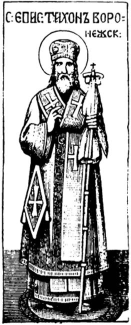
Только 4 года и 7 месяцев св. Тихон управлял воронежскою паствою. Пастырские труды, от которых отдых имел он самый короткий, заботы и огорчения, бывшие следствием препятствий намерениям его святым, расстроили здоровье его тем легче, что от природы расположен он был к нервным болезням. А опускать дела звания по болезни он не хотел, по чувству высоты звания. «Вот причины моего уединения, говорил он сам: слабость моего здоровья не позволяла мне управлять епархиею; епископский омофор, который носят на плечах епископы, очень тяжел»115. Потому просил он св. синод об увольнении его от дел правления и о дозволении жить в монастыре епархии; в конце 1767 г. уволен он с пенсиею и удалился в Толшевский пустынный монастырь. Болотистое положение обители и закоренелый раскольник – настоятель ее, усилили расстройство здоровья его и он переселился в Задонский монастырь.
Only 4 years and 7 months did St. Tikhon govern the Voronezh flock. Pastoral labors, from which he had the briefest rest, cares and griefs that were the consequence of obstacles to his holy intentions, undermined his health all the more easily because by nature he was disposed to nervous illnesses. And he did not wish to neglect the duties of his calling on account of illness, out of a sense of the loftiness of that calling. “These are the reasons for my withdrawal,” he himself said: “the weakness of my health did not allow me to govern the diocese; the episcopal omophorion, which bishops bear on their shoulders, is very heavy”115. Therefore he asked the Most Holy Synod to release him from the duties of administration and to permit him to live in a monastery of the diocese; at the end of 1767 he was released with a pension and withdrew to the Tolshevsky Wilderness Monastery. The marshy location of the monastery and its inveterate schismatic abbot increased the disorder of his health, and he moved to the Zadonsk Monastery.
В уединении Тихон предался со всею ревностию подвигам иноческой жизни. Он ходил почти каждый день в храм на литургию и вечерню и сам пел на клиросе. Весною и летом занимался в саду работами, для укрепления здоровья. «Ночи проводил он без сна и ложился на рассвете. Упражнением его в ночное время были молитвы с поклонами, при том не холодные, но самые горячие; иногда кричал он в голос: Господи помилуй/ Господи пощади! и прибавлял: Кормилец, помилуй! Сам же главою ударял об пол. – В полночь выходил в переднюю келию, певал тихо и умилительно псалмы святые. Когда бывал в мрачных мыслях, пел: благо мне, яко смирил мя еси (Пс.118:71). В ведренных мыслях певал: хвалите Господа с небес (Пс.148) и другие утешительные псалмы, но всегда со слезами и сердечным воздыханием»116. В первый год пребывания своего в Задонском монастыре, где здоровье его поправилось, пламенная деятельная душа его начинала тяготиться покоем; он укорял себя в кратковременном служении Церкви, для которой принял сан архиерейский. В этом грустном расположении духа он часто признавался окружавшим его и знакомым; но после сам признал скучные мысли свои искушением и освобождался от них молитвами. В этом расположении духа написал он живую картину: «вода мимотекущая»117. Келейник его пишет: «не раз собирался он выехать из Задонского монастыря в новгородскую епархию, куда не раз приглашал его митр. Гавриил. Однажды он решился на выезд и написал уже прошение, куда следует». Когда келейник объявил о том старцу Аарону, тот сказал: «что ты беснуешься? Матерь Божия не велит ему выезжать отсюда». Келейник передал это преосвященному. «Если так, сказал блаж. Тихон, не поеду отсюда, и разорвал просьбу»118. Самое тяжелое, самое докучливое искушение составлял для него меланхолический характер его, смешанный с холерическим. Случалось что говорил он келейнику: «не знаю, куда себя девать, братец? Или ты не чувствуешь, что в келье смрад? Возьми дегтю и лей на пол». Дегтярный запах любил он. Или скажет: «поедем в с. Липовку». Село это в 15 верстах от Задонска, там был дом господский, но господа Бахтеевы не жили в нем. По временам живал он там месяца по два и более; сам отправлял в доме вечерню, утреню и часы. Иногда езжал он в Толшевский монастырь, который нравился ему пустынным безмолвием, – или же отправлялся за полторы версты от Задонска на поляну, окруженную лесом, где молился в уединении и где своими руками обделал родник чистой, свежей воды. – В другое время лекарством для смущенной души его служил рясофорный монах Феофан, живший при келье его, старец; самый простой, из однодворцев, безграмотный, но добрый. Когда преосвященный впадал в мрачное расположение духа: «Феофан! скажет, пора, пора на родину, – мне уже наскучила жизнь, рад бы умереть, лишь бы не лишиться вечного блаженства». Феофан прерывал духовные слова святителя и начинал говорить свое. «Бачка/» – так называл он преосвященного, – «слушай»! – и преосвященный слушал немудрого Феофана и успокаивался. «Феофан – утеха моя, говорил он, люблю его и за простосердечие и за то, что никогда не бывает он празден, всегда в труде». Феофан плел лапти и портняжил; но св. Тихон так любил его, что без него редко садился за стол. После стола обеденного преосвященный отдыхал час и более. Вставши, читал жития святых и другие книги119. Златоуст был любимым учителем его. Из пророков чаще всего читал Исаию; псалтырь знал наизусть. Он желал видеть в русском переводе новый завет, который читал он часто: но остановился, чтобы не соблазнить слепых приверженцев буквы120. Когда ехал куда-нибудь, всегда читал псалтырь, а иногда пел вслух. Он любил простоту. Постелью его был ковер, набитый соломою; одеялом служил овчинный тулуп, крытый китайкою; ряса была у него одна суконная или гарусная, из подрясников один был овчинный, другой на заячьем меху, покрытый китайкою; опоясывался ременным поясом, обувался в коты и чулки суконные, подвязывая их ремнями; а две зимы ходил в лаптях, но только в келии; когда же шел к обедне или были гости, обувался в коты; четки у него были ременные; сундука не было, а только кожаная киса и та ветхая; одевался и обувался сам121.
In seclusion, Tikhon devoted himself with all zeal to the labors of the monastic life. He went to church almost every day for the Divine Liturgy and Vespers, and himself sang in the choir. In spring and summer he occupied himself with work in the garden, to strengthen his health. “He spent nights without sleep and lay down at dawn. His exercise in the night-time was prayers with prostrations, and not cold ones, but the most fervent; sometimes he cried out aloud: ‘Lord, have mercy! Lord, spare me!’ and added: ‘O Nourisher, have mercy!’ And he himself struck his head against the floor. – At midnight he would go out into the front cell, and sing the holy psalms quietly and tenderly. When he was in gloomy thoughts, he sang: ‘It is good for me that Thou hast humbled me’ (Ps. 118:71). In cheerful thoughts he sang: ‘Praise ye the Lord from the heavens’ (Ps. 148) and other comforting psalms, but always with tears and heartfelt sighing”116. In the first year of his stay at the Zadonsk Monastery, where his health improved, his fervent, active soul began to be burdened by repose; he reproached himself for his brief service to the Church, for which he had received the episcopal rank. In this sorrowful state of spirit he often confessed to those around him and to acquaintances; but later he himself recognized his gloomy thoughts as a temptation and freed himself from them through prayers. In this state of spirit he wrote a vivid picture: “Water That Flows By”117. His cell-attendant writes: “More than once he prepared to leave the Zadonsk Monastery for the Novgorod diocese, whither Metropolitan Gabriel repeatedly invited him. Once he decided to depart and had already written a petition to the proper authorities.” When the cell-attendant informed the elder Aaron of this, he said: “Why are you raving? The Mother of God does not permit him to leave here.” The cell-attendant conveyed this to the Right Reverend. “If so,” said blessed Tikhon, “I shall not leave here,” and he tore up the request118. The heaviest, most importunate temptation for him was his melancholic temperament, mixed with a choleric one. It happened that he would say to his cell-attendant: “I do not know where to put myself, brother. Do you not feel that there is a stench in the cell? Take some tar and pour it on the floor.” He loved the smell of tar. Or he would say: “Let us go to the village of Lipovka.” This village was 15 versts from Zadonsk; there was a manor house there, but the masters, the Bakhteevs, did not live in it. At times he lived there for two months or more; he himself performed Vespers, Matins, and the Hours in the house. Sometimes he traveled to the Tolshevsky Monastery, which pleased him with its wilderness silence, – or he would go a verst and a half from Zadonsk to a clearing surrounded by forest, where he prayed in solitude and where he worked with his own hands on a spring of pure, fresh water. – At other times, the medicine for his troubled soul was the rassophore monk Theophanes, an elder who lived at his cell, a very simple man, from the odnodvortsy, illiterate, but good. When the Right Reverend fell into a gloomy state of spirit: “Theophanes!” he would say, “it is time, it is time for the homeland – I am already weary of life, I would be glad to die, if only I might not lose eternal blessedness.” Theophanes would interrupt the Hierarch’s spiritual words and begin to speak his own. “Little father!” – so he called the Right Reverend – “listen!” – and the Right Reverend would listen to the unwise Theophanes and be calmed. “Theophanes is my comfort,” he said, “I love him both for his simplicity of heart and because he is never idle, always at work.” Theophanes wove bast shoes and did tailoring; but St. Tikhon loved him so much that without him he rarely sat down to table. After the midday meal the Right Reverend rested for an hour or more. Rising, he read the Lives of the Saints and other books119. Chrysostom was his beloved teacher. Of the prophets, he most often read Isaiah; he knew the Psalter by heart. He wished to see the New Testament in Russian translation, which he read often, but he stopped, so as not to scandalize the blind adherents of the letter120. When he traveled anywhere, he always read the Psalter, and sometimes sang aloud. He loved simplicity. His bed was a carpet stuffed with straw; his blanket was a sheepskin coat covered with Chinese silk; he had only one cassock, of cloth or worsted; of his inner cassocks, one was of sheepskin, the other on hare fur, covered with Chinese silk; he girded himself with a leather belt, shod himself in kots and woolen stockings, tying them with straps; and for two winters he went in bast shoes, but only in his cell; when he went to the Liturgy or had guests, he put on kots; his prayer rope was of leather; he had no chest, only a leather bag, and that an old one; he dressed and shod himself121.
Смирение и кротость приобрел он трудом над собою. По природной живости характера случалось ему оскорблять других; в том случае приходил он к обиженному, признавал себя виновным и просил прощения. – Тех, которые оскорбляли его, прощал он и без просьбы о прощении. «Не только нерассудительный настоятель обители делал святителю разные оскорбления, даже от монастырских служителей много терпел он». Иногда прохаживался он по монастырю, когда они работали, и случалось, что смеялись они вслед его. Он как будто не слышит ничего; а после скажет: «Богу так угодно, что и служители смеются надо мною, – я и достоин того за грехи мои». Часто говаривал он в подобных случаях: «прощение лучше мщения»122. Раз сидел он на крыльце своей келии и боролся с помыслами самомнения, которые упорно нападали на душу его. Вдруг подбежал к нему юродивый (Каменев), окруженный мальчиками, и ударив его по щеке, сказал ему на ухо: «не высокоумь». «В ту же минуту почувствовал я, что бес высокоумия отступил от меня, говорил преосвященный». За это врачество блаж. Тихон положил выдавать юродивому каждый день по 3 копейки и выдавал по самую кончину123.
Humility and meekness he acquired through labor over himself. By the natural liveliness of his character, it happened that he offended others; in such a case he would go to the offended one, acknowledge himself guilty, and ask forgiveness. – Those who offended him, he forgave even without a request for forgiveness. “Not only did the unreasonable abbot of the monastery inflict various insults on the Hierarch, but even from the monastery servants he suffered much.” Sometimes he would walk about the monastery when they were working, and it happened that they would laugh behind his back. He acted as if he heard nothing; but afterwards he would say: “It is so pleasing to God that even the servants laugh at me – I am worthy of it for my sins.” Often he would say in such cases: “Forgiveness is better than vengeance”122. Once he was sitting on the porch of his cell, struggling with thoughts of self-conceit, which stubbornly attacked his soul. Suddenly a Fool-for-Christ (Kamenev), surrounded by boys, ran up to him and, striking him on the cheek, said into his ear: “Be not high-minded.” “At that very moment I felt that the demon of high-mindedness departed from me,” said the Right Reverend. For this remedy, blessed Tikhon ordered that the Fool-for-Christ be given 3 kopecks every day, and he gave it until his very end123.
Велика была любовь св. Тихона ко всем людям. Он говорил, что желает всем спасения, не только раскольникам, но и неверующим в Господа Иисуса, туркам, евреям; пусть все получат блаженство вечное. Некоторые из донских раскольников, еще колебавшиеся в решимости оставить раскол, посланы были блаж. Тихоном к м. Гавриилу для бесед и возвратились чадами св. Церкви. Бл. Тихон пришел в восторг, – обнял их и говорил: «да возрадуется душа моя о Господе, яко обретох овцы погибшия; слава Богу, слава Богу за благость Его к нам». Наслышавшись о любви Тихона ко всем, саратовские раскольники приглашали его быть у них епископом. «Какие пустые, какие темные люди»! отвечал святитель. – Одному иноку, которого раскольники совращали в раскол, писал он: «раскольников, как огня, берегися и с ними никакого не имей сообщения; хотя бы они по недели постилися и всегда молилися и прочие дела показывали: бегай от них».
Great was the love of St. Tikhon for all people. He said that he desired salvation for all, not only for schismatics, but also for those who do not believe in the Lord Jesus, Turks, Jews; let all receive eternal blessedness. Some of the Don schismatics, who were still wavering in their resolve to leave the schism, were sent by blessed Tikhon to Metropolitan Gabriel for conversations and returned as children of the holy Church. Blessed Tikhon was overjoyed – he embraced them and said: “Let my soul rejoice in the Lord, for I have found the lost sheep; glory to God, glory to God for His goodness to us.” Having heard of Tikhon’s love for all, the Saratov schismatics invited him to be their bishop. “What empty, what dark people!” replied the Hierarch. – To a certain monk, whom the schismatics were seducing into the schism, he wrote: “Beware of schismatics as of fire, and have no fellowship with them; even if they fast for a week and always pray and show other works: flee from them.”
Для многих из окрестных помещиков я купцов св. Тихон был усердным учителем. «Компаний развращенных, как моровой язвы, берегись, писал он молодому дворянину: не скоро узнаешь от них язву на себе, но почувствуешь несравненно вреднейшую, нежели моровая язва делает»124. Строго обличал он жен за богатые наряды и богачей за усилившуюся роскошь125. – После увещаний святителя многие из людей рассеянных расставались с худыми привычками; иные вновь впадали в грехи, но вразумляемы были казнями Божиими. Один помещик, по убеждению святителя, расстался с страстию к псовой охоте: но потом пристрастился к картежной игре и за то наказан – у него утонул сын. Это так поразило его, что бросил он карты и роскошь и остальную жизнь провел как добрый христианин126. Бл. Тихон иногда выезжал из обители к знакомым для бесед о спасении праздных разговоров не любил он. Память его была так обширна и тверда, что служила ему вместо книг. Тексты св. писания приводил он от слова до слова; в объяснение прибавлял слова отцов и делал филологические замечания. Нередко являлся он в дом незванный, но в такое время, когда присутствие его было очень нужно. Это случалось при семейных раздорах, при разделе наследства и пр. Святителя встречали как ангела и он оставлял в доме мир и любовь127. В одном доме св. Тихон вошел в разговор с богатым дворянином, человеком вспыльчивым и самолюбивым. Заметив, что тот горячится, стал он отвечать тихо и покойно, но с силою опровергая суждения его. Тот вышел из себя до того, что в исступлении ударил святого по щеке. Святитель упал ему в ноги: «простите меня, говорил, Бога ради, что я ввел вас в искушение». Запальчивый пришел в себя и, упав к ногам святого, умолял о прощении и с того времени стал добрым христианином.
For many of the neighboring landowners and merchants, St. Tikhon was a zealous teacher. “Beware of corrupt companies as of the plague,” he wrote to a young nobleman: “you will not soon perceive the plague from them upon yourself, but you will feel one incomparably more harmful than the plague does”124. He strictly reproved women for rich attire and the rich for their increasing luxury125. – After the Hierarch’s admonitions, many dissipated people parted with evil habits; some fell again into sins, but were admonished by the punishments of God. One landowner, by the Hierarch’s persuasion, parted with his passion for hunting with hounds; but later he became addicted to card-playing and was punished for it – his son drowned. This so struck him that he abandoned cards and luxury and spent the rest of his life as a good Christian126. Blessed Tikhon sometimes went out from the monastery to acquaintances for conversations about salvation; he did not like idle talk. His memory was so extensive and firm that it served him instead of books. He quoted texts of Holy Scripture word for word; in explanation he added words of the Fathers and made philological remarks. Not infrequently he appeared in a house uninvited, but at a time when his presence was very necessary. This happened during family quarrels, at the division of an inheritance, and so forth. The Hierarch was received as an angel, and he left peace and love in the house127. In one house, St. Tikhon entered into conversation with a wealthy nobleman, a hot-tempered and self-loving man. Noticing that he was becoming heated, he began to answer quietly and calmly, but with force, refuting his opinions. The man lost his temper to such a degree that in a frenzy he struck the saint on the cheek. The Hierarch fell at his feet: “Forgive me,” he said, “for God’s sake, that I have led you into temptation.” The hot-tempered man came to himself and, falling at the saint’s feet, begged forgiveness, and from that time became a good Christian.
Блаженный любил разговаривать с простолюдинами и всегда о душевной пользе; с ними был ласков и прост, предлагал наставления простые, приводил им примеры из жития святых. – Строгий в себе, он был снисходителен к другим. В пятницу пред праздником ваий вошел он в келию друга своего схимонаха Митрофана и увидал его за столом с Козмою Игнатьевичем, елецким гражданином, которого также любил. На столе была рыба. – Друзья смутились. Благий Тихон сказал: «садитесь, я вас знаю; любовь выше поста». И чтобы еще более успокоить их, сам отведал ухи их128.
The blessed one loved to converse with common people, and always about spiritual benefit; with them he was kind and simple, offering simple instructions, bringing them examples from the Lives of the Saints. – Strict with himself, he was lenient toward others. On the Friday before the Feast of the Palms, he entered the cell of his friend, the schemamonk Mitrophan, and saw him at table with Kozma Ignatievich, a citizen of Yelets, whom he also loved. On the table was fish. – The friends were troubled. The good Tikhon said: “Sit down, I know you; love is above fasting.” And to set them even more at ease, he himself tasted their fish soup128.
Малых детей приучал он ходить к обедне своими ласками с ними. Когда пойдет из церкви, они идут за ним; войдет в келию и они за ним, – положат три поклона и громко скажут, по его наставлению: слава Тебе Боже наш, слава Тебе. Он спрашивает: «дети! где Бог наш»?Они в оре голос отвечают: «Бог наш на небеси и на земли». – Вот хорошо, дети! погладит их по головке, даст им по копейке и по куску белого хлеба, а в летнее время по яблоку. Когда же по слабости здоровья не бывал он в храме, дети посмотрят, что его нет, и уходят из церкви. Узнавая о том, преосвященный улыбался и говорил: «беда, они бедные ходят для хлеба»129.
He accustomed little children to go to the Liturgy by his caresses with them. When he went from church, they followed him; he entered his cell, and they followed him—they made three prostrations and said loudly, according to his instruction: “Glory to Thee, our God, glory to Thee.” He asked: “Children! Where is our God?” They answered in a loud voice: “Our God is in heaven and on earth.” — “That is good, children!” He would stroke their heads, give them a kopeck each and a piece of white bread, and in summer an apple. When, due to weakness of health, he was not in church, the children would see that he was not there and would leave the church. Learning of this, the bishop smiled and said: “It is a pity; the poor things come for bread.”129
Особенно полна была душа его состраданием к бедным и несчастным. – Им роздал он все платье свое, по поступлении на покой. К ним же переходила едва не вся и пенсия его. Он покупал им шубы, кафтаны, обувь, хлеб и раздавал; для иных покупал скот, другим – хижину. Он входил в разговор с поселянами о их быте и снабжал нужным. В 1768 г. посылал он с деньгами Митрофана в погоревшие Ливны, а в следующем году, когда погорел Елец, сам отправлялся в Воронеж и Острогожск испрашивать помощь пострадавшим от пожара. – Елец любил он; приезжая сюда вечером – останавливался он за городом и пешком приходил в тюрьму к заключенным, расспрашивал каждого о причине заключения; увещевал к раскаянию; при выходе же наделял милостынею, а содержащиеся за долги получали от него деньги на выкуп. В 1770 г. посылал он послушника с деньгами к родственникам своим, и тот отдал «брату Ефиму 5 рублей, а другому брату, Петру, который жил в Новгороде, 10 рублей». В том же году отправлял он того же келейника с письмами в Петербург хлопотать об освобождении от военной службы двух сыновей «церковной вдовы старухи» и очень рад был, когда те были уволены130. – Одно из дел милосердия его Господь ознаменовал чудом. Двое из елецких жителей решились обманом получить пособие у св. Тихона. Явясь к нему, они с притворными слезами говорили, что лишились всего от огня. Святитель посмотрел им в глаза и дал несколько денег. Довольные успешным обманом, они поспешили в Елец, но увидели дома свои в пламени. После того явились они с раскаянием к святителю; он помолился за них, простил их и, дав денег, просил жить честно. Эти люди были после того лучшими до гроба131.
His soul was especially full of compassion for the poor and unfortunate. He gave away all his clothing upon retiring to rest. Almost his entire pension also went to them. He bought them fur coats, caftans, footwear, and bread and distributed them; for some he bought cattle, for others a hut. He entered into conversation with peasants about their way of life and supplied them with necessities. In 1768, he sent Mitrophan with money to the burned-down town of Livny, and the following year, when Yelets burned, he himself went to Voronezh and Ostrogozhsk to seek help for those who had suffered from the fire. He loved Yelets; arriving there in the evening, he would stop outside the city and go on foot to the prison to the prisoners, asking each one the reason for his imprisonment; he exhorted them to repentance; upon leaving, he gave alms, and those held for debt received money from him for ransom. In 1770, he sent a novice with money to his relatives, and he gave “to brother Ephraim 5 rubles, and to another brother, Peter, who lived in Novgorod, 10 rubles.” In the same year, he sent the same cell-attendant with letters to Petersburg to petition for the release from military service of two sons of “a church widow, an old woman,” and was very glad when they were discharged.130 — The Lord marked one of his works of mercy with a miracle. Two of the inhabitants of Yelets decided to obtain assistance from St. Tikhon by deceit. Appearing to him, they said with feigned tears that they had lost everything by fire. The Hierarch looked them in the eyes and gave them some money. Satisfied with their successful deceit, they hastened to Yelets, but saw their own houses in flames. Afterwards, they appeared with repentance to the Hierarch; he prayed for them, forgave them, and, giving them money, asked them to live honestly. These people were thereafter the best of men until the grave.131
Св. Тихон питал сердца людей и письменными наставлениями. Этим успокаивал он и дух свой, по временам смущавшийся мыслию о раннем покое его. И лучшие творения его писаны на покое, таковы: «духовное сокровище, собираемое от мира» (пис. в 1770 г.)132 и другое – «о истинном христианстве» (1777 г.). Он вел переписку с помещиками и купцами о душевном спасении составлял краткие поучения, которых сам не говорил в храме, а поручал другим читать их.
St. Tikhon nourished the hearts of men also with written instructions. By this he also calmed his own spirit, which was at times troubled by the thought of his early retirement. And his best works were written in retirement, such as: “A Spiritual Treasure Gathered from the World” (written in 1770)132 and another — “On True Christianity” (1777). He carried on correspondence with landowners and merchants concerning the salvation of the soul, and composed brief homilies, which he himself did not deliver in church but entrusted to others to read.
С особенною любовию заботился он о желавших посвящать себя на служение Богу. Никандр Алексеевич Бахтеев, с юности полюбивший св. Тихона, оставил военную и службу и решился поступить в монастырь: но отец не хотел и слышать о том: он запер сына в верхнем этаже дома и прервал сношения его с блаж. Тихоном; сын ночью ушел из дома. Святитель, встретив его на берегу Дона, сказал: «я чувствовал, что нынешнюю ночь вы оставите родителей, зашел за Митрофаном, чтобы встретить вас, – не бойтесь хотя и будут поиски за вами, но вы останетесь в ограде Христовой». Придя в келью о. Митрофана, святитель приказал напоить Никандра Алексеевича чаем и затем скрыть его, где знает; о. Митрофан отвел его в пещеру, бывшую под кельею. Отец с гневом приезжал в обитель и в келье Митрофана разламывали пол; он жаловался губернатору и архипастырю; последний едва уговорил его успокоиться. «Опасно, говорил он отцу, – оскорблять праведника; у вас есть еще два сына, пусть один служит царю небесному». Так Никандр Алексеевич остался в обители и здесь, в своей келье, скончался в 1813 г., прожив в обители 40 лет.
With particular love he cared for those who wished to dedicate themselves to the service of God. Nikander Alexeevich Bakhteev, who from his youth had loved St. Tikhon, left military service and decided to enter a monastery; but his father would not hear of it: he locked his son in the upper floor of the house and broke off his relations with the blessed Tikhon; the son fled from the house by night. The Hierarch, meeting him on the bank of the Don, said: “I felt that this night you would leave your parents; I came for Mitrophan to meet you—fear not; though there will be searches for you, you shall remain in the fold of Christ.” Coming to the cell of Father Mitrophan, the Hierarch ordered that Nikander Alexeevich be given tea and then hidden wherever he knew; Father Mitrophan led him into a cave that was under the cell. The father came to the monastery in anger and broke up the floor in Mitrophan’s cell; he complained to the governor and to the archpastor; the latter barely persuaded him to calm down. “It is dangerous,” he said to the father, “to offend a righteous man; you have two other sons; let one serve the Heavenly King.” Thus Nikander Alexeevich remained in the monastery, and there, in his cell, he reposed in 1813, having lived in the monastery for 40 years.
Подвигами самоотречения и любви душа блаж. Тихона возвысилась до созерцаний небесного и до прозрений будущего. В 1778 г. в тонком сне было ему такое видение: Богоматерь стояла на облаках и около нее ап. Петр и Павел; сам он на коленях просил Пречистую о продолжении милости к миру. Ап. Павел громко сказал: «егда рекут мир и утверждение, тогда нападет на них внезапу всегубительство». Блаженный проснулся в трепете и слезах. – В следующем году он опять видел Богоматерь на воздухе и около нее несколько лиц; он упал на колени и около него пали на колени четверо, облеченные в белые одеяния; он просил Пречистую за кого-то, чтобы тот не удалялся от него. (Кто эти лица и за кого была просьба, не сказал он келейнику). Пречистая отвечала: «будет по просьбе твоей».133 – Когда получен был манифест о рождении в. к. Александра Павловича, св. Тихон в разговоре с другом своим Бахтеевым предсказал многое, что совершилось при Александре. В 1812 г., когда Наполен только что вступил в Россию, Никандр Алексеевич со слов св. Тихона говорил, что Голиаф погибнет, а Россия восторжествует. Раз св. Тихон ходил по саду и вдруг остановился, стал на колени, приложил руки к сердцу, устремил глаза к небу, как бы что видел там лице его изменилось и просветлело. Все это видел клирик с колокольни и, в страхе прибежав, рассказал монахам, что видел; те поспешили на колокольню, но уже Тихон покойно ходил по саду. Подобные явления бывали и в келье, во блаженный запрещал келейникам говорить о том134. За три года до кончины каждый день молился он: скажи ми, Господи, кончину мою. И тихий голос на утренней заре сказал: «в день недельный». В том же году видел он во сне прекрасный луг и на нем чудные палаты, хотел войти в двери, но ему сказали: «чрез три года можешь войти, но теперь потрудись». После этого видения он заключился в своей келье плакать над гробом своим, стоявшим в чулане, скрытно от людей. За год и три месяца до смерти, в тонком сне, представилось св. Тихону, что стоит он в придельной церкви монастырской; знакомый священник вынес из алтаря в царские двери младенца под покрывалом; Тихон подошел и поцеловал младенца в правую щеку, а младенец ударил его в левую. Пробудясь, почувствовал он онемение левой щеки, левой ноги и трясение левой руки. Эту болезнь принял он с радостию. Незадолго до кончины святой видел во сне высокую и крутую лестницу и услышал повеление восходить по ней. «Я, рассказывал он другу Козме, сначала боялся слабости своей, но когда стал восходить, народ, стоявший около лестницы, казалось, подсаживал меня все выше и выше, в самым облакам». – Лестница, объяснил Козма, – путь к царству небесному; помогавшие тебе – те, которые пользуются наставлениями твоими и будут поминать тебя. Святой сказал со слезами: «я и сам тоже думаю, чувствую близость кончины»135.
By the feats of self-denial and love, the soul of the blessed Tikhon was raised to contemplations of the heavenly and to foresights of the future. In 1778, in a light sleep, he had the following vision: the Mother of God stood on the clouds, and near Her were the Apostles Peter and Paul; he himself, on his knees, asked the Most Pure One for the continuation of mercy toward the world. The Apostle Paul said loudly: “When they say peace and security, then sudden destruction will come upon them.” The blessed one awoke in trembling and tears. — The following year he again saw the Mother of God in the air and several persons around Her; he fell on his knees, and around him four, clothed in white garments, also fell on their knees; he asked the Most Pure One for someone, that he might not depart from him. (Who these persons were and for whom the request was made, he did not tell his cell-attendant.) The Most Pure One answered: “It shall be according to your request.”133 — When the manifesto on the birth of the Grand Prince Alexander Pavlovich was received, St. Tikhon, in conversation with his friend Bakhteev, foretold much that came to pass under Alexander. In 1812, when Napoleon had just entered Russia, Nikander Alexeevich, from the words of St. Tikhon, said that Goliath would perish and Russia would triumph. Once St. Tikhon was walking in the garden and suddenly stopped, fell on his knees, pressed his hands to his heart, and fixed his eyes on heaven, as if seeing something there; his face changed and became radiant. A cleric saw all this from the bell tower and, running in fear, told the monks what he had seen; they hastened to the bell tower, but Tikhon was already walking calmly in the garden. Similar occurrences happened also in his cell, but the blessed one forbade his cell-attendants to speak of them.134 Three years before his repose, he prayed daily: “Show me, O Lord, my end.” And a quiet voice at the morning dawn said: “On Sunday.” In the same year, he saw in a dream a beautiful meadow and on it wondrous chambers; he wished to enter the doors, but he was told: “In three years you may enter, but now labor.” After this vision, he shut himself up in his cell to weep over his coffin, which stood in the storeroom, hidden from people. A year and three months before his death, in a light sleep, it appeared to St. Tikhon that he was standing in the side-chapel of the monastery church; a familiar priest brought out from the altar through the royal doors an infant under a veil; Tikhon approached and kissed the infant on the right cheek, and the infant struck him on the left. Upon waking, he felt numbness in his left cheek, left leg, and trembling in his left arm. He received this illness with joy. Shortly before his repose, the saint saw in a dream a high and steep ladder and heard a command to ascend it. “I,” he told his friend Kozma, “at first feared my weakness, but when I began to ascend, the people standing around the ladder seemed to lift me higher and higher, up to the very clouds.” — The ladder, Kozma explained, is the path to the Kingdom of Heaven; those who helped you are those who benefit from your instructions and will commemorate you. The saint said with tears: “I myself think the same; I feel the nearness of my end.”135
Согласно с обещанием небесным, кончина св. Тихона последовала в воскресный день, 13 августа 1783 г.
In accordance with the heavenly promise, the repose of St. Tikhon occurred on a Sunday, August 13, 1783.
«Память преосвященного Тихона, так объявлял св. синод июня 20-го 1861 г., со дня преставления его благоговейно чтима была в православном русском народе. – К почитанию святителя влекли верующих и воспоминания о высоких христианских добродетелях его, и вещания мудрости евангельской, оставленные в его богопросвещенных писаниях, и чудодейственные исцеления различных; недугов, совершавшиеся при его гробе. На всем этом основалось благочестивое упование, что сей иерарх причтен к лику святых. Еще в конце прошедшего столетия таковое упование выражено было в прошениях, поступавших на Высочайшее имя и в святейший синод»... В 1860 г. ближайшее обследование дела возложено на митрополита Исидора, местного архиепископа Иосифа и архимандрита Паисия. «19 мая вскрыли они гроб и нашли, что тело святителя Тихона, благодатию Божиею сохранилось нетленным и архиерейское облачение, в коем погребен был святитель, также осталось в целости, несмотря на сырость могилы. Преосвященный Исидор и Иосиф получили показания разных лиц, которые под присягою засвидетельствовали, что из них одни на себе, а другие – на своих сродниках испытали чудесные исцеления заступлением святителя. Таких событий; обнимающих собою течение времени с 1820 г. до января 1861 г., обследовано ими 48, из числа коих 19 были в свое время внесены в особо веденные в Задонском монастыре книги»136. Св. синод положил совершить торжественное открытие св. мощей 13 августа 1861 г. И оно совершено в это число, – «в день воскресный».
“The memory of His Grace Tikhon,” so declared the Most Holy Synod on June 20, 1861, “from the day of his repose has been reverently honored among the Orthodox Russian people. — Believers were drawn to the veneration of the Hierarch both by the remembrance of his lofty Christian virtues, and by the utterances of evangelical wisdom left in his God-enlightened writings, and by the miraculous healings of various ailments performed at his tomb. On all this was founded the pious hope that this hierarch had been numbered among the ranks of the saints. Already at the end of the past century, such hope was expressed in petitions submitted to the Imperial Name and to the Most Holy Synod.”... In 1860, the closest investigation of the matter was entrusted to Metropolitan Isidore, the local Archbishop Joseph, and Archimandrite Paisius. “On May 19, they opened the coffin and found that the body of Hierarch Tikhon, by the grace of God, had been preserved incorrupt, and the hierarchal vestments in which the Hierarch was buried also remained intact, despite the dampness of the grave. Their Graces Isidore and Joseph received testimonies from various persons who, under oath, attested that some of them on themselves, and others on their relatives, had experienced miraculous healings through the intercession of the Hierarch. Such events, covering the period from 1820 to January 1861, were investigated by them to the number of 48, of which 19 had in their time been entered into books kept specially in the Zadonsk Monastery.”136 The Most Holy Synod decreed that the solemn uncovering of the holy relics be performed on August 13, 1861. And it was performed on that date — “on the Lord’s Day.”