Пр. Исаакий (30 мая) скончался в 383 году, передав игуменство в основанной им обители Далмату, по имени которого она и называлась Далматскою. Далмат, в мире воин, презрев все мирское и оставя жену и детей, взял только сына Фавста и принял (381 г.) монашество в обители Исаакия. Ставши игуменом, подвизался больше прежнего, боролся с еретиками и оказал важную услугу православию. Когда на Ефесском соборе (131 г.) сторона еретическая готова была подавить православных, он, став во главе игуменов, монахов и верных православию мирян, пошел к царскому дворцу и дерзновенно говорил пред императором за истину, тогда как до сего 48 лет не выходил никуда из монастыря, не смотря на просьбы самого царя, чтобы он, во время бывших землетрясений, участвовал в общих молитвах. Скончался в глубокой старости, после 437 года. Сын Далмата Фавст также славен был добродетелями и мирно предал дух свой Господу.
Venerable Isaac (May 30) reposed in the year 383, having handed over the abbacy of the monastery he had founded to Dalmatius, after whom it was called the Dalmatian Monastery. Dalmatius, in the world a soldier, despising all worldly things and leaving behind his wife and children, took only his son Faustus and received (in 381) monastic tonsure in the monastery of Isaac. Having become abbot, he struggled more than before, fought against heretics, and rendered an important service to Orthodoxy. When at the Council of Ephesus (131) the heretical side was ready to overwhelm the Orthodox, he, placing himself at the head of the abbots, monks, and laymen faithful to Orthodoxy, went to the imperial palace and boldly spoke the truth before the emperor, whereas for forty-eight years before this he had not gone out anywhere from the monastery, despite the entreaties of the emperor himself that he, during the time of the earthquakes that had occurred, would take part in the common prayers. He reposed in extreme old age, after the year 437. The son of Dalmatius, Faustus, was also renowned for his virtues and peacefully surrendered his spirit to the Lord.
В тот же день преп. Пелагии Сирской. Искренняя подвижница, почившая в октябре 502 года. О ней см. 10-го июня в житии преп. Пансемнии.
On the same day, the Venerable Pelagia of Syria. A sincere ascetic, who reposed in October of the year 502. See about her on June 10, in the life of the Venerable Pansemnius.
Все возможно верующему (Мк.9:23). Если кто скажет горе сей: двинься и бросься в море, и не усумнится в сердце своем, а поверит, что сбудется по слову его: будет ему, что ни скажет» (Мк.20:23). – Это – слова Того, Чье каждое слово – ей и аминь. Опыты тому – в жизни пр. Антония Новгородского.
All things are possible to him that believeth (Mk. 9:23). For whosoever shall say unto this mountain, Be thou removed, and be thou cast into the sea; and shall not doubt in his heart, but shall believe that those things which he saith shall come to pass; he shall have whatsoever he saith (Mk. 11:23). These are the words of Him Whose every word is yea and amen. Proofs of this are found in the life of the Venerable Anthony of Novgorod.
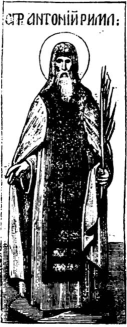
Преподобный Антоний родился, как сам он рассказывал ученику своему Андрею10, в Риме, от родителей весьма богатых и православных. Известно и по другим сведениям, что в Италии в X и XI в. весьма много жило православных греков и были православные обители11. Антоний по смерти родителей, видя волнение и раздоры в мире, решился посвятить себя на служение Богу. На 19 году принял пострижение и несколько лет прожил в пустыне, где иноки проводили жизнь скитскую. К великой субботе поста собирались они в малый пустынный храм, слушали литургию и приобщались св. Таин; в пасху также в общем собрании слушали утреню и св. литургию и по причащении св. Таин расходились в келии12. Поднялось гонение на православных со стороны гордого первосвященника римского и иноки разбежались, кто куда мог; Антоний, переходя с места на место, нашел на берегу моря камень и стал жить на нем. Так прожил он год, в посте и молитвах. Но поднялась грозная буря на море, волны как горы катились по морю и достигли до камня, на котором жил отшельник; они сорвали камень с места и понесли по морю: под Божиим покровом раб Божий спасся от всех опасностей. Он прибыл в Новгород: но здесь и люди, и язык их неизвестны были отшельнику. В городе встретился он с человеком, которого по одежде признал за купца грека и от него узнал, что город – Новгород Великий, жители – православные христиане и епископ их – блажен. Никита. Антоний благодарил Господа за дивные судьбы Его. Познакомясь несколько с русским языком, явился он к епископу принять благословение; епископ спрашивал его: кто он и откуда? Антоний отвечал одно: я грешник, и только наедине, под условием глубокого молчания, рассказал ему все, что с ним было. По благословению архипастыря, Антоний поставил небольшой храм в честь рождества Богоматери, так как в этот праздник ступил он на берег. Это – в 3 верстах от города, по течению Волхова. – На другой год рыболовы, ловившие рыбу, по желанию Антония, закинув невод, вытащили вместе с множеством рыбы бочку, которую давно вверил Антоний хранению Божию; в бочке хранились дорогие вещи. Преподобный купил землю у детей посадника для обители. Вот грамота его, которая в других актах называется купчею и обводною (межевою): «вот труд, Госпожа моя пресв. Богородица, над которым трудился я на этом месте. Купил я землю в дом Пречистой у Симеона и Прокофия, сыновей посадника Иоанна; а дал 100 рублей». Затем следует обвод земли или показание границ13. – По новгородским летописям, в 1106 г. «приплы в великий Новгород из Рима препод. отец наш Антоний»; в 1117 г. основан был каменный храм в монастыре его в честь рождества Богоматери; в 1119 г. он освящен и в 1125 г. расписан. Спустя еще два года построена каменная трапеза, при которой устроен потом храм в честь сретения Господня; при освящении сей церкви пр. Антоний (1128 г.) поставлен в игумена14. Латинские надписи на некоторых из вещей пр. Антония, доселе целых, подтверждают собою сказание о прибытии пр. Антония с запада. В обители Антония сохраняются мусийные иконы его, на которых мусия наложена на медные доски: на трех изображен Господь Вседержитель, а на других трех – Распятый Спаситель с латинскою надписью: IHSXPS, т. е., Iesus hominum Salvator, Xristus Patronus sanctissimus – «Иисус Спаситель человеков, Христос покровитель святейший»). Вместе с иконами при раке преподобнаго находится каменный крест его: на верхней перекладине сего шестиконечного креста наведены мозаикою слова: Ис. Хс.15. Две драгоценные чаши пр. Антония с изображением на них четвероконечных крестов ныне находятся в московском Успенском соборе16, быв взяты в Москву царем Иоанном Грозным17. Из трех служебников его, показанных в описи 1636 г., один хранится в синодальной библиотеке: святитель Златоустый, изображенный на этом служебнике, представлен благословляющим именословно18. В главном каменном храме своем преподобный устроил для уединенных молитв своих «божницу», где ныне небольшая, круглая церковь: по древним описям, называется это место «Антоновою божницею»19. По древнему житию, преподобный, какие получались доходы в обители, употреблял не только на братию, но и на пропитание нищих, несчастных, сирот и вдов. В духовной грамоте своей писал он: «вот я, Антоний, самый худой между мнихами, вышел на это место, не получив имения ни от князя, ни от епископа, а только приняв благословение от епископа Никиты; паша на чужой земле, не давал я покоя себе и огорчал братию и сирот, христиан здешних». Сиротами называет преподобный поселян, живших на монастырской земле и за то работавших на обитель: как звучит любовь в этом названии! «Сама Матерь Божия, продолжает преподобный, а исправит все, но сколько претерпел я скорбей за это место! Поручаю его Богу и святой Богородице и христианам, желая для него свободы. – Поручаю это место игуменства (кто преступит мое слово, да судит ему Бог и святая Богородица) тому, кого назначит Бог и изберут братия. Из братии никто да не будет притесняем на сем месте. Если какой либо брат сего места будет домогаться игуменства чрез подкуп или насилье: да будет он под клятвою. Князь ли будет участвовать в том насилием и мздою: и он подлежит клятве; епископ ли для мзды будет поставлять (игумена) и станет творить насилие здесь: подлежит тому же. Объявляю и то, что когда сел я на этом месте, то дал за землю и тони 70 гривен, да за село Волховское 100 гривен». Наконец поименовываются оброчные люди обители»20.
The Venerable Anthony was born, as he himself related to his disciple Andrew10, in Rome, of very wealthy and Orthodox parents. It is also known from other sources that in Italy in the tenth and eleventh centuries very many Orthodox Greeks lived, and there were Orthodox monasteries11. Anthony, after the death of his parents, seeing the turmoil and discord in the world, resolved to dedicate himself to the service of God. In his nineteenth year he received the tonsure and lived for several years in the wilderness, where the monks led a skete life. For Great Saturday of Lent they would gather in a small wilderness church, hear the Divine Liturgy, and receive the Holy Mysteries; at Pascha also, in a common assembly, they would hear Matins and the Divine Liturgy, and after Communion of the Holy Mysteries they would disperse to their cells12. A persecution arose against the Orthodox from the proud Roman pontiff, and the monks scattered, each wherever he could; Anthony, moving from place to place, found a stone on the seashore and began to live on it. Thus he lived for a year, in fasting and prayers. But a terrible storm arose on the sea; the waves rolled like mountains across the sea and reached the stone on which the hermit lived; they tore the stone from its place and carried it across the sea: under God's protection, the servant of God was saved from all dangers. He arrived in Novgorod: but here both the people and their language were unknown to the hermit. In the city he met a man whom, by his clothing, he recognized as a Greek merchant, and from him he learned that the city was Great Novgorod, the inhabitants were Orthodox Christians, and their bishop was the blessed Nikita. Anthony gave thanks to the Lord for His wondrous dispensations. Having become somewhat acquainted with the Russian language, he appeared before the bishop to receive a blessing; the bishop asked him: who he was and whence he came? Anthony answered only: "I am a sinner," and only in private, under the condition of profound silence, told him everything that had happened to him. With the blessing of the archpastor, Anthony erected a small church in honor of the Nativity of the Theotokos, since on that feast he had set foot on the shore. This was three versts from the city, along the course of the Volkhov. The following year, fishermen who were fishing, at Anthony's wish, cast a net and pulled out, together with a multitude of fish, a barrel which Anthony had long ago entrusted to God's keeping; in the barrel were kept precious objects. The Venerable One bought land from the sons of the posadnik for the monastery. Here is his deed, which in other acts is called a purchase deed and a boundary deed: "Behold the labor, O my Lady, Most Holy Theotokos, which I have labored upon this place. I bought the land for the house of the Most Pure One from Simeon and Procopius, the sons of the posadnik John; and I gave 100 rubles." Then follows the boundary circuit or indication of the limits13. According to the Novgorod chronicles, in the year 1106 "our Venerable Father Anthony sailed into Great Novgorod from Rome"; in 1117 a stone church was founded in his monastery in honor of the Nativity of the Theotokos; in 1119 it was consecrated, and in 1125 it was painted. Two years later a stone refectory was built, at which a church was afterwards constructed in honor of the Meeting of the Lord; at the consecration of this church, the Venerable Anthony (in 1128) was appointed abbot14. Latin inscriptions on some of the objects of the Venerable Anthony, still preserved intact, confirm the account of the Venerable Anthony's arrival from the West. In the monastery of Anthony are preserved his mosaic icons, on which the mosaic is applied to copper plates: on three is depicted the Lord Almighty, and on the other three, the Crucified Savior with the Latin inscription: IHSXPS, i.e., Iesus hominum Salvator, Xristus Patronus sanctissimus — "Jesus Savior of men, Christ most holy Patron"). Together with the icons, at the reliquary of the Venerable One is his stone cross: on the upper crossbar of this six-pointed cross are traced in mosaic the words: Is. Khs.15. Two precious chalices of the Venerable Anthony, with the image of four-pointed crosses on them, are now in the Moscow Dormition Cathedral16, having been taken to Moscow by Tsar John the Terrible17. Of his three service books, listed in the inventory of 1636, one is preserved in the Synodal Library: the Hierarch Chrysostom, depicted in this service book, is shown blessing with the name-forming blessing18. In his main stone church, the Venerable One arranged for his solitary prayers a "bóżnitsa" (oratory), where there is now a small, round church: in ancient inventories this place is called "Anthony's Oratory"19. According to the ancient life, the Venerable One used whatever income the monastery received not only for the brethren, but also for the sustenance of the poor, the unfortunate, orphans, and widows. In his spiritual testament he wrote: "Behold, I, Anthony, the most wretched among monks, came to this place, having received no property either from the prince or from the bishop, but only having accepted a blessing from Bishop Nikita; plowing on another's land, I gave no rest to myself and grieved the brethren and the orphans, the Christians of this place." By "orphans" the Venerable One means the peasants who lived on the monastery land and for that worked for the monastery: how love sounds in this name! "The Mother of God Herself," continues the Venerable One, "will set all things right, but how many sorrows have I endured for this place! I entrust it to God and the holy Theotokos and to Christians, desiring freedom for it. — I entrust this place of the abbacy (whoever transgresses my word, may God and the holy Theotokos judge him) to him whom God shall appoint and the brethren shall choose. Let no one from the brethren be oppressed in this place. If any brother of this place shall seek the abbacy through bribery or violence: let him be under anathema. If a prince shall participate in this by violence and bribery: he also is subject to anathema; if a bishop shall appoint (an abbot) for a bribe and shall commit violence here: he is subject to the same. I also declare that when I settled on this place, I gave for the land and the fishing grounds 70 grivnas, and for the village of Volkhovskoye 100 grivnas." Finally, the quit-rent people of the monastery are named20.
Опытом того, что преп. Антоний заботился о духовном просвещении учеников своих, служат труды ученика его, доместика Антониева монастыря, Кирика, который при жизни Антония в 1136 г. написал статью о счислении лет21 и потом предлагал вопросы епископам новгородским о разных предметах благочиния и богослужения22. Сохранившиеся до нашего времени рукописи обители все писаны письмом четким и красивым и на пергаменте лучшей выделки23. В одной из них, XIII в., заключающей обиход церковный, между прочим написан «завет молодым монахам». Так как в обители пр. Антония списывали этот завет, для назидания своего: повторим его и мы здесь, как согласный во всяком случае с мыслями пр. Антония24.
Proof that the Venerable Anthony cared for the spiritual enlightenment of his disciples are the works of his disciple, the domesticus of the Anthony Monastery, Kirik, who during Anthony's lifetime, in 1136, wrote an article on the reckoning of years21 and afterwards proposed questions to the bishops of Novgorod on various subjects of decorum and divine service22. The manuscripts of the monastery preserved to our time are all written in a clear and beautiful hand and on parchment of the finest quality23. In one of them, of the 13th century, containing the church typicon, there is written, among other things, a "testament to young monks." Since in the monastery of the Venerable Anthony they copied this testament for their edification, let us repeat it here as well, as being in any case in agreement with the thoughts of the Venerable Anthony24.
«Дело инока охранять ум и противиться странным помыслам; инок – умный ловец помыслов, седящий при дверях сердца; дело монаха – благодарение. Молитва, пение, – дело ангелов, молитва – пища душе, просвещение уму, секира на уныние, препятствие падению. Молитва должна совершаться умом, от души, с пониманием слов, – исправьте, сказано, в ведении разум (Прит.9:6).
"The work of a monk is to guard the mind and to resist strange thoughts; a monk is a wise catcher of thoughts, sitting at the doors of the heart; the work of a monk is thanksgiving. Prayer, psalmody, is the work of angels; prayer is food for the soul, enlightenment for the mind, an axe against despondency, a hindrance to falling. Prayer must be performed with the mind, from the soul, with understanding of the words — 'correct, it is said, in knowledge the understanding' (Prov. 9:6).
Просвещайся, чернец, для вечности, понуждай себя укрепляться крестным усилием, трудись в послушании и рукоделии: приемля пищу телесную, корми душу священными словами.
Be enlightened, monk, for eternity; compel yourself to be strengthened by the effort of the cross; labor in obedience and handicraft: receiving bodily food, feed the soul with sacred words."
Ум всегда держи на небе. Не привыкай ходить из кельи в келью, в угоду плотскому желанию; выходи только на молитву в церковь, или на служение братии. – Все делай с благословением старца. Не живи для себя, живи для Бога, заботясь о вечности. Келья твоя да будет гробом, прежде обычного гроба. Не имей собственности, не живи для тления, от чего отказался ты. Славь Бога с ангелами. – Когда увидишь игумена: поклонясь до земли, проси благословения. Встретившись с братом, поклонись и говори молитву: молитвами св. отцов наших, Господи Иисусе Христе, Боже наш, помилуй нас. После вечерни не говори ни с кем. Придет брат со стороны, из другого монастыря: встречая его, говори молитву: Господи Иисусе Христе, Боже наш, помилуй нас, аминь. Войдя с ним в келью, говори ту же молитву, потом, утешившись духовно, угости его. – Никогда не смейся до оскаления зуб и не смотри дерзко. Одежда твоя – простая свита, суконная, самоделковая, обтягивающая тело; пояс – кожаный, не выше чресл. Походка ни борзая, ни ленивая. Идя, имей руки согбенные на груди.
Keep your mind always on heaven. Do not grow accustomed to going from cell to cell, to gratify fleshly desire; go out only for prayer in church, or for service to the brethren. – Do everything with the blessing of the elder. Live not for yourself, live for God, caring for eternity. Let your cell be a tomb, before the common tomb. Have no possessions, live not for corruption, which you have renounced. Glorify God with the angels. – When you see the abbot: bow to the ground, ask for a blessing. Meeting a brother, bow and say the prayer: Through the prayers of our holy fathers, O Lord Jesus Christ our God, have mercy on us. After Vespers speak with no one. If a brother comes from elsewhere, from another monastery: meeting him, say the prayer: O Lord Jesus Christ our God, have mercy on us, amen. Entering the cell with him, say the same prayer; then, having been comforted spiritually, refresh him. – Never laugh so as to show your teeth, and look not boldly. Let your garment be a simple cloak, of cloth, homespun, fitting the body; a leather belt, not above the loins. Let your gait be neither swift nor slothful. Walking, keep your hands folded upon your breast.
С мирскими не разговаривай, особенно с молодыми и детьми, – не сиди и не стой с ними; не берись и учить детей грамоте. Беги оттуда, где игры, кощунство и смех.
With worldly people do not converse, especially with youths and children – sit not nor stand with them; do not undertake to teach children letters either. Flee from where there are games, blasphemy and laughter.
Не обнимайся руками с братом и не касайся его; не дозволяй и к тебе касаться или смотреть тебе в лице, – уклонись и отойди. Особенно берегись смотреть на лице молодого и голоусого. Остерегайся шуток и забав. Чернец потому и называется иноком, что он один внимает Богу день и ночь. Берегитесь, не сидите молодые один с другим, в праздности. Каждый оберегайся нечистой любви, – бегай пуще яда, чтобы не вскочила смерть дверцами, по пророку, – дверцами пяти чувств, языком, обонянием, слухом, осязанием, зрением. Эти дверцы заграждай страхом Божиим. Будь весь оком.
Do not embrace a brother with your hands nor touch him; allow not another to touch you or to look into your face – withdraw and step away. Especially beware of looking upon the face of a young and beardless man. Guard yourself from jokes and amusements. A monk is called an inok precisely because he alone attends to God day and night. Take heed, do not sit, young men, one with another, in idleness. Let each guard himself from impure love – flee it more than poison, lest death leap in through the doorways, as the prophet says – through the doorways of the five senses: the tongue, smell, hearing, touch, sight. Bar these doorways with the fear of God. Be wholly an eye.
Сон принимай при нужде великой. Перед сном долго молись, читай книги, занимайся рукоделием. Иначе, думая быть на тесном пути, окажетесь на широкой дороге, что ведет в пагубу. Ложась, будь опоясанным по свите, с клобуком на голове, с руками согбенными на груди; когда чешешься, не протягивай рук по телу, под свиту, для пагубной страсти; во сне и никогда не простирай руки к срамным членам, не касайся их и не смотри, хотя бы сгнили. Пусть ум твой будет на высоте. – Берегись пагубного ручного блуда. Апостол говорит: «не прельщайтесь: ни идолослужители, ни блудники, ни творящие содомский грех, ни творящие ручной блуд, ни разбойники, ни пьяницы, ни воры не причастятся царствия небесного». – Берегись нечистой мысли, вредного взгляда, такого же осязания и слуха. – Не ложись с другим на постели и не садись с другим на лошади; берегись нечистой связи, не погуби себя.
Receive sleep only when great need compels. Before sleep pray long, read books, occupy yourself with handiwork. Otherwise, thinking to be on the narrow path, you will find yourselves on the broad road that leads to destruction. When lying down, be girded over your cloak, with the klobuk on your head, with hands folded on your breast; when you scratch yourself, do not stretch your hands over your body, under your cloak, for destructive passion; in sleep and never stretch your hand toward your shameful members, touch them not nor look upon them, even if they fester. Let your mind be on high. – Beware of destructive hand-befoulment. The Apostle says: "Be not deceived: neither idolaters, nor fornicators, nor those who commit the Sodomite sin, nor those who commit hand-befoulment, nor robbers, nor drunkards, nor thieves shall inherit the kingdom of heaven." – Beware of an unclean thought, a harmful glance, and likewise of touch and hearing. – Do not lie on a bed with another, nor sit on a horse with another; beware of an impure bond, do not destroy yourself.
И вставая и ложась и сидя за трапезою и ходя и сидя, всегда говори молитву: молитвами св. отцов наших, Господи Иисусе Христе Боже наш, помилуй нас, аминь. Если монах молится только во время молитвы (общей); это – не молитвенник. Он должен молиться каждый час. Коротка это молитва: но приносит великую пользу молящемуся с верою; призываемый Бог отгоняет бесов. Ему слава со Отцом и св. Духом, ныне и присно и во веки веков, аминь».
Both when rising and when lying down, and when sitting at table, and when walking and when sitting, always say the prayer: Through the prayers of our holy fathers, O Lord Jesus Christ our God, have mercy on us, amen. If a monk prays only during the time of (common) prayer, he is no man of prayer. He must pray every hour. This prayer is short, but it brings great profit to him who prays with faith; God, when invoked, puts demons to flight. To Him be glory, with the Father and the Holy Spirit, now and ever and unto the ages of ages, amen."
Мощи его открыты в 1597г.; во он чтим был местно едва ли не с XIII в. Преподобным и чудотворцем называется он по памятникам с самого начала ΧVI в.; некоторые из описанных чудес его относились к 1546–1576 г. При гробе его возвращались силы расслабленным; подавалось зрение слепым и слышание глухим; покрытые гнойными, застарелыми ранами становились здоровыми и то же бывало с бесноватыми. И не только при гробе его получались исцеления, но и те, которые вдали от Новгорода призывали преподобного на помощь, получали желаемую помощь26.
His relics were uncovered in 1597 A.D.; he was venerated locally from almost the 13th century. He is called Venerable and Wonderworker in the records from the very beginning of the 16th century; some of his described miracles date from 1546–1576 A.D. At his tomb, strength was restored to the paralyzed; sight was given to the blind and hearing to the deaf; those covered with festering, old wounds became healthy, and the same happened with the demon-possessed. And not only at his tomb were healings received, but even those who, far from Novgorod, called upon the Venerable for help received the desired aid26.
«Наставником иноков ты был, отец Антоний! Но прежде себя приносил в жертву бескровную Богу, воздержанием, рассуждением духовным, смирением высоким, постом беспощадным, и посрамил ты врага. Моли спастись душам нашим»27.
"You were a teacher of monks, Father Anthony! But first you offered yourself as a bloodless sacrifice to God, by abstinence, spiritual discernment, lofty humility, relentless fasting, and you put the enemy to shame. Pray that our souls may be saved"27.
Блаж. Феодорит Кирский говорит о своей родине, провинции Кирской: «многие из лиц женского пола избрали жизнь чистую; при том одни ведут жизнь отшельническую, другие живут по 250 вместе, более или менее того, питаются одним хлебом, спят только на циновках, руками прядут шерсть, а уста посвящают священным песням».
Blessed Theodoret of Cyrus says of his homeland, the province of Cyrus: "Many women have chosen a pure life; some lead a solitary life, others live together in groups of 250, more or less, feeding on bread alone, sleeping only on mats, spinning wool with their hands, while their mouths are devoted to sacred hymns."
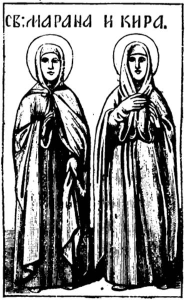
«Марана и Кира (Μαρανα кαι Kυρa), пишет он28, происходили из знатного семейства города Бериа и были воспитаны сообразно положению своему в свете. По любви к Господу Иисусу, они пренебрегли всеми преимуществами состояния своего, всеми приманками мира и избрали жизнь покаяния.
"Marana and Cyra (Μαρανα και Κυρα)," he writes28, "came from a noble family of the city of Beroea and were raised in accordance with their position in the world. Out of love for the Lord Jesus, they despised all the advantages of their station, all the allurements of the world, and chose a life of repentance.
Вблизи города нашли они себе ущелье и, войдя в него, заложили вход камнями и глиною. Служанкам своим, которые захотели делить жизнь их, дозволили они жить вблизи, в особом жилье. Из окошечка подвижницы видят, как те живут, и понуждают их к молитве, разогревают любовь их в подвигам благочестия. Сами они не имеют ни дома, ни шалаша, а живут под открытым небом, подвергаясь влиянию всех воздушных перемен. Необходимую пищу принимают в окошко; чрез то же окошечко беседуют с теми женами, которые приходят к ним. Впрочем на это определено одно время, Пятидесятница; в другое же хранят молчание; разговаривает с приходящими одна Марана; другую же никто не слыхал беседующею. Они носят еще на себе цепи и столько тяжелые, что Кира, слабая телом, всегда согнута до земли и не может подняться. Покрывала на них длинные, так что назади волочатся по земле и совсем закрывают ноги их; спереди же спускаются до пояса, совсем закрывая лице, шею, грудь и руки. Я часто видал их, говорит о себе блаженный; они приказывали для меня открывать вход, уважая достоинства священства. Знаю я и тяжесть цепей их, – и крепкий мужчина не мог бы носить их. После долгой просьбы моей, они снимали эти цепи. Но когда удалялся я, они опять наложили их на себя, на шею – шейную цепь, на чресла – пояс, на руки и ноги – цепи особые. И так они живут не пять или десять лет, а 52 года. Тогда как столько времени подвизались, ревнуют трудиться, как будто недавно начали подвизаться. Плененные красотою Жениха, они легко несут труды подвига и спешат дойти до конца подвига; они видят, – в конце стоит Он и показывает венцы победные. По этой-то причине переносят они и дождь, и снег, и зной солнца, не чувствуя ни страданий, ни боли. Подражая посту Моисея, они три раза выдерживали пощение его29. Ревнуя примеру Даниила, оставались без пищи три недели. Раз захотелось им видеть святые места Христовых страданий и они ходили в Иерусалим, но во всю дорогу не ели ничего. Когда пришли в город и выполнили поклонение, приняли пищу. Возвратный путь совершили опять без пищи. А всего пути не менее 20 дней. Еще захотелось им видеть в Исаврии дом Феклы, знаменитой победительницы, – захотелось разогреть в себе любовь к Господу и – они опять ходили туда и сюда, не вкушая пищи. Те, которые украсили женский труд такою жизнию, став образцами для других, явились увенчанными у Господа венцами победы».
Near the city they found a ravine for themselves, and entering it, they blocked the entrance with stones and clay. To their maidservants, who wished to share their life, they allowed them to live nearby, in a separate dwelling. Through a small window the ascetics see how they live, and urge them to prayer, and kindle their love for deeds of piety. They themselves have neither house nor hut, but live under the open sky, exposed to all the changes of the weather. They receive necessary food through the window; through the same window they converse with those women who come to them. However, a specific time is set for this, Pentecost; at other times they keep silence; only Marana speaks with those who come; the other has never been heard conversing. They also wear chains, and so heavy that Cyra, weak of body, is always bent to the ground and cannot rise. Their veils are long, so that behind they trail on the ground and completely cover their feet; in front they fall to the waist, entirely covering the face, neck, chest and hands. I have often seen them, says the blessed one about himself; they would order the entrance opened for me, out of respect for the dignity of the priesthood. I know the weight of their chains too – a strong man could not bear them. After my long entreaty, they would remove these chains. But when I departed, they would put them on again: on the neck – a neck-chain, on the loins – a belt, on the hands and feet – separate chains. And thus they lived not for five or ten years, but for 52 years. Though they had struggled for so long, they were zealous to labor as if they had only recently begun their asceticism. Captivated by the beauty of the Bridegroom, they easily bear the toils of the struggle and hasten to reach the end of the contest; they see – at the end He stands and shows the crowns of victory. For this reason they endure both rain and snow and the heat of the sun, feeling neither suffering nor pain. Imitating the fast of Moses, they three times endured his fast29. Emulating the example of Daniel, they remained without food for three weeks. Once they wished to see the holy places of Christ's sufferings, and they went to Jerusalem, but ate nothing during the whole journey. When they entered the city and performed their veneration, they took food. The return journey they again made without food. And the whole journey was no less than 20 days. Again they wished to see in Isauria the house of Thecla, the renowned victorious one – they wished to kindle in themselves love for the Lord – and again they went there and back, tasting no food. Those who adorned womanly labor with such a life, becoming examples for others, appeared crowned before the Lord with crowns of victory."
По другому известию, св. Марана и Кира, живя на земле, творили чудеса, возвращали зрение слепым, исцеляли бесноватых и хромым давали ходить прямо30. Кончина их последовала около 430 г.
According to another account, Sts. Marana and Cyra, while living on earth, worked miracles, restored sight to the blind, healed the demon-possessed, and made the lame walk straight30. Their end followed about 430 A.D.
Ркп. житие преп. Антония, по всем спискам, – сочинение ученика его Андрея. – (Обзор духов. литературы § 28–33. 133. 195). Напечатано в Правосл. Собеседнике 1858 г. Оно кое-где дополнено и изменено Нифонтом, описавшим чудеса преподобного (прим. 14.). Андрей пишет: «уведев преподобный свое отшествие к Богу, призва мя и нарече менесебе отца духовнаго и добре исповедав со слезами, поведа моему окаянству свое пришествие из Рима и о камени и о сосуде древяном, сиречь о бочки».
The manuscript Life of the Venerable Anthony, according to all copies, is the work of his disciple Andrew. – (Survey of Spiritual Literature §§ 28–33. 133. 195). It was printed in the Orthodox Interlocutor of 1858. It was in places supplemented and altered by Niphon, who described the miracles of the Venerable (note 14). Andrew writes: 'The Venerable one, knowing his departure to God, called me and appointed me his spiritual father; and having made a good confession with tears, he revealed to my wretchedness his coming from Rome, and about the stone, and about the wooden vessel, that is, the barrel.'
См. в прибав. к твор. отц. 1860 г. Для чести историка Костомарова было бы выгоднее, если бы он не говорил ни слова о давнем быте, не справясь с памятниками. (Севернорус. народоправства 2, 320, 321).
See in the Supplements to the Works of the Fathers, 1860. For the honor of the historian Kostomarov, it would have been more advantageous if he had said not a word about the ancient way of life, without consulting the monuments. (Northern Russian Popular Governments 2, 320, 321).
Если что либо другое, то эти черты древней отшельнической жизни, так мало известные России 17 в. несомненно убеждают в верности того, что ученик Антония Андрей писал записки о жизни Антония со слов его.
If anything else, then these features of ancient hermitic life, so little known in 17th-century Russia, undoubtedly convince us of the truth that Anthony’s disciple Andrew wrote his notes on the life of Anthony from his own words.
Грамота нап. в ист. иер. 3, 123. в том виде, как она написана на раке преподобного. Она то упоминается, то буквально повторяется в царских грамотах от 15 август. 1573 г. (Ист. иер. 3, 145), от декаб. 1592 г. ibid. 3, 155. 158. 160–164), от 11 авг. 1606 г. (ibid. 197. 198. 203. 2Ю), от 25 авг. 1621 г. ibid. 219. 222–226). На раке недостает конца ее, как это видно по грамотам. Житие: „начат строити обитель и купи землю около монастыря у посадников градских и со живущими, юже ту на той земли, людьми прилучившимися.
The charter is printed in History of the Hierarchy 3, 123, in the form in which it is written on the shrine of the Venerable. It is either mentioned or literally repeated in the tsar's charters of August 15, 1573 A.D. (History of the Hierarchy 3, 145), of December 1592 A.D. (ibid. 3, 155. 158. 160–164), of August 11, 1606 A.D. (ibid. 197. 198. 203. 210), of August 25, 1621 A.D. (ibid. 219. 222–226). The end of it is missing on the shrine, as is evident from the charters. The Life: 'He began to build the monastery and bought land around the monastery from the city posadniks and from the people living there on that land.'
Собр. л. III, 4–6. 123. 124. 213. IV, 2. 8. IX, 150. 154. Житие: «поживе с пришествия своего до игуменства 14 лет». Надлежало сказать: 24. Равно не мог написать Андрей, что построение каменной Церкви совершалось при епископе Никите, скончавшемся в 1108 г. Собр. л. 3, 4. 5. 214. В древнем списке говорилось конечно о построении деревянного храма. .
Collection of Chronicles III, 4–6. 123. 124. 213. IV, 2. 8. IX, 150. 154. The Life: 'He lived from his arrival until his abbacy 14 years.' It should have said: 24. Likewise, Andrew could not have written that the building of the stone church was accomplished under Bishop Nikita, who reposed in 1108 A.D. Collection of Chronicles 3, 4. 5. 214. The ancient copy certainly spoke of the building of a wooden church.
Снегирева памятники стр. 35. 36. По житию, Антоний взял из бочки «сосуды церковнии златы и сребряны и хрустальнии, потиры и блюда, и иная многая от священных вещей церковных, и злато и сребро от имения родителей».
Snegirev, Monuments, pp. 35–36. According to the Life, Anthony took from the barrel “vessels of the church, golden and silver and crystal, chalices and patens, and many other sacred things of the church, and gold and silver from the inheritance of his parents.”
Грамота изд. в ист. иер. 3, 124. В том виде, как написана она на древней раке, и у Карамзина 2 пр. 210. О ней в житии: «при великой реке Волхве рыбную ловитву купи на потребу монастырю и межами отмежив и письму вдав и в духовную свою грамоту написав... Предлагает преподобный братии заповедь: аще случится избрати игумена, но избрати от братии, иже кто на месте сем терпит, и аще князь нашлет игумена или епископ, по насилию или по мзде, – и тех преподобный проклятию предаст“.
The charter published in History of the Hierarchy III, 124. In the form in which it is written on the ancient reliquary, and also in Karamzin II, note 210. Concerning it in the Life: “He purchased fishing rights on the great river Volkhov for the needs of the monastery, and marked the boundaries, and committed it to writing, and wrote it into his spiritual testament… The Venerable One gives a commandment to the brethren: if it should happen that an abbot is to be chosen, let him be chosen from among the brethren, from those who endure in this place; and if a prince or a bishop sends an abbot, by force or for a bribe, the Venerable One consigns such to anathema.”
Оно изд. в труд. общ. ист. 1828 г. IV, 122–128. с замечаниями Хавского в чтен. общ. ист. 1847 г. № 6.
It was published in Transactions of the Society of Russian History for 1828, IV, 122–128, with notes by Khavsky in Readings of the Society of Russian History for 1847, No. 6.
Обиход, служебник и требник описаны Куприяновым в обозр. пергам. рукоп. № 57. 72. и 78. Изв. акад. VI, 229–301. 314–318.
The Horologion, Service Book, and Euchologion are described by Kupriyanov in Survey of Parchment Manuscripts, Nos. 57, 72, and 78. Bulletin of the Academy of Sciences VI, 229–301, 314–318.
В обиходе «завету монаху» предшествует «молебный канон Кирилла грешнаго», св. Кирилла Туровского. Это указывает на то, что завет принадлежит св. Кириллу и может быть прислан был в Антониеву обитель самим Кириллом. – В обиходе завет написан с ошибками. В двух чудовских рукоп. XIV в. ошибки исправлены, но прибавлены и пояснения. Удерживаем древний текст и последующие поправки, без пояснений. Завет изд. в матер. для ист. рус. Цер. стр. 157–161.
In the Horologion, the “Testament to a Monk” is preceded by the “Moleben Canon of Cyril the Sinner,” that is, St. Cyril of Turov. This indicates that the Testament belongs to St. Cyril and may have been sent to the Anthony Monastery by Cyril himself. In the Horologion, the Testament is written with errors. In two Chudov manuscripts of the 14th century, the errors are corrected, but explanations are also added. We retain the ancient text and the subsequent corrections, without explanations. The Testament is published in Materials for the History of the Russian Church, pp. 157–161.
В монастыре еще дело евангелие с припискою: «л. 7045 (1537) Евангелие сие дал в дом рождества Пречистой и к преподобному отцу Антонию». Ист. иер. III. 145. II о ркп. известны два описания чудес: одно Нифонтово 1598 г., другое неизвестного изображает чудеса 1546–1576 г. Румянц. муз. стр. 209. 210. Отенские святцы: «мощи его обретены Быша в л. 7105 (1597) июля в 1 день и почивают на верху земли; служба есть и чудес множество; память его св. Церковь празднует августа 3 дня». Ему праздновали и 17 января (д. пр. Антония егип.): но в 1678 г. отменили. Правосл. обзор. 1861 г. 1, 299.
In the monastery there is also a Gospel book with the inscription: “In the year 7045 (1537), this Gospel was given to the house of the Nativity of the Most Pure One and to the Venerable Father Anthony.” History of the Hierarchy III, 145. Of the manuscripts, two descriptions of miracles are known: one by Niphont from 1598; the other, by an unknown author, describes miracles from 1546 to 1576. Rumyantsev Museum, pp. 209–210. The Otensk Menologion: “His relics were uncovered in the year 7105 (1597) on July 1, and they rest above the ground; there is a service and a multitude of miracles; the Holy Church celebrates his memory on August 3.” They also celebrated his memory on January 17 (the day of St. Anthony of Egypt), but this was abolished in 1678. Orthodox Review, 1861, I, 299.
Боголюбская история гл. 29. Провинция Киррестика, называвшаяся так по городу Кирру, простиралась между равниною городов Антиохии и Евфратом, на севере оканчивалась Коммагеною и Аманом, на юге шла до пустыни. Кирр – в двух днях пути от Антиохии. Ritter Erdkunde X; 928. В Киррской епархии при бл. Феодоте было до 800 церквей и много монастырей. Le-Quien Or. chr. II, 930.
God-loving History, ch. 29. The province of Cyrrhestica, named after the city of Cyrrhus, extended between the plain of the cities of Antioch and the Euphrates; on the north it ended at Commagene and Mount Amanus, on the south it went as far as the desert. Cyrrhus is two days’ journey from Antioch. Ritter, Erdkunde X, 928. In the diocese of Cyrrhus, under Blessed Theodotus, there were up to 800 churches and many monasteries. Le Quien, Oriens Christianus II, 930.
Менолог Василия на 28 февр. Мартиролог римский – авг. 3. «В Беррее сирской кончина святых жен (дев) Вараны и Киры». У Вершинского (стр. 33) Марина – неточность.
The Menologion of Basil for February 28. The Roman Martyrology for August 3: “In Syrian Berœa, the end of the holy women (virgins) Barana and Cyra.” In Vershinsky (p. 33), “Marina” is an inaccuracy.