Orthodox Translations

July 3030 июля

Old Calendar: civil August 12 · New Calendar: civil July 30

History

Свв. Апп. от 70: Силы (Силоса), Силуана, Крискента, Епфнета и Андроника

Sts. Apostles of the Seventy: Silas (Silos), Silvanus, Crescens, Epenetus, and Andronicus

E1.TAI draft

Сила вместе с Ап. Павлом проповедовал слово Божие; посланный Апостолами из Иерусалима в Антиохию для прекращения спора, возникшего между верующими относительно обрядового Моисеева закона, он с того времени не отлучался от Ап. Павла до прибытия в Коринф; вместе с ним претерпел многие страдания и заключение в темницу. В Деяниях Апостольских так упоминается о нём: «а Павел, избрав себе Силу, отправился, быв поручен братиями благодати Божией. И проходил Сирию и Киликию, утверждая Церкви» (Деян.15:40–41). – По прибытии же в Коринф, был поставлен епископом и много потрудился для насаждения веры, подкрепляя проповедь свою знамениями и чудесами.

Silas together with the Apostle Paul preached the word of God; sent by the Apostles from Jerusalem to Antioch to settle the dispute that had arisen among the believers concerning the ceremonial law of Moses, from that time he did not depart from the Apostle Paul until his arrival in Corinth; together with him he endured many sufferings and imprisonment. In the Acts of the Apostles it is thus mentioned concerning him: "But Paul chose Silas and departed, being commended by the brethren to the grace of God. And he went through Syria and Cilicia, strengthening the churches" (Acts 15:40–41). – Upon his arrival in Corinth, he was appointed bishop and labored much for the planting of the faith, confirming his preaching with signs and wonders.

E1.0AI draft

Силуан был сотрудником в благовествовании свв. Апп. Петра и Павла: «Иисус Христос, проповеданный у вас нами, мной, и Силуаном, и Тимофеем», – воспоминает о нём св. Ап. Павел во втором своём послании к Коринфянам (2Кор.1:19). – «Сие кратко написал я вам через Силуана, верного, как думаю, вашего брата», – пишет о нём Ап. Пётр в своём первом соборном послании (1Пет.5:12).

Silvanus was a fellow worker in the gospel of the holy Apostles Peter and Paul: "Jesus Christ, who was preached among you by us, by me, and Silvanus, and Timothy," – the holy Apostle Paul recalls concerning him in his second epistle to the Corinthians (2 Cor. 1:19). – "By Silvanus, a faithful brother unto you, as I suppose, I have written briefly," – the Apostle Peter writes concerning him in his first catholic epistle (1 Pet. 5:12).

E1.1AI draft

Впоследствии Силуан был епископом в Македонском городе Солуне, где много пострадал за веру Христову и мученически скончался.

Afterwards Silvanus was bishop in the Macedonian city of Thessalonica, where he suffered much for the faith of Christ and died a martyr's death.

E1.2AI draft

О Крискенте говорит Ап. Павел во втором послании к Тимофею (2Тим.4:10), что «он пошёл в Галатию», где по поручению Апостола Павла и наслаждал Церковь Божию, быв поставлен епископом; также проповедовал в Галлии, нынешней Франции, основал там Церковь Виенскую и другие и, поставив епископом в городе Виенне ученика своего Захария, возвратился в Галатию, где мученически скончался в царствование императора Траяна.

Concerning Crescens the Apostle Paul says in the second epistle to Timothy (2 Tim. 4:10), that "he went to Galatia," where by the commission of the Apostle Paul he also edified the Church of God, having been appointed bishop; he also preached in Gaul, present-day France, founded there the Church of Vienne and others, and having appointed his disciple Zacharias as bishop in the city of Vienne, he returned to Galatia, where he died a martyr's death in the reign of the Emperor Trajan.

E1.3AI draft

О св. Епенете, бывшем родом из Ахаии и обращённом к вере Христовой св. Ап. Павлом, Ап. Павел воспоминает в своём послании к Римлянам: «приветствуйте возлюбленного моего Епенета, который есть начаток Ахаии для Христа» (Рим.16:6). Он епископствовал в Карфагене.

Concerning St. Epenetus, who was from Achaia and was converted to the faith of Christ by the holy Apostle Paul, the Apostle Paul recalls in his epistle to the Romans: "Greet my beloved Epenetus, who is the firstfruits of Achaia for Christ" (Rom. 16:6). He was bishop in Carthage.

E1.4AI draft

О св.Андронике, бывшем епископом в Паннонии, св. Апостол воспоминает также в своём послании к Римлянам: «приветствуйте Андроника и Юнию – сродников моих и узников со мной, прославившихся между Апостолами и прежде меня ещё уверовавших во Христа» (Рим.16:7).

Concerning St. Andronicus, who was bishop in Pannonia, the holy Apostle also recalls in his epistle to the Romans: "Greet Andronicus and Junia, my kinsmen and fellow prisoners, who are of note among the Apostles, who also were in Christ before me" (Rom. 16:7).

E1.5AI draft

Особое празднество св. Андронику совершается 17 мая вместе с Юниею, помощницей его.

A special feast of St. Andronicus is celebrated on May 17 together with Junia, his helper.
E1.6AI draft

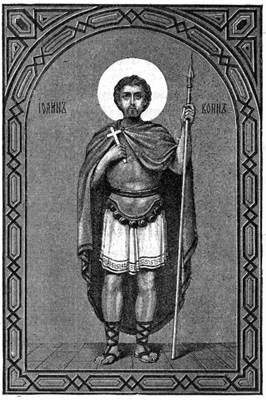
Св. Иоанна воина

St. John the Warrior

E2.TAI draft
Engraving

Иоанн был военачальником в царствование Иулиана Отступника (361–363); он исповедовал христианскую веру, и когда послан был во главе отряда для преследования и истребления христиан в одной области, где было замечено значительное распространение их, то, прибыв туда, тайно покровительствовал своим единоверцам, предупреждал их об угрожающих им опасностях, помогал им укрываться, содействовал освобождению их из темниц, доставлял им необходимое, ободрял и утешал их. Это не могло остаться в неизвестности, и Иулиан, уведомлённый об образе действий Иоанна, повелел заместить его другим лицом, а его представить на суд в Константинополь. Дорогой вытерпел он много страданий; воины, сопровождавшие его, как государственного преступника, обращались с ним жестоко, мучали его голодом и били его. Когда привели Иоанна в Константинополь, то Иулиана не было там; он в это время находился в походе против Персов, и Иоанна, в ожидании возвращения императора, заключили в темницу, где он был подвергнут всяким лишениям и страданиям. В продолжение нескольких месяцев томления в темнице, он иногда изнемогал душой; сомнение, стоит ли менять спокойную жизнь на такие страдания – закрадывалось в его душу, как неизбежное искушение в борьбе плоти и духа, но Иоанн не поддавался ему и искал поддержки в молитве. – «Господи! – взывал он своей скорбной душой, – Ты видишь, что я слаб и немощен... помоги мне! Сомнения колеблют ум мой: поддержи меня! утверди ноги мои на камне заповедей Твоих! Не устою, если Ты не поможешь мне!»

John was a military commander in the reign of Julian the Apostate (361–363); he professed the Christian faith, and when he was sent at the head of a detachment to persecute and destroy Christians in a certain region where a considerable spread of them had been noticed, then, having arrived there, he secretly protected his fellow believers, warned them of threatening dangers, helped them to hide, assisted in freeing them from prisons, supplied them with necessities, encouraged and comforted them. This could not remain unknown, and Julian, informed of John's manner of action, ordered that he be replaced by another person, and that he be brought to trial in Constantinople. On the way he endured much suffering; the soldiers who accompanied him, as a state criminal, treated him cruelly, tormented him with hunger and beat him. When they brought John to Constantinople, Julian was not there; he was at that time on a campaign against the Persians, and John, awaiting the emperor's return, was cast into prison, where he was subjected to every deprivation and suffering. During several months of languishing in prison, he sometimes grew faint in soul; doubt, whether it was worth exchanging a peaceful life for such sufferings, crept into his soul as an inevitable temptation in the struggle of flesh and spirit, but John did not yield to it and sought support in prayer. – "O Lord!" he cried out with his sorrowful soul, "Thou seest that I am weak and feeble... help me! Doubts shake my mind: support me! establish my feet upon the rock of Thy commandments! I shall not stand if Thou dost not help me!"

E2.0AI draft

И, успокоенный молитвой и вразумлённый свыше, он снова радостно молился: – «верую в Господа моего, сотворившего всё и Своей благостью давшего мне жизнь. Жив Бог, жива душа моя! Ради славы Его и любви к Нему я готов вытерпеть всё в этом мире!»

And, calmed by prayer and instructed from on high, he again prayed joyfully: – "I believe in my Lord, who created all things and by His goodness gave me life. As God lives, so lives my soul! For the sake of His glory and love for Him I am ready to endure everything in this world!"

E2.1AI draft

Между тем, пока ожидали возвращения с войны Иулиана и толковали в народе о страшных мучениях, которые готовятся содержащимся в темницах, внезапно получено было известие о смерти Иулиана, поражённого стрелой, и благодатная перемена произошла в государстве, так как преемником Иулиана был – Иовиан, ревностный христианин. Он не замедлил возвратить свободу заключённым в темницах христианам, и таким образом был освобождён и Иоанн. Испытанный скорбями и очищенный ими, как золото в горниле, он посвятил остальную жизнь свою на служение Богу и жил только для добра. Имение своё употребил всё в пользу бедных, посещал неутомимо болящих и страждущих, которые находили в нём истинного утешителя и помощника, и таким образом – в чистоте и святости дожил до преклонной старости. Умирая, завещал похоронить себя на том месте, где погребали странников и нищих, которые во всю жизнь были близки душе его.

Meanwhile, while awaiting Julian's return from the war and the people were talking about the terrible torments being prepared for those held in prisons, news was suddenly received of Julian's death, struck by an arrow, and a gracious change took place in the state, for Julian's successor was Jovian, a zealous Christian. He did not delay in granting freedom to the Christians imprisoned in dungeons, and thus John was also set free. Tested by sorrows and purified by them, like gold in a furnace, he devoted the rest of his life to the service of God and lived only for good. He used all his property for the benefit of the poor, tirelessly visited the sick and suffering, who found in him a true comforter and helper, and thus – in purity and holiness he lived to a ripe old age. Dying, he bequeathed that he be buried in the place where strangers and beggars were interred, who throughout his life were close to his soul.

E2.2AI draft

Впоследствии могила Иоанна была забыта, но она указана была в откровении одной благочестивой женщине, и с тех пор от мощей св. Иоанна, обретённых нетленными и прославленных чудотворной силой, происходили исцеления. В Константинополе праздник в память его совершался в церкви св. Апост. Иоанна Богослова близ Софии.

Afterwards John's grave was forgotten, but it was revealed in a vision to a certain pious woman, and from that time, from the relics of St. John, found incorrupt and glorified by wonderworking power, healings occurred. In Constantinople his feast was celebrated in the church of the holy Apostle John the Theologian near Hagia Sophia.

E2.3AI draft

В Киево-Софийском соборе находится икона св. Иоанна воина с молитвой следующего содержания: – «О, великий заступник и угодник Христов, Иоанне Воинственниче! помилуй раба твоего сущего в бедах и скорбях и во всякой злой напасти, и сохрани от всякого зла, заступи от обидящего человека: тебе бо дана бысть таковая благодать от Бога».

In the St. Sophia Cathedral in Kiev there is an icon of St. John the Warrior with a prayer of the following content: – "O great intercessor and servant of Christ, John the Warrior! have mercy on your servant who is in troubles and sorrows and every evil misfortune, and preserve from every evil, defend from the offending man: for such grace has been given you from God."

E2.4AI draft

† Обретение мощей преп. Германа Соловецкого

† Uncovering of the Relics of the Venerable Herman of Solovetsk

E3.TAI draft

Блаж. Герман412 сперва уединённо подвизался на р. Выге, у часовни. Здесь нашёл его блаж. Савватий, искавший безмолвного места. Герман указал Савватию на Соловецкий остров, как на место самое безмолвное. В 1429 г. он и Савватий переплыли Белое море на ладье, построили келью под Секирной горой и жили здесь отшельниками шесть лет. По кончине Савватия, Герман нашёл другого ревнителя безмолвной жизни и вместе с блаж. Зосимой (в 1436 г.) опять поселился на суровом острове. В 2 верстах от нынешнего монастыря построил себе келью блаж. Зосима, а в полверсте от него стал жить в куще Герман. Более 50 лет прожил он на холодном острове. Он не был человеком книжным, но подвигами приобрёл духовную опытность, различавшую духовные явления от естественных. Убеждённый в том, что жизнь великих подвижников доставляет назидание многим, Герман, как пишет современник его, «не умея писать по книжному, но вразумляемый Божиим промыслом, приказал клирикам записать для памяти всё, что видел он при жизни блаженного Савватия, как пришёл он с ним на Соловецкий остров, разные события при жизни блаженных отцов; таких записок составилось немало»413. Блаж. Герман любил чтение назидательное и собирал книги. Ещё цел в Соловецкой библиотеке сборник, по надписи принадлежавший пр. Герману. Эта любовь к назидательным книгам передана им и ученику его Досифею: достойный ученик обогатил обитель самыми полезными книгами, выбирая в Новгороде лучшие книги и по содержанию, и по письму и нанимая лучших писцов списывать их для обители414. Бл. Герман старался как можно более быть полезным для обители. И при жизни пр. Зосимы и после него не раз он путешествовал на твёрдую землю для выполнения нужд обители. Святая любовь его не взирала при том ни на опасности плавания по обманчивому морю, ни на другие неудобства пути, не лёгкие особенно для дряхлой старости. Он и скончался на службе обители. При игумене Арсении, преемнике св. Зосимы, авва Герман, быв послан в Новгород по нуждам обители, в обители пр. Антония Римлянина почувствовал близость кончины своей, исповедовался, приобщился св. Таин и мирно предал дух свой Богу. Ученики его везли тело его в Соловецкую обитель, но за распутицей принуждены были оставить его на берегу р. Свири у часовни деревни Хавроньиной. Спустя 5 лет (в 1484 г.) при игум. Исаии решились перенести гроб аввы в Соловецкую обитель; когда посланные откопали в земле и открыли гроб аввы, то нашли мощи его нетленными; перевезённый гроб с честью был поставлен близ алтаря, по правую сторону церкви св. Николая, рядом с мощами пр. Савватия. Ныне мощи аввы Германа почивают в часовне его имени415. Здесь же стоит каменный четвероконечный крест, стоявший в келье пр. Савватия и перед которым молился вместе с ним и авва Герман416. Вот древний тропарь авве Герману: «украсившись, премудре, постническим житием, спостник был еси и сожитель в морском отоце преподобным отцом Зосиме и Савватию, сподвизався в молитвех и трудех и в пощениих, преподобне отче Германе: но яко имея дерзновение к Богу, моли избавити нас от враг, и спасти души наши». Этот тропарь написан был в 1602 г. на старой Тотыме пресвитером Григорием, по приказанию явившегося ему Германа, и им же потом одобрен. По тому же видению написан был образ пр. Германа, вместе с Зосимой и Савватием, и от того образа истекло несколько исцелений больным417.

The blessed Herman412 first asceticised in solitude on the Vyg River, near a chapel. Here the blessed Sabbatius found him, seeking a place of silence. Herman pointed out to Sabbatius the Solovetsky Island as the most silent place. In 1429 he and Sabbatius crossed the White Sea in a boat, built a cell under Sekirnaya Hill, and lived here as hermits for six years. After the repose of Sabbatius, Herman found another zealot of the silent life and together with the blessed Zosimas (in 1436) again settled on the harsh island. Two versts from the present monastery the blessed Zosimas built himself a cell, and half a verst from him Herman began to live in a hut. He lived on the cold island for more than 50 years. He was not a bookish man, but through ascetic labors he acquired spiritual experience, which distinguished spiritual phenomena from natural ones. Convinced that the life of great ascetics provides edification to many, Herman, as his contemporary writes, "not knowing how to write in a bookish manner, but instructed by God's providence, ordered the clerics to write down for memory everything that he had seen during the life of the blessed Sabbatius, how he came with him to the Solovetsky Island, various events during the life of the blessed fathers; such notes were compiled in no small number"413. The blessed Herman loved edifying reading and collected books. In the Solovetsky library there is still preserved a collection, according to its inscription belonging to the Venerable Herman. This love for edifying books was also passed on by him to his disciple Dositheus: the worthy disciple enriched the monastery with the most useful books, selecting in Novgorod the best books both in content and in script, and hiring the best scribes to copy them for the monastery414. The blessed Herman strove to be as useful as possible to the monastery. Both during the life of the Venerable Zosimas and after him, he more than once journeyed to the mainland to fulfill the needs of the monastery. His holy love, moreover, regarded neither the dangers of sailing on the treacherous sea, nor other inconveniences of the journey, which were not easy especially for decrepit old age. He died while serving the monastery. Under Abbot Arsenius, the successor of St. Zosimas, Abba Herman, having been sent to Novgorod on monastery business, in the monastery of the Venerable Anthony the Roman felt the nearness of his end, made confession, partook of the Holy Mysteries, and peacefully surrendered his spirit to God. His disciples carried his body to the Solovetsky Monastery, but because of impassable roads they were forced to leave it on the bank of the Svir River near the chapel of the village of Khavronyina. Five years later (in 1484) under Abbot Isaiah they decided to transfer the coffin of Abba to the Solovetsky Monastery; when those sent dug up the ground and opened the coffin of Abba, they found his relics incorrupt; the transported coffin was honorably placed near the altar, on the right side of the church of St. Nicholas, next to the relics of the Venerable Sabbatius. Now the relics of Abba Herman rest in a chapel named after him415. Here also stands a stone four-pointed cross, which stood in the cell of the Venerable Sabbatius and before which Abba Herman also prayed together with him416. Here is the ancient troparion to Abba Herman: "Having adorned thyself, O wise one, with the ascetic life, thou wast a fellow faster and co-dweller on the sea island with the venerable fathers Zosimas and Sabbatius, striving together in prayers and labors and fastings, O venerable father Herman: but as having boldness toward God, pray to deliver us from enemies, and to save our souls." This troparion was written in 1602 in old Totma by the priest Gregory, at the command of Herman who appeared to him, and was afterwards approved by him. According to the same vision, an icon of the Venerable Herman, together with Zosimas and Sabbatius, was painted, and from that icon several healings of the sick flowed forth417.

E3.0AI draft

Примечания Notes

О житии пр. Германа говорит ученик его Досифей в житии Зосимы и Савватия. Особое житие написано в начале XVI века неизвестным, который дополнил сказания Досифея рассказом видевшего перенесение мощей аввы в 1484 году.

Concerning the life of the Venerable Herman, his disciple Dositheus speaks in the life of Zosimas and Sabbatius. A separate life was written at the beginning of the 16th century by an unknown author, who supplemented the accounts of Dositheus with the narrative of one who witnessed the translation of the abba’s relics in 1484.

N412AI draft

Послесловие Досифея к житию преп. Зосимы и Савватия. Москв <...> 1846 года, ч. VI.

The afterword of Dositheus to the life of the Venerable Zosimas and Sabbatius. Moscow <...> 1846, part VI.

N413AI draft

Библиотека Соловецкого монастыря – в Православ. собеседн. 1859 года, 1, 29–34.

The Library of the Solovetsky Monastery – in the Orthodox Interlocutor, 1859, 1, 29–34.

N414AI draft

Ркп. житие Германа, написанное со слов видевшего переносе мощей его. Опис. Соловецкого монастыря, стр. 41–45. 62. 65. 66. 244. 3<...>.

Manuscript life of Herman, written from the words of one who witnessed the translation of his relics. Description of the Solovetsky Monastery, pp. 41–45, 62, 65, 66, 244, 3<...>.

N415AI draft

Истина о св. Соловецкой обители, стр. 61. СПб. 1834. Опис. Соловецкой обители 292. Μ. 1836 года.

The Truth Concerning the Holy Solovetsky Monastery, p. 61. St. Petersburg, 1834. Description of the Solovetsky Monastery, p. 292. Moscow, 1836.

N416AI draft

Ркп. житие преп. Германа.

Manuscript life of the Venerable Herman.

N417AI draft