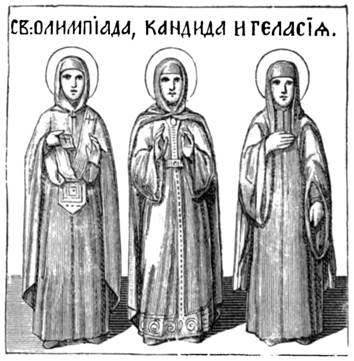
Дивная Олимпиада314 происходила из аристократической Константинопольской фамилии и была очень богата. Отец её был сенатор Анисий Секунд, а мать – дочь благочестивого Евлавия, префекта претории при благоверном Константине. Она ещё в детском возрасте лишилась родителей. Потому опека над её имениями поручена была дяде её Прокопию, а воспитанием её занималась Феодосия, тётка св. Амфилохия и св. Григория Назианзского, умная и добродетельная, которой поручена она была ещё отцом.
The wondrous Olympias314 came from an aristocratic Constantinopolitan family and was very wealthy. Her father was the senator Anicius Secundus, and her mother was the daughter of the pious Eulabius, prefect of the praetorium under the Right-believing Constantine. She lost her parents while still a child. Therefore, the guardianship of her estates was entrusted to her uncle Procopius, while her upbringing was undertaken by Theodosia, the aunt of St. Amphilochius and St. Gregory of Nazianzus, a woman of intelligence and virtue, to whom she had been entrusted by her father.
Так как она была богата и учёна, то руки её искали многие и ещё юной обручена она была с Небридием, префектом столицы. Прекрасные стихи присланы были (в 384 г.) дивным святителем Григорием в подарок Олимпиаде, вступающей в брак315. Но спустя 20 месяцев после обручения Небридий умер; Олимпиада осталась вдовой и вместе девою316. Многие после того искали руки Олимпиады. Сам император Феодосий Великий предлагал ей выйти за Елпидия, молодого аристократа Испанца, родственника царского. Но она отклонила предложение, а «Если бы Господь хотел, чтобы была я супругой, то не взял бы у меня Небридия», отвечала она. Феодосий повторил своё предложение, но также услышал отказ. Император оскорбился и, отправляясь на войну с Максимом (388 г.), приказал префекту столицы взять в опеку имение её до 30-летнего возраста её. Префект, услуживая Елпидию, поступал оскорбительно с Олимпиадой: ей запретили посещать епископов, не пускали её и в храм Божий, лишь бы вынудить её к браку. Олимпиада переносила всё благодушно. Она желала даже более стеснить себя. Она писала к императору: «Государь! ты оказал мне милость, которая достойна не только государя, но и епископа; опекой над имениями освобождена я от многих забот. Для большего счастья моего, благоволи повелеть, чтобы роздано было всё церквам и нищим. Издавна боюсь я наклонностей суетности, которые при раздаче имений так легко возникают. Временные блага, пожалуй, могли бы отдалить сердце моё от истинных благ, духовных и вечных». Феодосий жил тогда на западе и, когда после трёхгодичного отсутствия возвратился в столицу, возвратил (в 391 г.) в полное распоряжение её все имения. «Такая добродетельная и умная девушка лучше нас умеет, как употреблять блага времени», сказал государь.
As she was rich and learned, many sought her hand, and while still young she was betrothed to Nebridius, the prefect of the capital. Beautiful verses were sent (in 384 A.D.) by the wondrous Hierarch Gregory as a gift to Olympias upon her entering into marriage315. But twenty months after the betrothal, Nebridius died; Olympias remained a widow and at the same time a virgin316. Many afterwards sought the hand of Olympias. The Emperor Theodosius the Great himself proposed that she marry Elpidius, a young Spanish aristocrat and a relative of the imperial house. But she declined the proposal, replying, "If the Lord had wished me to be a wife, He would not have taken Nebridius from me." Theodosius repeated his proposal but again heard a refusal. The emperor took offense and, setting out for war with Maximus (388 A.D.), ordered the prefect of the capital to take her estate into guardianship until she reached the age of thirty. The prefect, currying favor with Elpidius, behaved insultingly toward Olympias: she was forbidden to visit bishops, and was not even allowed to enter the church of God, all in order to compel her to marry. Olympias bore everything with good grace. She even desired to constrain herself further. She wrote to the emperor: "Sovereign! You have shown me a kindness worthy not only of a sovereign but also of a bishop; by the guardianship of my estates, I have been freed from many cares. For my greater happiness, be pleased to command that everything be distributed to the churches and the poor. For a long time I have feared the inclinations of vanity, which so easily arise in the distribution of property. Temporal blessings might, perhaps, alienate my heart from the true blessings, the spiritual and eternal." Theodosius was then living in the West, and when, after a three-year absence, he returned to the capital, he restored (in 391 A.D.) all her estates to her full disposal. "Such a virtuous and wise maiden knows better than we how to use the blessings of time," said the sovereign.
Получив свободу по имениям, блаженная Олимпиада расточала средства свои на дела милосердия щедрой рукой. Не было города, ни деревни, ни пустыни, где бы не пользовались милостями знаменитой Олимпиады. Она доставляла приношения церквам, монастырям, кафедрам, странноприимным домам, темницам, местам ссылки. Не сосчитать тех невольников, которым она даровала свободу платой денег господам их317. Св. Златоуст сравнивал милосердие её с обильной рекой, которая несёт воды свои до самых границ земли и обогащает море. И он же убеждал её, а она смиренно слушалась, ограничивать щедрость свою, измерять её не просьбами, а нуждами.
Having obtained freedom over her estates, the blessed Olympias lavished her means on works of mercy with a generous hand. There was no city, no village, no desert where the benefactions of the renowned Olympias were not enjoyed. She provided offerings to churches, monasteries, cathedras, hospices, prisons, and places of exile. Innumerable were the slaves to whom she granted freedom by paying money to their masters317. St. Chrysostom compared her mercy to a bountiful river that carries its waters to the very ends of the earth and enriches the sea. And he also urged her—and she humbly obeyed—to limit her generosity, measuring it not by requests but by needs.
При богатстве своём Олимпиада вела жизнь смиренной рабы Божией. Воспитанная в пышности и неге, она отказалась от всех удовольствий света и вела жизнь простую. Никогда не вкушала она мяса; не принимала ванн, которые так нужны в жарком климате. Ночные бдения обратились ей в привычку и время её посвящалось преимущественно молитве. Обхождение её с другими дышало христианской скромностью и искренностью. «Наружность её открытая, нрав искренний, одежда даже одетым в лохмотья показалась бы ничего не стоящей; кротость её была такова, что превосходила простоту детей, говорит очевидец!318. Св. Златоуст, утешая её в скорбях, писал ей из заточения: «ты от природы получила самое нежное и слабое тело; знатная порода доставила тебе все способы роскошно питать его; но ты разными страданиями так истощила его, что оно теперь ничем не лучше мёртвого. Ты добровольно произвела в теле твоём такой род болезней, что их не могут вылечить ни искусство врачей, ни сила лекарств... Тебя не одолевает страсть к плотским удовольствиям и потому нет для тебя труда воздерживаться от них. Ты приучила своё тело столько принимать хлеба и питья, чтобы только не умереть. Скажу несколько слов вот об этой простоте и неизысканности, которую наблюдаешь касательно платья. Кажется, эта добродетель ниже других; но если внимательно рассмотреть её, найдёшь, что она весьма величественна, что она требует для себя души умной, стоящей выше всего житейского, парящей к небу. По сей причине не только в новом, но и в старом завете Бог запрещал страсть к нарядам и говорил: понеже вознесошася дщери Сиона и ходиша высокою выею и помизанием очей и ступанием ног, купно ризы влекущие по долу и ногами купно играющие: и смирит Господь начальныя дщери Сиона... И будет вместо вони смрад, а вместо пояса ужем препояшися (Ис.3:16–23)... Павел, обращая речь к светским женщинам, не только отклоняет их от нарядов золотых, но не дозволяет одеваться и в ценные одежды (1Тим.2:3). Ибо знал он, знал хорошо, что щегольство – тяжкая болезнь души; болезнь, с которой трудно бороться, – самый верный признак испорченного сердца»319.
Despite her wealth, Olympias led the life of a humble handmaiden of God. Brought up in luxury and delicacy, she renounced all worldly pleasures and led a simple life. She never tasted meat; she did not take baths, which are so necessary in a hot climate. Night vigils became a habit for her, and her time was devoted chiefly to prayer. Her manner with others breathed Christian modesty and sincerity. "Her appearance is open, her character sincere, her clothing such that even those dressed in rags would consider it worthless; her meekness was such that it surpassed the simplicity of children, says an eyewitness!318 St. Chrysostom, comforting her in her sorrows, wrote to her from exile: "You received by nature a most delicate and weak body; noble birth provided you every means to nourish it luxuriously; but you have so exhausted it through various sufferings that it is now no better than a corpse. You have voluntarily produced in your body such a kind of illness that neither the art of physicians nor the power of medicines can cure... You are not overcome by passion for bodily pleasures, and therefore there is no labor for you in abstaining from them. You have accustomed your body to receive only so much bread and drink as not to die. Let me say a few words about this simplicity and lack of adornment which you observe concerning clothing. This virtue may seem inferior to others; but if one examines it attentively, one will find that it is very majestic, that it requires a soul that is wise, standing above everything earthly, soaring to heaven. For this reason, not only in the New but also in the Old Testament, God forbade the passion for finery and said: Because the daughters of Zion are haughty, and walk with outstretched necks and wanton eyes, walking and mincing as they go, and making a jingling with their feet: therefore the Lord will humble the chief daughters of Zion... And instead of a sweet smell there shall be a stench, and instead of a girdle thou shalt be girded with a rope (Is. 3:16–23)... Paul, addressing worldly women, not only turns them away from gold ornaments but does not permit them to dress in costly garments (1 Tim. 2:3). For he knew, he knew well, that vanity in dress is a grievous sickness of the soul; a sickness with which it is difficult to struggle—the surest sign of a corrupted heart."319
Ещё св. Нектарий, патриарх Константинопольский, посвятил св. Олимпиаду в диакониссы. В чём состояли занятия Олимпиады, как диакониссы?
St. Nectarius, Patriarch of Constantinople, had already consecrated St. Olympias as a deaconess. In what did the duties of Olympias as a deaconess consist?
Первая забота – смотрение за страждущими и несчастными жёнами. «С рассветом дня можно видеть: многие старушки и вдовы толпятся около темницы; даже знаменитые из них прислуживают заключённой и всю ночь проводят при ней; приносятся вкусные угощения и читаются священные книги им», так писал язычник о христианских диакониссах.
Her first concern was the care of suffering and unfortunate women. "At daybreak one may see many old women and widows crowding around the prison; even the most distinguished among them minister to the imprisoned woman and spend the whole night with her; tasty refreshments are brought and sacred books are read to them," thus wrote a pagan about Christian deaconesses.
Диакониссы обучали женский пол Закону Божию, особенно во время приготовления к крещению. Карфагенский 4 собор постановил: «вдовицы или посвящённые, – избираемые в служение при крещении жён, должны быть столько приготовлены к должности, чтобы могли обучать простых сельских женщин ясными и церковными правилами, как отвечать крещаемой при крещении и как жить после крещения».
Deaconesses taught the female sex the Law of God, especially during preparation for baptism. The Fourth Council of Carthage decreed: "Widows or dedicated women, chosen for service at the baptism of women, should be so prepared for their office that they can teach simple rural women in clear and ecclesiastical rules how to answer the one being baptized at baptism and how to live after baptism."
Диакониссы услуживали женщинам при совершении над ними таинств, при крещении, при причащении, при исповеди, при браке; они наблюдали за благочинием жён в доме молитвы, украшали храмы и смотрели за их чистотой.
Deaconesses ministered to women during the celebration of the mysteries over them: at baptism, at Communion, at confession, at marriage; they watched over the decorum of women in the house of prayer, adorned the churches, and saw to their cleanliness.
Служение таинствам и сёстрам было приятным занятием для Олимпиады. Очевидец жизни её писал: «она питала священство, уважала клир, помогала вдовым, кормила сирот, посещала больных, плакала с грешниками, возвращала заблудших на путь добра, – многих жён, бывших за язычниками, наставляла в вере и давала им средства к пропитанию»320.
Ministry to the mysteries and to the sisters was a pleasant occupation for Olympias. An eyewitness of her life wrote: "She nourished the priesthood, respected the clergy, helped widows, fed orphans, visited the sick, wept with sinners, brought the erring back to the path of good—many women who were married to pagans she instructed in the faith and gave them means of sustenance."320
Добродетели Олимпиады были предметом удивления и утешения для целой Церкви. Знаменитые святители того времени говорили о ней с глубоким уважением. Святой Амфилохий, св. Епифаний, св. Пётр Севастийский, св. Оптат епископ пользовались щедрой её благотворительностью и славили за неё Господа. Она своими руками закрыла глаза умиравшим патр. Нектарию и епископу Оптату. Она благотворила и тем архипастырям, которые не отличались высокой нравственностью, каковы Акакий, Антиох, Севериан; она чтила высокий сан их.
The virtues of Olympias were a subject of wonder and consolation for the whole Church. The renowned hierarchs of that time spoke of her with deep respect. St. Amphilochius, St. Epiphanius, St. Peter of Sebaste, St. Optatus the bishop enjoyed her generous charity and glorified the Lord for it. With her own hands she closed the eyes of the dying Patriarch Nectarius and Bishop Optatus. She also showed charity to those archpastors who were not distinguished by high morality, such as Acacius, Antiochus, and Severian; she honored their high rank.
Буря бед поднялась на св. Олимпиаду с того времени, как начались гонения на Златоуста. Первый враг Златоуста, Феофил Александрийский, был первым врагом и блаж. Олимпиады. Она с любовью принимала его в доме своём, когда был он в столице, угощала и дарила его. Когда же приняла она, как принимала всех иноков и страждущих, великих братьев, изгнанных из Египта гордостью Феофила, – Феофил начал позорить её гнусными клеветами. Злость императрицы, преследовавшая Златоуста, бесновалась и против Олимпиады, уважавшей Златоуста и уважаемой в свете и Церкви. Особенно, когда пожар опустошил Софийский храм и сенат, злоба врагов Златоуста обрушилась над защищавшими Златоуста. Говорили, что пожар – их дело. Префект Оптат язычник взял Олимпиаду к допросу. «Для чего поднят этот пожар?» спрашивал он её. «Моя жизнь, какую доселе вела я, отвечала Олимпиада, освобождает меня от подозрения, высказываемого тобой. Кто столько денег роздал на построение храмов, конечно, не в состоянии жечь их». Префект присудил с невинной – на покрытие ущербов казны внести соразмерную (огромную) сумму денег321. Отягчённая скорбями, Олимпиада впала в болезнь, которая томила её всю зиму. В начале весны приказано ей было оставить столицу. Долгое время скиталась она из одного места в другое, не зная, где приклонить голову. В середине осени 405 г. приказано ей было возвратиться в столицу. Её и теперь обвиняли за то, что будто производит раздор в Церкви. Не могла она не считать невинно изгнанным Златоуста, и страдания великого святителя причиняли душе её глубокое страдание322. Но тем более чтила она заповедь его и не отделялась от Церкви по его завещанию. «Со всяким благочестием покорялась она своим епископам, говорит современник – и прибавляет; никто из близких к ней никогда не замечал, чтобы эта христоносная порицала кого-нибудь»323. Много раз призывали её к суду; бесстыдные слуги позорили её; рвали на ней платье. Одни имения её продавались с публичного торга, другие разоряемы были чернью, за третьи таскали её по судам. Собственные слуги её, которым благотворила она как мать, восставали против неё, по наущению врагов. Сильно страдала душа её; св. Златоуст писал к ней: «перестань плакать, перестань мучить себя печалью; не смотри на эти несчастья, которые идут к тебе непрестанно, идут одно за другим без промежутка; помышляй о свободе, которая так близка; помышляй о неизреченных наградах, которые принесут тебе твои несчастья... Что значит быть выброшенным из отечества, быть переводимым с места на место, быть пленником, быть везде гонимым, жить в ссылке, влачиться по судам, – получать оскорбления от людей, получавших тысячи благодеяний, подвергаться мучениям и от рабов, и от свободных, – что всё это значит, когда за всё это награда – целое небо»324.
A storm of calamities descended upon St. Olympias from the time the persecution of Chrysostom began. The first enemy of Chrysostom, Theophilus of Alexandria, was also the first enemy of the blessed Olympias. She received him lovingly in her home when he was in the capital, entertained him, and gave him gifts. But when she received—as she received all monks and the suffering—the great brothers expelled from Egypt by the pride of Theophilus, Theophilus began to defame her with vile slanders. The malice of the empress, which pursued Chrysostom, raged also against Olympias, who respected Chrysostom and was respected in society and the Church. Especially when a fire devastated the Church of Hagia Sophia and the Senate, the wrath of Chrysostom's enemies fell upon those who defended Chrysostom. They said that the fire was their doing. The prefect Optatus, a pagan, summoned Olympias for interrogation. "Why was this fire started?" he asked her. "My life, as I have led it until now," replied Olympias, "frees me from the suspicion you express. One who has given so much money for the building of churches is certainly not capable of burning them." The prefect sentenced the innocent woman to pay a sum of money proportionate (an enormous amount) to cover the treasury's losses321. Overwhelmed by sorrows, Olympias fell into an illness that tormented her all winter. At the beginning of spring, she was ordered to leave the capital. For a long time she wandered from one place to another, not knowing where to lay her head. In the middle of autumn of the year 405, she was ordered to return to the capital. Even then she was accused of causing discord in the Church. She could not but consider Chrysostom innocently exiled, and the sufferings of the great Hierarch caused deep anguish to her soul322. But all the more she honored his commandment and did not separate herself from the Church according to his testament. "With all piety she submitted to her bishops," says a contemporary, "and adds: none of those close to her ever noticed that this Christ-bearing woman spoke ill of anyone"323. Many times she was summoned to court; shameless servants insulted her; they tore her clothes. Some of her estates were sold at public auction, others were ravaged by the mob, and for still others she was dragged through the courts. Her own servants, to whom she had been charitable as a mother, rose up against her, instigated by her enemies. Her soul suffered greatly; St. Chrysostom wrote to her: "Cease weeping, cease tormenting yourself with grief; do not look at these misfortunes which come to you incessantly, one after another without interval; think of the freedom which is so near; think of the inexpressible rewards which your misfortunes will bring you... What does it mean to be cast out of one's fatherland, to be moved from place to place, to be a captive, to be persecuted everywhere, to live in exile, to be dragged through the courts—to receive insults from people who have received thousands of benefactions, to suffer torments from both slaves and free men—what does all this mean, when the reward for all this is the whole of heaven?"324
«Многих других жён научила она», пишет Гераклид о св. Олимпиаде, и св. Златоуст писал к самой Олимпиаде: «особенно приятно мне, что ты, освободившись от тяжб и поручений, положила им конец достойный тебя. Ты не отвергла их малодушно, не задержала понапрасну, не унизила себя в судах и неприятностях, соединённых с тяжбой»325. Как слова Гераклида, так слова Златоуста дают видеть, что в последние годы свои блаж. Олимпиада была настоятельницею сестёр-монахинь. Прерванием связей с миром блаженная хотела оградить себя от дрязг суда, как и от обвинений, сыпавшихся на неё без разбора, будто она, первая диаконисса, – причина того, что многие не хотят знать нового патриарха. Мир не любит винить себя в чём-либо; он всегда прав в его глазах, а виноваты только другие; слепой от страстей, он не видит ни себя, ни других. Потому злость мира преследовала Олимпиаду и в её уединении. При Аттике община сестёр Олимпиады выслана была из столицы в заточение в Кизик. Св. Златоуст писал тогда к Олимпиаде: «как славна добродетель, презирающая все перевороты настоящей жизни! Через старающихся унизить её она делает подвижников своих сильнее, выше, непобедимее... Вот чем, Боголюбезнейшая госпожа моя, должна ты веселить себя и тех, которые вместе с тобой борются в нынешней славной борьбе! Вот чем одобряй мысли и дух всех (девственниц), настраивая свою дружину»326.
"She taught many other women," writes Heraclides about St. Olympias, and St. Chrysostom wrote to Olympias herself: "It is especially pleasing to me that you, having freed yourself from lawsuits and commissions, have brought them to an end worthy of you. You did not reject them faint-heartedly, did not delay them in vain, did not debase yourself in the courts and the unpleasantness connected with litigation"325. Both the words of Heraclides and the words of Chrysostom show that in her last years the blessed Olympias was the abbess of a sisterhood of nuns. By breaking ties with the world, the blessed one wished to shield herself from the vexations of the court, as well as from the accusations that were heaped upon her indiscriminately, that she, the first deaconess, was the reason why many did not wish to acknowledge the new patriarch. The world does not like to blame itself for anything; in its own eyes it is always right, and only others are to blame; blind from passions, it sees neither itself nor others. Therefore, the world's malice pursued Olympias even in her seclusion. Under Atticus, the community of Olympias's sisters was sent from the capital into exile in Cyzicus. St. Chrysostom then wrote to Olympias: "How glorious is virtue that despises all the upheavals of this present life! Through those who strive to humble it, it makes its ascetics stronger, higher, more invincible... This, my most God-loving lady, is what you must use to cheer yourself and those who together with you are struggling in this glorious contest! With this, encourage the thoughts and spirit of all (the virgins), inspiring your company"326.
Святая девственница Олимпиада осталась в заточении до самой своей кончины, которая последовала в 410 году. «Лучшие жители Константинополя, писал Палладий в 420 году, считают её в числе исповедниц и уверены, что она, страдавшая за истину и для Бога, наследовала блаженную жизнь»327.
The holy virgin Olympias remained in confinement until her very end, which occurred in the year 410. "The best inhabitants of Constantinople," wrote Palladius in the year 420, "count her among the confessors and are confident that she, having suffered for the truth and for God, has inherited a blessed life"327.
Святое тело её, положенное в храме безвестного местечка, совершало чудеса. Спустя 200 лет дикари сожгли храм, но тело святой осталось невредимым. Когда переносили его в Константинополь, из него текла кровь, как из живого, в знак невинного страдания, перенесённого в земной жизни. Мощи положены были в обители, основанной святой328.
Her holy body, placed in the church of an obscure village, worked miracles. Two hundred years later, barbarians burned the church, but the body of the saint remained unharmed. When it was translated to Constantinople, blood flowed from it as from a living body, a sign of the innocent suffering she had endured in her earthly life. The relics were placed in the monastery founded by the saint328.
«По следам Олимпиады, говорит Палладий, Богоугодно проводила жизнь блаженная Кандида, дочь полководца Траяна. Она достигла высокой чистоты, разумно украшала церкви, по благоговению к тайнам Христовым чтила епископов и уважала весь клир. Обучив дочь свою правилам девственной жизни, отдала её Христу, как дар сердца своего. Потом и сама она, раздав имение своё, последовала за дочерью и проводила жизнь в чистоте и целомудрии. Для изнурения плоти трудилась она по целым ночам, молола своими руками муку и пекла просфоры. Так как один пост недостаточен, говорила она, то я присоединяю к нему изнурительное бдение, чтобы сокрушить похотливость Исава. Она вовсе не употребляла в пищу мяса животных, но ела только рыбу, масло и овощи, да и это лишь по праздникам; во всякое другое время довольствовалась водой, смешанной с уксусом, и сухим хлебом. Проведши такую суровую жизнь, эта достославная жена почила блаженным сном и теперь наслаждается вечными благами, уготованными для возлюбивших жизнь добродетельную»329.
"Following in the footsteps of Olympias," says Palladius, "the blessed Candida, daughter of the commander Trajan, led a God-pleasing life. She attained a high degree of purity, wisely adorned churches, and out of reverence for the Mysteries of Christ honored the bishops and respected the entire clergy. Having taught her daughter the rules of virginal life, she gave her to Christ as a gift of her heart. Then she herself, having distributed her property, followed her daughter and lived a life of purity and chastity. To mortify her flesh, she labored whole nights, ground flour with her own hands, and baked prosphora. 'Since fasting alone is insufficient,' she said, 'I add to it exhausting vigil, in order to crush the lustfulness of Esau.' She ate no meat of animals at all, but only fish, oil, and vegetables, and even these only on feast days; at all other times she contented herself with water mixed with vinegar and dry bread. Having led such an austere life, this glorious woman reposed in a blessed sleep and now enjoys the eternal blessings prepared for those who have loved a virtuous life"329.
Подобно сей благочестивой жене, с ревностью проходила путь правды и благочестиво несла иго девства славная Геласия, дочь трибуна. В этой чудной деве особенная была добродетель та, что солнце никогда не заходило в гневе её на раба, или на служанку, или на кого другого (Еф.4:26). Геласия боялась помнить об обиде или неприятности, нанесённых другим. Прощайте и прощены будете (Лк.6:37), такова воля Божия, говорила она себе. Не любя ближнего, нельзя любить Господа; а в том нет любви, кто сердится на другого, кто не прощает его за всё. Гнев – дело испорченной души (Ин.5:20). Гнев – беснование (Притч.27:4). Гнев покоится в сердце глупца (Еккл.7:10). К несчастью, ни чей гнев так не безобразен, как гнев жены (Сир.27:33). Дальше, дальше от него, то ли дело – детское незлобие: оно так приятно Господу. Он сказал нам: если не обратитесь и не будете как дети, не войдёте в Царство Небесное. Кто умалится как это дитя, тот и больше в Царстве Небесном (Мф.18:3–4). Таким путём, путём детского незлобия, блаженная вошла в жизнь блаженную330.
Like this pious woman, the glorious Gelasia, daughter of a tribune, zealously walked the path of righteousness and piously bore the yoke of virginity. The particular virtue of this wondrous maiden was that the sun never set on her anger towards a slave, or a maidservant, or anyone else (Eph. 4:26). Gelasia feared to remember an offense or unpleasantness she had caused others. Forgive and you will be forgiven (Lk. 6:37), such is the will of God, she said to herself. Without loving one's neighbor, one cannot love the Lord; and there is no love in one who is angry with another, who does not forgive him for everything. Anger is a matter of a corrupted soul (Jn. 5:20). Anger is madness (Prov. 27:4). Anger dwells in the heart of a fool (Eccl. 7:10). Unfortunately, no one's anger is as ugly as the anger of a woman (Sir. 27:33). Away, away from it; is that not the matter—childlike innocence: it is so pleasing to the Lord. He said to us: if you do not turn and become like children, you will not enter the Kingdom of Heaven. He who humbles himself like this child is greater in the Kingdom of Heaven (Mt. 18:3–4). By this path, the path of childlike innocence, the blessed one entered into the blessed life330.
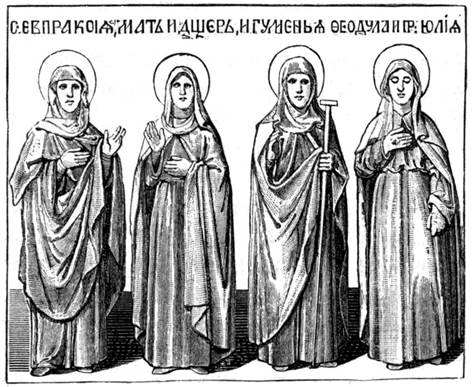
При императоре Феодосии Великом был в царственном городе сенатор Антигон331, близкий к императору и по родству, и по служебным отношениям, умный на словах и на деле, советник благожелательный, управлявший Ликией честно, человек сострадательный. Император любил его не только как сенатора, но и как христианина, всегда готового подать самый лучший совет. Богат он был, как никто из вельмож современных. Супруга его Евпраксия была также в родстве с домом императора и также была благочестива. «Она, вознося молитвы к Богу со слезами, много делала приношений храмам и монастырям». Бог благословил добрую чету рождением дочери Евпраксии. И отец, и мать были очень рады. В одно время Антигон говорит своей супруге: «ты знаешь, добрая Евпраксия, как ничтожна эта жизнь, как ничтожно богатство, как ничтожна пышность мирская. Напрасно мы тратим дни наши, если не заботимся о спасении душ». Евпраксия сказала: «как повелишь, господин мой, так и будем жить». Тот продолжал: «Бог дал нам дочь; довольно для нас, и не будем более мы делить ложа». Евпраксия с восторгом отвечала: «благословен Бог, подавший тебе святую мысль. Я давно молилась о том. Время коротко, говорит Апостол, – пусть имеющие жён живут, как не имеющие (1Кор.7:29)».
During the reign of the Emperor Theodosius the Great, there lived in the imperial city a senator named Antigonus331, close to the emperor both by kinship and by official relations, wise in word and deed, a benevolent counselor, who governed Lycia honestly, a compassionate man. The emperor loved him not only as a senator, but also as a Christian, always ready to give the best advice. He was wealthy as none of the nobles of his time. His wife Eupraxia was also related to the imperial house and was likewise pious. "She, offering prayers to God with tears, made many offerings to churches and monasteries." God blessed the good couple with the birth of a daughter, Eupraxia. Both father and mother were overjoyed. On one occasion Antigonus said to his wife: "You know, good Eupraxia, how insignificant this life is, how insignificant wealth is, how insignificant worldly pomp is. We waste our days in vain if we do not care for the salvation of our souls." Eupraxia said: "As you command, my lord, so we shall live." He continued: "God has given us a daughter; that is enough for us, and we shall no longer share the same bed." Eupraxia replied with delight: "Blessed be God, who has given you this holy thought. I have long prayed for this. The time is short, says the Apostle—let those who have wives live as if they had none (1 Cor. 7:29)."
Император был поражён скорбью о потере человека, которого по строгости его правил и по уму опытному заменить кем-либо было очень трудно. Тем более старался он утешить вдову. Когда дочери минуло 5 лет, император, объявивший себя опекуном её, советовал матери обручить её с сыном честного и богатого сенатора. Мать согласилась с умным советом и приняла подарки. Между тем в то же время, как мать устраивала судьбу дочери, собственной руки её домогался вельможа, втайне от императора искавший помощи императрицы, и императрица приняла сторону искателя. С величайшим изумлением приняла Евпраксия предложение, сделанное ей от имени императрицы. Она, не требуя времени на размышление, отказала наотрез искателю. Император, узнав о том, был очень недоволен супругой своей. Ему известна была решимость Евпраксии служить Господу; делать ей предложение о браке значило оскорблять её незаслуженно, – так понимал дело император. С печалью замечая, что неумный вызов на брак стал причиной холодности между императором и императрицей, Евпраксия тайно отправилась в Египет, под предлогом нужды осмотреть имения свои. По дороге посещала она многие монастыри, оставляя в них щедрые подаяния.
The Emperor was stricken with grief over the loss of a man whom, by the strictness of his principles and his experienced mind, it was very difficult to replace with anyone. He tried all the more to comfort the widow. When her daughter reached the age of five, the Emperor, who had declared himself her guardian, advised the mother to betroth her to the son of an honorable and wealthy senator. The mother agreed to the wise counsel and accepted the gifts. Meanwhile, at the same time that the mother was arranging her daughter’s fate, a certain nobleman was seeking her hand in secret from the Emperor, enlisting the aid of the Empress, and the Empress took the side of the suitor. Eupraxia received the proposal made to her in the Empress’s name with the greatest astonishment. Without asking for time to reflect, she flatly refused the suitor. The Emperor, upon learning of this, was very displeased with his wife. He knew of Eupraxia’s resolve to serve the Lord; to make her a proposal of marriage meant to insult her undeservedly—such was the Emperor’s understanding of the matter. Noticing with sorrow that the unwise challenge concerning marriage had become the cause of coldness between the Emperor and the Empress, Eupraxia secretly set out for Egypt, under the pretext of needing to inspect her estates. Along the way, she visited many monasteries, leaving generous alms in them.
Тавеннская женская обитель аммы Феодулы с 130 сёстрами славилась строгостью правил её332. «Тут не употребляли ни вина, ни яблока, ни винограда, ни финика, ни другого чего-либо приятного для вкуса, иные не вкушали даже и елея; одни постились с вечера до вечера; другие принимали пищу через день, а некоторые через два или три дня. Ни одна не мыла ног своих; иные, услышав о бане, смеялись и считали это за гнусность, нетерпимую для слуха. Для каждой постелью была земля, покрытая власяницей в локоть ширины и в три длины, тут и покоилась она. Одежда их была из шерсти и доходила до пят. Каждая работала, сколько могла. Если которая заболевала, к пособиям медицины не обращались; болезнь принимали за благословение Божие и терпеливо переносили страдание, если не посылалось исцеление Господом. Ни одна не выходила за ворота обители. Была привратница, через неё передавались все ответы. Вся забота их была о том, как угодить Господу молитвенными помышлениями. Потому Бог творил здесь много знамений, подавая исцеления для приходивших сюда».
The Tabennisi women’s monastery of Amma Theodula, with 130 sisters, was renowned for the strictness of its rule332. “Here they used neither wine, nor apple, nor grape, nor date, nor anything else pleasant to the taste; some did not even taste oil; some fasted from evening to evening; others took food every other day, and some every two or three days. Not one washed her feet; some, upon hearing of a bath, laughed and considered it an abomination, intolerable to the ear. For each, the bed was the earth, covered with a haircloth a cubit in width and three in length, and there she rested. Their garments were of wool and reached to the heels. Each worked as much as she could. If any fell ill, they did not resort to the aids of medicine; they accepted illness as a blessing from God and patiently bore the suffering, if healing was not sent by the Lord. Not one went out beyond the gates of the monastery. There was a portress; through her all answers were conveyed. Their whole concern was how to please the Lord with prayerful thoughts. Therefore God worked many signs here, granting healings to those who came.”
Глубоко поражённая такой жизнью инокинь, Евпраксия часто бывала в их обители с дочерью, которой был восьмой год. Она дарила обители свечи и ладан. Раз говорит она настоятельнице: «хотелось бы мне доставить доход обители в 20 или 30 литр (фунтов) золота, дабы молились вы за рабу вашу и за отца её Антигона». Игуменья отвечала: «госпожа моя благородная! рабыни твои не требуют ни золота, ни имений; они всё оставили, чтобы заслужить вечные блага, и всего мирского чуждаются, страшась лишиться Небесного Царства. Чтобы не опечалилась ты на нас, принеси нам елей для лампад и ладан для кадил, и за то будет награда тебе». Когда это принесено было, Евпраксия просила молиться за Антигона и дочь его Евпраксию333.
Deeply struck by such a life of the nuns, Eupraxia often visited their monastery with her daughter, who was in her eighth year. She presented the monastery with candles and incense. Once she said to the abbess: “I would like to provide the monastery with an income of 20 or 30 litrae (pounds) of gold, so that you might pray for your handmaiden and for her father Antigonus.” The abbess replied: “My noble lady! Your handmaidens require neither gold nor estates; they have left all to obtain eternal blessings, and they shun everything worldly, fearing to lose the Heavenly Kingdom. Lest you be grieved with us, bring us oil for the lamps and incense for the censers, and for that you shall have a reward.” When this was brought, Eupraxia asked them to pray for Antigonus and for his daughter Eupraxia333.
Настоятельница любила заниматься с маленькою Евпраксией. Нравятся ли ей монастырь и сёстры? спросила она девочку. «Очень нравятся», отвечала она. «Если же так, – почему не останетесь вы с нами?» продолжала игуменья. «Я осталась бы с большой охотой, – возразила девочка, – но боюсь, чтоб это не огорчило доброй моей мамы». – «Кого вы любите более, – сказала ещё настоятельница, – нас ли, или жениха своего, с которым обручены?» – «Я совсем не знаю его, – отвечала маленькая Евпраксия, – да и он тоже не знает меня; а вас я знаю и люблю; но вы кого любите: меня или моего жениха?» – «Мы очень любим вас, – отвечала настоятельница; – Господа же нашего Иисуса Христа любим более всего». – «И я, – сказала девочка, – люблю вас очень, а более вас люблю Господа Иисуса».
The abbess loved to occupy herself with little Eupraxia. “Do you like the monastery and the sisters?” she asked the girl. “I like them very much,” she replied. “If so, then why do you not stay with us?” continued the abbess. “I would stay with great pleasure,” the girl answered, “but I am afraid that this might grieve my good mother.” “Whom do you love more,” the abbess said further, “us, or your betrothed, to whom you are engaged?” “I do not know him at all,” replied little Eupraxia, “and he does not know me either; but you I know and love; yet whom do you love: me or my betrothed?” “We love you very much,” answered the abbess; “but our Lord Jesus Christ we love above all.” “And I,” said the girl, “love you very much, but more than you I love the Lord Jesus.”
Радостно вёлся этот разговор. Евпраксия мать выражала радость свою слезами. Когда нужно было расставаться с обителью, Евпраксия дочь объявила матери, что желает остаться в монастыре. Стараясь отговорить её, сказали ей, что в обители нельзя остаться иначе, как дав обет посвятить себя Христу. Девочка спросила: «а где Христос?» Игуменья показала ей на образ Спасителя. Девочка кинулась к иконе, целовала её и твёрдо произнесла: «истинно, искренно я даю обет Христу и не возвращусь домой с матерью»334. Тогда положили позволить ей переночевать в монастыре, полагая, что она не пожелает остаться долее. Но на следующий день убедились, что намерение её не изменилось. Настоятельница заметила, что, если она хочет остаться, должна выучить весь псалтирь наизусть, должна поститься до вечера и мало спать. Ребёнок согласился на всё, настаивая на том, чтобы остаться в монастыре.
This conversation was carried on joyfully. Eupraxia the mother expressed her joy with tears. When it was time to part from the monastery, Eupraxia the daughter declared to her mother that she wished to remain in the monastery. Trying to dissuade her, they told her that one could not remain in the monastery except by making a vow to dedicate oneself to Christ. The girl asked: “And where is Christ?” The abbess pointed to the icon of the Savior. The girl rushed to the icon, kissed it, and firmly pronounced: “Truly, sincerely I make a vow to Christ, and I will not return home with my mother”334. Then they decided to allow her to spend the night in the monastery, supposing that she would not wish to stay longer. But the next day they became convinced that her intention had not changed. The abbess remarked that if she wished to stay, she must learn the entire Psalter by heart, must fast until evening, and sleep little. The child agreed to everything, insisting on remaining in the monastery.
Эта решимость так была необыкновенна, что настоятельница сказала матери: «не Сам ли Бог внушает дочери вашей такое желание? Видно, добродетели и молитвы родителей призвали на неё особенную благодать Божию. Оставьте её с нами».
This resolve was so extraordinary that the abbess said to the mother: “Is it not God Himself who inspires such a desire in your daughter? Evidently, the virtues and prayers of the parents have called down upon her a special grace of God. Leave her with us.”
Любовь Евпраксии к Господу была выше нежной привязанности её к единственной дочери. Она подвела девочку к образу Спасителя и, подняв руки к небу, с громким плачем сказала: «Господи Иисусе! прими это дитя под Твой покров». Потом, обратясь к дочери, сказала: «Создатель, утвердивший горы, да утвердит тебя, дочь моя, в страхе Своём!» Затем передала дочь настоятельнице.
Eupraxia’s love for the Lord was stronger than her tender attachment to her only daughter. She led the girl to the icon of the Savior and, raising her hands to heaven, said with loud weeping: “Lord Jesus! Receive this child under Thy protection.” Then, turning to her daughter, she said: “May the Creator, who established the mountains, establish you, my daughter, in His fear!” Then she handed her daughter over to the abbess.
Спустя несколько дней игуменья с молитвами в молитвенном доме одела девочку в одежду отшельницы. Мать спросила её: «нравится ли ей новый наряд?» Девочка отвечала, что любит его больше всякого другого, потому что Христос дарует его только избранным. «Да соделает же Он тебя вполне достойной милостивого Своего избрания», сказала добрая мать. Она обняла её, простилась с настоятельницей и, вступая в одинокую жизнь, положила избрать и себе новую дорогу.
A few days later, the abbess, with prayers in the prayer-house, clothed the girl in the garment of a recluse. The mother asked her: “Do you like your new attire?” The girl replied that she loved it more than any other, because Christ grants it only to the chosen. “May He then make you fully worthy of His merciful election,” said the good mother. She embraced her, took leave of the abbess, and, entering upon a solitary life, resolved to choose a new path for herself as well.
Она продолжала дела щедрого милосердия, но вместе стала строже к себе самой, – прекратила употребление вина, мяса, рыбы, и ела только овощи, один раз в день. Император, услышав о перемене жизни её, изумился и рад был.
She continued the works of generous mercy, but at the same time became stricter with herself—she ceased the use of wine, meat, and fish, and ate only vegetables, once a day. The Emperor, hearing of the change in her life, was amazed and rejoiced.
В подвигах духовной жизни, Евпраксия старшая приблизилась к концу жизни своей. Это было открыто настоятельнице обители, где осталась дочь её. Она видела во сне Антигона, окружённого светом и просившего у Господа дозволения привести свою супругу. Настоятельница объявила об этом самой Евпраксии. Евпраксия была уже столько тверда, что считала только небо отчизной своей. Узнав о близости конца, она благодарила Господа за знак милости Его к ней и просила довершить милость упокоения её в святых Его.
In the labors of the spiritual life, Eupraxia the elder drew near to the end of her life. This was revealed to the abbess of the monastery where her daughter remained. She saw in a dream Antigonus, surrounded by light and asking the Lord for permission to bring his wife. The abbess announced this to Eupraxia herself. Eupraxia was already so steadfast that she considered only heaven as her homeland. Learning of the nearness of her end, she thanked the Lord for the sign of His mercy toward her and asked Him to complete the mercy of granting her repose among His saints.
Когда мать передала дочери весть о близости своей смерти, дочь, увлечённая нежной привязанностью к редкой матери, рыдала неутешно, что должна расстаться с такой матерью. Мать для успокоения её напомнила ей, что она дала обет любить выше всего Господа Иисуса. «Вот тебе, говорила она, завещание любимой тобой матери: люби Господа Иисуса с трепетом благоговения; уважай сестёр твоих; не смей никогда думать, что они ниже тебя и могут служить тебе; будь нищей в мыслях своих, чтобы пользоваться сокровищами духовными; ты теперь владеешь всем состоянием моим; доставляй нужное для обители; моли об отце твоём и о мне, да дарует Он нам милостивое прощение». Спустя три дня скончалась она и была похоронена в обители335.
When the mother conveyed to her daughter the news of the nearness of her death, the daughter, carried away by tender attachment to her rare mother, wept inconsolably that she must part with such a mother. To comfort her, the mother reminded her that she had made a vow to love the Lord Jesus above all. “Behold,” she said, “the testament of your beloved mother: love the Lord Jesus with the trembling of reverence; respect your sisters; never dare to think that they are beneath you and may serve you; be poor in your thoughts, that you may enjoy spiritual treasures; you now possess all my estate; provide what is necessary for the monastery; pray for your father and for me, that He may grant us merciful forgiveness.” Three days later she reposed and was buried in the monastery335.
Узнав о смерти старой Евпраксии, император повелел сказать о том сыну сенатора и известить, что, так как дочь приняла иночество, то связь его с ней прекращена. Потом, уступая просьбам сенатора, писал он сам к дочери и просил её возвратиться в Константинополь, чтобы вступить в обещанный брак. Евпраксия отвечала императору: «неужели хочешь ты, добрый император, чтобы раба твоя оставила Христа вечного для человека смертного? Ведь он может завтра быть пищей червей. Да избавит меня Бог от этого преступления! Повели лучше этому человеку не беспокоить тебя более и забыть о той, которая не в состоянии нарушить обета, данного Господу. Умоляю тебя, в память о моих родителях, разделить всё оставленное ими имущество между бедными, сиротами и церквами. Уверена, что ты помнишь о родителях моих и особенно об отце, который пользовался такой доверенностью твоей. Именем его и матери моей, прошу тебя обратить всё богатство их на дела угодные Богу, дать свободу всем рабам и простить долги должникам и наёмникам земель. Благоволи распорядиться всем, чтобы свободно могла я служить Господу. Молите Господа с доброй императрицей, чтобы удостоилась я быть достойной рабой Христа Господа».
Upon learning of the death of the elder Eupraxia, the Emperor ordered that this be made known to the senator’s son and that he be informed that, since the daughter had embraced monasticism, his bond with her was dissolved. Then, yielding to the senator’s entreaties, he himself wrote to the daughter and asked her to return to Constantinople in order to enter into the promised marriage. Eupraxia replied to the Emperor: “Do you indeed wish, good Emperor, that your handmaiden should leave the eternal Christ for a mortal man? For he may tomorrow be food for worms. May God deliver me from this transgression! Better command this man not to trouble you further and to forget about her who is unable to break the vow made to the Lord. I implore you, in memory of my parents, to distribute all the property they left among the poor, orphans, and churches. I am confident that you remember my parents, and especially my father, who enjoyed such trust from you. In the name of him and my mother, I ask you to turn all their wealth to works pleasing to God, to grant freedom to all the slaves, and to forgive the debts of debtors and tenants of the lands. Be pleased to arrange everything so that I may freely serve the Lord. Pray to the Lord together with the good Empress, that I may be deemed worthy to be a worthy handmaiden of Christ the Lord.”
Письмо Евпраксии было прочитано в сенате и сообщено жениху. Все видели, что юная Евпраксия – достойная дочь Антигона и Евпраксии, святая отрасль благочестивых родителей, и никто не думал более о возвращении её в мир. Император повелел немедленно выполнить со всей точностью желания её относительно наследственного имущества её. Это было перед самой смертью императора († 395 г.).
Eupraxia’s letter was read in the Senate and communicated to the bridegroom. All saw that the young Eupraxia was a worthy daughter of Antigonus and Eupraxia, a holy offshoot of pious parents, and no one thought further of her return to the world. The Emperor ordered her wishes concerning her inherited property to be carried out immediately and with all exactness. This was just before the Emperor’s death († A.D. 395).
Евпраксии было тогда 12 лет. Успехи её в жизни духовной были выше её возраста. Освободясь от заботы об имении, она вся предалась на служение Господу.
Eupraxia was then 12 years old. Her progress in the spiritual life was beyond her years. Freed from concern over her estate, she gave herself entirely to the service of the Lord.
Любовь к покаянию вызвала её на усиленный пост. Сперва она ела один раз в сутки; скоро потом – раз в двое и трое суток. Она себя отдавала на самые низкие послушания, И бывала рабыней каждой сестры обители. Не обращала она внимания на слабость сложения своего и несла труды наравне с другими.
Love for repentance led her to intensified fasting. At first she ate once a day; soon after, once every two or three days. She gave herself to the lowliest obediences, and was a servant to every sister of the monastery. She paid no attention to the weakness of her constitution and bore labors on a par with the others.
Было поставлено правилом обители, чтобы сёстры объявляли настоятельнице о каждом искушении, которое испытывали. Евпраксия, как и многие, была совершенно изумлена и встревожена первыми нападениями злобного врага; она прибегла к советам сестры Юлии, которая дана ей была в руководительницу. По её наставлению, открывала она настоятельнице состояние души своей при каждом искушении и оттого выходила из боя победительницей.
It was established as a rule of the monastery that the sisters should announce to the abbess every temptation which they experienced. Eupraxia, like many, was utterly astonished and troubled by the first attacks of the malicious enemy; she had recourse to the counsels of Sister Julia, who had been given to her as a guide. According to her instruction, she opened to the abbess the state of her soul at every temptation, and thus emerged from the battle victorious.
Опытная настоятельница не только молилась с сёстрами за юную подвижницу, но советами вела её как бы по ступеням к высокой жизни. Евпраксия, по её советам, не в том только подчинялась безмолвно, что было легко и приятно, но и в том, что оскорбляло струны самолюбия. Смирение, усвояемое более и более Евпраксией, уравнивало для неё дорогу к высоким подвигам.
The experienced abbess not only prayed with the sisters for the young ascetic, but by her counsels led her as if by steps to the lofty life. Eupraxia, according to her counsels, submitted silently not only in what was easy and pleasant, but also in what offended the strings of self-love. Humility, more and more acquired by Eupraxia, leveled the road for her to high feats of asceticism.
На 20-м году Евпраксии, когда она помимо намерений сформировалась изумительной аристократкой, настоятельница подвергла её жестокому испытанию. Она приказала ей перетаскать груду камней с одного места на другое. Камни были тяжёлые, но Евпраксия перетаскала. Игуменья приказала перетаскать их на прежнее место. Евпраксия исполнила. Тридцать раз настоятельница приказывала таскать камни с одного места на другое. И Евпраксия тридцать раз таскала их, не сказав ни слова ни о тяжести камней, ни о чём другом.
In the 20th year of Eupraxia's life, when, beyond her intentions, she had formed herself into an astonishing aristocrat, the abbess subjected her to a severe trial. She ordered her to carry a pile of stones from one place to another. The stones were heavy, but Eupraxia carried them. The abbess ordered her to carry them back to the former place. Eupraxia did so. Thirty times the abbess ordered her to carry the stones from one place to another. And Eupraxia carried them thirty times, saying not a word either about the weight of the stones or about anything else.
Твёрдость её в подвижничестве была редкая. Она читала целые часы вслух сестёр, изготовляла им трапезу; прибирала, чистила, мела в монастыре; колола и носила дрова; месила тесто и пекла хлебы. Это были ежедневные труды её. И она успевала всё делать, так что никто не оставался недовольным.
Her firmness in asceticism was rare. She read for whole hours aloud to the sisters, prepared their meal; tidied, cleaned, swept in the monastery; chopped and carried firewood; kneaded dough and baked bread. These were her daily labors. And she managed to do everything, so that no one remained dissatisfied.
Вместе с тем, не считала она себя в праве ни днём, ни ночью освобождаться от утренних молитв, третьего, шестого и девятого часа и всех служб.
At the same time, she did not consider herself entitled, either by day or by night, to free herself from the morning prayers, the third, sixth and ninth hours, and all the services.
Кто бы мог подумать, чтобы душа столько возвышенная могла подвергнуться укорам? Но Господь допустил одной сестре восстать против неё по зависти. Сестра эта была Германа. Она была низкого происхождения и по душе была невысока. Она была из тех, которые живут в монастыре на испытание другим. Германа упрекала Евпраксию в лицемерии и честолюбии, относя к ним все её труды и подвиги. Она уверяла, что Евпраксия постится лишь с тем, чтобы унижать собой других и заслужить место настоятельницы, которого ждёт нетерпеливо. Евпраксия не оскорблялась упрёками Германы; она кротко объясняла, что постится по воле игуменьи, и потом падала к ногам Германы, упрашивая простить её грешную.
Who could have thought that a soul so exalted could be subjected to reproaches? But the Lord permitted one sister to rise up against her out of envy. This sister was Germana. She was of low origin and was not lofty in soul. She was of those who live in a monastery as a trial for others. Germana reproached Eupraxia with hypocrisy and ambition, attributing to these all her labors and feats. She insisted that Eupraxia fasted only in order to humiliate others by herself and to earn the place of abbess, which she awaited impatiently. Eupraxia was not offended by Germana's reproaches; she meekly explained that she fasted by the will of the abbess, and then fell at Germana's feet, begging her to forgive her, a sinner.
Игуменья призывала к себе злобную сестру и, назначив ей особенное послушание, сказала, что она недостойна жить с другими. Евпраксия в продолжение месяца упрашивала игуменью простить Герману, потом уговорила Юлию, чтобы все сёстры просили настоятельницу за бедную Герману, и наконец достигла того, что настоятельница простила виновную. Блаженная с точностью выполняла заповедь Апостола: «не воздавайте злом за зло или ругательством за ругательство; напротив благословляйте» (1Пет.3:9).
The abbess summoned the malicious sister to herself and, assigning her a special obedience, said that she was unworthy to live with the others. Eupraxia, for the space of a month, begged the abbess to forgive Germana; then she persuaded Julia that all the sisters should ask the abbess for poor Germana; and at last she achieved that the abbess forgave the guilty one. The blessed one precisely fulfilled the Apostle's commandment: "Do not render evil for evil, or reviling for reviling; but on the contrary bless" (1 Pet. 3:9).
Злобный дух поднялся против Евпраксии с явными насилиями. Раз он столкнул её в колодезь, когда она доставала воду, в другой сбросил её с верхнего этажа здания; после опрокинул на неё котёл с горячей пищей; а там, когда колола она дрова, для кухни общей, он толкнул, и она рассекла себе ногу до того, что облитая кровью лежала без чувств. Только особенным покровом Божиим избавлялась Евпраксия от смерти336.
The malicious spirit rose up against Eupraxia with manifest violence. Once he pushed her into a well when she was drawing water; another time he threw her from the upper story of a building; afterwards he overturned a cauldron of hot food upon her; and then, when she was chopping wood for the common kitchen, he pushed her, and she cut her leg so badly that, covered with blood, she lay unconscious. Only by the special protection of God was Eupraxia delivered from death336.
Присутствие духа Божия в Евпраксии открылось нечаемым случаем. Женщина принесла дитя, поражённое параличом и лишённое слуха и языка; она со слезами просила помолиться о здоровье ребёнка. По воле игуменьи, Евпраксия приняла от матери ребёнка. Осеняя его крестным знамением, сказала она: «бедненький! да исцелит тебя Милосердый Создатель!» Она хотела нести его к игуменье, но едва пронесла несколько шагов, как больной исцелился, спросил о матери и, вырвавшись из рук святой девы, побежал, как будто и не был больным.
The presence of the Spirit of God in Eupraxia was revealed by an unexpected event. A woman brought a child stricken with paralysis and deprived of hearing and speech; with tears she asked that they pray for the child's health. By the will of the abbess, Eupraxia received the child from its mother. Making the sign of the cross over him, she said: "Poor little one! May the Merciful Creator heal you!" She wanted to carry him to the abbess, but she had scarcely carried him a few steps when the sick child was healed, asked for his mother, and, breaking free from the hands of the holy maiden, ran as if he had never been ill.
После этого опыта игуменья поручила Евпраксии ходить за бесноватой, давно жившей в обители. Её держали в цепях, да и то не смели подходить к ней, пищу подавали ей в корзине на длинном шесте. Когда Евпраксия хотела накормить бесноватую, она заскрежетала зубами и кинулась на неё. Святая дева погрозила на несчастную жезлом настоятельницы – и бесноватая утихла. Потом приняла пищу из рук Евпраксии. С тех пор Евпраксия свободно, без опасения прислуживала больной, к которой никто другой не смел подойти. Гордая и завистливая Германа раз вызвалась: и я могу кормить эту несчастную. Она подошла к ней, но ринувшаяся бесноватая бросила её на землю, изорвала на пей одежду и начала кусать и терзать её. Евпраксия прибежав спасла окровавленную Герману от бесноватой. Настоятельница сказала, что Евпраксия должна изгнать беса от больной. Святая дева глубоко смущена была таким поручением. Простёршись перед иконой Спасителя, в сознании своей немощи, со стоном призывала она помощь Божию. И отправилась к бесноватой. Сёстры следили издали, что будет. Подойдя к бесноватой, Евпраксия говорит: «да исцелит тебя Господь мой Иисус Христос, создавший тебя». И сотворила на челе её знамение креста. Вдруг все слышат голос: «как? столько лет живу я тут, а эта нечистая и похотливая хочет выгнать меня?» Евпраксия сказала: «не я выгоняю тебя, а Христос Бог». «Не выйду, поганка», – кричал дух. «Я точно поганая, полная всякой нечистоты, – говорила Евпраксия, – но повелевает Господь: выходи из неё». Как ни упирался бес, наконец, при сильной молитве Евпраксии к Господу, с криком вышел. Евпраксия прибрала бывшую больную, жившую дотоле в отвратительной нечистоте, и привела её к игуменье.
After this experience, the abbess entrusted Eupraxia with caring for a demoniac who had long lived in the monastery. They kept her in chains, and even then did not dare approach her; they gave her food in a basket on a long pole. When Eupraxia wanted to feed the demoniac, she gnashed her teeth and rushed at her. The holy maiden threatened the unfortunate woman with the abbess's staff—and the demoniac grew calm. Then she received food from Eupraxia's hands. From then on, Eupraxia freely, without fear, served the sick woman, whom no one else dared approach. The proud and envious Germana once volunteered: "I too can feed this unfortunate one." She approached her, but the demoniac, lunging, threw her to the ground, tore her clothes, and began to bite and rend her. Eupraxia, running up, saved the bloodied Germana from the demoniac. The abbess said that Eupraxia must cast out the demon from the sick woman. The holy maiden was deeply troubled by such a commission. Prostrating before the icon of the Savior, in awareness of her own weakness, with groaning she called upon God's help. And she set off to the demoniac. The sisters watched from afar to see what would happen. Approaching the demoniac, Eupraxia said: "May the Lord my Jesus Christ, who created you, heal you." And she made the sign of the cross on her forehead. Suddenly all heard a voice: "What? For so many years I have lived here, and this unclean and lustful one wants to drive me out?" Eupraxia said: "It is not I who drive you out, but Christ God." "I will not come out, you filthy one," cried the spirit. "I am indeed filthy, full of all uncleanness," said Eupraxia, "but the Lord commands: Come out of her." However much the demon resisted, at last, through Eupraxia's fervent prayer to the Lord, he came out with a cry. Eupraxia tidied the former sick woman, who had lived until then in disgusting filth, and brought her to the abbess.
После того Евпраксия жила недолго, созрев для жизни небесной. О близкой кончине её открыто было игуменье, которая, скрывая печаль свою о близкой потере, лишь за день сказала сёстрам, что близок конец Евпраксии. Сёстры поражены были глубокой скорбью. Евпраксия, услышав от Юлии извещение настоятельницы, упала на землю без чувств. По смирению считала она себя вовсе не готовой к той жизни, и потому так поражена была известием о близкой смерти. Она молилась вслух: «Господи! оставь для земной жизни моей хотя один год, дабы могла я покаяться в грехах и совершить угодное Тебе; у меня нет добрых дел для получения награды праведников». Настоятельница утешала её благостью Спасителя. Открылась тогда же горячка. Игуменья и Юлия пробыли всю ночь при больной. Юлия умоляла её упросить Господа, когда явится она к Нему, дабы и ей скоро явиться туда. Утром все сёстры простились с умиравшей и под звуки тихих молитв их Евпраксия сладко заснула, на 30-м году своей жизни, в 410 году.
After that, Eupraxia lived not long, having ripened for the heavenly life. Her imminent end was revealed to the abbess, who, concealing her sorrow at the near loss, only a day before told the sisters that Eupraxia's end was near. The sisters were struck with deep grief. Eupraxia, hearing from Julia the abbess's announcement, fell to the ground unconscious. Out of humility she considered herself altogether unprepared for that life, and therefore was so stricken by the news of her approaching death. She prayed aloud: "Lord! leave me for the earthly life at least one year, that I may repent of my sins and do what is pleasing to Thee; I have no good deeds to receive the reward of the righteous." The abbess comforted her with the goodness of the Savior. A fever then broke out. The abbess and Julia spent the whole night with the sick woman. Julia implored her to entreat the Lord, when she should appear before Him, that she too might soon appear there. In the morning all the sisters took leave of the dying one, and to the sound of their quiet prayers Eupraxia sweetly fell asleep, in the 30th year of her life, in the year 410.
Спустя три дня, проведённых в слезах, Юлия с радостью объявила игуменье, что Евпраксия умолила Творца, – и её берут туда. На другой же день, простясь с сёстрами, Юлия покойно скончалась.
After three days spent in tears, Julia joyfully announced to the abbess that Eupraxia had entreated the Creator—and she was being taken there. The very next day, having taken leave of the sisters, Julia peacefully reposed.
Прошло не более месяца, когда и настоятельнице, по ходатайству Евпраксии, возвещена была та же милость. Она объявила о том сёстрам и предложила избрать себе настоятельницу. Избрана была сестра Феогния. Настоятельница говорила ей: «умоляю тебя именем Святой Троицы не искать имений и богатства, не занимай сестёр заботами о временном, пусть они дорожат одним небом; вы же, дорогие сёстры, – обратясь к ним, сказала настоятельница, – старайтесь подражать блаженной Евпраксии, если хотите разделить её небесное блаженство».
No more than a month had passed when the same mercy was announced to the abbess herself, through the intercession of Eupraxia. She announced it to the sisters and proposed that they choose an abbess for themselves. Sister Theognia was chosen. The abbess said to her: "I implore you in the name of the Holy Trinity: do not seek estates and riches; do not occupy the sisters with cares about the temporal; let them treasure heaven alone. And you, dear sisters,"—turning to them, the abbess said—"strive to imitate the blessed Eupraxia, if you wish to share her heavenly bliss."
Расставшись со всеми, игуменья заперлась в моленной, и на другой день нашли её умершей. Евпраксия, Юлия и игуменья Феодула положены были в одной могиле (в 410 г.)337.
Having parted from all, the abbess shut herself up in the prayer-room, and on the next day they found her dead. Eupraxia, Julia, and the abbess Theodula were laid in one grave (in the year 410)337.
Чистая голубица Евпраксия трепетала, узнав о близкой смерти; она, подвизавшаяся 20 лет, говорила, что ей ещё надобно каяться. А мы что? Конечно, умирать не хотят почти все. Но почему? Не потому ли, что ещё вовсе не каялись во грехах? Не потому ли, что обиженные не удовлетворены? Бедным не подавали посильной помощи? Дети не воспитаны в страхе Божием? Когда бы было так! Когда бы всё подобное не было для нас делом сторонним! Хотят жить просто, без всякой заботы, или, что ещё хуже, хотят жить, чтобы завидовать покою других, спорить и ссориться за местечко более тёплое, более видное... Господи! по молитвам праведниц Твоих, просвети и спаси нас.
The pure dove Eupraxia trembled upon learning of her approaching death; she, who had struggled for 20 years, said that she still needed to repent. And what of us? Of course, almost no one wants to die. But why? Is it not because we have not yet repented of our sins at all? Is it not because the offended have not been satisfied? The poor have not been given help according to their need? Children have not been brought up in the fear of God? If only it were so! If only all such things were not extraneous matters for us! People want to live simply, without any care, or, what is worse, they want to live in order to envy the peace of others, to argue and quarrel over a warmer, more prominent place... O Lord! by the prayers of Thy righteous women, enlighten and save us.
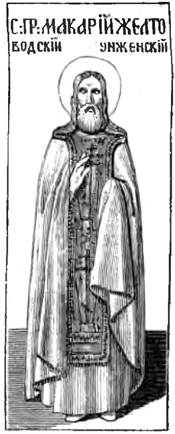
Сын благочестивых жителей Нижнего-Новгорода, преп. Макарий в детском возрасте обучен был книжной мудрости, причём он показывал в себе особенные дарования ума и любовь к учению338. Юным отроком тайно ушёл он из дома родителей и, на дороге переменив одежду свою на одежду нищего, явился в Печерский монастырь к архимандриту Дионисию, прося пострижения. На вопросы: кто он и откуда? отвечал, что он безродный сирота и желает одного – работать Господу. Дионисий, видя его ум и чистоту, постриг его и принял в свою келью. Макарию было тогда только 12 лет, и он начал подвизаться со всем пылом души юношеской, был послушен каждому в обители, особенно же настоятелю. Спустя три года отец, узнав, где сын, пришёл в обитель и умолял допустить его до свидания с любимым сыном, которого считал он или растерзанным от зверя, или умершим другой печальной смертью. Сын, посвятивший себя Господу, говорил, что отец его – Господь, а по Нём настоятель. Отец, слыша голос его за стеной, со слезами говорил: «сын мой, сын мой! дай посмотреть на тебя». Макарий отвечал: «лучше будет для обоих, если не увидимся здесь; увидимся там – в вечности». – «Не хочу я препятствовать твоему благому намерению, говорил отец; радуюсь о твоём спасении; но не отойду от кельи, пока не увижу тебя». Блаженный оставался твёрдым в своей решимости; тогда отец просил, чтобы сын протянул ему по крайней мере свою руку. В успокоение рыдающего отца сын выставил в окошко руку. Отец схватил её, поцеловал и сказал: «теперь спасайся о Господе, сын мой! и молись о нас». Живя в обители, блаж. Макарий подвизался искренно. Пост его был выше других; он принимал пищу, лишь бы не умереть от голода; хотя всегда ходил в трапезу вместе с другими, ел со страхом Божиим и потому очень мало. При такой жизни стали отличать его вниманием. Это было тяжело для смиренной души и, пламенно желая безмолвия, Макарий решился удалиться в пустыню.
The son of pious inhabitants of Nizhny-Novgorod, the Venerable Macarius was taught book-learning in his childhood, showing in himself particular gifts of intellect and a love of study338. As a young lad, he secretly fled from his parents’ home and, on the road, exchanged his clothing for that of a beggar, and appeared at the Pechersk monastery before Archimandrite Dionysius, asking for tonsure. To the questions: who he was and whence he came? he answered that he was a homeless orphan and desired but one thing—to labor for the Lord. Dionysius, seeing his intelligence and purity, tonsured him and received him into his own cell. Macarius was then only 12 years old, and he began to struggle with all the ardor of a youthful soul, being obedient to everyone in the monastery, and especially to the abbot. Three years later, his father, having learned where his son was, came to the monastery and begged to be allowed to see his beloved son, whom he had thought either torn apart by a beast or dead by some other grievous death. The son, having dedicated himself to the Lord, said that his father was the Lord, and after Him, the abbot. The father, hearing his voice through the wall, said with tears: “My son, my son! let me look upon you.” Macarius answered: “It will be better for both of us if we do not see each other here; we shall see each other there—in eternity.” “I do not wish to hinder your good intention,” said the father; “I rejoice in your salvation; but I will not depart from the cell until I see you.” The blessed one remained firm in his resolve; then the father asked that his son at least stretch out his hand to him. To calm his weeping father, the son put his hand out through the window. The father seized it, kissed it, and said: “Now save yourself in the Lord, my son! and pray for us.” Living in the monastery, the blessed Macarius struggled sincerely. His fast was greater than that of others; he took food only so as not to die of hunger; though he always went to the refectory with the others, he ate with the fear of God and therefore very little. With such a life, he began to be singled out for attention. This was burdensome for his humble soul, and, ardently desiring silence, Macarius resolved to withdraw into the wilderness.
Тайно оставив обитель Печерскую, Макарий пришёл на р. Лух; полюбив место на впадающей в неё р. Добрице, поставил себе хижину и стал жить один с Господом. Мало-по-малу стали собираться к нему ревнители благочестия и оставались при нём жить. По времени образовался монастырь, с храмом в честь Богоявления Господня339. Устроив обитель, преподобный опять стал искать безмолвия и, назначив для братии игумена, тайно удалился. Переходя из пустыни в пустыню, пришёл на озеро Жёлтое, что на левом берегу Волги. Здесь выкопал он себе пещеру и в ней стал подвизаться, по-прежнему, в посте и молитве. Узнали и здесь великого подвижника, и не только верующие, но и чтители ложного пророка с благоговейным удивлением смотрели на строгую жизнь отшельника, недоумевая, откуда столько силы для такой трудной жизни, какую вёл Макарий! Они приносили ему то хлеб, то мёд, то другие потребности жизни. Он принимал с благодарностью, но не для себя, а раздавал приходящим к нему, которые стали посещать его, желая слышать наставления его. Когда собралось к нему довольное число братии пустыннолюбивой, он построил (в 1435 г.) храм во имя Святой Троицы и был посвящён в игумена обители оной. Для всех служил он примером труда и смирения; сам готовил он пищу для братии. – Любовь и смирение его привлекали к нему не только верующих, но Чуваш, Черемис и Мордву; обходясь с ними ласково, передавал он сердцам их истины святой веры Христовой, и многие из них крестились по убеждению святого; перед самыми вратами обители находилось озеро, называвшееся потом Святым; здесь преподобный крестил язычников и магометан340.
Having secretly left the Pechersk monastery, Macarius came to the Lukh River; liking a place on the Dobritsa River, which flows into it, he built himself a hut and began to live alone with the Lord. Little by little, zealots of piety began to gather to him and remained to live with him. In time, a monastery was formed, with a church in honor of the Theophany of the Lord339. Having established the monastery, the venerable one again began to seek silence and, having appointed an abbot for the brethren, secretly departed. Passing from one wilderness to another, he came to Zheltoye (Yellow) Lake, on the left bank of the Volga. Here he dug himself a cave and began to struggle in it, as before, in fasting and prayer. Even here the great ascetic became known, and not only believers, but also venerators of the false prophet looked with reverent wonder at the strict life of the hermit, wondering whence came so much strength for such a difficult life as Macarius led! They brought him bread, honey, and other necessities of life. He accepted them with gratitude, but not for himself; rather, he distributed them to those who came to him, who began to visit him, desiring to hear his instructions. When a sufficient number of wilderness-loving brethren had gathered to him, he built (in 1435) a church in the name of the Holy Trinity and was consecrated abbot of that monastery. He served as an example of labor and humility for all; he himself prepared food for the brethren. – His love and humility attracted to him not only believers, but also the Chuvash, Cheremis, and Mordvins; treating them kindly, he conveyed the truths of the holy faith of Christ to their hearts, and many of them were baptized through the persuasion of the saint; right at the gates of the monastery there was a lake, later called the Holy Lake; here the venerable one baptized pagans and Mohammedans340.
В 1439 г. Улу-Махнет, утвердясь в Казани, перед тем опустелой, стал подвигать свою власть к пределам России. Сын его Мамотяк напал на Нижний и его окрестности. Толпы хищных Татар, как волны, разлились по поселениям Русским, и всё предавали опустошению341. они неожиданно нахлынули и на обитель Макариеву, разорили её, избили иноков, а самого Макария повели в улусы342. Когда Улу-Махмет увидел Макария, то, зная высокую жизнь его, его кротость и благотворительную любовь, изъявил негодование на своих бестолковых грабителей и с честью отпустил Макария на свободу; из уважения к нему он дал свободу и другим христианам, так что с Макарием вышли из плена до 400 человек; но с Макария взято при том слово – не жить более на Жёлтой воде; та земля, говорил хищный магометанин, принадлежит нам. Макарий выпросил себе ещё дозволение погребсти избиенных братий в разорённой обители. «Вот Божий человек, сказал хан, услышав просьбу о том; он заботится не только о живых, но и о мёртвых». Оплакав пострадавших братий, преподобный убедил вышедших с ним из плена не селиться на прежних местах, – иначе Татары предадут их злой смерти. Все согласились идти в Галичскую сторону, за 240 вёрст, и, помолясь Богу, отправились лесами и местами топкими. На дороге не стало у них хлеба, голод начал терзать непривычных к нему. Преп. Макарий начал молиться, и вот, нашли они завязшего в узком месте лося. Это было во время поста Апостольского. Путники просили у Макария дозволения утолить голод лосем. Но он не благословил им нарушать пост и убеждал потерпеть до праздника святых Апостолов Петра и Павла. «Поверьте, братия, прибавил преподобный, лось будет в ваших руках, когда придёт время разрешить пост: потерпите ещё три дня, – Господь сохранит жизнь вашу». Путники послушались преподобного и, надрезав ухо лосю, пустили его, а преподобный молил Господа, чтобы укрепил слабых товарищей его. По милости Всемощного даже малые дети остались живы, пробыв без пищи до праздника Апостолов. В праздник преподобный, отойдя в сторону от прочих, преклонил колена и, воздав благодарение Господу за Его благодать всесильную, молил Его пропитать гладных спутников его. И вот неожиданно явился тот самый лось, которого пустили на свободу за три дня перед тем. Его с восторгом поймали и привели к святому; святой с радостью благословил его для трапезы. «Надейтесь же, друзья мои, на Господа, прибавил он. Он не оставит нас и впредь». И точно, после того то попадался им лось, то без труда ловили оленя, и так благополучно дошли до Унжи.
In 1439, Ulugh-Muhammad, having established himself in Kazan, which had been desolate before that, began to extend his power toward the borders of Russia. His son Mamotyak attacked Nizhny and its environs. Hordes of predatory Tatars, like waves, spread over the Russian settlements, laying everything waste341. They unexpectedly surged upon Macarius’s monastery as well, destroyed it, slew the monks, and led Macarius himself away to the uluses342. When Ulugh-Muhammad saw Macarius, knowing his lofty life, his meekness, and his charitable love, he expressed indignation at his senseless plunderers and honorably released Macarius to freedom; out of respect for him, he also gave freedom to other Christians, so that up to 400 people came out of captivity with Macarius; but Macarius was given his word that he would no longer live on the Yellow Water; that land, said the predatory Mohammedan, belongs to us. Macarius also begged permission to bury the slain brethren in the ruined monastery. “Here is a man of God,” said the Khan, hearing this request; “he cares not only for the living, but also for the dead.” Having mourned the suffering brethren, the venerable one persuaded those who had come out of captivity with him not to settle in their former places—otherwise the Tatars would put them to a cruel death. All agreed to go to the Galich region, 240 versts away, and, having prayed to God, they set out through forests and marshy places. On the road, their bread ran out, and hunger began to torment those unaccustomed to it. The Venerable Macarius began to pray, and behold, they found a moose stuck in a narrow place. This was during the Apostles’ Fast. The travelers asked Macarius for permission to satisfy their hunger with the moose. But he did not bless them to break the fast and urged them to endure until the feast of the holy Apostles Peter and Paul. “Believe me, brethren,” added the venerable one, “the moose will be in your hands when the time comes to break the fast: endure yet three days—the Lord will preserve your lives.” The travelers heeded the venerable one and, having slit the moose’s ear, let it go, while the venerable one prayed to the Lord to strengthen his weak companions. By the mercy of the Almighty, even the small children remained alive, having gone without food until the feast of the Apostles. On the feast day, the venerable one, having stepped aside from the others, knelt down and, having given thanks to the Lord for His all-powerful grace, prayed Him to feed his hungry companions. And behold, the very same moose that had been set free three days before unexpectedly appeared. It was caught with delight and brought to the saint; the saint joyfully blessed it for the meal. “Trust then, my friends, in the Lord,” he added. “He will not abandon us in the future either.” And indeed, after that, either a moose came their way, or they easily caught a deer, and thus they reached Unzha safely.
Унжа весьма старинный Русский город343, но вблизи его ещё мало было сёл и вовсе не было иноческих обителей, когда явился здесь Макарий. Спутники Макария рассказали жителям Унжи, кто таков Макарий, как он избавил их от плена и как чудно прокормил в дороге. И Унжане приняли Макария, как ангела Божия. – Но преподобный спешил отыскать себе безмолвное место; ему указали в 15 вер. от города, на берегу озера Унжи, место окружённое лесом, ровное и красивое; он поставил здесь крест, построил келью и поселился. Это было в 1439 г. Продолжая подвижническую жизнь свою, преподобный прославился даром исцелений: девушку слепую и бесноватую осенил он с молитвой крестным знамением, и та стала видеть и перестала быть больной. В полугоре, не вдали от своей кельи, молитвой извёл он воду, и эта вода исцеляла больных. – На 5 году поселения своего на оз. Унже и на 95 году своей жизни преподобный приблизился к своей кончине. Он заболел в гор. Унже и заповедал похоронить тело его в его пустыне. По преставлении угодника Божия благоухание разлилось в воздухе. Жители, с благоговением исполняя волю преподобного, понесли святое тело его в пустыню, и на дороге многие больные получили здравие от мощей его. Блаж. кончина его последовала 25 июля 1444 г.344.
Unzha is a very ancient Russian town343, but near it there were still few villages and no monastic dwellings at all when Macarius appeared here. Macarius’s companions told the inhabitants of Unzha who Macarius was, how he had delivered them from captivity, and how wonderfully he had fed them on the road. And the people of Unzha received Macarius as an angel of God. – But the venerable one hastened to find himself a place of silence; they showed him a place 15 versts from the town, on the shore of Lake Unzha, surrounded by forest, level and beautiful; he set up a cross there, built a cell, and settled. This was in 1439. Continuing his ascetic life, the venerable one became renowned for the gift of healings: a blind and demon-possessed girl he blessed with the sign of the cross in prayer, and she began to see and ceased to be ill. On a hillside, not far from his cell, he brought forth water by prayer, and this water healed the sick. – In the fifth year of his settlement on Lake Unzha and in the ninety-fifth year of his life, the venerable one drew near to his end. He fell ill in the town of Unzha and commanded that his body be buried in his hermitage. After the repose of the man of God, a fragrance spread through the air. The inhabitants, reverently fulfilling the venerable one’s will, carried his holy body to the hermitage, and on the way many of the sick received healing from his relics. His blessed repose occurred on July 25, 1444344.
Скоро после кончины преподобного поселились в его пустыни любители пустынной жизни, – воздвигли над гробом его храм и завели монашеское общежитие. В 1522 г. густые толпы Татар окружили Унжу и трое суток осаждали слабый город, но не могли взять его, устрашаемые видением грозного черноризца. В четвёртый день они бросили огонь в город, и город загорелся. Народ в ужасе повторял одно: «св. Макарий! помоги нам». И неожиданно полился дождь, пожар был залит; а Татары в ужасе бросились бежать из города. В то же время отдельный отряд Татар из 300 человек хозяйничал в Макариевой пустыни: одни хотели оборвать серебряную раку, но ослепли. Это навело ужас на всех; бросились бежать, но многие потонули в Унже. – В то же время была захвачена Татарами одна женщина, собой красивая, но строго целомудренная. Три дня она не ела ничего и не спала, моля преп. Макария об избавлении её от греха и плена. На четвёртую ночь заснула она и видит – у головы её стоит благолепный старец и говорит: «встань и иди за мной». Она вскочила и нашла себя развязанной и уже наяву видит перед собой старца того вида, в каком писали преподобного на иконе, – она пошла за ним вслед, и когда стало светать, старец исчез; а она очутилась не вдали от Унжи. Воевода Иван Выродков сильно страдал от ран, полученных в стычке с Татарами; а по распоряжению вел. князя надлежало ему идти против Татар вместе с воеводой Заболоцким; как ни уговаривали его другие не утруждать себя походом, – по его воле повезли его в повозке и на дороге завезли, а частью и несли, в обитель Макария. Здесь он мысленно молил преподобного о помощи и, увидав сосуд с водой, попросил напиться; к изумлению иноков, он пил очень много. «Откуда берут эту воду?» спросил он. «Из колодезя, вырытого преп. Макарием», отвечали иноки. «В жизнь мою не пил я ничего слаще этой воды», сказал он и вслед затем почувствовал себя совершено исцелённым345. В 1532 г. молитвами преп. Макария спасся от Татар Солигалич, и благодарные жители устроили в соборном храме придел в честь преп. Макария346. Во время погрома Польского жители Юрьевца, Нижнего и Суздаля испытали в разных видах дивную защиту угодника Божия от нечестивых Ляхов. Сам царь Михаил дал тогда обет идти на поклонение преподобному, если отец его Филарет освободится из плена Польского347. В 1619 г. отправленные на место следователи нашли, что, по свидетельству сторонних людей, разных больных исцелено преп. Макарием более 50 человек, из них иные были больны по 20 лет, другие по 12 или 10 лет. Исцеление иных за дальностью не могло быть проверено свидетельством сторонних людей, но не подлежало сомнению: таких оказалось 23 человека. Так писал п. Филарет к сыну своему ц. Михаилу, который тогда был в пути на поклонение пр. Макарию. Патриарх в том же письме прибавлял: «в житии Макария написано, что и митр. Макарию известно было добродетельное житие Макария Желтоводского»348. Это означало, что житие преп. Макария описано было ещё при митр. Макарии, и описание было доставляемо ему, как и другие жития. Мощи преподобного ныне почивают в серебряной раке.
Soon after the repose of the Venerable One, lovers of the desert life settled in his hermitage; they raised a church over his grave and established a monastic community. In 1522, dense hordes of Tatars surrounded Unzha and for three days besieged the weak town, but could not take it, terrified by the vision of a fearsome black-robed monk. On the fourth day they cast fire into the town, and the town caught fire. The people in terror repeated only one thing: “St. Macarius! help us.” And unexpectedly a rain poured down, the fire was extinguished; and the Tatars in terror fled from the town. At the same time, a separate detachment of Tatars of 300 men was plundering in the Macarius Hermitage: some wanted to tear off the silver reliquary, but were struck blind. This struck terror into all; they fled, but many drowned in the Unzha. – At the same time, a certain woman was captured by the Tatars, beautiful in appearance, but strictly chaste. For three days she ate nothing and slept not, praying to Venerable Macarius for deliverance from sin and captivity. On the fourth night she fell asleep and saw—at her head stood a comely elder and said: “arise and follow me.” She sprang up and found herself unbound, and now awake she saw before her the elder of that appearance in which the Venerable One was depicted on the icon—she followed after him, and when it began to dawn, the elder vanished; and she found herself not far from Unzha. The voivode Ivan Vyrodkov suffered greatly from wounds received in a skirmish with the Tatars; and by order of the Grand Prince he was to go against the Tatars together with the voivode Zabolotsky; however much others urged him not to burden himself with the campaign—by his own will they carried him in a cart and on the road brought him, and partly carried him, to the monastery of Macarius. Here he mentally prayed to the Venerable One for help, and seeing a vessel with water, asked for a drink; to the amazement of the monks, he drank very much. “Where do they take this water?” he asked. “From the well dug by Venerable Macarius,” answered the monks. “In all my life I have drunk nothing sweeter than this water,” he said, and immediately thereafter felt himself completely healed345. In 1532, through the prayers of Venerable Macarius, Soligalich was saved from the Tatars, and the grateful inhabitants built a side-chapel in the cathedral church in honor of Venerable Macarius346. During the Polish devastation, the inhabitants of Yuryevets, Nizhny, and Suzdal experienced in various ways the wondrous protection of the man of God from the impious Poles. Tsar Michael himself then made a vow to go and venerate the Venerable One if his father Philaret should be freed from Polish captivity347. In 1619, investigators sent to the place found that, according to the testimony of outside persons, more than 50 different sick persons had been healed by Venerable Macarius, among whom some had been ill for 20 years, others for 12 or 10 years. The healing of others, due to distance, could not be verified by the testimony of outside persons, but was not subject to doubt: such were found to be 23 persons. So wrote Patriarch Philaret to his son Tsar Michael, who was then on his way to venerate Venerable Macarius. The Patriarch added in the same letter: “in the life of Macarius it is written that the virtuous life of Macarius of Zheltovodsk was also known to Metropolitan Macarius”348. This meant that the life of Venerable Macarius was described already under Metropolitan Macarius, and the description was delivered to him, as were other lives. The relics of the Venerable One now rest in a silver reliquary.
«Богоносный отец Макарий! ты с юности шёл путём жёстким и скорбным; добродетелями взошёл ты на высоту, как виноград плодовитый, с искренней любовью следовал за Владыкой своим. Потому и стал гражданином небесным. Испроси нам у Христа защиту от искушений бесовских; моли Христа Бога даровать душам нашим мир и милость обильную»349.
“God-bearing Father Macarius! from youth you walked a harsh and sorrowful path; by virtues you ascended to the height, like a fruitful vine, with sincere love following your Master. Therefore you became a citizen of heaven. Obtain for us from Christ protection from demonic temptations; pray to Christ God to grant our souls peace and abundant mercy”349.
Житие её по Лавзаику и Никифору – в Четье-Минее июля 25 день – Weiss. Leben d. Heiligen 16 December. На Греческом известны по рукописям два жития. Ladricii bibl. gr. X, 300.
Her life according to the Lausiac History and Nikephoros – in the Chet’ya-Mineya for July 25 – Weiss. Leben d. Heiligen 16 December. In Greek, two lives are known from manuscripts. Ladricii bibl. gr. X, 300.
Палладий в разговоре о Златоусте: «оставшись сиротой хотя выдана была замуж, но по общему отзыву не лишена была чистоты девства: с мужем прожила около 20 месяцев, и он неожиданно заплатил дань природе смертью». Лавзаик: «на деле не была ни чьей женой». Менолог Василия: «называлась невестой, но не была женой: понявший её отошёл к Господу, и она осталась девой и вместе вдовой».
Palladius in the Dialogue on Chrysostom: “having been left an orphan, although she was given in marriage, yet by common report she was not deprived of the purity of virginity: she lived with her husband about 20 months, and he unexpectedly paid the debt of nature by death.” Lausiac History: “in fact she was no one’s wife.” Menologion of Basil: “she was called a bride, but was not a wife: he who understood her departed to the Lord, and she remained a virgin and at the same time a widow.”
Палладий в Давзаике говорит о делах милосердия её, как очевидец их: «я своими глазами видел жизнь и ангельский нрав сей блаженной девы, как духовный и искренний друг её и ближайший родственник, так что поручала мне раздавать своё богатство».
Palladius in the Lausiac History speaks of her works of mercy as an eyewitness of them: “I saw with my own eyes the life and angelic character of this blessed virgin, as her spiritual and sincere friend and closest relative, so that she entrusted me with distributing her wealth.”
Лавзаик, гл. 126. Златоуст, отправляясь в ссылку, призвал в крестильницу диаконисс Олимпиаду, Певтадию и Проклию и добрую вдову Сальвину и сказал им: «увижусь ли я с вами, не знаю; но прошу вас не отделяйтесь от Церкви для епископа, кто будет поставлен вместо меня; повинуйтесь ему, как повиновались Иоанну».
Lausiac History, ch. 126. Chrysostom, setting out for exile, summoned to the baptistery the deaconesses Olympias, Pentadia, and Proclia, and the good widow Salvina, and said to them: “whether I shall see you again, I know not; but I beseech you, do not separate yourselves from the Church for the bishop who shall be appointed in my place; obey him as you obeyed John.”
Лавзаик, гл. 126. Гераклид, гл. 43. Менолог: «украсилась венцом исповедничества. Сосланная в ссылку за правду перенесла много скорбей.»
Lausiac History, ch. 126. Heraclides, ch. 43. Menologion: “she was adorned with the crown of confessorship. Sent into exile for the truth, she endured many sorrows.”
Лавзаик, гл. 127. Гераклид, гл. 44. В Мартирологе Усуарда под 29 августа, «кончина святой девы Кандиды». Les vies dessaintes Solitaires, 2, 245. Amsterd. 1714.
Lausiac History, ch. 127. Heraclides, ch. 44. In the Martyrology of Usuard under August 29, “the death of the holy virgin Candida.” Les vies des saintes Solitaires, 2, 245. Amsterd. 1714.
Жизнь св. Евпраксии, описанная современником, in vitis Patrum. 1, 623–642 Act. sanet, ad 13 martii, в Четье-Минее июля 25. Греческий текст у Болландистов, – а у Мины – древний Латинский.
The life of St. Eupraxia, described by a contemporary, in vitis Patrum. 1, 623–642 Act. sanct., ad 13 martii, in the Chet’ya-Mineya for July 25. The Greek text is with the Bollandists, – and with Migne – the ancient Latin.
Vita: monasterium mulierum – habens architria centum triginta, – «монастырь. – женский, – где сто тридцать келий». Менолог Василия: «вошла в монастырь, где его четыре девственницы проводили равноангельскую жизнь». Последнее число едва ли не ошибка писца.
Vita: monasterium mulierum – habens architria centum triginta, – “a monastery – of women – where one hundred and thirty cells.” Menologion of Basil: “she entered a monastery where four virgins led an angelic life.” The latter number is hardly not a scribal error.
В Египетском Патерике записано следующее о пожертвованиях обителям девственниц: «авве Дуле, ученику аввы Виссариона (современнику св. Феодулы) сказали: такой-то, служивший нам, умер и ещё при жизни отдал сёла свои женскому монастырю 300 постниц. Старец с скорбью сказал: ах несчастный! потерял награду свою». Мы спорили и говорили, что напротив приобрёл награду, оказав помощь постницам. Старец сказал нам: поверьте, братия, говорю известное по опыту. После того как видел я авву Герасима Иорданского и то, что лев по смерти его рыкал над гробом его и тут умер, сильно поражён я был и стал раздавать имение своё. Одно село думал я отдать постницам великой церкви Александрийской. Придя к авве Исидору, сказал я: хочу я отречься от мира и, раздав прочее, оставляю село для постниц; Августалий даст мне за него 70 литр золота. Продать ли? Старец сказал: если Августалий даст за него 50, отдай и передай золото постницам и тебе будет великая награда от Бога; если же отдашь село им, вовлечёшь их в хлопоты и расслабление. Не послушав старца, отдал я закреплённую судом бумагу на село постницам и поступил в скит. Спустя некоторое время, вижу во сне, будто я в Вифлееме. Алтарь полон света, поют светлые лица; тут же жена в порфире и в славе неизобразимой. Один с грозным голосом и строгим взором говорил мне: «Евстафий, отвечай за постниц, – из-за сёл они прогневляют Господа; погублю тебя, если не поправишь зла». Жена, облачённая порфирой, говорит: «намерение твоё приятно Мне, чадо! но душой и телом страдают постницы; отрёкшиеся от мира должны в безмолвии служить Господу». Указав рукой на обличителя моего, сказала: «это – Иоанн Предтеча, наставник и игумен инокинь. Знаменай сердце его, сказала Она ему, чтобы твёрдо верил сказанному и поправил дело». Он ознаменовал сердце моё. И я пришёл в себя. Немедля пошёл я к авве Исидору и рассказал о видении. С ним пришли мы к постницам и, призвав старших, сказали: царский чиновник идёт взять село для патриархии, – не продать ли его князю, с тем, чтобы вы получили золото? Как угодно вам, так и поступите, – сказали они. Немедленно продал я село Августалию за 60 литр, за исключением скота, и золото положил пред жертвенником постниц. Когда возвращались мы, сказал я авве: едва не погиб я с постницами. «Не говори этого, сын мой, это грех», говорил старец. Кто подаёт милость постницам, получит гораздо более награды, чем подающий милостыню хромым и слепым. Они также слабы, странны, отреклись от мира; выходить просить подаяния не могут, ни продавать рукоделия: иначе с ними случается одно из двух, или уязвляют или уязвляются. Потому кто подаст им пшеницу, бобы, деньги, одежду, шерсть, лён, не заставляя их выходить из обители, тот будет иметь великое дерзновение пред Богом. Кто же даст монастырю женскому или мужскому сёла, возвращает иноков к мирским хлопотам и мешает безмолвствовать». Пролог под 23 мая. Память пр. Дулы 15 июня; память пр. Виссариона 6 июня. Преп. Герасим Иорданский скончался в 475 г., след. рассказываемое аввой Дулой происходило в 476 г.
In the Egyptian Patericon the following is recorded about donations to monasteries of virgins: “Abba Dulas, a disciple of Abba Bessarion (a contemporary of St. Theodula), was told: such-and-such, who served us, died and while still alive gave his villages to a women’s monastery of 300 fasting women. The elder said with sorrow: alas, unfortunate one! he lost his reward.” We argued and said that on the contrary he gained a reward, having helped the fasting women. The elder said to us: believe me, brethren, I speak what I know from experience. After I saw Abba Gerasim of the Jordan and that the lion roared over his grave after his death and died there, I was greatly struck and began to distribute my property. I thought to give one village to the fasting women of the great church of Alexandria. Coming to Abba Isidore, I said: I wish to renounce the world and, having distributed the rest, I leave the village for the fasting women; Augustalis will give me 70 litras of gold for it. Shall I sell it? The elder said: if Augustalis gives 50 for it, sell it and give the gold to the fasting women, and you will have a great reward from God; but if you give the village to them, you will involve them in cares and relaxation. Not heeding the elder, I gave the deed of the village, confirmed by court, to the fasting women and entered the skete. After some time, I saw in a dream that I was in Bethlehem. The altar was full of light, bright faces were singing; there was also a woman in purple and in indescribable glory. One with a terrible voice and stern look said to me: ‘Eustathius, answer for the fasting women—because of the villages they anger the Lord; I will destroy you if you do not correct the evil.’ The woman clothed in purple says: ‘Your intention is pleasing to Me, child! but the fasting women suffer in soul and body; those who have renounced the world should serve the Lord in silence.’ Pointing with her hand at my accuser, she said: ‘This is John the Forerunner, the instructor and abbot of the nuns. Sign his heart,’ she said to him, ‘that he may firmly believe what is said and correct the matter.’ He signed my heart. And I came to myself. Immediately I went to Abba Isidore and told him of the vision. With him we came to the fasting women and, summoning the elders, said: a royal official is coming to take the village for the patriarchate—shall we not sell it to the prince, so that you may receive the gold? ‘As you please, so do,’ they said. Immediately I sold the village to Augustalis for 60 litras, excluding the cattle, and placed the gold before the altar of the fasting women. When we were returning, I said to the abba: I almost perished with the fasting women. ‘Do not say that, my son, it is a sin,’ said the elder. He who gives alms to fasting women will receive a much greater reward than he who gives alms to the lame and blind. They are also weak, strangers, have renounced the world; they cannot go out to beg for alms, nor sell their handiwork: otherwise one of two things happens to them, either they wound or are wounded. Therefore he who gives them wheat, beans, money, clothing, wool, flax, without forcing them to go out of the monastery, will have great boldness before God. But he who gives villages to a women’s or men’s monastery returns the monks to worldly cares and hinders them from being silent.” Prologue under May 23. Memory of Venerable Dulas on June 15; memory of Venerable Bessarion on June 6. Venerable Gerasim of the Jordan reposed in 475, therefore what was related by Abba Dulas took place in 476.
Это повествование о обете пред св. иконой Спасителя приводит Дамаскин в 3 слове о почитании икон. У него преп. Феодула диаконисса (διαϰονῆ), in vitis patrum abbatissa; в Четь-Минее игуменья, в одном месте «игуменья, яже бе и диаконисса». Пример Феодулы диакониссы, которая была и игуменьей-инокиней, с одной стороны доказывает, что напрасно наименование диакониссы принимали за улику в том, что диаконисса не инокиня, с другой – надобно положить, что едва ли не все древние игуменьи были диакониссами, хотя известные ныне жития не говорят того о каждой из них.
This narrative concerning a vow before the holy icon of the Savior is cited by Damascene in his third discourse on the veneration of icons. In his account, the Venerable Theodula is a deaconess (διαϰονῆ); in the Vitis Patrum she is an abbess; in the Cheti-Minei she is an abbess, and in one place “an abbess, who was also a deaconess.” The example of the deaconess Theodula, who was also an abbess and a nun, proves on the one hand that the title of deaconess was wrongly taken as evidence that a deaconess was not a nun; on the other hand, it must be supposed that nearly all the ancient abbesses were deaconesses, although the lives known today do not state this of each of them.
О ней вспоминает Церковь в сырную субботу в числе подвижников, под именем старшей Евпраксии. В Греческой Минее кроме того показана память о св. Евпраксии – под 11 января, а у Коптов – под 26 (22) марта.
The Church commemorates her on Cheese-Fare Saturday among the ascetics, under the name of the elder Eupraxia. In the Greek Menaion, moreover, the memory of St. Eupraxia is indicated under January 11, and among the Copts under March 26 (22).
Менолог Василия и пролог: «столько успела в добродетели и столько возвысилась над нуждами природы, что 45 дней предстояла неподвижно с поднятыми к небу руками». Об этом не говорит пространное житие по изданию Мины. Но в Четь-Минее есть рассказ о том.
The Menologion of Basil and the Prologue: “She advanced so far in virtue and rose so far above the needs of nature that for forty-five days she stood motionless with her hands raised to heaven.” The full Life according to the edition of Minas does not speak of this. But in the Cheti-Minei there is a narrative about it.
Преп. Феодула, как и обе Евпраксии, воспоминается в сырную субботу. Под именем Иулитты, воспоминаемой тогда же, разумеется Юлия. Кроме того Православная Церковь празднует день св. Евпраксии июля 25 дня, а Римская – марта 13. У Коптов Евпраксия – августа 2 (июля 26) и Юлия, подруга Евпраксии, августа 5 (июля 29). Ludolfi comm. р. 424.
The Venerable Theodula, like both Eupraxias, is commemorated on Cheese-Fare Saturday. By the name Julitta, commemorated at the same time, Julia is meant. Moreover, the Orthodox Church celebrates the feast of St. Eupraxia on July 25, and the Roman Church on March 13. Among the Copts, Eupraxia is on August 2 (July 26), and Julia, the companion of Eupraxia, on August 5 (July 29). Ludolfi comm. p. 424.
Ркп. житие пр. Макария – в б. общ. ист. № 54. Царского № 743. В Четь-Минее 25 июля с немногими переменами.
The manuscript Life of the Venerable Macarius is in the library of the Society of History, No. 54, and in that of Tsarsky, No. 743. In the Cheti-Minei for July 25, it appears with few changes.
Ныне здесь, в Макариевой обители при слободе Ромне, храм Св. Троицы с приделом в честь основателя пустыни пр. Макария.
Now here, in the monastery of Macarius near the settlement of Romny, there is a church of the Holy Trinity with a side-chapel in honor of the founder of the hermitage, the Venerable Macarius.
Стихира: «бывшу гневу Божию на люди, варвары обитель твою плениша и чада твоя мечи, яко классы пожаша». Минея июльская. Μ. 1646 г.
Sticheron: “When the wrath of God came upon the people, barbarians captured thy monastery and reaped thy children with swords as with sickles.” July Menaion, Moscow, 1646.
Щекатов (4, 13. 15), а за сим словарь святых 1836 г. и месяцеслов 1856 г. отнесли кончину преп. Макария к 1504 г., это – ошибка. По ркп. житию, он преставился 6952 (1444) июля 25 дня. Сказание о житии и чудесах пр. Макария. Μ. 1850 г.
Shchekatov (4, 13. 15), and following him the Dictionary of Saints of 1836 and the Menologion of 1856, assigned the repose of the Venerable Macarius to the year 1504; this is an error. According to the manuscript Life, he reposed on July 25, 6952 (1444). Narrative of the Life and Miracles of the Venerable Macarius, Moscow, 1850.
Житие пр; Макария, ч. 2, стр. 50–53. Μ. 1550 г. Здесь вся вторая часть состоит из опис. различных и многочисленных чудес пр. Макария.
Life of the Venerable Macarius, Part 2, pp. 50–53, Moscow, 1550. Here the entire second part consists of a description of various and numerous miracles of the Venerable Macarius.
Письма Русск. государей № 19 и прим. к № 4–6. Μ. 1848 г. Между ркп. п. Филарета, по описи 1630 г. служба и житие преп. Макария – в двух экземплярах. Иванова опис. госуд. арх. 292. 293. Μ. 1849 г.
Letters of Russian Sovereigns, No. 19 and notes to Nos. 4–6, Moscow, 1848. Among the manuscripts of Patriarch Philaret, according to the inventory of 1630, the service and Life of the Venerable Macarius are in two copies. Ivanov’s Description of the State Archive, 292, 293, Moscow, 1849.