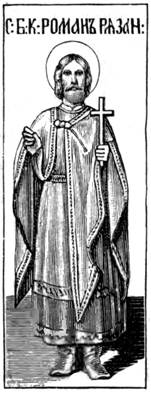
Страшное было время – первое время Татар в России. Это было время полного разгула сильной воли злой. Но оно же было временем высоких подвигов христианских. Церковь Рязанская украсилась тогда великими делами князей своих и более всего высоким, мученическим подвигом св. князя Романа. Два деда его, князья Юрий и Олег Игоревичи, умерли страдальцами за отчизну в битве с Батыем (1237 г.). Кн. Олег Игоревич, красавец ростом и лицом, умирал от ран на поле битвы; Батый, увидав мужественного князя, хотел лечить его, с тем, чтобы вступил он в службу его. «С врагом христиан не могу быть в приязни», сказал умирающий князь. Взбешённый Батый велел изрубить его в куски236. Кн. Олег Ингваревич, отец св. кн. Романа, также много вытерпел мук от Татар. Захваченный в плен Батыем, он увлечён был в орду и томился там в неволе более десяти лет. Отпущенный в Рязань (1252 г.), он должен был покорно смотреть, как Татарские численники (в 1257 г.) перечисляли земли Рязанскую и Муромскую, и в 1258 г. скончался иноком237. Кн. Роман воспитался скорбями в любви к св. вере. Он жил в слезах и молитве за родину. Старался облегчать участь разорённых и угнетаемых подданных; особенно же заботился о том, чтобы словом и примером внушать детям и подданным любовь к вере и благочестию, как источникам лучших утешений в скорбях жизни. Наставления его были не бесплодны. И для нашего времени сохранился памятник благочестия детей и супруги кн. Романа: это – номоканон, списанный по их усердию в Киеве238. Благочестивого князя Рязанского много утешило то, что в 1261 г. в самой орде поставлена была кафедра православного епископа. Святитель Русский среди шатров дикого язычества – явление отрадное для всех благочестивых сердец. В святителе Сарайском видели утешителя и наставника и князья, томившиеся в орде, и целые тысячи народа, захваченные в неволю Татарами239. Кн. Роман беспрекословно повиновался хану Беркаю, и ту же покорность оказывал и преемнику его хану Менгу-Темиру. Но он горячо любил своих подданных. И эта-то любовь его вызвала против него бурю бед. Хану Менгу-Темиру донесли, что кн. Роман поносит великого царя и его веру. Это была клевета злобного баскака, которого князь удерживал от бесчеловечных насилий при сборе дани. Но для сильного злодея всегда готовы помощники: и для баскака нашлись такие, которые подтвердили донос на благ. князя. Гордый своим счастьем Менгу-Темир объявил, что князь должен выбрать одно из двух – или смерть мучительную, или веру Татар. Благоверный князь отвечал, что христианин не может менять своей веры на другую. Татарские чиновники, которым передан князь, старались склонить князя к своей вере ласками и угрозами. Он с твёрдостью отвечал, что чистая вера – одна, вера данная Богом, вера христианская; она – одна, как и один Бог истинный. «Жалею о вашей слепоте, прибавил князь; покорный воле Божией, я повинуюсь власти хана, но в оскорбление воли Божией никто не заставит меня изменить святой моей вере». Татары заскрежетали зубами и стали бить князя. «Я – христианин», говорил князь; но уста его заткнули платком и бросили в цепях в темницу. В душной темнице князь молился о ниспослании ему благодатной помощи; он предчувствовал, что ждёт его смерть, и, предавая себя воле Божией, молил подать ему силы для совершения подвига христианского. Гордый хан произнёс приговор твёрдому князю: пусть умрёт мучительною смертью. Князь, выведенный на место казни, стал говорить о святости своих убеждений и о несостоятельности веры, к которой принуждают его. Ему отрезали язык. И затем стали мучить его с ужасающим зверством: ему вырезали глаза, отсекли персты рук и ног, обрезали уши и губы, потом отсекли руки и ноги. Когда же осталось одно туловище ещё с искрами жизни, то содрали с головы кожу и воткнули голову на копье. Благоверный князь Русский страдал и терпел, точно так, как св. Иаков Персянин. Так дух верного христианина выше всего на земле. Злоба человеческая может лишить нас доброго имени, может заковать в оковы, может истерзать муками. Но, губя жизнь телесную, лишая всего временного, не может изменить в нас, без нашей воли, ни одного святого чувства, ни одной святой мысли. Душа, защитившая себя от греха страхом Божиим, не боится телесных мук. Они не только не делают ей вреда, но увеличивают награду её за верность святой воле Божией. Мученический подвиг св. Романа совершился 19 июля 1270 г.240. Древняя летопись, сказав о страдальческой кончине кн. Романа, прибавляет: «возлюбленные князья Русские! не прельщайтесь суетным и маловременным блеском света сего: он пустее паутины, меняется каждый час, как тень, как дым исчезает и весь – сон. Нагими вышли мы из чрева матери, нагими и отойдём отсюда. Не обижайте друг друга, не берите чужого; любите правду, смирение, терпение, любовь и милость. И вы достигнете радости святых, как сей блаженный князь Роман купил страданиями Царство Небесное и с сродником своим Михаилом Всеволодовичем, Черниговским князем, принял от Господа венец нетленный, как пострадавший за христианскую веру»241. Назидательный этот совет говорит о том, что память князя Романа чтили в Русской Церкви со времени его кончины. Лик его, по преданию, изображался так на иконах: князь не старых лет с волосами русыми, курчавыми, падающими с ушей тонкой волной, в собольей шубе на плечах, в бархатной поддёвке, правая рука простёрта на молитву, а левая держит город и церковь242. В 1812 г., в день памяти св. кн. Романа, одержана была при Клястицах первая победа над Французами. В память сего положено написать образ св. кн. Романа на стене храма Спасителя в Москве.
Terrible was that time—the first time of the Tatars in Russia. It was a time of the full unbridling of an evil will. Yet it was also a time of lofty Christian deeds. The Church of Ryazan was then adorned with the great works of its princes, and above all with the lofty, martyric deed of St. Prince Roman. Both of his grandfathers, Princes Yuri and Oleg Igorevich, died as sufferers for the fatherland in battle with Batu (1237 A.D.). Prince Oleg Igorevich, handsome in stature and face, was dying of wounds on the field of battle; Batu, seeing the courageous prince, wished to heal him, on condition that he enter his service. "I cannot be in friendship with an enemy of Christians," said the dying prince. Enraged, Batu ordered him to be cut to pieces236. Prince Oleg Ingvarevich, the father of St. Prince Roman, also endured many torments from the Tatars. Captured by Batu, he was carried off to the Horde and languished there in captivity for more than ten years. Released to Ryazan (1252 A.D.), he was forced to look on submissively as Tatar census-takers (in 1257 A.D.) enumerated the lands of Ryazan and Murom, and in 1258 A.D. he reposed as a monk237. Prince Roman was raised amid sorrows in love for the holy faith. He lived in tears and prayer for the fatherland. He strove to ease the lot of his ruined and oppressed subjects; and especially he cared to instill in his children and subjects, by word and example, love for the faith and piety, as the sources of the best consolations in the sorrows of life. His instructions were not fruitless. Even for our time a monument of the piety of Prince Roman's children and wife has been preserved: this is a Nomocanon, copied by their zeal in Kiev238. The pious Prince of Ryazan was greatly consoled by the fact that in 1261 A.D. a see of an Orthodox bishop was established in the very Horde. A Russian Hierarch amidst the tents of savage paganism—a heartening sight for all pious hearts. In the Hierarch of Sarai, both the princes languishing in the Horde and whole thousands of people carried off into captivity by the Tatars saw a comforter and teacher239. Prince Roman obeyed Khan Berke without question, and showed the same submission to his successor, Khan Mengu-Timur. But he loved his subjects ardently. And it was this very love that raised a storm of calamities against him. It was reported to Khan Mengu-Timur that Prince Roman reviled the great tsar and his faith. This was a slander by a malicious baskak, whom the prince had restrained from inhuman violence in collecting tribute. But for a powerful evildoer helpers are always ready: and for the baskak there were found those who confirmed the denunciation against the pious prince. Proud of his good fortune, Mengu-Timur declared that the prince must choose one of two things—either a painful death, or the Tatar faith. The Right-believing Prince answered that a Christian cannot exchange his faith for another. The Tatar officials, to whom the prince was handed over, tried to incline the prince to their faith with flattery and threats. He firmly answered that the pure faith is one—the faith given by God, the Christian faith; it is one, as the one true God is one. "I pity your blindness," added the prince; "submissive to the will of God, I obey the authority of the khan, but to the insult of God's will no one shall compel me to change my holy faith." The Tatars gnashed their teeth and began to beat the prince. "I am a Christian," said the prince; but they stuffed his mouth with a cloth and threw him in chains into prison. In the stifling prison the prince prayed for the sending down of gracious help upon him; he foresaw what death awaited him, and, surrendering himself to the will of God, he begged that strength be given him to accomplish the Christian deed. The proud khan pronounced sentence upon the steadfast prince: let him die a painful death. The prince, led out to the place of execution, began to speak of the holiness of his convictions and of the untenability of the faith to which they were forcing him. They cut out his tongue. And then they began to torment him with horrifying brutality: they cut out his eyes, severed the fingers of his hands and feet, cut off his ears and lips, then cut off his hands and feet. When only the trunk remained, still with sparks of life, they flayed the skin from his head and stuck the head on a spear. The Right-believing Russian Prince suffered and endured, exactly as did St. James the Persian. Thus the spirit of a faithful Christian is above all on earth. Human malice may deprive us of a good name, may bind us in chains, may tear us with torments. But, destroying bodily life, depriving us of all that is temporal, it cannot change in us, without our will, a single holy feeling, a single holy thought. The soul that has shielded itself from sin by the fear of God is not afraid of bodily torments. They not only do it no harm, but increase its reward for faithfulness to the holy will of God. The martyric deed of St. Roman was accomplished on July 19, 1270 A.D.240. The ancient chronicle, having spoken of the suffering end of Prince Roman, adds: "Beloved Russian princes! Be not deceived by the vain and short-lived glitter of this world: it is emptier than a spider's web, it changes every hour, like a shadow, like smoke it vanishes, and all of it is a dream. Naked we came out of our mother's womb, naked we shall depart hence. Do not wrong one another, do not take what is another's; love truth, humility, patience, love, and mercy. And you shall attain the joy of the saints, as this blessed Prince Roman purchased the Heavenly Kingdom through sufferings, and with his kinsman Michael Vsevolodovich, Prince of Chernigov, received from the Lord an incorruptible crown, as one who suffered for the Christian faith"241. This instructive counsel shows that the memory of Prince Roman was honored in the Russian Church from the time of his death. His likeness, according to tradition, was depicted thus on icons: the prince, not of advanced years, with light-brown, curly hair falling from the ears in a fine wave, in a sable fur coat on his shoulders, in a velvet undercoat, his right hand extended in prayer, and his left holding a city and a church242. In 1812 A.D., on the day of the commemoration of St. Prince Roman, the first victory over the French was won at Klyastitsy. In memory of this, it was decreed to paint an image of St. Prince Roman on the wall of the Cathedral of Christ the Savior in Moscow.
После страдальческой кончины кн. Лазаря, старший сын его Стефан остался ещё малолетним243. И мать Стефана, умная кн. Милица, приняла дела Сербии в своё ведение.
After the suffering death of Prince Lazar, his eldest son Stephen remained still a minor243. And Stephen's mother, the wise Princess Milica, took the affairs of Serbia into her own administration.
Хотя султан, победитель Сербии, предоставил Сербии своё управление, но Сербия обязана была выставлять для каждой войны султана 30,000 войска и она же должна была каждый год вносить в казну султана 20,000 золотых дукатов244. – Положение не лёгкое! А между тем Вуку Бранковичу удалось было выпросить себе звание опекуна Стефанова и правителя Сербии.
Although the sultan, the conqueror of Serbia, granted Serbia its own governance, Serbia was obliged to furnish 30,000 troops for every war of the sultan, and it also had to pay 20,000 gold ducats into the sultan's treasury each year244.—No easy situation! Meanwhile, Vuk Branković had managed to obtain for himself the title of Stephen's guardian and ruler of Serbia.
Сперва удалось Вуку Бранковичу достать себе большую половину Сербии. Но умная деспотисса всё мало-по-малу улучшала дела свои и Сербии. На первых порах много надобно было трудиться, чтобы сколько-нибудь поправить разорённый войной край. – К большему горю, явились раздоры: некоторые предлагали вступить в союз с Венгрией и вместе с ней воевать против султана. Мысль эта до того увлекла иных, что составился заговор лишить Стефана прав деспота. А другие недоброжелатели доводили до сведения султана, что Стефан – враг султана. – Деспотисса сама явилась к султану с изъявлением покорности. Султан принял её ласково. Затем и юный деспот отправился к Баязету. После церемониального приёма Стефан не спешил уходить из дворца. «Зачем остался?» тревожно спросил султан. Стефан смело отвечал: «так как некоторые люди говорили обо мне худо вашему величеству, то сам я хочу сказать правду о себе, хотя и не выгодную. Действительно, советовали мне некоторые отложиться от твоей власти и стать другом Венгерцов; но я видел неуместность этого союза, помню клятву и ваши милости и – вот явился перед лицом вашего величества: жизнь моя в ваших руках: распорядитесь как угодно». Баязет изумился искренности; помолчал и потом объяснил молодому князю, что союз с Венграми точно – не умное дело, – он скоро смирит их; «если ты, прибавил султан, будешь делить мои походы, – ты будешь покоен, – принимаю тебя за сына, – дети мои, чувствую, перессорятся; тогда придёт время, что ты не только будешь владеть покойно своей страной, но приобретёшь соседние; при мне поступай так: смиряй сильных твоих и держи их в руках». – Никто не ожидал, чтобы грозный султан так отечески принял молодого Стефана и – тем более было радости для Сербии. Баязет «просил у деспотиссы Саломию, меньшую дочь её, в супругу себе и обещался принимать Стефана за сына». Для покоя Сербии умная Милица согласилась исполнить желание султана. Это было в 1393 г.245. – Через год после того в 1395 г. Стефан с войском своим отправился в поход в помощь Баязету, воевавшему с Венгрией; а ещё через год с войсками султана должен был воевать против Боснии, но на этот раз выпавший несвоевременно глубокий снег не допустил войска султана до Боснии. – За то Сербию миновали разгромы, нанесённые Баязетом крестоносцам, Венгрии и Греции.
At first Vuk Branković succeeded in obtaining for himself the greater half of Serbia. But the wise despotissa little by little improved her own affairs and those of Serbia. At the outset, much labor was needed to restore in some measure the region devastated by war. —To add to the grief, discord arose: some proposed entering into an alliance with Hungary and together with her waging war against the sultan. This idea so carried away certain persons that a conspiracy was formed to deprive Stephen of the rights of despot. And other ill-wishers brought it to the sultan's attention that Stephen was an enemy of the sultan. —The despotissa herself appeared before the sultan with an expression of submission. The sultan received her kindly. Then the young despot also set out to Bayezid. After the ceremonial reception, Stephen did not hasten to leave the palace. "Why have you stayed?" the sultan asked anxiously. Stephen boldly replied: "Since some people have spoken ill of me to your majesty, I myself wish to tell the truth about myself, even if it is unfavorable. Indeed, some advised me to break away from your authority and become a friend of the Hungarians; but I saw the inappropriateness of this alliance, I remember my oath and your favors, and—behold, I have appeared before your majesty: my life is in your hands; dispose of it as you will." Bayezid was astonished at the sincerity; he was silent for a while and then explained to the young prince that an alliance with the Hungarians was indeed an unwise thing—he would soon subdue them; "if you," added the sultan, "will share my campaigns, you shall be at peace—I receive you as a son; my children, I sense, will quarrel among themselves; then the time will come when you will not only rule your own country in peace, but will acquire neighboring lands; for now, act thus: humble your powerful men and keep them in hand." —No one expected that the fearsome sultan would receive young Stephen so fatherly—and the more joy there was for Serbia. Bayezid "asked the despotissa for Salomia, her younger daughter, as a wife for himself, and promised to accept Stephen as a son." For the peace of Serbia, the wise Milica agreed to fulfill the sultan's wish. This was in 1393245. —A year after that, in 1395, Stephen with his army set out on a campaign to aid Bayezid, who was warring with Hungary; and yet another year later he had to war with the sultan's forces against Bosnia, but on this occasion an untimely deep snowfall prevented the sultan's army from reaching Bosnia. —Thus Serbia was spared the devastations inflicted by Bayezid upon the Crusaders, Hungary, and Greece.
В одной грамоте своей Стефан писал: «промыслом Всевышнего Сербия избавилась от порабощения Измаильского, начавшегося с Косова поля: пришёл царь Персидский и сокрушил Агарян; меня же Бог избавил из руки Персов». Грозный Тимур потребовал от Баязета смириться перед ним – грозой востока. «Не лучше ли будет, думал султан, если одержу победу над врагами? Тогда и восток, и запад будут в моих руках». И послал жестокий отказ Тимуру, – а к Стефану послан гонец, чтобы Стефан спешил с войском к нему. Стефан хотел быть верным благодетелю. В страшном сражении Анкирском войска Тимура окружили Баязета. Стефан три раза врубался в ряды неприятеля, чтобы спасти Баязета. Когда отряды его уменьшились и не было уже никакой надежды на победу, Стефан пробился сквозь ряды неприятеля, спас жизнь сыну Баязета Сулейману, и прибыл в Константинополь. Царь-Град также трепетал Тимура; но тот обратился на Египет и, разгромив его, пошёл в Азию. Стефан отправил посла к Тимуру с просьбой освободить сестру его, жену Баязета. «Что значит герой Македонский? Он обошёл всю землю и ничего не удержал за собой, на стыд себе», так говорил Тимур послу Стефанову. И прибавил, что «придёт к ним назад не морем с востока, а сухим путём с севера и пройдёт весь запад». Так высоко о себе думал Тимур: и однако освободил Марию, которая до того времени, нагая до пояса, подносила питьё Тимуру, тогда как Баязет под столом с собаками питался крошками246. Стефан утверждён был в звании деспота и со стороны Византийского императора.
In one of his charters Stephen wrote: "By the providence of the Most High, Serbia was delivered from the bondage of Ishmael, which began at the Field of Kosovo: the Persian king came and crushed the Hagarenes; but God delivered me from the hand of the Persians." The fearsome Timur demanded that Bayezid humble himself before him—the terror of the East. "Would it not be better," thought the sultan, "if I gain victory over my enemies? Then both East and West will be in my hands." And he sent a harsh refusal to Timur, and a messenger was sent to Stephen, that Stephen should hasten with his army to him. Stephen wished to be faithful to his benefactor. In the terrible Battle of Ankara, Timur's troops surrounded Bayezid. Three times Stephen cut into the ranks of the enemy to save Bayezid. When his detachments had dwindled and there was no longer any hope of victory, Stephen broke through the enemy ranks, saved the life of Bayezid's son Suleiman, and arrived in Constantinople. Constantinople also trembled before Timur; but he turned toward Egypt and, having ravaged it, went into Asia. Stephen sent an envoy to Timur with a request to free his sister, Bayezid's wife. "What is the Macedonian hero? He went around the whole earth and kept nothing for himself, to his own shame," so said Timur to Stephen's envoy. And he added that "he would come back to them not by sea from the east, but by dry land from the north and would traverse the whole West." So highly did Timur think of himself; and yet he freed Maria, who until that time, naked to the waist, had served drink to Timur, while Bayezid under the table fed on crumbs with the dogs246. Stephen was confirmed in the rank of despot also by the Byzantine emperor.
Сыновья Баязета скоро перессорились: Сулейман занял западные долины, а старший брат – восточные. Сулейман стерёг Стефана на пути его из Константинополя в Сербию. Стефан отправился в Митилену и оттуда на корабле прибыл в Албанию. Юрий, женатый на тётке Стефана, на этот раз дал ему отряд свой, и Стефан благополучно прибыл с братом Буком в свой стольный город Сребреницу247. – Но после того Бранкович соединился с пашами Сулеймана, чтобы покорить Сербию – султану. Стефан отдал половину войска под команду брата Вука, а с другой вступил в бой с пашами и ловким манёвром разбил на голову пашей; Вук не был счастлив; Юрий истребил почти весь отряд его. Это было в 1402 г. Старший сын Баязета вступил после того в союз с Стефаном, уже как независимым владельцем. Зато Вук, оскорбившись на брата, поспешил к Сулейману; Милица поспешила за ним вслед, чтобы уговорить; не догнав его в Сербии, неустрашимая явилась в ставку Сулеймана и успела примирить султана с Стефаном248.
The sons of Bayezid soon quarreled among themselves: Suleiman occupied the western valleys, and the elder brother the eastern ones. Suleiman lay in wait for Stephen on his way from Constantinople to Serbia. Stephen set out for Mytilene and from there by ship arrived in Albania. George, married to Stephen's aunt, on this occasion gave him his detachment, and Stephen arrived safely with his brother Buka in his capital city of Srebrenica247. —But after that, Branković allied himself with Suleiman's pashas to subjugate Serbia to the sultan. Stephen gave half of his army under the command of his brother Vuk, and with the other half engaged the pashas in battle and, by a clever maneuver, utterly defeated them; Vuk was not fortunate; George destroyed almost his entire detachment. This was in 1402 A.D. The eldest son of Bayezid then entered into an alliance with Stephen, now as an independent ruler. But Vuk, offended at his brother, hastened to Suleiman; Milica hastened after him to persuade him; not having caught up with him in Serbia, the fearless woman appeared in Suleiman's camp and succeeded in reconciling the sultan with Stephen248.
Вступив в супружество с дочерью имп. Кантакузена (в 1403 г.), Стефан имел в ней добрую, благочестивую супругу; только она оказалась бесплодной, и это печалило обоих. Состарившаяся Милица-Евфросиния приняла монашество с именем Евгении в обители Люботинии, построенной ею между Каранавацом и Крушевацом, и скоро (нояб. 11-го 1405 г.) скончалась. Счастлив был Стефан, имевший такую мать, какова была кн. Милица; умная, энергическая, благочестивая, она много облегчала тяжкую долю народа, над которым начал тяготеть меч Турок, восстановляла народные храмы, напр. Дечанской обители, утешала бедность и вдовство бесприютное. Летопись говорит о Милице: «по смерти мужа своего, недалеко от Крушевца, в Рассии, созида монастырь, зовомий Любостиня, и тамо постриглася в иночество и совокупила многия сестры, наипаче великих госпожи, котории вдови изостали по мужех избитых с Лазарем на Косову. И тамо преставилася и погребена. А како она тамо Богу угодила, свидетельствуют чудеса повседневные над немощными, котории приходят к гробу ея, многократ и миро истекает от гроба ея». Она скончалась в великой схиме нояб. 11-го 1405 г.249.
Having entered into marriage with the daughter of Emperor Cantacuzenus (in 1403 A.D.), Stephen had in her a good, pious wife; only she proved barren, and this grieved them both. The aged Milica-Euphrosyne received monastic tonsure with the name Eugenia in the monastery of Ljubostinja, built by her between Karanovac and Kruševac, and soon (November 11, 1405 A.D.) reposed. Blessed was Stephen to have such a mother as Princess Milica; wise, energetic, pious, she greatly alleviated the heavy lot of the people over whom the Turkish sword began to hang, restored national churches, for example the Dečani monastery, and comforted poverty and homeless widowhood. The chronicle says of Milica: "After the death of her husband, not far from Kruševac, in Raška, she built a monastery, called Ljubostinja, and there she was tonsured into monasticism and gathered many sisters, especially great ladies who remained widows after their husbands were slain with Lazar at Kosovo. And there she reposed and was buried. And how she pleased God there, the daily miracles over the infirm who come to her grave bear witness; many times also myrrh flows from her grave." She reposed in the great schema on November 11, 1405 A.D.249.
Стефан умным правлением своим приводил в порядок и оживлял отчизну. – Он писался в грамотах: «милостию Божиею господин всои земли Србскои и поморию и по дунайским странам»250. Соседи уважали его. – Венгерский король Сигизмунд искал союза с ним. Пользуясь тишиной, Стефан стал украшать избранный им для пребывания своего Белград. Построив себе княжеский дом и храм св. Николаю, устроил при последнем обширную больницу. Затем стал строить обитель иноческую, себе Задушбину; это на горе при р. Рессаве, в Браничевском округе. Храм строился в честь Св. Троицы, и он был украшаем лучшими художниками; приглашены были иноки, особенно из Афонской горы. На освящение храма приглашён был патр. Кирилл, с собором архипастырей Сербских, – почётные светские люди княжества также были здесь. В праздник Св. Троицы в 1408 г. освящён был храм с полным торжеством251.
Stephen, by his wise governance, brought order to and revived his fatherland. —He styled himself in charters: "by the mercy of God, lord of all the land of Serbia and of the seacoast and of the Danubian regions"250. His neighbors respected him. —The Hungarian King Sigismund sought an alliance with him. Taking advantage of the peace, Stephen began to adorn Belgrade, which he had chosen for his residence. Having built a princely house and a church to St. Nicholas, he established at the latter a large hospital. Then he began to build a monastic dwelling, a zadušbina for himself; this was on a mountain by the Resava River, in the Braničevo district. The church was built in honor of the Holy Trinity, and it was adorned by the finest artists; monks were invited, especially from Mount Athos. For the consecration of the church, Patriarch Cyril was invited, with a council of Serbian archpastors—distinguished laymen of the principality were also present. On the feast of the Holy Trinity in 1408 A.D., the church was consecrated with full solemnity251.
По житию, храм убран был мрамором и дорогой мусией; летописец отзывается о живописи его: «банско злато и ресавско писание не обретаетьсе нигде же»252. – Приглашены были иноки для общежития, особенно из Афонской горы.
According to the Life, the church was adorned with marble and precious mosaic; the chronicler says of its painting: "the gold of Banjska and the painting of Resava are found nowhere else"252. —Monks were invited for the cenobitic life, especially from Mount Athos.
Брат Вулк восстал против Стефана. Дав обещание Сулейману быть данником его, он с его войском пошёл опустошать Сербию. Стефан разбил его. Вулк привёл более грозные полчища магометанские. Стефан, не находя себя в состоянии бороться с столькими врагами, с горестью говорил в молитве Господу: «Ты видишь, несправедлив ли я», и уступил Вулку половину Сербии. Булку не прошли даром неправды его. Вскоре между тремя сыновьями Баязета закипела упорная борьба. Старший сын Муса, не столько жестокий, сколько пьяный, после 5 лет правления прогнан был с ковра султанского; Сулейман остался полновластным. Но Муса нашёл помощь у Валахов. Младший брат Махоммед также поднялся против Сулеймана. По совету Византийского императора Бранковичи и Лазаревичи, за исключением одного Стефана, перешли к Сулейману. Муса был разбит в Азии, но в Адрианополе попались ему в руки изменившие ему и они все, кроме Юрия Вуковича, преданы были смерти. Муса восторжествовал над Сулейманом; но сын убитого им брата Оркан поднялся с местью за отца. – Муса стал изливать жестокости над теми, в ком видел неверных ему. Наместник Болгарский Юсуф и Юрий Бранкович бежали под защиту Стефана. – В 1413 году Муса поднялся на Сербию, с тем, чтобы всё истребить в ней. Махмуд и Оркан спешили на помощь к Стефану, Венгерцы также. Произошла страшная сеча, подобная Косовской; Муса был разбит и пойманный казнён. Стефан утверждён был в звании деспота Махмудом253.
Brother Vuk rose up against Stephen. Having promised Suleiman to be his tributary, he went with his army to devastate Serbia. Stephen defeated him. Vuk brought more fearsome hordes of Mohammedans. Stephen, finding himself unable to contend with so many enemies, said with grief in prayer to the Lord: 'Thou seest, am I unjust?' and yielded half of Serbia to Vuk. Vuk's injustices did not go unpunished. Soon a stubborn struggle flared up among the three sons of Bayezid. The eldest son Musa, not so much cruel as drunken, after five years of rule was driven from the sultan's carpet; Suleiman remained in full power. But Musa found help among the Wallachians. The younger brother Mohammed also rose against Suleiman. On the advice of the Byzantine emperor, the Brankovići and Lazarevići, with the exception of Stephen alone, went over to Suleiman. Musa was defeated in Asia, but in Adrianople those who had betrayed him fell into his hands, and all of them, except George Vuković, were put to death. Musa triumphed over Suleiman; but the son of his murdered brother, Orkhan, rose up with vengeance for his father. —Musa began to pour out cruelties upon those in whom he saw the unfaithful. The Bulgarian governor Yusuf and George Branković fled under Stephen's protection. —In 1413 A.D., Musa rose against Serbia, intending to destroy everything in it. Mahmud and Orkhan hastened to Stephen's aid, as did the Hungarians. A terrible battle ensued, like that of Kosovo; Musa was defeated and, being captured, was executed. Stephen was confirmed in the rank of despot by Mahmud253.
У него заведён был такой порядок управления: высшее управление – совет бояр под его непосредственным начальством; здесь он советовался с лучшими людьми о благоустройстве отчизны. Составленные предположения передавались средней палате на новые обсуждения; решения её исполнялись нижней палатой. Князь не допускал, чтобы служащие при нём допускали какое-нибудь оскорбление один другому или оскорбляли как-нибудь благочестие.
He established such an order of governance: the highest administration was the council of boyars under his direct authority; here he consulted with the best men about the welfare of the fatherland. The proposals drawn up were passed to the middle chamber for further discussion; its decisions were carried out by the lower chamber. The prince did not permit those serving under him to allow any offense to one another or in any way to offend piety.
Искренно благочестивый, он посвящал свободное время на молитву и духовные подвиги. Он более, чем кто другой, занимался переводом Греческих сочинений, между прочим полемики Зигабеновой против богомилов254, и сам писал сочинения255.
Truly pious, he devoted his free time to prayer and spiritual labors. He engaged more than anyone else in translating Greek works, among others Zigabenus's polemic against the Bogomils254, and himself wrote works255.
Нищим раздавал он милостыню щедро и всего чаще тайно от других; иногда ночью, не зримый другими, обходил он приюты бедности и оставлял деньги то на окне, то в другом месте хижины. Раз ночью встретился с ним известный ему вор; он и тому подал монету, с словами: «прими, вор, и не воруй». Тот отвечал: «не я вор, а ты, потому что ты крадёшь у себя Небесное Царство, обменивая на земное»256. Один нищий ночью четыре раза подходил к нему за подачкой. В последний раз деспот сказал ему: «возьми, вор, и перестань красть». Тот отвечал: «и ты – вор, но умнее меня, – за землю крадёшь себе небо»257. Если слышал он о каком-нибудь отшельнике, живущем для Господа, спешил послать ему на молитву нужное для него. В грамоте Хиландарю писал он: «аз от юностнаго ми взраста и младиих ноктий, Богу сьмотрениемь вса на ползу мне творещу, в многых злолютныих и несьтрьпыихь искушеныих, паче же сьмрьтехь попущень быхь... И от всех избави ме Господь... Ныня же скровища великаа благости Божие отверзошеся намь и смирихомся (умирены) и почихомь и облаци темнии расступишеся и всия нам солнце. И речемь с Апостолом: се время благоприетно, се ныня день спасения»258. Для странников всегда был у него покой. Уволившихся от службы чиновников снабжал он содержанием, также как подавал помощь всем потерпевшим от пожара или другой беды.
He distributed alms to the poor generously and most often secretly from others; sometimes at night, unseen by others, he would go around the shelters of poverty and leave money now on a window, now in another place of the hut. Once at night a known thief met him; he gave a coin to him as well, with the words: "Take it, thief, and do not steal." The other replied: "It is not I who am the thief, but you, because you steal the Heavenly Kingdom from yourself, exchanging it for the earthly"256. One beggar approached him four times at night for a handout. The last time the despot said to him: "Take it, thief, and stop stealing." The other replied: "You too are a thief, but wiser than I—for the earth you steal heaven for yourself"257. If he heard of some hermit living for the Lord, he hastened to send him what was necessary for his prayer. In a charter to Hilandar he wrote: "I, from my youthful age and from my young nails, God by His providence making all things for my benefit, was permitted into many grievous and unbearable temptations, and especially deaths... And from all the Lord delivered me... Now the great treasures of the goodness of God have been opened to us, and we have been humbled (pacified) and have rested, and the dark clouds have dispersed and the sun has shone upon us. And let us say with the Apostle: behold, now is the acceptable time, behold, now is the day of salvation"258. For travelers he always had a resting place. Officials who had retired from service he provided with support, just as he gave aid to all who had suffered from fire or other misfortune.
Никаких развлечений мирских не любил он, – ни музыки, ни плясок. Не увлекался никакой женской красотой, – жил чисто, как инок, на удивление всем259.
He loved no worldly amusements—neither music nor dances. He was not captivated by any womanly beauty—he lived purely, like a monk, to the amazement of all259.
Он приобрёл себе такую любовь и уважение, что даже папины священники молились вслух: «еще молимся о деспоте Стефане и Сербской стране». Рыцари запада считали себе за великую честь, если получали звание рыцаря от руки Стефана: «сам деспот Стефан произвёл меня в рыцари», говорили они потом. Когда султана Махмуда просили многие дать свободу Бегу Михаилу, он отвечал: «не выпущу, пока не спрошу совета у брата моего деспота». Стефан, зная лукавство узника, дал такой ответ: «если хочешь питать змею в доме, отними у неё жало». И Махмуд не выпустил узника, до своей смерти. Оркан дал ему свободу и дорого поплатился за то. Когда умер Махмуд в Адрианополе, приближённые советовали Стефану воспользоваться случаем, чтобы завладеть Адрианополем. «Я клялся султану делать всё доброе детям его», отвечал Стефан. По сущности дело было в том, что при разделении власти и её средств между удельными владельцами Сербии деспот Стефан не был столько силён, чтобы счастливо окончить борьбу с наследником Махмуда за полную свободу Сербии. Удельные эти владельцы слишком ревниво отстаивали личные свои выгоды, как это видел Стефан и по опытам своей жизни; давние обычаи, к сожалению, стояли за одно с болезненной организацией Сербии. Стефану и ещё раз пришлось испытать на себе, как трудно бороться с застарелой политической болезнью. По смерти Зетского владетеля Юрия Бакшича († 1420 г.) деспот, опираясь и на родство и особенно на желание усилить крепость Сербии единой властью, два раза осаждал Скадру; но Зетяне удержались при явившемся у них удельном правителе Черневиче260.
He acquired such love and respect that even the pope’s priests prayed aloud: “Again we pray for the despot Stephen and the Serbian land.” The knights of the West considered it a great honor if they received the rank of knight from the hand of Stephen: “The despot Stephen himself made me a knight,” they would say afterwards. When many asked Sultan Mahmud to set Beg Michael free, he replied: “I will not release him until I have asked the advice of my brother the despot.” Stephen, knowing the cunning of the prisoner, gave this answer: “If you wish to keep a serpent in your house, take away its sting.” And Mahmud did not release the prisoner until his own death. Orkhan set him free and paid dearly for it. When Mahmud died in Adrianople, those close to him advised Stephen to take advantage of the occasion to seize Adrianople. “I swore to the Sultan to do all good to his children,” Stephen replied. In essence, the matter was that, with the division of power and its means among the appanage lords of Serbia, the despot Stephen was not strong enough to end the struggle with Mahmud’s heir for the complete freedom of Serbia. These appanage lords too jealously defended their personal interests, as Stephen saw from the experiences of his own life; long-standing customs, unfortunately, stood together with the sickly organization of Serbia. Stephen had yet again to experience for himself how difficult it is to struggle with an inveterate political illness. After the death of the Zetan lord George Bakšić († 1420), the despot, relying both on kinship and especially on the desire to strengthen Serbia by a single authority, besieged Scutari twice; but the Zetans held out under the appanage ruler Černević who appeared among them260.
В последние годы свои Стефан страдал ногами. Чувствуя приближение смерти, пригласил он к себе зятя Юрия, патриарха, епископов и великих бояр. В присутствии всех благодарил верных слуг своих и объявил наследником своим Георгия. «Отныне его признавайте государем вашим вместо меня», сказал он. Впрочем, на этот раз Стефан освободился от опасной болезни. Он ещё два раза сражался с Амуратом и заключил с ним мир. В это время, жертвуя Милешевскому монастырю пять сёл, писал он: «молитвами их (святых Сербских) многажды спасень быхь, в мори же и на суши, в ратех и в различных нуждах и нахождении иноплеменных. Даже и окаанную душу мою от врат сьмрьтныхь взвратше»261. – Наконец мирно почил он 19-го июля 1427 г.262.
In his last years Stephen suffered from his legs. Sensing the approach of death, he summoned to himself his son-in-law George, the patriarch, the bishops, and the great boyars. In the presence of all, he thanked his faithful servants and declared George his heir. “From now on, acknowledge him as your sovereign in my place,” he said. However, this time Stephen recovered from the dangerous illness. He fought twice more with Amurath and concluded peace with him. At that time, donating five villages to the Mileševo Monastery, he wrote: “By their prayers (of the Serbian saints) I have been saved many times, on the sea and on land, in wars and in various needs and incursions of foreigners. Even my wretched soul they have turned back from the gates of death”261. – Finally he peacefully reposed on the 19th of July, 1427262.
Сербия горько рыдала о смерти Стефана, чувствуя, что у неё уже не будет столько умного, столько храброго и столько доброго оберегателя покоя её. Современник Стефана, понимая значение Стефана, с одушевлением писал: «и ныне показал Ты, Боже наш, силу Свою между Твоими людьми, не совсем оставив достояние Твоё на расхищение языков. И ныне оставил Ты не преклонивших колена перед Ваалом, при немощи естества их. Они были крепкими в бранях, предпочитали страдать с людьми Божиими, но не пить временную сладость греха. Они страдали за стадо Христово... Естественно для плачущих искать себе облегчения в образцах умилительных. Так и я, найдя себе как бы корабль, плыву на нём по пучине морской... Многих властителей превзошёл Стефан мудростью, но никто не превосходит его в милости и вере»263.
Serbia wept bitterly over the death of Stephen, feeling that she would no longer have so wise, so brave, and so good a guardian of her peace. A contemporary of Stephen, understanding Stephen’s significance, wrote with inspiration: “And now You have shown, O our God, Your power among Your people, not utterly abandoning Your inheritance to be plundered by the nations. And now You have left those who have not bowed the knee to Baal, in the weakness of their nature. They were mighty in battle, they chose to suffer with the people of God rather than to enjoy the temporary sweetness of sin. They suffered for the flock of Christ… It is natural for those who weep to seek comfort in touching examples. So I, finding for myself a kind of ship, sail upon it over the abyss of the sea… Stephen surpassed many rulers in wisdom, but no one surpasses him in mercy and faith”263.
Сестра Василия Великого. Жизнь её и другой сестры Василия Великого, преп. Феозевии, описана в житии матери их, св. Емилии, 8 мая.
The sister of Basil the Great. Her life and that of the other sister of Basil the Great, the Venerable Theosevia, are described in the life of their mother, St. Emilia, on May 8.
Из Антиохии Сирской, где в юности подвизался в благочестии, преп. Дий прибыл в Константинополь и тут сначала жил в пустынной кельи, а потом на средства, данные императором Феодосием Младшим, основал монастырь; скончался в 430 году.
From Syrian Antioch, where in his youth he struggled in piety, the Venerable Dius came to Constantinople and there first lived in a desert cell, and afterwards, with funds given by the Emperor Theodosius the Younger, founded a monastery; he reposed in the year 430.
Собр. л. 1, 221. Костр. л. 1, 94–96. О сём-то Олеге ркп. святцы: «св. благоверн. князь Олег Игоревич Пронский, в св. крещении Козма; убиен бысть от Батыя за исповедание Христово». Щекатов (словарь 4, 539. 540) то показывает кн. Олега, отца Романова, убитым в сражении с Батыем, то принимающим управление в 1250 г. и умирающим в иночестве. Ошибка от того, что дядю и племянника приняли за одно лицо. Олег Иванович в грамоте своей говорит: «коли ставили во-первых прадеды наши святую Богородицу, кн. Вел. Ингварь, кн. Олег, кн. Юрий» (Ист. ак. 1. № 2). Вот те кн. Олег и Юрий, которые по летописи пали в битве с Батыем. Убитый кн. Олег красный похоронен в Борисоглебском соборе, тогда как отец кн. Романа кн. Олег Ингваревич положен иноком «в церкви св. Спаса». Собр. л. 1, 203.
Collection of Chronicles 1, 221. Kostroma Chronicle 1, 94–96. Concerning this Oleg, the manuscript saints’ calendar says: “St. Right-believing Prince Oleg Igorevich of Pronsk, in holy baptism Cosmas; he was slain by Batu for confessing Christ.” Shchekatov (Dictionary 4, 539. 540) sometimes shows Prince Oleg, the father of Roman, as slain in battle with Batu, sometimes as assuming rule in 1250 and dying in monasticism. The error arises from the uncle and nephew being taken for the same person. Oleg Ivanovich in his charter says: “when our forefathers first established the holy Theotokos, Grand Prince Ingvar, Prince Oleg, Prince Yuri” (Historical Acts 1. No. 2). These are the Princes Oleg and Yuri who, according to the chronicle, fell in battle with Batu. The slain Prince Oleg the Red is buried in the Boris and Gleb Cathedral, whereas the father of Prince Roman, Prince Oleg Ingvarevich, was laid to rest as a monk “in the church of the Holy Savior.” Collection of Chronicles 1, 203.
Собр. л. IV, 42. V, 197. VII, 243. Никон. л. III, 53. 55. По словарю святых, кн. Романа принуждали к магометанству. Это – неправда. В степ. кн. I. 384 кн. Роман говорит: «не достоит – последовати обычаем идолослужения гнусныя вашея веры». Ист. Рус. Цер. 2, 17; месяцеслов 1856 г.
Collection of Chronicles IV, 42. V, 197. VII, 243. Nikon Chronicle III, 53. 55. According to the Dictionary of Saints, Prince Roman was forced into Mohammedanism. This is untrue. In the Book of Degrees I. 384, Prince Roman says: “It is not fitting to follow the customs of the idolatry of your abominable faith.” History of the Russian Church 2, 17; Monthly Calendar of 1856.
Григорович пишет: «житие Стефана деспота, писанное, по всей вероятности, Константином Костенским, гораздо важнее (жития Дечанского) для истории Византийской и Сербской... Сколько могу догадываться, есть несколько рецензий сего жития. Одна – подлинная с подробностями; другая та, которая ходит по России; третья – внесённая в Цароставник и Никонову летопись». Изв. акад. VII, 221. У Бодянского (о Славян. письм., стр. 89 и 43): «житие – благочестивого господина деспота Стефана, списано повелением и понужденыем св. патриарха земле Сербскые кирь Никона» и пр. Биограф говорит: «от святейшего кир Никона, патриарха Сербских и поморских земель, приходившего в Белград (на погребение бл. Стефана), от воеводы военного (к. Георгия) и от других лучших людей получили мы поручение написать житие сего святого деспота; но по неблагоприятным обстоятельствам отложили дело. Спустя четыре года после отшествия сам блаженный явился в сонном видении, грозил наказать за непослушание и велел выполнить обещание. Потому постарался я начертать житие». Раичь (III. 105) не знал, кто был сочинителем жития Стефанова. Но Сербская летопись говорит (Шафарика памятн.2:63): «житие все по реду написует се Константин философом, по мнозе умолени синклит».
Grigorovich writes: “The Life of Stephen the Despot, written in all probability by Constantine of Kostenets, is far more important (than the Life of Stephen of Dečani) for Byzantine and Serbian history… As far as I can guess, there are several recensions of this Life. One is the original with details; another is that which circulates in Russia; a third is that included in the Tsarostavnik and the Nikon Chronicle.” Proceedings of the Academy VII, 221. In Bodyansky (On Slavic Writing, pp. 89 and 43): “The Life – of the pious lord Despot Stephen, written by command and compulsion of the holy patriarch of the Serbian land, kyr Nikon,” etc. The biographer says: “From the most holy kyr Nikon, patriarch of the Serbian and maritime lands, who came to Belgrade (for the burial of blessed Stephen), from the military voivode (Prince George) and from other leading men we received the commission to write the Life of this holy despot; but due to unfavorable circumstances we postponed the task. Four years after his departure, the blessed one himself appeared in a dream vision, threatened to punish us for disobedience, and commanded us to fulfill the promise. Therefore I endeavored to compose the Life.” Raić (III. 105) did not know who was the author of Stephen’s Life. But the Serbian Chronicle says (Šafárik’s Monuments 2:63): “The Life in full order is written by Constantine the Philosopher, after much entreaty by the synclite.”
Гласник V, 94. Об исправлении Дечанской обители грамота у Миклошича № 248. 492. В грамоте Стефана Лазаревича 2 дек. 1405, данной Дубровнику, мать Стефана называется почившей кира Евфросинией. Запись на Вулковском Хиландарском типике: «м. ноеврия 11 дьнь престави се монахи Евфросини, подружие светого кнеза Лазаря». В Хиландарских грамотах: «аз благоверная монахы Евгениа и с Богодарованными сынови моими» (Миклошича monum. № 246–251). По этим памятникам, кн. Милица перед смертью приняла великую схиму и с тем вместе имя крещения своего, имя Евфросинии; а по кончине супруга была монахиней Евгенией. О мон. Любостинии Хр. чт. 1865 г. 2, 141, 142.
Glasnik V, 94. Concerning the restoration of the Dečani monastery, a charter in Miklosich No. 248. 492. In a charter of Stephen Lazarević dated December 2, 1405, given to Dubrovnik, Stephen’s mother is called the reposed kyra Euphrosyne. An inscription on the Vulk Hilandar Typikon: “On the 11th of November reposed the nun Euphrosyne, the spouse of the holy Prince Lazar.” In Hilandar charters: “I, the pious nun Eugenia, together with my God-given sons” (Miklosich’s Monum. No. 246–251). According to these monuments, Princess Milica before her death received the Great Schema and with it the name of her baptism, the name Euphrosyne; while after her husband’s death she was the nun Eugenia. On the Monastery of Ljubostinja, Christian Reading 1865, 2, 141, 142.
«Исписасе книга сиа великому господину Срьблемь деспоту Стефану», так сказано в рукописи второй книги Паноплии Зигабеновой у преосвящ. Агафангела. Вятские епарх. ведом. 1864 г. № 4. Кроме того по его распоряжению в 1426 г. переведены с Греческого на Сербский язык беседы Златоустого на Бытие, – одна часть иером. Иаковом, другая – священником Венедиктом. – Во 2 ч. на л. 351 записано: «в л. 6934 (1526) в дни благочестивого и благоверн. и Богом венчанного господина всее Срьбскые и Поморскые земле и многих чести Угрьскые и Босньскые земле, мудраго и сладчайшаго и славнаго деспота Стефаня сие святые и Божеств. книги, шестодневник Иоан. Златоуста, препися попь Венедикт в св. горе од Грчьскаго езыка Срьбскы, в славу Божию и Пр. Матере Божие Лещианскые». Опис. Синод. ркп. № 62, стр. 48. У Миклошича (monum. № 258) надпись на книге: «в дни благоверного и христолюбивого господина деспота Стефана – в 24 лето царьства его писасе книга сия рукою грешнаго еромонаха Иоанна в пустыни Лещианской, господину деспоту самому повелевшу, – тогда течаше лето 6920 (1412)».
“This book was written for the great lord of the Serbs, Despot Stephen,” so it is said in the manuscript of the second book of the Panoplia of Zygabenus belonging to the Right Reverend Agathangelus. Vyatka Diocesan Gazette 1864, No. 4. Moreover, by his order in 1426, the Homilies of Chrysostom on Genesis were translated from Greek into Serbian – one part by Hieromonk James, the other by the priest Benedict. – In part 2, on folio 351 it is written: “In the year 6934 (1526), in the days of the pious and right-believing and God-crowned lord of all the Serbian and maritime lands and of many parts of the Hungarian and Bosnian lands, the wise and most sweet and glorious Despot Stephen, these holy and divine books, the Hexaemeron of John Chrysostom, were copied by the priest Benedict on the Holy Mountain from the Greek language into Serbian, to the glory of God and of the Most Pure Mother of God of Lešje.” Description of Synodal Manuscripts No. 62, p. 48. In Miklosich (Monum. No. 258) an inscription on a book: “In the days of the pious and Christ-loving lord Despot Stephen – in the 24th year of his reign this book was written by the hand of the sinful hieromonk John in the wilderness of Lešje, by the command of the lord despot himself – then the year 6920 (1412) was running.”
У Аврамовича в описании древностей Сербских на св. Горе № 16. У Миклошича monum. № 269, у него же другие грамоты Стефана Хиландарю с пожертвованиями № 493. 494.
In Avramović’s Description of Serbian Antiquities on the Holy Mountain No. 16. In Miklosich Monum. No. 269, and in his other charters of Stephen to Hilandar with donations No. 493. 494.
Летописи и грамоты у Майкова, стр. 274, у Раича III, 125. Майков ставит в вину деспоту (стр. 282. 283), что он не воспользовался усобищами детей Баязета и в соединении с Палеологом и Сигизмундом не выгнал Турок из Европы. Но когда достиг он зрелого возраста, с Венгрией и Византией он был в союзе; доставало ли того, чтобы выгнать Турок из Европы? Нет. Безуспешность Сербии зависела всего более от того, что Сербия страдала раздроблением власти. При такой организации её то родной брат отнимал у Стефана половину Сербии, то Бранковичи или Балшичи воевали с Стефаном, ему едва доставало сил бороться с домашними врагами. Мужеству Стефана, его бескорыстию личному и уму отдавала честь Европа. После того не хочется ли г. Майкову, чтобы Стефан явился в истории Дон-Кихотом?
Chronicles and charters in Maikov, p. 274, in Raić III, 125. Maikov blames the despot (pp. 282, 283) for not taking advantage of the feuds among Bayezid’s sons and, in alliance with Palaiologos and Sigismund, driving the Turks out of Europe. But when he reached mature age, he was in alliance with Hungary and Byzantium; was that enough to drive the Turks out of Europe? No. Serbia’s lack of success depended most of all on the fact that Serbia suffered from a fragmentation of authority. With such an organization, now his own brother took half of Serbia from Stephen, now the Brankovići or the Balšići warred with Stephen; he barely had enough strength to fight domestic enemies. Europe honored Stephen’s courage, his personal selflessness, and his wisdom. After that, does Mr. Maikov wish Stephen to appear in history as a Don Quixote?
В прологе XV в. под 19 июля: «конць жития временнаго присть благочьстивый и христолюбивый господин Срьблемь и множае деспот Стефан в. л. 6935». Гласник X, 342. Сл. I, 169. Тот же год кончины блаженного деспота в Цароставнике и в летописях (Шафарика памят., стр. 73. 76. Гласник V, 99). То же время (июля 19-го 1427 г.) показано в надписи на каменном памятнике, поставленном на месте смерти его, в кнежине Ясенице (у Миклошпча monum. № 294. 295).
In a prologue of the 15th century under July 19: “the end of temporal life came to the pious and Christ-loving lord of the Serbs and moreover Despot Stephen in the year 6935.” Glasnik X, 342. Cf. I, 169. The same year of the blessed despot’s repose is in the Tsarostavnik and in the chronicles (Šafárik’s Památky, pp. 73, 76. Glasnik V, 99). The same time (July 19, 1427 A.D.) is shown in the inscription on the stone monument placed at the site of his death, in the knežina of Jasenica (in Miklosich, Monumenta, nos. 294, 295).