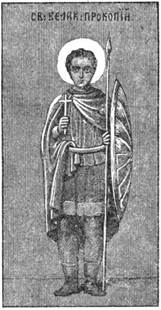
Прокопий, в язычестве Неаний, Иерусалимлянин родом, воспитан был матерью в язычестве и отдан на службу царю Диоклитиану, который и оставил его при дворе своём. Через несколько времени он сделал его воеводой и послал его в Александрию конфисковать имения христиан, а самих христиан предавать суду. При этом Неаний заметил царю: «слышал я о тех людях, что они почитают некоего Христа, Сына Божия, нравом тверды и в вере своей крепки, так что охотнее умирают, нежели приносят жертвы богам нашим; потому, думается мне, неудобно будет преклонять их к законам нашим». Диоклитиан разными поносными словами о христианской вере утвердил Неания в законности преследования христиан и отправил его в путь.
Procopius, in paganism Neanius, a Jerusalemite by birth, was raised by his mother in paganism and given into the service of the emperor Diocletian, who kept him at his court. After some time, he made him a voivode and sent him to Alexandria to confiscate the property of Christians and to deliver the Christians themselves to judgment. At this, Neanius remarked to the emperor: "I have heard of these people, that they worship a certain Christ, the Son of God, that they are firm in character and steadfast in their faith, so that they would rather die than offer sacrifices to our gods; therefore, it seems to me, it will not be easy to bring them under our laws." Diocletian, using various abusive words against the Christian faith, confirmed Neanius in the lawfulness of persecuting Christians and sent him on his way.
На дороге, миновавши Апамию, во время сильной грозы увидел Неаний в воздухе блестящий крест и услышал голос, призывавший его к вере во Христа и говоривший: «сим знамением побеждай врагов твоих!» Прибывши в Скифополь, он призвал золотых дел мастера и заказал ему сделать крест, по подобию виденного. Мастер отказывался делать крест, как знамение христианское; но получив заверение, что о том никто не узнает, втайне сделал крест по плану и словам воеводы. Когда крест был сделан, то на нём вдруг появилось изображение трёх лиц с Еврейской надписью; на верхней части и изобразился Господь Спаситель, по сторонам архангелы Михаил и Гавриил. Воевода спросил: чьи это лица? но мастер отвечал, что не знает, и рассказал, что не мог никак изгладить изображений. Тогда Неаний, уразумев в кресте Божественную силу, поклонился кресту, облобызал его и стал хранить у себя.
On the road, having passed Apamea, during a severe thunderstorm Neanius saw a shining cross in the air and heard a voice calling him to faith in Christ and saying: "By this sign conquer your enemies!" Arriving in Scythopolis, he summoned a goldsmith and ordered him to make a cross, after the likeness of the one he had seen. The craftsman refused to make a cross, as it was a Christian symbol; but having received assurance that no one would know of it, he secretly made the cross according to the plan and words of the voivode. When the cross was made, there suddenly appeared on it the image of three persons with a Hebrew inscription; on the upper part was depicted the Lord Savior, and on the sides the archangels Michael and Gabriel. The voivode asked: whose faces are these? but the craftsman answered that he did not know, and related that he could in no way erase the images. Then Neanius, perceiving in the cross a Divine power, bowed down to the cross, kissed it, and began to keep it with him.
Когда он прибыл в Иерусалим, граждане просили его избавить от окрестных разбойничьих шаек, которые грабили путников и похищали женщин. Неаний с войском погнался за хищниками, поразил их и возвратил всех уведённых ими. Когда после сего мать советовала ему благодарить богов за счастливое окончание предприятия, тогда он, сказав: «мне помог Бог мой», сокрушил всех идолов в доме матери. Мать отправилась в Антиохию к царю и жаловалась на сына за презрение к богам и неуважение к ней самой. Диоклитиап велел Иусту, правителю Палестины, вразумить уклонившегося в христианство, а если не послушает, предать пыткам.
When he arrived in Jerusalem, the citizens begged him to deliver them from the surrounding bands of robbers who plundered travelers and abducted women. Neanius, with his army, pursued the marauders, struck them down, and returned all those they had carried off. When after this his mother advised him to thank the gods for the successful outcome of the undertaking, he, saying: "My God helped me," shattered all the idols in his mother's house. The mother set out for Antioch to the emperor and complained against her son for contempt of the gods and disrespect toward herself. Diocletian ordered Justus, the governor of Palestine, to admonish the one who had turned to Christianity, and if he would not listen, to deliver him to torments.
Иуст прибыл из Кесарии и объявил царское повеление; Неаний же, признав себя христианином и готовым на смерть за веру, отвязал воинский пояс свой и бросил его в знак отречения от царской службы и идольского нечестия. Правитель велел, обнажив, повесить и строгать железом тело его, а потом бросить в темницу. Укреплённый небесным явлением, Неаний в ту же ночь принял св. крещение и имя Прокопия. Видя мужество и доблесть исповедника, некоторые воины тоже обратились ко Христу, крещены епископом Леонтием и на другой день открыто славили Христа Бога. Правитель велел отсечь им головы, в присутствии Прокопия. В тот же день подошли к тюрьме 12 женщин и сказали в окно мученику: «и мы – рабыни Христовы!» Донесли об этом правителю, и он велел заключить их в тюрьму, а на следующий день бичевать, палить огнём и отрезать им сосцы. В толпе стояла и мать Прокопия и плакала, видя лютые муки и терпение женщин. Вдруг она приблизилась к судье и сказала: «и я – раба распятого Христа Бога!» Тщетно правитель убеждал её отказаться от своих слов, и наконец велел отвести её с прочими женщинами в темницу. Увидев мать, Прокопий обрадовался, научил её св. вере и через епископа Леонтия крестил, как и других женщин. Когда затем исповедницы вновь представлены были на суд, то мужественными пребыли в вере, не смотря на бичевание по устам оловянными прутьями, и наконец обезглавлены.
Justus arrived from Caesarea and announced the imperial command; Neanius, however, having confessed himself a Christian and being ready to die for the faith, untied his military belt and cast it away as a sign of renunciation of the imperial service and of idolatrous impiety. The governor ordered him to be stripped, hung up, and his body scraped with iron, and then to be cast into prison. Strengthened by a heavenly vision, Neanius that same night received holy Baptism and the name Procopius. Seeing the courage and valor of the confessor, some soldiers also turned to Christ, were baptized by Bishop Leontius, and the next day openly glorified Christ God. The governor ordered their heads to be cut off in the presence of Procopius. That same day, twelve women approached the prison and said through the window to the martyr: "We also are handmaidens of Christ!" This was reported to the governor, and he ordered them to be confined in prison, and the next day to be scourged, burned with fire, and to have their breasts cut off. In the crowd stood also the mother of Procopius, and she wept, seeing the fierce torments and the endurance of the women. Suddenly she drew near to the judge and said: "I also am a handmaiden of the crucified Christ God!" In vain the governor urged her to recant her words, and finally ordered her to be taken with the other women to the prison. Seeing his mother, Procopius rejoiced, taught her the holy faith, and through Bishop Leontius baptized her, as well as the other women. When afterwards the confessors were again brought before the judgment seat, they remained courageous in the faith, despite scourging on the mouth with tin rods, and were finally beheaded.
Иуст скоропостижно умер, и преемник его вызвал Прокопия в Кесарию (это был главный город провинции), где после многих страшных пыток бичеванием, огнём и растяжением тела, св. великомученик скончал свою земную жизнь от меча (в 303 году).
Justus died suddenly, and his successor summoned Procopius to Caesarea (this was the chief city of the province), where, after many terrible tortures by scourging, fire, and stretching of the body, the holy Great Martyr ended his earthly life by the sword (in the year 303).
Не известно, шёл ли кто в России прежде блаженного Прокопия по пути юродства; но из православных святых Русской Церкви Прокопий является первым подражателем бл. Симеону и Иоанну, путём юродства взошедшим на небо110.
It is not known whether anyone in Russia before the blessed Procopius walked the path of foolishness; but among the Orthodox saints of the Russian Church, Procopius appears as the first imitator of the blessed Symeon and John, who ascended to heaven by the path of foolishness110.
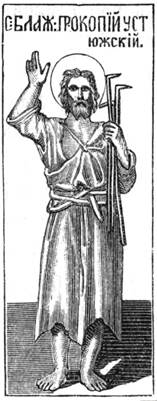
Прокопий, иностранный купец, торговавший в Новгороде, пленённый уставами и учением православной Церкви, отказался от папизма и принял православие. Жизнь православных иноков так подействовала на него, что он, раздав имение бедным и частью в Хутынскую обитель, вступил на новый путь жизни, на путь юродства111. Избегая известности, он недолго пробыл после того в Новгороде и удалился в Вел. Устюг. Он нашёл полузырянский город с христианскими храмами; соборная церковь была деревянная и очень высокая. На её паперти Прокопий стал проводит ночи в молитве; а днём ходил по городу глупцом. Над ним насмехались, его бранили, били; это делали и дети, и те, у которых духовный смысл ещё менее развит был, чем у детей, чтобы понимать поступки духовного человека. Блаж. Прокопий молился за них молитвой Распятого: «Господи! не постави им греха сего». Отдыхать ложился он то на навозе, то на камне или на голой земле. Одежда на нём была изорванная и в ней он переносил северные морозы. Это был мученик, обрёкший себя на неприятности и лишения всякого рода. Утешением для праведного Прокопия служила праведная чета – Иоанн и Мария. Иоанн Буга или Багу был Монгольским чиновником в Устюги; дозволяя себе своеволия, как и другие подобные ему баскаки, он (1262 г.) взял силой в наложницу себе дочь одного гражданина Марию. Народ взволновался и готов был убить дерзкого баскака. По внушению других, Багу принял крещение и вступил в брак с Марией. Народ примирился с ним, а Багу Иоанн совсем переменил жизнь свою, – он и Мария вели жизнь праведную и чистую; на Сокольей горе, где по Монгольской привычке Багу забавлялся соколиной охотой, построен был храм Предтечи с обителью112. Иоанн и Мария оставили по себе в Устюге память праведных и похоронены у Вознесенской церкви113. Праведный Прокопий по временам посещал их, но не пользовался удобствами земной жизни их. Другом и собеседником его был особенно блаж. Киприан, основатель Архангельской Устюжской обители: но и у него не искал он покоя для плоти своей.
It is not known whether anyone in Russia before the blessed Procopius walked the path of foolishness; but among the Orthodox saints of the Russian Church, Procopius appears as the first imitator of the blessed Symeon and John, who ascended to heaven by the path of foolishness110.
Procopius, a foreign merchant who traded in Novgorod, captivated by the statutes and teaching of the Orthodox Church, renounced papism and accepted Orthodoxy. The life of the Orthodox monks so affected him that he, having distributed his property to the poor and partly to the Khutyn Monastery, entered upon a new path of life—the path of foolishness111. Avoiding fame, he did not remain long after that in Novgorod and withdrew to Veliky Ustyug. He found a semi-Zyrian town with Christian churches; the cathedral church was wooden and very tall. On its porch Procopius began to spend the nights in prayer; and by day he walked about the town as a fool. They mocked him, reviled him, beat him; this was done both by children and by those whose spiritual sense was even less developed than that of children, so as to understand the actions of a spiritual man. The blessed Procopius prayed for them with the prayer of the Crucified: "Lord, lay not this sin to their charge." He would lie down to rest either on dung, or on a stone, or on the bare ground. His clothing was tattered, and in it he endured the northern frosts. He was a martyr, having condemned himself to discomfort and deprivations of every kind. A consolation for the righteous Procopius was the righteous couple—John and Mary. John Buga or Bagu was a Mongol official in Ustyug; allowing himself lawlessness, like other such baskaks, he (in 1262) took by force as his concubine the daughter of a certain citizen, Mary. The people became agitated and were ready to kill the insolent baskak. At the prompting of others, Bagu accepted Baptism and entered into marriage with Mary. The people were reconciled with him, and Bagu John completely changed his life—he and Mary led a righteous and pure life; on Sokolya (Falcon) Mountain, where according to Mongol custom Bagu amused himself with falconry, a church of the Forerunner was built with a monastery112. John and Mary left behind in Ustyug a memory as righteous ones and were buried at the Church of the Ascension113. The righteous Procopius would visit them from time to time, but did not avail himself of the comforts of their earthly life. His friend and companion was especially the blessed Cyprian, founder of the Archangel Ustyug Monastery; but even with him he did not seek rest for his flesh.
Раз была ночью жестокая стужа. Сильная вьюга забросала снегом дома, а мороз и ветер северный так были резки, что птицы падали мёртвые на землю, даже скот и люди замерзали. Можно представить себе, каково было нагому Прокопию, который обыкновенно проводил ночи на паперти Устюжского собора. Терзаемый морозом, он пытался войти в хижины нищих, бывшие при храме, чтобы сколько-нибудь погреться; но одни запирали дверь, другие прогоняли даже палкой Прокопия. Прогнанный страдалец нашёл сарай, где в углу лежали собаки; он лёг около собак, чтобы от них согреться, но и собаки ушли от него. Не тяжко ли не найти защиты от смерти у людей и даже у псов? «Буди имя Господне благословенно», сказал Прокопий и воротился на паперть; дрожа всеми костями и ожидая смерти, молился он, да примет Бог душу его. И вот, он чувствует какую-то теплоту; взглянув, видит перед собой ангела Божия с прекрасной веткой в руке; небесный гость, коснувшись веткой лица Прокопия, оживил страдальца; приятная теплота разлилась по всему телу его. Это было точно то же, что испытал бл. Андрей в подобном положении. Об этом бл. Прокопий рассказал любимому клирику Симеону, отцу св. Стефана Пермского, под условием – не говорить о том другим до смерти юродивого.
Once there was a severe frost at night. A fierce blizzard had buried the houses in snow, and the frost and northern wind were so bitter that birds fell dead to the ground, and even cattle and people froze to death. One can imagine what it was like for the naked Procopius, who usually spent his nights on the porch of the Ustyug cathedral. Tormented by the frost, he tried to enter the huts of the poor that were by the church, to warm himself a little; but some shut the door, others even drove Procopius away with a stick. Driven away, the sufferer found a shed where dogs lay in a corner; he lay down near the dogs to warm himself from them, but even the dogs left him. Is it not grievous to find no protection from death from men and even from dogs? "Blessed be the name of the Lord," said Procopius, and returned to the porch; trembling in every bone and expecting death, he prayed that God would receive his soul. And behold, he feels a certain warmth; looking up, he sees before him an angel of God with a beautiful branch in his hand; the heavenly guest, touching the face of Procopius with the branch, revived the sufferer; a pleasant warmth spread throughout his whole body. This was exactly the same as what the blessed Andrew experienced in a similar situation. Of this the blessed Procopius told the beloved cleric Symeon, the father of St. Stephen of Perm, on condition that he not speak of it to others until the death of the fool-for-Christ.
Любимое место, где часто и долго сиживал Прокопий, был камень на берегу р. Сухоны. Здесь, смотря на плывущие мимо суда, молился он молча за вверивших судьбу свою неверной стихии. Он так любил это место, что в последние годы жизни своей говаривал, чтобы погребли его тут114.
The favorite place where Procopius often and long sat was a stone on the bank of the Sukhona River. Here, looking at the ships sailing past, he prayed silently for those who entrusted their fate to the unreliable element. He so loved this place that in the last years of his life he would say that they should bury him there114.
От Богобоязненных людей Прокопий принимал пищу, которую вкушал не каждый день; а от богачей, нажившихся неправдой, не брал ничего. – За тяжкие подвиги Господь одарил Прокопия даром прозрения и чудес ещё на земле.
From God-fearing people Procopius would accept food, which he tasted not every day; but from the rich, who had grown wealthy by unrighteousness, he took nothing. — For his heavy labors, the Lord gifted Procopius with the gift of foresight and miracles even while on earth.
Бог наш, – Бог милости и любви, бывает за грехи наши Богом отмщения. Мор и голод, трус и потоп льются из фиала гнева Божия на нечестивых. Кто уцелеть может под тяжестью десницы Всемощной? Но Господь милостив и в гневе Своём. Он обещал пощадить виновные города для десяти праведников и даже для одного великого праведного. – Исполнение этого обещания видим в жизни блаженного Прокопия, тогда как люди не понимали сего праведника.
Our God—the God of mercy and love—is, for our sins, the God of vengeance. Pestilence and famine, earthquake and flood pour from the vial of God's wrath upon the ungodly. Who can survive under the weight of the right hand of the Almighty? But the Lord is merciful even in His wrath. He promised to spare the guilty cities for the sake of ten righteous men, and even for the sake of one great righteous man. — The fulfillment of this promise we see in the life of the blessed Procopius, even when men did not understand this righteous one.
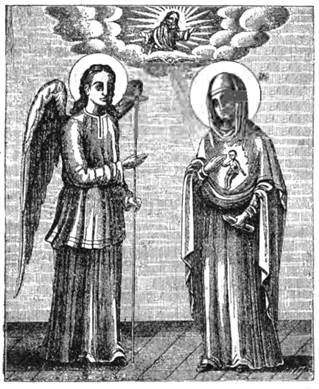
В один воскресный день Прокопий говорил народу в храме: «покайтеся, братия, во грехах ваших; умилостивляйте Бога постом и молитвами; иначе город погибнет от града огненного». «Он не в уме», говорили слушавшие Прокопия. После литургии Прокопий, сидя на паперти, плакал и рыдал, плакал потом днём и ночью. Проходившие мимо его спрашивали: – «что с тобой, Прокопий? Что за скорбь у тебя?» Блаженный отвечал: «бдите и молитеся, да не внидете в напасть». Но проповеди его не принимали к сердцу. – На третий день Прокопий пошёл по городу и говорил со слезами: «плачьте, други, плачьте о грехах ваших, молитесь, чтобы избавил вас Господь от гнева правды Своей, чтобы не погубил вас, как Содом и Гоморру, за беззакония ваши». Но и теперь ожестевшие во грехах не трогались и не приходили в себя, над проповедником смеялись, как над безумцем. И молитвенником остался один Прокопий. – Через неделю после первой проповеди, в полдень, явилось на небосклоне чёрное облако; приближаясь к городу, оно росло более и более; наконец день превратился в тёмную ночь. Молнии бегали огненными полосами и страшные раскаты грома раскатывались в воздухе, не прерываясь ни на минуту; от громовых ударов тряслись стены зданий и от оглушительных звуков не слышно было людского голоса. Тогда-то увидели, что городу грозит гибель; тогда-то вспомнили о проповеди Прокопия и поверили, что не безумие проповедует о гневе Божием на нечестие. Тогда все бросились в храмы и особенно в соборный храм Богоматери. Прокопий был уже здесь и перед иконой Благовещения Богоматери молился с горькими слезами, да будет Богоматерь тёплой ходатаицей за людей преступных. И весь народ с рыданием молился о спасении от гнева Божия: мужи и жёны, дети и дряхлые старцы взывали: «Владычица! спаси нас». Долго молились, и вот от иконы Богоматери потекло Миро ручейком и по храму разлилось благоухание. В то же время оказалась перемена в воздухе, удушливого зноя более не было; тучи с громами и молниями скатились вдаль – на пустынные места. Скоро узнали, что за 20 вёрст от Устюга пали с градом раскалённые камни, раздробили и уничтожили множество деревьев, но никто из людей не убит и даже скот везде остался цел. Между тем мира из св. иконы истекло столько, что им наполнили сосуды церковные, и мазавшиеся Миром получали исцеление от разных болезней115.
One Sunday, Procopius said to the people in the church: "Repent, brethren, of your sins; propitiate God with fasting and prayers; otherwise the city will perish from a fiery hail." "He is out of his mind," said those who heard Procopius. After the Divine Liturgy, Procopius, sitting on the porch, wept and sobbed, and wept afterward day and night. Those passing by asked him: "What is the matter with you, Procopius? What sorrow do you have?" The blessed one answered: "Watch and pray, that ye enter not into temptation." But they did not take his preaching to heart. — On the third day, Procopius went through the city and said with tears: "Weep, friends, weep for your sins, pray that the Lord may deliver you from the wrath of His righteousness, that He may not destroy you, like Sodom and Gomorrah, for your iniquities." But even now, those hardened in sins were not moved and did not come to themselves; they laughed at the preacher as at a madman. And Procopius remained the only intercessor. — A week after the first sermon, at noon, a black cloud appeared on the horizon; as it approached the city, it grew larger and larger; finally, day turned into dark night. Lightnings ran in fiery streaks, and terrible peals of thunder rolled in the air, not ceasing for a moment; from the thunderclaps the walls of buildings shook, and from the deafening sounds no human voice could be heard. Then they saw that the city was threatened with destruction; then they remembered the preaching of Procopius and believed that it was not madness that preached of the wrath of God against ungodliness. Then everyone rushed to the churches, and especially to the cathedral church of the Mother of God. Procopius was already there, and before the icon of the Annunciation of the Mother of God he prayed with bitter tears, that the Mother of God might be a fervent intercessor for the sinful people. And all the people with weeping prayed for deliverance from the wrath of God: men and women, children and decrepit elders cried out: "O Lady, save us!" They prayed long, and behold, from the icon of the Mother of God Myrrh flowed in a stream, and a fragrance spread throughout the church. At the same time, a change occurred in the air; the suffocating heat was no more; the clouds with thunder and lightning rolled away into the distance—to deserted places. Soon they learned that twenty versts from Ustiug, red-hot stones had fallen with hail, shattering and destroying many trees, but none of the people were killed, and even the cattle everywhere remained unharmed. Meanwhile, so much myrrh flowed from the holy icon that they filled church vessels with it, and those anointed with the myrrh received healing from various diseases115.
Прокопий стал после того опять юродствовать и юродством закрывал от людей обильную благодать, обитавшую в нём. – Он носил в руке три кочерги. Несколькими опытами замечено было, что, когда он носил их вверх головами, в тот год бывал хороший урожай на хлеб и другие плоды; когда же оборочены они были вниз головами, приходилось смиряться людям, бывал недостаток во всём.
After that, Procopius again began to play the fool, and by his foolishness concealed from men the abundant grace that dwelt in him. — He carried three pokers in his hand. From several experiences it was observed that when he carried them with the heads upward, that year there was a good harvest of grain and other fruits; but when they were turned heads downward, people had to humble themselves, and there was a shortage of everything.
Блаженный Прокопий преставился в старости, 8-го июля 1285 года, у ворот обители архистратига Михаила. Согласно с его желанием тело его похоронили на берегу р. Сухоны, близ соборной Успенской церкви. Камень, на котором часто сидел он на берегу Сухоны, молясь за плавающих, положен над гробом его, а на том месте, где он преставился, поставлена часовня116.
The blessed Procopius reposed in old age, on the 8th of July, 1285, at the gates of the monastery of the Archangel Michael. According to his wish, his body was buried on the bank of the Sukhona River, near the cathedral Dormition church. The stone on which he often sat on the bank of the Sukhona, praying for those who sailed, was placed over his grave, and a chapel was erected on the spot where he reposed116.
В 1495 году построен был храм в Устюге во имя праведного Прокопия. Это был памятник благодарности за спасение Устюжской дружины в Нижнем от повальной болезни; праведник являлся тогда многим из дружины с обещанием помощи своей против страшной болезни. Лик праведника ещё прежде того написан был на том камне, на котором любил он сидеть. Теперь положили праздновать в Устюге память его каждый год 8 июля. С того времени чаще стали являться исцеления по молитве призываемого на помощь праведника. Устюжский гражданин Григорий был в сильной горячке; расслабленный ею, просил он отнести его к гробнице Прокопия и здесь, когда отпет был молебен, встал здоровым. – Окольничий великого князя Владимир был сильно болен, всё тело его покрыто было язвами и никакие лекарства не помогали ему. – Один из Устюжских граждан, явясь к боярину по делам и узнав о его болезни, сказал ему: «не прогневайся на нас, честной боярин, мы хотим назвать тебе верного врача; за много лет жил у нас в Устюге юродивый Прокопий; в его имя ныне у собора есть церковь и от мощей его получаются разные исцеления». Боярин послал нарочного в Устюг отслужить молебен блаж. Прокопию за него больного; когда возвратился посланный с иконой св. Прокопия, больной встал с постели и, выслушав молебен перед иконой, стал совсем здоровым. – В ряду чудес достойно особенного внимания следующее: был у наместника Устюжского, боярина Семёна Борисовича, служитель любимый им, но который творил много пакостей Устюжанам; худой христианин умер не по-христиански, не удостоившись исповеди и причастия святых Таин. – Боярин велел похоронить любимого служителя близ собора и построить над его могилой палатку; воля его исполнена, но в ту же ночь палатка была размётана. Боярин велел построить новую, но и та была разбросана. Боярин рассердился, думая, что это делают худые люди по неудовольствию на него. – Один Устюжанин взял на себя смелость сказать боярину: «не гневайся, боярин; слышал я от прадедов моих, что здесь лежит блаженный Прокопий, юродивый для Христа». – Боярин понял правду; он велел перенести тело служителя в другое место и с слезами молился: «прости, блаженный Прокопий, меня грешного и неразумного, что осмелился положить вблизи твоей святости нечистого слугу»117.
In 1495, a church was built in Ustiug in the name of the righteous Procopius. This was a monument of gratitude for the deliverance of the Ustiug company in Nizhny from a plague; the righteous man had then appeared to many of the company with a promise of his help against the terrible disease. The image of the righteous man had been painted even earlier on the stone on which he loved to sit. Now they began to celebrate his memory in Ustiug every year on July 8. From that time, healings began to occur more frequently through the prayer of the righteous man invoked for help. A citizen of Ustiug, Gregory, was in a severe fever; weakened by it, he asked to be carried to the tomb of Procopius, and there, when a moleben was sung, he rose up healthy. — The okolnichy of the Grand Prince, Vladimir, was gravely ill; his whole body was covered with sores, and no medicines helped him. — One of the citizens of Ustiug, appearing before the boyar on business and learning of his illness, said to him: "Be not angry with us, honorable boyar; we wish to name to you a faithful physician. Many years ago there lived among us in Ustiug a fool-for-Christ, Procopius; in his name there is now a church near the cathedral, and from his relics various healings are received." The boyar sent a messenger to Ustiug to have a moleben served to the blessed Procopius for him, the sick man; when the envoy returned with an icon of St. Procopius, the sick man rose from his bed and, having heard the moleben before the icon, became completely well. — Among the miracles, the following is worthy of special attention: The Ustiug voivode, the boyar Simeon Borisovich, had a servant whom he loved, but who did much mischief to the people of Ustiug; this bad Christian died in an unchristian manner, not having been vouchsafed confession and communion of the Holy Mysteries. — The boyar ordered his beloved servant to be buried near the cathedral and a tent to be built over his grave; his will was done, but that same night the tent was torn down. The boyar ordered a new one to be built, but that too was scattered. The boyar became angry, thinking that evil people were doing this out of displeasure with him. — One citizen of Ustiug took the boldness to say to the boyar: "Be not angry, boyar; I have heard from my forefathers that here lies the blessed Procopius, a fool-for-Christ." — The boyar understood the truth; he ordered the servant's body to be moved to another place and prayed with tears: "Forgive me, blessed Procopius, a sinful and foolish man, that I dared to place an unclean servant near your holiness"117.
Набожный Устюжанин XVI века в своей похвале блаж. Прокопию писал: «Царьград ублажает святых блаженных мужей Симеона, Иоанна и Андрея, Христа ради юродивых. Великий Новгород славит архиепископов Иоанна, Евфимия, Никиту, Иону и преподобных Варлаама, Савву и Михаила Клопского; Псков город – блаженного князя Всеволода-Гавриила, преп. Аврамия и Савву. Москва величает митрополитов Петра, Алексия, Иону и Филиппа, блаженных Максима и Василия и иных святых. – Ростов ублажает епископов Леонтия и Игнатия, Исаию и Иакова, преп. Аврамия и блаж. Исидора. Смоленск и Ярославль чтят князя Феодора и чад его; Вологда преп. Димитрия, Корнилия Комельского, Павла и Сергия на Нурме, Дионисия и Амфилохия Глушицких. – Река Вага, на которой город Шенкурск, ублажает Георгия юродивого; Соловецкий остров и поморье – преп. Зосиму и Савватия. Мы же тебя, Прокопий, имеем стражем Христовым и заступником граду Устюгу»118.
A devout citizen of Ustiug of the 16th century, in his praise of the blessed Procopius, wrote: "Constantinople extols the holy blessed men Simeon, John, and Andrew, fools-for-Christ. Great Novgorod glorifies the archbishops John, Euthymius, Nikita, Jonah, and the Venerables Barlaam, Sabbas, and Michael of Klopsk; the city of Pskov—the blessed Prince Vsevolod-Gabriel, the Venerables Abramius and Sabbas. Moscow magnifies the metropolitans Peter, Alexis, Jonah, and Philip, the blessed Maximus and Basil, and other saints. — Rostov extols the bishops Leontius and Ignatius, Isaiah and James, the Venerable Abramius and the blessed Isidore. Smolensk and Yaroslavl honor Prince Theodore and his children; Vologda—the Venerable Demetrius, Cornelius of Komel, Paul and Sergius on the Nurma, Dionysius and Amphilochius of Glushitsa. — The River Vaga, on which stands the town of Shenkursk, extols George the fool-for-Christ; Solovki Island and the Pomor region—the Venerables Zosimas and Sabbatius. But we have you, Procopius, as a guardian of Christ and an intercessor for the city of Ustiug"118.
Церковь поёт: «ты был бездомным, Прокопий, и, перенося всякое оскорбление, приносил Богу дела добрые, как фимиам благовонный, как жертву приятную. Потому и получил ты дерзновение пред Ним на небе. Моли даровать очищение грехов славящим святую память о тебе»119.
The Church sings: "You were homeless, O Procopius, and, enduring every insult, you offered to God good deeds as fragrant incense, as a pleasing sacrifice. Therefore you have obtained boldness before Him in heaven. Pray to grant remission of sins to those who glorify your holy memory"119.
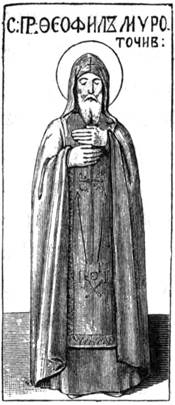
Родители преп. Феофила120 – Македонские Славяне из местечка Сичева121, добрые и благочестивые христиане, дали сыну прекрасное воспитание. Сын, с юных лет, учившись успешно, не любил весёлостей и рассеяния и любил разговаривать с умными и добрыми людьми. Большую часть времени посвящал он чтению христианских книг и любил обогащать ум свой познаниями. Став известным, как по доброй жизни, так и по познаниям христианским, он посвящён был в священника; в этом сане он ревностно сеял семена благочестия в христианских сердцах и для этого сеяния переходил из одного места в другое. Ревность к совершенству духовному сблизила его с Ранданским епископом Акакием, и Феофил остался жить при нём, для душевного назидания. Константинопольский патриарх Нифонт получает письма из Египта с известием о чудесах, совершенных Александрийским патриархом Иоакимом, в посрамление Иудеев, и по поручению патриарха епископ Акакий с Феофилом и другими отправляется в Египет, для личного сношения с патриархом. С посланными отправлено послание Константинопольского патриарха и к Александрийскому с изъявлением радости о милостях небесных.
The parents of the Venerable Theophilus120—Macedonian Slavs from the town of Sicheva121, good and pious Christians—gave their son an excellent upbringing. The son, from his youth, learning successfully, did not love amusements and dissipation, and loved to converse with wise and good people. He devoted most of his time to reading Christian books and loved to enrich his mind with knowledge. Having become known both for his good life and for his Christian knowledge, he was ordained a priest; in this rank he zealously sowed the seeds of piety in Christian hearts, and for this sowing he moved from one place to another. Zeal for spiritual perfection brought him close to the Bishop of Randa, Acacius, and Theophilus remained to live with him for spiritual edification. The Patriarch of Constantinople, Niphon, receives letters from Egypt with news of the miracles performed by the Patriarch of Alexandria, Joachim, to the shame of the Jews; and by the patriarch's commission, Bishop Acacius, together with Theophilus and others, sets out for Egypt for personal communication with the patriarch. With the envoys was sent an epistle from the Patriarch of Constantinople to the Patriarch of Alexandria, expressing joy over the heavenly mercies.
В Египте свирепствовала чума: Мисир и его окрестности особенно сильно пострадали. Жид-врач, отъявленный враг христианства, распустил молву между магометанами, что христиане виновники смертности, – они опускают в воду крест. Молва дошла до султана. Тот, уважая патриарха, на первый раз оставил без внимания донесение злобы. Жид-врач обратился к визирю-жиду, любимцу султана, и тот успел довести султана до того, что патриарх потребован в Диван для объяснений. Султан долго разговаривал с патриархом и наконец сказал: «пусть патриарх в оправдание Евангельских слов переставит гору соседнюю с Мисирем». Патриарх выпросил несколько дней для молитвы. Потом, в назначенный день при стечении народа сказал горе: «именем Господа говорю: сойди с места». И гора затряслась и сдвинулась с места. Эта гора с того времени называется дур дого – стань гора. – Это чудо поразило всех. Но жиды ещё более озлились. У них написано, говорили они султану: аще и смертное что испиют, не вредит им (Мк.16:18). Если это не ложь, пусть патриарх докажет это на себе. Султан принял и это внушение злости, согласился на то, чтобы подан был яд патриарху. Полный веры в силу креста Христова, патриарх осенил смертную чашу знамением креста и выпил яд. Все ожидали, что он тотчас умрёт. Патриарх остался невредим. Налив стакан водой, патриарх сказал султану: «пусть Еврей выпьет это, подаваемое хулимою им верою». По приказанию султана Еврей выпил и мгновенно издох. Поражённый такими чудесами, султан велел обезглавить клеветника визиря, а на всех Евреев наложена пеня: сделать водопроводы из Нила в Мисир122.
In Egypt a plague was raging: Misr and its environs suffered especially severely. A Jewish physician, a sworn enemy of Christianity, spread a rumor among the Mohammedans that Christians were the cause of the mortality—they were lowering a cross into the water. The rumor reached the sultan. He, respecting the patriarch, at first left the report of malice unheeded. The Jewish physician turned to the vizier, a Jew, the sultan’s favorite, and he succeeded in bringing the sultan to the point that the patriarch was summoned to the Divan for explanations. The sultan conversed long with the patriarch and finally said: “Let the patriarch, in vindication of the Gospel words, move the mountain neighboring Misr.” The patriarch begged several days for prayer. Then, on the appointed day, in the presence of a multitude of people, he said to the mountain: “In the name of the Lord I say: move from your place.” And the mountain shook and moved from its place. That mountain from that time is called dur dogo—move, mountain. This miracle astounded all. But the Jews became even more enraged. “It is written for them,” they said to the sultan, “and if they drink any deadly thing, it shall not hurt them (Mk. 16:18). If this is not a lie, let the patriarch prove it on himself.” The sultan accepted this prompting of malice as well and agreed that poison should be given to the patriarch. Full of faith in the power of the Cross of Christ, the patriarch made the sign of the cross over the deadly cup and drank the poison. All expected that he would die immediately. The patriarch remained unharmed. Filling a glass with water, the patriarch said to the sultan: “Let the Jew drink this, offered by the faith he blasphemes.” By the sultan’s command the Jew drank and instantly expired. Struck by such miracles, the sultan ordered the slanderer the vizier to be beheaded, and a penalty was imposed on all the Jews: to build aqueducts from the Nile to Misr122.
Акакий и Феофил приняты были Александрийским патриархом с радостью, и блаж. Феофил своей образованностью обратил на себя особенное внимание великого святителя. Пробыв довольное время в Александрии, благочестивые путешественники отправились на Синай, а оттуда в Иерусалим, были на Фаворе и в Дамаске, где получили письма Антиохийского патриарха к Цареградскому. Из Дамаска возвратились в Иерусалим, где блаж. Акакий заболел и умер. Письма Иерусалимского патриарха Феофил доставил уже патр. Пахомию, так как Нифонт удалился на покой. Патр. Пахомий столько полюбил Феофила, что удержал его при себе в должности нотария и экзарха великой церкви. Феофила все уважали за его добродетели, но он отяготился этим уважением и удалился на Афон.
Acacius and Theophilus were received by the Patriarch of Alexandria with joy, and blessed Theophilus, by his learning, drew the special attention of the great hierarch. Having spent a considerable time in Alexandria, the pious travelers set out for Sinai, and from there to Jerusalem; they were on Tabor and in Damascus, where they received letters from the Patriarch of Antioch to the Patriarch of Constantinople. From Damascus they returned to Jerusalem, where blessed Acacius fell ill and died. Theophilus delivered the letters of the Patriarch of Jerusalem to Patriarch Pachomius, since Niphon had retired to repose. Patriarch Pachomius so loved Theophilus that he kept him with himself in the office of notary and exarch of the Great Church. All respected Theophilus for his virtues, but he was burdened by this respect and withdrew to Athos.
В Ватопедском монастыре поручил он себя руководству пребывавшего на покое епископа; подчинив себя воле его, он каждый день совершал служение. По смерти епископа, перешёл в Иверскую обитель и здесь учился у одного послушанию, у другого любви, у третьего терпению. По поручению обители, он занимался списыванием книг – и многие книги письма его остались в Ивере123. Феофил так стал известен духовною жизнью и образованностью, что Солуняне сильно желали иметь его своим архипастырем. Сам патриарх Феолипт, бывший по случаю в Солуне, по просьбе Солунцев, писал к Феофилу, вызывая его в Солунь. Но смиренный Феофил поспешил облечься в схиму, а патриарху отвечал, что тяжкая болезнь, заставившая его принять схиму, никак не дозволяет ему прибыть в Солунь.
In the Vatopedi monastery he placed himself under the guidance of a bishop who was living in retirement; submitting himself to his will, he performed the services each day. After the bishop’s death, he moved to the Iveron monastery and there learned obedience from one, love from another, patience from a third. By commission of the monastery, he occupied himself with copying books—and many books in his hand remained in Iveron123. Theophilus became so renowned for his spiritual life and learning that the Thessalonians greatly desired to have him as their archpastor. Patriarch Theoliptus himself, who happened to be in Thessalonica, at the request of the Thessalonians, wrote to Theophilus, summoning him to Thessalonica. But the humble Theophilus hastened to be clothed in the schema, and replied to the patriarch that a grievous illness, which had compelled him to receive the schema, by no means permitted him to come to Thessalonica.
Близ Ивера уединённо подвизался тогда игумен Дионисий. Блаж. Феофил, выпросив у него дозволение, построил вблизи малую келью. Они жили в такой любви между сбой, что, казалось, была у них одна душа.
Near Iveron, Abbot Dionysius was then asceticising in solitude. Blessed Theophilus, having obtained his permission, built a small cell nearby. They lived in such love with each other that they seemed to have one soul.
Потом блаженный жил в Карее вместе с старцем Кириллом. Здесь прот Св. горы старец Серафим, духовник Кирилла, так полюбил Феофила, что они остались друзьями до гроба. Когда сильное желание безмолвия увлекло Феофила в уединённую келью св. Василия, принадлежавшую монастырю Пандократора124, а между тем Феофил не имел у себя ничего, чем бы поправить обветшавшую келью и уплатить монастырю, старец Серафим помог ему и потом, отказавшись от должности прота, перешёл жить вместе с блаж. Феофилом. Исключительным подвигом их было хранение ума непрестанной молитвой Иисусовой. Препод. Феофил ни о чём больше не думал, как о Господе Иисусе; Иисус был дыханием его, Он был постоянно в сердце его. Наконец, будучи исполнен дней, преподобный предузнал смерть свою и начал готовиться к переходу в ту жизнь. Он написал исповедание веры и завещание. В пяток, по его желанию, совершено над ним елеосвящение; простившись со всеми, приобщился святых Таин; ученику своему Исааку дал заповедь не хоронить его, а оттащить труп его куда-нибудь и бросить. Преподобный предал дух свой Богу 8 июля 1548 г.
Afterwards the blessed one lived in Karyes together with the elder Cyril. Here the Protos of the Holy Mountain, Elder Seraphim, Cyril’s spiritual father, so loved Theophilus that they remained friends unto the grave. When a strong desire for silence drew Theophilus to a solitary cell of St. Basil, belonging to the Pantocrator monastery124, and meanwhile Theophilus had nothing with which to repair the dilapidated cell or pay the monastery, Elder Seraphim helped him and afterwards, having resigned the office of Protos, came to live together with blessed Theophilus. Their exclusive ascetic labor was the guarding of the mind through unceasing Jesus Prayer. Venerable Theophilus thought of nothing else but the Lord Jesus; Jesus was his breath, He was constantly in his heart. Finally, being full of days, the Venerable One foreknew his death and began to prepare for the passage to that life. He wrote a confession of faith and a testament. On Friday, according to his wish, the Mystery of Holy Unction was performed over him; having taken leave of all, he partook of the Holy Mysteries; he gave his disciple Isaac a command not to bury him, but to drag his corpse somewhere and throw it away. The Venerable One gave up his spirit to God on July 8, 1548.
Исаак исполнил волю старца и оттащил тело его в лес. Когда во всей горе разнёсся слух о кончине Феофила, – весьма многие, знакомые и друзья, приходили поклониться могиле преподобного. Исаак указывал всем на одно место взрытое, как на могилу почившего. Только иноки Ивера и Пандократора по какому-то предчувствию не доверяли Исааку. Некоторые из них стали ходить по лесу и, найдя мощи преподобного, скрыли у себя. Когда в 40 день Исаак пришёл в лощину, к изумлению не нашёл мощей старца. После долгого разведывания дознался он, что мощи находятся в обители Пандократора. Он обратился с жалобой к Ерисскому епископу Макарию. Тот созвал игуменов, и решили оставить руку преподобного в обители Пандократора, а прочее отдать Исааку в келейную церковь святого Василия. С того времени мощи преподобного источают благовонное миро.
Isaac fulfilled the elder’s will and dragged his body into the forest. When the news of Theophilus’s end spread throughout the whole mountain, very many, acquaintances and friends, came to venerate the grave of the Venerable One. Isaac pointed out to all a certain dug-up spot as the grave of the departed. Only the monks of Iveron and Pantocrator, by some presentiment, did not trust Isaac. Some of them began to walk through the forest and, finding the relics of the Venerable One, hid them with themselves. When on the fortieth day Isaac came to the ravine, to his astonishment he did not find the elder’s relics. After long inquiry he learned that the relics were in the Pantocrator monastery. He turned with a complaint to Bishop Macarius of Hierissus. He summoned the abbots, and they decided to leave the hand of the Venerable One in the Pantocrator monastery, and to give the rest to Isaac for the cell church of St. Basil. From that time the relics of the Venerable One pour forth fragrant myrrh.
Древняя запись о явлении мощей святого и чудесах его говорит: «сего блаженнаго и приснопамятнаго Прокопия отечество дольно и племя земнородно, град или весь, в нейже святый родися, нам манием Божиим весьма утаися, да известнее вемы, яко святии Божии не земнаго, но небеснаго отечества ищут, не человеческим, но ангельским сродством хвалятся, и не дольнего, но горнего Иерусалима гражданами быти тщатся».
An ancient record of the appearance of the saint’s relics and his miracles says: “The fatherland and earthly lineage of this blessed and ever-memorable Procopius, the city or village in which the saint was born, is wholly hidden from us by the will of God, that we might know more surely that the saints of God seek not an earthly, but a heavenly fatherland, boast not of human, but of angelic kinship, and strive to be citizens not of the earthly, but of the heavenly Jerusalem.”
Мощи святого явились на берегу реки Усьи, близ приходской церкви села Верюги (Вельского уезда, Вологодской губернии), около 1600 года, в гробе из ивовых лоз, весьма обветшавшем. Мощи были целы, как бы того же дня погребены. Никто не знал и не помнил о явленном, но нетление мощей и чудесные исцеления многих больных тотчас убедили всех в святости явившегося. Окрестные жители, воздав хвалу и благодарение Богу за явленную к ним милость, построили часовню над мощами.
The relics of the saint appeared on the bank of the Ustya River, near the parish church of the village of Veryuga (Velsk district, Vologda province), around the year 1600, in a coffin made of willow withes, very much decayed. The relics were whole, as if buried that same day. No one knew or remembered the one who had appeared, but the incorruption of the relics and the miraculous healings of many sick people immediately convinced all of the holiness of the one who had appeared. The surrounding inhabitants, giving praise and thanksgiving to God for the mercy shown to them, built a chapel over the relics.
Вскоре после того святой явился земледельцу Савелию Онтропову и велел сделать себе новый гроб. На вопрос Савелия «кто ты?» он назвал себя Прокопием и объяснил, что он тот, тело которого недавно явилось при церкви. Савелий сделал гроб, и когда уже хотел везти его к церкви, святой снова явился ему и приказал несколько убавить гроб сверху. Савелий, исполнивши повеленное, объявил народу о бывших ему явлениях святого, через что все узнали его имя и с великим благоговением переложили святые мощи в новый гроб, а старый разнёс по пруткам народ на Благословение себе и память.
Soon after that, the saint appeared to a farmer, Savely Ontropov, and commanded him to make a new coffin for him. To Savely’s question, “Who are you?” he called himself Procopius and explained that he was the one whose body had recently appeared near the church. Savely made the coffin, and when he was already about to take it to the church, the saint appeared to him again and ordered him to shorten the coffin a little from the top. Savely, having done what was commanded, announced to the people the appearances of the saint that had occurred to him, through which all learned his name and with great reverence transferred the holy relics into the new coffin, while the people carried off the old one piece by piece for their own blessing and remembrance.
Мощи почивали в часовне, пока не перенесены были в новопостроенную, вместо обветшавшей, Введенскую церковь и поставлены открыто подле южной стены. В 1652 году усердием некоего купца из Сольвычегодска написан и образ святого. С того же времени, надобно полагать, начали совершать ему и службу церковную по особенной письменной книжице.
The relics rested in the chapel until they were transferred to the newly built Church of the Entry of the Theotokos, built in place of the dilapidated one, and were placed openly by the southern wall. In 1652, through the zeal of a certain merchant from Solvychegodsk, an icon of the saint was also painted. From that time, it must be supposed, they began to celebrate church services for him according to a special written booklet.
Когда Верюжская церковь из Новгородской отошла к Холмогорской епархии, то мощи, по распоряжению первого Холмогорского архиерея, свидетельствованы были в 1696 году, и затем – вторично 1739 года. С того времени епархиальное начальство дозволяло строить и храмы в честь св. Прокопия Усьянского.
When the Veryuga church passed from the Novgorod diocese to the Kholmogory diocese, the relics, by order of the first Kholmogory bishop, were examined in 1696, and then a second time in 1739. From that time, the diocesan authorities permitted the building of churches in honor of St. Procopius of Ustya.
Мощи ныне почивают в старинной деревянной раке в каменной Введенской церкви; они покрыты шитым по атласу шелками, серебром и золотом изображением святого (см. Верюжского Истор. сказания о жизни святых, подвизавшихся в Вологодской епархии. Вологда, 1880 года).
The relics now rest in an ancient wooden reliquary in the stone Church of the Entry of the Theotokos; they are covered with an embroidered image of the saint, worked on satin with silks, silver, and gold (see Veryuzhskoye Historical Accounts of the Lives of the Saints Who Asceticised in the Vologda Diocese. Vologda, 1880).
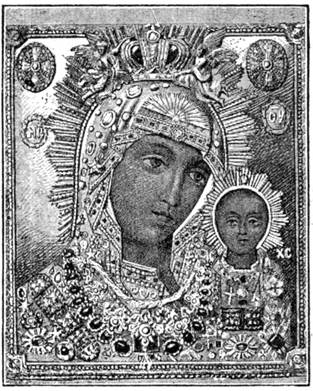
В 1579 году 28 июня при Иоанне Васильевиче IV в Казани, им покорённой, при Московском митрополите Антонии, при архиепископе Казанском Иеремии, в подкрепление веры Христовой среди магометан, населявших Казанское царство, Богоматерь явилась девятилетней девице Матроне и повелела возвестить духовным и светским сановникам города, чтобы они взяли икону её из недр земли, и указала само место на пепелище сгоревшего дома родителей девицы, где икона скрывалась. Видение повторилось трижды. Девица сначала никому не объявила о видении своём, потом открыла матери своей, которая сначала не внимала ей. После третьего видения Матрона со слезами говорила матери: «я видела во сне икону Богородицы, от лица которой исходило ужасное пламя, устремлявшееся на меня и готовое сжечь меня, и слышала голос: если ты не поведаешь глаголов моих, я явлюсь в другом месте, а ты погибнешь». После этого мать ходила с Матроной к Казанским воеводам и архиепископу Иеремии и заставляла её рассказывать им о бывших ей явлениях Богоматери. Когда они не поверили словам девицы, мать сама решилась рыть землю на указанном дочери месте, чтобы отыскать икону, но напрасно. Рыли землю и искали иконы и другие, и также не нашли. Матрона сама стала копать землю и скоро обрела святую икону Богоматери, как бы ново-начертанную, а не в земле найденную. Явленный образ с благоговением и радостью извлечён из земли и поставлен на месте, где обретён. Немедленно стеклось к нему бесчисленное множество народа; все с благоговейным удивлением взирали на святыню, молились и стремились приложиться к ней. О дивном обретении известили архиепископа и градоначальников. Архиепископ совершил крестный ход к явленной иконе и с великой честью препроводил её в ближайший храм на руках бывшего в то время священником этого храма Гермогена, впоследствии патриарха, и здесь совершил перед иконой молебствие. Сняв с неё список и изложив обстоятельства её явления и чудеса, послали в 1579 г. в Москву к царю. В 1595 г. благоверный государь Феодор Иоаннович повелел на месте явления иконы, где прежде была деревянная церковь, построить каменную и женский монастырь Богородицкий и от себя принёс великую жертву. В этом монастыре приняли иноческое пострижение дочь и мать, послужившие явлению иконы. Явлению Казанской иконы Божией Матери установлено праздновать в Казани 8 июля – в тот день, когда мать с своей дочерью, сподобившейся видения, ходила к архиепископу и начальникам города объявить им о видении.
In the year 1579, on the 28th of June, under John Vasilievich IV, in Kazan, which had been subdued by him, under Anthony, Metropolitan of Moscow, and under Jeremiah, Archbishop of Kazan, for the strengthening of the Christian faith among the Mohammedans who inhabited the Kazan kingdom, the Mother of God appeared to a nine-year-old maiden, Matrona, and commanded her to announce to the spiritual and civil authorities of the city that they should take Her icon from the bowels of the earth, and She pointed out the very place on the ashes of the burnt house of the maiden’s parents where the icon was hidden. The vision was repeated three times. At first the maiden told no one of her vision; then she revealed it to her mother, who at first did not heed her. After the third vision, Matrona said to her mother with tears: “I saw in a dream the icon of the Theotokos, from whose face issued a terrible flame, rushing upon me and ready to burn me, and I heard a voice: if you do not tell My words, I will appear in another place, and you will perish.” After this, the mother went with Matrona to the Kazan voivodes and to Archbishop Jeremiah and made her tell them of the appearances of the Mother of God that had come to her. When they did not believe the maiden’s words, the mother herself decided to dig the earth in the place indicated to her daughter, in order to find the icon, but in vain. Others also dug the earth and sought the icon, and likewise did not find it. Matrona herself began to dig the earth and soon found the holy icon of the Mother of God, as if newly painted, and not as one found in the earth. The appeared image was taken from the earth with reverence and joy and placed on the spot where it was found. Immediately an innumerable multitude of people flocked to it; all gazed upon the shrine with reverent wonder, prayed, and hastened to venerate it. The archbishop and the city authorities were informed of the wondrous uncovering. The archbishop made a procession of the cross to the appeared icon and, with great honor, escorted it to the nearest church in the arms of Hermogenes, who was at that time the priest of that church and later became patriarch, and there he performed a moleben before the icon. Having made a copy from it and having set forth the circumstances of its appearance and its miracles, they sent it in 1579 to Moscow to the Tsar. In 1595, the Right-believing Sovereign Theodore Ioannovich commanded that on the site of the appearance of the icon, where a wooden church had previously stood, a stone church and a women’s monastery of the Theotokos be built, and he himself made a great offering. In this monastery, the daughter and mother who had served the appearance of the icon received monastic tonsure. The celebration of the Kazan Icon of the Mother of God was established to be kept in Kazan on the 8th of July—on the day when the mother with her daughter, who had been vouchsafed the vision, went to the archbishop and the city authorities to announce the vision to them.
В этот день Православная Церковь воспоминает «знамение», явившееся в Устюге от иконы Благовещения Пресв. Богородины в 1290 г. Св. Прокопий, Христа ради юродивый, подвизавшийся в Великом Устюге, объявил однажды своим согражданам, что Бог, за их грехи, хочет погубить город их. Наступил предвозвещённый им день: на небе показалось над самым городом мрачное облако, и со всех сторон начали появляться грозные тучи с непрестанными молниями и громами. Городу угрожали бедствия; жители обратились к покаянию и все стеклись в храмы Божии для молитвы об отвращении предстоящего несчастия. В соборной церкви Богоматери от сей иконы, по молитвам народа, сокрушавшегося о грехах своих, и особенно по молитвам Устюжского чудотворца Прокопия, который, павши перед иконой Богоматери, со слезами молил Владычицу, да будет Она скорой заступницей перед Сыном Своим за люди согрешившие и праведный гнев Его на себя привлекшие, всенародно явлено былознамение благоволения Божия. На иконе Царицы Небесной увидели истекшее из очей её благовонное миро – знамение слёзного моления её о спасении града, и Господь, по заступлению Пречистой Матери Своей, избавил город от погибели. Страшные тучи, угрожавшие, по милосердию Божию, пронеслись над городом и на месте ненаселённом пролился из них дождь и выпали камни. В воспоминание этого спасительного события установлено ежегодное празднество чудотворной иконе Пресв. Богородицы в 8-й день июля.
On this day the Orthodox Church commemorates the “sign” that appeared in Ustiug from the icon of the Annunciation of the Most Holy Theotokos in the year 1290. St. Procopius, the Fool-for-Christ, who struggled in Great Ustiug, once declared to his fellow citizens that God, because of their sins, wished to destroy their city. The day foretold by him arrived: a dark cloud appeared in the sky directly over the city, and from all sides threatening storm clouds began to gather with incessant lightning and thunder. Disasters threatened the city; the inhabitants turned to repentance and all flocked to the churches of God to pray for the averting of the impending misfortune. In the cathedral church of the Theotokos, from this icon, through the prayers of the people who grieved over their sins, and especially through the prayers of the Ustiug Wonderworker Procopius, who, falling before the icon of the Mother of God, tearfully besought the Lady that She might be a swift intercessor before Her Son for the people who had sinned and drawn upon themselves His righteous wrath, a sign of God’s favor was publicly shown. On the icon of the Queen of Heaven, they saw a fragrant myrrh flowing from Her eyes—a sign of Her tearful prayer for the salvation of the city—and the Lord, through the intercession of His Most Pure Mother, delivered the city from destruction. The terrible clouds, by God’s mercy, passed over the city, and upon an uninhabited place rain poured from them and stones fell. In remembrance of this salvific event, an annual feast to the wonderworking icon of the Most Holy Theotokos was established on the 8th day of July.
Чудотворный образ Благовещения Богородицы, перед которым молился св. Прокопий, называется Устюжским и ныне находится в Московском Успенском соборе, куда этот образ перенесён вероятно во время княжения Иоанна Васильевича Грозного, около 1567 года. На месте же этого образа в Устюге поставлен в 1747 году 3 июля новонаписанный с него. В 1812 году неприятели, бывшие в Москве, лишили Устюжский образ богатого оклада, но Устюжане, и поныне благоговеющие к чудотворному образу, в 1817 году заменили новым.
The wonderworking icon of the Annunciation of the Theotokos, before which St. Procopius prayed, is called the Ustiug icon and is now located in the Moscow Dormition Cathedral, whither this icon was probably transferred during the reign of John Vasilievich the Terrible, around the year 1567. In place of this icon in Ustiug, a newly painted copy from it was installed on the 3rd of July, 1747. In 1812, the enemies who were in Moscow deprived the Ustiug icon of its rich riza, but the people of Ustiug, who even to this day revere the wonderworking icon, replaced it with a new one in 1817.
Ркп. житие св. Прокопия в Синод. б. в ркп. XVI в. № 477, 636, у Толстого 1, № 306. 2, № 375. О житии блаженн. Прокопия: а) написана была записка ещё Симеоном, отцом Стефана Пермского, вскоре по смерти Прокопия. «Раб Божий Симеон, почудися зело глаголанным от святаго и прослави Бога и скры тайные его глаголы и никому же поведа о великом терпении его, донележе он изыде от жития сего. По преставлении же святаго всенаписа по ряду, еже виде и слыша от святаго пользы ради душевные последним родом нашим», б) Полное житие написано было по построении храма в Устюге ок. 1500 г. не совсем искусной рукой. Сочинитель (в 30 гл.) говорит, что он составил своё описание по «церковным повестницам», в которых писано было о св. муже «ово же в тетрадех, а иное в свитцех, и не по ряду, передняя назади, а задняя напереди».
Manuscript Life of St. Procopius in the Synodal Library, in manuscripts of the 16th century, No. 477, 636; in Tolstoy 1, No. 306; 2, No. 375. Concerning the Life of the Blessed Procopius: a) A record was written by Simeon, the father of Stephen of Perm, soon after the death of Procopius. “The servant of God Simeon marveled greatly at the things spoken by the saint and glorified God, and kept secret his words, and told no one of his great patience, until he departed from this life. After the repose of the saint, he wrote everything in order, what he saw and heard from the saint, for the spiritual benefit of our later generations.” b) A full Life was written after the building of the church in Ustiug around 1500 by a not entirely skillful hand. The author (in 30 chapters) says that he composed his account from “church narratives,” in which was written about the holy man “partly in notebooks, and partly in scrolls, and not in order, the first things behind, and the last things in front.”
Ркп. житие блажен. Прокопия говорит, будто Прокопий слушал наставления в православии у пр. Варлаама в его обители; но св. Варлаам Хутынский, преставившийся в 1193 г., не мог преподавать наставлений в вере Прокопию, скончавшемуся почти столетием позже св. Варлаама; вероятно жизнеописатель принял одного из преемников св. Варлаама за самого преподобного Варлаама, по тождеству имен.Вершинский в Месяцеслове повторяет старую ошибку.
The manuscript Life of the Blessed Procopius says that Procopius heard instruction in Orthodoxy from the Venerable Barlaam in his monastery; but St. Barlaam of Khutyn, who reposed in 1193, could not have given instruction in the faith to Procopius, who died almost a century after St. Barlaam; probably the hagiographer took one of the successors of St. Barlaam for the Venerable Barlaam himself, because of the identity of names. Vershinsky in his Menologion repeats the old error.
Устюжский летописец у Савваитова, стр. 45. 46. «Повесть о страшном чудеси» в ркп. Минее Серг. лавры № 5. Слава Богоматери 3. 3, 51–53. Несколько камней, павших при св. Прокопии из воздуха, издавна хранятся во Владимирском соборе. Доброхотова о Владимире, стр. 97.
The Ustiug Chronicler in Savvaitov, pp. 45, 46. “The Tale of the Terrible Miracle” in a manuscript Menaion of the Holy Trinity–St. Sergius Lavra, No. 5. Glory of the Mother of God 3. 3, 51–53. Several stones that fell from the air during the time of St. Procopius have long been preserved in the Vladimir Cathedral. Dobrokhotov on Vladimir, p. 97.
Устюжский лет. у Савваитова, стр. 40. Год кончины показан по лит. Савваитова. У Карамзина IV, пр. 206, показан 1303 г. годом кончины.
The Ustiug Chronicler in Savvaitov, p. 40. The year of repose is given according to the literature of Savvaitov. In Karamzin IV, note 206, the year 1303 is given as the year of repose.
Житие; Фризова летоп. г. Устюга – в Север. архиве 1822 г. № 12. Сольвыч. XVII стол. в записк. архив. общ. в. 33. Служба прав. Прокопию – в опис. муз., стр. 591. 604. Царского № 563. В святцах устава XVI в. (Толстого 1, № 100) июля 8: «пр. Прокопия Устюжского чудотворца».
Life; Frizov’s Chronicle of the city of Ustiug—in the Northern Archive, 1822, No. 12. Solvychegodsk, 17th century, in the Notes of the Archival Society, vol. 33. Service to the Righteous Procopius—in the Description of the Museum, pp. 591, 604. Tsarsky No. 563. In the saints’ calendar of a 16th-century Typikon (Tolstoy 1, No. 100), July 8: “Venerable Procopius of Ustiug, Wonderworker.”
Об этих событиях говорят: а) Трифон Коробейников, бывший в Египте в 1583 г. (Путешествие его, стр. 149. 150. СПб. 1849 г.); б) п. Нектарий у Лекеня Ог. ehr. II, 502. О патр. Иоакиме Христ. чт. 1856 г. 1, 391. 392.
These events are mentioned by: a) Tryphon Korobeinikov, who was in Egypt in 1583 (His Journey, pp. 149, 150. St. Petersburg, 1849); b) Patriarch Nektarios in Le Quien, Oriens Christianus II, 502. Concerning Patriarch Joachim, Christian Reading, 1856, 1, 391, 392.
Монастырь Пандократора и его скиты избирали и избирают для пребывания своего особенно Русские. Заметки поклонника, стр. 78. Письма Святогорца 2, 201. 202.
The monastery of Pandokrator and its sketes have especially been chosen and are still chosen by Russians for their habitation. Notes of a Pilgrim, p. 78. Letters of a Holy Mountain Dweller 2, 201, 202.