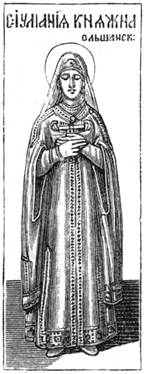
Во время Печерского архимандрита Елисея Плетенецкого († 1624 года) копали могилу для одной девицы близ Великой соборной церкви, и именно возле придела святого Иоанна Богослова, и нашли гроб с камнем. На камне высечен был герб князей Ольшанских. На гербе прибита была серебряная дощечка с тем же гербом и с надписью: «Иулияния, княжна Ольшанская, дочь князя Георгия Дубровицкого-Ольшанского, преставльшаяся девой на 16 году от рождения». Открыли гроб и оказалось: княжна лежала как бы живая, до того нетленно было её тело, белое и с прекрасным лицом. На ней было шёлковое платье, обложенное золотым позументом; на шее богатое ожерелье, на руках зарукавья золотые, на пальцах дорогие перстни, на голове девичий венец золотой с жемчугом, в ушах серьги – золотые с камнями. Гроб был перенесён в Великую церковь и поставлен в углу. В то время платье, от прикосновения повредившееся, было заменено новым шёлком83. В 1617 г., пишет современник Кольнофойский, один посетитель изъявил желание поклониться гробу св. княжны; ему показали и, казалось, с благоговением приложился он к мощам. Но едва вышел этот человек из церкви, как закричал страшным диким голосом и упал мёртвый. По осмотре его оказалось, что он воровски снял дорогой перстень с руки княжны, а по собрании сведений о его личности оказалось, что он был еретиксоцинианин, не верующий в Божество Сына Божия, ни в Святую Троицу84. Блаж. архимандрит Пётр Могила, коему являлась св. княжна с упрёком за малое внимание к её гробу, велел устроить новую раку и новое лучшее одеяние, и тогда св. мощи с торжеством поставлены были на приличном месте85. Тогда на гробнице св. княжны написали: «по воле Творца неба и земли живёт во все лета Юлияния, помощница и великая в небе заступница. Здесь кости – врачевство против всех страданий... Райские селения собой украшаешь, Юлияния, как цветок прекрасный в букете»86.
During the time of Eliseus Pletenecki, Archimandrite of the Kiev Caves († 1624), a grave was being dug for a maiden near the Great Cathedral Church, specifically beside the chapel of St. John the Theologian, when a coffin with a stone was found. On the stone was carved the coat of arms of the Olshansky princes. Nailed to the coat of arms was a silver plate bearing the same coat of arms and an inscription: "Juliana, Princess of Olshanka, daughter of Prince George of Dubrovitsa-Olshanka, who reposed a virgin in the 16th year of her birth." They opened the coffin, and it appeared: the princess lay as if alive, so incorrupt was her body, white and with a beautiful face. She wore a silk dress trimmed with gold braid; on her neck a rich necklace, on her arms golden bracelets, on her fingers costly rings, on her head a maiden's golden crown with pearls, in her ears earrings—golden with stones. The coffin was brought into the Great Church and placed in a corner. At that time, the dress, having been damaged by handling, was replaced with new silk83. In 1617, writes the contemporary Kalnofoiski, a visitor expressed a desire to venerate the coffin of the holy princess; it was shown to him, and he seemed to kiss the relics with reverence. But scarcely had this man left the church when he cried out with a terrible wild voice and fell dead. Upon examination, it was found that he had thievishly removed a costly ring from the princess's hand, and upon gathering information about his person, it turned out that he was a heretic Socinian, who believed neither in the Divinity of the Son of God nor in the Holy Trinity84. The blessed Archimandrite Peter Mogila, to whom the holy princess appeared with a reproach for the little attention paid to her coffin, ordered a new reliquary and new, better vestments to be made, and then the holy relics were solemnly placed in a fitting location85. Then on the tomb of the holy princess they wrote: "By the will of the Creator of heaven and earth, Juliana lives for all ages, a helper and great intercessor in heaven. Here her bones are a medicine against all sufferings... You adorn the heavenly dwellings with yourself, O Juliana, like a beautiful flower in a bouquet"86.
Когда же жила св. княжна? Придел Иоанна Богослова, у которого похоронена была св. княжна, в древнее время был на хорах, внизу же Великой церкви устроен при возобновлении её кн. Симеоном в XV веке. Потому и время жизни св. княжны не восходило раньше начала XVI века. Князь Юрий Дубровицкий-Ольшанский, по древнему синодику, напечатанному у Кальнофойского, был один из благотворителей Печерской лавры и в 1503 г. сражался с Татарами. Это отец святой Иулиании. Князь Иван Дубровицкий, который подписывался и княземОльшанским, в 1530 г. быстро собрал ополчение и разбил Татар, с 1542 г. был воеводой Киевским, а с 1544 г. Троицким и скончался в 1549 году87. Это, если не брат, то близкий родственник св. княжны. Известно ещё Евангелие, писанное в 1557 г. «иждивением благоверной и христолюбивой княгини (супруги) Козмы Ивановича Заславского. Настасьи Юрьевны, урождённой княжны Ольшанской, при благоверном князе Иоанне Феодоровиче Чарторыйском, зяте её милости»88. Настасья Юрьевна Ольшанская – сестра святой Иулиании Ольшанской. – Потому надобно положить, что кончина св. Иулиании последовала не позже 1540 г.89.
When did the holy princess live? The chapel of St. John the Theologian, near which the holy princess was buried, was in ancient times in the choir loft; below in the Great Church it was built during its restoration by Prince Simeon in the 15th century. Therefore, the time of the holy princess's life did not go back earlier than the beginning of the 16th century. Prince George of Dubrovitsa-Olshanka, according to the ancient synodicon printed by Kalnofoiski, was one of the benefactors of the Kiev Caves Lavra and in 1503 fought against the Tatars. This is the father of St. Juliana. Prince John of Dubrovitsa, who also signed himself as Prince of Olshanka, in 1530 quickly gathered a militia and defeated the Tatars, from 1542 was the Voivode of Kiev, and from 1544 the Troitsky Voivode, and reposed in 154987. This, if not a brother, is a close relative of the holy princess. There is also known a Gospel written in 1557 "at the expense of the faithful and Christ-loving Princess (wife) of Cosmas Ivanovich Zaslavsky, Anastasia Yurievna, née Princess of Olshanka, under the faithful Prince John Theodorovich Chartoryisky, her grace's son-in-law"88. Anastasia Yurievna of Olshanka is the sister of St. Juliana of Olshanka. Therefore, it must be supposed that the end of St. Juliana occurred no later than 154089.
Подвижничество преп. Сисоя продолжалось от ранней юности до глубокой старости. Сначала жил он в ските, потом и эта пустыня показалась ему многолюдной и, услышав, что Великий Антоний (пам. 17-го января) почил, он перешёл Нил и уединился на той горе, где подвизался Антоний и где всё напоминало ему о дивном образце иноческого жития.
The asceticism of the Venerable Sisoes continued from early youth to deep old age. At first he lived in the Skete; later even this wilderness seemed too populous to him, and having heard that the Great Anthony (commemorated January 17) had reposed, he crossed the Nile and secluded himself on that mountain where Anthony had struggled and where everything reminded him of the wondrous model of monastic life.
Уединение не скрыло однако же пустынника от внимательного взора людей, жаждущих просвещения духовного, и они стали посещать Сисоя, чтобы пользоваться его наставлениями. Он же не отказывался принимать их, предпочитая любовь к людям – тому удовлетворению, какое находил в сохранении безмолвия. В беседах его с людьми заключались преимущественно уроки смирения.
Seclusion, however, did not hide the hermit from the attentive gaze of people thirsting for spiritual enlightenment, and they began to visit Sisoes to benefit from his instructions. He, for his part, did not refuse to receive them, preferring love for people to the satisfaction he found in preserving silence. His conversations with people consisted chiefly of lessons on humility.
– Это ещё немного, сын мой, – отвечал ему Сисой, – ещё важнее того – видеть себя ниже всех, потому что такое уничижение способствует к приобретению смирения...
"That is still little, my son," Sisoes answered him, "yet more important than that is to see oneself as lower than all, for such self-abasement helps to acquire humility..."
О себе самом Сисой постоянно говорил: «грешником я засыпаю, грешником и пробуждаюсь» ... –Три пустынника, привлекаемые слухом о святости Сисоя, пришли видеть его: – что делать, чтобы избавиться от мук, предстоящих грешникам в будущей жизни, одно воспоминание о которых приводит в ужас и трепет?..
Of himself Sisoes constantly said: "A sinner I fall asleep, a sinner I awaken..." Three hermits, drawn by the report of Sisoes' holiness, came to see him: "What must we do to be delivered from the torments awaiting sinners in the future life, the mere remembrance of which fills one with horror and trembling?"
– Признаюсь вам, братия, что я не думаю об этих предметах, – отвечал им Сисой, – и зная, что Бог исполнен благости, думаю, уповаю, что Он окажет мне милосердие... Но вы, братия, блаженны! если у вас душа проникнута таким воспоминанием, то вам невозможно грешить... Что же делать мне, жестокосердому, которому не дано знать, что есть наказание человекам? Оттого я каждый день и согрешаю...
"I confess to you, brethren, that I do not think about these matters," Sisoes answered them, "and knowing that God is full of goodness, I think and hope that He will show me mercy... But you, brethren, are blessed! If your soul is penetrated by such remembrance, then it is impossible for you to sin... What then am I to do, hard-hearted as I am, who have not been given to know what punishment is for men? Therefore I sin every day..."
Сисой говорил, что в продолжение тридцати лет он молился так: «Господи Иисусе, не дай мне согрешить сегодня моим языком» ... «И между тем, – прибавляет он, – я постоянно согрешаю в этом роде» ...
Sisoes said that for thirty years he prayed thus: "Lord Jesus, do not let me sin today with my tongue" ... "And yet," he adds, "I constantly sin in this way..."
Не только смирен, но и кроток сердцем был проникнутый духом Христовым подвижник. Один брат, обиженный другим, пришёл к авве Сисою и жаловался: «брат обидел меня, я хочу отомстить ему». – «Не мсти, – сказал ему Сисой, – предоставь Богу отмщение».
Not only humble, but also meek of heart was the ascetic, penetrated by the spirit of Christ. A brother, offended by another, came to Abba Sisoes and complained: "A brother has offended me; I want to take revenge on him." "Do not take revenge," Sisoes said to him, "leave vengeance to God."
Тронутый кротостью старца, брат упал к ногам его со словами, вырвавшимися из глубины сердца: «прощаю, прощаю брата... и ты прости меня, отец» ...
Touched by the elder's meekness, the brother fell at his feet with words that burst from the depths of his heart: "I forgive, I forgive my brother... and do thou forgive me, father..."
Сам – искренний подвижник, Сисой не приходил в ужас от проступков брата и вместо того, чтобы с негодованием упрекать за них, он с непоколебимым терпением помогал исправляться в них и научал неослабно бороться с своими страстями. – «Нет человека, который мог бы избежать искушения, – говорил он, – но при каждом искушении и падении должно быть в человеке и стремление к восстанию, потому что Бог всегда готов и безгранично принимать падшего, но раскаивающегося» ...
Himself a sincere ascetic, Sisoes was not horrified by a brother's transgressions, and instead of reproaching him indignantly for them, he helped him to correct them with unwavering patience and taught him to struggle unceasingly against his own passions. "There is no man who can avoid temptation," he said, "but with every temptation and fall there must also be in man a striving to rise again, because God is always ready and without limit to receive the fallen, but repentant..."
«Но сколько же времени ты полагаешь на восставание после того, как я буду падать? – спросил его один пустынник, живший по соседству и часто приходивший говорить, что он впал в грех, между тем, как Сисой неизменно отвечал ему на это: «восстань» ... – «До тех пор, пока не наступит конец, человек непрестанно должен стремиться к восстанию, чтобы кончина застала его в этом спасительном расположении» ...
"But how much time do you allow for rising again after I fall?" a hermit who lived nearby and often came saying he had fallen into sin asked him, while Sisoes invariably answered him: "Rise up." "Until the end comes, a man must continually strive to rise again, so that death may find him in this saving disposition..."
В обстоятельствах кончины преп. Сисоя выразилось и великое смирение его, и великая благодать Господня, пребывающая на смиренных. Руфин, рассказывая о ней, говорит, что, чувствуя приближение смерти, старец пришёл в восхищение, лицо его просияло и он заговорил: «вот авва Антоний идёт ко мне» ... Немного спустя воскликнул: «я вижу лик пророков» и в то же мгновение лицо его ещё более просветлело, – «вот, пришли Апостолы», – стал он говорить тихо и как будто разговаривая с кем-то из святых.
In the circumstances of the Venerable Sisoes' end, both his great humility and the great grace of the Lord abiding upon the humble were expressed. Rufinus, telling of it, says that, feeling the approach of death, the elder fell into ecstasy, his face shone, and he spoke: "Behold, Abba Anthony is coming to me..." A little later he exclaimed: "I see the company of the prophets," and at the same moment his face grew even brighter—"Behold, the Apostles have come," he began to speak softly and as if conversing with someone among the saints.
Пустынники, собравшиеся вокруг него, чтобы выслушать его последние изречения, спросили: с кем он разговаривает? И он прибавил: «вот, ангелы пришли взять мою душу, и я молил их подождать ещё несколько, чтобы я успел совершить покаяние... Они же сказали: ты не имеешь более нужды в покаянии» ... «Не знаю, начинал ли я ещё его?» ... Эти последние слова, при знании о глубоком смирении Сисоя, дали понять ученикам его, что добродетель его была совершенна...
The hermits gathered around him to hear his last words asked: with whom was he speaking? And he added: "Behold, angels have come to take my soul, and I begged them to wait a little longer, that I might complete my repentance... They said: 'You have no further need of repentance'... 'I do not know whether I have even begun it yet?'" These last words, given the knowledge of Sisoes' deep humility, made his disciples understand that his virtue was perfect...
Наконец, лицо подвижника просияло, как солнце, и в то же время он воскликнул: «смотрите, Господь идёт ко мне!» и с этими словами переселился в иной мир...
Finally, the ascetic's face shone like the sun, and at the same time he exclaimed: "Behold, the Lord is coming to me!" and with these words he passed over into the other world...
Когда между воспоминающими о великом Сисое возникал разговор о нём, то подвижник авва Пимен, останавливая их, говорил: «перестаньте говорить о Сисое, потому что дела его выше повествования» ...
When a conversation arose among those remembering the great Sisoes, the ascetic Abba Pimen would stop them and say: "Cease speaking about Sisoes, for his deeds are beyond narration..."
Лукия, посвящённая Богу дева в Кампании, была взята в плен царём варваров Авцием и отведена в его страну. Когда она отказалась от преступных предложений царя, то внушила ему такое уважение, что он доставил ей особое помещение, где она беспрепятственно могла предаваться молитве. По молитве её царь одерживал победы над своими врагами. После 20-ти лет подвижнической жизни, она получила откровение – идти в Рим на мученический подвиг. Она отправилась туда, а с ней и царь, оставивший своё семейство и царство. Там оба они за исповедание Иисуса Христа после истязаний усечены префектом Елием Дионисием.
Lucia, a virgin consecrated to God in Campania, was taken captive by the barbarian king Avitus and led away to his country. When she refused the king's criminal proposals, she inspired such respect in him that he provided her with a separate dwelling where she could give herself to prayer without hindrance. Through her prayer the king gained victories over his enemies. After twenty years of ascetic life, she received a revelation to go to Rome for the feat of martyrdom. She set out there, and with her the king, who left his family and kingdom. There both of them, for confessing Jesus Christ, after tortures were beheaded by the prefect Aelius Dionysius.
После их казни представлены были префекту и другие христиане, которые также были мучены и обезглавлены (в 301 г., в царствование Диоклитиана)91.
After their execution, other Christians were brought before the prefect, who were also tortured and beheaded (in 301, during the reign of Diocletian)91.
Марин и Марфа, знатные Персиане, с сыновьями своими, Авдифаксом и Аввакумом, пострадали в Риме, куда прибыли на богомолье, при имп. Клавдии 2-м, в 269 году. Марин и сыновья обезглавлены, а Марфа утоплена. Мощи их ныне находятся в Римской церкви св. Иоанна Кущника. С ними пострадали и ещё многие другие, захваченные на молитвословии.
Marinus and Martha, noble Persians, with their sons, Audifax and Abacuc, suffered in Rome, whither they had come on pilgrimage, under Emperor Claudius II, in the year 269. Marinus and his sons were beheaded, and Martha was drowned. Their relics are now in the Roman church of St. John the Hut-dweller. With them suffered also many others, who were seized at prayer.
Teraturgima р. 37. Мелетий Сириг в каноне Киевским святым молится: «привожу к Тебе, Всещедрый! Иулианию, свечу постоянно светлую, владеющую обилием елея; её молитвами сохрани меня от всякого зла». Акафисты, К. 1674 г.
Teraturgima, p. 37. Meletius Syrigus, in the canon to the Kievan saints, prays: “I bring to Thee, O All-Bountiful One! Juliana, a lamp ever bright, possessing an abundance of oil; by her prayers preserve me from every evil.” Akathists, Kiev, 1674.