Orthodox Translations

July 33 июля

Old Calendar: civil July 16 · New Calendar: civil July 3

History

Св. мученика Иакинфа

St. Martyr Hyacinthus

E1.TAI draft

Иакинф, родом из Кесарии Каппадокийской, был постельничим (кубикуларием) имп. Траяна. Имея всего 20 лет, пострадал за то, что не хотел на языческом празднике есть идоложертвенного мяса и исповедал свою веру в истинного Бога. Император велел бить его по щекам и губам, и затем насильно кормить его; но юноша стиснул зубы и рот и не допустил осквернения. После сего велено было бичевать его, заключить в тюрьму и давать пищу только идоложертвенную. Иакинф не принимал этой пищи и умер через тридцать восемь дней.

Hyacinthus, a native of Caesarea in Cappadocia, was the chamberlain (cubicularius) of the Emperor Trajan. Being only twenty years old, he suffered because he would not eat meat offered to idols at a pagan festival and confessed his faith in the true God. The emperor ordered him to be struck on the cheeks and lips, and then to be force-fed; but the youth clenched his teeth and mouth and did not allow the defilement. After this, he was ordered to be scourged, cast into prison, and given only food offered to idols. Hyacinthus would not accept this food and died after thirty-eight days.

E1.0AI draft

Когда императору донесли об этом, он велел выбросить тело мученика за город и оставить в добычу зверям и птицам. Долго лежало оно невредимо; наконец, по особенному видению, взял его пресвитер Тимофей, родственник мученика, и положил в своём доме, возжигая всякий день лампаду при ковчеге. перед кончиной своей Тимофей поручил и святые мощи некоей благочестивой вдове. Много прошло времени, и вот одному человеку случилось ослепнуть от головной болезни, и ни один врач не мог пособить ему. Святый мученик явился ослепшему и сказал: «хочешь исцелиться от болезни?» – «Кто ж ты?» – спросил больной. «Я раб Христов, Иакинф, врач всяким болезням», сказал явившийся. Тогда больной воскликнул: «возьми всё моё имение, только бы мне видеть свет!» Иакинф сказал: «Бог мой исцелит тебя даром, только возьми моё тело у такой-то вдовы и с верными людьми отошли в Кесарию, а глаза свои помажь маслом из лампады при моей гробнице, и прозришь». Больной исполнил всё, что ему было сказано, и прозрел; мощи же Иакинфа, отправленные в Кесарию, положены в доме родителей его (уже скончавшихся).

When this was reported to the emperor, he ordered the martyr's body to be cast out of the city and left as prey for beasts and birds. For a long time it lay unharmed; finally, by a special vision, the presbyter Timothy, a relative of the martyr, took it and placed it in his own house, kindling a lamp every day before the reliquary. Before his own end, Timothy entrusted the holy relics to a certain pious widow. Much time passed, and then a certain man happened to go blind from a disease of the head, and no physician could help him. The holy martyr appeared to the blind man and said: "Do you wish to be healed of your ailment?" "Who are you?" asked the sick man. "I am a servant of Christ, Hyacinthus, a physician for all diseases," said the one who appeared. Then the sick man cried out: "Take all my possessions, only let me see the light!" Hyacinthus said: "My God will heal you for free; only take my body from such-and-such a widow and, with faithful men, send it to Caesarea, and anoint your eyes with oil from the lamp at my tomb, and you will regain your sight." The sick man did everything that was told him and regained his sight; the relics of Hyacinthus, sent to Caesarea, were placed in the house of his parents (who had already reposed).

E1.1AI draft

Св. Анатолия, патриарха Цареградского

St. Anatolius, Patriarch of Constantinople

E2.TAI draft

Из пресвитеров Александрийских возведён на патриарший престол в 449 г., по кончине св. Флавиана63, умерщвлённого евтихианами; присутствовал в 451 г. на Халкидонском соборе, на котором он получил для своей кафедры право равенства с кафедрой Римского епископа. Анатолий вёл деятельную борьбу против ересей Нестория и Евтихия и умерщвлён еретиками в 458 г. – Он известен в Церкви стихирами на воскресные дни, на некоторые Господские праздники, как то: на Рождество Христово и Богоявление, на дни мучеников, как то: Пантелеймона, Георгия, Димитрия и друг. Эти стихиры были первым опытом замены стихир Ветхозаветных – стихирами христианскими. Анатолий составлял их в подражание Ветхозаветным пиитическим творениям, псалмам, притчам, которые издавна называются стихирами.

From among the presbyters of Alexandria he was elevated to the patriarchal throne in 449 A.D., after the repose of St. Flavian63, who had been murdered by the Eutychians; he was present in 451 A.D. at the Council of Chalcedon, at which he obtained for his see the right of equality with the see of the Roman bishop. Anatolius waged an active struggle against the heresies of Nestorius and Eutyches and was murdered by heretics in 458 A.D. – He is known in the Church for his stichera for the Sundays, for certain feasts of the Lord, such as the Nativity of Christ and Theophany, and for the days of martyrs, such as Panteleimon, George, Demetrius, and others. These stichera were the first attempt to replace the Old Testament stichera with Christian stichera. Anatolius composed them in imitation of the Old Testament poetic works, the psalms and proverbs, which from ancient times were called stichera.

E2.0AI draft

Содержанием своим стихиры христианские стали заменять чтения житий, тогда как прежде того дни святых праздновались между прочим чтением их «деяний».

By their content, the Christian stichera began to replace the reading of Lives, whereas previously the days of the saints were celebrated, among other things, by the reading of their "Acts."

E2.1AI draft

(См. «Уч. об Отц. Ц.» Филар. Черн., ч. III, § 227).

(See "Teaching on the Fathers of the Church" by Philaret of Chernigov, part III, § 227).

E2.2AI draft

Преподобн. Александра, обители неусыпающих первоначальника

Our Venerable Father Alexander, Founder of the Monastery of the Unsleeping Ones

E3.TAI draft

Преп. Александр, уроженец Азийский, обучался наукам в Константинополе, потом вступил в военную службу и был не в малом чине; но через несколько времени (около 381 года) оставил всё, роздал имение нищим и удалился в Сирию, где постригся в монастыре. Четыре года прожил он тут, и потом, испросив благословение у настоятеля, пошёл в пустыню. Тут он подвизался один целых семь лет, к концу коих обратил в христианство большое языческое селение и градоначальника Равулу (бывшего впоследствии епископом Едесским, 405–435 года), а затем, углубившись дальше в пустыню, обратил скопище разбойников к жизни доброй и, дойдя до реки Евфрата, поселился в дупле некоего дерева (около 393 года). К нему стали приходить братия и селиться близ него. Он прожил тут двадцать лет и устроил общежительный монастырь, в котором было до четырёх сот монахов; тут-то впервые установился новый, до того ещё не бывший чин неусыпающих монахов. Монахи из Греков, Латинян и Сириан, разделяясь на 24 чреды по числу 24 часов дня и ночи, непрерывно на два лика славословили Господа, поя протяжно псалмы Давидовы.

The Venerable Alexander, a native of Asia, studied the sciences in Constantinople, then entered military service and held no small rank; but after some time (around 381 A.D.) he left everything, distributed his possessions to the poor, and withdrew to Syria, where he was tonsured in a monastery. He lived there for four years, and then, having asked the blessing of the abbot, he went into the desert. There he struggled alone for a full seven years, toward the end of which he converted a large pagan village and the city-governor Ravula (who later became bishop of Edessa, 405–435 A.D.) to Christianity; then, going deeper into the desert, he turned a band of robbers to a good life and, reaching the Euphrates River, settled in the hollow of a certain tree (around 393 A.D.). Brethren began to come to him and settle near him. He lived there for twenty years and established a cenobitic monastery, in which there were up to four hundred monks; it was here that a new, previously unknown order of Unsleeping monks was first established. The monks, Greeks, Latins, and Syrians, divided into twenty-four groups according to the twenty-four hours of the day and night, ceaselessly glorified the Lord in two choirs, chanting the Psalms of David at length.

E3.0AI draft

В то время в странах при-Евфратских ещё много было идолопоклонников; посему преп. Александр избрал из учеников своих искуснейших семьдесят, по образцу семидесяти учеников Христовых (Лук. X гл.), и, помолившись, послал их по два во все окрестные селения языческие. И труды их не были тщетны, потому что многие из язычников познали истинную веру.

At that time there were still many idolaters in the lands along the Euphrates; therefore the Venerable Alexander chose from among his disciples the most skillful seventy, after the pattern of the seventy disciples of Christ (Lk. ch. 10), and, having prayed, sent them out in pairs to all the surrounding pagan villages. And their labors were not in vain, for many of the pagans came to know the true faith.

E3.1AI draft

Через двадцать лет, оставив устроенному монастырю настоятеля Трофима с ста пятьюдесятью братиями, отправился на проповедь окрестным кочевникам и посетил Пальмиру, жители которой, впрочем, не пустили его в город, говоря: «кто может накормить столько народу!» Передающий об этом известие ученик и описатель жизни преподобного замечает, что, хотя жители Пальмиры и назывались христианами, но оставались при многих Еврейских обычаях (известно, что ещё в 250–272 г. Пальмира была столицей Зиновии, Арабской царицы, Иудеянки по вере, и тут жили по преимуществу торговцы Еврейские). Отринутый гражданами, Александр сказал: «лучше уповать на Господа, нежели на человека; не упадайте духом, братья! потому что посетит нас Бог, когда и не ожидаем». И едва прошли они несколько вёрст, как встретившиеся кочевники (Бедуины) приняли и угостили их. Отсюда, пройдя более ста вёрст, достигли они Антиохии, где епископствовал Феодот, вступивший на кафедру в 421 году. Тут он хотел было устроить монастырь, но и епископ и градоначальник не доброхотствовали ему. Посему, взяв с собой двадцать четыре из братии, отправился в Константинополь и поселился с ними при церкви св. Мины, куда через несколько времени собралось к нему до трёхсот человек братии из Греков, Латинян и Сирян; устроилась обитель и установился чин неусыпающих.

After twenty years, having left the monastery he had established under the abbot Trophimus with one hundred and fifty brethren, he set out to preach to the surrounding nomads and visited Palmyra, whose inhabitants, however, would not let him into the city, saying: "Who can feed so many people!" The disciple who conveys this news and who wrote the Life of the venerable one notes that, although the inhabitants of Palmyra called themselves Christians, they still clung to many Jewish customs (it is known that in 250–272 A.D. Palmyra was the capital of Zenobia, an Arabian queen of the Jewish faith, and Jewish merchants lived there predominantly). Rejected by the citizens, Alexander said: "It is better to trust in the Lord than in man; do not lose heart, brethren! for God will visit us even when we do not expect it." And they had scarcely gone a few versts when they met some nomads (Bedouins) who received and entertained them. From there, having traveled more than a hundred versts, they reached Antioch, where Theodotus was bishop, having entered upon the see in 421 A.D. Here he wished to establish a monastery, but both the bishop and the city-governor were ill-disposed toward him. Therefore, taking twenty-four of the brethren with him, he set out for Constantinople and settled with them at the church of St. Menas, where within a short time up to three hundred brethren, Greeks, Latins, and Syrians, gathered to him; a monastery was established and the order of the Unsleeping Ones was instituted.

E3.2AI draft

Как представитель знаменитого братства, Александр был известен патриарху Несторию; и этот, не видя его между поборниками своего начестия, потребовал его на суд как еретика (потому что при патриаршем дворе считали ересью православие). Представленный судьям и спрошенный о еретичестве своём, сказал только: князья сидят и сговариваются против меня, а раб Твой размышляет об уставах Твоих. Откровения Твои – утешение моё, и уставы Твои советники мои (Пс.118:23–24). Больше ничего не провещал он, и раздражённые судьи выгнали его. Но в конце того же (429) года и он, и многие из братства его обители потерпели заключение темничное. По умирении Церкви, преподобный прожил недолго и скончался в 431 году.

As the representative of the renowned brotherhood, Alexander was known to Patriarch Nestorius; and the latter, not seeing him among the supporters of his impiety, summoned him to trial as a heretic (because at the patriarchal court Orthodoxy was considered heresy). Brought before the judges and asked about his heresy, he said only: The princes sit and conspire against me, but Thy servant meditates on Thy statutes. Thy revelations are my comfort, and Thy statutes are my counsellors (Ps. 118:23–24). He uttered nothing more, and the enraged judges drove him out. But at the end of that same year (429 A.D.) both he and many of the brotherhood of his monastery suffered imprisonment. After the pacification of the Church, the venerable one lived not long and reposed in 431 A.D.

E3.3AI draft

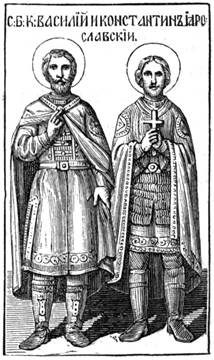
† Память о благоверн. князьях Ярославских Василии и Константине Всеволодовичах

† Commemoration of the Right-believing Princes of Yaroslavl, Basil and Constantine Vsevolodovich

E4.TAI draft
Engraving

Князь Всеволод Константинович, отец князей Василия и Константина64 остался после отца своего в юных летах и вырос под надзором благочестивого дяди своего кн. Георгия; по воле того же дяди вступил он в брак с Мариной, дочерью Олега, князя Курского. Плодом сего супружества были князья Василий и Константин. Им также суждено было недолго пользоваться любовью и наставлениями родителя. В 1238 г. отец их князь Всеволод пал в битве с татарами на р. Сити, вместе с блаженным дядей, кн. Георгием65. Осиротевшие князья должны были учиться добру скорбями жизни. Юному князю Василию надлежало собрать подданных, рассеянных ужасами варваров, и питать вдов мужей, павших на Сити. В 1242 г. он должен был вместе с другими князьями идти в орду на поклон к Батыю; потом и в следующем году отправлялся он туда же вместе с дядей, в. кн. Ярославом66. По возвращении из орды вступил он в брак с княжной Ксенией. Плодом этого союза были дочь Мария и сын Василий, умерший малолетним. Недолго длилась жизнь кн. Василия; но нужна нам не долгая жизнь, а жизнь добрая, какую вёл князь, испытанный скорбями. Зимой 1249 г. отправился он во Владимир для свидания с в. кн. Александром и там скончался. Гроб его от Владимира до Ярославля провожали двоюродные братья его, князья Борис и Глеб Ростовские, и сам в. кн. Александр: так любили и отличали уважением молодого летами, но зрелого духом князя! Погребение его совершал Кирилл, епископ Ростовский; чистое тело его положено было в Ярославском Успенском соборе, на северной стороне67. Младший брат принял правление княжеством. – Тяжкое было время. Юный князь, сколько мог, старался устроить покой подданных; но покой то и дело был нарушаем татарами. В 1252 г. опустошали они Суздальское княжество. Шайки диких степняков являлись то там, то здесь, чтобы грабить и убивать. В 1257 г. знаменитый Даниил Галичский вёл кровавую борьбу с татарами. Подобное происходило тогда же и в Ярославском княжестве. В июле татары подошли к Ярославлю. Кн. Константин с дружиной вышел на другую сторону р. Которости, на гору. Произошла кровавая битва с татарами; много пало татар, много и Ярославцев: юный князь положил здесь жизнь свою, за покой отчизны. Это было 3 июля. Гора, на которой происходило сражение, поныне называется Туговой, как место туги и слёз, пролитых осиротевшими Ярославцами68. Ярославль, потеряв князя и многих своих, не спасся от разорения татарского; тело благоверного страдальца отчизны похоронено было с честью в соборной церкви, подле брата его Василия.

Prince Vsevolod Konstantinovich, the father of Princes Basil and Constantine64, was left an orphan in his youth after his father and grew up under the supervision of his pious uncle, Prince George; by the will of that same uncle he entered into marriage with Marina, the daughter of Oleg, Prince of Kursk. The fruit of this marriage were Princes Basil and Constantine. They too were fated to enjoy the love and instruction of their parent for only a short time. In 1238 A.D. their father, Prince Vsevolod, fell in battle with the Tatars on the Siti River, together with his blessed uncle, Prince George65. The orphaned princes had to learn goodness through the sorrows of life. The young Prince Basil had to gather his subjects, scattered by the horrors of the barbarians, and to support the widows of the men who had fallen on the Siti. In 1242 A.D. he had to go, together with other princes, to the Horde to bow before Batu; then in the following year he went there again together with his uncle, Grand Prince Yaroslav66. Upon his return from the Horde he entered into marriage with Princess Xenia. The fruit of this union were a daughter, Maria, and a son, Basil, who died in childhood. The life of Prince Basil was not long; but what we need is not a long life, but a good life, such as the prince, tried by sorrows, led. In the winter of 1249 A.D. he set out for Vladimir to meet with Grand Prince Alexander, and there he reposed. His coffin was accompanied from Vladimir to Yaroslavl by his cousins, Princes Boris and Gleb of Rostov, and by Grand Prince Alexander himself: so greatly was the prince, young in years but mature in spirit, loved and honored! His burial was performed by Cyril, Bishop of Rostov; his pure body was laid in the Dormition Cathedral of Yaroslavl, on the north side67. The younger brother took up the rule of the principality. – It was a grievous time. The young prince, as best he could, strove to bring peace to his subjects; but peace was constantly disturbed by the Tatars. In 1252 A.D. they laid waste to the Suzdal principality. Bands of wild steppe-dwellers appeared now here, now there, to plunder and kill. In 1257 A.D. the renowned Daniel of Galich waged a bloody struggle with the Tatars. Something similar occurred at that same time in the Yaroslavl principality. In July the Tatars approached Yaroslavl. Prince Constantine with his retinue went out to the other side of the Kotorosl River, onto a hill. A bloody battle with the Tatars took place; many Tatars fell, and many Yaroslavl men as well: the young prince laid down his life here for the peace of his fatherland. This was on the 3rd of July. The hill on which the battle took place is still called Tugovaya, as a place of grief and tears shed by the orphaned Yaroslavl men68. Yaroslavl, having lost its prince and many of its men, did not escape Tatar devastation; the body of the right-believing sufferer for the fatherland was buried with honor in the cathedral church, beside his brother Basil.

E4.0AI draft

И на Туговой горе, и при гробах юных князей своих Ярославль сетовал словами Иова:

And on Tugovaya Hill, and at the tombs of their young princes, Yaroslavl lamented with the words of Job:

E4.1AI draft

«О бедный жребий человека!

"O wretched lot of man!

E4.2AI draft

Мгновенный гость земных садов,

A fleeting guest in earthly gardens,

E4.3AI draft

Зачем родишься ты?.. для муки.

Why are you born?.. for torment.

E4.4AI draft

Едва возникнет как цветок,

Scarcely arisen like a flower,

E4.5AI draft

Едва распустится, – уж видит

Scarcely unfolded, – he already sees

E4.6AI draft

Размах погибельной косы,

The swing of the deadly scythe,

E4.7AI draft

Готовый срезать гостя жизни.

Ready to cut down the guest of life.

E4.8AI draft

Как тень, как сон, мелькают дни.

Like a shadow, like a dream, the days flicker by.

E4.9AI draft

И кто их бегство остановит?

And who shall halt their flight?

E4.10AI draft

Ты дни его сочёл, измерил

Thou hast numbered his days, hast measured them,

E4.11AI draft

И сам уж положил предел

And Thyself hast set the bound

E4.12AI draft

Его же смертный не преходит»69

Which no mortal may pass.”69

E4.13AI draft

В 1501 г. Ярославский кремль опустошён был пожаром. Когда начали копать рвы для нового соборного храма, обрели два гроба с нетленными телами и по надписям на каменных плитах узнали, что это были гробы князей Василия и Константина. – По совершении соборной панихиды гробы опущены были в землю. Но поднявшаяся буря с громом и ливнем дождя продолжалась две недели. – Ярославль испугался, не за то ли гнев с неба, что скрыты в землю мощи князей молитвенников за Ярославскую страну. – Страх тем более естественный, что Ярославль твёрдо помнил, как за 40 лет перед тем недоверие некоторых к мощам св. князя Феодора было наказано видимо для всех. По просьбе народа епископ и духовенство с торжеством перенесли нетленные мощи из Кремля в церковь св. князей Бориса и Глеба. В. князь Иоанн III тогда же приказал строить каменный собор и когда тот был построен, приходил сам на поклонение мощам, от которых истекали исцеления. Имени св. князей издавна посвящён придел в соборе70.

In the year 1501, the Kremlin of Yaroslavl was devastated by a fire. When they began to dig ditches for a new cathedral church, they uncovered two coffins with incorrupt bodies, and from the inscriptions on the stone slabs they learned that these were the coffins of Princes Basil and Constantine. – After the celebration of a cathedral panikhida, the coffins were lowered into the earth. But a storm that arose, with thunder and a downpour of rain, continued for two weeks. – Yaroslavl was afraid, lest the wrath from heaven was for this, that the relics of the princes, intercessors for the land of Yaroslavl, were hidden in the earth. – This fear was all the more natural because Yaroslavl firmly remembered how, forty years before, the distrust of some toward the relics of St. Prince Theodore had been punished visibly for all. At the request of the people, the bishop and clergy solemnly transferred the incorrupt relics from the Kremlin to the church of the Holy Princes Boris and Gleb. The Grand Prince John III at once gave orders to build a stone cathedral, and when it was built, he himself came to venerate the relics, from which healings flowed forth. A side-chapel in the cathedral has long been dedicated to the name of the holy princes.70

E4.14AI draft

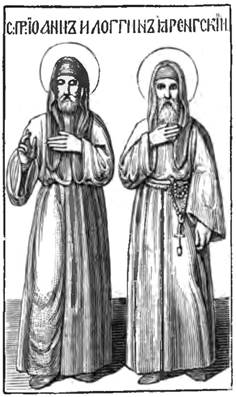
† Память о препод. Иоанне и Логгине, Яренгских чудотворцах

† The Commemoration of our Venerable Fathers John and Longinus, Wonderworkers of Yarenga

E5.TAI draft
Engraving

Блаж. Иоанн и Логгин были учениками св. Филиппа, когда он был ещё игуменом Соловецкой обители. Проводя жизнь и в строгом посте и внимании к своей совести, они были безответными исполнителями приказаний преп. игумена. Всяко, аще что творите, от души делайте, якоже Господу, а не человеком угождающе, заповедал Апостол (Кол.3:23). Иоанн и Логгин с точностью исполняли заповедь Апостола и возрастали в жизни духовной. Они были люди не книжные, но природа служила их внимательному уму открытой книгой. Они видели море необозримое и возносились умом к Тому, Кто положил предел и морю; мириады звёзд обращали мысль их к Владыке миров, назначившему всему свой порядок; видели свет солнца и в благоговении славили свет самобытный. Так восходили они от совершенства к совершенству. В 1561 г. отправились они на судах на твёрдую землю и возвращаясь застигнуты были сильной бурей; буря разбила суда; блаж. Иоанн и Логгин потонули. Св. тела их обретены нетленными на Корельском берегу, за 120 вёрст от обители, в устье Сосновки и положены в часовне св. Николая с. Яренги. Слава чудес, совершавшихся при мощах, привлекла к ним нескольких иноков, которые построили себе кельи и положили основание обители. В 1625 г. инок Илия Телов донёс п. Филарету о чудесах, совершающихся при мощах праведников. Вследствие сего Новгор. м. Макарием предписано Корельскому игумену Герасиму и боярскому сыну Солонову произвести на месте точное исследование о чудесах св. Иоанна и Логгина. По строгому розысканию, сведения, показанные в донесении инока Телова, оказались верными71. Самые замечательные чудеса: исцеление Марии, три года страдавшей от беснования; исцеление молодого крестьянина, страдавшего падучей болезнью; исцеление крестьянина Евфимия, полгода страдавшего желудком и вызванного в Яренгу явившимися Иоанном и Логгином. В 1635 г. Яренгский монастырь со всеми землями с. Яренги отдан был в ведение Соловецкой обители, и в грамоте своей царь писал: «пожаловали мы у моря Яренгским погостом, где лежат чудотворцы Иван да Логгин». Μ. Аффоний вскоре после того писал Соловецкому игумену Рафаилу: «по прошению свят. п. Иоасафа царь пожаловал вам Яренгу на краю моря, где лежат мощи новоявленных чудотворцев Ивана да Логгина»; затем, предписывая построить и освятить новый храм, говорит: «как тот храм совершится и мощи новоявленных чудотворцев Ивана и Логгина в новый храм перенесёшь и в котором месте в храме те мощи положишь, – и ты бы о том отписал». Июля 2-го 1638 г. мощи праведников перенесены в новый храм. Память их с того времени совершается июля 3 дня72.

The blessed John and Longinus were disciples of St. Philip when he was still abbot of the Solovetsky monastery. Leading a life of strict fasting and attention to their conscience, they were unquestioning executors of the commands of the venerable abbot. And whatsoever ye do, do it heartily, as to the Lord, and not unto men, the Apostle commanded (Col. 3:23). John and Longinus fulfilled the Apostle’s commandment with exactness and grew in the spiritual life. They were not book-learned men, but nature served their attentive mind as an open book. They beheld the boundless sea and were lifted up in mind to Him Who set a bound for the sea also; the myriads of stars turned their thought to the Lord of the worlds, Who appointed to all things their order; they saw the light of the sun and in reverence glorified the self-existent Light. Thus they ascended from perfection to perfection. In the year 1561 they set out in ships for the mainland, and on their return were overtaken by a violent storm; the storm shattered the ships; the blessed John and Longinus were drowned. Their holy bodies were found incorrupt on the Karelian shore, 120 versts from the monastery, at the mouth of the Sosnovka River, and were placed in the chapel of St. Nicholas in the village of Yarenga. The fame of the miracles wrought at the relics drew to them several monks, who built themselves cells and laid the foundation of a monastery. In 1625 the monk Elias Telov reported to Patriarch Philaret concerning the miracles taking place at the relics of the righteous ones. In consequence of this, Metropolitan Macarius of Novgorod ordered the Karelian abbot Gerasim and the boyar’s son Solonov to conduct a precise investigation on site into the miracles of Sts. John and Longinus. Upon strict inquiry, the information given in the report of the monk Telov proved true.71 The most remarkable miracles: the healing of Mary, who had suffered for three years from demonic possession; the healing of a young peasant who suffered from the falling sickness; the healing of the peasant Euthymius, who had suffered from a stomach ailment for half a year and was summoned to Yarenga by the appearing of John and Longinus. In 1635 the Yarenga monastery, with all the lands of the village of Yarenga, was placed under the authority of the Solovetsky monastery, and in his charter the Tsar wrote: “We have granted to you the Yarenga churchyard by the sea, where the wonderworkers John and Longinus lie.” Metropolitan Aphonius soon after wrote to the Solovetsky abbot Raphael: “At the petition of His Holiness Patriarch Joasaph, the Tsar has granted you Yarenga at the edge of the sea, where lie the relics of the newly-revealed wonderworkers John and Longinus”; then, prescribing the building and consecration of a new church, he says: “When that church is completed and you translate the relics of the newly-revealed wonderworkers John and Longinus into the new church, and in what place in the church you place those relics—you should write about that.” On July 2, 1638, the relics of the righteous ones were translated into the new church. Their commemoration has been observed from that time on July 3.72

E5.0AI draft

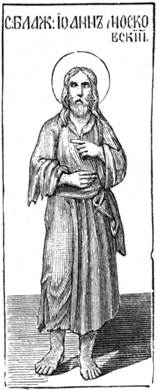
† Преставление бл. Иоанна юродивого Московского

† The Repose of the Blessed John, Fool-for-Christ of Moscow

E6.TAI draft
Engraving

Бл. Иоанн73, уроженец страны Вологодской, по занятию на соловаренных заводах назывался водоносцем; это название, сохранившееся за ним и в старости, было напоминанием о труженическом подвиге молодости его: в соловарне с тяжкими трудами добывания раствора соленого соединял он строгий пост и молитву. С заводов перешёл он в Ростов. Здесь начался новый подвиг его, подвиг особого рода. Его звали большим колпаком, потому что на голове носил он тяжёлый железный колпак. Но люди, видя это, не всё видели. На теле носил он ещё вериги, состоявшие из толстых железных крестов, тогда как на пальцах его было несколько колец. Раз, посетив блаж. Иринарха затворника, он дал ему совет носить на себе кресты и, предсказывая о нападении ляхов, говорил: «а я иду в Москву просить себе земли; в Москве будет много видимых и невидимых бесов, но их прогонит Св. Троица»74. В Москве ходил он почти ногой в самые жестокие морозы и с распущенными волосами. Встречаясь с Годуновым, говорил вслух: «умная голова, разбирай Божьи дела; Бог долго ждёт, да больно бьёт». Перед смертью пришёл он в церковь Покрова Богоматери, что на рву, и просил у протоиерея Димитрия место себе, где бы ему лечь. Протоиерей, поняв, чего желает юродивый, обещал похоронить его; блаженный указал на место могилы. По выходе из церкви блаженный пошёл к живому мосту на р. Москву; здесь встретился ему больной Григорий, два года не владевший ногой; расспросив его о болезни, Иоанн, как бы нечаянно, наступил ему на ногу, и нога исцелела; блаженный велел сказать о том протоиерею церкви Покровской, без сомнения для того, чтобы случаем исцеления побуждены были исполнить обещание о погребении. Потом пошёл за реку в баню и там, в первый раз, сняв с себя все вериги, трижды облился водой, готовя себя к погребению; лёг на скамью, положив под голову все свои тяжести, и сказал: «простите меня, братия; когда умру, отнесите к Церкви Покрова Богородицы, ко гробу блаж. Василия, чтобы протоиерей с братией похоронили моё тело». С этими словами скончался. Это было 3 июля 1589 г. – Желание блаженного поспешили исполнить: протоиерей и его братия перенесли почившее тело в церковь свою и во время панихиды исцелился боярский сын Елеазар Юрьев, 20 лет страдавший глазами. По воле царя Феодора, слышавшего о подвиге блаженного, погребение юродивого отпевали Казанский митрополит, Рязанский архиепископ и множество настоятелей монастырских. В сам час погребения забушевала буря с громом и молнией: ризничий владыки Рязанского убит был до смерти в самом храме; Покровского диакона Пимена вынесли едва живым, священника Иоанна ударило о землю, долго лежал он без чувств и едва успел исповедаться, как умер; многие другие были оглушены и опалены. Не вестник ли это был о буре междуцарствия, раздутой ляхами? После бури начались благодатные исцеления у гроба угодника Божия: до 15 исцелений записано в памятной книжке собора. В г. Орешке воевода Борис Петрович Благово был тяжело болен и ожидал смерти. Ночью в полудремоте услышал он голос: «молись Господу и Пречистой Матери Его, призывай на помощь Иоанна водоносца, называемого большой колпак, молитвами его исцелит тебя Господь». После того болезнь его прошла, и он прославил угодника Божия. – Мощи блаженного, обретённые нетленными 12 июня 1672 г., почивают под спудом в соборном приделе Рождества Богородицы75.

The blessed John,73 a native of the Vologda region, was called the Water-Carrier from his occupation at the saltworks; this name, which remained with him even in old age, was a reminder of the laborious ascetic feat of his youth: at the saltworks, amid the heavy toils of extracting the brine, he joined strict fasting and prayer. From the saltworks he moved to Rostov. Here began his new feat, a feat of a special kind. He was called the Big Cap, because on his head he wore a heavy iron cap. But men, seeing this, did not see all. On his body he also wore chains, consisting of thick iron crosses, while on his fingers he had several rings. Once, visiting the blessed Irenarchus the Recluse, he gave him counsel to wear crosses on himself, and, foretelling the attack of the Poles, he said: “And I am going to Moscow to ask for land for myself; in Moscow there will be many visible and invisible demons, but the Holy Trinity will drive them out.”74 In Moscow he went about almost naked in the most severe frosts and with his hair unbound. Meeting with Godunov, he would say aloud: “Clever head, discern the works of God; God waits long, but strikes hard.” Before his death he came to the church of the Protection of the Mother of God, which is on the Moat, and asked the archpriest Demetrius for a place for himself, where he might lie. The archpriest, understanding what the fool-for-Christ desired, promised to bury him; the blessed one pointed out the place of the grave. After leaving the church, the blessed one went to the Living Bridge on the Moscow River; here he met a certain sick man, Gregory, who for two years had not been able to use his leg; having questioned him about his illness, John, as if by accident, stepped on his foot, and the foot was healed; the blessed one told him to report this to the archpriest of the Protection church, doubtless so that the circumstance of the healing might move them to fulfill their promise concerning the burial. Then he went across the river to the bathhouse, and there, for the first time taking off all his chains, he poured water over himself three times, preparing himself for burial; he lay down on a bench, placing all his weights under his head, and said: “Forgive me, brethren; when I die, carry me to the church of the Protection of the Theotokos, to the grave of the blessed Basil, that the archpriest with the brethren may bury my body.” With these words he reposed. This was on July 3, 1589. – They hastened to fulfill the blessed one’s wish: the archpriest and his brethren translated the reposed body to their church, and during the panikhida the boyar’s son Eleazar Yuriev, who had suffered from an eye ailment for twenty years, was healed. By the will of Tsar Theodore, who had heard of the blessed one’s feat, the burial of the fool-for-Christ was served by the Metropolitan of Kazan, the Archbishop of Ryazan, and a multitude of monastic superiors. At the very hour of the burial a storm raged with thunder and lightning: the sacristan of the vladyka of Ryazan was struck dead within the church itself; the deacon Pimen of the Protection church was carried out barely alive; the priest John was thrown to the ground, lay long without consciousness, and had scarcely time to confess before he died; many others were deafened and scorched. Was this not a herald of the storm of the Time of Troubles, fanned by the Poles? After the storm, gracious healings began at the grave of the man of God: up to fifteen healings are recorded in the memorial book of the cathedral. In the town of Oreshek, the voivode Boris Petrovich Blagovo was grievously ill and expected death. At night, in a half-slumber, he heard a voice: “Pray to the Lord and His Most Pure Mother, call upon John the Water-Carrier, called the Big Cap, for help; through his prayers the Lord will heal you.” After that his illness left him, and he glorified the man of God. – The relics of the blessed one, found incorrupt on June 12, 1672, rest hidden beneath the floor in the cathedral side-chapel of the Nativity of the Theotokos.75

E6.0AI draft

Путь юродства, избранный блаж. Иоанном, – не есть путь общий. Но дух, с каким проходил этот путь блаженный Иоанн, – полное самоотречение, – дело касающееся до всех, долг наш общий. «Входите, говорит всем Спаситель, тесными вратами, потому что широкие врата и просторный путь ведут в погибель, и многие идут им. Как узки врата и тесен путь, ведущие в жизнь, и как немногие находят их!» (Мф.7:13–14).

The path of foolishness-for-Christ, chosen by the blessed John, is not a common path. But the spirit with which the blessed John traversed this path—complete self-denial—is a matter that concerns all, our common duty. “Enter ye in at the strait gate,” says the Savior to all, “for wide is the gate, and broad is the way, that leadeth to destruction, and many there be which go in thereat: because strait is the gate, and narrow is the way, which leadeth unto life, and few there be that find it” (Mt. 7:13–14).

E6.1AI draft

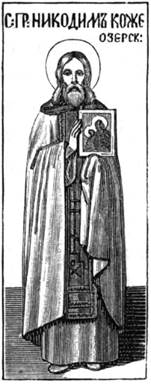
† Преставление преп. Никодима Кожеозерского

† The Repose of our Venerable Father Nicodemus of Kozheozero

E7.TAI draft
Engraving

По ркп. святцам, «пр. Никодим пустынник, чудотворец, преставился в л. 7148 (1640) м. июля 3 д.». В прологе, напечатанном 1662 г., положена память преп. Никодима под 3 июля, хотя и нет жития его. По ркп. житию76, пр. Никодим, в мире Никита, родился в с. Ивановке Ростовского уезда. – Ещё в молодости, находясь в поле вместе с отцом своим, Никита слышал голос: «Никодим, Никодим!» Испуганный зовом, он пересказал о нём родителям; верно быть тебе иноком, сказали они. После их смерти оставшись бедным сиротой, для того, чтобы иметь средства к пропитанию, выучился он кузнечному мастерству в Ярославле и пришёл в Москву. Здесь жил он вместе с другим кузнецом. Злая жена товарища решилась отравить мужа и всыпала яд в пищу. Не зная замысла жены, товарищ позвал Никиту обедать вместе с ним. Муж после обеда умер. Никита остался жив, но остался с жестокой болью в желудке. Раз встретился с ним незнакомец и сказал: «чем ты болен, Никита? Ступай в собор на ров, там дам я тебе лекарство Никита пошёл; незнакомец дал ему пить из сосуда, и он стал здоров. Странный человек скрылся, и конечно это был бл. Василий. В другое время, проходя Кулишки, Никита остановился у кущи юродивого Илии, которого обступила толпа; юродивый, увидя его, кричал: «Хузьюгский пустынник пришёл». – Эти слова сильно поразили Никиту: он принял их за призвание к другому роду жизни. – Продав что имел, пришёл он к архимандриту Чудова мон. Пафнутию и просил принять его в число братии. Научившись грамоте и испытанный послушаниями, принял он здесь монашество с именем Никодима. Прошло 7 лет, как Пафнутий (в 1602 г.) облечён был саном Сарского митрополита и взял с собой Никодима на Крутицы77, но спустя год Никодим, по благословению владыки, отправился в Кожеозерскую обитель. Здесь прожил он полтора года. Потом, желая работать Господу в глубоком безмолвии, в 5 вер. от обители, при речке Хузыоге, поставил себе келийцу и в ней начал подвизаться. Здесь прожил он безвыходно 35 лет, подражая Павлу Фивейскому. Около хижины был у него огород, где сам он возделывал землю; в другое время любил ловить удочкой рыбу, но плодами трудов своих делился с обителью; воду носил себе из реки за версту, совершая дорогой молитву; он только сидя предавался дремоте, ночь же проводил в молитве. Дикие олени так привыкли к кроткому пустыннику, что свободно, без тревоги, ходили около него и кормились. Раз вода в Хузьюге, во время полноводья, так поднялась, что залила всю окрестность, затопила келью пустынника до того, что свободной оставалась только кровля; преподобный, взяв Владимирскую икону Богоматери, которой благословил его преосв. Пафнутий, взошёл на кровлю кельи и здесь стоял на молитве дотоле, пока вода не упала. Страдальческими подвигами в пустыне преподобный достиг высокой степени духовной жизни. В 1635 г. поморяне Иван Пешков и Кирияк Козлов рассказали о себе в обители следующее: в весеннее время вышли они из р. Варгузы в море; поднявшаяся буря понесла их между льдов; положение их было отчаянное; призывая на помощь святых, они помянули старца Никодима. Внезапно явился на корме старец. «Не бойтесь, чада, сказал он, уповайте на Бога и Пречистую Матерь Его». Ладья под управлением чудного кормчего прошла между раздвигавшимися льдинами к берегу, целые две версты. Патр. Иоасаф I, услышав о строгой жизни старца Никодима, прислал ему свою шубу; но он, поцеловав святительский дар, отослал её в обитель; «для моей худости довольно и рубища», сказал он. За 7 дней до его смерти, свят. Алексий и преп. арх. Сергиевой лавры Дионисий предстали и сказали ему о скорой его кончине. Преподобный сильно изнемог от старости; игум. Иона убедил его перейти в обитель. Здесь, причастившись св. Таин, мирно предал он дух свой Богу, 3 июля 1640 г. Мощи его покоятся в храме св. Николая; лик изображён на гробнице, обитой медью. Клобук и епитрахиль его целы.

According to manuscript menologia, “the Venerable Nicodemus the hermit, wonderworker, reposed in the year 7148 (1640) on the 3rd day of July.” In the Prologue printed in 1662, the memory of the Venerable Nicodemus is appointed for July 3, although his Life is not given there. According to a manuscript Life76, the Venerable Nicodemus, in the world Nikita, was born in the village of Ivanovka in Rostov district. – While still a youth, being in the field together with his father, Nikita heard a voice: “Nicodemus, Nicodemus!” Frightened by the call, he told his parents about it; “Surely you are to be a monk,” they said. After their death, left a poor orphan, in order to have means of sustenance, he learned the blacksmith’s trade in Yaroslavl and came to Moscow. Here he lived together with another smith. The evil wife of his comrade decided to poison her husband and put poison into the food. Not knowing of the wife’s design, the comrade invited Nikita to dine with him. The husband died after dinner. Nikita remained alive, but was left with a severe pain in his stomach. Once a stranger met him and said: “What ails you, Nikita? Go to the Cathedral on the Moat; there I will give you medicine.” Nikita went; the stranger gave him a drink from a vessel, and he became well. The strange man disappeared, and surely this was the Blessed Basil. At another time, passing through Kulishki, Nikita stopped at the hut of the Fool-for-Christ Elijah, who was surrounded by a crowd; the Fool, seeing him, cried out: “The hermit of Khuzyuga has come.” – These words deeply struck Nikita: he took them as a calling to another kind of life. – Having sold what he had, he came to Archimandrite Paphnutius of the Chudov Monastery and asked to be received into the brotherhood. Having learned to read and write and having been tested by obediences, he received monastic tonsure here with the name Nicodemus. Seven years passed, when Paphnutius (in 1602) was invested with the rank of Metropolitan of Sarsk and took Nicodemus with him to Krutitsy77; but a year later Nicodemus, with the blessing of the vladyka, set out for the Kozheozero Monastery. Here he lived for a year and a half. Then, desiring to labor for the Lord in deep silence, five versts from the monastery, by the river Khuzyuga, he built himself a little cell and began his ascetic struggles in it. Here he lived without leaving for 35 years, imitating Paul of Thebes. Around his hut he had a garden, where he himself tilled the soil; at other times he loved to catch fish with a hook, but he shared the fruits of his labors with the monastery; he carried water for himself from the river a verst away, performing prayer along the way; he gave himself to sleep only while sitting, but spent the night in prayer. Wild deer became so accustomed to the gentle hermit that they freely, without fear, walked about him and fed. Once the water in the Khuzyuga, during a flood, rose so high that it flooded the entire vicinity, inundating the hermit’s cell to such an extent that only the roof remained free; the Venerable one, taking the Vladimir Icon of the Mother of God, with which His Grace Paphnutius had blessed him, went up onto the roof of the cell and stood there in prayer until the water subsided. Through his suffering ascetic labors in the wilderness, the Venerable one attained a high degree of spiritual life. In 1635, the Pomorians Ivan Peshkov and Kiriak Kozlov related the following about themselves in the monastery: in the springtime they went out from the Varguza River into the sea; a storm that arose carried them among the ice floes; their situation was desperate; calling upon the saints for help, they remembered the elder Nicodemus. Suddenly an elder appeared at the stern. “Fear not, children,” he said, “put your hope in God and His Most Pure Mother.” The boat, under the guidance of the wondrous helmsman, passed between the parting ice floes to the shore, a full two versts. Patriarch Joasaph I, hearing of the strict life of the elder Nicodemus, sent him his own fur coat; but he, having kissed the hierarch’s gift, sent it back to the monastery; “for my wretchedness, a rag is enough,” he said. Seven days before his death, St. Alexis and the Venerable Archimandrite of the Trinity-Sergius Lavra, Dionysius, appeared and told him of his imminent end. The Venerable one was greatly weakened by old age; Abbot Jonah persuaded him to move to the monastery. Here, having partaken of the Holy Mysteries, he peacefully gave up his spirit to God, on July 3, 1640. His relics rest in the church of St. Nicholas; his image is depicted on the tomb, which is covered with copper. His klobuk and epitrachelion are preserved.
E7.0AI draft

Преп. Исаии, отшельника Египетского

The Venerable Isaiah, Hermit of Egypt

E8.TAI draft

В скитской пустыне, на юг от Нитрийской, куда, по сыпучим пескам, можно было добраться только по указанию звёзд, проводил в IV в. отшельническую жизнь авва Исаия, современник преп. Орсисия, ученика преп. Пахомия (пам. 15-го июня). Он оставил после смерти не мало замечательных сочинений; некоторые из них сохранились в известности78. Изречения его помещены между достопамятными изречениями отцов. Между прочим Исаия говорил:

In the Skete desert, to the south of Nitria, where, over shifting sands, one could only make one’s way by the guidance of the stars, Abba Isaiah, a contemporary of the Venerable Orsisius, a disciple of the Venerable Pachomius (commemorated June 15), led a hermit’s life in the 4th century. He left after his death not a few remarkable writings; some of them have been preserved and are known78. His sayings are included among the memorable sayings of the fathers. Among other things, Isaiah said:

E8.0AI draft

«Ничего нет полезнее для нового инока, как поношение: что – дерево поливаемое, то и новый инок, которого поносят и который переносит поношение» ...

“Nothing is more profitable for a new monk than reproach: as a tree is watered, so is a new monk who is reproached and who bears the reproach” ...

E8.1AI draft

Примечания Notes

Память его 18 февраля.

His commemoration is on February 18.

N63AI draft

Жизнь кн. Василия и Константина описал при Грозном царе инок Пахомий; но в описании больше слов, чем мыслей, мало дельных сведений и есть басни. Таков же и канон князьям, сочинение того же Пахомия, в июльской минее. Μ. 1646 г. см. обзор литер., стр. 210.

The life of Princes Basil and Constantine was described under the Terrible Tsar by the monk Pachomius; but in the description there are more words than thoughts, few substantial facts, and there are fables. Such also is the canon to the princes, a composition of the same Pachomius, in the July Menaion. M. 1646. See Survey of Literature, p. 210.

N64AI draft

Продолж. Нестора, стр. 24. Степ. кн. I, 365.

Continuation of Nestor, p. 24. Book of Degrees I, 365.

N65AI draft

Никон. л. 3, 18. 19. Карамз. 4, пр. 37.

Nikon Chronicle 3, 18, 19. Karamzin 4, note 37.

N66AI draft

Собр. л. I, 206. 226. IV, 38. VII, 159. В Воскр. л. сказано, что бл. князь погребён 8 февр. 1249 г.

Collection of Chronicles I, 206, 226. IV, 38. VII, 159. In the Resurrection Chronicle it is said that the blessed prince was buried on February 8, 1249.

N67AI draft

Пахомиево описание жития. О Данииловой борьбе собр. л. 2, 194. Нельзя допустить той мысли, будто Ярославцы имели теперь дело с наглыми бесерменами, как было в Суздале в 1262 г. и в Ростове 1289 г. (Яросл. епарх. ведом. 1860 г. № 27). Нельзя потому, что численники явились зимой 1257 г. переписывать всю землю Русскую (собр. л. I. 203. IV, 38); а сражение на Туговой горе было 3 июля.

Pachomius’ description of the life. On Daniel’s struggle, Collection of Chronicles 2, 194. One cannot admit the idea that the Yaroslavl people were now dealing with insolent Basurmans, as was the case in Suzdal in 1262 and in Rostov in 1289 (Yaroslavl Diocesan Gazette, 1860, No. 27). One cannot because the census-takers appeared in the winter of 1257 to register the entire Russian land (Collection of Chronicles I, 203. IV, 38); but the battle on Tugovaya Mountain was on July 3.

N68AI draft

Глинки свобод. подраж. Иову 14, 1–7.

Glinka, free imitation of Job 14:1–7.

N69AI draft

Ярослав. епарх. ведом. 1860 г. № 14.

Yaroslavl Diocesan Gazette, 1860, No. 14.

N70AI draft

Опис. Сол. монаст., стр. 388–391. Ркп. святцы: «святые праведные Иоанн и Логгин, Яренские чудотворцы в Никольском монастыре, преставишася в л. 7050 (1542) июля 3 д.» О времени кончины и здесь и в словаре свят. 1836 г. показания неверны.

Description of the Solovetsky Monastery, pp. 388–391. Manuscript menologia: “The holy righteous John and Longinus, Yarenga wonderworkers, in the Nikolsky Monastery, reposed in the year 7050 (1542) on the 3rd day of July.” Concerning the time of their end, both here and in the Dictionary of Saints of 1836, the indications are incorrect.

N71AI draft

Грамоты – в опис. Солов. мон., стр. 390. 395. Сказание о чудесах и перенесении мощей и полная служба с двумя канонами – сочинение Соловецкого инока и Ипатского архимандрита Сергия в имп. публ. библ. № 728. Канон праведникам, – сочинение неизвестного, там же № 727.

Charters – in Description of the Solovetsky Monastery, pp. 390, 395. The account of the miracles and translation of the relics, and the complete service with two canons – a composition of the Solovetsky monk and Ipatiev Archimandrite Sergius, in the Imperial Public Library, No. 728. The canon to the righteous ones – a composition of an unknown author, ibid., No. 727.

N72AI draft

Жиие и чудеса блаж. Иоанна в ркп. Царского, № 128. Толстого 2, № 237, в Синод. библ. № 850.

The life and miracles of the Blessed John in the manuscripts of Tsarsky, No. 128; Tolstoy 2, No. 237; in the Synodal Library, No. 850.

N73AI draft

Ркп. житие пр. Иринарха.

Manuscript Life of the Venerable Irinarch.

N74AI draft

В ркп. Царского № 128 тропари и кондаки блаженному Иоанну. Ркп. святцы: «блаженный Иоанн большой колпак преставися в л. 7097 (1589); м. июня 12 д. обретены мощи его в л. 7180 (1672) июня 17 д.» По житию ск. 3 июля.

In the manuscript of Tsarsky, No. 128, troparia and kontakia to the Blessed John. Manuscript menologia: “The Blessed John the Big Cap reposed in the year 7097 (1589); on the 12th day of June his relics were uncovered in the year 7180 (1672) on the 17th day of June.” According to the Life, he died on July 3.

N75AI draft

Ркп. житие преподобного Никодима, сочинение инока Иакова, с 1624 г. жившего в Кожеозерской, обители. Извлечение в ст. Кожеозерский мон. в Московск. вед. 1852 г. № 33. 34. Арханг. ведом. 1848 г. № 37. 38.

Manuscript Life of the Venerable Nicodemus, a composition of the monk James, who lived from 1624 in the Kozheozero Monastery. An extract in the article “Kozheozero Monastery” in Moscow Gazette, 1852, Nos. 33, 34; Arkhangelsk Gazette, 1848, Nos. 37, 38.

N76AI draft

В ркп. житии сказано, что Никодим, принятый Пафнутием в Чудов монастырь, прожил здесь 11 лет. Но Пафнутий был архимандритом Чудова монастыря с 1595 г. и в 1602 г. посвящён в Сарского митрополита. Ист. иер. I, 438. 546. В ист. иер. свои ошибки. – Здесь не сказано, что Пафнутий поступил в Чудов из Павловой Комельской пустыни (см. о преподобном Адриане мая 5 ч.) и что на Крутицах был преемником его Исаия и потом уже с 1636 г. Павел.

In the manuscript Life it is said that Nicodemus, received by Paphnutius into the Chudov Monastery, lived there for 11 years. But Paphnutius was archimandrite of the Chudov Monastery from 1595 and in 1602 was consecrated Metropolitan of Sarsk. History of the Hierarchy I, 438, 546. In the History of the Hierarchy there are its own errors. – It is not stated here that Paphnutius entered the Chudov Monastery from the Paul’s Komel Hermitage (see on the Venerable Adrian, May 5) and that at Krutitsy his successor was Isaiah and then, after 1636, Paul.

N77AI draft

«Воскресное Чтение» 1856–1858 г. передаёт в Русском переводе аввы Исаии к блаженн. Феодоре – изречения святых жён.

«Sunday Reading» 1856–1858 presents in Russian translation Abba Isaiah’s To the Blessed Theodora – sayings of holy women.

N78AI draft