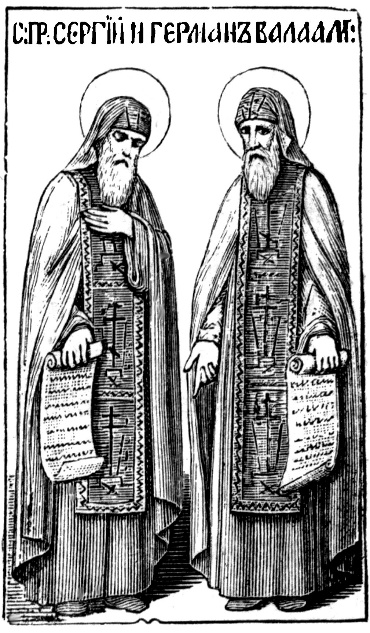
Преп. Сергий и Герман были основателями иноческой жизни на Валаамском острове. – Опустошения северного края Шведами лишили нас точных сведений о начале и начальниках Валаамской обители. По мнению одних, Сергий и Герман жили на Валааме ещё при равноапостольном Владимире; Но это мнение едва ли не столько же справедливо, как и то, которое выдаёт их за современников в. кн. Ольги или Ап. Андрея, потому что выставляемое им дело так же несообразно с обстоятельствами времени св. Владимира, как и со временем св. Ольги. Указывают на то, что по повести о перенесении мощей их, мощи обретены и перенесены при Новгородск. архиепископе Иоанне в 1163 г. Но если и не обращать внимания на то, что святитель Иоанн выставляется здесь архиепископом в 1163 г., эта повесть убеждает «повиноваться помазанному царю и благоверным князьям Русским», убеждает князей не жаловать монастырям крестьян и земель, а вместе с тем называет себя «древле-писанной, ветхой», т. е. она обличает сама себя в подлоге, составленном при Грозном царе288. – На доске древнего списка правил Софийского собора написано: «в лето 6837 (1329) нача жити на острове Валаамском, на озере Ладожском, старец Сергий»289. – В Новгородском свитке, писанном в конце XVI в., читается следующее известие: «6837 (1329) старец Сергий пришёл на Валаам; 6901(1393) «старец Арсений пришёл на остров Коневский» 290. Такое показание о времени первого Валаамского пустынника согласно и с обстоятельствами северного края, известными по летописям. – Известно, что в Карелии чистое, православное христианство распространено было перед самым нашествием Татар (1227 г.)291; а с 1249 г. Шведы, утвердясь в юго-западной Карелии, огнём и мечом принуждали Карелов к папизму – и тем возбудив в них отвращение к христианству, заставили их искать помощи в старых богах; между тем России, ограбленной и угнетаемой Монголами, не было возможности вступиться с силой за православие Карелии292. – Преп. Сергий и Герман, поселясь на Валааме в начале ΧΙV столетия, явились отрадными лучами для угнетённого края и оживили там учением и жизнью св. православие. На Валааме очень помнят короля Магнуса и не могут указать ни на один памятник времён более древних. Это служит новым подтверждением тому, что основание Валаамской обители относилось ко времени этого усердного слуги папы – и основателям пришлось потерпеть много скорбей по милости Магнуса, перекрещивавшего Финнов орешковских мечом в 1349 году. – О духе монашеского жития, насаждённого на Валааме преп. Сергием и Германом, вот что писали Валаамские иноки: «на Валааме исстари, как только стал монастырь, начальники Валаамского монастыря Сергий и Герман установили общину, полотняную одежду и обувь давали каждому... По уложению Валаамских начальников Сергия и Германа выходило в год на платье и обувь 50 руб., а много в иной год 60 рубл.»293. – По этим словам, братство иноков, собранных пр. Сергием и Германом на Валааме, было довольно многолюдное и для него установлено ими общежитие полное... Блаженная кончина Валаамских начальников последовала вероятно около 1353 г.294, а обретение мощей и написание их иконы, бывшее по повести при архиеп. Иоанне, должно быть отнесено ко времени архиеп. Иоанна, управлявшего церковью до 1401 г.295. Память их празднуется 28 июня, а перенесение мощей из Новгорода на Валаам, бывшее после Шведского опустошения, сентября 11. – Ныне мощи их почивают под спудом в нижней церкви соборного монастырского храма, посвящённой памяти самих св. угодников.
The Venerable Sergius and Herman were the founders of monastic life on Valaam Island. – The devastations of the northern region by the Swedes have deprived us of precise information concerning the beginning and the founders of the Valaam monastery. According to some, Sergius and Herman lived on Valaam already in the time of the Equal-to-the-Apostles Vladimir; but this opinion is scarcely more valid than that which makes them contemporaries of Grand Princess Olga or the Apostle Andrew, because the work attributed to them is as inconsistent with the circumstances of the time of St. Vladimir as with the time of St. Olga. They point to the account of the translation of their relics, that the relics were uncovered and translated under Novgorod Archbishop John in 1163. But even if one disregards the fact that St. John is here presented as archbishop in 1163, this account exhorts 'to obey the anointed tsar and the right-believing Russian princes,' exhorts princes not to grant peasants and lands to monasteries, and at the same time calls itself 'ancient-written, old,' i.e., it betrays itself as a forgery composed under Tsar Ivan the Terrible288. – On the board of an ancient copy of the rules of the Cathedral of St. Sophia is written: 'in the year 6837 (1329) the elder Sergius began to live on Valaam Island, on Lake Ladoga'289. – In a Novgorod scroll, written at the end of the 16th century, the following account is read: '6837 (1329) the elder Sergius came to Valaam; 6901 (1393) the elder Arsenius came to Konevets Island'290. Such an indication of the time of the first Valaam hermit agrees also with the circumstances of the northern region known from the chronicles. – It is known that in Karelia pure, Orthodox Christianity was spread just before the Tatar invasion (1227)291; and from 1249, the Swedes, having established themselves in southwestern Karelia, forced the Karelians to papism by fire and sword – and thereby having aroused in them an aversion to Christianity, compelled them to seek help from the old gods; meanwhile Russia, plundered and oppressed by the Mongols, had no possibility to intervene with force for the Orthodoxy of Karelia292. – The Venerable Sergius and Herman, settling on Valaam at the beginning of the 14th century, appeared as comforting rays for the oppressed region and revived there by their teaching and life the holy Orthodox faith. On Valaam they remember King Magnus very well and can point to no monument from more ancient times. This serves as new confirmation that the founding of the Valaam monastery belonged to the time of this zealous servant of the pope – and the founders had to suffer many sorrows by the grace of Magnus, who rebaptized the Finns of Oreshek with the sword in 1349. – Concerning the spirit of monastic life planted on Valaam by the Venerable Sergius and Herman, the Valaam monks wrote the following: 'on Valaam from ancient times, as soon as the monastery was established, the founders of the Valaam monastery, Sergius and Herman, established a cenobitic community, giving linen clothing and footwear to each... According to the rule of the Valaam founders Sergius and Herman, 50 rubles were spent per year on clothing and footwear, and in some years as much as 60 rubles'293. – According to these words, the brotherhood of monks gathered by the Venerable Sergius and Herman on Valaam was quite numerous, and a full cenobitic life was established for them... The blessed end of the Valaam founders probably occurred around 1353294, and the uncovering of their relics and the writing of their icon, which according to the account took place under Archbishop John, must be assigned to the time of Archbishop John, who governed the Church until 1401295. Their memory is celebrated on June 28, and the translation of their relics from Novgorod to Valaam, which took place after the Swedish devastation, on September 11. – Now their relics lie hidden beneath a bushel in the lower church of the monastery's cathedral, dedicated to the memory of the holy saints themselves.