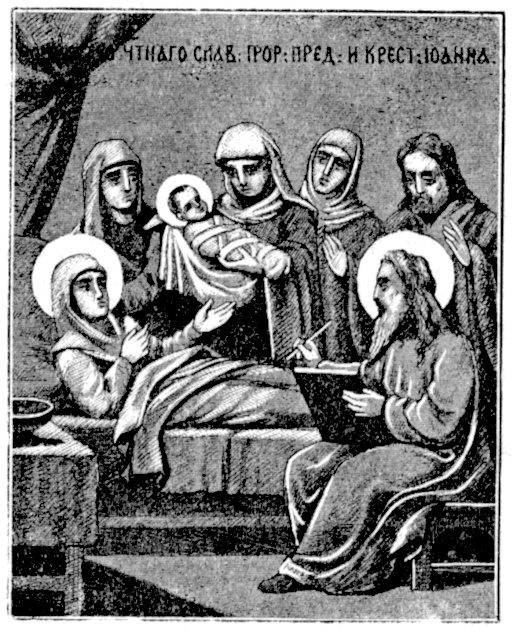
Когда солнце правды, Христос Спаситель наш захотел воссиять миру, то прежде явилась денница – Предтеча Христов. Он родился в Ютте близ Хеврона, от праведной Елисаветы, неплодной, и заматоревшей во днех своих, как древле Исаак от состарившейся Сарры. Чудесное рождество Иоанново было предтечей ещё более чудесному рождеству Христову. Соседи, сродники и знакомые, услыша о рождестве Иоанна, возрадовались, что Господь сотворил с Елисаветой милость, отъя от нея поношение бесчадства. В осьмой день обрезали младенца, назвали его, как предсказал Архангел, Иоанном, – именем приличнейшим тому, который долженствовал приготовить людей к принятию благодати Иисуса Христа: Иоанн – значит благодать. Все удивились этому новому имени в родстве Захарии и Елисаветы. После сего тотчас отверзлись уста, разрешился язык, и Захария стал говорить, благословляя Бога. При столь видимых знамениях всемогущей благодати Божией, на всех окрест живущих напал страх; все, слышавшие о событии рождения Иоанна, помышляли: что будет младенец сей? Захария, по внушению Духа Святого, возвестил о близком исполнении предсказанного пророками избавления людей и о высоком назначении Иоанна быть Предтечей Спасителя. И ты, отроча, между прочим говорил Боговдохновенный старец, наречешися пророк Вышняго: предыдеши бо пред лицем Господним, уготовати пути Его, дати разум спасения людем Его в оставление грех их. Младенец же Иоанн возрастал и укреплялся духом и был в пустынях до дня явления своего Израилю (Лк.1:65–80) для того, говорит Златоуст, чтобы не видеть и не слышать злодеяний человеческих.
When the Sun of Righteousness, Christ our Savior, desired to shine upon the world, the morning star appeared first—the Forerunner of Christ. He was born in Juttah near Hebron, of the righteous Elizabeth, who was barren and advanced in years, as of old Isaac was born of the aged Sarah. The miraculous nativity of John was a forerunner of the even more miraculous nativity of Christ. The neighbors, relatives, and acquaintances, hearing of John's birth, rejoiced that the Lord had shown mercy to Elizabeth, removing from her the reproach of childlessness. On the eighth day they circumcised the infant and named him John, as the Archangel had foretold—a name most fitting for him who was to prepare the people to receive the grace of Jesus Christ: John means grace. All marveled at this new name in the lineage of Zacharias and Elizabeth. After this, immediately his mouth was opened, his tongue was loosed, and Zacharias began to speak, blessing God. At such evident signs of the almighty grace of God, fear fell upon all who lived round about; all who heard of the event of John's birth pondered, saying: "What then will this child be?" Zacharias, by the inspiration of the Holy Spirit, proclaimed the near fulfillment of the deliverance of the people foretold by the prophets, and the high calling of John to be the Forerunner of the Savior. And thou, child, said the God-inspired elder among other things, shalt be called the prophet of the Highest: for thou shalt go before the face of the Lord to prepare His ways; to give knowledge of salvation unto His people for the remission of their sins. And the child John grew and became strong in spirit, and was in the deserts until the day of his showing unto Israel (Lk. 1:65–80), so that, as Chrysostom says, he might neither see nor hear the evil deeds of men.
В воспоминание рождества Предтечи Христова, согласно свидетельству Евангелия, что о рождестве его многие возрадуются, с первых времён христианства установлен праздник. Между сочинениями отцов Церкви IV века сохранились многие поучения на этот праздник, произнесённые ими в разных странах. Таковы поучения св. Амвросия Медиоланского, св. Иоанна Златоустого, Августина и других. В V веке Анатолий Константинопольский, в VII Андрей Критский, в VIII Иоанн Дамаскин, в IX монахиня Кассия и другие написали многие песнопения, коими Церковь ныне прославляет Предтечу в день его рождества.
In remembrance of the nativity of the Forerunner of Christ, according to the testimony of the Gospel that many shall rejoice at his birth, a feast was established from the earliest times of Christianity. Among the writings of the Fathers of the Church of the fourth century, many homilies for this feast have been preserved, delivered by them in various lands. Such are the homilies of St. Ambrose of Milan, St. John Chrysostom, Augustine, and others. In the fifth century, Anatolius of Constantinople; in the seventh, Andrew of Crete; in the eighth, John of Damascus; in the ninth, the nun Cassia and others composed many hymns with which the Church now glorifies the Forerunner on the day of his nativity.
Праздник рождества Иоанна Предтечи отнесён к 24 числу июня соответственно Рождеству Христову, которое Иоанн упредил шестью месяцами, и соответственно смиренному отзыву и великого пророка о себе самом в отношении к Иисусу Христу: Ему подобает расти, мне же малитися (Ин.3:30). «Этот отзыв Предтечи», по словам Амвросия Медиоланского, и «подтверждается самим временем. В праздник Рождества Иисуса Христа день растёт, а в праздник Рождества Иоанна умаляется. В Рождество Иисуса Христа день прибывает, поскольку является Спаситель мира, а в Рождество Иоанна умаляется, поскольку рождается последний пророк: ибо закон и пророцыдо Иоанна (Лк.16:16)». При летнем умалении дней светильник горевший и светивший, св. Предтеча Иоанн, конец Ветхого Завета, начинает умаляться, а при зимнем возрастании дней Христос Господь, Свет истинный, восходит и распространяется.
The feast of the Nativity of John the Forerunner is assigned to the 24th day of June, corresponding to the Nativity of Christ, which John preceded by six months, and corresponding to the humble testimony of the great prophet concerning himself in relation to Jesus Christ: He must increase, but I must decrease (Jn. 3:30). "This testimony of the Forerunner," according to the words of Ambrose of Milan, "is confirmed by the time itself. On the feast of the Nativity of Jesus Christ the day increases, while on the feast of the Nativity of John it decreases. On the Nativity of Jesus Christ the day lengthens, because the Savior of the world appears; on the Nativity of John it shortens, because the last prophet is born: for the law and the prophets were until John (Lk. 16:16)." In the summer shortening of the days, the burning and shining lamp, St. John the Forerunner, the end of the Old Testament, begins to decrease; while in the winter lengthening of the days, Christ the Lord, the true Light, rises and spreads abroad.
День Рождества св. Иоанна Предтечи есть великий христианский праздник, хотя и не дванадесятый. Прославляя чудесное зачатие Предтечи, который исполнился Духа Святого ещё от чрева матери своей, Церковь торжественнее прославляет его рождение, о котором, по словам Евангелия, будет радость и веселие, и мнози возрадуются (Лк.1:14), и которое возвеличило Елисавету и обрадовало соседей и родственников. Блаженный Августин в слове своём на день Рождества Предтечи говорит: «сегодня празднуем мы день рождения св. Иоанна, честь, какая, по нашему мнению, не воздаётся ни одному святому. Во всём христианском мире празднуется и почитается день рождения только Господа и св. Иоанна. Иоанн родился от Девы. У Елисаветы побеждено неплодство, у св. Марии изменён естественный закон рождения. Кто же Иоанн? Для чего он предназначен? Он есть великий Иоанн, о величии которого засвидетельствовал Сам Спаситель наш, сказавши: не воста в рожденных женами болий Иоанна Крестителя (Мф.11:11). Иоанн превосходит всех, и пророков, и патриархов, превосходит всякого, рождённого от жены. Иной, может быть, скажет: если Иоанн болий всех рождённых жёнами, то он болий и Спасителя. Нет, Иоанн есть сын жены, а Спаситель сын Девы. Иоанн родился из недр тленной плоти, а Христос от нетленных кровей Девы. Иоанн послан перед Господом, Который, сделавшись человеком, имел явиться по исполнении определённого времени. В Иоанне обитала такая благодать и величие, что его считали за Христа. Но что сам Иоанн свидетельствует о Христе?От исполнения Его мы вси прияхом и благодать возблагодать (Ин.1:16). А кто мы? – Все пророки, патриархи, Апостолы, все святые, до рождества и по рождестве Христа бывшие, от исполнения Его мы вси прияхом; мы – сосуды, а Христос – источник. Иоанн есть человек, а Христос – Бог. Человеку надлежало умалиться, чтобы Бог возвеличился, как сам Иоанн говорит о Иисусе Христе: Оному подобает расти, мне же малитися (Ин.3:30). Показуя умаление человека, Иоанн родился сегодня, когда дни умаляются. Являя величие Бога, Христос родился в такое время, когда дни возрастают. Великое, святое дело, братия! Мы празднуем день рождества Иоанна, равно как и день рождества Христова, потому, что то, и другое рождество – есть тайна. Одно есть тайна нашего умаления; другое – тайна нашего возвеличения. Мы умалились через человека, чтобы через Бога возрасти. В себе самих мы умалились, чтобы в Боге возвеличиться. Гордость человеческая должна быть умалена, чтобы возросло к человеку Божественное милосердие. Умаление человека и величие Бога примечаются и в страданиях Иоанна и Христа. Показуя умаление человека, Иоанн усечён; являя величие Бога, Христос вознесён на крест. Желательно, возлюбленные братья, чтобы мы для празднования настоящего дня с духовным веселием, расположили сердца свои к творению посильной милости, хранению со всеми мира. Желательно, чтобы мы, из любви к Богу и ревности к доброму поведению, всемерно стремились удалить все шутки и соблазнительные слова не только от себя и своих семейств, но и от всех нам принадлежащих. Желательно, чтобы сей св. праздник не был омрачён мирским пением. Только тогда св. Иоанн исполнит молитвы, если мы праздник его будем проводить в мире, воздержании, чистоте, без забав. Об этом я напоминаю вам, возлюбленные братья, по отеческой заботливости о вас. Я уверен, что вы, при благодатном, содействии Божием, будете сохранять не только себя, но и всех зависящих от вас, в совершенной скромности, чистоте и воздержании. Посему, благодаря Бога, вместе молю Его, чтобы Он дал вам смысл твёрдо желать и приобретать то, что свято, и содействовал вам к утверждению вас в спасительном праздновании».
The day of the Nativity of St. John the Forerunner is a great Christian feast, although not one of the Twelve. Glorifying the miraculous conception of the Forerunner, who was filled with the Holy Spirit even from his mother's womb, the Church more solemnly glorifies his birth, concerning which, according to the words of the Gospel, there shall be joy and gladness, and many shall rejoice (Lk. 1:14), and which magnified Elizabeth and gladdened the neighbors and relatives. Blessed Augustine, in his homily on the day of the Nativity of the Forerunner, says: "Today we celebrate the birthday of St. John—an honor which, in our opinion, is paid to no other saint. Throughout the whole Christian world, only the birthday of the Lord and of St. John is celebrated and honored. John was born of a Virgin. In Elizabeth, barrenness was overcome; in St. Mary, the natural law of birth was changed. Who then is John? For what was he destined? He is the great John, of whose greatness our Savior Himself bore witness, saying: Among them that are born of women there hath not risen a greater than John the Baptist (Mt. 11:11). John surpasses all—both prophets and patriarchs—he surpasses every one born of woman. Someone, perhaps, will say: If John is greater than all born of women, then he is greater than the Savior. No. John is the son of a woman, but the Savior is the Son of a Virgin. John was born from the womb of corruptible flesh, but Christ from the incorruptible blood of the Virgin. John was sent before the Lord, Who, having become man, was to appear at the fulfillment of the appointed time. In John dwelt such grace and greatness that he was thought to be the Christ. But what does John himself testify concerning Christ? Of His fullness have all we received, and grace for grace (Jn. 1:16). And who are 'we'?—All the prophets, patriarchs, Apostles, all the saints who lived before and after the birth of Christ: of His fullness have all we received; we are vessels, but Christ is the fountain. John is man, but Christ is God. Man had to be diminished, that God might be magnified, as John himself says of Jesus Christ: He must increase, but I must decrease (Jn. 3:30). Showing the diminution of man, John was born today, when the days decrease. Manifesting the greatness of God, Christ was born at the time when the days increase. A great and holy matter, brethren! We celebrate the day of John's birth, just as we celebrate the day of Christ's birth, because both births are a mystery. The one is the mystery of our diminution; the other is the mystery of our exaltation. We were diminished through man, that we might increase through God. In ourselves we were diminished, that we might be magnified in God. Human pride must be diminished, that divine mercy toward man may increase. The diminution of man and the greatness of God are also observed in the sufferings of John and of Christ. Showing the diminution of man, John was beheaded; manifesting the greatness of God, Christ was lifted up on the Cross. It is desirable, beloved brethren, that for the celebration of this present day with spiritual joy, we dispose our hearts to the doing of merciful deeds according to our ability, and to the preservation of peace with all. It is desirable that we, out of love for God and zeal for good conduct, strive with all our might to remove all jesting and seductive words not only from ourselves and our families, but also from all who belong to us. It is desirable that this holy feast be not darkened by worldly songs. Only then will St. John fulfill our prayers, if we spend his feast in peace, temperance, purity, and without amusements. Of this I remind you, beloved brethren, out of fatherly concern for you. I am confident that you, with the gracious assistance of God, will preserve not only yourselves, but also all who depend on you, in perfect modesty, purity, and temperance. Therefore, giving thanks to God, I also pray to Him together with you, that He may grant you the understanding to firmly desire and acquire that which is holy, and that He may assist you in confirming you in the saving celebration."
Воины, родные братья, в царствование Максиминово (310–312 г.) за непринесение жертвы богам сосланы в разные места восточного (приморского) Кавказа и скончались: Ерос – 22 июня в Паремволе (в так наз. Лагерях), Орентий – 24 июня в Ризее (близ нын. Батума), Фарнакий – 3 июля в Кордиле (близ Эрзерума), Фирмос и Фирмон – в крепостце Ансаре на реке того же имени 7 июля, Кириак – 14 июля в Загатисе, а Лонгин – 28 июля в море на пути в Лазику (Абхазию) и похоронен в Питиунте.
Soldiers, brothers by birth, in the reign of Maximin (310–312 A.D.), for refusing to offer sacrifice to the gods, they were exiled to various places in the eastern (coastal) Caucasus and met their end: Eros on June 22 in Parembola (in the so-called Camps); Orentius on June 24 in Rhizaeus (near present-day Batum); Pharnacius on July 3 in Cordyle (near Erzerum); Firmus and Firminus on July 7 in the fortress of Ansara on the river of the same name; Cyriacus on July 14 in Zagatis; and Longinus on July 28 in the sea on the way to Lazica (Abkhazia), and was buried in Pityus.
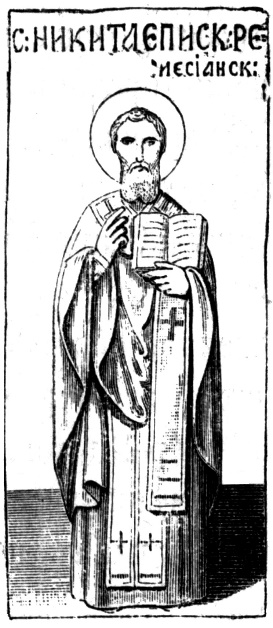
Св. Никита родился в том же городе Ремесиане (Ремешек), в котором родился и друг его Павлин, епископ Польский, и при том в том же 353 г. Так говорит блаж. Павлин233. Св. Никита не был Грек: иначе писал бы сочинения на Греческом языке; не был и Римлянин: иначе назывался бы Виктором, а не Никитой; да и не возбуждал бы Латинскими сочинениями удивление в Римлянах. Он был Славянин, но получил-обширное образование Римское, вероятно в Риме234. Святителем он был в родном своём городе. Ремешек находился между Софией и Нишью; это то же, что нынешний Нирот235.
St. Nicetas was born in the same city of Remesiana (Remeshek), in which his friend Paulinus, Bishop of Nola, was also born, and moreover in the same year 353. So says Blessed Paulinus233. St. Nicetas was not a Greek: otherwise he would have written his works in Greek; nor was he a Roman: otherwise he would have been called Victor, and not Nicetas; nor would he have aroused the admiration of the Romans with his Latin writings. He was a Slav, but he received an extensive Roman education, probably in Rome234. He was a hierarch in his native city. Remeshek was located between Sofia and Niš; it is the same as the present-day Nirot235.
Бесы при Страбоне «занимали большую часть горы Эмоса» – Балкан 237. При Юстиниане Фрак из племени Бесов лицо значительное238, другой Бес-Фрак военачальник Величара в войне с Персами и потом главный начальник войск в Италии239. – Иначе Бесы – Балканское племя Славян240.
The Bessi, according to Strabo, "occupied the greater part of Mount Haemus"—the Balkans237. Under Justinian, a Thracian from the tribe of the Bessi was a person of importance238; another Bessian-Thracian was a commander under Belisarius in the war with the Persians and later commander-in-chief of the forces in Italy239. — Otherwise, the Bessi are a Balkan Slavic tribe240.
Оба Дака – житель левого берега Дуная и другой, со времени Аврелиана живший на правом берегу Дуная242. Дакия собственно страна Славян на левом берегу Дуная, но где поселились колонии Римлян, известных у Нестора и других под именем Волохов243.
Both Dacians—the inhabitant of the left bank of the Danube and the other, who since the time of Aurelian lived on the right bank of the Danube242. Dacia is properly the country of the Slavs on the left bank of the Danube, but where colonies of Romans settled, known to Nestor and others under the name of Vlachs243.
В этом описании племён видим подтверждение той справедливой мысли, что после того, как многие Славянские племена силой оружия Филиппа Македонского вытеснены были из Фракии и Иллирии на северный берег Дуная244, где они известны истории под именем Даков, некоторые племена их оставались ещё во Фракии и Иллирии, особенно в ущельях гор южных245.
In this description of the tribes we see confirmation of that just thought, that after many Slavic tribes were driven by the force of arms of Philip of Macedon from Thrace and Illyria to the northern bank of the Danube244, where they are known to history under the name of Dacians, some of their tribes still remained in Thrace and Illyria, especially in the gorges of the southern mountains245.
Св. Никите, по воле Божией, пришлось быть Апостолом этих Славянских племён юга и путешествовать из страны в страну, чтобы с Апостольской ревностью проповедовать Евангельское учение246. Для Гетов проповедь не требовала даже долгого пути. «Геты бегут» сами, говорит Павлин. – Блаж. Иероним писал: «рыжее и белокурое войско Гетов носит с собой в палатках церкви»247.
St. Nicetas, by the will of God, was destined to be an Apostle of these Slavic tribes of the south and to travel from country to country, that with Apostolic zeal he might preach the Gospel teaching246. For the Getae, the preaching did not even require a long journey. "The Getae run" themselves, says Paulinus. – Blessed Jerome wrote: "the red-haired and fair-haired army of the Getae carries churches with them in their tents"247.
Во время св. Никиты христианство уже сильно распространено было во Фракии: на Средечском соборе 347 г. присутствовали епископы: Средца, Скун, Липляны, Нища, Водины (Aquae) и Чехова дома (Sigindum)248. – При Максимиане в Потаме замучены были Боголеп (Феопрений) и Зотик с Акиндином249. Но не только многие сёла Славянские, целые племена Славян как по дикости, так и по недоверчивости к Грекам, неохотно слушали проповедь Греков, которая при том большинству их была вовсе и непонятна. Св. Никита, первый епископ Ремешка, посвятил свою жизнь на проповедание веры своим родичам – Славянам. И успехи проповеди его были блистательные.
During the time of St. Nicetas, Christianity was already widely spread in Thrace: at the Council of Serdica in 347, bishops were present from Serdica, Scona, Lipljan, Niš, Voden (Aquae), and Sigindum (Čehov dom)248. – Under Maximian, in Potam, Theoprepius (Bogolep) and Zoticus with Acindynus were martyred249. But not only many Slavic villages, but entire Slavic tribes, both because of their wildness and because of their distrust of the Greeks, listened unwillingly to the preaching of the Greeks, which moreover was completely unintelligible to most of them. St. Nicetas, the first bishop of Remesiana, devoted his life to preaching the faith to his kinsmen – the Slavs. And the successes of his preaching were brilliant.
О перемене, произведённой св. Никитой между Бесами, тот же современник его блаж. Иероним говорил: «зверские Бесы и толпы тулупников (pellitorum), которые некогда приносили в жертву людей, изменили свой скрежет на сладкую песнь Христу»250. Блаж. Павлин поёт ещё о св. Никите:
Concerning the change wrought by St. Nicetas among the Bessi, that same contemporary of his, Blessed Jerome, said: "the savage Bessi and the crowds of sheepskin-clad men (pellitorum), who once offered human sacrifices, have changed their gnashing into a sweet song to Christ"250. Blessed Paulinus also sings of St. Nicetas:
Так деятельность св. Никиты, проповедника Славянского обращена была преимущественно на Славян Балканских. Это и естественно по близости их к месту кафедры его. Павлин восхищался тем, что неукротимые Бесы, усмирённые проповедью св. Никиты, стали мирны в отношении к империи; по отзывам же истории, один из питомцев св. Никиты уже сидел на престоле восточной империи; это Лев Великий, родом Фрак и точнее Бес254; а когда имп. Анастасий начал насилиями проповедовать евтихианство в империи, воспитанные в чистой вере св. Никитой жители Фракии, Мизии и малой Скифии явились (в 514 г.) самыми жаркими защитниками православия и защищали его с оружием в руках255.
Thus the activity of St. Nicetas, the Slavic preacher, was turned chiefly upon the Slavs of the Balkans. This is natural because of their proximity to the place of his see. Paulinus was delighted that the untamable Bessi, pacified by the preaching of St. Nicetas, became peaceful towards the empire; according to the testimonies of history, one of the nurslings of St. Nicetas already sat on the throne of the Eastern Empire; this was Leo the Great, a Thracian by birth and more precisely a Bessus254; and when the Emperor Anastasius began to preach Eutychianism by violence in the empire, the inhabitants of Thrace, Moesia and Scythia Minor, brought up in the pure faith by St. Nicetas, appeared (in 514) as the most ardent defenders of Orthodoxy and defended it with arms in hand255.
Св. Никита в 392 г. по поручению собора отправлялся увещевать соседнего епископа Боноза, запутавшегося в ошибки о вере256. – В 397 г. путешествовал он в Рим и в Ноле виделся с другом своим епископом Павлином. Павлину очень хотелось, чтобы святитель пробыл у него подольше; но дела паствы отозвали святителя к его пастве. Спустя четыре года (в 402 г.), св. Никита явился в Нолу к празднику св. Феликса (февр. 14), не взирая на опасность времени. Друг его Павлин был в восторге от этого неожиданного посещения. Он написал поэму о св. Феликсе, где изображает радость свою и о посещении его святителем257.
St. Nicetas in 392, by commission of a council, went to admonish the neighboring bishop Bonosus, who had become entangled in errors concerning the faith256. – In 397 he traveled to Rome and at Nola met with his friend Bishop Paulinus. Paulinus greatly desired that the Hierarch should remain with him longer; but the affairs of his flock called the Hierarch back to his flock. Four years later (in 402), St. Nicetas appeared at Nola for the feast of St. Felix (February 14), notwithstanding the danger of the time. His friend Paulinus was overjoyed at this unexpected visit. He wrote a poem on St. Felix, in which he depicts his joy and the visit of the Hierarch to him257.
Как долго после того подвизался св. Никита, точных известий о том нет. Но так как блаж. Павлин, ровесник св. Никиты, скончался в 431 г. на 87 г. своей жизни, то вероятно, и кончина св. Никиты последовала не прежде 420 г. июня 22 д.258.
How long St. Nicetas labored after that, there is no precise information. But since Blessed Paulinus, a contemporary of St. Nicetas, reposed in 431 in the 87th year of his life, it is probable that the repose of St. Nicetas followed not before the year 420, on June 22258.
Геннадий Массилийский писал: «Никита, епископ Ремессианы, сочинил слогом простым и чистым, приспособленным к оглашаемым в вере, шесть книг. Первая о готовящихся к вере; вторая о заблуждениях язычества; третья о вере в Высочайшее Существо; четвёртая против родословия; пятая о символе; шестая о жертве Пасхального агнца. Кроме того издал он книгу о падшей деве, возбуждающую каждого падшего к исправлению»259. – Кассиодор весьма хвалит сочинения св. Никиты за благочестивый дух их и за основательное знание260. Сочинения св. Никиты известны и ныне261.
Gennadius of Massilia wrote: "Nicetas, bishop of Remesiana, composed in a simple and pure style, adapted to those being catechized in the faith, six books. The first, concerning those preparing for the faith; the second, concerning the errors of paganism; the third, concerning faith in the Supreme Being; the fourth, against genealogy; the fifth, concerning the symbol; the sixth, concerning the sacrifice of the Paschal Lamb. Besides this he published a book concerning a fallen virgin, urging every fallen one to correction"259. – Cassiodorus highly praises the writings of St. Nicetas for their pious spirit and for their solid learning260. The writings of St. Nicetas are known even now261.
В 40 верстах от Новгорода, на берегу реки Менюги или Мьи, до 1764 г. существовал Троицкий Менюжский монастырь. От него остался Троицкий храм с мощами св. Иакова и Иоанна и с приделом в их имя. Святые родные братья, скончавшиеся в юном возрасте. На образе Новгородских чудотворцев Иаков и Иоанн изображены в отроческом виде. В ркп. святцах праведные братья названы мучениками; по обстоятельствам времени и места это означает, что они умерщвлены были злодеями; днём кончины их показано 24 число июня262.
Forty versts from Novgorod, on the bank of the Menyuga or Mya River, until 1764 there existed the Trinity Menyuzhsky Monastery. From it remains the Trinity Church with the relics of Sts. James and John and with a side-chapel in their name. The saints were blood brothers, who reposed at a youthful age. On the icon of the Novgorod Wonderworkers, James and John are depicted in youthful form. In manuscript menologia the righteous brothers are called martyrs; by the circumstances of time and place this signifies that they were put to death by evildoers; the day of their repose is given as June 24262.
Павлин в Письме к Северу, писанном в 202 г.: «в таком виде рекомендовал я тебя уважаемому и учённейшему епископу Никите, который пришёл из Дакии и по справедливости составляет предмет удивления для Римлян». Ер. 29.
Paulinus in a Letter to Severus, written in 202: "in such a manner I recommended you to the respected and most learned bishop Nicetas, who came from Dacia and rightly constitutes an object of wonder for the Romans." Ep. 29.
См. пр. 39. Гиерокл, признаваемый за современника имп. Юстиниана, пишет: «в области Дакии средиземной, находящейся под правлением консула, пять городов: Сардика (Сердика, Сердец) – главный город, Пайталия, Германа, Наис (Ниш), Ремесиана... В области Дардании, находящейся в управлении воеводы, 3 города: Скупы=главный город, Мирион, Улпиана». Тоже у Константина De themat. 3, 393. 56. 297. 298. 434. 435. Улпияна – у Славян Липляна (у Кедрина и у Анны Комниной Липенион).
See note 39. Hierocles, considered a contemporary of the Emperor Justinian, writes: "in the province of Dacia Mediterranea, under the rule of a consul, five cities: Sardica (Serdica, Serets) – the chief city, Pautalia, Germana, Naissus (Niš), Remesiana... In the province of Dardania, under the administration of a voivode, 3 cities: Scupi=chief city, Myrion, Ulpiana." Likewise in Constantine De themat. 3, 393. 56. 297. 298. 434. 435. Ulpiana – in Slavic Lipljan (in Cedrenus and Anna Comnena Lipenion).
Временник M. общ. ист. X, 19. 20. 74. 105. Города Бесов – Пловдин (Филиппополь), Самаков (Uscudama); по округу Драговичи митрополит Пловдинский назывался экзархом Фракии – Драговитии. Κωνσταντινου εγχειρ. περι επαρχ. Φιλιππουπολεως. Βιεννη. 1819. Шафарик знал по Птоломею Бесов, Славянскую ветвь, в восточной Галиции, под Карпатами (древн. § 10, ч. 10), но опустил вовсе из виду Балканских Бесов, которых часть ушла под Карпаты.
Vremennik M. obshch. ist. X, 19. 20. 74. 105. Cities of the Bessi – Plovdiv (Philippopolis), Samokov (Uscudama); by district Dragovitsa the metropolitan of Plovdiv was called Exarch of Thrace – Dragovitia. Κωνσταντινου εγχειρ. περι επαρχ. Φιλιππουπολεως. Βιεννη. 1819. Šafárik knew from Ptolemy the Bessi, a Slavic branch, in eastern Galicia, under the Carpathians (drevn. § 10, ch. 10), but completely overlooked the Balkan Bessi, a part of whom withdrew under the Carpathians.
Об этом говорено 20 января. Мальчик Гет, с Славянской надписью, приносящий в жертву гуся – у Классена в памяти. II, 12. М. 1854.
Concerning this, mention was made on January 20. A boy Getian, with a Slavic inscription, offering a goose in sacrifice – in Klassen's Pamiat. II, 12. M. 1854.
Славянский перевод Зонары: «Троян воинствова на Даки, сиречь на Срьбле, начальник же их србскыи Диковал.» Чтен. общест. ист. 1847 г., стр. 57. Временник X, 40–49. 79–81. Славянская надпись о спасении некоторых Славян от Трояна – у Классена, в материал. II, 37. 38. Феодорит говорит о Сардике: «этот Иллирийский город – главный город народа Даков» (Ц. ист. 2, 4). – Нельзя не пожалеть, что даровитый Шафарик, ошибочно приняв Волхвов за Кельтов, скоро исчезнувших в истории, потерял из виду историческую нить событий, происходивших в Славянском мире со времени Александра Македонского, при императорах Римских и до самого имп. Ираклия.
Slavic translation of Zonaras: "Trajan warred against the Dacians, that is, against the Serbs, and their Serbian leader was Dikoval." Chten. obshchest. ist. 1847, p. 57. Vremennik X, 40–49. 79–81. A Slavic inscription concerning the salvation of some Slavs from Trajan – in Klassen, Material. II, 37. 38. Theodoret says of Sardica: "this Illyrian city is the chief city of the Dacian people" (Eccl. Hist. 2, 4). – One cannot but regret that the gifted Šafárik, having mistakenly taken the Volkhvs for Celts, who soon disappeared from history, lost sight of the historical thread of events that took place in the Slavic world from the time of Alexander of Macedon, under the Roman emperors, and up to the Emperor Heraclius himself.
Геты, Бесы, Славяно-Влахи, Скифы, как особые племена Славянские, объясняют собой известие о Славяниях, покорённых в 657 г., чего не могли понять Шафарик и другие (Христ. чтен. 1858 г.11:142). По известию Феофана (р. 288) и Кедрина (1, 4357, в 657 г. «император (Констанс 2) предпринял поход против Славиний (κατα Σκλαβινιας, κατα Σκλαβινων) и взяв в плен многих, покорил. Одной малой Скифии нельзя здесь разуметь; дело идёт о Славяниях, о нескольких областях и княжествах Славянских. Даже в Македонии было несколько жуп Славянских. В 758 году Копроним ворвался «В Славянии, лежащие в Македонии» τας κατα Μακεδονίαν Σκλαβινιας. Stifferi 11. 79. Шафарик то говорит, что в Македонии занята область Славянами, поселившимися за Дунаем в первых столетиях (III, 398); то пишет (III, 259), что поселение Славян в Мизии, Дардании и Македонии относится к концу V столетия. Эта колеблемость – улика в том, что почтенный учёный потерял верную дорогу. – О войне Славян во Фракии и Паннонии с Готами в 334 г. и с Греками в 358 г. см. Классена материалы 2, 34. 34. М. 1854 г.
The Getae, Bessi, Slavo-Vlachs, Scythians, as distinct Slavic tribes, explain for us the account of the Sclaviniae subdued in 657, which Šafárik and others could not understand (Khrist. chten. 1858 g.11:142). According to the account of Theophanes (p. 288) and Cedrenus (1, 4357), in 657 "the emperor (Constans II) undertook a campaign against the Sclaviniae (κατα Σκλαβινιας, κατα Σκλαβινων) and taking many captive, subdued them. One cannot understand here only Scythia Minor; the matter concerns the Sclaviniae, several Slavic regions and principalities. Even in Macedonia there were several Slavic župas. In 758 Copronymus invaded "the Sclaviniae lying in Macedonia" τας κατα Μακεδονίαν Σκλαβινιας. Stifferi 11. 79. Šafárik sometimes says that in Macedonia a region was occupied by Slavs who settled beyond the Danube in the first centuries (III, 398); sometimes he writes (III, 259) that the settlement of Slavs in Moesia, Dardania and Macedonia belongs to the end of the fifth century. This vacillation is evidence that the esteemed scholar lost the true path. – Concerning the war of the Slavs in Thrace and Pannonia with the Goths in 334 and with the Greeks in 358, see Klassen's Materialy 2, 34. 34. M. 1854.
О путешествиях Павлин: «Ты проходишь по полям Филиппов Македонии, Шествуешь чрез город Томы, И близкие к очизне Скупы, Дарданский гость».
Concerning the travels, Paulinus: "Thou passest through the fields of Philip's Macedonia, Thou goest through the city of Tomi, And Scupi near to the fatherland, A Dardanian guest."
Память их августа 22 д. Менолог Василия: «когда, прибыл (префект) в город Патаму, то умертвил Зенона, Феопрепия (Боголепа) и Акиндина». Синаксарь минеи: «прибыв в местечко называемое Патама умертвил катапультой св. Зотика, Феопрепия (Боголепа) и Акиндина». – О Боголепе – в Изв. Археол. Общ. IV, 521. 523.
Their commemoration is August 22. Menologion of Basil: "when (the prefect) arrived in the city of Patama, he put to death Zeno, Theoprepius (Bogolep) and Acindynus." Synaxarion of the Menaion: "arriving at a place called Patama, he put to death by catapult St. Zoticus, Theoprepius (Bogolep) and Acindynus." – Concerning Bogolep – in Izv. Arkheol. Obshch. IV, 521. 523.
Блаж. Иероним, сказав о Гетах, что у них походные храмы, прибавляет: «потому-то конечно, что у них одинаковая (с нами) вера, они мало воюют с нами».
Blessed Jerome, having said of the Getae that they have portable churches, adds: "for this reason, of course, because they have the same faith (as we), they war little with us."
Павлин: «Искусных копателей золота превращаешь В золото и сам подражаешь Бесам. Из них словом проникающим живоеˆдобываешь золото», v. 269–272.
Paulinus: "Skilled diggers of gold thou dost transform Into gold and thyself dost imitate the Bessi. From them with a penetrating word thou dost obtain living gold," v. 269–272.
Poema ѵ. 209–225. Под руководством св. Саввы Палестинского (484–532) спасались иноки из Бесов. Cyrilli Scytho р. vita Sabbae in Cotelerii monum. Graec. Eccl. 3, 265.
Poem vv. 209–225. Under the guidance of St. Sabbas of Palestine (484–532), monks from among the Bessi were saved. Cyril of Scythopolis, vita Sabbae, in Cotelerii Monum. Graec. Eccl. 3, 265.
Менолог Василия под 6 ноября: «в последнее время импер. Льва В Великого, называемого Беса (επιλεγόμενου Βεσσου), небо покрылось облаками и пр. Лев был императором 457–473 г.
Menologion of Basil under November 6: "In the latter time of the reign of the Emperor Leo the Great, called Bessus (επιλεγόμενου Βεσσου), the heaven was covered with clouds," etc. Leo was emperor from 457–473.
Иэд. 10 Patrologiae t. LII. Здесь же помещены сомнения о подлинности сих, но вовсе напрасные. Особенно странны объяснения слов Павлина о св. Никите; автор, не зная истории Славян, перетолковывает слова Павлина наперекор значению их. Да и никто из Славянских писателей доселе не обращал внимания на Апостольскую деятельность св. Никиты между Славянами, описанную Павлином.
Ed. 10 of Patrologiae t. LII. Here are also placed doubts concerning the authenticity of these [writings], but they are entirely groundless. Especially strange are the explanations of Paulinus's words concerning St. Nicetas; the author, not knowing the history of the Slavs, misinterprets Paulinus's words contrary to their meaning. And indeed, none of the Slavic writers until now has paid attention to the Apostolic activity of St. Nicetas among the Slavs, as described by Paulinus.
Сведен. о монаст. 401. Ист. Иер. V, 65. Ркп. святцы: «святые и праведные братия по плоти, младенцы и мученицы Иоанн и Иаков, быша Менюге р. в л. 6000 июня в 24 д.» Так в старшем списке. В Отенском списке: «светии отроки и мученики братия по плоти Иоанн и Иаков в Троицком Менюжском монастыре, по Псковской дороге от Новаграда 30 поприщ, беша в л. 7000; мощи под спудом; службы нет, тропарь и кондак есть, память июня в 24 д.»
Information on Monasteries 401. Hist. Hier. V, 65. Manuscript menologia: "The holy and righteous brothers according to the flesh, infants and martyrs John and James, were on the River Meniuga in the year 6000, June 24." So in the oldest copy. In the Oten copy: "The holy youths and martyrs, brothers according to the flesh, John and James, in the Trinity Meniuzh Monastery, on the Pskov road from Novgorod, 30 versts, were in the year 7000; relics under a bushel; there is no service, but a troparion and kontakion exist; commemoration June 24."